All about dinosaurs, fossils and prehistoric animals by Everything Dinosaur team members.

Fossil finds, new dinosaur discoveries, news and views from the world of palaeontology and other Earth sciences.

10 02, 2014

Walking with Dinosaurs – Chicken Run

By |2023-03-09T16:52:51+00:00February 10th, 2014|Categories: Dinosaur and Prehistoric Animal News Stories|0 Comments

Scientists Attach Prosthetic Dinosaur Tails to Chickens

Why did the chicken with the prosthetic tail cross the road?  So that scientists can simulate the walking motion of Theropod dinosaurs in a bid to learn more about the way in which dinosaurs moved around.  That’s the rather bizarre summation from a study into non-avian, bipedal dinosaur posture and locomotion carried out by researchers at the University of Chile, working in collaboration with colleagues from the University of Chicago.

Ancestral Traits

Aves (birds) still share a number of ancestral traits of the Dinosauria and as such they can be utilised as experimental subjects to assess certain aspects of dinosaur anatomy and even inferred behaviour.  In this particular study, chickens were fitted with prosthetic tails as they grew so that scientists could assess how Theropod dinosaurs walked in comparison with their very much shorter-tailed descendants.  As birds evolved during the Mesozoic, so a number of forms gradually lost their long, reptilian tails, a tail is prominent in the fossils of Archaeopteryx (A. lithographica).  Indeed, one of the ways to tell birds apart from Maniraptoran dinosaurs in the fossil record is to count the number of likely caudal vertebrae (tail bones).

Prosthetic Dinosaur Tails

As a simple rule of thumb, if more than twenty-five tail bones are associated with the skeletal material, then chances are, you are looking at the fossilised remains of a dinosaur.  Less than twenty-five tail bones and the identification starts to lean more towards the Aves (birds).  Birds lost most of their tail as they evolved into more and more efficient fliers.  The long tail of Archaeopteryx would have made it quite a clumsy aeronaut.  Later birds, more competent fliers than Archaeopteryx for example, lost most of their tail.

Modern birds have a pygostyle, a vestigial tail that is composed of their last five caudal vertebrae fused into a plate of bone, the evolution of birds shows trends towards a lightening of the skeleton such as the loss of teeth and the gradual reduction in tail length.

The Locomotion of Theropod Dinosaurs

This then gives scientists a bit of puzzle when it comes to using birds to mimic the locomotion of theropod dinosaurs, birds don’t have a long tail and the addition of a tail alters the centre of gravity in relation to the rest of the body mass and effects the way a creature can move about.  The solution is simple, add artificial tails to your subject chickens as they grow.  With the tail the birds have to modify their gait and motion and therefore scientists can learn more about the movements of those long-tailed dinosaurs.

Extant birds today, maintain a crouched hind-limb posture and their locomotion is powered by knee flexion.  In non-avian Theropods, by contrast, scientists speculate that these dinosaurs had a more upright posture and limb movement powered by femur (thigh bone) retraction.  To test this theory, young chicks had a series of artificial tails attached to them from two days of age.  As the hatchlings grew, so bigger tails were fitted to mimic the growth of the tail in a young dinosaur.

Calculating Tail Weight

The scientists worked around a tail weight roughly equivalent to 15% of the bird’s total body mass, roughly the proportional weight of a theropod dinosaur’s tail when compared to the weight of the entire dinosaur’s body.  Velcro straps were used to keep the wooden, prosthetic tails in place and the scientists noted that by manipulating the location of the centre of mass within the chickens, the birds began to alter their locomotion and posture to accommodate the tail.

The Addition of a Tail Alters the Way In Which Chickens Walk

Watch the birdie!

Watch the birdie!

Picture credit: PLoS One

Artificial Dinosaur Tails

Artificial tails provide clues to non-avian dinosaur locomotion.  In the diagram (A), above, those birds used as controls have their hind-limbs shaded grey, those chickens with a counter weight added anteriorly (hind-limbs shaded yellow) and those chickens with tails (orange hind-limbs).  Estimations of the centre of mass of the tail rig (tCOM), as well as of a control (cCOM) and of an experimental individual (eCOM), are shown.   With the tail added, the centre of mass is moved towards the rear of the bird.  (B) Diagram showing the segmental angles (f, femur; tt, tibio-tarsus; tm, tarso-metatarsus) and joint angles (k, knee; a, ankle) used in this study.

It was noted that the chickens began to recreate the limb posture and kinetic movements inferred for bipedal dinosaurs.  The more rearward located centre of gravity indicated a more vertical orientation of the thigh during standing and increased femoral displacement during walking.

Commenting on the research, lead author of this rather unusual study, Bruno Gossi (Institute of Ecology and Biodiversity, University of Chile) wrote:

“We attached more realistic artificial tails to chickens shortly after hatching and allowing proper exercise, we expected adult chickens with added tails to show a more vertical femur in standing position and increased femoral excursion during locomotion.”

Changing the Centre of Body Mass

The research team states that this study supports the hypothesis that gradual changes in the position of the centre of body mass (posterior located with tail, to anterior located without a tail), resulted in a more crouched hind-limb posture and a shift form hip-driven limb movements to the knee-driven limb movement seen in extant birds.

Having mastered  the technique of adding artificial tails to chickens thanks to Velcro, the scientists are confident that this type of research can be used to gain further, significant insights into previously unexplored aspects of bipedal theropod locomotion.

Last spring (April 2013), Everything Dinosaur reported on some research into the posture of birds carried out by scientists including a team from the Royal Veterinary College which looked at the relationship between the Aves and the Dinosauria in terms of derived posture.  So in answer to the question how did dinosaurs walk? Get yourself a chicken.

To read more about this article: Birds Have the Dinosaurs to Thank for Their Crouching Gait.

Out thanks to Constantine, for reminding us to post something up about this research.

For replicas of theropod dinosaurs and other prehistoric animals: CollectA Deluxe Prehistoric World Models.
9 02, 2014

Dimetrodon with “Steak-knife” Teeth According to New Research

By |2024-05-02T08:02:03+01:00February 9th, 2014|Categories: Dinosaur and Prehistoric Animal News Stories|0 Comments

Serrated Teeth – The Secret of Dimetrodon’s Success

Long before the first dinosaurs evolved, one of the top terrestrial predators on the planet was Dimetrodon, the famous sail-backed reptile, a pelycosaur and now a new study by University of Toronto scientists suggests how this large carnivore was able to achieve apex predator status.

Dimetrodon

Graduate student Kirstin Brink, in collaboration with Professor Robert Reisz (University of Toronto), have studied the dentition (teeth) of a number of Dimetrodon species and they have discovered that these kinds of mammal-like-reptile were the first land living vertebrates to evolve ziphodont (serrated) teeth.  The pointed, recurved and serrated teeth allowed Dimetrodon to tackle prey animals much larger than itself.  The strong, reinforced skull and these knife-like teeth gave these reptiles a formidable bite, one that was capable of ripping and tearing flesh from their victim’s bodies.

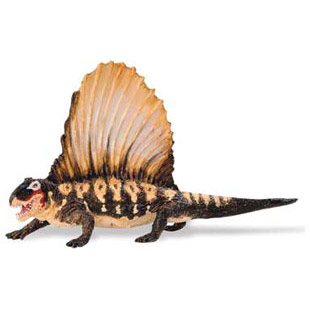
An Illustration of Dimetrodon

Sail-back reptile with ferocious teeth.

Sail-back reptile with ferocious teeth.

Picture credit: Safari Ltd/Everything Dinosaur

To view models and replicas of Palaeozoic animals: Wild Safari Dinos and Prehistoric World Models.
Sail-backed Reptile

Dimetrodon is one of the easiest to recognise of all the prehistoric animals, thanks to its huge “sail” that rose up out of this animal’s back.  This is a feature found in a number of pelycosaurs, although palaeontologists remain uncertain as to its exact role and function.   Models of this Permian predator are often found in “dinosaur model sets” although the Dimetrodon genus was extinct millions of years before the first dinosaurs evolved.  A synapsid reptile, Dimetrodon is actually more closely related to mammals than it is to the Dinosauria.

To read an article that attempts to explain why Dimetrodon is often regarded as a dinosaur: Dimetrodon – Often Mistaken for a Dinosaur.

Ziphodont Teeth

Although, most meat-eating theropod dinosaurs had ziphodont (serrated) teeth, this new study suggests that Dimetrodon spp. evolved dentition that was serrated over thirty-five million years before the first dinosaurs.  The scientists used scanning electron microscopy to examine minute structures in the teeth of a Dimetrodon species, analysing specimens from the collection of the Royal Ontario Museum.

Several different species of Dimetrodon were included in the tooth study, the fossils spanning some twenty-five million years of the Permian geological period.

Dimetrodon Species

The scientists conclude that Dimetrodon spp. had a diversity of previously unknown tooth morphology including cusps (raised points on the crowns of the teeth), the dominant morphology of teeth in modern Mammalia. Intriguingly, the researchers suggest that as Dimetrodon spp. evolved into the likes of the giant Dimetrodon grandis, so serrated teeth evolved too.

Ziphodont tooth structures are absent in earlier species of the Dimetrodon genus.  As the skull morphology remains relatively consistent across all the Dimetrodon species studied, it is the shape of the teeth that change, this indicates a gradual change in feeding habits.

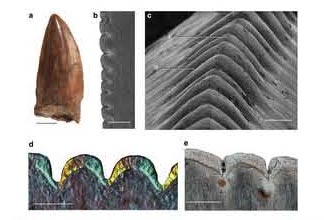
The Teeth of D. grandis Show “Tell-Tale” Serrations

Study maps evolution of serrated teeth in Dimetrodon species.

Study maps evolution of serrated teeth in Dimetrodon species.

Picture credit: University of Toronto

The picture shows a Dimetrodon grandis tooth specimen from the Royal Ontario Museum (Canada) (a), along with various scanning electron microscope images showing the serrations (b-e).

Professor Reisz explained:

“This research is an important step in reconstructing the structure of ancient, complex communities.  Teeth tell us a lot more about the ecology of animals than just looking at the skeleton.”

A spokesperson from Everything Dinosaur commented:

“It is very likely that Dimetrodon species such as D. grandis were highly mobile, apex predators, this new study provides further insights into how these large reptiles came to dominate terrestrial environments of the Late Permian.”

Research into Dentition

The research into the dentition of Dimetrodon and the way in which the teeth evolved but the skull shape and structure remained relatively unchanged suggests a change in feeding style and trophic interactions.  The term trophic, when used in biology, refers to feeding styles and nutrition.  The researchers conclude that ziphodont teeth evolved in the larger species of Dimetrodon independently from the ziphodont teeth that has been recorded from later therapsids.

The likes of Dimetrodon grandis would certainly have been one animal best avoided during the Permian, Professor Reisz stated:

“The steak-knife configuration of these teeth and the architecture of the skull suggest Dimetrodon was able to grab and rip and dismember large prey.  Teeth fossils have attracted a lot of attention in dinosaurs but much less is known about the animals that lived during this first chapter in terrestrial evolution.”

8 02, 2014

Oldest Footprints Outside of Africa Discovered (New Research is Published)

By |2024-05-02T08:04:55+01:00February 8th, 2014|Categories: Dinosaur and Prehistoric Animal News Stories, Palaeontological articles|0 Comments

The “Happisburgh Family” – Potentially Homo antecessor

It’s a common enough pastime, taking a stroll with the family.  It seems that any family taking a walk along the beaches of Norfolk (East Anglia, England), in the spring (presuming we ever get a spring after all the stormy weather), might just be mirroring events that took place between 800,000 and perhaps as long ago as one million years BC.  Scientists have discovered ancient, hominin footprints at Happisburgh on the Norfolk coast.

Oldest Footprints

The footprints left in the Pleistocene mud and preserved thanks to rapid burial, represent as many as five individuals, these might have been made by a family group exploring the banks of an estuary for food.  This discovery is hugely significant for palaeoanthropologists, as these are the oldest footprints found to date outside Africa.

Stone tools have been found in the UK and elsewhere in Europe which have been tentatively dated to around these dates but this is the first trace fossil evidence of hominins being present during the latter stages of the Late Calabrian, (Early to Middle Pleistocene) in what was later to become the British Isles.

Exploring the Preserved Silt Layer

Site of ancient footprints.

Site of ancient footprints.

Picture credit: PLoS One

Sometimes scientific discoveries are made after a great deal of research and painstaking effort, but in this instance it was sheer luck that the impressions were spotted and identified.  Rapid coastal erosion of the surrounding cliffs has exposed large portions of the underlying estuarine muds and silts that form part of a formation known as the Hill House Formation.  These sediments were laid down by large, slow-moving rivers during the Early to Middle Pleistocene.  These exposures have been explored as they reveal important information about the fauna and flora during what was a relatively warm, interglacial period for this part of Europe.

A Pleistocene Ecosystem

In early May 2013, a layer of compacted silt was exposed by tidal action.  A cursory examination of this layer, by one of the researchers studying the Pleistocene ecosystem, revealed a series of hollows and other impressions that resembled human footprints that had been preserved in Holocene-aged horizons.  The area, approximately twelve metres square, was then extensively mapped and photographed.  The surface of the exposure was assessed using multi-image photogrammetry and laser scanning to record the pattern of the impressions in extreme detail.

The team had to work fast as each time the tide came in the site was covered over and the silts exposed to erosion.  Within four weeks, the surface in which the prints had been found had become completely eroded.  All evidence of ancient human activity had been destroyed by tidal action.

Footprints this old are extremely rare in the fossil record.  For such a trace fossil to be preserved a number of factors have to be considered:

  • First of all, an ancient human must walk over a soft substrate of the right consistency to make an imprint.
  • There must be minimal erosion of the imprinted surface as it is exposed, the print must retain its shape and details.
  • Rapid burial must take place to help preservation, but such burial must be carried out without the print itself becoming too misshapen or eroded.  Such rapid burial comes about when material is laid over the print by slowly flowing/rising water or by air fall deposition such as volcanic ash – the 3.6 million year old Australopithecus prints discovered at Laetoli (Tanzania), for example.
  • Last but not least, the preserved impressions then have to be exposed and recorded before being eroded away, in this case it took less than a month for the elements to totally destroy the footprints made as far back as a million years ago.

Dr Nick Ashton (British Museum, London) one of the authors of the scientific paper describing this discovery that has been published in the on line journal PLoS One (Public Library of Science) commented:

“At first we weren’t sure what we were seeing.  But as we removed any remaining beach sand and sponged off the seawater, it was clear that the hollows resembled prints, perhaps human footprints, and that we needed to record the surface as quickly as possible before the sea eroded it away.”

Studying the Footprints

Heel and foot arch ridges have been identified, one print even had the outline of toes preserved.  But actually who made these prints, presents the research team including archaeologists from John Moores University (Liverpool), the University of London and the University of York, with a bit of a challenge.  One candidate is the enigmatic and very poorly known Homo antecessor (Pioneer Man).  H. antecessor is the second oldest hominid species to have been found in Europe.

This species of hominin is known from fossils excavated from sites in Atapuerca (northern Spain).  The fossils have been dated from around 1.2 million years ago to 800,000 years ago, so H. antecessor is known to have been in Europe (albeit one thousand miles away), when these tracks may have been made).

Views of the Happisburgh Site Showing Footprint Surface

Top photograph - view from the north Bottom photograph - view from the south

Top photograph – view from the north
Bottom photograph – view from the south.

Picture credit: PLoS One

Calculating Height

By carefully measuring the length of the footprints, the scientists were able to establish that the individuals who made these impressions measured from around 0.93 metres tall to a height of 1.73 metres.  To calculate the height, the research team used a standard hominin ratio measurement based on the foot length being approximately fifteen percent of the height of the person who made the print.

[Readers can try this for themselves, measure their height in centimetres then multiply this figure by 0.15 and this should give you the size of your own foot.  You can check the accuracy of the calculation by subsequently measuring your own foot length.]

A Close up of a Single Footprint

Camera lens cover provides scale.

Camera lens cover provides scale.

Picture credit: Martin Bates, Department of Archaeology (University of Wales)

A Family Group?

With the variation in heights plotted, the scientists have speculated that this could have been a family group foraging together.  At the time the prints were made, sea levels world-wide were much lower than they are today, the group of hominins whose prints had been found on the Norfolk coast, had actually been walking along the banks of a large, slow-moving estuarine river several kilometres inland.  The river system formed part of the massive Thames drainage basin, a forerunner of today’s course of the River Thames and its tributaries.

The largest print has been ascribed to a male and based on this height evidence the prints do fit within the framework of reference associated with Homo antecessor, so in the published academic paper, the footprints are tentatively assigned to H. antecessor.  However, the authors do note that during the Early to Middle Pleistocene at least two other species of hominin were present in Europe.

Evidence for Homo heidelbergensis is known from Germany and West Sussex, fossil material and other artefacts indicate that H. heidelbergensis was present in Europe from around 600,000 years ago.  In addition, early Neanderthals Homo neanderthalensis remains have been recorded from Sima de los Huesos in Spain, the same vicinity from which Homo antecessor fossils have been excavated and from Swanscombe (Kent, south-east England).

Commenting on this remarkable discovery, Professor Chris Stringer, an expert on early hominins, based at the Natural History Museum (London) stated:

“These people were of a similar height to ourselves and were fully bipedal.”

The professor went on to add:

“They [Homo antecessor]  seem to have become extinct in Europe by 600,000 years ago and were perhaps replaced by the species Homo heidelbergensis.  Neanderthals followed from about 400,000 years ago, and eventually modern humans some 40,000 years ago.”

The Happisburgh footprints are the oldest hominin tracks to be discovered in Europe to date.  Prior to their discovery, the oldest prints known were the “Ciampate del Diavolo”, the “Devil’s footprints”, a series of tracks preserved in volcanic ash discovered in the Roccamonfina region of central, southern Italy, about 35 miles north-west of Naples.  These prints indicate individuals around 1.5 metres in height and it has been speculated that these tracks were left by a group of Neanderthals.  The Italian prints are estimated to be around 345,000 years old (Mid to Late Ionian).

An Overview of the Map of the Happisburgh Site with Footprints Highlighted

Mapping the Location (footprints highlighted)

Mapping the location (footprints highlighted).

Picture credit: PLoS One with additional notes from Everything Dinosaur

Anyone imagining what it would be like to travel back in time the best part of one million years to meet these ancient hominins needs to take heed.  Cut marks on H. antecessor bones from the Spanish site (Atapuerca) indicate that at least one group of these ancient humans were cannibals.

For models and replicas of Pleistocene animals and other long extinct creatures: Mojo Fun Prehistoric and Extinct Animal Figures.

6 02, 2014

Famous Ardingly College Finds Oldest Residents – Dinosaurs

By |2024-05-02T09:17:37+01:00February 6th, 2014|Categories: Dinosaur and Prehistoric Animal News Stories|0 Comments

Dinosaur Bones Found in College Grounds

For school pupils at Ardingly College, an independent, fee paying school located in West Sussex, local history lessons just got a little more interesting with the discovery of a large number of fossils dating back to the Early Cretaceous.  The fossils described as a “treasure trove” by some observers include several dinosaur bones, the remains of crocodiles, freshwater turtles, fish scales, plants and a number of invertebrates including bivalves.

Dinosaur Bones

The first discoveries were made back in June as staff and pupils explored rubble and debris excavated as part of building work for a new boarding house.  One of the teachers at the private school took pupils on a “geo-trail” and apparently when studying rocks that had been dug up as part of the construction work, they came face to face with evidence of an Early Cretaceous ecosystem.

For models and replicas of Early Cretaceous dinosaurs and other prehistoric animals: CollectA Deluxe Prehistoric Life Models.

Ardingly College is an independent co-educational boarding and day school for boys and girls aged from under 3 years up to 18 years of age.  It is situated just a few miles away from the West Sussex village of Cuckfield, a location well-known for its Iguanodontid fossil remains.  For dedicated palaeontologists hoping to get a glimpse of these fossils, the College is planning an open day “dig for dinosaurs” event for locals to participate in.

The Ardingly Sandstone Member

This part of West Sussex from a geological perspective, is strongly associated with the Ardingly Sandstone Member which outcrops across the Weald in West Sussex and elsewhere in south-east England.  Fossils deposited in this strata have been dated to the Valanginian faunal stage of the Early Cretaceous (approximately 140 million to around 135 million years ago).  During this part of the Cretaceous the area of land that we now know as the bedrock of West Sussex was formed in a riverine/estuarine environment.

The land was relatively flat and criss-crossed by many slow moving rivers which were making their way down to the shrinking Tethys Ocean, either entering the sea via large bays to the north of West Sussex, land that was to become East Anglia or further to the south, land that is now part of France.

Early Cretaceous Environment

The Ardingly sandstones were deposited across a wide area of these braided river channels and in amongst the sandstones were the remains of animals and vegetation washed downstream.  At the same time, other areas were receiving deposits of much finer grained silts and mudstones, as a result of material being washed into much quieter bays and lagoons.

A team of scientists from the Natural History Museum and Imperial College (London) are currently assessing the fossil material and supervising the mapping of the site.

An Embryonic Atlantic Ocean

A spokesperson from Everything Dinosaur commented:

“During the Early Cretaceous, the embryonic Atlantic Ocean was beginning to divide up the landmasses of Eurasia, Africa and the Americas and the terrestrial fauna was dominated by the Dinosauria.  Due to the amount of urban development in this part of the world today, it is rare for this amount of fossiliferous strata to be exposed and hopefully this location will add to our knowledge regarding the environment and the animals and plants that lived within it during the Early Cretaceous, an important time in Earth’s history in terms of the diversity and radiation of vertebrates such as pterosaurs and dinosaurs.”

This is not the first time fossils have been found in school grounds (nor will it be the last), however back in 2010, team members from Everything Dinosaur reported on the discovery of ichthyosaur fossilised bones (a marine reptile), in a school’s vegetable patch (Richmond State School in western Queensland, Australia).

To read more about this discovery: Marine Reptile Fossils Amongst the Vegetables.

5 02, 2014

Pyroclastic Cloud Explains Liaoning’s Excellent Fossil Preservation

By |2023-03-09T14:50:08+00:00February 5th, 2014|Categories: Dinosaur and Prehistoric Animal News Stories|0 Comments

“Prehistoric Pompeii” Led to Preservation of Early Cretaceous Liaoning Ecosystem

The fine grained, siltstones associated with the quarries near Sihetun in the northern Chinese province of Liaoning have become famous over the last twenty years or so, as it is from these quarries that some of the most exquisitely preserved vertebrate fossils that have ever been found have come.  Several kinds of feathered non-avian dinosaurs are known, as are numerous primitive birds, lizards, mammals, evidence of flowering plants, insects, other invertebrates and fish.

Pyroclastic Cloud

It is from these Lower Cretaceous deposits that dinosaurs such as Sinosauropteryx, Sinornithosaurus and a species of Psittacosaurus have been discovered.  Such is the wealth of fossil material preserved that scientists have been able to piece together a huge amount of information about the fauna and flora in this part of China that lived around 133 to 120 million years ago.  The ecosystem is known as the Jehol Biota and represents one of the most complete fossil ecosystems recorded from Mesozoic aged strata.

Many of the fossils reveal dinosaurs with bristle-like, proto-feathers and the numerous bird fossils (such as Confuciusornis spp.) even have their stomach contents preserved.  But how did all these animals and plants come to be fossilised in such wonderful preservation and in such quantities?

Exceptional Fossil Preservation

A team of international scientists, including experts from the Chinese Academy of Sciences, Nanjing University (Jiangsu Province, eastern China), in collaboration with colleagues from the American Museum of Natural History (New York) and Los Alamos Laboratory (New Mexico) have proposed that a series of deadly pyroclastic clouds hitting the area may have been responsible for the mass extinction and deposition of the body fossils.

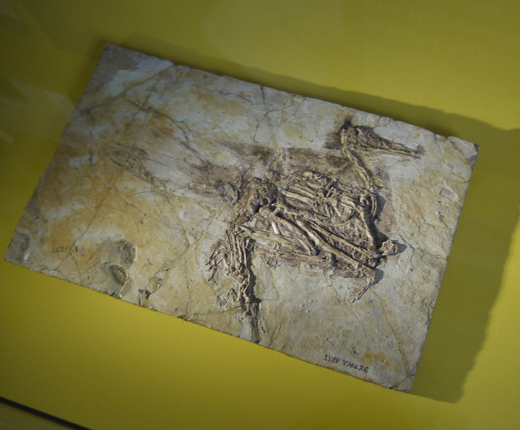
Amazing Early Cretaceous Fossils from Liaoning Province (China)

Yanornis fossil on display.

A genuine fossil of a Cretaceous bird (Yanornis martini).

Preserving Tiny Anatomical Details

Such is the quality of the fossil specimens that even tiny anatomical details have been preserved in the fossil material.  These fossils have helped palaeontologists to piece together important data relating to the phylogenetic relationship of the Dinosauria to Aves (dinosaurs to birds) as well as providing a detailed insight into the evolution of the birds themselves.

To read an article about a recently discovered primitive bird fossil discovered in western Liaoning: Bird Evolution Not as Easy as Eosinopteryx.

Such is the quantity and variety of specimens that scientists have puzzled how such a large assemblage of fossil material, with such excellent preservation, came about.  Previously, it had been thought that the remains of animals, plants and birds and all the other material had been washed into a large, stagnant lake.  The corpses and plant material rapidly sinking to the muddy bottom and becoming quickly buried.

Active Volcanoes

Volcanoes were active in the area during this stage of the Cretaceous and fine ash deposits from volcanic eruptions covered the specimens and aided their preservation.  Now a team of international scientists writing in the academic publication the “Journal of Nature Communications” have proposed that sudden and very localised, periodic  pyroclastic flows from the surrounding volcanoes were responsible for the sweeping of large amounts of organic matter into the lakes and its subsequent exceptional fossil preservation.

Scientists Had Puzzled Over the Exquisite Liaoning Fossil Preservation

An adult Hyphalosaurus and baby turtle died together

An adult Hyphalosaurus and baby turtle died together.

In the picture above a baby turtle has come to rest on top of a Hyphalosaurus (freshwater reptile, whose fossils are common in the Jehol Biota).  Both body fossils are complete and immaculately preserved.  There are many such examples of amazing fossil preservation and the researchers postulate that phreatomagmatic eruptions (volcanic eruptions caused by (most likely) rapid cooling of magma in contact with a body of water) forced pyroclastic flows to rapidly cover the surrounding countryside.

A Pyroclastic Flow

A pyroclastic flow is a cloud of hot gas and ash that tumbles away from a volcanic explosion at huge speed.  The hot gases, sometimes approaching 1,000 degrees Celsius, instantly kills everything in its path.  The Roman city of Pompeii was hit by such a pyroclastic flow.  Scientists have termed the forces responsible for the Liaoning preservation as “prehistoric Pompeiis”.

The research team examined and analysed sediments and residual fossils from several key horizons in the Lower Cretaceous Jiufotang and Yixian formations in a bid to understand more about the nature of the events and the mechanisms behind the exceptional fossil preservation.  The team conclude that the terrestrial material was transported by an sealed within the pyroclastic flows, thus providing palaeontologists with a unique record of the flora and fauna of the forested lowlands of this part of northern China.

Fossils of Both Terrestrial and Freshwater Vertebrates Buried Together

A victim of a pyroclastic flow?

A victim of a pyroclastic flow?

Turtle Fossils

There are many examples of turtle fossils preserved in the Yixian and Jiufotang formations.  These animals have remained little changed for over 130 million years.

Lead researcher and one of the main authors of the scientific paper Baoyu Jiang (Nanjing University), stated:

“All the studied fossils are directly embedded within pyroclastic flows.  And the preserved animals are characterised by entombment poses and showed evidence of charring, similar to those associated with victims at Pompeii.”

The researchers have proposed that the burials were not the result of a single event, but that there were probably several eruptions that occurred, most would have been small, localised but very violent causing localised mass extinctions.

Professor Mike Benton (Bristol University) commented:

“The new observations confirm and clarify what had been suspected.  But the authors go a step further in suggesting that all the Jehol animals were killed, transported and exceptionally preserved by the pyroclastic flows.”  This is quite a challenge to previous views that assumed most of the animals lived in and around the lakes in which they are found, and may have been transported in by regular rivers and other means.”

To view models and replicas of the Jehol Biota and other prehistoric animals: Age of Dinosaur Models from PNSO.

1 02, 2014

New Dinosaur “Titan” from North-western China Described

By |2023-03-09T14:29:15+00:00February 1st, 2014|Categories: Dinosaur and Prehistoric Animal News Stories, Dinosaur Fans|0 Comments

Yongjinglong datangi New Genus of Huge Titanosaur from China

A team of American researchers working in collaboration with Chinese colleagues have identified a new genus of huge titanosaur from north-western China (Gansu province).  Although only known from fragmentary fossil material, representing less than 10% of the complete skeleton, the research team have been confident enough to assign these fossils to a new species of plant-eating, dinosaur.  There is some evidence to suggest that since some bones are not fused entirely, this individual was a juvenile and not yet fully grown.  However, the scientists estimate that this specimen was perhaps up to eighteen metres long.

A New Titanosaur

The researchers, which include scientists from Beijing’s Institute of Vertebrate Palaeontology and Palaeoanthropology (IVPP), the University of Pennsylvania and the Gansu Geological Museum in Lanzhou (China) have published their findings in the on line academic journal PLoS One (On Line Public Library of Science).  The dinosaur has been named Yongjinglong datangi (pronounced Yong-jing-long dah-tang-gie).  The genus name comes from the ancient Chinese for Yongjing County, close to the site where the fossils of this huge prehistoric animal were found and “long” which means dragon.  The specific name datangi is a reference to the Tang dynasty and in addition, honours Mr Zhi-Lu Tang from the IVPP for his substantial contribution to study of Dinosauria.

Yongjinglong datangi

Research student Liguo Li, was given the opportunity to study a series of fragmentary remains representing a single individual animal that has been unearthed from a quarry in 2008.  The bones consisted of three large-crowned teeth, a number of vertebrae, the left scapula (shoulder blade) and lower leg bones from the front limbs.  Although the bones, particularly the vertebrae resembled those of another type of titanosaur, whose fossils have also been found in Gansu province, Euhelopus zdanskyi, the bone morphology was unique enough to merit the establishment of a new genus of Chinese titanosaur.

Researcher Liguo Li, commented:

“The shoulder blade [scapula] was very long, nearly two metres, with sides that were nearly parallel, unlike many other titanosaurs whose scapulae bow outward.”

Huge Fossil bones

So massive was the shoulder blade that when the scientists tried to position the bone within the typical body frame of a titanosaur it did not appear to fit quite where it should.  Unlike most other known titanosaurs, the shoulder blade seems to have been orientated at an angle of around fifty degrees from the horizontal.  In addition, the unfused portion of this bone indicated that this Titanosauriformes was not fully grown when it met its demise.

A number of titanosaurs have been discovered in this particular location, two within a thousand metres of the Yongjinglong fossil find (Daxiatitan binglingi and Huanghetitan liujiaxiaensis respectively).  With the unusual orientation of the shoulder blade, plus characteristics identified from the vertebrae and from the size and shape of the teeth, the research team were confident enough to erect a new genus, despite the large amount of titanosaur fossil material relating to already described genera that had been found in this locality.

Images of the Scapula of the New Chinese Titanosaur
Shoulder blade nearly two metres in length.

Shoulder blade nearly two metres in length.

Picture credit: PLoS One

A–E, photographs and interpretive line drawing in A, lateral; B, medial; C, cranial; D, distal and E, D-shaped cross-section of midshaft views.  Scale bar equals 200 mm.

Calculating Phylogenetic Relationships

The exact phylogenetic relationship between this new titanosaur species and already known genera remains unclear.  The fossil material indicates affinities with later titanosaurs known from South America.  It had been thought that the titanosaurs went into decline around the world, with the exception of South America, but there is an increasing amount of evidence to suggest that this clade continued to flourish on a global basis for much of the Cretaceous.  The teeth show a number of unique features.  One tooth, measures nearly fifteen centimetre in length from the tip of the crown to the base of the root.  They have a pronounced tip to the crown and show an unusual wear pattern.

An Image of the Teeth of Yongjinglong (Y. datangi)
Titanosaur teeth.

Titanosaur teeth.

Picture credit: PLoS One

The scientists are optimistic that more fossil material related to this new genus will be uncovered as further excavations are scheduled to take place in the area.

An Illustration of Yongjinglong datangi Showing Location of Bones

Scale bar = 600mm.

Scale bar = 600mm.

Picture credit: PLoS One

To view replicas and models of Chinese dinosaurs and other prehistoric animals: PNSO Museum Quality Age of Dinosaurs Models.

30 01, 2014

New Study Suggests that Some Diseases in Modern Humans Linked to Neanderthal DNA

By |2024-05-02T09:19:46+01:00January 30th, 2014|Categories: Dinosaur and Prehistoric Animal News Stories, Palaeontological articles|0 Comments

Neanderthal Genes Linked to Modern Human Diseases

Modern humans (Homo sapiens) are susceptible to some diseases as a result of inherited genes due to our interbreeding with Neanderthals (Homo neanderthalensis) according to a study published in the academic journal “Nature”.   A joint American and German-based team of researchers from Harvard Medical School, (Boston, Massachusetts) and the Max Planck Institute for Evolutionary Anthropology (Leipzig, Germany), have looked at the genetic makeup of over 1,000 people and compared this to the analysed genome of a Neanderthal toe-bone that is believed to be around 50,000 years old.

Inherited Genes from Neanderthals

The team also concluded that along with our susceptibility to some diseases, the inability to give up tobacco in some portions of the human population may be due to genes passed onto us from Neanderthals (not that Neanderthals smoked, as far as we know).  In addition, other traits such as hair colour, strong nails and the ability to adapt better to cold climates could be a result of our partial Neanderthal heritage.

Study Suggests Neanderthal DNA May Make Parts of Modern Human Population Susceptible to Diseases

Neanderthal skeleton compared to modern human skeleton

A Neanderthal skeleton (left) compared to a modern human skeleton (right). Picture credit: Ian Tattersall/ Max Planck Institute for Evolutionary Anthropology.

Picture credit: Ian Tattersall/ Max Planck Institute for Evolutionary Anthropology

Related Research Projects into the Human Genome

This study is one of a number of related research projects (no pun intended), as scientists attempt to unravel the complex relationship between early hominid species in Europe.  To read a news story on a research paper published late last year that looked at the genetic inheritance for a prevalence for diabetes in the human population: Modern Human’s Risk of Diabetes Inherited from Neanderthals.

In those members of our present population who are non-African in origin, there is a small amount of Neanderthal DNA present in their genetic make-up.  The level of Neanderthal DNA varies from approximately 2% to 4%.  Some Neanderthal DNA would be expected due to the belief that modern humans and Neanderthals shared a common ancestor.  However, the relatively high level suggests that there was interbreeding between these two species in the past.

New research suggests that in parts of the Old World, there were as many as four different types of hominid living at the same time.  The genetic relationship between these populations is very complex.  Part of this complexity is put down to interbreeding between species.

Adaptations for a Colder Climate

One of the genetic traits identified in this new research is that the Neanderthal’s genes to help adaptation to a colder climate by having tougher skin and nails may have been passed onto Homo sapiens that migrated northwards out of Africa.

People alive today, who are indigenous to sub-Saharan Africa, whose ancestors did not migrate out of Africa when Neanderthals were still present in Europe, carry very little Neanderthal DNA.  What they do carry would be as a result of our species sharing a common, ancient ancestor with the Neanderthals or perhaps a species of hominid from very far back in the human evolutionary line.

One of the conclusions made from the genetic study of the Neanderthal toe bone suggests that based on this evidence Neanderthal populations may have been very inbred.  The exact genetic relationship between Neanderthals and a third species of human that lived in Europe the same time as Neanderthals as well as H. sapiens has yet to be fully understood.

To read more about this: Mystery of the Denisovans.

Implications for Diabetes Research

Everything Dinosaur team members have already reported on one of the findings from research of this kind, the prevalence for type 2 diabetes being an inherited trait from Neanderthals.  In addition, it seems that Neanderthal genes may also predispose parts of the modern human gene pool to lupus, long-term depression, Crohn’s disease (inflammation of the digestive tract, a condition that affects around one person in every 700 in the United Kingdom), plus an autoimmune disease of the liver.  When Crohn’s disease is considered, it seems that Neanderthals passed on different genetic markers that increase and decrease the risk of this condition.

Commenting on the research, one of the authors of the academic paper, Professor David Reich (Harvard Medical School) stated:

“Now that we can estimate the probability that a particular genetic variant arose from Neanderthals, we can begin to understand how that inherited DNA affects us.  We may also learn what Neanderthals themselves were like.”

The London Natural History Museum’s Professor Chris Stringer, although not an author of this research, is regarded as an authority on the study of ancient hominids.  He explained that the findings added a new dimension to the debate over how early humans interacted with Denisovans and Neanderthals.  He stated that this research, in his opinion, did not challenge the current thinking that our ancestors originated in Africa.

Professor Stringer commented:

“The genetic data also shows there are thousands of DNA changes that are unique to Homo sapiens, and these distinctions are likely to have accumulated during the several hundred thousand years since Homo sapiens separated from the Neanderthal and Denisovan lineages as they evolved in Africa and Eurasia respectively.  Our genetic heritage is still largely from a recent African origin, despite the interbreeding with other human populations that undoubtedly occurred.”

No Traces of Neanderthal DNA in Parts of the H. sapiens Genome

This research also found that some areas of the human genome had no traces of Neanderthal DNA present within them.  This could be explained by alleles (pronounced al-eels) to these genes being dominant and the genes from the Neanderthals that may have been detrimental to the individual with those genes in some way, being lost out of the general population as a result of natural selection

Post-doctoral Fellow, Sriram Sankararaman (Harvard Medical School), one of the authors of this new research paper, explained:

“We find that there are large regions of the genome where most modern humans carry little or no Neanderthal ancestry.  This reduction in Neanderthal ancestry was probably due to selection against genes that were bad – deleterious – for us.”

The evidence suggests that some Homo neanderthalensis/H. sapiens hybrids may have had reduced fertility, or in some cases they may have been sterile.  Sterility in such hybridisation indicates that our species and Neanderthals, despite probably sharing a common ancestor, were so genetically far apart at the time of interbreeding, that these two species were only just compatible in terms of the ability to produce fertile offspring from any such union.

Unravelling More of the Neanderthal/Modern Human Genome

Human and Neanderthal genetic research.

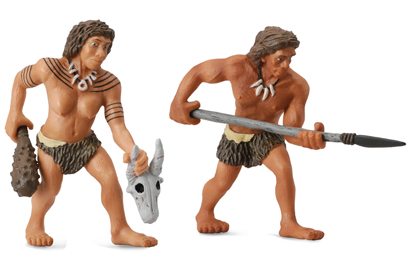
Models of Neanderthals.

Picture credit: Everything Dinosaur

Neanderthal Models and Figures

To view Neanderthal figures (whilst stocks last) and other prehistoric animal figures: CollectA Prehistoric Life Figures and Models.

Exploring the issue of infertility occurring as a result of mating, Professor Reich added:

“It tells us that when Neanderthals and modern humans met and mixed, they were at the very edge of being biologically compatible.”

There have been a number of papers published recently highlighting the research into the various taxonomic and genetic relationships between our species and other ancient hominids.  At the turn of the year, Everything Dinosaur team members made a number of predictions about what news stories this web log was likely to cover over the next twelve months.  We confidently predicted that further genetic research such as this would reveal more data relating to the linkages between our species and other hominid branches on the human family tree.

To view Everything Dinosaur’s 2014 predictions in full: Everything Dinosaur’s Predictions for 2014.

20 01, 2014

A New Troodontid Dinosaur Described – Gobivenator

By |2023-03-02T13:44:16+00:00January 20th, 2014|Categories: Dinosaur and Prehistoric Animal News Stories|0 Comments

Gobivenator mongoliensis – A New Troodontid from the Central Gobi Desert

A new scientific paper has just been published by an international team of scientists including researchers from Tokyo University that details the discovery of a troodontid dinosaur.  Troodonts are a group of small theropod dinosaurs that seem to lie somewhere between those speedy, long-legged ornithomimids such as Gallimimus and the fearsome dromaeosaurids such as Velociraptor.

New Troodontid Dinosaur

Fossils of these little dinosaurs (most of them were around two metres in length, most of that being tail), have been found in Upper Cretaceous deposits of North America and Asia.  From the several near complete specimens of this family known, palaeontologists have identified that their skeletons were very bird like and that these animals in proportion to the rest of their bodies, had relatively large brains for a member of the Dinosauria.

The newest member of the Troodontidae has been named Gobivenator mongoliensis (the name means “Gobi desert hunter from Mongolia”).  The almost complete specimen, including a very well preserved skull which was just missing the tip of the snout was excavated from deposits in the Djadokhta Formation of the central Gobi desert region.  Post cranial material includes virtually the rest of the skeleton with just some smaller bones and a neck vertebra (cervical vertebrae) missing.  A number of important Late Cretaceous fossils representing oviraptorids, dromaeosaurids, tyrannosaurs, as well as ornithischian dinosaurs, mammals, lizards and crocodiles have been found in the strata that makes up the Djadokhta Formation.

Gobivenator mongoliensis

Perhaps the most famous part of the Formation is the famous “Flaming Cliffs” , named for the reddish colour of the sandstones, as explored by the American Museum of Natural History expeditions led by Dr Roy Chapman Andrews.

The sandstone deposits of the Djadokhta Formation preserve evidence of a semi-arid, desert environment that had a number of oasis spread across it.  The fossils of Gobivenator have been dated to around 72 million years ago, although the exact date range of the entire Formation remains debated.  Most of the strata does date from the Early Maastrichtian/Campanian, but there is some evidence to suggest that the earliest deposits, representing a slightly more humid and wet environment date from the Santonian faunal stage.

Measuring around 1.6 metres in length (half of the body length being made up of the long tail) and most probably feathered, Gobivenator was probably a hunter of small, lizards, baby dinosaurs and mammals.  It may have lived in social packs.

An Illustration of Gobivenator mongoliensis

An illustration of G. mongoliensis. Scale bar = 1 metre.

An illustration of G. mongoliensis.
Scale bar = 1 metre.

Picture credit: Danny Cicchetti

The Newest Member of the Troodontidae

The near complete skeleton and the very well preserved and undistorted skull has provided the joint Japanese/Mongolian scientists with a unique opportunity to explore the phylogenetic relationship between members of the Troodontidae and also between troodonts and Aves (birds).  The shape and structure of the palate has been determined, showing close affinities with dromaeosaurids such as Velociraptor and primitive birds.

For articulated models of troodontids and dromaeosaurids: Beasts of the Mesozoic Articulated Dinosaur Figures.

Although the skull of Gobivenator is strongly fused (akinetic – limited movement between bones), it already shows preconditions for the later evolution of a more flexible skull as seen in many types of modern bird (cranial kinesis).  Preconditions identified by the research team include reduced contact between the small bones that make up the palate and the absence of a slender epipterygoid bone.

Cranial kinesis is effectively the ability of skull bones to flex against each other.  This adaptation is most closely allied to the need to cope with awkward or difficult to swallow prey items.  A number of bird families show a degree of cranial kinesis, most notably Prokinesis (flexing of the front facing portions of the skull).  In modern Aves, it is the psittacine (parrots) family that show the most pronounced form of cranial kinesis.  It is thought that the skull flexing in members of the parrot family evolved to help them feed on large, robust nuts and fruit.

The scientific paper detailing this research has been published in the academic journal “Naturwissenschaften” – the science of nature.

19 01, 2014

Baby Chasmosaurus and Rare Edmontosaurus with Evidence of a Soft Crest to go on Display

By |2024-05-02T09:04:52+01:00January 19th, 2014|Categories: Dinosaur and Prehistoric Animal News Stories|0 Comments

University of Alberta to Display Important Dinosaur Discoveries

The almost complete fossilised skeleton of a baby horned dinosaur and the preserved skull from an adult duck-billed dinosaur that shows evidence of a soft crest on top of its head are to go on display to the public in the Canadian city of Edmonton.  From February 6th until March 8th, visitors to the University of Alberta Museum’s galleries at Enterprise square will be able to view the fossilised remains of a baby Chasmosaurus along with the rooster-like comb on the skull of an Edmontosaurus (E. regalis).   These dinosaur fossils were amongst the most significant discoveries reported upon by Everything Dinosaur team members last year.

Dinosaur Provincial Park Formation

It is rare to find a baby dinosaur, these carcases decompose more rapidly than larger adult specimens and most baby dinosaur remains would have been snapped up by a passing meat-eater.  To have an almost perfectly preserved example of a young horned dinosaur is a great boost for the palaeontologists working in the Dinosaur Provincial Park Formation.

The Chasmosaurus skeleton is nearly complete, only the front limbs are missing, which are believed to have disappeared down a sink hole in the past.  The dinosaur has been affectionately called “baby” and if visitors look carefully, they will be able to make out 72 million year old preserved skin impressions on the specimen over the ribs of the 1.5 metre long specimen.

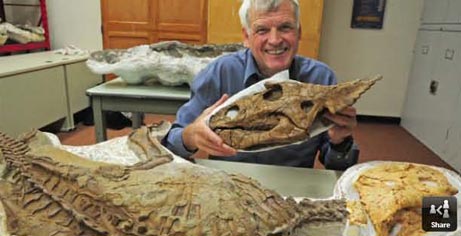
Phil Currie (Canada Research Chair in Dinosaur Palaeobiology at the University of Alberta) Shows Off the Fossil Find

"The best preserved baby horned dinosaur ever found".

“The best preserved baby horned dinosaur ever found”.

Picture credit: Bruce Edwards (from a video interview)

To read more about the baby Chasmosaurus fossil: Baby Chasmosaurus Fossil Unearthed in Alberta.

University of Alberta

Clearly excited about the prospect of putting this fossil, which was discovered in 2010, on public display, Phil Currie stated:

“It’s my pride and joy.  It is the best preserved baby horned dinosaur known anywhere in the world.  It is an unbelievable specimen!”

Joining “baby” on display will be skull material from an adult duck-billed dinosaur (Saurolophinae), called Edmontosaurus.  This specimen, Edmontosaurus regalis revealed for the first time evidence that these large, herbivores may have had soft-tissue crests on their heads, rather like the combs on cockerels.

Everything Dinosaur reported on this discovery, when the scientific paper was published in “Current Biology” just five weeks ago.  To read more about this study: Dinosaur with a Comb Like a Rooster’s.

The Edmontosaurus Material Going on Display

Arrows indicate preserved impression of skin, the presence of a crest and skull bones.

Arrows indicate preserved impression of skin, the presence of a crest and skull bones.

Picture credit: Frederico Fanti et al/Current Biology

A spokesperson from Everything Dinosaur commented:

“The fact that these recently described specimens are going on display to the public so quickly is fantastic news.   We applaud the staff at the University of Alberta for all their hard work.  These two fossil discoveries are very significant and they demonstrate to the public at large that we still have so much to learn about the Dinosauria.”

15 01, 2014

Jurassic India – Scientists Find Rare Prehistoric Tracks in Rajasthan

By |2024-05-02T06:59:37+01:00January 15th, 2014|Categories: Dinosaur and Prehistoric Animal News Stories|0 Comments

Trace Fossils Including Pterosaur Trackways Discovered in Rajasthan

The north-western province of Rajasthan in India has some spectacular limestone formations that represent sediments laid down in the Middle Jurassic.  A number of expeditions have been mounted to this part of India by institutions such as the University of Rajasthan to help map the geology and assess the many different types of marine invertebrate fossils that are associated with some parts of this strata.

Jurassic India

The specimens of ammonites are very useful in helping scientists to accurately date the age of these formations (biostratification) and for comparing the fauna found in these deposits with other sedimentary rock formations found elsewhere on the sub-continent.  Although, the area’s close proximity to the Pakistan border has led to difficulties over accessing some parts of the region, a number of geological surveys have been carried out exploring for reserves of natural gas and oil.  The limestone represent deposition in a marine environment, however, Jurassic sandstones that are also to be found in Rajasthan, most notably in Jaisalmer district, represent material deposited in a fluvial (river) environment.  These outcrops and the fossils contained therein are providing scientists with a fascinating glimpse into life in the Early to Middle Jurassic.

Palaeontologists and geologists visiting this part of India as part of their participation in the ninth annual International Congress on the Jurassic System, organised by the Geology department of Rajasthan University, have been taking the opportunity to explore the area and to look for fossils.  An outcrop of exposed Jurassic aged sediments on the Jodhpur-Jaisalmer highway, close to the village of Thaiat has yielded a number of trace fossils including pterosaur and three-toed dinosaur footprints.

An International Team of Scientists

The thirty-four strong party, including researchers from France and Germany have been staying in this area, with a view to mapping the formations and recording evidence of Jurassic vertebrates.  Little is known about the evolution of the Dinosauria and the Pterosauria (flying reptiles) in this part of the world during the Early Jurassic.

The footprint fossils may potentially belong to species that are new to science.  Dr Jan Schlogl of Slovakia working in collaboration with Professor Gregory Pienkowski (Poland), identified the footprints, preserved in finely grained, sandstone sediments as those belonging to a pterosaur (flying reptile).  Something like over 120 different pterosaur species are now known, mostly via fragmentary fossil remains.  Finding pterosaur tracks in these sediments, believed to date from around 180 million years ago, will help scientists to understand better the evolution and radiation of these vertebrates.

Jurassic Trace Fossils – Trackways

Amongst the footprints representing Jurassic dinosaurs at least two kinds have been identified.  Firstly, there are the small three-toed prints of a little theropod dinosaur known as Grallator.  The name Grallator is an ichnogenus, a name given to a genus of animal that is only known from trace fossils.  Some of the prints, representing the hind feet of this biped are five centimetres in length.  It is likely that this little dinosaur was about the size of a chicken.

Larger three-toed prints have also been identified.  These tridactyl (three-toed) prints measure approximately thirty centimetres long and must have been made by a much larger creature.  It is difficult to speculate what sort of dinosaur made such prints, but similar prints found in European strata of roughly the same geological age have been assigned to Tetanurae theropods such as megalosaurs, whereas, it is possible that these prints could represent another type of theropod such as a member of the Neoceratosauria or a coelophysid.

Rapidly Evolving Theropods

During the Early Jurassic the Theropoda group of meat-eating dinosaurs rapidly evolved and a number of  new families evolved.  If body fossils of meat-eating dinosaurs can be found in these sediments then this would add greatly to our knowledge of theropod dinosaurs from the southern super-continent of Gondwana.

Large Three-Toed Dinosaur Footprints Discovered

Evidence of Jurassic dinosaurs from India.

Evidence of Jurassic dinosaurs from India.

Picture credit: University of Rajasthan

The larger, tridactyl prints have been assigned to the ichnogenus Eurontes (Eurontes giganteus).

Associate Professor P. K. Pandey (Geology department of the University of Rajasthan), has studied a number of Jurassic aged fossils from these sandstone deposits.  He has already recorded the presence of small pterosaurs after finding fragmentary fossilised bones in these deposits.   A source close to Everything Dinosaur commented that these discoveries of dinosaur footprints and pterosaur footprints were very significant.

For models and replicas of Jurassic theropods and other prehistoric animals: CollectA Deluxe Scale Prehistoric Animal Models.

Go to Top