All about dinosaurs, fossils and prehistoric animals by Everything Dinosaur team members.

Fossil finds, new dinosaur discoveries, news and views from the world of palaeontology and other Earth sciences.

6 03, 2014

Europe’s Largest Meat-Eating Dinosaur Described to Date

By |2023-03-11T11:50:15+00:00March 6th, 2014|Categories: Dinosaur and Prehistoric Animal News Stories, Dinosaur Fans, Palaeontological articles|2 Comments

Torvosaurus gurneyi – Monster Megalosaur from Portugal

The scientific paper has just been published that permits a new species of Torvosaurus to be announced to the world.  Torvosaurus means “savage lizard” and joining Torvosaurus tanneri, a meat-eating dinosaur known from the famous Upper Jurassic Morrison Formation of the United States, is T. gurneyi from the Lourinhã Formation of central west Portugal.  Based on the size of the skull material and using other fragmentary fossils from the Lourinhã Formation that had been found previously, palaeontologists estimate that this dinosaur measured around ten metres in length and weighed between four and five tons.

Torvosaurus

Based on these dimensions, this dinosaur can lay claim to the title of being one of Europe’s largest meat-eating dinosaurs described to date.

“Savage Lizard” Torvosaurus gurneyi Apex Predator of the Late Jurassic of Europe
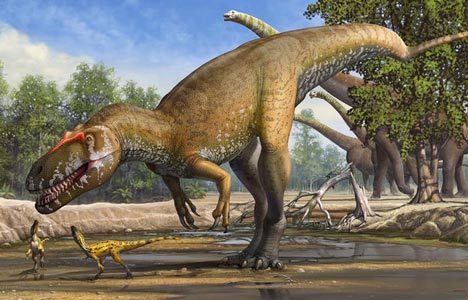
Top predator of Portugal from the Late Jurassic

Top predator of Portugal from the Late Jurassic.

Picture credit: Sergey Krasovskiy

Authors of the scientific paper, Professor Octávio Mateus and Christophe Hendrickx of the Museu da Lourinhã, (Lourinhã, Portugal), which has just been published on line in PLoS One, collated the known fossil material ascribed to Torvosaurus spp. found in Portugal and thanks to the discovery of part of a skull and jaws, they are able to distinguish this species from the Torvosaurus known from the United States.

Lourinhã Fossils

A study of the fossils from Lourinhã reveal a number of differences between them and the North American fossil material.  For example, the near complete left maxilla ( a bone from the upper jaw), was found in Portugal by the Dutch amateur fossil collector Aart Walen in 2006.  It was carefully prepared and it was the finding of this fossil that really gave the Portuguese scientists the opportunity to compare their material with the fossils of Torvosaurus tanneri.

The maxilla in large theropod dinosaurs can be very characteristic, it helps to determine affinities amongst meat-eating dinosaurs and, importantly in this case, can help palaeontologists identify a new species.  When the Portuguese maxilla was compared to the maxilla of a Torvosaurus tanneri the researchers were able to point out some subtle differences.  For example, the maxilla of the Portuguese specimen had fewer teeth (less than eleven), this and other anatomical differences permitted the team to create a distinct Portuguese species of Torvosaurus.

Comparing the Left Maxilla of T. gurneyi with T. tanneri
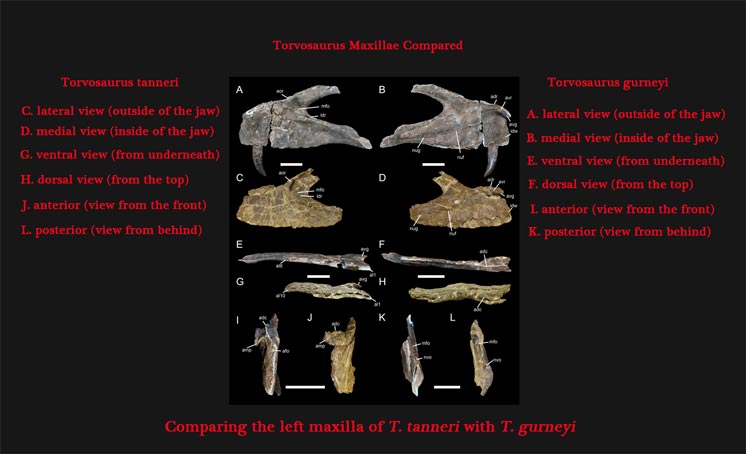
Torvosaurus jaw bones compared.

Torvosaurus jaw bones compared.

Picture credit: Journal PLoS One with additional notation by Everything Dinosaur

Torvosaurus tanneri

Although closely related to Torvosaurus tanneri, this new predator lived thousands of miles away on the eastern tip of the Eurasian and African landmass.  The species name honours the American artist and illustrator James Gurney who created the “Dinotopia” series of books all about a magical land where dinosaurs and people live together.  James Gurney was born in California and so from a geographical perspective he is much closer to the Torvosaurus known from the United States than from this new European dinosaur.

A Scale Drawing Giving the Approximate Size of T. gurneyi
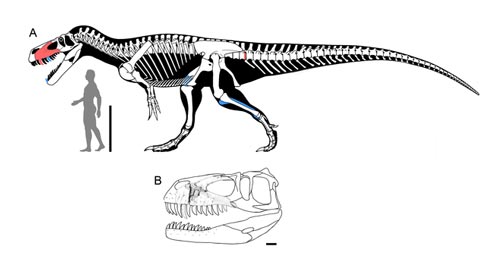
A scale drawing of Torvosaurus

A scale drawing of Torvosaurus.

Picture credit: Journal PLoS One/Scott Hartman (A) with additional skull drawing by Simão Mateus (B)

The drawing above gives an approximate size estimate for this new species of carnivorous dinosaur.  The maxilla is shaded red in drawing (A) and the scale bar is approximately 1 metre.  The other parts of the skeletal drawing shaded blue refer to fragmentary fossil material found previously that has been assigned to Torvosaurus gurneyi.  The skull drawing (B) indicates the position of the holotype left maxilla (ML1100) in relation to the rest of the skull.  The scale bar represents 10 centimetres.  Torvosaurus gurneyi has been assigned to the megalosaur family.

Trackway

A trackway with individual prints measuring up to seventy-nine centimetres in length has been assigned to this new species.  Although it is very difficult to tie down the fossil print to a species, there is no other known Portuguese theropod of comparable size so these trace fossils have been attributed to T. gurneyi.  Dinosaur eggs and some fossilised embryos from the Sobral Member of the Lourinhã Formation have also been attributed to this new dinosaur species.

The fauna and flora of the Iberian area of Europe in the Late Jurassic was very similar to that found in the western United States, as epitomised by the Morrison Formation.  Both the Morrison Formation and the Lourinhã Formation sediments were laid down at approximately the same time, these strata cover the Late Oxfordian, the Kimmeridgian and the Early Tithonian faunal stages of the Late Jurassic.  However, during this period in Earth’s history the continents of North America and Europe were already separated by an intercontinental sea (the early Atlantic).

Professor Mateus and his colleagues put forward an hypothesis a few years ago now, that suggested that during the Early Oxfordian and the preceding faunal stage of the Late Jurassic, the Callovian, uplift of continental plates formed temporary land bridges between Europe and the Americas.  This allowed an exchange of terrestrial faunas between the United States and Iberia.  When these land bridges were lost as sea levels rose, these two, now separate ecosystems which shared common ancestors were left to evolve in isolation.

Footnote

At Everything Dinosaur we are aware of the hyperbole that has surrounded the publication of the scientific paper on Torvosaurus gurneyi. It is certainly an impressive dinosaur and we do not dispute the size estimates (extrapolated from inferred skull size and skull size to body ratio) along with assigned limb bones and such like.  The left maxilla (ML1100) shows enough characteristics to allow a new species to be created, but the title of “Europe’s largest meat-eating dinosaur described to date”, is easier to justify than some of the other headlines used in articles.

For example, we have come across the misleading headline “Europe’s biggest dinosaur”, this is simply not true, many herbivorous dinosaurs were much bigger than Torvosaurus spp. and there are a number of fragmentary remains of meat-eating dinosaurs that could challenge the claim made by other writers that T. gurneyi is Europe’s biggest meat-eating dinosaur.  For example, the specimen of Baryonyx walkeri from the Wealden Clay of south-east England was not fully grown when it died and it could have potentially rivalled Torvosaurus in size.

For models and replicas of European dinosaurs including Torvosaurus, whilst stocks last: CollectA Age of Dinosaurs Deluxe Models.
5 03, 2014

Unravelling the Sequence of Deposition in North-eastern China

By |2023-03-11T08:53:51+00:00March 5th, 2014|Categories: Dinosaur and Prehistoric Animal News Stories, Dinosaur Fans, Palaeontological articles|0 Comments

The Daohugou Biota – China 160 Million Years Ago

A team of international researchers based at the Chinese Academy of Sciences have identified a stratigraphic sequence of Middle Jurassic deposits thanks to fossils of a salamander.  The huge assemblage of vertebrate fossils and other material has provided scientists with an exquisite insight into an ecosystem that thrived in north-eastern China around 160 million years ago.  The series of highly fossiliferous sites are being linked into one large group of sedimentary material that can be put together in terms of their geological age thanks to the common range of fossils these different locations contain.

Sequence of Deposition

The locations (six in total scattered across the provinces of Hebei and Liaoning), are described as the Daohugou Biota.  They form part of the Tiaojishan Formation (or at least most of the locations seem to do so), but importantly, the strata has been recognised as being much older than the Jehol Biota.  The Jehol Biota is associated with Lower Cretaceous deposits (Barremian and Aptian stages of the Early Cretaceous), however, the Daohugou Biota is dated to around the Bathonian faunal stage of the Middle Jurassic.

The Jehol Biota

The Jehol Biota epitomised by the wonderfully well preserved fossil remains of Liaoning Province, is famous for its feathered primitive bird and feathered theropod dinosaur fossils representing an ecosystem that consisted of a series of large lakes, forests and nearby volcanoes.  Periodically, the volcanoes would erupt, bury large areas of the surrounding landscape with ash and devastate the fauna and flora.

The fine grain sediments that were deposited helped preserve fossils in amazing detail.  At first, all the fossils from this part of China were thought to be of Lower Cretaceous age, after all, such beautifully preserved fossils are exceptionally rare, but it now seems that prior to the environment which formed the Jehol Biota and fossil assemblage, there existed in the same location but around 30 million years earlier another ecosystem which has been preserved in equal detail thanks again to volcanic activity.

Identifying the Biota

Just like their Jehol Biota counterparts, the Daohugou theropod dinosaurs are feathered, with a lot of anatomical detail preserved thanks to the fine lacustrine (lake) beds in which the fossils are found.  Something like 142 different vertebrate species have been identified from the Jehol Biota, pterosaurs, feathered and non-feathered dinosaurs, amphibians, fish, lizards and of course primitive birds.  The authors of a new study, which confirm the Midddle Jurassic age of the Daohugou Beds have documented at least thirty different vertebrate taxa to date, including two lizards, a tadpole from a frog, five dinosaurs, four early mammals and thirteen pterosaurs.

No Birds Found

Intriguingly, no birds, however, this may not be so much of a surprise as birds may not have evolved at the time of deposition of the first fossil assemblage.  What is known for certain is that a number of the dinosaur species identified to date from the Daohugou Beds are very similar to birds, Anchiornis for example, was extremely bird-like.

To read an article on the discovery of Anchiornis: Older than Archaeopteryx – Dinosaurs on their Way to Becoming Birds.

At an estimated 160 million years old, the Daohugou Beds are older than all the major bird-bearing fossil strata known, no definitive bird fossil may have been identified to date, but that is not surprising as at the time of the separation of the Aves from the Dinosauria, the birds closest relatives those non-avian Theropods, are going to look very similar.  What can be inferred from the evidence is that the ecosystem preserved as the Daohugou Biota represents the closest known to that point in geological time when the birds and the Dinosauria effectively split.

The Daohugou Biota

The Daohugou Biota is named after a small Chinese village close by to one of these six fossil locations.  What the international team of researchers have done is to link these locations together to prove that they represent a sequence of strata that was laid down at roughly the same point in deep time.  Radiometric dating has identified the age of the strata, but it is the presence of a signature fossil that has enabled the scientists to correlate the age of the separated deposits based on the fossils they contain.  The presence of the fossilised remains of a salamander (Chunerpeton tianyiensis) links these six locations together.  This amphibian’s fossils have effectively become a zonal fossil tying these six deposits together.

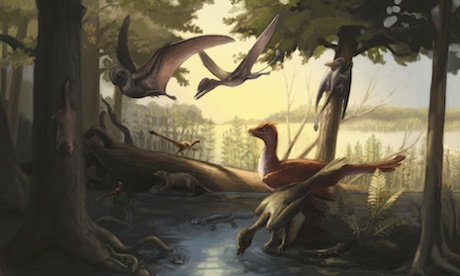
North-eastern China in the Middle Jurassic – Daohugou Biota

A rich and diverse Jurassic environment dominated by small mammals, Pterosaurs and feathered Theropods.

A rich and diverse Jurassic environment dominated by small mammals, pterosaurs and feathered theropods.

Picture credit: Julia Molnar

Biostratigraphy

The method of using the fossils of one or more species to identify the relative age of rock strata is called biostratigraphy.  C. tianyiensis has become a zonal fossil, a role more often than not played by invertebrates such as ammonites, graptolites and crinoids.

More importantly, although there are a number of families of vertebrates common to both the Daohugou Biota and the younger Jehol Biota, these two formations together represent an different ecosystems millions of years apart. The Daohugou Biota and the Jehol Biota are separate Lagerstätte assemblages that between them provide scientists with an unparalleled window into life in the Middle Jurassic and the Early Cretaceous of north-eastern China.

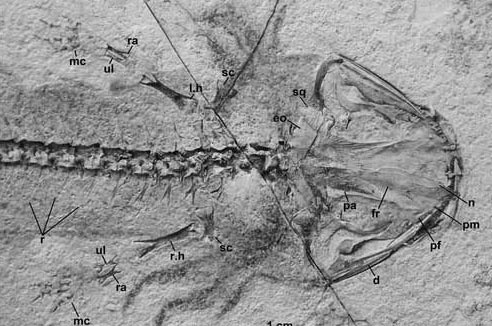
The Preserved Forequarters of a Specimen of C. tianyiensis (A Salamander)

Even the fine gills have been preserved.

Even the fine gills have been preserved.

Picture credit: Chinese Academy of Sciences/Journal of Vertebrate Palaeontology

Dating the Lioaning and Hebei Sediments

A spokes person from Everything Dinosaur commented:

“There has been confusion over the dating of the Lioaning and Hebei sediments, caused in part due to the large amount of fossil material that was made available to study which came from dubious sources such as local fossil collectors and dealers who rarely revealed exactly where the specimens came from, but now it seems that we have two “lost worlds” to study, one representing the Middle Jurassic and one representing younger sediments dating from the Cretaceous.  It is very likely that the Daohugou Beds will prove to be at least as biologically diverse as the fossil material that makes up the Jehol Biota, so we can expect to hear more announcements soon about further vertebrate discoveries.”

The Middle Jurassic deposits from these six Chinese locations have already provided fascinating glimpses into the weird and wonderful animals that lived in the forests and lakes that covered this part of the world 160 million years ago.  For instance, in 2008, Everything Dinosaur reported on the discovery of the bizarre fanged, feathered little dinosaur called Epidexipteryx.

Epidexipteryx

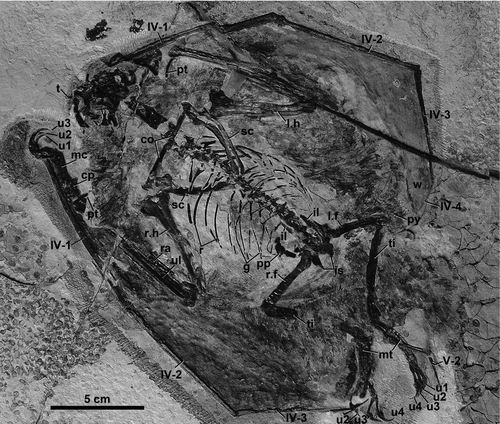
It has been suggested that this little dinosaur, which was no more than thirty centimetres in length, may have climbed trees.  For fans of the Pterosauria, the Daohugou Beds have provided a whole array of basal and derived forms of flying reptile such as the anurognathid pterosaur called Jeholopterus ningchenensis (note the confusing name from Jehol, although according to this new scientific paper, this pterosaur belongs to the Daohugou Biota and not the later Jehol Biota).

A number of rhamphorhynchid pterosaurs have been identified and sharing the same Jurassic skies was the recently discovered member of the Wukongopteridae pterosaur family called Darwinopterus modularis.

Composite Image of the Main Slab and Counter Slab of the Holotype Material of J. ningchenensis

Pterosaur material.

Pterosaur fossil material.

Picture credit: Chinese Academy of Sciences/Journal of Vertebrate Palaeontology

To read more about the discovery of the flying reptile called Darwinopterus: New Transitional Pterosaur Fossil Discovery from North-eastern China.

Shedding Light on the Evolution of Mammals

These sediments are also shedding light on the evolution of mammals and what bizarre forms there were in the Middle Jurassic.  Fossils of a tree climbing mammal with a membrane of skin stretched between its limbs have been found. It has been suggested that this creature, called Volaticotherium, occupied the same niche in the arboreal ecosystem as today’s flying squirrel from Asia.  Living alongside the abundant salamanders was the peculiar Castorocauda, a mammal adapted to an aquatic lifestyle with a broad, flattened tail to help it swim.

These creatures may seem strange to us, but we suspect that lurking in the finely-grained sediments of the Daohugou Beds even more bizarre vertebrates are awaiting discovery.

To view replicas and models of prehistoric animals from the Daohugou Biota: PNSO Age of Dinosaurs Models.

1 03, 2014

Amazing Mass Grave of Prehistoric Whales – Algal Bloom Toxins the Probable Cause

By |2023-03-11T08:37:20+00:00March 1st, 2014|Categories: Dinosaur and Prehistoric Animal News Stories|0 Comments

Algal Bloom Toxins Poison Prehistoric Marine Mammals

It had been the subject of intense scientific study, a series of mass graves of prehistoric cetaceans and other vertebrates found in the remote Atacama Desert of Chile.  The assemblage of fossils included many pristine examples of prehistoric whales preserved in sediments dated to the Miocene Epoch, the majority of the skeletons were virtually complete, so what caused these mass graves of so many ancient creatures?

A Scientific Paper

In a paper published in the academic journal “The Proceedings of the Royal Society B. (Biology)”, scientists have finally been able to piece together the sequence of events that led to one of the most spectacular Miocene aged vertebrate fossil collections known anywhere in the world.  It seems that algal blooms occurred in the region and have been preserved in sediments dated as being between six and nine million years old.  These blooms of microscopic, single-celled and multi-celled phytoplankton produced large amounts of a deadly neurotoxin, which when breathed in or ingested by these animals led to rapid organ failure and sudden death.

The blooms were probably caused by a sudden increase in run-off from the Andes Mountains, perhaps as a result of violent storms.  The sediments entering the Pacific coastal area of Chile were saturated with iron and other minerals which led to the dramatic increase in algae and the eventual algal blooms that led to the devastation of local stocks of marine mammal fauna.

Prehistoric Marine Mammals

One clue to the cause of death lay in the position and orientation of the  majority of corpses.  Many of the whale skeletons were lying on their backs, it seems that these creatures had not become stranded but had been washed ashore already dead.  Baleen whales such as Fin and Humpback whales have a huge throat pouch.  When these animals die and the carcase starts to decompose, this pouch fills with gases created from the putrefying flesh.  This pouch acts as a huge flotation device, the belly-up post mortem position suggests that these cetaceans died out at sea and then got washed inshore.

To view models and replicas of a prehistoric whale (whilst stocks last) and other prehistoric animals: CollectA Prehistoric Life Models and Figures.

In addition, the extremely well preserved and relatively undisturbed layout of the fossilised bones suggest that these bodies were washed ashore quite quickly and that the corpses were not scavenged by predators such as sharks which were abundant in these ancient Miocene waters.  Once on land, the carcases were lifted out of the surf zone perhaps by exceptionally high tides and deposited high up the beach, once there, since there were very few large predators in the arid environment the corpses lay relatively undisturbed until they were buried by sand.

Commenting on the exceptional preservation of the fossilised remains, one of the lead researchers, Nicholas Pyenson (a palaeontologist at the Smithsonian National Museum of Natural History), stated:

“These big hunks of meat stranded on a tidal flat, yet there were no terrestrial predators like a bear, nothing really larger than a dog, that could dismember the carcases and carry the bones away”.

Fossil Algal Mats

Tell-tale signs of fossil algal mats found in proximity of the skeletons also suggest it was neurotoxins from a bloom of phytoplankton that killed these animals.  Such mats are produced when algae reproduces rapidly and the population grows to many times the normal levels.  These preserved mats are orange in colour a result of their high iron content.  This suggests that large amounts of iron was dissolved in the offshore waters of Chile, most likely as a result of large amounts of iron-rich sediment reaching the sea having been washed down from the nearby mountains, to the east of the fossil site’s location.

This incident does not seem to have been an isolated event.  Four distinct layers of fossils have been identified, this indicates that algal blooms leading to such high levels of marine vertebrate mortality must have happened at least on four separate occasions over a period of perhaps ten to sixteen thousand years.  The fossil site was originally revealed back in 2010 when the Pan-American highway was being widened, although the area had already revealed a number of whale skeletons and other prehistoric marine mammals, such a concentration of large baleen whale fossils is particularly rare.

Ten Different Kinds of Marine Vertebrates

The palaeontologists have identified ten different kinds of marine vertebrates including whales, marlins, billfish, at least two species of seal, a bizarre Odobenocetops, a whale with two tusks that made it resemble an extant walrus, plus the remains of an aquatic sloth have also been discovered.  Such a mixture of different vertebrates all meeting a sudden end, made the scientists discount a virus that may have led to the deaths of a number of animals of the same species but not such a wide range of different marine animals.

The Smithsonian based researchers have prepared and extensive record of the fossil material, the area is known locally as the Cerro Ballena (the hill of whales) and there may be many more whale carcases buried in this region, already the fossils mapped so far represent the richest and most concentrated whale fossil site known anywhere in the world.

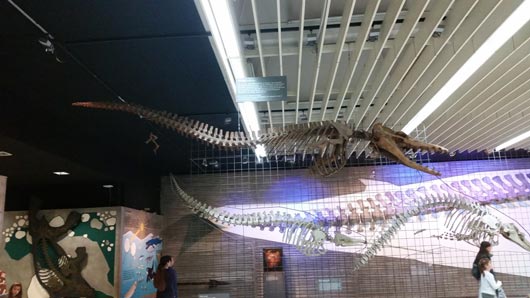
Some Whale Fossils May be Put on Display in Museums

Ancient whale fossils.

The magnificent ancient whales gallery at the Frankfurt Natural History Museum (Germany). Picture credit: Everything Dinosaur.

Picture credit: Everything Dinosaur

Dr Pyenson went onto add:

“The condition and arrangement of the bones, the presence of algal mats on some fossils and the fact that there are multiple species of marine animals at the site, all point to killer algae as really the only plausible explanation.  In today’s world, harmful algal blooms happen all the time.  This is the first time we can pin it down in the fossil record for marine mammals.”

The discovery also has implications for a number of extant marine mammal species.  Such algal blooms could devastate already vulnerable populations of rare inshore dolphins, dugongs and manatees.

27 02, 2014

Everything Dinosaur Publishes Unique Blog Article Number 2,500

By |2024-05-02T07:08:44+01:00February 27th, 2014|Categories: Dinosaur and Prehistoric Animal News Stories, Press Releases|0 Comments

2,500 Blog Articles On Line With Everything Dinosaur

This is post number 2,500 on the Everything Dinosaur web log and we have commemorated our blog reaching this landmark by creating a special image that is being shared across our social media sites including Twitter, Pinterest, Facebook and Google plus.  This blog site was started back in May 2007 and since then the team members at Everything Dinosaur have tried to publish a news story featuring dinosaurs, Earth sciences, fossil discoveries, product updates dinosaur model reviews and such like every day.

Celebrating 2,500 Blog Articles with Everything Dinosaur

Celebrating with Everything Dinosaur.

Celebrating with Everything Dinosaur.

Picture credit: Everything Dinosaur

Everything Dinosaur

Our company is made up of parents, teachers and dinosaur enthusiasts and we spend our time helping to motivate young people to learn more about science as well as helping collectors source dinosaur models, providing information, quizzes and all sorts of items to do with extinct animals and other amazing creatures.

When this blog site was set up back in late May 2007 we set out a number of purposes and aims for it:

  • To provide a diary of our day-to-day activities – what we get up to running our unusual company.
  • To act as a source for more information and a forum on dinosaurs/prehistoric animals for our visitors, customers and such like.
  • To discuss/review new dinosaur models, dinosaur toys and other items being added to our product range.
  • To report on new dinosaur and fossil discoveries.
  • To inform our readers about new research articles and prehistoric animal studies.
  • To perhaps, through our scribblings and notes here to help encourage others to set up their own little businesses doing things that they enjoy too.

Our Humble Blog

Our humble blog has been read by thousands and thousands of people, we have been listed as one of the top ten palaeontological blogs around and we have received an accolade with regards to our use of English and our writing style.  The Everything Dinosaur blog has been used as an example of the proper use of modern English to Chinese students, our posts have been shared, commented upon, used in schools and in other educational establishments, we have simply lost track as our web log has grown over the last seven years or so.

A very big thank you to all our readers and contributors, we really appreciate all your input and feedback.

To view the wide range of prehistoric animal toys, games and dinosaur models available from Everything Dinosaur: Visit Everything Dinosaur.

25 02, 2014

Earth was Cool A Lot Earlier than Previously Thought

By |2023-03-10T21:43:14+00:00February 25th, 2014|Categories: Dinosaur and Prehistoric Animal News Stories, Geology|0 Comments

Australian Zircon Suggests Earth Cooled Around 4.4 Billion Years Ago

An international team of scientists led by Professor John Valley (University of Wisconsin-Madison) have found evidence that our planet cooled much earlier than previously thought.  A cooler Earth could perhaps have led to an earlier start for life on our planet.

The Age of the Earth

Our solar system is believed to be somewhere around 4.56 billion years old.  It was formed from an enormous cloud of gas and dust (the solar nebula) that started to collapse in on itself under the force of gravity.  As this collapse occurred the mass of dust and gas flattened into an ever-faster spinning disc of debris.  It bulged at the centre, becoming extremely hot and this formed our sun.  Orbiting debris went on to form the rocky inner planets (including Earth), as well as the gas giants, the dwarf Pluto and the asteroid belt.

Analysis of a tiny fragment of zircon, excavated from a remote outcrop of rock in Australia has helped the researchers to form a picture of how Earth may have become able to sustain life around 4.4 billion years ago, just 160  million years or so, after the planet first formed.

Writing in the academic journal “Nature Geoscience”, Professor Valley, a renowned geochemist, stated that the study of this tiny zircon, a fragment of the Earth’s crust from that time, confirms that the Earth cooled and became habitable, this research not only has implications for the study of life on Earth, but it may also provide scientists with a better understanding of how other habitable planets may form.

Australian Zircon

Building on previous lead isotope analysis that proved the zircons extracted from rocky exposures in Western Australia’s Jack Hills region were the oldest known bits of Earth’s crust, the microscopic zircon used in this study has been confirmed as the oldest known material of any kind on our planet.

Commenting on the implications, Professor Valley said:

“This strengthens the theory of a cool early Earth, where temperatures were low enough for liquid water, oceans and a hydrosphere to form not long after the planet’s crust congealed from a sea of molten rock  This study reinforces our conclusion that Earth had a hydrosphere before 4.3 billion years ago and possibly life not long after.”

A new technique was used in the analysis of the zircon sample, a technique called atom-probe tomography, that when used in combination with ion mass spectrometry allowed the scientists to establish with great accuracy the age and thermal history of the material.  The mass of individual atoms of lead was calculated in the sample.  Instead of being distributed in a random fashion it was discovered that the lead atoms in the zircon had clumped together “like raisins in a pudding”.

The Thermal History of the Zircon

The clusters of lead atoms formed around one billion years after the crystallisation of the zircon material, by which time radioactive decay of uranium-235 had formed the lead atoms that formed clumps as the zircon was re-heated.  The re-heating took place around 3.4 billion years ago, this concentrated the lead atoms together and this formation allowed the research team to plot the thermal history of the zircon through deep time.

An Example of a Zircon Used in the Study

4.4 billion year old zircon crystals provide evidence of Earth cooling.

4.4 billion-year-old zircon crystals provide evidence of Earth cooling.

Picture credit: Professor John Valley

Radioactive elements such as uranium decay from the moment of their formation at a steady, uniform rate.  The decay occurs when negatively charged particles present in each atom (electrons) are lost.  This results in the creation of a series of “daughter atoms” known as isotopes such as uranium-235 decaying into lead-207.  As the decay takes place at a regular, consistent rate it is like setting a clock in motion.  Scientists can measure the relative proportions of the isotopes and determine the amount of time that has passed since the material was formed.

Although the clumps of lead are microscopic (less than fifty atoms in diameter), the isotopes and their clumping provides a reliable record of the age and the history of the material.

In addition, Professor Valley and his team measured oxygen isotope ratios in a bid to gain further evidence of a stabilisation of conditions on Earth,

The Professor explained:

“The Earth was assembled from a lot of heterogeneous material from the solar system, the Earth also experienced an intense bombardment by meteors, including a collision with a Mars-sized object about 4.5 billion years ago, that formed our moon [probably] and melted and homogenised the Earth.  Our samples formed after the magma cooled and prove that these events were very early.”

The Unique Earth

Earth is unique amongst the known planets in that it has abundant surface water and H2O can be present in its three forms, as water vapour, as a liquid and as a solid – ice.  The presence of water would have acted as a catalyst to the start of life and zircon grains have been found that  were deposited by water some 4 billion years ago. Pillow lavas from western Greenland, formed by volcanic activity underwater have been dated to 3.8 billion years ago.

When detectable life on Earth formed is still open to debate.  Whatever form this early life took, it was most probably tough, microscopic archaebacteria or eubacteria.  Evidence for single celled organisms have been found in Archean rocks dated between 3.49 and 3.43 billion years of age.

Placing the Jack Hills Material into a Timeline of Deep Geological Time

A simplified timeline showing where the 4.4 billion year old crystal fits.

A simplified timeline showing where the 4.4 billion year old crystal fits.

Picture credit: Andree Valley

22 02, 2014

Dinosaur Footprint Stolen in Utah

By |2023-03-10T21:25:24+00:00February 22nd, 2014|Categories: Dinosaur and Prehistoric Animal News Stories, Palaeontological articles|0 Comments

Dinosaur Footprint Vanishes from a Site near Moab (eastern Utah)

Bureau of Land Management officials responsible for dinosaur tracks to be found on an adventure trail called Hell’s Revenge near Moab in Utah, have reported the theft of a three-toed, theropod footprint from the site.  The area is renowned for a number of dinosaur tracks and footprints that have been preserved in the 190-million-year-old sediments.

Dinosaur Footprint

At least three different types of dinosaur footprint have been identified by ichnologists (an ichnologist specialises in studying footprints and trackways), the prints were made by dinosaurs as they crossed damp sand and this location is one of just a handful known in the world where Early Jurassic trace fossils of dinosaurs have been discovered.

Three-toed Print

The three-toed print, which measures around twenty-five centimetres in length, was most probably made by a theropod dinosaur.  The Hell’s Revenge trail has about twenty different dinosaur tracks and footprints preserved, it seems that a person or persons unknown chiselled the print out of its surrounding sandstone, the fossil may have been stolen to order, ending up in the hands of a private collector or the fossil could have been pinched in the hope of making a lot of money as dinosaur fossils can sell for thousands of dollars.

Another possibility is that this footprint was stolen by a fossil collector with no intention to sell, merely to keep the specimen in their own collection.

Fossil Theft

Sadly, such thefts are all too common.  Bureau of Land Management staff have reported a number of fossil and other thefts from public land over the last few years.  In 2012, Everything Dinosaur reported the theft (and eventual recovery) of a set of dinosaur footprints that were removed from an exposure on the Bristol Channel.  In this case, the thief offered the fossils for sale on Ebay and also to a fossil dealer in Lyme Regis.

Thanks in part to the publicity generated by sites such as this blog, the fossils were recovered, but sadly they are now deemed to precious to be returned to their original location.  Instead, these fossil prints are stored in a secure location under lock and key.

To read more about this fossil theft: Dinosaur Footprints Stolen from the Vale of Glamorgan.

Commenting on the Utah theft, palaeontologist with the Bureau of Land Management Field Office in Moab, Rebecca Hunt-Foster said:

“They’re priceless to us, you can’t replace them.”

Visitors to the area, instead of seeing a pristine three-toed (tridactyl) dinosaur footprint, can now see an ugly triangular scar left in the sandstone where a section of rock containing the print was removed.

Such thefts are becoming more commonplace, a spokesperson from Everything Dinosaur stated that fossil thefts of this nature were probably fuelled by the high prices such specimens can fetch on the black market.  Bureau of Land  Management staff have found that a number archaeological artefacts as well as fossils are taken from public lands each year.  When it comes to dinosaur footprints, some visitors attempt to create their own casts using latex or silicon to make moulds, this can often damage the tracks and Everything Dinosaur team members would strongly discourage anyone from attempting to cast their own print.

In the light of the fossil theft, Bureau of Land Management staff have proposed putting up signs to inform visitors about the tracks and to warn them not to damage or deface them.

The United States has some of the strictest national laws to protect fossils and other ancient relics on public land, taking any such items from public land is an offence and offenders can face a possible prison sentence.

A spokesperson from Everything Dinosaur said:

“It is so very sad to hear of this fossil theft and we urge all our readers to be vigil and to keep a look out on auction sites to see if this specimen is offered for sale.  Let’s hope that this dinosaur track can be recovered and returned to the Hell’s Revenge trail.”

Visit Everything Dinosaur’s website: Everything Dinosaur.

21 02, 2014

Huge Pachyrhinosaurus Skull Discovered in Alberta

By |2023-03-10T21:19:49+00:00February 21st, 2014|Categories: Dinosaur and Prehistoric Animal News Stories|2 Comments

Huge Pachyrhinosaurus Dinosaur Skull Discovered in Alberta

Many different types of horned dinosaur are known from Upper Cretaceous deposits of Canada and the United States, one of the best represented of all the ceratopsian genera in Canada is Pachyrhinosaurus, a member of the centrosaurine group.

Fossil Discoveries

Despite a lot of fossil discoveries over the last seventy years or so, finding cranial fossil material from a pachyrhinosaur is still a significant event.  A team of researchers from the University of Calgary have reported finding an enormous skull of an old, mature Pachyrhinosaurus, this fossil material might represent the largest skull specimen of a Pachyrhinosaurus discovered to date.

The specimen was found back in October 2013, close to the town of Drumheller, a part of Alberta, that team members at Everything Dinosaur know very well.  Assistant Professor Darla Zelenitsky, a leading vertebrate palaeontologist, was conducting a routine survey of one of the very many fossil deposits in the area when the discovery was made.  What at first glance looked like an outcrop of rock, was actually the partially exposed remains of a dinosaur’s skull.  The skull is believed to measure around two metres in length.

Commenting on the importance of the University’s fossil find, Assistant Professor Zelenitsky stated:

“Based on our preliminary estimates, the dinosaur’s head would have been well over two metres long and was likely of a mature or older individual.  The skull of this animal has an enormous bony structure over the snout that would have made for a very strange looking individual.”

The Assistant Professor from the University’s department of Geosciences went on to add:

“It is very rare to find such a complete skull specimen of this size and type in the region.”

Three Species Recognised

Currently, three species of pachyrhinosaur have been assigned to the Pachyrhinosaurus genus, at this stage Everything Dinosaur team members have proposed that as this material comes from the famous Horseshoe Canyon Formation, it is likely to represent a Pachyrhinosaurus canadensis, although if the fossil material is from a older component of this formation it could be a skull from the species which was described in 2008 and known as Pachyrhinosaurus lakustai.

The pachyrhinosaurs were one of the last of the great horned dinosaurs to evolve, P. canadensis for example, is known from fossil bearing strata that has been dated to around seventy million years ago.  Growing to lengths in excess of six metres and perhaps weighing as much as three tonnes, these herbivores were sizeable dinosaurs.

Palaeontologist Darla Zelenitsky with the Newly Discovered Pachyrhinosaur Fossil Material

Darla with the dinosaur skull.

Darla with the dinosaur skull.

Picture credit: University of Calgary

Pachyrhinosaurus

The picture shows Darla with part of the skull exposed and the remainder still sitting in its jacket of burlap.  Behind the fossil is an illustration of a Pachyrhinosaurus (artwork by Julius Csotonyi).  After the initial discovery, the research team with the help of a number of field staff removed several thousand kilogrammes of surrounding rock to extract the skull material.  The skull has spent the last four months or so in a laboratory at the University being carefully prepared for study.

Explaining the preparation work that had been undertaken, Darla stated:

“So far, the upper part of the skull has been exposed and the skull will be flipped over to prepare the lower part, including the jaws.  There are still many months of work necessary in order to clean the entire skull.”

It has also been suggested that this pachyrhinosaur material could represent a new species, further examination will be required before any conclusions can be drawn.  Pachyrhinosaurus is already the most speciose of the centrosaurine genera and the problem with horned dinosaurs is that as these animals grew and matured, so their skull morphology and its ornamentation changed.

Combine this with any subtle distortion that may have occurred during the fossilisation process and determining a new species, even from an 85% complete skull will be no mean feat.

An Illustration of a Pair of Pachyrhinosaurs

Two adult Pachyrhinosaurs

Two adult pachyrhinosaurs.

Picture credit: Mike Fredericks

Associate Professor Zelenitsky outlined the team’s next steps:

“Our initial goal will be to determine if this specimen represents a new species.  Following that, the specimen will be measured and scanned to help document how the skull of pachyrhinosaurs changed during growth, particularly in the later stages of life.  A discovery of this nature will certainly add to our understanding of the biology of pachyrhinosaurs.”

Pachyrhinosaurs in the Spotlight

Pachyrhinosaurs have recently been very much in the spotlight when it comes to horned dinosaurs.  A herd of pachyrhinosaurs were the stars of the recent film “Walking with Dinosaurs in 3-D” in addition, Pachyrhinosaurus was named the ninth most popular prehistoric animal in Everything Dinosaur’s annual survey of prehistoric animal popularity.  Safari Ltd have recently introduced a highly acclaimed model of a Pachyrhinosaurus (believed to represent P. canadensis) into the popular Wild Safari Dinosaurs model range.

The Wild Safari Dinosaurs Pachyrhinosaurus Dinosaur Model

Horned dinosaur model.

Horned dinosaur model.

Picture credit: Safari Ltd

For models and replicas of horned dinosaurs and other prehistoric animals: Wild Safari Prehistoric World Replicas.

It is hoped that once the skull material has been fully prepared and cleaned it will be put on permanent display at Calgary University.  The Geosciences department have plans to explore the vicinity of the skull fossil find, in case other elements from the skeleton of this dinosaur can be found.

18 02, 2014

Malaysia’s First Dinosaur – Dinosaur Tooth Discovery

By |2023-03-10T21:11:01+00:00February 18th, 2014|Categories: Dinosaur and Prehistoric Animal News Stories|1 Comment

Malaysia’s First Dinosaur Discovery – Potential Spinosaurid

On a scale of dinosaur discoveries a few isolated and worn teeth are not necessarily going to set the world of palaeontology alight but for the team of Malayan and Japanese researchers, the fragmentary fossils discovered at a secret location, deep in the heart of rural Pahang have finally put Malaysia on the map when it comes to the Dinosauria.

Malaysia’s First Dinosaur

Scientists from the University of Malaya working in collaboration with researchers from the Waseda and Kumamoto universities (Japan) have evidence of a potential spinosaur from Cretaceous aged deposits.  These are the first known dinosaur fossils to have been found in Malaysia.

Much of the central area of Pahang has exposed outcrops of Mesozoic aged strata, particularly sediments dating from the Cretaceous, however, this is the first time that evidence of dinosaurs having once roamed the peninsular of Malaysia has been found.  Field expeditions had been mapping likely sites since September 2012 and in a press conference, the excited scientists confirmed that they had indeed found dinosaur fossils and in all likelihood their discovery represents a new species of theropod dinosaur belonging to the Spinosauridae.

Commenting on the fossil finds, lead researcher Dr Masatoshi Sone stated:

“We have started our collaboration and carried out field expeditions to search for potential dinosaur deposits.  Recently, we have successfully confirmed the presence of dinosaur remains [fossilised teeth] in Pahang.”

Fossil sample number UM10575 is one of the team’s most spectacular finds, measuring just under an inch in length (23 mm) and 10 mm wide.  The shape and serrations have led the team to suggest that this tooth is that of a carnivorous dinosaur that specialised in hunting and eating fish.

Spinosaurid Fossils

A number of spinosaur fossil discoveries have been made from Australasia in recent years.  The spinosaurid known as Ichthyovenator (Ichthyovenator laosensis) was discovered in Laos in 2010, in Savannakhet Province, there have also been reports of potential spinosaur fossil material being found in Australia.

To read more about the potential Australian Spinosaur: Tiny Vertebra Re-Writes the History of Australian Dinosaurs.

It was Professor Ren Hirayama (Waseda University, Tokyo), who was given the task of identifying the creature that the teeth probably belonged to.  He describes specimen number UM10575 as having distinct carinae (front and rear edges), typical of the teeth from a spinosaur.  In addition, there are well-marked coarse ridges running down the tooth and the surface bears micro-ornamentation which when viewed under the microscope are characteristic of spinosaurids.

The Spinosaur Tooth from Pahang (Malaysia’s First Evidence of Dinosaurs)
Dinosaur Tooth found in Malaysia.

Dinosaur Tooth found in Malaysia.

Picture credit: University of Malaya

Dinosaur Tooth Fossil

It is very likely that there are substantial vertebrate fossil deposits in Malaysia and the Japanese/Malaysian team are confident that dinosaur bones will soon be discovered.  However, they are keeping the exact location of the teeth discovery under wraps.  There is a large black market in dinosaur fossils and a number of important sites in Thailand, Mongolia and Laos have been plundered as unscrupulous fossil dealers cash in on the high prices that such fossils can fetch.  

The scientists expressed the need for the authorities to protect such areas so that private fossil collectors and smugglers can be deterred.  As more fossils are found, it is hoped that Malaysia will one day have its very own Natural History Museum, perhaps in a building close to the University of Malaya in Kuala Lumpur.

Scientists Announce the Fossil Discovery

Academics announce dinosaur discovery.

Academics announce dinosaur discovery.

Picture credit: University of Malaya

Left to right: Dean of Faculty of Science, Professor Dato Dr Mohd Sofian Azirun;  Adnan, Deputy Vice-Chancellor (Academic & International), Professor Dr Mohd Hamdi Abd. Shukor and Dr Masatoshi at the press conference where the fossil was unveiled.

Without any further body fossils it is not possible to reconstruct and image of what the dinosaur might have looked like.  It’s size cannot be estimated either, however, if there has been evidence of a large predator found, then it is very likely that other vertebrate fossils will be discovered.  Certainly, there will be other reptiles, crocodiles and turtles, as these creatures are often found in the lacustrine or estuarine deposits associated with spinosaur fossil discoveries.  In addition, if the habitat supported one large, specialised predator such as a member of the Spinosauridae it is very likely that other dinosaurs and flying reptiles were present.

Everything Dinosaur team members expect to hear more about dinosaur discoveries from this part of the world in the next few months.

An Illustration of the Spinosaur from Laos (Ichthyovenator)

A prehistoric scene featuring the Collecta Ichthyovenator dinosaur model.

A prehistoric scene featuring the CollectA Ichthyovenator dinosaur model.

Picture credit: Everything Dinosaur

For models and replicas of Asian theropod dinosaurs and other prehistoric animals: CollectA Prehistoric Life Models.

15 02, 2014

Working out the Colour of Dinosaurs Just Got Harder

By |2023-03-10T08:20:09+00:00February 15th, 2014|Categories: Dinosaur and Prehistoric Animal News Stories|9 Comments

Conventions for Colouring Extinct Animals Using Melanosome Analysis Re-Written

Over the last few years there have been a number of research programmes with a focus on identifying and interpreting preserved melanosome structures in fossil specimens that may provide clues as to the colour of long extinct creatures.  We have had papers published on ginger coloured dinosaurs (Sinosauropteryx) and interpretations of Archaeopteryx (A. lithographica) with black feathers.

Colour of Dinosaurs

Establishing the colour of long extinct creatures, especially feathered dinosaurs has attracted a great deal of media attention lately.  However, new research from scientists based at the University of Akron and the University of Texas in collaboration with a number of Chinese scientific institutions including the China University of Geosciences, has questioned the presumptions made in previous studies.  In addition, this research team’s findings may provide new evidence as to a link between colouration of an animal and its metabolism.

Finding and analysing the shape of preserved melanosomes within fossil material has been at the centre of dinosaur colour analysis.  Melanosomes are specialised components within animal cells responsible for storage and transport of melanin, a natural pigment.  Fossils of animals with feathers, have in exceptional circumstances, been found to preserve remnants of melanosome structures and it is from their shape and arrangement that scientists have been able to infer the colouration of long extinct creatures.

Dark Pigmentation

However, the preponderance of preserved structures that indicate dark pigmentation has puzzled a number of palaeontologists.  The preservation process may favour these darker pigments and therefore the fossil record may show a bias towards dark colouration.  The interpretation of the colour of feathered dinosaurs has been challenged in a number of recently published articles.

To read more about an earlier paper challenging the interpretation of melanosome shape: Identifying the Colour of Dinosaurs – It’s All a Bit of a Blur.

This new Sino/American research takes melanosame studies in a new direction.  Not only does it challenge recently established conventions on fossil pigmentation analysis, this latest study may also provide a tool for understanding the evolution of powered flight and changes in dinosaur physiology that permitted the ability to fly to occur in members of the Dinosauria.  Publishing their work in the academic journal “Nature”, the scientists conducted an in-depth survey of the hair, skin and feathers of a number of extant vertebrates and compared these structures to those known from a number of Chinese vertebrate fossils.

Analysing Melanosomes

They found evidence for evolutionary shifts in the relationship between the shape of the melanosome and its likely colour.  In addition, the researchers discovered that warm-blooded vertebrates (endothermic animals such as birds and mammals) shared a pattern of diverse melanosome shapes that was different from those seen in extant cold-blooded creatures (ectothermic animals such as crocodiles, lizards and snakes).

The scientists discovered that when it came to melanosomes and dinosaurs, maniraptoran dinosaurs and paravians (those members of the Dinosauria believed to be very closely related to birds), also had a wide range of melanosome shapes and sizes.  These patterns mirrored what the researchers found in extant warm-blooded mammals and birds.  By examining how these different shaped and sized melanosomes evolved raises the intriguing possibility of melanosome shape, size and pattern yielding an insight into the physiology of dinosaurs.

Conventions in Melanosome Shape and Size Assessment Linked to Colour May Provide Clues to Dinosaur Physiology

Melanosomes in the fossil record potentially linked to understanding physiology of extinct animals.

Melanosomes in the fossil record potentially linked to understanding physiology of extinct animals.

Picture credit: Li et al (scientific paper authors)

Decoding the Colour Code

According to this particular piece of research, melanosome shape and size may help with the colour decoding for some species, but in the case of others, the melanosomes may actually be very misleading.  Over the course of their studies, the scientists compared melanosome structures of 181 living specimens with 13 extinct specimens and utilised a lot of the already published data on fossil melanosome diversity.  The team concluded that cold-blooded reptiles living today show  much less diversity in the shape of melanosomes than extant, warm-blooded birds and mammals.  This suggests a link between the evolution of a greater variety of melanosome structures, increasing colour complexity in fauna and higher metabolic rates.

The limited diversity in the shape of melanosomes in living, cold-blooded animals (ectotherms) shows very little correlation to body colour.  The same principle seems to hold true for fossil members of the Archosauria (the group of reptiles that includes the Pterosauria and the dinosaurs).  In short, when the spherical shape of fossilised melanosomes are considered in the preserved proto-feathers or pycnofibres of feathered dinosaurs, it may not be possible to determine the colour of these animals when they were alive, as modern reptiles only seem to have spherically shaped melanosomes but they come in many different colours and hues.

Contrast this to those feathered dinosaurs believed to be closely related to birds (Aves).  The research team found a huge range of different sized and shaped melanosomes, that may correlate to an explosion of colour within these groups.  The shift in melanosome diversity seems to have taken place abruptly, near to the origin of pinnate feathers in maniraptoran dinosaurs.

Commenting on the significance of this research work, one of the paper’s lead authors Julia Clarke (University of Texas) stated:

“This points to a profound change at a pretty discrete point.  We are seeing an explosion of melanosome diversity right before the origin of flight associated with the origin of feathers.”

Melanosome Diversity in the Maniraptora

The researchers were taken by surprise by the significance of the correlation in the pattern of melanosome diversity amongst maniraptoran dinosaurs, paravavians and extant mammals and birds.

Co-author Matthew Shawkey (University of Akron) added:

“Only in living, warm-blooded vertebrates that independently evolved higher metabolic rates do we see the melanosome diversity that we also see in feathered dinosaurs.”

It is now known that many of the genes involved in pigmentation have roles in other processes related to digestion, stress management and reproductive behaviours.  As a result, the evolution of diverse melanosome shapes may be linked to wider changes in the physical abilities of dinosaurs and their physiology.  By studying melanosomes preserved in the fossil record, scientists might be able to infer aspects of dinosaur behaviour related to the evolution of a warm-blooded metabolism.

The explosion of diversity in melanosome shape and structure seems to have taken place right at the origin of pinnate feathers, it may mark a “sea-change” in Dinosaurian physiology that occurred immediately prior to the origin of flight.

Two of the Feathered Dinosaur/Bird Specimens Used in the Study

Feathered dinosaur fossils used in melanosome study.

Feathered dinosaur and bird fossils used in the melanosome study.

Picture credit: Li et al (scientific paper authors)

Beipiaosaurus Studied

The picture above shows two of the fossils analysed in the study.  The top picture shows a fossil of the feathered therizinosaur known as Beipiaosaurus.  This dinosaur shows the rounder melanosomes seen in extant crocodilians and lizards (enlarged area top right).  The bottom picture shows the preserved remains of a bird that lived in the Mesozoic.  Under the scanning electron microscope, a different melanosome shape is detected.  These “skinny” melanosomes are unique to living birds and mammals and many of the feathered dinosaurs such as maniraptorans.

Changes in the diversity of these melanin containing organelles may indicate a physiological shift in feathered members of the Dinosauria that are phylogenetically related to those members of the Dinosauria closest to the origins of powered flight.

Associate Professor Julia Clarke stated:

“We are far from understanding the exact nature of the shift that may have occurred.  But if changes in genes involved in both colouration and other aspects of physiology explain the pattern we see, then these precede flight and arise close to the origin of feathers.”

It is also possible, note the scientists, that colour variation between species and different individuals within species resulting from an increased diversity of melanosome shape and structure may have been due to increasing evolutionary pressure on populations as more and more complex visual signalling behaviours came about.

It is still very early days and palaeontologists have a long way to go when it comes to determining the exact relationship between melanosomes and endothermy.  Ironically, what may turn out to be rather crude attempts at determining the colour of dinosaurs could well have opened the door to a better understanding of dinosaur physiology.

For models and replicas of theropod dinosaurs and other prehistoric creatures: Dinosaur and Prehistoric Animal Models.

11 02, 2014

Basal Ichthyosaur Fossil Suggests Origins of Live Birth on Land

By |2023-03-09T16:59:42+00:00February 11th, 2014|Categories: Dinosaur and Prehistoric Animal News Stories|2 Comments

Primitive Ichthyosaur Chaohusaurus Provides New Data on Origins of Viviparity in Marine Reptiles

Scientists had thought that the ability to give birth to live young (viviparity) evolved in ancient reptiles that had fully adapted to a marine environment.  The ability to give birth to live young rather than to have to scramble ashore to lay eggs in a nest is known in a number of extinct genera of ichthyosaurs.  A series of fossils discovered last year have helped scientists learn more about the origins of the ichthyosaur group and one remarkable specimen has shed light on the origins of live birth.

Ichthyosaurs (Fish Lizards)

Ichthyosaurs (the name means “fish lizards”), or more correctly termed members of the Ichthyopterygia, are perhaps the most highly adapted to a marine habitat of all the types of marine reptile discovered to date.  Originating in the very Early Triassic, these reptiles evolved streamlined bodies, tails with flukes and flippers.  They superficially resemble today’s whales and dolphins.

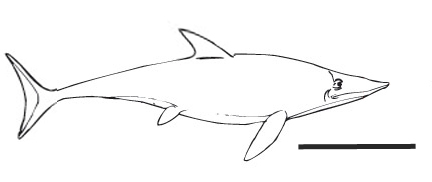
An Illustration of a Typical Jurassic Ichthyosaur

Palvennia hoybergeti illustrated

An illustration of the ophthalmosaurid ichthyosaur Palvennia hoybergeti.

Picture credit: Everything Dinosaur

Ichthyosaur Genera

Fossils representing at least six different ichthyosaur genera have provided evidence of live birth in this particular group of reptiles, but until now it had been thought that as these reptiles adapted to a life in the sea, they gradually evolved the ability to give birth in the water rather than having to venture out onto land to lay eggs.  However, a group of Chinese and American scientists, in collaboration with an Italian based colleague, have published a paper on a series of Chaohusaurus fossils that indicate that viviparity may have evolved in the terrestrial ancestors of these animals.

The paper detailing the research work has been published in the academic, on line journal PLoS One (public library of science).

Basal Ichthyosaur Fossil

A field expedition to a fossil quarry that had exposed Lower Triassic strata, yielded over eighty different specimens of the primitive ichthyosaur known as Chaohusaurus  from a marine assemblage, representing sediments laid down in a relatively sheltered, shallow tropical sea.  The fossil site is located in south Majiashan,  near the city of Chaohu in Anhui province, approximately 150 miles east of the Chinese city of Shanghai.  The site had been extensively mapped in 2013 and when the U.S./Sino research team explored a slab of rock with preserved remains of the ray-finned fish Saurichthys contained within it, they discovered the fossilised remains of a female Chaohusaurus and her babies.

The position of the fossilised young indicate that the mother and offspring perished during the act of giving birth and the “head-first” orientation of the baby reptiles suggests that viviparity in these animals was inherited from terrestrial ancestors and not an adaptation to living in the sea.

Viviparity Inherited from Terrestrial Ancestors

The scientists which include researchers from the University of California, the Field Museum (Chicago), Peking University and Anhui Geological Museum, have stated how important these fossils are, as very few fossils of primitive, Early Triassic ichthyosaurs are known.  It is hoped that these specimens will help scientists to understand in more detail the transition from terrestrial reptiles to fully adapted marine animals.  The strata has been dated to around 248 million years ago and this indicates that ichthyosaurs were already very well adapted to marine habitats not long after the Permian mass extinction event.

Other fossils of Ichthyosaurs which are believed to show animals that died during the process of giving birth show babies emerging from the mother tail first.  This the usual orientation seen in the majority of air breathing marine vertebrates as being born tail first avoids suffocation.  However, in land-based animals that are viviparous, being born head-first is the norm.

The Slab of Chaohusaurus Ichthyosaur Fossil Material (Mother and Babies)

Chaohusaurus fossil specimen (maternal specimen)

Chaohusaurus fossil specimen (maternal specimen).

Picture credit: PLoS One/Motani et al

The picture on top is the actual fossil slab, with a colour coded interpretation shown underneath.  Elements coloured black are the back bones of the mother.  The bones coloured blue represent a hind flipper and part of the pelvis of the mother, whilst embryos number one and two are coloured yellow and orange.  The bones coloured red indicate other material from new-born ichthyosaurs.  The bones coloured green are the ribs and gastralia of the maternal specimen.   The scale bar provided measures one centimetre.

Live-bearing Marine Reptiles

Commenting on the research Dr Motani (University of California), one of the lead authors of the scientific paper stated:

“We always assumed that live-bearing in marine reptiles evolved after they invaded the sea, partly because of this difference [evidence to suggest tail-first births].  Now the new fossil shows that the most primitive marine reptile gave birth head first.  This strongly suggests that they inherited live-bearing from their land ancestors.”

Perhaps one of the most famous examples of ichthyosaur live birth comes from Germany.

An Image Showing “Tail-First” Live Birth in Ichthyosauria

CollectA Temnodontosaurus platyodon model.

Detailed ichthyosaur figure. Temnodontosaurus platyodon.

Picture credit: CollectA

The picture above shows a Jurassic ichthyosaur model (Temonodontosaurus) in the act of giving birth. The baby is emerging from the mother tail first.

To view the CollectA range of not-to-scale models and figures: CollectA Prehistoric Life Figures.

The scientific paper: “Terrestrial Origin of Viviparity in Mesozoic Marine Reptiles Indicated by Early Triassic Embryonic Fossils” by Ryosuke Motani, Da-yong Jiang, Andrea Tintori, Olivier Rieppel and Guan-bao Chen published in PLoS One.

Go to Top