All about dinosaurs, fossils and prehistoric animals by Everything Dinosaur team members.

Fossil finds, new dinosaur discoveries, news and views from the world of palaeontology and other Earth sciences.

5 04, 2014

New Research Reveals Earliest Cardiovascular System in Study of Unique Cambrian Animal

By |2024-05-02T09:54:34+01:00April 5th, 2014|Categories: Dinosaur and Prehistoric Animal News Stories, Palaeontological articles|0 Comments

Oldest Known Cardiovascular System Identified – Fuxianhuia protensa

The fossil of an arthropod found in rocks laid down around 520 million years ago with an exquisitely preserved cardiovascular system has been described by a team of scientists led by researchers from the Natural History Museum in London.  The specimen represents the oldest known fossil showing a rudimentary heart and blood vessels known to science.

Burgess Shale and Other Remarkable Fossil Sites

Thanks to remarkable fossil sites such as the Burgess Shale deposits in British Columbia and beautifully preserved remains of Cambrian creatures from highly fossiliferous strata from south-western China, palaeontologists have built up an astonishing amount of data on life in the seas and oceans of the world around 520 to 500 million years ago, a period in the geological history of planet Earth known as the Cambrian explosion due to the range and diversity of organisms that had evolved at that time.

The exquisitely preserved specimen represents Fuxianhuia protensa from the Middle Cambrian aged strata of the Chengjiang Formation (the Moatianshan shales of Yunnan Province, south-west China).  Fossils of this shrimp-like creature are very common in these marine shales, sixteen different phyla that have been identified from the Chengjiang Formation, a location that rivals the Burgess Shales in terms of the rich fossil record that has been preserved, although the material from the Chengjiang Formation is slightly older than the fossils from the Walcott Quarry section of the Burgess Shale deposits.  Until this particular specimen had been studied, it has been assumed that most of the internal organs of early arthropods would not survive the fossilisation process.

Fuxianhuia protensa

Some fossils had been found that indicated the presence of a digestive tract and back in October 2013, Everything Dinosaur reported the discovery of an arthropod (Alalcomenaeus spp.) from the same region of Yunnan Province that showed signs of a brain and the soft tissue preservation of a nervous system, here we report on the discovery and mapping of a complete cardiovascular system in a 520-million-year-old arthropod.

To read more about this earlier discovery: Ancient Arthropod Brain and Nervous System Studied.

Although many fossils of F. protensa are known, its taxonomic position with the Arthropoda remains unclear, it is thought to be a basal member of this phylum, which today is the largest phylum of animals and includes crustaceans, insects, spiders, mites, scorpions, centipedes, king crabs millipedes and a number of extinct Orders such as the Trilobita.

The external skeleton is most commonly preserved, either as parts shed as the animal grew or as complete specimens that represent animals that died, however, due to the exquisite degree of preservation in some specimens from the Chengjiang Formation, scientists now have a much better understanding of the internal anatomy of early arthropods.  What is remarkable, is that sophisticated cardiovascular and nervous systems seem to have evolved in the Arthropoda at an early stage in the history of life on Earth.

Fuxianhuia Fossils that have been used in the Study

Cardiovascular system in 520 million year old Arthropod preserved.

Cardiovascular system in 520-million-year-old arthropod preserved.

Picture credit: Journal of Nature Communications

Fossil Examples

The photograph shows examples of the F. protensa fossil material used in the study.  Diagram (a) is a view of specimen YKLP 11336 from above (dorsal view), the location of the digestive tract running down the centre of the body is indicated by the black arrows.

Illustration (b) shows the head and the front of the animal (anterior view), specimen number YKLP 11337, the white arrows indicate the mouth of the creature.  Part (c) shows the filled gut within the abdominal segments, the gut has been preserved as carbon in this specimen (YKLP 11338).  Diagram (d) shows empty gut area marked by arrows in abdominal segments Ab9 to Ab14.

Diagram (e) shows the preserved outline of the cardiovascular system (YKLP 11335), A1 in the photograph marks the position of the left antenna and ey marks the position of the right eye.  The black triangles towards the top of the picture indicate the position of the bottom portion of the animal’s headshield.  The white outlined triangles towards the bottom of photograph (e) show the end of the thorax portion of the animal’s body.

Scale Bars

Most complete specimens of F. protensa are around 30 mm in length, the scale bars in the photographs are:

(a) = 5 mm

(b, c and d) = 1 mm

(e) = 4 mm

Commenting on the significance of this fossil discovery, palaeontologist Xiaoya Ma (Natural History Museum, London), one of the authors of the scientific paper published in the journal “Nature Communications” stated:

“It is an extremely rare and unusual case that such a delicate organ system can be preserved in one of the oldest fossils and in exquisite detail.  However, under very exceptional circumstances, soft tissue and anatomical organ systems can be preserved as fossils.”

The Internal Anatomy of an Ancient Arthropod

Scientists now have an excellent understanding of the internal organisation of the anatomy of this arthropod.  Usually, soft tissue decays rapidly after death and fossils typically only preserve the hard parts of an organism, such as the exoskeleton in the case of the Arthropoda.  With Fuxianhuia protensa the fossils show a tubular heart in the middle of the body with a complex system of blood vessels leading to the creature’s antennae, eyes, brain and limbs.

The cardiovascular system consists of the heart and the blood vessels.  It allows blood to circulate and to deliver oxygen and nutrients around the body.  Most higher forms of life in the Kingdom Animalia have such a system, although those organisms without a real body cavity such as flatworms and jellyfish do not.

The specimens studied suggest that as early as 520 million years ago, arthropods had evolved a complex internal anatomy which is very similar in structure to the internal anatomy found today in extant arthropods such as shrimps.

The Chengjiang Formation

Like the Burgess Shales, the Chengjiang Formation material has preserved much of an ecosystem that thrived in a shallow marine environment more than half a billion years ago.  It seems that these two ancient environments suffered much the same fate as each other even though just like today, in the Cambrian, these two locations were thousands of miles apart.  Both the Burgess Shale Formation and the Chengjiang Formations represent shallow marine environments which were on slopes.

From time to time mudflows, buried entire ecosystems and as a result, a wealth of organic material has been preserved.  A large number of Fuxianhuia fossil material is known from Yunnan Province, scientists believe that this Arthropod was benthic (living on the sea floor), although it is not known whether this animal was an active hunter or a scavenger.

A Schematic Diagram of the Internal Anatomy of Fuxianhuia protensa

Digestive tract and cardiovascular system of Fuxianhuia protensa

Digestive tract and cardiovascular system of Fuxianhuia protensa.

Picture credit: Journal of Nature Communications

The Anatomy of F. protensa

The diagram above shows the internal anatomy of F. protensa.  Diagram (a) shows the cardiovascular system (red) shown in relation to the brain and central nervous system (blue).  Diagram (b) shows the whole reconstruction, with brain and segmental ganglia (blue) overlaid against the external skeleton of the animal.  Diagram (c) shows the cardiovascular system in relation to the digestive tract (green).  In all three diagrams, the tubular heart organ can be seen running down the central region of the thorax.

Thanks to highly detailed fossils from British Columbia and south-western China, scientists have been able to acquire a lot of knowledge about life in the oceans of the world during the Cambrian geological period.  Although, advanced and highly evolved cardiovascular systems were present in many organisms, the paucity of the fossil record that pre-dates the Cambrian prevents scientists from calculating when key structures such as hearts and brains first evolved.

Given the degree of sophistication seen in the Fuxianhuia material two competing theories have been put forward.  Firstly, such specialised internal structures such as hearts, brains and a cardiovascular system must have evolved gradually with incremental changes many millions of years before the Cambrian.  Secondly, the evolution of such specialised internal organs occurred relatively quickly in response to the development of predator/prey interactions and the increased availability of food resources.

The research team are able to conclude that organisms had cardiovascular systems before Fuxianhuia, but evidence of lacking in the fossil record so no further light on the subject can be cast for the time being.

The genus name Fuxianhuia is after Lake Fuxian in Yunnan Province, the specific or trivial name “protensa” means “elongated” a reference to the elongated thorax of the creature.

For replicas and models of Palaeozoic creatures including invertebrates: CollectA Prehistoric Life Models and Replicas.
1 04, 2014

Digitally Reconstructing a Famous Dinosaur Trackway

By |2023-03-11T17:48:06+00:00April 1st, 2014|Categories: Dinosaur and Prehistoric Animal News Stories, Dinosaur Fans, Palaeontological articles|0 Comments

Dinosaur Tracks Lost to Science for Decades Recreated Using Digital Technology

A set of dinosaur tracks, one from a large sauropod dinosaur, the second set from a meat-eating dinosaur, have been digitally recreated permitting scientists to study the complete tracks for the first time in more than seventy years.  The footprints, which cover a distance of approximately forty-five metres, are part of a number of dinosaur trackways preserved in near marine sediments that were laid down between 113 and 110 million  years ago (Cretaceous geological period).  The theropod dinosaur’s three-toed prints overlie the larger sauropod prints and this indicates that the large herbivorous dinosaur passed first, perhaps the carnivore was stalking the sauropod.

“Dinosaur Chase Tracks”

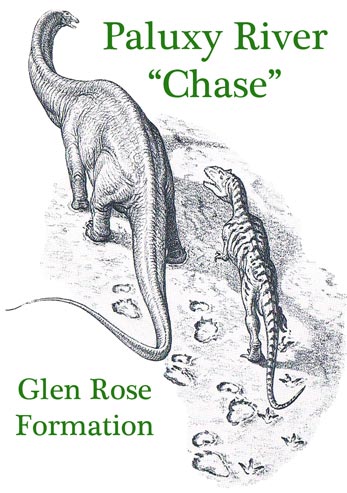
The tracks, now forming part of the bed of the Paluxy River in Texas are often referred to as the “dinosaur chase tracks”, although scientists cannot be certain whether or not the theropod was stalking its prey.

The Famous Dinosaur “Chase” Tracks (Paluxy River, Texas)

Famous dinosaur tracks - Theropod and Sauropod tracks.

Famous dinosaur tracks – theropod and sauropod tracks.

Picture credit: Everything Dinosaur from original artwork by John Sibbick

The picture above shows a potential interpretation of the Paluxy River tracks, with the huge, plant-eating dinosaur being stalked by the bipedal, theropod dinosaur.  It is difficult to assign a genus to these dinosaur footprints, but it has been speculated that the theropod may have been a member of the Acrocanthosaurus genus, as fossils of this large predator have been found in similar aged rocks and a dinosaur bone from the Glen Rose Formation, has been assigned to Acrocanthosaurus.

Famous Dinosaur Trackway

Using a technique called photogrammetry, scanning and combining photographs taken during research at the location back in the 1940s, the scientists were able to build a digital model of the site.  The computer model created is the only complete record available to study as some of the physical tracks themselves have been lost.

The Paluxy River dinosaur tracksite is among the most famous in the world.  In 1940, Dr Roland T. Bird, a American palaeontologist from the American Museum of Natural History (New York), described and excavated a portion of the site containing associated theropod and sauropod trackways, the so-called “dinosaur chase tracks”.  As the river flow was in danger of completely eroding away the dinosaur footprints, it was decided to remove the tracks in a serious of carefully excavated blocks.

The trackway was thus broken up into a number of sections.  Split up as it was, the fossil specimens were housed in different museum collections and over the years the slabs have deteriorated and a portion of the track has been lost.

International Research Team

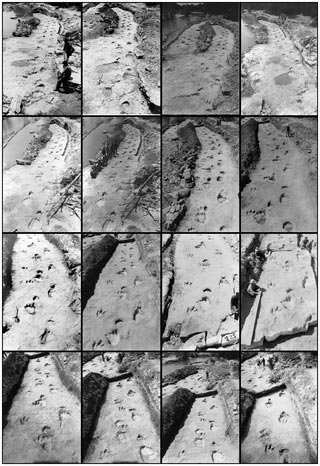
The research team, which included scientists from Liverpool University, the Royal Veterinary College (London) and Indiana-Purdue University, Indiana, applied state-of-the-art photogrammetric techniques to seventeen black and white photographs of the tracks that had been taken by Dr Bird during the 1940 trace fossil study.  By producing highly detailed scans of the original photographs and their corresponding negatives the researchers were able to digitally reconstruct the site prior to its fateful excavation.

Furthermore, the three-dimensional study was able to corroborate sketches drawn by Dr Bird when the trackway was first scientifically described.

Sixteen of the Photographs from the 1940 Expedition Used to make the 3-D Digital Map

Some of the original photographs used to create the 3-D image.

Some of the original photographs used to create the 3-D image.

Picture credit: PLOS One

This new mapping technique demonstrates the exciting potential for digitally recreating palaeontological, geological, or archaeological specimens that have been lost to science, but for which photographic documentation still exists.

Dinosaur Footprints

Using dinosaur footprints made back in the Aptian/Albian faunal stage of the Cretaceous, this work has dramatically illustrated the potential for the technique of historical photogrammetry, permitting the creation of highly detailed and precise 3-D maps of sites that may have been physically lost and just preserved in photographs.  In this instance, the last time the set of dinosaur tracks was complete was back in 1940 prior to the removal of the footprint blocks.

Commenting on the significance of this study, lead researcher Dr Peter Falkingham (Royal Veterinary College) stated:

“Here we’re showing that you can do this to lost or damaged specimens or even entire sites if you have photographs taken at the time.  That means we can reconstruct digitally, and 3-D print, objects that no longer exist.”

31 03, 2014

The World’s Most Northerly Dinosaurs Identified in New Study

By |2024-05-02T09:59:27+01:00March 31st, 2014|Categories: Dinosaur and Prehistoric Animal News Stories, Dinosaur Fans, Geology|0 Comments

Duck-Billed Dinosaur Bone from Axel Heiberg Island

Much has been discovered about the northern ranges of Late Cretaceous dinosaurs over the last two decades or so.  Palaeontologists now recognise that during the last few million years of the Cretaceous geological period a number of different dinosaur genera adapted to living at high latitudes, year round residents of territory which today is well within the Arctic Circle.  There have been a number of important fossils finds at locations such as those from the Prince Creek Formation (North Slope Borough, Alaska), only recently a new genus of pygmy tyrannosaur was scientifically described – Nanuqsaurus hoglundi.

Northerly Dinosaurs

To read more about this new tyrannosaur: The “Polar Bear” Tyrannosaur.

Although the climate was much milder, the weather at these very high latitudes would have been seasonally extreme.  There would have been long periods of total darkness with the sun never ascending over the horizon with snow falls and temperatures close to or below freezing for prolonged periods.  In the summer, the high latitude would have have guaranteed twenty-fours of daylight for a number of weeks and the overall climate, based on studies of plant fossils and pollen suggests an environment similar to the state of Oregon in the United States or perhaps British Columbia (Canada).

Prince Creek Formation

The fossils found in the Prince Creek Formation are certainly important, but they do not represent the most northern dinosaur discovery to date.  That honours goes to a single, fossil bone found during a geological survey of the remote Axel Heiberg Island in 1992.  Axel Heiberg Island is seventy-nine degrees north and is one of the larger islands of the Canadian Arctic Archipelago.  It is uninhabited, although some research teams set up seasonal summer camps.

The highly abraided dinosaur bone was determined as being a hadrosaurine veretebra (back bone), although the genus remains uncertain.  It was found in the Kanguk Formation which consists of marine strata laid down during the Late Cretaceous.  A number of other vertebrate fossils have also been found but to date only one dinosaur bone.  It is likely that this fossil was deposited during the Campanian faunal stage of the Late Cretaceous (around 83 – 74 million years ago).

The Canadian Arctic During the Campanian

During the Campanian, the eastern Canadian Arctic was likely isolated both from western North America by the Western Interior Seaway and from more southern regions of eastern North America by the Hudson Seaway.  This fossil suggests that large-bodied hadrosaurid dinosaurs may have inhabited a substantial polar insular landmass during the Late Cretaceous, where they would have lived year-round.  Being effectively marooned on the land mass, these dinosaurs were unable to migrate southwards  to escape the worst of the winter weather.

It is possible that the resident herbivorous dinosaurs could have fed on non-deciduous conifers, as well as other woody twigs and stems, during the long, dark winter months when most deciduous plant species had lost their leaves and others would have died back due to the lack of sunlight.

It is likely that other dinosaur fossil discoveries await on the islands that make up the Canadian Arctic Archipelago, however, the difficulty in reaching them, the extreme climate and the lack of a road network or suitable airstrip means that much more research has been carried out in Alaska than on the islands of the high Arctic.  Palaeontologists are confident that further research will establish a rich and diverse Late Cretaceous ecosystem that was dominated by dinosaurs.

For models and replicas of Late Cretaceous dinosaurs and other prehistoric animals: Mojo Fun Prehistoric and Extinct Models.

26 03, 2014

New Data on Mesozoic CO2 Levels Can Help Map Today’s Climate Change

By |2023-03-11T15:50:34+00:00March 26th, 2014|Categories: Dinosaur and Prehistoric Animal News Stories, Geology, Palaeontological articles|0 Comments

Mesozoic CO2 Levels Much Higher than Today

A new study published by University of Utrecht researchers and published in the “Proceedings of the National Academy of Sciences” suggest that for much of the Mesozoic, carbon dioxide levels in the Earth’s atmosphere were much higher than they are today, even with global warming caused by greenhouse gases such as higher levels of CO2.  Earlier studies had come to similar conclusions but this new research suggests that at the onset of the Triassic and into the Jurassic global CO2 levels could have been as much as five times their current levels.

Mesozoic

The new methodologies used to model the ancient CO2 levels could have implications for how climatologists plot changes in our environment as CO2 levels rise.

Scientists have known for some time that a large amount of volcanic activity results in more CO2 being released, but with previous analytical methods, it had been tricky to weigh up all the variables and to come up with an overall assessment of CO2 concentrations.

Lots of CO2 Around in the Mesozoic with the Dinosaurs

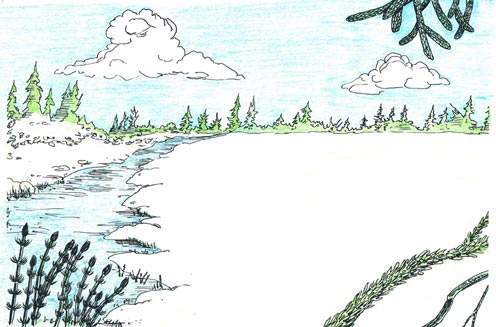
A warm and humid Earth back in the early Mesozoic.

A warm and humid Earth back in the early Mesozoic. Picture credit: Everything Dinosaur.

Picture credit: Everything Dinosaur

As the Mesozoic progressed so the super-continent of Pangaea began to break up into two smaller landmasses, essentially Laurasia in the Northern Hemisphere and Gondwana further south.   The huge amount of plate movements led to extensive subduction and a great deal of volcanic activity.  It was this volcanism that drove the release of CO2 into the Earth’s atmosphere, thus leading to a “greenhouse” world which was warm and humid and the dinosaurs thrived in.

CO2 Levels in the Atmosphere

Lead author of this new study, geoscientist Douwe van der Meer, (Utrecht University), explained that previous research had led to widely varying amounts of CO2 in the atmosphere, making such work of limited use when trying to model current climate change.

The Utrecht University research team used a state-of-the-art imaging technique called seismic tomography to reconstruct 250 million years of volcanic CO2 emissions.  Seismic waves were analysed as they travelled through the rock layers that make up the Earth’s crust, this gave the team the opportunity to create a model of the structure of the Earth’s interior.

For dinosaur models, clothing and toys: Visit Everything Dinosaur.

Lead author, van der Meer stated:

“This method is comparable to CT scans used in hospitals to image inside bodies.  With sufficient earthquake wave travel times, we can create a velocity model of the Earth.  Faster regions are more dense, colder material plates that sank into the Earth as a result of subduction processes due to plate tectonics.”

Carbon dioxide is not the only greenhouse gas.  Herbivorous dinosaurs may have played an indirect role in global warming by producing a lot of methane as they digested large amounts of plant matter.

To read an article about the role of sauropod dinosaurs in global warming: The Winds of Change – Methane Produced by Dinosaurs May Have Led to Global Warming.

25 03, 2014

Nanuqsaurus hoglundi – An update on “Polar Bear Lizard”

By |2023-03-11T15:47:47+00:00March 25th, 2014|Categories: Dinosaur and Prehistoric Animal News Stories, Dinosaur Fans, Palaeontological articles|2 Comments

Nanuqsaurus hoglundi – Tyrannosaur from the High Arctic

Earlier this month, an academic paper was published on a newly discovered tyrannosaur which once roamed the very far north of an ancient Cretaceous strip of land called Laramidia.  This new dinosaur might only be known from a few fragmentary fossils, fossils which were overlooked at the time they were first found back in 2006, but it is believed that this member of the tyrannosaurine may have been very closely related to T. rex.

Nanuqsaurus hoglundi

Named Nanuqsaurus hoglundi the fossils of this predatory dinosaur were found in a well-known horned dinosaur excavation site more than five hundred kilometres inside the Arctic Circle.  The site is called Kikak-Tegoseak and it represents Upper Cretaceous deposits that form part of the extensive Prince Creek Formation in North Slope Borough, Alaska.  The fossil material consists of three disarticulated pieces of skull including elements from the front of the jaw.  These pieces were found in close proximity to each other and are believed to represent fragments from the same skeleton.

Comparison with Other Tyrannosaurs

Based on comparisons with better known tyrannosaurs, this dinosaur is believed to have been a “pygmy tyrannosaur”.  It bucks the trend seen in tyrannosaurids known from the Maastrichtian faunal stage of the Cretaceous, when if anything, the tyrannosaurs roaming North America at the very end of the Cretaceous period tended to be bigger than their forebears from the Campanian faunal stage.

The Fossil Material Discovered to Date – Nanuqsaurus hoglundi 

The fossil material.

The fossil material.

Picture credit: PLOS One

Diagram A indicates where on the tyrannosaur skull the three pieces of fossil would be located.  The actual shape of the skull is based on more complete specimens.  The research team led by Dr Anthony Fiorillo and Dr Ronald Tykoski of the Perot Museum of Nature and Science in Dallas, Texas came across the fossils in 2006 when trying to locate more material related to a horned dinosaur, one that would turn out to be a new species of Pachyrhinosaurus (P. perotorum).

It was only later, back in the preparation laboratory that the scientists realised the importance of their discovery.

To read more about the discovery of the third species of pachyrhinosaur: New Species of Polar Horned Dinosaur is Announced.

The Tyrannosaur Family Tree

This latest edition to the tyrannosaur family tree, measured around six metres in length.  It was approximately half the size of its more illustrious cousin from the south, Tyrannosaurus rex.  The name Nanuqsaurus hoglundi  is derived from the local dialect for Polar Bear, a reference to the fact that as far as any one knows, this dinosaur was the apex predator in the environment.  The specific or trivial name honours Forrest Hoglund in recognition of his career in the Earth Sciences and his work to help fund the Perot Museum.

A team member from Everything Dinosaur commented:

“Although this part of the world was not as cold back in the Late Cretaceous as it is now, Nanuqsaurus lived in a high-latitude continental environment with seasonal extremes.  It may have been covered in a thick, coat of shaggy feathers, helping to insulate this dinosaur from the worst of the winter weather.”

The team member went onto state:

“For a significant amount of the year, the sun would not have risen above the horizon, its world would have been a very dark place, which explains why analysis of the skull material discovered to date suggests that this predator had a powerful sense of smell.  Helpful when you live in a world of almost perpetual twilight for much of the year.”

Everything Dinosaur’s Illustration of Nanuqsaurus hoglundi

Potentially a very, shaggy coated Tyrannosaur!

Potentially a very, shaggy coated tyrannosaur!

Picture credit: Everything Dinosaur

The academic paper’s authors have suggested the smaller body mass of Nanuqsaurus hoglundi compared to other Late Cretaceous tyrannosaurs may reflect an adaptation to the fluctuating amount of food resources available in its Arctic environment.  In the summer, when daylight was almost constant, it is likely that large numbers of herbivorous dinosaurs migrated northwards up Laramidia to take advantage of the huge amounts of plant food available.

For models and replicas of members of the Tyrannosauroidea: CollectA Age of Dinosaurs Popular Models.

As the days grew shorter, the carnivores had much slimmer pickings as many prey animals probably moved out of the area.  Of course, this is just speculation, this tyrannosaur may have migrated northwards from lower latitudes following the herds of herbivores.

The diversification of the Dinosauria in this part of the Americas at the end of the Cretaceous may stem from the partial isolation of the very northernmost parts of Laramidia with the pushing up of a mountain range (the Brooks Range), which may have cut-off part of the north of Laramidia during the Late Campanian faunal stage.

A Comparison of Nanuqsaurus hoglundi with other Tyrannosaurs

N. hoglundi compared to other Tyrannosaurs and predators from the Arctic.

N. hoglundi compared to other Tyrannosaurs and predators from the Arctic.

Picture credit: PLOS One

The diagram above compares N. hoglundi with T. rex (B – Sue from the Field Museum), a second Tyrannosaurus rex from the American Museum of Natural History (gracile form) – (C).  Other theropods depicted include Daspletosaurus torosus (D) and Albertosaurus sarcophagus (E).

The other two theropods featured in the diagram above are not tyrannosaurs.  The discovery of a “pygmy tyrannosaur” has intrigued a number of palaeontologists who are trying to build up a detailed picture of the fauna at the “top of the world” during the Late Cretaceous.  Back in 2008, Dr Fiorillo discovered some super-sized troodontid teeth from the Colville River area.  The Alaskan fossils represented animals that were 1.5 times bigger than the Troodons known from more southerly latitudes.  In the diagram, Troodon formosus is represented by (F), the much large Troodon species from Alaska is (G).

In the diagram the scale bar equals 1 metre.

Why should we have much larger Troodon type predators yet evidence of a “pygmy” tyrannosaur living in the same environment?  A number of theories have been proposed.  Perhaps the proportionately larger eyes of the troodontids enabled them them to hunt larger prey than their southern cousins which did not have the predatory advantage of all that darkness.

24 03, 2014

Man Charged over Dinosaur Footprint Theft In Utah

By |2023-03-11T15:41:43+00:00March 24th, 2014|Categories: Dinosaur and Prehistoric Animal News Stories, Main Page, Palaeontological articles|0 Comments

Man Charged with Stealing Fossilised Dinosaur Footprint

A grand jury has charged a resident of the town of Moab (Grand County, eastern Utah), with four federal offences related to the theft and subsequent loss of a fossilised dinosaur footprint from Bureau of Land Management administered land.  Thirty-five year old, Jared Frederick Ehlers has been indicted on one count each of removal of palaeontological resources, depredation of government property, destruction of evidence and theft of government property.

Dinosaur Footprint

The motive for the removal of the three-toed dinosaur footprint from a sandstone ridge near to the Hell’s Revenge off-road jeep trail and the alleged subsequent dumping of the fossil in the Colorado river remains unclear, however, given the high prices the sale of such fossil material can fetch on the black market, it is suspected that the fossil was stolen for commercial gain.

Staff have been monitoring the progress of the investigation closely since Everything Dinosaur team members carried the story of the fossil theft on this blog back on February 22nd.

To read about the fossil theft: Dinosaur Footprint Stolen in Utah.

Fossil Theft

Over the weekend of 8th/9th March, Utah State officials organised a dive team to search an area of the Colorado River as it was believed that the fossil specimen had been thrown into the water from the Dewey Bridge but despite an intense search the fossil was not retrieved.

Explaining how difficult it was to search the riverbed, Grand County Sheriff Steven White stated:

“You’re searching by Braille, everything is by hand.  You have zero visibility, you’re dealing with changing currents, you’re dealing with obstacles.  It was very hazardous diving conditions.”

The river search was instigated after a suspect came forward and informed State officials where the 190 million year old, Early Jurassic print had been allegedly dumped.  It remains unclear as to whether this person was Jared Ehlers.

Facing Prosecution

Ehlers is facing prosecution under the Paleontological Resources Preservation Act, (American spelling), a law that was passed by the United States Government to help prevent the theft of fossils from public land and to prosecute any person or persons who vandalises fossils.  Violators face civil and criminal penalties including fines and possible incarceration.

Moab Man Charged with Four Federal Offences Related to Fossil Footprint Theft

Jared Ehlers facing four federal charges over alleged fossil theft

Jared Ehlers facing four federal charges over alleged fossil theft.

Picture credit: Grand County Jail

A Maximum Prison Sentence of Twenty Years

The most serious count, that Elhers is facing, the destruction of evidence, carries a maximum prison sentence of twenty years.  The other three counts carry a maximum prison sentence of between five and ten years.  No date has been set yet for Mr Ehler’s first court appearance, if he is convicted on all four counts, he could face a maximum possible sentence of forty-five years in prison.

A spokes person from Everything Dinosaur commented:

“The federal authorities are to be congratulated for the swift and speedy way in which they have pursued this case.  However, the fossil specimen itself remains lost and as it is sandstone, it will quickly begin to erode and abrade if it remains in the river.  At this juncture, it is very hard to say whether or not the fossil will ever be recovered.  Even if the fossil is found, it may be virtually destroyed as a trace fossil.”

Visit Everything Dinosaur’s award-winning website: Dinosaur Toys, Models and Games.

23 03, 2014

Dr Phil Manning to Present at the Famous Bollington Science Festival

By |2024-05-02T10:06:30+01:00March 23rd, 2014|Categories: Dinosaur and Prehistoric Animal News Stories, Famous Figures|0 Comments

Cayman Caves to Badland Dinosaurs: Dr Phil Manning

Dr Phil Manning from Manchester University’s School of Earth, Atmospheric and Environmental Sciences, will once again be presenting at the forthcoming Bollington Festival which takes place in May.  Dr Manning who heads up the palaeontology research group at the School of Earth, Atmospheric and Environmental Sciences has had a very busy year and his talk will focus on his travels over the last twelve months or so.

Bollington Science Festival

Entitled “Cayman Caves to Badland Dinosaurs”, Dr Manning will discuss giant rats from the Cayman Islands as well as the continuing work on a number of Upper Cretaceous dinosaur fossils from the rugged, exposed outcrops of South Dakota.

The last time we caught up with Phil was when he was in America, at the “Duelling Dinosaurs of Montana” auction.  He was lobbying to try to ensure whoever purchased this remarkable pair of dinosaur fossils, that the specimens would be made available for further study.

To read more about the auction of the “Duelling Dinosaurs”: D-Day for Duelling Dinosaurs.

Dr Manning was busy with a number of media commitments, enthusiastically talking about the importance to science of these two dinosaur fossils.  He was even interviewed on the Simon Mayo radio 2 programme about this particular fossil discovery.  An excellent and engaging communicator, the talk, which is scheduled for Thursday 29th May (7.30 pm start) and will take place at the Bollington Civic Hall and it is bound to be one of the highlights of the whole of the Bollington Festival.

Tickets on Sale

Tickets for this event are priced at just £3 for adults and £1 for children.  The talk will be suitable for age 11+ and no doubt members of the audience will get the chance to ask questions at the end of the presentation.

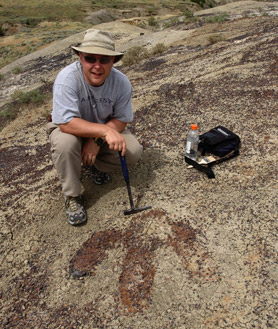
Dr Phil Manning Examining a Theropod Footprint

Potential Tyrannosaurid Print

Potential tyrannosaurid print.

Picture credit: Dr Phil Manning (Manchester University)

The Bollington Festival covers a wide range of topics aimed at participants of all ages.  Themes which are extremely varied from flamenco, to brass bands, literature to comedy and it has a number of science events crammed in amongst the one hundred or so planned performances.  The festival is celebrating its fiftieth year and with the likes of Dr Phil Manning talking about dinosaurs it is bound to be another “roaring success”.

Visit Everything Dinosaur’s website: Everything Dinosaur.

22 03, 2014

Putting the “Chicken from Hell” into Context

By |2023-03-11T15:31:50+00:00March 22nd, 2014|Categories: Dinosaur and Prehistoric Animal News Stories, Palaeontological articles|0 Comments

Anzu wyliei – Probably Feathered and an Omnivore from the very end of the Cretaceous

With the publication of the scientific paper on the newest member of the very bird like Oviraptorosauria published this week in the on line journal PLoS One (Public Library of Science),  team members at Everything Dinosaur attempt to put the discovery of the “chicken from Hell” into context.  The dinosaur has been named Anzu wyliei and this genus has been erected based on the fossils of three individual dinosaurs discovered in Upper Cretaceous deposits of North and South Dakota (United States).

The fossil sites are around fifty kilometres apart and they represent a dinosaur, whose presence in the Hell Creek Formation (Maastrichtian faunal stage) had long been suspected but these fossils provide definitive proof that such creatures roamed the western United States at the end of the Cretaceous.

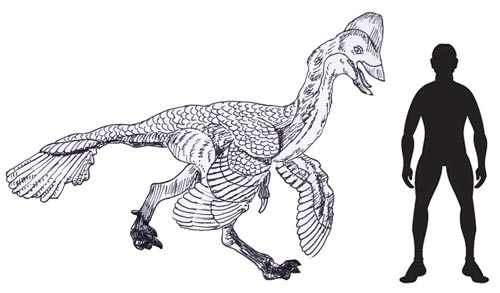
A Scale Drawing of Anzu wyliei

Anzu wyliei scale drawing.

A scale drawing of Anzu wyliei. Picture credit: Everything Dinosaur.

Picture credit: Everything Dinosaur

Oviraptorosaurs

Most discoveries of oviraptorosaurs have been made in Asia, most notably in China and Mongolia.  Much of what has been inferred about A. wyliei has been based on comparisons with Asian Oviraptors, even though the remains of the three individuals when combined together represent about 80% of the total skeleton.  For example, Anzu wyliei has been pictured as a feathered dinosaur, although no fossilised feathers have been associated with the Hell Creek Formation specimens.

The covering of a shaggy coat of feathers is inferred, as a result of Asian specimens preserved in finer grained matrices which have permitted feather preservation.  The discovery of skull material, including a hyper extended premaxilla indicates that this dinosaur had a large rounded crest on the top of its skull.  This feature is common to a number of Oviraptor genera.

An Illustration of Anzu wyliei

Scale bar = one metre

Scale bar = one metre.   A skeletal reconstruction of A. wyliei.

Picture credit: PLoS One/Everything Dinosaur

The picture above gives an overall impression of what this new dinosaur species looked like.  The post cranial bones coloured grey represent fossil specimens.  The skull material indicated represents the extent of the fossil material found to date.  The Oviraptorosauria can be split into a number of families, one such family is the Caenagnathidae (the name means “recent jaws” – as the group were originally thought to be a Cretaceous clade of birds). The jaws are very bird-like and these dinosaurs had no teeth.  Intriguingly, compared to other North American members of the Caenagnathidae such as Chirostenotes spp. known from older rocks found in Alberta, Canada (Campanian faunal stage), Anzu wyliei was a real bruiser!

Anzu wyliei

Body mass estimates based on femur (thigh bone) measurements suggest that this dinosaur weighed between 200 and 300 kilogrammes and that it probably stood around 1.5 metres high at the shoulder and had an overall length approaching 3.5 metres.  Some of the Canadian caenagnathines were probably only around 20 kilogrammes in weight when fully grown.

The Reconstructed Skull of Anzu wyliei

A reconstruction of the skull (left side view)

A reconstruction of the skull (left side view).

Picture credit: Donald E. Hurlbert (Smithsonian Institute)

 The American scientists from Utah University, the Smithsonian Institute and the Carnegie Museum of Natural History re-examined the fossil material that had been collected a few years earlier.  Their research helps palaeontologists to piece together a little more about the other types of dinosaur that shared the same environment with more famous dinosaurs like Triceratops and Tyrannosaurus rex.

Phylogenetic analysis suggests that this new species of dinosaur was most closely related to Caenagnathus collinsi (known from Campanian-aged strata from Alberta, Canada).  The fossils have also suggested that A. wyliei and other caenagnathines may have preferred open expanses such as floodplains, as to what they might have been eating way back at the end of the Cretaceous, these animals were probably generalist omnivores.

It is likely that the bulky Anzu wyliei fed on small mammals, insects, lizards, baby dinosaurs and plants.  It may even have specialised in eating the eggs of other dinosaurs.  Scientists have nick-named this dinosaur the “chicken from Hell” a reference to the Hell Creek Formation where the fossils were found.

An Illustration of a Typical Oviraptor

Part of the Carnegie Collectibles Range from Safari Ltd

A typical feathered Oviraptor.

A spokes person from Everything Dinosaur commented:

“This research is extremely important as it helps to fill in the gaps in terms of the smaller, theropods that lived at the very end of the Cretaceous.  These fossils represent some of the youngest Oviraptor fossils discovered to date.”

To view models and replicas including a model of Anzu wyliei (whilst stocks last): Safari Ltd Prehistoric Animal Figures.

13 03, 2014

New Genus of Ancient Crocodile from the Isle of Wight

By |2023-03-11T14:13:34+00:00March 13th, 2014|Categories: Dinosaur and Prehistoric Animal News Stories, Dinosaur Fans|0 Comments

New Genus of Cretaceous Crocodile – Koumpiodontosuchus aprosdokiti

Living alongside Early Cretaceous dinosaurs such as Baryonyx and the giant herbivore Iguanodon was a small crocodile, which probably grew to no more than a metre in length.  It was probably very much at home in water, just like today’s crocodilians but this button-toothed predator, specialised in catching molluscs and arthropods.  Scientists are aware of this newly described genus of ancient crocodile from the Isle of Wight, thanks to serendipity.  From time to time palaeontology gets helped out with an enormous slice of luck.

Cretaceous Crocodile Fossil

Two fossilised skull fragments found in the same location, but by different people and months apart turned out to belong to a single skull from a sixty-centimetre-long crocodile which is new to science.  When experts at the Dinosaur Isle Museum examined the specimens, they found, to their collective amazement that the two pieces fitted together perfectly.

Dr Steve Sweetman has published a paper on the newest member of the crocodile lineage, in the scientific journal “Acta Palaeontologica Polonica.”  It has been named Koumpiodontosuchus aprosdokiti and the name means “unexpected button-toothed crocodile” and pronounced (and we suggest you take a run up with this one), Comp-pee-oh-dont-to-suk-us ap-pros-doe-kee-ti.

The first part of the skull fossil, most of the cranial elements with just the front portion of the snout missing was discovered by holiday maker Diane Trevarthen on a beach near Sandown in March 2011. She took her specimen to the local museum and it was identified as being a crocodile fossil, probably a fossil of the skull of a juvenile from a large crocodile species that had already been described. Three months later, Finley and Austin Nathan found the snout whilst out fossil hunting. When museum staff saw their fossil, somebody must have said snap! Diane was asked to visit the museum with her fossil again and the two pieces of the skull were united.

An Artist’s Reconstruction of Koumpiodontosuchus aprosdokiti

126 million year old "button-toothed" crocodile.

126-million-year-old “button-toothed” crocodile.

Picture credit: Dr Mark Witton

A wonderful illustration by the highly talented Dr Witton, we think those dinosaurs in the background are a pair of Neovenators (N. salerii).

Koumpiodontosuchus aprosdokiti

Dr Sweetman had thought that the specimen represented an example of a crocodilian known from Spain, Belgium and elsewhere in Europe called Bernissartia, but when the fossils were cleaned it was noted that the bones at the back of the skull were very different and this led to a new genus being established.

Dr Sweetman added:

“Both parts of this wonderful little skull are in good condition, which is most unusual when you consider that crashing waves usually batter and blunt the edges of fossils like this within days or even hours of them being washed onto the beach.  Both parts must therefore have been found very soon after they were released from the mud and debris originally laid down on a dinosaur-trampled river floodplain around 126 million years ago.  The sheer serendipity of this discovery is quite bizarre”.

For replicas and models of Early Cretceous prehistoric animals including dinosaurs: CollectA Prehistoric Life Replicas.

10 03, 2014

Diving for a Rare Dinosaur Footprint

By |2024-05-02T10:12:27+01:00March 10th, 2014|Categories: Dinosaur and Prehistoric Animal News Stories, Geology, Palaeontological articles|0 Comments

State Officials Go Diving for a Stolen Dinosaur Footprint

Back on February 22nd, Everything Dinosaur reported on the shocking theft of a three-toed dinosaur footprint that had been stolen from an adventure trail called Hell’s Revenge close to the town of Moab in Grand County (eastern Utah).

The Bureau of Land Management, responsible for the management of the site had said in a statement that the theft of such objects was becoming all too commonplace and an appeal went out to help try to locate the missing theropod dinosaur footprint.

To read the article about the theft: Dinosaur Footprint Stolen in Utah.

We are pleased to say that there have been a number of developments in the case, which might lead to the footprint fossil being recovered.  Over the weekend, officials from the State, organised a dive team to explore an area of river bed downstream of the Dewey Bridge over the Colorado River.  Unfortunately, the divers were unable to locate the missing fossil.

Dinosaur Footprint

Their efforts were hampered by the very poor visibility and the fact that unfortunately, that part of the Colorado river has a very rocky riverbed.  It’s not the easiest of tasks groping around in near zero visibility looking for a rock amongst many hundreds of other rocks.

According to a statement from the Grand County Sheriff’s Office, investigators had identified a suspect but this person’s name was not being released for the moment.  The area of river bed immediately below and just downstream of Dewey Bridge on State Road 128 is being explored as this is where the print is believed to have been dumped.

The dinosaur track which measures around twenty-five centimetres in length is thought to have been stolen sometime around the 17th or 18th of February.  No explanation for the reason for the robbery has been given, but it is known that dinosaur fossils such as this single foot print may fetch very high prices on the black market.

A Reward Offered

The Bureau of Land Management offered a reward for information leading to the identification of the culprit or culprits, other parties such as a group of off-road enthusiasts that use the Hell’s Revenge trail also chipped in and the various rewards offered now total somewhere in the region of $9,000 USD (£5,400 GBP).

Commenting on the loss of the 190-million-year-old theropod footprint, Rebecca Hunt-Foster, a palaeontologist for the Bureau of Land Management stated that this specimen was one of the nicest tracks in the area and that the three-toed print was most probably made by a large, meat-eating dinosaur – a likely ancestor of the Utah State Dinosaur, the Allosaurus.

Locals are incensed about the loss of this fossil.  The area is known for its dinosaur tracks and many visitors to the area come up to the Hell’s Revenge trail to view the evidence of dinosaurs preserved in what is now sandstone, but was once a sandy shoreline next to an early Jurassic lake.

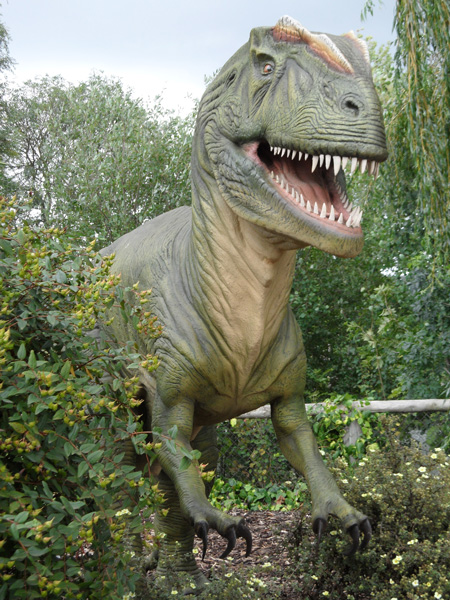
A Picture of the Fearsome Late Jurassic Predator Allosaurus (A. fragilis)

Allosaurus attacks
Allosaurus attacks.

Picture credit: Everything Dinosaur

Team members at Everything Dinosaur wish the Utah State authorities well in their search for the fossil and hopefully this rare and very important dinosaur fossil will be found soon.

Visit Everything Dinosaur’s award-winning website: Dinosaur Toys and Models.

Go to Top