All about dinosaurs, fossils and prehistoric animals by Everything Dinosaur team members.

Fossil finds, new dinosaur discoveries, news and views from the world of palaeontology and other Earth sciences.

29 04, 2014

Fossil Find Provides Information on the Evolution of Herbivores

By |2023-03-12T10:17:26+00:00April 29th, 2014|Categories: Dinosaur and Prehistoric Animal News Stories, Main Page, Palaeontological articles|0 Comments

Earliest Ancestor of Terrestrial Herbivores Discovered

When watching a wildlife documentary it is easy to overlook some fundamental truths about today’s complex ecosystems with their multi-layered food chains.  Lions attacking zebras on the Serengeti, caribou grazing on Arctic lichens and mosses, foxes chasing after rabbits for instance.  We have predators which prey on primary consumers of plant materials, the predator/prey relationship.  However, such complex ecosystems have not been present throughout the history of land vertebrates, back in the days of the very first land animals with backbones ecosystems were populated by carnivores, it seems the ability to digest tough plant materials such as cellulose had to evolve and that herbivory has its roots amongst the meat-eaters.

Fossil Find

Newly published research into the fossil of a reptile discovered in Kansas, by scientists from the University of Toronto Mississauga in collaboration with researchers from Museum für Naturkunde and Humboldt-University (Berlin), had shed light on the evolutionary processes that led to the transition of carnivores into land herbivores.  The specimen which consists of some cranial material from the back of the skull, the backbone, ribs, elements from the pelvic girdle and the right rear limb was collected by Dr Larry Martin, the curator of the Dyke Museum of Natural History, University of Kansas.  Dr Martin was exploring a highly fossiliferous location known as Hamilton Quarry in south-eastern Kansas.  Strata laid down at this site were formed in a tidal environment with changing sea levels.

A diverse variety of fauna and flora has been preserved including many fish species, some amphibians and a few, rare reptiles.   The twenty centimetre long specimen was poorly preserved with those bones exposed in the matrix showing signs of erosion.  To preserve the fossil and to allow it to be properly studied, the fossil was loaned to the Biology Department at the University of Toronto. It was encased in epoxy resin to stabilise it and to permit further cleaning and preparation.  Unfortunately, the acidic solution used to clean the fossil and to reveal important anatomical details dissolved the fine, conical teeth that had been preserved in the jaw.

Photograph and Illustration of the Fossil Material (KUVP 9616b)

Scale bar = 1cm

Scale bar = 1 cm

Picture credit: PLOS One/Reisz RR, Fröbisch J.

The skull material is located in the top right of the image, with the hind limb and the pelvic bones located top left.  The fossil material is believed to represent a juvenile.

Eocasea martini

The little reptile has been named Eocasea martini.  The genus name means “dawn or first Caseidae”, the clade of synapsids that this animal belonged to.  The specific or trivial name honours Dr Larry Martin.  Caseids are an ancient group of terrestrial vertebrates that form part of a larger group known as synapsids.  Synapsids represent a diverse and unusual group of vertebrates, that include the ancestors of modern reptiles and all mammals, plus those reptiles that have closer affinities to Mammalia than they do to extant reptiles, the so-called mammal-like reptiles.  The fearsome Dimetrodon is an example of a synapsid along with the tusked dicynodonts such as Placerias and the ancestors of today’s mammals.

An Illustration of Eocasea martini

Ancient fossil shed light on the earliest ancestors of land herbivores.

Ancient fossil shed light on the earliest ancestors of land herbivores.

Picture credit: Danielle Dufault

A “Ghost Lineage”

The fossil has been dated to around 300 million years ago, (Upper Pennsylvanian of the Carboniferous).  The discovery helps to close a twenty million year gap between E. martini and the next oldest caseid known from the fossil record.  When scientists map the evolution of closely related organisms and find large gaps in the known fossil material, leading back to a very early ancestral form, as in this case, it is referred to as a “ghost lineage”.

Commenting on the significance of the research, Professor Robert Reisz of the Department of Biology at the University of Toronto stated:

“The evolution of herbivory was revolutionary to life on land because it meant terrestrial vertebrates could directly access the vast resources provided by terrestrial plants.  These herbivores in turn became a major food resource for large land predators.”

One of the authors of the paper published in the on line scientific journal PLOS One, Jörg Fröbisch (Museum für Naturkunde and Humboldt-University in Berlin), added:

“Eocasea is one of the oldest relatives of modern mammals and closes a gap of about twenty million years to the next youngest members of the caseid family.  This shows that caseid synapsids were much more ancient than previously documented in the fossil record.”

Analysis of the fossil material indicates that Eocasea martini was a basal member of the caseids, a carnivore feeding on small animals and insects but fossils of caseids dating from the Permian provide clear evidence that terrestrial herbivores evolved from this group’s small, carnivorous members, animals such as Eocasea.

Evidence for Herbivory

The evolution of the ability to consume, process and digest tough plant material is regarded by many scientists as one of the most important developments in the evolution of land living animals with backbones.  Adapting to a diet largely consisting of vegetation requires some modifications to the body plan of an animal, these adaptations can be observed by studying the fossil bones of long extinct creatures.  For example, in order to cope with hard to digest cellulose, the digestive tract tends to get much bigger and a larger, wider body is required to support a bigger gut.  A longer or broader trunk region can be seen in preserved fossils when their skeletons are compared to those of similar sized carnivores.

The body cavity becomes modified to house a bigger digestive tract, which in turn has to house a huge number of symbiotic bacteria to permit the fermentation and and breakdown of plant cells.  Palaeontologists, can therefore identify Palaeozoic herbivores because their rib cages are typically much wider with a bigger capacity than closely related insectivores and carnivores.

 The Wide Body of Edaphosaurus (Herbivorous Pelycosaur)

Wide-bodied Edaphosaurus a herbivorous sail-backed reptile.

Wide-bodied Edaphosaurus a herbivorous sail-backed reptile.

Picture credit: Everything Dinosaur

The image (above) shows a Bullyland Edaphosaurus figure.  To view the range of Bullyland “Prehistoric World” figures including the Edaphosaurus (whilst stocks last): Bullyland “Prehistoric World” Models.

The researchers conclude that Eocasea is one of the first animals to have started the process that would result in the establishment of modern ecosystems, with many plant-eaters supporting fewer types of predator – the start of more complex food chains.

Intriguingly, the research team went onto identify that the ability to digest and process vegetation was not just established in the lineage that includes the caseids, it arose independently at least five times more, including twice in the Reptilia.

Professor Reisz added:

“When the ability to feed on plants occurred after Eocasea, it seems as though a threshold was passed.  Multiple groups kept re-evolving the same herbivorous traits.”

The five groups developed the novel ability to live off plants in staggered bursts with synapsids such as Eocasea preceding reptiles by nearly 30 million years.  This shows that herbivory as a feeding strategy evolved first amongst those synapsids that are the ancestors of the Mammalia.  Our ancestors evolved a taste for plants long before that branch of the terrestrial vertebrates that includes extant reptiles, the dinosaurs and Aves (birds).

Moving onto a plant-eating diet, resulted in a dramatic change in the size of early herbivores over the duration of the Permian geological period.  Four of the five groups showed that as the Permian progressed so herbivores got bigger and bigger.  The age of the super-sized grazer had dawned.  Professor Reisz observed that the caseids showed the most extreme examples of size increase.  The earliest member of the group, the diminutive Eocasea martini probably weighed less than two kilogrammes when fully grown.  Later caseids weighed more than two tonnes, one of the largest known being the enormous, fat bellied Cotylorhynchus whose fossils have been found in the United States.

The research team have stated that the study of Eocasea has led to more questions being asked then answers found.  For example, why didn’t the ability to digest plant material evolve earlier on?  Why did herbivory evolve independently in at least five lineages of vertebrates?

Perhaps there are fossils out there which will shed further light on these mysteries.

28 04, 2014

Pushing the Evolution of the Pterodactyloidea Back in Time

By |2023-03-12T10:16:32+00:00April 28th, 2014|Categories: Dinosaur and Prehistoric Animal News Stories, Dinosaur Fans, Palaeontological articles|0 Comments

Basal Member of the Pterodactyloidea – Kryptodrakon progenitor

Fans of the Pterosauria, that enigmatic Order of reptiles that evolved powered flight and lived alongside the Dinosauria for much of the Mesozoic are in a bit of a flap at the moment.  A newly described, fragmentary pterosaur fossil found in north-west China has pushed back the evolution of the most successful group of pterosaurs, the Pterodactyloidea by another five million years.

At least one hundred and sixty three million years ago, these leathery winged creatures were soaring overhead and the Pterodactyloidea were to radiate and evolve into a huge range of different types of flying reptile.  Something like 120 different genera of Pterodactyloidea have been identified so far.

Discovered in 2001

The fossil was found in 2001, it consists of some pieces from the enlarged fourth digit (the wing fingers) from the right and left wings, elements from the metacarpals, the radius, part of the left humerus and other fragmentary elements including a scapula.  Although, only about 10% of the skeleton was found and no cranial material identified, the length of the fourth metacarpal in relation to the other bones that make up the forelimb places this flying reptile at the base of the pterodactyloid group of pterosaurs.

This group of pterosaurs radiated and diversified throughout the Late Jurassic and into the Cretaceous Period.  They produced a myriad of forms which include the Late Cretaceous Azhdarchidae some of the largest flying creatures known to science with some species standing taller than a modern day giraffe.

The Start of Something Big!

Pterodactyloidea a diverse SubOrder of the Pterosauria.

Pterodactyloidea a diverse Suborder of the Pterosauria.

Picture credit: Everything Dinosaur

A “Dinosaur Death Pit”

The bones were found in a “dinosaur death pit”, red mudstone strata that represents fine sediments, including volcanic ash which acted like “quicksand” trapping many animals and leaving their bodies piled up on top of each other.  Such locations have revealed a “treasure trove” of fossil material, including these largely uncompressed pterosaur bones.  For the international research team involved in the 2001 field study, it would have been quite a odd feeling working in what are virtually vertical bone beds, but the fossil material that has been excavated has provided a rare insight into a rich and diverse Upper to Middle Jurassic terrestrial environment.

To read more about dinosaur death pits from China: Dinosaur Death Pits Reveal Dozens of Fossils.

The fossil comes from the famous Shishugou Formation of Xinjiang Province (north-western China), the scientific paper on this new genus of flying reptile has just been published in the academic journal “Current Biology”.  Lead authors of the paper include University of South Florida palaeontologist Brian Andres, James Clark of the George Washington University and Xu Xing of the Chinese Academy of Sciences.

The specimen is currently stored in the Institute of Vertebrate Palaeontology and Palaeoanthropology (Beijing).  It has taken time to realise the significance of this discovery, at first the fragmentary bones were thought to be that of an unknown species of theropod dinosaur.  The fossils were found in an ash bed some thirty-five metres below a layer of rock that had been dated to 161 million years ago (Bathonian/Callovian faunal stages of the Middle to Late Jurassic).

Commenting on the length of time taken to identify the specimen, a spokes person from Everything Dinosaur stated:

“It is not unusual for ten years or more to pass before a formal scientific description is published.  The wealth of the fossil material being found in China leads to a backlog in the research and the importance of the discovery was not recognised at first.  A basal Pterodactyloid pterosaur was not expected, not many people would have considered this possibility when the fossils were first found and catalogued.”

Kryptodrakon progenitor

The new species has been named Kryptodrakon progenitor.  The genus name means “hidden dragon” a reference to the fact that the martial arts film “Crouching Tiger Hidden Dragon”, directed by Ang Lee and released in 2000 was filmed in the same locality as where the fossils were found.  The trivial or species name means “ancestor”, reflecting the fact that this flying reptile has been ascribed to a basal position in the Pterodactyloidea.

Fossil Material Assigned to Kryptodrakon progenitor

New Pterosaur named after "Crouching Tiger Hidden Dragon" Film.

New pterosaur named after “Crouching Tiger Hidden Dragon” Film.

Picture credit:  Brian Andres

The diagram shows the fragmentary remains of Kryptodrakon progenitor found in the famed “dinosaur death pits” area of the Shishugou Formation in north-western China.  The red mudstone strata from which the fossil was obtained can be seen in the background, the pterosaur skeleton used to give an impression of what this flying reptile may have looked like represents Pterodactylus antiquus (original drawing by Peter Wellnhofer).  The scale bar represents five centimetres.

This pterosaur lived on a flood plain, many miles from the sea. It had been thought that pterosaurs evolved in areas that were close to the sea and that the majority of early pterodactyloid forms were fish-eaters.  The discovery of the fossils of K. progenitor far inland challenges this long held assumption.  It is likely that the first members of the Pterodactyloidea evolved far inland.

Phylogenetic comparative analysis of wing shape supports this theory as the research team support the idea of there being a significant correlation between wing morphology and the environment in which the animal lived.  Such a strong relationship between wing shape and environmental suitability is seen in extant flying vertebrates, this indicates that pterosaurs lived in or were at least adapted to the environments represented by the strata in which their fossils have been preserved.

For models and replicas of pterosaurs and other prehistoric creatures: Schleich Prehistoric Animal Figures.

Dr Clark explained the significance of their fossil discovery:

“Kryptodrakon is the second pterosaur species we’ve discovered in the Shishugou Formation and it deepens our understanding of this unusually diverse Jurassic ecosystem.  It is rare for small, delicate fossils to be preserved in Jurassic terrestrial deposits and the Shishugou fauna is giving us a glimpse of what was living alongside the behemoths like Mamenchisaurus [Sauropod dinosaur].“

27 04, 2014

Smithsonian Institute’s Beautiful Dinosaur Gallery to Close Monday

By |2024-05-01T15:29:52+01:00April 27th, 2014|Categories: Dinosaur and Prehistoric Animal News Stories, Dinosaur Fans, Main Page|2 Comments

Last Day to Visit the Dinosaur Gallery at the Smithsonian National Museum of Natural History

Today, April 27th is the last day that visitors will be able to explore the magnificent dinosaur gallery at the Smithsonian National Museum of Natural History (Washington D.C.), on Monday the gallery closes and the hall will not open again until 2019.  The 31,000 square foot dinosaur gallery attracts in the region of 5.5 million visitors each year.  It has been estimated that nearly seventy percent of all the Natural History Museum’s visitors each year spend time exploring the amazing dinosaur fossils and other vertebrates on display in the dinosaur gallery.  However, as from tomorrow, the gallery will be closed as a $48 million USD renovation project commences.

Dinosaur Gallery

The hall will be undergoing an extensive re-fit, it has not had any major alterations since the 1980s and as palaeontology has moved on so the directors at the museum feel the time is right (and the funding is now in place), to conduct a major overhaul of the space and the vertebrate fossil exhibits and casts.

The current dinosaur hall began as “The Hall of Extinct Monsters” when the museum opened in 1910.  The museum’s most recent public display of dinosaurs and palaeontology has been essentially unchanged for more than 20 years.  Although the museum has one of the most comprehensive collections of fossils and a staff of eminent palaeobiologists, the exhibition has become outdated because the museum lacked the funding for a total renovation of the space.

A New Dinosaur Exhibition Hall

The new dinosaur exhibition hall has been made a reality thanks to the extremely generous donation of $35 million USD from David H. Koch, the executive vice president of Koch Industries.  The renovation will be the most extensive and costly in the museum’s 104 year history and it will provide a fitting showcase for some of the museum’s 46 million fossils as well as permitting state-of-the-art research to be demonstrated to the public.

Although it is sad to hear that the gallery will be closed for five years, we, at Everything Dinosaur do understand the time that will be needed to prepare the new exhibits.  For example, the Diplodocus replica skeleton which measures nearly ninety feet long will have to be dismantled, cleaned and the put back together again, a major undertaking in itself, as we think this is one of the original Diplodocus casts donated by the Scottish born philanthropist Andrew Carnegie (cast of museum specimen CM 84).

Three Phases of Work

The renovation work will be undertaken in three major phases.

Firstly, there will be the dismantling of all current exhibits, their careful cataloguing, cleaning and storage.  Secondly, the hall itself will be completely re-fitted, the brief is to return the space to its original splendour when it first opened, with the architecture of the building itself given greater prominence.  Thirdly, there is the re-fitting of the exhibition space which will include the installation of the Museum’s very own real Tyrannosaurus rex fossil exhibit (the Wankel T. rex), although we are confident the life-size replica of the gracile T. rex currently on display (cast of Stan – BHI 3033) will still form part of the display.

Ever since the donation was confirmed, the process of planning the new hall layout was started.  A number of preliminary sketches have been released and team members at Everything Dinosaur are very excited about the prospect of seeing a substantial proportion of the museum’s collection exhibited using the very latest visitor enrichment techniques.

Some of the iconic dinosaur fossils and specimens in the Museum’s collection will be on display over the period of construction and renovation.  For example, a stopgap exhibition featuring the “Stan” cast and a cast of the skull of a Triceratops (T. horridus) as well as other Late Cretaceous dinosaur fossils will open in November 2014.  This exhibition will be called “The Last American Dinosaurs – Discovering a Lost World”.  This exhibition will remain open until the new dinosaur hall re-opens.

For dinosaur models, toys and clothing: Visit Everything Dinosaur.

We wish all the staff and contractors involved in the project the best of luck and we pass on our best wishes to them.

22 04, 2014

Aim to Keep Unique “Dakota” in North Dakota

By |2024-04-12T18:27:51+01:00April 22nd, 2014|Categories: Dinosaur and Prehistoric Animal News Stories, Dinosaur Fans|0 Comments

Hugely Important Duck-Billed Dinosaur Fossil Plans to Keep it in North Dakota

The permanent home for one of the most important dinosaur discoveries made in the last fifty years or so is under discussion in the United States.  The fossil, representing a duck-billed dinosaur that lived in the Late Cretaceous (Edmontosaurus) has helped palaeontologists to learn a lot about these long extinct creatures as its state of preservation permitted large sections of the animal’s skin to be preserved along with ossified tendons, ligaments and even the possibility of having preserved internal organs.  Like many large specimens, the fossil has a nick-name, it is called “Dakota” as it was found in North Dakota back in 1999.

Duck-billed Dinosaur Fossil

State officials in North Dakota are hoping that an agreement can be reached to permit the huge fossil to stay in the State, hopefully becoming a centre piece exhibit in a newly refurbished and expanded North Dakota Heritage Centre based in Bismarck (capital city of the State).  The Heritage Centre is due to re-open on November 2nd this year, the 125th anniversary of the State joining the United States of America.

To read more about the research into this remarkable dinosaur fossil: Dinosaur Fossil Begins to Show its Secrets.

The Edmontosaurus died close to a river and the carcase was rapidly buried and a form of mummification took place, the fine grained sediments and the lack of oxygen when the body was buried prevented decay, hence the high degree of preservation.  The Edmontosaurus fossil was discovered by Tyler Lyson, on his uncle’s farm near the town of Marmarth.  The extraction and the preparation of the fossil was an enormous task.

Two Large Blocks of Stone Contain the Specimen

The specimen was encased in two large blocks of stone, the largest of which weighed several tonnes.  The blocks were extensively scanned using sophisticated CT (computerised tomography) and even traces of organic compounds were identified in the matrix material.

Commenting on the importance and the significance of this fossil, North Dakota’s state palaeontologist John Hoganson said:

“We want to keep that iconic fossil in North Dakota.”

The fossil was prepared in the preparation laboratory at the Heritage Centre and it has been on exhibit in Bismarck, the State capital, but such is the importance of the fossil that it has been in demand from other museums and it was carefully packed up and sent over to Japan to take part in a major exhibition about Cretaceous dinosaurs before being returned to North Dakota.

A Model of an Edmontosaurus (E. regalis)

Edmontosaurus a member of the Hadrosaurine group of duck-billed dinosaurs.

Edmontosaurus a member of the hadrosaurine group of duck-billed dinosaurs.

Picture credit: Everything Dinosaur

For duck-billed dinosaur figures and other prehistoric animals: Wild Safari Dinos Figures and Models.

The specimen is owned by Tyler Lyson, who since the fossil’s discovery has earned a doctorate in palaeontology from Yale University and is currently a post-doctoral researcher at the Smithsonian Institute.  Currently, Tyler is negotiating with the State Historical Society of North Dakota, sources suggest that the sum of money involved will be around $3 million USD to ensure the permanent future of this 76 million year old dinosaur.

Further research into “Dakota”: Dinosaur Mummy Reveals More Secrets.

Tyler is reported to have said in a statement to the Associated Press:

“We are all working to keep Dakota at the North Dakota Heritage Centre and to establish a Marmarth Research Foundation endowment fund to be used to further vertebrate palaeontology.”

The Heritage Centre

When the redeveloped Heritage Centre opens in November it will be a state-of-the-art museum and it would be fantastic to have “Dakota” as part of the dinosaur gallery.  It would also help with further study into this amazing specimen as keeping the fossil in a permanent home would help with fund raising efforts.  According to local sources, the finance to secure the fossil is not yet in place but it is likely that this iconic fossil will attract funding and significant sponsorship once arrangements for display have been put in place.

Dakota remains on loan to the Heritage Centre until 2015, all parties involved in the negotiations are keen to see the fossil stay in North Dakota and Everything Dinosaur team members are confident that there will be a swift resolution and that this fossil of a duck-billed dinosaur will remain in North Dakota.  Today, April 22nd is Earth Day, an annual event celebrated worldwide in which people demonstrate their support for environmental protection.  It is appropriate on this day of all days to be discussing the future of a dinosaur fossil, one that can tell scientists a lot about how these huge plant-eaters lived.

20 04, 2014

Amazing Ancient Shark Fossil Provides Insight into Jaw Evolution in Vertebrates

By |2024-05-02T09:48:04+01:00April 20th, 2014|Categories: Dinosaur and Prehistoric Animal News Stories, Palaeontological articles|0 Comments

325-Million-Year-Old Fossil Suggests Sharks are Not “Primitive”

Often described as a group of animals that have remained virtually unchanged for millions of years, extant shark species (and there are something like 470 known species) are actually more highly evolved than previously thought.  The discovery of a remarkably well-preserved specimen of an ancient shark-like creature that once swam in a marine ecosystem more than 325 million years ago (Pennsylvanian Epoch of the Carboniferous), has provided palaeontologists with evidence to suggest that early cartilaginous and bony fishes have more to tell us about the evolution of jaws.

The Evolution of Jaws

A study published in the academic journal “Nature”, vividly demonstrates how new fossil discoveries can dramatically alter our understanding of the evolution of vertebrates.  The fossil, a three-dimensional concretion, shows a combination of primitive and more advanced anatomical features in a cartilaginous fish, evidence of a sophisticated jaw has been identified along with a complete gill section.  Importantly, the fossil shows the arrangement of the jaw and the gills “in situ”, the fossil has preserved these delicate organs in their natural, life position.

The layout of these anatomical features are very similar to that found in bony fishes as well as cartilaginous fish.  This suggests that this specimen might represent a common ancestor of these extremely important vertebrates.

The Concretion that Represents the Fossilised Jaws and Gill Structures of a Palaeozoic Fish

Scale bar = 10 millimetres

Scale bar = 10 millimetres.

Picture credit: American Museum of Natural Hisotory/Pradel

The picture shows two lateral views (views from sideways on) of the fossil material that was later scanned at the European Synchrotron Radiation Facility to reveal its internal structures.

Ancient Shark Fossil

The first fish are believed to have evolved from Chordate animals (animals that possess a stiff rod that runs along or part-way along their body length for at least a portion of their life cycle).  The evolutionary links remain poorly known but fossils found in China indicate that the first jawless fish, (agnathans) may have evolved more than 530 million years ago.  It is believed that sometime during the Silurian geological period, a crucial development in the history of life on Earth occurred, the first vertebrates with true jaws (gnathostomes) evolved.

Part of the American Museum of Natural History Collection

Although, this fossil, part of an enormous fossil collection donated to the American Museum of Natural History by Ohio University, may not represent the earliest jawed fish, its state of preservation has provided scientists with an insight into the evolution of jaws from modified gill arches.

The Evolution of Jaws in Fish (Agnathan compared to a Gnathostome)

How jaws may have evolved.

How jaws may have evolved.

Studying Agnathans

In jawless fish (agnathans), the first and second gill arches (branchial arches) support the first gill slit.  In jawed vertebrates, the first gill arch has become a pair of jaws and the first gill slit a spiracle to let water pass over the remaining gills.

Lead author of the research paper, post-doctoral researcher at the New York based museum, Alan Pradel stated:

“Sharks are traditionally thought to be one of the most primitive surviving jawed vertebrates.  Most textbooks in schools today say that the internal jaw structures of modern sharks should look very similar to those in primitive shark-like fishes, but we’ve found that’s not the case.  The modern shark condition is very specialised, very derived and not primitive.”

The story of this significant breakthrough, starts with Ohio University professors Royal and Gene Mapes and their students, who over the years amassed in excess of half a million Palaeozoic fossils from Arkansas, Oklahoma and Texas.  The fossils represent marine ecosystems and consist of invertebrates such as trilobites, ammonites, brachiopods and gastropods, as well as a number of fossils of primitive fish.

Ozarcus mapesae

The fossilised skull of the new species named Ozarcus mapesae is so well preserved it allowed scientists to create a three-dimensional model to show the organisation of the jaw in relation to the gill arches.  The trivial name for this new species honours the Ohio University professors.

Fish heads, including cartilaginous fish such as sharks and rays, are segmented into the jaws and a series of arches that support both the jaw and the gills.  However, as the fossils of most early gnathostomes (jawed fish) are poorly preserved and usually distorted and flattened, this is the oldest known specimen found to date that shows the jaw/gill arch relationship in such clarity.

A Computer Generated Image that shows the Internal Structures of the Fossil

3-D image of fossil produced.

3-D image of fossil produced.

Picture credit: American Museum of Natural History/Pradel

The picture above shows one of the three-dimensional images created after the fossil material had been bombarded with X-rays to produce the computer model.  The brain case can be seen at the top (shaded a tan colour), the structure of the jaws are shaded red, the jaws having evolved from the first gill arch.  The second gill arch, known as the hyoid arch is shown in blue.  The remaining gill arches are shaded yellow.

The Importance of this Donated Specimen

Commenting on the importance of this donated specimen, one of the study authors, John Maisey (American Museum of Natural History) added:

This beautiful fossil offers one of the first complete looks at all of the gill arches and associated structures in an early shark.  There are other shark fossils like this in existence, but this is the oldest one in which you can see everything.   There is enough depth in this fossil to allow us to scan it and digitally dissect out the cartilage skeleton.”

In order to study the three-dimensional concretion so the layout and the orientation of the delicate branchial arches (gill arches) could be mapped, the scientists took the specimen to the European Synchrotron Radiation Facility (ESRF), located at Grenoble in France so that high-resolution X-rays could bombard the specimen and produce a detailed, computer generated image of the fossil in three-dimensions.  The team discovered that the arrangement of gill arches is not like that seen in modern, extant sharks.  Instead the gill layout is fundamentally similar to that seen in bony fishes (osteichthyans).

The authors state that it is not unexpected that sharks, because of their long evolutionary history, would undergo evolution of these anatomical structures, but bony fish may have more to tell us about the first jawed ancestors of land-living vertebrates such as ourselves than living sharks.  Bony fish are the most successful group of gnathostomes.  All tetrapods (that includes us) are descended from bony fish.

Sharks – A very Diverse and Geographically Widespread Group

Sharks - a diverse group with over 470 extant species.

Sharks – a diverse group with over 470 extant species.

Picture credit: Everything Dinosaur

For models and replicas of marine sea monsters and prehistoric sharks: PNSO Age of Dinosaurs Models.

17 04, 2014

Rare Ichthyosaur Fossil Discovered at Lyme Regis

By |2024-04-12T18:29:10+01:00April 17th, 2014|Categories: Dinosaur and Prehistoric Animal News Stories, Dinosaur Fans, Everything Dinosaur videos, Geology|0 Comments

New Ichthyosaur Fossil Discovery at Lyme Regis

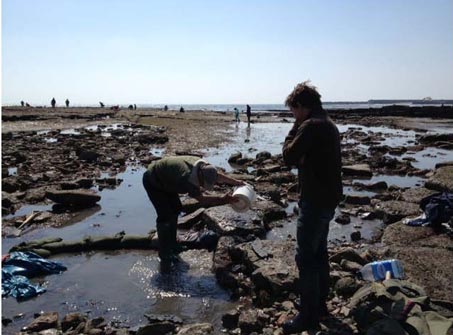
Yesterday, team members at Everything Dinosaur received news that a beautifully preserved ichthyosaur specimen had been discovered at Lyme Regis.  Our chum Brandon, a local fossil expert from Dorset, sent us some pictures and a video which illustrate the exciting discovery.   The specimen was discovered on the beach to the east of the town of Lyme Regis, near to where the council have been working to strengthen the cliff area and to improve the town’s coastal defences.

Video Footage of the Ichthyosaur Discovery

Video credit: Brandon Lennon

 The video shows the block which contains the fossil specimen, vertebrae can be clearly seen along with some of the rib bones, the skull is only partially exposed.  The dig team will cut the block away from the surrounding material and carefully transport the specimen away so that it can be prepared and examined in detail.  From the video, the bones don’t look too compressed or deformed and although some of the distal elements of the skeleton are probably missing, this particular ichthyosaur looks relatively complete.

Ichthyosaur Fossil

It is a little difficult to get our bearings just from the video and the photographs that we have received but we think the specimen was discovered in the Blue Lias of the Church Cliffs section of beach, immediately east of Lyme Regis.

The Location of the Fossil Discovery

The location of the fossil find.

The location of the fossil find.

Picture credit: Brandon Lennon

Water is carefully removed from around the fossil matrix, sand bags will be put in position to help keep the fossil material protected and then the dig team will map the exposed bones and work out the best way to cut and remove the stone block.

The Fossil Material is Carefully Examined

Icthyosaur fossil find April 2014.

Ichthyosaur fossil find April 2014.

Picture credit: Brandon Lennon

Exposing the Specimen

Carefully the specimen is exposed and then the layout and orientation of the fossil material is studied.  Consideration needs to be given to the tide times as the specimen will be covered once the tide turns.

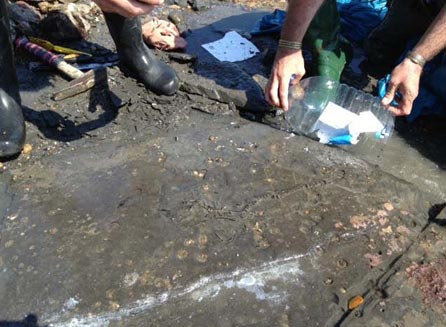
A Close up of the ichthyosaur Fossil

The vertebrae can be clearly made out.

The vertebrae can be clearly made out.

Picture credit: Brandon Lennon

The hand in the photograph helps to provide scale.  The ichthyosaur is lying with its head facing towards the bottom right and the tail up towards the top left of the photograph.  The vertebrae can be clearly seen in the picture.  It is certainly a member of the Ichthyosauria Order, but it is very difficult to assign a species name to the specimen at this stage just having the short video and the photographs to study.  As a guess, it might be an example of Ichthyosaurus breviceps, however, it is best to wait until the fossil material has been more thoroughly prepared before any precise identification can be made.

The Ichthyosauria were an Order of fast-swimming, nektonic and (as far as we know entirely marine), predatory marine reptiles with dolphin-shaped bodies.  As a group, these highly specialised reptiles evolved in the Early Triassic and thrived throughout the Jurassic and for much of the Cretaceous, before finally becoming extinct around 80 million years ago.

For models and replicas of ichthyosaurs and other Mesozoic marine reptiles: CollectA Age of Dinosaurs Popular Models.

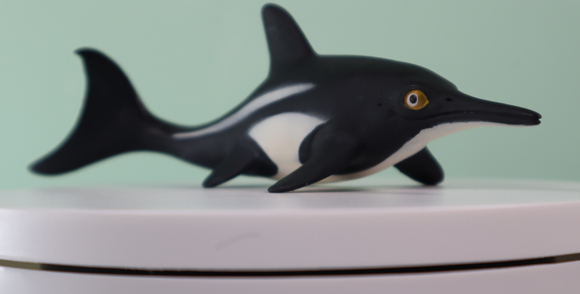
A Typical Jurassic Ichthyosaur Model

An Ichthyosaurus model

The Ichthyosaurus model (Wild Safari Prehistoric World) ready to take its turn on the Everything Dinosaur turntable. Picture credit: Everything Dinosaur.

Lyme Regis is an amazing place to visit and a fossil hunting trip to the beach is highly recommended, although we at Everything Dinosaur would advise that you take advantage of the local knowledge of a fossil hunting expert so that you can get the most from your visit.

To read more about guided fossil walks: Guided Fossil Walks (Lyme Regis).

We look forward to hearing more about this exciting fossil find and no doubt there will be more marine reptile discoveries made over the next few months.

13 04, 2014

The Weird and the Wonderful – Chinese Triassic Marine Reptiles

By |2023-03-12T07:12:04+00:00April 13th, 2014|Categories: Dinosaur and Prehistoric Animal News Stories, Main Page, Palaeontological articles|0 Comments

Parahupehsuchus longus – Armoured Marine Reptile with a “Corset”

As life on Earth recovered from the devastating End Permian mass extinction event which took place some 250 million years ago, it seems that a myriad of strange and bizarre vertebrates evolved to take advantage of vacant niches in ecosystems that had arisen due to the extinction of so many different types of organism.  One of the strangest marine creatures known to science has just been described in the on line scientific journal PLOS One.  It seems that as environments and ecosystems recovered in the Early Triassic, so marine tetrapods evolving the capability to eat other marine tetrapods came about in earnest and the first tetrapod apex predators of the sea appeared.

Marine Tetrapods

This led to the evolution of body armour and other forms of protection in smaller marine tetrapods that were now the potential prey.  Step forward the bizarre Parahupehsuchus longus, around a metre long, marine reptile that evolved a bony tube that completely surrounded its body wall, like a sort of armoured corset.  Just like a corset, breathing movements and body movements may have been restricted, but the primary role for this unusual pseudo carapace was probably protection against attacks from a much larger predatory marine reptile that shared P. longus’s watery world.

Parahupehsuchus longus

Back in 2011, scientists from the Wuhan Centre of China Geological Survey undertook a field excavation in Yuan’an County, Hubei Province, (east central China), to find Early Triassic marine reptile fossils.  The strata in this part of China represents exposures of marine sediments laid down in a shallow tropical sea around 248 million years ago (Jialingjiang Formation).  The area had been mapped and studied since the late 1950’s and a number of marine reptile genera unique to this part of the world had already been named and described.  However, when Chinese scientists first studied these fossil rich deposits, the strata was believed to be younger, dated to the Anisian faunal stage of the Middle Triassic.

Triassic Marine Strata

The rocks at this location were thought to be roughly the same age as Triassic marine strata found in the provinces of Yunnan and Guizhou (south-western China).  More recent studies have assigned the sediments exposed around Yuan’an County to be up to three million years older than most of the sedimentary rocks bearing marine reptile fossils in Yunnan and Guizhou.  The rocks which entombed Parahupehsuchus longus date to around 248 million years ago (Olenikian faunal stage of the Lower Triassic).

This is significant because the vertebrate fossils found in Yuan’an County are much closer to the End Permian extinction event than those from south-western China, the ecosystem represented is one that is at an earlier stage of recovery from the most devastating extinction event known.

Parahupehsuchus longus (Holotype Material WGSC 26005)

Scale bar = 10cm

Scale bar = 10cm.

Picture credit: PLOS One

In the diagram above the strange bony carapace-like structure surrounding the body of this new species of marine reptile can be clearly made out.  The labels in red have been added by Everything Dinosaur to help readers gain a better understanding as to the layout of the fossil as the skull and much of the tail is missing.

Ten Marine Reptile Specimens

The research team identified more than ten marine reptile specimens, one partially complete fossil represents this new genus.  Most of the marine reptile specimens discovered represented animals of around a metre in length, but one fossil suggests a marine reptile of around 4 metres in length.  Although not formally described yet, the skull is robust and the teeth that of a meat-eater.  It has been suggested that this reptile was the apex predator.  Parahupehsuchus evolved its corset-like body to resist attacks from this much larger marine reptile.

Surprisingly, very few fish fossils have been found in the strata that contains the marine reptile fossils.  This might be a reflection of fossil preservation bias, but if there were few fish species present and this may not be that surprising as something like 57% of all marine families died out at the end of the Permian, it seems that marine reptiles evolved to attack and hunt other marine reptiles.  The corset of Parahupehsuchus may have evolved as a response to the predatory pressure.

The Order Hupehsuchia

Parahupehsuchus has been assigned to the Hupehsuchia Order of marine reptiles.  This Order currently consists of just three genera, all of which are found in the Lower Triassic sediments of Hubei Province.  The first named and described was Nanchangosaurus, then in 1972 a near complete specimen of a new type of marine reptile that had been discovered was named this was Hupehsuchus.  Palaeontologists consider that Parahupehsuchus was closely related to Hupehsuchus.

Parahupehsuchus pronounced “par-rah-hoop-pay-sook-cus” means beside Hupehsuchus which refers to the taxonomic relationship between these two genera.  The term Hupehsuchus is derived from Hupeh, an alternative spelling for Hubei Province and the Greek word for crocodile.

Hupehsuchus nanchangensis  Fossil Material (specimen number WGSC 26004)

Scale bar = 10cm

Scale bar = 10cm.

 Picture credit: PLOS One

The more complete specimen (diagram B) above, provides scientists with clues to how Parahupehsuchus might have looked.  It may have had a long narrow, toothless snout like its close relative Hupehsuchus.  It was probably capable of moving around on land as well as being adapted to a marine environment and although the tail is missing in the holotype specimen it is likely that the tail was quite powerful and Parahupehsuchus propelled itself through the water with sideways movements of its tail, in a similar to modern crocodilians today.

Toothless Jaw

If indeed Parahupehsuchus had a toothless jaw, then it may have eaten soft-bodied creatures such as squid.  This bizarre marine reptile remains unique amongst vertebrates for the strange configuration of its trunk.

Its body is completely surrounded by a bony tube, around fifty centimetres long and nearly seven centimetres deep.  The tube is made up of overlapping ribs and gastralia (belly ribs).  This tube and the presence of dermal armour on the dorsal surface of the skeleton (back) have been interpreted as defensive features to withstand the bites of larger marine reptiles.  This is evidence that by the Early Triassic, ecosystems had recovered enough from the End Permian extinction event to permit the establishment of complex marine tetrapod food chains dominated by large apex vertebrate predators.

The Front Dorsal Region of Parahupehsuchus longus

White scale bar shown on actual fossil material = 1cm

White scale bar shown on actual fossil material = 1cm.

Picture credit: PLOS One

The unique corset-like body protection is made up of a combination of fused true ribs, belly ribs (gastralia) and neural spines.

Key

red = dermal armour, scales and ossicles (da)

dark brown = first segment of neural spine (ns1)

dark green = second segment of neural spine (ns2)

grey = ribs (ri)

orange = lateral gastralia (lg)

white = median gastralia (mg)

green = bones of the left forelimb

arf (pink) = anterior rib facet extending from the parapophysis, dia (light brown) = diapophysis of the neural arch, para (yellow) = parapophysis main facet.

Note that ribs and gastralia overlap in a complex manner and the double rib articulation prevents rib motion.  This would have made chest movements difficult for breathing and restricted the body movements to aid swimming and locomotion on land.

Although, the ribs are expanded in a similar way to that of a turtle’s shell, Parahupehsuchus is not closely related to the Chelonia (turtles, tortoises and terrapins).  This might be an example of convergent evolution.

Scientists hope to find more fossils of this strange marine reptile in rocks that make up the Jialingjiang Formation and with further research they intend to build up a more detailed picture of the food chain that is represented by this Lower Triassic fossil material.

For models and replicas of marine reptiles and other creatures: PNSO Age of Dinosaurs Figures and Models.

11 04, 2014

Huge Extraterrestrial Impact that Shaped Our World

By |2023-03-12T07:05:24+00:00April 11th, 2014|Categories: Dinosaur and Prehistoric Animal News Stories, Geology, Main Page|0 Comments

Impact Earth 3.26 Billion Years Ago

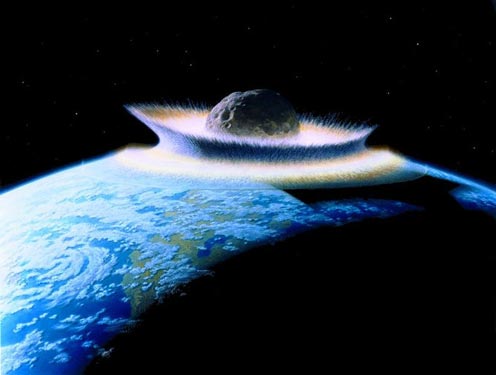
Scientists have discovered tell-tale signs in the geology of Earth which reveal a catastrophic ancient impact event that would have dwarfed the dinosaur killing asteroid of sixty-five million years ago.  Approximately, 3.26 billion years ago, the region we now know as South Africa was hit by a colossal rock from space, a rock that would have been at least three times the size of the space rock responsible for the Cretaceous impact event.

Huge Extraterrestrial Object

Such was the magnitude of the impact that the Earth’s crust shifted, giving rise to some of the tectonic features that are still found today.

The study, published in the academic journal “Geochemistry, Geophysics, Geosystems” focuses on the geological formation called the Barberton greenstone belt in South Africa.  This formation can be found in the north-east of South Africa and it partially borders the sovereign state of Swaziland.  The rocks are mainly continental and consist of some of the oldest continental crust rocks known.  The research team examined the seismology of the region and they estimate that between 3.47 billion and 3.23 billion years ago the area was the site of a massive impact from outer space.

Huge Extraterrestrial Object Crashes into Earth Around 3.26 Billion Years Ago

Cataclysmic impact event.

Cataclysmic impact event.

Picture Credit: Don Davis commissioned by NASA

The “Late Heavy Bombardment”

During that time in the formation of the Earth and the solar system, our planet had cooled sufficiently for oceans to form and primitive bacterial thrived, although at the time there was very little oxygen, the most significant gases in the atmosphere were nitrogen and carbon dioxide.  The impact event occurred after the “Late Heavy Bombardment – LHB” which was a period of several hundred million years ending around 3.7 billion years ago when the inner rocky planets and satellites of the solar system was bombarded by space debris, left over from the creation of the planets and other bodies that make up our solar system.

Giant Space Rock

The space rock, perhaps an asteroid or even a comet from further out in the solar system crashed into Earth. The object measured between 37 and 58 kilometres across and smashed into the region of southern Africa at a speed of more than 20 kilometres a second (a speed of around 43,000 miles an hour).  The crater caused would have measured over five hundred kilometres in diameter (300 miles), although this has been eroded away.  The resulting impact sent seismic waves through the entire planet and it is likely that these seismic waves exceeded the amplitudes of typical earthquake waves. The duration of extreme shaking was also far longer, probably hundreds of seconds, than that from strong earthquakes.

Debris Ejected into the Atmosphere

Debris thrown up into the atmosphere would have sufficient momentum to leave the Earth’s orbit, firestorms would have ravaged the planet and tsunamis hundreds of metres high would have smashed into the nascent continents.  Indeed, water at the surface of the oceans would have been boiled away.  Such was the force generated that subduction might have occurred as a result, helping to shape the continents.

Geologist, Donald Lowe of Stanford University and a co-author of the scientific study explained:

“We can’t go to the impact sites.  In order to better understand how big it was and its effect we need studies like this. We knew it [the impact event] was big, but we didn’t know how big.”

A Devastated Earth

The Earth and the primitive life upon it would have been devastated, wiping out whole genera of bacteria, but just like the extinction event that marks the end of the Cretaceous, other organisms would have evolved to replace those that had died out, just as the Mammalia rose to prominence with the extinction of the Dinosauria.  The shock of the impact could also have moved the tectonic systems around the Earth’s crust into a higher gear, making the planet more tectonically active.

The impact of this event, so long ago, is still being felt by the Earth today the researchers speculate.  Identified by the presence of spherule beds in the Barberton greenstone belt, this Archean impact event has shaped the way the Earth’s continents and oceans came about.

The Size and Scale of the Impact

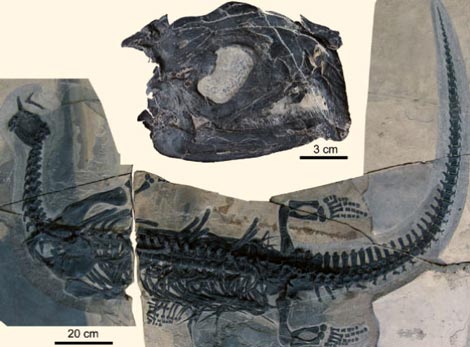
Impact event in the Barberton greenstone belt of South Africa.

Impact event in the Barberton greenstone belt of South Africa.

Picture credit: American Geophysical Union

The illustration above compares the extraterrestrial object responsible for the Chicxulub impact that may have helped wipe out the dinosaurs, with the Archaen impact event and the world’s highest mountain, Mount Everest.  The impact craters illustrated are compared with the island of Hawaii for scale.  The estimated crater formed by the collision around 3.26 billion years ago may have been as much as five hundred kilometres across.

Commenting on the research, geologist Frank Kyte of the UCLA (University of California, Los Angeles) stated:

“This is providing significant support for the idea that the impact may have been responsible for this major shift in tectonics.”

10 04, 2014

Bizarre New Triassic Marine Reptile Described

By |2023-03-11T18:47:01+00:00April 10th, 2014|Categories: Dinosaur and Prehistoric Animal News Stories, Palaeontological articles|0 Comments

Atopodentatus unicus from Yunnan Province

The fossils of a bizarre marine reptile with a unique mouth have been discovered in south-western China.  Although its body resembles other types of marine reptile, the skull and the mouth are extremely unusual and nothing like them has been seen before in the fossil record.   A number of scientists have speculated about this strange anatomical arrangement, the upper jaw resembles a vertical slit with fine teeth arranged to form sieve-like structure.  A prehistoric animal that has a “zipper” for an upper jaw.   These adaptations indicate that this three-metre long sea creature evolved to fit a very specialist niche in the marine ecosystem of 245 million years ago.

Marine Reptile Fossils

The animal has been named Atopodentatus unicus, the name translates from the Latin to mean “peculiar teeth of unique shape” and one glance at an illustration of this particular beastie shows why the nomenclature is so appropriate.

An Illustration of A. unicus

Strange Triassic marine reptile.

Strange Triassic marine reptile.

Picture credit: Nobu Tamura 2014

A Bizarre Creature

This is one of those occasions when the interpretation of the fossil material and a resulting illustration needs to proceed any further discussion so that the reader can gain an impression of just how weird this animal was.

The land that makes up the border between the south-western Chinese provinces of Guizhou and Yunnan is very important to palaeontologists as they try to reconstruct how life on Earth bounced back following the End Permian mass extinction.  The rocks laid down in this region represent Early and Middle Triassic marine faunas, the fine sediments that were deposited at the bottom of a shallow, tropical sea have preserved a wealth of marine reptile fossils, along with fishes and a vast array of invertebrates.

Triassic Marine Diversity

By recording the diversity of life preserved within this series, scientists can see how life on Earth recovered from the mass extinction event that marked the end of the Permian geological period.

The Atopodentatus fossil material was found in  Luoping County (Yunnan Province), the strata in this area has been dated to around 245 million years ago (Anisian faunal stage of the Middle Triassic), a little over five million years since the extinction event that saw an estimated 95% of life on the planet wiped out.  At this time in the Triassic, a number of different types of marine reptile had evolved, all of which were descended from terrestrial ancestors.

Atopodentatus unicus

A large number of ichthyosaur specimens have been discovered, some ichthyosaurs co-existed with Atopodentatus but in younger Triassic rocks (Ladinian to Carnian faunal stages 230 to 225 million years ago), it seems that ichthyosaurs had established themselves as the largest and most important marine reptile group.  The other types of marine reptile that lived alongside Atopodentatus are almost as bizarre.

There are primitive sauropterygians, such as nothosaurs and animals that are ancestors of the much more familiar plesiosaurs and pliosaurs, protorosaurs, partially marine reptiles that were to give rise to the long-necked Tanystropheus and other peculiar archosauriforms.

It seems that this part of the world was a “melting pot” for marine reptile evolution with some groups, surviving into the Jurassic, with other types completely dying out within a few million years.

A Specimen of the Sauropterygian Nothosaur called Keichousaurus

Keichousaur Fossil

 These rocks have been explored and mapped for more than ten years, by an international team of scientists. The report on the strange Atopodentatus has been published in the academic journal “Naturwissenschaften”, the study into A. unicus was conducted by scientists from the Canadian Museum of Nature, the Wuhan Institute of Geology and Mineral Resources as well as the Chinese Academy of Sciences.

A Newly Described Creature

Dr Xiao-Chun Wu (Canadian Museum of Nature) and his colleagues named the new prehistoric creature Atopodentatus unicus and suggest it belonged to a Superorder of reptiles called the sauropterygians.  Staff from Everything Dinosaur, having reviewed the fossil bones have suggested it might be a type of Nothosaur, but one with a very specialised feeding method.  The body of the animal was quite long, the neck short and the skull much deeper than other similar sized Triassic marine creatures.

Most nothosaurs were fish-eaters, but the dentition and the morphology of the jaws suggest that this newly discovered reptile had a weak bite and teeth unsuitable for tackling struggling prey.

Atopodentatus unicus Mouth

On each side of the mouth, A. unicus had around 35 small, pointed teeth in the front of the upper jaw.  There were around 140 similarly shaped teeth in the rest of the upper jaw, with at least 100 located in the horizontal portion with the remainder located in the vertical, zipper-like portion of the top jaw.  There were nearly 200 teeth located in the lower jaw, over half of which were in the horizontal portion with the remainder located in the shovel-headed front part.

All the teeth were covered in enamel, indicating even wear across all parts of the crown of the tooth, but the teeth do not look very worn, perhaps this hints at the sort of prey this animal specialised in catching.  Whatever it was eating, it probably had this food resource all to itself amongst the vertebrates as no other creature found to date has anything approaching the jaw anatomy of this marine reptile.

The Prepared Fossils (Atopodentatus unicus)

Bizarre Triassic marine reptile.

Bizarre Triassic marine reptile.

Picture credit: Long Cheng/Wuhan Institute of Geology and Mineral Resources

The picture shows the long, serpentine body of the reptile with the deep, shovel-shaped skull shown as an inset.  Note the well developed limbs, particularly the large humerus.  This prehistoric animal was probably only partially marine, still capable of venturing out onto land, although the broad wrist bones and elongated fingers and toes enabled the limbs to be used to help the animal swim.

The Diet of Atopodentatus?

As to what this animal actually ate, no one knows for sure, there is nothing similar living today that seems to have anything remotely like its specialised feeding apparatus, or is there?  The Bowhead Whale (Balaena mysticetus), has plates of baleen made from keratin in its mouth which it uses to sieve out planktonic organisms as it swims through Arctic waters.

The mouth of Atopodentatus may have been adapted for sieving out small creatures but not from open water like the huge-mouthed Bowhead, but from soft mud on the sea floor.  Dr Wu and his colleagues, suggest that the broad, shovel-like head of this marine reptile may have ploughed through soft sediments with its teeth sieving out soft-bodied creatures such as marine worms.

The doctor added:

“It is obvious that such delicate teeth are not strong enough to catch prey, but were probably used as a barrier to filter micro-organisms or benthic invertebrates such as sea worms.  These were collected by the specialised jaws, which may have functioned as a shovel or push-dozer and a grasper or scratcher.”

At the moment, the actual function of the jaws remain a mystery.  Perhaps a specimen will be found with stomach contents preserved or perhaps some trace fossils will be discovered the reveal a ploughed up seabed.  One of the few certainties surrounding this bizarre creature is that like a number of the strange marine reptiles that existed in the Middle Triassic seas of China, within a few million years this particular branch of the marine family tree had become extinct.

For models and replicas of prehistoric animals including Atopodentatus (whilst stocks last): PNSO Age of Dinosaurs Models and Figures.

6 04, 2014

Call for more Work to be Done on Western Australia’s Unique Dinosaur Trails

By |2024-05-02T09:49:58+01:00April 6th, 2014|Categories: Dinosaur and Prehistoric Animal News Stories, Dinosaur Fans, Main Page|0 Comments

Research being Carried out on the Dampier Peninsula Dinosaur Tracks

Usually when team members at Everything Dinosaur are asked to write about Australian dinosaur research, the focus is on sites in Queensland or indeed Victoria, however, a series of extensive dinosaur tracks located in Western Australia, along the Dampier peninsula north of the small town of Broome, are rapidly coming to prominence.  In the Early Cretaceous, around 130 million years ago (Barremian faunal stage), Australia was much further south than it is today, it was not a separate continent but attached to the landmass that would become Antarctica.

Coal deposits and plant fossils indicate that the climate at this southerly latitude was much warmer than it is today, there was probably no permanent ice at the poles and the land that was to become Western Australia was a huge flood plain, crossed by large, slow moving rivers.  Dinosaurs flourished in this environment and evidence of the diversity of the dinosaurs has been preserved in a multitude of dinosaur tracks.  The trackways can be found all along the coast north of Broome, where the Lower Cretaceous Broome sandstone is exposed.

Dampier Peninsula Dinosaur Tracks

The lengths of the tracks are very significant, some of the trackways can be correlated over a tens of metres, they are regarded as “mega track sites”, otherwise known colloquially as “dinosaur freeways”.

Tridactyl Theropod Tracks from the Broome Area

Three-toed dinosaur tracks.

Three-toed dinosaur tracks.

Picture credit: Government of Western Australia (Dept. of State Development)

2011 Geological Survey

In a survey undertaken in 2011 a number of dinosaur trackways were classified and assessed, something in the region of fifteen different types of dinosaur have been identified including sauropods, ornithopods, theropods and armoured dinosaurs (Thyreophora).

Dr Steve Salisbury (University of Queensland), one of the researchers who carried out the study in 2011 is keen to see further research work undertaken and is enthusiastic about making the dinosaur tracks and trails better known to the public.  However, it is important that any studies are undertaken with the utmost respect for the feelings of the local indigenous people as the tracks and footprints play an important role in local aboriginal art and culture.  Dr Salisbury commented on the importance of these Cretaceous dinosaur footprints:

“There are some really important ones, scientifically and culturally, that we don’t really want to let everyone know where they are.  But there are plenty of tracks that it would be fantastic to share them with people… Broome should embrace what it’s got on its doorsteps because it’s really special.”

Trying to Avoid Fossil Thefts

In addition, care should be taken when it comes to publicising the location of some of the tracks, thefts of dinosaur footprints have occurred and in 1996 prints made by an armoured dinosaur were stolen from the Crab Creek area on the north coast of Roebuck Bay.  The theft of dinosaur fossils, even trace fossils such as footprints is an all too often occurrence, to read an article about the theft of a dinosaur footprint from Jurassic aged strata near to the town of Moab in Utah: Dinosaur Footprint Stolen in Utah.

Some of the sauropod prints (long-necked dinosaurs) are huge.  Individual prints have been measured at over 1.7 metres long.  Although ichnologists (the term used to describe a person who studies trace fossils), are not able to assign a genus to the footprints, it has been estimated that some of the sauropod dinosaurs that made the tracks were in excess of thirty metres in length.

Giant Sauropod Trackways from Western Australia

Dinosaur tracks from the Broome area of Western Australia.

Dinosaur tracks from the Broome area of Western Australia.

Picture credit: Government of Western Australia (Dept. of State Development)

The enormous, rounded prints of a sauropod dinosaur can be clearly seen in this picture taken in the Red Cliffs area.

Shedding More Light on the Ecology of the Early Cretaceous

The scientists hope that their studies will help shed more light on the ecology of this part of the world in the Early Cretaceous.  The large number of different dinosaur species that the tracks potentially represent gives the palaeontologists the opportunity to learn a little more about the behaviour and interactions of the Dinosauria.  The team intend to digitally map the locations using technology similar to that used recently to recreate the famous sauropod/theropod tracks preserved in the Paluxy River of Texas.

To read more about the Paluxy River trace fossils: Digitally Mapping a Famous Set of Dinosaur Tracks.

Dr Salisbury explained what the dinosaur footprints and tracks showed:

“Some of them look like they’re on a mission; they’re definitely heading somewhere.  Other ones look like they’re lost, and they’re wandering around in circles… We’ve got a record of what they were doing and it’s a hundred and thirty million years old, so it’s pretty special.  If you could go back in time and look at the Broome area, you would have seen all these different types of dinosaurs wandering around; it would have been really special. It’s your own Cretaceous Park, on your doorstep.”

Sacred to the Indigenous People

The tracks are sacred to the local indigenous people.  The Aborigine tribes in the area believe that the tracks help explain their creation story and the scientists are keen to record the fossils, take latex rubber copies of the prints but to leave all the tracks in situ.  The first recorded description of a print made by non-indigenous people dates back to the 1930’s but the entire region has not been fully studied to date.  The survey undertaken in 2011 highlighted the importance and the significance of the location, now scientists are hoping to learn more by walking in the footsteps of dinosaurs.

Visit Everything Dinosaur: Everything Dinosaur.

Go to Top