All about dinosaurs, fossils and prehistoric animals by Everything Dinosaur team members.

Fossil finds, new dinosaur discoveries, news and views from the world of palaeontology and other Earth sciences.

23 05, 2014

Volunteers Required to Help Protect Scotland’s Unique Fossil Heritage

By |2024-04-12T15:43:03+01:00May 23rd, 2014|Categories: Dinosaur and Prehistoric Animal News Stories, Dinosaur Fans, Geology, Main Page, Palaeontological articles|2 Comments

Action Taken to Safeguard Fossils In Scotland

The Isle of Wight off the coast of southern England might be regarded by some as Britain’s “Dinosaur Isle” but the United Kingdom does in fact have several contenders for this accolade.  Travel north of the border into Scotland to the Inner Hebrides and you might find the residents of the Isle of Skye taking issue with such claims.  However, the island’s rich fossil heritage has been under threat with unscrupulous fossil collectors damaging important scientific sites in their quest to obtain rare vertebrate specimens.

Everything Dinosaur team members reported on the sad case of “fossil vandalism” back in 2011: Important Fossil Site is Vandalised.

Safeguarding Steps

Steps are being taken to help protect Scotland’s fossil heritage and local people on the Inner Hebrides are being asked to volunteer as wardens to help watch over and safeguard sites that are important to geology and palaeontology.  The Isle of Skye may seem like an unlikely place to find dinosaurs and fossils of other Mesozoic vertebrates, but back in the Jurassic, this part of the world was joined up with the land mass that was later to become the western United States.  Rocks laid down in the Middle Jurassic are exposed on the Isle of Skye and in the U.S. States such as Utah, Colorado and Wyoming – parts of America famed for their Jurassic aged dinosaur fossils.

‘To view Everything Dinosaur’s article explaining the importance of the Isle of Skye and its links to the western United States: Question!  What do the Isle of Skye and the State of Wyoming have in Common?

Fossil Heritage

Scotland did introduce a national fossil hunting code back in 2008.  Most fossil hunters and amateur palaeontologists follow this code when collecting fossils, however, there are those who simply see an opportunity to hack into the relatively deserted cliffs and gullies on Scottish islands in a bid to find fossilised bones of vertebrates which then can be sold to private collectors.  A public meeting was held at Portree (Isle of Skye), this week which involved representatives from Scottish National Heritage (SNH), National Museums Scotland, The Hunterian Museum and the Highland Council with the aim of setting up a network of wardens to help record and protect important fossil sites.

With a managed approach to these important fossil sites, it is hoped that more fossil collectors will visit Scotland, especially the Isle of Skye and neighbouring islands, boosting tourism and the local economy.

Important Geology

Skye and the nearby island of Raasay have a rich geological heritage spanning the last three billion years of Earth’s history.  Fossil remains of plants and animals record the evolution of life .  They also record the fascinating journey of the area we now know as Skye and Raasay, as it drifted for hundreds of millions of years across the face of the Earth, from once being part of America to now being part of the western edge of Europe.

Comments on the Plan

Commenting on the plan to form local action groups to protect the beaches, Dr Colin MacFadyen of Scottish National Heritage stated:

“Skye and Raasay have a fantastic fossil heritage, and kids and amateur fossil hunters should be encouraged to collect.  But at the same time something has to be done about irresponsible collecting and to reduce examples where people for whatever reasons damage fossil localities and important fossils.   This is where the local community can get involved and help secure their threatened natural heritage.  Local action may ensure that rare fossil finds are rescued, recorded and saved for the nation.  The public meeting in Portree will encourage local people to play an important part in safeguarding and promoting an internationally significant asset.”

Dr Nick Fraser, Keeper of Natural Sciences at National Museums Scotland commented:

“We are excited by the opportunities to work together to bring Skye’s remarkable fossil heritage into greater prominence.  This is a precious resource which, with support from the wider community, will benefit generations of islanders.”

Everything Dinosaur Comments

A spokes person from Everything Dinosaur explained the importance of the Isle of Skye fossil sites, stating:

“Only a few places in the world have exposed strata dated to the Middle Jurassic that contain vertebrate body and trace fossils preserved within them.  The Isle of Skye is one such location and the fossils found here and on neighbouring islands have helped palaeontologists to understand more about the fauna and flora of our planet around 170 million years ago.  It is vitally important that such fossil bearing sites are protected, whilst at the same time striking a balance to help encourage tourism to boost the economy.”

Everything Dinosaur acknowledges the contribution of a press release from Scottish National Heritage in the compilation of this article.

Visit Everything Dinosaur’s award-winning website: Everything Dinosaur.

21 05, 2014

Google Doodle Celebrates the Amazing Mary Anning

By |2024-04-12T15:43:40+01:00May 21st, 2014|Categories: Dinosaur and Prehistoric Animal News Stories, Dinosaur Fans, Main Page, Palaeontological articles, Press Releases|0 Comments

Happy Birthday to Mary Anning – Google Doodle

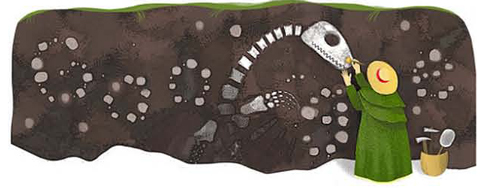
We wonder what Mary Anning would have made of the internet?  Coming from a poor family she may have found access to a personal computer, smart phone or tablet a little beyond her budget.  Perhaps one of those wealthy individuals who benefited from her fossil finds and research might have provided her with a laptop.  Google has marked the birthday of Mary Anning with a Google Doodle to commemorate her birthday on 21st May 1799.

Google Doodle Celebrates the Birthday of Mary Anning

Happy Birthday Mary Anning

Happy Birthday Mary Anning.

Picture credit: Google

Mary’s contribution to the nascent science of palaeontology was immense.  Along with her brother, Joseph, she is credited with finding the first ichthyosaur skeleton that was scientifically studied, the discovery of Plesiosaurus fossils (the fossil depicted in the Google Doodle) and for finding and bringing to the attention of science the first pterosaur fossil to be formally studied outside Germany (Dimorphodon) and only the third to be described in the world.

For models and replicas of ichthyosaurs and other marine reptiles: CollectA Age of Dinosaurs Popular Range.

Mary Anning

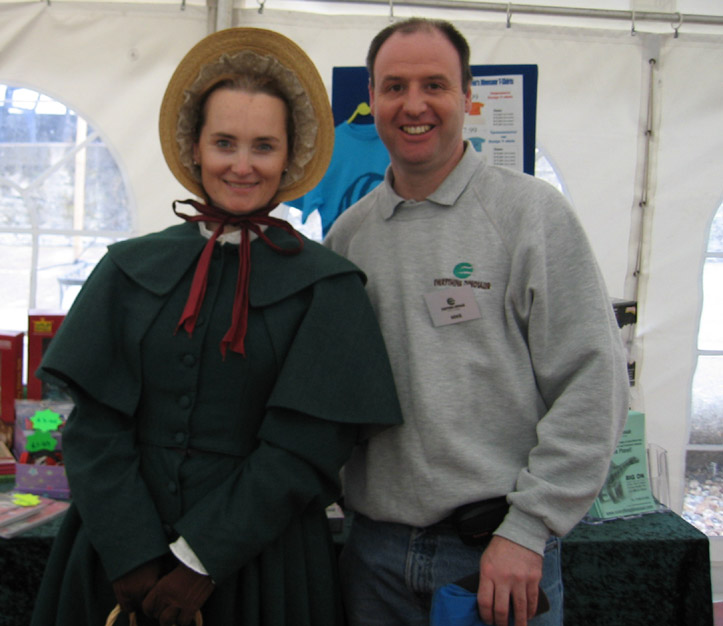
Everything Dinosaur team members were enthusiastic supporters for the life of Mary Anning to be included in the national curriculum of England.  She is one of the designated people who can be studied by school children as part of the science/history scheme of work within the national teaching guidelines.  As a small team, we have done quite a lot to promote science studies in schools and in particular to champion the role of women in science with the aim of encouraging girls to take up science and to develop a career in science disciplines.

Everything Dinosaur with Mary Anning – Helping to Promote Girls into Science

Helping to promote science for girls by dressing up as Mary Anning.

Helping to promote science for girls by dressing up as Mary Anning. Picture credit: Everything Dinosaur.

Picture credit: Everything Dinosaur

A couple of years ago Google created a Google Doodle celebrating the life and works of Mary Leakey, now Mary Anning has been honoured.  Happy Birthday Mary!

For models and replicas of iconic fossils including many from the “Jurassic Coast”: Replicas of Iconic Fossils.

17 05, 2014

Biggest Dinosaur of All – A New South American Contender

By |2023-03-13T10:31:10+00:00May 17th, 2014|Categories: Dinosaur and Prehistoric Animal News Stories, Dinosaur Fans, Main Page|0 Comments

Seven Titanosaur Fossil Skeletons – Graveyard of Giants!

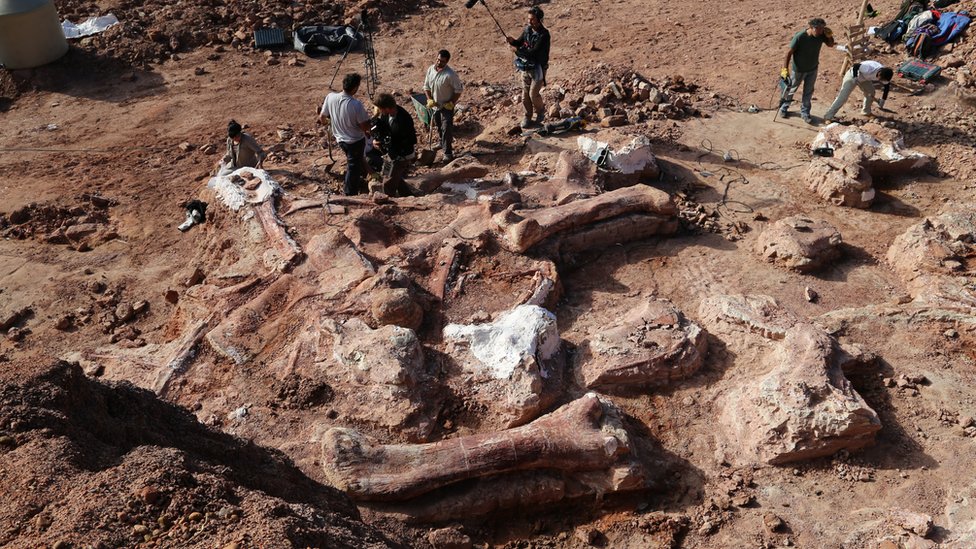
So the story is out, we have a new contender for the title of biggest dinosaur known to science!  In fact we have seven of them, for a team of researchers working at an outcrop of Cretaceous aged strata in Chubut Province (southern Argentina),  have uncovered the fossilised remains of seven huge titanosaurs and when we say huge we really mean it.  These giants could well prove to be the largest terrestrial animals of all.  Somebody is going to need a very big dinosaur museum to exhibit this collection.

A Graveyard of Giants

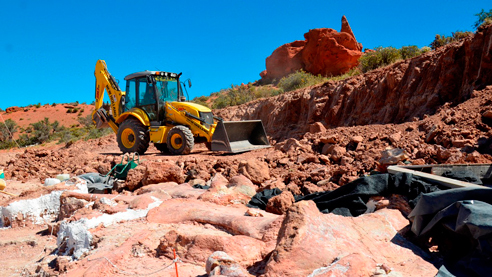
A team of researchers led by scientists from the Museo Paleontológico Egidio Feruglio (Trelew City), a museum and scientific research centre that team members at Everything Dinosaur know very well having visited and viewed the spectacular vertebrate fossil collection on numerous occasions, have uncovered a total of two hundred fossils so far from this single location.  Best of all, a film crew from the BBC Natural History film unit was on hand to visit the site and record the field team at work as they carefully gathered evidence of past habitats within the dinosaur bone bed that has been nick-named the “graveyard of giants”.

An Overview of the Fossil Site

Up to seven individual Titanosaur remains found.

Up to seven individual titanosaur remains found.

Picture credit: Museo Paleontológico Egidio Feruglio (MEF)

Titanosaur Fossils

This part of Argentina has produced a number of giant dinosaurs, including immense titanosaurs, the largest of which, to be formally described is Argentinosaurus huinculensis.  However, this new discovery is remarkable as there are a number of individuals to be studied and the preservation of the bone material is exceptional.  This new species of titanosaur has yet to be named.

Size and Scale of New Dinosaur Discovery

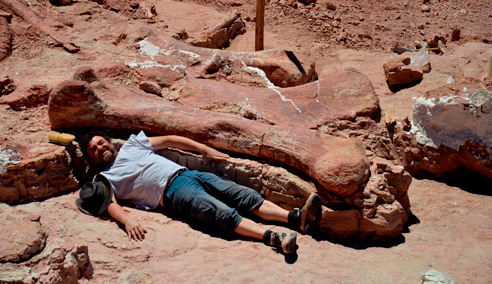
The thigh bone of one of the giant Titanosaurs.

The thigh bone of one of the giant titanosaurs.

Picture credit: Museo Paleontológico Egidio Feruglio (MEF)

The picture above shows one of the researchers lying beside the thigh bone (femur) of one of these enormous plant-eating dinosaurs.  It is a kind of a tradition amongst palaeontologists to have their picture taken lying next to the huge limb bones of these long-necked dinosaurs.  Many field workers have posed for such photographs, it is probably the most practical and simple way to demonstrate the immense size of the fossils in the field.

Large Fossil Bones Discovered

In 2011, a local farmworker contacted the MEF and reported the finding of large bones that were exposed and weathering out of the surrounding rock.  Field team workers have been busy excavating the site, which is approximately 160 miles south-west of Trelew City, close to the small town of El Sombrero.  About one fifth of all the fossil material has been removed and transported back to the MEF for further restoration and preparation.  The size of the fossil bones made transport no easy task and the scientists were grateful for the support and advice of the Highways National Road Administration as well as the National Atomic Energy Commission which provided tools and heavy plant equipment to help with the fossil dig.

Heavy Duty Fossil Handling Equipment Required

Big fossils require big diggers to excavate them.

Big fossils require big diggers to excavate them.

Picture credit: Museo Paleontológico Egidio Feruglio (MEF)

The industrial plant, more at home on a construction site, certainly beat our hammers and chisels, but big diggers are required when handling fossil extraction on this scale.

The strata in which the fossils have been found has been tentatively dated to around 95 million years ago (Cenomanian faunal stage of the Cretaceous).  This dry and dusty part of Patagonia was very different back then, it was a lush and verdant dinosaur paradise, criss-crossed by slow flowing rivers.  For this group of titanosaurs, it may be a case of “paradise lost” as they all perished together.  Amongst the huge bones, the palaeontologists have found sixty broken teeth from large theropod dinosaurs. It seems the carcases of these animals were scavenged by some big meat-eaters.

Predators Attracted

The heap of decaying corpses would have attracted every carnivorous dinosaur from miles around, after all, there would have been something like 250 – 300 tonnes of meat available for the scavengers to consume.  One of the benefactors of this feast might have been the carcharodontosaurid known as Tyrannotitan (T. chubutensis).  Fossils of this twelve-metre-plus giant have been found in slightly older strata in the same area.

The site has also yielded important data on the flora that existed in this part of the world during the Cretaceous.  Amongst the fossil material excavated to date there are chunks of fossilised wood and the delicate impressions of the leaves of early flowering plants (Angiosperms).  However, with the number of fossil bones found and their degree of preservation, scientists are confident that they can gather accurate data on just how big these dinosaurs were.

At Least Seven Individual Dinosaurs

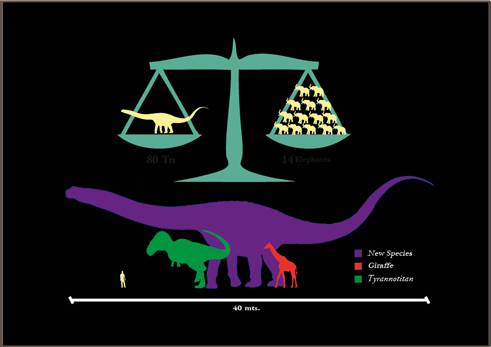
The seven individuals represent adult animals,  there are some slight differences in the size of the bones, indicating that some of the dinosaurs were bigger than others.  Initial estimates of body size and mass of the largest individual, calculated by measuring the length and circumference of the femur (thigh bone) suggest an animal around eighty tonnes in weight and forty metres in length.  Such figures are approximations and further work is required but the bones are on a par with those ascribed to the biggest dinosaur yet described, the mighty Argentinosaurus.

Recently, Everything Dinosaur reported on a study conducted by an international team of scientists that compared how quickly dinosaurs evolved compared to birds.  As part of this research, the body weights of the largest known dinosaurs were calculated.  The femur size and circumference measure for Argentinosaurus gave this dinosaur a body mass of around ninety tonnes.  However, the femur used was a fragmentary fossil, in this instance scientists have, for the first time, got the virtually complete super-sized titanosaur limb bone material to work with.

To read more about this research: Dinosaurs Shrank So That They Could Continue to Evolve.

Commenting on the size of these potential record breaking dinosaurs, palaeontologist Dr José Luis Carballido (MEF) stated:

“It’s like two semi trucks, one after another, and the equivalent of more than 14 African elephants weighed together.  It’s a real palaeontological treasure, there were so many bones and the remains are practically intact, this does not happen very often.  All previously discovered giant titanosaur fossils are very fragmented”

Titanosaur Fossils

The giants seem to have all perished around the same time, indicating that this might represent a herd or at least a partial herd of these herbivorous dinosaurs.  A spokes person from Everything Dinosaur remarked that the fossil find was indeed astonishing and that the fossils once prepared and protected against further erosion and damage would yield new information on just how big some dinosaurs could grow to.

The spokes person added:

“We can speculate that this bone bed deposit represents a herd of titanosaurs that stayed close to a dwindling water supply that eventually dried up.  In a drought, these giants would have been trapped close to a water source and yet in need of vast amounts of vegetation to fuel their huge bodies, even if they had the lower metabolisms of cold-blooded creatures.  We see similar instances of mass mortality of large herbivores in Africa today, when significant numbers of elephants succumb to drought in places such as within some of the National Parks of Botswana.”

The South American research team are optimistic that these enormous fossils will eventually go on display to the public, but for the Museo Paleontológico Egidio Feruglio, this is going to cause a bit of headache.  They are going to need a much bigger main gallery to display them in.

A Comparison of Body Sizes – Scale of Titanosaurs

New dinosaur discovery compared to a human, a giraffe and a meat-eating Theropod.

New dinosaur discovery compared to a human, a giraffe and a meat-eating theropod.

Picture credit: Museo Paleontológico Egidio Feruglio (MEF)/Everything Dinosaur

The diagram above shows the new, as yet unnamed dinosaur compared to a human (yellow), a giraffe (red) and the meat-eating, theropod dinosaur known as Tyrannotitan.

16 05, 2014

Identifying the First Americans

By |2023-03-13T10:16:58+00:00May 16th, 2014|Categories: Dinosaur and Prehistoric Animal News Stories, Geology, Main Page|0 Comments

“Naia” – The Water Nymph Provides Clues to the First Americans

To a palaeontologist, the Yucatan peninsula of Eastern Mexico is a fascinating part of the world, for it was here something like sixty-six million years ago, that an extra-terrestrial body crashed into the Earth which contributed to the Cretaceous mass extinction event leading to the demise of the dinosaurs.

In addition, the amazing geology of the area, essentially extensive limestone deposits that over millions of years have been hollowed out in places by the action of water to create an enormous network of caverns, yields secrets of much more recent times – the remains of creatures and people that lived in America during the last Ice Age.

The First Americans

The discovery of the remains of a teenage girl who fell to her death in a cave between 12,000 and 13,000 years ago are helping archaeologists to piece together the story of how the Americas came to be populated.

The skeleton, nick-named “Naia” by the scientists, (the name means water nymph), represents the oldest genetically intact human known from the Western Hemisphere.  The water nymph epithet is apt, as the when the Ice Age began to give up its icy grip on the continent around 10,000 years ago, the caves quickly became inundated with water and much of this subterranean world was submerged, including the cavern where the bones of this young girl were found.

The picture above shows Divers Susan Bird (in blue) and Alberto Nava (in yellow) carefully transporting the skull to an underwater turntable so that it can be photographed from various angles to make a three-dimensional image of the human remains.  Details of the research into mitochondrial DNA (mtDNA) extracted from a tooth have been published in the academic journal “Science”.  Mitochondrial DNA is passed down the maternal line, from mother to daughter.

Examining the Mitochondrial DNA

The mitochondria are the “factory” areas in cells with a membrane, these convert chemical energy into food substances that can be utilised by the body.  By mapping the genetic information and identifying markers within it, the girl’s ancestry can be compared with those of Native American Indian populations, helping scientists to determine how North America came to be inhabited, by whom and when.  It also permits researchers to look more closely at the genetic relationships between today’s Native American population and the first inhabitants of this continent.

The data supports the hypothesis that Ice Age humans who crossed from Asia into the Americas did in fact give rise to the modern Native American Indians.  This means that tribes people today can trace their origins back to the very first settlers who migrated from Asia into Alaska via the landmass called Beringia that linked these two continents together.  The date when people first crossed over from Asia to America is hotly debated amongst palaeoanthropologists.

Some scientists suggest that migrations began as recently as 15,000 years ago.  With the discovery of the human remains in eastern Mexico and their dating to circa 12,000 – 13,000, this suggests that either modern humans spread very rapidly south, or that migrations may have started much earlier.

The Ice Ages led to the locking up of vast quantities of water in ice sheets.  Global sea levels fell and Asia and the Americas were linked.  A land bridge existed between the north-eastern tip of Siberia and the State of Alaska (Beringia), the ancestors of “Naia” crossed this land bridge and the Americas were colonised.

A Young Girl

The girl, believed to have been around fifteen or sixteen years of age when she died, probably fell in the cave.  The pelvis is shattered, the break suggests this was an injury caused from a fall and not the distortion of fossil material as a result of the fossilisation process.  Scientists have speculated that the girl may have fallen a considerable distance, having entered the cave looking for a source of water.  The divers also found a collection of other bones that represent prehistoric animals, some of which “Naia” would have been familiar with.

Prehistoric Animal Bones

The divers found the remains of giant ground sloths, sabre-toothed cats, cave bears and a Gomphothere (extinct type of elephant).  Around twelve thousand years ago, this part of Mexico was much more arid than it is today, some of the caves would have held freshwater in them, and the girl may have been part of a group of gatherers looking for fresh water supplies.  Measuring under 1.5 metres tall and slightly built, the girl fell into a pit which is over thirty metres deep in places.  The bell-shaped cave, now flooded is so dark and claustrophobic that the divers refer to it as “Hoyo Nero” – the black hole.

For models and replicas of prehistoric mammals including prehistoric elephants: CollectA Deluxe Scale Replicas and Figures.

Archaeologist, James Chatters (Applied Paleoscience [American spelling]), one of the leaders of the research team stated that the cavern represented “a time capsule of the environment and human life at the end of the Ice Age.”

The origins of the first Americans has been a source of controversy for some time.  The date when the first, nomadic, hunter-gatherers crossed from Beringia remains unclear, evidence collected from early human settlements found in north-eastern Siberia (Ushki Lake and Berelekh) when compared to later human settlements in North America (Tuluaq Hill, Bluefish Caves and Swan Point) suggest that the crossings of Beringia may have taken place between 26,000 and 18,000 years ago.

However, the discovery of “Naia” has confused academics as the girl had skull characteristics that distinguish her from modern Native Americans.  For instance, the skull is narrower and this and the other anatomical differences led researchers to propose that the first people of the New World might represent an earlier migration from a different part of the world, than the true forebears of today’s modern Native Americans.

Analysis of the mtDNA extracted from a wisdom tooth identifies the girl as belonging to the same Asian-derived genetic lineage as those of modern Native Americans.  The tooth along with bone samples was used to provide an estimate of the age of the human material.

The genetic data, although far from comprehensive suggests that the physical facial and skull differences between the first New World inhabitants and today’s Native American population probably arose due to evolutionary changes after the first migrants had crossed over from Beringia.

The study was led by the Mexican Government’s National Institute of Anthropology and History supported by the National Geographic Society.  In addition, to the human remains the researchers are keen to put the prehistoric mammal fossil discoveries on display once they have been prepared.

In terms of human migration, the arrival of our species in America happened relatively recently.  Homo sapiens (if we accept the “out of Africa” theory), has been steadily spreading out from Africa for the last 130,000 years or so.

To read an article about the recent discovery of a H. sapiens skull in Laos that is helping to map the progress of the earliest settlers in Asia: Laos Man and the Spread of Humans into South-East Asia.

12 05, 2014

“Gluttonous and Filthy” – New Species of Cretaceous Crocodile

By |2023-03-13T09:58:35+00:00May 12th, 2014|Categories: Dinosaur and Prehistoric Animal News Stories, Dinosaur Fans, Palaeontological articles|0 Comments

Aplestosuchus sordidus – Fearsome Late Cretaceous Predator from Brazil

When it comes to naming new species, a candidate for the best and most appropriately named in 2014  has got to be Aplestosuchus sordidus.  Aplestosuchus was a crocodilian that roamed south-central Brazil in the Late Cretaceous.  The name means “gluttonous and filthy crocodile”, for found in the body cavity of this nearly complete specimen was the remains of its last meal – another crocodile.  Direct fossil evidence of interactions between extinct species of crocodiles is extremely rare, but this fossil shows that large crocodyliforms ate smaller crocodyliforms and more importantly, it helps scientists to understand a little more about the food chain that existed in this part of South America around eighty million years ago.

Aplestosuchus sordidus

A scientific paper on the newly described species of crocodile, a distant relative of today’s extant crocodiles, has just been published in the academic journal “PLOS One”.  The fossils were found in a rocky outcrop, close to a small river.  The strata at this location makes up part of the Adamantina Formation which has been tentatively dated to the Turonian to Santonian faunal stages of the Late Cretaceous, although some strata that form the upper layers of this formation may be younger, dating from the Campanian faunal stage.

A number of crocodyliform fossils have been found in the Adamantina Formation. During the Cretaceous, crocodiles occupied many more niches in food chains than they do today.  There were terrestrial forms as well as species more adapted to a semi-aquatic lifestyle.  Some evolved heavy armour and whilst predominately a clade of carnivores, a number of fossils show evidence of herbivory.

Excavating and Preparing the Fossil

This fossil of Aplestosuchus was recovered from two blocks, the first of which contained a nearly complete, although somewhat compressed skull and jaws.  The second block contained most of the rest of the body, just elements from the end of the tail and the hind limbs were missing.

The animal fossil remains measured just over a metre in length and it has been assigned to the Baurusuchidae family of crocodyliforms, terrestrial predator crocodiles in which some species exceeded four metres in size.  Inside the body cavity of this specimen was the remains of a small, not yet fully described species of crocodile, which has been assigned to the Sphagesauridae family.  Sphagesaurid crocodiles, themselves evolved into a variety of forms and are distantly related to the Baurusuchidae.

Cretaceous Crocodile

The scientists who studied the fossilised stomach remains have concluded that given the relative size of the two fossil specimens, it is likely that the larger Aplestosuchus attacked and killed the smaller crocodile.  This is cited as evidence of predator/prey interaction and not a case of A. sordidus scavenging a carcase.

Fossil Crocodiles Showing Evidence of a Predator/Prey Relationship

Skull material seen in top left of the image.

Skull material seen in top left of the image.

Picture credit: PLOS One

The picture shows (A) skull material in one block with the rest of the fossil remains located in a larger adjacent block, scale bar = 10 cm.  Picture B, is a close up of the body cavity showing evidence of predation, scale bar 5 cm.

The illustration (C) shows a drawing of the larger crocodyliform with the prey in its mouth (scale bar = 50 cm).

Examining the Body Cavity

Examination of the abdominal cavity revealed the presence of skull bones and a tooth from the smaller sphagesaurid crocodile.  This location has yielded a number of crocodyliform fossils, something like twenty different species have been identified so far.  It is not known whether this particular part of South America proved to be a locus for extensive crocodyliform radiation, or whether there is a strong bias towards crocodiles within the fossil record at these sites.

A Colour Coded Image Showing a Close Up of the Stomach Contents

A close up of the body cavity showing evidence of predation.

A close up of the body cavity showing evidence of predation.

Picture credit: PLOS One

Photograph A shows the green ribs of A. sordidus, the belly ribs (gastralia) are highlighted in orange.  The remains of the smaller sphagesaurid are shown in yellow, with diagram B providing a key to sphagesaurid fossil bones found: f, frontal; j, jugal; p, parietal; pl, palpebral; t, tooth.

Scale bar = 5 cm.

Formidable Predators

Baurusuchid crocodiles were formidable predators and in the absence of theropod dinosaurs, larger species would have probably occupied the position of apex predators within the terrestrial environments of south-central Brazil during the latter stages of the Cretaceous.  The skull although compressed, indicates that Aplestosuchus sordidus had a formidable bite and the largest teeth in the jaws are over 2 cm in size.

A Lateral (side) View of the Skull of A. sordidus

A strong and powerful skull.

A strong and powerful skull.

Picture credit: PLOS One/Everything Dinosaur

The Adamantina Formation has provided researchers with a wealth of Late Cretaceous fossil material.  As a result, a picture of the fauna that existed has been built up, but until now it was not certain how the food chain relating specifically to crocodyliforms was set up.  This fossil material suggests that, as previously thought, the Baurusuchidae occupied an apex predator position.   Only a handful of theropod dinosaur fossils have been found.

These specimens represent a miscellany of meat-eating dinosaurs and no genera have been successfully ascribed from the fossil evidence.  Teeth fossils along with fragmentary body fossils indicate the presence of large, carnivorous dinosaurs (abelisaurids, carcharodontosaurids, or possible other tetanurans).  As fossils of large herbivorous dinosaurs (titanosaurs) have been found in this formation, it is likely that big theropods co-existed with them but in this instance the fossil evidence suggests that crocodiles made up a significant proportion of the predators within this environment.

Suggested Food Web Reconstruction (Adamantina Formation) South-Central Brazil

Crocodyliforms shaded black.

Crocodyliforms shaded black.

Picture credit: PLOS One

The red arrow indicates the predator/prey relationship between the Baurusuchidae and sphagesaurids.

Key

1, Large theropods (Abelisauridae, Charcarodontosauridae, Megaraptora); 2, Peirosaurids (Montealtosuchus arrudacamposi, Pepesuchus deiseae); 3, Turtles (Bauruemys elegans, Roxochelys wanderleyi); 4-6, Fishes (Teleostei, Lepisosteidae, Dipnoi); 7, Trematochampsids (Barreirosuchus franciscoi); 8, “Notosuchians” (Labidiosuchus amicum, Mariliasuchus amarali, M. robustus, Morrinhosuchus luziae); 9, Baurusuchids (Baurusuchus albertoi, B. pachecoi, B. salgadoensis, Campinasuchus dinizi, Gondwanasuchus scabrosus, Pissarrachampsa sera, Stratiotosuchus maxhetchi); 10, Mammals; 11, Anurans; 12, Adamantinasuchus navae; 13, Sauropods (Adamantisaurus mezzalirai, Aeolosaurus maximus, Gondwatitan faustoi, Maxakalisaurus topai, Nemegtosauridae); 14, Other sphagesaurids (Caipirasuchus paulistanus, Caryonosuchus pricei, Sphagesaurus huenei, S. montealtensis); 15, Unenlagiines; 16, Birds (Enantiornithes); 17, Lizards (Brasiliguana prudentis); 18, Snakes (Anilioidea); 19, Insects (Coleoptera); 20, Armadillosuchus arrudai.

This latest research highlights the significant diversity of crocodiles and it also provides evidence of predator/prey interactions amongst crocodyliforms.  The artwork created by Rodolfo Nogueira which accompanied the PLOS One paper is superb.  As well as demonstrating robust academic vigour, the research team involved in this study have been able to provide a vivid illustration that interprets this fossil evidence.

Aplestosuchus sordidus Preying on a Unknown sphagesaurid

Predator/prey relationship within Late Cretaceous Crocodyliforms.

Predator/prey relationship within Late Cretaceous crocodyliforms.

Picture credit: Rodolfo Nogueira

If the fossil evidence is anything to go by, then Aplestosuchus sordidus “gluttonous and filthy crocodile” has been appropriately named.

9 05, 2014

Nosing Around Qianzhousaurus sinensis – The Implications

By |2023-03-13T09:18:13+00:00May 9th, 2014|Categories: Dinosaur and Prehistoric Animal News Stories, Dinosaur Fans, Main Page, Palaeontological articles|0 Comments

“Pinocchio rex” Qianzhousaurus sinensis – A new Look for the Tyrannosaurs

Over the last two days or so, there has been a lot of media coverage regarding the discovery of a long-snouted member of the tyrannosaur family, a fearsome, carnivorous dinosaur that has been named Qianzhousaurus sinensis.  The fossil discovery is very significant as it establishes the presence of long-snouted tyrannosaurs nestling somewhere amongst the Tyrannosauridae family.  Quite where they fit is still up for debate as the phylogeny of this group is becoming more and more complicated as new genera are described.  Phylogenetics looks at the evolutionary history of a species or group of organisms, it aims to map out lines of descent and taxonomic relationships.

Qianzhousaurus sinensis

This new tyrannosaur nick-named “Pinocchio rex” due to its long snout, has led to the establishment of a new branch of the tyrannosaur family. Living alongside the bone crushing apex predators that were the deep-skulled tyrannosaurs, there was another closely related group, meat-eaters that probably hunted different sorts of prey and fed in a different way.  This new sub-branch or clade of tyrannosaurs has been named the Alioramini (pronounced Al-ee-oh-ram-min-eye), as for the moment it contains just two genera, Alioramus and the newly described Qianzhousaurus.

Alioramus also had a long, narrow snout.  The genus name translates as “other evolutionary branch”, as ever since Alioramus was discovered, palaeontologists had suspected that there was a sub-branch of the tyrannosaur family tree.  The fossils of Qianzhousaurus go a long way in helping to strengthen this hypothesis.

Long-Snouted Fearsome Tyrannosaur – Qianzhousaurus sinensis

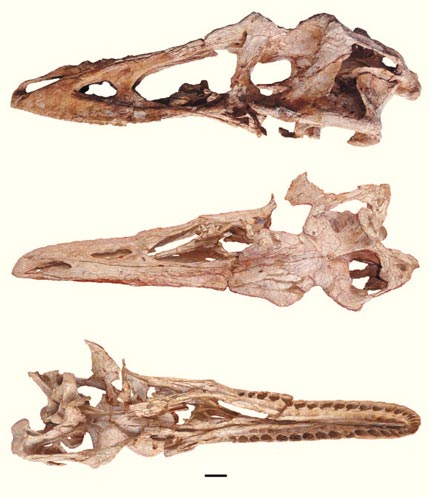
New long-snouted Tyrannosaur.

New long-snouted tyrannosaur.

Picture credit: Junchang Lü/Chinese Academy of Geological Sciences

The picture above shows three views of the partial skull and upper jaw of Q. sinensis.  The first picture shows a view from the side (lateral), the second picture shows a view looking down onto the fossil (dorsal) and the third picture shows the view from the underside (ventral).  The scale bar represents five centimetres.

Scientific Paper Published

In a paper published this week in the journal “Nature Communications”,  the authors which include Stephen Brusatte (Chancellor’s Fellow in Vertebrate Palaeontology at the University of Edinburgh) and Junchang Lü (Institute of Geology at the Chinese Academy of Geological Sciences), describe this Theropod as a “remarkable find”.  It is indeed, but the story of this fossil’s discovery is also very remarkable.

Back in the late summer of 2010, construction workers helping to build a new industrial park close to the city of Ganzhou in Jiangxi Province (south-eastern China), uncovered the remains of two dinosaurs.  One was a small oviraptorid, the second and much more spectacular find represented a substantial meat-eater.  The works foreman telephoned a local fossil hunter who visited the site and having examined some of the finds and realised their importance, called in the Ganzhou city Mineral Resources Management Department.  A field team was quickly despatched and within a few hours the vast majority of the exposed fossil material was collected, which in the case of the large theropod represented much of the skull and jaws, vertebrae, parts of the pelvis and limb bones.

Late Cretaceous “Hotbed”

Many different types of dinosaur have been found in the sedimentary rocks that are exposed in and around Ganzhou city, it is often described as a “hotbed” for Late Cretaceous dinosaur discoveries.  The field team had to work fast, as a number of fossil dealers had also heard of the discovery and if they had got to the bones first, then the fossilised remains could have ended up being sold on the black market.

As things turned out, following the speedy collection, the story of Qianzhousaurus slowed down to a snail’s pace.  The fossils which had been bagged up remained with the Mineral Resources Management Department for the best part of eight months, before they were presented to the Ganzhou Natural History Museum.  In August 2012, the museum assembled a team of Chinese scientists and technicians to examine the bones and begin the reconstruction of the specimen.

Close Phylogenetic Relationship with Alioramus

The initial research work was concluded in January of last year and the full significance of the discovery was realised.  Here was an adult tyrannosaur that exhibited skull characteristics that placed it in a close phylogenetic relationship with the tyrannosaur known as Alioramus.  This was proof that the long suspected sub-branch of long-snouted tyrannosaurs had existed.

Further work was undertaken and the formal academic paper published this week.  Say hello to Qianzhousaurus sinensis.  Qianzhousaurus is pronounced Chy-an-shoe-sore-us, the genus name is derived from the old name for the city of Ganzhou (Qianzhou), the species name reflects that this dinosaur was Chinese.

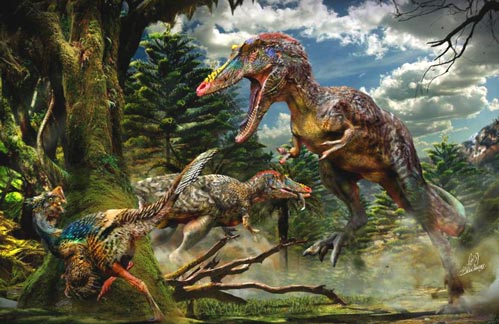
An Illustration of the Late Cretaceous Tyrannosaur Q. sinensis

New Tyrannosaur described - Qianzhousaurus sinensis.

New tyrannosaur described – Qianzhousaurus sinensis.

Picture credit: Chuang Zhao

This dinosaur had a number of small horns or bumps running along its snout.  It is illustrated attacking a feathered oviraptorid dinosaur, as the fossils of Qianzhousaurus sinensis were found in association with the bones of a small member of the Oviraptoridae family.

Dr Brusatte explained:

“This is a different breed of tyrannosaur.  It has the familiar toothy grin of T. rex, but its snout was much longer and it had a row of horns on its nose.  It might have looked a little comical, but it would have been as deadly as any other tyrannosaur, and maybe even a little faster and stealthier.”

This specimen is very significant as the fused skull bones identify it as an adult animal. Qianzhousaurus probably weighed around 1,000 kilogrammes and reached lengths of around 8-9 metres.  Smaller than its deep-skulled tyrannosaur contemporaries, Qianzhousaurus probably occupied a niche in the Late Cretaceous food chain, that of a secondary predator.  Even if it lived in packs, it probably did not specialise in hunting really large herbivorous dinosaurs.  It was nowhere near as powerful as some of the other Upper Cretaceous tyrannosaurs known from Asia, the likes of Tarbosaurus and the recently described Zhuchengtyrannus.

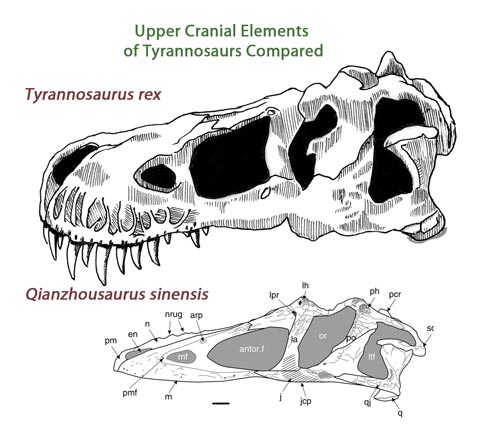
Tyrannosaur Skull Comparisons (T. rex versus Q. sinensis)

Scale bar = 5cm

Scale bar = 5cm

Picture credit: Journal of Nature Communications and Everything Dinosaur

To read an article about Zhuchengtyrannus: New Species of Asian Tyrannosaur Announced.

Studying Tyrannosaurs

The bite force that this predator could generate was nowhere near the bone crushing bite force of Tyrannosaurus rex.  This was a more graceful, agile hunter, perhaps stalking feathered dinosaurs and other reptiles.  Consider Qianzhousaurus as the leopard that shares the same habitat as a lion.

For models and replicas of Qianzhousaurus, numerous tyrannosaurs and other prehistoric animals: PNSO Age of Dinosaurs Models.

This fossil is very important for a number of reasons, firstly there is a substantial amount of fossil material to study, scientists can learn more about the tyrannosaur family as a result.  Secondly, unlike the two known Alioramus specimens which both represent juveniles, this adult animal demonstrates that there were long-snouted forms of Tyrannosauridae.  A sub-branch of tyrannosaurs did exist and the presence of a long-snout in the likes of the Alioramus specimens cannot be attributed to the fact that these not fully grown dinosaur specimens “hadn’t filled out yet” as a colleague puts it.

Thirdly and perhaps most crucially of all, this fossil discovery from south-eastern China was found in Upper Cretaceous deposits located more than two thousand kilometres away from the Upper Cretaceous deposits that yielded the Alioramus material.  It seems that the long-snouted tyrannosaurs were widely distributed in Asia during the last few million years of the Cretaceous period.  This means that there are, very probably a number of other “Pinocchio rex” tyrannosaurs awaiting discovery.

We wonder what Geppetto would have made of it all…

7 05, 2014

The Dinosauria Shrank to Continue to Evolve

By |2023-03-13T08:14:46+00:00May 7th, 2014|Categories: Dinosaur and Prehistoric Animal News Stories, Dinosaur Fans, Palaeontological articles|0 Comments

New Study Suggests that Birds Survived Mass Extinction Events Because they Stayed Small

There has been a lot of media coverage today with regards to a paper published in the scientific journal PLOS Biology (Public Library of Science),  that used an analysis of dinosaur and bird body masses to examine how quickly members of the Dinosauria including the ancestors of modern birds evolved to exploit new ecological niches.  A lot of emphasis has been placed on the size and scale of the non-avian dinosaurs, we shall come to this in due course, but the main thrust of the academic paper does not concern itself with just how big some of the dinosaurs got.

Measuring Body Mass

In this instance, measuring body mass is a means to an end, the research suggests that on that branch of the Dinosauria family tree that leads to the birds (Aves), there was a sustained and very lengthy period of evolution of species.  Birds and their direct dinosaur ancestors seem to have evolved rapidly for at least 170 million years, quickly diversifying and becoming more speciose to exploit niches in ecosystems as and when they arose.  Other types of dinosaur, those not directly related to extant birds, seemed to evolve at a slower rate, once an initial burst of adaptive radiation took place to exploit those gaps left in the world’s terrestrial ecosystems after the End Triassic extinction event.

An International Team

The international team of researchers including academics from Oxford University, the Royal Ontario Museum of Canada, the University of Toronto, the Smithsonian Institute, Imperial College, University College of London, the IVPP (Beijing) and Sweden’s Uppsala University also suggest that the evolutionary ability of those birds that existed during the time of Cretaceous mass extinction event, to remain small may have assisted their survival.  The larger, less diverse dinosaurs, the likes of Tyrannosaurus rex and Triceratops horridus died out.

Decreasing Body Size to Continuously Exploit New Ecological Niches

small body size helped birds evolve rapidly.

Small body size helped birds evolve rapidly.

Picture credit: Everything Dinosaur

Decreasing Body Size

The research team believes that the group that eventually evolved into birds decreased their body volume to continuously take advantage of new ecological niches through their evolution, becoming the successful species they are today.  Small, may indeed have been beautiful when it came to surviving major extinction events and the more speciose your clade was, the more niches you as a clade occupied the better your chances of survival.

Let’s start at the beginning, the first dinosaurs evolved sometime in the Middle Triassic, palaeontologists can’t be certain as to when or even where, although some of the latest research suggests that the very first dinosaurs as we now know them evolved in Africa.

To read an article on what might have been one of the first dinosaurs: The First Dinosaur?

The first birds may have evolved in the region of 170 million years ago (Middle Jurassic), the problem with both the early dinosaurs and those early birds is that the fossil record is extremely poor and material fragmentary.  It is difficult to establish a clear, evolutionary lineage.

To read an article about one of the first types of bird to evolve: New Contender for the “First Bird” – Aurornis.

What the fossil record does show is that in all the major groups of animals there was a rapid burst of evolution with lots of new body shapes and sizes rapidly evolving during their early history.  Different types evolve to exploit niches in food chains.  There is a rapid explosion of adaptive radiation amongst organisms.  Adaptive radiation, to an evolutionary biologist is a process in which living things rapidly diversify into a vast array of new forms.

Mass Extinction Event

This burst of natural selection is often prompted by a mass extinction event that eliminates competitors or through climate change that opens up new territories and habitats to exploit.  For example, the dinosaurs rapidly diversified into a number of different Superfamilies in the Early Jurassic, perhaps a biological response to the gaps left after the End Triassic extinction event.

Problem is, very few studies of adaptive radiation have looked at how Orders evolve over deep geological time, so the links between how diverse a modern day Order might be in relation to major extinct groups remains relatively unclear.  This is what the international team of scientists set out to examine.  Today, there are over 10,000 species of birds, they are the most speciose of all the living tetrapod clades, how did the evolution of the birds and their dinosaur ancestors compare to the evolutionary rates of other types of dinosaur not that closely related to the Aves?

Measuring the Pace of Development

To measure the pace of evolutionary development, the scientists chose to look at the variations in body mass.  Put simply the idea is this:

  • Look at the family tree of the dinosaurs and examine each of the major branches.
  • Look at the body sizes of the different types of prehistoric animal (estimating body mass was undertaken by measuring the robustness and size of limb bones notably femurs)

Work on the basis that if closely related animals are similar in body size then evolutionary rates were probably slow.

However, if closely related animals show a very wide range in body size then evolutionary rates were probably very rapid

A comprehensive data set of body mass was compiled for the major types of dinosaur and birds that evolved in the Mesozoic.  Although it is difficult to accurately estimate the weight of long extinct animals (a source of continual debate amongst scientists), in living creatures the scaling model based on the size and shaft circumference of major limb bones such as the thigh bone seems the most reliable.

From this study, the scientists concluded that the heaviest dinosaur known was Argentinosaurus (Argentinosaurus huinculensis) with an estimated body mass of around 90,000 kilogrammes.

Dinosaur Super-Heavyweight Argentinosaurus

Argentinosaurus model (CollectA)

Biggest dinosaur known to science.

Estimating Body Weights of Dinosaurs

The body weights of 426 dinosaurs were estimated and when added to the number of bird species studied the total exceeds 600, the smallest and lightest species analysed was Qiliania (Q. graffini), a primitive bird whose fossils date from around 120 million years ago and come from China.  Qiliania graffini weighed six million times less than Argentinosaurus huinculensis.  However, Qiliania may have been tiny, but there are very few Mesozoic creatures that can claim to have been named after the founder of a punk rock band (Dr Gregory Graffin).

Estimated Body Masses of Various Types of Dinosauria (the Smallest Examples)

The estimated size of the smallest member of various dinosaur Superfamilies

The estimated size of the smallest member of various dinosaur Superfamilies.

Table credit: PLOS One Biology

The table above lists the smallest Dinosauria members known by type of dinosaur, weights are given in kilogrammes.

Estimated Body Masses of Various Types of Dinosauria (the Biggest Examples)

Estimated size of the biggest members of the Dinosauria.

Estimated size of the biggest members of the Dinosauria.

Table credit: PLOS One Biology

The table above shows the body mass estimates of some of the biggest dinosaurs and birds known (weight in kilogrammes).

The Heaviest Types of Dinosaurs

The international team of researchers did not set out to re-classify the heaviest types of dinosaur and submit new information to the Guinness Book of Records, this is what has intrigued a number of media outlets and journalists who have focused on the estimated size and scale of these long extinct creatures.  There are one or two notable points worth making.  For instance, using the limb robustness and shaft circumference method, Tyrannosaurus rex comes out significantly heavier than Giganotosaurus carolinii.  The herbivorous Iguanodon (I. bernissartenis) and Triceratops (T. horridus) are approximately twice as heavy as the fearsome T. rex.

But enough of this, let’s focus on the main aspect of this new research.  The Dinosauria evolved very rapidly early on in their evolutionary history, but the speed of evolutionary change for most of the Superfamilies slowed down, if the relative body masses of closely related dinosaur types is used as a measure of evolutionary change.

Only in the Maniraptora, that clade of coelurosaurian theropods that gave rise to modern birds did that initial high rate of evolutionary change continue.  According to Dr David Evans, the Curator of Vertebrate Palaeontology at the Royal Ontario Museum and one of the co-authors of the paper, the branch of the dinosaur family tree that led to the birds represents “the second major adaptive radius ring of dinosaurs”.

Examining Body Sizes

Closely related groups of dinosaurs with similar body sizes may not have evolved to exploit new opportunities with quite the same rapidity as the birds.  As a result, when there was intense pressure put on the Superfamily because of environmental changes such as those that occurred at the end of the Cretaceous, extinction was the outcome.

Dinosaur Phylogeny Showing Nodes which indicate Exceptional Evolution of Body Size 

The Aves (Avialae) have been ringed faintly in red.

The Aves (Avialae) have been ringed faintly in red.

Picture credit: PLOS One Biology 

Feathered maniraptoran dinosaurs, including those now classified as Mesozoic birds sustained a rate for rapid evolution, suggesting these taxa would have been much quicker at adapting to new ecological niches.  Birds retained their ability to evolve very rapidly, a precondition of which was their relatively small size when compared to other dinosaurs.

The research team conclude that the smaller body masses attained by the Aves was the key to their survival, the birds lowered the body mass threshold of the Dinosauria below one kilogramme, subsequently individuals would need fewer resources to survive.  It is thanks to these factors that the birds remain the most speciose of all the tetrapod vertebrates alive today.

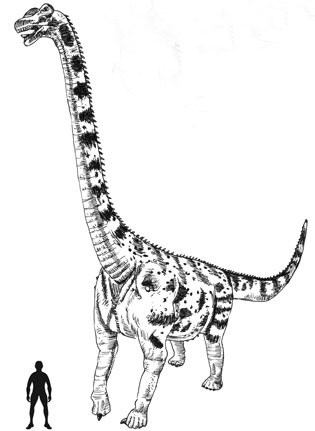
Finally, for all those who wanted to see just how big Argentinosaurus was, we have reproduced below a drawing of a huge titanosaur.  This dinosaur is only known from fragmentary remains and the casts have been made based on scaling up the sizes of bones from better known, more complete titanosaurs.

Just How Big was Argentinosaurus?

Illustration of a giant titanosaur.

Huge dinosaurs – titanosaurids.

For dinosaur models and prehistoric animal figures: Dinosaur Models and Prehistoric Animal Models.

6 05, 2014

Palaeontologists Fear for Safety of Red Rock Canyon Dinosaur Tracks

By |2023-09-03T09:35:04+01:00May 6th, 2014|Categories: Dinosaur and Prehistoric Animal News Stories, Geology, Main Page|0 Comments

Recently Discovered Dinosaur Tracks May be Damaged or Stolen Before they are Studied

Scientists fear that recently discovered Early Jurassic dinosaur tracks might be damaged before they can be studied.

Located in southern Nevada, just twenty-five miles from the bustling city of Las Vegas, the Red Rock  Canyon National Conservation Area provides a peaceful haven for campers and walkers amongst spectacular sandstone buttes and rock formations.  This State Park covers nearly 200,000 acres and up until recently its main claims to fame include being the preferred filming location for several westerns and for sandstone petroglyphs created by native Indians.

“Jurassic Park”

However, this arid place was once home to a range of Early Jurassic dinosaurs and palaeontologists fear that the footprints these ancient creatures left behind could be either damaged or even stolen before they have been properly studied.

The Park attracts over one million visitors a year and back in 2010, three hikers reported finding dinosaur tracks whilst out trekking in the Park.  At first these reports were dismissed, but a scientific investigation confirmed the trace fossil find and the announcement of the discovery was made public in the autumn of 2011.

Dinosaur Tracks

As many as ten locations within Red Rock Canyon have been identified as having preserved prehistoric tracks, five of these sites represent the footprints made by a small, bipedal dinosaur, these prints, once made in soft, wet sand are now preserved in the location’s famous sandstone deposits.

Pictures show a set of three-toed dinosaur prints preserved in the sandstone rock of the Park.  The picture has been taken as if the dinosaur which made these tracks was walking towards the camera.  The species is not known, but it is presumed to have been around two to three metres in length and probably carnivorous.

Early Jurassic Prints

At this time in the Early Jurassic, there was a significant radiation of different types of dinosaur and a number of new types of dinosaur evolved.  Palaeontologists and the National Park’s staff are keen to protect these trace fossils, they hope to keep most of the locations secret, at least until they have been mapped, recorded and properly studied.  However, with a million visitors a year to contend with, the threat of damage to the delicate prints or even theft is always on their minds.

In the neighbouring stage of Utah, Everything Dinosaur team members recently reported on the theft of a dinosaur footprint from near the town of Moab.  The thief has subsequently been caught but the fossil has yet to be found.  A trail date has been set for July 7th.

To read more about this incident of fossil theft: Dinosaur Footprint Stolen in Utah.

Commenting on just how fragile these ancient tracks can be, University of Nevada (Las Vegas), palaeontologist Josh Bonde stated:

“Even well-intentioned folks going out to take a look can harm the site by walking on or nearby the tracks.  The formation the tracks are preserved in is not a very rigid rock and it is notorious for easily falling apart.”

Studying the Tracks

The initial 2010 discovery, once confirmed, triggered a number of similar finds in the Park.  Bureau of Land Management officials would prefer visitors not to go out deliberately looking for more signs of dinosaurs having walked this way.  Most of the known prints are not on designated trails and some of them are in more remote and unsafe locations.

A spokes person for the Bureau explained:

“We really want visitors to stay on designated trails” to minimise damage to all of the Park’s sensitive natural and cultural resources.”

Picture show a close up of a single dinosaur footprint.  Two of the three toes that this little dinosaur walked on can clearly be made out.  Such fossil finds are extremely significant and team members at Everything Dinosaur have been studying a set of similar tracks found in southern Utah, near the town of St George.

To read more about the St George trace fossils: Important Dinosaur Trace Fossil Discovery in Utah.

University of Nevada Leading the Research

The University of Nevada (Las Vegas) was recently awarded a $25,000 USD (£14,800 GBP), by the Bureau of Land Management to study the fossilised tracks in the Red Rock Canyon region.  High resolution cameras will be used to photograph the prints and even LiDAR (light detection and range), a three-dimensional laser mapping system has been proposed.  LiDAR would record the prints in very fine detail without causing any damage to the prints themselves.  It is likely that the study will take more than twelve months to complete.

Staff at the Red Rock Canyon State Park, are hopeful that once completed this study could form the basis of a permanent display located in the Park’s visitor centre.

However, there is the ever-present risk of theft and staff have urged visitors to be on the look out for any suspicious activity.  With high prices being paid for dinosaur fossils at auction, there has been a number of thefts reported in recent years.  A spokesperson from Everything Dinosaur added:

“As the tracks are preserved in coarse grained sandstone, any attempts to lift the prints by untrained individuals would most probably result in the prints being damaged to such an extent that they would have no commercial value.  There are very strict laws in the United States concerning damage to or theft of such precious artefacts.  Any one caught committing such an act of wanton vandalism can expect to face very severe penalties.”

The Bureau of Land Management requests that anyone who finds what they believe could be dinosaur tracks or other fossils in the Park, calls 702-515-5000 and reports their discovery.  They advise taking careful note of the location and photographing the finds.  The Bureau also is quick to remind visitors to the Park that it is illegal to dig up or collect fossils on public land without a permit.

It is likely that more dinosaur tracks await discovery in the Lower Jurassic sandstone, known as Aztec sandstone, that outcrops this part of the western United States.  Hikers and other  tourists can play their part by looking out for such fossils but are reminded to report their finds and to not to attempt to dig or in anyway remove the fossils.

Visit Everything Dinosaur’s website: Everything Dinosaur.

5 05, 2014

Turkmenistan’s Remarkable “Jurassic Park” Fossil Site

By |2024-05-02T06:16:48+01:00May 5th, 2014|Categories: Dinosaur and Prehistoric Animal News Stories, Main Page|1 Comment

Dinosaur Plateau in Turkmenistan Part of Proposal for UNESCO World Heritage Site

Bordering the land-locked Caspian sea to the west, Kazakhstan to the north-west, Uzbekistan as well as Afghanistan and Iran, the central Asian state of Turkmenistan has been a part of the world largely out of bounds to western scientists.  However, tucked in the eastern corner of the country, close to the border with Uzbekistan is the visually stunning  Koytendag National Park, an area known for its caves, spectacular mountain scenery and waterfalls.  The Park is also one of the most important locations for ichnologists in the world.

Koytendag National Park

Ichnologists study trace fossils, most notably footprints and tracks, for preserved in the rocks that make up an area of the Park, are thousands of dinosaur footprints.  The area is known as the “Plateau of the Dinosaurs” and so perfectly preserved are the prints, they look like they were made just yesterday.  The fossilised tracks have been dated to the Upper Jurassic.  Although, this part of Turkmenistan is semi arid, 150 million years ago, it was a lush, tropical paradise that teemed with life and there were many different types of dinosaur inhabiting the area.

Dinosaur Tracks

The location is regarded as one of the most important vertebrate trace fossil assemblages anywhere in the world, but it was not until the latter part of the 20th Century that scientists from outside the Soviet Union became aware of them.  Locals had marvelled at the tracks for centuries, one of the villages at the foot of the plateau is Khodja Pil which in the native dialect (Turkmen) translates as “the miracle of the elephants”, local legend has it that the tracks were made by elephants that formed part of the huge army of Alexander the Great.

Trace Fossils Made by Herds of Plant-Eating Dinosaurs from the Jurassic

Hundreds of dinosaur tracks preserved.

Hundreds of dinosaur tracks preserved.

Picture credit: AFP Photo/Igor Sasin

An Extensive Trace Fossil Site

The site which covers an extensive area, has been carefully mapped and more than 2,500 individual prints have been recorded.  There are a range of different types of dinosaur represented.  The most common ones are the prints of large herbivores, but there are several tracks of three-toed carnivorous theropod dinosaurs too.

A resident of Khodja Pil commented that:

“Steven Spielberg should have shot “Jurassic Park here.  Here the tracks of the dinosaurs are real and not made by computers.”

The largest tracks represent sauropod dinosaurs, most probably diplodocids.  Some of the individual prints measure seventy centimetres in length and are more than sixty centimetres in diameter, but most of the sauropod tracks are from slightly smaller animals, that left prints measuring forty centimetres long by thirty centimetres wide.

A Close up of One of the Large Sauropod Prints to be Found on the Plateau

Sauropod footprint, the hand provides scale.

Sauropod footprint, the hand provides scale.

Picture credit: AFP Photo/Igor Sasin

Long Dinosaur Tracks

It is not only the quantity of the footprints that are of fascination to palaeontologists.  The area has some of the longest continuous lines of footprints made by dinosaurs to be found anywhere in the world.  Individual tracks can run for over two hundred metres.  Such tracks enable scientists to study Dinosauria locomotion and even behaviour can be inferred from the prints.

Anatoly Bushmakin, a Turkmen scientists who along with colleagues has been studying the fossils explained how the tracks were formed:

“Some 145-150 million years ago, [Upper Jurassic], there were lakes and marshes and herds of dinosaurs strode along the banks.  There were both vegetarian and carnivorous dinosaurs.  This sandy marshland quickly silted up and so these prehistoric tracks left their mark forever.”

The site is remote and only a handful of foreign tourists visit this location each season.  The United Kingdom Government provides advice on visiting Turkmenistan and there are a number of extreme sports and extreme off-roading companies that offer tours.  Visiting this border region requires a special permit.

A Typical Late Jurassic Scene

Dinosaurs roamed the land whilst Pterosaurs soared overhead.

Dinosaurs roamed the land whilst pterosaurs soared overhead.

Picture credit: Everything Dinosaur

Turkmenistan officials are optimistic that the Park could become a major tourist attraction which would help to boost revenues for the country’s exchequer.  To this end, the Ministry of Tourism is preparing a submission to UNESCO to have the Koytendag National Park declared a world heritage site, on a par with the Great Barrier Reef of Australia or our own “Jurassic Coast”.

We at Everything Dinosaur wish the authorities well in their campaign, but we do urge caution.  Opening up such a remote part of the world can bring problems and it would be essential to ensure that the environment is protected and that visitor numbers to view the dinosaur tracks are managed appropriately to ensure the site is properly preserved.

For dinosaur models and figures plus other prehistoric animals: CollectA Deluxe Scale Models.

3 05, 2014

Dinosaur Footprints Set Out on a Tour of New Zealand

By |2023-03-13T07:49:22+00:00May 3rd, 2014|Categories: Dinosaur and Prehistoric Animal News Stories, Geology, Main Page|0 Comments

New Zealand’s Very Own “Walking with Dinosaurs”

Dinosaur fossils are exceptionally rare in New Zealand, despite this remarkable and very beautiful country being home to some flora and fauna that can definitely be thought of as being prehistoric.  For example, there is the Tuatara (Sphenodon punctatus), which belongs to an otherwise extinct reptilian group called the Rhynchocephalians and this little reptile is found nowhere else in the world.  The country can also boast some of the finest examples of cycad groves (Cycadales) on the planet.

Dinosaur Footprints

However, evidence for dinosaurs having lived in New Zealand, which formed part of the huge southern super-continent of Gondwana has been hard to find.  Very few body fossils have been discovered and trace fossils such as dinosaur tracks are even rarer, but for GNS Science* geologist Greg Browne, the next few months sees some Titanosaur footprints that he found forming part of a touring exhibition that aims to educate New Zealanders about their prehistoric heritage.

GNS Science was founded in 2006 it was formerly known as the Institute for Geological and Nuclear Science Ltd.

The exhibition entitled “Dinosaur Footprints: A Story of Discovery” will open at the prestigious Auckland War Memorial Museum in June before touring the country.  The footprints, the first evidence of such dinosaurs having lived on what is now known as South Island were found in sedimentary rocks north-west of the town of Nelson.  At first, scientists were unsure whether the strange marks in the rocks represented the tracks of giant plant-eating dinosaurs, but the circular footprints, some of which are over sixty centimetres in diameter have been confirmed as being the tracks produced by a long-necked dinosaur referred to as a titanosaur.

Titanosaur

To read an article on the footprints published by Everything Dinosaur: Dinosaur Tracks from New Zealand.

Visitors to the exhibition will be able to learn all about the fossil discovery, the prints have been identified from more than half a dozen locations and they stretch over an area of around ten kilometres.  Replicas and casts of the prints will be on display and artist Dave Gunson has created a watercolour illustration depicting a pair of giant titanosaurs roaming across a Late Cretaceous, sandy beach, the moment in time when the trails were formed.

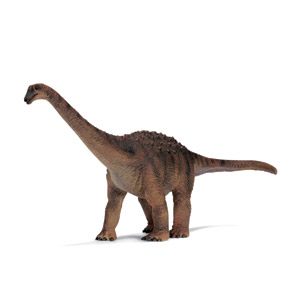
An Illustration of a Typical Titanosaur – Saltasaurus

Saltasaurus

Saltasaurus – a typical titanosaur.

Picture credit: Everything Dinosaur

The Titanosaurids

The titanosaurids were the last group of sauropod dinosaurs to evolve and although the Sauropoda seemed to have gone into decline in the Northern Hemisphere as the Cretaceous progressed, titanosaurs made up a significant proportion of the herbivorous biomass on the southern continents.  This group of long-necked dinosaurs persisted until the very end of the Cretaceous.

For models and replicas of titanosaurs and other prehistoric animals: Wild Safari Prehistoric World Models.

Although Greg Browne and his team are not able to identify the genus that made the tracks, the footprints vary in diameter and indicate that the dinosaurs ranged in size from about two metres to more than six metres in length.  These animals were probably moving as a herd and chose to walk close to the shore as this would have been an easier and probably safer route than attempting to move as a group through the forest that was located further inland.  The roughly circular prints probably represent a single species.

The current tour Itinerary is as follows:

  • Auckland War Memorial Museum 13th June until July 27th
  • Rotorua Museum 6th September until October 12th
  • New Zealand National Aquarium, Napier over Labour Weekend – from January 11th 2015
  • Puke Ariki, New Plymouth 17th January until March 22nd
  • Nelson Provincial Museum from July through to September 2015

A spokesperson from Everything Dinosaur commented that is was great to hear that the story of  these enigmatic and extremely rare footprints was going to reach a wider audience.  He encouraged New Zealanders to attend, to have the opportunity to get up close to the evidence for dinosaurs roaming New Zealand seventy million years ago.  It was also important for the work of sedimentologists such as Greg Browne to receive wider public recognition.

It is likely that more venues will be added to the tour schedule.

Go to Top