All about dinosaurs, fossils and prehistoric animals by Everything Dinosaur team members.

News stories and articles that do not necessarily feature extinct animals.

7 04, 2010

If you go down to the woods today – discover a new species of Monitor Lizard

By |2023-03-05T14:22:17+00:00April 7th, 2010|Categories: Animal News Stories, Educational Activities, Main Page|0 Comments

Beware of a new Dragon in the Woods – Varanus bitatawa  a New Species

Finding a new species of vertebrate is a rare event.  Finding a new, large species, an animal that would be described as a member of the “mega fauna” is exceptional, but a new 2-metre-long species of Monitor Lizard (genus Varanus) has just been brought to the attention of western scientists.

The giant lizard resides in the Philippines, in the northern forests of Luzon island.  Luzon island is the largest island that makes up the Philippines and despite having parts of it densely populated (it is one of the most populated islands on Earth), it still has plenty of natural wonders awaiting discovery.

Monitor Lizard

The genus Varanus (Monitor Lizards) contains nearly 30 species, all of which live in the Old World, with species found in Africa, southern Asia, the Philippines and Australia.  The largest lizard in the world today is a Monitor Lizard – the Komodo dragon (V. komodoensis), it too has revealed some surprising discoveries recently, with confirmed evidence that this lizard that can grow up to 3 metres long and weigh 90 kilogrammes has a venomous bite.

Recently, a scientific paper was published suggesting that a genus of dinosaur called Sinornithosaurus may also have been venomous.

To read more about this: Sinornithosaurus – A Dinosaur with Venom.

This new species of monitor, although longer than a man, is actually very lightly built with the largest specimens so far weighing a little more than 10 kilogrammes.  Half the body length of this new species, named Varanus bitatawa is made up of tail.

The animal poses no threat to humans as it appears to be entirely herbivorous.  It has remained undescribed for so long as it is extremely secretive and spends a great deal of time living in trees, where it finds fruit to eat.  This new Monitor Lizard, described by the scientists who found it as “spectacular”, is a very striking animal indeed with bright yellow, blue and green skin.

A Model of the Largest Living Lizard – the Komodo Dragon

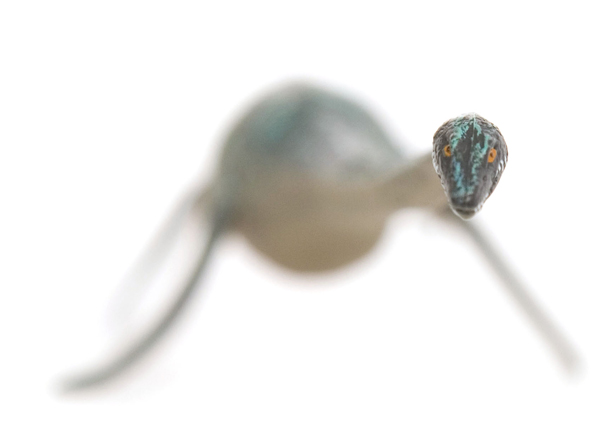
Rebor Komodo dragon 1:6 scale replica. A species of monitor lizard.

Rebor GrabNGo Komodo dragon model. Picture credit: Everything Dinosaur.

Picture credit: Everything Dinosaur

The model (above) is the Rebor Komodo dragon replica, to view this figure (whilst stocks last): Rebor Replicas and Prehistoric Animal Figures.

This lizard may be completely new to western science, but to the local tribes people of the forests of northern Luzon, the animal is very well known.  For centuries the locals have hunted it for food, it is reputed to taste extremely pleasant and such animals provide a valuable source of protein for the indigenous people.  We suppose it would be kind of like a version of “corn fed chicken”.  The secretive nature of this lizard may well be a result of hunting pressure with only the most reclusive and shy animals avoiding the attention of the local hunters.  At the same time, this Monitor remained unknown to scientists in the west.

International Research Team

The American, Dutch and Philippines based research team had found plenty of evidence of a large, arboreal lizard.  Many trees had claw marks on the trunk and the native people had talked about a lizard that was good to eat, but until now no documentary proof of this lizard’s existence had been collected.

One of the authors of the paper on this new species, Dr Rafe Brown stated:

“It is an incredible animal”.

The paper has been published in the scientific journal “Biology Letters”.  In the journal, the researchers describe how rare it is to find such a large terrestrial animal new to science.

The new species, which is called Varanus bitatawa, is thought to live almost entirely on fruit, making it one of just three species of fruit-eating Monitor Lizards in the world.  Living as it does in the tree canopy, this large lizard has remained undetected to the eyes of western scientists, despite a number of scientific expeditions to this part of the Philippines to map the diversity of the fauna and flora.

The new species of monitor lives at least 150km away from its nearest relative, another lizard called V. olivaceus, which also lives in trees and eats fruit.

4 04, 2010

From Full Stops to Commas – update on the Frog Blog 2010

By |2023-01-04T08:00:56+00:00April 4th, 2010|Categories: Animal News Stories, Everything Dinosaur News and Updates, Main Page|0 Comments

Tadpoles are Developing – Frog Blog 2010

Not exactly the most wonderful spring weather at the moment, at least we have been able to avoid the heavy snow falls that affected parts of Scotland earlier this week.  The patches of frogspawn in the pond are showing signs of development, well at least those clutches of eggs that are in the sunny shallows.  Although, these clumps of spawn (we are not sure what the collective noun for frogspawn is), were some of the last to be laid, several days after the first frogspawn, they are developing more quickly.

The spawn that was laid first was moved out of the shallow water into slightly deeper water, this was as a result of all the frantic activity of the frogs.  Two clumps of spawn have ended up in about 2 feet of water.  The frogspawn can still be seen and as far as we can tell it is not developing as quickly as the frogspawn produced later but laid in the warmer, sunlit shallows.

Frog Blog

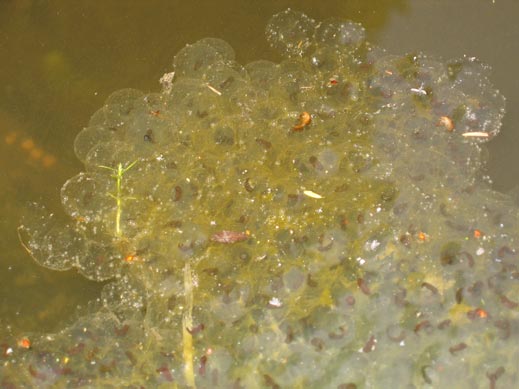
Tadpoles Developing in the Frogspawn

Picture credit: Everything Dinosaur

Tadpoles

The first frogspawn was laid around 20th March, this particular clump of spawn has been pushed into deeper water, whereas, the spawn laid towards the end of the mating period has remained in shallows and seems to be developing quicker.  The picture above shows a clump of frogspawn in the shallows.  Note that the black dots of the embryos are turning from a round “full stop” into a “comma” shape with a distinctive head and a tail.  Movement can be detected in the clump of spawn as the tadpoles move inside their eggs.  No signs of development can be seen in the spawn in the deeper part of the pond.  We have suspected for sometime that egg development was related to water temperature.  Those eggs exposed to direct sunlight in shallows will be warmed and therefore hatch quicker than their counterparts deeper in the pond.  It is really a question of balance, perhaps the clump of spawn in the deeper water is protected from drying out and is less likely to predated upon by terrestrial based predators.  The price paid for this is a slow start to the hatching process.

3 04, 2010

Sir David Attenborough Provides Helpful Comments on the Restrictions placed on Children to Learn about Nature

By |2024-04-19T10:28:15+01:00April 3rd, 2010|Categories: Animal News Stories, Dinosaur and Prehistoric Animal News Stories, Educational Activities, Main Page|0 Comments

Sir David Attenborough wants Children to Gain a “Foundation Stone” of Science

The natural curiosity of children with their desire to collect and understand the world around them is being suppressed as the are too many restrictions and laws today.  That is the view expressed by veteran natural history broadcaster and naturalist Sir David Attenborough, who believes that young people are being denied the chance to learn about the world around them because of restrictions on collecting items from the countryside.

Sir David Attenborough

Sir David spoke about his concerns at the launch of a new organisation aiming to promote the teaching of biological sciences – The Society of Biology.  He considers that much of the legislation brought into the UK to protect threatened species and environments has resulted in declining opportunities for young people to collect other non-protected species and so learn about the natural world around them.  Sir David commented on the many restrictions imposed on fossil collectors, those locations where people can freely collect fossils in the UK are becoming fewer and fewer.  The lack of access was stifling the enquiring minds of the next generation of scientists he claimed.

Sir David’s comments are particularly pertinent, what with the granting of the first two injunctions against professional fossil collectors extracting fossils from Dorset cliffs.

To read more about these injunctions: Rogue Fossil Collectors on England’s Jurassic Coast Face Ban.

He stated:

“Children become interested in natural history because they are natural collectors.  It is a pity that it is not possible to allow them to go out and collect any more.  Not to be able to collect a wild flower or fossils is sad.”

Whilst we at Everything Dinosaur accept that the loss of many fossil hunting sites is a great shame, we are also aware of the great damage done to many locations by professional fossil collectors who literally smash up locations in their search for specimens that they can sell.

The Joy and Excitement of Finding that Special Fossil

Finding that special fossil.

The joy and excitement of finding that special fossil. Picture credit: Everything Dinosaur.

When asked about the decline in the public’s ability to identify species of animals in the world around them, Sir David stated that:

“Taxonomy is the foundation stone of the biological sciences.”

He went onto bemoan the lack of opportunities children have to collect and classify insects, animals and other objects saying that:

“It is a great loss to our children that they are prevented legally from collecting animals.”

Helping Children Explore Nature

By allowing children to collect and classify insects, animals and other objects they found around them helped them to learn the skills needed for taxonomy, the science of classifying species.  It is certainly true, that many great scientists such as Napier and Darwin were fascinated from an early age with the natural world and in Victorian England there was a huge fashion for collecting, whether it was ferns and plants or even butterflies and birds eggs.  Putting together vast collections was seen as an appropriate hobby for Victorian gentle folk to indulge in.  Sadly, legislation became increasingly necessary as these natural resources were rapidly exploited and species became endangered.

Today there are a number of laws and voluntary codes in place.  These are designed to protect our natural world, although these restrictions do inhibit the opportunities children may have to learn more about subjects such as botany and biology.

Commenting on the current legislation, Sir David Attenborough said:

“I hope we might be able to shift legislation in a more intelligent and generalised way that will not be so specific.”

We remember the joys of pond dipping, collecting frogspawn and observing the tadpoles metamorphosize into frogs, catching butterflies and watching caterpillars pupate.  Teachers and teaching assistants have a role to play in helping to fire the imaginations of children.  The National Curriculum does empower teachers to develop creative and thoughtful ways of meeting the requirements of the syllabus.  Indeed, teachers and teaching staff along with parents can have a huge influence on the development of an interest in the sciences amongst children.

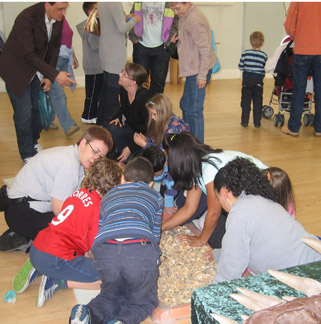
Sadly, when it comes to fossil collecting there are fewer and fewer opportunities to take groups out these days.  We have helped to overcome this problem to some extent by building trays that we fill with sand, gravel and fossils – bringing the joy of fossil hunting to children in those areas where they may not be able to go and experience it for real.

One of the Everything Dinosaur Portable Fossil Beaches in Action

Picture credit: Everything Dinosaur

For educational games and toys visit Everything Dinosaur’s website: Dinosaur Toys and Games.

A spokesperson for Defra (The Department for the Environment, Food and Rural Affairs) said that the legislation was not intended to stop children from exploring or learning about the natural world.

She stated:

 “It is important to protect plants, birds and animals from damage and disruption and to help preserve an important part of our heritage so that we can enjoy the benefits for years to come.  The legislation does not prevent children and adults from exploring and learning about the natural world and we encourage them to enjoy the beauty of the countryside.”

21 03, 2010

Exciting Frog Blog 2010

By |2024-04-18T18:59:22+01:00March 21st, 2010|Categories: Animal News Stories, Everything Dinosaur News and Updates, Main Page|0 Comments

Frog Blog 2010 – We have Frogspawn in the Office Pond

Last night there were clear skies and air temperatures dropped to near freezing.  We were concerned about the frogs in the pond that we had observed, they had been croaking at each other for two days but there had been on sign of spawn.

Frog Blog

We had seen the first frog of spring in the office pond about a week ago, we had been concerned about how many of these amphibians had survived given the very cold winter that we had endured (cold for UK standards).

To read the article about the first frog spotted: First Frog Seen in the Office Pond.

However, this morning there was mass of frogspawn laid in the shallows (one pair of frogs had bred), then shortly before 8am this morning (we arrived early to check on the frog’s progress), we observed a second mass of spawn being laid.  It is difficult to count all the frogs in the pond, they are moving around so much, but we think there are as many as seven in the pond.  This is the first time we have two sets of spawn laid in our pond.  It is only the third year that we have spawn laid in it at all.  One of our colleagues rescued what they thought was a female frog from a busy road a few days ago.  He put the frog in some shrubbery behind the pond.  We know that frogs instinctively try to return to the water they were born in to breed, but hopefully this frog would have stayed close to our pond as it would be much safer for it to have done so.  Perhaps it has spawned, we would like to think so.

Frogspawn

Today the weather is gorgeous, bright and sunny.  The frogs are still very active and the air temperature has climbed to 13 degrees Celsius (tropical).  As a result of all the frog activity we have banned ourselves from going outside in case we disturb the frogs so we have to observe them from the office window.

Hopefully, more frogs will breed over the next 24-hours or so.  However, interestingly, both sets of spawn produced so far have been laid in very shallow water.  Some of the spawn is actually exposed to the air.  It may be an old wives tale, but according to local folklore, if frogspawn is seen laid in deep water it indicates  a dry spring.  If frogspawn is laid in shallow water it indicates rain.  The weather forecast for the next few days is for showers and unsettled conditions, perhaps there is some truth in this folklore after all.

Update – ten frogs seen in the pond.

20 03, 2010

Ancient Crocodile Poop Provides Unique Evidence of Deinosuchus Diet

By |2024-04-18T19:00:01+01:00March 20th, 2010|Categories: Animal News Stories, Dinosaur and Prehistoric Animal News Stories, Educational Activities, Main Page|1 Comment

New Study into Fossilised Crocodile Poop Provides Evidence of Deinosuchus Diet

It was not just the tyrannosaurs and raptors that the unwary dinosaur herbivore had to look out for in the Late Cretaceous habitats of the southern and southwestern United States seventy million years ago.  In estuarine environments (where rivers meet the sea), there lurked a monster crocodile called Deinosuchus that would have quite happily tackled a duck-billed dinosaur or pachycephalosaur had one ventured too near.

Deinosuchus

That is the conclusion drawn by a team of U.S. based scientists following a study of ancient crocodile coprolite (fossilised poop).  The coprolite, some of which measures more than 13 cm long, has been assigned to the fearsome Late Cretaceous predator Deinosuchus and evidence from the study of such objects has helped scientists determine the diet of this huge reptile and where it lived.

Deinosuchus (Deinosuchus hatcheri) was a huge, crocodilian that lived in what was North America during the later stages of the Cretaceous period.  Although, no complete skeleton has been found, a number of fragmentary fossils and a nearly complete skull have been discovered.  Scientifically named in 1909, this huge reptile has been estimated to have reached lengths in excess of 10 metres and would have weighed perhaps as much as 2 tonnes.  A recent study has indicated that Deinosuchus (the name means “terrible crocodile”) may actually be  more closely related to modern alligators than crocodiles.

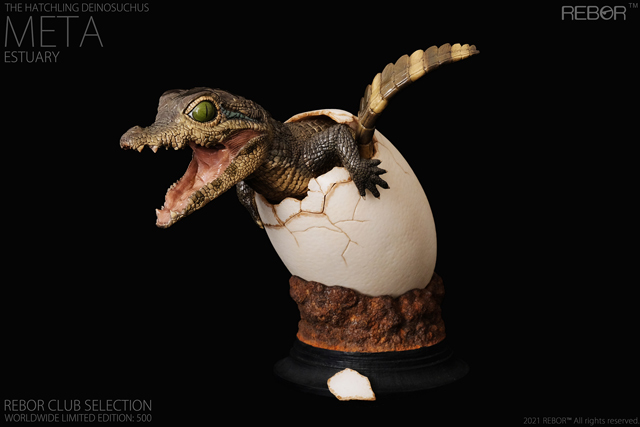
A Replica of a Hatching Deinosuchus

Rebor Meta the hatchling Deinosuchus model (Estuary Variant0

The Rebor Club Selection: Meta the hatchling Deinosuchus is about to leave its egg! It’s very keen to get to the safety of the water.

Picture credit: Everything Dinosaur

The picture (above) shows the Rebor limited-edition hatching Deinosuchus (Esturary variant).

To view the range of Rebor figures and models: Rebor Prehistoric Animal Figures.

Estimating the Size of Deinosuchus

It is difficult to provide an accurate estimate of the size of this particular ancient crocodile in the absence of more complete skeletal material.  Using ratio measurements of skull length compared to body size of modern crocodiles as a guide, an estimated size of between 10-12 metres can be obtained.

Professor David Schwimmer of Columbus State University and one of his students of palaeontology, Samantha Harrell; carried out a detailed analysis of the fossilised crocodile dung and bones that showed bite marks from crocodilians.  They have concluded that this fearsome beast preferred to live in shallow, estuarine environments and preyed mainly on sea turtles but would have also been capable of taking down a dinosaur or two.

Palaeontologist Professor Schwimmer (no relation to the actor who played Ross the palaeontologist in “Friends”) stated:

“We’re sure [Deinosuchus] ate a lot of sea turtles, but it’s evident it liked to prey on dinosaurs too.”

Professor Schwimmer and Harrell gave a combined presentation on the bite marks and the coprolites, at the March 13-16 Geological Society of America Northeastern/South-eastern annual meeting in Baltimore.  Additionally, the coprolite study is being published as “Coprolites of Deinosuchus and other Crocodylians from the Upper Cretaceous of Western Georgia, USA” in a special symposium volume of the New Mexico Museum of Natural History and Science Bulletin.

Bite Marks on Dinosaur Bones

The studies detail how bite marks on dinosaur bones discovered in various locations around the United States, and large fossilised dung droppings discovered near Columbus, Georgia (southern USA), have been linked to Deinosuchus.

The dung fossils are the first such documented samples from the Deinosuchus and help confirm that this giant, prehistoric crocodile preferred living in the marine shallows. Meanwhile, the separate bite mark findings reveal aspects of the creature’s eating habits.

In the spring of 2009, Professor Schwimmer asked Harrell to take command of a project as an independent study course to gather and analyse fossilised dung he had started to recover from a fossil hot spot along the banks of the Hannahatchee Creek in Stewart County, a major tributary of the Chattahoochee River, south of where the Piedmont meets the Coastal Plain.

Harrell explained coprolites are studied in order to convey information about the lifestyles of the dead and buried.  She discovered sand and lots of shell fragments, signifying that these crocodiles lived in a shallow, brackish, warm-water environment — likely near the mouth of a river where it opened to a sea with a sandy shoreline and an abundance of sea turtles for its diet.

Although it is difficult to be absolutely precise when assigning fossilised dung to a particular genus, in this case the size, shape and nature of the dung studied  does indicate a large crocodile and Deinosuchus is the only known genus of crocodile from this strata.

To view models of prehistoric crocodiles: Wild Safari Prehistoric World Models and Figures.

18 03, 2010

Worm Wiggles its Way to Pre-eminence

By |2023-01-03T09:17:09+00:00March 18th, 2010|Categories: Animal News Stories, Dinosaur and Prehistoric Animal News Stories, Educational Activities, Main Page|0 Comments

Canadian Worm Wiggles its Way to Pre-eminence

In the warm waters surrounding the Cambrian continent of Laurentia lived an array of bizarre creatures, early arthropods, brachiopods and our ancient vertebrate ancestors.  The Annelida (worms) were very well represented with a number of different families of segmented worms.  These survivors from the Precambrian continued to diversify and flourish and if you want to find the fossilised remains of a prehistoric worm, look no further than your average Canadian construction site.  That is exactly what one Canadian amateur fossil collector called “James” did, and he inadvertently helped the Royal Ottawa Museum (ROM) discover a fossil of a 480 million-year-old armoured worm.

The extremely rare fossil of an armoured worm, a fossil that predates the emergence of the dinosaurs by some 250 million years was found when a local fossil collector examined the spoil coming from the excavation of an underground car park for the World Exchange Plaza, a set of buildings that can be found in downtown Ottawa (Ontario State, Canada).  However, it was not until a similar find was made in Morocco that scientists from the ROM realised the significance of the fossil found on the construction site ten years earlier.

Armoured Worm

Lead author Jakob Vinther and colleague David Rudkin have published a detailed description of this fossil in January’s edition of the scientific journal “Palaeontology”.  This tiny fossil, (measuring 16 mm long), about the size of an adult man’s little finger nail represents the organism Plumulites canadensis, a member of the Machaeridian family.  The significance of the Canadian fossil was not recognised until similar material was recovered from ancient marine deposits found in North Africa.

In 1998, the local fossil fan, known as “James” approached the ROM and handed the bizarre fossil to museum staff.  It was not until the Moroccan material was discovered that researchers realised the importance of this ancient object.  Unfortunately, the original donor of the fossil cannot be traced.

This fossil and other recently discovered material helps to cement the evolutionary link between the ancient Machaeridia and Annelid worms.

Commenting on how rare this example was, Vinther stated:

“They are really hard to find complete, fewer than ten of these fossils are known to exist.  We just had these skeletons and we didn’t know what kind of animal was underneath these plates.  We didn’t even know that they were worms, actually.”

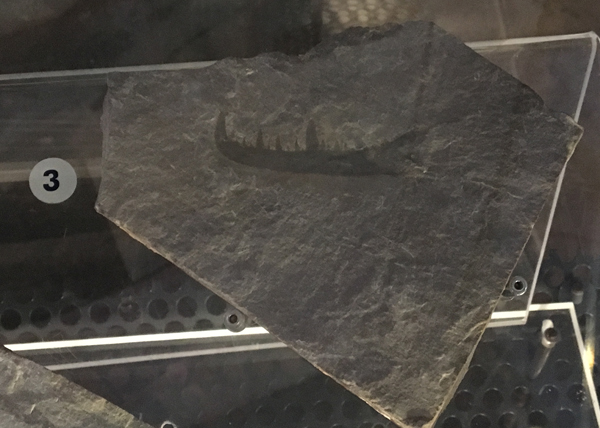
Pictures show the bizarre fossil found in the spoil of a Canadian construction site.  It superficially resembles the much larger Vendian organism Dickinsonia and seems to have a segmented body that has a mid-line of symmetry.  This creature probably lived on or in the sea floor.  It would have been a member of the epifauna.  Essentially vagrant it would have roamed around the soft sea bed on thin, spindly legs that emerged in parallel out of key body segments.  The strange carapace of bony plates that protected this creature was made from calcite.  It would have provided some protection against marauding cephalopods or arthropods.

The emergence of hard body parts, items such as shells and an exoskeleton is evidence of the “Cambrian Explosion” a period when life in the sea diversified rapidly and the first complex predator/prey relationships were established.

Body Armour

Commenting on the body armour of this creature, Yale University graduate, Vinther added:

“A number of animals started evolving a higher level of protection in this period of time.  These annelid worms, they did the same thing … that seems to correlate well with the appearance of cephalopods.”

The Machaeridia persisted for some 200 million years, finally going extinct towards the end of the Palaeozoic, but their ancestors are very much with us today and perform a number of essential roles in both marine and terrestrial eco-systems.

Strange Cambrian Fauna

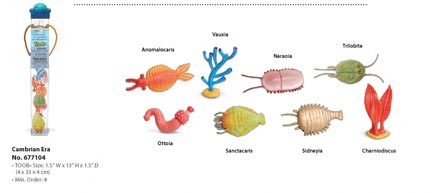
Cambrian Toob by Safari Ltd

Say hello to Cambrian wildlife.  Strange Cambrian fauna.

The picture (above) shows the Cambrian Toob by Safari Ltd a model set that highights the bizarre nature of Cambrian fauna.

Allan Donaldson, a retired Carleton University Professor of Geology, participated in an authorised dig at the construction site of the World Exchange Plaza.  He said he found the routine trilobites and shelled orthocones, but nothing spectacular like the Machaeridia this amateur found in the material removed from the spot.

“Good for him” Donaldson acknowledged.

It is hoped that all the publicity over this worm fossil will reach the ears of the local man who actually found this ancient relic of Late Cambrian marine life and he can come forward to take some of the credit for the discovery of the worm from pre-history.

16 03, 2010

America’s Oldest Artwork Described in New Study

By |2024-04-19T09:44:13+01:00March 16th, 2010|Categories: Animal News Stories, Dinosaur and Prehistoric Animal News Stories, Main Page|0 Comments

Ancient Elephant Carved into Bone – Could be Three Times Older than Stone Henge

Scientists describe what could be America’s oldest artwork.

A small piece of fossilised animal bone, with a carving of a prehistoric elephant scratched onto the surface could be the oldest example of artwork found to date in the USA.  Researchers from the University of Florida have suggested that this carving could date from as early as 15,000 years ago, making this relic many thousands of years older than the Egyptian pyramids and perhaps up to three times older than Stone Henge.

America’s Oldest Artwork

James Kennedy, an amateur fossil collector from Vero Beach, a holiday resort on the Atlantic coast of Florida was cleaning and inspecting his collection when he discovered the small carving a Mastodon on a piece of fossilised animal bone.  This relic could present tangible evidence that early human settlers lived in Florida, sharing their environment with huge prehistoric elephants and Sabre-toothed cats.  Already, one anthropologist involved in analysing the artefact has dubbed this fossil as the “oldest, most spectacular and rare work of art in the Americas.”

The piece of bone looks fairly innocuous at first glance, we ourselves at Everything Dinosaur have seen lots of bone fragments such as this, partially permineralised fragments of bone from river channels and such like that would date from the very late Pleistocene.  However, as James Kennedy cleaned and studied this piece of bone he was amazed to see that there was a carving of a prehistoric elephant on it.

The close up picture of the fossilised bone shows the faint outline of a prehistoric elephant with a pair of large tusks.  The head is at the right hand side of the picture.

The carving in the picture has been highlighted in red ink by Everything Dinosaur team members to reveal the outline of the prehistoric relic.

Visit Everything Dinosaur’s website for prehistoric animal themed craft ideas: Dinosaur Toys and Gifts.

Scientists at the University of Florida studied this artefact, not with the intention of dating it accurately, but initially in a bid to see whether the carving was a fake.  It had been thought that the engraving had been scratched onto the fossil bone very recently but tests showed that the fossil and its carving were the same date.

Scanning Electron Microscopy

Scanning electron microscopy allowed the researchers to examine the carving minutely.  Marks were made on the fossil and then compared to the engraving to help prove conclusively that the engraving was genuine.  All the tests indicated that this was the real thing, and that sometime between 13,000 and 15,000 years ago a person carved the image of a Mastodon into the bone.

Retired professor Barbara Purdy, a specialist in anthropology at the University of Florida commented:

“the exact age [of the object] is less important than what the artefact tells us about early humans.  The detail of the artwork itself suggests that the artist saw a Mastodon up close.”

The scientists are concerned that this ancient relic may be lost to the public forever as James Kennedy plans to auction the fossil instead of donating it to a museum.

13 03, 2010

First Frog seen in the Office Pond

By |2023-02-25T06:44:02+00:00March 13th, 2010|Categories: Animal News Stories, Everything Dinosaur News and Updates, Main Page|0 Comments

Frog’s Back in the Pond

We have seen the first frog in the small pond outside the office today.  We had been concerned that the particularly cold winter had killed off a number of the small creatures that reside in and around the pond, however, with the milder weather of the last couple of days it seems that at least one amphibian has been stirred from their winter slumber.

Frog in the Office Pond

It is likely that a number of frogs, toads and other amphibians did not survive the cold.  Unfortunately, a severe winter will often affect the number of small animals and birds that survive into the spring.  We have even been putting food out for the birds in order to help sustain them, particularly over the prolonged period of snow that we have had.

The invertebrates in the pond, notably the water-boatmen have been observed and they are becoming more active as the temperature increases, the plants around the margins have begun to show signs of life and hopefully it will not be long before the frogs spawn in the pond once more.  We have had frogspawn in the pond for the last two springs, the frogs spawning around the first week of April and from what we have observed it is just one female that has laid.  If she has survived, there is a good chance that she will spawn again.  We will have to watch the pond carefully over the next couple of weeks to see if we can spot any more frogs.

1 03, 2010

The Controversy over the Polar Bear Highlighted by New Research

By |2024-04-19T09:34:21+01:00March 1st, 2010|Categories: Animal News Stories, Main Page|0 Comments

Polar Bear Jawbone gives Clues to Evolution of Polar Bear Species

Scientists have known for some time that the Polar Bear (Ursus maritimus) is most closely related to the Brown Bear (Ursus arctos) or a sub-species thereof.  However, the timing of the evolution of a bear adapted to the cold and subsequently being named and described as a new species has been debated.

Polar Bear Jawbone

In a research paper published by a team of Scandinavian scientists, on the study of a fossilised jawbone from an ancient Polar Bear, one of the conclusions drawn is that Polar Bears evolved as recently as 150,000 years ago, in response to dramatic climate change in the northern hemisphere.  The jawbone is the oldest Polar Bear fossil found to date and it suggests that Brown Bears trapped on remote islands at the onset of a period of global cooling adapted to the cold conditions and over many thousands of years they evolved into a new species – the Polar Bear.

Affinity Between the Polar Bear and the Brown Bear

The close affinity between the Polar Bear and the Brown Bear is well known, with genetic studies indicating how closely related these two species are.  There have also been several reports of “hybrid” bears being discovered in the wild and bred in zoos, natural crosses between a Brown Bear and a Polar Bear.  This has caused certain difficulties for hunters in the Canadian frozen wastes, as although they may have had the correct hunting permit to shoot Polar Bears (around 500 such bears are shot legally each year), sometimes a hybrid is shot a “pizzly” as they are referred to by the locals and this can get the hunter into trouble with the Canadian authorities.

Discovery on an Arctic Island

The bone was discovered at Poolepynten on the Arctic island of Svalbard by Professors Olafur Ingolfsson, of the University of Iceland, and Oystein Wiig, of the University of Oslo.

In a research paper the researchers concluded:

“The Poolepynten subfossil mandible, which we argue is from a fully grown male, is probably the oldest Polar Bear find discovered so far.  Its true age is interpreted to be 110,000-130,000 years old.”

Academics have debated the Polar Bear lineage for many years, some believe that it evolved as recently as 50,000 years ago, whilst other scientists have argued that this species evolved more than a million years in the past.

Svalbard Fossil

The existence of the Svalbard fossil indicates that polar bears were already a distinct species by about 130,000 years ago.  But anatomical and DNA evidence from the fossil indicate a closeness between Polar Bears and Brown Bears of the time — suggesting the species diverged no more than about 200,000 years ago and probably about 150,000 years ago.

This sharply narrows the “window” during which Polar Bears might have emerged to a period when the Northern Hemisphere was being drawn into an ice age that lasted from approximately 190,000 to 130,000 years ago.  This period of dramatic climate change would have put pressure on the northerly enclaves of Brown Bears, especially those on isolated islands such as Admiralty Island and its neighbours Baranof Island and Chichagof Island (known locally as the ABC islands).

Examining DNA

One research group, led by Gerald Shields, of the University of Alaska Fairbanks, used DNA from 61 Brown Bears taken from three populations in Alaska and 55 Polar Bears from Arctic Canada and Siberia.  The scientists wanted to work out not only when Polar Bears evolved but also, potentially, where from and from which population of Brown Bears.

The researchers discovered that the DNA of the ABC island bears was closer to that of the Polar Bear than any other Brown Bear population studied.

In a paper they research team concluded:

“Brown Bears of the ABC islands may be descendants of ancient ursids [bears] that diverged from other lineages of Brown Bears and subsequently founded the Polar Bear lineage.”

This view is expected to get support from new research, out this week, based on DNA extracted from the Poolepynten jawbone.

It means polar bears have already survived a global warming that affected the northern hemisphere from 130,000 to 115,000 years ago, when the Greenland ice sheet and the Arctic ice cap were smaller than now.  Professor Chris Stringer, of the Natural History Museum in London, an expert in ice age mammals and the evolution of hominids, commented:

“Early Polar Bears would not have had all the specialisations of modern animals and we know nothing about their behaviour.”

Reflecting on the current plight of Polar Bear (listed as vulnerable under the Endangered Species Act), Professor Stringer said:

“Living through a warm period back then does not mean they are resilient to climate change now.”

For models and replicas of prehistoric animals: Prehistoric Animal Models and Figures.

28 02, 2010

Monster Crocodile a Predator of Early Hominids

By |2023-01-02T20:29:39+00:00February 28th, 2010|Categories: Animal News Stories, Dinosaur and Prehistoric Animal News Stories, Main Page|0 Comments

Fear of Crocodiles an Ancient Human Trait

In the first episode of the BBC television series “Walking with Cavemen”, the episode entitled “First Ancestors” an adult Australopithecus afarensis is taking a drink from a river when a crocodile attacks, grabs the unfortunate hominid and drags him into the water to his death.  Although this scene was depicted in a fictional, albeit educational television series; this incident reflects what has been found in the fossil record, as some early hominid fossil bones have marks on them reputedly made by feeding crocodiles.

Most scientists had thought that these attacks were from Nile Crocodiles (Crocodylus niloticus) or at least a very similar species to the large extant predator found in this part of Africa today.  However, a new study from a joint team of U.S. based scientists and researchers from the National Natural History Museum of Tanzania indicates that hominid attacks around 2 million years ago, may have been carried out by a different type of crocodile.

Monster Crocodile

Following a review of partial and fragmentary crocodilian remains from 1.8 million-year-old strata from the Olduvai gorge region of Tanzania, a new species of large crocodile has been identified, an animal similar in size to today’s Nile crocs, but one with a distinct crest of bone over the back of skull.  According to the authors of the crocodilian study, Chris Brochu, a vertebrate palaeontologist from the University of Iowa, Robert Blumenschine and Tanzanian Jackson Njau, it is this crocodile that may have terrorised our ancestors.

In the report, published in this month’s edition of the online journal PLoS One, this crocodile may have been the largest predator these ancient humans encountered in their East African world.

Commenting on the fossil evidence showing crocodile attacks on prehistoric people Chris Brochu stated:

“I can’t guarantee these crocodiles were killing our ancestors, but they were certainly biting them.”

It was Brochu who named and described this new crocodilian Crocodylus anthropophagus, the name means “man eating crocodile”, as Chris remarked he hopes that “people get the joke.”

The re-evaluation of the crocodile fossils found in the Olduvai gorge deposits indicate that this new species of crocodile could have been responsible for the attacks on people.  Certainly, our ancestors such as A. africanus et al were relatively small and light, many of them less than one metre tall.  Such small animals would have been no match for this 7-metre-long predator.

Crocodylus anthropophagus

Although roughly the same size as the modern reptilian apex predators of the Nile, the Olduvai crocodiles had thinner, more flared snouts and large horns that are more characteristic of a Madagascan crocodile that went extinct in the past few thousand years.

The discovery of C. anthropophagus points to far more diversity in African crocodiles in the past 2.5 million years than previously thought, Brochu stated:

“People have always perceived crocodiles as these slowly evolving, living fossils. That’s just nonsense.”

His team haven’t found many fossils belonging to C. anthropophagus, and none that is complete, so it’s impossible to determine its precise relationship to modern Nile crocodiles or when these particular man-eaters went extinct.  Crocodiles remain dangerous to humans today and a number of species are known to have attacked people and caused fatalities.  Our smaller ancestors had to cope with animals just as big as the ones we see in the Nile or in Australia today.

Perhaps, our fear of these scaly creatures began farther back in our prehistory than previously thought.  Humans reliance on freshwater and our underdeveloped senses when compared to other mammals would have made us vulnerable to ambush attacks from these freshwater predators.

A Replica of an Australopithecine

Australopithecus

At home on the plains. An australopithecine.

The picture (above), shows an australopithecine model that was created by Bullyland of Germany.

To view the Bullyland range of prehistoric animal models: Bullyland Prehistoric Animal Figures.

Go to Top