All about dinosaurs, fossils and prehistoric animals by Everything Dinosaur team members.

News stories and articles that do not necessarily feature extinct animals.

26 12, 2009

And Darwin Mentions the Remarkable Quagga

By |2024-04-18T15:10:39+01:00December 26th, 2009|Categories: Animal News Stories, Everything Dinosaur News and Updates, Main Page|0 Comments

Darwin uses the Quagga to help explain the Laws of Variation

It is interesting to note whilst re-reading the Origin of Species, that Darwin uses the example of several genera of horses to demonstrate reversion in natural selection with striped markings appearing in the offspring of many separate species from the family Equus (horses).

Darwin Illustrates the Laws of Variation

When Darwin’s ground-breaking book the Origin of Species, or to give its full title “The Origin of Species by means of Natural Selection or The Preservation of Favoured Races in the Struggle for Life”, was first published the year was 1859.  The science of genetics did not exist and there was no known scientific mechanism for passing on inheritance.  In chapter 5, Darwin sets out his thoughts on the laws of variation in nature.  He uses Equus (horses) to illustrate how species of the same genus can vary in an analogous manner.  Analogy in this instance is describing the resemblance of structures which depends upon similarity of function, as in the wings of insects and birds.  Such structures are said to be analogous, and to be analogues of each other.

The Quagga

One of the animals used to illustrate the points made by Darwin in this chapter is the South African Quagga.  At the time Darwin wrote this book, the Quagga was still around but within a few years this particular striped horse had been hunted to extinction.

An Illustration of a Quagga (Mojo Quagga Model)

Mojo Quagga replica.

The Mojo Quagga model.

The image (above) shows a Mojo Fun Quagga replica. To view the range of animal models and figures in the Mojo Fun range: Mojo Fun Prehistoric and Extinct Models.

The Quagga had the distinctive markings of the plains Zebra on the head and neck, but the dark markings between the white bars grew darker and whiter towards the rear of the animal with the rump dark brown in colour.  Sadly, this animal was hunted to extinction for meat, hides and to preserve grazing land for domesticated animals.  The last Quagga in the wild was probably killed in the late 1870’s.  Darwin may have viewed a Quagga as there was one at London Zoo until this animal died in 1870.  The Quagga has the remarkable distinction of being one of the very few extinct animals where the date is known when they became extinct.  The last Quagga, alive on Earth was kept in a Zoo in Holland. When this animal died on August 12th 1883, these animals became extinct.

Ironically, even though Darwin et al referred to the Quagga as a separate species, the DNA of hides and the very few skeletons of this animal that remain indicate that it was actually a sub-species of the highly variable plains Zebra.  Attempts are being made to reproduce the Quagga by selectively breeding Zebra species.

The name Quagga was taken from a native language, it is supposed to be onomatopoeic as the sound made by pronouncing the word reflects the call made by the animal.

As these animals have become extinct in recent history, those exhibits seen in museum collections are not fossils but actual skeletons.  The Quagga skeleton is believed to be the rarest mammal skeleton on the planet kept in museums, as so few of these creatures were preserved and retained in Natural History Museum collections.

29 11, 2009

Lyuba Makes Her Terrestrial Television Debut

By |2022-12-31T20:55:31+00:00November 29th, 2009|Categories: Animal News Stories, Dinosaur and Prehistoric Animal News Stories, Main Page, TV Reviews|0 Comments

Secrets of a Baby Mammoth

The discovery of a perfectly preserved baby Woolly Mammoth by a nomadic reindeer herder in the north-western part of the huge Siberian tundra, sent shock waves rippling across the scientific world.  Baby Woolly Mammoths had been found before, but they had been weak and sickly animals, Lyuba (as that was the name given to the carcase), was different.  Here was a young Mammoth that had drowned and by all accounts was a strong calf.  Her body was to provide an insight into the fauna and flora of an Ice Age world some 40,000 years ago.

Baby Mammoth

To read an article on Lyuba: New Baby Mammoth Found.

The story of the research and the study of this amazing well preserved fossil has been made into a ninety minute documentary.  It has been shown on satellite television channels before, but it is being shown on terrestrial television for the first time this Friday.

To view a model of a baby Woolly Mammoth, other Ice Age figures and replicas, plus of course, dinosaur models: Dinosaur and Prehistoric Animal Models.

A Model of a Baby Mammoth

baby mammoth

A baby Mammoth on the move.

The picture (above) shows the juvenile Woolly Mammoth model from Papo.  To view the Papo range of prehistoric animal models and figures in stock at Everything Dinosaur: Papo Prehistoric Animal Figures.

This programme is being shown on Channel 4 at 9pm on Friday December 4th.  It should be fascinating.

22 11, 2009

Bikini Clad Girls Photographed on top of a Crocodile Trap

By |2022-12-31T18:21:05+00:00November 22nd, 2009|Categories: Animal News Stories, Dinosaur and Prehistoric Animal News Stories, Main Page|0 Comments

Girls in Bikinis Dance on Top of Crocodile Trap

Austrialian authorities express concerns after two girls were photographed dancing on top of a crocodile trap.

It was not Darwin who coined the phrase “Survival of the Fittest” but a contemporary of his Herbert Spencer, a philosopher born in the English city of Derby in 1820.  We wonder what Darwin and Spencer would make of the antics of two bikini clad girls as they dance away using the top of a crocodile trap as their stage.

Drinking Champagne

The girls were photographed drinking champagne and using the bottles as microphones as they danced on top of a crocodile trap that had been set close to the coastal town of Manigrida in Australia’s Northern Territory.  As the rain poured down, the girls seemingly unaware of any danger or simply oblivious to it, danced on top of the croc trap, that had been placed there to catch a deadly Saltwater crocodile, the largest reptile on Earth.

The image was taken last weekend, and has been published just a day after a picture of two male tourists tempting fate by doing a similar thing at the Jim Jim Falls in Kakadu National Park.

The image, taken at the weekend, surfaced a day after the paper published a picture of two male tourists tempting fate by doing a similar thing at Jim Jim Falls in Kakadu National Park, also in the Northern Territory.

Crocodile Trap

The Saltwater or Estuarine crocodile is known to be a man-eater, or in this case a bikini clad girl-eater.  Growing to lengths in excess of 8 metres long in the remote Australian outback.  Large males can weigh over a tonne and they are the apex predators in the area.

Recently, there have been calls from local residents to curb the crocodile population by having a cull, after a number of people and domestic animals were attacked by these fearsome, prehistoric reptiles.

To read an article on the problems with the growing Saltwater crocodile population in Australia: Invasion of the Crocodiles.

Commenting on the actions of these men, park ranger and crocodile expert Garry Lindner said this sort of behaviour was “absurd”.

He went on to add:

“Crocs are attracted to the bait in the traps, so it is extremely dangerous to fool around like this.”

These Aussie “Sheilas” are perhaps trying to prove Herbert Spencer’s phrase “Survival of the Fittest” as you would certainly have to question their common sense in choosing a crocodile trap as a dance floor.  Let’s hope the only “snaps” they encounter are the photos taken by the photographer.

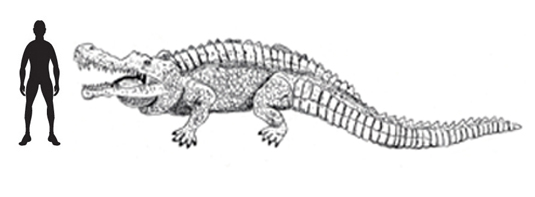
Even the Saltwater crocodile would be dwarfed by the giant crocs of the Mesozoic, for example Sarcosuchus (the name means “flesh crocodile”) was over 12 metres long and palaeontologists estimate it would have weighed as much as two Indian elephants.

Sarcosuchus Scale Drawing

Sarcosaurus scale drawing

Everything Dinosaur’s scale drawing of Sarcosuchus.

Picture credit: Everything Dinosaur

To view a model of Sarcosuchus and other prehistoric crocodiles, we suggest you take a look at the models section of the Everything Dinosaur website: Dinosaur and Prehistoric Animal Models.

19 11, 2009

The Goat that lived like a Reptile

By |2023-09-02T06:46:51+01:00November 19th, 2009|Categories: Animal News Stories, Dinosaur and Prehistoric Animal News Stories, Main Page|0 Comments

Ancient Goat Species Lived like a Reptile

An ancient mammal lived in the slow lane, scientists studying Myotragus goat fossils suggest that this island-living animal may have had a metabolic rate similar to an extant reptile.

The island of Majorca in the Spanish Balearics may be regarded as a holiday retreat for many.  Indeed, this group of islands, of which Majorca is the largest, attract many millions of holidaymakers each year.  However, the geology of Majorca is truly fascinating and a study of a type of goat that once lived on this island has revealed a remarkable adaptation to a resource poor environment.  For one type of prehistoric mammal, the key to survival in a harsh environment was to live like a reptile.

Amongst all this recent debate over whether dinosaurs were warm-blooded or cold-blooded (ectothermic v endothermic) comes a research paper published in the scientific journal the Proceedings of the National Academy of Sciences, suggesting that goats adapted to a resource-poor environment by changing their growth rate and metabolism to match the available food supply.  A mammal living in the slow lane, developing a metabolism and growth rate more like a reptile’s than other mammals.

This discovery is the first time scientists have seen this ectothermic survival strategy in Mammalia.  Unfortunately, for the species of goats concerned, their adaptations may have eventually led to their extinction, once skilled human predators came to the Majorca.

Co-author of this study into the prehistoric goats of Majorca, Meike Köhler, a palaeobiologist at the Autonomous University of Barcelona, Spain noted that the energy saving adaptations made these animals small, slow and easy prey for sophisticated human hunters when modern people came to live on the island approximately 3,000 years ago.

Myotragus Goat Fossils

A study of the fossilised bones of this prehistoric goat (Myotragus) were first found on the island in the early part of the 20th Century.  The fossils show that this species lived, isolated on this island for more than 5 million years, with virtually no natural predators.  In most large mammals, constant high growth rates and fast metabolisms require lots and lots of food to sustain them.  Cold-blooded reptiles, relying on the sun to warm their bodies do not require anything like as much food as an equivalent sized mammal would.  Since resources can fluctuate wildly on isolated islands, reptiles often displace mammals in such environments as the mega fauna.

However, this new research, which analysed the ontogeny of several Myotragus specimens revealed that the goats may have adapted their growth and metabolic rates seasonally to cope with the limited amounts of food that was available – just like reptiles do.

Commenting on the research findings Meike Köhler stated:

“This way, it burned only the energy that was available from the environment, slowing down the ‘fire of life’ in times when resources became scarce”.

The reptile-like lifestyle, however, meant that the newborn of this particular goat were extremely small, about the size of rats and the young would have taken many years to reach breeding age and adulthood.  The goat may have saved a lot of energy by developing a brain only half the size of similar-sized ungulates and eyes only a third as large as other species of goat that existed on the mainland of Europe.  The small eyes can clearly be seen in the picture above.

Detailed Bone Analysis

The bone analysis indicated that the ontogeny (growth rates) was very slow for this particular species and these goats probably had a sluggish appearance.

Like modern-day reptiles, the goats probably “saved as much energy as possible just lying around and basking in the sun,” Köhler said.

“The postcranial skeleton indicates that this animal was not able to run, jump, or move fast around, and [would have been] easy prey, ” added Köhler.

A number of remote, isolated islands have provide evidence of the enormous ability of organisms to adapt to their constrained environments.  Examples include giant flightless birds such as the New Zealand Moa, pygmy elephants and humans on the Indonesian island of Flores, and now a goat that adapted to limited resources by taking on the metabolism of a cold-blooded reptile.

Visit Everything Dinosaur’s website: Everything Dinosaur.

1 11, 2009

World’s Oldest Spider’s Web found Entombed in Amber

By |2023-03-03T17:44:56+00:00November 1st, 2009|Categories: Animal News Stories, Dinosaur and Prehistoric Animal News Stories, Main Page|0 Comments

Ancient Spider’s Web Preserved In Amber

Fossils in amber provide a window for palaeontologists into ancient ecoystems.

An amateur fossil hunter looking for dinosaur fossils along the Sussex coast (England), has found a 140 million-year-old piece of amber (fossilised tree resin), which contains the remains of a spider’s web.  This discovery is being claimed by scientists as the oldest spider’s web evidence ever found in the fossil record.

Spider Fossil

The amber and the tiny, tangled fragments of web have been dated to the Early Cretaceous (Berriasian/Valanginian faunal stages), a time when the Earth was much warmer and dinosaurs dominated the Earth.  The web’s structure seems similar to those webs woven by modern orb spiders.  Orb spiders weave a spiral of silk, many with sticky droplets on them to help trap insects.

The amber, which was found on a Sussex beach (near Bexhill) was handed over to palaeobiologist Professor Martin Brasier who analysed the contents of the amber nodule.  His findings are reported in the Journal of the Geological Society.  The minute threads of spider silk are about 1 millimetre long and suspended in the amber nodule along with bits of burnt tree sap, insect droppings, microbes and fossilised vegetable matter.  The amber nodule was found by amateur fossil hunter Jamie Hiscocks.

Prof. Brasier, a member of the faculty at the University of Oxford commentated:

“This amber is very rare. It comes from the very base of the Cretaceous period, which makes it one of the oldest ambers anywhere to have inclusions in it.”

Earliest Evidence of Actinobacteria

Professor Brasier and his colleagues have also found the earliest evidence of Actinobacteria a tiny group of organisms that break down wood and resins into soil particles, potentially rewriting the history of soil evolution.  An examination of the threads contained in the amber indicate that they were spun by spiders closely related to modern day Orb spiders, or Garden spiders.  Spiders are members of the Phylum Arthropoda, the largest phylum of animals.  Fossils of spiders are extremely rare in the fossil record, although palaeontologists believe that spiders evolved during the Devonian (410-355 million-years-ago).

Professor Brasier stated:

“We actually have the sticky droplets preserved within the amber.  These turn out to be the earliest webs that have ever been incorporated in the fossil record to our knowledge.  You can match the details of the spider’s web with the spider’s web in my garden.”

Spider Silk Trapped in Sticky Resin

The spider silk became trapped in sticky resin (most probably from a conifer), the resin may have been produced by the tree to help heal a wound in the tree bark, perhaps as a response to fire damage.  There is evidence of a fire event, this is indicated by the burnt sap contained within the amber nodule.

The arrow in the diagrams released to the media is pointing at a tiny strand of spider silk.  These remains were identified by Professor Brasier and his team when they viewed the amber as different sections and studied these slices using microscopic imaging, a technique known as confocal microscopy.  The large, dark blobs are pieces of burnt tree sap.

Experiments using modern cherry trees have demonstrated that very similar threads can be obtained by trapping modern spider webs in resin.

More Amber Nodules to Study

Just a tiny proportion of the deposits have so far been examined, and Professor Brasier and his colleagues believe that amber nodules such as this one have the potential to yield many more exciting finds, largely due to the development of increasingly powerful imaging techniques.

He said:

“It is a very exciting time to be a palaeontologist, because of all these wonderful techniques being developed.  We are able to view things and see detail in ways that we’ve never been able to before.”

The discovery suggests that orb web spinning spiders existed far earlier than had been previously thought, at a time before flowering plants appeared on the planet and triggered an explosion in flying insects.  The Bexhill site has revealed a number of other finds, including charcoal indicating that forest fires were common in the area during this time in Earth’s history.

Amber from the North Sea

The amber deposit, which is hidden beneath the tide for much of the time, is also believed to be the first significant amber deposit in Britain.  Most famous amber deposits have been found in France, Germany, the Caribbean and Lebanon.  A lot of jewellery is made from Baltic amber, this dates from the Palaeogene period, so it is approximately 90 million years younger than the Bexhill find.  Occasionally, pieces of Baltic amber are found on the Norfolk coast, having floated across the North Sea.  Amber, as it is a natural substance filled with air spaces, is buoyant and can float in sea water.

Despite the intense interest in the newly discovered spider silk, questions have been asked by members of the press about whether dinosaur DNA could ever be extracted from amber, thus leading to a real-life Jurassic Park.  For the time being let us marvel at the miraculous way in which this ancient evidence of a spider’s activity has been preserved.

For replicas of iconic invertebrates from the fossil record: Replicas of Fossil Animals.

1 10, 2009

Dinosaur Drama Saved from Extinction

By |2022-12-30T07:32:54+00:00October 1st, 2009|Categories: Animal News Stories, Dinosaur Fans, Main Page|0 Comments

ITV Primeval Saved from the Axe

The science fiction, time travelling show Primeval has been saved from the commissioner’s axe after a new deal between ITV and the digital channel Watch has been concluded.  The show which features human actors battling prehistoric and future monsters which escape to present day Earth through time portals has had three series.  It was originally commissioned to run against the BBC’s  Doctor Who and at is peak attracted nearly 8 million viewers to ITV1 on Saturday evenings.

This is a turn around in the fortunes of this TV programme, in the spring we reported on talks between Impossible Pictures, the makers of the show and Warner Bros about a possible Primeval movie deal.

Primeval off to Hollywood: Primeval Movie Deal.

ITV and Watch will work together to make thirteen new episodes for television and BBC Worldwide will continue to distribute the show abroad.  The programme is already shown in forty-five countries.  The first few episodes, the start of series 4 will be shown in 2011 on ITV1.  Later episodes will be premiered on Watch.

Commenting on the new venture with Watch, ITV drama commissioning editor Laura Mackie stated:

“We’re delighted to have agreed this new deal to return Primeval to ITV1. The innovative nature of this partnership will allow the show to maintain its high production values”.

This is good news for fans of prehistoric animals, although the storyline was becoming a little jaded after three series and a number of stars of the show had left before the end of the last run.  Primeval featured dinosaurs, prehistoric mammals, flying reptiles and huge invertebrates as well as speculating about the evolution of creatures from the future.  Perhaps the break of a year will provide writers to refresh the show and explore new angles in the time travelling series.

To pick up models and toys of some of the prehistoric animals featured in the television series, take a look at Everything Dinosaur’s website: Everything Dinosaur.

27 08, 2009

The Original King Kong – Gigantopithecus

By |2023-03-03T17:15:31+00:00August 27th, 2009|Categories: Animal News Stories, Dinosaur Fans, Main Page|0 Comments

Gigantopithecus blacki – The Original King Kong

The original King Kong film was released in 1933.  Merian C Cooper (who produced the film) along with Edgar Wallace (the writer of the screen play) wrote the story, a twist on “Beauty and the Beast” between them.  It was the pioneering special effects engineer Willis H. O’Brien that brought King Kong, the gigantic ape and the prehistoric animals that shared Skull Island to life.  The 1925 film “The Lost World” was a very big influence on the original King Kong movie.  In the novel, the Lost World, written by Sir Arthur Conan Doyle, a team of daring explorers led by Professor Challenger venture up a remote plateau and encounter prehistoric creatures.

King Kong

Kong the great ape, is worshipped by the natives on Skull Island.  Kong falls for the beautiful actress that accompanies the explorers as they visit the island.  The actress is offered to Kong as a sacrifice, but the huge simian does not eat her but steals her away into the jungle.  Kong is eventually captured and taken to New York as the “Eighth Wonder of the World”.  However, the ape escapes from his shackles and meets his end on top of the Empire State Building in perhaps one of the most memorable scenes in the whole of cinema.

A Model of a Giant Gorilla – Rebor Gorilla Model

The albino gorilla model from Rebor.

A fearsome animal! The Rebor Alpha Male Mountain Gorilla replica in 1/11 the scale (Albino). Picture credit: Everything Dinosaur.

Picture credit: Everything Dinosaur

To view the range of Rebor replicas and figures including gorilla models (whilst stocks last): Rebor Replicas.

Giant apes the size of Kong, as far as we can tell from the fossil record did not exist, Kong was the figment of the script writer’s imagination.  The fossil record for primates and early human ancestors is actually very incomplete, although there is no credible evidence to suggest that giant gorillas roamed the Earth.  However, sometimes real life can reflect fiction.  Two years after the film King Kong was released a German palaeoanthropologist Ralph von Koenigswald purchased a very large molar from a Hong Kong pharmacy.  Animal teeth and bones are commonly used in Chinese medicine, even today.

Chinese doctors used “dragons teeth” found in remote caves in a number of traditional medicines.  Koenigswald correctly identified the tooth as a molar from an unknown, giant primate species.  He went onto name the animal Gigantopithecus blacki.

Gigantopithecus blacki

Gigantopithecus fossils are known from South east Asia (China and Vietnam), this animal lived during the Pliocene Epoch but survived into the Pleistocene, before finally becoming extinct approximately 200,000 years ago.  Like Orangutans and Gorillas extant species today, the males were much larger than females.  A mature male could weigh over 500 kilogrammes and stand 3.1 metres tall.

A Scale Drawing of Gigantopithecus

Picture credit: Everything Dinosaur

Although known from a few fragments of jawbone the rest of the animal has been deduced following studies of extant species of primate.  Fortunately, for our ancestors and other hominids such as Homo erectus, Gigantopithecus was a herbivore, feeding mainly on bamboo.

7 08, 2009

New Research into Bird Brains – Feathered Friends Capable of Complex Problem Solving

By |2024-04-17T11:16:37+01:00August 7th, 2009|Categories: Animal News Stories, Educational Activities, Main Page|0 Comments

Bird Brains – Corvidae proves Aesop Fable could be True

The term “Bird Brain” is often meant as an insult, but in reality some members of the Order Aves (the birds) are known to be remarkably intelligent and able to demonstrate the ability to solve complex problems.  For example, members of the crow family (Corvidae) are regarded by scientists as being remarkable adaptable and have been used in a number of studies providing an insight into how the cerebrum (the problem solving part of the brain) functions.

Bird Brains

Clever crows and rooks are not new to science but a new study by a team of British researchers has demonstrated the problem solving abilities of these birds and perhaps, proved that one of Aesop’s ancient fables may be based on truth.

In one of Aesop’s fables (morality tales from ancient Greece attributed to writer Aesop who lived some 600 years before the birth of Christ), a thirsty crow finds a pitcher of water.  Unfortunately, for the crow, the neck of the pitcher is quite narrow and the water cannot be reached, as the pitcher is not filled up to the top.  The crow solves this problem by dropping stones into the water, thus raising the water level via displacement.  As more stones are dropped in, so the water rises, until the crow is rewarded with a drink.

The moral of this particular story might be necessity is the mother of invention, but now a team of scientists from Cambridge University have demonstrated that there may be some truth behind this story.

Several rooks, at the University’s aviary have quickly mastered the technique of stone dropping to enable them to raise the level of water within a plastic tube so that they can catch a worm floating on the surface.  This “brains trust” amongst “bird brains” consists of four rooks, named Cook, Fry, Monroe and Connelly.  The scientists have observed the birds carefully examining the problem before dropping in the right number of stones needed to allow them to bring the tasty worm within reach.  Although, is is very difficult to attempt to assess the level of cognitive reasoning involved the birds did seem to wait until the water level was high enough to be reached before attempting to grab the worm with their beaks.

In addition, the birds did not add any more stones after eating the worms, suggesting the pebble dropping was a means to the end and not just a form of play.

Our Feathered Friends

The ingenuity of the feathered friends was shown when they were presented with a pile of stones of varying sizes. The rooks quickly learnt that picking the bigger ones would speed up the task, allowing them to snack more quickly and showing an efficiency of effort.  When given a choice of a worm floating in a tube part-filled with water and one half-packed with sawdust, they grasped that adding stones to the part filled tube with sawdust would not bring the treat within reach.

The study was led by the appropriately named Christopher Bird, a PhD student studying zoology, it has been published in the latest edition of the scientific journal “Current Biology”.

Commenting on his study, Christopher stated:

“Corvids are remarkably intelligent, and in many ways rival the great apes in their physical intelligence and ability to solve problems. “This is remarkable considering their brain is so different to the great apes”.

Such behaviour has not been observed in the wild, but the crow family with their relatively small brains (encephalisation quotient not withstanding), have gained a reputation in many societies for being clever.  For example, in Finland we were told stories by fisherman that when they went ice fishing and left their lines in the water overnight, ravens soon learnt to examine the holes early in the morning before the men returned and to pull up the lines that had a fish hooked on them.  The encephalisation quotient is a simplistic measurement of an animal’s intelligence and allows comparisons across genera.  It examines the ratio between body weight and brain size.

A Fossil Cast of the Early Bird Archaeopteryx

Archaeopteryx fossil cast

Archaeopteryx fossil cast an early bird. Picture credit: Everything Dinosaur.

Picture credit: Everything Dinosaur

This study could help palaeontologists to assess the relative intelligence of theropod dinosaurs, the closest relatives to birds in the animal kingdom fossil record.

Everything Dinosaur stocks a huge range of theropod dinosaur models and figures, some primitive members of the Aves too.  For example, take a look at the scale model range here: CollectA Deluxe Prehistoric Life Models.

3 08, 2009

The Mystery of Dunkle’s Bones

By |2023-03-03T14:39:09+00:00August 3rd, 2009|Categories: Animal News Stories, Dinosaur Fans, Main Page|0 Comments

A Puzzle about Dunkleosteus – A Bony Problem

The apex marine predator during the Late Devonian was the huge placoderm Dunkleosteus.  Placoderms (the term means plated or armoured skins), were a hugely successful group of primitive jawed fish.  They evolved in the Silurian and rapidly diversified to become the main predators along with the first sharks during the Devonian.

Ranging in size from a few centimetres to giants like Dunkleosteus at over 8 metres long, the placoderms were extremely successful.  However, the placoderms became extinct at the end of the Devonian and as far as the fossil record shows, no placoderms survived into the Carboniferous.  A number of marine families became extinct at the end of the Devonian (approximately 354 million years ago), many fish species become extinct and also organisms such as corals, brachiopods, bivalve molluscs and sponges.  Tropical reef-dwelling animals seem to have been the most badly affected.  The exact causes of the Devonian mass extinction are unknown.

A Model of Dunkleosteus

Dunkleosteus

Swimming into view the Schleich Dunkleosteus model.

Picture credit: Everything Dinosaur

The picture above, shows the Dunkleosteus model from Schleich: Schleich Prehistoric Animal Models.

One of the mysteries surrounding the huge, carnivorous Dunkleosteus (the name means Dunkle’s Bones, as this animal was named after the American palaeontologist D. H. Dunkle), is exactly what this animal looked like.  Scientists believe that is lived in the open ocean, and was pelagic (lived above the sea floor).  It is likely that it was also nektonic (an active swimmer), however, only the head and thorax of this fish were covered in bony plates.

A number of these bony plates have been preserved as fossils and scientists have a good idea of what the front end of Dunkleosteus looked like. As for the rest of the animal, the lack of fossil remains (rest of the skeleton probably made of cartilage, like sharks) means that scientists have to make an educated guess as to what the animal actually looked like.

Did Dunkleosteus have a shark-like habit? Was it an active hunter, swimming constantly as it lacked a swim bladder like sharks?  Or was the bus-sized fish more like an eel with a long slender body, fringed with ribbon-like fins swimming sinuously?

Scientists have used the complete remains of smaller placoderms as the basis for their reconstructions of Dunkleosteus.

A Model of Dunkleosteus (Wild Safari Dino Dunkleosteus)

Picture credit: Everything Dinosaur

In this illustration, Dunkleosteus is modelled on the anatomy of a sleek, predator with a powerful tail providing bursts of acceleration to help it catch prey.  The body is broader than in other depictions of this particular placoderm and the tail flukes wider at the bottom to give thrust.

This is the model of Dunkleosteus created by Safari Ltd of the USA and is part of the model series entitled Wild Safari Dinos.

To view the prehistoric animal models in the Wild Safari Prehistoric World range: Safari Ltd. Wild Safari Prehistoric World.

30 07, 2009

Dunkleosteus An Amazing Fish Built like a Bulldozer and a Guillotine for Jaws

By |2024-04-18T06:56:22+01:00July 30th, 2009|Categories: Animal News Stories, Dinosaur Fans, Main Page|0 Comments

Dunkleosteus – The Terror of the Devonian

The Devonian period which lasted approximately sixty-three million years (417 million years to 354 million years ago), is known as the Age of Fishes, as fish were the most advanced vertebrates on the planet for much of the Devonian.  Although the Devonian period marks the formation of a supercontinent with the closing of the Lapetus Ocean, life in the oceans still dominated and it was only towards the end of the Devonian that primitive tetrapods began to venture out onto land. Lakes and rivers were becoming populated by fish and the land was forested as plants evolved greater adaptations to a terrestrial habit.  Indeed by the Middle Devonian, land plants were becoming more complex and taller and by the end of this geological period the first trees had become established.

Dunkleosteus

Insects diversified and began to increase in number, exploiting the many new opportunities life on land was providing.  However, it was in the sea where the truly spectacular animals lurked.  The top predators in the marine environment were the newly evolved primitive sharks and the armour plated placoderms such as Dunkleosteus.

A Scale Illustration of Dunkleosteus

Picture credit: Everything Dinosaur

The model in the picture is a Wild Safari Dinos Dunkleosteus model.

Dunkleosteus was a huge prehistoric fish with an armoured head and thorax made up of several interlocking plates.  In large specimens (the biggest may have been as long as bus), the armour was up to 5 cm thick.  The word placoderm means armoured or plated skin, it is pronounced plak-oh-dermz and this particular group of jawed fish had their origins in the Silurian, rapidly diversified in the Devonian before becoming extinct at the end of this period, leaving a sort of evolutionary dead end.  The ancestors of placoderms lacked teeth, instead this group developed a pair of bony plates that hung down from the top jaw, whilst the edges of the lower jaw were also bony and very sharp.  When the mouth was closed the jaws sheared against each other making a self-sharpening cutting surface.  Dunkleosteus was a top predator and the fossilised remains of regurgitated fish, the remnants of a meal from a Dunkleosteus have been found.

A Replica of the Anterior Portions of the Giant Member of the Placodermi Class – Dunkleosteus

A Dunkleosteus exhibit.

A Dunkleosteus cast on display.

Picture credit: Everything Dinosaur

With jaws like a guillotine and a front end built like a bulldozer, Dunkleosteus was a very formidable predator indeed.

To view a model of Dunkleosteus and other amazing replicas of prehistoric animals, take a look at the PNSO section of the Everything Dinosaur website: PNSO Age of Dinosaurs.

Go to Top