Everything Dinosaur team members are busy preparing for the arrival of new for 2020 prehistoric animal models from Safari Ltd. One of the new figures is a replica of the Middle Triassic, horned archosauromorph from India called Shringasaurus (Shringasaurus indicus). Plans are advanced as we prepare for the arrival of the models, team members are already compiling the fact sheets that are to be sent out with these new additions to our product portfolio.
Shringasaurus
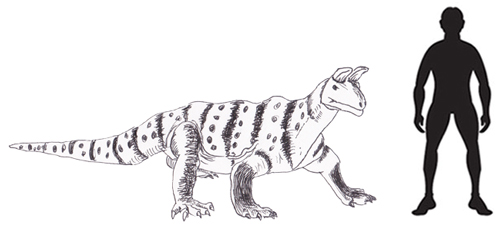
For Shringasaurus, as with the vast majority of the prehistoric animal models we supply, a scale drawing has been commissioned, primarily for use with the fact sheet.
Everything Dinosaur’s Scale Drawing of the Horned, Middle Triassic Archosauromorph Shringasaurus
The archosauromorph reptile from the Middle Triassic of India – Shringasaurus indicus. Picture credit: Everything Dinosaur.
Picture credit: Everything Dinosaur
Tale of the Tape
The actual model measures approximately 16.5 centimetres in length. When Everything Dinosaur blogged about the formal naming and scientific description of this reptile back in the late summer of 2017* the length of this herbivore, based on the seven known specimens was estimated to have been around 3.5 to 4 metres. Taking an average, Everything Dinosaur team members prepared the scale drawing (see above). Although Safari Ltd do not publish a scale for these types of models, the new for 2020 Shringasaurus is in approximately 1:23 scale.
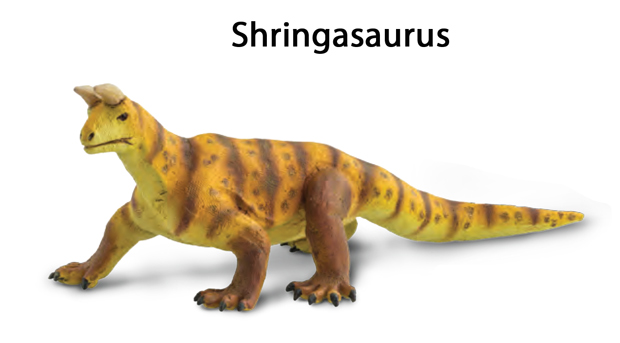
The New for 2020 Safari Ltd (Wild Safari Prehistoric World) Shringasaurus Model
The new for 2020 Wild Safari Prehistoric World Shringasaurus. Everything Dinosaur’s commissioned illustration for this prehistoric animal seems to have captured the detailing in the Safari Ltd model quite nicely.Picture credit: Everything Dinosaur.
Model collectors and dinosaur fans can expect all the new for 2020 Safari Ltd prehistoric animal replicas to be in stock at Everything Dinosaur in the near future.
A New Abelisaurid (Tralkasaurus cuyi) from Argentina
A team of scientists based in Argentina have described a new species of abelisaurid from the Huincul Formation in northern Patagonia. The new dinosaur is represented by a fragmentary skeleton consisting of caudal vertebrae (tail bones), a bone from the upper jaw (maxilla), a distorted pelvic girdle and sacral vertebrae. Although the fossils were found in a disarticulated state and quite widely scattered, it is likely that the bones represent a single, individual animal.
Tralkasaurus cuyi
With an estimated body length of around five metres and a hip height of approximately 1.5 metres, this newest member of the Abelisauridae, named Tralkasaurus cuyi, is much smaller than abelisaurs such as Carnotaurus sastrei, Abelisaurus comahuensis and Ekrixinatosaurus novasi.
Writing in the “Journal of South American Earth Sciences”, the researchers, which included Mauricio Cerroni, a PhD student at the Museo Argentino de Ciencias Naturales, Buenos Aires (Argentina), conclude that Tralkasaurus probably occupied a different ecological niche compared to the much larger and heavier Late Cretaceous abelisaurids.
A Size Comparison Between Carnotaurus sastrei and Tralkasaurus cuyi
A size comparison between Tralkasaurus cuyi and Carnotaurus sastrei. Tralkasaurus very probably had a typical abelisaurid body plan, but its size suggests that it was a secondary predator, specialising in hunting other types of prey compared to the much larger carnivorous dinosaurs that it co-existed with.Picture credit: Everything Dinosaur.
Picture credit: Everything Dinosaur
A New “Thunder Lizard”
This new dinosaur was found at the Violante Farm site, in Río Negro province (northern Patagonia). The sandstones of the Huincul Formation has yielded a diverse range of theropods including the giant carcharodontosaurid Mapusaurus (M. roseae), which is estimated to have measured around 12 metres in length along with the at least 6-metre-long Gualicho (G. shinyae), tentatively described as a member of the Neovenatoridae family and two other abelisaurids Skorpiovenator (S. bustingorryi) and Ilokelesia (I. aguadagrandensis).
The genus name translates as “thunder lizard”, in the native Mapuche language.
Being much smaller than other abelisaurids such as Abelisaurus and Carnotaurus suggests that this new taxon probably occupied a different ecological niche within the ecosystem.
The scientific paper: “A new abelisaurid from the Huincul Formation (Cenomanian-Turonian; Upper Cretaceous) of Río Negro province, Argentina” by M. A. Cerroni, M. J. Motta, F. L. Agnolína, A. M. Aranciaga Rolando, F. Brissón Egli and F. E. Novas published in the Journal of South American Earth Sciences.
Wishing all our customers, web log readers, Facebook fans, followers on Instagram and social media friends a very happy New Year. The start of another decade of dinosaur and prehistoric animal news stories and fossil discoveries.
Wishing All our Customers and Readers a Very Happy New Year
Team members at Everything Dinosaur would like to wish all our customers, readers and social media followers a very happy New Year. Can you spot the dinosaur? Can you spot the pterosaur? Picture credit: Everything Dinosaur.
Picture credit: Everything Dinosaur
Happy New Year from Everything Dinosaur
Team members have lots of exciting plans for the next twelve months. Many more dinosaur and prehistoric animal models will be added to our already huge portfolio, the first of the new for 2020 models should be with us in just a few weeks.
Wishing all our customers and readers a wonderful, peaceful and prosperous 2020.
Given our plans, we think it is appropriate to also say: Feliz Año Nuevo, Bonne Année, Frohes neues Jahr, Felice Anno Nuovo, Feliz Ano Novo, Akemashiteomedetōgozaimasu …
Visit our Everything Dinosaur website. Yes, we do have customers overseas: Everything Dinosaur.
Maintaining the Feefo Gold Trusted Service Award for 2019
Everything Dinosaur has continued to maintain its very high customer service standards throughout the whole of the festive period. Furthermore, the UK-based dinosaur themed company has maintained the Feefo Gold Trusted Service award throughout the whole of 2019. The company has been awarded the highest accolade by Feefo, the independent ratings company for the last three years.
Everything Dinosaur Has Maintained the Highest Standards of Customer Service Throughout 2019
Everything Dinosaur has once again, maintained the very highest standards of customer service.Picture credit: Everything Dinosaur.
Picture credit: Everything Dinosaur
Everything Dinosaur Receives Hundreds of Reviews
There are hundreds of customer reviews on the Everything Dinosaur website. Every single one of them has been independently verified by Feefo.
Some examples of recent customer reviews for Everything Dinosaur:
Rustam from Azerbaijan wrote:
“I would definitely recommend them and continue purchasing the models and other prehistoric accessories from Everything Dinosaur.”
Basit Ali (Qatar), stated:
“Everything Dinosaur is one of the best things that ever happened in my life. I came here late but I think to me personally their customer service is nearly unbeatable as not even once I have regretted my purchase from them. I highly recommend shopping with these guys, you do it once and you’ll come again yourself.
Thank you, Everything Dinosaur!”
Everything Dinosaur Committed to Maintaining Customer Service Excellence
Maintaining 100% customer service all year round.Picture credit: Everything Dinosaur.
Picture credit: Everything Dinosaur
Customer Reviews
Donovan from Canada provided a review about our delivery of the limited edition Papo Spinosaurus model:
“Great service all around and they always make it easy to get what you like. Did an amazing job with Papo limited Spinosaurus and getting figure to me in great time and boxed up so nothing could happen to it on its travels.”
Our customers in the UK think a lot about us too.
Recently, we received a review from Abigail she wrote to say:
“I have bought from this website twice now and their customer service is excellent. Speedy delivery and items arrived in perfect condition. The information sheets are a welcome bonus, making the dinosaurs brilliant presents for the dinosaur enthusiasts in my life! I have emailed queries and spoken to them on the phone and in both situations my questions were answered politely, quickly and fully. I have no complaints at all.”
In her 5-star review Courtney stated:
“Fantastic service as always – went above and beyond in fulfilling my order.”
Writing about his purchase of the CollectA Hydrotherosaurus dinosaur model Raymond commented:
“Excellent item, service, and value. Fully recommended to all.”
Top Marks for Everything Dinosaur
5-star service from Everything Dinosaur throughout the whole of 2019.Picture credit: Everything Dinosaur.
Picture credit: Everything Dinosaur
2020 – A New Service Challenge (Platinum Trusted Service Award from Feefo)
With Everything Dinosaur, every day is all about delivering top-notch customer service. Since we signed up with Feefo we have been consistently one of the highest rated of all their clients. As a result of the endeavours of businesses like us, Feefo have decided to introduce a very special award which recognises consistently high levels of customer service. The Platinum Trusted Service award is due to be launched next year and Everything Dinosaur is hotly tipped to be amongst the first organisations in the world to be awarded this accolade.
The Platinum Trusted Service award recognises those businesses that go above and beyond to provide a consistently excellent service and dedicate themselves to acing their customer experience year after year. We hope to post up news of this award in the near future.
A spokesperson from Everything Dinosaur commented:
“We appreciate that this time of year can be a stressful time for shoppers, we have continued to maintain our customer service and support channels and we have done all we can to help and assist our customers. Our work is reflected in our consistently high customer service rating. We are truly proud and humbled to have received such praise and positive feedback from our customers over many years.”
To see what all the fuss is about, Everything Dinosaur’s Feefo reviews can be found on the company website here: Everything Dinosaur’s website.
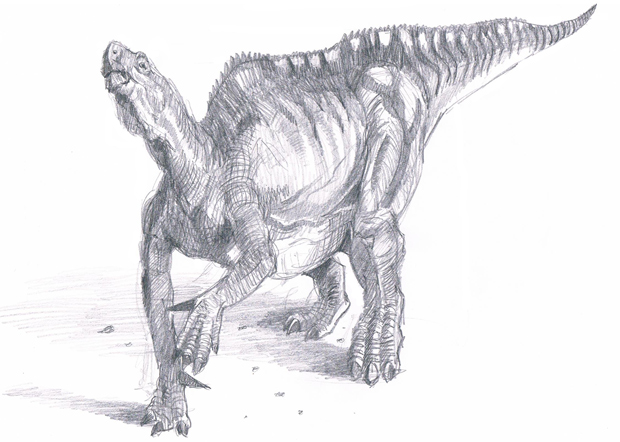
Everything Dinosaur team members get sent lots of amazing prehistoric animal drawings, we really do have some supremely talented customers. Today, we feature a pencil sketch from Ian, he has chosen to illustrate an iguanodontid. From the heavy build, we suggest that this is an illustration of Iguanodon bernissartensis, however, it could just as well be an illustration of another robust iguanodontid such as Barilum dawsoni.
Illustrating Iguanodon
Ian’s Iguanodontid Illustration Sent into Everything Dinosaur
An illustration of a robust iguanodontid, possible I. bernissartensis or B. dawsoni.
Picture credit: Ian
A Quadrupedal Stance
Ian has chosen to depict his ornithopod in a quadrupedal stance. Such a large and powerful animal would have had little to fear from the predators that shared its habitat, although if threatened and needing to make a quick getaway, these animals could rear up onto their strong hindlegs and adopt a bipedal running gait.
A spokesperson from Everything Dinosaur commented:
“Our thanks to Ian for sending into us his splendid pencil drawing of a stocky, robust iguanodontid. It is always a pleasure to receive illustrations of dinosaurs and other prehistoric animals.”
Everything Dinosaur’s Top Ten Blog Posts of 2019 (Part 2)
Today, we conclude our review of the top ten blog posts written by Everything Dinosaur team members in 2019. We have produced a blog post for every day of the year and as a result we have covered a tremendous range of topics from new fossil discoveries, highlighting research, the introduction (and retirement) of prehistoric animal replicas, book reviews, artwork created by academic illustrators and scientific discoveries.
Here is our countdown of the top five.
5). Ngwevu intloko – New Dinosaur “Hiding in Plain Sight”
Over the summer, Everything Dinosaur published a wide range of articles. A new bizarre, shovel-mouthed duck-billed dinosaur (Aquilarhinus), was reported and news of a fast-running Triassic theropod from Switzerland (Notatesseraptor) broke. We had strange prehistoric parrots, an analysis of the cranial capacity of “parrot lizard” Psittacosaurus and herbivorous crocodylomorphs. However, number five on our list concerns the discovery of a new type of Triassic herbivorous dinosaur that was found in a museum cabinet.
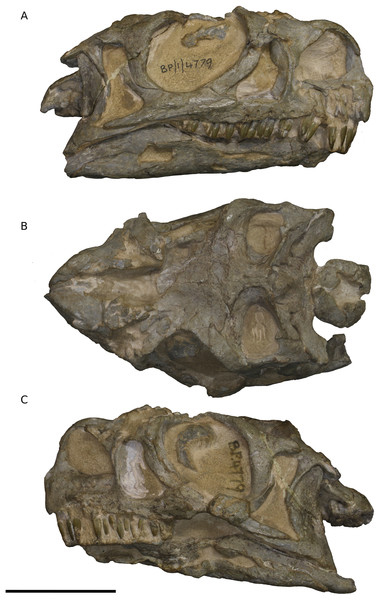
Fossils once thought to represent an unusual specimen of Massospondylus (M. carinatus) in the collection of the University of Witwatersrand (South Africa), were assigned to their own genus. Student Kimberley Chapelle and colleagues identified a total of twenty-two characteristics that supported the establishment of a brand new dinosaur genus. The new dinosaur was named Ngwevu intloko, this member of the Sauropodomorpha had been hiding in plain sight within the vertebrate fossil collection of the University for more than three decades.
Views of the Skull of Ngwevu intloko
Views of the skull of Ngwevu intloko.
Picture credit: Kimberley Chapelle/University of Witwatersrand
4). Keresdrakon vilsoni – Toothless Pterosaur from an Ancient Desert Ecosystem
September and thirty days of blog posts covering stiff T. rex skulls and subsequently how the skull of T. rex may have helped it to keep cool, dinosaur model deliveries to hotels, the most complete dinosaur fossil from Japan (Kamuysaurus japonicus) and the Asian origins of Saurornitholestes, but our number four features a newly described species of pterosaur from Brazil.
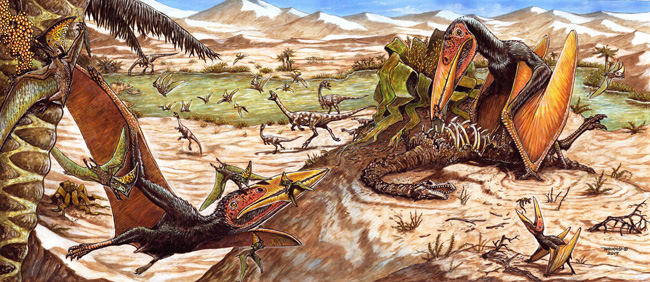
Researchers, writing in the academic journal “Anais da Academia Brasileira de Ciências”, identified a new species of edentulous flying reptile that co-existed with the pterosaur Caiuajara and may have fed on its young. Described as part of a non-tapejarid lineage of pterosaurs outside the Tapejaromorpha, Keresdrakon provides a new perspective on the paleoecology of a Cretaceous desert environment.
Keresdrakon Life Reconstruction It Feeds on the Carcase of a Contemporary Dinosaur (Vespersaurus) whilst a Second Keresdrakon is Mobbed by Juvenile Caiuajara
Keresdrakon life reconstruction, feeding on the carcase of a Vespersaurus.
Picture credit: Maurilio Oliveira
An honourable mention to Cryodrakon boreas the first pterosaur to be described which is unique to Canada.
3). A Potential Terrestrial Tetrapod that May Not Have Gone onto Land
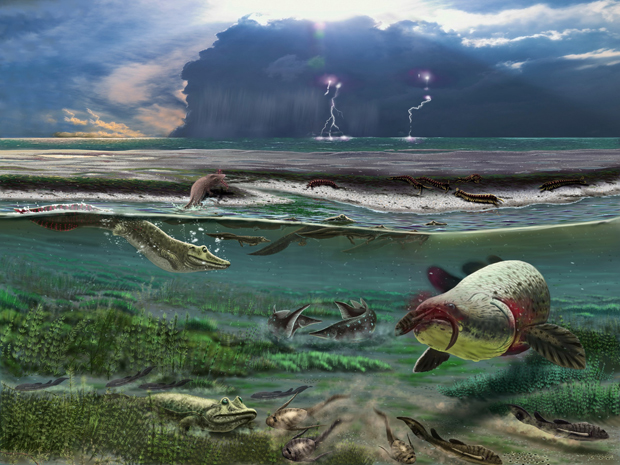
In October, Everything Dinosaur team members covered the amazing TetZooCon event in London, the naming of a new, basal carcharodontosaurian theropod from Thailand (Siamraptor suwati) and the reclassification of crocodiles in New Guinea. A team of researchers, writing in “Nature” put forward an intriguing new hypothesis that some of the first vertebrates that were capable of terrestrial locomotion may have never left the water. Parmastega aelidae was a sharp-eyed predator that may have ambushed invertebrates that ventured too close to the sea.
With eyes positioned towards the top of their heads, Parmastega was capable of observing life on land and potential prey without leaving the water.
Life in a Late Devonian Coastal Lagoon (Sosnogorsk, Russia)
Sosnogorsk lagoon with Parmastega aelidae hunting behaviour.
Picture credit: Mikhail Shekhanov for the Ukhta Local Museum
2). Unusual Styracosaurus Skull Might Change the Way New Dinosaurs are Identified
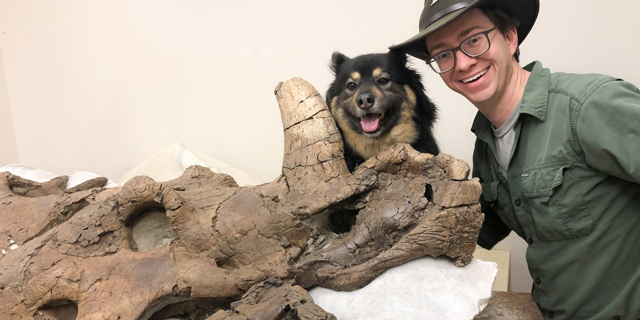
The first fossil evidence of feathered polar dinosaurs, plans to map extra-terrestrial space objects in a bid to prevent Earth impact events, limited edition dinosaur models, a new predatory dinosaur from Brazil – Gnathovorax cabreirai, all featured in October. A fossil ape from the Miocene of Germany, Poland’s first pliosaur, Rebor Komodo dragons, a new megaraptorid from “Down Under” and the discovery of a Styracosaurus skull that might just turn palaeontology on its head were also discussed. “Hannah” an asymmetrical Styracosaurus skull named after the pet dog of palaeontologist Scott Persons has cranial imperfections that could alter the way that scientists identify new species of dinosaur. Whoops, looks like there may have to be another revision of the Centrosaurinae.
Palaeontologist Scott Persons Poses with the Two “Hannahs” in His Life “Hannah” the pet dog and “Hannah” the Styracosaurus
Scott Persons with “Hannah” the Styracosaurus and his dog.
Picture credit: Scott Persons/University of Alberta
1). Asfaltovenator vialidadi – A New Basal Allosauroid from Argentina
Our blog articles this month have covered such varied topics as galloping crocodilians, 7,000 Facebook “likes”, the announcement of new for 2020 Papo prehistoric animal figures, dinosaur teeth replacement, how to distinguish teenage tyrannosaurs and Mimodactylus libanensis, a new toothy pterosaur from the Late Cretaceous of Lebanon.
However, since we started this top ten countdown with a fossil discovery from North America and despite the focus on asymmetrical dinosaurs, we shall conclude with a dinosaur from the opposite end of the Americas.
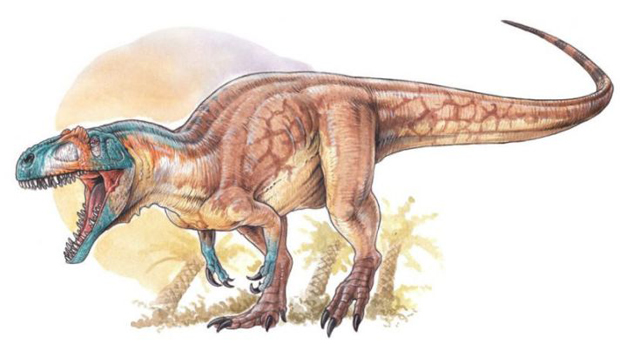
Asfaltovenator vialidadi from the Cañadón Asfalto Formation (Chubut Province, Patagonia) roamed South America perhaps as early as 170 million years ago. Its discovery is important, as most Middle Jurassic theropods are only known from quite fragmentary material and this dinosaur, described as a basal allosauroid, has traits linking it to both the allosauroids and the megalosauroids. The fossils suggest that the Allosauroidea and the Megalosauroidea evolved from a common ancestor.
A Life Reconstruction of the Newly Described Asfaltovenator vialidadi
Asfaltovenator life reconstruction. The theropod dinosaur shows a mix of anatomical characteristics linking the Allosauroidea and the Megalosauroidea.
Picture credit: Gabriel Lio/Conicet
Team members at Everything Dinosaur look forward to posting up more blog articles that help to work out taxonomic relationships within the Dinosauria and improve our understanding of ancient life still further in the coming months.
Everything Dinosaur’s Top Ten Blog Posts of 2019 (Part 1)
As this year draws to a close, it is time to reflect on all the work put into writing this web log by Everything Dinosaur team members. It is also an opportunity to look back and reflect on some of the news stories and articles that we have published over the last twelve months. Today, we start our look at the top ten articles that we have posted, the countdown from ten to number six. This list has been compiled based on the total number of comments made, emails received requesting further information, Facebook “likes” and comments, Pinterest shares and so forth.
So, without any further fuss, here is the first part of our top ten news stories for 2019.
10). Prehistoric Shark Named After Video Game Character
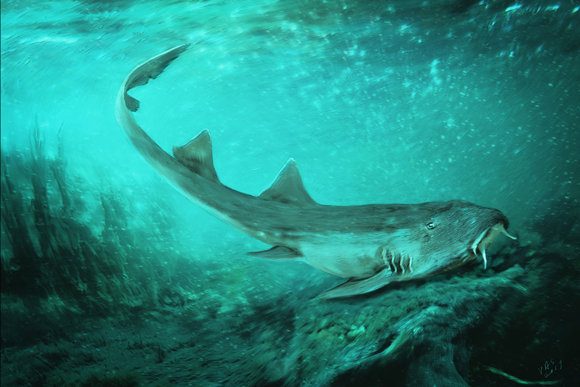
In January, Everything Dinosaur covered a story about the naming of a new species of Late Cretaceous prehistoric shark. Strange, unusually shaped shark’s teeth had been found preserved in some of the matrix associated with the famous “Sue” T. rex skeleton. The tiny teeth reminded the research team of the shape of a spaceship from the 1980’s video game Galaga. This was the inspiration behind the naming of this new species – Galagadon nordquistae.
Life Reconstruction of Galagadon nordquistae
A life reconstruction of the Late Cretaceous shark Galagadon nordquistae.
Early February saw the announcement of the discovery of a new, bizarre dicraeosaurid from Neuquén Province, Argentina. A single, cervical vertebra suggests that Bajadasaurus had a series of forward facing defensive spikes on its neck. A sauropod that carried its own set of Victorian railings around with it. Although, the fossil material is fragmentary, CollectA were quick of the mark and have created a stunning replica of this Early Cretaceous giant. Everything Dinosaur expects to have the CollectA Bajadasaurus replica in stock early in 2020.
A Silhouette Showing a Reconstruction of the Neck Vertebrae of Bajadasaurus and the CollectA Bajadasaurus Dinosaur Model
The bizarre cervical vertebrae of Bajadasaurus. In the silhouette illustration known fossil material is shown in white.
Picture credit: Gallina et al published in Scientific Reports and Everything Dinosaur
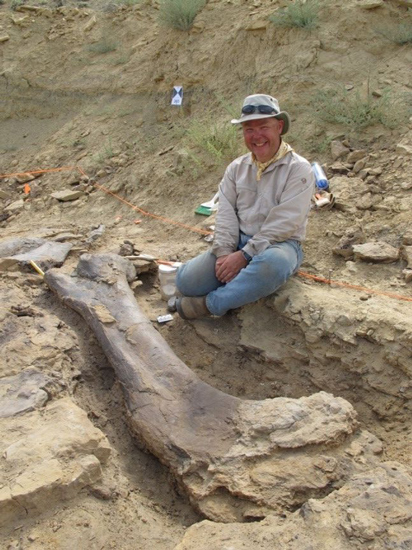
In March, a blog post was published recording the start of a huge collaboration between a number of European and American museums to explore and excavate an extraordinary, fossil-rich deposit located in the Badlands of Wyoming. The site has been nicknamed the “Jurassic Mile” and these Morrison Formation deposits have already yielded a treasure trove of dinosaur bones, fossil plants and dinosaur trackways.
Everything Dinosaur will be providing more details of the fossil discoveries in blog articles over the coming twelve months, but the site is so vast that it could be decades before all the fossil material has been collected and studied.
Palaeontologist Phil Manning Sitting Next to a Diplodocid Femur from the “Jurassic Mile”
Professor Phil Manning (The University of Manchester) poses next to the diplodocid femur.
Picture credit: Manchester University
7). New Kid on the Block – Homo luzonensis
The discovery of fragmentary fossil remains of a diminutive hominin on the island of Luzon in the Philippines gave the human family tree a jolt in 2019. The fossil material, dated to around 67,000 years ago, provides the earliest direct evidence of human inhabitation of the Philippines archipelago, but is Homo luzonensis, with its arboreal adaptations the descendant of a primitive African hominin that somehow migrated to south-eastern Asia or a more advanced hominin, perhaps related to Homo erectus that evolved and changed as it adapted to life on a heavily forested tropical island?
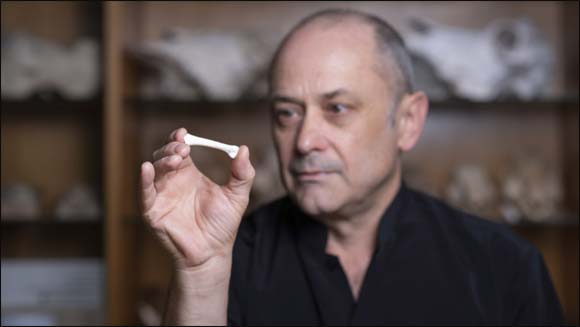
Professor Philip Piper – A Co-author of the Scientific Paper Published in April Holding a Cast of a Toe Bone
Professor Piper (Australian National University) holding a cast of a toe bone assigned to H. luzonensis.
Picture credit: Lannon Harley (Australian National University)
6). A Terrifying Trilobite (Redlichia rex)
In the summer, Everything Dinosaur published an article about the largest trilobite to have been discovered in Australia. A likely predator of other trilobites, this was a thirty-centimetre-long Cambrian terror. It was appropriately named Redlichia rex and was nicknamed “the king of the trilobites”. The fossil material comes from an exceptional Lagerstätte known as the Emu Bay Shale on Kangaroo Island, South Australia.
Around fifty different species of trilobite have been identified from this location. Intriguingly, the predatory and potentially cannibalistic Redlichia rex may also have been hunted, preserved coprolite and the injuries recorded on the exoskeleton of specimens hint at a much larger predator lurking in the shallow sea that once covered this part of Australia.
A Fossil Specimen and the New for 2020 CollectA Redlichia rex Trilobite Model
A Redlichia rex trilobite fossil and the new for 2020 CollectA model.
Picture credit: University of Adelaide/Everything Dinosaur
The naming of a new Cambrian predator inspired the model makers at CollectA to create a replica of Redlichia rex, we expect this figure to make its debut on the Everything Dinosaur website around the middle of next year. Prior to that event in 2020, we must first complete our chronicle of the top blog posts of 2019, we will conclude this feature tomorrow.
Baby Dinosaurs from Australia Indicate Dinosaurs Bred at High Latitudes in the Southern Hemisphere
Evidence has been found of ornithopod dinosaurs breeding at high latitudes in the Northern Hemisphere but evidence of similar behaviours in the Southern Hemisphere, dinosaurs nesting within the Antarctic Circle, had been lacking until now.
Writing in the on-line, open access journal “Scientific Reports”, researchers from the University of New England (New South Wales, Australia), in collaboration with colleagues from the Australian Opal Centre (Lightning Ridge, New South Wales), report the discovery of two tiny thigh bones (femora), that suggest that ornithopods did breed in southern polar environments.
An Artist’s Reconstruction of a Nesting Ornithopod with Recently Hatched Young
A life reconstruction of a nesting Australian ornithopod (based on Weewarrasaurus). The two femora are indistinct and scientists are not able to identify them down to the genus level but since the wallaby-sized ornithopod Weewarrasaurus is known from close by, the reconstruction has been based on this dinosaur.
Picture credit: James Kuether
Co-author of the scientific paper, Dr Phil Bell (School of Environmental and Rural Science, University of New England) explained:
“We have examples of hatchling-sized dinosaurs from close to the North Pole, but this is the first time we’ve seen this kind of thing anywhere in the southern hemisphere. It’s the first clue we’ve had about where these animals were breeding and raising their young.”
Dinosaurs Were Able to Tolerate a Range of Climates
The discovery of the two tiny, opalised thigh bones adds to the growing body of evidence that suggests that the Dinosauria, just like their close relatives the birds, were remarkably climate-tolerant. They thrived in equatorial, temperate and polar environments.
Fossilised eggshell and the fossilised remains of tiny hatchling hadrosaurids demonstrates that dinosaurs bred at high latitudes in the Northern Hemisphere and now the discovery to two partial thigh bones from the Griman Creek Formation exposed near Lightning Ridge suggests that non-iguanodontid ornithopods bred beyond sixty degrees south, well inside the Antarctic Circle.
The Two Opalised Fragmentary Dinosaur Thigh Bones (Femora)
Proximal parts of ornithopod femora from the Griman Creek Formation. LRF 0759 (a–d). LRF 3375 (e–i). Anterior views (a-e); (b,f) medial views; (c,g) posterior views; (d,i) proximal views; (h) lateral view.
Picture credit: Scientific Reports
The two fragmentary fossil femurs do not preserve any evidence of histology, so, it is not possible to determine the exact age of the animals from these fossils. However, when this material is compared with neonatal and slightly older, possible yearling specimens known from the geologically slightly older Eumeralla and Wonthaggi formations in Victoria (Australia), it can be deduced that these are the thigh bones of embryonic dinosaurs, ones that were yet to hatch.
The femur is relatively large (although in these tiny dinosaurs, one femur is estimated to have a total length of 4.5 cm, whilst the other is even smaller with an estimated total length of just 3.7 cm), as such, this bone has a better chance of surviving the fossilisation process than most of the other bones in the dinosaur’s body.
Permanent Residents
Palaeontologists had thought that dinosaurs living at high latitudes were not permanent residents, they migrated into these areas during the period of extended daylight and subsequent copious plant growth, just like herds of caribou in the Arctic Circle do today. However, the ornithopods, even as fully grown adults were relatively small animals, as such they were probably not capable of migrating vast distances. Therefore, it is likely that at least some dinosaurs were permanent residents at very high southerly latitudes and as such they bred at these environments.
Palaeogeographic Map of Australia Around 100 Million Years Ago
Palaeogeographic map of Australia at the Albian/Cenomanian boundary (circa 100 million years ago) showing the fossil localities discussed in this paper. (1) Lightning Ridge, Griman Creek Formation (Cenomanian); (2) Dinosaur Cove, Eumeralla Formation (Albian); (3) Flat Rocks, Wonthaggi Formation (Aptian).
Picture credit: Scientific Reports
The image (above) shows the approximate landmass associated with the polar regions around 100 million years ago. The tiny fossilised thigh bones come from (1) the Lightning Ridge location. In order to determine the age of these dinosaurs, they were compared with bones representing neonatal and slightly older animals found at locations (2) and (3).
The researchers conclude that these fossils support they hypothesis that some dinosaurs at least were permanent residents in the very southernmost portion of Gondwana.
The scientific paper: “High-latitude neonate and perinate ornithopods from the mid-Cretaceous of south-eastern Australia” by Justin L. Kitchener, Nicolás E. Campione, Elizabeth T. Smith and Phil R. Bell published in Scientific Reports.
“Tis the season to be jolly.” A very merry Christmas to all our customers, social media followers, Instagram aficionados, Facebook fans and blog readers. It has been another very busy year of web log posts with lots of amazing new fossil discoveries, news stories and fascinating research. Seasonal greetings and compliments of the season to all our dedicated readers of this blog.
Merry Christmas from Everything Dinosaur
Wishing all our customers, social media fans, followers and of course, our web log readers the compliments of the season.Picture credit: Everything Dinosaur.
Picture credit: Everything Dinosaur
Team members are already looking forward to an exciting 2020, plans are very well advanced for the forthcoming year. We intend to write lots of new dinosaur and prehistoric animal themed articles over the next twelve months or so. We can’t wait to introduce our readers to lots of new dinosaurs and yes, there will be quite a few in 2020.
Wishing all our customers and readers a wonderful Christmas and a happy New Year.
Given our plans, we think it is appropriate to also say: Feliz Navidad, Joyeux Noël, Fröhliche Weihnachten, Buon Natale, Feliz Natal, Merīkurisumasu ….
Scientists Map out the Late Cretaceous Biota of the Chorrillo Formation (Patagonia)
Scientists meeting at the end of year conference of the Argentine Museum of Natural Sciences have presented a new paper that provides an insight into the vertebrate biota associated with the Chorrillo Formation in the Province of Santa Cruz (Patagonia, southern Argentina). Two new dinosaurs have been described, a basal member of the Iguanodontia estimated to have measured around four metres in length and a much bigger dinosaur, a titanosaur that is estimated to have measured around twenty-five metres long.
Numerous fossil fragments representing several individuals have been found indicating that the iguanodont material might represent a small herd of animals that died together. This dinosaur has been named Isasicursor santacrucensis, whilst the titanosaur has been named Nullotitan glaciaris.
Two New Dinosaurs were Named at the Conference
A life reconstruction of the titanosaur Nullotitan and the basal iguanodontid Isasicursor.
Picture credit: CONICET
“Los Dinosaurios del fin del Mundo”
All the fossil material examined in the scientific paper, the dinosaur remains, fossilised titanosaur eggshells, fossils associated with other reptiles including a mosasaur, come from an area of approximately 2,000 square metres.
The sequential strata associated with this part of the Chorrillo Formation plot a gradual ingression of the sea eating into a coastal environment. The dinosaurs are believed to have lived around 70 million years ago (Maastrichtian faunal stage of the Cretaceous). As these fossils date from near the end of the Age of Dinosaurs and are geographically located in the south of Argentina, the researchers dubbed them as “Los dinosaurios del fin del mundo” – the dinosaurs from the end of the world.
Silhouette Reconstructions of Isasicursor and Nullotitan
Silhouettes of Isasicursor santacrucensis (top) and Nullotitan glaciaris (bottom).
Picture credit: CONICET
An Enormous Femur
Nullotitan fossil material consists of fragmentary elements from the tail (caudal vertebrae), along with a single neck bone (cervical vertebra), portions of the limbs and other scrappy fossil material. The largest, most complete fossil bone is a humerus (upper arm bone), it measures 114 cm long, but both the distal and proximal ends of an enormous femur (thigh bone) were also recovered from the site. The femur is estimated to have been around 190 centimetres in length.
The scientists also reported fragments of theropod eggshells as well as evidence of the presence of both large and small members of the Megaraptoridae, although no fossils associated with abelisaurs were found. Remains of fishes, lizards, turtles and snakes were also identified along with fossil wood and a large number of terrestrial and freshwater snails.
Mammals were present in the ecosystem, two isolated vertebrae belonging to a small mammal were found. The fossil material representing individual animals might be quite poor and scrappy in nature, but the number of fossil finds has greatly improved our understanding of the biota of the southern tip of Patagonia close to the K-Pg boundary that marks the end of the Cretaceous.
Fossil Material Ascribed to Isasicursor santacrucensis