A team of international scientists led by Dr Fernando Novas of the Museo Argentino de Ciencias Naturales (Buenos Aires, Argentina), have been exploring the Upper Cretaceous, fossil rich beds at Estancia La Anita in the Province of Santa Cruz, Patagonia. In a media release, circulated this week, the researchers from the Museo de Ciencias Naturales report the discovery of the fossilised remains of a giant megaraptorid dinosaur. At an estimated ten metres in length, it potentially represents the largest confirmed member of the Megaraptora clade discovered to date.
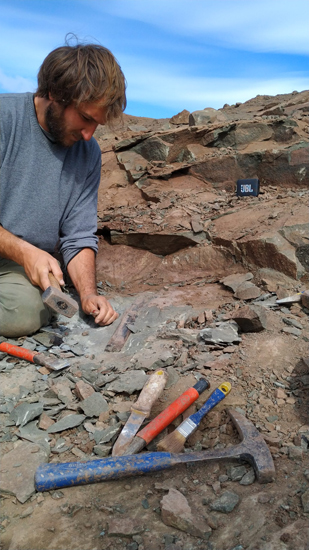
A Field Team Member Carefully Removing Overburden Close to a Fossil Bone
A field team member works close to a fossil bone.
Picture credit: Museo Argentino de Ciencias Naturales
Upper Cretaceous Sediments
The research team, which includes scientists from a number of Argentinian universities as well as colleagues from the National Museum of Tokyo (Japan), have spent much of the early part of the Southern Hemisphere autumn, working in the remote and mountainous Estancia La Anita which is some 1,750 miles (2,800 km), south of Buenos Aires. Many different vertebrate fossils were found, including those of the basal iguanodontid Isasicursor. The palaeontologists speculate that rather than attack the titanosaurs that lived in this region during the Late Cretaceous, megaraptors may have specialised in catching smaller, more agile prey such as the five-metre-long Isasicursor.
Members of the Megaraptora were quite lightly-built, long-armed carnivores. Very little is known about these dinosaurs, although they do seem to have been both geographically and temporally widely dispersed. They were not closely related to the dromaeosaurids, a family of dinosaurs that includes the “raptors” such as Velociraptor.
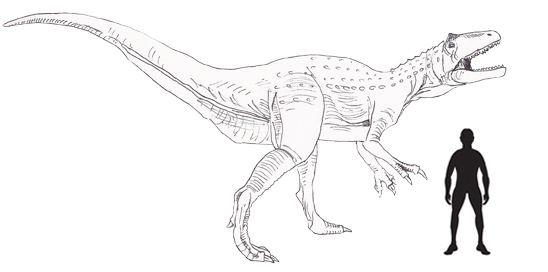
A Speculative Life Reconstruction of the Giant Megaraptor from Argentina
A speculative life reconstruction of the giant megaraptor from Patagonia.Picture credit: Everything Dinosaur.
Elements from the rib cage and vertebrae have been found, but sadly no skull material has been reported. It is likely that a new genus will be erected as a result of these discoveries, the scientific paper is likely to be published next year.
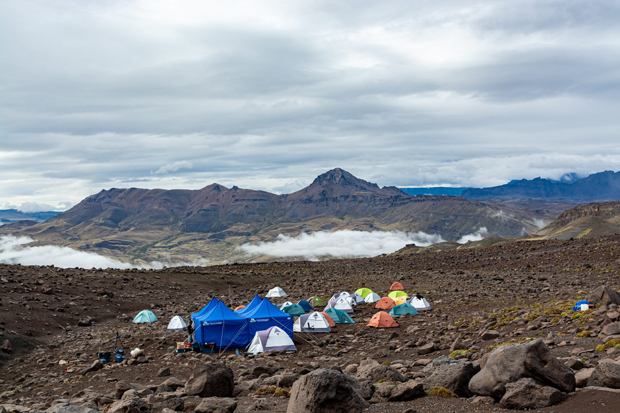
The Field Team’s Campsite at the Remote Location
The remote campsite at Estancia La Anita in Patagonia.
Picture credit: Museo Argentino de Ciencias Naturales
One of the Last of its Kind
The fossils represent the youngest material discovered to date that have been assigned to the Megaraptora. It is therefore quite likely that these types of theropod persisted until the extinction of the non-avian dinosaurs. Fernando Novas has been instrumental in the development of our understanding of this type of carnivorous dinosaur. It was Dr Novas who co-authored the review of theropod dinosaurs from Argentina in 2013, that led to the establishment of the Megaraptor clade.
To read a related article from Everything Dinosaur that looks at the ancient biota from this part of the Late Cretaceous of Argentina: Dinosaurs from the End of the World.
Recently Haolonggood introduced a megaraptor dinosaur model.
Think of a theropod dinosaur and a ferocious carnivore with a large head and big teeth probably comes to mind. However, the Theropoda is an extremely diverse clade within the Dinosauria, not all of them were big, particularly ferocious or even had teeth. One group the elaphrosaurines, were very bizarre indeed and the discovery of a single neck bone in Victoria has led to the conclusion that these strange, light-weight dinosaurs distantly related to Carnotaurus, roamed Australia in the Early Cretaceous.
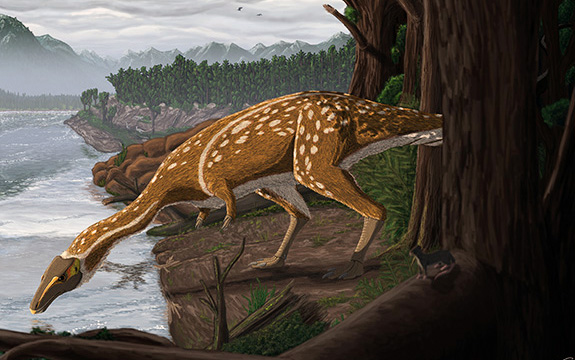
A Life Reconstruction of the Australian Elaphrosaurine
A life reconstruction of the first elaphrosaur from Australia.
Picture credit: Ruairdh Duncan (Swinburne University of Technology, Victoria)
From the Lower Cretaceous of Australia
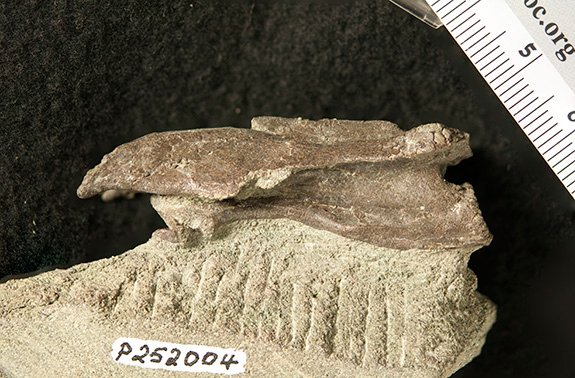
Volunteer Jessica Parker discovered a 5-centimetre-long bone whilst helping out at the annual Dinosaur Dreaming excavation near Cape Otway, Victoria (2015). The sediments at the site, known as Eric the Red West, date from the late Albian faunal stage of the Lower Cretaceous and are part of the Eumeralla Formation. At first, the bone identified as a cervical vertebra (neck bone), was thought to have come from a pterosaur.
Intriguingly for Swinburne University palaeontologist Dr Stephen Poropat and PhD student Adele Pentland, once the fossil specimen had been prepared it became clear that this was not a bone from the middle portion of the neck of a flying reptile.
Dr Poropat explained:
“Pterosaur neck vertebrae are very distinctive. In all known pterosaurs, the body of the vertebra has a socket at the head end, and a ball or condyle at the body end. This vertebra had sockets at both ends, so it could not have been from a pterosaur.”
The Cervical Vertebra – Evidence of Australia’s First Elaphrosaur
The five-centimetre-long bone identified as a middle cervical from an elaphrosaur.
Picture credit: Dr Stephen Poropat
Geologically Much Younger Than Most Elaphrosaurines
The taxonomic affinity of the subfamily Elaphrosaurinae within the Theropoda remains controversial. A number of authors have placed this little-known group, characterised by their small, light, graceful bodies, tiny heads, long necks and reduced forelimbs within the Noasauridae family, which means that they are distantly related to abelisaurids such as Ekrixinatosaurus, Majungasaurus and Carnotaurus.
Most elaphrosaurs are known from the Late Jurassic, but this new elaphrosaur from Australia, lived some forty million years later. Only Huinculsaurus (H. montesi), from the Cenomanian/Turonian (early Late Cretaceous), of Argentina is geologically younger, than the Australian fossil remains.
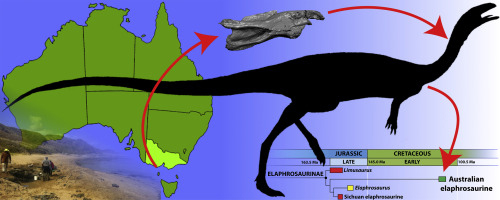
The Fossil Find Location, Typical Elaphrosaurine Body Plan and Placing the Fossil Find in a Chronological Context
A silhouette of the elaphrosaur with a map showing fossil location and a timeline showing elaphrosaurine chronology. The newly described elaphrosaurine from Victoria is geologically the second youngest member of this group known.
Picture credit: Poropat et al (Gondwana Research)
A Dinosaur of the Polar Region
The discovery of this single, fossilised neckbone adds support to the idea that the elaphrosaurines were geographically and temporally much more widespread than previously thought. The similarity of these dinosaurs to the much better-known ornithomimosaur theropods (bird mimics), could help to explain why few other Cretaceous elaphrosaur specimens have come to light. Fossil material may have been found but misidentified as representing ornithomimids.
As the Cape Otway location would have been situated much further south during the Early Cretaceous (110-107 million years ago), at around a latitude of 76 degrees south, this implies that elaphrosaurines were capable of tolerating near-polar palaeoenvironments.
Elaphrosaurines were Related to Noasaurids
Recently, Everything Dinosaur wrote a post about the discovery of noasaurid from an opal mine close to Lightning Ridge (New South Wales). Noasaurids and elaphrosaurines were related, most scientists classifying them as different branches within the Abelisauroidea. Coincidentally, the New South Wales noasaurid was identified from a single cervical vertebra too. Both it and the Cape Otway elaphrosaurine dinosaur have not been assigned to any genus, but both fossils are likely to represent new species.
To read Everything Dinosaur’s article about the recently discovered noasaurid from New South Wales: Noasaurids from Australia.
The scientific paper: “First elaphrosaurine theropod dinosaur (Ceratosauria: Noasauridae) from Australia — A cervical vertebra from the Early Cretaceous of Victoria” by Stephen F. Poropat, Adele H. Pentland, Ruairidh J. Duncan, Joseph J. Bevitt, Patricia Vickers-Rich and Thomas H. Rich published in Gondwana Research.
Wild Safari Prehistoric World Gryposaurus “Turntable Tuesday”
It’s “Turntable Tuesday” and today, it is the turn of the award-winning Wild Safari Prehistoric World Gryposaurus to be put through its paces on the Everything Dinosaur turntable. This fantastic model of a hadrosaur was introduced in 2013 and it was awarded the accolade of best dinosaur toy of the year by readers of the prestigious “Prehistoric Times” magazine.
The Wild Safari Prehistoric World Gryposaurus Dinosaur Model – “Turntable Tuesday”
Video credit: Everything Dinosaur
The Wild Safari Prehistoric World Gryposaurus Dinosaur Model
Our short video (it lasts under two minutes), shows the beautiful, blue-eyed Gryposaurus figure. We also use this opportunity to compare it to the recently introduced Edmontosaurus model, also from Safari Ltd.
Within the large Hadrosauridae family, both Edmontosaurus and Gryposaurus are members of the Saurolophinae sub-family, sometimes referred to as the Hadrosaurinae, although these duck-billed dinosaurs were not that closely related. Both genera are associated with the North American landmass Laramidia, in general terms, Edmontosaurus specimens tend to be associated with younger strata. For example, Edmontosaurus annectens is confined to the late Maastrichtian, whilst the species within the Gryposaurus genus are associated with older Campanian-aged deposits.
The Wild Safari Prehistoric World Gryposaurus Compared to the Edmontosaurus Figure
The Wild Safari Prehistoric World Gryposaurus compared to the 2020 Edmontosaurus from the same model range. The Gryposaurus (left), compared to the recently introduced Wild Safari Prehistoric World Edmontosaurus (right). Picture credit: Everything Dinosaur.
Named as a result of its prominent nasal arch, that gives Gryposaurus its distinctive bulbous-looking snout, this dinosaur compares very well to the 2020 Edmontosaurus. Although no scaling for these figures is given, the two models are roughly comparable in scale, Gryposaurus being regarded as smaller than both E. regalis and E. annectens. When these two figures are together on our turntable we refer to them as “a dazzling duo of duck-bills”.
A Close View of “Hook-nosed Lizard” – Gryposaurus
“Turntable Tuesday” Gryposaurus on display. Picture credit: Everything Dinosaur.
Picture credit: Everything Dinosaur
Everything Dinosaur on YouTube
The short video highlighting the Gryposaurus figure can be found on Everything Dinosaur’s YouTube channel. We plan to post up one new video a week, plus more in-depth reviews of prehistoric animal models and replicas.
Sales of the Wild Safari Prehistoric World Gryposaurus model at Everything Dinosaur are accompanied with a fact sheet, researched and written by team members that provides further information on this herbivorous dinosaur.
Tiny Crystals Plug Gaps Limiting the Uptake of Contaminants in Rocks
Research published today by a UK-based team of scientists has shown for the first time that the mobility of potentially harmful contaminants in crystalline rocks over long periods of time may be severely limited due to the presence of tiny crystals, meaning contaminant movement is likely to be focused to water-bearing fractures only. Movement of contaminants through rocks below ground can act to spread contamination, an issue relevant to the geological disposal of some wastes. Scientists and academics undertake studies to enhance their understanding of how this process works, helping to reduce uncertainties and to assess potential environmental risks.
Tiny Crystals
These new results shed light on the difficult problem of how contaminants may move over extremely long time periods and should improve our ability to calculate long term risks. This study, published in the academic journal “Scientific Reports”, examined crystalline (granite) rock samples from an underground system in Japan (Upper Cretaceous Toki Granite) and the results imply that in many cases the importance of “rock matrix diffusion” may be minimal. Additional analyses of a contrasting crystalline rock system (Carnmenellis Granite, from the UK) confirm and corroborate these results.
The Japanese samples were taken from the Toki Granite pluton which was formed around 70 million years ago.
CT-Scans Permitted the Researchers to Map Voids and Fractures in the Granite Samples
Pore sizes and pore distributions within the Toki and Carnmenellis granite proximate to primary fractures (indicated by solid blue regions at upper surfaces) as determined via X–ray CT analysis.
Picture credit: Wogelius et al published in “Scientific Reports”
Published in “Scientific Reports”
These findings, which apply to long-lived systems, build on previous field studies and laboratory assessments over short periods of time which also suggested that contaminant mobility in crystalline rocks, such as granite, will be limited to short distances in parts of the rock that are away from large fractures.
This new work has examined rocks from ancient crystalline rock systems in Japan and the UK to show that even over immensely long periods of geological time the movement of elements within such crystalline rock is indeed small, in large part because the formation of large quantities of small crystals during the aging of the rock acts to seal small openings and limit fluid access to only a few millimetres of the rock bordering fractures.
Professor Roy Wogelius, the senior author on this paper, commented:
“We set out to test exactly what we could resolve in terms of fluid access to the matrix of these rocks and we were amazed at the extremely limited volume involved. But what was most amazing to us was the distribution of tiny crystals of carbonate minerals throughout what we usually think of as a uniform block of crystalline rock. Here, unexpected little crystals of calcite appear throughout the rock plugging up all the tiny openings. These crystals clog everything up and keep most of the fluid in large cracks with no access to smaller openings. This effectively shuts down contaminant access to the rock mass, meaning any contaminant movement would likely focus in rock fractures only. “
Helping Geologists
This study in combination with other collaborative research projects will help geologists to produce more accurate models of how pollutants and other contaminants can persist in the environment and threaten groundwater.
The work was completed by researchers from UK academia (The University of Manchester and the University of Leeds), in partnership with the British Geological Survey, two environmental consultancies – Quintessa and NSG – and was funded as part of collaborative work with the UK organisation Radioactive Waste Management.
Everything Dinosaur acknowledges the help and assistance of a media release from the University of Manchester in the compilation of this article.
The scientific paper: “Mineral reaction kinetics constrain the length scale of rock matrix diffusion” by R. A. Wogelius, A. E. Milodowski, L. P. Field, R. Metcalfe, T. Lowe, A. van Veelen, G. Carpenter, S. Norris and B. Yardley published in Scientific Reports.
This week, team members at Everything Dinosaur were able to bring in another shipment of Papo prehistoric animal models. In total, we were able to replenish stocks of eleven Papo figures. As part of our planning to help maintain our mail order business in the advent of a lockdown due to the coronavirus (COVID-19), we put into place some contingency stock that we could draw upon quite easily to help ensure that we could keep delivering products to our customers.
Papo Pentaceratops and Gorgosaurus Gift Box Stocks Replenished
The Papo Gorgosaurus and Pentaceratops box set. Stock of this popular gift set has been replenished.
Papo Prehistoric Animal Models
The new for 2020 Papo figures remain unlikely to become available until August at the earliest. The Papo factory has been badly affected by the coronavirus pandemic. If Everything Dinosaur gets news about the new for 2020 Papo prehistoric animals we shall, of course, post this information up onto our social media platforms including this site.
A Wide Range of Papo Prehistoric Animals
The latest delivery into our warehouse consists of a range of Papo figures. These deliveries are all part of our planning and contingency operations to keep product stocks available to our customers. Along with the Papo Gorgosaurus and Pentaceratops gift box, the shipment also contained a small number of Papo Pentaceratops and Gorgosaurus models so we can continue to sell these figures individually.
On Hand! The Papo Pentaceratops Dinosaur Model
The Papo Pentaceratops dinosaur model.Picture credit: Everything Dinosaur.
Picture credit: Everything Dinosaur
A spokesperson from Everything Dinosaur commented:
“We continue to do all we can to protect our team members and to assist the public. Social distancing measures have been put in place as part of a suite of measures to keep us operating as normally as possible in these far from normal times. We know how important it is for our customers when it comes to indulging a hobby or shopping for birthday gifts and presents, so far, the steps we have taken have permitted us to keep going. Part of our strategy was to plan for a time when deliveries to our warehouse would be difficult, so we have been able to stockpile certain items that have helped us to manage inventories effectively.”
The Warehouse Delivery Also Included the Papo Carnotaurus
“Meat-eating Bull” from Papo. The Papo Carnotaurus dinosaur model was also included in our latest re-supply shipment.
Maintaining Product Stocks
With so much uncertainty about with regards to factory production schedules, Everything Dinosaur is doing all it can to maintain supplies. For example, next week, further deliveries are expected from CollectA and Rebor and plans are in place to obtain more Bullyland figures.
Our thanks to model collector Elizabeth who sent into Everything Dinosaur a photograph of her recently acquired Wild Past Protoceratops dinosaur model on display. Enthusiastic collector Elizabeth had combined her Protoceratops andrewsi figure with the base from the Paleo-Creatures Moschops replica. The result is a very effective composition, highlighting the attention to detail that can be found in both these ranges, Wild Past and Paleo-Creatures.
The Wild Past Protoceratops
The Wild Past 1:35 Scale Protoceratops andrewsi Displayed on the Paleo-Creatures Moschops Base
A Wild Past Protoceratops andrewsi combined with the base from the Paleo-Creatures Moschops figure.
Depicting an Ancient Environment
Elizabeth’s choice of display base for her model is very appropriate. Protoceratops fossil remains are associated with two geological formations, the Djadochta Formation epitomised by the astonishing beauty and desolation of the Flaming Cliffs site, the type locality for this formation, from which the fossil remains of Protoceratops andrewsi have been recovered. Secondly, the larger species Protoceratops hellenikorhinus, is known from the Bayan Mandahu Formation which outcrops some 450 km (280 miles) to the south-east of the Flaming Cliffs location.
Both formations are dominated by sandstones and remarkably, the climate in these areas today is roughly comparable to the palaeo-climate of the Late Cretaceous. Displaying the Wild Past Protoceratops andrewsi on a sandy base is an accurate reconstruction of the habitat of this neoceratopsian.
The biota associated with the Upper Cretaceous deposits of the Djadochta and Bayan Mandahu formations occupied a harsh, arid scrubland with little permanent water. Biologists refer to such difficult habitats as “stressed environments”, the absence of large vertebrates, such as the fossils of much bigger dinosaurs, supports the hypothesis that Protoceratops and the other Late Cretaceous residents had to endure a harsh climate.
The Paleo-Creatures Moschops Model with the Sandy Display Base
The Paleo-Creatures Moschops figure is in 1:20 scale. Model collector Elizabeth has used the display base for her Wild Past Protoceratops figure. Picture credit: Everything Dinosaur.
Picture credit: Everything Dinosaur
An Exciting Start for a New Model Range
The 1:35 scale Protoceratops is the first in a new range of models (Wild Past), Elizabeth emailed to say:
“Here’s another photo for you to use if you wish. It’s the Wild Past Protoceratops – I think this is such an exciting start to a new line.”
Ironically, both the Wild Past Protoceratops and the Paleo-Creatures Moschops have featured on Everything Dinosaur’s YouTube channel, in a series of short videos we have entitled “turntable Tuesday”.
The Moschops and the Protoceratops andrewsi videos can be found on Everything Dinosaur’s YouTube channel: Everything Dinosaur on YouTube.
The Wild Past Protoceratops Dinosaur Model Showcased by Everything Dinosaur for “Turntable Tuesday”
The Wild Past Protoceratops ready for “turntable Tuesday” at Everything Dinosaur. Picture credit: Everything Dinosaur.
“She [the Protoceratops] is gate-crashing the base of the Paleo-Creatures Moschops. She seems intent on checking out the sizeable footprint of the animal that walked over the sand previously, perhaps while she was away foraging for her minute hatchlings in the nest!”
In our correspondence with the photographer, we highlighted a research paper published back in 2011, that examined an extremely rare event preserved in the fossil record. A footprint of a protoceratopsid dinosaur had been found in association with the fossilised remains of a Protoceratops. As Elizabeth’s photograph depicts a Protoceratops investigating a footprint, it could be argued that is an example of art imitating science.
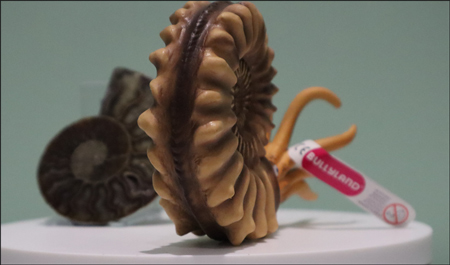
It’s “Turntable” Tuesday at Everything Dinosaur! The time of the week when we put another prehistoric animal model on our turntable and give it a spin. Today, it is the turn of the Bullyland ammonite model, the first invertebrate to feature in this series and an ammonite replica that it is used by museums all over the world to illustrate the Ammonoidea.
The Bullyland Ammonite Model “Turntable Tuesday”
Video credit: Everything Dinosaur
Ammonite Replicas
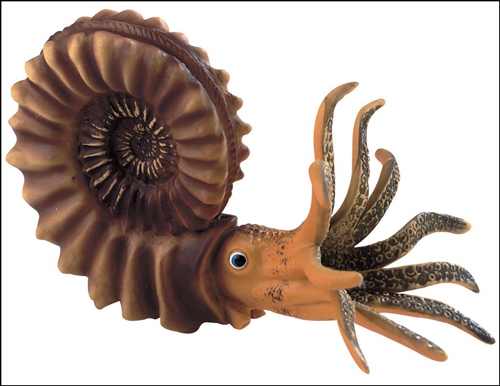
The Bullyland ammonite is one of the most popular figures in the German company’s “Dinosaur Park” range. It depicts a typical ammonite, with large eyes, a hypernome and a beautifully detailed beak (mouth). The shell has an inverted keel and it is strongly ribbed, characteristics associated with a number of known genera from both the Jurassic and Cretaceous geological periods.
The Bullyland Ammonite Model
The Bullyland replica ammonite model. The strongly ribbed shell, large eyes and the presence of a hypernome (siphon).
Visit the award-winning and user-friendly Everything Dinosaur website: Everything Dinosaur.
Ubiquitous and Important Extinct Group of Cephalopods
Although extinct, animals in the Subclass Ammonoidea are extremely important to scientists. Ammonites are members of the Mollusca Phylum that lived in chambered shells and were entirely marine. Many hundreds of different genera are known. The ability to evolve rapidly, to leave abundant fossil material in the form of their fossilised shells (comprised of aragonite, a naturally occurring crystalline form of calcium carbonate), has made these molluscs ideal candidates for zonal fossils.
Outcrops of rock, although in some cases, separated by thousands of miles and composed of different constituents, limestone and sandstone for example, can be correlated due to the fact that they contain similar ammonite fossils. The technique of using fossils to identify the relative age of sediments is called biostratigraphy. Rock layers are divided into distinct and easily identifiable zones as they are characterised by one or more particular fossil species. Ammonites make ideal zone fossils.
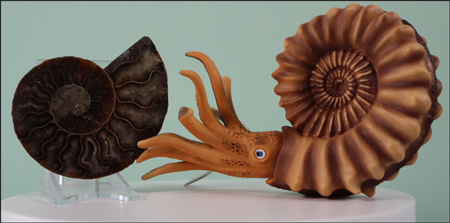
The Bullyland Ammonite Model is Often Used in Museum Exhibits
The Bullyland ammonite model is often used in museum displays to depict the living animal next to fossil material. Picture credit: Everything Dinosaur.
Picture Credit: Everything Dinosaur
Used in Museum Displays and Exhibits
In the short video, the ammonite model is shown next to a fossil specimen. Many museums use the Bullyland ammonite replica in display cases so that visitors can get an idea of what the living animal was like whilst they view the fossilised remains of the ammonite aragonite shells.
The Posterior Portion of the Bullyland Ammonite Model
The strongly ribbed shell and the obvious keel of the ammonite replica.Picture credit: Everything Dinosaur.
Picture credit: Everything Dinosaur
The Bullyland Ammonite Model Features in “Turntable Tuesday”
The “turntable Tuesday” ammonite model video, lasts a little over two minutes, it is one of a series of videos posted on Everything Dinosaur’s YouTube channel showcasing different replicas. To view these videos check out our YouTube channel: Everything Dinosaur on YouTube.
We recommend that readers subscribe to Everything Dinosaur on YouTube.
New Study Challenges Dromaeosaurids Hunting in Packs
The “Jurassic Park/Jurassic World” movie franchise certainly spawned new generations of dinosaur fans. It could be argued that these extremely successful films, may have influenced the career choices of would-be scientists. All very well and good, but one of the problems associated with the films and with the original book “Jurassic Park” written by Michael Crichton, concerns the “raptors”, those fast running, social pack hunters the size of Deinonychus but in this franchise referred to as Velociraptors.
Popular media has depicted these “raptors” as highly social, intelligent animals capable of working together to attack and bring down prey, but what scientific evidence is there to back-up the on-screen abilities of these dinosaurs?
Studying Isotopes in Dinosaur Teeth
Since it is very rare for the fossil record to preserve behaviour, scientists have had to employ some ingenious lines of research in order to gain an insight into the behaviour of dinosaurs. For example, researchers from the University of Wisconsin, the University of Oklahoma and the Sam Noble Museum (Oklahoma), set about analysing differences in stable carbon isotopes within Deinonychus teeth. Differences in the composition of these stable isotopes in teeth from young dinosaurs when compared to the isotopes found in the teeth of adults, would indicate a different diet.
If the adults had a different diet compared to the younger animals then this would contradict the idea of these dinosaurs being social and hunting in packs.
They conclude that Deinonychus probably did not hunt in a co-operative, co-ordinated manner. These “raptors” were probably not complex, social hunters.
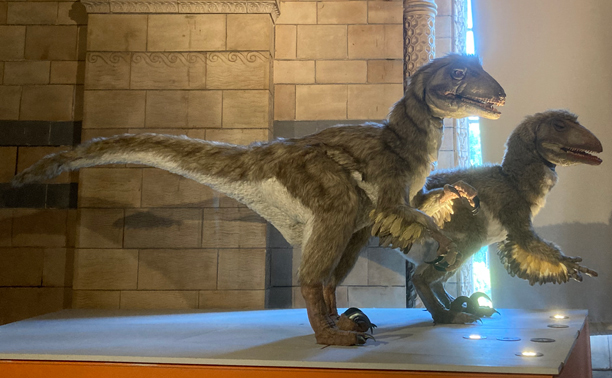
Life-size Deinonychus Replicas on Display
Life-size Deinonychus replicas on display at the London Natural History Museum. Picture credit: Everything Dinosaur.
Picture credit: Everything Dinosaur
Laying a Ghost – Highly Intelligent, Pack Hunting “Raptors”
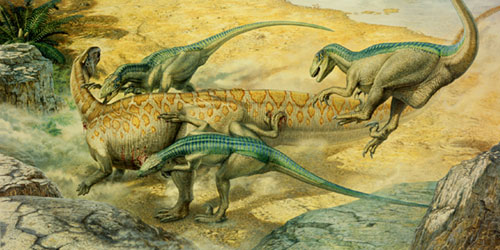
The idea of pack hunting in dromaeosaurids pre-dates “Jurassic Park”, it was first proposed to explain the co-occurrence of Deinonychus (D. antirrhopus) and the iguanodontian Tenontosaurus (T. tilletti). Around a fifth of all Tenontosaurus remains are found in association with D. antirrhopus. It has been proposed that Deinonychus hunted the larger Tenontosaurus and as numerous fossil specimens of Deinonychus have been found with Tenontosaurus remains it was suggested that this was evidence of pack hunting behaviour amongst members of the Dromaeosauridae.
A Pack of “Raptors” (Deinonychus) Attack a Tenontosaurus
A pack of Deinonychus attacking the herbivore Tenontosaurus. Pack hunting behaviour inferred from fossil evidence.
Picture credit: John Sibbick
Dromaeosaurs Probably Not Pack Hunters
The depiction of dromaeosaurs as pack hunters is problematic as sophisticated hunting strategies are rarely observed in living archosaurs such as crocodiles and birds. Palaeontologists have considered that perhaps Deinonychus was more analogous to extant reptilian predators such as the Komodo dragon (V. komodoensis), where there seems to be no co-ordinated attack strategy, instead an attack by an individual may instigate mobbing behaviour which would bring down the prey.
Lead author of the study, published in Palaeogeography, Palaeoclimatology, Palaeoecology, Dr Joseph Frederickson (University of Wisconsin), explained:
“The evidence for this behaviour [pack hunting], however, is not altogether convincing. Since we can’t watch these dinosaurs hunt in person, we must use indirect methods to determine their behaviour in life. Though widely accepted, evidence for the pack-hunting dinosaur proposed by Yale University palaeontologist John Ostrom is relatively weak. The problem with this idea is that living dinosaurs (birds) and their relatives (crocodilians) do not usually hunt in groups and rarely ever hunt prey larger than themselves. Further, behaviour like pack hunting does not fossilise so we can’t directly test whether the animals actually worked together to hunt prey.”
Social Pack Hunters versus Mob Hunters
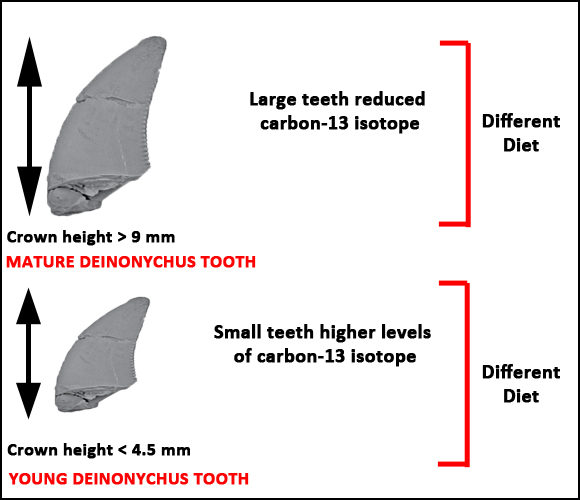
In order to test the likelihood of Deinonychus being a social pack hunter or whether these dinosaurs simply mobbed victims in an uncoordinated manner, the researchers looked at evidence for dietary changes preserved in the stable carbon isotopes found in fossilised Deinonychus teeth of various sizes. The team analysed tooth carbonate from teeth less than 4.5 mm tall (crown height less than 4.5 mm) and compared the carbon isotopes found to those from much larger teeth (crown height greater than 9 mm).
The smallest teeth studied were the relatively most enriched with carbon-13 isotope, whilst the largest teeth used in the study had depleted levels. These results suggest that juvenile Deinonychus consumed different prey than older members of this species.
Analysis of Stable Isotope Carbon-13 in the Teeth of Deinonychus Sheds Doubt on the Social Hunter Hypothesis
Deinonychus teeth – carbon-13 isotope analysis. Tooth samples collected from the Lower Cretaceous Cloverly (Montana) and Antlers (Oklahoma) formations when analysed for carbon-13 levels suggest a dietary shift as Deinonychus matured. This challenges the social, pack hunter hypothesis.Picture credit: Everything Dinosaur.
Picture credit: Everything Dinosaur
Testing the Teeth of Other Prehistoric Animals as Well as Deinonychus
Teeth from goniopholidid crocodilians as well as the teeth of Tenontosaurus tilletti were also tested. The crocodilian results mirrored those found for Deinonychus. If goniopholidid had the same behaviours of extant crocodilians then, just like their modern counterparts, these reptiles went through a distinct dietary transition as they grew. If the teeth of Deinonychus show very similar results to the crocodilians, then, the implication is that just like crocodiles today, this “raptor” was probably not a complex social hunter it is unlikely that its hunting behaviour was comparable to the pack hunting behaviour of wolves or lions.
Still, the prospect of being mobbed by a gang of agile, three-metre-long, predatory dinosaurs remains unappealing.
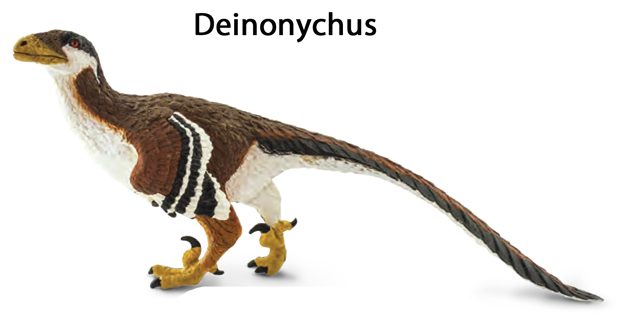
A Model of a Deinonychus Dinosaur (D. antirrhopus)
New for 2020 the Wild Safari Prehistoric World Deinonychus dinosaur model. Evidence suggests that Deinonychus was not a social, sophisticated pack hunter.
The picture (above) depicts the recently introduced Wild Safari Prehistoric World Deinonychus model.
The scientific paper: “Ontogenetic dietary shifts in Deinonychus antirrhopus (Theropoda; Dromaeosauridae): Insights into the ecology and social behavior of raptorial dinosaurs through stable isotope analysis” by J.A. Frederickson, M. H. Engel, R.L. Cifelli published in Palaeogeography, Palaeoclimatology, Palaeoecology.
It’s “Turntable Tuesday” at Everything Dinosaur and time to give another prehistoric animal figure in our extensive range, a spin. Today, we have selected one of the most underrated models in the CollectA Deluxe Prehistoric Life model range – the 1:20 scale Woolly Mammoth. It is time this fabulous figure of an iconic Ice Age animal got put into the spotlight.
“Turntable Tuesday”
“Turntable Tuesday” – The CollectA Deluxe 1:20 Scale Woolly Mammoth
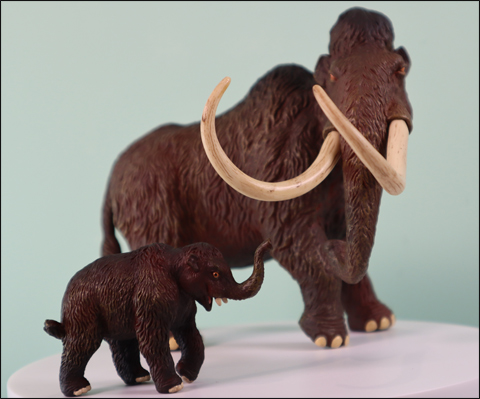
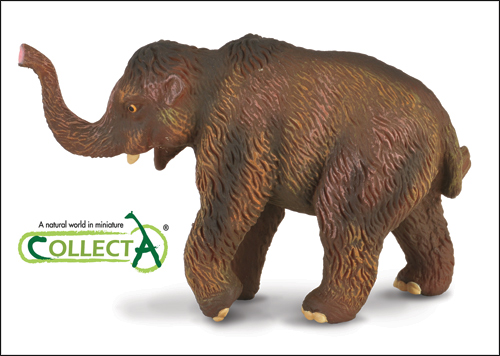
Lots of prehistoric animal ranges include a Woolly Mammoth figure (M. primigenius). It seems that as soon as a manufacturer starts to extend a range beyond the Dinosauria, the Woolly Mammoth comes into consideration. The CollectA 1:20 scale replica was introduced back in 2009 along with the Woolly Mammoth calf, which coincidentally, makes a short appearance in our video. Interestingly, although no scale declaration was ever made for the calf model, these models were originally given sequential catalogue and production numbers. They do work very well together in terms of scale.
CollectA Woolly Mammoth Models
The CollectA Deluxe Woolly Mammoth model in 1:20 scale and the CollectA Prehistoric Life Woolly Mammoth calf.Picture credit: Everything Dinosaur.
Picture credit: Everything Dinosaur
A Woolly Mammoth on the Turntable
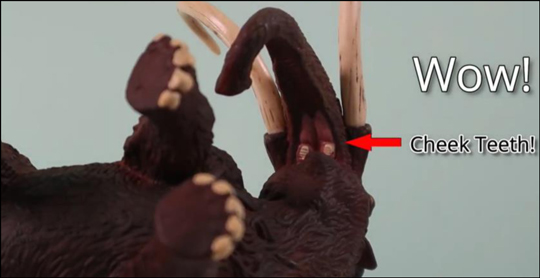
Our short video showcasing these excellent replicas lasts around one minute fifty seconds. Using a turntable to display the models we can permit viewers an all-round view of the figure. We did have to place the adult Mammoth on its back so that we could show the beautifully sculpted teeth in the upper jaw. Those tusks (upper incisors), are beautifully weathered too.
The Everything Dinosaur Video Highlights Some of the Details on the Ice Age Models
The Everything Dinosaur video highlights the details in the upper jaw.Picture credit: Everything Dinosaur.
Picture credit: Everything Dinosaur
Model Measurements – Are They 1:20 Scale Woolly Mammoth Models?
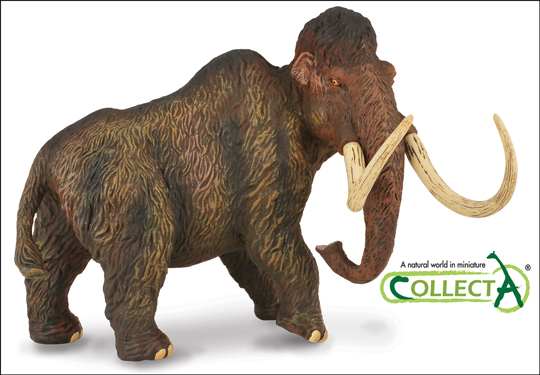
The CollectA Deluxe adult Woolly Mammoth measures around 20 cm long and that magnificent head is approximately 15 cm off the ground. Different species were different sizes and as with extant elephants today, the males were much larger than the females. Scientific measurements based on Mammuthus primigenius suggest an adult body size of around 3.5 metres to 4 metres in length, so this figure is indeed in approximately 1:20 scale.
The CollectA Deluxe Woolly Mammoth Replica
CollectA Deluxe Woolly Mammoth replica.
The CollectA Woolly Mammoth Calf
CollectA Prehistoric Life Woolly Mammoth calf model.
The Woolly Mammoth video can be found on Everything Dinosaur’s YouTube channel, please subscribe, you can find the channel here: Everything Dinosaur on YouTube.
Stellasaurus ancellae – Missing Link from the Two Medicine Formation of Montana
A new species of horned dinosaur has been described based on fossil material from the famous Two Medicine Formation of north-western Montana. The new species named Stellasaurus ancellae is a possible missing link in the evolutionary transition of Centrosaurinae dinosaurs from Styracosaurus to one of the last of the horned dinosaurs known to science – Pachyrhinosaurus.
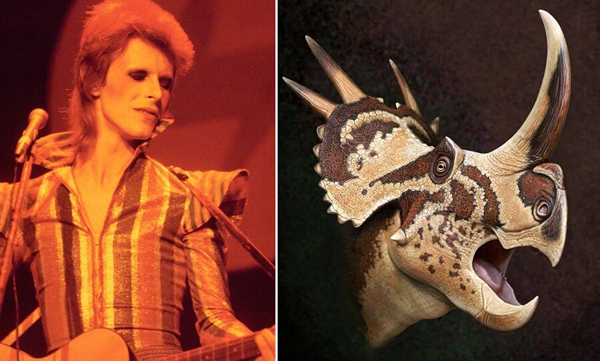
Stellasaurus means “star lizard”, reflecting the ornate star-shaped head crest and in honour of British rock/pop star David Bowie, famous for his flamboyant appearance and his hit single “Starman” which was released on April 28th 1972, almost 48 years to the day that the Stellasaurus scientific paper was published in Royal Society Open Science.
United by a Flamboyant Appearance David Jones AKA David Bowie and “Star Lizard” AKA Stellasaurus
David Bowie (left) and Stellasaurus ancellae (right).
Picture credit: Getty Images and Andrey Atuchin
Stellasaurus ancellae
Just like the career of David Bowie, Stellasaurus has had to wait a while before becoming famous. The fossil material now assigned to Stellasaurus was discovered in 1986, near the town of Cut Bank in Montana, close to the USA/Canadian border. The discovery was made by Carrie Ancell. It remained catalogued but not studied in the Museum of the Rockies (Montana), vertebrate fossil collection.
The contribution of Carrie Ancell, now a senior preparator at the Museum of the Rockies, has been recognised as the species name honours her. Carrie Ancell has played a significant role in developing our understanding of northern Laramidian centrosaurines. She discovered and prepared MOR 492, the holotype specimen of Stellasaurus ancellae, as well as the holotype of Achelousaurus horneri, and co-discovered the holotype of Einiosaurus procurvicornis.
Views of the Holotype Fossil Material of Stellasaurus ancellae
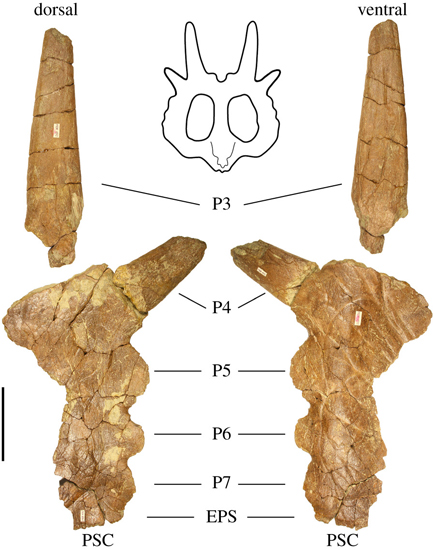
Left lateral parietal bar of Stellasaurus ancellae holotype MOR 492 in dorsal and ventral views. The line drawing has been reproduced from a PLOS One article (Evans and Ryan). Note scale bar on left equals 10 cm.
Picture credit: Wilson et al/Royal Society Open Science
Reviewing the Centrosaurinae Fossil Material from the Two Medicine Formation
A review of cranial material, specifically the ornamentation associated with the neck frill (parietal processes), previously assigned to the centrosaurine Rubeosaurus ovatus resulted in the identification of this new taxon. However, this assessment could mark the demise of R. ovatus as the researchers, which include John Wilson of Montana State University, conclude that only what was the holotype fossil, a partial parietal specimen number USNM 11869, can be attributed Rubeosaurus. This could spell the end for Rubeosaurus. When USNM 11869 was first described it was assigned to a new species of Styracosaurus (S. ovatus).
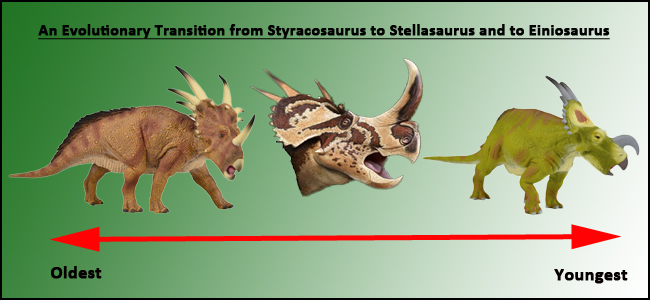
Thus, this new paper proposes that the genus Rubeosaurus is now no longer valid and that Styracosaurus ovatus is the sister taxon to Styracosaurus albertensis and Stellasaurus marks a missing link in centrosaurine evolution between Styracosaurus and Einiosaurus procurvicornis.
A Stratigraphical and Temporal Assessment of Late Cretaceous Centrosaurines Based on Two Medicine Formation Fossil Material*
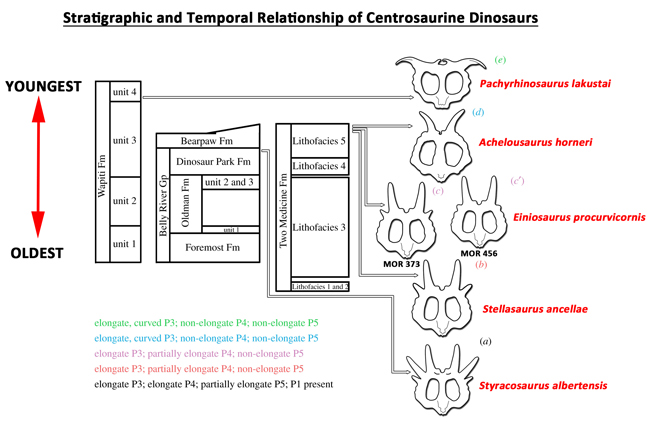
Stratigraphic and temporal relationship between Two Medicine Formation centrosaurine taxa. *Pachyrhinosaurus lakustai fossil material is not from the Two Medicine Formation but from the younger unit 4 sediments of the Wapiti Formation of Canada.
Picture credit: Wilson et al/Royal Society Open Science
A Missing Link Amongst the Centrosaurinae
The researchers postulate that Stellasaurus represents a missing link in the centrosaurine family tree. The fossils of Stellasaurus are believed to be around 75 million years old. From a stratigraphical perspective, they are younger than Styracosaurus albertensis fossils, but older than fossils assigned to Einiosaurus. That flamboyant head shield with its various lumps and bumps could reflect a transitional stage between the headshield morphology of Styracosaurus and that of Einiosaurus. It is suggested that Stellasaurus was preceded by Styracosaurus and that Styracosaurus evolved into Stellasaurus. In addition, Einiosaurus evolved from Stellasaurus.
A Transitional Process – One Horned Dinosaur Leading Directly to Another Species of Horned Dinosaur
Anagenesis within centrosaurine dinosaurs. Stellasaurus evolved from Styracosaurus and Einiosaurus evolved from Stellasaurus.
Commenting upon the importance of this new research, lead author John Wilson stated:
“The ornamental horns and spiky frills on the skulls of these animals are what changed the most through evolution. The new species has skull ornamentation which is intermediate. This gives us evidence these species are members of a single, evolving lineage – this type of evolution is called anagenesis.”
The Phylogeny of the Centrosaurinae from Statistical Analysis Undertaken by the Research Team
Phylogeny of the Centrosaurinae clade of the Ceratopsidae based on Bayesian statistical analysis mapped against a temporal range. Styracosaurus ovatus (formerly Rubeosaurus ovatus), is placed as the sister taxon to Styracosaurus albertensis, whilst Stellasaurus is mapped between S. albertensis and Einiosaurus procurvicornis.
Picture credit: Wilson et al/Royal Society Open Science
The scientific paper: “A new, transitional centrosaurine ceratopsid from the Upper Cretaceous Two Medicine Formation of Montana and the evolution of the ‘Styracosaurus-line’ dinosaurs” by John P. Wilson, Michael J. Ryan and David C. Evans published in Royal Society Open Science.