

Recently, Everything Dinosaur published an article about the discovery of some remarkable, probable Tyrannosaurus rex tracks that had been discovered in North Dakota. The three-toed prints were made by a large theropod. The trackway measures around seven metres in length and four individual prints have been excavated. There are probably more but the overburden from the hill would be difficult to remove to expose the entire trackway. The four prints that have been found represent two left prints and two right prints – a walking sequence.
The size and tridactyl nature of the tracks is consistent with an adult Tyrannosaurus rex trackmaker. Researchers from the Denver Museum of Nature & Science and Liverpool John Moores University studied the trackway. Their research has been published in the Journal of Vertebrate Paleontology.
To read Everything Dinosaur’s earlier article about this trace fossil discovery: Extraordinary Probable Tyrannosaurus Trackway Discovered.
How Did These Trace Fossils Form?
Trace fossils such as these footprints preserve evidence of the activity of an animal. In contrast to body fossils such as teeth or bones which can be transported a long way from where the animal died, most trace fossils are direct evidence of the environment at the time and the place where the animal lived. Trace fossils often provide in situ evidence.
Intriguingly, the tracks are preserved as raised mounds (epirelief). How did they form? Thankfully, the media release from the Denver Museum of Nature & Science also included some beautiful artwork by Andrey Atuchin that illustrate their formation.
In order to have potential Tyrannosaurus rex tracks preserved, the first thing required is to have a dinosaur (a T. rex) leave its footprints in a substrate such as soft mud.
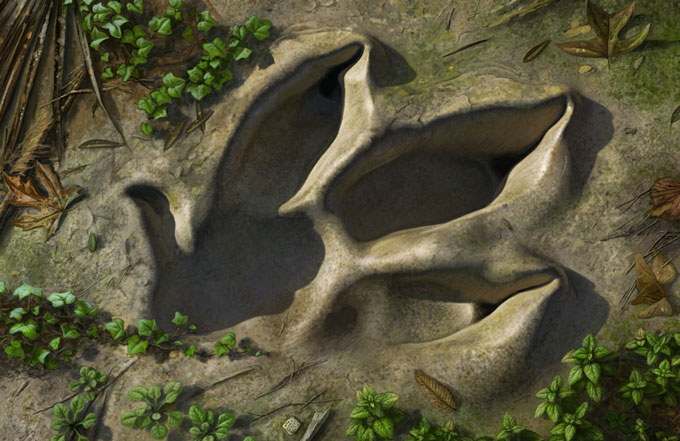
The large theropod (probable Tyrannosaurus rex) walks along leaving tracks in soft mud. Picture credit: Andrey Atuchin.
Picture credit: Andrey Atuchin
The mud dries out and the impression of dinosaur’s foot is preserved as a tridactyl depression in the mud.
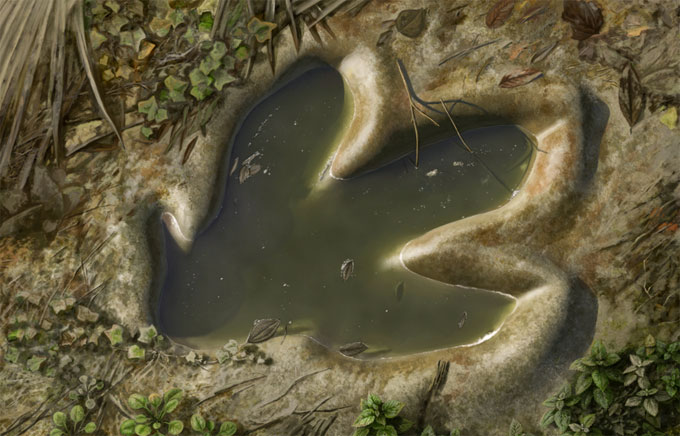
Over time the mud hardens leaving a track preserved in the mud. Picture credit: Andrey Atuchin.
Picture credit: Andrey Atuchin
The Track is Filled by Sediment
The indentation caused by the dinosaur’s foot is gradually filled in with other sediment. In this case, sand slowly fills the track. This forms a natural cast of the print.
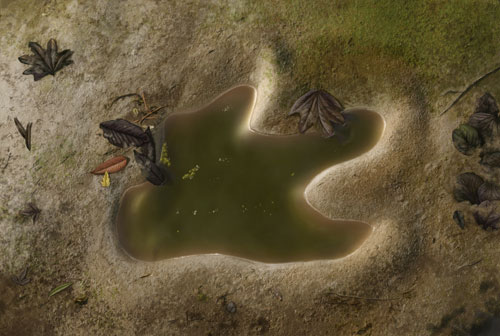
The track is gradually infilled by sediment such as sand, creating a natural cast of the footprint. Picture credit: Andrey Atuchin.
Picture credit: Andrey Atuchin
Over millions of years the sand turns into sandstone and the mud forms mudstone. These two different types of sedimentary rock might erode at different rates. For example, the softer mudstone erodes quicker than the sandstone. Thus, a track is preserved as a raised structure (epirelief).
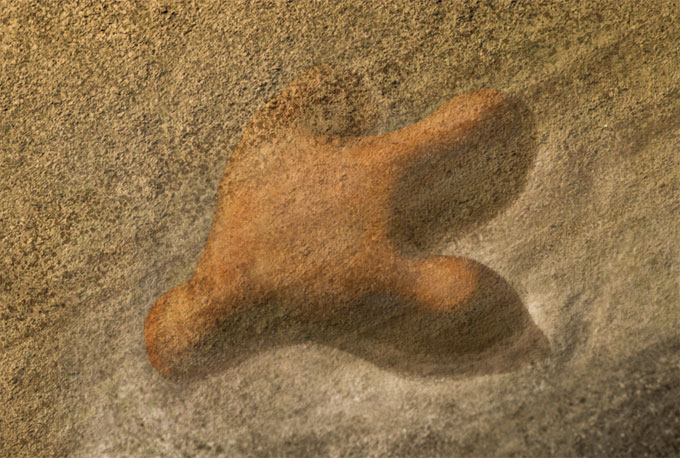
The hard sandstone is more resistant to weathering and over time the track is left as a raised portion of rock (epirelief) surrounded by more rapidly eroded mudstone. Picture credit: Andrey Atuchin.
Picture credit: Andrey Atuchin
Three of the footprints are expected to be recovered by helicopter this autumn (2026) and then transported to the Denver Museum of Nature & Science. We wish the research team every success with their endeavours to recover and preserve these amazing tracks.
Everything Dinosaur acknowledges the assistance of a media release from the Denver Museum of Nature & Science in the compilation of this article.
The scientific paper: “A large tridactyl trackway from the Upper Cretaceous Hell Creek Formation of North Dakota, likely attributable to an adult Tyrannosaurus rex” by Peter L. Falkingham, Kent M. Hups, Evan M. Tamez-Galvan, Antoine D. Bercovici and Tyler R. Lyson published in the Journal of Vertebrate Paleontology.
The award-winning Everything Dinosaur website: Dinosaur Toys and Models.

Leave A Comment