

The discovery of Diplodocus in Europe has been confirmed following the study of sauropod fossils from eastern Spain. Fourteen caudal vertebrae and several chevrons from Teruel have been assigned to the iconic genus Diplodocus. This represents the first definitive evidence of this famous dinosaur outside North America.
The fossils come from the La Tejería site in the municipality of El Castellar (Teruel). They were recovered from sediments associated with the Upper Jurassic Villar del Arzobispo Formation dating from approximately 150 million years ago.
Identifying Diplodocus in Europe
Diplodocus is one of the best-known sauropod dinosaurs. These enormous, quadrupedal herbivores had long necks, relatively small heads and extremely long tails. Until now, definitive fossils assigned to Diplodocus had only been recognised from North America. Specifically, Diplodocus fossil material is associated with the famous Upper Jurassic Morrison Formation.
The Spanish specimen consists of fourteen vertebrae from the middle and posterior portions of the tail, along with several chevrons. Chevrons are bones associated with the underside of the caudal vertebrae.
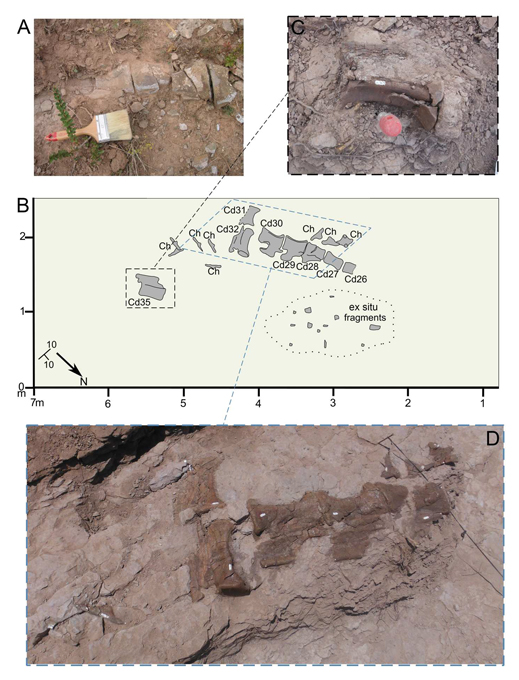
Photographs (A, C and D) of the fossil material plus an excavation map (C) of the La Tejería (CT-30) site (El Castellar, Teruel, Spain). Picture credit: Sánchez-Fenollosa et al. 2026.
Picture credit: Sánchez-Fenollosa et al. 2026
Several anatomical characteristics helped the researchers identify the fossils as Diplodocus. These include large pneumatic cavities in the vertebrae, elongated vertebral centra without lateral ridges and deep longitudinal grooves on their undersides. The specimen also preserves bifurcated chevrons. It has been classified as Diplodocus sp.
Sergio Sánchez Fenollosa, a researcher at the Fundación Dinópolis, and co-author of the study explained:
“The anatomical study and evolutionary analyses carried out have enabled us to identify the El Castellar specimen as belonging to the genus Diplodocus. It is one of the most complete diplodocids discovered to date in Europe and represents the first evidence of this genus outside North America.”
Dinosaurs Crossing the Early Atlantic
The discovery has important implications for our understanding of Late Jurassic dinosaur biogeography. Around 150 million years ago, North America and Europe were separated by the developing proto-Atlantic Ocean. However, the distribution of closely related dinosaurs indicates that opportunities for faunal interchange occurred.
Sánchez Fenollosa added:
“This discovery provides some of the strongest palaeontological evidence for episodes of dispersal and faunal interchange between the two continents across the proto-Atlantic Ocean during the Late Jurassic. Furthermore, this discovery allows us to better understand Iberian Mesozoic ecosystems and the diversity of sauropod dinosaurs that inhabited Jurassic Europe.”
The presence of Diplodocus in Spain therefore strengthens the evidence for connections between the dinosaur faunas of Europe and North America during the Late Jurassic.
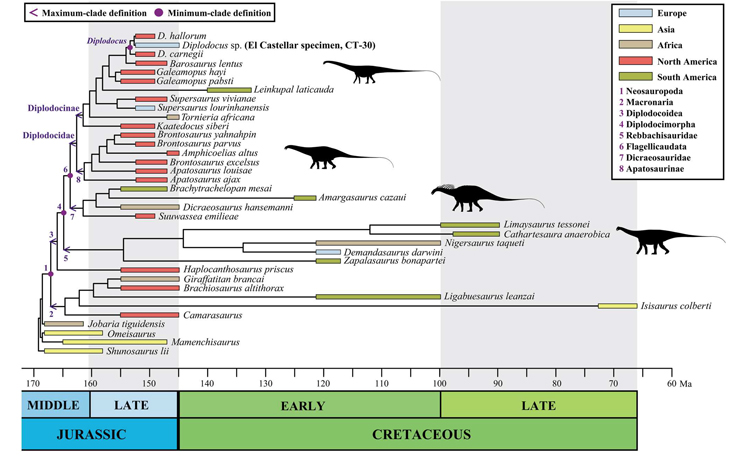
A diagram showing the palaeogeographic, temporal and phylogenetic relationships of Diplodocus sp. La Tejería site fossil material (El Castellar, Teruel, Spain) is grouped with the North American Diplodocus species D. hallorum and D. carnegii. Picture credit: Sánchez-Fenollosa et al. 2026.
Picture credit: Sánchez-Fenollosa et al. 2026
The first evidence of colour patterning in Diplodocus skin: Diplodocus Integument Study Reveals Colour Patterning.
A Giant Spanish Diplodocus
The El Castellar Diplodocus was certainly a substantial animal. Alberto Cobos, Managing Director of the Fundación Dinópolis, stated that it was approximately twenty-five metres in length.
He commented:
“The Diplodocus from El Castellar was approximately twenty-five metres long, making it another of the giant sauropods of the Jurassic of Spain, alongside other sauropod dinosaurs from Teruel with characteristics very different from those of diplodocids, such as Turiasaurus and Losillasaurus, among others.”
Cobos added:
“The fossils of all these dinosaurs, including those of the new Diplodocus, which make Teruel an important reference point for understanding this great diversity, are currently on display in the dinosaur gallery of the Museo Aragonés de Paleontología at Dinópolis in Teruel.”
The Diplodocus Genus
Diplodocus was first named in 1878 (Marsh). Several species have been erected. It is one of the best-known of all the dinosaurs amongst members of the public. The philanthropist Andrew Carnegie acquired giant fossil bones discovered in Wyoming. He wanted these sauropod fossils to form the centrepiece for his new museum in Pittsburgh. During the preparation of the material and reconstruction of the skeleton, scientists identified unique autapomorphies that enabled them to erect a new Diplodocus species. The dinosaur was named Diplodocus carnegii in honour of the Scottish-born philanthropist.
During a visit to Carnegie’s Scottish castle, King Edward VII remarked how he would like a similar specimen for the British Museum in London (Natural History Museum). A replica of the specimen was cast and presented to the British Museum. The Diplodocus skeleton replica, now known affectionately as “Dippy” was unveiled in 1905. Subsequently, another nine replicas were commissioned. These are exhibited in museums around the world, including the Museum für Naturkunde Berlin.
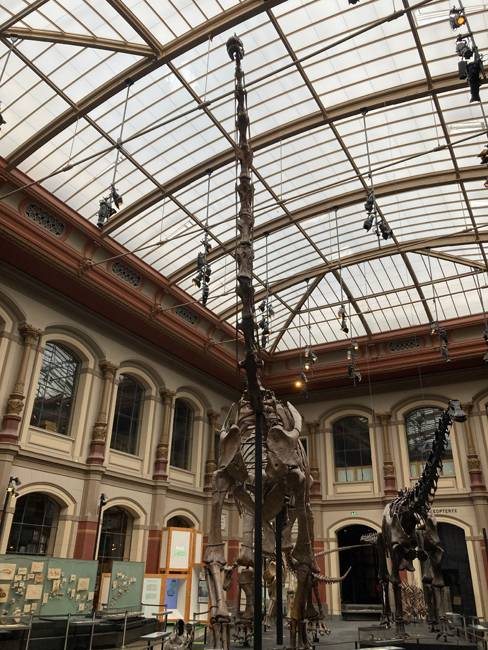
The spectacular dinosaur gallery at the Museum für Naturkunde Berlin. The Diplodocus carnegii cast is seen on the right with the enormous brachiosaurid specimen (Giraffatitan brancai) shown on the left. Picture credit: Everything Dinosaur.
Picture credit: Everything Dinosaur
These spectacular displays helped make this Late Jurassic sauropod one of the most familiar prehistoric animals. Whilst the Spanish fossil material has been assigned to the Diplodocus genus, no species name has been assigned as yet. However, the caudal vertebrae probably represent a new species.
The identification of Diplodocus in Europe substantially extends the known geographical distribution of this iconic sauropod. Moreover, the fossils from Teruel provide further evidence that Late Jurassic dinosaur faunas on either side of the proto-Atlantic were not entirely isolated from each other.
Everything Dinosaur acknowledges the assistance of the co-author of the scientific paper Sergio Sánchez Fenollosa in the compilation of this article for supplying a copy of the scientific paper and the media release from the Fundación Conjunto Paleontológico de Teruel-Dinópolis.
The scientific paper: “Intercontinental evidence of the iconic genus Diplodocus Marsh, 1878 (Dinosauria, Sauropoda)” by Sergio SáNchez-Fenollosa, Josué García-Cobeña and Alberto Cobos published in the Journal of Vertebrate Paleontology.
For scale models of Diplodocus and other sauropod dinosaurs: Scale Models of Sauropods and Other Dinosaurs.

Leave A Comment