All about dinosaurs, fossils and prehistoric animals by Everything Dinosaur team members.
28 09, 2017

New Basal European Ornithopod Described

By |2023-08-15T13:50:51+01:00September 28th, 2017|Categories: Dinosaur and Prehistoric Animal News Stories, Dinosaur Fans, Main Page, Photos/Pictures of Fossils|0 Comments

Burianosaurus augustai  – Unappreciated Ornithopods

A new basal ornithopod has been named in honour of Zdeněk Burian.  The dinosaur has ben named Burianosaurus augustai.

If you were able to book yourself onto a time-travelling safari to the Cretaceous, before journeying into the long distant past, you might explain to the travel guide that you would be hoping to spot a tyrannosaur, get up close to a browsing armoured dinosaur or possibly take some photos of Triceratops.  However, we suspect, that even if such a venture was possible, few tourists would spare a thought for one group of dinosaurs, that ironically, you would be much more likely to encounter.  These are the ornithopods, that diverse and extremely successful group of bird-hipped dinosaurs, that are often overlooked.

A new basal ornithopod has been named and described this week – Burianosaurus augustai.  A plant-eating dinosaur named after the palaeoartist Zdeněk Burian, who, in his lifetime did much to raise the profile of the Dinosauria.

An Illustration of Burianosaurus (B. augustai)
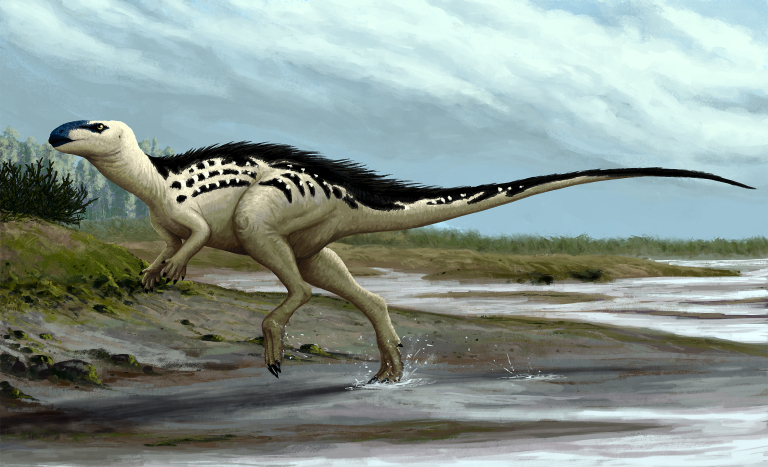
Burianosaurus augustai illustrated.

An illustration of the basal ornithopod from the Czech Republic Burianosaurus augustai.

Picture credit: Edyta Felcyn

The Dinosaur Equivalent of Antelopes

They lacked horns, body armour and for the majority, they did not reach huge sizes, but these herbivores would have made up a significant component of the dinosaur fauna in most Cretaceous ecosystems.  If you were to go on a safari to the Maasai Mara of Kenya or the Serengeti of Tanzania, tourists might be keen to spot lions, leopards and elephants but in all likelihood, you would encounter a great many different types of antelope.   Dinosaurs like the newly described Burianosaurus can be considered as being the dinosaur equivalent of today’s antelopes.

Described from a single, well-preserved, left femur (thigh bone), Burianosaurus is the first dinosaur to be named from fossils found in the Czech Republic.  It is not the first dinosaur fossil from the Czech Republic to be scientifically described, that honour goes to a single, broken tooth from an indeterminate theropod from Upper Jurassic sediments that was described in 2014, coincidentally by the lead author of the paper describing Burianosaurus, Daniel Madzia (Polish Academy of Sciences).

The Fossilised Thigh Bone of Burianosaurus (Various Views)
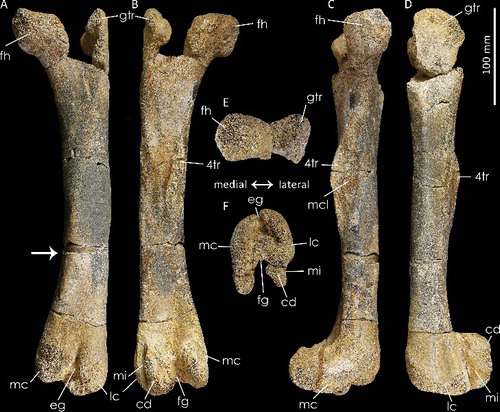
Specimen number NBP oB 203 (Burianosaurus left femur)

Views of the left femur, the only fossil from which the basal Ornithopod Burianosaurus augustai has been described.

Picture credit: The Journal of Systematic Palaeontology

The photograph (above), shows various views of the left femur of Burianosaurus.  This is the holotype fossil (NMP Ob 203), from which this genus was described.

Described from a Single Fossil Bone

It is not common these days, to have a new dinosaur genus erected on the description of a single bone.  When this fossil was first studied back in 2005, it was assigned to the iguanodontids.  However, over recent years the Iguanodontia and their relatives have been subject to phylogenetic reassessment and many of the taxonomic relationships between different components of the Ornithopoda have been revised.  The single bone was preserved in such fantastic condition, that its shape and muscle scars proved crucial in assigning a new dinosaur genus.

The views of the femur are (A) a view from the front, (B) viewed from the back, (C) a medial view (the bone viewed from the side closest to the body, think of it as the “inside leg view”) and (D) a lateral view, the bone viewed from the side of the bone towards the outside of the body.  Photographs (E) and (F) are views of the bone from the top looking down (proximal) and from the bottom of the bone looking up (distal).

The scale bar is 10 centimetres and the white arrow in (A) indicates the site from which a small sample of fossil bone was taken to permit an internal examination of bone structure to take place.  This histology helped the research team, writing in the Journal of Systematic Palaeontology, to identify this specimen as coming from a young, adult animal.

Burianosaurus augusta was Bigger than Hypsilophodon (H. foxii)

A lot of work has recently been undertaken in a bid to better understand how different ornithopods were related to each other.  These dinosaurs are characterised by their small, quite triangular heads, large orbits (eye sockets) and relatively primitive dentition (at least when compared to their relatives that comprise the Ankylopollexia clade – more derived iguanodonts, camptosaurs and the duck-billed dinosaurs).  Their front limbs tended to be much shorter than their hind limbs, so these dinosaurs were probably bipedal, although capable of dropping onto all fours if needed.

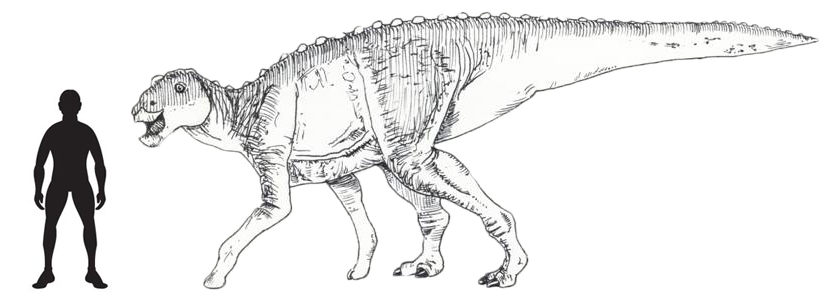
Burianosaurus has been depicted as being very similar to Hypsilophodon (H. foxii), to which it was related.  However, the largest H. foxii thigh bone that we at Everything Dinosaur are aware of, is only about half the size of the holotype of B. augustai.  Based on this we estimate that Burianosaurus was around four metres long.

Size Estimate Burianosaurus Compared to Hypsilophodon
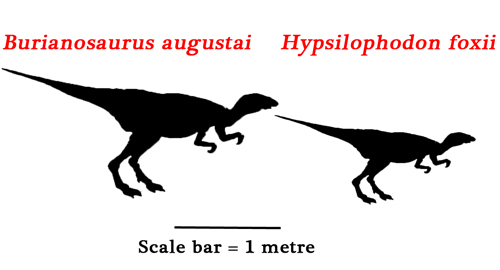
Hypsilophodon and Burianosaurus size comparison.

An approximate size comparison between Burianosaurus and Hypsilophodon (H. foxii).  Picture credit: Everything Dinosaur.

Picture credit: Everything Dinosaur

Honouring Burian and Augusta

The genus name honours the famous palaeoartist Zdeněk Burian (1905–1981), whilst the species name refers to the influential palaeontologist and author Josef Augusta (1903 – 1968), who between them, did much to popularise the study of prehistoric animals.  Like Burianosaurus, both Burian and Professor Augusta came from the Czech Republic.

The single fossil bone that represents this new genus (the thigh bone), was found in the Korycany Beds of the Peruc-Korycany Formation.  These are a series of marine deposits laid down in a shallow sea, close to land during the Cenomanian faunal stage of the Late Cretaceous.  Team members at Everything Dinosaur estimate that Burianosaurus lived around 95 million years ago.

For models and replicas of ornithopods like Burianosaurus augustaCollectA Age of Dinosaurs Popular Range.

Burianosaurus augusta

In the scientific paper, the researchers carry out  a series of phylogenetic analyses of ornithopod data and as a result, B. augustai is classified as a basal ornithopod, however, quite how the Ornithopoda is configured remains open to debate.  If you do ever get the chance to participate in a time-travelling safari to the Cretaceous, look out for these fast-running, bipeds, fossils of which are just as valuable to science as that of any other dinosaur.

The scientific paper: “A Basal Ornithopod Dinosaur from the Cenomanian of the Czech Republic” by Daniel Madzia, Clint A. Boyd and Martin Mazuch published in the Journal of Systematic Palaeontology.

Visit the Everything Dinosaur website: Everything Dinosaur.

27 09, 2017

Countdown to the Frankfurt Book Fair

By |2023-08-15T14:05:22+01:00September 27th, 2017|Categories: General Teaching|Comments Off on Countdown to the Frankfurt Book Fair

Excitement Builds as Frankfurter Buchmesse Approaches

The countdown has started, there are now just two weeks to go before the start of the annual Frankfurt Book Fair (Frankfurter Buchmesse), the world’s largest event for the book industry and publishing.  Running from Wednesday 11th October through to Sunday the 15th October, this year’s gathering of the great and the good in the publishing world promises to be bigger and better than ever.

The Frankfurter Buchmesse 2017

Frankfurt Book Fair 2017

Frankfurter Buchmesse 2017.

Picture credit: Frankfurt Book Fair

Education and Teaching are Prominent at the Frankfurter Buchmesse

The publishing industry’s commitment to education and the next generation of learners is, once again, very prominent.  Servicing the needs of the educational sector is one of the key aims of the Frankfurter Buchmesse and this year, over 240 exhibitors representing all aspects of education from preschool and nursery through to adult further education are going to be at this international event.

The majority of the education service and publishing providers can be found in Halls, 4, 5 and 6.  There is an especially large number of exhibitors supporting the needs of the primary and elementary schools sector.  Teachers, teaching assistants and those staff members tasked with improving literacy amongst children from ages five and upwards, have a wonderful opportunity to meet some of the leading suppliers, experts and consultants providing services to the Key Stage 1 and Key Stage 2 cohorts.

Engaging Young Minds and Encouraging Life-Long Learning

The Educational Hot Spot at the Frankfurt Book Fair.

A focus on education at the Frankfurter Buchmesse.

Picture credit: Marc Jacquemin/Frankfurt Book Fair

Visit the award-winning Everything Dinosaur website: Visit Everything Dinosaur.

27 09, 2017

New T. rex Documentary Coming Soon to the BBC

By |2023-08-15T14:26:45+01:00September 27th, 2017|Categories: Dinosaur Fans, Famous Figures, Main Page, Press Releases, TV Reviews|2 Comments

T. rex” Documentary with Chris Packham

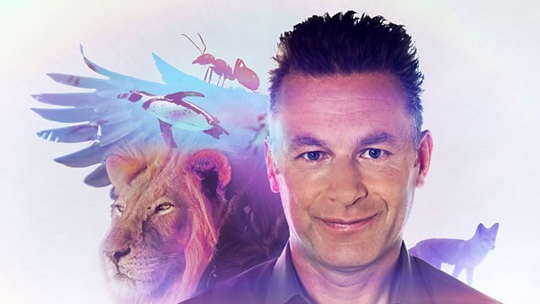
Naturalist and broadcaster Chris Packham will be presenting a special one-hour documentary on the “King of the Tyrant Lizards”.  Sources close to Everything Dinosaur expect this television programme to form part of the corporation’s Christmas 2017 schedule.

Chis Packham Brings Tyrannosaurus rex to Television

Chris Packham naturalist.

Naturalist and broadcaster Chris Packham.

Picture credit: BBC

New Insight into the Life and Behaviour of an Apex Late Cretaceous Predator

Life-long dinosaur fan Chris Packham once told Everything Dinosaur team members that one of the first things he made at school was a plasticine model of T. rex.  His model with its kangaroo stance and tail dragging on the floor was based on pictures of Tyrannosaurus rex he had encountered in books.  In the fifty years or so, since Chris made that model, our understanding of this iconic Late Cretaceous predator has been transformed.  This sixty-minute, one-off television programme, aims to bring viewers up to date and combines state-of-the-art computer animation and the very latest research into one of the largest land carnivores known to science.

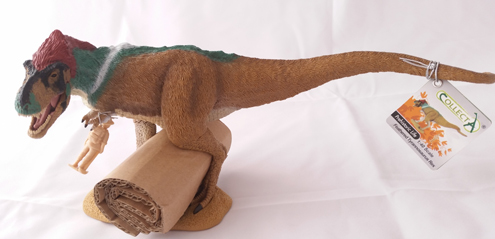
Viewers Can Expect T. rex to be Depicted with a Shaggy Coat of Feathers

Tyrannosaurus rex.

We even supply a roll of cardboard with every model!  A replica of a feathered Tyrannosaurus rex.

Picture credit: Everything Dinosaur

The model in the picture above is a CollectA feathered T. rex.

To view the CollectA range: CollectA Age of Dinosaurs Popular Prehistoric Life Range.

Embarking on a Journey

In the programme, Chris embarks on a journey to expose the myths and misconceptions surrounding T. rex.  He aims to separate the science from the often inaccurate portrayal of this dinosaur as seen in many movies.  Viewers can expect further information about the running speed of this 7-tonne monster, it is unlikely there will be any scenes with a tyrannosaur chasing down a jeep à la Jurassic Park.  Taking inspiration from the “Tyrannosaur Chronicles – The Biology of the Tyrant Dinosaurs” by palaeontologist Dr David Hone (London University), the programme will explore the biology, diet, behaviour and anatomy of T. rex.

The Truth Behind an Iconic Theropod

Chris will meet numerous international experts and joins an excavation site in the Badlands of South Dakota to see how fossilised bones are excavated and prepared for study.  One of the aims of the production team will be to produce the most accurate CGI model of a T. rex created to date, that’s a long way from the plasticine figure from Chris Packham’s childhood.  Expect to see plenty of feathers in what is being hailed as a trailblazing documentary blending the latest research from palaeontologists, ideas from zoologists and ground-breaking computer technology.

To help put “flesh on the bones”, as it were, Chris will have access to Tristan (Tristan Otto), one of the most complete T. rex specimens ever found.  Discovered in 2010 in the Hell Creek Formation (Montana), some 170 bones from a single individual have been collected.  Tristan is housed in the vertebrate fossil collection of the Museum für Naturkunde (Berlin).  It is the only actual fossil T. rex skeleton exhibit in Europe and a team of scientists are currently involved in an extensive research project to learn more about the life and times of this twelve-metre-long monster.

“Tristan Otto” on Display at the Museum für Naturkunde (Berlin, Germany)

"Tristan" Tyrannosaurus rex on display (Berlin).

“Tristan Otto” the T. rex specimen on display in Berlin.

Picture credit: Carola Radke (Museum für Naturkunde)

A T. rex Documentary

The documentary makers promise new information and insights into tyrannosaur brain function and more details on those deadly, bone crushing jaws.

Chris Packham commented:

“Big, fierce and extinct!  It’s the most famous, most glamorous poster pin-up in the zoological world; it’s the greatest animal that ever lived.  And yet perhaps the most misrepresented too.  It’s time to put that right.  T. rex has evolved more in my lifetime than the last 65 million years.  It’s gone from a grey tail-dragging dullard to an intelligent, social super-predator.  Using science, we will at last tell the truth about T. rex.  Don’t bother to put the kettle on!”

Dinosaur fans in the UK can expect this documentary to light up their Christmas viewing, it will probably be available in other countries too, as broadcasting rights get sorted.

T. rex” for BBC2 is a co-production between Talesmith and Cineflix.  The Executive Producer is Martin Williams and the BBC Commissioning Editor is Diene Petterle.

In the meantime, visit the Everything Dinosaur website: Everything Dinosaur’s Website.

26 09, 2017

California Adopts a State Dinosaur as New Law is Passed

By |2024-05-09T14:35:30+01:00September 26th, 2017|Categories: Dinosaur and Prehistoric Animal News Stories, Dinosaur Fans, Main Page|0 Comments

Augustynolophus Makes the Grade

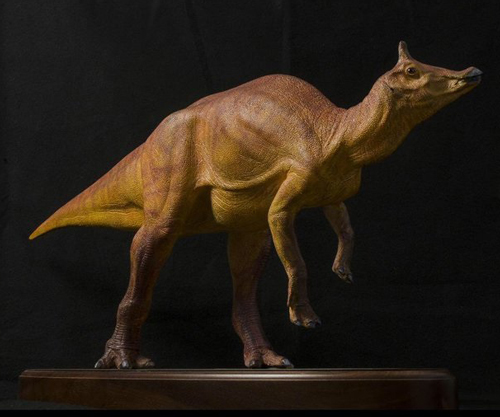
The duck-billed dinosaur Augustynolophus morrisi has become the state dinosaur symbol for California. “Auggie” as this Late Cretaceous member of the Hadrosaurinae has been nick-named by campaigners, joins a long list of symbols for the “Golden State”.  Thus, California becomes the eighth state in the Union to adopt a dinosaur as an official state symbol.

Hadrosaur Becomes the State Dinosaur for California

Augustynolophus image.

Augustynolophus has become California’s State dinosaur.

Picture credit: Augustynolophus Twitter Account

The End of a Long Campaign

It was back in April that Everything Dinosaur first reported on moves within the Californian Senate to adopt a duck-billed dinosaur as a symbol for one of the most populous parts of the United States.  The Assembly member for Santa Monica, Richard Bloom, put forward the legislation for this long extinct reptile to become honoured in this way.

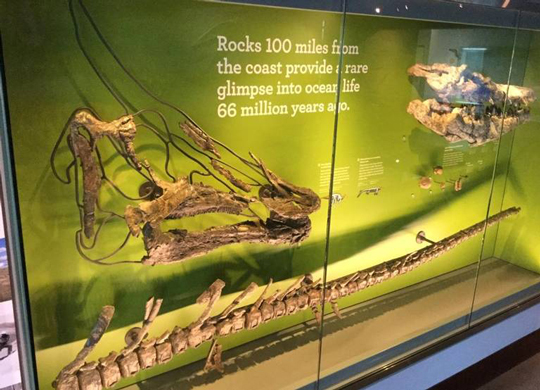
The fossils of this eight to ten-metre-long herbivore come from Upper Cretaceous (Maastrichtian deposits).  The fossil material, including several elements from the skull, have been excavated from marine deposits of the Moreno Formation, strata more frequently associated with mosasaurs and plesiosaurs.  It is likely that rivers in spate occasionally washed the carcasses of these dinosaurs out into the sea, the bodies settled on the seabed and were rapidly buried, thus preventing the corpses being broken up by scavengers.  California is the only place in the world where fossils of this particular duck-billed dinosaur have been found.

Two specimens are known, both are part of the vertebrate fossil collection of the Natural History Museum of Los Angeles County.

To read this earlier article: Moves to Adopt a Dinosaur State Symbol for California.

Augustynolophus morrisi

Governor Jerry Brown announced earlier this week that the signing of a bill making “Auggie” one of the official insignia of California had taken place.

Once Saurolophus, now Augustynolophus but Always Californian

The first fossil evidence for the dinosaur that was to eventually become the newest Californian state symbol was found in the Panoche Hills of Fresno County in 1939.  A second specimen was excavated from strata in the nearby San Benito County two years later.  The excavation work was undertaken by field teams from the California Institute of Technology.  Both specimens were originally assigned to the Hadrosaur genus Saurolophus, a dinosaur that was first named and described in 1912 from fossils discovered in Canada.

Researchers Excavating the Fresno County Fossil Find (1940)

Augustynolophus excavation.

A field team from the California Institute of Technology excavating the fossils of Augustynolophus.

Picture credit: Natural History Museum of Los Angeles County

A review of the fossil specimens led to an assignment of a new species within the Saurolophus genus – S. morrisi (2013), however, a more recent reassessment, involving a number of scientists from the Natural History Museum of Los Angeles County, established that there were enough differences in the fossilised bones to permit the establishment of a new genus.

The species name honours Dr William J. Morris, a notable American palaeontologist who did much to improve our understanding of Mesozoic reptiles found in California.  The genus name, which was formally adopted in 2014, pays tribute to Mrs Gretchen Augustyn, a long-time supporter of the Earth sciences and a former Trustee for the Raymond M. Alf Museum of Palaeontology in Claremont, California.

Augustynolophus morrisi Helping to Spark an Interest in Science, History and Education

Augustynolophus (pronounced Awe-gus-tine-oh-loaf-us), was closely related to Saurolophus, but just three years after being placed into its own genus, the dinosaur has been honoured by becoming one of around thirty state symbols for the most heavily populated state in the Union.

It is not California’s state fossil, that accolade goes to Smilodon californicus, however, after sixty-six million years one of California’s oldest vertebrate residents has been recognised.  Some might think that such insignia are not important, but it is hoped that by raising the profile of the Dinosauria in this way, an interest in science, local history and the story of California will be sparked.

Fossils of Augustynolophus morrisi on Display at the Natural History Museum of Los Angeles County

Augustynolophus fossils

Augustynolophus fossils on display.

Picture Credit: Natural History Museum of Los Angeles County

Everything Dinosaur acknowledges the assistance of a media release from the Natural History Museum of Los Angeles County in the compilation of this article.

Visit the Everything Dinosaur website: Visit Everything Dinosaur.

25 09, 2017

Tyrannosaur Inspired Diorama a Sensational Dinosaur Landscape

By |2024-05-08T20:40:10+01:00September 25th, 2017|Categories: Dinosaur Fans, Everything Dinosaur News and Updates, Everything Dinosaur Products, Main Page, Photos of Everything Dinosaur Products|0 Comments

Late Cretaceous Tyrannosaurs Feature in Dinosaur Diorama

Our thanks to Robert Townsend who set us some more photographs of the prehistoric animal inhabitants of his large dinosaur inspired diorama.  This time, the theme is Late Cretaceous Tyrannosaurus and the enthusiastic model maker has created a number of mini scenes featuring “Tyrant Lizard Kings” and their contemporaries.

A Pair of Tyrannosaurs Feeding on the Carcass of a Titanosaur

Two Tyrannosaurs feeding on the carcass of a Titanosaur.

A pair of tyrannosaurs feeding on the carcass of a titanosaur.

Picture credit: R. Townsend

The picture above shows a Wild Safari Prehistoric World T. rex (foreground) with a now retired, Carnegie Collectables special anniversary T. rex replica (background).  Titanosaurs did co-exist with tyrannosaurs, especially in the more southern parts of Laramidia.  The titanosaur Alamosaurus sanjuanensis is known from Upper Cretaceous (Maastrichtian faunal stage) deposits, there is some evidence to suggest that T. rex scavenged carcasses of this huge sauropod, whether or not they actively hunted these giants remains open to debate.  If you look carefully a series of three-toed dinosaur prints can be seen in the photograph, a nice touch from the model maker, adding realism.

An Adult T. rex Feeds a Juvenile

An adult T. rex feeds its baby.

T. rex mother and baby (feeding time).

Picture credit: R. Townsend

Late Cretaceous Tyrannosaurs

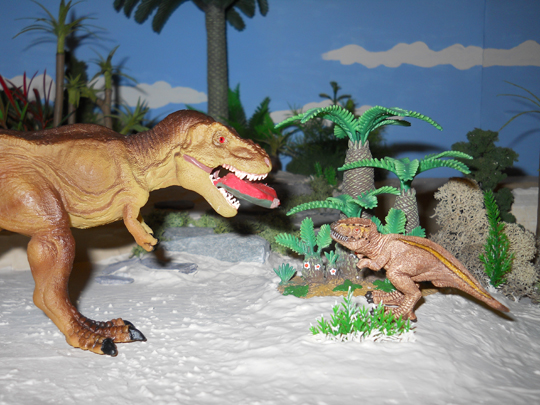
One of the benefits of building such a large diorama is that various mini-scenes can be incorporated into the bigger scenario.  The photograph above shows an adult T. rex feeding a juvenile, one of the Schleich mini dinosaur figures.  In the picture below, an armoured dinosaur Euoplocephalus (from the Battat Terra range of figures) battles a T. rex.

Tyrannosaurus rex Attacks Euoplocephalus

T. rex and Euoplocephalus confrontation.

T. rex confronts Euoplocephalus.

Picture credit: R. Townsend

Detailed Prehistoric Animal Replicas and Models

As the number of detailed prehistoric animal models and replicas have increased, collectors have been keen to find new ways of displaying their collections.  Mr Townsend has constructed a substantial three-metre-long landscape that lends itself to a wide variety of scene building concepts representing different parts of the geological record.

For example, the Late Cretaceous of North America was the inspiration behind these images and horned dinosaurs made up a substantial portion of the megafauna in this part of the world at the end of the Mesozoic.  Robert does not disappoint dinosaur fans as he has included several ceratopsians in his diorama.

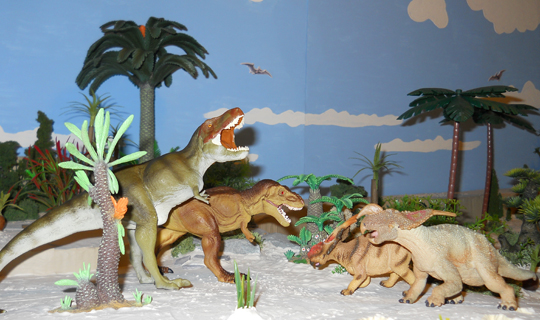
Horned Dinosaurs (Einiosaurus and Achelousaurus) Confront Marauding Tyrannosaurs

A pair of Einiosaurus dinosaurs defend themselves against a couple of T. rex.

Two tyrannosaurs face a pair of horned dinosaurs Einiosaurus.

Picture credit: R. Townsend

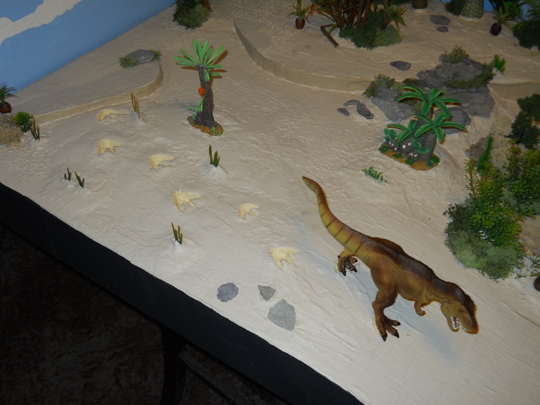
It is the attention to detail that elevates this dinosaur diorama, such as the skilfully painted backdrop complete with pterosaur stickers.  The attention to detail is demonstrated in this aerial shot of the landscape, a tyrannosaur is making its way across the model and its tracks can be clearly made out in the substrate.

For dinosaur models and figures: Prehistoric Animal and Dinosaur Models.

An Aerial Shot of the Dinosaur Diorama Showing a Theropod Trackway

T. rex making tracks.

T. rex footprints in a diorama.

Picture credit: R. Townsend

The image (above) also demonstrates the clever use of other props that add authenticity, such as the strategic placement of boulders and the use of various model plants to help represent the flora of the Mesozoic.

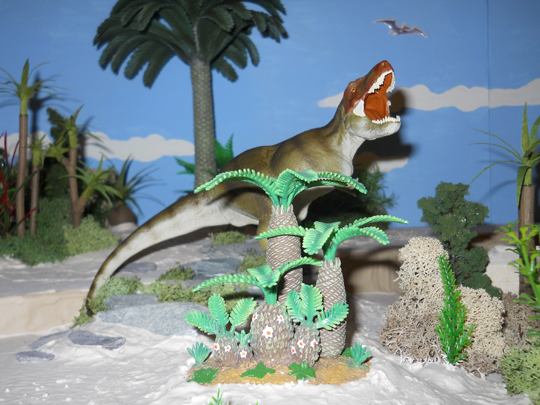
Plant Model Takes Centre Stage

T. rex lurks behind some prehistoric plants.

The Carnegie special edition Tyrannosaurus rex model behind a CollectA Monathesia and Cycad model.

Picture credit: R. Townsend

In this cleverly composed photograph, it is the model of the prehistoric plants that take centre stage (CollectA Monathesia and Cycads), this model is seen in sharp focus, whilst a Tyrannosaurus rex model is in the background, other prehistoric plants frame the photograph and provide perspective.

To view the CollectA Prehistoric Life model range: CollectA Age of Dinosaurs Popular Range.

A spokesperson from Everything Dinosaur commented:

” A large landscape such as this lends itself to all sorts of possibilities when it comes to depicting life in the past.  Much thought and care has gone into its construction and it is always a pleasure to see how Everything Dinosaur’s customers display their purchases.”

Visit the award-winning Everything Dinosaur website: Everything Dinosaur.

24 09, 2017

Everything Dinosaur Websites Upgraded to HTTPS an Important Development

By |2024-05-09T14:36:57+01:00September 24th, 2017|Categories: Adobe CS5, Everything Dinosaur News and Updates, Main Page, Press Releases|0 Comments

Everything Dinosaur Websites – All Upgraded to HTTPS

As part of our on-going commitment to customer service, every one of Everything Dinosaur’s websites have completed the upgrade to HTTPS status.  This acronym stands for “Hyper Text Transfer Protocol Secure”, which means that the data sent between your browser and our website as you read this blog post is encrypted.  By upgrading from HTTP to HTTPS, were helping to protect your data from any third party that might want to have this information.  Although our blog site does not collect personal data, we welcome customer comments and feedback and, as a result, our visitors can be assured that Everything Dinosaur is taking their personal on-line security very seriously.

All Everything Dinosaur’s Websites Have HTTPS Security

Helping to keep visitors safe and secure (HTTPS).

The Everything Dinosaur blog site has HTTPS.  Picture credit: Everything Dinosaur.

Picture credit: Everything Dinosaur

Transport Layer Security Protocols at Everything Dinosaur

Our TLS (Transport Layer Security protocols), are used to encrypt the transmitted information to secure identities and other personal information in cyberspace.   As a general guideline, all websites should have a TLS or, as it is sometimes known, a Secure Sockets Layer (SSL) certificate to ensure data integrity, effective encryption and to support website authentication.  Even though this blog site (our dinosaurs for schools site as well), does not collect financial information or personal data of that nature, with the big search engines placing greater emphasis on security, we thought it would be best to convert all our sites to HTTPS, not just or main website: Everything Dinosaur.

Building Trust Helping to Avoid Nasty Surprises

When someone visits this blog site, our on-line shop, or any other part of our website, such as: Dinosaur Soft Toys they can be assured that they are visiting a secure site.  A spokesperson from Everything Dinosaur commented:

“With the HTTPS configuration users can be assured that the website is secured and they can be confident exploring our huge web log, after all, just like the dinosaurs 66 million years ago, nobody likes nasty surprises!”

Everything Dinosaur’s Secure Websites Helps Avoid Nasty Surprises

A secure website from Everything Dinosaur.

An evolving Everything Dinosaur website. Picture credit: Everything Dinosaur.

Picture credit: Everything Dinosaur

The Benefits of HTTPS on Websites

Having upgraded to HTTPS is not going to protect the planet from extra-terrestrial impacts, however there are a number of benefits such as:

  • Authentication – HTTPS ensures that users communicate with the intended website, it prevents data hijacking and “middle-man” attacks.  When you communicate with us via our websites, be it by leaving comments, placing orders, or by other means, you can be assured that you are communicating with us.
  • Encryption – Safe from unwanted eavesdroppers, when sending data via HTTPS, no-one can “listen in”, data cannot be tracked across multiple pages and information cannot be stolen.
  • Integrity of data – Information cannot be changed, modified or corrupted during the transfer.

Everything Dinosaur’s Commercial Website Upgraded to HTTPS Some Time Ago

HTTPS a secure website.

New security safeguards added to Everything Dinosaur’s website. Picture credit: Everything Dinosaur.

Picture credit: Everything Dinosaur

Search engines in future may notify browsers that they are visiting a site without HTTPS, but you can always check by examining the websites address in the page tool bar.

For dinosaur and prehistoric animal figures: Dinosaur and Prehistoric Animal Models.

23 09, 2017

Crunchy Crustaceans and Rotting Wood on the Menu for Dinosaurs

By |2023-08-15T14:52:56+01:00September 23rd, 2017|Categories: Dinosaur and Prehistoric Animal News Stories, Dinosaur Fans, Main Page|0 Comments

Kaiparowits, Coprolites, Crustaceans and Consumption

This week sees the publication of a new scientific paper that questions the strictly herbivorous diet of ornithischian dinosaurs.  Writing in the journal “Scientific Reports”, the researchers, which include lead author, Associate Professor Karen Chin, (University of Colorado, Boulder), describe the contents of several coprolites (dinosaur dung), from numerous sites in the Upper Cretaceous Kaiparowits Formation.

Kaiparowits, Coprolites, Crustaceans and Consumption

Turns out that some hefty Late Cretaceous herbivores were tucking into a smorgasbord of rotting wood, insects and crustaceans, despite the fact that when these dinosaurs lived, approximately 75 million-years-ago, this part of Laramidia was a botanist’s paradise.

Associate Professor Karen Chin Picking at Some Potential Prehistoric Poo

The quest for dinosaur coprolite

Karen Chin (Department of Geological Sciences and Museum of Natural History, University of Colorado Boulder), searching for coprolite.

Picture credit: University of Colorado, Boulder (Colorado)

Herbivorous Dinosaurs were Not Strictly Herbivores

Direct evidence of the diet of a dinosaur is not usually found, but there is some evidence, plant remains and other matter which is present in the body cavity for example.  Then there is the assessment of tooth wear at the microscopic layer, an analysis such as this when compared to the wear patterns on the teeth of extant animals can prove helpful, but most of our knowledge about dinosaur diet has been inferred from studying their fossilised faeces.

In this new study, the researchers describe the fossilised faecal matter (coprolites) that indicate a recurring consumption of crustaceans and rotting wood.  The scientists conclude that this may have been seasonal behaviour, with female duck-billed dinosaurs seeking out additional calcium and protein to help supplement their diets in preparation for egg laying.  Many species of avian dinosaur (birds), adopt similar feeding strategies today, deliberately selecting food items that contain calcium, copious quantities of which are needed if the female is going to be able to produce healthy, viable eggs.

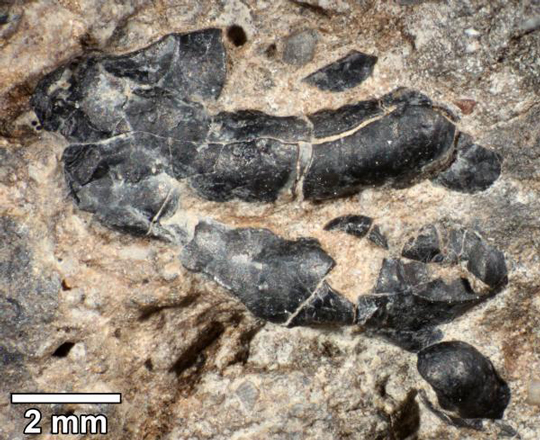
The Remains of the Shell of a Crustacean Found in the Dinosaur Coprolite

The cuticle of a crustacean found in dinosaur dung.

The black objects represent the exoskeleton of a crustacean within the dinosaur coprolite.

Picture credit: University of Colorado, Boulder (Colorado)

A Calcium Taste Receptor

In mammals, the calcium taste receptor gene has recently been discovered, the same gene may exist in other tetrapods – birds for instance.  It is also known that taste buds in different species are sometimes co-opted into undertaking different taste functions, so birds and by implication, their extinct close relatives the Dinosauria, might well have had specific calcium detecting sensors on their tongues or elsewhere in their mouths.

There is still a lot we don’t know about eggs of living dinosaurs, (birds) and we must be careful not to draw too many conclusions from this fossil evidence. However, this paper supports similar research undertaken previously, when the coprolites of ornithischian dinosaurs (seventeen fossilised faeces), were studied from the Two Medicine Formation of the United States.

Which Dinosaur “Dung” It?

The coprolites are similar to those from the Two Medicine Formation, these trace fossils were attributed to the duck-billed dinosaur Maiasaura.  The scientists cannot be certain as to what type of dinosaur produced this Kaiparowits Formation dung, there are a number of potential candidates.  Several bird-hipped dinosaurs are associated with the various bedding planes of the Kaiparowits Formation from which the coprolites were excavated, but which of these produced the dung, which dinosaur “dung” it?

Firstly, the coprolites are large, with some of them having an estimated volume of around ten litres, this rules out a hypsilophodontid, along with the pachycephalosaur known from this formation.  Whichever type of dinosaur produced the dung, it must have possessed multi-toothed dental batteries capable of handling the coarse diet.  This probably rules out a thyreophoran (armoured dinosaur).  That leaves three described genera of ceratopsian – there is a centrosaurine taxa – Nasutoceratops and two representatives of the Chasmosaurinae, namely Kosmoceratops and Utahceratops.  However, although both ceratopsians and duck-billed dinosaurs possessed dental batteries, they chewed food in their mouths in different ways.

Most Likely Hadrosaur Coprolites

The scientists studying these coprolites concluded, that their constituents and their similarity to those fossil faeces ascribed to Maiasaura, suggests in all likelihood, that the coprolites were produced by a type of hadrosaur.  Hadrosaurid bones are the most common body fossil associated with the Kaiparowits Formation and two genera are known, the crested Parasaurolophus (Lambeosaurinae) and the hadrosaurine Gryposaurus.

Gryposaurus – A Likely Candidate for the Coprolites

Gryposaurus scale drawing.

A scale drawing of the duck-billed dinosaur Gryposaurus. Picture credit: Everything Dinosaur.

Picture credit: Everything Dinosaur

For models and replicas of hadrosaurs and other ornithischian dinosaurs: Safari Ltd. Wild Safari Prehistoric World Models.

Rotten Wood and Insects

The scientists propose that duck-billed dinosaurs actively sought out rotting wood and ingested this material.  It would have provided a source of carbon and the fungi helping to break down the cell walls might also have provided additional nutrition.  Copious invertebrates would probably have been eaten too.  Many of these herbivores would have accidentally ingested small animals such as insects as they consumed leaves and other plants, but at least ten of the fifteen coprolites examined from three different stratigraphic layers, contained fragments of crustacean shells.  If these were crabs, the carapace of some of the specimens are several centimetres in diameter.

The researchers suggest that these herbivores would have known what they were eating, these fossils can be interpreted as evidence of plant-eating dinosaurs deliberately eating animals.  It might be reasonable to infer that these coprolites reflect a seasonal shift in the diet of herbivores, that might have related to the breeding cycle.  This interpretation of the fossil evidence provides yet another link between non-avian and avian dinosaurs.

Karen Chin summarised the research findings:

“While it is difficult to prove intent regarding feeding strategies, I suspect these dinosaurs targeted rotting wood because it was a great source of protein in the form of insects, crustaceans and other invertebrates.  If we take into account the size of the crustaceans and that they were probably wriggling when they were scooped up, the dinosaurs would have likely been aware of them and made a choice to ingest them.”

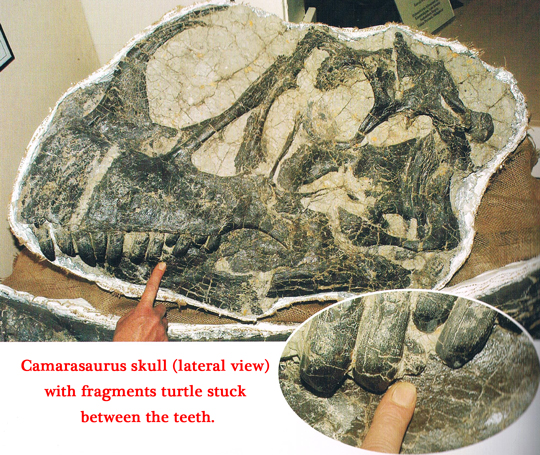
A few years ago, we remember seeing fragments of fossilised turtle, stuck between the teeth of a Camarasaurus.  At the time, we thought that this was as a result of the depositional process.  However, perhaps a pre-gravid Camarasaurus may have picked over the carcass of a turtle in a bid to pick up valuable nutrients.

Bits of Fossil Turtle Found in Between the Teeth of a Camarasaurus

Camarasaurus skull with turtle fossils in the teeth.

Camarasaurus skull with turtle fossil fragments in the teeth.

Picture credit: Peter Larson Black Hills Institute of Geological Research

The scientific paper:  “Consumption of Crustaceans by Megaherbivorous Dinosaurs: Dietary flexibility and Dinosaur Life History Strategies” by Karen Chin, Rodney M. Feldmann & Jessica N. Tashman published in the open access journal “Scientific Reports”.

Visit the Everything Dinosaur website: Everything Dinosaur.
22 09, 2017

Countdown to Exciting TetZooCon 2017

By |2024-05-09T14:37:18+01:00September 22nd, 2017|Categories: Dinosaur and Prehistoric Animal News Stories, Dinosaur Fans, Main Page, Press Releases|0 Comments

TetZooCon 2017 (October 21st, 2017)

The fourth annual Tetrapod zoology conference (TetZooCon), is rapidly approaching and for those of us used to dealing with deep geological time, the 21st October is coming around really fast!  Playing host to this Everything Dinosaur supported event, is The Venue, Malet Street, London and this year’s agenda is jam-packed with great speakers and super presentations.

TetZooCon – 2017

The TetZooCon logo for 2017

The Tetrapod Zoology Conference (October 21st 2017).

Picture credit: Darren Naish/John Conway

A Wide Range of Scientific Topics

The organisers have once again provided a rich, diverse and varied range of topics with some notable book signings and a special palaeoart inspired activity that is being kept rather hush-hush for the moment.  If you have an interest in biology, animal behaviour, evolutionary history, ecology, conservation and all other matters related to tetrapods, this conference is well-worth checking out.  Tickets are £50 per person for the whole day and booking details can be found here: Further Information and Booking Details for TetZooCon 2017.

Renowned palaeoartist, Pterosauria expert and author, Dr Mark Witton will once again be at TetZooCon, attendees will have the opportunity to acquire Dr Witton’s latest book “Recreating an Age of Reptiles”, a publication, Everything Dinosaur was invited to review a few weeks back*.

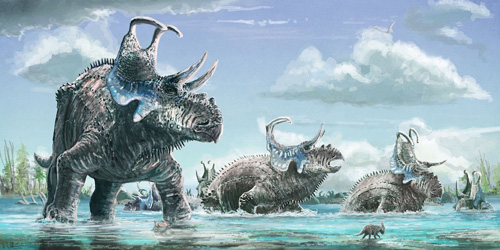
An illustration of a small herd of Machairoceratops dinosaurs by Mark Witton.

An illustration of a small herd of Machairoceratops dinosaurs by Mark Witton.

Picture credit: Mark Witton

A Conference Open to Anyone

The conference is open to anyone, this not a technical event or one that is only for professionals, if you have a fascination for dinosaurs, enjoy reading about the Earth sciences or an interest in fossils, then TetZooCon is ideal for you.  Last year’s event was a sell-out, so a bigger venue “The Venue” has been chosen this year.  If you like palaeoart, enjoy learning about how scientific discoveries are interpreted and illustrated, then get yourself booked!

One of the event organisers, Darren Naish, will brief conference participants on the latest developments in the world of cryptozoology and another highlight will undoubtedly be Beth Windle’s update on Thylacine research.  This is the fourth TetZooCon and it’s going to be bigger and better than ever.

Everything Dinosaur Supports TetZooCon

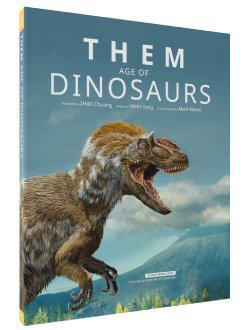
Everything Dinosaur has provided a range of great goodies to help support this annual gathering. These will be available as prizes at the end of conference quiz.  One of the prizes donated is the amazing “Them – Age of Dinosaurs” with stunning illustrations by Zhao Chuang and text by Yang Yang and Mark Norrell.   This hardback book outlines the evolution of life using wonderful artwork and the copy we have donated to TetZooCon is the only one in Europe, as far as we are aware.

The Beautifully Illustrated Book – “Them – Age of Dinosaurs”

"Them - Age of Dinosaurs" book.

“Them – Age of Dinosaurs” by Zhao Chung, Yang Yang and Mark Norrell.

“Them – Age of Dinosaurs”

Combining scientific research with vivid prehistoric animal dioramas, life in the Mesozoic is revealed in all its spectacular, multi-coloured glory.  The illustrations are exquisite and this beautiful book might not be printed anymore, its future publication is in doubt.  Attendees at TetZooCon will have the chance to win this amazing prize, along with PNSO Tyrannosaurs and wonderful Rebor models.

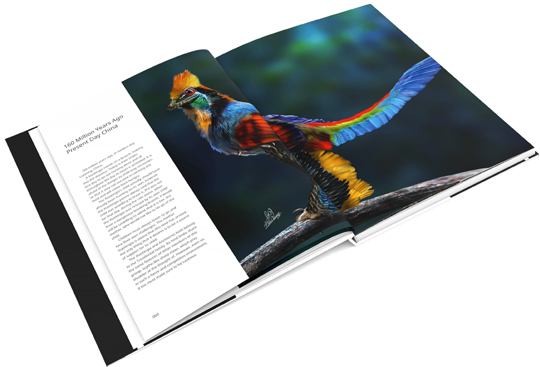
One of the Stunning Illustrations from the Book

Amazing dinosaur illustrations.

Fantastic illustrations.

A spokesperson from Everything Dinosaur commented:

“We are delighted to support TetZooCon, this is a marvellous event for anyone with an interest in cryptozoology, biology, evolution and everything else covered in that well-written blog Tetrapod Zoology.  We congratulate Darren Naish, John Conway and all those involved in helping to bring about this annual event.”

We have been promised some photos of this year’s activities, presentations and attractions and we are looking forward to posting them up onto our various social media platforms.

The link for further information and to book tickets: Ticket Information and Booking Details.

To read Everything Dinosaur’s review of “Recreating an Age of Reptiles”: A Review of “Recreating an Age of Reptiles”.

Visit the Everything Dinosaur website: Everything Dinosaur.
21 09, 2017

Everything Dinosaur Receives a Fantastic 5-stars on Feefo

By |2024-05-09T14:37:52+01:00September 21st, 2017|Categories: General Teaching|Comments Off on Everything Dinosaur Receives a Fantastic 5-stars on Feefo

Feefo Top Rating for Everything Dinosaur

Many teachers and teaching assistants purchase fossils, dinosaurs and other prehistoric animal themed resources to help support their schemes of work.  From the “Jurassic Forest” through to the “Stone Age” Everything Dinosaur stocks a wide range of inexpensive, robust and practical items to help support teaching about science in schools, as well as other topic areas of the national curriculum.  Feefo, the independent supplier of ratings and reviews has recognised the high standards of Everything Dinosaur’s products and customer service by awarding a 5-star rating.

 Feefo Gives Everything Dinosaur a 5-star Rating for its Customer Service

Everything Dinosaur 5-star Feefo rating.

5-star rating for Everything Dinosaur.

Picture credit: Feefo

For educational, dinosaur themed toys and gifts: Prehistoric Animal Themed Toys and Gifts.

Top Marks for Everything Dinosaur

At the start of the teaching year, teachers, teaching assistants and educationalists can be assured that the various prehistoric animal-themed resources that Everything Dinosaur supplies to school are backed by top-notch customer service.  When it comes to meeting the needs of the education market it is top marks for Everything Dinosaur.

Sue Judd, from the Cheshire-based company commented:

“We are very proud of our customer service and we work hard to meet the needs of our extensive customer base.  There are so many pressures on schools these days, at least teachers and school administrators can be assured that they are dealing with a highly respected company.  That’s one less thing to worry about.”

Feefo Rates Everything Dinosaur’s Products and Customer Service

Top marks from Feefo for Everything Dinosaur.

Everything Dinosaur 5-stars on Feefo.

Picture credit: Feefo/Everything Dinosaur

As part of Feefo’s independent company scrutiny, a web profile of Everything Dinosaur has been published.  The reviews on Everything Dinosaur’s customer service and products can be accessed on this site and this permits potential customers the opportunity to read feedback from existing clients and customers.  The independent site can be viewed here: Feefo’s Everything Dinosaur Site.

The Importance of Customer Service

As teaching teams get more freedom to spend budgets to help support learning outcomes, so there is a greater need to act responsibly when it comes to allocating, often limited financial resources.  Raising purchase orders puts the onus on the Year leaders to get the very best support from their suppliers.  With Everything Dinosaur’s 5-star rating for its delivery of school workshops, now being complimented by a 5-star rating for its products and customer service, educationalists can be confident that purchasing from Everything Dinosaur is a sensible choice.

To view the extensive range of dinosaur, prehistoric animal and fossil-themed resources available from Everything Dinosaur: Everything Dinosaur’s Website.

21 09, 2017

JurassicCollectables Reviews the New Papo Cave Bear Model

By |2024-05-09T14:38:15+01:00September 21st, 2017|Categories: Everything Dinosaur Products, Everything Dinosaur videos, Main Page, Photos of Everything Dinosaur Products, Product Reviews|0 Comments

Papo Cave Bear Video Review (JurassicCollectables)

The latest video review from JurassicCollectables has been posted up and it features the wonderful Papo Cave Bear model.  This replica is one of two prehistoric mammals being added to the Papo “Les Dinosaures” model range this year.  The Smilodon replica has been delayed, so for the time being we have this Ursus spelaeus figure to admire.  In this short video review, (it lasts just under three minutes), the narrator takes us on a tour of this beautifully painted Papo model.

The JurassicCollectables Video Review of the New for 2017 Papo Cave Bear Model

Video credit: JurassicCollectables

The Papo Cave Bear Model

It is great to see another prehistoric mammal added to the Papo range, especially after the retirement of the Woolly Rhino figure a couple of years ago and the recent news that the Papo baby Woolly Mammoth is going out of production*.   The JurassicCollectables video displays the quality of the paintwork and attention to detail on this model.  Thanks to “off-colour Alan” and a handy Tyrannosaurus rex, this video provides a good idea of the model’s size and scale.

The Distinct Sloping Forehead of U. spelaeus 

The narrator talks about the distinctive sloping forehead of Ursus spelaeus that helps to distinguish this model from more ubiquitous models of Brown Bears (Ursus arctos).  He also explains about some of the problems that can occur when trying to sculpt realistic looking fur on models of large mammals.

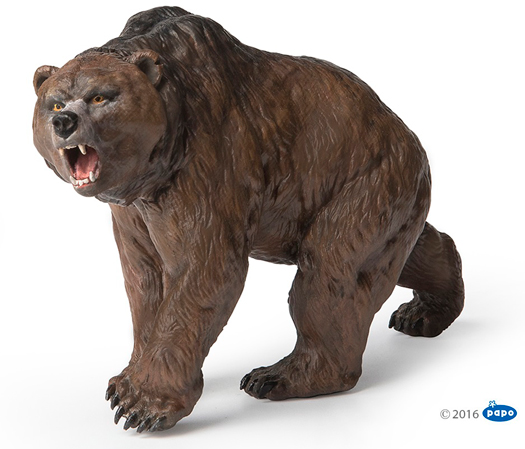
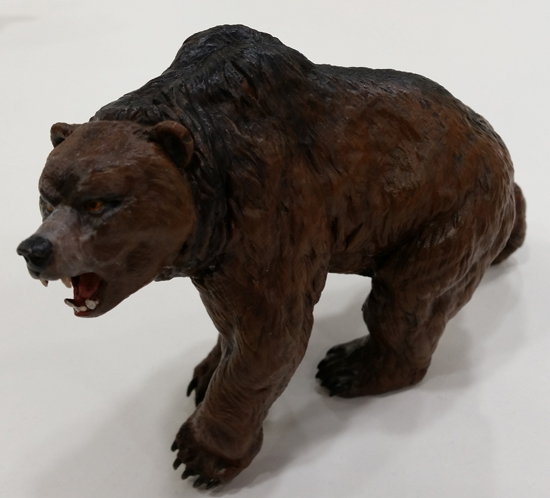
The Papo Cave Bear Figure (New for 2017)

The Papo Cave Bear Model.

A powerful looking Cave Bear model from Papo.

In this excellent video, the narrator comments on the beautifully sculpted feet and paw pads.  The dynamic pose is discussed and the position of the hind legs noted.

The JurassicCollectables YouTube channel has amassed well over 54,000 subscribers and has something like seven hundred dinosaur and prehistoric animal inspired videos.  We think this might be the first video review of a Cave Bear replica undertaken by the team at JurassicCollectables.

Everything Dinosaur recommends prehistoric animal enthusiasts and model fans to visit JurassicCollectables on YouTube and to subscribe: JurassicCollectables on YouTube.

The Powerfully Built Cave Bear

Becoming extinct as recently as 24,000 years ago, the Cave Bear would have been known to the people of the Late Pleistocene.  It was a powerfully built animal, but not the largest bear that ever lived, a common misconception. True, a fully grown, male might have weighed as much as one tonne and when it reared up on its strong hind legs it could have stood more than 3.3 metres high, but the fossil remains of a South American Short-faced Bear (Arctotherium angustidens) indicate that this animal was much larger, weighing around 1.6 tonnes.

Everything Dinosaur Photographed the Papo Cave Bear Last Year

Cave Bear model by Papo.

Papo Cave Bear.  Picture credit: Everything Dinosaur.

Picture credit: Everything Dinosaur

To view the Papo Cave Bear replica and the rest of the excellent Papo “Les Dinosaures” model range: Papo Prehistoric Animal Models.

Our thanks once again to JurassicCollectables for producing such an interesting and informative video.

* Everything Dinosaur has blogged about Papo model retirements.  For an article that reveals which models are being dropped from the Papo range: New Papo for 2018 and Model Retirements.

For further details about prehistoric animal models and figures, visit: Everything Dinosaur.
Go to Top