

Prehistoric whale palaeoart helps scientists communicate remarkable fossil discoveries to the public. By combining scientific evidence with artistic expertise, researchers can reconstruct animals that disappeared millions of years ago. The recent description of the bizarre pygmy sperm whale Scaphokogia huachafo provides an excellent example of how palaeontology and palaeoart work together.
Discovered in the fossil-rich Pisco Formation of southern Peru, this unusual marine mammal lived approximately six to five million years ago, during the Late Miocene. The skull indicates that this ancient cetacean had pronounced asymmetrical forehead structures (spermaceti organ and melon).
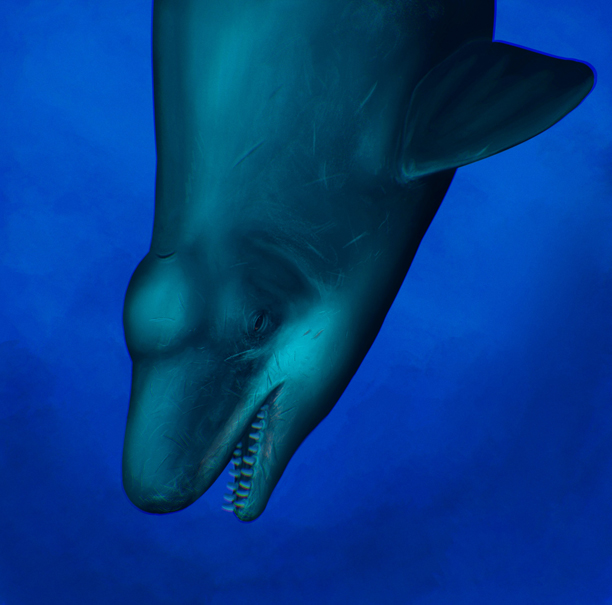
Anatomical portrait of the head of Scaphokogia huachafo by Jaime Bran, emphasizing the pronounced, asymmetrical forehead structures (spermaceti organ and melon) associated with sound generation and directional echolocation during seafloor foraging. Picture credit: Jaime Bran Sarmiento.
Picture credit: Jaime Bran Sarmiento
How Prehistoric Whale Palaeoart Begins with Fossils
Every scientifically informed reconstruction begins with fossil evidence. Palaeontologists examine preserved bones, compare anatomical structures and investigate the evolutionary relationships of extinct animals. The skull of Scaphokogia huachafo is particularly remarkable because of its extreme asymmetry. Its unusual cranial anatomy provides important clues about the evolution of sperm whales and the diversity of these marine mammals during the Miocene.
However, fossil skulls cannot reveal every detail of an animal’s appearance. Palaeoartists must interpret the available evidence, drawing upon their knowledge of anatomy and comparisons with living relatives. For example, scientists can study the soft tissues of modern cetaceans to help inform reconstructions of prehistoric whales. Nevertheless, features such as skin colour and markings often remain speculative.
Studying the Extraordinary Whales of Peru
The international research team describing Scaphokogia huachafo was led by Dr Aldo Benites-Palomino. The fossil-rich sediments of the Pisco Formation have yielded an extraordinary variety of prehistoric marine mammals. These include ancient dolphins, baleen whales and several unusual members of the sperm whale lineage.
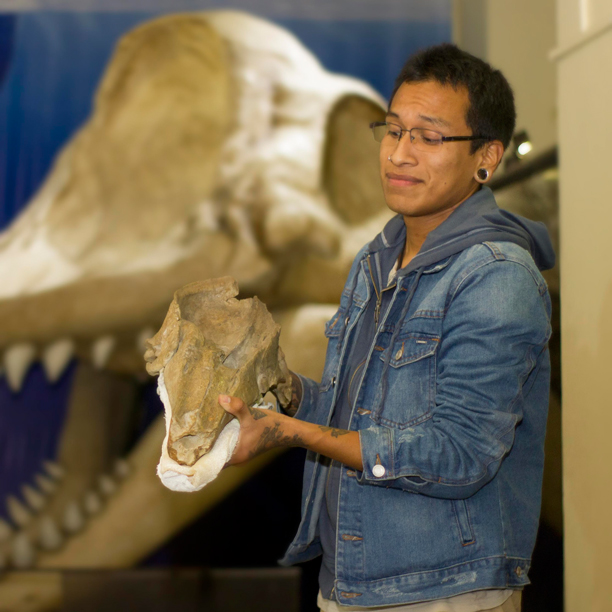
Aldo Benites-Palomino in 2017 at the Museo de Historia Natural UNMSM with the holotype cranium of Scaphokogia totajpe prior to his undergraduate BSc thesis defence, marking the start of a decade-long study resolving the taxonomy and extreme cranial evolution of Peruvian fossil sperm whales. A reconstruction of the giant, predatory whale Livyatan melvillei can be seen in the background. Picture credit: Aldo Benites-Palomino.
Picture credit: Aldo Benites-Palomino
The reconstructed skull of the enormous predatory sperm whale Livyatan melvillei provides a striking contrast to the much smaller Scaphokogia. Both discoveries demonstrate the remarkable evolutionary diversity of prehistoric sperm whales.
Everything Dinosaur stocks the PNSO Livyatan replica. It provides collectors with a three-dimensional interpretation of this formidable prehistoric predator.
To view the range of PNSO models available: Prehistoric Animal Figures from PNSO.
Ironically, both Livyatan as well as Scaphokogia are represented by numerous examples of prehistoric whale palaeoart.
Discovering Fossils in the Peruvian Desert
Before palaeoartists can reconstruct prehistoric animals, field palaeontologists must first locate and document the fossil evidence. The arid landscapes of southern Peru provide exceptional opportunities for fossil exploration. Erosion exposes ancient marine sediments, sometimes revealing bones that have remained buried for millions of years.
In 2022, Dr Benites-Palomino was photographed beside an eroded fossil skull of a Scaphokogia pygmy sperm whale exposed in the badlands near Ocucaje, Ica, Peru.
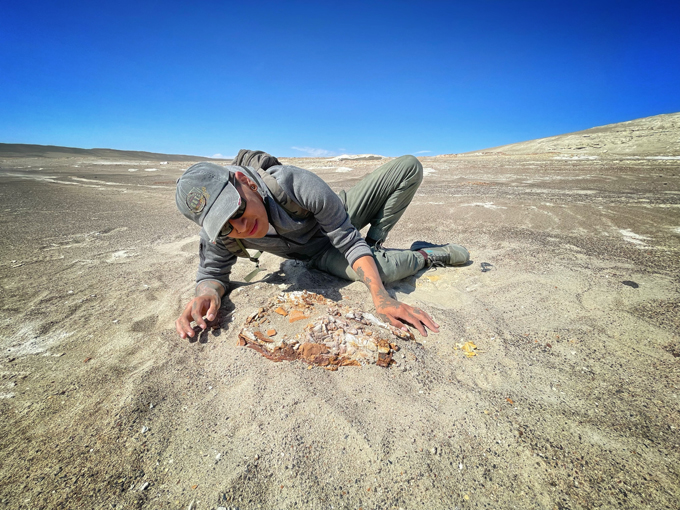
Lead author Dr Aldo Benites-Palomino (Friedrich-Alexander-Universitat Erlangen-Nurnberg) in 2022 in the field next to an eroded fossil skull of a Scaphokogia pygmy sperm whale exposed in the Pisco Formation badlands, Ocucaje, Ica, Peru. Picture credit: Aldo Benites-Palomino.
Picture credit: Aldo Benites-Palomino
Careful fieldwork helps researchers establish the geological context of fossils. This information is essential when determining their age and understanding the environments in which prehistoric animals lived.
Scientific Collaboration Brings Prehistoric Animals to Life
Palaeontological research frequently involves specialists working together across different institutions and countries. For example, co-author Dr Alton Dooley contributed to the research describing Scaphokogia huachafo. Detailed examination of fossil material helps scientists identify anatomical features and compare extinct species with their living relatives.
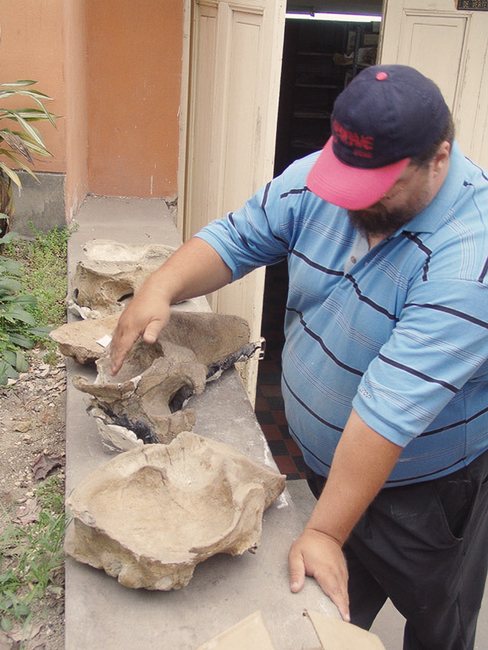
Co-author Dr Alton Dooley (Executive Director, Western Science Center, USA) working on the preparation of the holotype skull of Scaphokogia huachafo at the Museo de Historia Natural in Lima. Dooley and Omura began the initial anatomical examination of the specimen in the early 2000s. Picture credit: Aldo Benites-Palomino.
Picture credit: Aldo Benites-Palomino
Scientific discoveries also inspire palaeoartists to create illustrations and three-dimensional reconstructions that help explain the research to a wider audience. In addition, palaeoartists are often employed to help illustrate scientific papers.
Mike from Everything Dinosaur commented:
“Palaeoart plays an important role in helping people understand prehistoric life. Fossils provide the scientific evidence, but talented artists help us visualise animals that disappeared millions of years ago. When palaeontologists and palaeoartists work together, they can bring remarkable creatures such as Scaphokogia back to life.”
The Importance of Palaeoart in Palaeontology
Prehistoric whale palaeoart helps bridge the gap between scientific research and public understanding. Accurate illustrations and carefully researched models allow people to appreciate the extraordinary diversity of ancient marine life. However, palaeoart is more than simply creating an attractive picture. The most effective reconstructions distinguish between anatomical features supported by fossil evidence and those based on informed scientific interpretation.
The discovery of Scaphokogia huachafo demonstrates how fossil exploration, anatomical research and artistic expertise can combine to reveal a fascinating chapter in the evolutionary history of cetaceans.
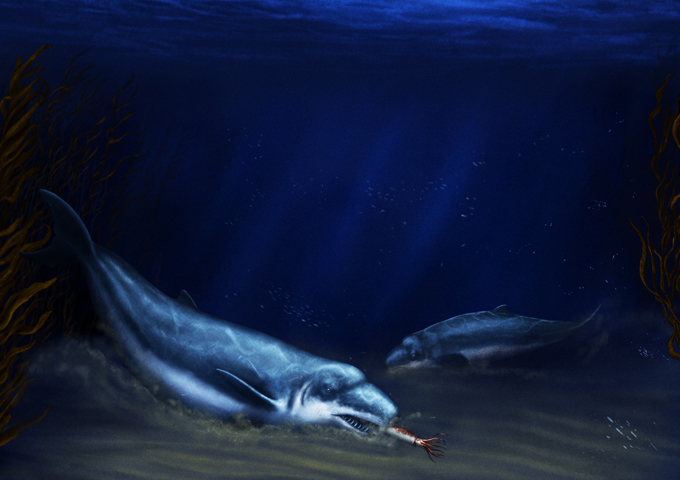
Life reconstruction of the extinct pygmy sperm whale Scaphokogia huachafo. The animal (~2.7 m long) is shown foraging along the muddy seafloor in the Sacaco basin (southern Peru) during the Late Miocene (~6.3 to 5.6 million years ago), in a coastal bay partially blanketed by kelp forests. Dense cranial ballast and a downturned snout allowed it to cruise the bottom and scan the soft substrate for prey using specialised biosonar. Picture credit: Jaime Bran Sarmiento.
Picture credit: Jaime Bran Sarmiento
Readers can learn more about this extraordinary marine mammal in our earlier Everything Dinosaur article describing the discovery of Scaphokogia huachafo: A Bizarre Prehistoric Whale from the Peruvian Desert.
As new fossils are discovered and scientific techniques improve, palaeoartists will continue to refine their interpretations of prehistoric life.
Everything Dinosaur acknowledges the assistance of Dr Aldo Marcelo Benites Palomino and the University of Zurich in the compilation of this article.
The S. huachafo scientific paper: “Extreme cranial asymmetry in extinct benthic feeding sperm whales” by Aldo Benites-Palomino, Marcelo R. Sánchez-Villagra, Florencia Paolucci, Jorge Vélez-Juarbe, Alberto Collareta, Apolline Alfsen, Alton Dooley, Dan Omura, Mario Urbina, Rodolfo Salas-Gismondi and Gabriel Aguirre-Fernández published in Communications Biology.
The multi-award-winning Everything Dinosaur website: Prehistoric Animal Figures.

Leave A Comment