

The remarkable discoveries made by Peruvian palaeontologist Mario Urbina, have helped scientists understand the extraordinary diversity of prehistoric cetaceans. For decades, he has explored fossil-rich sediments in southern Peru, documenting ancient whales and other marine vertebrates. His dedicated fieldwork has contributed significantly to our knowledge of Cenozoic marine ecosystems. Furthermore, he has inspired a new generation of South American palaeontologists.
Mario Urbina is a field palaeontologist and senior researcher associated with the Natural History Museum of the National University of San Marcos in Lima (Peru). His work has helped establish Peru as one of the world’s most important regions for studying the evolution of prehistoric whales.
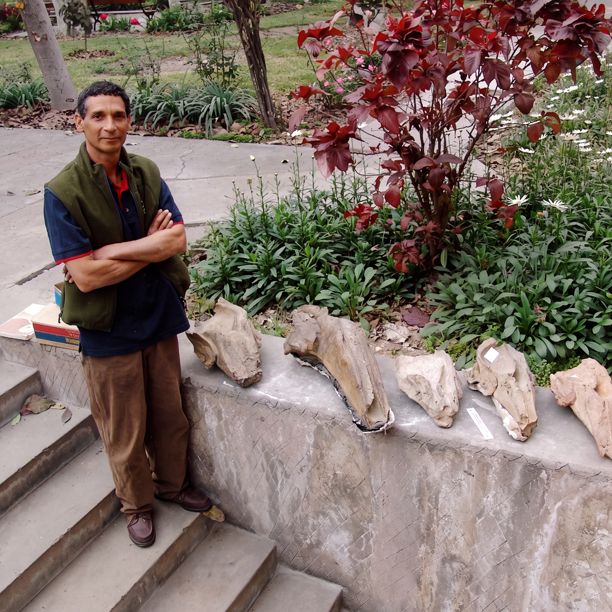
Veteran Peruvian palaeontologist Mario Urbina in 2001 at the Museo de Historia Natural, Universidad Nacional Mayor de San Marcos (UNMSM) in Lima, Peru, alongside several Scaphokogia skulls shortly after mechanical preparation (removal of the rock matrix) and years prior to their formal scientific description. Urbina originally discovered the holotype of S. huachafo during pioneering surveys in Sacaco in the mid-1990s. Picture credit: Aldo Benites-Palomino.
Picture credit: Aldo Benites-Palomino
Exploring the Hugely Significant Pisco Basin
The Pisco Basin of southern Peru preserves an extraordinary record of prehistoric marine life. Its Cenozoic sediments have yielded numerous fossil whales, dolphins, seals, seabirds and other marine animals. According to his ResearchGate biography, Mario Urbina has spent thirty years investigating the geology and palaeontology of these ancient marine deposits.
His fieldwork has led to the discovery of previously unknown species and important new fossil localities. Furthermore, his expertise has supported international research projects investigating the evolution of marine mammals. For example, he was a co-author of the recently published study describing the bizarre, prehistoric pygmy sperm whale Scaphokogia huachafo.
To read an article summarising the scientific paper: A Remarkable Late Miocene Pygmy Sperm Whale.
Mario Urbina and the Discovery of Fearsome Livyatan
One of the most spectacular prehistoric whales discovered in Peru is Livyatan melvillei. Scientists formally described this enormous predatory sperm whale in 2010, with Mario Urbina among the authors of the scientific paper. Unlike living sperm whales (Physeter macrocephalus), Livyatan possessed enormous functional teeth in both its upper and lower jaws. These formidable teeth suggest that this giant predator hunted large marine vertebrates, potentially including other whales.
Everything Dinosaur’s blog post from 2010 announcing the discovery of Livyatan: Fearsome Whale from Prehistory.
The discovery of Livyatan provided compelling evidence of the remarkable diversity of predatory whales that inhabited Miocene seas.

The PNSO Requena the Livyatan prehistoric whale model.
The picture (above) shows the head and jaws of a model of the giant predatory whale Livyatan (L. melvillei). This Livyatan model is part of the range of PNSO prehistoric animal models.
To view this range: PNSO Prehistoric Animal Figures.
The Extraordinary Discovery of Perucetus colossus
Another remarkable fossil discovery associated with Mario Urbina is the enormous prehistoric whale Perucetus colossus. In 2010, whilst exploring ancient marine sediments in southern Peru, Mario discovered unusual fossil bones. These remains belonged to an immense basilosaurid whale that lived approximately 39 million years ago, during the Eocene Epoch.
The fossil bones were exceptionally large and dense. Indeed, some vertebrae weighed more than 100 kilogrammes. An international team of researchers subsequently described Perucetus colossus in the scientific journal Nature in 2023. Once again, Mario Urbina was among the co-authors.
Initial estimates suggested that this prehistoric whale might have rivalled or even exceeded the blue whale in body mass. However, subsequent research has challenged these estimates, and scientists continue to debate just how heavy Perucetus was.
Everything Dinosaur reported on this extraordinary discovery in August 2023.
To read our article: Giant Whale from Peru – Possibly One of the Heaviest Animals Known to Science.
The discovery of Perucetus colossus demonstrates the importance of Mario Urbina’s dedicated fieldwork. His discoveries have helped scientists investigate the evolution of whales over tens of millions of years.
Peruvian Palaeontologist Mario Urbina Encourages the Next Generation of Earth Scientists
Mario Urbina’s contribution to palaeontology extends far beyond his fossil discoveries. Working alongside fellow researcher Rodolfo Salas-Gismondi, he helped establish the Department of Vertebrate Palaeontology at the Natural History Museum in Lima. Furthermore, Mario has expressed his enthusiasm for supporting students and encouraging scientific collaboration between researchers in Peru and other countries.
Such contributions are essential for developing palaeontology. Experienced field researchers help identify promising fossil sites, document important specimens and share their knowledge with future generations.
Celebrating Decades of Remarkable Fossil Discoveries
The recent scientific description of the extraordinary prehistoric pygmy sperm whale Scaphokogia huachafo provides another reminder of the remarkable fossil record preserved in southern Peru. From the enormous predatory sperm whale Livyatan melvillei to the gigantic Eocene whale Perucetus colossus, discoveries associated with Mario Urbina have helped transform our understanding of prehistoric marine mammals.
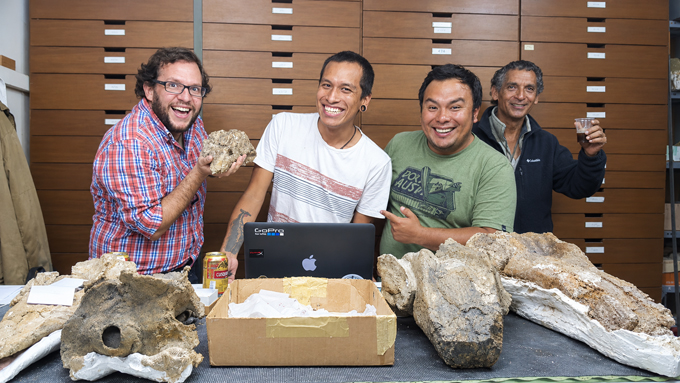
Left to right: Dr. Jorge Velez-Juarbe (Curator of Marine Mammals, Natural History Museum of Los Angeles County), Aldo Benites-Palomino, Rafael Varas-Malca, and celebrated Peruvian palaeontologist Mario Urbina in 2016 in the Department of Vertebrate Paleontology at the Museo de Historia Natural (Lima, Peru) examining fossil marine mammal specimens from the Pisco Formation. Picture credit: Aldo Benites-Palomino / Jorge Velez-Juarbe.
Picture credit: Aldo Benites-Palomino / Jorge Velez-Juarbe
At Everything Dinosaur, we recognise the tremendous contribution made by dedicated field palaeontologists such as Mario Urbina.
His enthusiasm, expertise and commitment to scientific discovery have helped advance Peruvian palaeontology. Furthermore, his willingness to support students and encourage international collaboration will help inspire future generations of scientists.
The extraordinary fossils of the Pisco Basin still have many stories to tell, and researchers such as Mario Urbina have played an essential role in bringing these prehistoric animals to the attention of the world.
Everything Dinosaur acknowledges the assistance of Dr Aldo Marcelo Benites Palomino and the University of Zurich in the compilation of this article.
The scientific paper describing Scaphokogia huachafo: “Extreme cranial asymmetry in extinct benthic feeding sperm whales” by Aldo Benites-Palomino, Marcelo R. Sánchez-Villagra, Florencia Paolucci, Jorge Vélez-Juarbe, Alberto Collareta, Apolline Alfsen, Alton Dooley, Dan Omura, Mario Urbina, Rodolfo Salas-Gismondi and Gabriel Aguirre-Fernández published in Communications Biology.
The award-winning Everything Dinosaur website: Models of Prehistoric Animals.

Leave A Comment