All about dinosaurs, fossils and prehistoric animals by Everything Dinosaur team members.

Everything Dinosaur team members working in schools, helping museums and other educational bodies. Our work with and in schools.

28 09, 2014

Positive Feedback from Foundation Class after Special Dinosaur Workshop

By |2024-05-04T13:59:22+01:00September 28th, 2014|Categories: Educational Activities, Everything Dinosaur News and Updates, Teaching|0 Comments

Five Stars for Everything Dinosaur (sort of)

At Everything Dinosaur we encourage teachers to provide our team members with feedback over our visits to schools to teach about dinosaurs.  We conduct dinosaur and fossil workshops from children within the EYFS (Early Years Foundation Stages) right up to students at Key Stage 4.  We are keen to develop our work in schools and museums and we are very grateful for all the feedback that we receive.  Whilst it would be great if teachers could leave feedback and comments on our dedicated teaching website, we do have a section dedicated to this, we do appreciate that sometimes teaching professionals find themselves so busy that this is not always possible.

Everything Dinosaur

To view Everything Dinosaur’s dedicated prehistoric animal toys and gifts website: Visit Everything Dinosaur.

To help overcome this we always carry feedback forms with us when we visit schools, colleges and other institutions.  Being able to provide instant feedback is a great benefit to the teachers, teaching assistants and learning support team members that we work with.

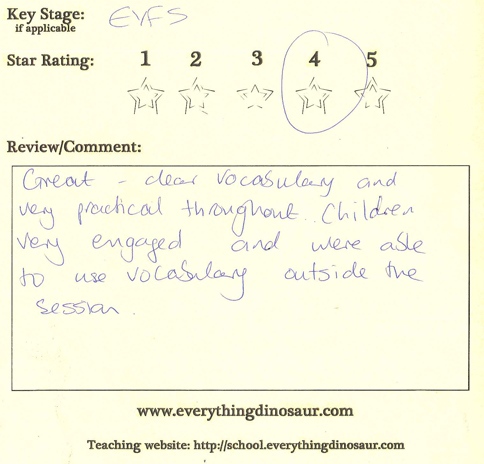
Following our visit to Kensington Primary School to work with Foundation Stage children, we got lots of very positive feedback from the teaching team.  This feedback has already been posted up on our dedicated teaching website, but we thought it would be helpful if we posted up one of the forms from a class teacher here.

Foundation Stage Teacher Praises Everything Dinosaur
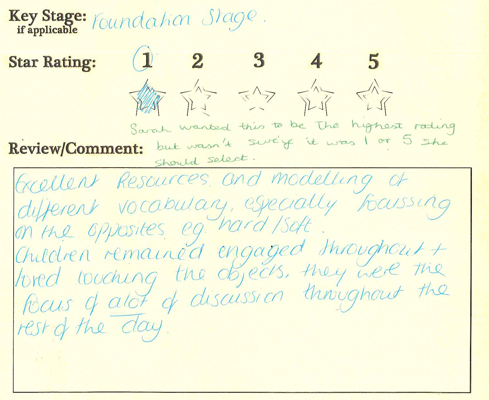
5 Stars for Everything Dinosaur.

5 stars for Everything Dinosaur.

Picture credit: Kensington Primary School

 Feedback

We note that our “star rating” system was perhaps a little confusing but the comments are greatly appreciated.

The Foundation Stage teacher commented:

“Excellent resources and modelling of different vocabulary, especially focusing on opposites eg. hard/soft.  Children remained engaged throughout and loved touching the objects.  They were the focus of a lot of discussion throughout the rest of the day.”

Our dinosaur expert talked through a couple of extension activities with the teaching team and we look forward to hearing how the term topic develops.
27 09, 2014

Evolution and Genetics (KS3 and KS4) – Trilobites Provide a Useful Case Study

By |2024-05-04T14:01:23+01:00September 27th, 2014|Categories: Key Stage 3/4|Comments Off on Evolution and Genetics (KS3 and KS4) – Trilobites Provide a Useful Case Study

A Case Study in Evolution – the Trilobites (Trilobita)

When Key Stage 3 students are being taught about genetics and evolution as part of the national curriculum for schools in England, it is important for teachers to set the work of Darwin, Wallace et al into context.  For example, natural selection within a species relies on variation existing within that species (a form of intra-specific competition).  Natural selection between two different species relies on variation between these species (an illustration of inter-specific competition).  This variation between species and from organisms within a single species means that some members of a particular species or some species as a whole will compete more successfully.

It is this competition that drives natural selection.

Environmental Changes

Changes in the environment may lead to some less well adapted individuals within a species to fail to reach maturity and breed.  Some entire species that are less well adapted to compete and reach maturity when compared to other species will fail to breed.  If they fail to breed, they cannot pass on their inherited characteristics to the next generation.  The inability to compete successfully may lead to population decline and ultimately extinction.

Why Did the Trilobites Become Extinct?

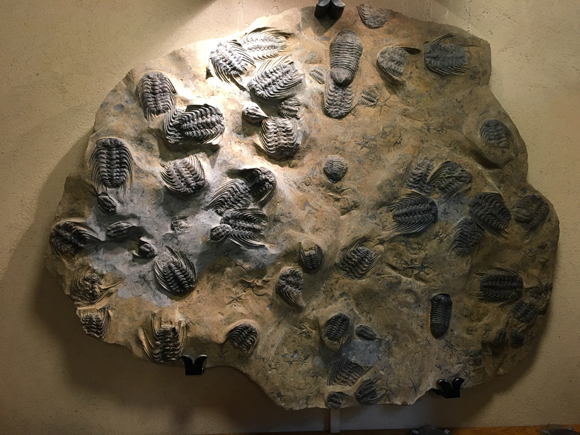
Trilobite fossils - the Selenopeltis slab.

Trilobites galore – the Selenopeltis slab, but why did these arthropods become extinct.

Picture credit: Everything Dinosaur

Extension Activity

Introduce the class to trilobites, collect pictures and images of different types of trilobite fossil and depictions of them as living marine organisms.  Explore their senses (calcite eyes) and adaptations to a marine environment.  Consider the reasons for their success as a group, develop theories on why these once diverse, successful creatures became extinct.  More capable learners might be able to apply extinction theories to climate change issues happening today.

Trilobites

Trilobites were an extremely abundant and speciose group of Palaeozoic arthropods that evolved into a least ten different Orders.  The first trilobites evolved in the Early Cambrian (540 million years ago approximately), the last of the trilobites became extinct at the end of the Permian geological period nearly 300 million years  later.  These sea-living arthropods had a distinct, threefold, longitudinal division of the body and hard, calcified exoskeletons.  To grow, the external exoskeleton had to be moulted.

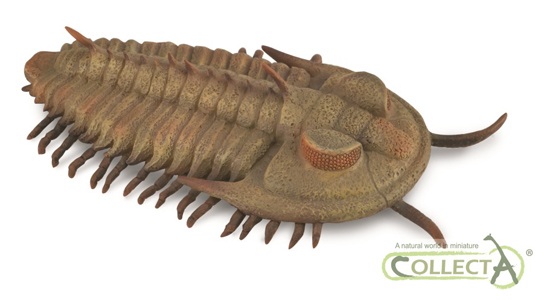
A Model of a Trilobite (Redlichia rex)

CollectA Redlichia rex trilobite.

CollectA Redlichia rex trilobite model.

To view models of iconic prehistoric animals such as trilobites, belmenites, orthroceras and ammonites: Models of Iconic Prehistoric Animals.

The trilobites rapidly diversified and by the Early Ordovician period there were over sixty different families.  This number fell to around forty by the end of the Ordovician and despite spurts of adaptive radiation during the Silurian, Devonian and into the Carboniferous by the end of the Carboniferous period around 299 million years ago there were just four families left.  Two families of Trilobita survived until the late Permian before the Trilobita finally became extinct at the end of the Permian (mass extinction event).

What is the Family Classification?

In Linnaean Classification, there can be one or more closely related species in a genus.  These genera (plural) are then grouped together into closely related Families, then Orders, then Classes, Phyla, Kingdom and Domain.

For the Trilobita (H. spasskyi)

  • Domain = Eukaryotes
  • Kingdom = Animalia
  • Phylum = Arthropoda
  • Class = Trilobita
  • Order = Harpetida
  • Family = Harpetidae
  • Genus = Harpes
  • Species = Harpes spasskyi

Relate the study of trilobites to the importance of maintaining biological diversity and compare and contrast to current extinction issues seen today.

Visit the award-winning website of Everything Dinosaur: Everything Dinosaur.

26 09, 2014

Year 1 Exploring All Things Dinosaur

By |2023-03-16T16:00:14+00:00September 26th, 2014|Categories: Key Stage 1/2|Comments Off on Year 1 Exploring All Things Dinosaur

Year 1 Children at Altrincham Preparatory School Explore Dinosaurs

Children in Year 1 at Altrincham Preparatory School learned all about dinosaurs and fossils yesterday morning when the school was visited by Everything Dinosaur.  The dinosaur expert showed the children all sorts of fossils and helped them conduct some experiments to see how dinosaurs like Diplodocus and Apatosaurus fed.  The children in 1B and 1E had been studying dinosaurs since the beginning of the autumn term and both classrooms had displays of the children’s hand-writing and dinosaur themed artwork on display.

Everything Dinosaur

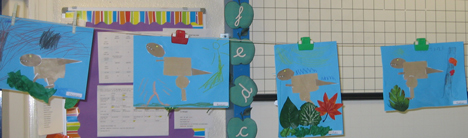
Colourful “Plateosaurs” on Display in 1B

Children make a dinosaur themed display.

Dinosaurs made from plates, a wall display featuring Plateosaurus!

Picture credit: Everything Dinosaur/Altrincham Preparatory School

Everything Dinosaur’s Work in Schools

To read more about the extensive range of prehistoric animal and dinosaur themed gifts available from Everything Dinosaur including replicas of iconic prehistoric animals that make fantastic teaching aids: Dinosaur and Prehistoric Animal Educational Gifts.

Commenting on their work in schools, a spokesperson from Everything Dinosaur stated:

“It was great to see the enthusiastic children and to help them explore dinosaurs and fossils.  The plastic sheet that we brought with us proved invaluable as there were some very hungry Diplodocus dinosaurs in the classroom.”

A Wonderful Day

The teacher of 1E, Mrs Eyley commented that the morning had been wonderful and that they had all benefited from such a hands on, practical experience.  With the help of Mrs Barry (teaching assistant), the children had been learning all about carnivores and herbivores so when the fossil teeth were shown, the class were able to work out which teeth were suitable for feeding on plants and which teeth were those of a meat-eater.

The spokesperson from Everything Dinosaur added:

“When the children go away from this class, they will be able to write about dinosaurs in a more confident manner, using the additional knowledge gained.  Dinosaurs may have lived a long time ago but they still have the ability to inspire and enthuse.”

26 09, 2014

Year 1 Explore Exciting Dinosaurs

By |2024-05-04T13:55:38+01:00September 26th, 2014|Categories: Educational Activities, Everything Dinosaur News and Updates, Teaching|0 Comments

Exploring Dinosaurs and Learning How to Eat Like a Diplodocus

Another busy day yesterday for Everything Dinosaur with a visit to Altrincham Preparatory School to work with Year 1.  The children, under the enthusiastic tutelage of their teachers Mrs Bacon and Mrs Eyley had been studying dinosaurs and fossils and a visit from our dinosaur expert helped to reinforce learning.  One of the pupils in the class heralds from Canada, so it was apt to explore the rib bones of an Edmontosaurus (named after the capital of the Canadian province of Alberta).  One of the children in 1E was born in Argentina, so we promised to send out some information on Argentinosaurus, a huge titanosaur, as part of the extension resources.

Exploring Dinosaurs

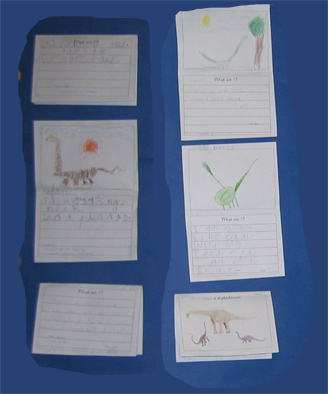
The children had been busy writing about Diplodocus and our expert was able to see some of the excellent examples of hand-writing, vocabulary use and sentence construction that was on display.

Year 1 Pupils Write About Diplodocus

A "What I am" writing exercise with Diplodocus.

A “what I am?” writing exercise with Diplodocus.

Picture credit: Altrincham Preparatory School/Everything Dinosaur

Everything Dinosaur

As part of the experiments we conducted, we showed how sauropod dinosaurs like Diplodocus fed and then we looked at some fossilised plants and compared them to living ferns.

To read more about Everything Dinosaur’s school visit: Children Prepare Questions About Dinosaurs.

There was also some wonderful artwork on display in the classrooms of 1B and 1E, the children were keen to demonstrate their knowledge and one young dinosaur fan even brought in a model of a Baryonyx.

Piecing Together a Carnivorous Dinosaur

Meat-eating dinosaurs inspire artwork.

Meat-eating dinosaurs inspire artwork.

Picture credit: Altrincham Preparatory School/Everything Dinosaur

The children and the teaching team really enjoyed the morning and it was great to see so many dinosaur themed examples of work posted up around the classrooms.  We even met one little boy called Owen, so we sent over some information on the anatomist Sir Richard Owen who was responsible for naming the group of animals we know as the Dinosauria.

To read more about Everything Dinosaur’s huge product range: Visit Everything Dinosaur.

24 09, 2014

Practical Dinosaur Themed Workshop for Reception

By |2023-03-16T15:52:13+00:00September 24th, 2014|Categories: Early Years Foundation Reception|Comments Off on Practical Dinosaur Themed Workshop for Reception

Tactile Fossil and Dinosaur Workshop Extends Vocabulary

Everything Dinosaur staff are busy carrying out lots of dinosaur and fossil themed workshops as the autumn term gets into full swing.  Dinosaurs and exploring fossils makes an excellent autumn topic for reception aged children, as it encourages lots of creative work and it also leads nicely into some of the science themes outlined as key teaching outcomes in Key Stage 1.

Dinosaur and Fossil Workshops

When working with reception aged children, Everything Dinosaur team members try to help the children gain more confidence in speaking.  We endeavour to engage, inform and to help the children learn about materials and the world around them.  All our teaching plans are focused on achieving desired learning outcomes.  Our work with reception classes yesterday demonstrated this approach as we were asked by the teaching team in the short briefing prior to the teaching to help develop the children’s confidence in using adjectives.

To see a blog post that provides feedback on a school visit: Feedback after Everything Dinosaur school visit.

Could the question of the day be answered – were some dinosaurs huge?

English as an Additional Language

The teaching team very often have to help children who do not have English as a first language.  Children at this age soon pick up language skills and our team members do our best to assist.  The feedback received from yesterday’s visit certainly suggests that all our teaching objectives were met.

Typical Feedback from a Teacher (Reception Class)

Feedback after dinosaur workshop.

Genuine feedback from teachers, teaching assistants and members of the senior leadership team.

Everything Dinosaur is grateful for all the feedback we receive.  Such feedback is always treated in the strictest confidence and we encourage teachers and learning support providers to enquire about extension activities as well as providing us with comments, suggestions and feedback.

We look forward to hearing more from the school as the term topic progresses.

To visit Everything Dinosaur’s award-winning website: Everything Dinosaur.

24 09, 2014

Feedback after Working with EYFS (Reception)

By |2023-03-16T15:12:20+00:00September 24th, 2014|Categories: Educational Activities, Teaching|0 Comments

A Tactile Dinosaur Themed Session Helping to Develop Vocabulary

Everything Dinosaur’s team members are busy with the teaching and other outreach commitments as the autumn term progresses.  Yesterday, Everything Dinosaur was working with a primary school in Merseyside, the aim being to help with the term topic (dinosaurs) by providing an interactive and tactile dinosaur and fossil themed workshop.

Dinosaur Workshop

Could we answer the question of the day – Were some dinosaurs huge?

One of the objectives that was set in the short briefing with the teaching team prior to the first session was to focus on helping to develop vocabulary and to give the children the opportunity to develop a wider range of describing words.

Feedback form from Reception Teacher

Feedback from Primary School (EYFS).

Feedback from Primary School (EYFS).  Feedback about Everything Dinosaur.

Picture credit: Everything Dinosaur

Working with children, some of whom do not have English as a first language and who have only just started school, can be quite a challenge.  However, guided by their enthusiastic teachers the children had been undertaking all sorts of exciting exercises and activities to do with dinosaurs and other prehistoric animals.  It seems from the feedback received that Everything Dinosaur had indeed, achieved the learning objectives.

We suggested a couple of extension activities as a follow up to some of the work undertaken in the actual dinosaur themed workshop and we look forward to hearing how the children fared as they explore all things dinosaur!

To learn more about Everything Dinosaur’s dinosaur and prehistoric animal toys and games: Everything Dinosaur’s Toys and Gifts.

20 09, 2014

An Exciting Dinosaur Egg Hunt

By |2024-05-02T10:31:38+01:00September 20th, 2014|Categories: Key Stage 1/2|Comments Off on An Exciting Dinosaur Egg Hunt

Key Stage 1 Learn All About Dinosaurs

Pupils at St. Joseph and St. Bede R. C. Primary were certainly very enthusiastic as they explored dinosaurs and fossils with Everything Dinosaur.  The day was spent working with Key Stage 1 learning about fossils, what they are, how they feel and what they can tell us about animals and plants that lived in the past.  There was certainly a lot to see and do.  Indeed,  there were some amazing questions as well, hopefully we managed to get them all answered.   Mrs Ellison (class teacher), commented that one of children in her class had exclaimed as they returned to the classroom:

“That was awesome!  Everything Dinosaur let me touch and hold real fossils”.

Learn All About Dinosaurs

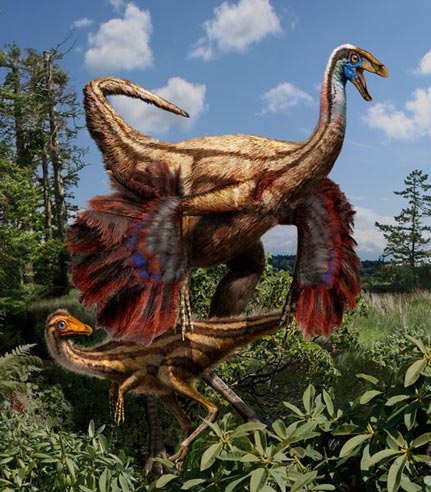
One of the things that we explained to Mrs Myerscough’s class (Year 2), was that dinosaurs hatched from eggs.  There is lots of fossil evidence to suggest that some dinosaurs were actually very caring and dedicated parents.  Dinosaurs made nests and even brooded their eggs to help keep them safe.  Once the babies had hatched, many different types of dinosaurs (even the fat ones Archie), took great care of their offspring, looking after them and bringing food to them whilst they stayed in the nests.  Fossil record evidence suggests that many dinosaurs looked after their offspring just as well as many types of birds do today.

A Feathered Dinosaur Protects One of its Brood

A feathered ornithomimid dinosaur.

Mums and Dads with wings in the Ornithomimidae.

Picture Credit: Julius Csotonyi

We Have Lost Some Eggs

Trouble is, with so many fossils and other things to transport to and from the school, we seem to have lost some dinosaur eggs.  It had been our intention to show the children in Miss Lowe’s class the dinosaur eggs.  We wanted to explain to Mrs Ellison’s pupils what a dinosaur nest might have looked like. We were hoping that the children in Mrs Myerscough’s class would have been able to handle the eggs and compare them to the fossils, but now our eggs seem to have disappeared…

The person in charge of Everything Dinosaur, “Tyrannosaurus Sue” said:

“Oh dear, we are all very worried about our missing eggs, I have asked all the team members in the company to search for them in our warehouse.  I suppose you could say that I have sent them all off on a dinosaur egg hunt.  So far we have not been able to find them, I do hope our dinosaur eggs are going to be OK and that they are being looked after.”

Are the Missing Dinosaur Eggs with our Fossil Dinosaur Eggs?

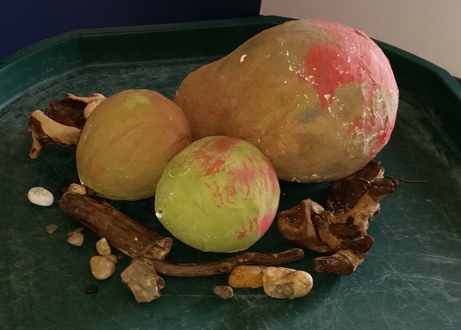
Paper mache dinosaur eggs.

Dinosaur eggs made from a balloon covered in paper mache.

Picture credit: Everything Dinosaur

Hope to Find the Eggs Soon

Hopefully, we will be able to find the dinosaur eggs soon.

To view the extensive range of educational, dinosaur themed items available from Everything Dinosaur: Everything Dinosaur – Dinosaur Toys and Gifts.

19 09, 2014

Key Stage 1 Pupils Learn about Dinosaurs and Fossils

By |2023-03-16T14:53:26+00:00September 19th, 2014|Categories: Educational Activities, Teaching|0 Comments

Primary School Pupils Explore the Dinosauria

Another busy day for Everything Dinosaur team members with a primary school visit.  Children at St. Joseph and St. Bede R. C. Primary had a great time exploring fossils and learning all animals and plants that lived in the past.  As part of our teaching work we looked at the work of a palaeontologist, examined the differences and the similarities between plants today and those preserved as fossils.  The pupils looked at plant-eaters and meat-eaters, well done to Tilly for knowing what a herbivore ate.

Dinosaurs and Fossils

Our team member even met a student called Maia and we explained all about the dinosaur called Maiasaura (Good Mother Lizard).

To read more about the dinosaur called Maiasaura: Maiasaura – Mothers Day and Marsh.

 The Teaching Team Prepared A Slide Show of the Activities

Slideshow credit: St. Joseph and St. Bede Primary School

 We did have some dinosaur eggs, but we are not sure where they have gone.  Could we have left them at the school?

Lots of extension activities have come out of the visit, we look forward to hearing more about how the school children have been learning to work scientifically.

For more information about Everything Dinosaur’s extensive dinosaur and prehistoric animal themed product range: Visit Everything Dinosaur.

17 09, 2014

Congratulations as North West Science Alliance Wins Special Award

By |2024-05-02T10:43:06+01:00September 17th, 2014|Categories: General Teaching|Comments Off on Congratulations as North West Science Alliance Wins Special Award

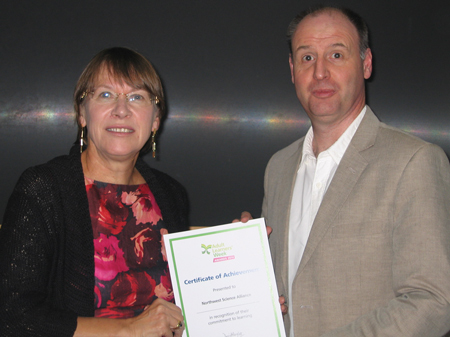
Certificate of Achievement for North West Science Alliance

The efforts of the North West Science Alliance  in helping to advance the general public’s understanding of science was recognised earlier this week with the award of a Certificate of Achievement.  The award given by the National Institute of Adult Continuing Education (NIACE), was presented to Lorelly Wilson, the Chairperson of the Science Alliance.  There are a great many dedicated members of the scientific community who give freely of their time to help educate and inform.  The award was presented by “Dinosaur Mike”, of Everything Dinosaur.

North West Science Alliance

North West Science Alliance Wins Award

North West Science Alliance wins award.

Lorelly Wilson accepts award.

The North-West branch of the British Science Association is involved in many educational projects, including science festivals, workshops, SciBars (a science event held in a pub) and other hands-on, practical activities.

Everything Dinosaur

Mike Walley a team member of Everything Dinosaur, a company which has been involved in a substantial amount of out-reach to help inform the general public about advances in the Earth Sciences presented the award at a special meeting held at the headquarters of BASF.

Commenting on the award, Mike stated:

“It was a great pleasure to present this award to the hard-working members of the North West Science Alliance.  We applaud their work in the community and we look forward to hearing about their plans for 2015 and beyond.”

To visit Everything Dinosaur’s website: Visit Everything Dinosaur’s Website.

10 09, 2014

School Site Updates and Important News for Teachers

By |2024-05-02T10:23:07+01:00September 10th, 2014|Categories: Educational Activities, Press Releases, Teaching|0 Comments

Everything Dinosaur’s School Site Updates

Busy days at Everything Dinosaur, not only are team members starting the first of the autumn term’s teaching assignments this morning, but there are further updates being added to the company’s bespoke teaching website.  Everything Dinosaur provides a lot of educational resources and support to schools, home educators, teaching assistants and museums.  The teaching website was set up so as to provide a dedicated support site about dinosaurs and fossils to assist those involved in education.

Everything Dinosaur

Teaching tips, articles, resources and free downloads.

Teaching tips, articles, resources and free downloads.  Everything Dinosaur supplies lots of dinosaur themed educational resources.

Picture credit: Everything Dinosaur

Helping Teachers

Amongst the free downloads, teaching plans, schemes of work and other resources, Everything Dinosaur team members have been busy writing bespoke articles about how dinosaurs and fossils can help in education on the site’s teaching blog.  Trouble is, we have hundreds of articles and even more ideas for new articles so this task is monumental.  Still we shall persevere and new articles are being posted up all the time.

To visit Everything Dinosaur’s extensive range of dinosaur themed educational resources: Dinosaur Themed Educational Resources.

Go to Top