All about dinosaurs, fossils and prehistoric animals by Everything Dinosaur team members.

Everything Dinosaur team members working in schools, helping museums and other educational bodies. Our work with and in schools.

6 11, 2014

Year 2 Pupils Learn All About Dinosaurs

By |2023-03-17T17:13:16+00:00November 6th, 2014|Categories: Educational Activities, Main Page, Teaching|0 Comments

Dinosaur Workshop at Liverpool Primary School

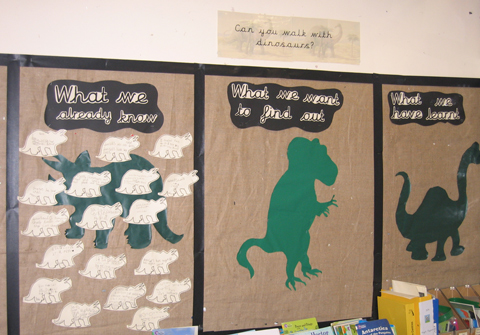
School children at Anfield Infants School enjoyed a visit from Everything Dinosaur this week, as Year two pupils studied dinosaurs and fossils.  The school children had just started their topic and they had lots of amazing questions about prehistoric animals, which we did our best to answer.  The dedicated teaching team had prepared a comprehensive scheme of work and they had posted up a huge K-W-L chart in each of the Year 2 classrooms (high flyers, bright sparks and whizz kids).

Dinosaurs

What fantastic and imaginative names for the classes!

The K-W-L Chart Prepared as Part of the Term Topic

Learning all about dinosaurs and fossils.

Learning all about dinosaurs and fossils. Year 2 pupils learn about dinosaurs.

Picture credit: Everything Dinosaur/Anfield Infants

The K-W-L concept helps teachers to plan a topic and to check learning.  It consists of three areas, firstly, the children brainstorm and say what they think they know about dinosaurs and fossils.  During the brainstorming session, statements might be identified that provide the teacher with information as to what the children would like to find out about prehistoric animals.

The third area highlights what the children have learned at the end of the topic.  This helps reinforce learning and allows the teacher to check understanding.

K-W-L Chart

A different dinosaur denotes each section of the K-W-L chart with the initial brainstorming session indicated by a Triceratops. The second element of the K-W-L chart features a Tyrannosaurus rex, whilst the final section (what the children have learned from the topic), is denoted by a sauropod (long-necked dinosaur).

The Everything Dinosaur team member, as part of the dinosaur workshop, challenged the classes to carry out some extension activities and promised to follow up any questions that the children emailed into the company as part of uniting this topic with their ICT studies.

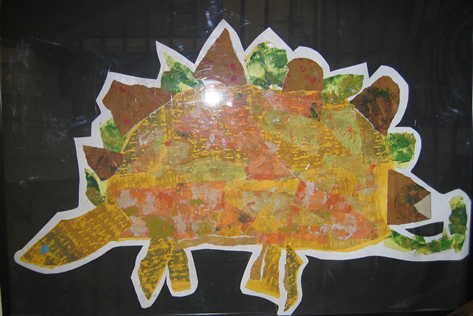
Lots of Prehistoric Animal Inspired Artwork on Display Throughout the School

Stegosaurus inspired artwork.

Stegosaurus inspired artwork.

Picture credit: Everything Dinosaur

To read more about Everything Dinosaur’s huge range of dinosaur toys and gifts: Dinosaur Toys and Gifts.

25 10, 2014

Haverigg Primary School Pupils Study the Stunning Stone Age

By |2024-05-04T18:06:19+01:00October 25th, 2014|Categories: Educational Activities, Teaching|0 Comments

School Pupils Learn All About Mammoths and Woolly Rhinos

Children in Year 3 at Haverigg Primary School were happy to show our dinosaur expert how much they knew about prehistoric animals.  Under the enthusiastic tutelage of the teaching team the children had been studying different parts of human history beginning with the Stone Age.  We were happy to point out how long ago dinosaurs lived before the likes of the Stone Age came along, a simple demonstration using a clapping exercise was a helpful way of illustrating just how deep geological time can be.

With the assistance of some very knowledgeable Year 3 students we explained how fossils form and what types of rock are likely to contain fossils.  In addition, we helped the children gain an appreciation about what fossils can tell us (and perhaps, as importantly), can’t tell us about animals and plants that lived long ago.

Mammoths and Woolly Rhinos

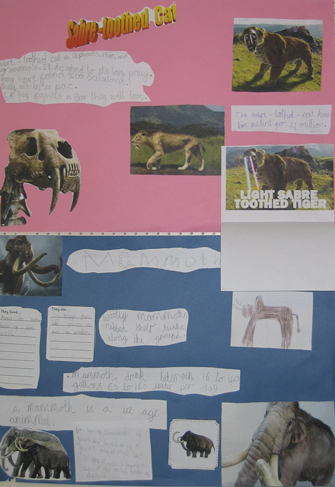
The children had created lots of very well labelled posters.  Each class had been split into teams and given the task of researching and writing about a certain type of prehistoric mammal that might have roamed the land now known as the United Kingdom sometime in the past.

To view the large range of prehistoric mammal models available from Everything Dinosaur: Models of Prehistoric Mammals.

Year 3 Children Research Prehistoric Mammals

All about Ice Age animals.

All about Ice Age animals. Picture credit: Everything Dinosaur.

Picture credit: Everything Dinosaur

Mary Anning

In addition, we discussed the important role of Mary Anning and her contribution to the nascent science of palaeontology.  We set each class a couple of challenges as part of planned extension activities agreed with the teaching team.  The Everything Dinosaur team members are looking forward to seeing the results.

A spokesperson from Everything Dinosaur commented:

“The children loved showing how much they had learned as they studied this topic.  They also enjoyed the fossil workshop immensely and we look forward to hearing how they have progressed with the extension activities we set after teaching about fossils in school.”

23 10, 2014

Deinocheirus – A Very “Peculiar” Dinosaur

By |2023-03-17T11:54:11+00:00October 23rd, 2014|Categories: General Teaching|Comments Off on Deinocheirus – A Very “Peculiar” Dinosaur

Deinocheirus mirificus – Very ” Peculiar Terrible Hand”

Yesterday, a team of international scientists published a scientific paper on the bizarre dinosaur called Deinocheirus.  Everything Dinosaur team members had published data on this prehistoric animal and reported on the research almost a year ago, when it was discussed at the Society of Vertebrate Palaeontology conference.  Anyway, it is important for teachers to note that the science of palaeontology is ever changing.  New fossil discoveries and new techniques used to study previously well-described fossil material are providing lots of new insights into the Dinosauria.

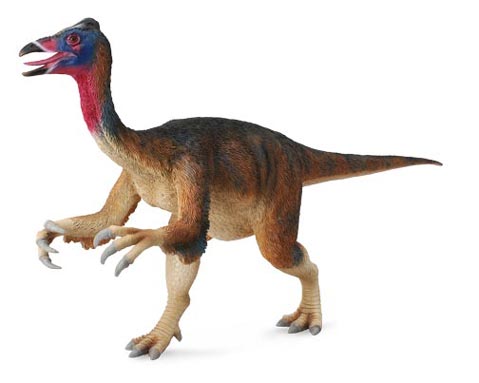
An Illustration of Deinocheirus

Deinocheirus illustrated.

Adding a hump to a dinosaur. An illustration of the CollectA deluxe Deinocheirus dinosaur model.

Picture credit: Everything Dinosaur

Deinocheirus

The first fossils of this dinosaur consisting of a huge pair of arms over 2.4 metres on length were discovered by a joint Mongolia/Polish expedition to the exposed Nemegt Formation in the Gobi Desert.  This expedition was led by a remarkable woman, Professor Zofia Kielan-Jaworowska.  An announcement about the fossil discovery was made a year later and in 1970 a new genus and species of dinosaur was erected based on a study of the fossilised arm bones and a few other fragmentary pieces of bone that had been found at the same location.

This dinosaur was named Deinocheirus mirificus, the name translates from the Greek to mean “peculiar, terrible hand”.  Just how peculiar, scientists have had to wait the best part of fifty years to find out.

To read more about the research about Deinocheirus, believed to be one of the largest omnivores that ever lived: Deinocheirus 2014 Research.

Changing Perceptions

One of the important things to note about Earth sciences such as palaeontology which has connotations in how the theory of evolution is explained and interpreted, is that new fossil finds and discoveries can alter views and perceptions.  For example, the much more complete fossils found of Deinocheirus which helped scientists piece together a much more detailed description of this dinosaur have raised a number of questions about this Late Cretaceous prehistoric animal.

It had a pygostyle (fused tail vertebrae), like a bird.  It is the only dinosaur in the ornithomimid (bird mimic) family that had a pygostyle as far as we know.  Finding this anatomical feature on this huge dinosaur, has led palaeontologists to review other ornithomimid fossils to see if closely related dinosaurs in this family may have possessed fused tail vertebrae.

A Model of Deinocheirus (CollectA Deluxe)

CollectA Deluxe Deinocheirus dinosaur model.

Scientists speculate that Deinocheirus was covered in simple feathers.

To view the CollectA Deluxe Deinocheirus dinosaur model and the rest of the CollectA Deluxe range of prehistoric animal models: CollectA Deluxe Prehistoric Life Figures.

22 10, 2014

Using Walls to Help Demonstrate Rock Types (Some Helpful Advice)

By |2024-05-04T18:07:11+01:00October 22nd, 2014|Categories: Key Stage 1/2|Comments Off on Using Walls to Help Demonstrate Rock Types (Some Helpful Advice)

School Buildings and Yard Inspire Study of Rock Types

With rocks and fossils now part of the Year 3 science curriculum in England, teachers may be thinking of purchasing expensive mineral sets to help demonstrate different rock types.  These of course have their place, but our dinosaur experts suggest that a quick tour of the school should be conducted as you probably have a whole range of different rocks and structures on display and available as examples.  Gravel from a path can help demonstrate how rocks erode and explain the action of water on the polishing of rocks as well as transportation and re-deposition.

Rock Types

In addition, a simple brick wall can be used to demonstrate how sedimentary rocks form layers that build up with the oldest rocks deposited first (not withstanding any geological movements and so forth).

You might be lucky to have fantastic walls such as this one, spotted by one of our teachers whilst delivering a workshop about fossils to a primary school in Cumbria.  An ideal example that can be used when studying rocks and fossils with Year 3.

A Wall Makes A Wonderful Example When Discussing Rocks

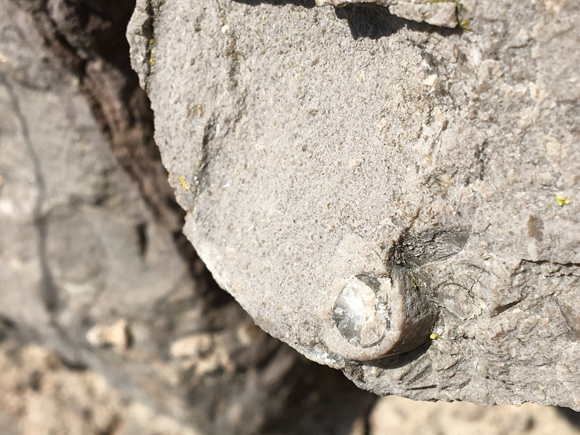
Spotting a piece of a Carboniferous crinoid.

A crinoid stem exposed in a stone wall at Mynydd Marian nature reserve. Walls can help to explain deposition.

Picture credit: Everything Dinosaur

Explaining About Sedimentary Rocks

This stone wall made of slate was just what was needed to help explain how metamorphic rocks can form from sedimentary ones.  Helping Year 3 study fossils and rocks.

To visit Everything Dinosaur’s award-winning website: Visit Everything Dinosaur.

19 10, 2014

Lesson Plan – How Do Fossils Form? Providing Helpful Answers

By |2024-05-04T18:08:09+01:00October 19th, 2014|Categories: Key Stage 1/2|Comments Off on Lesson Plan – How Do Fossils Form? Providing Helpful Answers

Lesson Plan – How Do Fossils Form?

Everything Dinosaur team members have created this simple lesson plan that can be set up as a  class experiment for part of a science week or term topic exploring rocks and fossils.  Using very basic resources, the process of permineralisation can be demonstrated in a classroom, one of the key factors in petrifaction, the process of fossilisation.  Living things have lots of pores and open spaces in them.  Even hard parts of an organism such as wood, teeth and bones are full of holes.  It is these holes that can become filled with minerals that help in the process of turning organic matter into a fossil.

Everything Dinosaur Lesson Plan

There are many different types of fossil, trace fossils, natural casts, internal moulds, external moulds and so forth but how to demonstrate to a class the fossilisation process?

Lesson Plan Experiment – Observable Movement of Coloured Water up a Celery Stalk to Prove that Open Spaces in Living Things Can be Permineralised

Resources

  • Celery stalks (with leaves on if possible)
  • Glass or clear plastic beaker
  • Food colouring (just a few drops – blue or red works best)
  • Magnifying glasses for the children to study the celery stalks closely and to observe the change in colour
  • Simple chopping tool to trim the celery stalks
  • Ruler to measure the length of the stalks used
  • Tap water

Resources for the How Fossils Form Experiment

Experiment to demonstrate how do fossils form.

Experiment to demonstrate how do fossils form?

Picture credit: Everything Dinosaur

Structuring the Lesson

Divide the class into groups and give each group a set of the above resources.  Explain using pictures of fossils (available free of charge from Everything Dinosaur), what fossils are, stress that many fossils are the remains of once living things that have been turned to stone (petrifaction).  The celery’s vascular transport system can be used to demonstrate that living things are not solid objects but have many open spaces and pores in them.

By placing a stalk of celery into coloured water and observing the change in colour, this experiment demonstrates this principle very nicely.  The ruler can be used to measure the length of the stalks, and the magnifying glasses can assist with the children’s observation of the structure of the plant and the movement of the coloured dye via the xylem.

Overnight Dramatic Changes Can Be Seen

Dramatic changes - how do fossils form experiment.

If a camera or Ipad is handy a visual record of the change can be made.

Picture credit: Everything Dinosaur

The children can record what they observe during the course of the day and the experiment can be left overnight or even for longer if required.

For more detailed information about this lesson and for further information about fossil formation: How Do Fossils Form?

A Close up of a Dinosaur Bone Shows the Internal Structure

Dinosaur bone close-up (how do fossils form?)

The internal structure of the dinosaur bone can be seen.

Picture credit: Everything Dinosaur

Extension Ideas

  1. Why was it easier to see the colour change in the leaves and not the stalks?  Hint – links to the functions of different parts of the plant
  2. What happens to the softer parts of animals?  Do they fossilise?
  3. What examples of fossils formed from the soft parts of animals and plants can the students find?  More able pupils can be asked to work out what conditions are needed for soft parts to turn to fossils.
  4. Can the class think up examples of other types of fossil – footprints, fossils of shells, fossilised wood etc?

By keeping a record of this experiment it will work in nicely when it comes to exploring the roles of different parts of the plant.

National Curriculum (England) Coverage

Plants (Years 1, 2 and 3) with links onward to KS3
Living Things and their Habitats (Years 2, 4, 5 and 6)
Rocks and Fossils (Year 3)
Animals including Humans (Years 1-6)
To view the large range of educational items available from Everything Dinosaur: Everything Dinosaur – Learning.
17 10, 2014

School Lesson Plan – How do Fossils Form? (Helpful Questions for Key Stage 1/2)

By |2024-05-04T18:31:43+01:00October 17th, 2014|Categories: Educational Activities, Teaching|0 Comments

Celery Experiment Helping to Demonstrate How Fossils are Formed

With rocks and fossils now part of the National Curriculum for science at Key Stage 2 and with many schools running a term topic focused on dinosaurs as part of their scheme of work with Reception and Year 1, our team members have received lots of requests from teachers to help them explain how fossils are formed.  We do cover this subject area in our dinosaur workshops but here is a simple experiment that the children can conduct that demonstrates an important principle in fossilisation.

How Do Fossils Form?

The vascular system of plants can be used to suggest how open spaces in a living organism can become filled with minerals that crystallise out of water seeping through the sediment that the remains have been covered by.  The filling up of the pores and open spaces is known as permineralisation.  This process helps to explain how some types of fossil can be formed.

By studying the movement of coloured water in a stalk of celery the children can observe how liquid is moved around a plant.  An experiment such as this demonstrates that plants have spaces inside them, which allow permineralisation (and replacement for that matter), it also leads in very nicely to the work in the English national curriculum about the structure of plants.

National Curriculum Links (England)

  1. Plants (Year 1, 2, 3)
  2. Living Things and their Habitats (Year 2, 4, 5, 6)
  3. Rocks (Year 3)
  4. Animals including Humans (Year 1-6)

Preliminary

Ask the class what are fossils?  Explore ideas about how fossils form.  Stress that fossils can be formed over very long periods of time and some fossils are formed when the spaces inside an animal or plant that has died gets filled with minerals and slowly over time the remains of the plant or animal turn to stone (petrification).  It is this process, that explains in part how fossils are made.

This experiment will permit the children to see that living matter has spaces inside, it is these spaces that can be filled with minerals as part of the fossilisation process.

What You Will Need – Teaching Resources

How Fossils Form (Celery Experiment) Resources
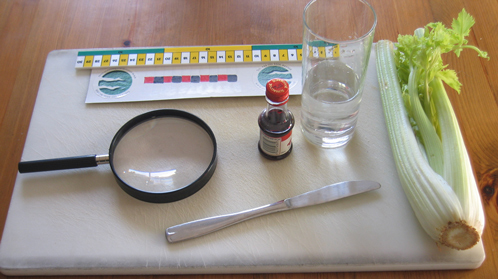
s

Resources = plant material (celery recommended), magnifying glass, water, glass, food colouring, chopping utensil, chopping board or surface and a ruler

Picture credit: Everything Dinosaur

Using Celery to Demonstrate Fossil Formation

Resources = celery stalks, glass or clear plastic beaker, a few drops of food colouring (we found red or blue works best), magnifying glasses, a simple chopping tool, a chopping board, ruler and some tap water.

How Fossils Form – The Experiment (Part 1)

  1. Divide the class up into small groups, provide each group with their own set of resources as outlined above.
  2. Have the children carefully chop the top and bottom of their chosen celery stalk(s), if resources allow have them choose stalks with and without leaves.
  3. Using the magnifying glasses, have each group observe what they can see when they study the stalk ends.  The bottom part of the celery stalk should show very clearly evidence of a vascular system.  Record this information.

Examining and Recording What Can Be Observed
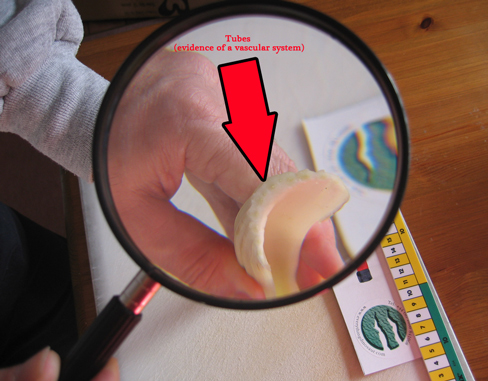
Tubes and other structures can be made out (evidence of a vascular system).

Tubes and other structures can be made out (evidence of a vascular system).

Picture credit: Everything Dinosaur

How Fossils Form – The Experiment (Part 2)

  1. The length of each stalk can be measured (remember to include the length of the leaves on any stalks), these measurements can be recorded.
  2. A quantity of water can then be put into the beaker or glass.  A precise measurement is not needed but it is important to make sure that the bases of all the stalks will be covered.
  3. Carefully, each group puts a couple of drops of the food colouring into the glass or beaker.  Only two to three drops will be needed.  A cap full of food colouring will be sufficient.  The water can be given a quick stir.

Adding the Food Colouring to the Beaker/Glass
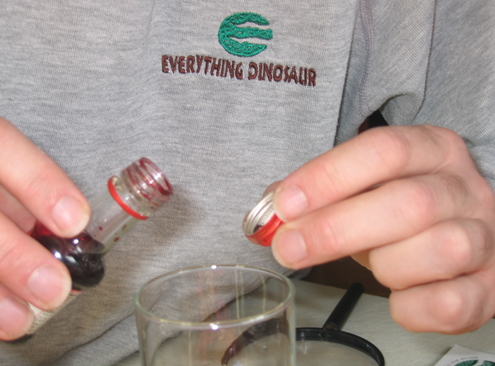
Add a couple of drops of food colouring to each beaker/glass.

Add a couple of drops of food colouring to each beaker/glass.

Picture credit: Everything Dinosaur

Place the celery to be tested in the beaker/glass, record the time when this was done.

Time to Leave Your Fossil Experiment
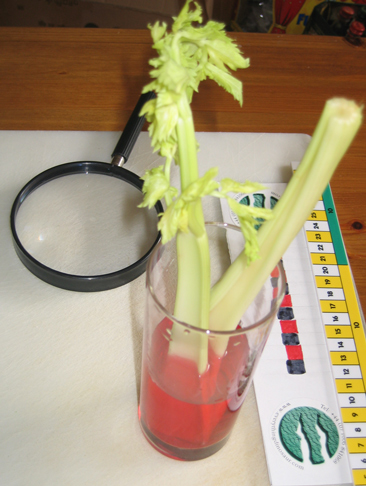
Record the time when the celery was placed in the solution.

Record the time when the celery was placed in the solution.

Picture credit: Everything Dinosaur

It may take several hours, but slowly capillary action will permit the coloured water to move up the plant tissues.  This experiment not only highlights the water transportation system in plants (xylem) but also demonstrates that spaces in living organisms have the potential to be filled by minerals such as calcium carbonate or phosphate that are dissolved in water.   This experiment is demonstrating how living things can become filled with minerals dissolved in water which can lead to petrifaction (means turning to stone), the fossilisation process.

How Fossils Form – The Experiment (Part 3)

  1. Examine the celery leaves and stalks after 4 hours (later on in the school day).  What changes can the children see?   Can they record how far the coloured water has travelled?  What differences can be seen between stalks?

Examine the Celery Stalks after about Four Hours
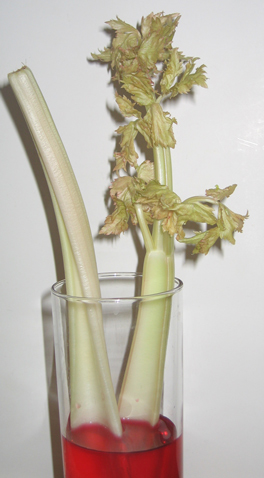
If a camera or Ipad is handy a visual record of the change can be made.

If a camera or Ipad is handy a visual record of the change can be made.

Picture credit: Everything Dinosaur

What differences can the children observe with their fossil formation experiments after a day, two days, a week?  Can the children measure the amount of red colouration they see after each time interval?

After One Day the Fossil Formation Experiment Will Show A Distinctive Colour Change
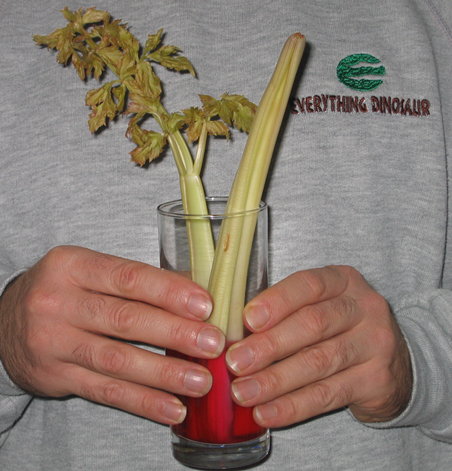
The food colouring in the water will have been transported up the plant.

The food colouring in the water will have been transported up the plant.

Picture credit: Everything Dinosaur

Hard biological materials such as bones, shells and wood contain tiny pores and other spaces (such as the Haversian canals in bones – see close up picture of dinosaur fossil bone provided below).  When buried in sediment, these pores and spaces can be filled up with minerals that crystallise out of the water seeping thorough the layers of sediment.  These extra minerals are permineralising the organism, the start of the process of turning a once living thing into stone has begun.

A Close up View of Fossilised Dinosaur Bone Showing Internal Structure
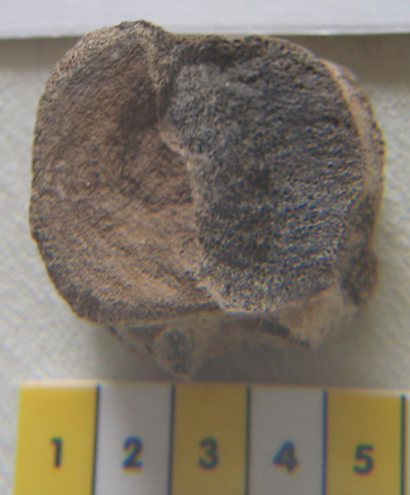
The internal structure of the dinosaur bone can be seen.

The internal structure of the dinosaur bone can be seen.

Picture credit: Everything Dinosaur

The picture above shows the internal structure of a dinosaur tail bone.  Bones just like teeth, shells and even wood contain pores, it is these open spaces that can become permineralised as part of the process of fossilisation.

Extension Ideas

  1. Why was it easier to see the movement of water when the leaves were examined (links to the role of different parts of the plant)?
  2. If the hard parts of organisms like bones and teeth can permineralise and become fossils, what happens to the soft parts such as gums, skin, muscle?
  3. What examples of fossils formed from the soft parts of animals and plants can the children find?  How were these fossils formed?
  4. What other types of fossils can be found?  Think moulds, casts and trace fossils like burrows and footprints.
  5. Record and photograph this experiment and utilise it again when exploring plants, plant transport systems and photosynthesis with older year groups

Extra Notes – Capillary Action

Capillary action, the movement of liquid through tubes takes place because water molecules stay close together (cohesion forces) and because water molecules are attracted to and stick to other substances (adhesion forces).  The adhesion of water to the walls of a narrow vessel such as xylem in a plant stem will cause an upward force on the liquid at the edges where the water and the surface of the tube interact.  This will result in the meniscus turning upward.  Surface tension acts to hold this water at the surface of the tube (the front of the water column) intact.  Capillary action will occur when the adhesion to the walls of the tube is stronger than the cohesive forces between the water molecules.  It is through this capillary action that water is transported around plants.

To view the huge range of educational, prehistoric animal themed items available: Dinosaur Toys, Games and Crafts.

If you need to speed up the experiment, some change in colouration can be seen after two hours or so, especially if a wilted piece of celery with leaves is chosen.

For information on Everything Dinosaur’s fossil and dinosaur themed workshops in schools and other activities: Email EverythingDinosaur.

3 10, 2014

Year 2 Dinosaur Workshop Extension

By |2023-09-03T09:11:04+01:00October 3rd, 2014|Categories: Educational Activities, Everything Dinosaur News and Updates, Teaching|0 Comments

St Joseph and St Bede R.C. Primary make Dinosaur Video

Year 2 under the supervision of their enthusiastic teachers made a comic strip and video presentation after a visit by Everything Dinosaur.  Our team members had conducted a dinosaur workshop with the class back in September and as part of a planned extension activity we had pretended to leave a clutch of dinosaur eggs behind for the schoolchildren to discover and then look after.

Dinosaur Video

The children asked if they could look after the eggs and we agreed.  However, disaster has struck, one of the eggs has hatched and a baby dinosaur has escaped.

St Joseph and St Bede Primary School Children Make a Video

Picture credit: St Joseph and St Bede R.C. Primary School

We think the baby dinosaur is going to be all right.  It was spotted on the school’s CCTV climbing out of a window and heading off out of the school gates to start a “dinosaur adventure”.  We provide lots of extension activities and support to schools when we conduct dinosaur and fossil workshops in schools.

Visit the Everything Dinosaur website: Everything Dinosaur.

Dinosaur Soft Toys

One of the suggestions we have made, is for the dinosaur to be pictured (photoshop comes in very handy), at a number of famous landmarks.  The “Cretaceous critter” can then send the class postcards and emails all about where it has been and what it has done.  The children can plot the dinosaur’s travels on a map (great for helping with geography lessons).  They can also write back to the dinosaur, which in itself is a great lesson plan for a creative writing session.

Where has our Baby Dinosaur Got To?

Dinosaur adventure!
Dinosaur adventure!

Picture credit: Everything Dinosaur

Congratulations to the school children and the teaching team for making such a super video.

Everything Dinosaur team members used a soft toy dinosaur to help develop this lesson plan, to view the range of dinosaur soft toys available at Everything Dinosaur: Dinosaur Soft Toys.

3 10, 2014

Year 2 – Dinosaur Workshop Extension Idea

By |2023-03-16T17:01:07+00:00October 3rd, 2014|Categories: Key Stage 1/2|Comments Off on Year 2 – Dinosaur Workshop Extension Idea

St Joseph and St Bede R. C. Primary Explore Dinosaurs

As a term topic, studying dinosaurs at Key Stage 1 lends itself to all kinds of imaginative and creative learning activities.  The teaching team for Year 2 at St Joseph and St Bede R. C. Primary school have provided an example of this with an extension activity organised in co-operation with Everything Dinosaur team members following our visit to the school.

Dinosaur Workshop

During the dinosaur workshop we explained that as far as we know, all dinosaurs hatched from eggs.  Working in collaboration with the Year 2 teachers, we pretended to have left behind some dinosaur eggs after we had finished packing up our fossils and other equipment.  The  children wrote informing us about the eggs (helpful exercise regarding sentence construction, spelling, format of letter and so forth), we agreed that it would be a good idea if they looked after the eggs for us.

Disaster has struck!  Earlier this week the children discovered that an egg had hatched and that the baby dinosaur had disappeared.  The pupils then created their own comic strips all about their “Dinosaur Disaster”.

Dinosaur Disaster at Primary School

Picture credit: Year 2 St Joseph and St Bede Primary School

This is a great example of an extension activity.  The children are encouraged to investigate, explore ideas and to use different media to tell a story.  We suspect that the school’s baby dinosaur is going to have lots of adventures and thanks to photoshop, it is going to turn up in some amazing parts of the world.  Postcards sent to the school by the dinosaur will then act as a catalyst to introduce other subject areas into the scheme of work.

Visit Everything Dinosaur’s user friendly website: Visit Everything Dinosaur.

2 10, 2014

Evolution of Dinosaur Arms into Bird Wings Mapped in New Study

By |2024-05-04T14:01:59+01:00October 2nd, 2014|Categories: Key Stage 3/4|Comments Off on Evolution of Dinosaur Arms into Bird Wings Mapped in New Study

Scientists Demonstrate how Dinosaur Arms Evolved into the Wings of Birds

A team of researchers based at the University of Chile (Santiago, Chile) have resolved a mystery surrounding one of the anatomical puzzles related to the theory that birds are descended from meat-eating dinosaurs.  Whilst it is now widely accepted that modern birds are descended from a group of dinosaurs called the theropods, the wrist bones of many dinosaurs including members of the Theropoda are very different from the wrist bones of birds.  Many types of early dinosaur had nine wrist bones, birds today, only have four.  Can the theory of evolution explain these changes?

Robust, Strong Immobile Wrists of Dinosaurs Versus the Hyper-flexible Wrist of Aves

The dinosaurs which are most closely related to modern birds walked on their hind feet.  Their forelimbs were not involved in locomotion.  They became adapted for a number of functions, primarily related to food gathering.  Most of the theropod dinosaurs were meat-eaters.  The wrist evolved as a relatively strong and immobile joint to help subdue prey or to assist in attacking other animals.

The wrist joint in birds helps to manage the forces involved in the movements of the wing in flight.  They also permit the wings to be folded back when the bird is not flying, so how the wrist bones of dinosaurs evolved into the specialised and highly modified wrist bones of birds has been the subject of much debate.

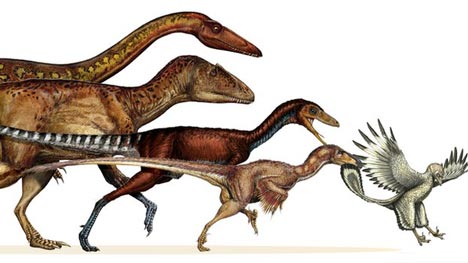
 The Evolution of Dinosaurs to Birds

Evolution of dinosaurs to birds

The evolution of a wrist bone adapted to flight.

Picture credit: Davide Bonnadonna.

Two Distinct Research Techniques

The University of Chile team, published a paper in October 2014, that used two distinct research techniques to help solve the mystery of why dinosaur wrist bones are very different from the wrist bones of birds.

  • Technique 1 – staining proteins in the developing embryos of extant birds and reptiles to see how the wrist bones are formed
  • Technique 2 – studying the fossilised wrist bones from dinosaurs and extinct birds

Mapping Evolutionary Changes

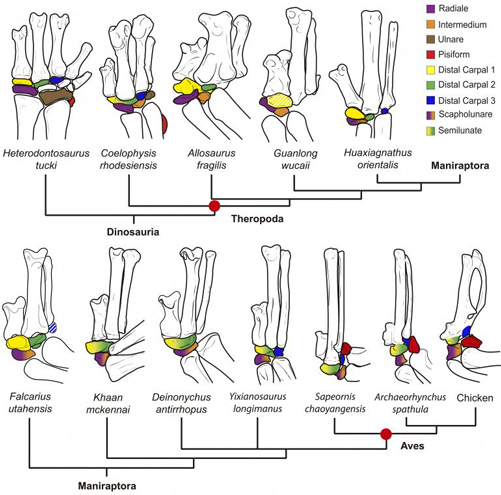
The scientists were able to map evolutionary changes in the Dinosauria and primitive birds that showed how wrist bones evolved over time to resemble those bones found in birds.  The embryo studies, using the newly developed technique of whole-mount immunostaining, showed that one of the wrist bones found in birds, the semilunate had actually formed from two fused dinosaur bones (distal carpal 1 and distal carpal 2).

Mapping the Evolution of Bones in the Wrist (Dinosaurs to Birds)

Evolution of the wrist bones in birds.

From dinosaur wrist bones to the wrist bones of birds.

Picture credit: PLOS Biology

The above chart shows the phylogenetic relationship diagram that helps explain how dinosaur wrist bones evolved eventually into the four, square-shaped bones found in the wrist of a modern bird (chicken).  The coloured bones relate to bones found in modern birds.

Dinosaur Arms

The Early Jurassic dinosaur called Heterodontosaurus, is believed not to be very closely related to modern birds.  Heterodontosaurus was an ornithopod, not a theropod.  It had a total of nine bones in its wrist.

There are some similarities between this dinosaur and the wrists of birds, but Heterodontosaurus may also have used its forelimbs for walking.  Coelophysis from the Triassic was a theropod and therefore more closely related to birds. This dinosaur was very probably entirely bipedal.  Note in the evolutionary diagram above, the presence of a small red bone located close to the ulna arm bone in both Heterodontosaurus and Coelophysis. This is the pisiform bone, a pea-shaped bone found in birds but not in later theropod dinosaurs such as Allosaurus, Guanlong, Deinonychus and Yixianosaurus.

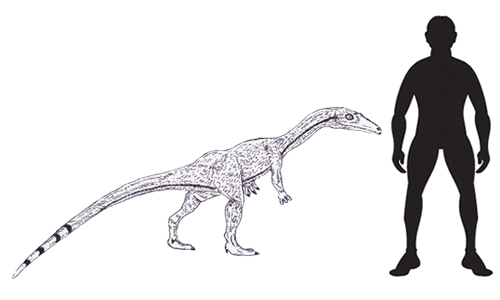
An Illustration of Coelophysis (Scale Drawing)

Coelophysis illustrated.

A scale drawing of the Triassic dinosaur Coelophysis.

Picture credit: Everything Dinosaur

The South American research team discovered that some bones in the wrist of dinosaurs were lost, some fused to form a single bone as seen in birds today and the pisiform, once lost in the Dinosauria, re-evolved as the wrist became adapted to accommodate the forces associated with powered flight.

A New Research Technique

The newly developed technique of whole-mount immunostaining permitted the research team to see how proteins grouped together in embryonic birds to form cartilage that later became bone.  The semilunate bone (yellow and green in the diagram) starts of as two separate areas of cartilage in the embryo which then fuse to form a single bone.  Palaeontologists have long believed that that semilunate bone is a fusing of two wrist bones from the ancestral dinosaurs (distal carpal 1 and distal carpal 2), this new research seems to support this theory.

The study also produced an interesting surprise, when they discovered a wrist bone called the pisiform (in red in the diagram), which was present in the ornithopod Heterodontosaurus and primitive theropods but later disappeared in more advanced theropods from the Jurassic and Cretaceous.

Commenting on this discovery, lead author of the research paper, Dr Alexander Vargas stated:

“We think the pisiform was lost when dinosaurs became bipedal.  Quadrupedal animals used this bone because they walk with their forelimbs, but bipedal dinosaurs no longer walked with their forelimbs and lost the bone. However they regained it when they began using their forelimbs for locomotion in flight.”

Mapping Proteins

New techniques such as the mapping of proteins in embryos using whole-mount immunostaining demonstrates an evolutionary lineage from those theropod dinosaurs most closely related to birds and the four wrist bones found today in modern birds.

Extension Ideas Key Stage 3 Evolution (Birds Evolved from Dinosaurs)

  • Have the class gather together pictures of birds and illustrations of dinosaurs – what anatomical similarities are there – scales on feet, feathers, three-toes, claws etc.
  • Examine pictures of dinosaur  (Theropoda) skeletons and the skeletons of extant Aves – what anatomical similarities can now be seen – wish bones, claws, limb bone assemblage etc.
  • Using information related to the discovery of Archaeopteryx, what does this state about dinosaur/bird evolution?
28 09, 2014

EYFS Teachers Provide Positive Feedback after Special Dinosaur Workshop

By |2024-05-04T14:00:35+01:00September 28th, 2014|Categories: Early Years Foundation Reception|Comments Off on EYFS Teachers Provide Positive Feedback after Special Dinosaur Workshop

Feedback from Reception Class

A topic about dinosaurs and prehistoric animals can be a great way to help children in the autumn term of Reception move from learning through play to a more diverse range of activities aimed at developing learning skills and meeting individual learning needs.  Children in the Reception classes at Kensington Primary School had been learning all about dinosaurs and a visit from one of Everything Dinosaur’s experts to show them fossils proved to be the highlight of their week.

Positive Feedback

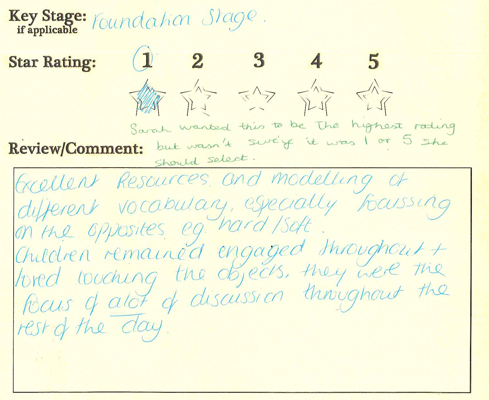
The focus on this very tactile session, was very much on helping to develop vocabulary and confidence in handling unusual objects.  The children were able to make comparisons and use describing words.  There was lots of activities incorporated into the fast paced session and the children (plus the teaching team), really enjoyed helping our dinosaur expert answer the question of the day – “how big were dinosaurs?”

Feedback from the Reception Class Teacher

Feedback from teachers.

Five stars awarded to Everything Dinosaur. Picture credit: Everything Dinosaur.

Picture credit: Everything Dinosaur

Five Stars for Everything Dinosaur

Whilst we appreciate our star rating system might need a little clarification we were happy to help out at the school and our “5 star” rating was greatly appreciated.

To learn more about Everything Dinosaur’s award-winning range of models and figures: Visit Everything Dinosaur.

As part of our support for the school, Everything Dinosaur pretended to have left some dinosaur eggs for the children to discover. Pictures of the eggs along with some describing words were then posted up on the classroom “Wow wall” to help reinforce the learning.

Everything Dinosaur

The dinosaur workshop for the reception class really helped the teaching team animate and bring to life the dinosaur themed term topic.

For models and replicas plus dinosaur toys and games: Dinosaur Toys, Models and Gifts.

Go to Top