All about dinosaurs, fossils and prehistoric animals by Everything Dinosaur team members.

Pictures of fossils, fossil hunting trips, fossil sites and photographs relating to fossil hunting and fossil finds.

12 09, 2021

The Peculiar Pravitoceras an Amazing Ammonite

By |2024-07-02T21:33:13+01:00September 12th, 2021|Categories: Adobe CS5, Dinosaur Fans, Everything Dinosaur News and Updates, Everything Dinosaur Products, Main Page, Photos of Everything Dinosaur Products, Photos/Pictures of Fossils, Press Releases|0 Comments

Ask someone to draw an ammonite and it is very likely that they will sketch a coiled shell. Such fossils are ubiquitous and a mainstay of most people’s fossil collections. However, not all ammonites had a coiled shell, some of the members of the Order Ammonitida (more derived ammonites), especially some families that evolved during the Late Cretaceous, had very bizarre shell shapes, far removed from the tightly coiled planispiral shape that most people associate with these highly successful cephalopods.

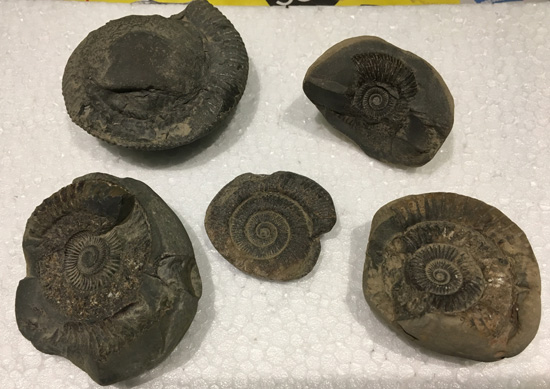
Ammonite fossils (Dactylioceras).
A selection of ammonite fossils to be used in an exercise exploring the role of index fossils with science students. These ammonites (Dactylioceras), possess tightly coiled, planispiral shells. However, not all ammonites had shells like these, some genera evolved bizarre shells and these are referred to as heteromorphic ammonites. Picture credit: Everything Dinosaur.

Picture credit: Everything Dinosaur

Preparing for Pravitoceras

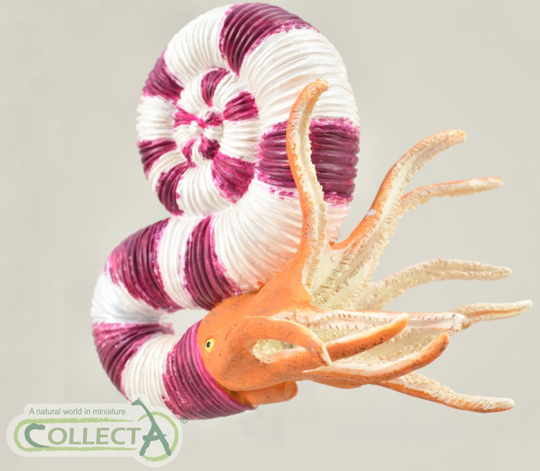
As team members at Everything Dinosaur prepare for the arrival of the last of the new for 2021 CollectA Age of Dinosaur models they have been busy checking over their fact sheet for Pravitoceras. The CollectA Pravitoceras is a replica of one of those ammonite genera with a very peculiar shell.

CollectA Pravitoceras model.
The colourful heteromorph ammonoid model – CollectA Pravitoceras.

Visit the award-winning Everything Dinosaur website: Everything Dinosaur.

Heteromorphic Ammonites

The attractive Pravitoceras model increases the number of invertebrates featured in the CollectA range following the recent introduction (2020) of a horseshoe crab, a trilobite, Orthoceras, a belemnite, the nautilus (N. pompilius) and an ammonite with a regularly coiled shell (homomorph) – Pleuroceras.

Members of the public might be quite familiar with those types of ammonites with tightly coiled shells, as epitomised by the CollectA Pleuroceras (an example of a homomorph shell). In the Late Jurassic a number of new types of marine cephalopod began to appear in the fossil record with different shell morphotypes – the ammonite shell began to diverge from the standard planispiral shape. These ammonites became increasingly abundant and diverse during the Cretaceous and by the Late Cretaceous they were geographically widespread.

The heteromorphic ammonites were so abundant, that just like their coiled relatives, many genera have become important zonal fossils assisting with the relative dating of strata (biostratigraphy).

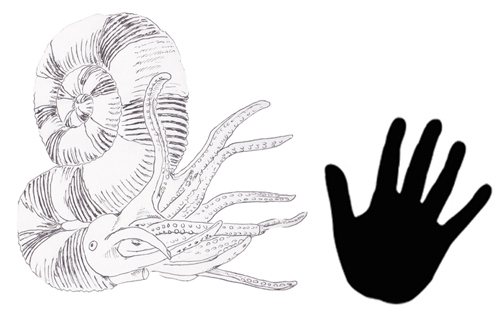
Pravitoceras scale drawing
A scale drawing of the bizarre heteromorphic ammonite from the Late Cretaceous of Japan (Pravitoceras). This scale drawing will be used in the Everything Dinosaur Pravitoceras fact sheet. Picture credit: Everything Dinosaur.

Picture credit: Everything Dinosaur

Pravitoceras – An “S-shaped” Ammonite

The final shell coil of Pravitoceras helps to form a distinctive “S” shape and the body chamber is folded back on itself to form a retroversal hook. Palaeontologists have speculated that these types of ammonites were either entirely epifaunal (dwelling on the sea floor), perhaps scavenging or hunting slow moving animals such as bivalves or snails, or they floated passively in the water column, like many types of extant jellyfish, feeding on zooplankton.

Research using wax replicas and computer models has demonstrated that no matter how complex the shell shape, these creatures would have had no trouble maintaining their buoyancy in the water column. Palaeontologists debate what role in the food web ammonites like Pravitoceras occupied. Many scientists have postulated that Pravitoceras floated passively in the water column feeding on zooplankton.

To view the range of CollectA prehistoric animal models available from Everything Dinosaur: CollectA Prehistoric Life Models.

11 09, 2021

New Carnotaurus Skin Study is Published

By |2024-07-02T21:31:21+01:00September 11th, 2021|Categories: Adobe CS5, Dinosaur and Prehistoric Animal News Stories, Dinosaur Fans, Main Page, Palaeontological articles, Photos/Pictures of Fossils|0 Comments

In 1984, a field team led by the renowned Argentinian palaeontologist José Bonaparte uncovered the fossilised remains of a theropod dinosaur in Chubut Province (Patagonia). The articulated fossil remains included most of the front-portion of the skeleton and although some of the bones had been deformed and distorted due to taphonomic processes, skin impressions of parts of the right side of the animal had been preserved. Skin impressions associated with the head of this dinosaur were also present, but these were not recognised during laboratory preparation and sadly they were lost as the skull fossils were cleaned and prepared.

A year later, Carnotaurus (C. sastrei) was formally named and described. Remarkably, despite the Carnotaurus skin impressions being the most completely preserved of any theropod, no detailed study of the skin had been undertaken.

All that changed this week with the publication of a scientific paper in the journal “Cretaceous Research”.

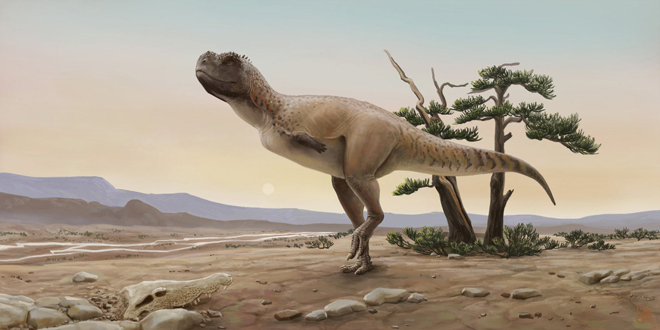
Carnotaurus Life Reconstruction
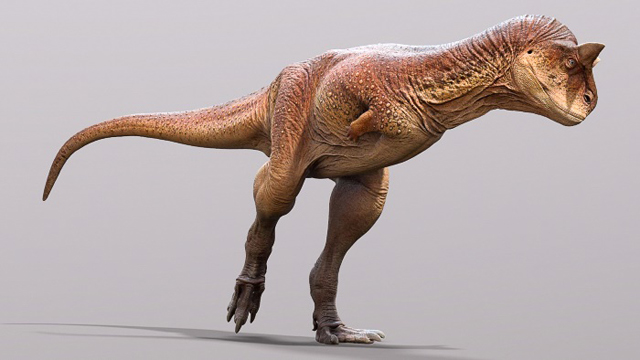
Researchers have described in detail the scaly skin of the abelisaurid Carnotaurus sastrei. The image shows a life reconstruction of Carnotaurus. Picture credit: Jake Baardse.

Not a Feather to be Found

Palaeontologist Dr Christophe Hendrickx from the Unidad Ejecutora Lillo in San Miguel de Tucumán (Argentina), worked with Dr Phil Bell from the University of New England (New South Wales, Australia), an expert in dinosaur integumentary coverings. Whilst the skin impressions only cover part of the body, (the largest skin impression is associated from the base of the tail), the scientists were able to determine that the skin covering consisted of a diverse range of scales and bumps of different shapes and sizes.

No evidence for any bristle-like structures or feathers could be found.

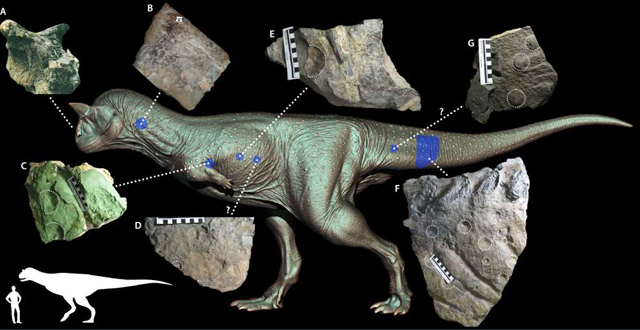
Carnotaurus skin study
The skin is preserved in the shoulder, flank, tail and, possibly, neck regions and consists of medium to large (20–65 mm in diameter) conical feature scales surrounded by a network of low and small (<14 mm) non-imbricating basement scales separated by narrow interstitial tissue. Picture credit: Christophe Hendrickx.

Dr Hendrickx remarked:

“By looking at the skin from the shoulders, belly and tail regions, we discovered that the skin of this dinosaur was more diverse than previously thought, consisting of large and randomly distributed conical studs surrounded by a network of small elongated, diamond-shaped or sub-circular scales.”

Have Carnotaurus Model Makers Got it All Wrong?

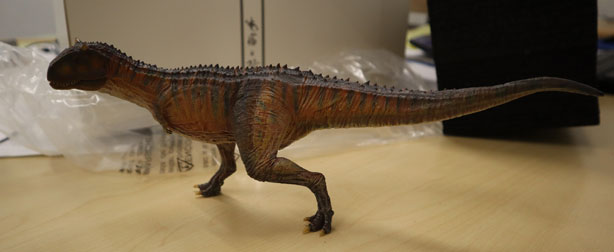
Contrary to previous interpretations and the attempts of model makers to depict Carnotaurus, the feature scales are randomly distributed and neither form discrete rows nor show progressive variations in their size along parts of the body. All those illustrations and replicas of Carnotaurus with a neat row of spines running down its back are not accurate according to the conclusions drawn from this research.

Nanmu Studio Carnotaurus (Ranger) dinosaur model
The Nanmu Studio Carnotaurus (Ranger), the distinct rows of prominent scales may not reflect the actual integument of this abelisaurid, but their random size fits the assessment of the skin composition as proposed by the researchers. Picture credit: Everything Dinosaur

Picture credit: Everything Dinosaur

The picture above shows a Carnotaurus replica in the Nanmu Studio Jurassic Series range.

To view this range: Nanmu Studio Dinosaur Models.

Carnotaurus Skin – Reminiscent of a Thorny Devil

The composition of the skin and the morphology of the scales reminded the researchers of the integument of the Australian lizard the Thorny Devil (Moloch horridus). This small, spiny lizard which is relatively common in the deserts of western and central Australia, uses its spines primarily for defence. It would be difficult for any would-be predator to swallow it. Grooves between the spines allow the lizard to channel water to its mouth, a useful adaptation when living in an environment with infrequent rain.

Detailed view of the skin of Carnotaurus (base of the tail).
A close-up view of the scales from the base of the tail. The variety of bumps and scales are reminiscent of those found in the extant lizard the Thorny Devil (Moloch horridus). It has been suggested that the skin texture of Carnotaurus played a role in thermoregulation. Picture credit: Christophe Hendrickx.

At around 8 metres in length and since Carnotaurus is regarded as the apex predator in its environment, it is unlikely that the lumps and bumps on the skin were primarily for self-defence, but protection from intraspecific combat cannot be ruled out. However, recent studies have shown that Carnotaurus was a strong runner. If this large dinosaur had a very active lifestyle, then helping to regulate body temperature and permit heat-loss would have been very important.

Playing a Role in Thermoregulation

The researchers speculate that the skin may have played a vital role in thermoregulation, a role consistent with integument function in living mammals and reptiles.

Detailed view of the skin of Carnotaurus
No evidence for feathers on the skin of Carnotaurus was found in this study. Scientists conclude that the lumps, bumps and large scales on the skin could have played a role in thermoregulation. Picture credit: Christophe Hendrickx

The scientific paper: “The scaly skin of the abelisaurid Carnotaurus sastrei (Theropoda: Ceratosauria) from the Upper Cretaceous of Patagonia” by Christophe Hendrickx and Phil R. Bell published in Cretaceous Research.

Visit the Everything Dinosaur website: Everything Dinosaur.

10 09, 2021

Ulughbegsaurus – Bossing Tyrannosauroids a New Species of Dinosaur is Described

By |2024-07-02T07:32:06+01:00September 10th, 2021|Categories: Adobe CS5, Dinosaur and Prehistoric Animal News Stories, Dinosaur Fans, Main Page, Palaeontological articles, Photos/Pictures of Fossils|0 Comments

A new species of carcharodontosaurid has been named from a single fragment of upper jawbone found in Uzbekistan. The dinosaur has been named Ulughbegsaurus uzbekistanensis and it was probably the apex predator in the ecosystem suggesting that carcharodontosaurids remained the dominant predators relative to tyrannosauroids, at least in Asia until around 90 million years ago.

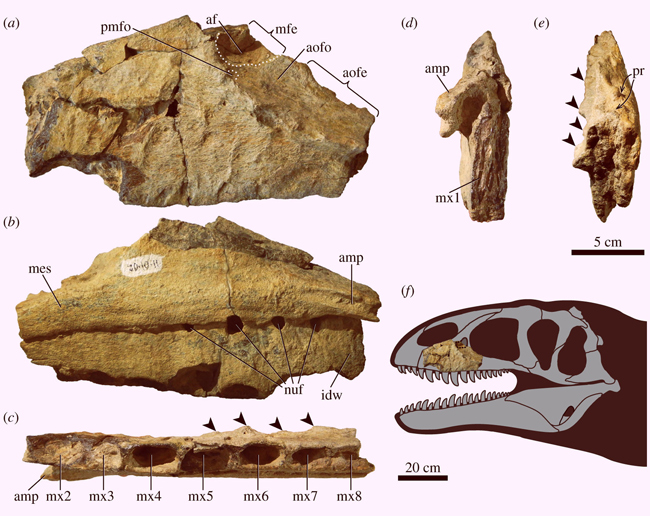
Ulughbegsaurus uzbekistanensis fossil material (various views)
Left maxilla of Ulughbegsaurus (fossil specimen UzSGM 11-01-02) in (a) lateral, (b) medial, (c) ventral, (d) anterior and (e) posterior views. Reconstruction of skull in lateral view (e) – grey missing bones are based on Neovenator, modified from Naish et al. Picture credit: Tanaka et al.

The First Late Cretaceous Carcharodontosaurian from Central Asia

Ulughbegsaurus has been named based on partial maxilla found in strata associated with the Bissekty Formation of the Kyzylkum Desert (Uzbekistan). Several other predatory theropods have been described from fossils found in this formation, but all of them are considerably smaller. The tyrannosauroid Timurlengia euotica was coeval, but much smaller than Ulughbegsaurus providing further support for the idea that carcharodontosaurians were the dominant, apex predators in Laurasia until their extinction some 20 million years prior to the end of the Cretaceous, from which point onwards it was the tyrannosauroids that took over this niche in most Laurasian ecosystems.

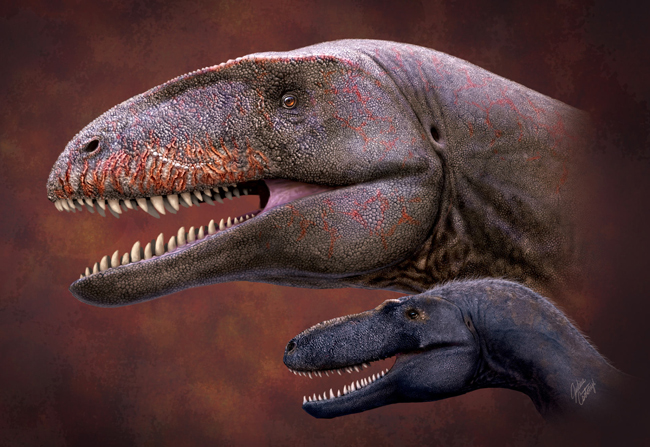
Ulughbegsaurus uzbekistanensis and Timurlengia euotica life reconstruction
A life reconstruction of Ulughbegsaurus uzbekistanensis (top) compared in size with the coeval tyrannosauroid Timurlengia euotica which was named and described in 2016. Picture credit: Julius Csotonyi.

Estimating Size from a Single Fragment of Bone

Palaeontologists can use the size of the tooth row in the maxilla to help them estimate the body size of theropod dinosaurs. Studies of carcharodontosaurids and tyrannosaurids have demonstrated that the length of the tooth row in the maxilla is isometrically correlated with femur length, which is very helpful, as the length of the thigh bone is widely used to help calculate body mass. Based on this data, the authors of this paper, calculate that the Ulughbegsaurus specimen was at least 7 metres long and over a tonne in weight.

The researchers, which included corresponding author Kohei Tanaka (University of Tsukuba, Japan) and Darla Zelenitsky (University of Calgary, Canada), conclude that the individual represented by the single bone was probably 7.5 to 8 metres in length.

Ulughbegsaurus uzbekistanensis was much bigger than any other theropod known from this region. The tyrannosauroid Timurlengia was approximately 3-4 metres long and around 8 times lighter. This suggests that Timurlengia was a secondary predator along with an as yet, unnamed large dromaeosaurid, whilst Ulughbegsaurus occupied the niche of apex predator. The discovery of Ulughbegsaurus records the geologically latest stratigraphic co-occurrence of carcharodontosaurid and tyrannosauroid dinosaurs from Laurasia and evidence indicates carcharodontosaurians remained the dominant predators relative to tyrannosauroids, at least in Asia, as late as the Turonian faunal stage of the Cretaceous.

Tyrannosauroids Kept in Check by Carcharodontosaurians

For much of the Cretaceous allosauroids (part of the Carnosauria clade), including carcharodontosaurians were the largest terrestrial predators on Earth. It was only after their extinction that tyrannosauroids (members of another theropod clade, the Coelurosauria), became much larger and occupied the role of apex predators in most ecosystems across Laurasia.

Evidence of larger tyrannosauroids is not known until the Campanian of North America, some 7 million years after Ulughbegsaurus and Timurlengia lived. Palaeontologists remain uncertain as to the dynamics of apex predator evolution amongst the Theropoda as the fossil record from 90 to 83 million years ago (Coniacian-Santonian) is extremely poor.

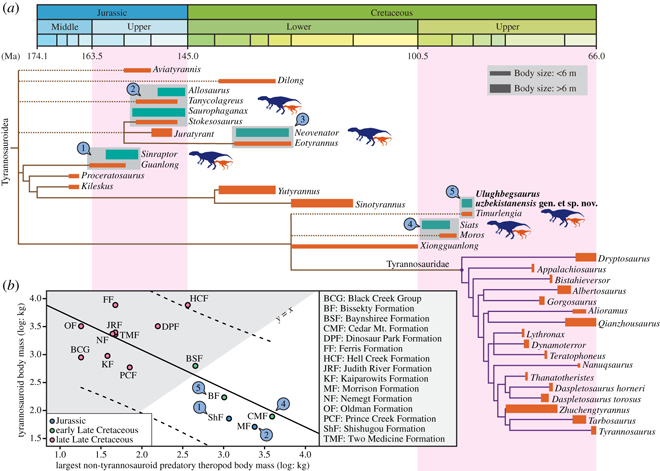
Relationship between coeval small tyrannosauroids and non-tyrannosauroid predatory dinosaurs
Comparisons between small tyrannosauroid and large non-tyrannosauroid predatory theropods. Phylogenetic tree (a) comparing Tyrannosauroidea with sympatric allosauroid taxa. Guanlong with sympatric Sinraptor from the Late Jurassic Shishugou Formation of China (1); Tanycolagreus and Stokesosaurus with sympatric Allosaurus and Saurophaganax from the Late Jurassic Morrison Formation of the United States (2); Eotyrannus and sympatric Neovenator from the Early Cretaceous Wessex Formation of the United Kingdom (3); Moros and sympatric Siats from the early Late Cretaceous Cedar Mountain Formation of the United States (4) and (5) Timurlengia and sympatric Ulughbegsaurus from the Turonian Bissekty Formation of Uzbekistan indicating that sympatric large allosauroid taxa are found at least until the Turonian faunal stage of the Cretaceous. Bivariate plot of body mass between tyrannosauroids and non-tyrannosauroid predatory theropods that stratigraphically co-occur (b). The analysis indicates that tyrannosauroids were small when other large predatory theropods were present. The grey shadow is where tyrannosauroids are larger than non-tyrannosauroid theropods and demonstrates the tyrannosauroid apex predatory dominance during the Late Cretaceous. Picture credit: Tanaka et al.

Honouring a Sultan of the Timurid Empire

Ulughbegsaurus uzbekistanensis (pronounced Ul-lug-bey-sore-us uz-bek-ee-stan-en-sis), was named in honour of Ulugh Beg, a sultan and polymath of the Timurid Empire in the fifteenth-century. The species or trivial name honours the country of Uzbekistan.

A Significant Fossil Discovery

Although Ulughbegsaurus has been described from a single bone, its discovery is very significant. U. uzbekistanensis represents the first definitive fossil evidence of carcharodontosaurians from Central Asia. It fills a geographic gap in the clade between Europe and East Asia and shows that carcharodontosaurians were widespread across Asia.

To read Everything Dinosaur’s 2016 article about the discovery of Timulengia euotica: Fossil Study Shows How Tyrannosaurs Got Big.

To read about the diminutive tyrannosauroid Moros intrepidus that co-existed with the much larger allosauroid Siats meekerorum: Fleet-footed Tyrannosaur Leaps 70 million-year Gap.

The scientific paper: “A new carcharodontosaurian theropod dinosaur occupies apex predator niche in the early Late Cretaceous of Uzbekistan” by Kohei Tanaka, Otabek Ulugbek Ogli Anvarov, Darla K. Zelenitsky, Akhmadjon Shayakubovich Ahmedshaev and Yoshitsugu Kobayashi published in Royal Society Open Science.

The award-winning Everything Dinosaur website: Dinosaur Toys and Models.
9 09, 2021

Titanokorys gainesi – A New, Giant Cambrian Radiodont

By |2024-07-02T07:29:37+01:00September 9th, 2021|Categories: Adobe CS5, Dinosaur and Prehistoric Animal News Stories, Dinosaur Fans, Main Page, Palaeontological articles, Photos/Pictures of Fossils|0 Comments

Researchers from the Royal Ontario Museum (Canada), have announced the discovery of a new species of armoured arthropod from the Burgess Shale of British Columbia. A study looking at 12 fossil specimens collected from Marble Canyon and Tokumm Creek in the Kootenay National Park (British Columbia), has been published this week by Royal Society Open Science. The arthropod has been named Titanokorys gainesi and at around 50 cm in length, it is a giant by Cambrian biota standards.

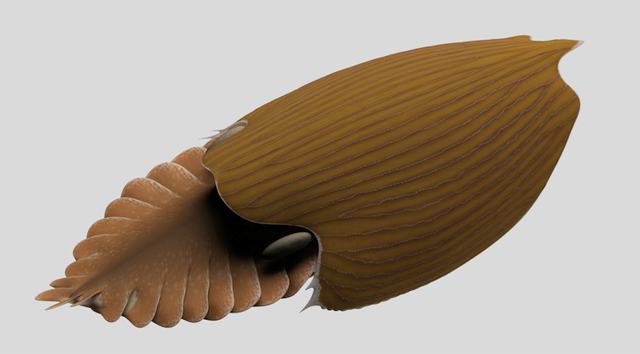
Titanokorys gainesi life reconstruction.
A life reconstruction of Titanokorys gainesi. Picture credit: Royal Ontario Museum.

The authors of the scientific paper, Dr Jean-Barnard Caron of the Royal Ontario Museum, an expert on Burgess Shale fauna and PhD student Joe Moysiuk, classify Titanokorys as a member of the Radiodonta, a stem group of the Arthropoda. Radiodonts were extremely diverse and geographically widespread during the Late Cambrian and many of them were giants when compared to other animals alive during this time in Earth’s history. Perhaps the most famous radiodont is the taxon Anomalocaris, regarded by many palaeontologists as the world’s first super-predator.

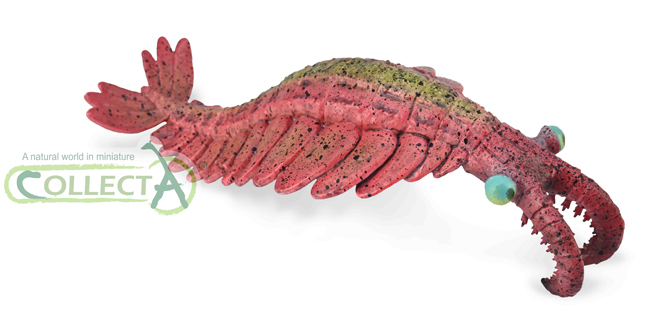
CollectA Anomalocaris

The CollectA Anomalocaris model. A fantastic replica of an early apex predator. The CollectA Anomalocaris (Other Prehistoric Animal Models).

The picture (above) shows a model of an Anomalocaris.  This figure is part of the CollectA Prehistoric Life model range.

To view this range: CollectA Prehistoric Life.

Living on the Seabed – A Benthic Existence

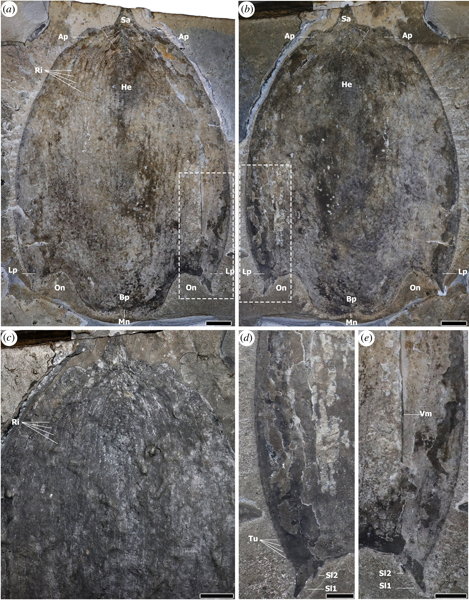
Radiodonts are characterised by their compound eyes, disc-shaped mouthparts and paired frontal appendages, which in the case of Titanokorys consist of comb-like structures which may have been used to sift through mud in search of prey. The broad, flattened carapace of Titanokorys supports the idea that it was benthic – living on the seabed.

Views of the Cambrian radiodont Titanokorys gainesi
Life reconstruction of Titanokorys gainesi (a) dorsal view, (b) ventral view, (c) lateral view and (d) anterior view. Picture credit: Lars Fields/Royal Ontario Museum.

Dr Caron stated:

“The sheer size of this animal is absolutely mind-boggling, this is one of the biggest animals from the Cambrian period ever found.”

Coeval with Cambroraster falcatus

The bedding planes that provided the Titanokorys fossil material have also revealed an abundance of the smaller, but closely related Cambroraster falcatus, which was named and described by Caron and Moysiuk in 2019. Cambroraster was named after the Millennium Falcon from Star Wars franchise, as its carapace resembled the shape of this iconic spaceship. The co-occurrence of these two species on the same bedding planes highlights potential competition for benthic resources and the high diversity of large predators sustained by Cambrian communities.

To read about the discovery of Cambroraster falcatus: Prehistoric Predator with a Mouth Shaped Like a Pineapple Ring.

Why some radiodonts evolved such a bewildering array of head carapace shapes and sizes is still poorly understood and was likely driven by a variety of factors.

Titanokorys gainesi fossil material.
Views of the carapace of Titanokorys gainesi (paratype ROMIP 65168).

Dr Caron added:

“These enigmatic animals certainly had a big impact on Cambrian seafloor ecosystems. Their limbs at the front looked like multiple stacked rakes and would have been very efficient at bringing anything they captured in their tiny spines towards the mouth. The huge dorsal carapace might have functioned like a plough.”

Honouring Professor Robert Gaines

The genus name is derived from the Greek Titans, powerful gods of huge size and from the Greek “Korys” for helmet. The species or trivial name honours Professor Robert Gaines who was instrumental in the co-discovery of the Marble Canyon fossil deposit, where some of the Titanokorys specimens were found.

The scientific paper: “A giant nektobenthic radiodont from the Burgess Shale and the significance of hurdiid carapace diversity” by J.B. Caron and J. Moysiuk published by Royal Society Open Science.

Visit the Everything Dinosaur website: Dinosaur Models and Toys.

7 09, 2021

New Species of Abelisaurid Described

By |2024-07-02T07:17:03+01:00September 7th, 2021|Categories: Dinosaur and Prehistoric Animal News Stories, Dinosaur Fans, Main Page, Palaeontological articles, Photos/Pictures of Fossils|0 Comments

A team of international researchers have identified a new species of Late Cretaceous carnivorous dinosaur from fragmentary fossil bones found in south-eastern Brazil. The dinosaur has been named Kurupi itaata, the strata from which the fossils came were laid down in a very arid environment, as such, Kurupi itaata is the first named tetrapod from the Late Cretaceous Marília Formation (Bauru Group).

Kurupi itaata life reconstruction
A life reconstruction of the newly described Brazilian abelisaurid Kurupi itaata. The semi-arid environment as revealed by the Marília Formation deposits. Picture credit: Júlia d’Oliveira.

To read a recent article about a new abelisaurid from Argentina: A New Abelisaurid from Argentina.

Bones from the Tail and a Partial Pelvic Girdle

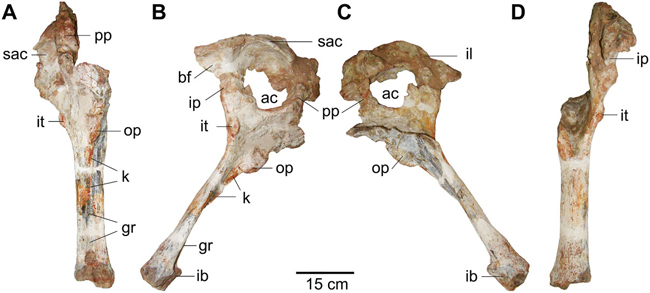
Described from three tail bones (caudal vertebrae) and a partial pelvic girdle, the research team were able to identify anatomical traits that led them to conclude that Kurupi was an abelisaurid. Estimated at around five metres in length, its discovery provides further information on the dinosaurs that inhabited South America around 70 million years ago (Maastrichtian faunal stage of the Late Cretaceous).

Analysis of muscle attachment scars associated with the pelvic girdle and an assessment of the shape of the tail bones indicating a rigid tail suggest that Kurupi was a strong runner. The fossil bones come from the Municipality of Monte Alto in the state of São Paulo.

The dinosaur was named after a monstrous child from the Guarani indigenous culture – Kurupira. A child of evil spirits in local legend Kurupira is the lord of forests and the protector of all the animals that lived in them as well as being a God of fertility and sexual prowess. The species or trivial name “itaata” refers to the extremely hard surrounding rock matrix that proved difficult to remove.

Views of the partial hip bones of Kurupi itaata
Views of the partial hip bones of Kurupi itaata, the partial pelvic girdle and the caudal vertebrae are believed to represent the bones from a single individual animal. Note scale bar equals 15 cm. Picture credit: Iori et al.

Potentially More Dinosaurs?

The presence of a large predator suggests that the fossils of herbivorous dinosaurs might be found in the Marília Formation, although it is not known whether Kurupi was a permanent resident of the arid, Late Cretaceous environment represented by the deposition or whether it was a seasonal visitor.

Described as a mid-sized abelisaurid, its discovery provides further information of the diversity of the Abelisauridae in western Gondwana, although a phylogenetic analysis proved inconclusive and this dinosaur’s taxonomic placement within the Abelisauridae remains uncertain.

The scientific paper: “New theropod dinosaur from the late Cretaceous of Brazil improves abelisaurid diversity” by Fabiano Vidoi Iori, Hermínio Ismael de Araújo-Júnior, Sandra A. Simionato Tavares, Thiago da Silva Marinho, Agustín G. Martinelli published in the Journal of South American Earth Sciences.

Visit the award-winning Everything Dinosaur website: Dinosaur Toys and Models.
31 08, 2021

The Beautiful Red Wharf Bay – Anglesey

By |2024-05-28T15:06:28+01:00August 31st, 2021|Categories: Geology, Main Page, Photos/Pictures of Fossils|0 Comments

The picturesque Red Wharf Bay on the eastern coast of the isle of Anglesey is often visited by geology students. The rocks surrounding the bay provide evidence of changing sea levels from the Carboniferous. Rounded pebbles part of the way up one of the cliffs provide evidence of a much more recent change in sea level. The weather-worn and eroded rocks represent a raised beach, geological proof of sea levels being much higher during interglacial intervals (Pleistocene Epoch).

The views are fairly spectacular too.

Red Wharf Bay - Anglesey
Red Wharf Bay on the east coast of Anglesey is a popular location for geology students, it has stunning views too.  Picture credit: Everything Dinosaur.

Picture credit: Everything Dinosaur

Carboniferous Limestones

The limestones that make up the cliffs were deposited around 330 million years ago during the Serpukhovian stage (the youngest stage of the Mississippian, the lower subsystem of the Carboniferous). The area is dominated by the huge Castell Mawr (Castle Rock), the limestone was quarried for many years, but all quarrying has been abandoned and the area is now a haven for nesting seabirds.

The bay attracts a variety of birds, as well as the ubiquitous gulls, many different types of wading bird can be found in this area including oystercatchers, sandpipers and curlews. Occasionally, visitors to this part of Anglesey can be treated to a view of a Little Egret (Egretta garzetta) hunting for fish as the tide comes in.

This area of outstanding natural beauty is famous for its geology, the limestone was formed in a shallow, tropical sea, but the presence of sandstone indicates that the sea retreated and the sandstones represent estuarine and river channels that criss-crossed the area, with the sand infilling the limestone as it was partially dissolved away.

Fossils can be found, but they are relatively rare. Brachiopod traces can be seen in the limestone rocks that litter the beach, a testament to the rich marine life that thrived in this area during the Carboniferous.

Carboniferous brachiopods.
Brachiopod fossils can be seen in the limestone rocks as you walk along the coast from Red Wharf Bay to the village of Benllech.  Picture credit: Everything Dinosaur.

Picture credit: Everything Dinosaur

Occasional Corals Found in Pebbles

Walkers, if they descend onto the beaches from the Welsh Coastal Path can find the occasional fossil of colonial corals in pebbles scattered along the beach. They are rare and difficult to differentiate from the limestones and other material on dry, sunny days, but with patience the fossil collector can be rewarded with some finds, albeit highly eroded specimens.

Pebble containing coral fossils.
Occasionally weathered pebbles containing colonial coral remains can be found.  Picture credit: Everything Dinosaur.

Picture credit: Everything Dinosaur

Whilst sunny weather can never be guaranteed in North Wales, Red Wharf Bay is a family friendly beach close to beautiful countryside with stunning views which even on Bank Holidays is never overcrowded. It also provides the opportunity to spot a fossil or two.

Carboniferous fossil Red Wharf Bay
The fossilised remains of a Carboniferous brachiopod from Red Wharf Bay.  Picture credit: Everything Dinosaur.

Picture credit: Everything Dinosaur

Visit the award-winning Everything Dinosaur website: Prehistoric Animal and Dinosaur Models.
27 08, 2021

Tupandactylus Gets a Body Thanks to New Research

By |2024-05-28T14:41:49+01:00August 27th, 2021|Categories: Adobe CS5, Dinosaur and Prehistoric Animal News Stories, Dinosaur Fans, Main Page, Palaeontological articles, Photos/Pictures of Fossils|0 Comments

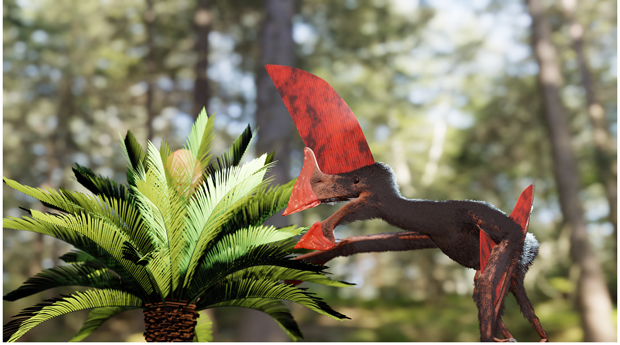
A superbly preserved and almost complete specimen of the pterosaur Tupandactylus navigans has enabled researchers to get a better understanding of the body of this Brazilian flying reptile. The skull too, with its exquisite preservation has provided new data on the amazing super-sized sagittal crest associated with this genus.

Tupandactylus navigans life reconstruction
Tupandactylus navigans life reconstruction. The study of a nearly complete articulated specimen confiscated in a police raid has provided palaeontologists with the opportunity to study post-cranial fossils of this spectacular tapejarid pterosaur for the first time. Picture credit: Beccari et al.

Confiscated in a Police Raid

The fossil specimen (number GP/2E 9266), was confiscated in a police raid at Santos Harbour, São Paulo State (Brazil), along with several other beautifully well-preserved fossils. Unfortunately, illegal fossil collection and sale of specimens on the black market is an increasing problem in Brazil. However, the successful raid prevented this hugely significant pterosaur fossil from ending up in the hands of a private collector.

The specimen is now housed at the Universidade de São Paulo (Brazil) and most of the researchers involved in the scientific paper are also based in Brazil, except for Octávio Mateus (Museu da Lourinhã, Portugal). Writing in the on-line, open access journal PLOS One, the scientists conclude that this specimen is the best-preserved tapejarid skeleton discovered to date. Their analysis has shed new light on the anatomy of this Tapejaridae family.

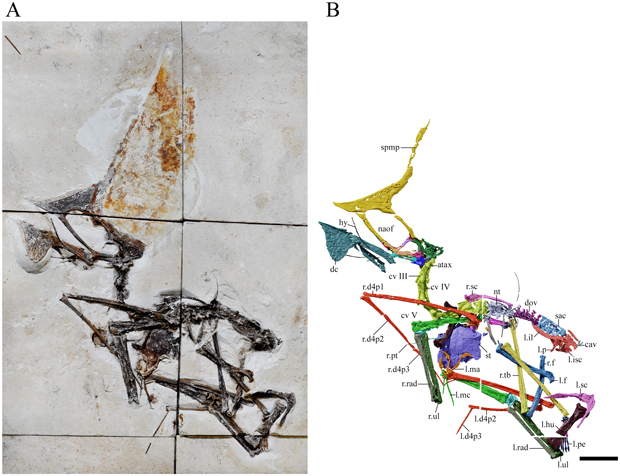
Tupandactylus navigans specimen and model
Tupandactylus navigans specimen number GP/2E 9266. Photo of specimen (A) and three-dimensional model of specimen based on CT scans (B). Picture credit: Beccari et al.

CT Scans

The pterosaur fossil is comprised of six limestone slabs. As this fossil was collected illegally, its provenance is unknown. However, by studying the yellow-stained, laminated limestone matrix, the research team were able to confidently assign the fossil to the Aptian-aged Crato Formation. The fossil took a trip to the local hospital in São Paulo, to enable CT scans to be undertaken. The subsequent three-dimensional models generated enabled the scientists to reconstruct the body of Tupandactylus for the first time. Prior to the discovery of this fossil, most Brazilian tapejarids had been described based on isolated skull bones.

Tupandactylus skeletal reconstruction and close-up of skull.
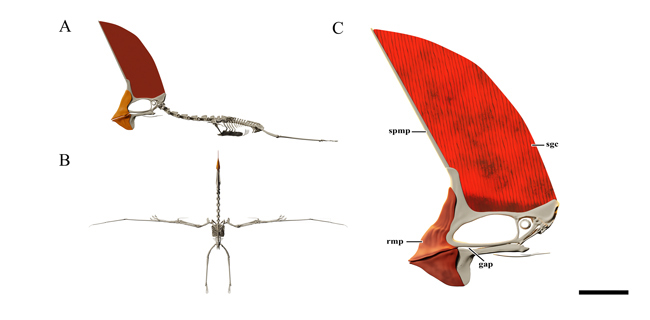
Skeletal reconstruction of Tupandactylus navigans based on specimen number GP/2E 9266 in (A) lateral view and (B) dorsal view. Skull reconstruction (C). Scale bar in C = 10 cm. This superb, articulated specimen enabled scientists to learn more about the anatomy of tapejarid pterosaurs. Picture credit Beccari et al.

Tupandactylus and a Remarkable Head Crest

Soft tissue from the huge crest on the top of the head, extends to more than five times the actual height of the skull. Analysis of the crest enabled the research team to confirm differences between Tupandactylus navigans and the closely related T. imperator. Specimens of T. navigans tend to be smaller than T. imperator and it had been speculated that just one species was represented with the differences between T. imperator and T. navigans being explained by sexual dimorphism. Thanks to the exquisite preservation of this fossil specimen the research team were able to identify several anatomical traits that support the idea that Tupandactylus navigans and Tupandactylus imperator are indeed separate species.

Different colour patterns seen in the sagittal crest do not represent fossilisation of any colour patterning but may have occurred due to oxidation of the material. However, a more detailed analysis of the soft tissues associated with GP/2E 9266 is currently being undertaken.

Close-up view of the skull of T. navigans with soft tissue preservation.
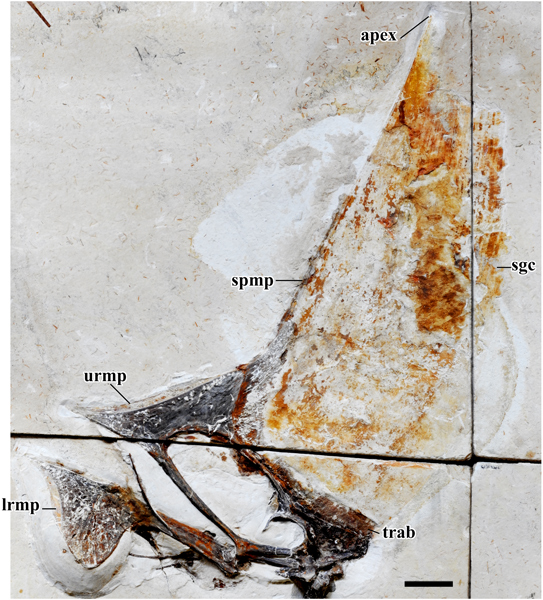
A close-up view of the skull of T. navigans showing the soft tissue preservation. Picture credit: Beccari et al.

Tupandactylus navigans

Tupandactylus navigans was named and scientifically described in 2003 based on a study of two fossil skulls (Frey, Martill and Buchy). At the time, it was postulated that the huge head crest could have been used as a sail to help with flight stability and assist with aerial propulsion. For this structure to work in this way, the neckbones would have had to be robust, relatively short and supported by powerful tendons to combat stresses imposed on the neck. With an almost complete, articulated skeleton to study, the scientists led by Victor Beccari (Universidade de São Paulo), discovered that this pterosaur had a long neck, long limbs and relatively short wings (estimated wingspan 2.7 metres).

The enormous crest probably did not play a role in aiding powered flight. Such a huge structure may well have hindered this pterosaur’s aerial abilities.

A spokesperson from Everything Dinosaur commented:

“The sagittal crest of Tupandactylus may have evolved due to sexual selection pressure, females showing a bias towards males with larger crests. The crest may have been used for display or to denote maturity, status or fitness for breeding. Many living birds sport crests, wattles and other structures, perhaps adult T. navigans sacrificed some aerial ability by growing enormous crests in a bid to attract mates.”

For models and replicas of pterosaurs and other prehistoric creatures: Prehistoric Animal Models.
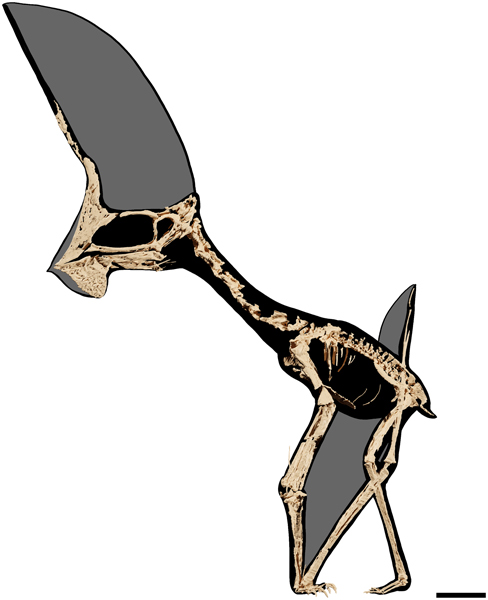
Tupandactylus navigans skeleton reconstruction.
Skeleton reconstruction of Tupandactylus navigans based on specimen number GP/2E 9266. Scale bar = 5 cm. Picture credit: Beccari et al.

Spotting a Notarium

The front five dorsal vertebrae form a notarium which helps brace the chest and counter the stresses on the torso created by the flapping of the wings. This structure is found in living birds and some types of pterosaur but this is the first time, as far as Everything Dinosaur team members are aware, that a notarium has been identified in a tapejarid.

he scientific paper: “Osteology of an exceptionally well-preserved tapejarid skeleton from Brazil: Revealing the anatomy of a curious pterodactyloid clade” by Victor Beccari, Felipe Lima Pinheiro, Ivan Nunes, Luiz Eduardo Anelli, Octávio Mateus and Fabiana Rodrigues Costa published in PLOS One.

24 08, 2021

Getting Inside the Head of a Plesiosaur with a New Scientific Paper

By |2024-05-28T14:31:24+01:00August 24th, 2021|Categories: Adobe CS5, Dinosaur and Prehistoric Animal News Stories, Dinosaur Fans, Main Page, Palaeontological articles, Photos/Pictures of Fossils|0 Comments

Researchers writing in the on-line, open-access journal PLOS One have described the most complete plesiosaur skull found to date from sub-Saharan Africa. The skull and post cranial fossil material reported upon comes from the Upper Cretaceous Mocuio Formation exposures located at Bentiaba in the Namibe Province of Angola.

The fossils represent another specimen of the elasmosaurid Cardiocorax (C. mukulu) one of just six valid plesiosaurian taxa known from the whole of Africa. This plesiosaur swam in a shallow, tropical sea and the fossils are around 71.5 million years old.

Three-dimensional images of the skull of Cardiocorax.
Three-dimensional computer models showing the skull of Cardiocorax mukulu (A) computer image in dorsal view with (B) annotated diagram of skull also in dorsal view. Picture (C) shows the computer model in ventral view with (D) an annotated diagram of the skull (dorsal view). Picture credit: Marx et al.

Cardiocorax mukulu

The specimen was found in sandstone deposits, stratigraphically just 3 metres above where the holotype material for this taxon was found. The researchers who studied the fossils, which included Octávio Mateus (Museu da Lourinhã, Portugal) and lead author Miguel Marx from the Southern Methodist University (Dallas, Texas), concluded that the fossils represented C. mukulu as the overlapping skeletal material of this specimen – MGUAN PA278 with that of the holotype were virtually identical.

Cardiocorax drawing.
An illustration of Cardiocorax mukulu based on the holotype and the newly described cranial material (MGUAN PA278). The illustration is based on the earlier elasmosaurid Thalassomedon (T. haningtoni). Picture credit: Everything Dinosaur.

Picture credit: Everything Dinosaur

This elasmosaurid had been originally named and described back in 2015. The genus name comes from the Greek “kardia” which means heart and coracoid, a paired bone that forms part of the shoulder in most vertebrates. This is a reference to the unique heart-shaped fenestra (hole) which occurs between the coracoid bones, a characteristic that is unique to this genus. The specific or trivial name comes from the local Angolan Bantu dialect and means “ancestor).

Cardiocorax pectoral girdle
The pectoral girdle of Cardiocorax (specimen number MGUAN PA103) in ventral view with the heart-shaped fenestra between the coracoid bones highlighted (red arrow). Picture credit: Araújo et al.

High Resolution CT Scans Reveal Details of Plesiosaur Skull

The exquisite, three-dimensional preservation of the skull material provided the scientists with an opportunity to examine in close detail the morphology of the skull. The delicate fossil could have been damaged during further preparation, so the specimen was subjected to high resolution CT scans at the University of Texas High-Resolution X-ray CT Facility this permitted the anatomy of the skull to be revealed.

The holotype fossils, which were used to name and describe this elasmosaurid back in 2015 lacked skull bones. The discovery of an almost complete, three-dimensional skull of Cardiocorax enabled the research team to conduct an elaborate series of phylogenetic assessments to assess where within the Plesiosauria Cardiocorax should be placed.

Most of these analyses suggest an early-branching or intermediate position for Cardiocorax mukulu within the Elasmosauridae family. Elasmosaurines have elongated neck bones (cervical vertebrae), this anatomical characteristic is absent in Cardiocorax mukulu which suggests that it was a relic of an older, less derived lineage of elasmosaurids. These results indicate that several different types of elasmosaurid persisted into the Maastrichtian faunal stage of the Cretaceous.

The scientific paper: “The cranial anatomy and relationships of Cardiocorax mukulu (Plesiosauria: Elasmosauridae) from Bentiaba, Angola” by Miguel P. Marx, Octávio Mateus, Michael J. Polcyn, Anne S. Schulp, A. Olímpio Gonçalves and Louis L. Jacobs published in PLOS One.

The Everything Dinosaur website: Prehistoric Animal Figures and Toys.

14 08, 2021

Two New Sauropods from the Lower Cretaceous of North-western China

By |2024-05-28T14:05:00+01:00August 14th, 2021|Categories: Adobe CS5, Dinosaur and Prehistoric Animal News Stories, Dinosaur Fans, Main Page, Palaeontological articles, Photos/Pictures of Fossils|0 Comments

In 2017, Everything Dinosaur reported on the discovery of an extensive pterosaur nesting site that had been found south of the Tian Shan Mountains in Xinjiang (Xinjiang Uygur Autonomous Region), in north-western China. The bonebeds represented colonial nesting sites of Hamipterus tianshanensis. It was a flying reptile that had been formally named and described back in 2014.

To read Everything Dinosaur’s 2017 article about the Hamipterus nesting sites: Hamipterus Nesting Ground Discovery.

New Sauropods Described

Fieldwork in this area has revealed the presence of dinosaurs and a paper has been published this week describing sauropod fossils. These are the first dinosaurs to be identified from this part of China. Two of the fossil specimens have led to the erection of new sauropod species Silutitan sinensis and Hamititan xinjiangensis. Four incomplete bones from the sacrum along with associated sacral ribs representing another sauropod specimen have also been found, but as yet, no genus for these fossils has been assigned.

Two new Chinese sauropods have been described - Silutitan sinensis and Hamititan xinjiangensis.
Two sauropods disturb a nesting colony of Hamipterus pterosaurs. Silutitan sinensis (left) and Hamititan xinjiangensis (right), a single theropod tooth found in association with the H. xinjiangensis material indicates the presence of carnivorous dinosaurs. Picture credit: Zhao Chuang.

Silutitan sinensis

Described from a series of six articulated cervical vertebrae (neck bones), with associated cervical ribs, Silutitan sinensis (which translates as Chinese Silk Road Titan), has been assigned to the Euhelopodidae family and is thought to have been closely related to Euhelopus (E.zdanskyi). At an estimated twenty metres plus, it is the larger of the two sauropods to be described in the scientific paper.

The cervical bones of Silutan sinensis.
Silutitan sinensis gen. et sp. nov. (holotype-IVPP V27874) in left lateral view. Note scale bar in (B) = 50 cm. Picture credit: Wang et al.

Hamititan xinjiangensis

Although contemporaneous with Silutitan (Lower Cretaceous, Shengjinkou Formation of the Tugulu Group). Hamititan was not closely related. Cladistic analysis based on the tail bones (caudal vertebrae) from which this dinosaur was described, suggests that Hamititan is a titanosaur (a lithostrotian titanosaur), as such, it seems more closely related to South American titanosaurs such as Epachthosaurus and Notocolossus.

The genus name translates as Hami City Titan, whilst the species name honours the Xinjiang Uygur Autonomous Region of China.

A single theropod tooth (below, picture F), indicates the presence of theropod dinosaurs.

Hamititan xinjiangensis tail bones.
Hamititan xinjiangensis gen. et sp. nov., caudal sequence (HM V22) in right lateral view. Scale bar for specimen (top) = 50 cm. Scale bar for theropod tooth (F) = 5 cm. Picture credit: Wang et al.

No Name for the Third Specimen

A third specimen consisting of four sacrum bones and associated sacral ribs has not been assigned to a species. However, the researchers, writing in the academic journal Scientific Reports conclude that not only do these fossils represent the first dinosaurs to be described from the Shengjinkou Formation but they also help to support the hypothesis that Asia was home to a great variety of different types of sauropod during the Early Cretaceous.

 Shengjinkou Formation Sauropod Fossils
All specimens described in the scientific paper shown in one skeleton of a typical titanosaur. Preserved cervical elements of Silutitan sinensis (IVPP V27874) in red with preserved caudal elements of Hamititan xinjiangensis (HM V22) shown in yellow and the preserved sacral elements of the unnamed sauropod (specimen number IVPP V27875) in green. Picture credit: Maurílio Oliveira.

The scientific paper: “The first dinosaurs from the Early Cretaceous Hami Pterosaur Fauna, China” by Xiaolin Wang, Kamila L. N. Bandeira, Rui Qiu, Shunxing Jiang, Xin Cheng, Yingxia Ma and Alexander W. A. Kellner published in Scientific Reports.

The Everything Dinosaur website: Dinosaur Models and Toys.

13 08, 2021

The Amazing Thapunngaka shawi – The 4th Aussie Pterosaur

By |2024-05-28T14:02:25+01:00August 13th, 2021|Categories: Dinosaur and Prehistoric Animal News Stories, Dinosaur Fans, Main Page, Palaeontological articles, Photos/Pictures of Fossils|0 Comments

A new species of Australian pterosaur has been named and described based on a fragmentary fossil representing the front portion of the lower jaw. Thapunngaka shawi is just the fourth pterosaur to have been named and described from the “land down under” and with a wingspan estimated to be as much as 9.47 metres, it might just be the largest Australian flying reptile known to science.

Thapunngaka-shawi fossil and skull drawing
A reconstruction of the metre-long skull of Thapunngaka shawi showing the placement of the rostral portion of the mandible. Scale bar = 10 cm. Picture credit: Richards et al.

Thapunngaka shawi

Pterosaur fossils from Australia are exceptionally rare. The light and hollow bones of flying reptiles rarely survive fossilisation, T. shawi is only the fourth pterosaur to have been described from the twenty fossil specimens attributed to members of the Pterosauria discovered in Australia.

Council worker and local fossil collector Len Shaw found the fossil bone ten years ago at a site known as the “water pond” at the “Free Fossil Hunting Site”, located seven miles northwest of the town of Richmond (Queensland). The strata at this site were laid down at the bottom of the Eromanga Sea (Toolebuc Formation) around 106 million years ago (Early Cretaceous). A researcher from the Kronosaurus Korner Museum was sent out to view and excavate the area and a scientific paper on T. shawi was published this week in the “Journal of Paleontology” with the collaboration of scientists from the University of Queensland.

PhD student Tim Richards poses with a cast of the skull and jaws of an anhanguerid pterosaur.
PhD student Tim Richards (University of Queensland), poses with a cast of the skull and jaws of an anhanguerid pterosaur.

Commenting on the significance of the fossil discovery, one of the report’s authors, University of Queensland PhD student Tim Richards stated:

“By world standards, the Australian pterosaur record is poor, but the discovery of Thapunngaka contributes greatly to our understanding of Australian pterosaur diversity.”

“Shaw’s Spear Mouth”

The genus name is derived from the local aboriginal language of the Wanamara Nation, on whose land the holotype material was found. It translates as “spear mouth”, a reference to the sharp teeth that would have been located in the alveoli (tooth sockets) preserved on the fossil specimen. The species name honours Len Shaw.

Assigned to the Anhangueridae, Thapunngaka and other anhanguerid pterosaurs from Queensland help to demonstrate the global distribution of these types of flying reptile during the Cretaceous, with anhanguerids known from South America, Africa, Europe and Australia.

A phylogenetic assessment indicates that Thapunngaka was related to Tropeognathus from South America.

Mojo Fun Tropeognathus.
A pair of Mojo Fun Tropeognathus pterosaurs. The newly described Australian anhanguerid T. shawi would have looked similar to Tropeognathus.

The picture (above) shows a pair of Mojo Fun Tropeognathus pterosaur figures.  This flying reptile figure was recently introduced into the Mojo Fun Prehistoric and Extinct range.

To view this range of prehistoric animal models and figures: Mojo Fun Dinosaurs and Figures.

Australian Pterosaurs

Of the four Australian pterosaurs named to date, three of them Mythunga, Ferrodraco and Thapunngaka have been assigned to the Anhangueridae family which suggests anhanguerids were the dominant group of Australian pterosaurs during the Early Cretaceous.

Aussiedraco molnari is the only non-anhanguerian pterosaur described so far from Australian fossil finds. This flying reptile has been assigned to the Targaryendraconia, a clade of pterosaurs that was created following a reassessment of ornithocheirid fossil material.

A List of the Australian Pterosaurs Described to Date:

  • Mythunga camara – a member of the Anhangueridae family, named and described in 2008 based on fossils from the Toolebuc Formation.
  • Ferrodraco lentoni – also an anhanguerid and believed to be the sister taxon of M. camara which was named and described in 2019: Australia’s Most Complete Pterosaur Fossil.
  • Thapunngaka shawi – the third anhanguerid to be described.
  • Aussiedraco molnari – named and described in 2011, also from the Toolebuc Formation.

The Largest Australian Pterosaur

Estimating the size of Thapunngaka with only a fossil fragment to study is challenging. The researchers compared the size and proportions of the mandible fossil with those of better-known and more complete anhanguerids. Although the authors of the scientific paper admit that there is not a strong relationship between mandible size and wingspan, they estimate that Thapunngaka could have had a wingspan from around 5.83 metres up to a massive 9.47 metres. The researchers suggest that Thapunngaka shawi is the largest pterosaur known from Australia.

Estimating the size of the wingspan of Australian pterosaurs.
Estimates of the wingspans of Australian anhanguerid pterosaurs. Based on a comparison of mandibles, Thapunngaka shawi is thought to have had a wingspan from 5.83 to 9.47 metres in diameter. Note scale bar = 1 metre. Picture credit: Richards et al with additional annotation from Everything Dinosaur.

The scientific paper: “A new species of crested pterosaur (Pterodactyloidea, Anhangueridae) from the Lower Cretaceous (upper Albian) of Richmond, North West Queensland, Australia” by Timothy M. Richards, Paul E. Stumkat and Steven W. Salisbury published in the Journal of Vertebrate Paleontology.

Go to Top