All about dinosaurs, fossils and prehistoric animals by Everything Dinosaur team members.
24 09, 2020

“Dung and Dusted” – A Scatological Approach to Archaeology

By |2024-03-15T22:54:06+00:00September 24th, 2020|Categories: Adobe CS5, Main Page, Photos|0 Comments

Did Ancient Potters use Sheep Dung to Fire their Clay Pots?

A project is underway to provide “hands-on” information about how ancient Britons could have fired clay pots before the invention of kiln technology.  By undertaking practical experiments trying different sorts of fuel to fire clay vessels, archaeologists hope to find out more about the way our ancestors lived their lives.

Ancient Potters and Sheep Dung

A new study, with the catchy title “Dung and Dusted”, aims to do just that, specifically by examining whether sheep dung could have been used to fire pots before the widespread use of kilns.  Dr Michael Copper, from the School of Archaeological and Forensic Sciences in the Faculty of Life Sciences (University of Bradford), hopes that these practical experiments will help researchers to gain a better understanding of how different, ancient communities were organised.

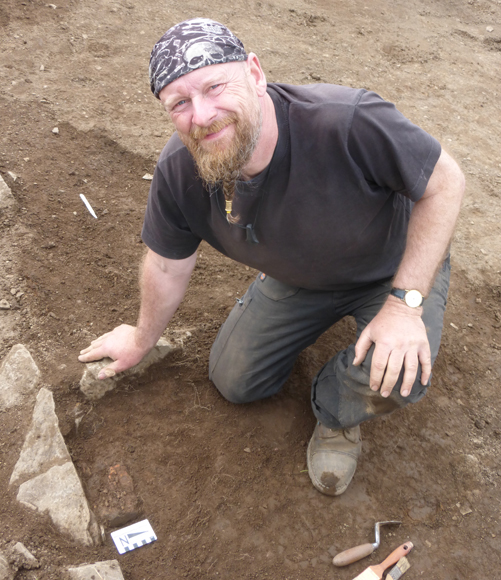
Dr Mike Copper – Part of the “Dung and Dusted” Project

Dr Mike Copper who will be part of the "Dung and Dusted" project.
Doctor Mike Copper on location in Orkney. The project aims to uncover the secrets of ancient potters.

Picture credit: University of Bradford

Dr Copper explained:

“Despite considerable advances in our knowledge of how ancient pots were made and used, archaeologists still know remarkably little about how prehistoric pottery was fired before the introduction of the potter’s kiln, including what fuels were used.  One abundant and freely available fuel source in prehistory would have been animal dung.  Could it then have been the case that dried dung was used to fire pottery in prehistoric Britain and Ireland?”

A Six-month Project

The research project is funded by the Gerda Henkel Foundation and is planned to last around six months.  A series of firings of hand-built replica prehistoric pots using sheep dung and other fuels are planned.  The vessels and firing sites will then be analysed to see whether residues left behind can be matched to ancient pottery or can be used to help archaeologists identify dung firing evidence at archaeological digs.

Dr Copper, a specialist in prehistoric pottery and ancient ceramic technology, added:

“In terms of why it is significant, experimental projects such as this provide an important way for archaeologists to understand how prehistoric people went about tasks such as pot firing using materials and techniques with which we are no longer familiar.  Pottery is one of the most important finds made on archaeological excavations.  Its varied forms help us to date sites and analysis of burnt food residues can tell us about what the inhabitants ate.  If we find that animal dung was used to fire the pots then it could be that people were managing animals with one eye on using dung as a product.”

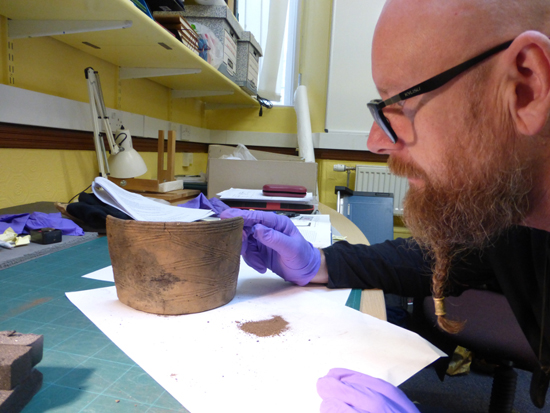
Dr Mike Copper Examining an Ancient Clay Pot

Dr Mike Cooper examines a prehistoric clay pot.
Dr Mike Copper, inspecting a prehistoric clay pot.

Picture credit: University of Bradford

Learning the Secrets of Ancient Potters Through Experimentation

The researchers, which include Dr Cathy Batt, an expert in magnetic studies with extensive experience of investigating ancient firing sites and Dr Gregg Griffin, a recent PhD graduate who looked at ways to identify fuels from residues discovered on archaeological excavations, hope to gain an understanding of how ancient societies were organised with pot-making and firing a central part of the community.  Variations in the use of technology, such as choice of fuel for pottery making, are passed down from one generation to another.  This can provide archaeologists with a lot of additional information about how a community organised itself.

We look forward to hearing more as this project concludes and we wonder whether the sheep will be cited in the subsequent paper as contributors…

Everything Dinosaur acknowledges the assistance of a press release from the University of Bradford in the compilation of this article.

The Everything Dinosaur website: Prehistoric Animal Figures, Toys and Gifts.

15 09, 2020

“Prehistoric Pets” – New Book Links Pets with Their Ancestors

By |2024-03-15T07:49:16+00:00September 15th, 2020|Categories: Adobe CS5, Book Reviews, Dinosaur Fans, Main Page, Photos, Press Releases|0 Comments

“Prehistoric Pets” – New Book Links Pets with Their Ancestors

A new book is due to be published shortly entitled “Prehistoric Pets”.  It has been written by the very talented palaeontologist Dr Dean Lomax, with illustrations by Mike Love.  This exciting forthcoming publication links pets with their prehistoric ancestors, helping to bridge a gap in children’s understanding about fossils and deep geological time.

The Front Cover of “Prehistoric Pets” by Dr Dean Lomax with Illustrations by Mike Love

The front cover of "Prehistoric Pets".
This colourful and well-written book takes the reader on a journey back in time, linking common household pets today with their prehistoric ancestors.  If you have ever wondered about the ancestors of cats, dogs and guinea pigs, then this exciting new publication will provide the answers.

Picture credit: Templar Books/Everything Dinosaur

Highly Informative, Fact Filled and Humorous

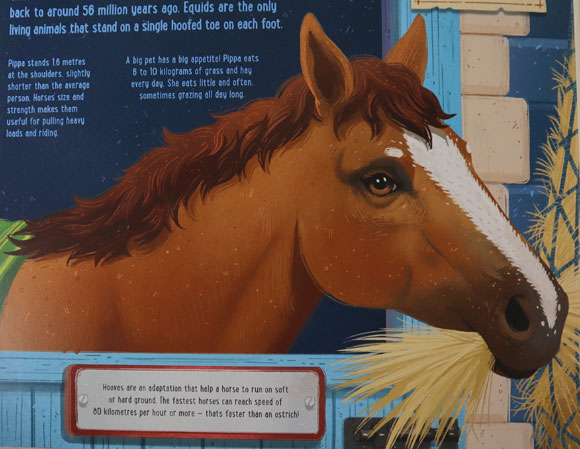
Dr Dean Lomax is one of a very select number of academics who have the ability to communicate complex ideas in simple terms so that general readers can comprehend.  The book is crammed full of fascinating facts and snippets of information that children will relish.  Beautifully designed pop-ups feature amazing prehistoric creatures, animals such as the tiny Sifrhippus (siff-rip-uss), the oldest known ancestor of the modern horse.  A cat-sized creature that roamed Wyoming during the Eocene Epoch.

“Prehistoric Pets” – Tracing the Ancestry of the Modern Horse

Horses feature in the book "Prehistoric Pets".
One of the beautiful animal illustrations from the book “Prehistoric Pets” by Dr Dean Lomax (illustrated by Mike Love).

Picture credit: Templar Books/Everything Dinosaur

“Prehistoric Pets” is an Awesome Book

This awesome book is due to be published next month (October 2020), it will make an ideal Christmas gift for a young palaeontologist.

The website of Dr Dean Lomax: British Palaeontologist Dr Dean Lomax.

When this book is available, Everything Dinosaur will be writing a review of “Prehistoric Pets”.

Well-written and Cleverly Designed – A Great Christmas Gift Idea “Prehistoric Pets”

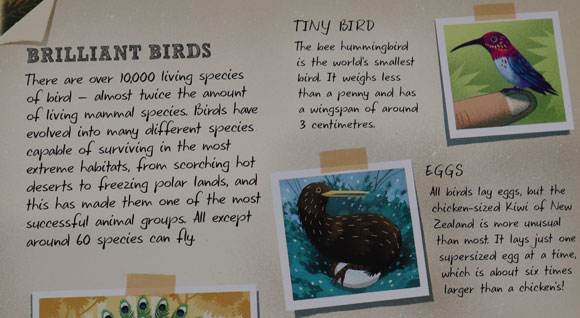
"Prehistoric Pets" - brilliant bird facts.
Brilliant bird facts in the awesome new book written by Dr Dean Lomax and illustrated by Mike Love.  The book contains lots of amazing information and facts.  Written in a humorous style, “Prehistoric Pets” takes the reader on a journey back in time, linking familiar pets alive today with their prehistoric ancestors. 

Picture credit: Templar Books/Everything Dinosaur

For advice and further recommendations about dinosaur/prehistoric animal books aimed at young readers: Email Everything Dinosaur.

The Everything Dinosaur website: Everything Dinosaur.

31 08, 2020

Hunting Ammonites A Wonderful Fossil Collecting Trip

By |2024-03-14T09:21:22+00:00August 31st, 2020|Categories: Educational Activities, Geology, Photos, Photos/Pictures of Fossils|0 Comments

Hunting Ammonites

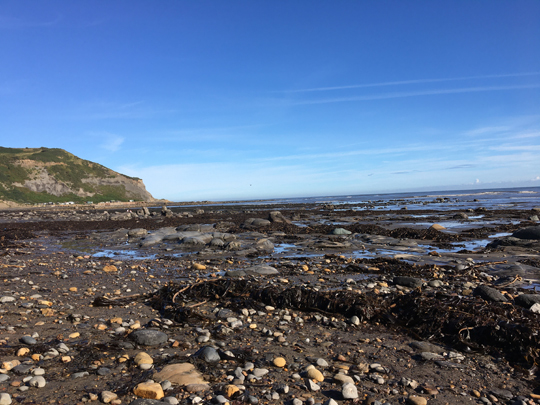
For a few hours team members at Everything Dinosaur were able to take a break from their duties and to visit the Yorkshire coast on a hunt for ammonites and other fossil remains.  It was an early start to take advantage of collecting on a low tide and to make the best of the fine weather that had been forecast.  For many fossil hunters, the hunt is almost as rewarding as the finds.  With all the problems with travel at the moment due to the COVID-19 pandemic, it made a pleasant change to be able to participate in a fossil hunting expedition, albeit only for a few hours.

The Spectacular and Very Beautiful Yorkshire Coast

A trip to the coast to collect fossils.
A visit to the North Yorkshire coast on fossil collecting expedition.  The beginning of the day, fine weather is forecast and the early start permitted the team to collect fossils on a falling tide.  Picture credit: Everything Dinosaur,

Picture credit: Everything Dinosaur

Avoiding the Cliffs Whilst Fossil Hunting

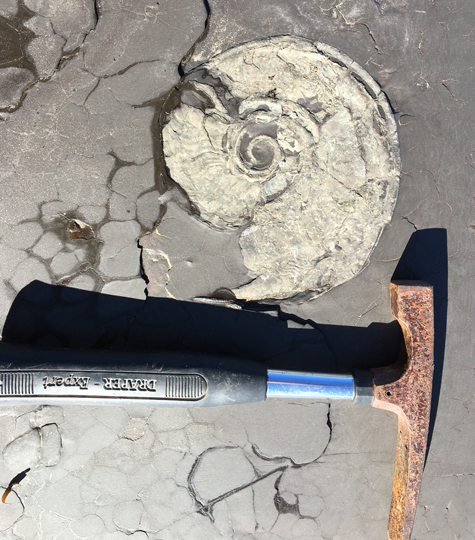
The recent heavy rains had saturated the cliffs, making the risk of rockfalls even greater.  During the team’s visit to the beach, several small rockfalls were observed, however, team members stayed away from the cliffs and were content to scour the foreshore looking for fossils.  As this location on the North Yorkshire coast is a SSSI (site of special scientific interest), hammering rocks out of the cliffs is not permitted.  There were plenty of ammonites to see, including quite large ones, preserved at numerous locations at beach level.

Large Ammonite Fossils Could be Observed on the Beach

Fossil ammonite (geological hammer provides scale).
Large ammonites preserved on the beach.  The geology hammer provides a scale.

Picture credit: Everything Dinosaur

The cliffs at this location are very dangerous and there is a steep and hazardous descent to the beach from the cliff top, this location is not for the faint hearted and not suitable for family groups.

Searching for Fossils on the Foreshore – Some Interesting Finds

Fossil hunting on the foreshore.
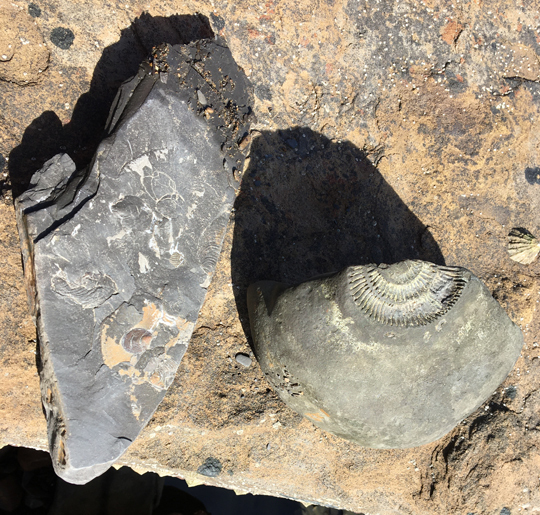
A Dactylioceras ammonite negative exposed in a broken “cannonball” and some brachiopod pieces collected from the foreshore.

Picture credit: Everything Dinosaur

The Everything Dinosaur website: Everything Dinosaur.

Lower Jurassic Fossils

The strata dates from the Lower Jurassic and there were plenty of small fragments of ammonites to collect in addition to the occasional gryphaea fossil along with various bivalves and brachiopods.  Some of the large specimens were kept as when we visit schools or conduct outreach science activities, we like to give away fossils to help provide resources to the teaching team and to encourage young people to take up fossil collecting as a hobby.

An Ammonite Fossil Found on the Beach

An ammonite fossil find.
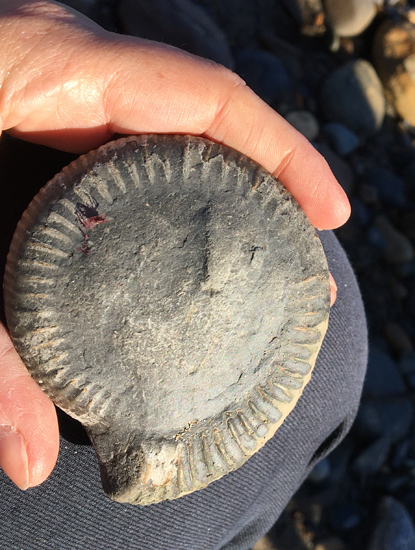
An ammonite partially eroded out of a nodule. We think this is an example of Dactylioceras commune. A wonderful discovery whilst fossil hunting.

Picture credit: Everything Dinosaur

An Ammonite Model

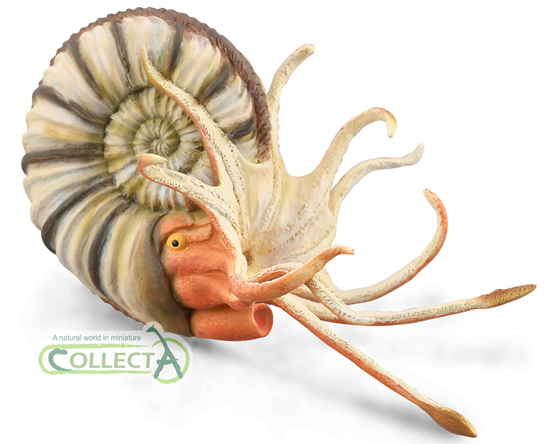
When we visited schools we liked to take an ammonite model with us as well as ammonite fossils. The model helped the children to understand what the creature looked like in real life.

A Model of an Ammonite

CollectA Pleuroceras ammonite model.
CollectA Age of Dinosaurs Popular Size Pleuroceras ammonite model.

The picture (above) shows a CollectA ammonite figure. To view this range of prehistoric animal models: CollectA Prehistoric Life Figures.

14 08, 2020

The Remarkable Eustreptospondylus from Summertown (Oxfordshire)

By |2024-03-12T15:16:17+00:00August 14th, 2020|Categories: Dinosaur Fans, Main Page, Photos, Photos/Pictures of Fossils|1 Comment

Eustreptospondylus oxoniensis from Summertown (Oxfordshire)

After the recent hot weather and to coincide with the gradual opening up of museums as some of the COVID-19 restrictions are eased in England, we wanted to feature the fossilised remains of one of the most complete theropod dinosaurs known from the Middle Jurassic of Europe – Eustreptospondylus oxoniensis.

Eustreptospondylus oxoniensis

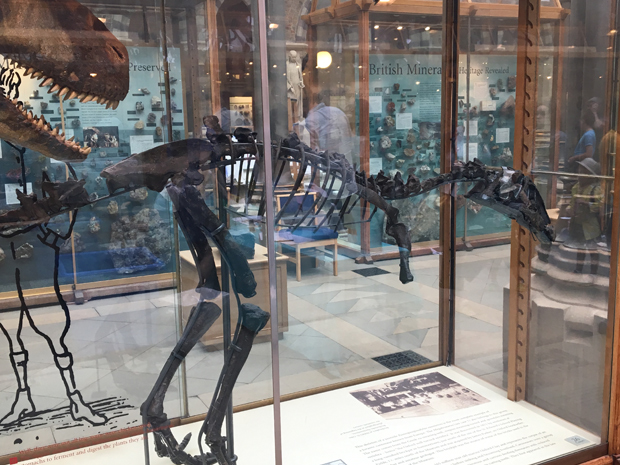
Why Eustreptospondylus?  It’s fossils were discovered in a clay pit at Summertown, Oxfordshire.  The marine sediments revealed a single, disarticulated skeleton, probably representing a young animal.  The specimen (OUMNH J. 13558) is on display at the Oxford University Museum of Natural History.  As we reach high summer in the Northern Hemisphere, we think it fitting to remember the dinosaur from Summertown.

Eustreptospondylus oxoniensis on Display at the Oxford University Museum of Natural History

Eustreptospondylus fossil specimen on display.
The mounted skeleton of Eustreptospondylus oxoniensis on display at the museum. Picture credit: Everything Dinosaur.

Picture credit: Everything Dinosaur

Visit the award-winning and highly rated Everything Dinosaur website: Everything Dinosaur.

Discovered in 1871?

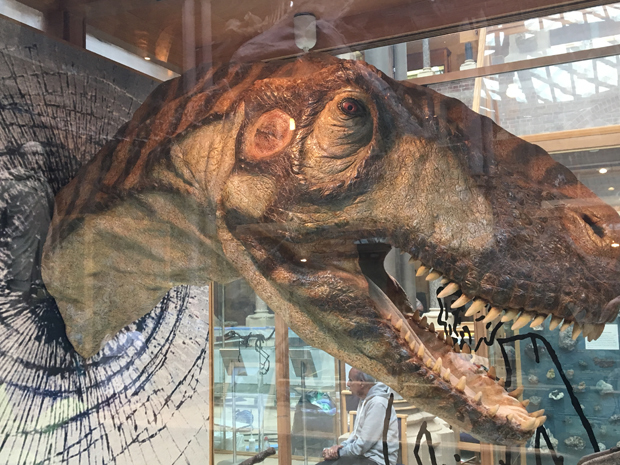
The fossilised remains of this theropod were discovered in 1871 according to the Oxford University museum, but some sources claim the fossils were found in the previous year.  The dinosaur has not always been displayed like this, for many years the fossils were posed in a “kangaroo-like” posture with the tail bones dragging on the ground.  In addition, a replica of the head of an adult Eustreptospondylus was added to the exhibition case to demonstrate that this dinosaur would have grown up into a formidable predator, had it lived for a few years longer.

The Reconstructed Head of the Fearsome Eustreptospondylus (E. oxoniensis)

A reconstruction of the head of Eustreptospondylus.
A reconstruction of the head of Eustreptospondylus oxoniensis on display at the Oxford University Natural History Museum.

Picture credit: Everything Dinosaur

As we move into high summer, it’s a pleasure to remember one resident of Summertown.

For dinosaur and prehistoric animal figures: Prehistoric Animal Models and Replicas.

5 08, 2020

Lifelike Replica of “Sue” T. rex Goes on Display

By |2024-03-09T19:18:54+00:00August 5th, 2020|Categories: Adobe CS5, Dinosaur and Prehistoric Animal News Stories, Dinosaur Fans, Main Page, Photos|2 Comments

Lifelike Replica of “Sue” T. rex Goes on Display

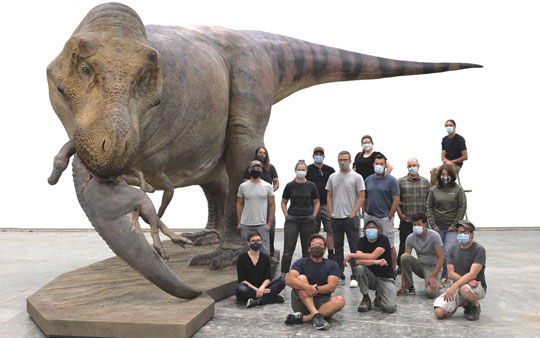
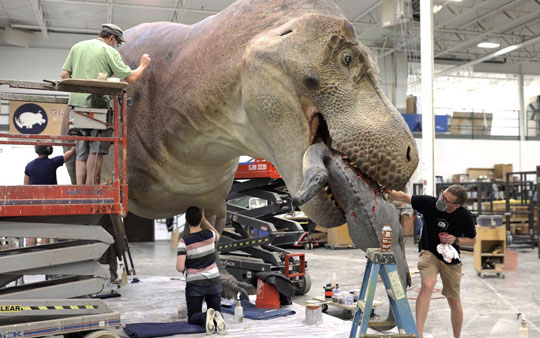
One of the most famous museum exhibits in the world, “Sue” the enormous T. rex mount located at the Field Museum in Chicago has something new to keep her company.  A life-size replica of the skeleton has been installed and museum visitors can get to see “Sue” in the flesh.  The 13 metre-long life-size model was created by the amazing talented people at Blue Rhino Studio (based in Minnesota).

Staff at Blue Rhino Studio Pose Next to the Completed Tyrannosaurus rex Replica

Lifesize model of "Sue".
Staff at Blue Rhino Studio photographed next to their life-size replica of Tyrannosaurus rex.

Picture credit: Blue Rhino Studio

Say Hello to “Fleshy”

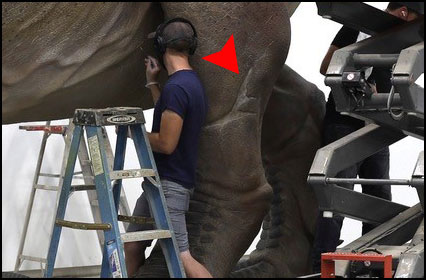
The beautifully crafted replica is currently on display at the Field Museum, but is due to go shortly on a nationwide tour.  The huge theropod figure is based on the skeleton of “Sue”, it shows some of the pathology associated with the fossil specimen.  For example, there is a substantial scar just above the left ankle.  This was the site of a bone infection, probably resulting from an injury that “Sue” had sometime during her long life.  This amazing replica has been named “Fleshy”.

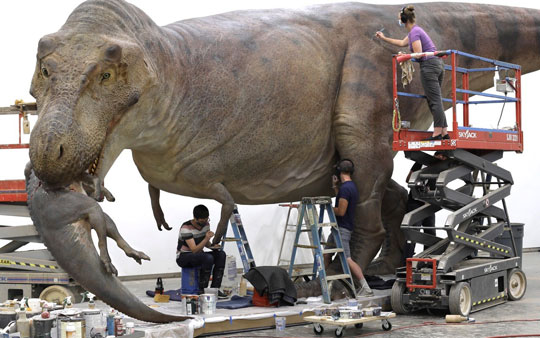
Blue Rhino Studio Staff Working on the Huge T. rex Replica

Working on the enormous T. rex model.
Blue Rhino staff working on the huge model.

Picture credit: Blue Rhino Studio

A Close-up View of the Area Above the Left Ankle Showing the Scar

The T. rex replica even has its own scars.
A close-up view of the area above the left ankle showing the scar.   The red arrow points to the patholoy on the replica.

Picture credit: Blue Rhino Studio with additional annotation by Everything Dinosaur

Tyrannosaurus rex Sharing a Home with a Titanosaur

The fossilised remains of perhaps the most famous dinosaur in North America were moved in the winter of 2018 to a new location at the museum.  “Sue” can now be found within the museum’s Griffin Halls of Evolving Planet, alongside a skeleton of a titanosaur (nicknamed Máximo).  The replica stands nearly 4.5 metres tall and it has a juvenile Edmontosaurus in its mouth.  It is likely that E. annectens was on the menu for this Late Cretaceous apex predator.

The Life-size “Sue” T. rex Replica has a Baby Edmontosaurus in its Mouth

"Sue" the T. rex has captured a young Edmontosaurus.
Team members working on the giant T. rex figure – complete with juvenile Edmontosaurus.

Picture credit: Blue Rhino Studio

The figure took two whole days to set up in the Field Museum, the staff responsible for the set build and dismantling of “Sue” hope to reduce this to just a day when the figure is on tour.

A spokesperson from Everything Dinosaur commented:

“This is an amazing piece of work!  Yes, you can debate the lack of feathers, but this wonderful exhibit will really help visitors to appreciate just how large Tyrannosaurus rex actually was.”

The Everything Dinosaur website: Everything Dinosaur.

20 07, 2020

New “Prehistoric Times” Issue 134 Reviewed

By |2024-03-09T06:32:52+00:00July 20th, 2020|Categories: Dinosaur Fans, Magazine Reviews, Main Page, Photos|0 Comments

A Review of Prehistoric Times Magazine (Issue 134)

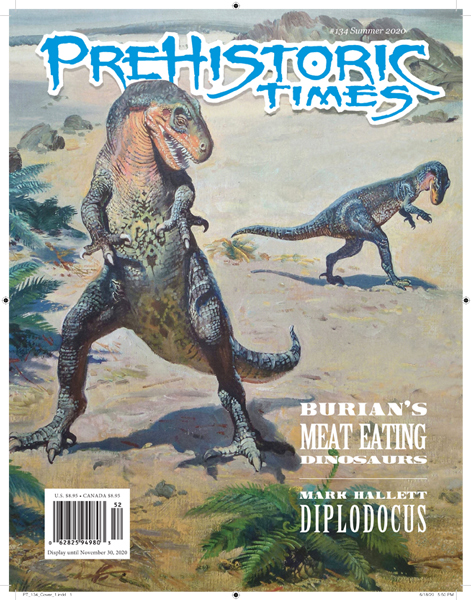
Summer is officially here at the Everything Dinosaur offices with the arrival of the summer edition of “Prehistoric Times”, issue number 134.  This is the magazine for dinosaur enthusiasts and fans of model collecting.  Published four times a year, “Prehistoric Times” provides a one-stop shop for all your prehistoric animal collecting needs.  Adorning the front cover is an illustration of Allosaurus by the highly influential Zdeněk Burian.  Inside the magazine John Lavas continues his comprehensive review of the famous Czech artist’s work, the summer edition starts the sequence of articles that will cover dinosaur illustrations produced by Burian and it is the theropods that take centre stage.

The Front Cover of Prehistoric Times (Summer 2020)

"Prehistoric Times" magazine, the front cover of issue 134.
The front cover of “Prehistoric Times” magazine (summer 2020).  Inside the magazine (page 11), the full illustration featuring a Stegosaurus is discussed.   This artwork was produced in 1950.

Picture credit: Mike Fredericks

Diplodocus and Kaprosuchus

Diplodocus and Kaprosuchus are featured and Phil Hore provides plenty of information including the story of “Dippy” the Diplodocus, not just the London Natural History Museum cast that occupied the famous Hintze hall from 1979 until 2017.

Reading the article was quite poignant for Everything Dinosaur team members, as they had been working with the Natural History Museum “Dippy” tour in the UK when the COVID-19 pandemic began to get really serious and such events were cancelled.  There are some wonderful Diplodocus themed illustrations included, look out for the skeleton reconstruction by John Sibbick and the “head on” view created by the talented Luis Rey.  There is a Diplodocus drawing submitted by Fabio Pastori and Mark Hallett, provides some illustrations too, along with an article discussing nostril placement in diplodocids.

Phil’s Kaprosuchus article includes plenty of “boar croc” artwork as well.   Cody Zaiser’s galloping crocodyliform is particularly impressive.

Kaprosuchus is One of the Featured Prehistoric Animals in Issue 134

Papo Kaprosuchus model.
Papo Kaprosuchus model, the pen provides scale. Picture credit: Everything Dinosaur.

Picture credit: Everything Dinosaur

The picture (above) shows a Papo Kaprosuchus model. To see the range of Papo prehistoric animal models available from Everything Dinosaur: Papo Dinosaur and Prehistoric Animal Models.

Collector Updates and Neanderthals

Randy Knol provides updates on some of the new releases, now expected towards the latter stages of 2020 (due to the COVID-19 pandemic) and his notes on the models include some cleverly composed photographs of the figures.  Dr Andreas Forrer provides a guided tour of three locations in his native Switzerland that were once inhabited by Neanderthals.  As well as featuring lots of stunning scenery, the article includes plenty of facts about our near cousins including some information on the author’s own genotype, complete with a trace of Homo neanderthalensis DNA.

There’s also a very well written feature on how to draw Lambeosaurines, specifically Corythosaurus, penned by Tracy Lee Ford.  Editor Mike Fredericks, now happily much better after having had a spell in hospital (a troublesome gall bladder), contributes with his regular “Collector’s Corner” and book reviews in “Mesozoic Media”.  If creepy crawlies give you the creeps, then it might be best to avoid John Tuttle’s article that documents some of the giant arthropods that once scuttled or buzzed around ancient ecosystems.

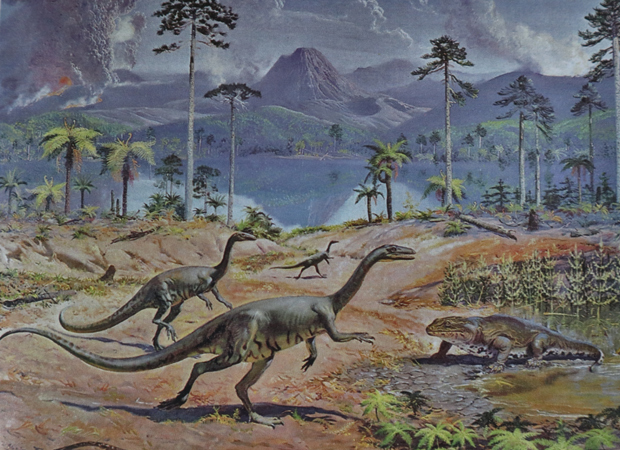
One of the Stunning Theropod Illustrations by Zdeněk Burian that Feature in the Magazine

Burian depicts a Triassic landscape.
Beautiful and evocative artwork from Burian (Coelophysis bauri and Eupelor durus).

Picture credit: Zdeněk Burian as featured in Prehistoric Times

Visit Everything Dinosaur: Everything Dinosaur.

Subscribe to “Prehistoric Times” Magazine

Issue 134 (summer 2020), is packed full of fascinating articles, great artwork and well-written features.  Everything Dinosaur recommends this excellent magazine for dinosaur model fans.

For further information about Prehistoric Times and to subscribe: Prehistoric Times Magazine.

18 07, 2020

Celebrating the Start of National Dragonfly Week

By |2024-03-08T15:41:38+00:00July 18th, 2020|Categories: Animal News Stories, Main Page, Photos|0 Comments

National Dragonfly Week (Saturday 18th – Sunday 26th July) 2020

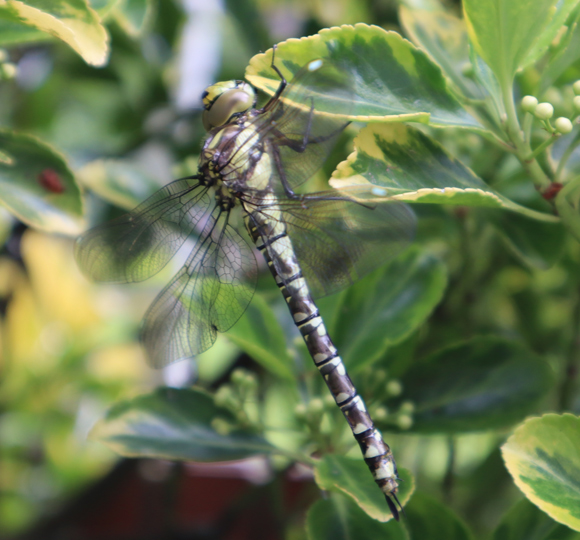
Today, Saturday 18th 2020, is the start of Dragonfly Week, an annual celebration of these amazing members of the Odonata organised by the British Dragonfly Society. It is wonderful to see these magnificent creatures emerging from the office pond and we know how important small ponds are to many temperate species as in recent years, great tracts of wetland habitat have been lost.

Recently Emerged from the Office Pond – A Hawker Dragonfly

Dragonfly spotted around the office pond.
A dragonfly that has just emerged from Everything Dinosaur’s office pond. Picture credit: Everything Dinosaur.

Picture credit: Everything Dinosaur

Celebrating National Dragonfly Week

We are not experts, but we think the majority of dragonflies that we see are Southern Hawkers (Aeshna cyanea), a relatively large and inquisitive species that is widespread in the UK and Europe.  These insects have a long fossil record with the first winged forms evolving around 325-330 million years ago (Carboniferous).  They may have been around for a very long time, but it is always exciting to see them leave the office pond and very occasionally we can spot them in the warehouse yard.

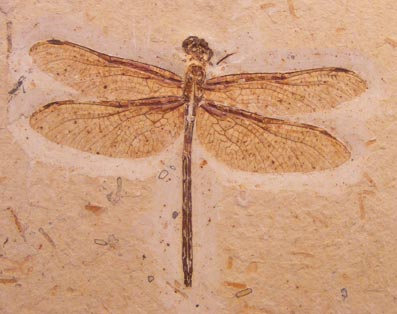
A Fossil of a Dragonfly (Brazil – Crato Formation)

Dragonfly fossil (Cretaceous).
The first animals to take to the air.  Dragonflies are believed to be amongst the very first animals to evolve powered flight.  The insects had the sky largely to themselves until the first members of the Pterosauria evolved.

Picture credit: Manchester University

The website of Everything Dinosaur: Everything Dinosaur.

16 07, 2020

Ancient Mega Tsunamis Devastated Doggerland According to New Research

By |2024-03-08T15:30:55+00:00July 16th, 2020|Categories: Geology, Main Page, Photos|0 Comments

Massive Tsunamis Devastated Ancient Britain

Scientists led by the University of Bradford have made a major breakthrough in the hunt for confirmation of a historic mega tsunami that is thought to have raged across the North Sea some 8,150 years ago.  Evidence of the catastrophic event has already been found in onshore sediments in Western Scandinavia, the Faroe Isles, north-eastern Britain, Greenland and Denmark but now for the first time, confirmation of the event has been identified on the UK’s southern coasts.

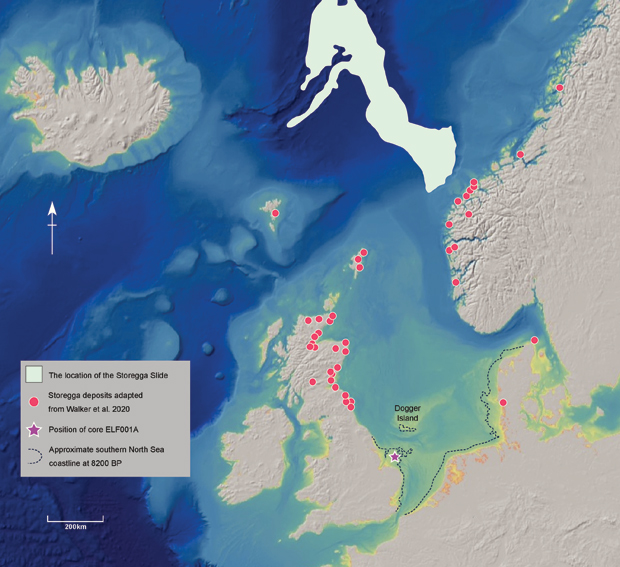
Map Showing the Location of the Storegga Slide

Map outlining the Storegga Slide and subsequent tsunami events.
Map showing location of Storegga Slide in 6,200 BC.

Picture credit: University of Bradford

Doggerland and the Storegga Slide

The giant tsunami, known as the Storegga Slide, was caused when an area of seabed the size of Scotland (measuring some 80,000 square kilometres and around 3,200 cubic kilometres), shifted suddenly off the coast of Norway.  This triggered huge waves that would have brought devastation to an inhabited ancient land bridge, which once existed between ancient Britain and mainland Europe, a region known as Doggerland, that is now submerged beneath the North Sea.

Professor Vince Gaffney (University of Bradford) explained:

“Exploring Doggerland, the lost landscape underneath the North Sea, is one of the last great archaeological challenges in Europe.  This work demonstrates that an interdisciplinary team of archaeologists and scientists can bring this landscape back to life and even throw new light on one of prehistory’s great natural disasters, the Storegga Tsunami”.

The professor from the University’s School of Archaeological and Forensic Sciences in the Faculty of Life Sciences went onto add:

“The events leading up to the Storegga tsunami have many similarities to those of today.  Climate is changing and this impacts on many aspects of society, especially in coastal locations.”

Finding Traces of the Natural Disaster in the Southern North Sea

It is thought the tsunami, the largest to hit Northern Europe since the end of the last ice age, happened following a period of global climate change.  Until now no clear trace of the tsunami had been found across the southern North Sea and importantly no trace had been found on Doggerland, which was gradually swallowed by rising sea levels after the end of the last glacial maximum.  Indeed, scientists now think the tsunami may even have led to the final inundation of Doggerland.

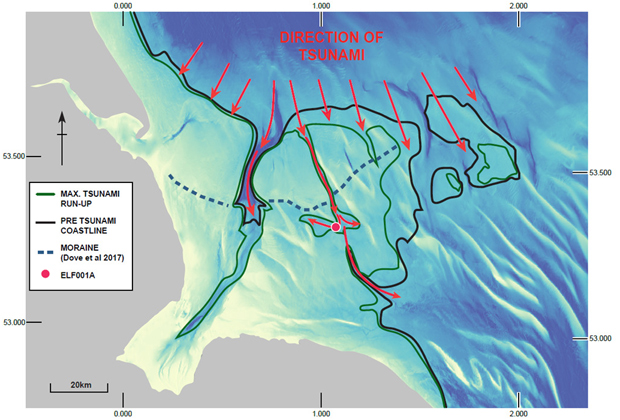
Cores from an area south of a marine trough named the Outer Dowsing Deep provided nearly half a metre of tsunami-like deposits, stones and broken shells sandwiched between laminated estuarine sediments.  Dating indicated they were contemporary with the Storegga event, while analysis including geochemical, sedimentological, palaeomagnetic, isotopic, palaeobotany and “sedaDNA” (sedentary DNA), techniques showed the deposits could be readily interpreted as resulting from a tsunami.

Area of Ancient Tsunami Research off the Norfolk Coast

Tsumani research area off the Norfolk coast.
Area of research off the Norfolk coast.

Picture credit: University of Bradford

The study was led by the University of Bradford and collaborators from the University of Warwick, St Andrews University and a number of other academic institutions including the Washington Smithsonian and the London Natural History Museum.

Differentiating a Tsunami Event from Periodic Storm Activity

Evidence for a tsunami event is often difficult to discern from sediment deposition that results from periodic storm activity.  Key to understanding the sequence of events was the interpretation of geochemical signatures of three major waves hitting and retreating from the land.  In a part of the research instigated by the University of Warwick team, the scientists were able to examine how biomass changes with large natural events.

Professor Robin Allaby (University of Warwick) stated:

“This study represents an exciting milestone for sedimentary ancient DNA studies establishing a number of breakthrough methods to reconstruct an 8,150 year old environmental catastrophe in the lands that existed before the North Sea flooded them away into history.”

At the time the tsunami hit Doggerland, a Mesolithic hunter-gather people could have been using the remaining archipelago and for those unfortunate enough to be caught within the tsunami runup zone, it would have been devastating.  However, the palaeo-topography and environmental modelling suggest that much of the landscape may have survived reasonably intact to rapidly return to pre-tsunami conditions.  The longer term fate of these lands was to be submerged as sea level rose to those of the present day.

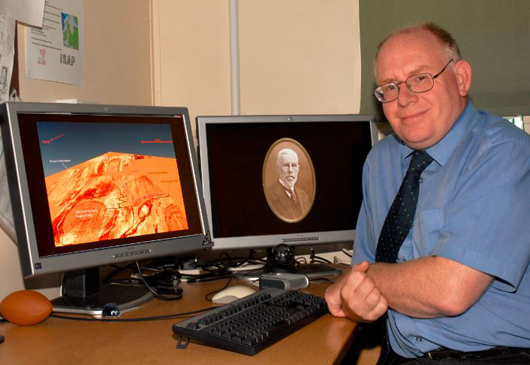
Professor Vince Gaffney (University of Bradford)

Professor Vince Gaffney (University of Bradford).
Professor Vince Gaffney, 50th Anniversary Chair at the School of Archaeological and Forensic Sciences in the Faculty of Life Sciences at the University of Bradford.

Picture credit: University of Bradford

Everything Dinosaur acknowledges the assistance of a media release from the University of Bradford in the compilation of this article.

The scientific paper: “Multi-Proxy Characterisation of the Storegga Tsunami and Its Impact on the Early Holocene Landscapes of the Southern North Sea” by Vincent Gaffney, Simon Fitch, Martin Bates, Roselyn L. Ware, Tim Kinnaird, Benjamin Gearey, Tom Hill, Richard Telford, Cathy Batt, Ben Stern, John Whittaker, Sarah Davies, Mohammed Ben Sharada, Rosie Everett, Rebecca Cribdon, Logan Kistler, Sam Harris, Kevin Kearney, James Walker, Merle Muru, Derek Hamilton, Matthew Law, Alex Finlay, Richard Bates and Robin G. Allaby and published in the journal Geosciences.

The Everything Dinosaur website: Everything Dinosaur.

22 06, 2020

Getting To Grips with the Jaws of Clevosaurus

By |2024-02-23T07:50:14+00:00June 22nd, 2020|Categories: Dinosaur and Prehistoric Animal News Stories, Dinosaur Fans, Main Page, Palaeontological articles, Photos|0 Comments

Did the Ancient Rhynchocephalians Out Compete Early Mammaliaforms?

Had you been around south Wales or south-western England some 200 million years ago, you would most probably have required a boat to get about.  The area around the Bristol channel today (where you still need a boat), during the Early Jurassic, consisted of a series of small islands surrounded by a warm, shallow tropical sea.  This archipelago (referred to as the Mendip Archipelago), was home to small dinosaurs and also to a variety of other reptiles including five species of Clevosaurus.

Studying Clevosaurus

Clevosaurs are members of an ancient Order of reptiles called the Rhynchocephalia.  A new study published in the journal of the Palaeontological Association, suggests that these hardy reptiles may have filled the roles performed by early mammaliaforms on some of these small islands.

In addition, where Clevosaurus fossils are found, mammaliaform fossils tend to be lacking, so did these two types of tetrapod compete with each other for the same food resources?  This new research carried out by members of the School of Earth Sciences (University of Bristol), indicates that this could have been the case.  The scientists examined the biomechanics of the skulls of these lizard-like reptiles in a bid to gain an understanding of the likely diets of the species studied.

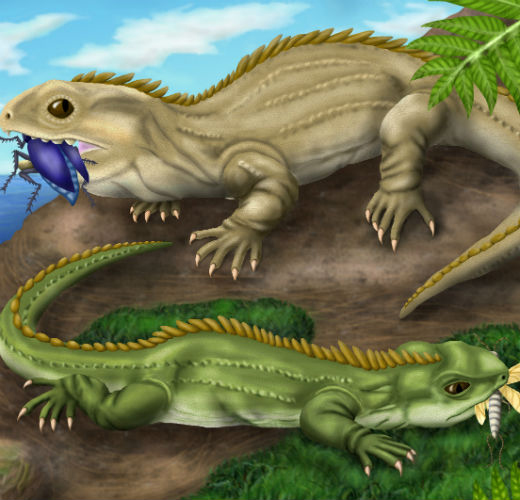
Different species of clevosaur had different bite forces, which hints at a degree of niche partitioning within this genus.  This may explain why five different species were able to exist within a relatively small area.

Different Species of Clevosaurus may have had Slightly Different Diets

Niche partitioning within the Cleovosaurus genus.
Clevosaurus feeding habits – niche partitioning in Early Jurassic clevosaurs.  The illustration shows two species of Clevosaurus associated with the Mendip Archipelago feeding on different types of insect prey.  Clevosaurus hudsoni feeding on a hard-shelled beetle, whilst (bottom), Clevosaurus cambrica consumes a softer insect without a carapace.

Picture credit: Sofia Chambi-Trowell (University of Bristol)

Computerised Tomography Used to Analyse Skull Biomechanics

PhD student, Sofia Chambi-Trowell, from Bristol’s School of Earth Sciences, worked on CT scanned skulls of ancient rhynchocephalians and found differences in their jaws and teeth.

The student commented:

“I looked at skulls of two closely related species of Clevosaurus, Clevosaurus hudsoni and the slightly smaller Clevosaurus cambrica – the first one came from a limestone quarry near Bristol and the other one from South Wales.  Clevosaurus was a lizard-like reptile, but its teeth occluded precisely, meaning they fit together perfectly when it was feeding.  But what was it eating?”

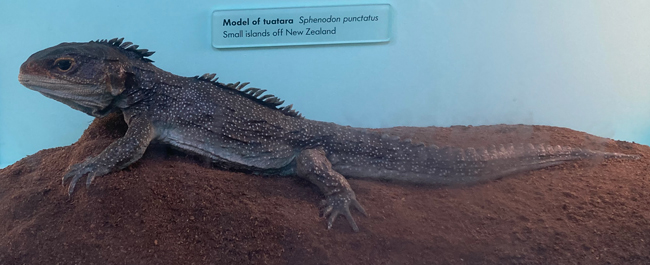
Rhynochocephalians (beak heads), were a very successful, globally distributed group of diapsid reptiles that flourished during the Mesozoic.  The Tuatara (Sphenodon punctatus), is the only living member of this order, the Tuatara is confined to small islands off the coast of New Zealand and some specially designated and protected release sites on North Island.

Using Finite Element Analysis

Whilst studying the extant Tuatara is of great assistance to palaeontologists, expanding any findings to extinct members of this group is challenging.  Likewise, identifying the feeding habits of long extinct species is equally difficult.  However, finite element analysis conducted on two, near complete, three-dimensionally preserved skulls (Clevosaurus hudsoni and Clevosaurus cambrica respectively), provided bite force data and an assessment of jaw biometrics.  From this information, the potential feeding preferences of these two closely related reptiles could be inferred.

The Last of the Rhynochocephalians – A Tuatara

Tuatara specimen
A close-up view of a Tuatara specimen on display at the London Natural History Museum. Picture credit: Everything Dinosaur.

Picture credit: Everything Dinosaur

The researchers found that Clevosaurus had bite forces and pressures sufficient to break down beetles, and even small vertebrates easily, suggesting they could have taken the same prey items as the early mammals on the islands.  Calculations of muscle forces show that Clevosaurus hudsoni could take larger and tougher prey than the more slender jaws of Clevosaurus cambrica.

Did Clevosaurus Compete with the World’s First Mammals?

Co-author of the scientific paper and the project supervisor, Professor Emily Rayfield (University of Bristol) stated:

“We wanted to know how Clevosaurus interacted with the world’s first mammals, which lived on the Bristol islands at the same time.  I had studied their jaw mechanics a few years ago and found they had similar diets and that some fed on tough insects, others on softer insects.”

This study, having identified difference in jaw mechanics between different species of Clevosaurus provides a hypothesis as to why several species of Clevosaurus could co-exist in the same habitat.  Niche partitioning could have been taking place with each species avoiding competition by specialising in hunting and eating different types of prey.

As the data generated in this study is roughly comparable to what is known about the jaws of early mammaliaforms, it raises the intriguing prospect that the jaws may have been functionally similar and thus rhynochocephalians and early mammaliaforms were in direct competition with each other for food resources.

Everything Dinosaur acknowledges the assistance of a media release from the University of Bristol in the compilation of this article.

The scientific paper: “Biomechanical properties of the jaws of two species of Clevosaurus and a reanalysis of rhynchocephalian dentary morphospace” by Sofia A. V. Chambi‐Trowell, David I. Whiteside, Michael J. Benton and Emily J. Rayfield published in Palaeontology.

The award-winning Everything Dinosaur website: Everything Dinosaur.

21 06, 2020

A Trip Down Memory Lane to the Late Jurassic

By |2024-02-23T07:37:28+00:00June 21st, 2020|Categories: Book Reviews, Dinosaur Fans, Everything Dinosaur News and Updates, Main Page, Photos|0 Comments

The Solnhofen Lagerstätte

Whilst looking for some information related to Triassic archosaurs, we came across a copy of a dinosaur book that was published forty-four years ago (1976).  Entitled “The evolution and ecology of the Dinosaurs”, this publication and the way it depicts the Dinosauria and their relatives might be very much out of date these days, but perusing the pages with their beautiful illustrations is still a very worthwhile activity.

The Front Cover of “The evolution and ecology of the Dinosaurs”

"The evolution and ecology of the Dinosaurs" by L. B. Halstead.
The front cover of “The evolution and ecology of the dinosaurs” by L. B. Halstead. Picture credit: Everything Dinosaur.

Picture credit: Everything Dinosaur

Written by L. B. Halstead and illustrated by Giovanni Caselli, this dinosaur book was part of the Eurobook Ltd stable and was published by Book Club Associates.  We suspect that further editions were published but this is the only copy that we have in Everything Dinosaur’s library.

Five Chapters

Following a brief introduction, the book takes the reader through the evolution of the dinosaurs with one chapter dedicated to the origin of the Reptilia and the conquest of terrestrial environments.  A second chapter defines dinosaurs and sets out the “classical” view of the dinosaur family tree complete with a skilfully designed chronology of the main types of dinosaur and how they fit into the Reptilia and in broader terms, the evolution of the subphylum Vertebrata (the vertebrates).  The other three chapters are dedicated to the Triassic, Jurassic and the Cretaceous respectively.

One of the Beautiful Illustrations from the Dinosaur Book

A Late Jurassic lagoon.
An illustration from a dinosaur book, depicting the extensive lagoons of what was to become Germany in the Late Jurassic.

Picture credit: Giovanni Caselli

Amazing Late Jurassic Dinosaurs

In the foreground (above), a second species of Compsognathus – C. corallestris is shown.  It was thought that this theropod was adapted to a semi-aquatic existence.  The first fossils associated with Compsognathus were found in southern Germany in the 19th century.  A second, larger specimen associated with this genus was found in a lithographic limestone quarry near Nice in 1971.  This specimen was scientifically described and named in 1972 by Alain Bidar et al.

Although, the French specimen was found in association with lagoonal deposits and at the time it was described it was thought to be a separate species, C. corallestris is now thought to be a junior synonym of Compsognathus longiceps and most palaeontologists think that there is just one species associated with this genus.

The Complete Illustration of a Jurassic Lagoon from the Dinosaur Book

A Late Jurassic scene from Germany.
The full illustration depicting the lagoonal environment associated with the Solnhofen Lagerstätte. Picture credit: Everything Dinosaur.

Picture credit: Everything Dinosaur

It was a pleasant experience to take a few minutes out of our busy day to take a trip down memory lane with this book about dinosaurs.

For another pleasant experience, visit the Everything Dinosaur website: Everything Dinosaur.

Go to Top