Dinosaur and Prehistoric Animal Posters – How to pack them?
Since the inception of Everything Dinosaur, the team has strived to find educational and informative products related to dinosaurs and other prehistoric animals. In the beginning , when our product range was considerably smaller than it is today posters were an important product category. Posters provide young people the opportunity to learn about prehistoric animals, can help theme a bedroom into a young child’s very own Jurassic Park and can provide a useful teaching and reference source for schools and home educators.
Prehistoric Animal Posters
The number and types of posters we now stock has increased considerably, but one issue with posters always remains – how to ensure that they arrive in tip-top condition when they have been mailed out. Making sure that posters arrive safely and undamaged is a problem for all mail order companies that sell items such as this. We would not want to disappoint any of our customers, so right from the day the company first started trading we have taken great care to make sure that posters get VIP treatment.
To view Everything Dinosaur’s toys and gifts including posters, visit our website: Everything Dinosaur.
Posters purchased from Everything Dinosaur are most usually packed separately from other purchases. Often this means that we send out two parcels per order rather than one, even though we only charge customers one posting and packing/administration fee. As a company made up of parents and teachers as well as knowledgeable dinosaur people, we would rather subsidise the delivery than risk a poster getting damaged and spoiled if it were packed in some other way.
Special Parcel Tubes
Posters are packed into special Royal Mail parcel poster tubes, these robust tubes prevent damage and permit the poster to arrive in tip-top condition.
Within the UK, Royal Mail changed the way in which post and parcels were handled in April 2006. Parcels were now categorised according to both size and weight dimensions. These changes have not affected the way in which we pack posters, however, customers are not expecting two deliveries from us and to prevent them thinking that a poster has been left off their order, team members contact customers to let them know that their order has been split and two parcels have been despatched.
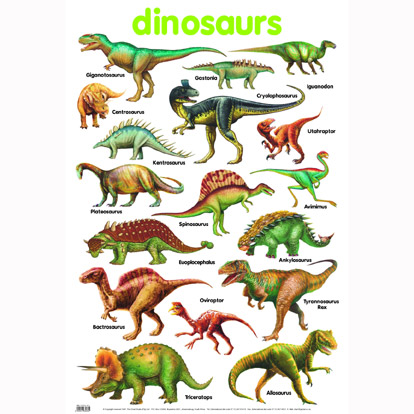
Our good reputation for packing orders has helped us develop a number of new posters for dinosaur enthusiasts. For example, the My First Dinosaur Poster concept has proved very popular since its introduction about three months ago. This is an especially robust, double laminated poster featuring colour illustrations of dinosaurs. The poster has been specially designed to appeal to young children from 3 years and up.
The My First Dinosaur Poster From Everything Dinosaur
Illustration: Everything Dinosaur
Seventeen different dinosaurs are featured, some of the more well-known ones with a good mix of the more unusual dinosaurs. The name of each animal is provided, printed clearly in black ink against a white background to help young children recognise letters and help them to form words.
As people all around the world start a new year, this is often a good time to consider what changes, developments and news stories we might expect over the next twelve months. For scientists involved with studying ancient life and attempting to piece together our knowledge of pre-history, 2008 will no doubt be filled with exciting discoveries. Just for a bit of fun, the team at Everything Dinosaur has compiled a list of predictions, trying to guess what the next year will bring.
Palaeontological Predictions
We are certainly living in a “golden age” for palaeontology. New parts of the world are being explored and with the advancement of techniques such as electron microscopy and CAT scans we can gain much more information from the fossils already found.
Here in no particular order are our predictions for 2008:
More Aussie Polar Dinosaurs will come to Light
Study of Dinosaurs within what was a polar environment will continue on the rugged coast of Victoria, Australia. With the help of sponsors and the regular band of dedicated volunteers from the universities of Australia, it is likely that more dinosaurs and other vertebrates such as the large amphibious Labyrinthodonts will be discovered. A number of small ornithopods have already been described perhaps evidence will be uncovered to provide a clue as to how these little animals could survive such cold conditions – evidence of a feathered hypsilophodont perhaps?
“Walking with” Tour will shake London
The European tour of the “Walking with” Dinosaurs is scheduled to take place in 2008. This spectacular, live stage show featuring animatronic dinosaurs will no doubt prove to be a huge hit in Europe. Not too difficult a prediction to make, bearing in mind the reception this tour has already received in Australia and north America. We were lucky enough to get the chance to review one of the early shows on the Australian leg of the show’s world tour and then to write about the first shows in America.
The next series of ITVs “Primeval” is scheduled to start in the spring (UK). Seven episodes have been made and this time viewers will see Dinosaurs. In addition, expect more documentaries from the likes of the Discovery Channel and National Geographic. These type of programmes, providing an insight into a specific set of finds or relating a theory about a dinosaur’s demise are ratings winners. Expect more controversy when television programmes are screened before all the palaeontological evidence has been collated and peer reviewed.
More Dubious “fossils” on Auction Web Sites
As more people gain access to the Internet and speedy downloads with the aid of broadband expect the number of fossils that appear on auction websites to increase. Many of these items are genuine fossils from respected dealers and private individuals, but as prices for fossils go up expect the trend for misrepresentation and dodgy deals to increase. It is a fine line between a “restored” fossil, a “repaired” fossil and a “reconstructed” fossil. We have come across many examples of spinosaur teeth from north Africa which on closer examination don’t appear to be as perfect as promised. Expect more disappointed purchasers when they realise that the massive theropod tooth they spent a fortune on; bidding for it on an auction site; turns out to be a collection of tooth shards skilfully glued together to mimic a perfect specimen. Expect more disappointed collectors when they realise the large fossil tooth they saw a picture of on-line turns out to have had its length increased somewhat by the sticking of lots of sand around the base to replicate the root portion. Such practices will no doubt continue into 2008 and beyond.
More Specimens to Private Collectors
2007 was marked by an increase in the number of large fossils auctioned off and being sold to wealthy individuals. Complete skeletons of prehistoric animals, rare skulls and such like have found their way via auctions and sales into private collections. As the market value of such specimens increases so this trend is expected to continue. Some types of fossil are seen as an investment, with stock markets fluctuating, money is finding a refuge in more abstract investment markets – paintings, fine wines and relics from pre-history. Dinosaurs are “trendy” collecting them has become the pastime of celebrities, famous and wealthy people wanting to own something a little different and unusual – such as a sauropod femur or a tyrannosaur skull.
Financial Issues for Museums
Calls for UK Museums to Charge for Entry
In the late 1990s it was decided by the UK government to allow free access to many of the country’s national museums and monuments. By providing free entry it was argued that people would not be deterred from learning about their heritage and this would increase the opportunities to learn for those less well-off than others. Certainly, attendance at many museums, the natural history ones for example, has increased. Museums are able to apply for grants, subsidy and subventions to help fund their activities and research, but as costs rise and the political wind changes, this policy of free entry may well be challenged in the next twelve months.
Chinese Dinosaur Discoveries will continue to make the Headlines
In 2008, the spotlight will fall onto China and Beijing in particular, as after all, this is the year that China will host the Olympics for the first time. However, for palaeontologists the focus will remain on other more rural parts of China such as the provinces of Liaoning and Henan. Expect more amazing, beautifully preserved fossils of feathered dinosaurs and many new species from the extensive deposits. Also, with the law passed last year granting all fossil finds to the state, expect more prosecutions and fossil confiscations when peasants attempt to sell their finds.
Everything Dinosaur to Increase Product Range
The team at Everything Dinosaur have been busy organising hall tests, focus groups and other forms of marketing research to identify new prehistoric animal themed products and services. This trend is going to continue into 2008 and the dedicated team will introduce a number of new products this year, new games, clothing lines, new models and such like. Trade events and exhibitions will be visited and many new items will be added to the Everything Dinosaur website over the next few months.
It is very probable that new types of plesiosaur (giant marine reptiles) will be named and described in 2008. Such is the interest in palaeontology at the moment that a number of research teams are excavating Mesozoic marine deposits and within these sediments it is quite likely that new species of marine reptile, including the long-necked plesiosaurs will be found. Hot spots for plesiosaur finds in 2008 are Greenland, the Arctic circle, Germany and Alberta, Canada. More pliosaurs and ichthyosaurs may also be discovered.
New Legal Dispute over United States Fossil Tyrannosaur
Last but not least comes our final prediction. A new discovery, perhaps more T. rex bones or another major theropod from the Cretaceous will end up caught in a legal wrangle. After 67 million years, a well preserved fossil uncovered in some part of the western USA will fall foul of a legal dispute over ownership of the specimen and the right to extract more bones from the site. US federal law is currently being tested by one collector and his discovery of the remains of a large tyrannosaur, if another such specimen is discovered outside of a properly orchestrated museum expedition and dig then expect another legal wrangle.
One thing is for sure, it may be 65 million years since the Dinosaurs disappeared and the science of palaeontology may well be a relatively young discipline but 2008 will certainly have plenty of highs and lows for dinosaur enthusiasts, scientists and palaeontologists.
The Five Most Popular Everything Dinosaur Web Log Articles of 2007
Continuing the countdown of the top ten web log articles of 2007, this entry counts down from five to the coveted number one spot. Like the previous blog entry (December 31st), the top five cover a broad range of topics, from new products and developments at Everything Dinosaur, news stories and updates on theories within the science of palaeontology.
Now to the top five most popular articles of 2007:
5). The Everything Dinosaur Calendar – (Friday 28th September 2007)
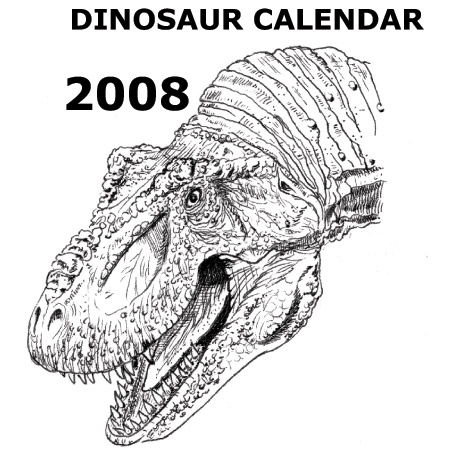
This was the first dinosaur themed calendar produced by Everything Dinosaur. It was created in collaboration with Mike Fredericks, a professional prehistoric animal illustrator and editor of the magazine “Prehistoric Times”. Scientists do not know what colour dinosaurs were, it is assumed that they had colour vision and since they evolved in a mostly green and brown world they could have been as colourful as their relatives the birds. The concept behind the calendar was to produce a series of black and white drawings – one dinosaur for each month, plus front, inside front and back pages and then get children to colour them in creating their own dinosaur scenes. Each page had dinosaur facts and information, all verified by our dinosaur experts. The calendar proved very popular – with orders from the UK and also overseas.
4). My First Dinosaur Poster – (Thursday 11th October 2007)
The autumn saw a number of new product introductions as Everything Dinosaur prepared for Christmas. The introduction of a special double laminated poster for young dinosaur fans captured a lot of reader’s imaginations and as a result this item makes number 4 on our list.
My First Dinosaur Poster
Dinosaur posters available from Everything Dinosaur.
The poster shows 17 different dinosaurs, some well-known ones some relatively unknown. Each is colourfully illustrated and the name of the animal is produced clearly in big, black ink so that children can associate the name with the animal. The poster is large and double laminated, making it sticky-finger proof, essential when it comes to young dinosaur fans.
3). How Big was Liopleurodon? – (Sunday 9th of September)
Ever since Liopleurodon featured in episode 3 of the ground-breaking BBC series “Walking with..” this short-necked plesiosaur, more commonly known as a pliosaur has been regarded as a truly huge predator. The programme, which was entitled “The Cruel Sea” showed Liopleurodon snatching an unwary Eustreptospondylus from rocks on the seashore and chomping a female Ophthalmosaurus in half before finally coming to a sad end stranded on a Jurassic beach.
At the time the writers and researchers for the TV series estimated that an adult male Liopleurodon could reach lengths in excess of 25 metres and weigh more than 150 tonnes. If this were indeed the case then Liopleurodon with its 18 inch long teeth could lay claim to being the biggest carnivorous animal ever.
However, the existing fossil evidence does not back up the BBC’s claims and the article went on to discuss the fossils and put forward alternative estimates of this animal’s size. Perhaps our thoughts on Liopleurodon are influenced by the weights and sizes of modern whales. Whales have their body weight supported by water and are totally marine, not venturing back onto shore. This helps to explain the huge sizes these animals can reach. It is not known whether Liopleurodon was fully adapted to life in the water and did not come ashore.
2). Did the Birds wipe out the Pterosaurs? – (Thursday 2nd of August)
A review of published works on the pterosaur fauna of the Dinosaur Provincial Park formation in Alberta (Late Cretaceous – Campanian faunal stage) led the scientific team to conclude that the limited remains found were mainly representative of the Azhdarchidae pterosaurs. Azhdarchids were the very large flying reptiles, an animal such as Quetzalcoatlus being a representative of this group.
Phil Currie (curator of Dinosaurs at Royal Tyrrell) and Stephen Godfrey (dept. of Palaeontology at the Calvert Marine museum) who wrote up the original data, concluded that surprising few pterosaur remains had been found, despite over a century of exploration in the area. Not withstanding the fragile nature of the bones, did the lack of pterosaur fossils indicate that these creatures only made up a small proportion of the total ecosystem. Had the evolution of the birds led to the decline of the pterosaurs?
Last but not least the number one, the most popular Everything Dinosaur web log article of 2007, concerned a tiny bee fossilised in amber.
1). To Bee or not to Bee – Bee Provides Clue to Orchid Origins – (Friday 31st August 2007)
A study of the remains of a bee preserved in amber revealed tiny pollen grains which gave scientists working at Harvard University a clue to the origin of orchids.
In a report printed in the journal – “Nature”, the university team led by Dr Santiago Ramirez have estimated that the orchid family may have first evolved in the Late Cretaceous.
Most Popular Everything Dinosaur Blog Articles of 2007
As 2007 draws to a close, it is a good time to reflect on the first year of the Everything Dinosaur web log. This is article number 231 in a blog started at the end of May, so our record of publishing something new everyday has just about been kept up. In the fast moving world of palaeontology there is always something happening, this coupled with the growth of Everything Dinosaur has meant that there is always plenty of things to write about.
This is the time of year when lots of lists are drawn up, favourite films of the year, most popular books and so forth, just for a bit of fun we have compiled a list of the top ten Everything Dinosaur blog articles in terms of most views.
The top ten list covers an eclectic range of subjects, from new scientific discoveries, Everything Dinosaur products, theories and new fossil finds. It reflects the diverse nature of our web log. We are sure there is going to be lots and lots to write about in 2008.
Like all good compilations we will start the countdown at ten and this article covers the articles and items that fill the places from tenth down to sixth, with the top five published tomorrow.
The Everything Dinosaur Top Ten Blog Articles (Part 1)
10). Dinosaur Dino-opoly – (Saturday 18th August)
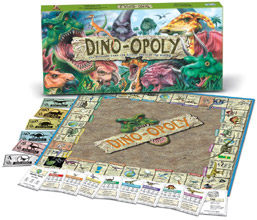
The addition of Dinosaur Dino-opoly to the Everything Dinosaur game range is at number 10, attracting readers throughout the autumn and especially at Christmas. The game, based on the traditional board game monopoly is aimed at players from eight years and up, you have to collect bones and trade them in for museum exhibits as each player strives to build the best dinosaur museum. A fun game to play with the added bonus that young dinosaur fans can learn about prehistoric animals whilst playing.
9). Blame the Deccan Traps! – (Saturday 3rd November)
A number of theories have been put forward regarding the causes of the mass extinction event at the end of the Cretaceous. A team of American scientists challenged the asteroid/meteorite theory and proposed that massive volcanic eruptions in India led to the demise of the dinosaurs and about 65% of all life on Earth. New studies of the enormous basaltic lava flows of western and central India – known as the Deccan Traps, indicated that the most violent and devastating eruptions are dated very closely to the mass extinction event.
Volcanic activity on this scale would have thrown out into the atmosphere huge volumes of carbon dioxide and sulphur dioxide, dramatically changing the world’s climate and leading to the collapse of entire ecosystems.
8). Claws! – Giant Sea Scorpion of the Devonian Discovered – (Saturday 24th November)
Markus Poschmann of the Mainz museum, in Germany found a 390 million-year-old fossil claw from what could be the biggest arthropod known to date. The fossil was found in a quarry near the town of Prum in western Germany. Study revealed the fossil to be part of a claw of a sea scorpion species named Jaekelopterus rhenaniae, this species had been described and named from other German finds last century but this new find reveals that this particular sea scorpion was a giant of the Devonian seas, reaching lengths in excess of 2.5 metres.
This animal would have been one of the top predators around at the time, hunting fish, trilobites and anything else it could catch. Taking a dip in the Devonian would have been a very risky business!
7). Dinosaur Raincoats and Dinosaur Pyjamas – (Tuesday 25th September)
The introduction of dinosaur raincoats and pyjamas with a dinosaur pattern into our clothing range proved a popular article amongst readers in the Autumn of 2007.
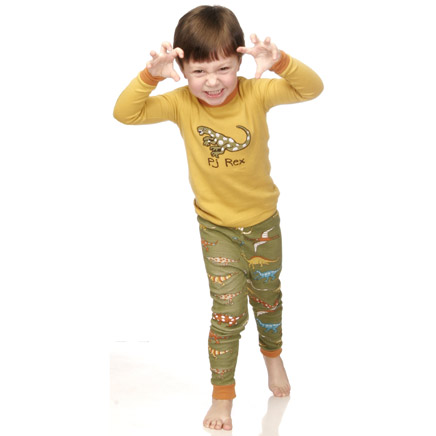
The pyjamas are made from 100% cotton and have proved to be a big hit with the parents of children aged 3 – 7 years. They are pyjama sets, consisting of a trouser with a colourful dinosaur pattern and a top which has a dinosaur applique motif on the chest.
The caption on the top says “PJ Rex” we did not get too fussy over the scientific accuracy of the theropod featured on the motif, or in the way that the manufacturers have misappropriated a species name by giving it a capital letter, but they are warm, practical and covered in lots and lots of dinosaurs – brilliant!.
Pyjamas from Everything Dinosaur
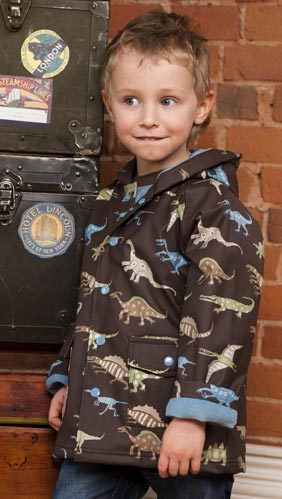
The dinosaur raincoats were a real find, almost as exciting as finding a fossil on a field trip. These hard-wearing, durable raincoats are made from 100% waterproof polyurethane with a terry cotton lining (78% cotton, 22% polyester). They have a hood to keep the rain off and the coat has a colourful dinosaur pattern on it with lots and lots of dinosaurs (and the odd flying reptile). There are even two front pockets for young palaeontologists to keep their fossils in.
We had a lot of fun deciding which prehistoric animals were represented in the artwork, there is a real mixture with stegosaurs, spinosaurs, lots of other meat-eaters but our favourite is the blue coloured ornithomimid with orange spots – wonderful! After such a wet summer, these raincoats were bound to prove popular!
Dinosaur Raincoats – Introduced in the Autumn
6). Nigersaurus – The Dinosaur the Grazed like a Cow – (Tuesday 24th November)
Stories and articles about unusual dinosaurs are always popular, certainly Nigersaurus was a very unusual dinosaur indeed and just misses out on a top five placing.
Nigersaurus was a long-necked dinosaur, a sauropod. It lived during the Cretaceous, fossil evidence suggests that these type of animals were around from 119 to approximately 99 million years ago (Aptian and Albian faunal stages). It was a member of the rebbachisaur family, a group of sauropods from the southern continents and Europe. Estimates of size vary but it is believed that Nigersaurus grew to lengths of around 10 metres and when compared to more typical diplodocoids its neck was considerably shorter.
The most remarkable feature of the rebbachisaurs, and very evident in Nigersaurus was the extensive battery of sophisticated teeth. Nigersaurus had upwards of 600 teeth in its jaws. These teeth were arranged in rows along the front edges of the jaws, forming effective 30 cm long shears for cropping vegetation. Study of the head and neck vertebrae indicate that the head was held close to the ground and Nigersaurus was probably a low level browser, shearing away at ferns, horsetails and other ground level plants like a cow grazing.
A 29-year old man has blamed a pterodactyl, a common term used to describe flying reptiles or pterosaurs for causing his car to crash into a street lamp. The incident took place in Wenatchee, a small town in Washington state, USA, on Thursday evening around 11.30pm.
Pterodactyl Blamed for Car Crash
When asked by police officers who attended the incident the driver simply stated that he had been forced off the road by a pterodactyl. It was not reported what the police officers thought of this reply, perhaps the most unusual excuse that any of them had heard. Not surprisingly the driver was tested for alcohol in his bloodstream, the police suspecting a drink-driving offence but a local source claimed only a “minimal” amount of alcohol was found in his system.
According to witness reports, the car drifted onto the wrong side of the highway before crashing into the street lamp. No one else reported seeing any sort of flying reptile so the young man’s story could not be corroborated.
No Serious Injuries
Fortunately, there were no serious injuries and after a brief spell in hospital the man was released into the hands of the local law enforcement officers who have subsequently charged him with first degree negligent driving.
The town of Wenatchee in Chelan county in the south of Washington state nestles between two rivers, the Columbia and Wenatchee. At this time of year, temperatures rarely rise above freezing (32 degrees Fahrenheit), and although many scientists think pterosaurs were covered in fur they would have needed some heavy duty insulation to make them feel at home in such cold weather.
It is unlikely that cryptozoologists will be rushing up to the nearby Cascade Mountain range in the hope of finding an animal new to science, but at least the excuse provided by the driver is an original one.
Pterosaurs were not “flying Dinosaurs”, they were not members of the Dinosauria clade but reptiles, who like the dinosaurs evolved from the archosaurs. Pterosaurs evolved around the middle of the Triassic and they were the first back-boned animals to take up an aerial life style. The pterosaurs were around for 160 million years, with the last of their kind becoming extinct at the very end of the Cretaceous – 66 million years ago.
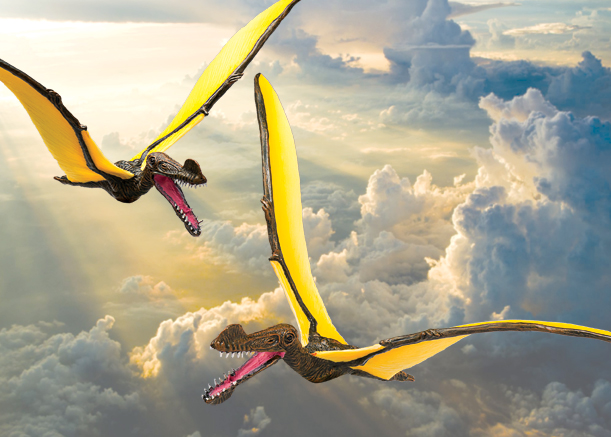
A pair of Mojo Fun Tropeognathus pterosaurs. Examples of typical flying reptiles (pterosaurs).
It is thought that the rapid expansion of the birds during the later stages of the Cretaceous hastened their decline, with only the likes of the Pteranodon and Quetzalcoatlus genera lasting until the very end of the Age of Reptiles.
Partial Hypsilophodontid Skeleton from Victoria Described.
A team of palaeontologists working on the rugged coastline of Victoria state have uncovered the first partial skeleton of a dinosaur, the first such find in the area for nearly 20 years. The team led by scientists from the Museum Victoria and Monash University have published their findings on a small plant-eating dinosaur found near Cape Otway
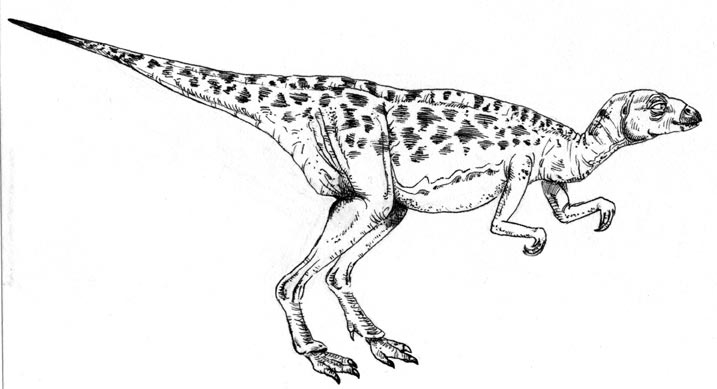
This small dinosaur, known as a hypsilophodontid, part of the ornithopod group, probably stood about a metre tall and would have been a fast runner. The rocks the fossil was found in date from approximately 106 million years ago (Lower Cretaceous – Albian faunal stage).
A Typical Hypsilophodontid Dinosaur Drawing
A typical hypsilophodontid dinosaur.
It is only the third partial skeleton of a dinosaur ever found in Victoria. The first two – of similar dinosaurs – were found about 20 kilometres away at the famous site known as Dinosaur Cove. Since then, only isolated dinosaur bones and teeth have been found in Victoria.
Research leader and Museum Victoria vertebrate palaeontologist Tom Rich, who with his wife Professor Patricia Vickers-Rich of Monash has led and funded the dinosaur operations in Victoria since 1978, have named and described a number of hypsilophodontids including Leaellynasaura and Qantassaurus
The latest discovery, from a sandstone shore platform, was first uncovered by the research team in November 2005, but details had not been publicly reported.
Exciting Fossil Discovery
The fossils reveal the rear half of the dinosaur’s spinal column, including the tail and a foot. Unfortunately, the front half of the fossil had already been washed away by the sea. However, tests carried out in the area reveals that this was probably a prehistoric log jam caused as rivers in flood gathered materials in a certain spot. This may mean that other fossils and evidence from the Cretaceous will have been preserved at this site, so there might be more dinosaur remains waiting to be discovered.
Around 106 million years ago this part of Australia was located approximately 75 degrees south, these little hypsilophodontids would have inhabited a polar forest, enduring freezing temperatures in the long Southern Hemisphere winter and survived in total darkness for 3-4 months of the year as the sun remained below the horizon.
One of the peculiarities about this group of little dinosaurs, is how they got their names. Leaellynasaura was named after Tom Rich and Professor Patricia Vickers-Riches’ daughter. Fair enough, but due to the sponsorship of the dig site and the support required from commercial organisations for the researchers to actually extract the fossils, some dinosaurs have ended up with strange names. For example, Qantassaurus is named after the Australian national airline, an important sponsor, and the small hypsilophodontid Atlascopcosaurus was named after Atlas Copco, another company that helped fund the dig and supplied important equipment.
The Famous Dinosaur Cove
An articulated partial skeleton of an Atlascopcosaurus found at the Dinosaur Cove mine provides an insight into the lives of these little dinosaurs. The left tibia (the shin bone) shows signs of an acute infection of the bone (osteomyelitis). Such a condition would have made this animal incapable of moving very far and would have effectively crippled it. However, this Atlascopcosaurus lived for many years with this painful condition. Scientists have speculated that this animal may have been part of a small family group and it was its clan members that looked after it. Also, this fossil evidence may indicate that these animals were year-round residents of the polar forests and did not migrate backwards and forwards following the sun, as some scientists have postulated. This Atlascopcosaurus would not have been capable of making such a long journey. Finally, the crippled Atlascopcosaurus may indicate that there were few predators around, as such a severe handicap would have made this little dinosaur an easy meal for any passing theropod.
Potential Trouble over new Chinese Law making all Fossils State Property
The Liaoning Province of northeastern China has become world-renowned for the amazing prehistoric animal fossils that have been recovered from its sediments. Indeed, much of the current work on the relationship between birds and theropod dinosaurs would not be taking place had not little feathered dinos such as Sinosauropteryx and Sinornithosaurus been discovered.
Despite the considerable palaeontological resources of scientific bodies such as the Institute of Vertebrate Paleontology and Paleoanthropology based in Beijing, it is not possible to explore this vast hinterland without the help and co-operation of the local peasant farmers.
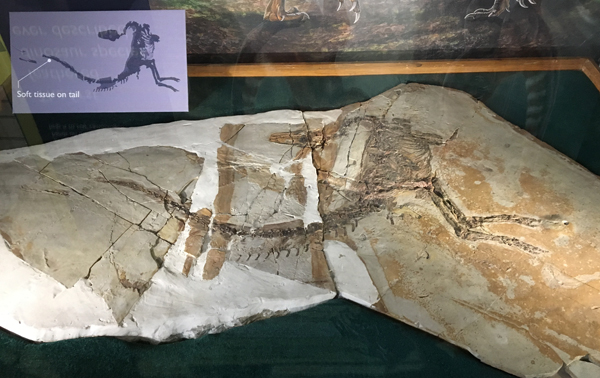
A Feathered Dinosaur Fossil (Sinosauropteryx )
Sinosauropteryx on display – the first feathered dinosaur described.
Picture credit: Everything Dinosaur
Earning Extra Income
Many local farmers have supplemented their meagre earnings from agriculture by digging pits into the fine sediments, finding fossils and selling them onto dealers and brokers, or even direct to the research institutes Thousands of individual specimens have been found by the peasants, carefully picking through layer upon layer of rocks and doing much of the “donkey” work for the palaeontologists.
This kind of “free market” approach has benefited science, a young boy found the first Chinese fossil bird Sinornis and a farmer discovered Sinosauropteryx. Only a few of the discoveries made to date have actually been made by palaeontologists and researchers, it is the farmers and peasants that have made the discoveries.
Naturally, the locals are curious to hear more about the strange,ancient creatures lurking in the ground but the real incentive is the possibility of finding an excellent specimen and cashing in on it.
Fossils are State Property
However, a new law which came into force in 2006 is now beginning to make its presence felt. The new law makes all dinosaur fossils state property, its aim is to cut down on the amount of small time excavation work and to prevent fossils being sold to dealers who then smuggle these items out for sale on the black market.
In November, matters came to a head when the issue of who actually owes fossil finds led to a court case in the central Henan province, where seven peasants were jailed for trying to prevent local officials from confiscating fossils they had collected.
If farmers are prevented from selling fossils openly, they will either give up digging, which could dramatically cut the supply of specimens to the museums or they could go literally “underground” and sell everything illegally on the black market. Which ever route is taken it spells bad news for palaeontologists.
They will lose a keen and willing workforce with local knowledge and a lot of fossils will simply leave the country via various illegal means and be lost to science forever as these finds will be destined for the private collections of the wealthy individuals of Europe, Japan and the USA.
Striking a Balance
Perhaps a balance could be struck with the setting up of local, unbiased vetting stations. Finds could be brought in by the farmers for examination by scientific staff, who the state could provide funds to, allowing them to purchase any finds. Those fossils not deemed worthy of further study could be returned to the discoverer who would then be free to sell his fossil on the open market.
No matter what system is proposed there is always the possibility of misrepresentation and corruption. However, if the palaeontologists and the state museums are given the funds to allow them to have first choice of the fossil finds, then the peasants will be disinclined to turn to the black market and they will be properly rewarded for their digging.
We suspect there are many more amazing discoveries awaiting us in the vast fossil rich sediments of China, how many actually see the light of day, how many end up in private collections before they have a chance to be studied has yet to be decided.
Amazing Fossil Discoveries
The dinosaurs from Liaoning and other parts of China have helped to revolutionise the way scientists think, thanks to these amazing discoveries our knowledge of dinosaurs and their kin has been changed forever. At Everything Dinosaur we are being asked more questions about feathered dinosaurs than 2 years ago, they really seemed to have captured people’s imaginations. We are working on a number of feathered dinosaur projects, for example new models are being introduced by most of the major model manufacturers that reflect these new ideas and dinosaur interpretations.
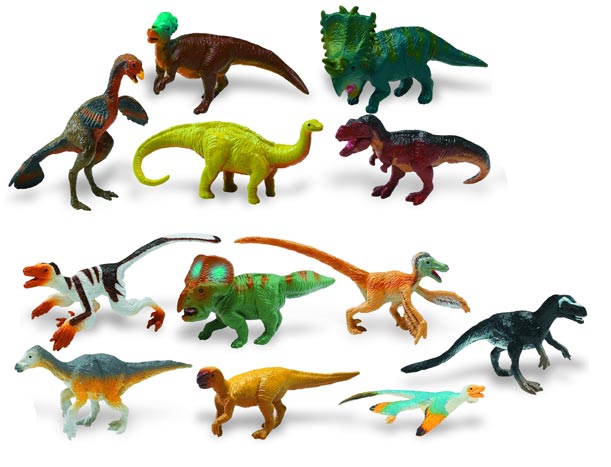
One of our popular sales products this Christmas has been the Feathered Dinosaur Tube, a set of models showing feathered and non-avian dinosaurs. These models have been designed by the palaeontologists at the American Museum of Natural History (New York) and the tubes contain a variety of dinosaur models including the likes of Microraptor, a feathered Velociraptor, Caudipteryx, the small Theropod Dilong as well as some non-feathered dinosaurs such as Chasmosaurus and Protoceratops to keep them company.
Forget the Boxing Day Sales – how about Bidding for a Tyrannosaur at an Auction?
Today is the day when lots of people brave the high street crowds in a bid to snap up a bargain at the traditional Christmas holiday sales. Lots of shoppers may be looking for the latest HD ready television or the next game for their X-box 360 but if you want to purchase something a little different this year then an auction house based in the famous ski resort of Aspen (Colorado), is offering a tyrannosaurid head for sale.
Tarbosaurus Dinosaur Skull
However, be prepared to face up to some high rollers as dinosaur fossils and other prehistoric relics are being purchased by celebrities and other well-to-do folk. With a price tag of £225,000, this tyrannosaur skull is going to take a big bite out of your Christmas budget.
True enough, dinosaur fossils have become extremely popular over the last few years with many movie stars and celebrities purchasing rare items for their own private collections. Last summer Nicholas Cage and Leonardo Di Caprio went head-to-head bidding for another tyrannosaur skull at a Beverley Hills auction house.
The tyrannosaur skull has been classified as belonging to a Tarbosaurus bataar (means alarming reptile), a Late Cretaceous, Asian relative of Tyrannosaurus rex.
The 45 kilogramme skull which consists of about 75% fossil material, the remainder being restoration materials used to complete the skull, is being auctioned by the Nature Gallery by Rick Rolater, the gallery owner.
Rick has specialised in the sale of unusual and rare collectibles for more than 30 years, explaining people’s interest in the fossil he stated; “I think all of us are fascinated with dinosaurs”.
An Asian Tyrannosaur
Tarbosaurus was an Asian tyrannosaur that lived in the Late Cretaceous. Its remains were first found in the late 1940s when a joint Mongolian/Soviet expedition explored the Gobi desert. It may have reached lengths of 14 metres or so, making it the largest predator in the area at the time and top of the food chain. Despite the relatively abundant skull material that has been recovered (skull material is very important as it helps palaeontologists trace relationships between different genera); it is still debated whether Tarbosaurus is a separate genus.
There is a lot of conjecture as to whether this animal is sufficiently different from Tyrannosaurus to be granted its own distinct genus. What is for certain is that whether or not tarbosaurs and tyrannosaurs are different enough to merit their own individual genera, they are very closely related.
The tyrannosaur family tree remains shrouded in controversy. The lack of fossil evidence makes it very difficult to piece together the relationships between all the different types of Tyrannosauroidae. The earliest tyrannosaur remains have been ascribed to a small bipedal dinosaur found in Portugal but this has been challenged recently with possible Jurassic tyrannosaur finds in China (Guanlong – estimated to be 160 million years old).
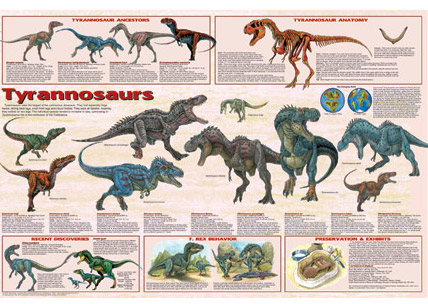
At Everything Dinosaur we have been able to source a beautifully illustrated poster that shows the evolution of tyrannosaurs. It explains how these predators came to dominate food chains and charts their rise to prominence (and infamy) in the dinosaur pecking order.
A founder of the chain of Discovery channel stores in the USA, Rick commented that his reputation as a seller of rare items and his network of contacts in the fossil hunting community enabled him to land the most prized items for sale at his Aspen gallery. Mr Rolater has run a similar venture at the exclusive ski resort of Beaver Creek before opening the gallery in nearby Aspen in 2005.
The well preserved skull is one of six that were exported out of Mongolia about 10 years ago. The skulls of large theropods are extremely scarce and this sale represents a rare opportunity to purchase a piece of palaeontology all for yourself. After all, they stopped making tyrannosaur skulls about 65 million years ago!
Your Christmas Dinner Provides Evidence of Dinosaurs Close Relation to Birds
The idea that certain dinosaurs such as Velociraptor, Caudipteryx and even Tyrannosaurus rex were quite closely related to modern birds is now accepted by most scientists. Many lay people believe that this theory is quite modern, the idea of dinosaurs being related to birds coming about due to the amazing discoveries of feathered dinosaurs in places such as the Liaoning province in China. However, this idea has been around for at least 140 years.
Thomas Huxley, the English scientist and supporter of Charles Darwin first proposed a special classification for dinosaurs and birds, grouping them together in their own Order called “Sauropsida” demonstrating their close relationship. He studied the anatomical links between birds and reptiles and listed a number of characteristics that are shared between certain dinosaurs and birds, thus demonstrating that they must be closely related. He published his work in 1867, making the theory about a link between dinosaurs and birds much older than most people think.
Christmas Dinner Linked to Dinosaurs and Birds
Christmas is an ideal time for young, budding palaeontologists to explore the links between dinosaurs and birds and you don’t need a Victorian anatomy collection to do this – just your Christmas dinner.
You can spot several features in your Christmas roast Turkey, Goose or Chicken that helps link these birds to the theropod dinosaurs (the lizard-hipped group of dinosaurs that scientists believe are the direct ancestors of birds).
Here is the Everything Dinosaur guide to dissecting your Christmas roast so that you can demonstrate the close anatomical relationship between dinosaurs and our modern feathered friends. All you need is a sharp knife (parents to assist here), and you can see for yourself some of the traits that link your Christmas dinner with the likes of a ferocious Velociraptor.
The Everything Dinosaur Christmas Dinner Autopsy
There are a number of features in a roast turkey/goose/chicken dinner that you can identify that links these birds with their Dinosauria ancestors, but today we shall focus on just two, the breast bone (flight muscles) and the wishbone (the furcula). Once the bird has been cooked and has been taken out of the oven to rest, with a bit of careful carving you can see these characteristics for yourself.
Anatomical Feature 1 – Breast Bone and Flight Muscles
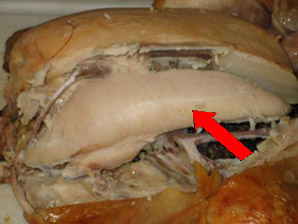
Carefully peel back the skin of the bird away from the breast, a word of caution here, even if the bird has been resting out of the oven for a few minutes the meat under the skin will still be hot so take care. Once the skin has been removed you can see the white breast meat. This meat is attached to the breast bone or sternal plate. Birds and dinosaurs share a similar sternal plate. The large area of white meat on the breasts is actually a muscle called the major pectoralis. This is the muscle which powers the down stroke of a bird’s wing.
A Picture of the Major Pectoralis Muscle (on our Christmas dinner)
The red arrow is pointing to the major pectoralis muscle on the right-hand side of the bird.
Underneath this muscle is another major flight muscle called the supracoracoideus. This one is very easy to find in your Christmas roast, simply carefully remove the larger major pectoralis in strips and this will expose a long, lozenge shaped supracoracoideus muscle. This is the muscle that powers the upward movement of a bird’s wing in flight.
A Picture of the Supracoracoideus (on our Christmas dinner)
The arrow shows the muscle.
Picture credit: Everything Dinosaur
The red arrow is pointing to the supracoracoideus muscle, it is quite easy to recognise being a sort of tongue or lozenge shaped muscle directly under the white breast meat of the bird.
We therefore have identified the following muscles in our Christmas dinner:
The major pectoralis – that powers the downward stroke of a wing beat.
The supracoracoideus – which raises the wing.
We can trace the evolution of this muscle across theropod dinosaurs.These muscles sit on the breast bone (sternal plate) which is present in a variety of non-avian dinosaurs. Palaeontologists can study the fossilised muscle scars on the bones of dinosaurs, this is why we know that animals such as Velociraptor had these muscles present.
Tracing the Furcula – Anatomical Feature 2 (The Wishbone)
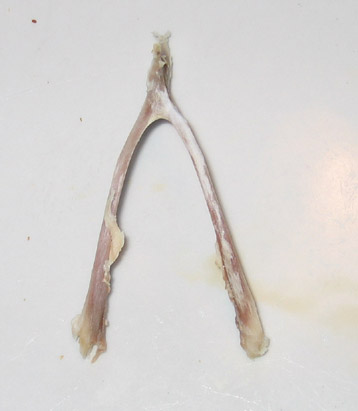
You can now remove these flight muscles to reveal the wishbone, take the wishbone out. The wishbone is formed by the fusion of two collarbones (the scientific name is clavicles); and is a feature present in both birds and dinosaurs.In birds it strengthens the skeleton to withstand the rigours of flight.The scientific name for the wishbone is the furcula.
The Wishbone from our Christmas Dinner
Furcula (wishbone).
Picture credit: Everything Dinosaur
Wishbones have been associated with a number of excavated theropod fossils. It helps to demonstrate the link between dinosaurs and birds.
Oviraptor (first one found in the 1980s) – quite advanced more closely resembling the wishbones we find in birds.Other dinosaur wishbones discovered:
Velociraptor (another advanced wishbone design).
Bambiraptor, Albertosaurus, Gorgosaurus, Allosaurus and T. rex the biggest wishbone found to date (measures approximately 35 cm long and is shaped like a boomerang with a thick end and a slightly thinner end).
If the furcula is added to the skeleton of a theropod then the whole arrangement of the shoulder blades and the arm bones is called into question. Debate is ongoing whether the presence of a wishbone in certain dinosaurs would have altered palaeontologist’s interpretation as to the location of the shoulders and arms of these dinosaurs.
A Picture of an Albertosaurus without the Furcula
The wishbone is absent.
Picture credit: Everything Dinosaur
The above picture was taken by a member of the Everything Dinosaur team on one of their many visits to the Royal Tyrrell museum in Alberta, Canada. In an exhibit of Albertosaurus, an exhibit that had been mounted quite a few years ago, the forelimbs are shown to be spaced far about and no furcula has been added to this reconstruction.
A Picture of a Tyrannosaurus rex “Stan” with a Furcula
The arrow shows the wishbone in the mounted skeleton.
Picture credit: Everything Dinosaur
The picture above is a snap of the mounted cast of the “Stan” Tyrannosaurus rex.
The red arrow indicates where the wishbone or furcula has been reconstructed on top of the scapulae (the shoulder blades). This “U” or “V'” shaped bone has been found in a number of theropods, it may have been in contact with the anterior edges of the scapulae, coracoids and sterna (breastbone). Note how as a result of the addition of a furcula the position of the arms has been changed. The scapulae are positioned much closer together, which in turn positions the arms in closer proximity to each other.
Dinosaurs to Birds
There are other features of your Christmas dinner that we could use to illustrate the close anatomical relationship between birds and the theropod dinosaurs, the articulation of the hip-bone, the position of the legs under the body, the feet and such like, but we will save these for another time.
To view Everything Dinosaur’s huge range of dinosaur models including theropod dinosaur replicas: Dinosaur Models.
Meanwhile, the Christmas pudding is waiting and we think that we have dissected enough of our dinner, but there you have it – proof on your plate as to how closely related dinosaurs are to birds.
Dubai’s Ruling Family Plans Robotic Prehistoric Animal Theme Park
Moving away from their dependence upon oil revenues, developing the state of Dubai as a world class destination has been the vision of the Al-Maktoums, Dubai’s ruling family for some time. The waterfront along the city of Dubai has been completely redeveloped over the last few years with a huge boom in tourist attraction construction, from the building of famous landmarks such as the seven star Burj Al Arab, the giant sail-shaped hotel to the creation of artificial islands to enhance the areas leisure facilities.
The “Restless Planet”
Now a new attraction called “Restless Planet” will take visitors on an amazing tour of the Earth’s history, with the star attractions being a number of high-tech, super realistic giant animatronic prehistoric creatures. There are plans to feature more than 100 robotic animals, a total of 40 different species in a visual panorama of the Mesozoic era – a sort of “Jurassic Park” but in real life. The aim of the attraction is to create a cross between a conventional museum and a theme park with the robotic animals reacting to visitors as they roam freely throughout the exhibit.
Robotic Reptiles
Imagine how a party of tourists might feel when, on hearing their approach a 40 foot Tyrannosaurus suddenly wheels round and roars at them!
For Audrey O’Connell, the museum’s project co-coordinator one of the biggest tasks is to re-create Mesozoic landscapes which are scientifically accurate. To assist her she has called upon the expertise of the Natural History museum in London plus the world renowned American palaeontologist Jack Horner. Jack, an expert on Late Cretaceous dinosaurs (hadrosaurs are his favourite), advised Steven Spielberg on the Jurassic Park films. Jack, with his long hair, dark beard and penchant for wearing stetson hats even inspired a character from the second movie – “The Lost World”. Unfortunately, this character, one of the palaeontologists with the larger Hammond expedition ended up being eaten by a Tyrannosaurus rex.
A Robotic Tyrannosaurus rex Life-size Replica
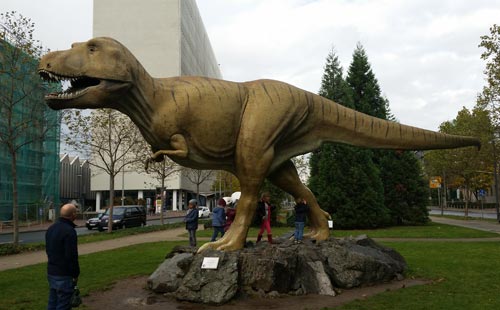
A well-known Frankfurt landmark. The T. rex outside the Naturmuseum Senckenberg .
Picture credit: Everything Dinosaur
Audrey stated “we wanted to create a hybrid of a theme park and a museum which would allow people to experience a Jurassic era habitat in a scientifically realistic environment”.
A New Attraction
This new attraction will be sited just 6 miles from the coast in an area of development called the City of Arabia and it should be open in 2010, although once opened the attraction management team hope to be able to continually update their exhibits to reflect new discoveries and new research into prehistoric animals.
It will be the size of 10 football pitches and consist of two climate-controlled buildings, one of them dome-shaped. It will contain grassland and woodland divided into several different micro-environments, within which the various animals will wander. As well as the dinosaurs, pterosaurs will swoop overhead and amphibians will swim in a large, artificial lake.
Inspired by Jurassic Park
The park’s developers hope to set new standards in the realism of animatronics in the same way that Steven Spielberg’s 1993 film Jurassic Park was a landmark in computer graphics with its dramatic portrayal of dinosaurs on screen.
An international team of scientists led by the museum are advising on the accuracy of details such as the stretching of the dinosaurs’ skin, their colour, the flaring of their nostrils and the smell of their breath.
In addition to the dinosaurs, the park will include displays showing the development of Earth from the big bang to the creation of oceans and mountains, before arriving in the age of the dinosaurs. An adjoining exhibition hall will house temporary exhibitions, some of which are likely to be loaned from leading Natural History museums.
The Dubai Project
The Dubai project is the first of a series of four scientific theme park-style attractions which the museum plans to develop overseas. It seems apt that having built up the state on a fossil fuel economy, that other fossils should now act as the inspiration for the development of Dubai as a major tourist attraction.
The emphasis will be on realism, with realistic prehistoric animals wandering a realistic prehistoric landscape.
The Press Release
Below is a copy of the press release sourced from the Restless Planets own site:
“Imagine going back 100 million years or more… to feel the power of the cosmic forces that helped shape our planet, and come face to face with giant dinosaurs. Restless Planet is a unique electronic media and natural history experience… where visitors enter a prehistoric world.
Restless Planet offers the world’s ultimate theme ride back into the mists of time – through the state-of-the-art electronics of today. Here, in the glittering new City of Arabia, you are transported back millions of years into the prehistoric kingdom of the dinosaurs. The world-renowned Natural History Museum of London has drawn on the elite of science, entertainment and technology expertise to realise the dream of bringing these giant creatures and the mysteries of the nature of our planet to life.
Along with the acclaimed dinosaur authority Jack Horner, Tokyo-based animatronics team Kokoro have recreated the real life creatures of the Jurassic era, the visitor experience is designed by international theme park specialists Jack Rouse Associates and is enclosed by a 75-metre dome, designed by international specialists firm RH Architects.
Gathered from the latest research available, the creators of the Restless Planet transport you into an age where earth-shattering events impacted the world. From earthquakes, eruptions and meteor strikes, the evolving shape of our planet will come alive before your eyes.
Step Back in Time
Step back in time to when our Earth was young. Feel your heart race as you travel through a Jurassic landscape alongside gigantic dinosaurs. Restless Planet is a unique, world-class natural history phenomenon, designed to draw tourists and investment and put Dubai into the scientific spotlight on the international stage.
A first of its kind in the world, Restless Planet will respond to breaking dinosaur discoveries through an ongoing programme of exhibits, announcements and events. No visit to Dubai will be complete without the thrill of stepping into our primitive world. Real natural history and entertainment – more exciting and authentic than ever before, and an attraction for all ages.”
With the world-wide “Walking with Dinosaurs” tour continuing to pack stadia I am sure this attraction will prove a success. However, whether or not they are able to satisfy the keen eyed palaeontologists on the exhibits accuracy is a different kettle of animatronic fish. For example, in the publicity DVD to promote the park, a tracking shot of brachiosaurs and stegosaurs majestically walking across a plain is interrupted by the passing overhead of a large pterosaur. The problem is that the flying reptile is clearly modelled on an Pteranodon ingens, pterosaurs like this evolved long after the likes of brachiosaurs and stegosaurs had disappeared – never mind.