All about dinosaurs, fossils and prehistoric animals by Everything Dinosaur team members.
23 12, 2007

Why did Spinosaurus have a Sail on its Back?

By |2022-11-06T09:10:09+00:00December 23rd, 2007|Categories: Dinosaur Fans, Everything Dinosaur News and Updates, Main Page|11 Comments

Theories on Spinosaurus – the Sail-back Dinosaur

Spinosaurus was one of the most spectacular looking meat-eating dinosaurs.  Like most of the big carnivores, fossils of this bizarre animal are extremely rare.  As animals move up the food chain, their numbers become smaller and they make up an ever-decreasing proportion of the ecosystem, which means it is less likely for any of them to be preserved as fossils.  For example, scientists in Canada and the western United States can conduct studies on duck-billed dinosaurs (herbivores) that involve hundreds of skeletons, yet in contrast there are only about 30 known fossils of Tyrannosaurus rex.

Spinosaurus

Spinosaurus is even less well-known, this is because a number of factors have conspired to leave us with little fossil evidence of this dinosaur.  There are few Spinosaurus remains partly because as a meat-eater and at the top of the food chain there were fewer of them around at any one time and also because the area of Africa that Spinosaurus lived in during the Cretaceous has still to be fully explored.  Unfortunately, the 20th Century has been particularly unkind to this dinosaur, with the best fossils of Spinosaurus being destroyed in a bombing raid over Germany during WWII.

Ernst Stromer von Reichenbach, a German palaeontologist and geologist found the first fossils of Spinosaurus (1912), in an area approximately 300 kilometres south-west of Cairo, Egypt.  A number of German funded and led expeditions were despatched to north Africa between 1911 and 1914, Spinosaurus was named and described by Ernst Stromer von Reichenbach in 1915.  Estimates of its size vary, with most scientists stating that these animals grew to lengths in excess of 12 metres and they may have weighed as much as 4 tonnes.

An Illustration of Spinosaurus (S. aegyptiacus)
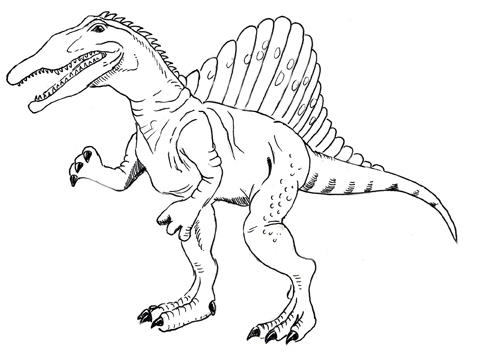
A drawing of Spinosaurus.

Picture credit: Everything Dinosaur

Over the last ten years or so more partial remains of spinosaurs have been found.  There are now believed to have been two species of Spinosaurus around during the Cretaceous (approximately 95 million years ago).  The larger species S. aegyptiacus from Egypt and a less well known, smaller species from Morocco (S. marocannus), which was named and described in 1996.  Spinosaurus marocannus has yet to be universally accepted as a different species, it is still classified as “Nomen dubium” – a name given to an animal whose validity is still in doubt.

In 2005, Cristiano Dal Sasso and his colleagues at the Civic Natural History Museum in Milan, Italy, carried out a study of the partial remains of a Spinosaurus skull that had been discovered just a few years earlier.  The assumption had always been that the original Spinosaurus unearthed in 1912 was a sub-adult and not fully grown.  Using those parts of the skull that they had – mainly parts that formed the upper jaw, this team of scientists calculated skull length and from this they deduced the overall size of this particular specimen.  They concluded that the skull would have exceeded 1.75 metres in length, making it comparable to the size of the biggest tyrannosaur or allosauroid skulls known.

The Biggest Meat-eating Dinosaur

They concluded that this creature would have been between 16 – 18 metres long (approaching 60 feet in length) and would have weighed as much as 9 tonnes.  Spinosaurus could lay claim to the title of the biggest meat-eating dinosaur known.

A Size Comparison between Spinosaurus aegyptiacus and Tyrannosaurus rex
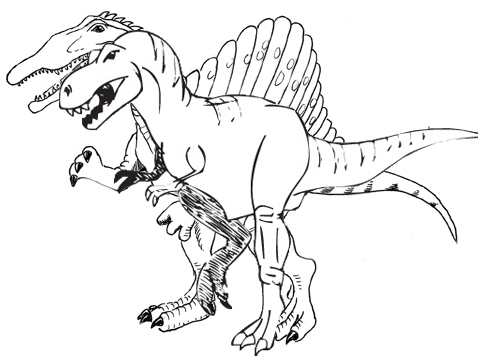
Comparing T. rex to Spinosaurus.

Picture credit: Everything Dinosaur

The above diagram attempts to compare the projected sizes of T. rex and the largest known species of Spinosaurus.  Scientists are still unsure how much Spinosaurus weighed.  It may not have been as heavy as Tyrannosaurus rex but if the Italian led team from the Civic Natural History Museum of Milan are correct, the largest spinosaurs would have been longer than the biggest known T. rex.  The figure of a man (approximately 1.80 metres tall) is given to provide further scale.

The most striking feature about Spinosaurus was undoubtedly its huge sail.  Again estimates vary as to the size of the sail, but most scientists agree that at its highest point it was between 1.5 to 2 metres tall.  Very few fossils of these spines (called neural spines) have been collected.  For example, in the original 1912 specimen only 8 elements of individual neural spines are known, most of which were not found in association with the back vertebrae.  The German scientists had no real idea how these spines fitted together with the backbone, or indeed which order they should be put in.  The photograph of the team’s attempts to reconstruct the backbone show the spines arranged in a nice convex pattern, but the vertebrae connected to the spines for the reconstruction are clearly in the wrong order.

The spines themselves seem to have a broadened out top end, they are sort of spoon shaped or spatula like.  Similar shaped neural spines can be found in bison, these spines help support a fleshy lump on the backs of these animals where fat is stored to help the animals through leaner times.

There is only limited photographic evidence of Ernst Stromer von Reichenbach’s work on the Spinosaurus fossils, most of the photographs were destroyed by the Allied bombing raid on Munich in 1944.

A number of theories about the sail have been put forward.  It has been suggested that such a big animal could use the structure on its back like a sail on a ship to help it move or at least keep stable as it lumbered along.   A similar theory was put forward many years ago concerning the function of the sail on the back of a mammal-like reptile called Edaphosaurus.

A Piscivore

It is believed that Spinosaurus was a fish eater.  There is no proof for this, the arms of Spinosaurus have never been found but as the jaws are similar to Baryonyx (a relative, which scientists believe did eat fish), perhaps the sail was used to cast a shadow over water to attract fish or to let Spinosaurus see fish in the water without the reflection from the water surface to distract it.

Could the sail have acted as a device for helping Spinosaurus warm up quickly in the beginning and end of  the day, as well as helping to keep it cool under the mid-day sun? Palaeontologists believe that the sail area was well supplied with blood vessels, turning to face the sun in the morning would have helped this animal to warm up quickly, perhaps giving it an advantage over the other meat-eaters that roamed north Africa at this time.  Turning directly into the sun at mid-day would have exposed only a small portion of the sail’s surface area to the sun and this would have helped Spinosaurus keep cool.

Another theory has been put forward recently by a young dinosaur fan called Ewan.  He thinks that the sail on the back of Spinosaurus could be a mock spine, that could put off an attacking dinosaur.  We know that Spinosaurus shared its world with some very ferocious carnivores such as Carcharodontosaurus, the spine could make Spinosaurus look bigger than it actually was so it could intimidate predators.  We know from bite marks on hadrosaurs that the back was a favourite area to target for the big meat-eaters, perhaps the spine helped protect the vulnerable back and neck of Spinosaurus.  Many animals use spines as a form of defence, so why not a Spinosaurus.  It is certainly an interesting theory and without more fossil evidence like the other theories concerning the sail on a Spinosaurus it cannot easily be disproved.

Our own favourite theory concerns a theory put forward recently from palaeontologists who studied the remaining Spinosaurus fossils as well as the drawings made by the German team under the supervision of Ernst Stromer von Reichenbach.  Fortunately, many of these drawing survived the war and they helped to give today’s scientists a unique insight into how flexible the backbone of Spinosaurus was.  From the fragmentary remains and the beautiful pencil and ink drawings from the last century, scientists have calculated that the backbone was quite flexible.  Perhaps Spinosaurus was able to flex its back and spread out the sail like an enormous fan.  If the sail had been brightly coloured it could have been used to attract a mate or to scare off rivals.  Due to recent studies of theropod brain cases and other evidence amassed from studies of the skulls and in the particular the area where the optic nerve was present, it is now thought that these dinosaurs had excellent eyesight and colour vision, so a big, colourful signalling device would have been extremely useful.

We are indebted to Ewan and his father for helping to write this article.

To view the range of Spinosaurus models and figures available from Everything Dinosaur: Spinosaurus and Prehistoric Animal Models.
22 12, 2007

Deer-like Fossil Confuses Whale Evolution Research

By |2024-04-03T07:19:19+01:00December 22nd, 2007|Categories: Dinosaur and Prehistoric Animal News Stories, Main Page|0 Comments

Land Dwelling Potential Ancestor of Whales Described

Researchers at the North-eastern Ohio Universities Colleges of Medicine and Pharmacy have published a paper on a land dwelling animal that shows links to the ancestry of whales.  The discovery of this animal could possibly provide evidence of a missing link in how terrestrial animals adapted to a marine existence.

Scientists have speculated that the ancestor of whales (cetaceans) was probably a carnivore with the otter-like Ambulocetus from the Eocene being a strong contender.  Ambulocetus means “walking whale” , the remains of this animal, which could reach lengths of 3 metres or more, have been found in Pakistan, now a new fossil from Kashmir, provides further insight into the evolution of modern whales.

Fossil From Kashmir

This new fossil, which was actually unearthed 30 years previously, but has only recently been studied closely, is of a small deer-like animal, about the size of a large domestic cat, that roamed the dense rain-forests of Kashmir around 48 million years ago.  It had been thought that the ancestors of whales had adapted to a life in water as they hunted fish or became waterside ambush predators similar to crocodiles.  However, this little animal was definitely herbivorous, perhaps taking to an aquatic lifestyle to munch on lush water plants much as rodents like the South American Capybara do today.

This little animal has been named Indohyus,  although the skeleton is not complete the skull has been found and the preserved middle ear structure is identical to that found in the cetacean group.  Isotope analysis of the teeth is a little ambiguous, but has led to speculation that this animal was probably a herbivore and that it may have fed in water, although another interpretation of this data would conclude that Indohyus probably fed on land but spent a lot of time in an aquatic environment.

Ancestor of Whales

Lead researcher Hans Thewissen commented “what we think happened is that the ancestors of both Indohyus and whales were animals that looked like tiny deer”.  Discussing the apparent herbivorous habit of Indohyus he added “apparently the dietary shift to hunting animals, as modern whales do, came later than the habitat shift to the water”.

The research team, whose work has just been published in the journal Nature conclude that Indohyus was probably not a direct ancestor of modern cetaceans as the fossil remains of this little animal date 48 million years ago, whilst remains of marine mammals such as Pakicetus date from at least 50 million years ago.

For models and replicas of prehistoric mammals and other extinct creatures: Prehistoric Animal Models

21 12, 2007

And the Beetles shall Inherit the Earth According to New Research

By |2024-04-03T07:18:28+01:00December 21st, 2007|Categories: Dinosaur and Prehistoric Animal News Stories, Dinosaur Fans, Main Page|0 Comments

Scientists Show that Beetles evolved alongside the Dinosaurs

A visitor to Earth 230 million years ago wandering the Middle Triassic landscape may well have marvelled at the small, but swift moving, funny looking reptiles that seemed to becoming more abundant.   These were the first dinosaurs, who along with other fast moving reptiles such as the Ornithosuchia, ancient reptiles from the archosaur group and the mammal-like reptiles and the “dead clades walking” left over from the Permian extinction made up the mega fauna of this period.  However, hopefully such a visitor might have taken time to study a much smaller group of animals, just beginning to make their presence felt in the undergrowth and flying around the horsetails and ferns.

These were the early ancestors of beetles, a group of insects classified as the order Coleoptera and arguably now the most successful group of creatures on the planet, with scientists estimating that beetles make up about 25% of all known animal species.  A conservative estimate of total beetle species (the vast majority yet to be named and described); puts the total number of individual beetle species at around 8 million – 1,000 times as many species of beetle than all the mammal species on Earth.

Early Beetles

Now a British based research project tracing the origin of beetles indicates that these creatures appeared at the time of the first dinosaurs.  The research team, led by Professor Alfried Vogler from Imperial College London and the department of Entomology at the Natural History Museum, put the success of beetles down to their ability to diversify and fill a wide range of ecological niches.  The very large number of beetle species may be due to these animals ability to evolve rapidly to exploit new opportunities within ecosystems as they arise.

Certainly as the Jurassic period came along with its warmer and wetter climate this would have fuelled beetle diversification, just as it did with the dinosaurs.

The team used DNA sequencing from 1,880 beetle species, coupled with a review of the known beetle fossil record, to compile a family tree of Coleoptera, which could then reveal the key moments in the evolution and development of beetles.

Previous scientific research had indicated that the beetle group had diversified due to the emergence of flowering plants in the Cretaceous period.  This new study shows that beetles diversified and evolved into new forms much more quickly than previously thought.

Professor Vogler stated that beetles have displayed an exceptional ability to seize new ecological opportunities and develop a great range of life styles and feeding types.

“Unlike the dinosaurs which dwindled to extinction, beetles survived because of their ecological diversity and adaptability,” he said.

Beetle Evolution

Gaining a better understanding about the evolution of beetles is an important part of learning about the world around us.  Studying such a successful group of insects can help scientists learn more about biodiversity and how ecological niches are filled.

The hard exoskeleton (carapace) of beetles and their abundance makes fossils of them pretty common.  Many pieces of amber contain beetle fossils and members of the Everything Dinosaur team have seen water beetle fossils from late Pleistocene times as they removed samples from tar pits.

Visit Everything Dinosaur’s website: Everything Dinosaur.

20 12, 2007

A Rare Prehistoric Handbag or Prehistoric Tool Kit?

By |2024-04-03T07:14:09+01:00December 20th, 2007|Categories: Dinosaur and Prehistoric Animal News Stories, Dinosaur Fans, Main Page|0 Comments

Rare Collection of Mesolithic Tools Provide Insight into Hunter/Gatherer Life

A beautifully preserved 14,000 year old sickle part of an ancient hunter/gatherer’s prized possessions has just been put on display at the Faculty of Archaeology and Anthropology at Jordan’s Yarmouk University.  The double bladed sickle, made from two carefully grooved horn pieces fitted with stone bladelets is part of a remarkable set of Mesolithic tools found at a site in Jordan.  The area was inhabited by the Natufian people, early humans that lived in the Mediterranean region, establishing some permanent settlements around water holes but mainly leading a hunter/gatherer existence.

Prehistoric Handbag

Sometime around 14,000 years ago, one of these ancient people left a wicker or leather bag by the side of a stone round house and although the bag itself has long since perished its contents lay untouched awaiting discovery.  Now archaeologists have excavated the area and published their findings in the scientific journal “Antiquity”.

Although a lot of individual stone age tools and items have been discovered, it is very rare to find a collection, one person’s possessions.  The tools show that these people were well equipped for their hunter/gatherer lifestyle.

Hunter/Gatherer Lifestyle

Describing the contents of the bag for journalists, Phillip Edwards, senior lecturer in the Archaeology programme at Melbourne’s La Trobe University (Victoria, Australia); stated that the tools indicate that this person hunted but also used some tools for gathering wild plant food.

The tools consist of a sickle for harvesting the wild cereals that grew in the region (wheat and barley), a cluster of flint spearheads and a larger piece of flint and a big stone (perhaps for striking more spearheads from the large flint).  Also included in the tool kit was a set of small, rounded pebbles, perhaps sling shots, a cluster of gazelle phalanges (toe bones) which were used to make decorative beads and part of a second bone tool.

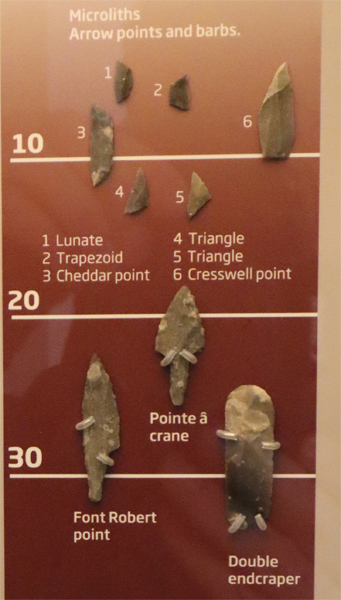
A Museum Exhibit Showing Stone Tools

Stone Age Tools. The Movius line explained.

A collection of typical Stone Age Tools. Picture credit: Everything Dinosaur.

Picture credit: Everything Dinosaur

A Shoulder Bag

Scientist Phillip Edwards believes that the wicker or leather bag may have had a strap which enabled it to be slung over the shoulder, a bit like a modern handbag or man-bag for that matter.

The discovery, from an archaeological site called Wadi Hammeh 27 in Jordan has yielded a number of finds providing a glimpse into the lives led in this early civilisation.  The bag probably did not have any compartments so to protect these items they were probably wrapped in bark or small pieces of leather to prevent them bashing into each other.

The hunting weapons were used to kill the plentiful game that existed in the area at the time.  These people hunted aurochs (ancient cattle), gazelles, deer, hares as well as tortoises and many different types of bird.  The contents of the bag has led archaeologists to question our understanding of gender roles in early people.  As the bag contains beads and a tool for gathering plant material as well as hunting equipment, the original owner could have been either a man or a woman.

For models and replicas of Stone Age people and Pleistocene mammals: CollectA Prehistoric Animal Figures.

Perhaps the hunting and gathering roles were split up between the genders rather than the more traditional view of women gathering food and the menfolk being the hunters.

19 12, 2007

Allosaurus Fossils Discovered In Thailand

By |2022-11-06T08:54:11+00:00December 19th, 2007|Categories: Dinosaur and Prehistoric Animal News Stories, Dinosaur Fans, Main Page|0 Comments

Largest meat-eating Dinosaur Known to Date from Thailand

A group of palaeontologists working in the North-east of Thailand close to the village of Ban Saphan Hin in the Muang district have uncovered the fossilised bones of an Allosaurus – the largest carnivore found to date in the country.

Working in layers of sediment estimated to be 100 million years old (late Albian faunal stage), the scientists have uncovered the remains of several prehistoric animals, providing them with a unique insight into the ecosystem.  As well as the partial remains of a member of the allosauroid family, iguanodontids and a duck-billed dinosaur (hadrosaur) have also been discovered.  It is likely that these plant-eaters were the prey of the bigger allosaur.  Without the complete skeleton it is difficult to estimate the size of this meat-eater but an examination of the teeth (some of which are more than 10 cm long) and other material indicates that this animal could have exceeded 10 metres in length.

Allosaurus Fossils

The allosaurs are a very widely distributed group of meat-eating dinosaurs, part of the order Theropoda.  allosaur remains have been ascribed to Western USA, Africa and Portugal.  There has even been evidence of allosaurs found in Australia.

Allosaurus was named and described by the American palaeontologist Othniel Charles Marsh in 1877.  This is the same year that Stegosaurus was named and described.  The terms Allosaurus and Stegosaurus have been used by palaeontologists for 130 years.  An almost complete skeleton of Allosaurus (A. fragilis) was discovered in the United States in 1883.  Many more articulated skeletons have been found and Allosaurus is one of the better known theropods.  Allosaurus got its name “different lizard” as Marsh noted that the back bones (dorsal vertebrae) had cavities in their sides and this had not been seen in other dinosaur fossils at the time.  These cavities (pleurocoels), probably contained air sacs and helped lighten the skeleton whilst retaining bone strength.

A Typical Allosaurus – Picture of Model Taken from the Schleich Series (Dinosaurs)

Schleich Allosaurus dinosaur model.

Picture credit: Everything Dinosaur

Models of Allosaurus and other meat-eating dinosaurs: Dinosaur and Prehistoric Animal Models.

Allosaurs were large predatory theropods with relatively deep skulls.   Many had horns in front of the eyes or a row of bumps or hornlets along the tops of the nasal bones. The arms were much larger than in the later tyrannosaurs and they possessed three, sharply clawed fingers on each hand.

Late Jurassic Theropods

Scientists believe that the allosaurs had their hey day in the Late Jurassic but then went into decline during the Cretaceous (possibly due to competition from abelisaurids, spinosaurids and tyrannosaurs), but many genera seem to have survived in Gondwanaland and the southern continents.

A number of dinosaur fossils have so far been discovered, 1,000 fossils have been extracted and are awaiting further study.  Thai scientists are being supported by palaeontologists from China as they bid to classify them all.  The remains of a pterosaur (flying reptile) have also been recovered from the site.

18 12, 2007

Ancient Ancestor of Armadillos Found in the Andes

By |2022-11-06T08:51:50+00:00December 18th, 2007|Categories: Dinosaur and Prehistoric Animal News Stories, Main Page|0 Comments

Early Glyptodont Remains Provides Clue to Glyptodont Origins

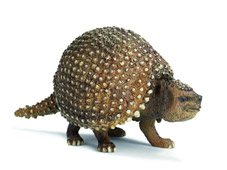
A team of American palaeontologists have recovered the remains of an ancient armoured mammal – a glyptodont from a remote fossil site high up in the Chilean Andes.

The fossils, part of the backbone, jaw and elements of the armoured shell that is so distinctive for this group, indicate that this is a new species, one of the earliest representatives of this mammal lineage.  It has been named Parapropalaehoplophorus septentrionalis, a very long name for this animal which was relatively small compared to some of this group’s later representatives which could weigh more than one tonne.

The animal was named after another genus of these group Propalaehoplophorus, which was found in Argentina at a more southerly latitude.  The species name – septentrionalis is from the Latin for northern so this new glyptodont’s name can be interpreted as“near to Propalaehoplophorus from the north”.

The American team worked at an altitude of 18,000 feet, making this site one of the highest fossil excavation sites in the world.  They had to work in freezing conditions, high winds and the lack of oxygen in the air made the work exceedingly difficult.  The fossil dates from the Miocene Epoch (18 million years ago), and although the fossils were found at an elevation in excess of 5,000 metres scientists believe that when this animal lived the land was much lower.  This small herbivore weighed in at around 90 KGs and was about 1.2 metres long, it wandered around the grasslands that covered much of this part of the world in the Miocene.  Earth movements that are pushing up the Andean mountains led the fossil remains to be found at such a high altitude

A Picture of a Typical Glyptodont

Picture credit: Everything Dinosaur

Glyptodont model here: Prehistoric Animal Models.

Co-leader of the expedition, John Flynn (Dean of the Richard Gilder Graduate School and a curator at the American Museum of Natural History); has stated that this fossil could indicate that the armoured-shelled glyptodonts could have originated in northern Chile, before diversifying across the rest of South America.  The armour for each species of glyptodont tends to have  a different pattern, the armour on P. septentrionalis for example, consisted of tiny, circular bumps.

The fossils were first located in 2004 during a field expedition to the Salar de Surire region of northern Chile.  This site has yielded important information regarding the evolution of Miocene mammal groups.  To date 18 animal species have been recovered from the site, collectively they have been called “Chucal fauna” and they represent part of the complex ecosystem that thrived on the grassy plains.  As well as primitive relatives of modern armadillos (xenarthran mammals), remains of marsupials, rodents, and hoofed mammals (ungulates) have been discovered.  The site has also yielded the ancient remains of prehistoric frogs (they look very much like modern frogs).

The last of the giant glyptodonts died out approximately 10,000 years ago, perhaps driven to extinction by a combination of changing climate, competition from other mammal species and hunting by humans.

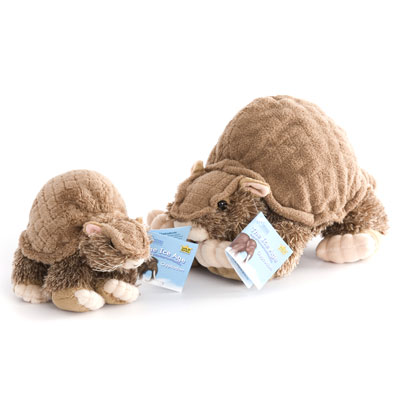
Glyptodonts are certainly very enigmatic.  There unusual shape and bizarre body armour makes them a popular prehistoric mammal.  They have been included in our Natural History range of prehistoric mammal soft toys.  An adult and a baby glyptodon have been designed.  Unlike the dinosaur range, as these represent mammals they could be made more soft and fluffy.

The Soft Toy Glyptodon (Mother and Baby)

Cute and cuddly glyptodonts.

Picture credit: Everything Dinosaur

For prehistoric animal soft toys: Prehistoric Animal Soft Toys.

17 12, 2007

Long-necked Dinosaurs from the Antarctic

By |2022-11-06T08:50:17+00:00December 17th, 2007|Categories: Dinosaur and Prehistoric Animal News Stories, Dinosaur Fans, Main Page|0 Comments

Early Jurassic Dinosaur Found on Antarctic Mountainside

Scientists from the Field Museum in Chicago in co-operation with palaeontologists from Argentina (Museo Paleontologico – Chubut); have named and described a new genus and species of dinosaur that once roamed the Antarctic portion of Gondwanaland 190 million years ago.

Dinosaurs from the Antarctic

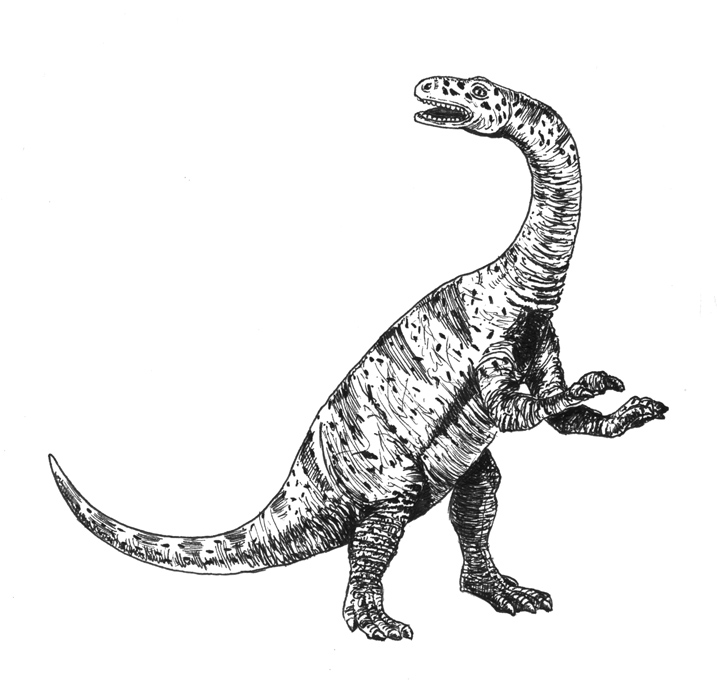
The animal was a sauropodomorph, an early long-necked dinosaur, although only partial remains were excavated (a femur and an incomplete ankle plus some foot bones); scientists estimate that this animal was 8 metres long and weighed 4 tonnes.  It has been named Glacialisaurus hammeri (Hammer’s glacial lizard), in honour of Dr William Hammer who led the expedition.  This team’s paper on this new dinosaur has been published in the scientific journal Acta Palaeontologica Polonica.  The fossils were found at Mount Kirkpatrick near the Beardmore glacier, extracting them in the extreme cold proved very difficult but the site has yielded more evidence of the climate in the region during this time.  A second more advanced, true sauropod skeleton has been found nearby, it is hoped that these two discoveries will help palaeontologists understand the ecosystem that existed in this near polar environment.  Both fossil sites are at elevations that exceed 10,000 feet, making excavation extremely difficult.

An Illustration of a Typical Sauropodomorph

Lufengosaurus drawing.

Early Jurassic aauropodomorph. A typical illustration of a sauropodomorph dinosaur.

Picture credit: Everything Dinosaur

During the Early Jurassic, Antarctica was connected to the other southern land masses.  It was situated further north, having yet to settle over the south pole.  The region served as an important prehistoric animal highway, permitting animals to travel from Australia to South America across this huge land mass.  Although the area was not as cold as Antarctica is today, dinosaurs would have had to endure a period of darkness during the Southern Hemisphere winter and the climate would have been much harsher than further north.

Polar Dinosaurs

A large body mass would have been helpful in cold climate.  Although it would have taken longer to warm up, the large body would have lost body heat slower than smaller creatures around at the time.  Perhaps these animals migrated south feeding on the lush growth that would have been permitted in the short season when there was maximum daylight, it is unknown whether this species was a migrant or a permanent resident of this environment.  The single skeleton provides no evidence of herd behaviour which is what would have been expected had the animal migrated south to feed.  This behaviour is usually seen in herding animals, who gather together on the move to protect themselves from predators.

Determining the Diet

The diet of this animal has yet to be determined.  The lack of skull material makes this difficult.  Other animals of similar size, for example, the prosauropod Massopondylus, had an enlarged thumb claw, an upper jaw that stuck out and  a variety of teeth types within the jaws.  Some palaeontologists claim that this evidence indicates that this animal was a carnivore, certainly the lizard-hipped dinosaurs gave rise to the great carnivorous lineages of dinosaurs, but perhaps Glacialisaurus was an omnivore, eating plants and supplementing this diet by catching smaller creatures.

To view models of sauropodomorphs and polar dinosaurs: Dinosaur and Prehistoric Animal Models.

16 12, 2007

Happy 90th Birthday Sir Arthur C. Clarke

By |2023-02-23T17:07:36+00:00December 16th, 2007|Categories: Everything Dinosaur News and Updates, Famous Figures, Main Page|1 Comment

Happy Birthday to Sir Arthur C. Clarke

Today, (December 16th) marks the 90th birthday of Sir Arthur C. (stands for Charles); Clarke – author, scientist and thinker.  Perhaps Sir Arthur is best known for his ground breaking novel “2001 – A Space Odyssey”, which was later made into a film of the same name directed by Stanley Kubrick.  To many palaeontologists and other scientists, Sir Arthur acted as an inspirational figure.   In 1980; an ITV television series “Arthur C. Clarke’s Mysterious World” was aired.  This thirteen part series covered the paranormal and explored strange mysterious such as UFOs, monsters of the deep, apeman and other phenomenon.  In one of the later episodes (episode 11), entitled “Dragons, Dinosaurs and Giant Snakes” – Sir Arthur explored the then, current myths and stories about unknown animals lurking in explored parts of the world.

Each programme was written in a documentary style with an introduction and conclusion filmed with the great man from his residence in Sri Lanka.  An earlier episode had focused on the strange stories from around the world of lake monsters such as Nessie and Champ.  A book was published in 1981 to accompany the series.

Quick Correction

The film 2001: A Space Odyssey was loosely based on and developed by Sir Arthur & Mr Stanley Kubrick from Clarke’s short story ‘The Sentinel’, first published in 1951 and much-reprinted. The novel of 2001 was first published in 1968 to accompany the film’s release, based on the screenplay.  Our thanks to Epacris for this information.

Sir Arthur’s rational approach helped de-bunk some of the more outlandish stories but in his concluding commentary on episode 11, comments, which can be found in the book that accompanied the series, he tells a strange story from his childhood.  His mother once claimed to have seen strange sheep with five horns in a neighbour’s field.  Young Arthur dismissed this sighting stating that she must have been mistaken.  Off they went on their bikes to see for themselves and sure enough in the field just as his mother had stated was a small flock of strange curly horned sheep the like of which he had never seen.

It may be relatively easy to dismiss strange stories of sea monsters like pliosaurs, or plesiosaurs roaming remote parts of the world’s oceans.  Claims of a sighting of a long-necked dinosaur in the inhospitable marshlands and rain-forests of the Congo may seem unlikely but as Sir Arthur famously commented:

“The truth as always will be far stranger”.

You never know…

Happy Birthday Sir Arthur.

15 12, 2007

New Giant Meat-Eater Discovered In Africa

By |2022-11-06T08:40:30+00:00December 15th, 2007|Categories: Dinosaur and Prehistoric Animal News Stories, Dinosaur Fans, Main Page|0 Comments

New species of Carcharodontosaurus Discovered in Niger

For graduate Steve Brusatte, a palaeobiologist at the University of Bristol, England, the long wait for the naming and describing of his 1997 fossil find is finally over.  Elements of the skull, including the premaxilla and cervical vertebrae discovered in an expedition to Niger (Africa) have been described in the scientific publication “The Journal of Vertebrate Paleontology” out this week.

New Carcharodontosaurus Species

Although only fragments of the skeleton have been found the skull material and teeth have enabled scientists to identify this animal as belonging to the Carcharodontosaurus genus.  The animal has been named C. iguidensis and it would have been one of the top predators in the area around 95 million years ago (Cenomanian faunal stage).

The carcharodontosaurids are named after the Great White Shark (C. carcharias), these fierce meat-eaters (the name means shark toothed lizards), roamed North Africa in the Cretaceous and one species C. saharicus is estimated to have rivalled Tyrannosaurus rex and Giganotosaurus as being the biggest theropod discovered so far.  The carcharodontosaurids are members of the allosaur family.  Size estimates for this new species put this animal at around 14 metres in length, but considerably lighter than the likes of T. rex, Giganotosaurus and its close relative from Morocco C. saharicus.  It weighed approximately 3.2 tonnes.

A Scale Drawing of a Carcharodontosaurus

 A new Carcharodontosaurus species has been described.

Fearsome “Shark Lizard”.

There were a number of large theropods roaming this part of the Gondwanaland during this stage of the Cretaceous, as well as the carcharodontosaurids, there were the likes of the spinosaurids and the abelisaurs.  However, it seems likely that these massive carnivores did not necessarily compete with each other over food sources.  Studies of jaw material indicates that the spinosaurs may have been mainly fish eaters, whilst the abelisaurs had much more slender and narrow jaws perhaps indicating a different prey than the broader and sturdier jawed carcharodontosaurids.

PNSO have developed a large range of theropod replicas including Carcharodontosaurus: PNSO Dinosaur Models and Figures.

The carcharodontosaurid family are still not well known, the original fossils were described by the famous German palaeontologist Ernst Stromer von Reichenbach.  Several expeditions were sent to North Africa between 1911 and 1914. At first the fossils of carcharodontosaurids were classified as belonging to a megalosaur, the Megalosaurus genus has been used as a dumping ground for unknown theropod remains for many years.  The original fossil bones and teeth were destroyed by bombing in WWII, only later did these fossils get ascribed to their own separate genus. Megalosaurs have been used to place various indeterminate fossils of meat-eaters, a previous web log article discussed this point:

Megalosaur Miscellany

Commenting on the abundance of large meat eaters in North Africa at this particular stage of the Cretaceous, Steve Brusatte stated that during this period sea levels were rising and this may have isolated dinosaur communities, allowing new species of carnivorous dinosaur to evolve.

12 12, 2007

Why does a Baby Diplodocus have a Short Neck?

By |2022-11-06T08:04:57+00:00December 12th, 2007|Categories: Everything Dinosaur News and Updates, Everything Dinosaur Products, Main Page|0 Comments

The Joys of Working with Baby Dinosaurs – the wonders of Ontogeny

Ask any young dinosaur fan to draw a Diplodocus, an Apatosaurus and even a Brachiosaurus and they will most likely produce a picture of a big animal with a large body, a long tail and of course a very long neck, just the way these animals are depicted in books, CDs and television programmes.  These dinosaurs, known as sauropods, are also commonly called long-necked dinosaurs as one of their distinguishing features is of course their elongated, muscular necks.

Baby Diplodocus

However, when it comes to working on a soft toy that depicts a baby Diplodocus, our thoughts about the typical long-necked dinosaur shape have to be discarded.   Baby dinosaur fossils are extremely rare, baby sauropods are no exception.  Unfortunately, a baby Diplodocus would have made a nice bite-sized snack for a hungry Allosaurus so if a youngster happened to perish in a location where fossilisation had a chance of occurring, chances are the body would have been eaten before sediments could cover the remains up.

Very occasionally a baby or a juvenile fossil sauropod is found.  One nearly complete specimen was discovered at the Howe Quarry, near the town of Shell in Wyoming, USA.  When fully excavated this little long-neck measured just over 2.4 metres long.  Although, the skeleton was just about complete, the head was missing (a problem palaeontologists usually face with all sauropod remains); so it has proved difficult to assign this animal to any genus of sauropod, but the consensus of opinion is that this little chap (or young lady) was an Apatosaurus.  The fossil shows a relatively, short neck compared to the adults.  This fossil was extracted from sediments which make up the famous Morrison formation, it has been dated to the late Jurassic, approximately 145 million years ago.  The original fossils are on display in a museum in Switzerland.

But how do we know that this animal was a youngster?  Could it be a new species of mini-sauropod?  The fossils have provided us with a number of clues to indicate that this animal was a juvenile, only a few years old.  Firstly, as we get older some of our bones grow closer together and fuse, the same applies to dinosaurs.  The fossil shows unfused bones in the hip region, tail and the scapula (shoulder blade).  The lack of wear and tear on the wrist and ankle bones also supports the theory that this animal was quite young when it died.  Dinosaur bones, if thinly sliced and studied under a powerful microscope can show growth rings, similar to the growth rings seen in wood.  The tiny femur (thigh bone) was analysed and its study revealed that the animal was less than 5 years old.

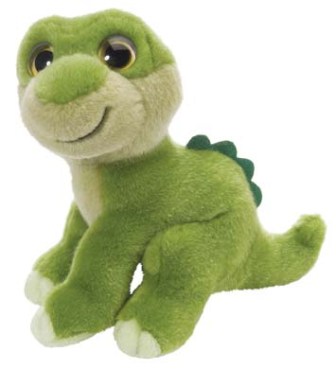
The  Baby Diplodocus Soft Toy (with a short-neck)

Diplodocus Soft Toy.

Picture credit: Everything Dinosaur

Dinosaur Stuffed Animals: Dinosaur Soft Toys.

So when it comes to thinking about  a baby Diplodocus soft toy we have to consider the process of ontogeny.  As animals grow their body proportions change, its physical features change in relation to body size.  A foal looks very different from its mother.  Its head looks larger, and the legs are proportionately longer.  This trait is related to a process called distal growth.  Another beautifully preserved and virtually complete skeleton of a baby long-necked dinosaur was discovered in Utah in 1922.   This time the head was preserved and the fossil was identified as a Camarasaurus, it had a large head and a relatively short neck when compared to an adult.   This was the basic blueprint for our baby Diplodocus in both the Itsy Bitsy and the Pocket Pals range of soft toys.

Eggs the Size of Footballs

Scientists think that animals like Diplodocus laid eggs about the size of footballs, buried in clutches of about 100 eggs or so.  After incubation the eggs hatched and the young sauropodlets emerged on mass just as turtles and crocodiles do.  This would give some of the babies the opportunity to get away from predators.  Palaeontologists estimate that at hatching a baby Diplodocus was around 1 metre in length.  Hiding in the fern undergrowth of forests the youngsters probably spent their first few years away from the adults living in small groups, using the dense forest as cover to protect them from the many predators that were about.  Their growth rates were astonishing, it has been estimated that in their first year these animals with their constant feeding on mosses and ferns, were able to put on about 2 kilogrammes per day and that after 12 months these young dinosaurs were over 3 metres in length and weighed as much as an adult Friesian cow.

The Pocket Pals Diplodocus

Pocket Pal Diplodocus.

Picture credit: Everything Dinosaur

As Everything Dinosaur is a company made up of parents, teachers and real dinosaur experts we have tried to illustrate scientific principles behind the products that we put into our shop.  As with the Itsy Bitsy soft toy Diplodocus, in the slightly larger (and older) Pocket Pal Diplodocus we have tried to keep the head relatively large with the neck and tail short.  Naturally, this process can only go so far, because with the adults the heads were very small compared to the body proportions.  For example, a fully grown Diplodocus could exceed 30 metres in length, the head being about the size of a horse’s balanced on a neck that was as long as a bus.

Dinosaur Stuffed Animals: Dinosaur and Prehistoric Animal Soft Toys.

Go to Top