All about dinosaurs, fossils and prehistoric animals by Everything Dinosaur team members.
10 12, 2007

New Study Examines Lack of Vitamin D and Possible Tuberculosis Link

By |2024-04-03T07:10:42+01:00December 10th, 2007|Categories: Dinosaur and Prehistoric Animal News Stories, Main Page, Palaeontological articles|0 Comments

Early Hominid Skull shows signs of Tuberculosis

In science, a breakthrough in one field leads to a better understanding in a whole host of other scientific studies, often ones that on first inspection would have Little to do with the field of science where the break through occurred.

Take our understanding of tuberculosis for example.  Tuberculosis is an infectious disease of the lungs, it is caused by the bacillus Mycobacterium tuberculosis and unless effective treatment is available, this disease can be fatal.  In 2007, a series of papers were published in various scientific and medical journals detailing the outcome of an extensive research project that proved a link between humans ability to produce vitamin D and their ability to fight off tuberculosis.  It seems that vitamin D produced in the skin as it reacts with sunlight can strengthen our immune system and trigger a chain of events that help people fight and kill the infectious bacillus within their bodies.

Now palaeontologists have applied this modern theory to help them examine the skull of an ancient human found recently in western Turkey, a skull which is estimated to be 500,000 years old.  The fossil remains have been identified as belonging to Homo erectus an early hominid that was extremely successful migrating out of Africa establishing humans in parts of the world for the first time.  H. erectus moved north up the Nile valley, through Sinai and onto the region of the Black Sea.  For this poor individual, a male aged between 15 to perhaps 40 years of age, whose skull was found in a block of rock, this was as far as he got.  However, H. erectus continued to spread and colonise new areas of the world including the Himalayas, the jungles of south-east Asia and eventually China.  Hence the alternative name for this particular species of human “Peking Man”.  Indeed, it could be claimed that Homo erectus was one of the most successful species of hominid ever.  They were around for over 1 million years and they spread to virtually every known part of the Old World.

A Model of Homo erectus
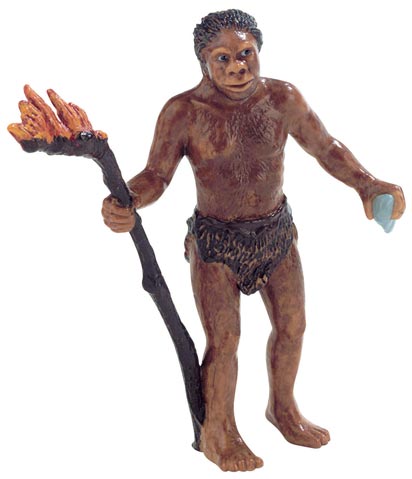
H. erectus illustration. A model of an early hominid.

Early hominid model – Homo erectus.

To view models of early hominids as well as prehistoric mammals: Safari Ltd. Prehistoric Animal Figures.

The skull will help scientists understand more about the migration of H. erectus but intriguingly anthropologists from the university of Texas have identified strange pits and lesions on the inside of the cranial material which may indicate that this poor fellow suffered from and probably died from tuberculosis.

The blue arrow indicates the lesions identified on this piece of skull material.  The lesions are caused by a specific kind of tuberculosis bacillus that infects the membrane surrounding the brain.  Inflamed nodules within the membranes create pressure on the bone surface leaving marks and lesions.

If tuberculosis lesions are present in the skull then it may reinforce the theory regarding the association between vitamin D and the ability to fight off tuberculosis infection.

Vitamin D is synthesised in the skin by exposure to sunlight. Since ultraviolet radiation penetrates only the top layers of skin, people with darker complexions produce less of the vitamin, as the pigment in their skin filters out the sunlight.

Earlier studies have suggested that humans migrating north developed a lighter skin complexion as an adaptive response to maintain their vitamin D levels when exposed to less sunlight.  So it may have been an inability to synthesis vitamin D due to having a dark skin colour that caused the demise of many early hominids as they journeyed north.

Published medical literature about modern people (H. sapiens) who have migrated from southern latitudes—and are more likely to have a darker skin colour—to more northern latitudes show a higher incidence of tuberculosis, and this appears to be linked to an inability to synthesis enough vitamin D.

After a presumably dark-skinned population of Homo erectus had migrated north, this individual male in western Turkey was unable to generate enough vitamin D from the reduced sunlight, and a tuberculosis infection proved fatal.   If more skulls are studied then perhaps more lesions will be found and this could give scientists an insight into the speed of the H. erectus migration.

The paper on this unusual discovery has been published today in the American Journal of Physical Anthropology.
9 12, 2007

Is it a new Species of Norwegian Marine Reptile or Not?

By |2023-02-23T17:08:24+00:00December 9th, 2007|Categories: Dinosaur and Prehistoric Animal News Stories, Dinosaur Fans, Main Page|0 Comments

Confusion over Norwegian Pliosaur Excavations

To the north of Norway, half-way between the Norwegian coast and the North Pole lies the archipelago of Svalbard.  Over the last few summers the local population of under 3,000 has been swelled by the arrival of a number of teams of palaeontologists keen to study the rich fossil bearing strata of the islands.  Following in the footsteps of geologists who have been exploring the island’s geology in search of further coal measures as well as reserves of oil and natural gas, on behalf of Norway’s state run coal mining company.

Norwegian Marine Reptile

The strata consists mainly of marine deposits.  A number of marine reptiles have already been found, particularly plesiosaurs and their short-necked relatives the pliosaurs.  These finds are helping scientists to learn more about the fauna in the seas of the Mesozoic and for Norwegian scientists starved of dinosaur remains to study, these discoveries are helping to put Mesozoic Norway on the palaeontological map.

With much of Norway consisting of igneous and metamorphic rocks, dinosaur fossils are exceptionally rare.  To date only one small dinosaur bone has been found in the country and that was down to an incredible piece of luck!

Read about Norway’s first dinosaur:  Norway’s First Dinosaur – say hello to Plateosaurus.

To view a model of Norway’s first dinosaur and other prehistoric animals: Prehistoric Animal Models.

A team of scientists from the University of Oslo are currently working on a number of sites, one of which is a dig site that is slowly revealing the remains of a huge predator that swam in the sea that covered this area 150 million years ago in the late Jurassic.

An initial excavation of this dig site has unearthed teeth, partial skull material and a number of vertebrae of a pliosaur.  As yet, the size of the animal has not been accurately calculated but estimates indicate that this animal may have been 40 feet (13 metres) long.  It has been nick-named “Predator X”.

Predator “X” – Pliosaur

There does seem to be some confusion as to whether or not this particular find relates to a new species of pliosaur.  A number of news releases have claimed that these remains are those of a new species, but there seems to be some doubt as to this.  Attempting to clarify the situation a spokesman for the University of Oslo stated that this new find was not new to science, early indications are that it is the same species as a pliosaur discovered last year at a different location in the Svalbard islands.  The Norwegian team intend to return to this dig site next year and to carry out further excavation work.  It will be some time before the site is probably studied as the inclement weather can disrupt work, but at least at such high latitudes, the Svalbard summer permits the team to work virtually all night if required as the sun hardly dips below the horizon.

Once the site has been cleared and the remains studied and any papers peer reviewed the team should be able to publish further information on their discovery.

7 12, 2007

Dinosaur Models – On a Grand Scale!

By |2023-02-24T08:16:24+00:00December 7th, 2007|Categories: Dinosaur and Prehistoric Animal News Stories, Main Page|0 Comments

Australian Museum Provides sneak Preview of new Dinosaur Exhibit

Preparations for the new permanent dinosaur exhibit at the Australian Museum in Sydney, New South Wales, are well advanced and the star exhibit, a life-sized model skeleton of a huge dinosaur has just been installed in the new exhibition hall.

Dinosaur Models

The model of the fossilised remains of a Cretaceous sauropod named Jobaria tiguidensis stands over 10 metres tall and its 22 metres just about fits into the newly erected exhibition hall of the museum.  At the moment the model is still covered in protective wrapping and the scaffolding surrounding it indicates that the project team have one or two finishing touches to add, but when the new hall opens in March this exhibit will make an impressive centrepiece.

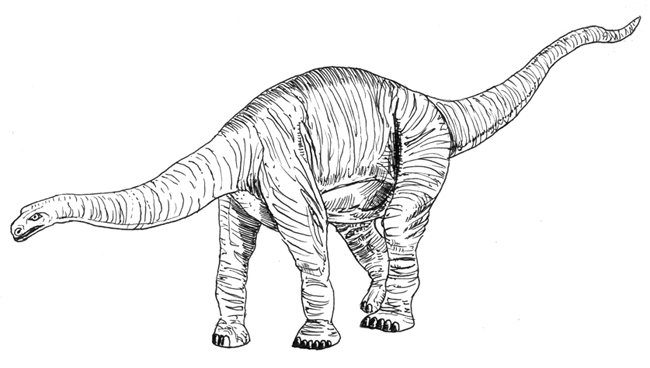
An Illustration of a Typical Sauropod

Primitive sauropod illustration.

An illustration of a typical sauropod.

Picture credit: Everything Dinosaur

Producing Large Model Dinosaurs

The plastic model was cast from the real fossilised bones of this dinosaur, by a Chicago based organisation called Project Exploration which specialises in providing educational exhibits and materials.  Light weight plaster casts have replaced the real fossil bones erected in museums, as being lighter they do not need the ugly looking steel girders to support them and to permit palaeontologists to depict animals in more life-like poses.

Besides, the fossils themselves are very valuable and are more likely to preserved in the storage rooms away from public display.

Purchasing casts like this for museums is very common, although it is quite unusual to have such a large model kit to be put together  by the museum staff.  Casts cost hundreds of thousands of dollars, whereas to purchase the actual fossilised bones would cost millions of dollars – a sum that even the Australian museum with its AUD $41 million budget would find hard to justify.

The bones of this long-necked dinosaur, a relative of Brachiosaurus as classified by Paul Sereno who placed Jobaria in the Macronaria clade of sauropods, lived in the Niger Republic area about 135 million years ago.  Sauropods that belong to the Macronaria clade are distinguished from other long-necked dinosaurs as they have large nostrils high on their skulls.  These may have been covered in fleshy, folds of skin to provide an enhanced sense of smell or to act as call resonating chambers.

For models of sauropods and other dinosaurs: Dinosaur and Prehistoric Animal Models.

Quite a lot is known about this giant plant-eater as an almost complete skeleton of Jobaria was unearthed by a team of palaeontologist led by Paul Sereno about ten years ago.  To find a complete skeleton is exceptionally rare, even the huge bones of these dinosaurs are rarely found together.  It was from this skeleton that the model bones were cast.

Jobaria and Other Sauropods

Jobaria lived in a lush, swampy area in what is now the Sahara desert.  The name Jobaria comes from local Tuareg mythology – Jobar in the local dialect refers to a mysterious animal.  Jobaria is one of the best understood genera of sauropods as fossil bones from adults and juveniles have been found.  For a Cretaceous sauropod it was quite primitive with a disproportionately short neck compared to the length of its body and more primitive, chisel like teeth.

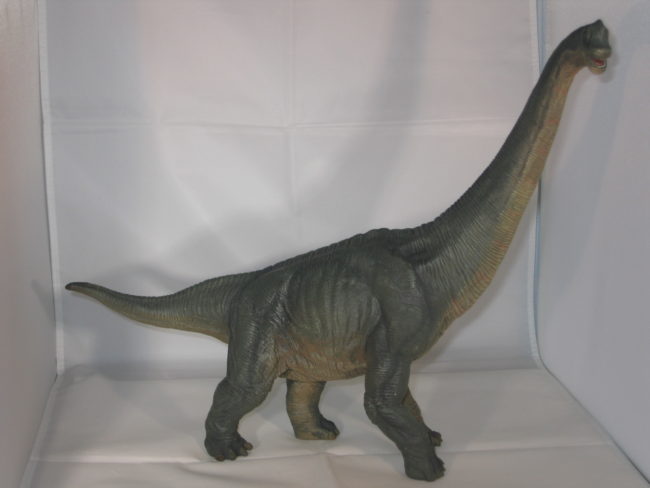
A Replica of a Sauropod Dinosaur (Brachiosaurus)

Papo Brachiosaurus Model

Dinosaur model gets reviewed.  A replica of a brachiosaurid sauropod dinosaur.  Picture credit: Everything Dinosaur.

Picture credit: Everything Dinosaur

The Jobaria model arrived in ten large crates and the museum team then set to putting the display together.  It is not known how long the process took to erect the huge beast but the work was certainly worth it as this exhibit will form the main attraction on an new exhibition based on evolution when the new hall opens in March 2008.

5 12, 2007

Dinosaur Mummy Unlocks Duck-Billed Dinosaur Secrets

By |2022-11-06T06:58:18+00:00December 5th, 2007|Categories: Dinosaur and Prehistoric Animal News Stories, Main Page|2 Comments

“Mummified Dinosaur – the Holy Grail of Palaeontology”

Dinosaur bones are rare, well preserved ones are exceptionally rare and for some palaeontologists the discovery of fossilised bones in association with each other or bones in articulation are the find of a life-time.  However, for one young, American scientist, Tyler Lyson, his discovery of a remarkably well-preserved duck-billed dinosaur, complete with fossilised skin, ligaments and tendons is a discovery to beat most other discoveries.

Tyler, who is currently completing his Doctorate in Palaeontology at Yale University, found the amazing fossil whilst on a fossil hunting expedition in a remote part of North Dakota.  The animal, a hadrosaur, when it died was buried very quickly by fine sediment and this has preserved parts of the soft body tissue, the dinosaur’s skin scales have even been preserved on parts of the skeleton.

This animal had no flamboyant head crest so it was probably a member of the hadrosaurine group, placing it in the same clade of dinosaurs as animals such as Edmontosaurus and Kritosaurus and dates from 67 million years ago, the Late Cretaceous (Maastrichtian faunal stage).

A Dinosaur Mummy

This find has been called a “Mummy” as like the Egyptian mummies soft tissue has been preserved, allowing scientists to shed new light on how these animals looked.  Dr Phil Manning (Manchester University), the chief researcher on this specimen has supervised a CAT scan of this amazing fossil.  CAT scans enable scientists to see inside fossils without intrusive and damaging extra preparatory work.  The CAT scan was only possible due to the fact that the animal was able to be extracted from the site in one complete block of stone.  Only a small part of the tail, was contained in a second block.

The CAT scan and other assessments have provided the researchers with a wealth of new material.  For example, the vertebrae seem to be further apart in this specimen than previously thought.  This may mean that scientists are going to have to amend their estimated sizes for this type of hadrosaur.  They may actually have been bigger than we think.  Animals such as Edmontosaurus have been estimated at lengths in excess of 13 metres, now this new find may lead to scientists having to revise these estimates.

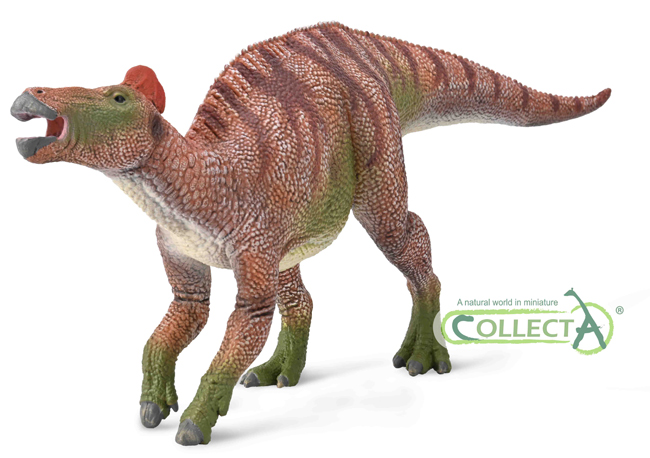
A Typical Model of an Edmontosaurus

CollectA Deluxe 1:40 scale Edmontosaurus dinosaur model

The new for 2022 CollectA Deluxe 1:40 scale Edmontosaurus dinosaur model. CollectA had wanted to introduce a replica of this iconic Late Cretaceous hadrosaur for some time.

The picture (above) shows a CollectA Deluxe 1:40 scale Edmontosaurus figure, to view this range of prehistoric animal models and figures: CollectA Deluxe Prehistoric Life.

CAT Scans

The CAT scan has also revealed that this hadrosaur had larger hind quarters than previously thought.  The powerful back legs would have helped this animal take up a bipedal posture and run quicker than earlier studies had shown, perhaps helping to escape from predators such as Tyrannosaurus rex which were around in this part of Dakota 67 million years ago.

The picture shows some of the fossilised skin, the degree of preservation is remarkable.

Dark Stripes Along the Tail

According to Dr Manning, patterns identified in the skin scales indicate that this animal had stripes along its tail.  It has been speculated that the strips were a form of camouflage to help this plant-eater blend into its surroundings.  Stripes may have also served another purpose.  In herd animals such as zebras, the strip pattern helps the animals merge into each other, preventing predators from singling out an individual.  Palaeontologists believe that hadrosaurs lived in large herds, so perhaps the stripped pattern was designed to confuse potential attackers.

As with many special finds, this specimen has been given a nick-name by the research team, the dinosaur has been named “Dakota”, named after the US state where the fossil was found.

Other “mummified” dinosaur remains have been found, notably in the USA, Canada, Italy and China.  What makes this specimen so rare is that the soft tissue has actually been preserved, other mummified fossils such as the beautifully preserved hadrosaur unearthed by Charles Sternberg in 1908 have the impression of soft tissue such as skin preserved as an impression in the surrounding rock matrix.

3 12, 2007

Important News! Recommended Last Posting Dates before Christmas 2007

By |2024-04-03T07:03:01+01:00December 3rd, 2007|Categories: Everything Dinosaur News and Updates, Main Page|0 Comments

Recommended Last Posting Dates for Christmas

December is here already and 2007 is nearly over, it does not seem like 12 months, but Christmas will soon be upon us and none of the team members at Everything Dinosaur have completed their Christmas shopping.

Recommended Last Posting Dates

To help our UK customers here are the latest safe posting dates published by the Royal Mail.  These dates are the recommended last posting dates to ensure parcels and letters arrive in time for Christmas.  Remember, Royal Mail staff are put under tremendous pressure at this time of year and the earlier you can send items out the better.

Last recommended date for Standard Parcels = Friday 14th December

Last recommended date for Second Class = Monday 17th December

Last recommended date for First Class = Thursday 20th December

Last recommended date for Special Delivery (Saturday guarantee) = Friday 21st December

Last recommended date for Special Delivery = Saturday 22nd December

As always the team at Everything Dinosaur will do all they can to ensure that orders are prepared and packed as quickly as possible.  We will be working on the Saturdays up to Christmas and dispatching on Saturday mornings to help speed deliveries on their way.

To view Everything Dinosaur’s terms and conditions: Terms and Conditions.

If customers have left it too late to use regular postal services and Special Delivery is the only option left, then please feel free to contact us (details below) and we will do our best to provide the Royal Mail Special Delivery service to help prevent disappointment on Christmas Day.

You can view the range of dinosaur and prehistoric animal gifts available from Everything Dinosaur: Everything Dinosaur.

For further contact options: Email Everything Dinosaur.

2 12, 2007

Fancy a Mosasaurus for Christmas? Prehistoric Animals under the Hammer

By |2022-11-06T06:44:28+00:00December 2nd, 2007|Categories: Dinosaur and Prehistoric Animal News Stories, Main Page|3 Comments

Why not Purchase your very own Marine Reptile for Christmas!

Hammers have long been associated with fossils as palaeontologists carefully chip away at rocks with their geological hammers to reveal the remains of prehistoric animals.  Today, Sunday 2nd December, one particular fossil is being associated with a very different type of hammer – the auctioneers gavel as a virtually complete fossil mosasaur goes up for auction.

Mosasaurus Fossil

Bonhams the world famous auction house is selling the 30-foot mounted skeleton at a special sale a their Los Angeles sale rooms.  This unusual collectors item is expected to fetch $400,000 dollars (£200,000).  However, the purchaser will also have to pay for the removal and transportation of this delicate exhibit and the costs for getting this 10-metre-long fossilised specimen which includes skull, flippers, ribs and 126 vertebrae back home could be considerable.

The PNSO Mosasaurus "Ron".

“Ron” the PNSO Mosasaurus replica. A typical reconstruction of a Mosasaurus bases on Mosasaurus fossil material.

The picture (above) shows the Mosasaurus model from the PNSO Age of Dinosaurs model collection: PNSO Age of Dinosaurs Models.

Fossil Auction

Fossils being auctioned is not a new phenomenon, many wealthy people including celebrities and film stars have purchased rare finds and curios over the last few years and this has pushed up the price of many fossils, especially those from the age of reptiles (Mesozoic).

Bonhams sale catalogue describes this lot as a Mosasaurus baugei, a graceful predator of the late Cretaceous; dining on fish, squid and other marine reptiles.  Mosasaurs were not dinosaurs but marine reptiles related to modern snakes and lizards (order Squamata).  They were named after the Latin name for the river Meuse “Mosa” in the Netherlands, as it was in a limestone mine at Maastricht close to this river that the first remains of Mosasaurs were discovered back in 1780. The naming of mosasaurs pre-dates the founding of  Bonhams by just 13 years as this now famous auction house with venues in London, San Francisco and Los Angeles was established in 1793.

Mosasaurs – Marine Reptiles

Mosasaurs were a very successful group of marine reptiles, appearing in the Late Cretaceous, these animals were to establish themselves as the most diverse group of large marine reptiles by the end of the Mesozoic with some of them such as the Russellosaurines evolving into giant, long-skulled predators that terrorised the other creatures of the deep.

This particular mosasaur fossil was found in Africa, it is a very complete and well preserved specimen, the picture above shows the large eyes and the and the ring of bones that surrounded the eye ball.  This is called the sclerotic ring, it helped support the large aqueous mass of the eyeball and may have assisted with focusing of the eye, improving the animal’s vision under water.

1 12, 2007

All Terrain Vehicles driven where once Unique Dinosaurs Roamed

By |2024-04-03T07:04:13+01:00December 1st, 2007|Categories: Dinosaur and Prehistoric Animal News Stories, Main Page|0 Comments

Amazing Concentration of Prehistoric Animal Tracks Discovered In Utah

The use of all terrain vehicles (ATVs) in the countryside can be a thorny issue.  There are the drivers and enthusiasts who love the thrill of pitching themselves and their machines against what Mother Nature has to offer, whilst on the other side there are those folk who consider them to be noisy, intrusive beasts; leaving a trail of destruction wherever they go.  Certainly, in parts of Southern England, such as the historic, ancient Ridgeway track on the South Downs; such vehicles have damaged the countryside, but in America, a popular off-roading area has provided scientists with a fascinating glimpse of life from the Early Jurassic.

Dinosaur Tracks

In Kane County, a part of Utah not far from the Arizona state line, scientists are busy studying a serious of fossilised trackways and individual footprints preserved in the sandstone sediments in an area popular with off-road riders.  The site, which is south of the town of Mount Carmel, has revealed a large concentration of fossilised footprints, including prints from at least five different dinosaur species and three-toed crocodiles.

The prints are beautifully preserved and date back 190 million years to the lower Jurassic (Sinemurian faunal stage), a time when the dinosaurs were really beginning to diversify and dominate life on land.  Amongst the finds discovered so far, are a series of huge footprints made by a giant plant-eating dinosaur (believed to be a prosauropod).  Using estimates taken from the footprints themselves, as well as stride length, local palaeontologists believe the tracks were made by a dinosaur at least 12 metres long.

Attempts to Prevent Further Damage

The site was reported to Bureau of Land Management workers in early November, and realising the significance of the site, the football field sized area was quickly fenced off to prevent further damage to the trackways from ATVs.

A team of scientists from the University of Colorado have been drafted in to map the area and to study the ecosystem that this concentration of fossil footprints reveal.  After consulting with local ATV clubs the site has been closed in order to prevent any further damage to the fossils.

This particular location is very special as the sandstone has been deposited in fine layers and erosion has enabled some of the layers to be studied in depositional sequence, revealing the history of the ecosystem, like, as one palaeontologist put it “looking through a window in time”.

Although, during the Jurassic the super continent of Pangaea had started to break up, this part of Western North America was inland and in the process of being formed into part of the great, dry Laurasian Plains.  The area was very arid and desert-like, with occasional rainy periods and flash floods that formed oasis.  The footprints seemed to have been made over a considerable period of time as the rare rains provided the right muddy and sticky conditions for animal’s footprints to be preserved.  The presence of large herbivores indicates that some time in the history of this area, there must have been a lot of rain that permitted large amounts of vegetation to establish and it was the plants that attracted these big herbivores into the area, whilst the newly formed lakes became home to crocodile-like animals.

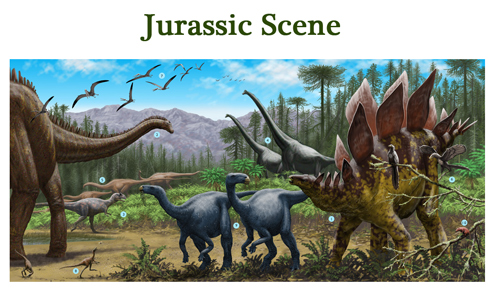
The Dinosaur Dominated Jurassic Environment

A Jurassic scene - dinosaur tracks discovered in Utah

Dinosaur tracks have been discovered in Utah.  The picture above depicts a typical Late Jurassic scene from North America (Utah).

Lower Jurassic sediments are not nearly as well researched and understood as geological formations from the Late Jurassic, there are very few sites in the world that provide information about the ecosystems at this time in the Earth’s history and it is hoped that these trackways will help scientists understand more about the fauna around during the Early Jurassic.

Papo has produced a range of Jurassic dinosaur models, such as Allosaurus, Stegosaurus and Apatosaurus: Papo Dinosaur Models.

29 11, 2007

New Late Cretaceous Bonebed Discovered In Spain

By |2022-11-06T06:25:20+00:00November 29th, 2007|Categories: Dinosaur and Prehistoric Animal News Stories, Geology, Main Page|4 Comments

Spanish Discoveries show Thriving Dinosaurs in the Late Cretaceous

Spanish scientists have announced the discovery of a large dinosaur bonebed containing the remains of numerous dinosaurs, so far eight species of dinosaur have been identified amongst the 8,000 fossils unearthed.

The site, near the city of Cuenca in western Spain is being heralded as one of the largest dinosaur bonebeds found in Europe, although it will have to go a long way to beat the amazing plateosaur bonebeds discovered recently on the Swiss/German border.

To read article on Swiss bonebeds:  Europe’s Largest Mass Dinosaur Grave to Date Discovered.

However, the Spanish site, consists of sediments laid down in the Upper Cretaceous, approximately 80 million years ago (Campanian faunal stage) and the beautifully preserved finds provide a window onto a time period towards the end of the age of Dinosaurs.  Most fossil yielding sediments dating from this part of the Mesozoic are located in the Americas, accessing layers of strata from this time in Europe is a rare event.

Late Cretaceous Bonebed

The site was discovered in June during construction of a new high-speed rail link between Madrid and Valencia.  Construction work was halted to permit the scientists to remove many fossils from the path of the railway line.  Although the excavation is not complete the concentration of finds has impressed even the most hard-nosed of palaeontologists.  The remains of over 100 titanosaurs (long-necked dinosaurs), have been identified, some of them nearly intact.  Interestingly, scutes and plates have been found at the site, indicating that these titanosaurs probably had body armour like their South American cousin – Saltasaurus.

Find dinosaur models here: Dinosaur and Prehistoric Animal Models.

Some scientists studying Campanian and Maastrichtian strata from North America have identified a notable decline in the species and diversity of dinosaurs in Upper Cretaceous sediments.  This has led to claims that the dinosaurs were under environmental pressure and declining as a group before the extinction event 65 million years ago.  Evidence from this new site (the area is called Lo Hueco), supports studies of Late Cretaceous dinosaurs from France indicating that at least in Europe, the dinosaurs show no signs of decline.

Other finds include the remains of a Struthiosaurus, a small, armoured nodosaur (like an ankylosaur but without the club tail) and possibly three different species of dromaeosaurid (fast-running, small, bipedal carnivores similar to Velociraptor).

Fossil evidence has also been found of an ornithopod called Rhabdodon.  Remains of this Iguanodon-like animal have been found before in France, Spain and Romania but palaeontologists are unsure as to whether this animal was an iguanodontid or a member of the Hypsilophodontidae.  Perhaps these new finds will help scientists classify this dinosaur.

The abundance of fossil animal and plant material recovered from the dig site, indicate a very rich and diverse ecosystem with no evident signs of environmental pressure.

28 11, 2007

The Dinosaur Collection – an Ideal Dinosaur Fans Christmas Gift

By |2023-02-24T15:56:26+00:00November 28th, 2007|Categories: Main Page, Press Releases|1 Comment

The Dinosaur Collection – Six models for Prehistoric Animal Fans

With the myriad of different models of prehistoric animals it can be difficult identifying which model belongs to which manufacturer’s series, especially with so many animals being retired and new ones coming along all the time.

Perhaps we should use the “Prefix and Accession number” system that scientists use to identify individual specimens housed in museums around the world.  For example, MIWG6621 is the unique classification code given to a single caudal vertebra (tail bone), of a small bipedal plant-eater – Hypsilophodon foxii, which is housed in the Museum of Isle of Wight Geology, Sandown on the Isle of Wight in the UK.

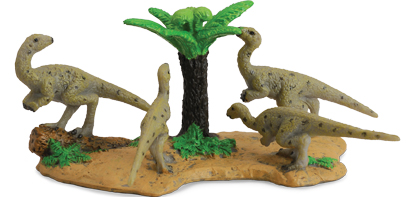
A Model of Four Hypsilophodon Dinosaurs (CollectA)

Hypsilophodon model. Gifts for prehistoric animal fans.

CollectA Hypsilophodon family group part of the successful CollectA Prehistoric Life model range which make ideal gifts for prehistoric animal fans.

The Hypsilophodon models make great gifts for prehistoric animal fans. The range can be viewed here: CollectA Prehistoric World Dinosaur Models.

Gifts for Prehistoric Animal Fans

This would certainly help streamline our searches for various specific models for avid fans and collectors when they ask us to conduct a “Dino Hunt” for them, finding prehistoric animal models for customers.

Access our website here: Everything Dinosaur Home Page.

Simply type in the dinosaur name into the search field box, press the magnifying glass icon next to the box to start the search and if no items appear, then you can always contact us and one of our dinosaur experts and researchers will try to find the product or animal that you have requested.  This certainly saves our customers a lot of time.

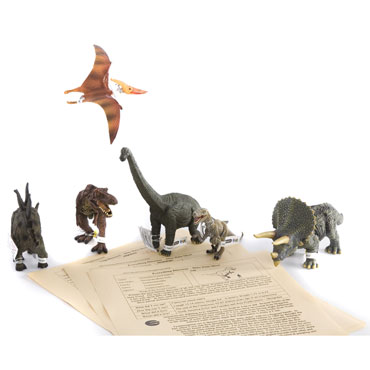
One model series we have taken a fancy to is the “Dinosaur Collection” series from CollectA.  This model series currently consists of six models, five dinosaurs (T. rex, Triceratops, Stegosaurus, Brachiosaurus and Velociraptor), plus a pterosaur.  The pterosaur in question is Pteranodon ingens, so this makes a popular choice for the avid dinosaur fan and for serious model collectors.

The Dinosaur Model Series from Everything Dinosaur

Picture credit: Everything Dinosaur

Models and Fact Sheets

Each model comes with its own fact sheet written by our researchers, and this series is available from Everything Dinosaur, they are just some of the dinosaur and prehistoric animal replicas we have in stock.

To see the dinosaur collection set of models: Dinosaur and Prehistoric Animal Models.

27 11, 2007

Rare Australian Dinosaurs Threatened by Desalination Plant

By |2024-04-03T07:03:38+01:00November 27th, 2007|Categories: Dinosaur and Prehistoric Animal News Stories, Geology, Main Page|0 Comments

Australian Dinosaurs under Pressure from Development

One of the widely publicised impacts of global warming and climate change has been the very severe drought suffered by much of Australia in the last couple of years.  Many scientists claim that global climate change was one of the causal factors in the extinction of the dinosaurs 65 million years ago and now climate change is indirectly threatening the excavation of rare dinosaur fossils.

Australian Dinosaurs

In East Gippsland, south-east Victoria, the demands for drinking water have grown rapidly as the population increases.  The area provides much of the Melbourne region with fresh water, now plans to build a AUS$ 3 billion desalination plant in East Gippsland could prevent the excavation of rare polar dinosaurs.  The dinosaur bones are located in sediments found on a rock shelf on a beach at Wonthaggi, an area famous for its rich coal deposits, another legacy from ancient times.  The fossil bearing rock has yet to be fully explored but palaeontologists claim that it is just one of six known locations where evidence of polar dinosaurs has been found.

The Australian Government’s Water Minister – Tim Holding has said that the fossils will not delay the much needed project.  The intention is to build one of the world’s largest desalination plants on the coast, when completed it will boost the drinking water supplies to the urban population.

“This in no way impacts on our ability to construct and operate a desalination plant,” Mr Holding said.

“Details of the fossils had been included in investigations carried out by the Department of Sustainability and Environment,” Mr Holding stated.

“The fossils exist in the first 10 metres of beachfront below the surface and it is proposed that the inlet and outlet pipes for the plant will be placed well below that.  The reason why is because these fossilised remains exist in the first 10 metres of the beachfront in that area and it’s proposed that our inflow and outflow pipes will be placed well below that.

So as the scientists themselves have acknowledged, if the inlet and outlet pipes are to be 10 metres or more below the surface the existence of these fossils will have no impact to the operation of the plant at all.”

Full Environmental Effects Not Known

The State Government is yet to decide whether to conduct a full environmental effects statement (known as an ESS), for the controversial project.  Lesley Kool, who is co-ordinating the fossil dig on behalf of Monash University (Victoria), has led the calls for an environmental effects statement and a full review of the proposed project, not just to consider the impact on the rare 115-million-year-old fossils but also to examine the potential environmental impact on many endangered native animals and plants that live in this coastal area.

Commenting on the palaeontological significance of the site, Mrs Kool stated that the Wonthaggi location was one of only a very few sites where polar dinosaur fossils had been found, indeed this area if properly explored could yield a lot of data on the ecosystems present at this time during the Cretaceous.  So far evidence of ornithopods (plant-eaters) has been discovered but scientists speculate that they may find evidence of theropods in these sediments also.  Meat-eaters are rare from polar deposits.  This area has also provided evidence of fresh-water plesiosaurs.  It was thought that these long-necked marine reptiles were found only in salt water environments but now evidence from south-eastern Australia supports data collected from the Dinosaur Provincial Park in Canada which shows plesiosaurs spending some time in brackish and freshwater.  Whether these animals were juveniles from fully marine species or a group of plesiosaurs adapted to life in lakes, rivers and estuarine environments is open to debate.

The construction of this huge desalination plant, although badly needed by a parched Australia, could destroy forever fossils that could provide further information on the fauna and flora of the Cretaceous polar environment.

As more of the geology of Australia is explored a number of new and exciting discoveries have been made.  This vast continent still holds many palaeontological surprises and a number of papers and reports have been published recently, many written by researchers at Monash University.

Recent report of carnivore tracks: Meat-eating Dinosaur Tracks Discovered in Australia.

Go to Top