All about dinosaurs, fossils and prehistoric animals by Everything Dinosaur team members.
26 11, 2007

Head back to the Silurian on the Niagara Escarpment

By |2023-02-24T15:58:19+00:00November 26th, 2007|Categories: Geology, Main Page|6 Comments

Niagara Falls Area Reveals Ancient Fossil Treasures

The Niagara Falls attracts millions of tourists every year to watch the water cascading over the huge falls on the Canadian/U.S. border, but the geology that created this spectacular wonder of nature has been providing scientists with a glimpse into the rich diversity of life in ancient seas 425 million years ago.

Ancient Fossil Treasures

The Niagara Escarpment is formed from layers of sedimentary rocks laid down in a marine environment, these sit on the ancient Pre-Cambrian rocks of the huge Canadian shield that covers much of North America and the Arctic.  In geological terms, this feature, an escarpment, although sometimes known as a cuesta, is a ridge composed of gently tilted rock strata with a long gradual slope on one side and a steep, or scarp slope on the other.

A team of palaeontologists from the Royal Ontario museum in Toronto have been exploring a 16 kilometre area of sedimentary strata in the Grey Bruce area heading up to the shores of Lake Huron.  In this area they have discovered a unique fossil community that provides a rich source of information about life in the late Silurian, about 425 million years ago.  At the time, this area was a shallow sea, much nearer the equator than it is today and fossils of many primitive fish, as well as invertebrates, corals and aquatic plants have been discovered.  The team of scientists have described this area as one of the most important and unique fossil finds in Canada.  The discovery of exceptionally well preserved aquatic plant fossils is particularly exciting as it was around this period in Earth’s history that the first plants began to colonise the land and so began the chain of events that led to the atmosphere that we have on Earth today.

Remnants of a Silurian Ecosystem
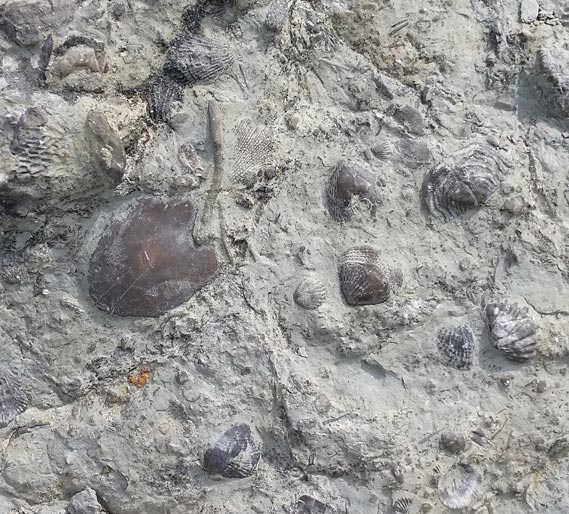
More than 700 different fossils found at Wren's Nest

Lots of brachiopod and coral fossils remnants of a Silurian ecosystem.

Picture credit: Everything Dinosaur

The beautifully preserved fossils will be studied in more detail at the museums laboratories, they demonstrate the amazing biodiversity of life in the warm shallow seas of the late Silurian.  What is surprising is that this rich fossil yielding strata was found in an area just two hours north of Toronto, one of the most densely populated areas of Canada.  As a scientist commented in a press conference, the site lay under their noses but nobody bothered to take a closer look until now.

CollectA have produced a range of replicas of iconic fossil animals including trilobites and molluscs. To view this CollectA range: CollectA Prehistoric Life Replicas.

In February 1990, the Niagara Escarpment was designated a World Biosphere Reserve by the United Nations Educational, Scientific and Cultural Organisation (UNESCO). It is one of only 12 biosphere reserves in Canada, and is part of a network of more than 400 reserves in 95 countries.
25 11, 2007

Megalosaurus – A Dinosaur Waste Basket

By |2023-02-24T16:00:42+00:00November 25th, 2007|Categories: Dinosaur and Prehistoric Animal News Stories, Everything Dinosaur Products, Main Page|0 Comments

Megalosaurus – A Dinosaur Waste Basket

Megalosaurus represents a very important genus within the Dinosauria cladogram.  As a meat-eater it is part of the theropod group and as a family, the megalosaurs tend to be overshadowed by their more illustrious relatives the tyrannosaurs, Maniraptoriformes and allosaurs.  However, Megalosaurus will still hold a special place in the hearts of scientists as it was the first Dinosaur to be named and described.

Megalosaurus

This momentous event took place in 1824, nearly 20 years before the name dinosaur was invented.  An English clergyman and geologist the Reverend William Buckland was appointed to examine and review a piece of fossilised lower jaw plus a number of other strange fossil bones which had been found in quarries in Oxfordshire.  He had been aware of these bones for a number of years and collected several specimens himself.  In his review, William Buckland incorporated studies of upper and lower limb bones, parts of the pelvis, scapula and vertebrae.  It was the lower jaw that played the most important role in his studies.  Although the bones were assumed to come from the same genus, but from different individuals, it was the lower jaw that was most striking.

The teeth were different from any other living animals, known to science at the time and the jaw had a number of teeth embedded within it ready to emerge, replacing older teeth in the jaw.

Identifying the fossils as belonging to a reptile, William Buckland used living lizards anatomy to estimate the size of this new animal.  He calculated that the creature was over 13 metres in Length (in excess of 40 feet), and would have weighed more than an elephant.  In the light of this evidence the name Megalosaurus (means huge or great lizard) was adopted, although the name had been already ascribed to this animal by another British scientist – James Parkinson two years earlier.

Lithographic Plates

The Reverend Buckland’s article contained five beautifully detailed lithographic plates that depicted the fossils.  Special attention was paid to illustrating the jaw fragment, as Buckland understood the significance of this particular find.  Even today, skull bones, teeth and jaws are the prize finds for palaeontologists as they can tell them so much about the animal’s lifestyle and possible relationships to other dinosaur species.  On one plate Buckland provided views of the inside (lingual view – what the teeth look like facing the tongue) and the outside (labial view – what the teeth look like when viewed from the side that would have faced the lips).  These were drawn at 1/2 scale but in addition he provided a fold out section within his paper that illustrated the lingual view of the jaw at full size.  Perhaps he was aware of the need to demonstrate the size of the animal using this full size drawing with its socket-ed teeth, or maybe this additional illustration was added to give a “flourish” to his work.  Certainly, in the scientific circles of the gentry in the 1820s a bit of “embellishment” was quite common place.

Ironically, William Buckland in his published paper never actually stated that the jawbone came from a carnivore, an obvious deduction given the shape and size of the teeth, but in the final print of his work, this fact was not included.

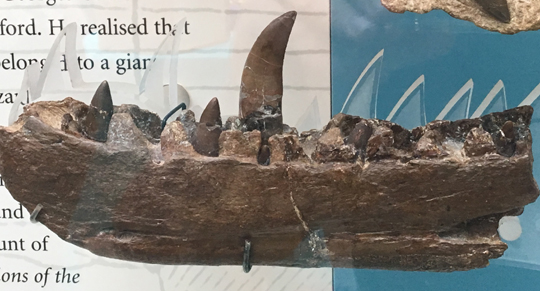
The Fossil Dentary Assigned to Megalosaurus

The lower jaw of Megalosaurus.

The partial dentary for teeth associated with Megalosaurus bucklandii.

Picture credit: Everything Dinosaur

Little is known about Megalosaurus, with very few finds of this type of Jurassic carnivore being made to add to our knowledge.  In fact, for much of the 19th and early 20th Centuries many partial fossils and fragments from carnivores discovered in Europe were assigned to the genus Megalosaurus.  So many finds were labelled as belonging to megalosaurs that this genera became known as “a Dinosaur Waste Basket” with virtually every indeterminate piece of carnosaur fossil being placed within this group.  It is only in the last few years, as our knowledge of European theropods has improved that scientists have taken a fresh look at these “Megalosaurus bones” and have begun to sort them out into other genera.

Megalosaurus was one of the top predators around at the time, it reached lengths of around 9 metres and weighed approximately 1 tonne.  As a result, a number of Megalosaurus dinosaur models have been produced.

It remains a favourite amongst model collectors and dinosaur enthusiasts and in recognition of this it was one of the first dinosaurs commissioned by the Natural History museum when they created their own model collection.

Models of dinosaurs including Megalosaurus here: Dinosaur and Prehistoric Animal Models.

A Picture of the Model Megalosaurus from the Natural History Museum

Megalosaurus replica dinosaur model.

Source: Natural History Museum Picture Library

24 11, 2007

Claws! Giant Sea Scorpion of the Devonian

By |2023-02-18T13:15:15+00:00November 24th, 2007|Categories: Dinosaur and Prehistoric Animal News Stories, Main Page, Palaeontological articles|1 Comment

Fossil Claw Indicates Giant Arthropods of the Devonian

Spiders can be quite frightening, especially at this time of year when some particular types of spider, such as the Wolf Spider take up residence in your house to avoid the wintry weather.  Suddenly, seeing one of these animals scuttling along the living room floor can be enough to make anyone jump, but scientists in Germany have come across a fossil to really put the wind up anyone with a slight fear of arthropods.

Giant Sea Scorpion

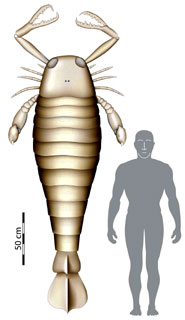
Markus Poschmann of the Mainz museum, in Germany has found a 390-million-year-old fossil claw from what could be the biggest arthropod known to date.  The fossil was found in a quarry near the town of Prum in western Germany.  The fossil is part of a claw of a sea scorpion species named Jaekelopterus rhenaniae, this species had been described and named from other German finds last century but this new find reveals that this particular sea scorpion was a giant of the Devonian seas, reaching lengths in excess of 2.5 metres,

Based on the size of the claw, which is 46 cm long scientists have calculated that this animal would have grown to at least 2.5 metres in length, making it a contender for the largest ever arthropod.  Certainly, based on these measurements this new find puts J. rhenaniae up alongside the likes of Pterygotus, another huge sea scorpion (known as Eurypterids).

Jaekelopterus rhenaniae

Jaekelopterus rhenaniae was probably a top predator during this part of the Devonian period, feeding on other arthropods, including smaller sea scorpions and fish.  Markus and co-author Simon Braddy, a palaeobiologist from Bristol University have just had their work published in Biology Letters, a scientific journal.

A Scale Drawing of Jaekelopterus (J. rhenaniae)

Jaekelopterus scale drawing

Jaekelopterus scale drawing. Life reconstruction of Jaekelopterus. Picture credit: Markus Poschmann.

Picture credit: Markus Poschmann

Lived in a Marine Environment

Based on other fossils of J. rhenaniae it can be seen that the limbs were relatively weak and would not have supported the weight of this huge animal without the assistance of water, so the scientists have speculated that this animal spent the vast majority of its life in a marine environment.  It would have been a ferocious ambush predator, tackling any animal smaller than itself that ventured within reach.  Once captured the powerful claws would have simply torn the victim to pieces, which could then have been passed up to the animal’s mouth on the underside of its heavily armoured head.

Despite this animal’s terrible appearance, it was no terror of the deep.  Instead it would have patrolled the shallow coastal areas, where there would have been a greater congregation of potential prey.  This theory is borne out by evidence from the matrix from which the fossil was taken.  The rocks reveal that the claw was buried by sediments laid down in a coastal swamp or probably a river delta.

With arthropods this size swimming around its no wonder that the vertebrates decided to give living on land a go.

To view models and replicas of Palaeozoic invertebrates: CollectA Prehistoric Life Models.

23 11, 2007

Meet Eotriceratops – a Possible Ancestor of Triceratops

By |2022-11-05T22:54:05+00:00November 23rd, 2007|Categories: Dinosaur and Prehistoric Animal News Stories, Main Page|4 Comments

New Horned Dinosaur Discovered in Alberta

A new type of horned dinosaur, a possible ancestor of the famous three-horned Triceratops has just gone on display at the Royal Tyrrell museum in Alberta.

Although Alberta, Canada is a real hotbed for new dinosaurs, especially ceratopsians with many new genera being discovered in the area such as Albertaceratops*, this new find is especially important has it comes from strata not normally associated with many well preserved dinosaur fossils.

To read article on the discovery of Albertaceratops please click on the link below:

*Albertaceratops: Meet an ancestor of Triceratops – Albertaceratops.

This specimen was found in a remote canyon in Dry Island Buffalo Jump Provincial Park in Central Alberta, in a rock horizon that represents sediments deposited around 68 million years ago (Cretaceous – Maastrichtian faunal stage).  Very few dinosaurs are known from this particular period, so the find is potentially very important in helping to trace the lineage of other dinosaurs that came later such as Triceratops.

According to David Eberth, a senior researcher at the Royal Tyrrell museum, it was lucky that the specimen was noticed as the joint expedition from the Tyrrell and Ottawa’s Canadian Museum of Nature could easily have passed this very poorly preserved fossil by as it lay partially exposed in the canyon wall.  However, as dinosaurs were rarely found in rocks of this age, the team persisted and their work was rewarded when they were able to recover most of the huge skull of this horned dinosaur.

It took the scientists a month to complete the initial excavation and then a further 18 months of laboratory work before the skull was able to go on display.  The work was well worth it as Eotriceratops (E. xerinsularis to give this animal its full name); represents a new genus of horned dinosaur, more primitive than Triceratops, with three horns, one small nose horn and two brow horns, each exceeding 1 metre in length.

The skull is also very large, at approaching 3 metres in length.  This is longer than any Triceratops skull found in Canada.  The skull is the size of a Mini Cooper.

It is remarkable how well the skull material has been reconstructed, as when it was first extracted from the shale deposits where it was embedded it was in about 50 pieces.  Indeed, one of the palaeontologists quipped that when it was first excavated the skull resembled “Cretaceous roadkill”.

We still have a lot to learn about the evolution of the ceratopsians.  The greatest variety of horned dinosaurs seems to be found in North America, although they may well have evolved in Asia.  Triceratops is often classified as the largest member of the “long-frilled ceratopsians”; although it could hardly be described as typical of this group.  Perhaps this new discovery will help shed further light on the evolution of Triceratops.  The name Eotriceratops means “dawn Triceratops”.

Everything Dinosaur stocks a wide selection of horned dinosaur models: Dinosaur and Prehistoric Animal Models.

22 11, 2007

The New Dino Xcavator Game – Are you Brave enough to Dig out T. rex?

By |2024-04-02T21:19:16+01:00November 22nd, 2007|Categories: Everything Dinosaur News and Updates, Main Page, Press Releases|0 Comments

Dino Xcavator Game – a novel twist on the classic family game “Operation”

We were going through some notes taken from our focus groups and family testers from the last twelve months or so, yesterday.  With so much going on at the moment it is an effort trying to keep the office tidy, but it proved well worth while as we were able to free up some office space.

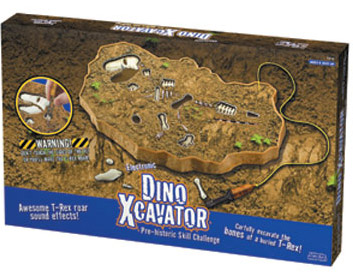
One of the reports we came across was the feedback we received on one of our dinosaur themed games that was introduced last year; an electronic Dinosaur Excavation game – snappily titled “Dino Xcavator”.  The game is a new twist on the family game Operation, but instead of a patient to operate upon, removing tibia, fibias and of course funny bones (humerus), you have to excavate the skull, vertebrae, pedals and unguals (foot bones and bones related to claws); of a Tyrannosaurus rex!

Electronic Dino Xcavator from Everything Dinosaur

Picture credit: Everything Dinosaur

Dinosaur Toys from Everything Dinosaur: Dinosaur Toys and Gifts.

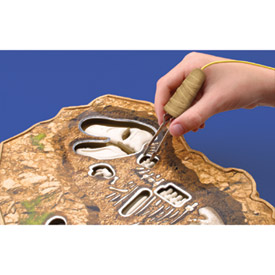
The game is suitable for children of 5-years and older.  Using the special excavation forceps you have to test your palaeontological skills as you excavate your very own Tyrannosaur.  Watch out, touch the sides of the pit whilst you are digging and the T. rex will ROAR…  This is a multi-player game and the winner is the one who can excavate the most bones.  It is certainly a great dinosaur excavation game.

Take turns to draw a card, trying your best to avoid getting the job or removing the devilishly difficult caudal section (the tail bones); then using the special excavation tool try to remove a bone.  A steady hand is required plus a little knowledge about dinosaurs of course.

Carefully Does It! – You Do Not Want to Wake up this Dinosaur!

Digging out Tyrannosaurus rex.

Picture credit: Everything Dinosaur

21 11, 2007

Finding Rare Fossils at an Airport – Something to do whilst Waiting for your Flight

By |2024-03-14T09:26:59+00:00November 21st, 2007|Categories: Dinosaur and Prehistoric Animal News Stories, Geology, Main Page|0 Comments

Liverpool John Lennon Airport Launches Fossil Finding Tour

For passengers waiting at Liverpool John Lennon Airport a new attraction has just been launched to help them pass the time whilst waiting for their flight or for relatives to arrive.  The airport has the usual shops, cafes and bars to keep passengers and visitors entertained but launched this week, the airport now provides the chance for people to go on their own fossil hunt around the terminal.

Finding Fossils

Like many public buildings, Liverpool John Lennon Airport’s terminal buildings have been constructed from quarried sedimentary rocks, many of which contain fossils and if these fossils end up on an exposed face of a building they can be seen by passers by.  Much of the atrium and concourse is made from limestone, a sedimentary rock formed by calcium carbonate, which originally came from the shells and carapaces of marine organisms.  Fossils of marine organisms can be preserved and in recognition of the fossils in the walls and floors of the airport buildings, the airport has introduced the “JLA Fossil Mystery Tour” in conjunction with the Liverpool Geological Society.

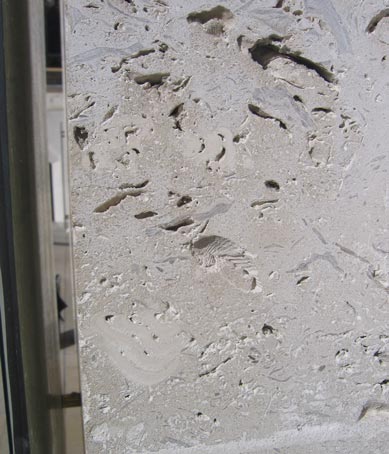
Finding Fossils – Can You Spot the Fossils?

Portland Stone

Looking for fossils at Liverpool John Lennon Airport.  Picture credit: Everything Dinosaur.

Picture credit: Everything Dinosaur

Fossils in the Limestone

The limestone is estimated to be approximately 250 million years old (Upper Permian/Lower Triassic) and was formed at the bottom of a shallow, tropical sea.  A guidebook can be purchased and visitors can then wander back through time to explore the world at a time before the Dinosaurs.  Indeed, sediments from this period in Earth’s history are particularly poignant as at the end of the Permian there was a huge extinction event and 95% of all life on the planet died out.

Everything Dinosaur has published other articles associated with the Permian extinction event: Can snails and oysters provide a clue to mass extinction?

Robin Tudor, General Manager – Corporate and Community Affairs at JLA, said: “We’re delighted to be launching JLA’s Fossil Mystery Tour guide. I’ve heard people say there’s a load of old fossils at JLA – I used to think they were talking about Airport Management but now I realise they were just well-informed!

“It’s fascinating to learn about the fossils which live in the limestone and to be able to now tell our passengers all about them.

Marks and Patterns in the Floor

“Some passengers aren’t aware that the marks and patterns around the terminal are in fact fossils. Before now we’ve received complaints about the marks and coffee stains on the terminal floor that passengers have mistaken these excellent fossil examples for!”

We can understand what Robin says when it comes to people thinking that the floor may be stained, when actually the “blemish” on the floor represents a marine animal from prehistoric times.  One of our team members was purchasing a new kitchen from a bathroom and kitchen supply store and they overheard a rather well to do lady complaining that the Italian marble tiles she had purchased had strange marks on them, that in her view spoilt the finish.

Fossils Preserved in Tiles

The young shop assistant was becoming quite flustered as the woman continued with her complaint, however, when our team member pointed out to her that the metamorphic marble was originally sedimentary limestone and that these marks were actually rare and ancient fossils which would make her floor a talking point and indeed a unique piece of architecture, she quickly changed her tune and insisted on having more tiles with fossils.

The launch of John Lennon Airport Fossil Mystery Tour guide coincides with the bicentenary celebrations of the Geological Society of London. This society, the oldest Geological society in the world was set up on November 13th 1807 and the launch of the John Lennon Airport Fossil Tour is just one of the special events planned to mark this event.

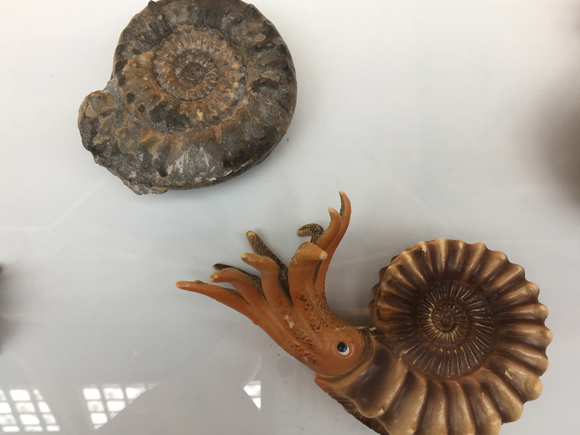
A Model of an Ammonite and an Ammonite Fossil

We spotted a Bullyland ammonite model being used to help illustrate a display of ammonite fossils. Ammonite replicas are often purchased by fossil hunters.

A Bullyland ammonite model is used to help illustrate a display of ammonite fossils. The building materials may contain mollusc shells.  Picture credit: Everything Dinosaur.

Picture credit: Everything Dinosaur

For models and replicas of Palaeozoic and Mesozoic invertebrates and other prehistoric animal figures: CollectA Prehistoric Life Models and Replicas.

The Fossil Mystery Tour guide is now available from the Information Desk in the terminal building.

For visitors to the airport the guide will provide an educational and informative way to help pass the time, after all, standing on an ancient sea floor which is 250 million years old is something that we don’t get the chance to do everyday.

Although not famous for its palaeontological heritage the Cheshire and Liverpool area has a number of public buildings made from sedimentary rock, in which fossils can be found.  Indeed, fossils can turn up in some very strange and unexpected places, take the quiet village of Lymm in Cheshire for example:

Article about Dinosaurs at Lymm (Cheshire).

20 11, 2007

Nigersaurus – An unusual long-necked Dinosaur that grazed like a Cow

By |2023-02-14T08:12:57+00:00November 20th, 2007|Categories: Dinosaur and Prehistoric Animal News Stories, Main Page|2 Comments

Latest Research Findings on Nigersaurus

As Dinosaurs dominated life on Earth during the latter part of the Mesozoic they diversified into many varied forms, each genus adapting to a specific way of life and filling an ecological niche.

Further research has just been published (November 2007), on a particularly bizarre looking sauropod from Africa – Nigersaurus.

Nigersaurus

Nigersaurus was first described in 1976 but little was known about this diplodocoid sauropod as although many isolated bones and fragments of fossils had been recovered very few were found in any form of association or articulation, so piecing together a complete picture of this animal was proving difficult.  Nigersaurus (means “Niger lizard”) has been found in the fossil rich sediments of the Elrhaz Formation in the Niger Republic – Africa.

A rich variety of fauna has been recovered from this particular fossil site including fossils of the iguanodont Ouranosaurus and the huge, ancient crocodile Sarcosuchus, however because of the nature of the bones of Nigersaurus (highly pneumatic – filled with air spaces) and the delicate structure of the skull the remains of Nigersaurus were often overlooked in favour of better preserved and articulated specimens.

Now research published in the scientific journal “The Public Library of Science” building on work carried out by the American palaeontologist, Paul Sereno (University of Chicago), and his colleagues has shed new light on this remarkable animal.

A Cretaceous Dinosaur

Nigersaurus lived during the Cretaceous, fossil evidence suggests that these type of animals were around from 119 to approximately 99 million years ago (Aptian and Albian faunal stages).  It was a member of the rebbachisaur family, a group of sauropods from the southern continents and Europe.  Estimates of size vary but it is believed that Nigersaurus grew to lengths of around 10 metres and when compared to more typical diplodocoids its neck was considerably shorter.  The most remarkable feature of the rebbachisaurs, and very evident in Nigersaurus was the extensive battery of sophisticated teeth.  Nigersaurus had upwards of 600 teeth in its jaws.  These teeth were arranged in rows along the front edges of the jaws, forming effective 30 cm long shears for cropping vegetation.

Study of the head and neck vertebrae indicate that the head was held close to the ground and Nigersaurus was probably a low level browser, shearing away at ferns, horsetails and other ground level plants like a cow grazing.

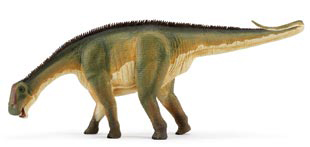
A Picture of a Nigersaurus Model

Nigersaurus dinosaur model.

The “Lawn Mower” sauropod.

Using CT scans to reveal the strange dentition in the jaws, scientists have calculated that each row of teeth had at least 9 replacement teeth ready in the jaws ready to erupt through the bone and replace any teeth lost.  The mouth parts of Nigersaurus have been described as a huge vacuum cleaner, hoovering up vegetation as it went along.  The ultra light skull and back bones had made this animal difficult to study, but the CT scan showed the placement of delicate canals in the brain-case area and research into their orientation indicates that Nigersaurus spent most of its time with its head lowered to the ground.

It is not known whether Nigersaurus had thick lips or a prehensile trunk to assist it with feeding, other similar appendages have been speculated for diplodocoids but as soft tissue rarely fossilises, no evidence for this has been found.

The Position of the Eyes

The eyes were positioned relatively high on the skull and like all other sauropods were on the side of the head, this enabled Nigersaurus to keep a careful watch out for predators as it grazed with its head facing the ground.  Living in herds would also have provided protection as in a group some animals would be feeding whilst others would have had their heads raised keeping watch for hungry theropods.  The close cropping action of Nigersaurus may have influenced the evolution of plants with many of the angiosperms (flowering plants) developing a low to the ground growing habit.  Grass for example, has an adaptation to overcome grazing as the growing point of the plant is at soil level thus permitting the plants to grow back after having been grazed.

There is no evidence of grass from this particular part of the Cretaceous, perhaps further research into the palynology (study of microfossils such as spores and pollen) will provide further information of the flora around at the time of Nigersaurus.

From evidence recovered in numerous expeditions, Nigersaurus has been formerly named and described – Nigersaurus taqueti by Paul Sereno and his team.  The species name ascribed to this animal honours the French palaeontologist Philippe Taquet who first uncovered the strange lightweight, air sac filled bones of this animal.  The peculiar dentition of rebbachisaurids, a sort of battery of cropping teeth is an example of parallel evolution within dinosaurs.  Groups of ornithischian dinosaurs such as hadrosaurs and ceratopsians also developed batteries of many hundreds of teeth, but in these bird-hipped dinosaurs the teeth were located towards the back of the jaws and formed an immense grinding service to help them cope with their tough diet.

Keeping your head close to ground was a dangerous habit during the middle Cretaceous.  Nigersaurus shared its world with a number of top predators including spinosaurids, carcharodontosaurids and abelisaurs.

Even lakes and rivers held their dangers, fossils of Sarcosuchus (means “flesh crocodile”) have been found in the same deposits as Nigersaurus.  This primitive crocodile grew to lengths of 40 feet or more and weighed an estimated 8 tonnes, certainly big enough to ambush a young Nigersaurus as it came down to drink.

Dinosaur Toys and Dinosaur Models: Dinosaur and Prehistoric Animal Models.

19 11, 2007

Dating the Mesozoic Cow New Study Suggests it was the Fish and Ostracods that did it!

By |2024-04-02T21:24:26+01:00November 19th, 2007|Categories: Dinosaur and Prehistoric Animal News Stories, Main Page, Palaeontological articles|1 Comment

Dating an early Mammal Tooth to the very end of the Cretaceous

On Friday 9th November we published an article about the discovery of an ancient tooth, believed to come from an early ancestor of ungulates (hoofed mammals) from 65 million years ago.  The discovery had been made in India, and this find was important as very little is known about Late Cretaceous mammals.

To read article: Very ancient udders! Mesozoic cow discovered in India.

Mammal Tooth

At first we queried whether the tooth had indeed been recovered from late Maastrichtian strata, thus placing this tooth at the very end of the age of Dinosaurs 65 million years ago.  The diversification and geographical distribution of mammals is still very poorly understood at this particular time in Earth’s history.  Material from the southern continents (Gondwanaland) is particularly rare, with most mammal fossils from this particular faunal stage having been recovered from the Northern Hemisphere – Laurasia.

However, one of the research scholars who worked on this particular discovery, Omkar Verma of the department of Geology (University of Jammu), was able to furnish us with a little more information.  From the articles and research papers that we were sent, it seems that the tooth was dated using other micro-fossil remains that had been recovered from the same matrix and the same site.  In particular remains of an ancient fish (a ray) Igdabatis indicus; and evidence from the many types of ostracod (crustaceans) and their carapaces indicates that the tooth came from the Maastrichtian faunal stage, placing this ancient mammal at the time of the last of the dinosaurs.

Dating the Fossils

Dating of fossils using “key” or “indicator” species which have a more precise date assigned to them in the palaeontological record is called biostratigraphy.  The remains of I. indicus are associated with the very late Cretaceous and so it seems that the mammalian tooth can be dated to that time period as well.

Ostracods, are still abundant today (the date back to the Cambrian period) and live in both marine and freshwater environments, there are thousands of different genera.  As the carapace or shell can enclose the entire body including the legs they are often referred to as “seed shrimps”, but their importance to micro-palaeontologists cannot be underestimated.  The huge numbers of micro-fossil remains and their prevalence all over the world enables scientists to accurately date geological deposits and thus assist in the dating of rarer finds such as in this case, the ancient mammalian molar from an ancestor of cows.

To view replicas of prehistoric mammals and other extinct creatures: Papo Dinosaur and Prehistoric Animal Models.

18 11, 2007

Digging Up Dinosaurs – A New Book Review

By |2024-04-02T21:20:33+01:00November 18th, 2007|Categories: Book Reviews, Main Page|0 Comments

Digging Up Dinosaurs – Book Review

If you have ever wondered how and where dinosaur fossils are found and thought about wanting to have a go at excavating your very own dinosaur, then this book (an ideal dinosaur book for kids),  is for you.

Combining information about the Age of Reptiles, the hard book cover folds out into a one metre wide sized booklet that takes young dinosaur fans through the step-by-step process of conducting their own dinosaur dig.  With a little guidebook included entitled “The Fossil Finders Handbook”, this very well crafted and colourful publication explains how palaeontologists unlock secrets from the past.

The book has been designed so that it can be folded outwards to provide a 3-D Tyrannosaurus skeleton that can be hung on a bedroom wall as an informative dinosaur poster.  The two main dinosaurs featured are Tyrannosaurus rex and Triceratops and information and lots of facts are provided about these two late Cretaceous dinosaurs in particular.

It is a colourful and informative publication with a unique style and layout which will appeal to children aged 5-6 years and upwards.

To view prehistoric animal and dinosaur toys: Dinosaur Toys and Gifts.

17 11, 2007

Where is the best place to find a new Dinosaur – in a museum collection?

By |2023-02-24T16:05:14+00:00November 17th, 2007|Categories: Dinosaur and Prehistoric Animal News Stories, Main Page, Palaeontological articles|0 Comments

If you want to find a new Dinosaur Species- try looking in a Museum’s Vaults

The romantic notion of an earnest young palaeontologist exploring the base of a cliff away from the rest of the dig team and uncovering their very own brand new genus of dinosaur is a bit fanciful, but these occasions do occur.  However, sometimes amazing discoveries can be made by simply re-examining earlier finds in museum collections.

This is precisely what happened to Mike Taylor, a PhD student from the University of Portsmouth who has discovered a brand new type of sauropod (long-necked dinosaur) whilst studying at the Natural History museum – London.

New Dinosaur Species

For Mike, who has been studying the vertebrae of sauropods for 5 years as soon as he saw the strange partially complete fossil bone, he knew it was very different from fossil vertebrae he had seen before.  The isolated bone represents a posterior part of the dorsal vertebrae section of an elephant-sized sauropod.  The fossil was unearthed in the early 1890s in Ecclesbourne Glen, near Hastings in the county of Kent.  Unfortunately since palaeontology was very much in its infancy and the importance of accurate mapping of find locations was not well understood, no detailed records were kept of the actual site.

Acquired by the London Natural History Museum

The fossil was acquired by the Natural History museum and briefly reviewed by the English palaeontologist Richard Lydekker in 1893, but after this it was simply stored in the vaults – that is until a very observant PhD student came along and noted its significance.

Xenoposeidon proneneukus

This new dinosaur has been named Xenoposeidon proneneukus, which means “alien sauropod – forward sloping” in homage to another sauropod called Sauroposeidon discovered in Western North America and because the upper portion of this single bone slopes forward.  It has been estimated that this animal lived during the early Cretaceous approximately 130 million years ago and from the shape and structure of this single dorsal vertebra it appears to represent a totally new family of Sauropoda.

Mike’s work is to published in the academic journal “Palaeontology” and here’s hoping that his diligence and hard work leads to more exciting discoveries in the museum’s collection.

More Dinosaurs Awaiting Discovery

Having been privileged to visit behind the scenes at a number of museums, the fact that new species of dinosaur (and even new families) can be found does not really surprise us.  For example, the Natural History museum has over 70 million specimens in its collection, the vast majority in storage.  Many of the fossils unearthed in the past have been misidentified and mis-labelled so there may be other fascinating finds awaiting discovery.

Once whilst at the Royal Tyrrell museum in Alberta, Canada we calculated that in their fossil depository, the tonnes and tonnes of burlap covered fossil bearing rock would take over 100 years to prepare and describe properly.  One hundred years, if every single palaeontologist and team worker stopped what they were doing and then spent 8 hours a day working on the museum’s back catalogue.

For dinosaur and prehistoric models and figures including sauropods: CollectA Deluxe Prehistoric Animal Figures.

Go to Top