All about dinosaurs, fossils and prehistoric animals by Everything Dinosaur team members.

Everything Dinosaur’s work with schools and other educational bodies. Articles, features and stories about dinosaurs and their role in education and educating young people.

17 03, 2024

New Royal Mail Mary Anning Stamps

By |2024-03-21T15:41:21+00:00March 17th, 2024|Categories: Adobe CS5, Dinosaur and Prehistoric Animal Drawings, Dinosaur Fans, Educational Activities, Main Page, Photos of Everything Dinosaur Products|0 Comments

Royal Mail intend to introduce a set of Mary Anning stamps. The set of four stamps feature a portrait of the pioneering palaeontologist and three fossil finds. The stamps have been launched at the same time as a set of prehistoric animal stamps.

The Royal Mail Mary Anning stamps can be purchased individually or as a special presentation set for collectors.
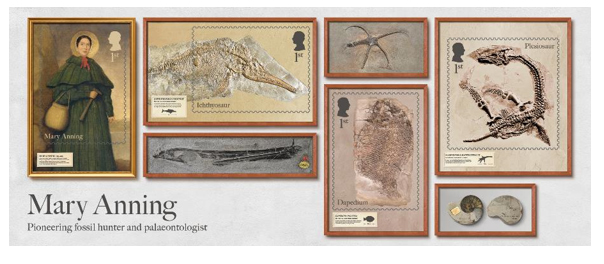
Royal Mail Mary Anning stamps.
Four Royal Mail stamps produced in collaboration with the Natural History Museum of London commemorate the contribution to the nascent science of palaeontology made by the amateur fossil collector Mary Anning (1799-1847). Picture credit: Royal Mail.

To view Everything Dinosaur’s recent article about the Royal Mail prehistoric animal stamps: Royal Mail Introduces Prehistoric Animal Stamps.

Ichthyosaurus communis and Other Significant Fossils

One of the stamps illustrating fossil discoveries features Ichthyosaurus communis. This was the first species within the Ichthyosaurus genus to be erected (De la Beche and Conybeare, 1822).
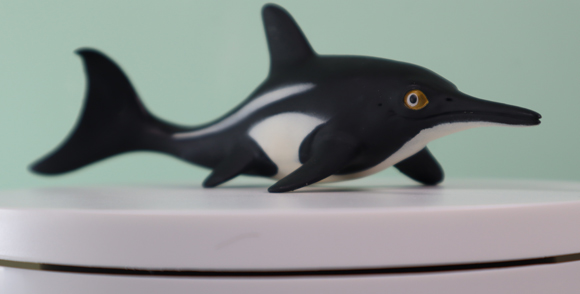
An Ichthyosaurus model
The Ichthyosaurus model (Wild Safari Prehistoric World) ready to take its turn on the Everything Dinosaur turntable. Picture credit: Everything Dinosaur.

Picture credit: Everything Dinosaur

The image (above) shows a typical replica of an ichthyosaur. This marine reptile was a sleek and agile predator with a body shape similar to that of extant dolphins. The dolphin/ichthyosaur body morphology is often cited as an example of convergent evolution.

The model is from the Wild Safari Prehistoric World range.

To view this range: Models of Prehistoric Animals.

From the Lower Jurassic

The stamps feature three prehistoric animals connected to Mary Anning. Ichthyosaurus communis (top) a complete fossilised juvenile, purchased from Mary Anning circa 1835. Dapedium politum a species of ray-finned fish (Actinopterygii) collected by Mary Anning circa 1829 (middle). Plesiosaurus macrocephalus (bottom), a near-complete, articulated juvenile collected by Mary Anning in 1830.
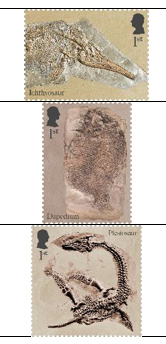
Stamps celebrating the discoveries of Mary Anning.
The stamps feature three prehistoric animals connected to Mary Anning. Picture credit: Royal Mail.

A Portrait of Mary Anning

The set of stamps also includes a portrait of Mary Anning. The date of the painting remains unknown, but it has been suggested that it was painted before 1842. It is housed at the Natural History Museum (London). Unfortunately, the name of the artist who created this portrait of Mary in her best clothes was not recorded.
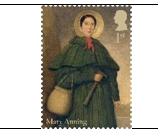
A portrait of Mary Anning part of a Royal Mail stamp collection.
A portrait of Mary Anning. Picture credit: Royal Mail.

A spokesperson from Everything Dinosaur commented:

“It is wonderful to see Royal Mail recognising the contribution to palaeontology and geology by Mary Anning. We hope these beautiful Mary Anning stamps and the presentation set will spark an interest in the Earth sciences.”

The Everything Dinosaur website: Dinosaur Toys and Models.
12 03, 2024

New Royal Mail Prehistoric Animal Stamps

By |2024-03-21T10:02:24+00:00March 12th, 2024|Categories: Adobe CS5, Dinosaur and Prehistoric Animal Drawings, Dinosaur Fans, Educational Activities, Main Page, Photos of Everything Dinosaur Products|0 Comments

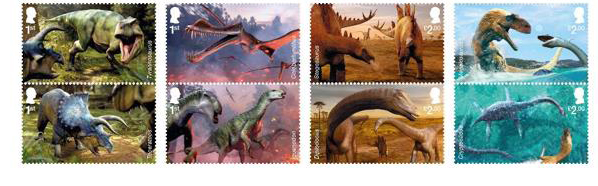
A beautiful set of Royal Mail prehistoric animal stamps is being introduced. The main set will feature prehistoric animals including Tyrannosaurus, Triceratops and Stegosaurus. A second set of stamps is also going on sale commemorating the life and works of Mary Anning.

Royal Mail prehistoric animal stamps (2024).
The eight main stamps feature beautiful illustrations of prehistoric animals by the Exeter-based digital concept illustrator Joshua Dunlop. Six dinosaurs are featured along with a pterosaur (Coloborhynchus) and a plesiosaur (Cryptoclidus). Picture credit: Royal Mail.

Celebrating Two Hundred Years Since the Formal Description of Megalosaurus

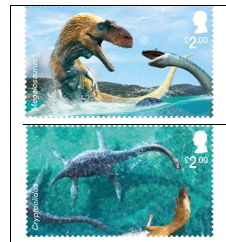
2024 marks the two hundredth anniversary of the formal, scientific description of a prehistoric animal that was later to be classified as a dinosaur. The theropod dinosaur Megalosaurus was named and described in 1824 by the Reverend William Buckland who was president of the Geological Society of London. The binomial species name Megalosaurus bucklandii was erected in 1827. This was the first scientific account in the western world of a dinosaur. Megalosaurus features on a pair of stamps along with the roughly contemporaneous marine reptile Cryptoclidus.

Royal Mail Prehistoric Animal Stamps (Megalosaurus and Cryptoclidus).
The fourth pair of stamps feature a Megalosaurus encountering a plesiosaur (Cryptoclidus) whilst wading through shallow water. Picture credit: Royal Mail.

Megalosaurus was for a long time a taxonomic waste basket. Theropod fossils from different strata were assigned to this taxon. The only definitive Megalosaurus remains come from Oxfordshire (England).

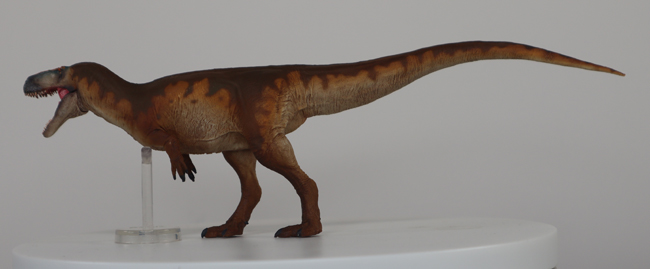
The PNSO Megalosaurus model.
A model of Megalosaurus bucklandii. The new for 2023 PNSO Megalosaurus dinosaur model. Picture credit: Everything Dinosaur.

Picture credit: Everything Dinosaur

The picture (above) shows a model of Megalosaurus bucklandii from PNSO.

To view the PNSO range of prehistoric animal figures: PNSO Prehistoric Animal Models and Figures.

Royal Mail Prehistoric Animal Stamps

The eight prehistoric animal stamps were created by Joshua Dunlop, a digital concept artist based in Exeter (Devon). A second set of stamps features a portrait of the pioneering fossil collector Mary Anning. In addition, three stamps have been created that show photographs of fossils associated with Mary Anning and the Lower Jurassic rocks of Lyme Regis.

The list of dinosaurs featured:

  • Tyrannosaurus
  • Triceratops
  • Stegosaurus
  • Diplodocus
  • Iguanodon
  • Megalosaurus
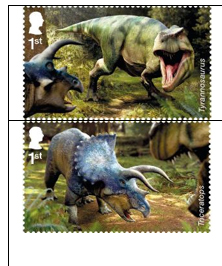
Royal Mail prehistoric animal stamps (Tyrannosaurus rex and Triceratops).
Triceratops and Tyrannosaurus feature on the new for 2024 Royal Mail prehistoric animal stamps. Only the genus name for Tyrannosaurus is given on the stamps and in the accompanying Royal Mail press release. We suspect that this is an illustration of Tyrannosaurus rex. Picture credit: Royal Mail.

In Collaboration with the London Natural History Museum

The Royal Mail prehistoric animal stamps were created in collaboration with the London Natural History Museum.

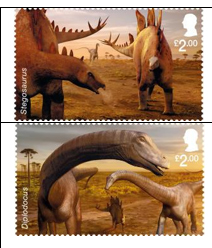
Royal Mail prehistoric animal stamps (Stegosaurus and Diplodocus).
Diplodocus and Stegosaurus feature on the Royal Mail £2 stamps. These animals are known from the Upper Jurassic Morrison Formation of the United States. Picture credit: Royal Mail.

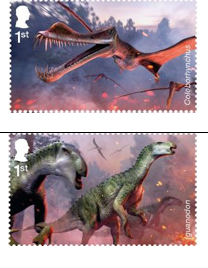
North American dinosaurs are featured (Tyrannosaurus, Triceratops, Stegosaurus and Diplodocus). Prehistoric animals known from fossil discoveries from southern England are also included. Each pair of stamps show a similar image but from a different prehistoric animal’s perspective. For example, one pair of stamps depicts a herd of Iguanodon escaping a forest fire whilst a flock of startled pterosaurs (Coloborhynchus) fly overhead.

Royal Mail prehistoric animal stamps (Coloborhynchus and Iguanodon).
One of the largest toothed pterosaurs known to science is featured on a stamp (Coloborhynchus). It accompanies an Iguanodon stamp. Both these prehistoric animals are known from the Lower Cretaceous of England. Picture credit: Royal Mail.

Everything Dinosaur Comments

A spokesperson from Everything Dinosaur commented:

“These are beautiful stamps. The eight prehistoric animal stamps show four different scenes, and they are designed to be viewed as pairs. For instance, the Tyrannosaurus stamp shows this theropod attacking a Triceratops. In contrast, the Triceratops stamp shows the horned dinosaur fending off a lunge from the Tyrannosaurus.”

Visit the Everything Dinosaur website: Dinosaur Toys, Models and Dinosaur Clothing.

3 03, 2024

Thirteen Batches of Frogspawn in the Office Pond

By |2024-03-02T21:35:49+00:00March 3rd, 2024|Categories: Adobe CS5, Animal News Stories, Educational Activities, Main Page, Photos|0 Comments

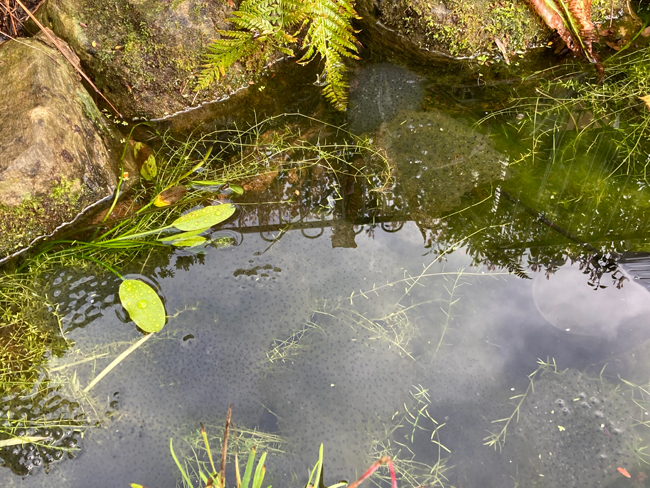
Common frogs (Rana temporaria) began breeding in the office pond very early this year. The first batch of frogspawn was observed on the morning of Saturday, the 18th of February. Frog activity had been observed in the pond a few days earlier. The spawning season has stared early, perhaps because of the mild, wet weather. February the 18th is the earliest date in the year that we have recorded frogspawn. Last year (2023), the first frogspawn was recorded on the 28th of February. This was the first time that we had recorded frogs spawning in February.

We estimate that by this weekend, a total of thirteen batches of frogspawn had been laid. The number of frogs seen in the pond has rarely exceeded four or five. However, other frogs must be visiting the pond and breeding during the night or in the early morning.

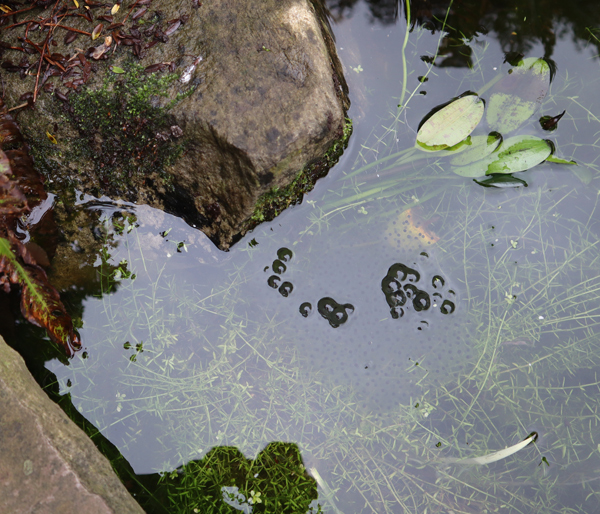
Frogspawn in the office pond recorded on the 2nd March (2024).
A large amount of frogspawn observed in the office pond on the morning of the 2nd of March (2024). Picture credit: Everything Dinosaur.

Picture credit: Everything Dinosaur

A Record Amount of Frogspawn

A spokesperson from Everything Dinosaur commented:

“Although we cannot be certain, there could be a record amount of frogspawn in the office pond. We think there are thirteen batches in total. All the eggs were laid in a shallow part of the pond.”

Hopefully, the sudden cold snap with overnight frosts will not have harmed the eggs. We are looking forward to watching the tadpoles hatch.

Visit the Everything Dinosaur website: Everything Dinosaur.

24 02, 2024

Studying Sea Scorpion Fossils – How Did Eurypterids Breathe?

By |2024-03-16T17:25:24+00:00February 24th, 2024|Categories: Adobe CS5, Educational Activities, Main Page, Palaeontological articles, Photos/Pictures of Fossils|0 Comments

The eurypterids were an extremely successful group of arthropods. These animals are often referred to as “sea scorpions”. However, their taxonomic relationship to extant scorpions remains unclear and they were not confined to marine environments. These invertebrates are members of the Subphylum Chelicerata (claw horns) and are members of the Eurypterida Order. Approximately 250 different species have been named. One of the fascinating aspects of eurypterids is understanding how they breathed.

Examining sea scorpion fossils
A fossil of a sea scorpion (eurypterid) on display at the Manchester Museum. Note the pointed end segment (telson). Probably an example of the Silurian eurypterid Eurypterus. Picture credit: Everything Dinosaur.

Picture credit: Everything Dinosaur

How Did Eurypterids Breathe?

Most palaeontologists believe that eurypterids evolved in marine environments. However, fossils have been found in association with estuarine and freshwater environments. Carboniferous trackways suggest that some eurypterids may have been amphibious and able to spend some time on land.

No eurypterid is thought to have been wholly or primarily terrestrial. There is some remarkable fossil evidence to suggest that they did evolve air-breathing organs. When discussing respiration, it is thought that the primary organs of aquatic respiration are likely to have been retained at least in part.

The extant horseshoe crab (Limulus) may provide an analogue. These animals inhabit marine environments although they do venture into shallow water to mate and onto the shore to lay eggs. Horseshoe crabs have five pairs of gills located on their abdomen (Opisthosoma). Each pair of gills consists of flap-like structures covering a series of membranes that resemble the pages from a book. These are called lamellae, but their morphology has given rise to the popular term “book lungs”. Oxygen is absorbed via gaseous exchange on the surface area of the lamellae.

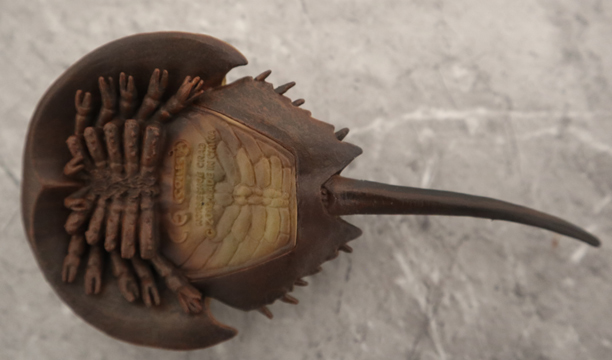
CollectA Horseshoe crab model in ventral view
The CollectA Horseshoe crab model in ventral view (view of the underside). Picture credit: Everything Dinosaur.

Picture credit: Everything Dinosaur

The image (above) shows a ventral view of the popular CollectA horseshoe crab model.

To view the range of CollectA models in stock: CollectA Prehistoric Animal Models and Figures.

Four Pairs of Book Gills or Five?

Debate still continues as to whether eurypterids had four pairs of book gills or five. A specimen of Onychopterella augusti from Late Ordovician strata located in South Africa preserved four pairs of vertical book gills. The book gills were located in the third to sixth segments of the abdomen. It has been suggested that all eurypterids had four pairs of book gills rather than the five pairs seen in xiphosurans such as horseshoe crabs.

Terrestrial scorpions also have four pairs of vertically orientated book lungs, located in the third to sixth body segments. It is not known whether this is case of synapomorphy (shared characteristic different from that of their latest common ancestor). This anatomical similarity could indicate that scorpions (Order Scorpiones) are more closely related to eurypterids than previously thought. The phylogenetic relationship between eurypterids and other members of the Arthropoda remains controversial.

Pancaked Sea Scorpion Fossils

Unfortunately, most fossil specimens of eurypterids are squashed flat and may only represent exuviae (shed exoskeletons after moulting [ecdysis]).

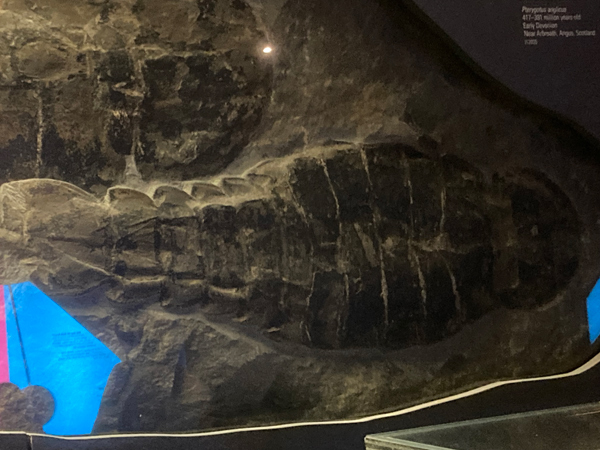
Two Pterygotus sea scorpion fossils.
Examples of the Pterygotioidea eurypterid lineage. Note the flattened, blade-like telson that probably helped with propulsion or acted like a rudder helping to steer the animal through the water. The fossils represent Pterygotus anglicus. A pair of beautiful sea scorpion fossils. Picture credit: Everything Dinosaur.

Picture credit: Everything Dinosaur

Visit the Everything Dinosaur website: The Everything Dinosaur website.

18 02, 2024

Frogspawn Discovered in the Office Pond

By |2024-02-18T21:22:20+00:00February 18th, 2024|Categories: Animal News Stories, Educational Activities, Main Page, Photos|0 Comments

We have frogspawn in the office pond. Today, a clump of frogspawn was observed in a shallow area of the office pond. Frogs had been spotted in the pond a few days ago, it seems that the spawning season has started. This is the earliest date in the year that we have recorded frogspawn. Last year (2023), the first frogspawn was recorded on the 28th of February. This was the first time that the frogs have spawned in February. This year, the frogs have begun spawning even earlier.

Frogspawn in the office pond.
Frogspawn in the office pond. Today, 18th February a batch of frogspawn was observed in the office pond. This is the earliest recorded spawning. Picture credit: Everything Dinosaur.

Picture credit: Everything Dinosaur

Common Frogs (Rana temporaria)

The spawn was produced by Common frogs (Rana temporaria). Observations by team members suggest that there were four frogs in the pond. The pond has been created to attract wildlife and frogs have laid their eggs in the pond each spring since 2008. For many years the frogs spawned around the third week of March. However, there is a distinct trend for recording spawning much earlier in the year.

Could this be a consequence of global warming and climate change?

It has certainly been very mild over the last week or two. Temperatures of 13-14 degrees Celsius have been recorded in the northwest of England. The average temperature for February in the Manchester area of England would normally be expected to be around 4-7 degrees Celsius.

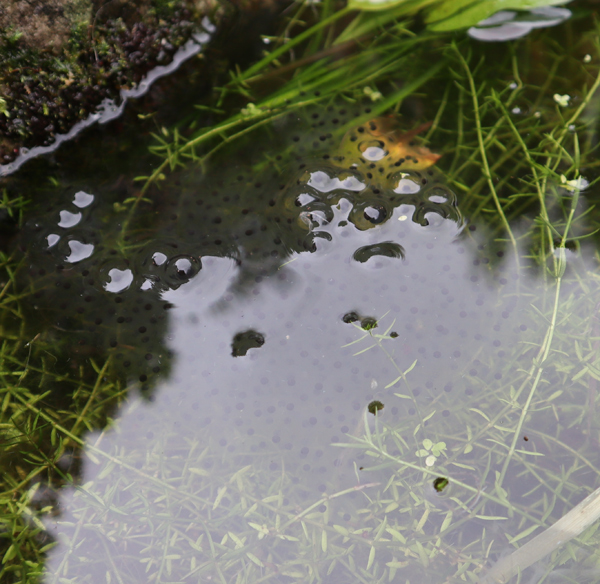
A close-up view of the frogspawn (18th February, 2024).
A close-up view of the frogspawn laid early in the morning of 18th February. Picture credit: Everything Dinosaur.

Picture credit: Everything Dinosaur

Frogspawn Laid in a Shallow Part of the Pond

The frogs have laid their eggs in a shallow part of the pond. Eggs are not normally laid in this part of the office pond. Folklore suggests that if frogs lay in the shallows, then the next few weeks will be mild but wet. We will continue to observe the pond to see if more frogs arrive and more spawn is produced.

The Everything Dinosaur website: Everything Dinosaur.

13 02, 2024

Studying Stunning Sea Scorpion Fossils

By |2024-03-03T12:39:31+00:00February 13th, 2024|Categories: Adobe CS5, Educational Activities, Main Page, Palaeontological articles, Photos/Pictures of Fossils|0 Comments

Eurypterids (Eurypterida) are often referred to as sea scorpions. Like scorpions these extinct invertebrates are members of the Arthropoda Phylum. They are distantly related to extant scorpions and spiders. It is thought that the first eurypterids evolved during the Ordovician. They thrived in the Silurian and Devonian. Giant forms evolved, animals like Jaekeklopterus, Acutiramus and Pterygotus. However, the number of taxa was severely depleted during the end-Devonian extinction event and although they survived for at least another 100 million years or so, during the Carboniferous and Permian they only made up a very small percentage of the taxa described from fossil deposits.

Two Pterygotus sea scorpion fossils.
Examples of the Pterygotioidea eurypterid lineage. Note the flattened, blade-like telson that probably helped with propulsion or acted like a rudder helping to steer the animal through the water. The fossils represent Pterygotus anglicus. Picture credit: Everything Dinosaur.

Picture credit: Everything Dinosaur

The picture (above) shows two Pterygotus anglicus fossil specimens on display at the London Natural History Museum. These Early Devonian fossils come from Arbroath (Scotland).

The Shape of the Telson

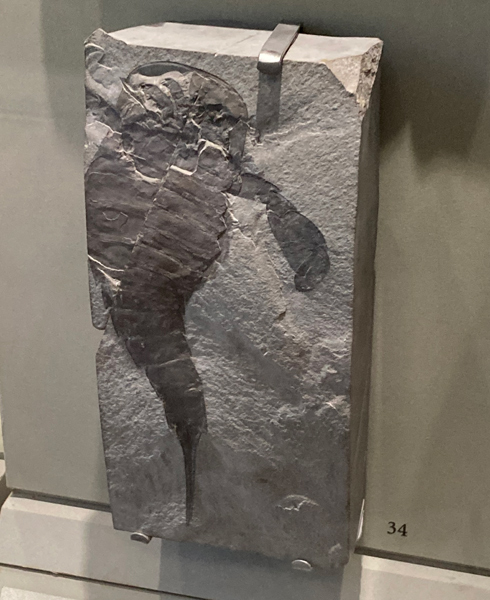
Note the broad, flattened, blade-like final segment of the animal. This is the telson and in the Pterygotioidea lineage (as well as in some other Superfamilies), the telson evolved into an organ to help with propulsion and steering. In other eurypterids, the telson is shaped very differently. For example, in the sea scorpion fossil (below), the telson is long and pointed.

Examining sea scorpion fossils
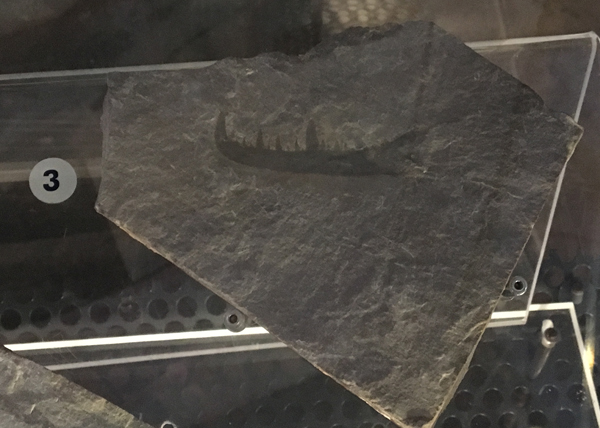
A fossil of a sea scorpion (eurypterid) on display at the Manchester Museum. Note the pointed end segment (telson). Probably an example of the Silurian eurypterid Eurypterus. Picture credit: Everything Dinosaur.

The Giant Claws (Chelicerae) Seen in Some Sea Scorpion Fossils

The segmented body of eurypterids consisted of the frontal prosoma (head) and the posterior opisthosoma (abdomen). The prosoma contained the mouth and six pairs of appendages which are usually referred to as appendage pairs I to VI using Roman numerals. The segments that make up the opisthosoma are usually numbered using Arabic numerals 1, 2, 3 etc. The opisthosoma comprised twelve segments in total plus the telson.

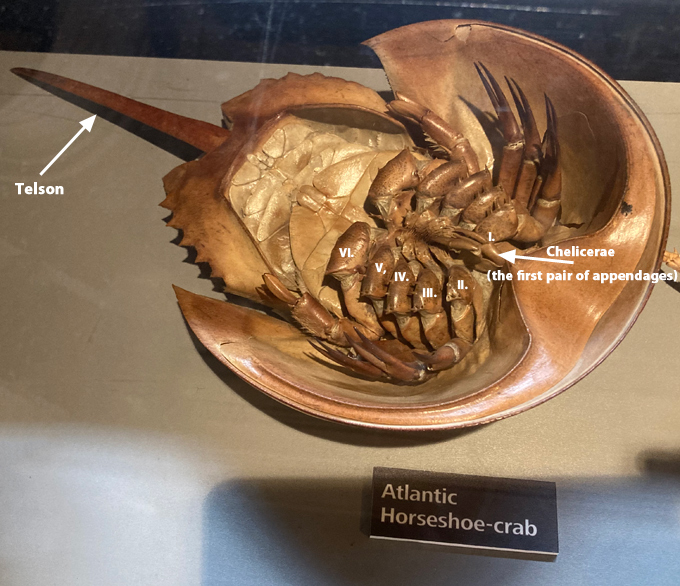
The first pair of appendages, the only pair located in front of the mouth opening, is called the chelicerae (pronounced kel-iss-ser-ray). This pair of appendages evolved into a myriad of forms in the Chelicerata (pronounced kel-iss-ser-rat-ah), the Subphylum containing the eurypterids, spiders, mites, scorpions and horseshoe crabs. This pair of appendages form the fangs seen in spiders and form the feeding limbs of horseshoe crabs.

An Atlantic horseshoe crab viewed ventrally.
An Atlantic horseshoe crab in ventral view with the six pairs of appendages and the telson labelled. The first pair of appendages (chelicerae) help to push food into the mouth opening. Picture credit: Everything Dinosaur.

Picture credit: Everything Dinosaur

Powerful Pincers Adapted for Grasping Prey

Some of these appendages, such as the chelicerae of giant pterygotids evolved into powerful pincers armed with strong claws analogous to those seen in crabs and lobsters. These chelicerae seem to be adapted for grasping and subduing prey. This suggests that many eurypterids were predatory.

A sea scorpion claw
A stunning fossil of a sea scorpion (eurypterid) claw housed at the National Museum Cardiff (Wales) photographed in 2019 when team members at Everything Dinosaur visited. The image shows a single chelicera ramus. Picture credit: Everything Dinosaur.

Note

A single appendage is referred to as a chelicera (pronounced kel-iss-ser-rah). Whereas a pair or more are referred to as chelicerae (kel-iss-ser-ray).

A spokesperson from Everything Dinosaur commented that these arthropods were remarkable animals.

“Some 250 different taxa have been described and some of these sea scorpions show adaptations that indicate they may have been partially terrestrial. Venturing out onto land is supported by trace fossils potentially preserving tracks of eurypterids walking across mud close to bodies of water.”

Visit the Everything Dinosaur website: Everything Dinosaur’s Website.

12 02, 2024

The CollectA Horseshoe Crab Model is Reviewed

By |2024-02-24T17:06:48+00:00February 12th, 2024|Categories: Adobe CS5, Animal News Stories, Educational Activities, Everything Dinosaur Products, Main Page, Photos of Everything Dinosaur Products|0 Comments

In 2020, CollectA introduced a Horseshoe crab model. These animals are members of the Limulidae family. This model of an ancient invertebrate is extremely detailed. The Horseshoe crab lineage has a fossil record that dates back to the Ordovician. Team members were asked to take some photographs of the figure for a palaeontology related project.

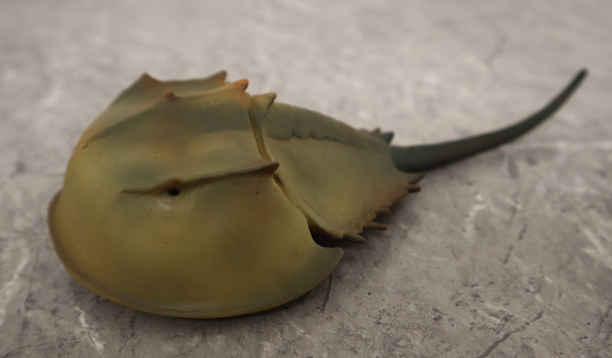
CollectA Horseshoe crab model in lateral view.
CollectA Horseshoe crab in lateral view. Picture credit: Everything Dinosaur.

Picture credit: Everything Dinosaur

The CollectA Horseshoe Crab Model

The model is very detailed, and the paint scheme makes this replica look extremely realistic. However, it is on the underside where the care and dedication of the design team really shows.

CollectA Horseshoe crab model in ventral view
The CollectA Horseshoe crab model in ventral view (view of the underside). Picture credit: Everything Dinosaur.

Picture credit: Everything Dinosaur

To view the not-to-scale CollectA range of models available from Everything Dinosaur: CollectA Prehistoric Life Models.

The small chelicerae (modified claws) are bent towards the mouth. These appendages pass food into the mouth. The walking legs show the bifurcated end segments, and the rear “pusher” leg is clearly visible. The design team have included a vent at the base of the long, pointed telson.

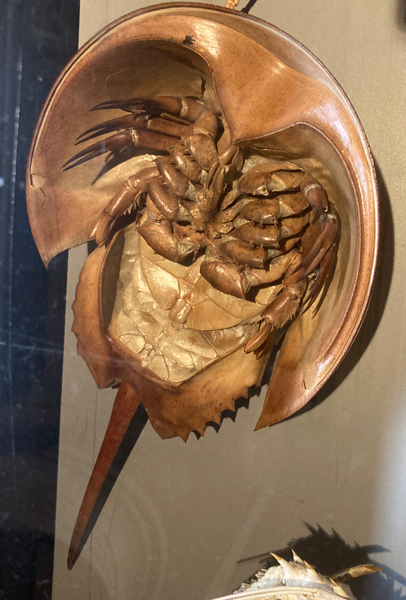
Atlantic Horseshoe crab in ventral view.
An Atlantic Horseshoe crab in ventral view (view of the underside). Picture credit: Everything Dinosaur.

Picture credit: Everything Dinosaur

The picture (above) shows an Atlantic Horseshoe crab (Limulus polyphemus) in ventral view. It is on display at the London Natural History Museum.

CollectA Horseshoe Crab model.
CollectA Age of Dinosaurs Popular Size Horseshoe crab figure. The model measures 15 centimetres in length and the width of the carapace is 7.7 cm approximately.

In horseshoe crabs, the head and thorax are fused. This structure is called the prosoma. It is also sometimes referred to as the cephalothorax. The cephalothorax is covered in a hard, protective carapace.

Visit the Everything Dinosaur website: Take a Look at the Everything Dinosaur Website.

2 02, 2024

Spotting an Ammonite Fossil at a Trade Fair

By |2024-02-06T22:05:42+00:00February 2nd, 2024|Categories: Educational Activities, Everything Dinosaur Products, Geology, Main Page, Photos/Pictures of Fossils, Press Releases|0 Comments

Team members at Everything Dinosaur recently visited the Spielwarenmesse trade fair in Germany. Many of the buildings in this part of Bavaria are constructed from limestone. The limestone dates from the Jurassic and is highly fossiliferous. Whilst walking between the halls of the Spielwarenmesse on our way to another meeting, we spotted an ammonite fossil in the stone floor,

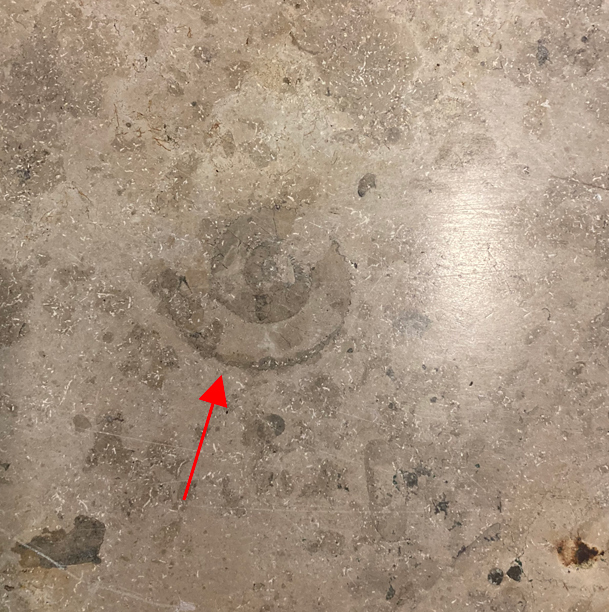
Ammonite fossil in the stone floor on the site of the annual Spielwarenmesse trade fair.
On the floor of the Spielwarenmesse building fossils can be spotted. For example, this limestone slab has the remains of an ammonite clearly visible within it. The red arrow highlights the position of the ammonite fossil. Picture credit: Everything Dinosaur.

Picture credit: Everything Dinosaur

Looking for an Ammonite Fossil

Numerous fossils can be spotted entombed in the polished stone floors of the vast Messezentrum Nuremberg which hosts the international toy fair. Belemnites, bivalves and oyster shells are common. Ammonites tend to be a little rarer, but there are still plenty to see.

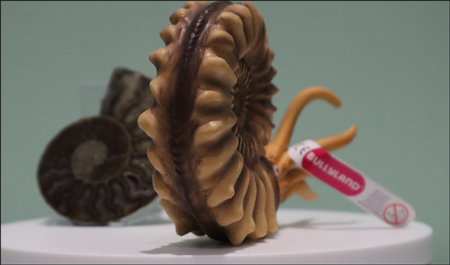
Ammonite model next to a fossil specimen.
A model of an ammonite (foreground) with a polished ammonite in the background. The strongly ribbed shell and the obvious keel of the ammonite replica. Picture credit: Everything Dinosaur.

Picture credit: Everything Dinosaur

The picture (above) shows a Bullyland ammonite replica in the foreground with a polished ammonite fossil behind it.

To view the Bullyland range of prehistoric animal models and figures: Bullyland Prehistoric Animal Replicas.

A spokesperson from Everything Dinosaur explained that many municipal buildings in and around Nuremberg were built from limestone that contains lots of fossils. The sediments that went onto form the limestone were Upper Jurassic in age.

The spokesperson added:

“Nuremberg airport is famous for its fossils. It is always intriguing to see what we can spot in the floor tiles as we wait to board an aeroplane.

Visit the award-winning Everything Dinosaur website: Everything Dinosaur.

11 12, 2023

The Story of Earth’s Climate in 25 Discoveries

By |2023-12-12T10:13:13+00:00December 11th, 2023|Categories: Book Reviews, Educational Activities, Geology, Main Page, Palaeontological articles|0 Comments

Delegates at COP28 continue their discussions on how to limit and make preparations for future climate change. These discussions, their success or failure will have consequences for all of humanity. Decisions made today will have implications for all future generations too. The publication of a new book that documents the history of our planet’s climate and its connection to life on Earth provides context and delivers a fresh perspective.

“The Story of Earth’s Climate in 25 Discoveries” is written by Donald R. Prothero. He is an incredibly talented American palaeontologist and geologist with a gift for communication. As adjunct professor of geological sciences at California State Polytechnic University (Pomona, California), the author is well qualified to explain the intimate connection between climate and life on Earth. However, unlike many scientists, Donald R. Prothero’s engaging writing style permits the general reader to understand and grasp sometimes difficult concepts.

Climate change book
The story of our planet’s climate in twenty-five discoveries by Donald R. Prothero.

Picture credit: Columbia University Press

Climate Change from a Deep Time Perspective

Our planet has undergone radical climate change throughout its history. Climate has changed dramatically from a “Snowball Earth” that led to a mass extinction event to sweltering jungles that stretched across the globe. Over deep geological time, climate has shaped the evolution of life on our planet. Furthermore, living organisms have shaped the Earth’s climate. We are not the first inhabitants to dramatically influence our planet’s climate. This new book documents these changes. It highlights how our climate has never changed so radically as it is changing now.

“The Story of Earth’s Climate in 25 Discoveries”

“The Story of Earth’s Climate in 25 Discoveries” takes the reader on a journey through Earth’s history. In this highly entertaining book, the author addresses questions such as Why do we have phytoplankton to thank for the air we breathe? What kind of climate was necessary for the rise of the dinosaurs, or the mammals, their successors? When and how have climatic changes caused mass extinctions?

Team members at Everything Dinosaur have enjoyed reading other books written by Donald R. Prothero. For example, we reviewed “The Story of the Dinosaurs in 25 Discoveries”.

Our review can be found here: A Review of “The Story of the Dinosaurs in 25 Discoveries.”

Today’s Climate Crisis

The author concludes this most informative publication with an examination of the Ice Ages and the Holocene Epoch. Our role in climate change is outlined and the perils we now face are explained.

Understanding why the climate has changed in the past, this timely book shows, is essential to grasping the gravity of how radically human activity is altering the climate today.

The Book Details

The Book: “The Story of Earth’s Climate in 25 Discoveries”

Publisher: Columbia University Press

Published February 2024 | Price: £32.00/$38.00 USD (hardback) | Pages: 472

ISBN: 9780231203586

Visit the website of Columbia University Press: Columbia University Press. Search on the website for the author or title to find the book.

6 12, 2023

A Fun Dinosaur Themed Teaching Activity for Young Children

By |2024-03-09T15:03:00+00:00December 6th, 2023|Categories: Early Years Foundation Reception, Educational Activities, General Teaching, Key Stage 1/2, Main Page, Photos/Schools|0 Comments

Whilst sorting our image archive, we came across a super example of a dinosaur themed teaching activity. In December 2019 Everything Dinosaur visited Greenhill Primary in Bury (Greater Manchester). The teaching team had invited us in to help with the Year 1 term topic. The children had been learning all about dinosaurs and prehistoric animals. One of the areas of learning the teachers wanted to focus upon was improving literacy.

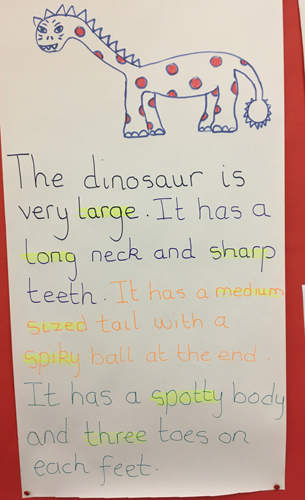
Dinosaur themed teaching activity.
A super example of a dinosaur themed activity helping to support Year 1 literacy. This example was spotted on a visit to Greenhill Primary in Bury. Picture credit: Everything Dinosaur.

Picture credit: Everything Dinosaur

Dinosaur Themed Teaching Activity

The dedicated and enthusiastic teaching team had prepared a comprehensive term topic. A topic that would appeal to a variety of learning styles. The children were excited and keen to demonstrate their knowledge.

Dinosaurs appeal to children. Many are fascinated by them, and a clever term topic can really engage young minds. If the children are motivated and enthused, they will quickly develop new skills and gain confidence with writing and reading.

The colourful drawings of prehistoric animals posted around the classroom helped to encourage the pupils in their own creative writing.

The award-winning Everything Dinosaur website: Everything Dinosaur.

Go to Top