All about dinosaurs, fossils and prehistoric animals by Everything Dinosaur team members.

Drawings of dinosaurs and other prehistoric animals either done by team members or sent into Everything Dinosaur.

26 09, 2019

A Stunning Smilodon Illustration

By |2023-12-30T17:21:25+00:00September 26th, 2019|Categories: Dinosaur and Prehistoric Animal Drawings, Main Page|0 Comments

Stunning Smilodon Illustration

Our thanks to Caldey who sent into Everything Dinosaur her latest prehistoric animal illustration.  Caldey decided to produce a drawing of a Smilodon (Sabre-toothed cat) and what a carefully drawn member of the cat family (Felidae), has been produced.  Normally, we receive lots of dinosaur drawings at our offices, our postbag contains pictures of Triceratops, Stegosaurus, sauropods and of course T. rex.  Being sent a Smilodon drawing is quite a rarity.

A Smilodon as Illustrated by Caldey

Smilodon illustration.
Caldey’s illustration of a Smilodon (Sabre-toothed cat).

Picture credit: Caldey

Sabre-tooth Cat “Knife Tooth”

Smilodon is a genus of the extinct Felidae subfamily the Machairodontinae.  These cats were both geographically and temporally widespread (Smilodon is associated with both North and South America), with the very last of them surviving into the Late Pleistocene.

The powerfully built Smilodon is famous for its huge upper canine teeth and palaeontologists have undertaken a great deal of research to determine just how these teeth functioned and how these predators hunted prey.  The genus has been translated from the Greek as “knife tooth”, a reference to those huge canines that in some of our specimens measure more than 18 centimetres in length (Smilodon fatalis).

A Close-up View of the Head and Neck of Caldey’s Sabre-toothed Cat
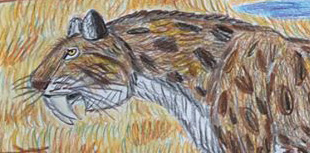
A Smilodon illustration.
This close up shows the fine detail on the head and neck of the Smilodon drawing.

Picture credit: Caldey

Smilodon Colouration

Although the exact coat colouration of Smilodon is unknown, there has been a recent trend to depict this animal with a mottled or spotted coat.  It is thought that ancestral cats, which were small and confined to forested habitats probably had spotted coats that would have provided more effective camouflage.  However, the colouration of Smilodon remains speculative.

A spokesperson from Everything Dinosaur commented:

“Caldey’s drawing show lots of amazing detail and she has taken great care to fill in the background for her big cat.  We are sure that Smilodon feels very much at home in that landscape.”

Visit the Everything Dinosaur website: Everything Dinosaur.
22 09, 2019

The Amazing Second Velociraptor Species – Velociraptor osmolskae

By |2023-12-30T15:24:19+00:00September 22nd, 2019|Categories: Dinosaur and Prehistoric Animal Drawings, Dinosaur Fans, Main Page|0 Comments

The Second Velociraptor Species – Velociraptor osmolskae

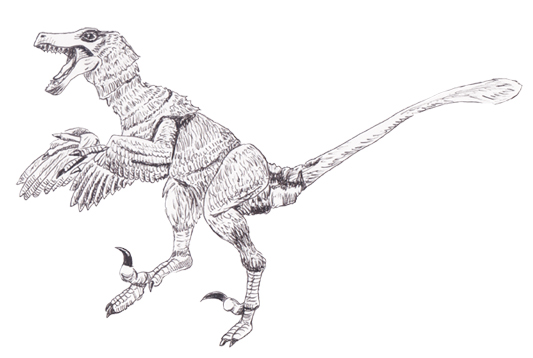
The second Velociraptor species to be scientifically described – V. osmolskae, is very similar to V. mongoliensis.  However, the known fossil material has sufficient autapomorphies to support the erection of a separate species.

Velociraptor mongoliensis and Velociraptor osmolskae

It is intriguing that the Djadochta and Bayan Mandahu Formations have yielded a very similar dinosaur fauna.  For example, Velociraptor mongoliensis, Protoceratops andrewsi, and Pinacosaurus grangeri are synonymous with the Djadochta Formation.  In contrast, V. osmolskae is associated with the Bayan Mandahu Formation, and this member of the Velociraptorinae subfamily shared its environment with Protoceratops hellenikorhinus, and Pinacosaurus mephistocephalus.

These differences in the biota associated with each geological formation might be due to some form of natural barrier separating the regions where these two deposits were formed.  Evidence for any substantial barrier that would deter the movement of animals from one area to another has proved elusive.  It might be and indeed, many palaeontologists favour this hypothesis, that the different faunas can be explained by there being a temporal difference between the two formations, i.e. one formation is younger than the other.

Both Velociraptor species are featured in the Beasts of the Mesozoic range of articulated dinosaur figures.

To view this range: Beasts of the Mesozoic Models.

Everything Dinosaur’s Scale Drawing of Velociraptor osmolskae

Drawing of Velociraptor osmolskae.
A drawing of Velociraptor osmolskae.  It is estimated that this little “raptor”  measured around 1.8 metres in length (mostly tail), stood approximately 1 metre high and weighed around 15 kilograms. Picture credit: Everything Dinosaur.

Picture credit: Everything Dinosaur

Visit the award-winning Everything Dinosaur website: Everything Dinosaur.
21 09, 2019

Beautiful PNSO Box Art is Highlighted

By |2023-12-30T15:18:13+00:00September 21st, 2019|Categories: Dinosaur and Prehistoric Animal Drawings, Dinosaur Fans, Everything Dinosaur Products, Main Page|0 Comments

The Fantastic Box Art on the PNSO Megalodon Figure (Patton)

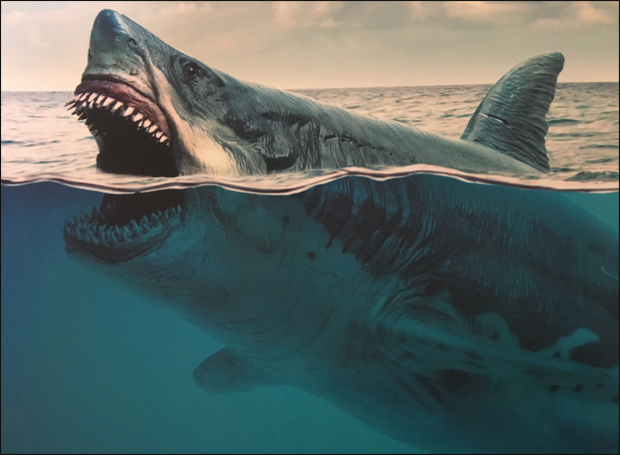
Team members at Everything Dinosaur have received a lot of very positive comments about the cover sleeve artwork on the PNSO Megalodon model.  The company has gained a tremendous reputation for its artwork, thanks largely to the input of famous Chinese palaeoartist Zhao Chuang. This person has illustrated numerous scientific papers highlighting fossil discoveries.  The artwork, showing a large shark breaking the surface with its huge teeth-lined jaws gaping has received lots of praise.

The PNSO Megalodon Model

The Beautiful and Highly Detailed Cover Sleeve Artwork – PNSO Megalodon Model “Patton”

Brilliant artwork on the PNSO Megalodon model cover sleeve.
The amazing, colourful sleeve artwork on the PNSO Megalodon figure.  A fantastic illustration of the giant prehistoric shark Megalodon.

Picture credit: Everything Dinosaur

PNSO have lots of other prehistoric animal figures in the pipeline, we look forward to seeing the box art that will accompany these models.

To view the range of PNSO models and figures in stock at Everything Dinosaur: PNSO Age of Dinosaurs Figures.

9 09, 2019

Picturing a Papo Pentaceratops Beautifully

By |2023-12-29T16:56:31+00:00September 9th, 2019|Categories: Dinosaur and Prehistoric Animal Drawings, Dinosaur Fans, Everything Dinosaur Products, Main Page, Photos of Everything Dinosaur Products|0 Comments

Picturing a Papo Pentaceratops

One of the most enthusiastically received new prehistoric animal models of 2019 is the Papo Pentaceratops.  When we first published photographs of this new horned dinosaur model from the French manufacturer (Papo), earlier this year, a number of collectors and dinosaur model fans commented on its unusual pose.  After all, a rearing ceratopsid is very different from the postures normally associated with Triceratops, Torosaurus, Styracosaurus, Pachyrhinosaurus and so forth.

The Papo Pentaceratops

However, this dinosaur model has proved to be a big hit.  Everything Dinosaur team members have received lots of photographs, positive feedback and drawings of this Papo dinosaur model.  For example, young dinosaur fan Caldey sent in a beautiful illustration of her Papo Pentaceratops.

Caldey’s Illustration of the Papo Pentaceratops Dinosaur Model

A drawing of the new for 2019 Papo Pentaceratops by Caldey.
Caldey’s illustration of the new for 2019 Papo Pentaceratops dinosaur model.

Picture credit: Caldey

A spokesperson from Everything Dinosaur commented:

“Our thanks to Caldey and all the other dinosaur model collectors and fans who have sent in pictures and photographs of their Papo model.  It is great to see how this new prehistoric animal figure has inspired so many people to get in touch.”

Pentaceratops en Español “Cara Con Cinco Cuernos”

Everything Dinosaur has received feedback about the Papo Pentaceratops from customers all over the world.  One of our customers from Chile commented:

“Increíble modelo y pintura, además de una versatilidad en su forma de posar.”

This translates from the Spanish as:

“Incredible model and painting, as well as versatility in the way that it has been posed.”

It seems that this prehistoric posture has been very well received indeed.  Can we expect more posing prehistoric animals from Papo in the future?  Collectors and fans of dinosaur replicas will have to wait and see what 2020 brings.  The Pentaceratops “five horned face”, or as they say in Chile “cara con cinco cuernos”, has gathered a world-wide following.

Proudly Holding a Papo Pentaceratops

Papo Pentaceratops dinosaur model.
The Papo Pentaceratops dinosaur model. Picture credit: Everything Dinosaur.

Picture credit: Everything Dinosaur

Visit the Everything Dinosaur website: Everything Dinosaur’s Website.

Our thanks to Caldey and all the other Everything Dinosaur customers who have been in touch to sing the praises of the Pentaceratops.

To view the complete range of Papo prehistoric animals available from Everything Dinosaur, including the new for 2019 Papo Gorgosaurus and the Pentaceratops: Papo Dinosaurs (Les Dinosaures) and Prehistoric Animal Models.

3 09, 2019

Colourful and Creative Dinosaur Drawings

By |2023-12-29T16:24:17+00:00September 3rd, 2019|Categories: Adobe CS5, Dinosaur and Prehistoric Animal Drawings, Educational Activities, Main Page, Teaching|0 Comments

Colourful Creative Dinosaurs

Our thanks to young Nataliya (Year 2), who sent into Everything Dinosaur a beautiful illustration of a dinosaur that she had designed following a visit to her school by one of our team members.  Nataliya and her classmates had taken up our challenge to design a dinosaur as part of an extension exercise that arose following one of our dinosaur and fossil workshops at the school.  The dinosaur was named “spikeraptor” and despite its fearsome name, Nataliya explained that this dinosaur was a herbivore and even included a picture of some leaves that the dinosaur was grazing upon in her prehistoric portrait.

A Colourful Dinosaur Design – “Spikeraptor”

A colourful green dinosaur - Spikeraptor the product of the imagination of young Nataliya (Key Stage 1).
A colourful green dinosaur – Spikeraptor the product of the imagination of young Nataliya (Year 2).

Picture credit: Nataliya (Key Stage 1) and Everything Dinosaur

Lovely Labels on the Dinosaur Drawing

As part of a writing exercise we asked the children to label their prehistoric animal’s body parts.  Nataliya was keen to emphasis the spikes and prickles on her dinosaur and our congratulations to Nataliya and the rest of the class for sending in some super drawings with fantastic examples of handwriting.  These drawings have made our day and we shall post them up in our warehouse so that all the Everything Dinosaur team members can view them.

The Everything Dinosaur website: Everything Dinosaur.

28 08, 2019

The Doubtful Sauropod Bothriospondylus – A Fascinating Tale

By |2023-12-29T14:24:02+00:00August 28th, 2019|Categories: Dinosaur and Prehistoric Animal Drawings, Dinosaur Fans, Main Page|0 Comments

The Dubious Sauropod Bothriospondylus

Occasionally, Everything Dinosaur features the artwork of the talented Chinese palaeoartist Zhao Chuang on this blog.  Today, we feature one of his illustrations of a dubious species of sauropod named from fragmentary fossils found in Wiltshire.

An Illustration of the Sauropod Bothriospondylus (B. suffossus) by Zhao Chuang)

The sauropod Bothriospondylus illustrated by Zhao Chuang.
An illustration of the dubious (nomen dubium) sauropod Bothriospondylus by the Chinese artist Zhao Chuang.

Picture credit: Zhao Chuang (from the Science Art World by Zhao Chuang and Yang Yang)

Bothriospondylus

Named and described by Richard Owen in 1875, based on four dorsal vertebrae collected from Upper Jurassic strata (Kimmeridgian faunal stage), a number of species have subsequently been assigned to this genus including a species based on fossils from as far afield as Madagascar.

The four vertebrae (along with three unfused, fragmentary sacral vertebrae), referred to this species are now regarded as non-diagnostic.  They lack distinctive characteristics to permit the establishment of a new genus, therefore Bothriospondylus is regarded by most palaeontologists as nomen dubium.

What Does Nomen dubium Mean?

Nomen dubium is a term that we have explained in previous articles on this blog.  It simply means that the name given to the organism is doubted.  Any organism whose validity is in doubt is regarded as nomen dubium.

The Everything Dinosaur website: Everything Dinosaur.

17 08, 2019

A Ferocious Carnotaurus is Illustrated

By |2023-12-27T17:52:17+00:00August 17th, 2019|Categories: Adobe CS5, Dinosaur and Prehistoric Animal Drawings, Main Page|2 Comments

A Ferocious Carnotaurus

The image below is an illustration of the Late Cretaceous South American abelisaurid Carnotaurus (C. sastrei), by the renowned Chinese palaeoartist Zhao Chuang.  This is one of our favourite illustrations of the dinosaur known as “meat-eating bull”.

The Illustration of Carnotaurus (C. sastrei)

Carnotaurus illustrated by the renowned artist Zhao Chuang.
An illustration of the fearsome theropod dinosaur Carnotaurus by Zhao Chuang.

Picture credit: Zhao Chuang

The artwork (above), was produced as part of a series of commissioned pieces to illustrate the science/art world by Zhao Chuang and Yang Yang for PNSO (Peking Natural Science-Art Organisation).

Carnotaurus sastrei

Known from an almost complete skeleton found in Argentina, this large, carnivorous dinosaur was scientifically described in 1985.  Zhao Chuang has chosen to focus on the remarkable skull of this Late Cretaceous abelisaurid.  The head is short and blunt with two imposing horns positioned over the eye sockets sticking out sideways.  The deep skull contrasts with the slender lower jaw which for such a large dinosaur (estimated at more than seven metres in length), indicates a relatively weak bite.

Everything Dinosaur stocks a wide selection of Carnotaurus models.

To view these models: Dinosaur and Prehistoric Animal Models.

For many years, Carnotaurus was regarded as a hunter of large prey, however, analysis of the bite force exerted by the jaws indicated a surprisingly weak bite for a carnivore weighing in excess of a tonne.  Research (Mazzeta et al 2009), indicated that this dinosaur could generate a bilateral bite force – measured on both sides of the jaw, of around 3,400 Newtons.  In contrast, the much smaller extant lion (Panthera leo) and the spotted hyena (Crocuta crocuta) are capable of generating bite forces of at least 1.3 times the bite force calculated for Carnotaurus, even though these living carnivores are considerably smaller.

As to what Carnotaurus ate, this is open to speculation, but it could have specialised in catching smaller animals or perhaps it was a specialised scavenger, the narrow jaws proving adept at removing flesh from corpses.  Whatever, Carnotaurus consumed, we still take time out to admire this marvellous illustration by the very talented Zhao Chuang.

The Everything Dinosaur website: Everything Dinosaur.

2 08, 2019

A Jinzhousaurus in Trouble – Tremendous Artwork

By |2023-12-26T15:36:59+00:00August 2nd, 2019|Categories: Adobe CS5, Dinosaur and Prehistoric Animal Drawings, Dinosaur Fans, Famous Figures, Main Page, Photos of Everything Dinosaur Products|0 Comments

A Jinzhousaurus in Trouble

Continuing our occasional series, in which we post up illustrations from renowned palaeoartists, today, we feature a dramatic scene as depicted by the well-known Chinese artist Zhao Chuang.  An unfortunate Jinzhousaurus is being attacked by a flock of “raptors”.  The fast-running theropods will not find the Jinzhousaurus easy prey, Jinzhousaurus was strongly built and at over five metres long and weighing perhaps as much as three-quarters of a tonne, it was a formidable opponent.

Zhao Chuang’s Illustration of the Jinzhousaurus Attacked by Dromaeosaurids

Jinzhousaurus under attack from "raptors". An illustration by Zhao Chuang.
A Jinzhousaurus under attack from a flock of “raptors”.

Picture credit: Zhao Chuang (PNSO)

Jinzhousaurus yangi

Named and described in 2001, Jinzhousaurus (J. yangi) is known from an almost complete skeleton (including cranial material) from north-eastern China (Yixian Formation, Liaoning Province).  The exact taxonomic position of Jinzhousaurus remains controversial.  The skeletal material ascribed to this genus shows a mix of basal and more advanced characteristics.  At first it was thought that this ornithischian was related to the likes of Dollodon, Mantellodon from Europe and Bolong (B. yixianensis) from north-eastern China.  It was described as an iguanodontoid, however, more recent analysis places Jinzhousaurus as a member of the Hadrosauroidea Superfamily.

For models and replicas of ornithischian dinosaurs: Dinosaur Models and Figures.

Which Dromaeosaurid or Troodontid?

There is certainly no shortage of candidates as to which dromaeosaurid or troodontid might be depicted in this illustration.  The Maniraptora is well represented in these Early Cretaceous deposits.  However, as Jinzhousaurus is confined to the Dawangzhangzi Beds section of the Yixian Formation, this does narrow the field somewhat. It could be Sinornithosaurus, but as this genus is regarded as one of the smallest of the dromaeosaurids, then unless the Jinzhousaurus in the artwork is a juvenile, this seems unlikely.  It could be an as yet, unnamed member of the Maniraptora whose fossils have yet to be formally described.  Perhaps the attacking “raptors” are a flock of Zhenyuanlong dromaeosaurs.

An Illustration of the Early Cretaceous Dromaeosaurid Zhenyuanlong suni

Zhenyuanlong illustrated.
Very probably a ground-dwelling predator.  An illustration of the dromaeosaurid Zhenyuanlong suni.  This artwork was also created by the talented Chinese palaeoartist Zhao Chuang.

Picture credit: Zhao Chuang

Zhenyuanlong suni

Zhenyuanlong is one of several dromaeosaurid genera from Liaoning Province, for an article that compares these various dinosaurs and comments on whether they were ground-dwelling or otherwise: Updating the Winged Dragon.

To read an article about the scientific description of Zhenyuanlong suni: New Winged Dragon from Liaoning Province.

Although Zhenyuanlong was only recently named and scientifically described, there is already a prehistoric animal figure available that represents this dinosaur.  In fact, in the Beasts of the Mesozoic model series, there are two Zhenyuanlong figures available.  Our congratulations to the team behind these wonderful display pieces for being so quick off the mark when it comes to adding new dromaeosaurids to their “raptor” range.

Not One but Two Zhenyuanlong suni Figures are Available in the Beasts of the Mesozoic Range

Beasts of the Mesozoic "raptor" figures - Zhenyuanlong suni.
Beasts of the Mesozoic Zhenyuanlong suni “raptor” figures. Picture credit: Everything Dinosaur.

Picture credit: Everything Dinosaur

To view the Zhenyuanlong figures and the rest of the splendid Beasts of the Mesozoic series: Beasts of the Mesozoic Prehistoric Animal Figures.

31 07, 2019

The Late Cretaceous of Northern China and Some Beautiful Artwork

By |2024-05-11T17:10:20+01:00July 31st, 2019|Categories: Adobe CS5, Dinosaur and Prehistoric Animal Drawings, Dinosaur Fans, Everything Dinosaur Products, Main Page|0 Comments

The Late Cretaceous of Northern China

Today, we wanted to post up some more of the amazing artwork produced by Zhao Chuang that was created in association with the Peking Natural Science-Art Organisation (PNSO).  Zhao Chuang has an extensive portfolio of palaeoart, we have already featured a number of illustrations of prehistoric scenes and individual dinosaurs and other long extinct creatures on this blog.  However, rather than focus on one particular dinosaur we thought that for a change, we would post up an imagined dinosaur diorama.

Northern China in the Late Cretaceous

The Late Cretaceous of northern China
Northern China in the Late Cretaceous.

Picture credit: Zhao Chuang (PNSO)

A Stunning Piece of PNSO Palaeoart

The picture (above), depicts northern China (Inner Mongolia), in the Late Cretaceous, approximately 77-75 million years ago (Campanian faunal stage of the Late Cretaceous).  The armoured dinosaur in the foreground (left), is Pinacosaurus (P. grangeri), a member of the Ankylosaurinae.  At around five metres in length, this heavily armoured dinosaur probably had little to fear from the numerous dromaeosaurids such as Velociraptor and Tsaagan which shared its environment, although there is some evidence to suggest that larger theropods (tyrannosaurids) were present.

The artist has depicted a dromaeosaurid on the extreme left of the diorama.  This fleet-footed predator is on its own, no pack or flock behaviour for this little carnivore is inferred.  The feathered dromaeosaurid is making a swift exit as it does not want to get involved with the herd of duck-billed dinosaurs approaching the oasis, although in truth, these herbivorous giants have very little to fear from this particular theropod.

A Closer View of the Small Theropod Dinosaur Depicted in the Dinosaur Diorama

A dromaeosaurid takes evasive action to avoid a herd of duck-billed dinosaurs.
A closer view of the beautifully coloured dromaeosaurid dinosaur depicted in the illustration by Zhao Chuang.

Picture credit: Zhao Chuang (PNSO)

Plesiohadros?

We have commented on this artwork on a previous post, but on that occasion we did not identify the hadrosaurids approaching the waterhole.  Although the Hadrosauridae has an extensive fossil record in northern latitudes, identifying the group approaching the oasis in this illustration is quite tricky.  Remarkably, despite the multitude of vertebrate fossils associated with the Djadokhta Formation (sometimes also referred to as the  Djadochta Formation), of northern China, very few ornithischian dinosaurs have been identified.

The majority of ornithischian dinosaurs known from this region are either members of the armoured Thyreophora such as Pinacosaurus or Neoceratopsia (part of the horned dinosaurs group).

The duck-billed dinosaurs could represent Plesiohadros (Plesiohadros djadokhtaensis), which is known from both cranial and postcranial fossil material from the same locality where Velociraptor fossils have been found.

As Plesiohadros is the only hadrosaurid discovered so far from the Djadokhta Formation , then the large herbivores in the diorama could represent this species.  However, as Plesiohadros was only named and described in 2014, if the artwork had been completed earlier, then the presence of hadrosaurids could be speculative on the part of the illustrator.

Are the Hadrosaurids Depicted in the Diorama Plesiohadros?

A herd of dubk-billed dinosaurs.
Is this a herd of Plesiohadros?

Picture credit : Zhao Chuang (PNSO)

Whatever the species represented, the illustration is truly spectacular and one of our favourites.

To view the range of PNSO prehistoric animal models and figures available from Everything Dinosaur: PNSO Age of Dinosaurs.

Our congratulations to the artist for the fabulous illustrations.

The Everything Dinosaur website: Everything Dinosaur.

30 07, 2019

Illustrating the PNSO Ankylosaurus “Sede”

By |2023-12-26T15:17:22+00:00July 30th, 2019|Categories: Adobe CS5, Dinosaur and Prehistoric Animal Drawings, Dinosaur Fans, Everything Dinosaur Products, Main Page, Photos of Everything Dinosaur Products|0 Comments

Illustrating the PNSO Ankylosaurus “Sede”

Our thanks to dinosaur fan and model collector Ian who sent us an illustration of “Sede” the PNSO Ankylosaurus model on receipt of his order.  Ian has sent us some beautiful drawings of various prehistoric animals and we have been delighted to receive them and to post them up onto our social media pages.

The Illustration of “Sede” the Ankylosaurus Dinosaur Model

A drawing of "Sede" the Ankylosaurus dinosaur model (PNSO).
An illustration of an Ankylosaurus based on the PNSO “Sede” the Ankylosaurus model.

Picture credit: Ian

The PNSO Ankylosaurus Model “Sede”

The Ankylosaurus replica is regarded by many collectors as being one of the best armoured dinosaur models to have been produced.  Everything Dinosaur team members have been busy supplying a number of academics, museum staff and educationalists.  We have supplied this finely detailed model to authors of scientific publications on the Thyreophora (shield bearers).

A Picture of “Sede” the PNSO Ankylosaurus Dinosaur Model

"Sede" the Ankylosaurus dinosaur model.
The image of Sede the Ankylosaurus that probably inspired Ian’s illustration.  Can you see the resemblance?

A Fabulous Drawing

We congratulate Ian for his fabulous drawing.  It is always a pleasure to receive artwork from model collectors and fans of dinosaurs.  We have added this model to our own collection, in doing so, we took some outdoor shots of this figure so that we could show the beautiful detail and colouration on this Ankylosaurus.

An Outdoor Shot Showing the Beautiful Detail and Colouration 

PNSO Ankylosaurus "Sede".
“Sede” the Ankylosaurus dinosaur model. Picture credit: Everything Dinosaur.

Picture credit: Everything Dinosaur

To view “Sede” the Ankylosaurus and the rest of the PNSO prehistoric animal models available from Everything Dinosaur: PNSO Age of Dinosaurs.

The Everything Dinosaur website: Everything Dinosaur.

Go to Top