All about dinosaurs, fossils and prehistoric animals by Everything Dinosaur team members.

Fossil finds, new dinosaur discoveries, news and views from the world of palaeontology and other Earth sciences.

25 10, 2017

The First Ichthyosaur from India

By |2023-08-19T06:44:54+01:00October 25th, 2017|Categories: Dinosaur and Prehistoric Animal News Stories, Dinosaur Fans, Main Page|0 Comments

India Has Its First Ichthyosaur

What has Dorset and New Delhi got in common?  What’s the connection between Charmouth and Gujarat State?  It seems that marine reptiles are the link, with the discovery of India’s first ichthyosaur fossil.  Granted, the Indian ichthyosaur is younger than the ichthyosaur material related with Lyme Regis and Charmouth but just as palaeontologists from the Dorset Museum have excavated ichthyosaur fossils, so have their counterparts from Delhi University.  Intriguingly, these may be the first ichthyosaur fossils to have been found in Gujarat State, but they won’t be the last, there are very probably lots more ichthyosaur (and plesiosaur) fossils awaiting discovery in India’s most westerly State.

Ichthyosaur Fossils Found In India

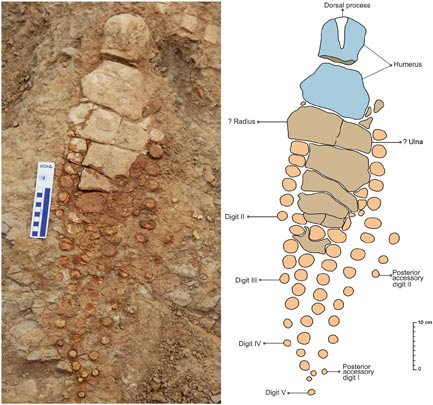
A Field Photograph Showing the Fossil Material and Accompanying Line Drawing

Indian Ichthyosaur fossil with line drawing.

A photograph showing the Ichthyosaur fossil as it is exposed, with line drawing (below).

Picture credit:  Dr Guntupalli V.R. Prasad (University of Delhi)

Member of the Ophthalmosauridae

Writing in journal PLOS One, the researchers conclude that the partial 3.6-metre-long fossil represents the remains of an ichthyosaur that measured between 5 and 5.5 metres in length.

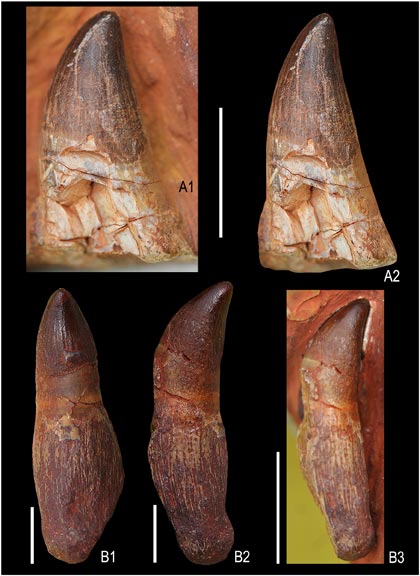
The specimen was discovered in the greenish-yellow shales of the Katrol Formation exposed at a site just south of the village of Lodai in the Kachchh district of Gujarat.  The presence of ammonites and belemnites (important zonal fossils), suggest that the ichthyosaur lived some 152 million years ago in the Kimmeridgian (there’s that Dorset connection again), faunal zone of the Late Jurassic.  The broken tips of the teeth, could have resulted from taphonomy but they might suggest that this marine reptile had a duraphagous diet, crunching the shells of ammonites.

For models of marine reptiles and ammonites: CollectA Prehistoric Life Models and Figures.

This new ichthyosaur species has yet to be formally named but it has been assigned to the Ophthalmosauridae, a family of ichthyosaurs that were widespread in the Late Jurassic.

Wear on the Teeth and Broken Teeth Suggest a Diet of Hard-shelled Creatures Such as Ammonites

Views of two fossil teeth from the Indian Ichthyosaur.

Views of two teeth from the Indian Ichthyosaur (scale bar = 1 cm).

Picture credit: PLOS One

Commenting on the discovery, lead author, Dr Guntupalli V. R. Prasad (University of Delhi) stated:

“This is a remarkable discovery not only because it is the first Jurassic ichthyosaur record from India, but also it throws light on the evolution and diversity of ichthyosaurs in the Indo-Madagascan region of the former Gondwanaland and India’s biological connectivity with other continents in the Jurassic.”

Faunal Exchanges

The research team conclude that the widespread occurrence of ophthalmosaurids in the Upper Jurassic deposits of western Tethys, Madagascar, South America and India indicate possible faunal exchanges between the western Tethys and Gondwanan continents through a southern seaway.

A Photograph and Line Drawing of the Left Forefin

Indian Ichthyosaur (left forefin).

The left forefin and accompanying line drawing of the Indian ichthyosaur.

Picture credit: PLOS One

Visit the Everything Dinosaur website: Everything Dinosaur.

24 10, 2017

The Biosignature of an Ichthyosaur Identified in New Study

By |2024-05-10T06:52:38+01:00October 24th, 2017|Categories: Dinosaur and Prehistoric Animal News Stories, Dinosaur Fans, Main Page, Palaeontological articles|1 Comment

Future Marine Biologists Could Study Ichthyosaur Biology

Over the last two decades or so, a number of remarkable discoveries concerning soft tissue preservation within the fossil record have been made.  Work pioneered by the remarkable Professor Mary Schweitzer (North Carolina State University), has led to evidence of dinosaur blood and traces of molecular biomarkers that represent preserved proteins such as collagen.

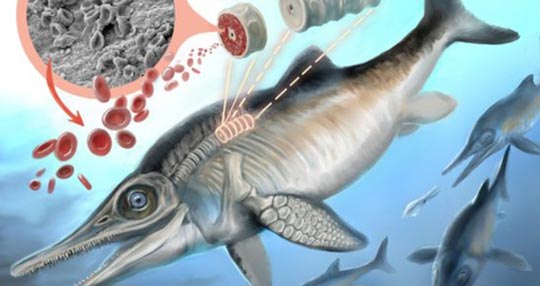
It may seem extraordinary, that such delicate evidence of organic remains can be preserved over huge amounts of time, but there is a growing body of data that indicates that such soft tissue preservation might be more common than previously thought.  Under exceptional preservational circumstances soft tissue remnants could persist at the molecular level.  A team of scientists led by researchers from Curtin University (Western Australia), have found red blood cells, collagen, white blood cells, platelet-like structures and cholesterol from the back-bone of an Early Jurassic ichthyosaur.

In the future, marine biologists could study the biology of a long extinct marine reptile…

Study Finds Soft Tissue Preservation in an Early Jurassic Marine Reptile

Organic material preserved in an ichthyosaur.

Traces of organic material preserved in an ichthyosaur.

Picture credit: Curtin University

Carbonate Concretion Gives Up Its Secrets

The researchers, led by organic geochemist John Curtin, analysed a dorsal vertebra from a 182.7 million-year-old ichthyosaur fossil from the world-famous Posidonienschiefer (Posidonia Oil Shales), of south-western Germany.  Although vertebrate remains tend to be disarticulated, a lack of oxygen on the sea bed (anoxic conditions) at this location led to exceptional preservation conditions, there were few organisms present to decompose organic remains.

These conditions, in conjunction with rapid burial in the sediment has permitted remarkable fossil preservation to take place. Ichthyosaur carcasses have been preserved with soft tissue outlines intact, showing dorsal fins and tails, ink sacs and body outlines of belemnites such as Passaloteuthis sp. have also been preserved, allowing palaeontologists to vastly improve their understanding of the biology of these marine creatures.  The high organic material content of the sediments permitted the formation of numerous carbonate concretions, these concretions isolate fossil material contained therein and can promote exceptional preservation of fragile tissues and biomolecules.

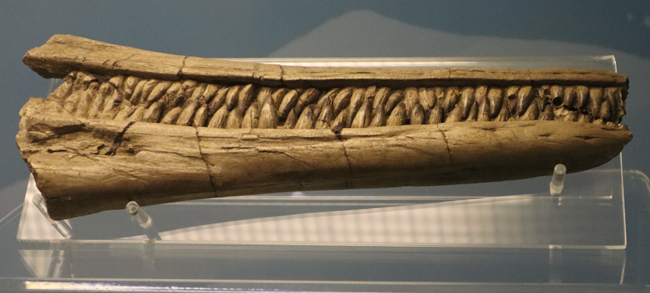
Ichthyosaur Fossil Jaw

Ichthyosaur jaw.

A museum exhibit showing the jaw of a large ichthyosaur. Picture credit: Everything Dinosaur.

Picture credit: Everything Dinosaur

For models and replicas of ichthyosaurs and other marine reptiles: PNSO Age of Dinosaurs Models.

Stenopterygius Vertebra Studied

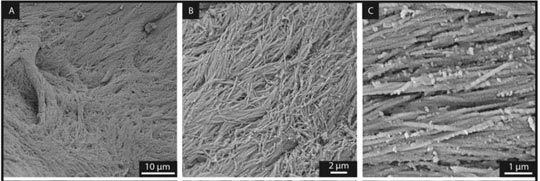
A single vertebra (back-bone) from a genus of ichthyosaur known as Stenopterygius was subjected to a range of microanalytical techniques, including scanning electron microscopy and microscopic calcite deposit removal at the molecular level using focused applications of acetic acid.  Entombed inside the concretion, the internal structure of the vertebra, the spongy, trabecular bone, revealed biosignatures that represent the remnants of cholesterol, blood cells as well as straw-like structures that suggest the preservation of collagen fibres.

Scanning Electron Microscopy Reveals Collagen Fibres

Soft tissue preservation in Ichthyosaur back-bone

Early Jurassic Stenopterygius vertebra reveals soft tissue preservation. (collagen fibres).

Picture credit: Curtin University/Scientific Reports

Co-author of the research paper, published this week in the academic journal “Scientific Reports”, Distinguished Professor Kliti Grice (Curtin University), explained:

“A carbonate concretion encapsulated the Early Jurassic period vertebra, forming a tight seal that helped protect its tissue and cellular remains from full decomposition.”

Compact and Trabecular Bone Studied

As well as the spongy, trabecular bone, the research team also examined the compact, cortical bone.  Isotopic analysis of the cholesterol biomolecules is consistent with the view that ichthyosaurs dined on cephalopods and fish.  Helping to reaffirm studies of coprolites and stomach cavity contents as to where in the marine food web these reptiles were situated.

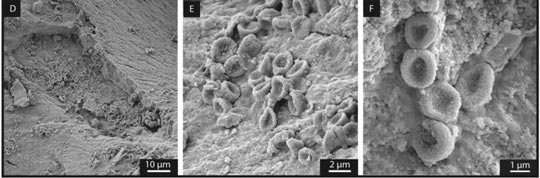
Red Blood Cell Structures Identified in the Fossil Material

Red blood cells in Ichthyosaur fossil bone.

Red blood cell-like structures identified in fossil bone (ichthyosaur).

Picture credit: Curtin University/Scientific Reports

The Size of Red Blood Cells – Adaptations to Low Oxygen Levels

The doughnut shaped objects in the photograph (above), were identified as red blood cells.  These cells were assessed to be up to five times smaller than those seen in extant animals.  This finding led the researchers to propose the small size of these blood cell structures was related to the ichthyosaur’s evolutionary adaptation to environmental conditions – the lower oxygen levels associated with much of the Mesozoic.

Chloe Plet, a PhD student at Curtin University and a co-author of the scientific study stated:

“Ichthyosaurs evolved during a time when atmospheric oxygen levels were continuously low over a period of 70 million years.  We propose that small red blood cells were favourably produced by the species to provide efficient oxygen transport and diffusion.  For example, modern-day mammals living at elevated altitudes with lower oxygen levels make small and abundant red blood cells.”

Similarly sized red blood cells have been reported from dinosaurs (fossil material from the Upper Cretaceous), dinosaurs too, would have had to adapt to low atmospheric oxygen levels.

Understanding the Palaeobiology of an Ichthyosaur

The team conclude that the extraordinary preservation conditions associated with carbonate concretions could play a significant role in helping scientists to investigate the palaeobiology of long extinct species.  Perhaps, one day in the future marine biologists will be able to study the biology of ichthyosaurs.

The scientific paper: “Palaeobiology of Red and White Blood Cell-like Structures, Collagen and Cholesterol in an Ichthyosaur Bone” by Chloé Plet, Kliti Grice, Anais Pagès, Michael Verrall, Marco J. L. Coolen, Wolfgang Ruebsam, William D. A. Rickard & Lorenz Schwark published by “Scientific Reports”.

Visit the Everything Dinosaur website: Everything Dinosaur.

21 10, 2017

Steppe Mammoth Model on Display at Museum

By |2023-09-02T08:53:28+01:00October 21st, 2017|Categories: Dinosaur and Prehistoric Animal News Stories, Dinosaur Fans, Everything Dinosaur News and Updates, Everything Dinosaur Products, Main Page, Photos of Everything Dinosaur Products|3 Comments

Eofauna Steppe Mammoth Helps Out with Museum Display

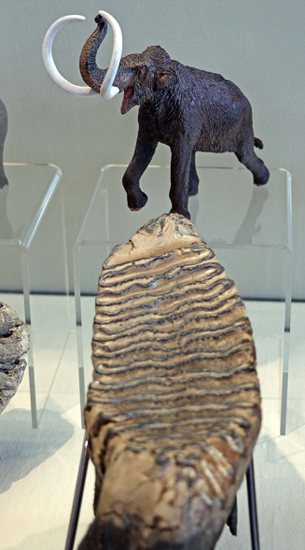
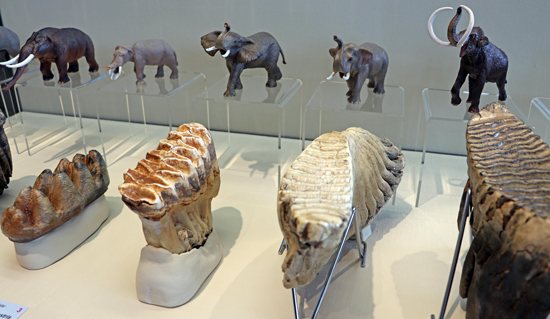
Scale models of prehistoric animals are not just appreciated by collectors, they can also help to educate and inform.  Here is a wonderful example of a museum quality replica being used in a museum exhibition to help illustrate evolution.  Everything Dinosaur was contacted by Dr Jan Fischer of the Urweltmuseum GEOSKOP, Dr Fischer wanted a Eofauna Steppe Mammoth model for a display case illustrating the evolutionary development of elephants.

Not a problem, as soon as stock of this 1:40 scale Mammuthus trogontherii model had arrived at our warehouse, one of our dedicated team members reserved a replica for the museum and emailed Dr Fischer.  One purchase later and the usual customary swift delivery from Everything Dinosaur and Dr Fischer could add the Steppe Mammoth model to his display showcasing the diversity of Proboscideans and how their teeth show adaptations to different diets.

The Eofauna Steppe Mammoth on Display Next to a Steppe Mammoth Molar

Eofauna Steppe Mammoth on display in a museum.

Eofauna Steppe Mammoth used in museum display.

Picture credit: Dr Jan Fischer/Urweltmuseum GEOSKOP

Toothy Tales Illustrated by Prehistoric Animal Models

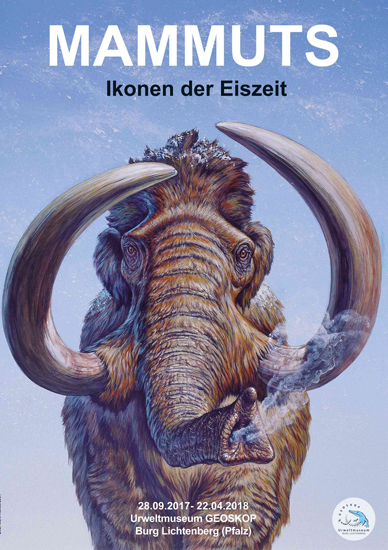
The Urweltmuseum GEOSKOP is located at the Lichtenberg castle (Burg Lichtenberg), near the picturesque town of  Thallichtenberg in Rhineland-Palatinate, south-western Germany.  It is the largest natural history museum in Rhineland-Palatinate and at the present time, it is hosting a special exhibition all about prehistoric elephants “Mammoths – Icons of the Ice Age”.

The Urweltmuseum GEOSKOP Exhibition Poster

Poster for a Mammoth exhibition.

Mammoth exhibition poster.

Picture credit: Dr Jan Fischer/Urweltmuseum GEOSKOP

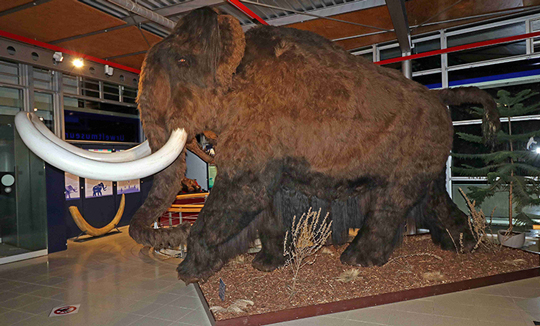
Running until the 22nd April 2018, this exhibition “Mammoths – Icons of the Ice Age” includes a life-size replica of a Woolly Mammoth (Mammuthus primigenius), as well as lots of fossils and other artefacts that highlight the evolutionary history of this branch of the elephant family.

A Life-size Model of Woolly Mammoth at the Urweltmuseum GEOSKOP

Woolly Mammoth on display.

Life-size model of a Woolly Mammoth on display.

Picture credit: Dr Jan Fischer/Urweltmuseum GEOSKOP

Amongst the numerous exhibits and helpful information boards look out for the replica of a frozen Mammoth calf from Siberia.

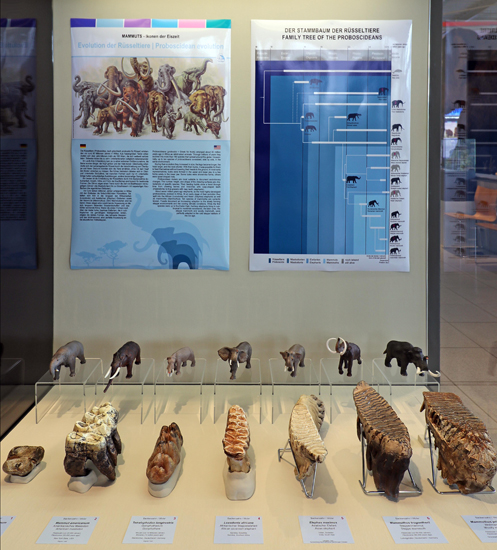
Showcasing the Evolution of the Proboscideans

Prehistoric elephant models in a museum display.

Prehistoric animal models are used in a museum display.

Picture credit: Dr Jan Fischer/Urweltmuseum GEOSKOP

For further information about the “Mammoths – Icons of the Ice Age”Urweltmuseum GEOSKOP (German),

A spokesperson from Everything Dinosaur commented:

“The molars give information on the diets of the various prehistoric and extant elephants in the display case and the scale models provide an excellent illustration of what the prehistoric animal actually looked like.  The Eofauna Scientific Research Steppe Mammoth model has been created from three-dimensional scans of fossil material, so it is fitting that this very accurate prehistoric elephant model is being used in a museum display.”

To view the Eofauna Scientific Research model range: Eofauna Scientific Research Models.

The Beautiful Display Case Highlight Proboscidean Evolution

A beautiful display showcasing Proboscidean evolution.

Proboscidean evolution on display.

Picture credit: Dr Jan Fischer/Urweltmuseum GEOSKOP

Our congratulations to Dr Fischer and everyone involved in the setting up of this most informative and carefully laid out museum exhibit.

Visit the award-winning Everything Dinosaur website: Everything Dinosaur.

20 10, 2017

New Type of Dinosaur Egg Described from Eastern China

By |2023-08-18T21:51:42+01:00October 20th, 2017|Categories: Dinosaur and Prehistoric Animal News Stories, Dinosaur Fans, Main Page|0 Comments

Umbellaoolithus xiuningensis “Eggciting” Fossil Egg Discovery

Chinese scientists have announced that a new type of fossilised dinosaur egg has been found.  A single nest, discovered in 2011, contains the remains of at least nine dinosaur eggs.  Their unique shape and surface structure makes them distinguishable from all other known dinosaur eggs, this has led to the establishment of a new oospecies.  An oospecies is the equivalent to a species in taxonomy, the “double o” in front of the taxonomic rank indicates that the term is being used to classify fossil eggs.  Several dinosaur oogenera and oospecies are known, but since this fossil nest and its contents does not resemble anything found before, a new oospecies has been erected.

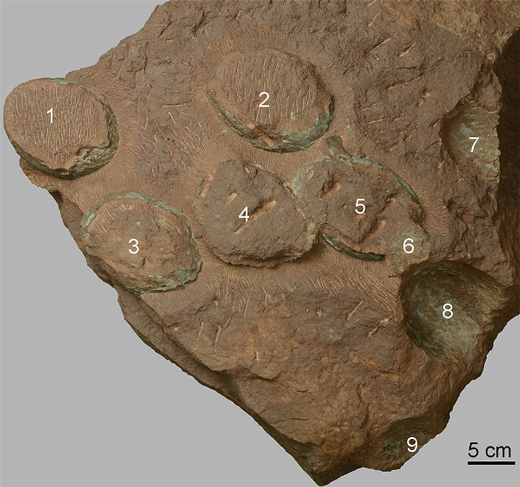
The Fossilised Dinosaur Eggs were Found in Upper Cretaceous Strata

Dinosaur egg fossils.

Dinosaur egg fossils (Umbellaoolithus xiuningensis).

Picture credit: L. Feng/Chinese Science Bulletin

Dinosaur Egg Study

The photograph (above) shows the clutch of eggs, they have been numbered for reference purposes. Numbers 1-5 are the most complete, 6 is a fragment of eggshell resting on egg number 5, whilst egg numbers 7 through to 9 represent the preserved outline of eggs.  The new species Umbellaoolithus xiuningensis was named after Xiuning county in Anhui Province (eastern China), where the egg fossil discovery was made.

From the Upper Cretaceous Huizhou Formation

The oval eggs are arranged along the long axis of all the eggs parallel to each other and not at the same horizontal level within the clutch, this nest arrangement, if an accurate depiction of the actual eggs after laying and not resulting from taphonomy, is very different from the elongated pairs, regular arrangement and radial orientation seen in other fossilised dinosaur nests (examples being the oogenera Macroelongatoolithidae and Elongatoolithidae).

A Typical Elongate Theropod Dinosaur Egg

Chinese dinosaur fossils. A fossilised dinosaur egg.

A fossilised dinosaur egg (Theropoda). Picture credit: Everything Dinosaur.

Picture credit: Everything Dinosaur

With an average diameter of just under fourteen centimetres (13.86 cm), it is not known what type of dinosaur laid the eggs.  The discovery was reported in an article in the Chinese Science Bulletin by Dr Huang Jiandong, from the Anhui Geological Museum and Wang Qiang, a deputy researcher at the Chinese Academy of Sciences.

Visit the Everything Dinosaur website: Everything Dinosaur.

13 10, 2017

Ankylosaurus Not Your Typical Ankylosaur

By |2023-08-17T10:00:44+01:00October 13th, 2017|Categories: Dinosaur and Prehistoric Animal News Stories, Dinosaur Fans, Main Page|0 Comments

Ankylosaurus magniventris – Not Your Archetypal Ankylosaur

A newly-published study has provided fresh insights on Ankylosaurus.  This ornithischian dinosaur, a contemporary of Tyrannosaurus rex in the Late Cretaceous of North America, is perhaps, one of the best-known of all the armoured dinosaurs in the minds of the public, however, this dinosaur star of stage and screen with such a high profile in the popular media, has actually a very fragmentary fossil record, when compared to its close relatives.

Palaeontologist and Ankylosauridae expert Victoria Arbour (Royal Ontario Museum), in collaboration with Jordan Mallon (Canadian Museum of Nature), writing in the Canadian open access science journal “Facets”, suggest that the dinosaur that gave its name to the family Ankylosauridae, is a very atypical member of this armoured dinosaur family.

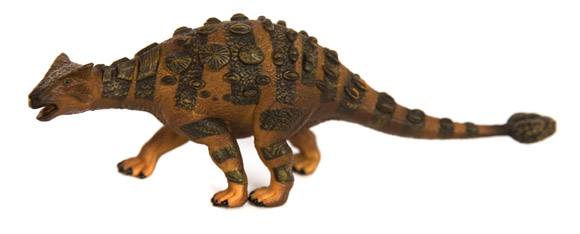
A Model of an Ankylosaurus

An Ankylosaurus model.

Armoured dinosaur – Ankylosaurus

The Ankylosaurus model (above) is from the not-to-scale CollectA model series.

To view this range: CollectA Prehistoric Life Models.

Examining Previously Unidentified Elements of the Holotype

Ankylosaurus (A. magniventris), is known from only a handful of fossil specimens excavated from Upper Cretaceous deposits in Montana, Wyoming, Saskatchewan and Alberta.  The researchers examined previously unidentified and not described fossil fragments associated with the holotype fossil AMNH 5895 (from Montana).  In addition, they revisited earlier research (Carpenter 2004), making further observations as to body mass, arrangement of the body armour, size of the tail club and the anatomy of Ankylosaurus.

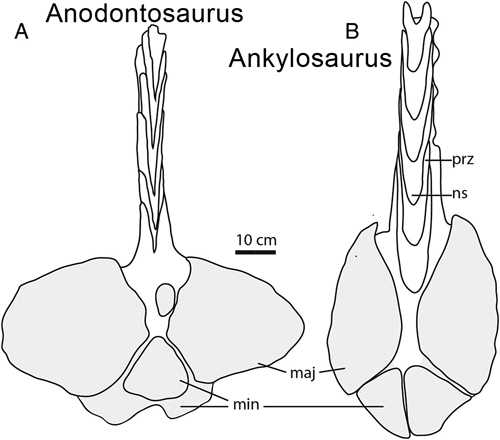
Tail Club Comparison Anodontosaurus Compared to Ankylosaurus

Ankylosaur tail club comparisons.

Ankylosaur tail club comparisons (Anodontosaurus versus Ankylosaurus).

Picture credit: “Facets Journal”

The picture above shows a comparison between the tail club of Anodontosaurus lambei, and the closely related Ankylosaurus magniventris (dorsal view).  The tail bones and club of Ankylosaurus are poorly known, although the specimen number AMNH 5214 includes a portion of the tail club and a well-preserved, bony knob.

The vertebrae that make up the handle are twice as wide as those corresponding vertebrae making up the handle on the Anodontosaurus club, but they are not longer.  The researchers suggest that the tail of Ankylosaurus may have been proportionately shorter than the tail of Anodontosaurus, or the tail may have had similar overall proportions but the Ankylosaurus tail club was smaller.

The handle vertebrae of Ankylosaurus are unique among ankylosaurids, with U-shaped neural spines in dorsal view compared with the V-shaped neural spines in Anodontosaurus, Euoplocephalus, Pinacosaurus, Talarurus, and most other ankylosaurids.  There may be an upward size limit for ankylosaurid clubs, the shape of the bony knobs (labelled “maj” and “min” for major and minor respectively in the diagram), are different between these two closely related genera, Ankylosaurus magniventris may have had an atypical tail club, one that was not representative of the Ankylosauridae.

One Large Skull Helping to Shape Our Understanding

The largest skull associated with Ankylosaurus is specimen CMN 8880.  It is huge and it was briefly described in 2004 (Carpenter), who regarded the dorsal surface as poorly preserved.  However, the skull was stored on its dorsal surface and it was not turned to permit a proper examination of what would have been the top of the dinosaur’s head.

In Arbour and Mallon’s new paper, they have had the chance to examine the dorsal surface of CMN 8880, which they found to be remarkably well-preserved.  As a result, the scientists have been able to compare and contrast the bony cranial morphology of the top of the skull and confirm that the arrangement of scales and scutes on the top of the skull was very different when compared to other North American ankylosaurids.

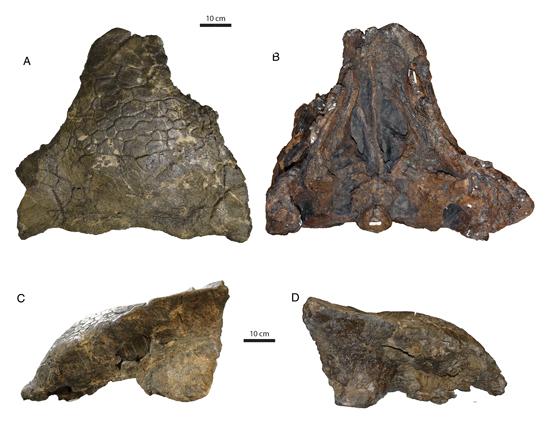
The Largest Skull of Ankylosaurus (Specimen Number CMN 8880)

Ankylosaurus cranial material.

Views of the largest Ankylosaurus skull found to date (CMN 8880).

Picture credit: “Facets Journal”

The picture above shows the skull of CMN 8880, Ankylosaurus magniventris, in (A) dorsal, (B) ventral, (C) left lateral, and (D) right lateral views, note the scale bar equals ten centimetres.  The skull is well preserved on the dorsal and left lateral surfaces. The right lateral surface has caved inwards slightly, the researchers have measured the basal skull length as 671 millimetres, based on these measurements and other material reported in this scientific paper, the researchers were able to confirm that A. magniventris was much larger than other Late Cretaceous armoured dinosaurs.  The scientists reaffirmed the length of this dinosaur at around ten metres.

Ankylosaurus is Not a Typical Ankylosaurid

This review underscores the fact that although Ankylosaurus gave rise to the family name the Ankylosauridae, A. magniventris is far from typical of this family.  The teeth, the nares, the tail club and body size of Ankylosaurus tend to make it stand out from the other Laramidian Ankylosaurines.

Changing Views of Ankylosaurus magniventris

Changing views of Ankylosaurus (dorsal view).

Changing views of Ankylosaurus magniventris over the years.

Picture credit: “Facets Journal”

In Competition with Edmontonia – Perhaps Not

It is thanks to this new study, that we have a better understanding of Ankylosaurus, it is not your typical ankylosaur.  Intriguingly, the researchers postulate on the role of Ankylosaurus in the palaeoenvironment of Laramidia during the Late Cretaceous.  Fossils of this armoured dinosaur are very infrequently found and therefore it might have been ecologically rare, or just a very infrequent visitor to the coastal plain where fossilisation of corpses was much more likely than if these creatures habitually lived further inland away from rivers and large bodies of water.

The nodosaurid Edmontonia was contemporaneous with Ankylosaurus and the researchers comment on previous studies that have alluded to the fact that Edmontonia may have been ecologically separated from Ankylosaurus on the basis that Edmontonia seems to have been more abundant in coastal, lowland habitats.  It is likely that these animals did not compete directly with each other (different beak and tooth shapes – indicating niche partitioning).

Ecosystem Engineer Like a Modern Elephant – Unlikely

Ankylosaurus probably fed on low-growing vegetation, ferns, flowers and shrubs, with an estimated consumption of about 60 kilogrammes of vegetable matter per day, about the same as an elephant. It did not chew its food, food processing taking place in the enormous gut.

Modern elephants with their ability to knock down trees and strip bark, are regarded as ecosystem engineers, helping to shape the environment.  It is suggested that Ankylosaurus did not carry out this role, tree felling, bark stripping and environmental engineering was more likely to have been undertaken by the equally massive and much more ubiquitous hadrosaurids.

Although ankylosaurines are typically categorised as herbivores, the unusual narial anatomy of Ankylosaurus could reflect a change in diet or feeding strategy relative to other ankylosaurs and the researchers suggest this warrants further investigation.  The smaller, posteriorly set, and dorsally roofed external nares in Ankylosaurus could have evolved as these animals grubbed in the soil for nutritious grubs, earthworms, insects or plant tubers.

The broad muzzle and powerful front limbs would have made Ankylosaurus an accomplished digger.  So perhaps Ankylosaurus had a different lifestyle compared to other members of the Ankylosauridae, it may have foraged through leaf litter or turned over the soil, like a giant hog.

The scientific paper: “Unusual cranial and Postcranial Anatomy in the Archetypal Ankylosaur Ankylosaurus magniventris” by Victoria M. Arbour and Jordan C. Mallon, published in the Canadian open access journal “Facets”.

Link to the paper: Ankylosaurus Paper.

Visit the Everything Dinosaur website: Everything Dinosaur.

12 10, 2017

Reaffirming Protoichthyosaurus as a Valid Genus

By |2023-08-17T09:37:39+01:00October 12th, 2017|Categories: Dinosaur and Prehistoric Animal News Stories, Dinosaur Fans, Main Page, Photos/Pictures of Fossils|0 Comments

The Muddy Water Surrounding Protoichthyosaurus and Ichthyosaurus Just Got a Little Clearer

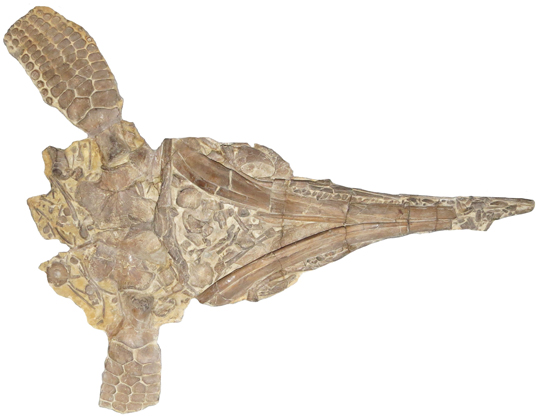
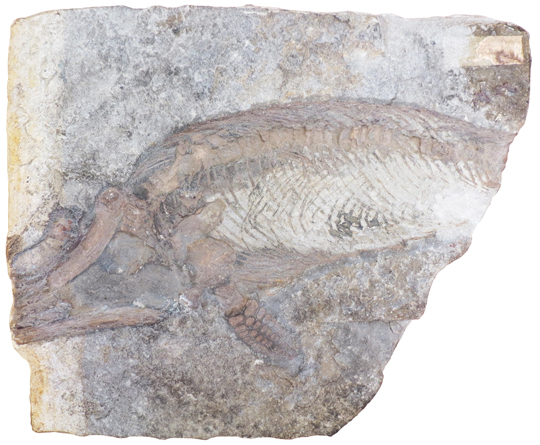
A type of British Ichthyosaur, first identified nearly forty years ago, but then dismissed as a distinct genus, has been re-examined and found to be a new type of marine reptile after all.  British palaeontologist Dr Robert Appleby, in 1979, conducted a review of ichthyosaur fossil material found around the UK and announced a news species which he named Protoichthyosaurus.

Two separate species were assigned to this genus P. prostaxalis and P. prosostealis.  Erecting this genus with its two component species proved controversial and a number of other scientists have dismissed this assessment, reassigning the fossil material to the Ichthyosaurus genus.

One of the Fossil Specimens from the 1979 Marine Reptile Study

Protoichthyosaurus fossil material.

One of the original skeletons of Protoichthyosaurus described by Robert Appleby in 1979

Picture credit: National Museum of Wales/Dean Lomax

A Detailed Study of Protoichthyosaurus Fossils

A detailed study which involved making comparisons between Protoichthyosaurus and Ichthyosaurus by Dean Lomax, (Manchester University), Rashmi Mistry (University of Reading) and Professor Judy Massare (State University of New York), published in the “Journal of Vertebrate Paleontology” has established Protoichthyosaurus as a separate genus once again.

The researchers found major differences in the number of bones in the front fin, or forefin, of both species.  The team posit that this fundamental difference in anatomy probably reflects the way both species used their forefins to manoeuvre whilst swimming.  Differences were also found in the skulls.

Scientists Studying the Fossil Material

A Protoichthyosaurus fossil is studied by palaeontologists.

Bill Wahl, Prof. Judy Massare, Dr David Large and Dean Lomax study the fossil.

Picture credit: University of Nottingham

Fin Grabs Attention

During this research, another discovery about the fins was made, palaeontologist Dean Lomax explained:

“This unusual forefin structure was originally identified by Robert Appleby in 1979, but some of the historic specimens he examined had been ‘faked’, and this fakery had been missed until now.  In some instances, an isolated fin of an Ichthyosaurus had been added to a Protoichthyosaurus skeleton to make it appear more complete, which led to the genuine differences being missed.  This has been a major problem because it stopped science from progressing.  We also found some pathological fins, including Ichthyosaurus fins with pathologies that mimic the Protoichthyosaurus forefin structure”.

To visit the website of Dr Dean Lomax: British Palaeontologist Dr Dean Lomax.

Dean and Judy teamed up with former undergraduate student Rashmi Mistry, who had been studying an unusual ichthyosaur in the collections of the Cole Museum of Zoology, (University of Reading), as she prepared her undergraduate dissertation.

Rashmi added:

“Whilst doing my dissertation in 2016, I studied several ichthyosaurs in the collections, including a very small skeleton.  It had an unusual forefin that matched Protoichthyosaurus, which I understood to be a widely unrecognised genus.  However, when I contacted Dean, he was very excited.  He told me that this little skeleton is the only known small juvenile Protoichthyosaurus.”

The Juvenile Protoichthyosaurus Specimen

Protoichthyosaurus (juvenile).

The juvenile Protoichthyosaurus fossil.

Picture credit: University of Reading

More Than Twenty Specimens of Protoichthyosaurus Identified

As a result of this extensive study, more than twenty specimens of Protoichthyosaurus have been identified.  This is highly significant as each specimen (with a forefin) has the same structure.  The specimens all date from the early Jurassic geological period (200-190 million years ago) and they are geographically dispersed with specimens reported from Dorset, Somerset, Leicestershire, Nottinghamshire, Warwickshire and Glamorgan (Wales)

Links with the Dinosaurs of China Exhibition

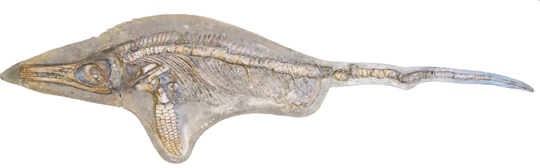
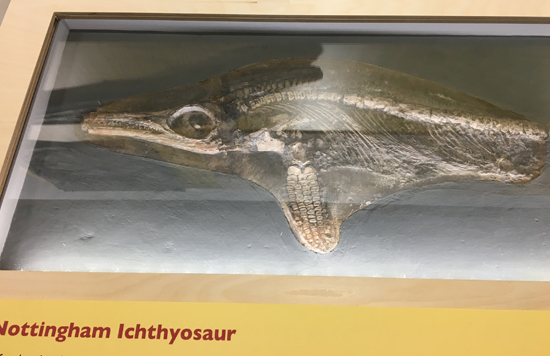
As part of his research, Dean examined a nearly complete skeleton which is part of the vertebrate collection at the museum of Nottingham.  This specimen turned out to be different from all the other known examples of Protoichthyosaurus (autapomorphies concerning the cranium and the shape of the humeri).  A new species of Protoichthyosaurus has been erected, it has been named  Protoichthyosaurus applebyi, in honour of Dr Appleby and in recognition of his work some forty years ago that established the Protoichthyosaurus genus in the first place.

The Protoichthyosaurus applebyi Specimen

Protoichthyosaurus applebyi fossil specimen.

Protoichthyosaurus applebyi fossil.

The fossil specimen is currently on display at the Nottingham Lakeside Arts centre, as part of the “Dinosaurs of China” exhibition.  If you want to catch this marine reptile and take in all the beautiful feathered dinosaurs in this exhibition, you had better hurry, “Dinosaurs of China” closes at the end of the month.

Everything Dinosaur Team Members Viewed the Specimen at the “Dinosaurs of China” Exhibition

Protoichthyosaurus applebyi

The Nottingham ichthyosaur (P. applebyi).  Picture credit: Everything Dinosaur.

Picture credit: Everything Dinosaur

For models and replicas of marine reptiles including ichthyosaurs: PNSO Age of Dinosaurs.

The scientific paper: “The Taxonomic Utility of Forefin Morphology in Lower Jurassic Ichthyosaurs: Protoichthyosaurus and Ichthyosaurus” by Lomax, D. R., Massare, J. A. and Mistry, R.  Published in the Journal of Vertebrate Paleontology.

Visit the Everything Dinosaur website: Visit Everything Dinosaur.

10 10, 2017

Fused Bones in Primitive Birds Earlier than Previously Thought as New, Innovative Research is Published

By |2024-05-09T14:47:22+01:00October 10th, 2017|Categories: Dinosaur and Prehistoric Animal News Stories, Dinosaur Fans, Main Page, Photos/Pictures of Fossils|0 Comments

The Evolution of the Light but Strong Skeleton for Powered Flight

It is widely accepted that birds evolved from dinosaurs.  The Order Dinosauria is now classified into two parts, the non-avian dinosaurs, which are extinct and the avian dinosaurs (the birds), which are very much still with us.  However, the evolution of the specialised anatomy that enables powered flight is not well understood.

Birds have several skeletal modifications that greatly assist them when it comes to their aerial abilities.  Any aeronautical engineer will expound the virtues of a light but strong frame for an aircraft, birds have a light but strong skeleton with many elements fused for greater rigidity.  A team of scientists writing in the “Proceedings of the National Academy of Sciences”, have provided new evidence to help explain how these remarkable anatomical modifications came about.  This evolutionary story is likely to be much more complicated than previously thought.

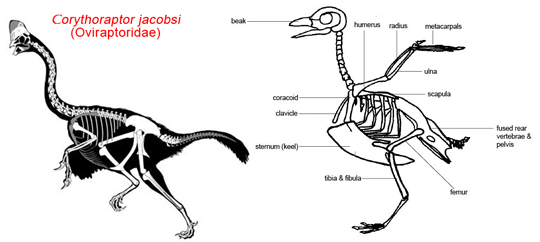
Some Theropod Dinosaurs Evolved into Birds Skeletal Similarities and Differences

Bird skeleton compared to ground dwelling dinosaur skeleton

A skeleton of the theropod dinosaur compared with a simplified skeleton of a modern bird.

Picture credit: Everything Dinosaur

The picture above shows the skeleton of the recently described oviraptorid Corythoraptor jacobsi compared to that of a modern bird.  The bird skeleton shows a number of adaptations for powered flight, such as fused hand and foot bones and an enlarged sternum but the ground-dwelling Oviraptor possesses number of anatomical characteristics which show its affinity to modern birds.  Both Aves and the Oviraptoridae are included together in the clade Maniraptora which consists of modern birds and their closest extinct relatives from the coelurosaurian theropods.

Pterygornis dapingfangensis – Fused Bones

A second, beautifully-preserved specimen of the Early Cretaceous enantiornithine bird Pterygornis dapingfangensis has fully fused hands (carpometacarpus bones) as well as a fused pelvic girdle.  Dating from around 120 million years ago, this specimen is the oldest known bird fossil which shows these modifications for powered flight.  The fossil comes from the Jiufotang Formation of Liaoning Province (north-eastern China).  This sparrow-sized creature is one of several genera known from these Lower Cretaceous deposits, only the Solnhofen deposits of Germany are older in terms of the bird fossils they contain.

The exquisite specimen shows that the carpometacarpus and the pelvis are completely fused, it had been thought that these traits did not appear in Aves until the Late Cretaceous.   The fossil record had shown that all bird fossils associated with Upper Cretaceous deposits have a completely fused hand and pelvis.  Thanks to this newly published scientific paper, the historical origin of these avian bone fusions has been pushed back some forty million years.

The Second Specimen of Pterygornis dapingfangensis

Pterygornis dapingfangensi helps scientists to better understand bird evolution.

Pterygornis dapingfangensi fossil.

Picture credit: W. GAO (Chinese Academy of Sciences)

Great Fossils but Squashed Flat!

Named in 2015 from a single, disarticulated specimen, discovered near the town of Dapingfang, Chaoyang County in Liaoning Province, Pterygornis shows a number of unique autapomorphies that distinguishes it from other enantiornithines and the second fossil has shown that the body plan for a rigid, fused skeleton was present in at least one species of bird from the Early Cretaceous.

Dr Steve Brusatte (University of Edinburgh), who reviewed the scientific paper, commented:

“These [fused bones] are fundamental features of the modern bird blueprint, and are integral to giving birds the strength and rigidity needed to fly.  There seems to have been a lot of experimentation among early birds, with different species trying out different ways of making their skeletons stronger and better able to withstand the rigours of flight.”

Sadly, many of the fossils from the Jiufotang Formation have been compressed and distorted as a result of the fossilisation process.  However, despite the taphonomy that ends with a lot of the fossils from these rocks being squashed flat, the researchers from the Chinese Academy of Sciences were able to identify that the fused bones in the second known specimen of Pterygornis were not a result of pathology or the fossilisation process.

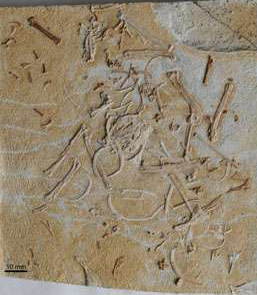
The Disarticulated Holotype Specimen of Pterygornis dapingfangensis

Pterygornis dapingfangensi holotype material.

The scattered and disarticulated fossil remains of Pterygornis dapingfangensi.

Picture credit: Wang Min

The Search for Transitional Fossils (Birds Evolved from Dinosaurs)

The lack of transitional fossils has hindered the process of identifying the evolutionary process towards the modern bird skeleton.  More fossils would help to demonstrate how birds evolved from dinosaurs.  However, in this research paper the authors outline how the fusion of pelvic bones and those in the hands and feet may have evolved independently in non-avian dinosaurs, primitive and more advanced birds.

The scientists speculate that varying degrees of bone fusion were likely to have evolved in basal birds, perhaps as a result of environmental pressures or related to a refinement of flight capability.  It seems that the developmental pathway from ground-dwelling dinosaur to the skeletal shape of living birds has a few more surprises to spring before it is more fully understood.

Visit the Everything Dinosaur website: Everything Dinosaur.

6 10, 2017

New Prehistoric Crocodile with a Tough Skull

By |2023-08-16T22:16:56+01:00October 6th, 2017|Categories: Dinosaur and Prehistoric Animal News Stories, Dinosaur Fans, Main Page, Photos/Pictures of Fossils|0 Comments

Ieldraan melkshamensis – The Monster of Melksham

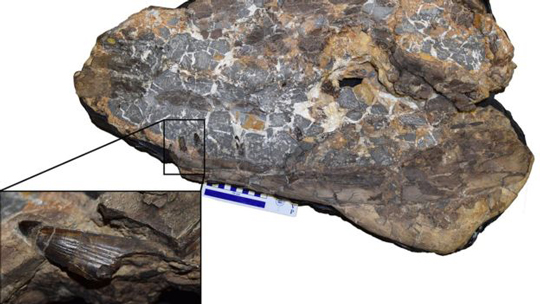
A new species of prehistoric marine crocodile has been described after an amazing effort by the preparators at the Natural History Museum (London), to separate this crocodile’s partial skull and fragmentary jaw bones from an extremely hard concretion, in which the fossils were entombed.  Although in very poor condition, the research team from the University of Edinburgh as well as the Natural History Museum, were able to identify enough unique anatomical traits (autapomorphies), to allow a new species to be erected.

The new marine crocodile (metriorhynchid) has been named Ieldraan melkshamensis, the species name honouring the town of Melksham in Wiltshire where the fossil material was unearthed.

Ieldraan melkshamensis – One Tough Crocodylomorph with a Very Tough Skull

Ieldraan melkshamensis fossil material.

Ieldraan melkshamensis fossil.

Picture credit: University of Edinburgh/Davide Foffa

Prehistoric Marine Crocodile

The specimen was acquired by the Natural History Museum in 1875, but because of its poor condition it did not attract a lot of scientific attention.  The fossil being entombed within an extremely hard concretion (septarian concretion), meant any form of scientific study was extremely limited.

Mark Graham, Senior Fossil Preparator at the Natural History Museum explained the problem:

“The specimen was completely enclosed in a super-hard rock nodule with veins of calcite running through, which had formed around it during the process of fossilisation.  The work took many hours over a period of weeks, and great care had to be taken to avoid damaging the skull and teeth as they became exposed.”

Ieldraan melkshamensis – Newest member of the Metriorhynchidae

Measuring more than three metres in length, Ieldraan melkshamensis was one of the most powerful and dangerous marine predators in the warm, shallow seas of western Europe some 163 million years ago (Callovian faunal stage of the late Middle Jurassic).  The teeth with their distinctive striations (series of ridges running down the length of the teeth) indicate that this large crocodylomorph, which was very distantly related to today’s crocodilians, fed on large prey items.  It might have hunted other marine reptiles as well as preying on squid and fish.

It has been classified as member of the Metriorhynchidae family, specifically assigned to the sub-family Geosaurinae and a phylogenetic analysis places Ieldraan as the sister taxon of Geosaurus, perhaps the best-known of all the metriorhynchids, having been named and described over 100 years ago.

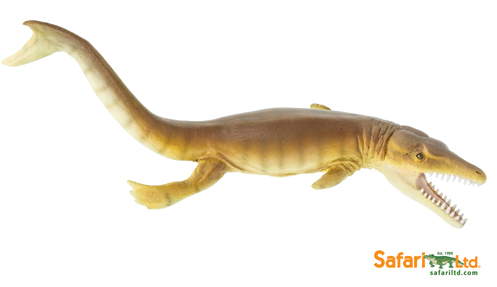
A Model of a Typical Metriorhynchid Crocodylomorph (Plesiosuchus)

Plesiosuchus a prehistoric marine crocodile model.

Prehistoric marine crocodile – Plesiosuchus.

The Plesiosuchus model shown above is part of the Wild Safari Prehistoric World model collection, replicas of marine crocodiles are quite rare, to learn more about this model series and to view the range at Everything Dinosaur: Safari Ltd: Wild Safari Prehistoric World”.

A Sister Taxon to Geosaurus

The authors of the scientific paper, published in the “Journal of Systematic Palaeontology” conclude that if this new species is a sister taxon to Geosaurus, this places it in the Geosaurini clade and this data suggests that the major Geosaurini lineages originated millions of years earlier than previously thought.

Lead author Davide Foffa (School of GeoSciences at the University of Edinburgh), stated:

“It’s not the prettiest fossil in the world, but the Melksham Monster tells us a very important story about the evolution of these ancient crocodiles and how they became the apex predators in their ecosystem.  Without the amazing preparation work done by our collaborators at the Natural History Museum, it would not have been possible to work out the anatomy of this challenging specimen.”

Prehistoric Marine Crocodile on Patrol – Plesiosuchus manselii

Marine crocodile (Plesiosuchus).

Plesiosuchus manselii illustrated.

Picture credit: Fabio Manucci/University of Edinburgh

Visit the Everything Dinosaur website: Everything Dinosaur.

5 10, 2017

Thailand’s Biggest Dinosaur Discovery Reported a Remarkable Fossil Discovery

By |2026-05-16T21:04:36+01:00October 5th, 2017|Categories: Dinosaur and Prehistoric Animal News Stories, Dinosaur Fans, Main Page, Photos/Pictures of Fossils|0 Comments

Fossils of Biggest Dinosaur Found to Date in Thailand Reported

Everything Dinosaur has received reports that news sources are stating that fossils of a very big dinosaur, a sauropod, have been found in Thailand.  The first dinosaur bone from Thailand was discovered back in 1976, since then, as the country’s geology has been mapped and explored, a number of exciting dinosaur fossil discoveries have been made, mostly by employees of the Department for Mineral Resources, which is part of the Ministry for Natural Resources and the Environment.

Thailand’s Biggest Dinosaur Discovery

Thailand has quite extensive Mesozoic-aged exposures from both marine and non-marine environments.  To date, team members think that the largest dinosaur known from Thailand would be Phuwiangosaurus (P. sirindhornae), which is estimated to have reached a length of about twenty metres and weighed as much as seventeen tonnes.

The First Ever Dinosaur Fossil from Thailand

Partial sauropod femur (Thailand)

The distal end of a sauropod femur.

Picture credit: Department of Mineral Resources (Thailand)

The photograph above shows the first dinosaur fossil to have come to the attention of science found in Thailand.  The distal end (the part furthest away from the body) of a femur was found eroding out of a stream bed in 1976.  Since then, a number of dinosaur genera have been named and described including an iguanodont (Sirindhorna khoratensis) and two sizeable theropods (Siamotyrannus isanensis and Siamosaurus suteethorni).

A senior government official (Niwat Maneekut, deputy director-general of the Department of Mineral Resources), is reported to have said that the fossils come from the north-east of the country.  A single fossilised bone was found by a villager in the Nong Bua Raheo district of  Chaiyaphum province, around two hundred miles north-east of the capital Bangkok, last year, but more recent excavations led by palaeontologists from the Department of Mineral Resources had recovered a further twenty pieces of bone.

Information remains patchy, but the fossils are estimated to be around 100 million years old and scientists are conducting more research.

Phuwiangosaurus is Believed to be a Member of the Euhelopodidae and Therefore Similar to Euhelopus

Scale drawing - Euhelopus.

Euhelopus scale drawing. Picture credit: Everything Dinosaur.

Picture credit: Everything Dinosaur

For models of sauropods and other dinosaurs: Dinosaur and Prehistoric Animal Models.

3 10, 2017

Squid the Last Meal of a Baby Ichthyosaurus

By |2023-08-13T16:07:03+01:00October 3rd, 2017|Categories: Dinosaur and Prehistoric Animal News Stories, Dinosaur Fans, Main Page, Photos/Pictures of Fossils|1 Comment

Baby Ichthyosaurus communis Dined on Squid

A team of UK-based scientists have identified the youngest and therefore the smallest specimen of Ichthyosaurus communis known to science and, just for good measure, they have found what could have been the marine reptile’s last meal.  Inside the body cavity of the seventy-centimetre-long fossil, the researchers found tiny “hook-like” structures, these are the less digestible parts of squid and therefore, the scientists were able to deduce that this young Ichthyosaurus had recently fed on cephalopods.

A Young Ichthyosaurus communis Attacking a Prehistoric Squid
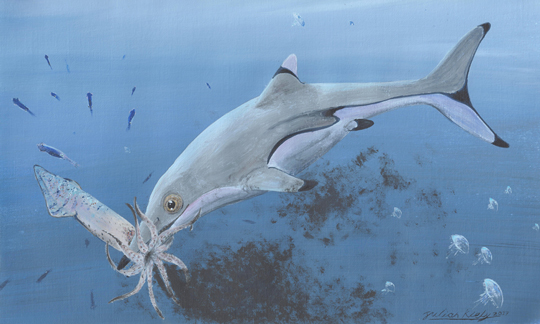
A neonate Ichthyosaurus communis feeding on a squid.

A neonate Ichthyosaurus attacks a squid.

Picture credit: Julian Kiely

The artist Julien Kiely has kindly reconstructed the new-born in this fantastic scene, which depicts the moment a newly born Ichthyosaurus communis attacks a squid.

Commenting on the significance of this discovery, one of the authors of the scientific paper, published today in the journal “Historical Biology – The International Journal of Paleobiology”, Dean Lomax stated:

“It is amazing to think we know what a creature that is nearly 200 million years old ate for its last meal.  We found many tiny hook-like structures preserved between the ribs.  These are from the arms of prehistoric squid.  So, we know this animal’s last meal before it died was squid.”

From the Biggest to the Smallest

University of Manchester palaeontologist Dean Lomax, in collaboration with German colleagues, had recently published a paper describing the largest specimen of Ichthyosaurus communis, a female that turned out to be pregnant when she died.  Everything Dinosaur wrote an article about the research in August*, as well as having described the biggest I. communis, just a few weeks later, this new paper, describes the smallest.

Palaeontologist Dean Lomax Holds the Neonate Ichthyosaurus communis Specimen
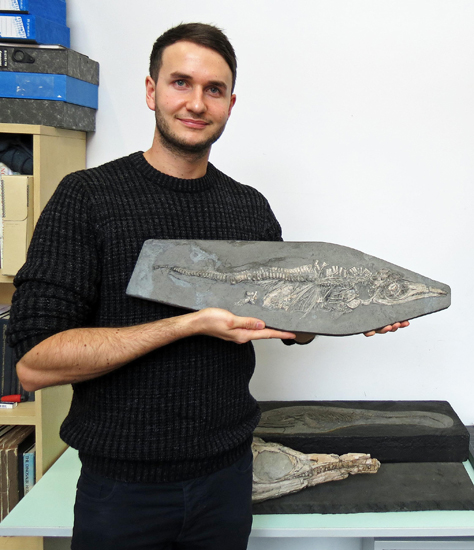
Dean Lomax holding the neonate Ichthyosaurus fossil.

Palaeontologist Dean Lomax holding the baby Ichthyosaurus fossil.

Picture credit: University of Manchester/University of Birmingham

*To read the article about the largest Ichthyosaurus communis specimen: Palaeontologists and the Pregnant Ichthyosaurus.

Ichthyosaurus communis

Several species of Ichthyosaurus have been identified, but Ichthyosaurus communis was the first, being named and described in 1822 from fossil material discovered by Mary Anning.  These reptiles were viviparous and a number of specimens showing embryos preserved inside their mothers are known.  However, this Ichthyosaurus is one of only a handful of fossils that represent very young animals.  As it was not preserved in association with a larger specimen (the mother) and as there are stomach contents present, it is likely that this fossil represents an independent, recently born animal, the first neonate Ichthyosaurus communis skeleton to be described.

The Ichthyosaurus Fossil on Display at the Lapworth Museum of Geology, University of Birmingham
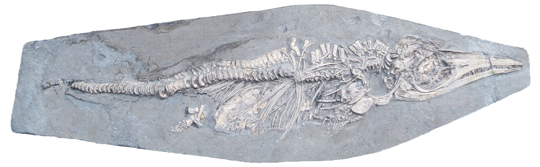
The neonate Ichthyosaurus communis fossil specimen.

The neonate I. communis specimen.

Picture credit: University of Manchester/University of Birmingham

The fossil is definitely a new born and not a dwarf species of ichthyosaur as the scientists noted the large ring of sclerotic bone relative to the eye socket and the poorly ossified (highly cancellous) bones of the skull and other parts of the skeleton, these signs all indicate that these are the fossilised remains of a very young marine reptile.

Niche Partitioning in the Ichthyosauria

The new specimen is from the collections of the Lapworth Museum of Geology, (University of Birmingham).  Palaeontologist Nigel Larkin, a research associate at Cambridge University, cleaned and studied the specimen in 2016,  as he prepared the fossil, he became aware of its potential significance.  Nigel has recently been involved in an extensive restoration project at Biddulph Grange in Staffordshire.  He has been helping to restore the Victorian Geological Gallery at this National Trust property to its former glory.

As one of the most highly respected fossil preparators in the UK, Nigel was able to reveal the fossil’s secrets as he cleaned and helped to preserve the delicate marine reptile skeleton.

To read an article about the Geological Gallery preservation project at Biddulph Grange: Fossil Hunting at Biddulph Grange.

The discovery of squid remnants in the gut area suggests these types of ichthyosaur specialised in hunting cephalopods.  Commenting on the implications of this fossil, Dean Lomax explained:

“This is interesting because a study by other researchers on a different type of ichthyosaur, called Stenopterygius, which is from a geologically younger age, found that the small – and therefore young – examples of that species fed exclusively on fish.  This shows a difference in prey-preference in new-born ichthyosaurs.” 

Visit the website of Dr Dean Lomax: British Palaeontologist Dr Dean Lomax.

This could hint at niche partitioning, whereby similar species use different resources within an environment to reduce direct competition and to help them co-exist.

Dean Lomax and Nigel Larkin in Front of the Jurassic Seas Exhibit (Lapworth Museum of Geology)
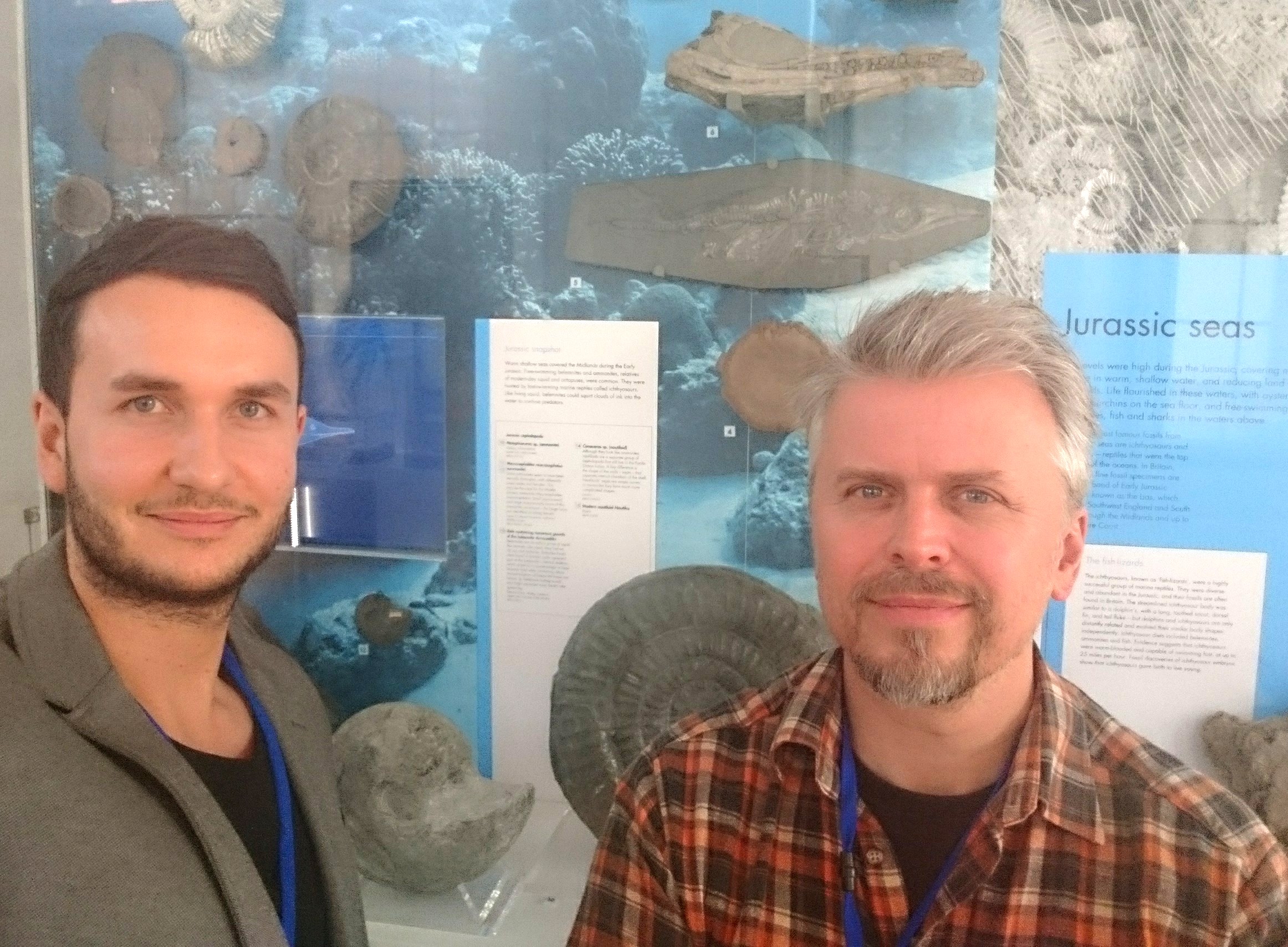
The neonate Ichthyosaurus fossil on display.

Dean Lomax (left) and Nigel Larkin (right) in front of the Lapworth Geological Museum exhibit.

Picture credit: University of Manchester/University of Birmingham

How Old is the Fossil?

The specimen, part of the vertebrate fossil collection of the Lapworth Museum of Geology, (University of Birmingham), has no provenance data associated with it.  Unfortunately, there were no collection notes or other details to help the palaeontologists to identify where the fossil came from.  However, permission was granted for Nigel to remove a small portion of the matrix surrounding the fossil.  He passed this on to Ian Boomer (University of Birmingham) and Philip Copestake (Merlin Energy, Resources Ltd), so that they could analyse the rock for microscopic fossils.

Based on the types of microfossil preserved, the scientists were able to identify that this ichthyosaur was around 199-196 million years old, (uppermost Hettangian faunal stage to lowermost Sinemurian of the Early Jurassic).

Nigel outlined the difficulties the team faced:

“Many historic Ichthyosaur specimens in museums lack any geographic or geological details and are therefore undated.  This process of looking for microfossils in their host rock might be the key to unlocking the mystery of many specimens.  Thus, this will provide researchers with lots of new information that otherwise is lost.  Of course, this requires some extensive research, but it is worth the effort.”

In addition, establishing a microfossil signature for a fossil may also help in those cases where theft of fossil material is suspected.

Ichthyosaurus communis is Scanned in High Resolution

As part of the study, the skeleton was Micro CT-scanned and a three-dimensional digital model was created by Steve Dey of ThinkSee3D Ltd.  Using medical imaging software, Steve converted the three sets of CT cross-sectional images (from scans of the tail, middle section and head) into a single digital three-dimensional model of the whole animal.  This non-destructive technique provided further key information helping to identify the species and potentially, helping to provide new data on Ichthyosaur ontogeny.

The beautiful new-born Ichthyosaurus is on display in the recently refurbished Lapworth Museum of Geology, University of Birmingham, which was nominated for the 2017 Art Fund Museum of the Year.

The scientific paper: “The First Known Neonate Ichthyosaurus communis Skeleton: A Rediscovered Specimen from the Lower Jurassic, UK” by Lomax, D. R., Larkin, N. R., Boomer, S., Dey, S. and Copestake, published in “Historical Biology”.

Visit the award-winning Everything Dinosaur website: Everything Dinosaur.

Go to Top