All about dinosaurs, fossils and prehistoric animals by Everything Dinosaur team members.

Fossil finds, new dinosaur discoveries, news and views from the world of palaeontology and other Earth sciences.

11 02, 2021

Elasmosaurs Lived In Rivers According to New Research

By |2024-05-19T07:14:56+01:00February 11th, 2021|Categories: Adobe CS5, Dinosaur and Prehistoric Animal News Stories, Dinosaur Fans, Main Page, Photos/Pictures of Fossils|0 Comments

Fluvionectes sloanae – Late Cretaceous Freshwater Elasmosaurid

Researchers based in Canada have identified the remains of a Late Cretaceous elasmosaur from fossil remains found in Alberta.  Fossils of these large, long-necked plesiosaurs are not unknown from North America, but significantly these fossils were found in rocks laid down in a non-marine environment.  This suggests that this elasmosaur named Fluvionectes sloanae, spent at least some of its time in freshwater.

An Artist’s Reconstruction of Fluvionectes sloanae Hunting Fish in a Freshwater Environment
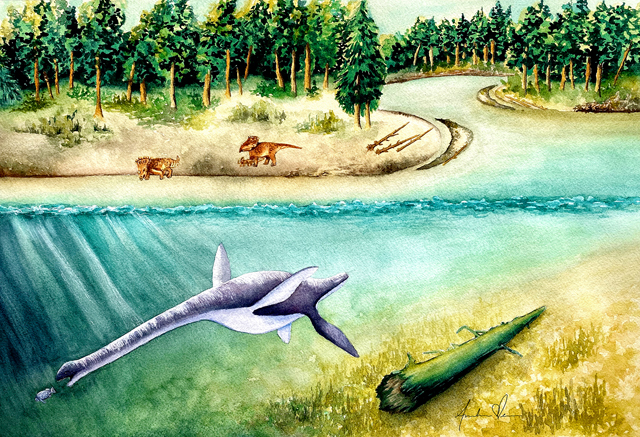
Fluvionectes sloanae life reconstruction.

Fluvionectes sloanae hunting fish in a river.

Picture credit: Andrea Elena Noriega

“River Swimmer”

Fossils of plesiosaurs occur throughout the Dinosaur Park Formation but they are generally rare, fragmentary and poorly preserved.  As a result, these fossils have attracted little scientific attention although they were first documented by Lawrence Lambe back in 1902.

This specimen is different, it consists of a partial disarticulated skeleton made up of a single tooth, numerous vertebrae, ribs, parts of the pectoral and pelvic girdles and elements from the left forelimb and left hindlimb.  The bones and the tooth were collected from a stratum immediately overlying the basal most coal bed of the Lethbridge Coal Zone in the Dinosaur Park Formation with the first material discovered in 1990.

Fluvionectes sloanae

It is the most complete example of an elasmosaurid found to date in the Dinosaur Park Formation and as such, the researchers have been able to formally describe the specimen and assign it a scientific name – Fluvionectes sloanae. The genus name translates as “river swimmer”, a reference to the fact that the fossils come from alluvial deposits believed to have been laid down at least 100 kilometres inland from the Western Interior Seaway.  The species name honours Donna Sloan who discovered the holotype, and in recognition of her service to palaeontology, both in the field and as the scientific illustrator at the Royal Tyrrell Museum of Palaeontology (Drumheller, Alberta).

Quarry Map and Skeletal Reconstruction of F. sloanae
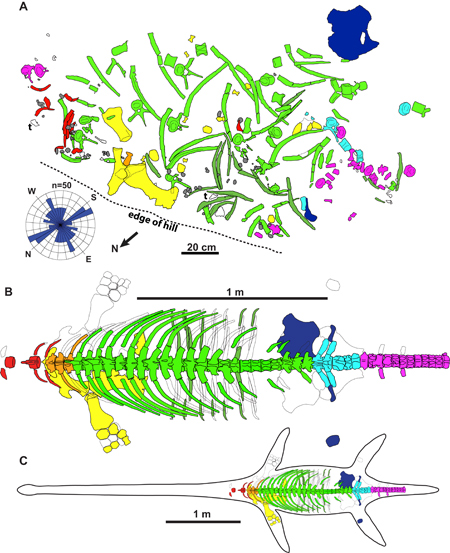
Colour coded quarry map showing location of F. sloanae fossil material.

Quarry map and skeletal reconstruction of F. sloanae.  The fossil material was found scattered over an area of around 2.5 square metres.

Picture credit: Campbell et al (PeerJ)

A Freshwater Predator (Fluvionectes sloanae)

A taxonomic analysis conducted by the scientists which included Dr James Campbell of the University of Calgary and Mark Mitchell, a technician at the Royal Tyrrell Museum of Palaeontology, failed to resolve definitively the exact taxonomic relationship of Fluvionectes within the Elasmosauridae.  However, the team were able to conclude that the fossil remains probably represent a young adult.  The specimen indicates an animal approximately 5.6 metres long when it died.

Fragmentary fossils of potentially larger elasmosaurids, representing animals around seven metres in length have been found in the Dinosaur Park Formation.  Some of these specimens might represent the Fluvionectes genus.  The scientists conclude that further study is needed to identify specimens at the genus level.

Views of the Vertebrae Associated with Fluvionectes sloanae
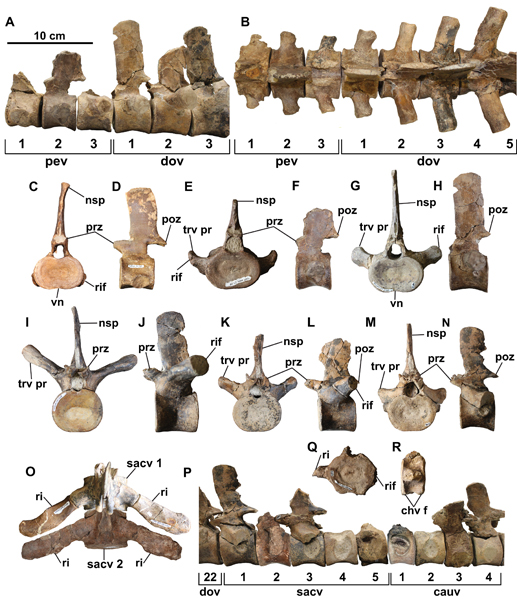
Vertebrae associated with the elasmosaurid Fluvionectes sloanae.

Fluvionectes sloanae – examples of vertebrae.

Picture credit: campbell et al (PeerJ)

Everything Dinosaur stocks a wide range of marine reptile models.  Models of elasmosaurs, plesiosaurs and mosasaurs are in stock.

To view a selection of marine reptile figures: Wild Safari Prehistoric World Models and Figures.

Did Some Juvenile Elasmosaurs Live in Freshwater?

Intriguingly, the elasmosaurid fossils found in the Dinosaur Park Formation (non-marine deposition), are relatively small when compared to elasmosaurid fossils found in offshore, marine deposits such as the Pierre Shale or Bearpaw formations.  Large elasmosaur fossil bones have not been found in the Dinosaur Park Formation.  It could be speculated that juvenile elasmosaurs ventured into estuarine environments and freshwater river systems before relocating to marine environments when they reached maturity.

This is not the first example of a marine reptile, normally associated with marine environments been found in freshwater.  To read Everything Dinosaur’s 2013 article about the discovery of a freshwater pliosaur in Australia: Freshwater Pliosaur from Cretaceous Australia.

To read our article about a freshwater Mosasaur: Freshwater Mosasaur from a Hungarian Bauxite Mine.

The scientific paper: “A new elasmosaurid (Sauropterygia: Plesiosauria) from the non-marine to paralic Dinosaur Park Formation of southern Alberta, Canada” by James A. Campbell, Mark T. Mitchell, Michael J. Ryan and Jason S. Anderson published in PeerJ.

Visit the Everything Dinosaur website: Everything Dinosaur.
5 02, 2021

Research Suggests Horned Dinosaurs Evolved Frills to Attract Mates

By |2024-05-18T22:04:02+01:00February 5th, 2021|Categories: Dinosaur and Prehistoric Animal News Stories, Dinosaur Fans, Main Page, Palaeontological articles, Photos/Pictures of Fossils|0 Comments

Horned Dinosaurs Evolved Frills to Attract Mates

The ornate and very diverse head crests and frills of horned dinosaurs (ceratopsians) probably evolved to help them attract a mate.  That is the conclusion from a study recently published in the Proceedings of the Royal Society B.

Why Did Some Horned Dinosaurs Have Elaborate Frills?

Ever since the first horned dinosaurs were discovered, palaeontologists have debated why these plant-eating dinosaurs evolved such elaborate neck shields (these features are produced by elaborate extensions to the parietal and squamosal skull bones).  It had been thought that these frills provided some protection from attack from theropod dinosaurs such as the contemporaneous tyrannosaurs, or perhaps they had a role in thermoregulation.

With so many different types of large ceratopsians known from the Late Cretaceous of North America it had also been suggested that these crests and frills played a role in species recognition.  An extensive analysis of the skulls of “first horned face” – Protoceratops (P. andrewsi), suggests that they played a role in sexual selection.

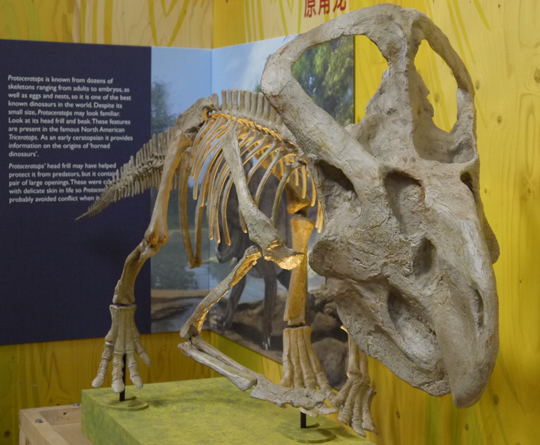
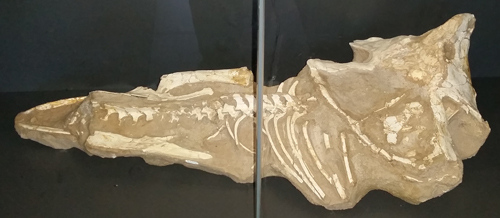
A Reconstruction of the Skeleton of Protoceratops (P. andrewsi)

Protoceratops skeleton on display.

A skeleton of a Protoceratops on display.  The elaborate head crest complete with fenestrae (two large holes), probably evolved as a result of sexual selection.  Picture credit: Everything Dinosaur.

Picture credit: Everything Dinosaur

Sexual Selection in Horned Dinosaurs

Sexual selection is a method of natural selection in which members of one biological sex choose mates of the other sex to mate with.  Certain characteristics in organisms are favoured by members of the opposite sex and organisms that possess the favoured feature(s) are the ones that breed.  This leads over time to these preferred characteristics becoming more intricate and elaborate.  There are plenty of examples to be found in the natural world today, most certainly amongst the closest living relatives of the Dinosauria the birds.  The elaborate but cumbersome tails of peacocks for instance, or the ornate and very beautiful plumes of the birds of paradise.

The researchers, which included scientists from the Natural History Museum (London) and Queen Mary University of London, used computer modelling to map how the skull of Protoceratops changed as the dinosaur grew.  Protoceratops has a rich and extensive fossil record.  Hundreds of specimens have been found ranging from embryos in unhatched eggs up to large, very old adults.  This extensive fossil record made this type of horned dinosaur an ideal candidate for this study.

The Fossilised Remains of a Protoceratops

The fossils of a Protoceratops.

Protoceratops fossil display in Frankfurt Museum (could be a cast).  Picture credit: Everything Dinosaur.

Picture credit: Everything Dinosaur

An Important Driver of Evolution

Sexual selection is predicted to be an important driver of evolution.  It influences adaptation and the development of new species.  There are anatomical traits and characteristics that can be identified in the fossil record that indicate sexual selection within a species is at work.   The fossilised skulls of horned dinosaurs can be studied to see if any of these traits and characteristics can be found.

Predicted characteristics of horned dinosaur skulls that indicate sexual selection having an influence include:

  • Low integration with the rest of the skull.
  • A significantly higher rate of change in size and shape as the dinosaur grows.
  • A higher morphological variance in the parietal and squamosal when compared to other bones of the skull.

The computer modelling used to assess these traits supported the theory that sexual selection was at work within Protoceratops andrewsi.

No Evidence of Sexual Dimorphism in Protoceratops

Whilst it is notoriously difficult to identify males from females using just the fossil record, the large number of Protoceratops specimens gave the researchers the opportunity to see if they could spot evidence of male Protoceratops having different skull frills compared to the females.  Although the research involved a substantial sample set, no evidence of sexual dimorphism in skull shape was found.  This suggests that either there were no differences in frill shape between the boys and the girls or that any differences between the genders was very small.

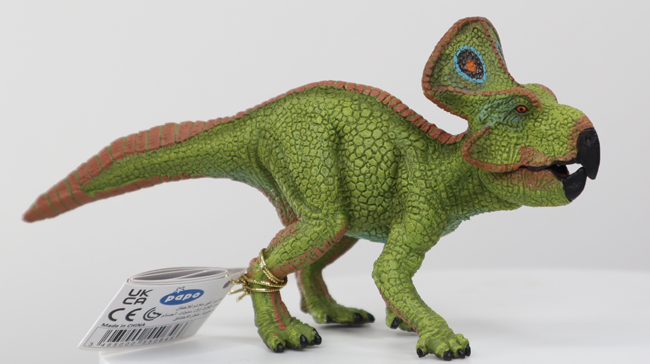
A Model of an Adult Protoceratops

Papo Protoceratops dinosaur model.

Papo Protoceratops dinosaur model.  Picture credit: Everything Dinosaur.

Picture credit: Everything Dinosaur

The image (above) shows a Papo Protoceratops dinosaur model.

To view the Papo dinosaur model range: Papo Dinosaurs and Prehistoric Animal Models.

The scientific paper supports the idea that the elaborate frills of horned dinosaurs did play a role in sexual selection.  Scientists have suspected that many of these strange anatomical features found in the Dinosauria were linked to sexual selection and display.  This evidence is extremely hard to find using the fossil record alone, however, the computer modelling and in-depth analysis used here provides evidence for the presence of signalling structures linked to sexual selection in Protoceratops andrewsi.

The scientific paper: “Three-dimensional geometric morphometric analysis of the skull of Protoceratops andrewsi supports a socio-sexual signalling role for the ceratopsian frill” by A. Knapp, R. J. Knell and D. W. E. Hone published in the Proceedings of the Royal Society B.

Visit the Everything Dinosaur website: Everything Dinosaur.
30 01, 2021

Four-year-old Finds Rare Dinosaur Footprint

By |2024-05-18T17:39:24+01:00January 30th, 2021|Categories: Dinosaur and Prehistoric Animal News Stories, Dinosaur Fans, Main Page, Photos/Pictures of Fossils|0 Comments

Three-toed Dinosaur Track Found in South Wales

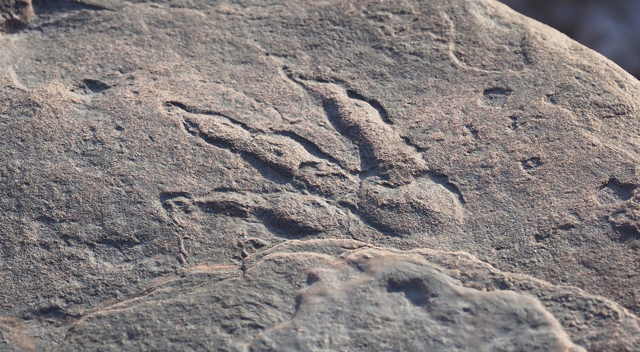
There has been a lot of media interest in the discovery of a beautifully-preserved three-toed dinosaur footprint on a beach near the town of Barry in South Wales.  The track identified as an example of the ichnogenus Grallator was spotted by four-year-old Lily Wilder whilst out for a walk with her family.  The specimen, preserved in a loose boulder is now in the care of scientists at the National Museum of Wales.

A Superb Example of a Three-toed Dinosaur Track from the Mercia Mudstone Group at Bendrick Rock (Vale of Glamorgan, South Wales)

Grallator fossil track (South Wales).

Grallator track spotted by a 4-year-old girl at Bendrick Rock (South Wales).

Picture credit: National Museum Wales

An Area Famed for its Dinosaur Footprints

This part of the South Wales coast is famous for its prehistoric animal tracks, which represent the oldest confirmed dinosaur trackways known from the British Isles.  The tracks are preserved in sediments associated with the Mercia Mudstone Group at Bendrick Rock and hundreds of individual prints have been found, representing at least sixty different trackways.  National Museum of Wales Palaeontology curator Cindy Howells was notified of the find and has described it as the best specimen ever found on this beach.  The print representing a small theropod dinosaur is estimated to be around 220 million years old (Late Triassic).

The print is a fraction over 10 cm long and was probably made by a light, agile, bipedal dinosaur similar in appearance to Coelophysis.

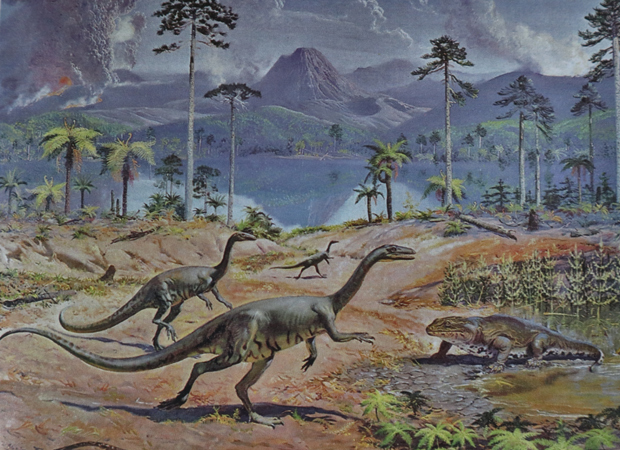
A Late Triassic Landscape Featuring a Trio of Coelophysis Dinosaurs

Burian depicts a Triassic landscape.

Beautiful and evocative artwork from Burian (Coelophysis bauri and Eupelor durus).  An illustration of a Late Triassic scene featuring the small, agile biped Coelophysis (C. bauri).

Picture credit: Zdeněk Burian

The tracks preserved in the rocks exposed in this area not only record the movements of dinosaurs but prints associated with rauisuchian reptiles (crocodile-like contemporaries of the first dinosaurs), have also been found.

A Site of Special Scientific Interest (SSSI)

Like many similar sites in the UK, this part of the coast close to the seaside town of Barry is designated as a Site of Special Scientific Interest (SSSI).  The landowner, the British Institute for Geological Conservation, is a charity that works to conserve natural heritage through site ownership, education and community engagement.  Natural Resources Wales (NRW) had to seek special permission in order to remove the track.  Researchers at the National Museum of Wales located in Cardiff will be studying the print in a bid to find out more about early dinosaur locomotion.

Commenting on this fantastic fossil find, Cindy Howells, the curator of palaeontology at National Museum Wales exclaimed:

“This fossilised dinosaur footprint from 220 million years ago is one of the best-preserved examples from anywhere in the UK and will really aid palaeontologists to get a better idea about how these early dinosaurs walked.  Its acquisition by the museum is mainly thanks to Lily and her family who first spotted it.  During the Covid pandemic scientists from Amgueddfa Cymru [National Museum Wales] have been highlighting the importance of nature on people’s doorstep and this is a perfect example of this.  Obviously, we don’t all have dinosaur footprints on our doorstep but there is wealth of nature local to you if you take the time to really look close enough.”

Lily’s mother Sally Wilder stated:

“It was Lily and Richard (her father) who discovered the footprint.  Lily saw it when they were walking along and said “Daddy look”.  When Richard came home and showed me the photograph, I thought it looked amazing.  Richard thought it was too good to be true. I was put in touch with experts who took it from there.  We were thrilled to find out it really was a dinosaur footprint and I am happy that it will be taken to the national museum where it can be enjoyed and studied for generations.”

Dinosaur Tracks from the Vale of Glamorgan Area (South Wales)

Vale of Glamorgan dinosaur tracks.

Dinosaur Tracks from the Late Triassic from the Vale of Glamorgan area (South Wales).

Picture credit: Tom Sharpe (Dinosaurs of the British Isles)

To read a related article from 2012 reporting on the theft of dinosaur tracks from the Vale of Glamorgan: Dinosaur Footprints Stolen from the Vale of Glamorgan.

Everything Dinosaur acknowledges the assistance of a media release from National Museum Wales in the compilation of this article.

Visit the Everything Dinosaur website: Everything Dinosaur.
27 01, 2021

Ancient Placoderm Could Turn Vertebrate Evolution on its Head

By |2024-05-18T17:30:02+01:00January 27th, 2021|Categories: Dinosaur and Prehistoric Animal News Stories, Main Page, Palaeontological articles, Photos/Pictures of Fossils|0 Comments

Cutting-edge Technology Provides New Insights into Ancient Fish

Sophisticated, cutting-edge MicroCT scanning employed to look inside the fossilised skull of a prehistoric fish from the Early Devonian of New South Wales (Australia), has provided scientists with new insights into early vertebrate evolution and challenged the current view regarding the phylogeny and taxonomy of the bony, armoured prehistoric fishes known collectively as placoderms.

The research team, which included scientists from the University of Birmingham, the Chinese Academy of Sciences and colleagues based in Australia and Sweden, used MicroCT scanning to view the internal structures of the skull of a 400 million-year-old Brindabellaspis (Brindabellaspis stensioi) specimen.  A fish nicknamed the “platypus fish” due to its elongated snout.

Ancient Placoderm Study

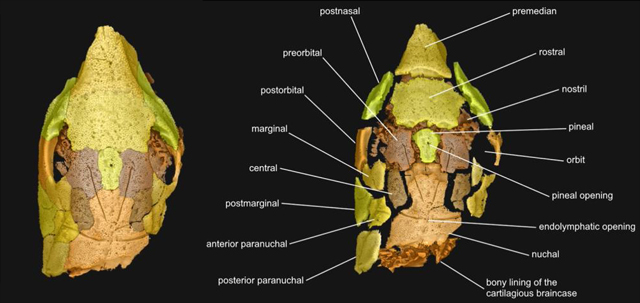
Computer software was used to create a digital reconstruction of brain cavity and the inner ear.  The team discovered that Brindabellaspis possessed an inner ear that was surprisingly compact with closely connected components resembling the inner ear of modern jawed vertebrates such as sharks and bony fishes.  Some features of the inner ear from this ancient fish are remarkably similar to the structure of our own inner ear.

A Digital Model Showing the Skull and its Constituent Parts (Brindabellaspis stensioi)

A digital model of the skull of Brindabellaspis stensioi.

The skull of Brindabellaspis stensioi digitally recreated after MicroCT scan analysis.

Picture credit: Institute of Vertebrate Palaeontology and Palaeoanthropology

Important Implications for the Placodermi

Brindabellaspis is a member of the Placodermi, a diverse, geographically and temporally widespread class of armoured fish which thrived during the Devonian between 420 and 360 million years ago.  Most placoderms have less complex inner ear structures, with a large sac, called a vestibule, placed in the centre and separating all the other components.  The remarkably well-preserved and three-dimensional nature of the specimens from New South Wales provided the research team with an opportunity to examine the brain cavity and inner ear of Brindabellaspis for the first time.

Their findings could change the way in which the tree of life representing early vertebrates is constructed.

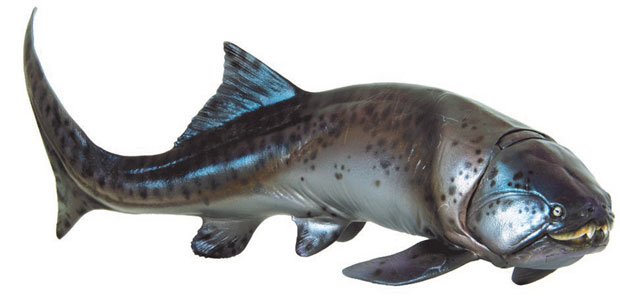
Life Reconstruction of a Devonian fish – The Giant Placoderm Dunkleosteus

Zaha the Dunkleosteus (PNSO)

A stunning model of an ancient placoderm – the PNSO Dunkleosteus model.

The picture above shows a replica of Dunkleosteus, a giant placoderm.  The model is from the PNSO range of figures.

To view this range: PNSO Prehistoric Animal Models.

Re-writing the Evolutionary History of Early Vertebrates

Previous studies had suggested that prehistoric fish such as Brindabellaspis were closely related to primitive, jawless fish (agnathans), that first evolved around 500 million years ago.  This study challenges the assumption that placoderms are a distinct group, as considerable variation has been identified in the brain cavities and inner ears of “placoderms”.

Furthermore, this research suggests the possibility that these types of fish may be the ancestors of modern jawed vertebrates (the Gnathostomata).

Co-author of the scientific paper, published in the journal Current Biology, Dr Sam Giles (University of Birmingham), stated:

“The inner ear structure is so delicate and fragile that it is rarely preserved in fossils, so being able to use these new techniques to re-examine specimens and discover this wealth of new information is very exciting.  This fossil has revealed a really intriguing mosaic of primitive features and a surprisingly modern inner ear.  We don’t yet know for certain what this means in terms of our understanding of how modern jawed vertebrates evolved, but it’s likely that virtual anatomy techniques are going to be a critical tool for piecing together this fascinating jigsaw puzzle.”

Sensitive Snouts

An earlier research paper suggested that the snout of Brindabellaspis was sensitive and may have played a role in locating food or avoiding predators.  To read Everything Dinosaur’s article from 2018 about this study: A Primitive Placoderm Platypus Fish from Australia.

Everything Dinosaur acknowledges the assistance of a media release from the University of Birmingham in the compilation of this article.

The scientific paper: “Endocast and Bony Labyrinth of a Devonian “Placoderm” Challenges Stem Gnathostome Phylogeny” by You-an Zhu, Sam Giles, Gavin C. Young, Yuzhi Hu, Mohamed Bazzi, Per E. Ahlberg, Min Zhu and Jing Lu published in Current Biology.

Visit the Everything Dinosaur website: Everything Dinosaur.
25 01, 2021

Baby Tyrannosaurs Born Ready to Hunt

By |2024-05-18T17:22:49+01:00January 25th, 2021|Categories: Adobe CS5, Dinosaur and Prehistoric Animal News Stories, Dinosaur Fans, Main Page, Palaeontological articles, Photos/Pictures of Fossils|0 Comments

Baby Tyrannosaurs Born Ready to Hunt

A new scientific paper published this week suggests that tyrannosaurs were able to hunt and to look after themselves soon after they hatched.  In addition, tyrannosaur hatchlings were surprisingly large, perhaps more than a metre long when they broke out of their eggs and if this the case, then tyrannosaur eggs would have been colossal, perhaps larger than any other dinosaur egg known to science.

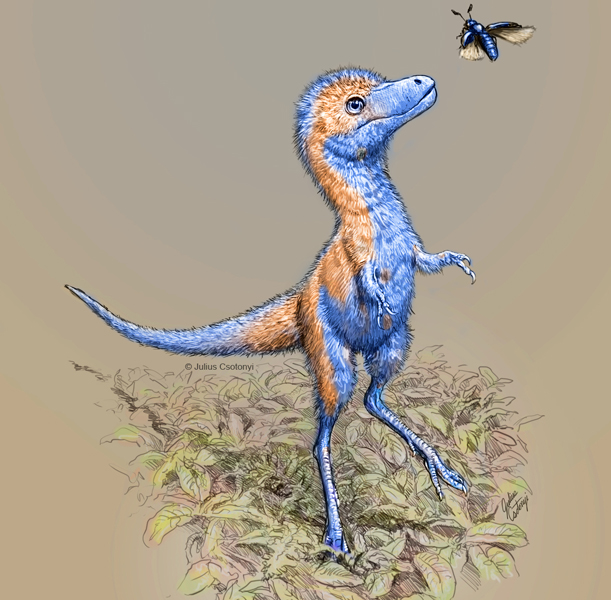
A Life Reconstruction of a Baby Tyrannosaur

Juvenile tyrannosaur life reconstruction.

A life reconstruction of a juvenile tyrannosaur.  This illustration by the talented palaeoartist Julius Csotonyi, depicts a baby tyrannosaur covered in a coat of insulating protofeathers.

Picture credit: Julius Csotonyi

As Big as a Collie Dog

Writing in the latest edition of the Canadian Journal of Earth Sciences, the scientists which include such eminent figures as Phil Currie, “Jack” Horner and Stephen Brusatte, have written up an on-line presentation from last October which took place at the virtual Society of Vertebrate Palaeontology Conference and they indicate that young tyrannosaurs were big babies.  With a length of in excess of 1 metre, that’s about the size of a border collie dog.

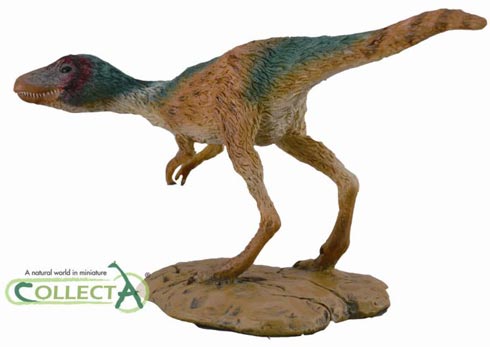
A Model of a Young Tyrannosaurus rex

A juvenile T. rex.

A young T. rex.  Research suggests that Late Cretaceous tyrannosaurs may have been around a metre in length when very young.  Rare fossil bones from perinatal tyrannosaurs from North America also suggest that these predators were highly developed and capable of hunting for themselves – precocial development – mobile and relatively fully developed when first hatched.

The model (above) is from the CollectA Prehistoric Life Age of Dinosaurs range.

To view this range: CollectA Prehistoric Life Figures.

Perinatal Tyrannosaurid Bones and Teeth

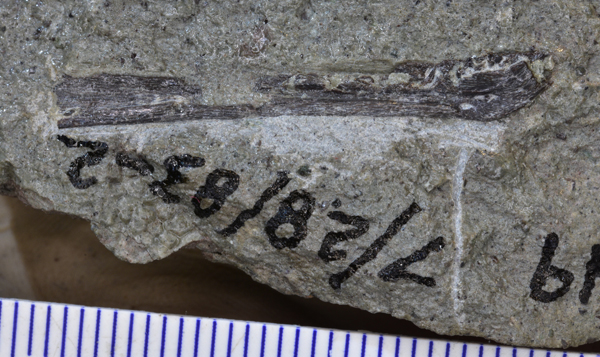
Perinatal tyrannosaurid bones and teeth from the Campanian–Maastrichtian of western North America provide the first window into this critical period of the life of a tyrannosaurid.  An embryonic dentary (Daspletosaurus horneri) from the Two Medicine Formation of Montana, measuring just 3 cm in length, already exhibits distinctive tyrannosaurine characters like a “chin” and a deep Meckelian groove, and reveals the earliest stages of tooth development.  When considered together with a remarkably large embryonic claw bone (ungual) from the Horseshoe Canyon Formation of Alberta and believed to have come from an Albertosaurus sarcophagus, a minimum hatchling size for tyrannosaurids could be estimated by the research team.

Corresponding author for the paper, Gregory Funston (University of Edinburgh), stated:

“It appears that tyrannosaurs were born ready to hunt, already possessing some of the key adaptations that gave tyrannosaurs their powerful bites.  So, it’s likely that they were capable of hunting fairly quickly after birth, but we need more fossils to tell exactly how fast that was.”

Tyrannosaur Babies Bigger than Other Dinosaur Babies

The dentary and the claw bone indicate that Late Cretaceous tyrannosaurs were bigger than any other known dinosaur babies.  The researchers conclude that they must have hatched from enormous eggs, perhaps exceeding the 43 cm length of largest dinosaur eggs described to date.

The Embryonic Tyrannosaur Dentary

Daspletosaurus horneri juvenile jawbone.

The fossilised lower jawbone (dentary) of a Daspletosaurus horneri, one of the first baby tyrannosaurs ever discovered.

Picture credit: Gregory F. Funston (University of Edinburgh)

Studying Embryonic Fossil Material

Co-author of the paper, Mark Powers a PhD student at the University of Alberta (Canada), commented:

“Tyrannosaurs are represented by dozens of skeletons and thousands of isolated bones or partial skeletons, but despite this wealth of data for tyrannosaur biology, the smallest identifiable individuals are aged three to four years old, much larger than when they would have hatched.  No tyrannosaur eggs or embryos have been found even after 150 years of searching—until now.”

The study, focused on the two fossils representing perinatal development of tyrannosaurids.  The ungual was found near Morrin in the province of Alberta, whilst the dentary came from Montana. The ungual is approximately 71.5 million years old, and the jawbone a little older at around 75 million years old.

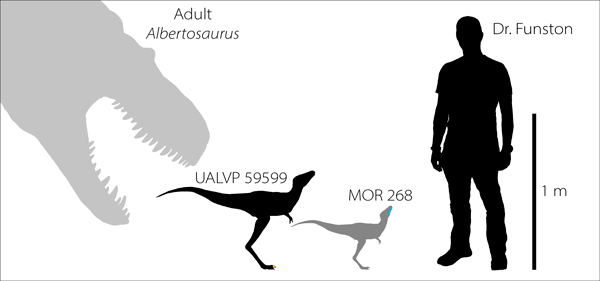
Comparing the Tyrannosaurid Fossil Material with Dr Funston and an Adult Albertosaurus

Comparing the juvenile tyrannosaur specimens.

This diagram compares the size of a full-grown Albertosaurus with that of palaeontologist Greg Funston and the two dinosaur embryos whose toe claw and jawbone were identified in a newly published study.

Picture credit: Gregory F. Funston (University of Edinburgh)

Mark Powers, who completed the research as a master’s student supervised by Phil Currie added:

“The discovery of embryonic material is a huge find in our efforts to understand how some of the most popular and charismatic dinosaurs began their life and grew to immense sizes.  It provides a much-needed—and until now, missing—data point depicting the starting point for tyrannosaur growth.”

Surprising Results

The researchers were surprised to find that the small tyrannosaur teeth in the lower jaw were distinct from the teeth of older tyrannosaurids.  They had not developed true serrations running along the cutting edges.  In addition, the toe claw (specimen number UALVP 59599), came from an animal estimated to be about 1.1 metres long, whilst the tiny jawbone (MOR 268), came from a tyrannosaur around 71 cm in length.

The size estimates for perinatal tyrannosaurs based on this study reinforce the work of the late American-Canadian palaeontologist Dale Russell, who back in 1970 provided some of the first insights into tyrannosaur development and ontogeny.  This study was published in a special issue of the Canadian Journal of Earth Sciences which honours the contribution made to vertebrate palaeontology by Professor Russell.

Everything Dinosaur acknowledges the assistance of a media release from the University of Alberta in the compilation of this article.

The scientific paper: “Baby tyrannosaurid bones and teeth from the Late Cretaceous of western North America” by Gregory F. Funston, Mark J. Powers, S. Amber Whitebone, Stephen L. Brusatte, John B. Scannella, John R. Horner and Philip J. Currie published in the Canadian Journal of Earth Sciences.

Visit the award-winning Everything Dinosaur website: Everything Dinosaur.
22 01, 2021

Limb Bone Research Confirms Large Pterosaurs Across Laramida

By |2024-05-18T17:14:46+01:00January 22nd, 2021|Categories: Dinosaur and Prehistoric Animal News Stories, Dinosaur Fans, Main Page, Palaeontological articles, Photos/Pictures of Fossils|0 Comments

Single Bone Suggests Large Pterosaurs Across Both North and South Laramidia

A single bone from a large pterosaur tentatively described as an ulna found in 2016 has confirmed the presence of large flying reptiles in terrestrial ecosystems in both north and south Laramidia during the Late Cretaceous.

Writing in the on-line, academic journal “PeerJ”, Dr Andrew Farke of the Raymond M. Alf Museum of Palaeontology (Claremont, California), reports that the 36 cm long bone from a bonebed within the middle unit of the Kaiparowits Formation (Utah), extends the distribution of large pterosaurs across terrestrial environments during the Campanian of western North America.

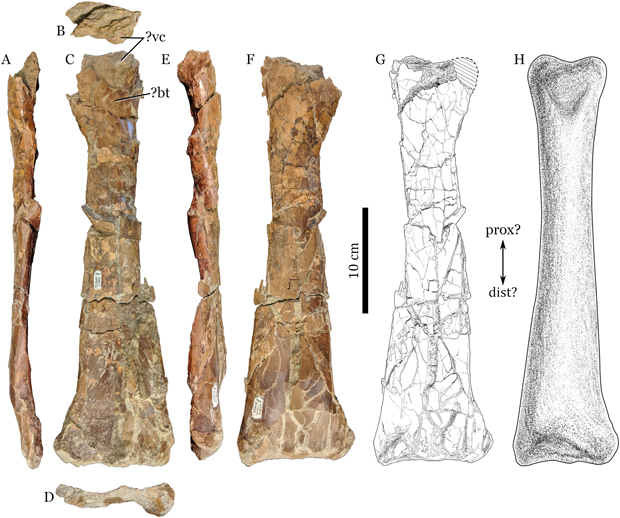
Views of the Single Pterosaur Bone with Accompanying Line Drawings

RAM 22574 pterosaur limb bone and line drawings

Views of the pterosaur limb bone with accompanying line drawings.  Note scale bar = 10 cm.

Picture credit: Farke (PeerJ)

The picture above shows various views of the single pterosaur limb bone (specimen number RAM 22574).  Dorsal (A), proximal (B) with anterior (C) and dorsal (D) views, whilst E and F represent ventral and posterior views.  Line drawing (G) shows an interpretation of the posterior view with missing parts shaded and line drawing H shows a posterior view of the complete and restored bone.  The large size of the bone has permitted Dr Farke to make an estimate of the wingspan of the pterosaur.  He estimates that this bone came from an individual with a wingspan between 4.3 and 5.9 metres.   This bone is the largest pterosaur fossil reported to date from the Kaiparowits Formation.

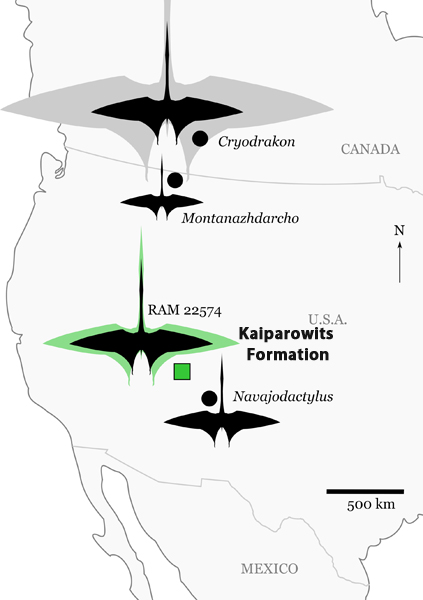
Based on these estimates, the Kaiparowits Formation specimen is roughly comparable in size to Cryodrakon boreas an azhdarchid pterosaur known from the Dinosaur Park Formation of southern Alberta, Canada which was formally named and described in 2019: The First Pterosaur Unique to Canada is Described Cryodrakon boreas.

Significant Pterosaur Fossil Finds Associated with Terrestrial Environments in Late Cretaceous North America

Late Cretaceous major pterosaur fossil finds in western North America.

Major pterosaur fossil finds from late Campanian-aged terrestrial depositional environments in western North America.

Picture credit: Farke (PeerJ) with additional annotation from Everything Dinosaur (silhouettes based on work from Naish and Witton)

Silhouettes are scaled to maximum estimates of wingspan for individual specimens.  The silhouette for RAM 22574 shows the minimum (black) and maximum (green) size estimates for the specimen (4.3 to 5.9 metre wingspan).

The strata in southern Alberta (Dinosaur Park Formation) from which C. boreas comes from was laid down shortly after the portion of the Kaiparowits Formation associated with this single pterosaur bone.  Thus, Dr Farke concludes that relatively large pterosaurs occurred in terrestrial ecosystems in both the northern and southern parts of Laramidia (western North America), during the late Campanian.

The scientific paper: “A large pterosaur limb bone from the Kaiparowits Formation (late Campanian) of Grand Staircase-Escalante National Monument, Utah, USA” by Andrew A. Farke published in PeerJ.

Visit the Everything Dinosaur website: Dinosaur Models and Prehistoric Animal Toys.

17 01, 2021

Unravelling the Origins of the Earliest Animals

By |2024-05-18T16:47:03+01:00January 17th, 2021|Categories: Dinosaur and Prehistoric Animal News Stories, Main Page, Palaeontological articles, Photos|0 Comments

Unravelling the Origins of the Earliest Animals

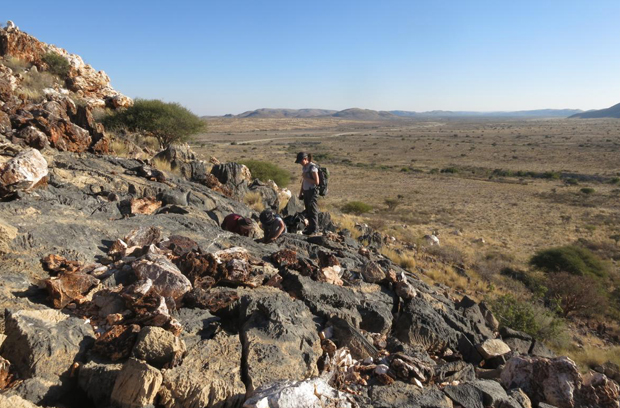
A team of international scientists including researchers from the University of Edinburgh and Moscow State University have used some remarkable fossils of animals that lived before the Cambrian Explosion to trace the ancestry of some of the world’s earliest organisms.  The fossils, a total of 73 specimens of the primitive metazoan known as Namacalathus (N. hermanastes), were found a single bedding plane sample of rocks associated with the Upper Omkyk Member of the Nama Group of Namibia (Africa).

The Origins of the Earliest Animals

An in-depth analysis of the tiny three-dimensional fossils, the largest of which were around 12.3 mm in diameter, suggest that these animals are basal members of the Superphylum Lophotrochozoa which are characterised by having a feeding/food gathering structure that is surrounded by a ring of tentacles and a free-swimming, zooplankton developmental stage.  This Superphylum includes the Brachiopoda as well as molluscs, worms and other related, generally soft-bodied organisms.

Members of the Research Team at the Fossil Site (Namibia)

Field team members looking for Ediacaran fossils in Namibia.

Exploring an outcrop of the Upper Omkyk Member (Nama Group, Namibia).  The beautiful but remote fossil site.

Picture credit: Professor Rachel Wood (University of Edinburgh)

Writing in the academic journal Science Advances, the research team report on the first known link between some of the major groups of animals that evolved during the Cambrian Explosion and their ancestral forms.

Mapping Life from 547 Million Years Ago

The close proximity of the marine deposits that contain the tiny Namacalathus fossils and an ash layer which resulted from volcanic activity permitted the researchers to accurately date the fossils to around 547 million years ago (late in the Ediacaran), the geological period that immediately precedes the Cambrian and the beginning of the Phanerozoic Eon (visible life).  It is only in the last few decades that scientists have been able to piece together a picture of life prior to the Cambrian Explosion event but the fossil record for the tiny, soft-bodied creatures that dominated early marine ecosystems is exceptionally poor.

Once thought to be an ancestor of today’s jellyfishes, Namacalathus have been described as a “pin cushion on a short, hollow stalk”.  The stalk is at its narrowest towards the strange cup-like structure at the top of the stalk where the feeding apparatus was located.

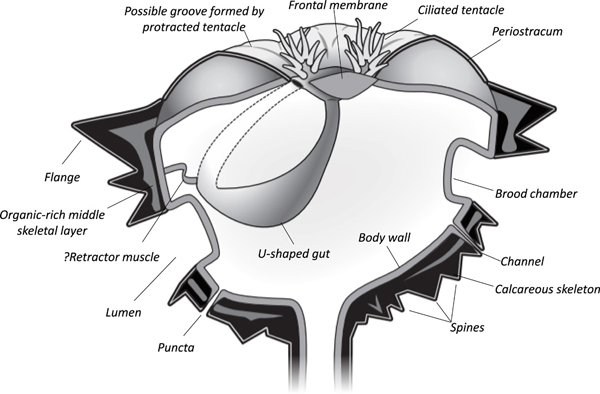
A Diagram of the Proposed Body Plan of Namacalathus (N. hermanastes)

The anatomy of Namacalathus.

A diagram showing the anatomy of Namacalathus.  Measuring just a few millimetres in diameter, the 3-dimensional preservation of the Namibian specimens has permitted researchers a glimpse into the biological affinity of some of the oldest animals known to science.

Picture credit: Shore et al (Science Advances)

Commenting on the significance of this research, co-author of the scientific paper, Professor Rachel Wood of the School of GeoSciences at the University of Edinburgh stated:

“These are exceptional fossils, which give us a glimpse into the biological affinity of some of the oldest animals.  They help us trace the roots of the Cambrian Explosion and the origin of modern animal groups.  Such preservation opens up many new avenues of research into the history of life which was previously not possible.”

Soft Tissue Preservation and Preserved Structures

Prior to this research the exact position of Namacalathus within the Kingdom Animalia remained controversial.  It had been difficult to trace the origins of the major invertebrate groups found today, as the mainly soft-bodied Ediacaran biota left only the merest hints as to their taxonomy in the fossil record.

Using advanced and sophisticated X-ray imaging techniques, the research team were able to identify some of the animal’s soft tissues beautifully preserved inside the fossils by iron sulphide. Until this paper’s publication, scientists had only ever identified exoskeleton remains of Namacalathus.

By looking at the soft tissues that had been entombed by the iron sulphide, the research team were able to identify that Namacalathus was probably a distant ancestor of today’s worms and molluscs (a basal member of the Superphylum Lophotrochozoa).

Everything Dinosaur acknowledges the assistance of a press release from the University of Edinburgh in the compilation of this article.

The scientific paper: “Ediacaran metazoan reveals lophotrochozoan affinity and deepens root of Cambrian Explosion” by A. J. Shore, R. A. Wood, I. B. Butler, A. Yu Zhuravlev, S. McMahon, A. Curtis and F. T. Bowyer published in Science Advances.

Visit the user-friendly Everything Dinosaur website: Everything Dinosaur.
15 01, 2021

Extensive and Rare Dinosaur Tracks Discovered in China

By |2024-05-18T16:41:10+01:00January 15th, 2021|Categories: Dinosaur and Prehistoric Animal News Stories, Dinosaur Fans, Main Page, Palaeontological articles, Photos/Pictures of Fossils|0 Comments

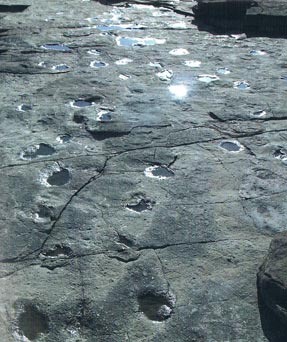
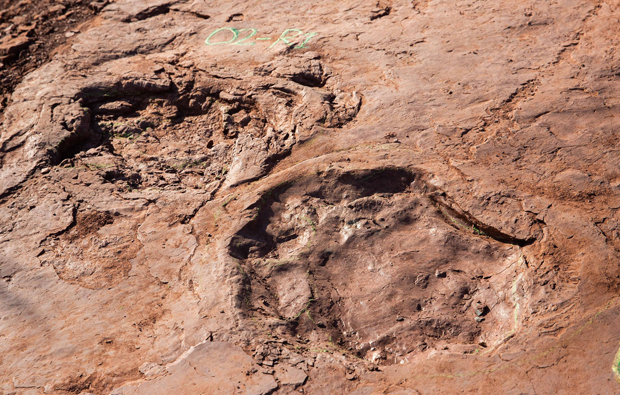
Over 240 Fossilised Dinosaur Prints Discovered in South-eastern China

Everything Dinosaur team members have received several media reports from Chinese news agencies about the discovery of an extensive series of dinosaur tracks in Fujian Province (south-eastern China).  The dinosaur track site was uncovered in Shanghang County and covers approximately 1,600 square metres.  The tracks and individual prints were made around 80 million years ago (Campanian faunal stage of the Late Cretaceous) and they represent the first dinosaur trace fossils to have been found in Fujian Province.

Field Team Members Examine and Map the Dinosaur Tracks

Extensive dinosaur tracks uncovered in China.

Chinese field team members examine and map the numerous dinosaur tracks and prints uncovered in Fujian Province.

Picture credit: CFP

The Tracks of at Least Eight Different Types of Dinosaur

Extensive track sites such as this are exceptionally rare, early indications from the field team mapping the prints are that at least eight different types of dinosaur are represented.  The three-toed prints of ornithopods and the large, more rounded prints of sauropods have been identified.  The various media channels have also reported both large and small theropod prints including prints around thirty centimetres in length made by a large, bird-like member of the Deinonychosauria, a raptor that has left distinctive two-toed prints, as the second toe was raised off the ground as it possessed a large, curved sickle-like claw.

Running with Second Toe Raised Off the Ground

The second toe claw of Velociraptor.

A model showing the raised second toe held off the ground as a member of the Deinonychosauria (Velociraptor) runs.  Picture credit: Everything Dinosaur.

Picture credit: Everything Dinosaur

Visit the Everything Dinosaur website: Dinosaur Toys and Models.

Xing Lida, from the China University of Geosciences and a member of the research team has stated:

“Judging from the size of the footprints, which were eight to fifty-five centimetres long, lengths of the dinosaurs range from one metre to ten metres.”

The site is under the stewardship of the local authorities in order to protect this important discovery and to deter any would-be fossil hunters who might be tempted to remove any prints for sale on the black market.  The site contains at least 240 individual dinosaur prints.

Two of the Dinosaur Prints from the Shanghang County Site

Dinosaur tracks discovered in Fujian Province.

Two dinosaur prints from the Fujian Province site.  The research team estimate that the tracks represent lakeside activity from around 80 million years ago.

Picture credit: CFP

Dinosaur Tracks Alongside an Ancient Lake

The tracks were made as dinosaurs visited an ancient lake, the various prints and trackways being preserved in the soft mud on the lake margins.

Senior palaeontologist and former curator at the Zigong Dinosaur Museum (Sichuan Province) Peng Guangzhao, explained that the researchers were optimistic about finding more fossils.  The team are hopeful that more tracks, bones or even dinosaur eggs could be discovered in Fujian Province in the future.

14 01, 2021

World’s Oldest Cave Art Known to Science Discovered in Sulawesi

By |2024-05-18T16:28:21+01:00January 14th, 2021|Categories: Adobe CS5, Animal News Stories, Dinosaur and Prehistoric Animal Drawings, Dinosaur and Prehistoric Animal News Stories, Main Page|0 Comments

Oldest Cave Art Found in Sulawesi

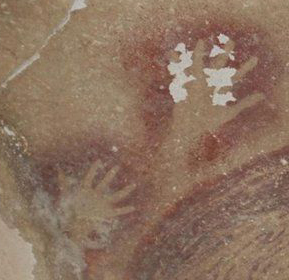
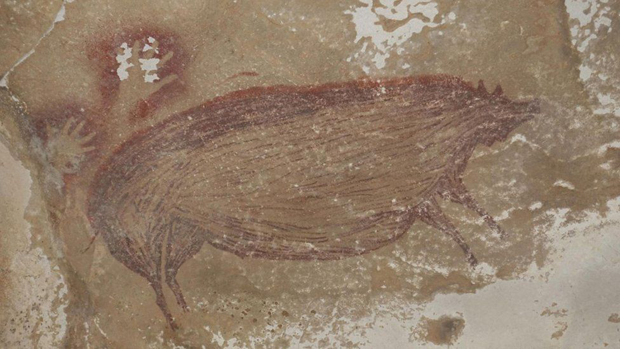
Scientists have discovered the world’s oldest known animal cave painting on the island of Sulawesi (Indonesia) – a wild pig – believed to have been drawn 45,500 years ago.  The cave painting consists of a figurative depiction of a group of Sulawesi warty pigs, one male seems to be observing an interaction between two other pigs, their impressions are only partly preserved.  Painted in red ochre, the dark red impressions are approximately life size.  There are two handprints painted above the back of the pig, this evocative artwork provides the earliest evidence recorded to date of human settlement in this region.

The Oldest Cave Art Known to Science

The World’s Oldest Known Animal Cave Painting

Warty pig cave art (Sulawesi, Indonesia).

The world’s oldest known animal cave painting on Sulawesi (Indonesia).  An illustration of a warty pig believed to have been drawn 45,500 years ago.

Picture credit: Maxime Aubert (Griffith University, Australia)

Writing in the academic journal Science Advances, the archaeologists from Griffith University, the University of Brisbane in collaboration with their Indonesian colleagues from Pusat Penelitian Arkeologi Nasional (ARKENAS), Hasanuddin University (Indonesia) and other academic bodies discovered the remarkable cave art in a limestone cave known as Leang Tedongnge on the south-western peninsula of the island of Sulawesi.  The cave painting consists of a figurative depiction of a group of Sulawesi warty pigs (Sus celebensis) that are endemic to this Indonesian island.

Commenting on the significance of their discovery, Professor Adam Brumm (Australian Research Centre for Human Evolution at Griffith University) stated:

“The Sulawesi warty pig painting we found in the limestone cave of Leang Tedongnge is now the earliest known representational work of art in the world, as far as are aware.  The cave is in a valley that’s enclosed by steep limestone cliffs and is only accessible by a narrow cave passage in the dry season, as the valley floor is completely flooded in the wet.  The isolated Bugis community living in this hidden valley claim it had never before been visited by Westerners.”

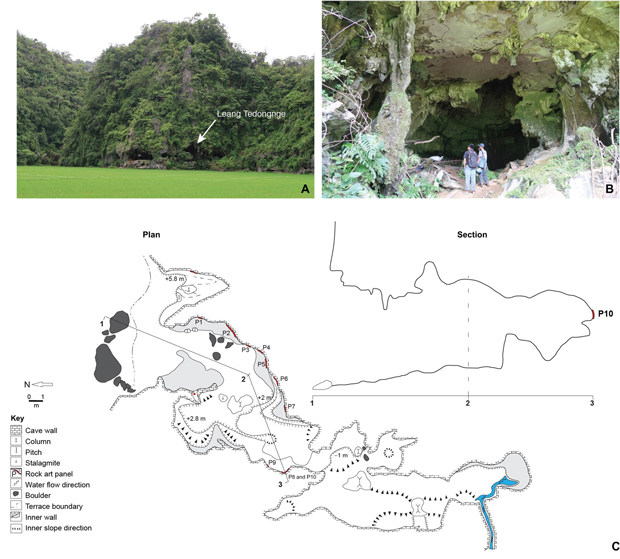
Views of the Entrance to the Leang Tedongnge Cave and a Schematic Plan of the Cave Site

Views of the Leang Tedongnge cave on Sulawesi and a schematic diagram of the cave system.

(A and B) Leang Tedongnge cave.  The cave is located at the foot of a limestone karst hill (A); the cave mouth entrance is shown in (B).  Plan (C) and section of Leang Tedongnge site.

Picture credit: Brumm et al (Science Advances)

Dating Using Isotope Analysis of Mineral Deposits

To determine the approximate age of the cave paintings, the research team used Uranium-series isotope dating of associated calcium carbonate mineral deposits.  The oldest cave painting was estimated to be at least 45,500 years old.  A second painting from a nearby cave known as Leang Balangajia was dated to around 32,000 years ago.

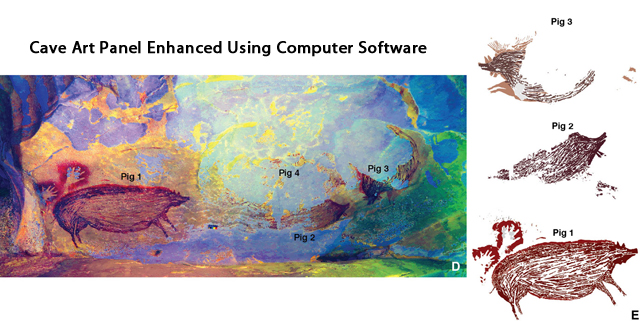
A Digitally Enhanced View of the Cave Art at the Leang Tedongnge site

Computer enhanced view of the cave art with hand prints and pigs highlighted.

A stitched panorama view of the cave art enhanced using Decorrelation Stretch (DStretch) computer software.

Picture credit: Brumm et al (Science Advances)

Professor Brumm described the artwork:

“It shows a pig with a short crest of upright hairs and a pair of horn-like facial warts in front of the eyes, a characteristic feature of adult male Sulawesi warty pigs.  Painted using red ochre pigment, the pig appears to be observing a fight or social interaction between two other warty pigs.”

Co-author of the paper PhD student Basran Burhan, an Indonesian archaeologist from southern Sulawesi ,who is currently studying at Griffith University commented:

“These pigs were the most commonly portrayed animal in the ice age rock art of the island, suggesting they have long been valued both as food and a focus of creative thinking and artistic expression.”

Recovering DNA from the Handprints

The research team are confident that they will be able to recover DNA from the two handprints located above the pig’s back.  A study of this genetic material will shed light on the origins of the people who painted this prehistoric scene.  This cave art underlines the importance of Indonesia in terms of mapping the spread of modern humans around Asia and the researchers state that even older cave art may still be awaiting discovery in the hundreds of limestone caves located on Sulawesi.

Views of the Two Sulawesi Handprints

Cave art hands.

Close-up views of the two Sulawesi handprints preserved above the red ochre illustration of the warty pig.  One looks much larger than the other and these may represent stencils made by two individuals.

Picture credit: Maxime Aubert (Griffith University, Australia)

The scientific paper: “Oldest cave art found in Sulawesi” by Adam Brumm, Adhi Agus Oktaviana, Basran Burhan, Budianto Hakim, Rustan Lebe, Jian-xin Zhao, Priyatno Hadi Sulistyarto, Marlon Ririmasse, Shinatria Adhityatama, Iwan Sumantri and Maxime Aubert published in the journal Science Advances.

Visit Everything Dinosaur: Everything Dinosaur.
9 01, 2021

Rare Oviraptorid Fossil Overturns Ideas on Late Stage Egg Incubation

By |2024-04-03T09:01:12+01:00January 9th, 2021|Categories: Adobe CS5, Dinosaur and Prehistoric Animal News Stories, Dinosaur Fans, Main Page, Palaeontological articles, Photos/Pictures of Fossils|0 Comments

Fossil of Dinosaur Sitting on Eggs (Late Stage Incubation)

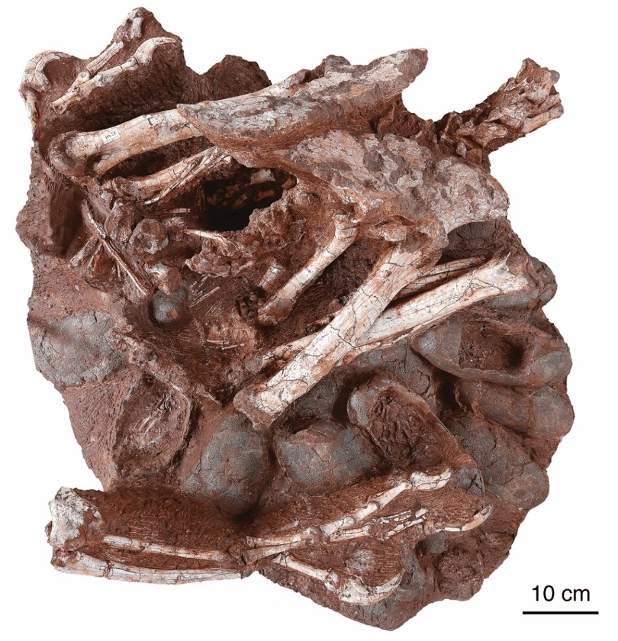
Fossils of dinosaurs are rare, fossils of articulated dinosaur skeletons rarer still and any fossils that preserve evidence of behaviour, these are amongst the rarest of all, truly scientific treasures.  A newly published paper describes the fossilised remains of a Late Cretaceous oviraptorid from east China’s south-eastern Jiangxi Province, a specimen that ticks all these boxes.  The fossils represent the partial, articulated remains of oviraptorosaur preserved sitting on a clutch of eggs in a brooding position.  Such fossils have been found before, but uniquely these 70-million-year-old remains include fossils of baby dinosaurs preserved inside the eggs, the first time this has been recorded in the non-avian dinosaur fossil record.

The Partially Preserved Adult Oviraptorid On the Nest

Oviraptorid sitting on eggs with embryos identified.

The fossilised remains of an oviraptorid with preserved eggs that contain the remains of baby dinosaurs.  Note scale bar = 10 cm.

Picture credit: Shundong Bi et al (Science Bulletin)

Sitting Atop a Dinosaur Nest

The multinational team of researchers includes Dr Shundong Bi (Indiana University of Pennsylvania) and Xing Xu (Institute of Vertebrate Palaeontology – Beijing) along with Dr Matt Lamanna (Carnegie Museum of Natural History) and scientific illustrator Andrew McAfee.

Commenting on the significance of this discovery, Dr Bi stated:

“Dinosaurs preserved on their nests are rare, and so are fossil embryos.  This is the first time a non-avian dinosaur has been found, sitting on a nest of eggs that preserve embryos, in a single spectacular specimen.”

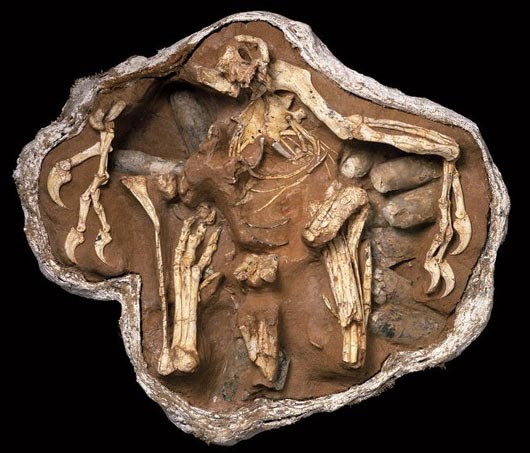
Fossils of brooding dinosaurs have been found before, perhaps the most famous is “Big Mamma” the fossilised remains of an adult Citipati osmolskae (also an oviraptorid) on display at the American Museum of Natural History (New York).

Citipati osmolskae Fossil Sitting Atop a Nest of Eggs

Citipati osmolskae fossil.

The Citipati fossil sitting on a nest “Big Mamma”.

Picture credit: The American Museum of Natural History

An Oviraptorid – A Very Bird-like Dinosaur

The Chinese fossil material has been assigned to the Oviraptoridae, although Everything Dinosaur are not aware of any new taxon being announced.  Oviraptorid dinosaurs are mainly associated with Asia, but the closely related Caenagnathidae are also known from North America.  The bones of these dinosaurs are very bird-like and they do belong to a great linage of theropods that are related to modern birds (the Maniraptora).

The specimen represents an incomplete, articulated skeleton of a large, (presumably adult) oviraptorid crouched in a bird-like brooding posture over a clutch of at least twenty-four eggs.  The adult appears to have perished whilst brooding the clutch.  The researchers identified the preserved remains of seven unhatched dinosaurs entombed inside the eggs.  The late stage of development of the embryos suggests that, just like modern birds, oviraptorids brooded their eggs, rather than simply guarding them as observed in extant crocodilians.

A Caring Parent

Dr Lamanna explained:

“This kind of discovery, in essence, fossilised behaviour, is the rarest of the rare in dinosaurs.  Though a few adult oviraptorids have been found on nests of their eggs before, no embryos have ever been found inside those eggs.  In the new specimen, the babies were almost ready to hatch, which tells us beyond a doubt that this oviraptorid had tended its nest for quite a long time.  This dinosaur was a caring parent that ultimately gave its life while nurturing its young.”

As part of their research, the scientists conducted an oxygen isotope study that demonstrated that the eggs were incubated at high bird-like temperatures, further evidence to support the idea that the adult died whilst brooding its clutch of eggs.  Analysis of the tiny baby dinosaur bones preserved inside their eggs indicate that some babies were more fully developed than others, this suggests that the eggs might have hatched at different intervals, a hatching strategy known as asynchronous hatching.  This strategy is found in many types of birds today such as Shoebill storks and numerous species of birds of prey such as raptors and owls.

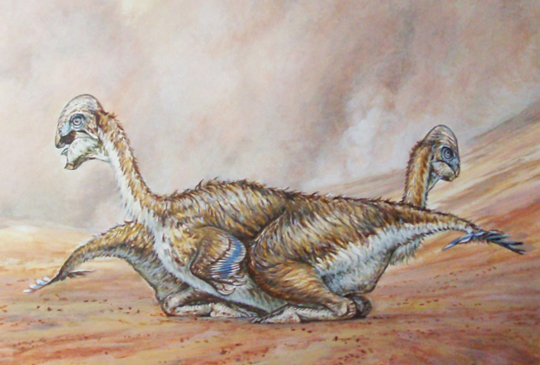
Oviraptorids – Evidence that they were Caring Parents

Communal roosting in oviraptorids.

A pair of oviraptorosaurs.  Scientists suggest that these dinosaurs incubated their eggs and that they were caring parents.

Picture credit: Mike Skrepnick

Asynchronous hatching appears to have evolved independently in oviraptorids and modern avians.

The Evolutionary Benefits of Asynchronous Hatching

If the eggs of oviraptorids did hatch at different intervals, then this too can provide an insight into the behaviour of these Late Cretaceous dinosaurs.  Biologists have identified a number of reasons why some kinds of bird alive today have evolved asynchronous hatching.

The evolutionary benefits of asynchronous hatching:

  • To reduce the losses from predators due to the whole brood not being present in the nest at the same time.
  • The younger animals are a back-up plan in case earlier hatched animals die.
  • When food resources are scarce the adults can dedicate the bulk of these scarce resources to the older babies and let the younger siblings perish.
  • Reduces the demands on the parents as they do not have to care for all the babies at the same time.

Gastroliths Identified

The researchers also noted the presence of gastroliths (stomach stones).  A cluster of tiny pebbles had accumulated in the body cavity of the adult dinosaur.  Gastroliths are associated with many different types of dinosaur, but this is the first time that undoubted gastroliths have been found in an oviraptorid.  As such, these stones may provide new insights into the diets of these very bird-like dinosaurs.

Dr Xu concluded:

“It’s extraordinary to think how much biological information is captured in just this single fossil.  We’re going to be learning from this specimen for many years to come.”

To read a related article on dinosaur parenting skills: Doting Fathers – A Parenting Strategy Amongst the Dinosauria.

Everything Dinosaur acknowledges the assistance of a press release from the Carnegie Museum of Natural History (Pennsylvania).

The scientific paper: “An oviraptorid preserved atop an embryo-bearing egg clutch sheds light on the reproductive biology of non-avialan theropod dinosaurs” by Shundong Bi, Romain Amiot, Claire Peyre de Fabrègues, Michael Pittman, Matthew C. Lamanna, Yilun Yu, Congyu Yu, Tzuruei Yang, Shukang Zhang, Qi Zhao and Xing Xu published in Science Bulletin.

Visit Everything Dinosaur’s website: Visit Everything Dinosaur.
Go to Top