All about dinosaurs, fossils and prehistoric animals by Everything Dinosaur team members.

Fossil finds, new dinosaur discoveries, news and views from the world of palaeontology and other Earth sciences.

25 03, 2021

Cephalopods Evolved 30 Million Years Earlier Than Previously Thought

By |2024-05-22T21:11:24+01:00March 25th, 2021|Categories: Dinosaur and Prehistoric Animal News Stories, Main Page, Palaeontological articles, Photos/Pictures of Fossils|0 Comments

Cephalopods those advanced sophisticated molluscs such as octopi, squid and cuttlefish evolved some thirty million years earlier than previously thought according to some new research published this week.
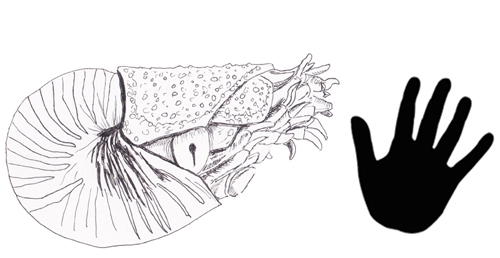
Nautilus scale drawing.
A scale drawing of an extant nautilus (Nautilus pompilius). Newly published research suggests the ancestors of the modern Nautilus were around at least 522 million years ago.  Picture credit: Everything Dinosaur.

Picture credit: Everything Dinosaur

Cephalopods belong to the phylum Mollusca. Animals such as the octopus are regarded as highly intelligent, capable of complex behaviours and are regarded by many scientists as being as sophisticated, if not more so, than many vertebrates. The ancestors of the extant cephalopods around today originally possessed a chambered shell, indeed, the pearly nautilus still retains this feature (see above for a nautilus illustration). Researchers from Heidelberg University in collaboration with colleagues from the Bavarian Natural History Collections examined a 522 million-year-old outcrop from the Lower Cambrian Bonavista Formation exposed at Bacon Cove (south-eastern Newfoundland, Canada). Slices of the red sandstone which represent a shallow, marine depositional environment revealed tantalising glimpses of ancient Cambrian animals.
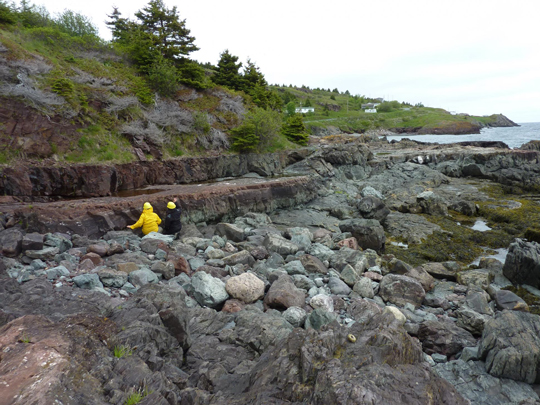
Looking for evidence of the oldest cephalopods known to science.
Scientists documenting the evidence at Bacon Cove (Newfoundland). Picture credit: Anne Hildenbrand (Heidelberg University).

The Oldest Known Cephalopods

Tiny calcareous shells measuring no more than 14 mm high and around 3 mm wide discovered in cross-sections of the red sandstone rock are interpreted as representing phragmocones, part of the internal skeleton of a marine invertebrate. The researchers postulate that as similar structures are found in cephalopods, then these fossils represent the earliest evidence of the Cephalopoda.
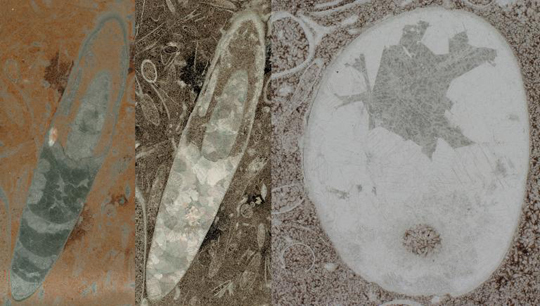
Longitudinal and cross-sectional images of the fossils that could represent the oldest cephalopods known to science.
Longitudinal and cross-sectional images of the fossils that could represent the oldest cephalopods known to science. Picture credit: Gregor Austermann, Heidelberg University / Communications Biology.

An Extraordinary Find

Co-author of the research, Dr Gregor Austermann (Institute for Earth Sciences at Heidelberg University), commented:

“This find is extraordinary. In scientific circles it was long suspected that the evolution of these highly developed organisms had begun much earlier than hitherto assumed. But there was a lack of fossil evidence to back up this theory.”
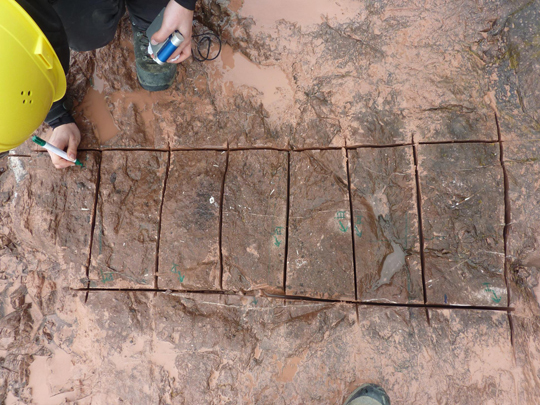
Documenting the fossil finds.
Carefully documenting the fossil finds at Bacon Cove. Picture credit: Anne Hildenbrand (Heidelberg University).

Plectronoceras cambria

Although molecular studies had suggested that cephalopods evolved earlier than indicated by the fossil record, there was very little physical evidence to back this up. Many palaeontologists regard Plectronoceras cambria, fossils of which come from Texas limestones and date from the Middle/Late Cambrian as the earliest cephalopod. These Canadian fossils, if proved to represent the body fossils of cephalopods, push back the evolutionary origins of this important group by at least 30 million years.

The specimens described here may represent the earliest cephalopods capable of regulating the buoyancy of their shell through a siphuncle. This view supports the molecular studies that suggest that cephalopods originated in the Early Cambrian. These animals may have been the first to actively control their buoyancy and therefore to be capable of moving up and down the water column. It could be speculated that these fossils which are around 522 million years old, represent the remains of some of the first animals living above the sea floor (pelagic animals) and able to swim (nektonic).

The scientific paper: “A potential cephalopod from the early Cambrian of eastern Newfoundland, Canada” by Anne Hildenbrand, Gregor Austermann, Dirk Fuchs, Peter Bengtson and Wolfgang Stinnesbeck published in Communications Biology.

Visit the award-winning Everything Dinosaur website: Prehistoric Animal Models and Toys.
24 03, 2021

Dig Those Remarkable Ankylosaurs

By |2024-05-22T21:07:36+01:00March 24th, 2021|Categories: Adobe CS5, Dinosaur and Prehistoric Animal News Stories, Dinosaur Fans, Main Page, Palaeontological articles, Photos/Pictures of Fossils|0 Comments

A study of the fossilised remains of an as yet unnamed species of ankylosaurid suggests that these dinosaurs were adapted for digging. Whilst it seems unlikely that these large herbivores could have lived in burrows, they may have been able to dig for roots and tubers, excavate wells in dried up rivers to reach subsurface water and dig into sediments to obtain supplementary minerals in a similar way that extant elephants do today.

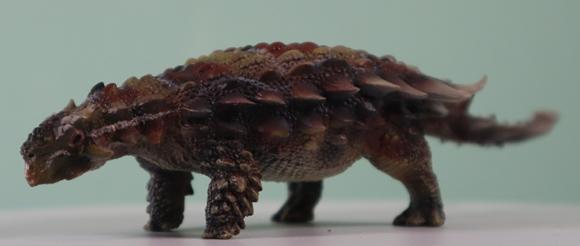
The compact and low-slung Pinacosaurus could have been adapted for digging.
A compact and low-slung body shape with powerful limbs could be adaptations for digging. The low profile of the PNSO Pinacosaurus ankylosaurid model. A newly published scientific paper suggests that these types of dinosaurs may have dug shallow pits in which they could protect themselves from attack. Picture credit: Everything Dinosaur.

Picture credit: Everything Dinosaur

The model (above) is a Pinacosaurus armoured dinosaur from PNSO.

To view the range of PNSO dinosaur models: PNSO Prehistoric Animal Figures.

Digging Pits to Protect Their Undersides

Furthermore, many palaeontologists have postulated that these armoured herbivores might have been able to hunker down to defend their limbs and undersides from theropod predators. If these animals dug shallow pits they might have been able to protect themselves from attack and make it difficult for carnivorous dinosaurs to spot them when they were partially buried. Horned lizards (Phrynosoma) have a similar flat body and lateral fringe scales as seen in some types of ankylosaurid, these extant reptiles adopt these types of defensive strategies.

Discovered in the Early 1970s

Remains of an armoured dinosaur was first reported by a joint Soviet-Mongolian expedition to the southern Gobi Desert of Mongolia in the early 1970s. The skeleton consisting of dorsal vertebrae, elements from the limbs, ribs parts of the pelvis and the pectoral girdle along with several armoured scutes, was partially prepared for removal, but the excavation was not completed. The fossil specimen remained uncollected but crated up until 2008 when it was taken away for preparation by members of a Korean/Mongolian research team.

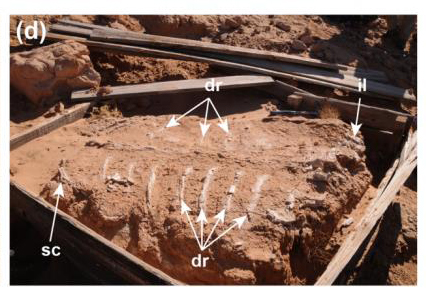
The crate containing (MPC-D 100/1359)
A close view of the crate containing the postcranial remains in a dorsal orientation. The fossil specimen was partially crated up but not removed from the site at Hermiin Tsav in the southern Gobi Desert (Mongolia). Abbreviations sc = scapula, dr = dorsal ribs, il = ilium.

Probably a New Species of Armoured Dinosaur

The sandstone sediments of the Upper Cretaceous (Middle to Late Campanian stage), Baruungoyot Formation have yielded the remains of three ankylosaurid taxa, namely Saichania chulsanensis, Tarchia kielanae and Zaraapelta nomadis. Writing in the journal “Scientific Reports” the researchers which include such luminaries as Phil Currie and Eva Koppelhus (University of Alberta), Michael Ryan (Canadian Museum of Nature) and corresponding author Yuong-Nam Lee (Seoul National University, South Korea), state the unnamed ankylosaurid has some similarities to S. chulsanensis, but there are anatomical differences. Unfortunately, very little postcranial fossils of Tarchia kielanae and Zaraapelta nomadis have been found making it impossible to undertake a direct comparison with this specimen (MPC-D 100/1359).

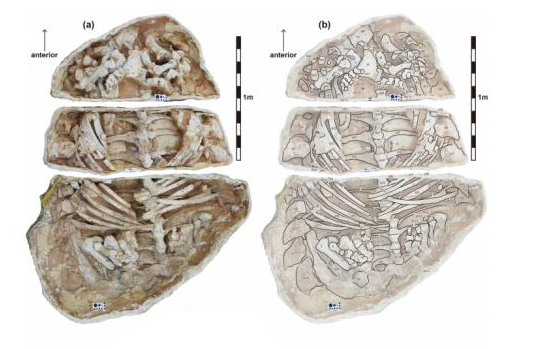
Photograph (a) and line drawing (b) of ankylosaurid fossil material.
The new ankylosaurid postcranial specimen (MPC-D 100/1359). Photograph (a) and line drawing (b) of the specimen in ventral view. Note scale bar equals 1 metre.

Adapted for Digging

The scientists speculate that several anatomical features identified in MPC-D 100/1359 could indicate that this ankylosaurid was adapted for digging. The bones in its front feet are arranged in a shallow arc, which could have enabled it to dig soft earth. The fused vertebrae and the reduced number of bones in its hind feet, compared to other dinosaurs, may have helped anchor the ankylosaurid when digging or moving its tail. The body shape of MPC-D 100/1359, which is wider in the middle and narrower at the front and rear, may have helped its body to remain straight when digging. These traits such as the narrow-wide-narrow body shape and the manus (hand) and pes (foot) bone configuration are also known in other ankylosaurids.

Dig Those Ankylosaurs

Digging for resources out of reach from other animals and excavating shallow pits as part of a defensive strategy might have been prevalent amongst these armoured dinosaurs.

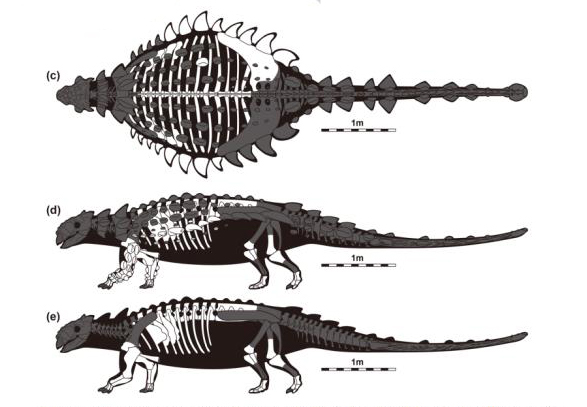
Ankylosaurid skeletal drawing.
Line drawing of the ankylosaurid skeleton, known elements in white (c) dorsal view, (d) left lateral view with armour shown, (e) left lateral view with armour removed. Note scale bar = 1 metre.

To read Everything Dinosaur’s article from 2014 about the discovery of Zaraapelta nomadis: New Species of ankylosaurid in Praise of Victoria Arbour.

The scientific paper: “A new ankylosaurid skeleton from the Upper Cretaceous Baruungoyot Formation of Mongolia: its implications for ankylosaurid postcranial evolution” by Jin-Young Park, Yuong-Nam Lee, Philip J. Currie, Michael J. Ryan, Phil Bell, Robin Sissons, Eva B. Koppelhus, Rinchen Barsbold, Sungjin Lee and Su-Hwan Kim published in Scientific Reports.


20 03, 2021

New Utahraptor State Park Proposed

By |2024-05-11T17:52:56+01:00March 20th, 2021|Categories: Dinosaur and Prehistoric Animal News Stories, Dinosaur Fans, Geology, Main Page, Photos/Pictures of Fossils|0 Comments

Fossils of the large dromaeosaurid Utahraptor (U. ostrummaysorum) were put on display as legislators and campaigners lobbied for the creation of a state park named after the iconic theropod dinosaur.

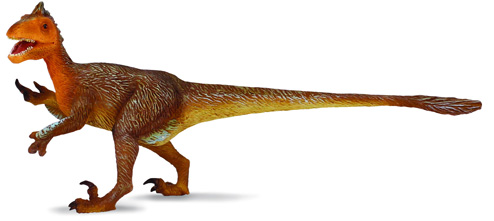
Utahraptor dinosaur model
Legislators have proposed a new state park in Utah which would conserve and protect the famous Dalton Wells quarry (Yellow Cat Member of the Cedar Mountain Formation), which has yielded numerous important dinosaur fossils including the first fossils of the giant dromaeosaurid Utahraptor (U. ostrummaysorum).

The picture (above) shows a model replica of Utahraptor from the CollectA Age of Dinosaurs range.

To view this range: CollectA Prehistoric Life Popular Models.

A New State Park for Grand County, Utah

A bill has been proposed that would create the Utahraptor State Park, if passed this would be the 45th such park designated within the “Beehive State”. The park would cover an area of Grand County in eastern Utah, close to the town of Moab and it would include the Dalton Wells Quarry where the first fossils of the giant raptor Utahraptor were discovered.

As well as providing camp sites and trails the park would protect and preserve the Dalton Wells Quarry site. Although the park’s current plans do not include provision for a museum, it has been suggested that if funding could be found, then a small museum documenting the extensive Lower Cretaceous strata that are exposed in this area and their contribution to palaeontology could be constructed.

It has been speculated that a 1:1 scale replica of the skeleton of a Utahraptor could be erected within the park’s boundary.

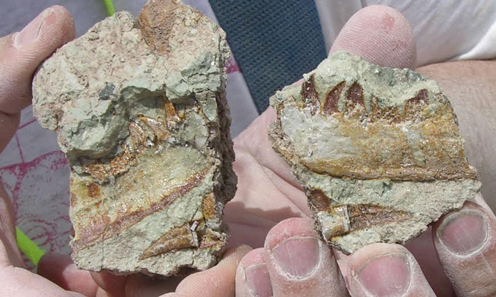
The fossilised remains of a Utahraptor jaw (slab and counter slab)
Slab and counter slab of a Utahraptor jaw (dentary). This fossil was collected from the Arches National Park, the proposed Utahraptor State Park will border it. Picture credit: James Kirkland/St George News.

Utahraptor State Park Proposed

The proposals involve the conversion of approximately 6,500 acres (2,630 hectares), into a park. Responsibility for conservation would be undertaken by either Utah’s Division of Forestry, Fire and State Lands or the Utah School and Institutional Trust Lands Administration.

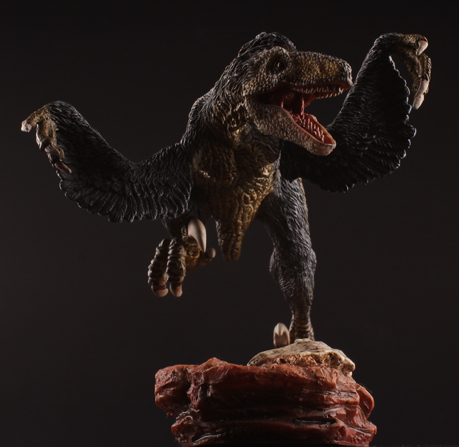
Rebor Wind Hunter (Utahraptor model).
A replica of the fearsome Early Cretaceous predator Utahraptor. The model is “Wind Hunter” the Rebor Utahraptor replica which has been out of production for some time.

The picture (above) shows a Utahraptor figure from the Rebor range of replicas.

To view this range: Rebor Prehistoric Animal Models and Figures.

A spokesperson from Everything Dinosaur commented:

“We do appreciate how tight budgets are right now, but if the funding could be found to establish this new park and to protect the famous Dalton Wells location, that would be fabulous. So much of the world’s open spaces and important scientific sites are under threat it would be wonderful to see this exceptionally important fossil site protected.”

7 03, 2021

The First Rebbachisaurid Sauropod Reported from Asia

By |2024-05-21T07:12:17+01:00March 7th, 2021|Categories: Dinosaur and Prehistoric Animal News Stories, Dinosaur Fans, Main Page, Palaeontological articles, Photos/Pictures of Fossils|0 Comments

An open-access paper has recently been published in the on-line academic journal PLOS One announcing the discovery of a new species of rebbachisaurid sauropod. The newly described dinosaur named Dzharatitanis kingi is the first member of the Rebbachisauridae family to have been found in Asia. Rebbachisaurids are known from Europe, Africa South America and possibly North America. They are related to diplodocids such as Brontosaurus and Apatosaurus and most palaeontologists group them in the Diplodocoidea superfamily along with the Diplodocidae and the rare and enigmatic Dicraeosauridae dinosaurs.

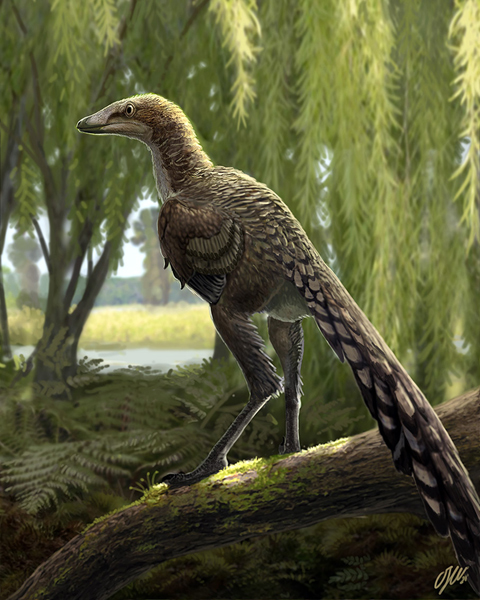
A Life Reconstruction of Dzharatitanis kingi
Dzharatitanis kingi the first rebbachisaurid to be described from Asia. Picture credit: Alexander Averianov. The large pterosaurs walking in the same direction as the sauropod probably represent the azhdarchid Azhdarcho, the only pterosaur to have been described to date from fossils found in the Bissekty Formation.

Described from a Single Fossil Bone

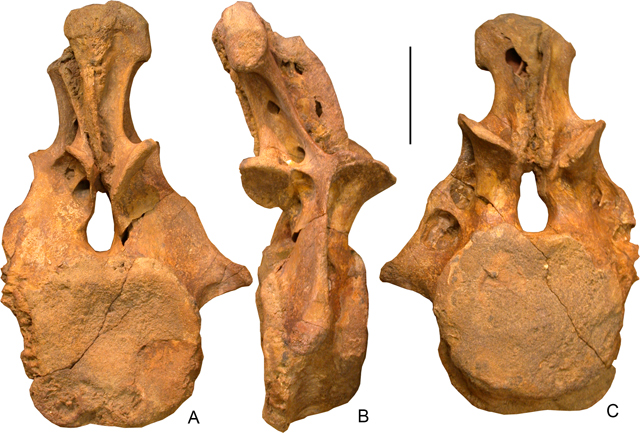
Described from a single, well-preserved tail bone from the base of the tail (anterior caudal vertebra), this herbivore is estimated to have been around 15 to 20 metres in size. The fossil bone was found in 1997, by David Ward and one of the authors of the scientific paper, Hans-Dieter Sues, during the Uzbekistan/Russian/British/American/Canadian exhibition to map and document Late Cretaceous Dzharakuduk escarpment outcrops associated with the Bissekty Formation in the Kyzylkum Desert of Uzbekistan.

Dzharatitanis is (as far as Everything Dinosaur team members are aware), the first sauropod to have been formally described from the Bissekty Formation.

The strata associated with the fossil find are believed to be around 90 million years of age (Turonian stage of the Late Cretaceous). D. kingi represents one of the geologically youngest known rebbachisaurids.

Dzharatitanis caudal vertebra
Dzharatitanis kingi, USNM 538133 (holotype), anterior caudal vertebra in posterior (A), right lateral (B), and anterior (C) views. Note scale bar = 10 cm. Picture Credit: Alexander Averianov and Hans-Dieter Sues

“Dzharakuduk titan”

The genus name is derived from the Dzharakuduk escarpment and translates as “Dzharakuduk titan”, whereas the species name honours the late Dr Christopher King who did much to map and document the geology of the Cretaceous-aged strata of central Asia.

Numerous “pencil-shaped” teeth along with isolated bones indicate the presence of sauropods within the Bissekty Formation however, D. kingi is the first member of the Sauropoda to be described. The caudal vertebrae of these types of dinosaur are very diagnostic. Their shape and characteristics help palaeontologists to identity related genera and this single fossil bone, believed to represent the first bone of the tail was sufficient to merit the erection of a new dinosaur species.

The sauropods from the Bissekty Formation now comprise at least two taxa, the rebbachisaurid Dzharatitanis kingi and an indeterminate and as yet unnamed titanosaur.

The scientific paper: “First rebbachisaurid sauropod dinosaur from Asia” by Alexander Averianov and Hans-Dieter Sues published in PLOS One.

The Everything Dinosaur website: Everything Dinosaur.

6 03, 2021

New Research Suggests Troodontids in Europe

By |2024-05-21T07:09:48+01:00March 6th, 2021|Categories: Adobe CS5, Dinosaur and Prehistoric Animal News Stories, Dinosaur Fans, Main Page, Palaeontological articles, Photos/Pictures of Fossils|0 Comments

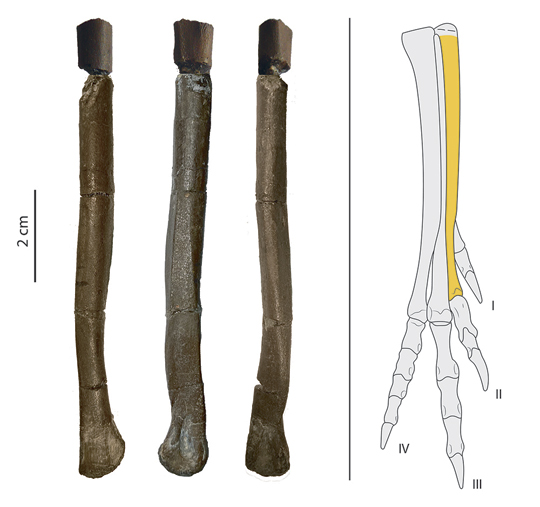
A team of international scientists including Steve Brusatte (University of Edinburgh), have confirmed the presence of troodontids in the Late Cretaceous of Europe. A new species of troodontid has been erected based on the discovery of a single metatarsal bone (the second metatarsal bone from the right foot), from Late Cretaceous strata in the Talarn Formation exposed at the Sant Romà d’Abella site in the southern Pyrenean region of Spain. This new dinosaur has been named Tamarro insperatus.

Tamarro insperatus Life Reconstruction
A life reconstruction of the first troodontid confirmed from the Late Cretaceous of Europe Tamarro insperatus.

Picture credit: Oscar Sanisidro

Found in 2003

The single fossil bone indicating the presence of troodontids in Europe was found in September 2003 by a team of palaeontologists from the Museu de la Conca Dellà (Lleida, Isona, Spain) at the Sant Romà d’Abella site (Spain). It was found in fluvial floodplain deposits believed to have been laid down just 200,000 years or so before the K-Pg mass extinction event.

The fossil bone was found in the same horizon as plant fossils and the type specimen of the lambeosaurine Pararhabdodon isonensis, the metatarsal was found in close proximity to the Pararhabdodon type specimen, these are the only two vertebrates known from this site.

The Dinosaurs from the Late Cretaceous of Europe

During the Late Cretaceous, high sea levels ensured that much of the European landmass we know today was underwater. Numerous islands existed, creating an extensive archipelago and several dinosaurs associated with these islands exhibit dwarfism or other unusual features associated with isolated ecosystems. Very little is known about the Theropoda that inhabited these islands. For example, the presence of troodontids in Europe has been debated for a long time. Several troodontid-like and Paronychodon teeth (a nomen dubium taxa referred by some to the Troodontidae), were recovered from the Campanian and Maastrichtian deposits of the ancient Hateg (Romania) and Ibero-Armorican (Portugal, France and Spain) islands, but this fossil bone provides definitive, unequivocal proof of these theropods being present in the Late Cretaceous of Europe.

The Single Fossil Bone (Metatarsal) of Tamarro insperatus
Views of the second metatarsal (metatarsal II from the right foot), plus line drawing showing the skeletal position of the bone.

Picture credit: Albert G. Sellés (Institut Català de Paleontologia Miquel Crusafon/Museu de la Conca Dellà)

A Basal Troodontid with Asian Origins

An analysis of the bone and a phylogenetic assessment suggests that Tamarro is a basal member of the Troodontidae family and most likely a representative of the Asian subfamily the Jinfengopteryginae. The research team speculate on how a dinosaur with relatives in Asia could have become established in Europe. Maastrichtian troodontids like Tamarro could have reached Europe during the Cenomanian faunal stage and persisted on these islands until the K-Pg extinction event.

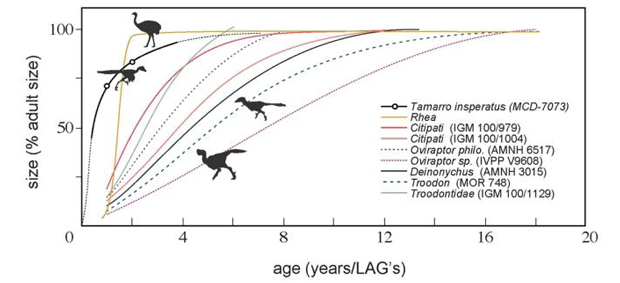
Estimated at around two metres in length Tamarro is around twice the size of other related troodontids. A close examination of the bone (cross-sectional histology), reveals that the metatarsal came from a subadult animal that was growing rapidly. Although troodontids are known to have fast growth rates, Tamarro seemed to be growing much quicker than other members of the Troodontidae, perhaps reaching full maturity in around two years.

Tamarro insperatus Growth Rate
Growth rate of Tamarro insperatus compared to other members of the Maniraptora. When compared to other taxa from the group of dinosaurs most closely related to birds (including Aves), Tamarro has a rapid growth rate reaching a subadult state in around one year.

The genus name is derived from the Catalan word “Tamarro” which refers to a small, mythical creature from local folklore. The species or trivial name “insperatus” is from the Latin for unexpected, a reference to the unexpected discovery of the fossil bone.

The scientific paper: “A fast-growing basal troodontid (Dinosauria: Theropoda) from the latest Cretaceous of Europe” by Albert G. Sellés, Bernat Vila, Stephen L. Brusatte, Philip J. Currie and Àngel Galobart published in Scientific Reports.

The Everything Dinosaur website: Dinosaur Models and Gifts.

2 03, 2021

Why So Few Medium-sized Carnivorous Dinosaurs?

By |2024-05-21T06:27:00+01:00March 2nd, 2021|Categories: Dinosaur and Prehistoric Animal News Stories, Dinosaur Fans, Main Page, Palaeontological articles|0 Comments

Researchers from the University of Nebraska-Lincoln and University of New Mexico have come up with a novel explanation as to why there are so few medium-sized carnivorous dinosaurs found in the fossil record.

In a scientific paper published in the academic journal “Science” they propose that sub-adults and juveniles of much larger species out-competed similarly sized adults of medium-sized meat-eating dinosaurs resulting in a transformation of dinosaur community populations.

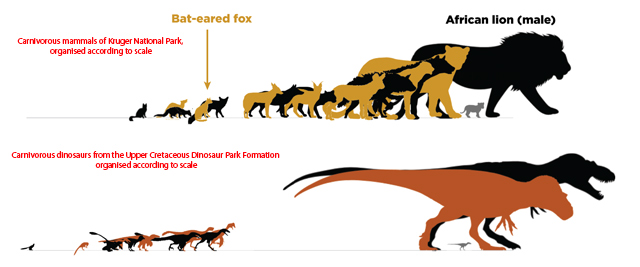
Comparing Mammalian and Dinosaurian Carnivorous Communities

Comparing Mammalian Predator Communities to Dinosaur Predator Communities
Did juvenile and sub-adult hypercarnivores drive out the medium-sized meat-eaters?

Picture credit: Schroeder et al (Science)

Communities with Megatheropods Lacked Medium-sized Carnivores

The researchers identified that based on the known fossil record, communities of dinosaurs with super-sized theropods such as the Dinosaur Provincial Park fauna (Campanian faunal stage of the Late Cretaceous), lacked medium-sized carnivorous dinosaurs in the size range from 100 kilograms to 1,000 kilograms.

In contrast, modern mammalian communities such as that which exists on the savannah of Kruger National Park in South Africa have predators in a range of sizes, small ones such as mongooses, medium-sized species such as wild dogs as well as mega-carnivores such as leopards and lions. Each meat-eating species is able to exploit a food resource (prey animals). The distinctive biology of the Dinosauria wherein, all predators hatched from eggs so started out as tiny in size perhaps less than ten kilogrammes for even the largest tyrannosaurids, may have led to a fundamental shift in predator community dynamics.

Rapidly growing juveniles and sub-adults of the larger species could have out-competed the fully grown medium-sized carnivores (mesocarnivores).

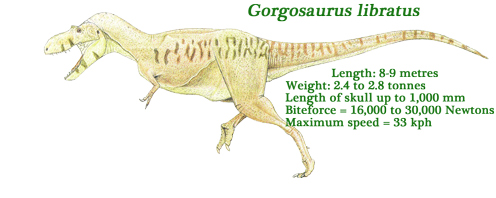
Gorgosaurus libratus – An Apex Predator of the Dinosaur Park Formation

Gorgosaurus libratus illustrated.
Did juvenile and sub-adult tyrannosaurids such as Gorgosaurus and Daspletosaurus out-compete mesocarnivores? Picture credit: Everything Dinosaur.

Picture credit: Everything Dinosaur

Lead author PhD student Katlin Schroeder (University of New Mexico), explained:
“Dinosaur communities were like shopping malls on a Saturday afternoon — jam-packed with teenagers. They made up a significant portion of the individuals in a species and would have had a very real impact on the resources available in communities.”

Compiling Physiological Data on Dinosaur Dominated Ecosystems

The researchers compiled physiological and fossil data on more than 550 different dinosaur species from 43 different dinosaur dominated ecosystems. They found that there was an absence of mesocarnivores. The scientists concluded that it was the teenage megatheropods that created and filled this gap in the community. After dividing this 100 to 1,000 kilogram gap into different weight categories, they found that juvenile megatheropods made up more than 50% of the total dinosaur biomass in every weight class. This is like a boxer destined to be the heavyweight champion dominating the bantam, lightweight and middleweight classes during their rise to the top.

Abelisaurids Also Drove out Mesocarnivores

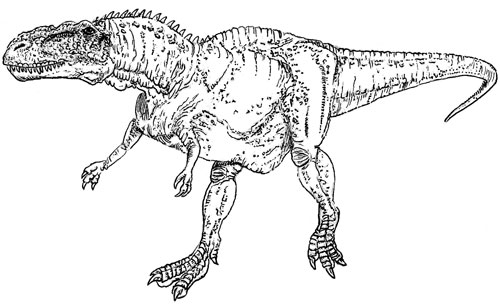
A drawing of a dinosaur (Abelisaurus).
A typical large theropod dinosaur. Like the Tyrannosauridae, abelisaurs were the megatheropods in a number of dinosaur communities that lacked mesocarnivores. Picture credit: Everything Dinosaur.

Picture credit: Everything Dinosaur

Driving Out the Medium-sized Meat-eaters

Although herbivorous dinosaurs were found in a range of different body sizes, including medium-sized ones, the team concluded that when it came to the meat-eaters, the way in which large carnivorous dinosaurs grew was an important factor that helped shape dinosaur community structure and diversity.

Co-author of the study, Kate Lyons (Assistant Professor of Biological Sciences at the University of Nebraska-Lincoln), added that the research:

“Essentially says that megatheropods were consuming 50% or more of the energy available to dinosaurs at a respective body size, leaving very little for other species to consume. If they were consuming the majority of the energy at that body size, then they were going to be outcompeting anything else that might try to feed at that size, as well.”

A Difference in Jurassic and Cretaceous Dinosaur Communities

It was noted that there was a subtle difference between dinosaur communities from the Jurassic with those from the Cretaceous. Generally, there were smaller gaps in the size range of carnivorous dinosaurs during the Jurassic when compared to the size gap seen in later communities dating from the Cretaceous.

Katlin Schroeder postulated that this difference came about because:

“Jurassic megatheropods don’t change as much, the teenagers are more like the adults, which leaves more room in the community for multiple families of megatheropods as well as some smaller carnivores. The Cretaceous, on the other hand, is completely dominated by tyrannosaurs and abelisaurs, which change a lot as they grow.”

Jurassic Ecosystems

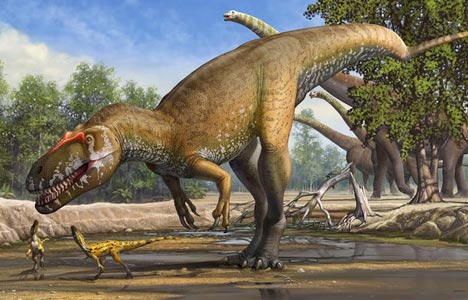
T. gurneyi.
Torvosaurus gurneyi a top predator of Portugal from the Late Jurassic but there were also mesocarnivores in this ecosystem too such as Lourinhanosaurus, Ceratosaurus and Lusovenator.

Picture credit: Sergey Krasovskiy

The scientific paper: “The influence of juvenile dinosaurs on community structure and diversity” by Katlin Schroeder, S. Kathleen Lyons and Felisa A. Smith published in Science.

Visit the Everything Dinosaur website: Everything Dinosaur.

25 02, 2021

New Coins Commemorate Mary Anning

By |2024-05-19T12:02:02+01:00February 25th, 2021|Categories: Adobe CS5, Dinosaur and Prehistoric Animal News Stories, Dinosaur Fans, Famous Figures, Main Page|0 Comments

Coin Collection Celebrates the Contribution of Mary Anning

The Royal Mint in collaboration with the London Natural History Museum has launched a commemorative coin collection honouring the celebrated palaeontology pioneer Mary Anning.  From selling seashells on the seashore to a coin collection which includes a gold proof coin valued at over £1,100.00 ($1,540.00 USD) featuring an image of an ichthyosaur, the contribution to science of the most famous former resident of Lyme Regis in Dorset is being honoured in a very special way.

Celebrating Mary Anning

One of the Commemorative Coins Features an Ichthyosaur

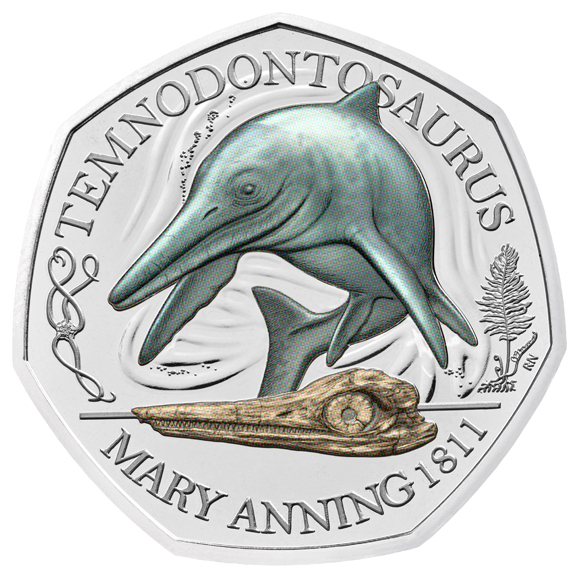
A coin features an ichthyosaur (Temnodontosaurus).

One of the coins that commemorates Mary Anning features an illustration of an ichthyosaur (Temnodontosaurus).

Picture credit: The Royal Mint

The “Tales of the Earth” Series

This is the second coin collection in The Royal Mint’s “Tales of the Earth” series, celebrating the remarkable fossil record of the British Isles. Whilst the original series featured the first dinosaurs to be named and described (Iguanodon, Megalosaurus and the armoured dinosaur Hylaeosaurus), there are no dinosaurs on these three coins, after all, dinosaur fossil remains from the “Jurassic Coast” are exceptionally rare.

The marine shales explored by the Anning family in Georgian times revealed the remains of huge sea monsters and occasionally pterosaurs, such as Dimorphodon which features on another of the coins that make up this set.

Honouring Mary Anning – The First Fossil Remains of Dimorphodon Were Found in 1828

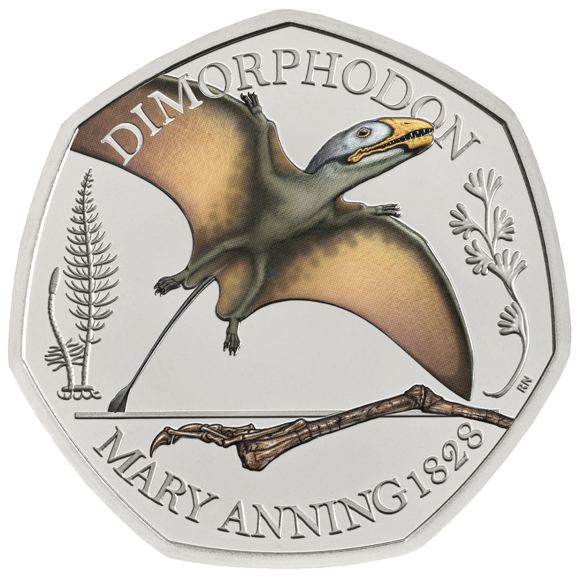
Coin honours Mary Anning.

From the Royal Mint, a coin has been issued which honours the discovery of the first pterosaur fossil in England by Mary Anning.

Picture credit: The Royal Mint

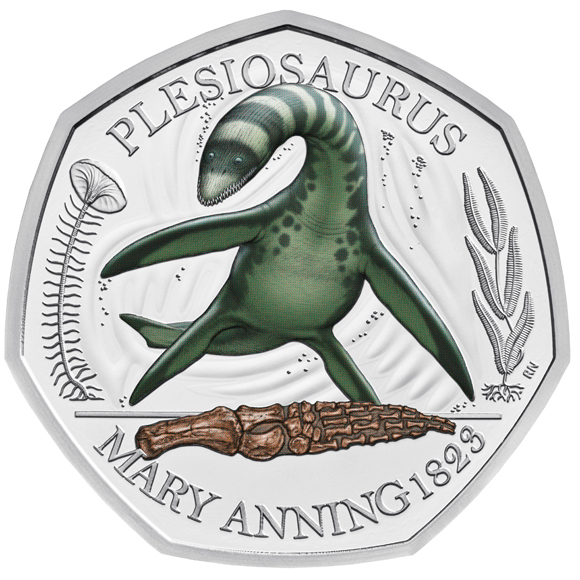
The renowned British palaeo-artist Bob Nicholls who designed the trio of dinosaurs that featured on the first set of “Tales of the Earth” commemorative coins, returns to bring back to life three prehistoric creatures that reflect the contribution to palaeontology made by Mary Anning.  The third coin features a beautiful illustration of a Plesiosaurus.

A Plesiosaurus Features on One of the Commemorative Fifty Pence Coins

Honouring Mary Anning (Plesiosaurus 1823).

Picture credit: The Royal Mint

Coins Designed by Bob Nicholls

With the assistance of Sandra Chapman of the Earth Sciences Department at the Natural History Museum, each of the coin design’s created by Bob Nicholls are a scientifically accurate reconstruction of the creatures and their ancient Early Jurassic environment.  By using the latest colour printing techniques, the intricate characteristics of each of the prehistoric marine reptiles have been captured to illustrate accurately how these creatures looked like on Earth millions of years ago, making them appear dynamic and adding a new level of visual fidelity to the coins.

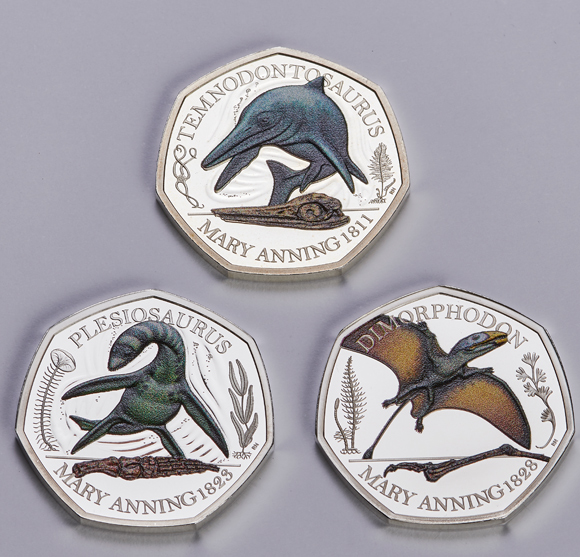
Commemorative Coins to Celebrate the Contribution of Mary Anning

Coins minted to honour Mary Anning.

A trio of coins that have been minted to honour the contribution to science of Mary Anning.

Picture credit: The Royal Mint

Commenting on the addition of this coin collection, the Divisional Director of Commemorative Coin at The Royal Mint, Clare Maclennan stated:

“It is an absolute pleasure to continue the popular Tales of the Earth commemorative 50p coin series in conjunction with the Natural History Museum.  The next collection in the series celebrates fossil hunter and pioneering palaeontologist Mary Anning, with three coin’s featuring Anning’s astonishing discoveries of Temnodontosaurus, Plesiosaurus and Dimorphodon.”

The coins each with a face value of fifty pence are available in a number of formats at various price points permitting coin collectors and dinosaur fans the opportunity to acquire them.  For the record, the gold coin valued at over £1,000 is a limited edition piece, just 250 have been produced.

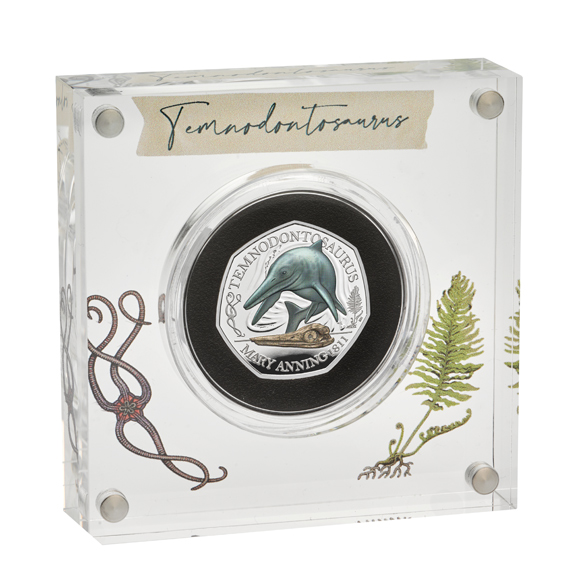
The Temnodontosaurus Coin in a Presentation Acrylic Block

Acrylic block containing one of the Mary Anning commemorative coins.

An acrylic block which features the 50p commemorative Temnodontosaurus image honouring Mary Anning.

Picture credit: The Royal Mint

For models and replicas of prehistoric animals: Prehistoric Animal Figures.

A Mysterious Coin Found at Lyme Regis

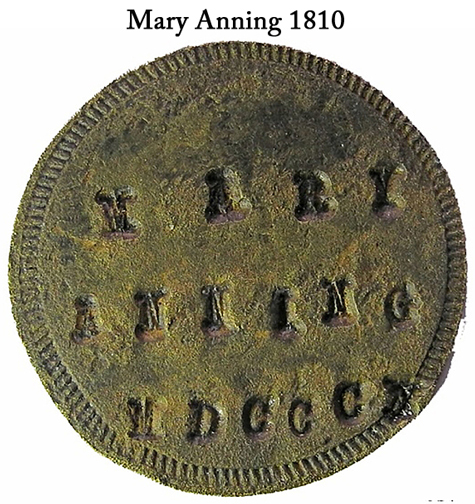
Back in 2015 Everything Dinosaur reported on the discovery of a mysterious metal token that was found by a metal detectorist at Lyme Regis.  It was speculated that this coin-like object could have been the property of Mary Anning.  We wonder what Mary would have made of the coin collection created by The Royal Mint commemorating her contribution.

Did This Metal Token Once Belong to Mary Anning?

The Mary Anning Disc

Stamped on the disc are the words “Mary Anning and the year 1810 marked in Roman numerals.

Picture credit: Lyme Regis Museum with additional annotation by Everything Dinosaur

To read more about the Mary Anning disc: Mysterious Token Linked to Mary Anning.

Visit the Everything Dinosaur website: Everything Dinosaur.

17 02, 2021

Million-Year-Old DNA Sheds Light on Mammoth Evolution

By |2024-05-19T08:13:02+01:00February 17th, 2021|Categories: Dinosaur and Prehistoric Animal News Stories, Main Page, Photos/Pictures of Fossils|0 Comments

Million-Year-Old DNA Sheds Light on Mammoth Evolution

A paper that sheds light on the evolutionary history of the mammoth has been published this week.  Scientists led by researchers from the Centre for Palaeogenetics (a joint venture between Stockholm University and the Swedish Museum of Natural History), sequenced DNA recovered from mammoth remains that are up to 1.2 million years old.  The analyses revealed that the Columbian mammoth which inhabited North America during the last ice age was a hybrid between the woolly mammoth and a previously unknown genetic lineage of mammoth.  Furthermore, the study provides new insights into when and how fast mammoths became adapted to cold climate.

Ancient Mammoth DNA Provides New Insights into How These Mammals Adapted to Cold Climates

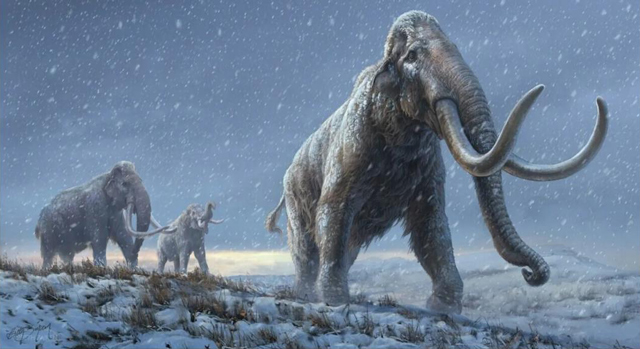
Siberian Steppe Mammoths.

Siberian Steppe mammoths provided their descendants with many adaptations that helped these descendants adapt and thrive in cold environments.

Picture credit: Beth Zaiken (Centre for Palaeogenetics)

Commenting on the importance of this study, senior author Love Dalén, a Professor of evolutionary genetics at the Centre for Palaeogenetics stated:

“This DNA is incredibly old.  The samples are a thousand times older than Viking remains and even pre-date the existence of humans and Neanderthals.”

Tracing the Evolutionary History of an Iconic Ice Age Elephant

Around one million years ago there were no Columbian or Woolly mammoths, these creatures had not evolved.  This was the time of their predecessor, the Steppe mammoth (Mammuthus trogontherii), a prehistoric elephant which was very widely dispersed across Eurasia.  Fossils have been found in the UK, perhaps most famously at West Runton on the Norfolk coast.  Steppe mammoth fossils are also known from much of Europe and as far away as China.  The research team extracted tiny amounts of DNA from mammoth teeth ranging in age from around 700,000 to 1.2 million years of age, that had been found eroding out of the Siberian permafrost.

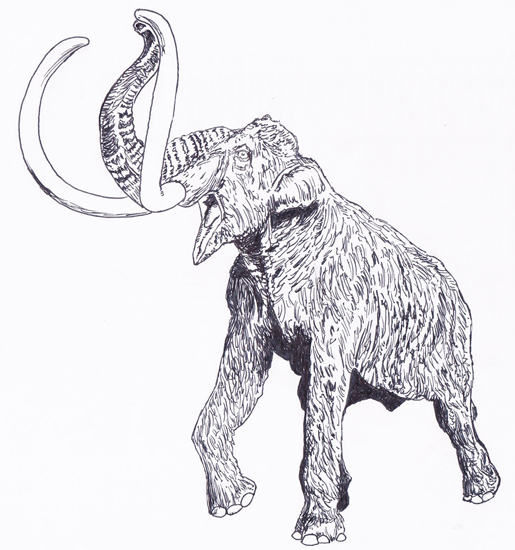
An Illustration of Mammuthus trogontherii (Steppe Mammoth)

Steppe Mammoth illustration.

An illustration of a Steppe mammoth (Mammuthus trogontherii).  Picture credit: Everything Dinosaur.

Picture credit: Everything Dinosaur

Professor Dalén added:

“This is the first time that DNA has been sequenced and authenticated from million-year-old specimens and extracting the DNA from the samples was challenging.”

Unexpected Results

Analyses of the genomes showed that the oldest specimen, which was approximately 1.2 million years old, belonged to a previously unknown genetic lineage of mammoth.  The researchers refer to this as the Krestovka mammoth, based on the Siberian locality where the fossil teeth were found.  Writing in the academic journal Nature, the scientists report that the Krestovka mammoth diverged from other Siberian mammoths more than two million years ago.

Tom van der Valk from the Centre for Palaeogenetics, the paper’s  lead author explained:

“This came as a complete surprise to us.  All previous studies have indicated that there was only one species of mammoth in Siberia at that point in time, called the Steppe mammoth.  But our DNA analyses now show that there were two different genetic lineages, which we here refer to as the Adycha mammoth and the Krestovka mammoth.  We can’t say for sure yet, but we think these may represent two different species.”

The Columbian Mammoth was a Hybrid

The research team proposes that it was mammoths that belonged to the Krestovka lineage that colonised North America some 1.5 million years ago.  Furthermore, the analyses show that the Columbian mammoth that inhabited North America during the last ice age, was a hybrid.  Roughly half of its genome came from the Krestovka lineage and the other half from the Woolly mammoth.

Co-author Patrícia Pečnerová from the Swedish Museum of Natural History commented:

“This is an important discovery.  It appears that the Columbian mammoth, one of the most iconic Ice Age species of North America, evolved through a hybridisation that took place approximately 420 thousand years ago.”

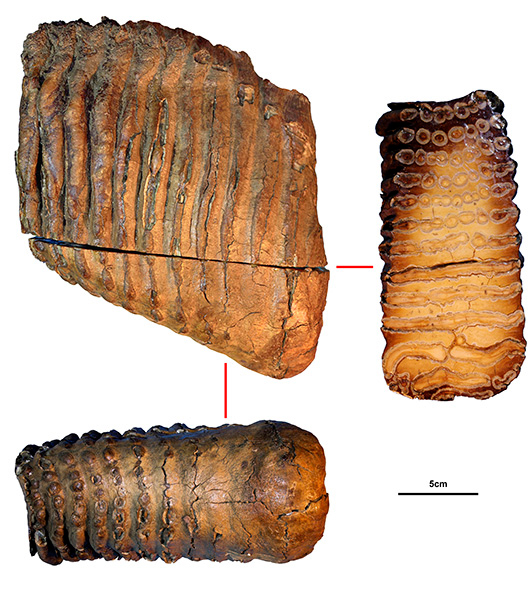
Genomic Data (DNA) Extracted from a Mammoth Tooth Approximately 1.2 Million Years Old

The Krestokva mammoth tooth.

Views of the mammoth tooth more than 1.2 million years old from which ancient DNA was extracted.  Note scale bar = 5 cm.

Picture credit: Natural History Museum of Stockholm

Plotting Mammoth Evolution

The scientists could now compare the genome from mammoths covering a span of one million years.  This made it possible to investigate how mammoths became adapted to a life in cold environments and to what extent these adaptations evolved during the speciation process.  The analyses showed that gene variants associated with life in the Arctic, such as hair growth, thermoregulation, fat deposits, cold tolerance and circadian rhythms, were already present in the million-year-old mammoth, long before the origin of the Mammuthus primigenius (Woolly mammoth).  These results suggest that most adaptations in the mammoth lineage happened slowly and gradually over time.

Recovering DNA?

It may be possible to recover even older DNA from the permafrost of Siberia.   The researchers speculate that genomic data could be recovered from fossilised teeth that dates back more than two million years, perhaps as far back into deep time as 2.6 million years.  Unfortunately, there is a limit to what can be achieved with the current technology and prior to 2.6 million years ago, there was no permafrost where ancient DNA could have been preserved.

The mammoth DNA represents the oldest genomic data known to science.  In 2013, Everything Dinosaur reported on genomic data that was recovered from the leg bone of horse found in Canada.  The horse specimen was approximately 700,000 years old.  To read more about this remarkable research: The Rocking Horse – Ancient Fossil Decodes Horse Evolution.

Everything Dinosaur acknowledges the assistance of a media release from the Centre for Palaeogenetics in the compilation of this article.

The scientific paper: “Million-year-old DNA sheds light on the genomic history of mammoths” by Tom van der Valk, Patrícia Pečnerová, David Díez-del-Molino, Anders Bergström, Jonas Oppenheimer, Stefanie Hartmann, Georgios Xenikoudakis, Jessica A. Thomas, Marianne Dehasque, Ekin Sağlıcan, Fatma Rabia Fidan, Ian Barnes, Shanlin Liu, Mehmet Somel, Peter D. Heintzman, Pavel Nikolskiy, Beth Shapiro, Pontus Skoglund, Michael Hofreiter, Adrian M. Lister, Anders Götherström and Love Dalén published in the journal Nature.

Visit the Everything Dinosaur website: Everything Dinosaur.

16 02, 2021

How Long is a Dinosaur’s Tail?

By |2024-05-19T08:11:13+01:00February 16th, 2021|Categories: Dinosaur and Prehistoric Animal News Stories, Dinosaur Fans, Main Page, Palaeontological articles, Photos/Pictures of Fossils|0 Comments

How Long is a Dinosaur’s Tail?

How long is the tail of a dinosaur?  That’s a good question, one that has quite a complicated answer, but if a definitive assessment of the morphology of caudal vertebrae (tail bones) of the Dinosauria could be carried out, then palaeontologists would be better able to piece together (literally), the tails of dinosaurs and assess their length from even fragmentary remains.

The Tail of a Huge Titanosaur (Sauropod Dinosaur)

A dinosaur tail (titanosaur).

The tail of a dinosaur (titanosaur). Picture credit: Everything Dinosaur.

Picture credit: Everything Dinosaur

For dinosaur and prehistoric animal models: Prehistoric Animal and Dinosaur Models.

A Dinosaur Tail

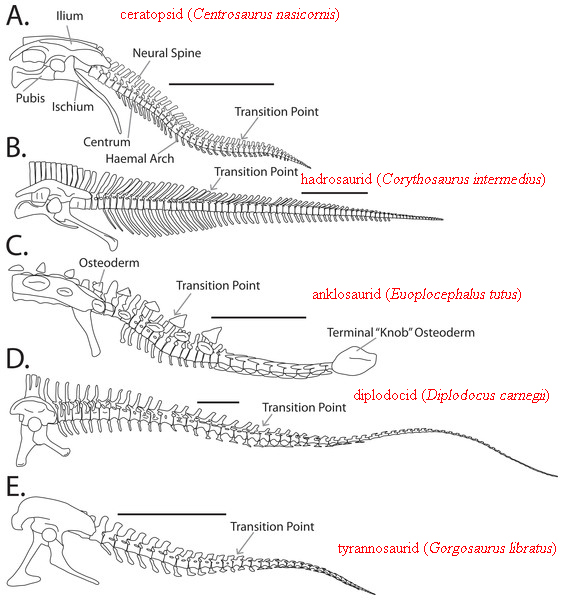
Research led by Dr David Hone (Queen Mary University of London), in collaboration with colleague Dr Steven Le Comber (who sadly passed away in 2019) and Dr Scott Persons of Mace Brown Museum of Natural History (Charleston, South Carolina, USA), permitted a comprehensive dataset of dinosaur tails to be built up.  The data indicates that there is considerable variation in the caudal vertebrae of members of the Dinosauria.  The number of tail bones varies, as does their morphology (shape).  In addition, overall length of the tail as a proportion of body size is inconsistent within the very diverse dinosaur clade.

With such variation, comparing tails of different genera or even dinosaurs from the same family will prove troublesome.

However, the scientists did identify some general patterns that could prove useful when it comes to learning about a genus with only a few tail bones to work with.

What’s in a Tail?  The Great Variation within the Tails of Dinosaurs

Different types of dinosaur tail.

Examples of different dinosaur tails.  Note scale bar = 1 metre.

Picture credit: Hone et al (PeerJ) with additional annotation by Everything Dinosaur

General Principles of Dinosaur Tails

Patterns of changes in centra lengths (the central part of each vertebra) along the tails of dinosaurs do vary.  However, the researchers did identify some general principles in terms of the bones that make up the tails.  For example, when viewing the tail bones from the base of the tail down to the tip, several different dinosaurs show a pattern of short centra, followed by a sequence of longer centra, with the remainder of the tail being made up of a long series of centra tapering in length.

The team suggest that this general pattern is consistent with the function of different parts of the tail, the longer centra quite near to the base of the tail help to provide support for the attachment of the large muscles associated with the top of the leg and this region of the tail.  This general pattern is not found in many early types of dinosaur, so the researchers conclude that this trait must have evolved independently in different kinds of dinosaurs over time.

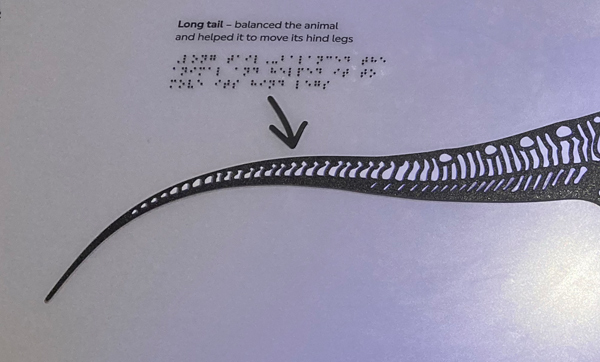
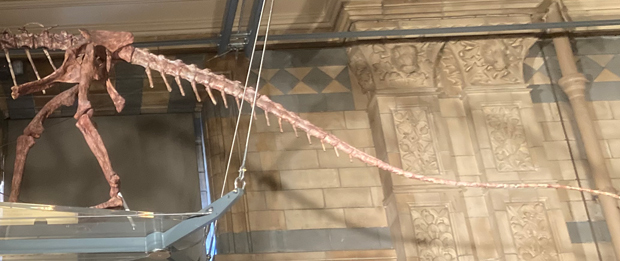
A Reconstruction of the Tail of a Massospondylus

Massospondylus dinosaur tail.

Massospondylus dinosaur tail. Picture credit: Everything Dinosaur.

Picture credit: Everything Dinosaur

Deducing Form and Function

Writing in the on-line journal “PeerJ”, the scientists state that the number of vertebrae in a given section of tail can indicate its flexibility or its stiffness.  The more vertebrae recorded over a given distance then it is likely that this section of tail was quite flexible.  Conversely, the fewer joints in any length of tail will imply reduced flexibility.

General conclusions about dinosaur tails could be made, for example:

  1. The base of many dinosaur tails was flexible and allowed virtually the whole tail to be swung as a collective whole, helping to stabilise the animal as it moved and perhaps also having a defensive function in some herbivores.
  2. Just passed the tail base there was a zone of relative stiffness that supported the muscles associated with the tail and rear legs (caudofemoralis musculature).
  3. After the termination of the caudofemoralis and for a highly variable distance, the remaining vertebrae tapered to a reduced size.

The scientific paper: “New data on tail lengths and variation along the caudal series in the non-avialan dinosaurs” by David W. E. Hone, W. Scott Persons and Steven C. Le Comber published in PeerJ.

Vist the Everything Dinosaur website: Everything Dinosaur.

14 02, 2021

Dinosaurs and St Valentine’s Day

By |2024-05-19T08:06:10+01:00February 14th, 2021|Categories: Dinosaur and Prehistoric Animal News Stories, Dinosaur Fans, Main Page, Photos|0 Comments

Dinosaurs and St Valentine’s Day

Today, February 14th is St Valentine’s Day in the UK (and elsewhere in the world too).  It is the feast day of St Valentine, a day associated with romance.  Romance and the Dinosauria might be an unusual mix, but we are reminded of an article we published nearly five years ago that reported upon some remarkable research into dinosaur trace fossils that possibly shed light on the mating behaviour of “terrible lizards”.

Dinosaurs and St Valentine’s Day

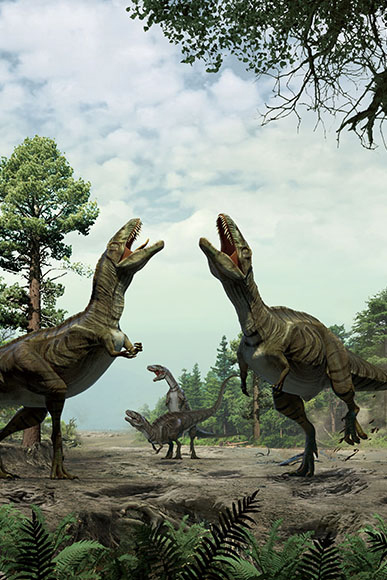
Writing in the academic journal “Scientific Reports”, a team of scientists from Poland, China, South Korea and the USA concluded that a series of trace fossils consisting of pits, scrapes and gouges associated with Upper Cretaceous strata located in western Colorado, preserve evidence of dinosaurs engaging in courtship and mating behaviours similar to modern birds.

Dinosaurs Go a Wooing

Courtship of dinosaurs.

An artist imagines the Cretaceous courtship scene.  Gouges and scrapes preserved in sandstone strata that is estimated to be around 100 million years old, preserve evidence of dinosaurs engaging in courtship and mating behaviours similar to extant birds.

Picture credit: Lida Xing and Yujiang Han / University of Colorado, Denver

Dinosaurs and Birds

The connection between dinosaurs and Aves (birds) is well established.  However, to what extent can we view the behaviour of modern-day birds and infer behaviours in their long extinct relatives?  Thanks to some research published in 2016 in the academic journal “Scientific Reports”, palaeontologists may have gained an insight into the courtship and mating behaviours of theropod dinosaurs.

To view the original Everything Dinosaur article from 2016: Dance of the Dinosaurs.

The scientific paper: “Theropod courtship: large scale physical evidence of display arenas and avian-like scrape ceremony behaviour by Cretaceous dinosaurs” by Martin G. Lockley, Richard T. McCrea, Lisa G. Buckley, Jong Deock Lim, Neffra A. Matthews, Brent H. Breithaupt, Karen J. Houck, Gerard D. Gierliński, Dawid Surmik, Kyung Soo Kim, Lida Xing, Dal Yong Kong, Ken Cart, Jason Martin and Glade Hadden published in the journal Scientific Reports.

Visit the Everything Dinosaur website: Everything Dinosaur.

Go to Top