How Far Might Plant-eating Dinosaurs Have Dispersed Seeds?
During the imposed lockdown due to COVID-19 lots of people have attempted to learn new skills, perhaps studying a musical instrument, mastering a new language or taking an on-line course as part of a planned career move.
Studying Plant-eating Dinosaurs
For Professor George Perry of the School of the Environment at the University of Auckland, time away from his students gave him the opportunity to conduct a study into the pooping habits of plant-eating dinosaurs. This is not simply a case of an educated man with too much time on his hands but a serious examination in the role played in seed dispersal by ancient megaherbivores.
How Far Might Plant-Eating Dinosaurs Have Dispersed Seeds?
A scientist has examined the role large, herbivorous dinosaurs may have had in the dispersal of seeds.
The picture (above) shows a Mojo Fun sauropod figure.
Plotting Frequency of Pooping Against Walking Speed
Herbivores play and important role in seed dispersal in modern ecosystems and it has been proposed that herbivorous dinosaurs might have been important seed dispersal agents in the Mesozoic. It is likely that a proportion of the plant seeds ingested by plant-eating dinosaurs would have passed through the gut, ending up being deposited with a helpful quantity of dung to act as fertiliser.
How far dinosaurs of different body sizes might have dispersed seeds remains uncertain.
Professor Perry modelled the likely travelling speeds of various dinosaurs along with the likely frequency of defecation (both factors that can be estimated based on an assessment of body mass).
It is known that large vertebrates are capable of transporting seeds considerable distances. For example, African elephants (Loxodonta africana africana) can deposit seeds as a far away as 36 miles (60 kilometres), from their parent plant. Using statistical analysis to assess the spread of seeds from members of the Dinosauria, Professor Perry concluded that the simulations demonstrated that dinosaurs likely moved some seeds very long distances, comparable distances to those observed in extant megaherbivores.
It is not possible to infer from the fossil record the effect on germination on seeds having passed through the gut of a dinosaur, or indeed, whether plants evolved seed dispersal strategies to take advantage of browsing and grazing dinosaurs, but this research does suggest that dinosaurs such as Triceratops and Stegosaurus may have spread seeds around 20 miles (more than 30 kilometres) away from their parent plants.
A Champion at Seed Dispersal (Triceratops)
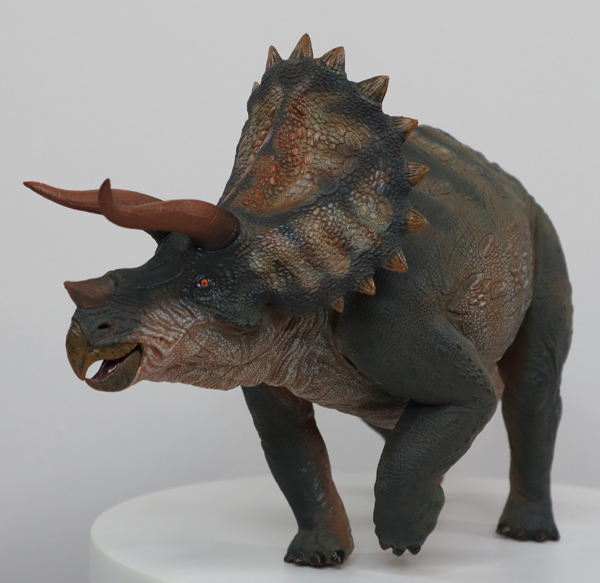
The Triceratops model (Heavy Lance – Tricolor) in anterior view. Picture credit: Everything Dinosaur.
Picture credit: Everything Dinosaur
The image (above) shows a Rebor Triceratops dinosaur model.
Analysis of the brain and inner ear of the Late Triassic basal Sauropodomorpha Thecodontosaurus (T. antiquus), reveals that it may have been bipedal, able to hold a steady gaze whilst running and possibly predatory. These are some of the conclusions drawn by researchers from the University of Bristol and the Oxford University Museum of Natural History in a new study published in the Zoological Journal of the Linnean Society.
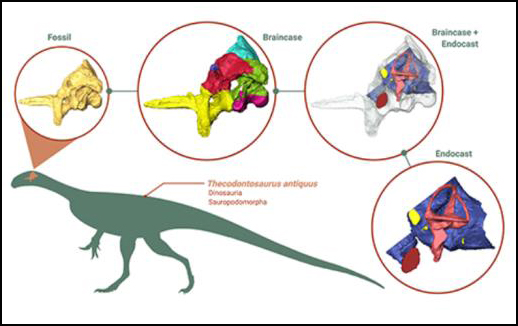
The Research Team Used CT-scans and 3-D Modelling to Construct the Brain and Inner Ear of Thecodontosaurus
Building up a picture of the brain and the inner ear based on the fossilised braincase of Thecodontosaurus antiquus.
Picture credit: Antonio Ballell et al
Thecodontosaurus antiquus
Named in 1836 (it was only the fourth dinosaur to be scientifically described), Thecodontosaurus is regarded as a basal member of the lizard-hipped Sauropodomorpha, a clade of dinosaurs that includes Brontosaurus, Brachiosaurus, Diplodocus and Argentinosaurus. Thecodontosaurus was much smaller than its illustrious Jurassic and Cretaceous descendants. It was approximately two metres long, more than half its body length was made up by its long, thin tail and it was lightly built with most palaeontologists estimating that it weighed around 20-25 kilograms, about as heavy as a border collie.
As an early member of the lineage of long-necked dinosaurs, a study of the fossilised remains of Thecodontosaurus can provide palaeontologists with a better understanding of the evolutionary history of the Sauropodomorpha.
Bristol University has Researched the “Bristol Dinosaur” For Decades
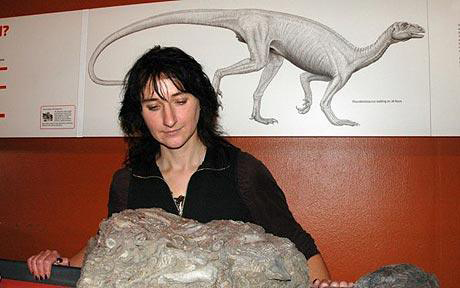
Thecodontosaurus fossil block with life reconstruction in the background. In the picture (above), from 2009, a researcher stands in front of a block of Thecodontosaurus bones with a life reconstruction of the dinosaur in the background. Note that in 2009, Thecodontosaurus was thought to be quadrupedal, this new study suggests that it may have been bipedal.
Picture credit: Simon Powell/University of Bristol
Three-dimensional Modelling Techniques
Research, led by the University of Bristol, used advanced imaging and 3-D modelling techniques to digitally rebuild the brain of Thecodontosaurus. The scientists suggest that Thecodontosaurus could have eaten meat. Although the substantial part of its diet was plant matter, its brain morphology indicates that this little dinosaur had a good sense of balance and that it was agile. Traits that may have helped it supplement its vegetarian diet with the occasional meal of captured prey.
Lead author of the study, Antonio Ballell stated:
“Our analysis of Thecodontosaurus’ brain uncovered many fascinating features, some of which were quite surprising. Whereas its later relatives moved around ponderously on all fours, our findings suggest this species may have walked on two legs and been occasionally carnivorous.”
The research team was able to deploy imaging software to extract new information from the fossils in a non-destructive manner. Numerous three-dimensional models were generated from CT scans by digitally extracting the bone from the rock, identifying and classifying anatomical details about the brain and the inner ear which were previously unknown in this taxon.
PhD student Antonio explained the basis of the research:
“Even though the actual brain is long gone, the software allows us to recreate brain and inner ear shape via the dimensions of the cavities left behind. The braincase of Thecodontosaurus is beautifully preserved so we compared it to other dinosaurs, identifying common features and some that are specific to Thecodontosaurus. Its brain cast even showed the detail of the floccular lobes, located at the back of the brain, which are important for balance. Their large size indicate it was bipedal. This structure is also associated with the control of balance and eye and neck movements, suggesting Thecodontosaurus was relatively agile and could keep a stable gaze while moving fast.”
The Diet of Thecodontosaurus
The diet of Thecodontosaurus, nicknamed the “Bristol dinosaur” as a result of its association with the city, remains uncertain, although this new study suggests that it may have been omnivorous.
Antonio added:
“Our analysis showed parts of the brain associated with keeping the head stable and eyes and gaze steady during movement were well-developed. This could also mean Thecodontosaurus could occasionally catch prey, although its tooth morphology suggests plants were the main component of its diet. It’s possible it adopted omnivorous habits.”
The researchers were also able to reconstruct the inner ears, allowing them estimate how well it could hear compared to other dinosaurs. Its hearing frequency was relatively high, potentially inferring some sort of social complexity, an ability to recognise varied squeaks and honks from different animals.
Comparing the Brain Cast of Thecodontosaurus to Other Dinosaurs
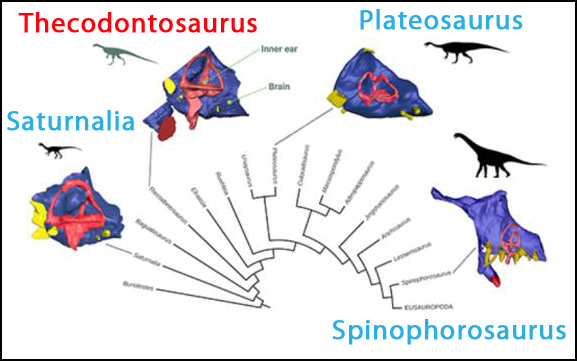
Structure, size and shape of the inner ear and brain examined in relation to the evolution of the Sauropodomorpha.
Picture credit: Antonio Ballell et al with additional notation by Everything Dinosaur
Comparing Thecodontosaurus to Other Members of the Sauropodomorpha
The application of these technologies enabled the research team to compare the brain and inner ear of Thecodontosaurus to Saturnalia tupiniquim – an earlier basal sauropodomorph which roamed the Southern Hemisphere around twenty-five million years before Thecodontosaurus evolved. Comparisons were also carried out between Plateosaurus, which is also known from the Late Triassic and the much later sauropod Spinophorosaurus (S. nigerensis) from the Middle Jurassic.
Professor Mike Benton, study co-author, said:
“It’s great to see how new technologies are allowing us to find out even more about how this little dinosaur lived more than 200 million years ago.”
The distinguished professor added:
“We began working on Thecodontosaurus in 1990, and it is the emblem of the Bristol Dinosaur Project. We’re very fortunate to have so many well-preserved fossils of such an important dinosaur here in Bristol. This has helped us understand many aspects of the biology of Thecodontosaurus, but there are still many questions about this species yet to be explored.”
Everything Dinosaur acknowledges the assistance of a media release from the University of Bristol in the compilation of this article.
The scientific paper: “The braincase, brain and palaeobiology of the basal sauropodomorph dinosaur Thecodontosaurus antiquus” by A. Ballell, J. L. King, J. M. Neenan, E. J. Rayfield and M. J. Benton published in the Zoological Journal of the Linnean Society.
Study Suggests Ziphodont Dentition Appeared First in Synapsids
If we ever get back into cinemas (the ravages of COVID-19 notwithstanding), if the latest instalment of the “Jurassic Park/Jurassic World” franchise ever gets released, then movie goers will be treated to lots of scenes of scary-looking meat-eating dinosaurs flashing their huge teeth in their cavernous mouths at their luckless human victims.
Huge theropod dinosaurs such as Acrocanthosaurus, Giganotosaurus and T. rex might be famous for their big teeth, with serrations running along the edges, after all, we have all heard and probably used the term “steak knives” to describe the shape of tyrannosaur teeth, but new research published in Biology Letters suggest that it was those tetrapods that were eventually to lead to the mammalian lineage that evolved such specialised tearing and cutting teeth first.
Theropod Dinosaurs Are Famous for Their Teeth Adapted to Cutting and Tearing Flesh
The PNSO A-shu the Qianzhousaurus dinosaur model has an articulated jaw. The tyrannosaurid Qianzhousaurus has the typical serrated and blade-like teeth of a carnivorous dinosaur (ziphodont dentition).
The picture (above) shows a replica of a PNSO theropod dinosaur (Qianzhousaurus).
Teeth that are laterally compressed, pointed and have serrated edges are known as ziphodont teeth (ziphodont dentition). The teeth of Theropoda, the only clade of predominantly predatory dinosaurs, are characterised by ziphodonty, the presence of serrations (denticles) on their cutting edges (carinae). Today, such dentition is only found in monitor lizards (varanids) but the fossil record reveals that this condition was much more pervasive in the past.
A team of researchers from Harvard University (USA), in collaboration with colleagues based at the universities of Manitoba, Alberta and Ontario (Canada), examined and compared the teeth from four types of extinct prehistoric hypercarnivore (an animal that gets at least 70% of its nutrition from the consumption of the flesh of other animals).
The teeth studied were:
Tyrannosaurid tooth from the Dinosaur Provincial Park (Alberta, Canada) – a Late Cretaceous tyrannosaur tooth which is approximately 75 million years old.
Dimetrodon grandis tooth (synapsid, pelycosaur) from the Arroyo Formation Texas, USA) which is approximately 275 million years old.
A tooth from the Permian gorgonopsid Lycaenops ornatus from the Upper Permian Madumabisa Mudstone Formation of Zambia. A synapsid (Therapsida) that lived approximately 265 million years ago.
An upper canine tooth from Smilodon fatalis a member of the Felidae (cat family). The tooth comes from the Talara “tar pits” of Peru. The youngest tooth in the research circa 13,000 years old.
The scientists identified the same denticles and interdental folds forming the cutting edges in the teeth of the Permian gorgonopsid (L. ornatus), as those seen in members of the Theropoda.
Non-mammalian Synapsid Teeth
The researchers conclude that these tooth features, specifically adaptations to assist with the processing of meat, first appeared in the non-mammalian synapsids. Comparisons of tooth serrations in gorgonopsians with those of earlier synapsids and hyper carnivorous mammals reveal that some gorgonopsians acquired a complex tissue arrangement that differed from other synapsids,
Plotting the Serrations in Non-mammalian Synapsids
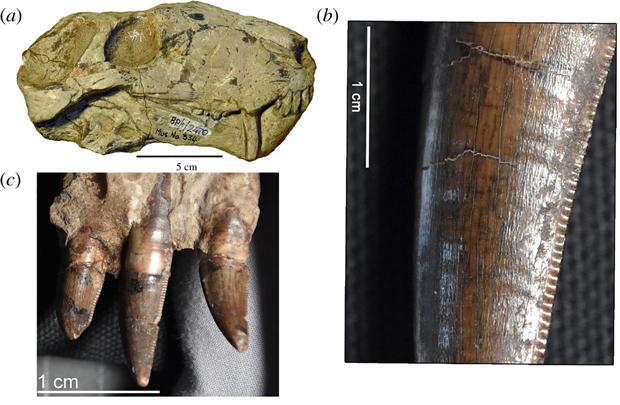
The skull of the gorgonopsid Lycaenops ornatus (a), serrations on the canine (b) and (c) serrations on the incisors in the premaxilla.
Picture credit: Whitney et al (Biology Letters)
In 2015, Everything Dinosaur published an article on research into the Theropoda that looked specifically at the interdental folds associated with their teeth.
This new study demonstrates that similar types of teeth evolved in different types of hypercarnivores that were not closely related. This is an example of convergent evolution and the ziphodont teeth of the non-mammalian synapsids represent the earliest record of this adaptation and indicate that the first iteration of this morphological feature appeared long before the Dinosauria evolved.
High Magnification Images Showing the Morphology of the Carinae (Cutting Edges)
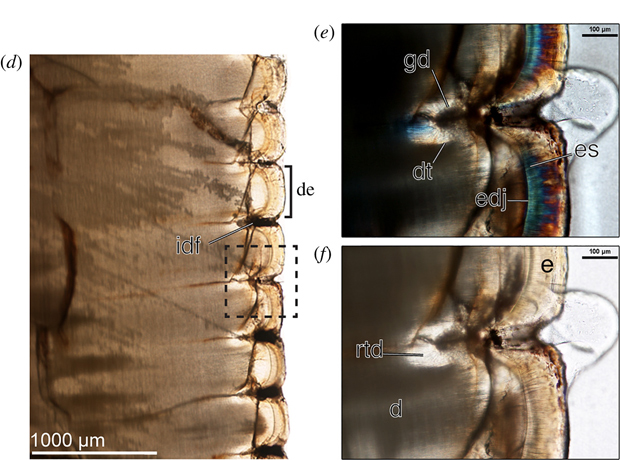
Thin section through distal serrations of NHCC LB334 displaying both interdental folds and denticles (d). Dashed box indicates location of high magnification images in both plain (e) and cross polarized light (f). Both (e) and (f) highlight features of the denticles and interdental folds including the enamel spindles that cross the enamel.
Picture credit: Whitney et al (Biology Letters)
The scientific paper: “Convergent dental adaptations in the serrations of hypercarnivorous synapsids and dinosaurs” by M. R. Whitney, A. R. H. LeBlanc, A. R. Reynolds and K. S. Brink published in Biology Letters.
Everything Dinosaur team members conclude their review of their favourite blog articles of 2020 by looking at articles and news stories that were posted up between July and December. With the best part of 180 posts to choose from selecting our favourite six for this period was quite tricky. The ones we have selected demonstrate the broad range of topics we cover on the Everything Dinosaur weblog.
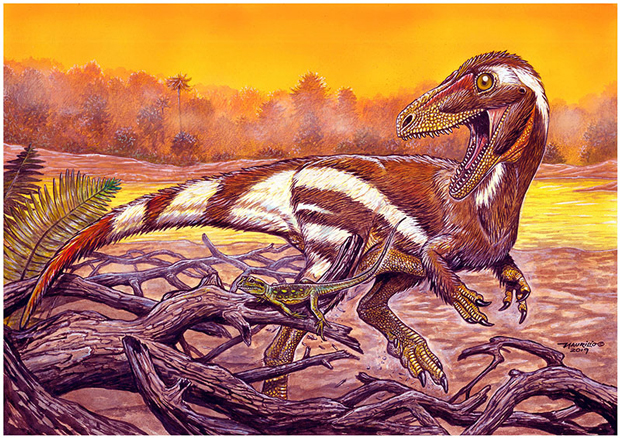
We might have been in the middle of a global pandemic but Everything Dinosaur team members kept up their blogging reporting upon tiny theropod eggs from Japan, a revision of Dilophosaurus and a number of new dinosaurs. Our favourite post of the month concerned the scientific description of Aratasaurus museunacionali, a basal member of the Coelurosauria from Brazil. The genus name translates as “lizard born of fire”, a reference to the terrible fire that ripped through the National Museum of Brazil where the fossil specimen was kept.
A Life Reconstruction of the Basal Member of the Coelurosauria Aratasaurus museunacionali
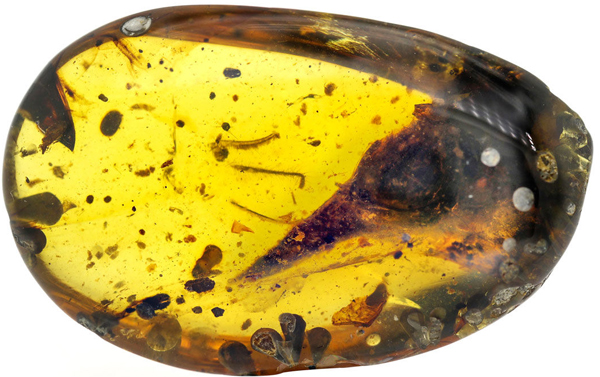
The controversy over the naming of the smallest dinosaur based on a skull preserved in amber from northern Myanmar rumbled on. In August, a paper was published that refuted claims that the tiny skull of the animal named Oculudentavis khaungraae was that of an archosaur. A month earlier (July 2020), the original scientific paper describing this remarkable fossil was retracted.
The Tiny Fossil Skull Preserved in Amber from Myanmar – But is it a Dinosaur?
Tiny fossil skull preserved in amber (Oculudentavis khaungraae).
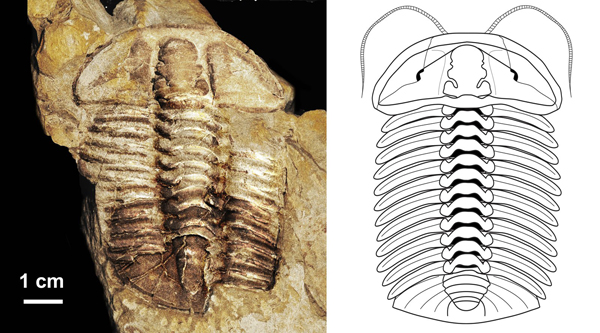
The Oxford University Museum of Natural History celebrated its 160th birthday, the Monsters of the Deep exhibition opened in the midst of the chaos caused by COVID-19 and Euparkeria got a makeover. Our favourite post of September concerned a new species of trilobite (Gravicalymene bakeri) from Tasmanian that was named after Doctor Who actor Tom Baker.
A Photograph of a Gravicalymene bakeri Trilobite Fossil with Line Drawing
Gravicalymene bakeri trilobite fossil with line drawing.
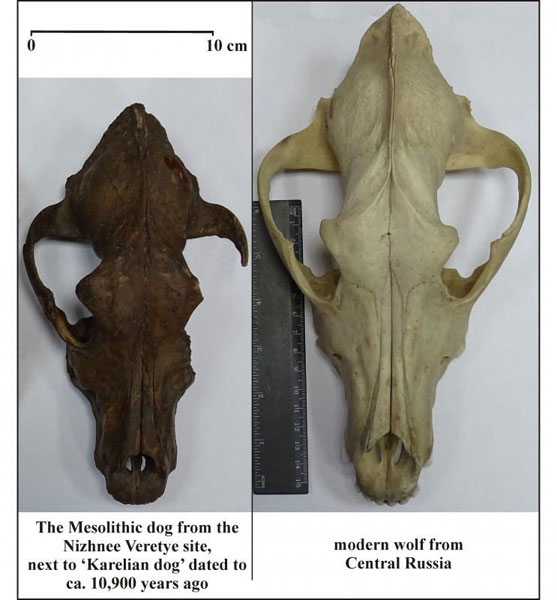
In October we reported on the mapping of the genome of the Scimitar-toothed cat Homotherium latidens, discussed a new species of mosasaur from Morocco and the diet of pterosaurs, but our favourite article concerned the research into ancient dog DNA. The study suggested that the diversity observed between dogs in different parts of the world today originated when all of mankind were hunters and gatherers.
Mapping Ancient Doggy DNA
Mesolithic dog skull (left) compared to wolf skull (right).
Picture credit: E. E. Antipina (Institute of Archaeology of the Russian Academy of Sciences)
In November, Everything Dinosaur celebrated publishing its 5,000 blog post, discussed Kholumolumo a dinosaur from an African rubbish dump, looked at seal evolution and got to grips with the earliest Paranthropus robustus skull described to date.
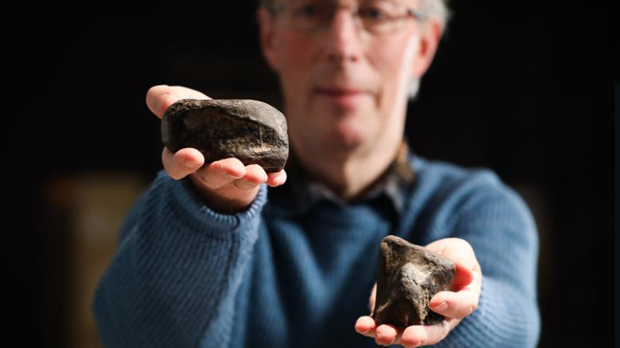
Our favourite post concerned the first dinosaur remains reported from Ireland, not just one dinosaur but two!
First Evidence of Dinosaurs from Ireland
Dr Mike Simms (National Museums Northern Ireland) holds the theropod tibia on the left and the thyreophoran femur on the right.
As the year closed, in the final month of 2020 we looked at how interactive “I-books” were helping to explain archaeology, examined a very flashy new dinosaur (U. jubatus), the first sauropod dinosaur from Switzerland (Amanzia greppini) and studied Parasaurolophus pathology.
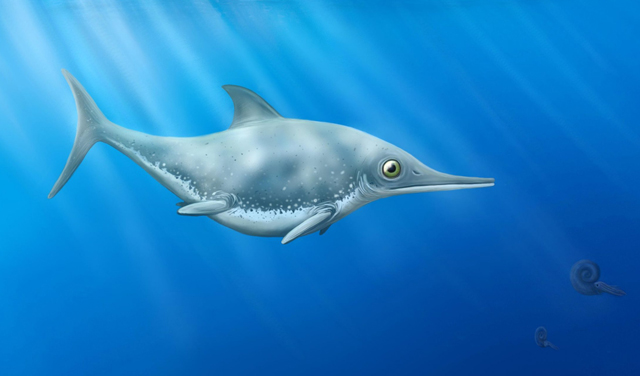
Our favourite post concerned the establishment of a new species of Late Jurassic ichthyosaur after the discovery of fossil bones by the wonderful Dr Steve Etches MBE, the founder of the amazing Etches Collection museum in Dorset.
A Life Reconstruction of the Newly Described Thalassodraco etchesi
A life reconstruction of the newly described Late Jurassic ichthyosaur Thalassodraco etchesi.
Picture credit: Megan Jacobs/University of Portsmouth
At Everything Dinosaur, we try and post up an article on this blog site every single day. This can be quite a challenge considering all our other activities and projects. However, as a result of our work on this weblog we have managed to compile a huge amount of information, articles and features chronicling (for the most part), advances in the Earth sciences and new fossil discoveries along with research into the Dinosauria.
This year, Everything Dinosaur’s blog has passed the 5,000 articles benchmark. Here is a selection of our own favourite news stories that we have covered in the first six months of 2020 (January to June).
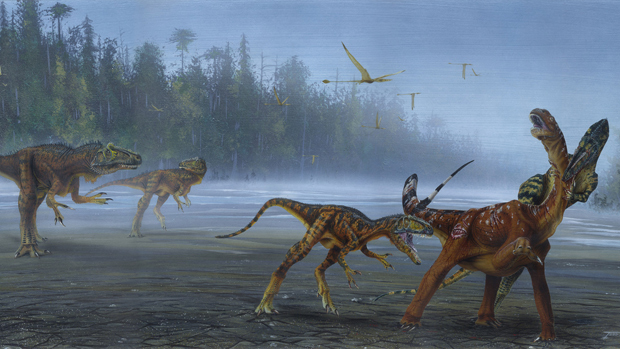
January – A New Allosaurus Taxon
In January, a new species of North American Allosaurus was added to the pantheon of dinosaurs known from the famous Morrison Formation of the western United States. Allosaurus jimmadseni honours the sadly departed James H. Madsen Jr. Utah’s inaugural state palaeontologist. The famous Allosaurus specimen MOR 693 “Big Al” was reassigned to this new species.
A Pack of Allosaurus (A. jimmadseni) Attack a Luckless Juvenile Sauropod
A pack of allosaurs (A. jimmadseni) attacking a juvenile sauropod.
February – The “Father of Argentinian Palaeontology” – José Bonaparte
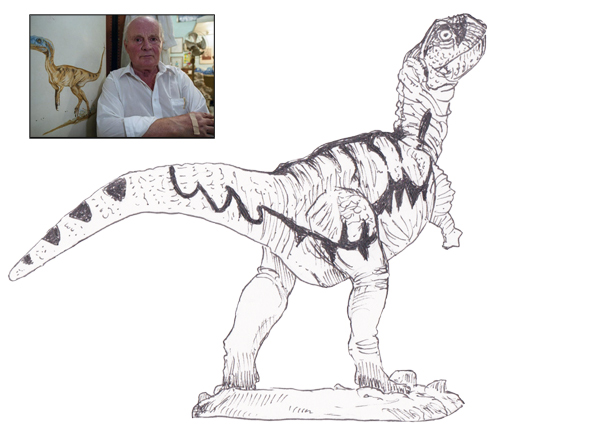
On the 18th February José Bonaparte, regarded by many as the most influential vertebrate palaeontologist of the 20th century passed away. Respected and admired, José helped to develop and train a whole new generation of Earth scientists. He was also responsible for naming and describing a large number of new dinosaurs including Abelisaurus, hence our illustration of that South American theropod (below).
José Bonaparte and a Drawing of One of the Many Dinosaurs He Named and Described (Abelisaurus comahuensis)
José Bonaparte (inset) and a drawing of one of the dinosaurs he named in his long and distinguished career Abelisaurus (A. comahuensis).
As the COVID-19 pandemic took hold, team members at Everything Dinosaur were distracted by some remarkable research undertaken by scientists from the University of Ghent and the Vrije Universiteit Brussel.
A study of the growth rings preserved on the fossilised shells of Cretaceous bivalves permitted the researchers to calculate that 70 million years ago, the day length was approximately thirty minutes shorter and a year on Earth was around a week longer than it is today.
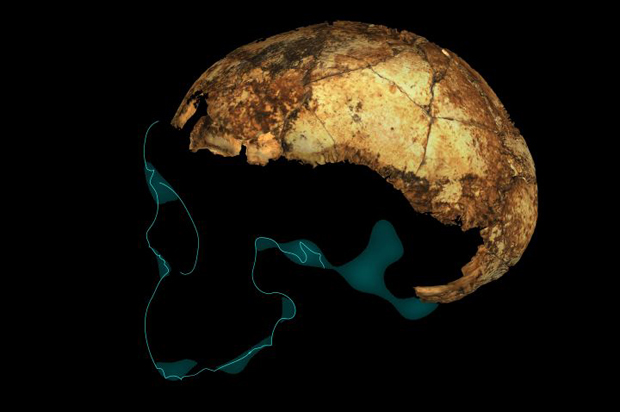
The remarkable Drimolen fossil hominin site in South Africa, provided palaeoanthropologists with likely confirmation that the hominin H. erectus did indeed evolve in Africa and not Asia. A carefully and painstakingly reconstructed fossil skull (DNH 134), found in this area – regarded as the “Cradle of Humankind”, suggests that Homo erectus existed some 100,000 to 200,000 years earlier than previously realised.
We still have a lot to learn about our own evolution.
Homo erectus Evolved in Africa
The partial H. erectus cranium from the Drimolen Fossil Hominin site.
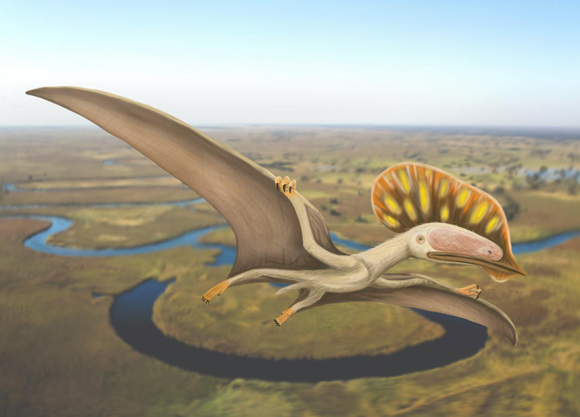
A jawbone found on the Isle of Wight was identified as a new species of tapejarid pterosaur. The flying reptile, named Wightia declivirostris which translates as “slanting beak from the Isle of Wight” was one of several new pterosaur species described in 2020.
A Life Reconstruction of the Early Cretaceous Pterosaur Wightia declivirostris
A life reconstruction of the newly described tapejarid from the Lower Cretaceous of the Isle of Wight (Wightia declivirostris).
Picture credit: Megan Jacobs (University of Portsmouth)
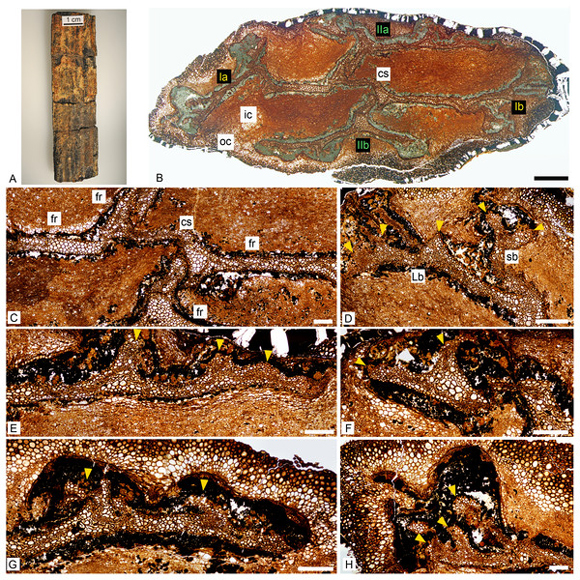
A fossil discovered more than fifty years ago and regarded as little more than a “fossilised stick” has proved to be a new species of Late Devonian plant and it will help scientists to better understand the flora of the ancient landmass of Gondwana.
The specimen was found by amateur geologist John Irving whilst exploring the banks of the Manilla River in Barraba (New South Wales, Australia). A study in the open-access journal PeerJ identifies the newly named Keraphyton mawsoniae and proposes that it has a similar structure to primitive horsetails and ferns. The fossil which looks so unremarkable on the outside, once studied in cross-section, has provided a unique window into the plant life on Earth around 360 million years ago.
Not Much to Look at on the Outside but Inside a Treasure Trove of Information for Palaeobotanists
The newly described Keraphyton mawsoniae a fern-like land plant from the Late Devonian of Australia.
A new genus of feathered dinosaur Ubirajara jubatus has been described.
News about the discovery of a species of feathered dinosaur has now become relatively commonplace. Yet, it is worth remembering that it was just twenty-four years ago, back in 1996, that the first, non-avian dinosaur species with evidence of fuzzy feathers was described. Named Sinosauropteryx this lithe meat-eater literally “rocked” scientists as the long-awaited proof of feathered dinosaurs was revealed to the world. Sinosauropteryx was a compsognathid, a team of researchers, including scientists from the University of Portsmouth have described another feathered dinosaur, this new feathered theropod is a compsognathid too, but with a more elaborate and spectacular integumentary covering.
Ubirajara jubatus
The newly described Ubirajara jubatus is the first Gondwanan non-avian theropod with preserved filamentous integumentary structures. It is also the first non-maniraptoran possessing elaborate integumentary structures that were most likely used for display.
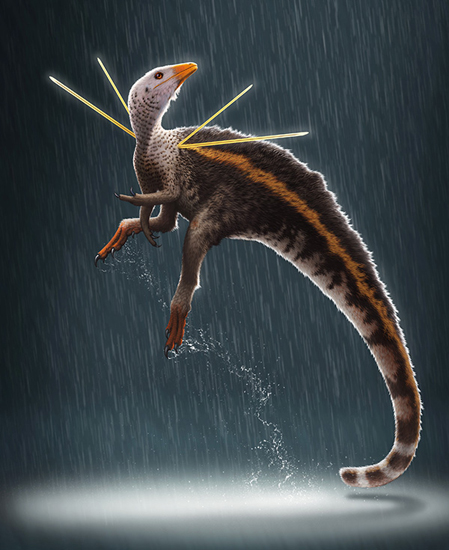
A Life Reconstruction of the Newly Described Brazilian Compsognathid Ubirajara jubatus
Ubirajara jubatus life reconstruction by the very talented palaeoartist Bob Nicholls.
Picture credit: Bob Nicholls/Paleocreations
Dressed to Impress
Described as the most elaborately dressed-to-impress dinosaur described to date, the research team co-led by Professor David Martill and researcher Robert Smyth (University of Portsmouth), propose that U. jubatus will shed new light on how birds evolved elaborate display structures.
This chicken-sized dinosaur possessed a mane of long bristles running down its back and stiff ribbons projecting out and back from its shoulders, a combination of features never seen before in the fossil record.
The scientific paper has been published in the journal of Cretaceous research and involved a collaboration between the University of Portsmouth and the appropriately named Professor Dino Frey at the State Museum of Natural History, Karlsruhe, Germany, who discovered the new species while examining fossils in Karlsruhe´s collection and Héctor E. Rivera-Sylva of the Departamento de Paleontología, Museo del Desierto in Saltillo, Mexico. The fossil was authorised by the Brazilian authorities for export some time ago, but was only recently studied.
Bizarre Integumentary Structures
The bizarre integumentary structures must have had a purpose, whilst the body covering may have originally evolved to provide insulation, the stiff ribbons on either side of the shoulders were probably used for display, perhaps to attract a mate, deter a rival or to frighten a potential predator.
Professor Martill commented:
“We cannot prove that the specimen is a male, but given the disparity between male and female birds, it appears likely the specimen was a male, and young, too, which is surprising given most complex display abilities are reserved for mature adult males. Given its flamboyance, we can imagine that the dinosaur may have indulged in elaborate dancing to show off its display structures.”
Not Scales or Fur
The ribbons are not fur or scales, they are not feathers in the modern sense, as seen on an extant bird. They appear to be structures unique to this animal.
Mr Smyth added:
“These are such extravagant features for such a small animal and not at all what we would predict if we only had the skeleton preserved. Why adorn yourself in a way that makes you more obvious to both your prey and to potential predators? The truth is that for many animals, evolutionary success is about more than just surviving, you also have to look good if you want to pass your genes on to the next generation.”
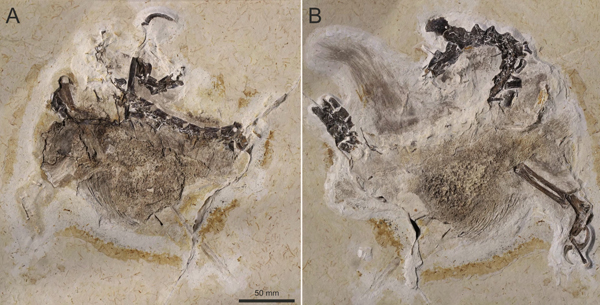
The Holotype of Ubirajara jubatus Preserved as a Slab and Counter Slab
The holotype of Ubirajara jubatus preserved as slab and counter slab. Note scale bar = 50 mm.
Picture credit: Smyth et al /Cretaceous Research
From the Lower Cretaceous (Aptian) Crato Formation of North-eastern Brazil
Fossil discoveries starting with the ground-breaking Sinosauropteryx specimen that was described in 1996 have fundamentally changed our understanding of the phylogenetic relationships between birds and dinosaurs as well as the origin and evolution of feathers. A variety of elaborate integumentary coverings and structures are now known from the Theropoda and from ornithischian dinosaurs too. They have been linked to behaviours including egg incubation, mating displays and thermoregulation.
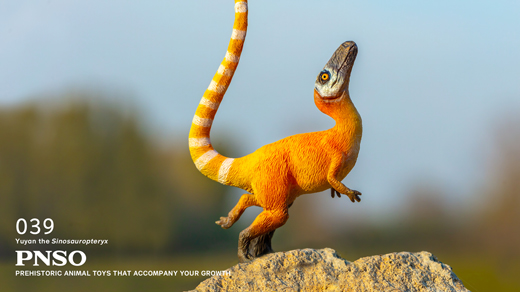
The Colourful PNSO Model of the Chinese Compsognathid Sinosauropteryx
PNSO Yuyan the Sinosauropteryx dinosaur model. The PNSO model of the compsognathid Sinosauropteryx.
The picture (above) shows a PNSO Sinosauropteryx dinosaur model.
Within the Theropoda, such features have only been previously recorded within the Maniraptoriformes, a theropod clade which includes birds and is defined as “the most recent common ancestor of the ostrich mimic Ornithomimus and Aves (birds) and all descendants of that common ancestor.”
The majority of theropods preserving integumental structures come from the Upper Jurassic and Lower Cretaceous of China or the Upper Jurassic of southern Germany and all are of Laurasian origin. Ubirajara jubatus from the Lower Cretaceous (Aptian) Crato Formation of north-eastern Brazil, is the first non-maniraptoran possessing elaborate integumentary structures that were most likely used for display.
Ubirajara jubatus the First Non-avian Theropod with Preserved Filamentous Structures
It is also the first non-avian theropod with preserved filamentous integumentary structures to have been described from the southern hemisphere landmass of Gondwana.
The researchers compare Ubirajara to living birds stating that many modern Aves are famed for their exotic and colourful plumage along with their complex displays that are used to win mates. Male peacocks with their stunning tails and male birds of paradise are examples of this.
Ubirajara jubatus (pronounce You-bi-rah-jar-rah jew-bay-tus), lived approximately 110 million years ago (Aptian faunal stage of the Early Cretaceous). The genus name is derived from the local Tupi dialect and translates as “lord of the spear”, whilst the trivial or specific name is from the Latin for “mane” a reference to the integumentary covering on its back.
Able to Raise its Hackles Like a Dog?
The mane running down its back is thought to have been controlled by muscles allowing it to be raised, in a similar way a dog raises its hackles or a porcupine raises its spines when facing a threat. Once the danger had passed, Ubirajara could lower its mane close to the skin allowing this little dinosaur to move quickly through the undergrowth without getting tangled up.
Professor Martill explained:
“Any creature with movable hair or feathers as a body coverage has a great advantage in streamlining the body contour for faster hunts or escapes but also to capture or release heat.”
The unique body plan of Ubirajara with its long, flat, stiff shoulder ribbons of keratin, each with a small sharp ridge running along the middle, described by the authors as “enigmatic” might have looked cumbersome, but in reality they were located on the body in such a way as not to impede movement allowing Ubirajara to preen, hunt, move around and display unencumbered.
The scientific paper: The scientific paper: “A maned theropod dinosaur from Gondwana with elaborate integumentary structures” by Robert S. H. Smyth, David M. Martill, Eberhard Frey, Héctor E. Rivera-Sylva and Norbert Lenz published in Cretaceous Research. This paper was withdrawn in July 2022.
Revising the Mamenchisauridae – Analong chuanjieensis
2020 has proved to be an important year for that enigmatic family of sauropods the Mamenchisauridae, which are predominantly associated with the Early Jurassic of China, although, as with most things relating to vertebrate palaeontology, there are exceptions to the consensus. For example, the Late Jurassic Tanzanian genus Wamweracaudia is regarded by many scientists as a mamenchisaurid, based on the shape and structure of its tail bones (caudal vertebrae).
Revising the Mamenchisauridae
That’s the point with the mamenchisaurids. They are one of the most extensively researched of all the Sauropodomorpha, thanks almost entirely to the numerous fossil bones found near Zigong in the Chinese Province of Sichuan. However, even the most well-researched group of dinosaurs are subject to revision.
This is the case with a specimen of Chuanjiesaurus (C. anaensis) which is pronounced Chu-an-je-sore-us, a twenty-five metre long giant known from the Middle Jurassic Chuanjie Formation of Yunnan Province located in south-western China.
Chuanjiesaurus was named and described in 2000, from fossils found near to the town of Chuanjie in Lufeng County (Yunnan Province). Intriguingly, a recent assessment of the disarticulated sauropod fossil remains found just a few metres away in the same quarry have demonstrated that these fossils are not the remains of a second Chuanjiesaurus as previously thought.
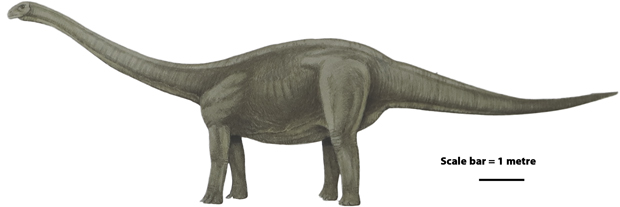
A Life Reconstruction of the Newly Described Mamenchisaurid Analong chuanjieensis
A life reconstruction of the recently erected mamenchisaurid taxon Analong chuanjieensis. Fossils of this dinosaur, once regarded as a specimen of the related Chuanjiesaurus come from the Chuanjie Formation (Bajocian faunal stage of the Middle Jurassic). Analong roamed China around 170-168 million years ago.Picture credit: Everything Dinosaur.
Picture credit: Everything Dinosaur
A New Scientific Paper
In a scientific paper published in the International Journal of Paleobiology, Ren at al erected a new mamenchisaurid taxon based on a revision of specimen number LFGT LCD 9701-1. Analong chuanjieensis is based on several autapomorphies (unique characteristics). This reassessment has important implications for the Mamenchisauridae as a whole. Analysis of the bones of the newly described Analong with other related mamenchisaurids indicate that Analong chuanjieensis is the earliest branching of the Mamenchisauridae family, whereas the contemporary Chuanjiesaurus represents a later branching of these types of dinosaurs.
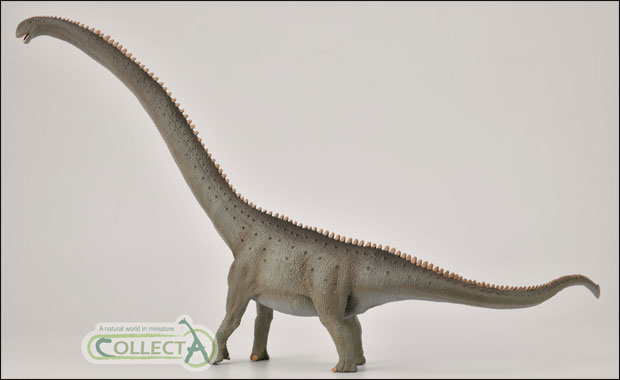
In Recognition of the Increasing Public Awareness of the Mamenchisauridae CollectA are Introducing a Scale Replica of Mamenchisaurus in 2021
CollectA Deluxe Mamenchisaurus a 1:100 scale replica of an Asian sauropod.
Thus, the establishment of a the new Analong taxon not only increases the number of long-necked dinosaurs known from the Middle Jurassic of China but also suggests that the ecosystem which was dominated by these herbivores was more complex and nuanced. Furthermore, this reassessment of the fossil material suggests that the evolution of the Mamenchisauridae is more convoluted than previously realised.
The scientific paper: “A revision of the referred specimen of Chuanjiesaurus anaensis Fang et al., 2000: a new early branching mamenchisaurid sauropod from the Middle Jurassic of China” by Xin-Xin Ren, Toru Sekiya, Tao Wang, Zhi-Wen Yang and Hai-Lu You published by An International Journal of Paleobiology (Historical Biology).
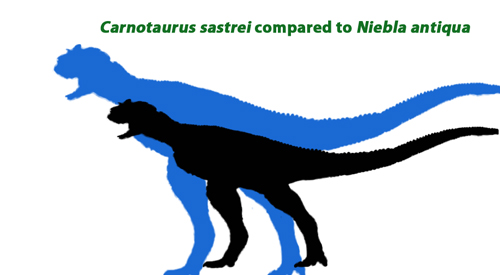
A new species of Late Cretaceous abelisaurid theropod has been named based on fragmentary fossils found in northern Patagonia (Argentina). The dinosaur has been named Niebla antiqua and it represents one of the most derived of all the abelisaurids described to date. With an estimated body length of around 4 to 4.5 metres, Niebla is smaller than the roughly contemporaneous abelisaurid Quilmesaurus (Q. curriei), known from the same formation and considerably smaller than Carnotaurus sastrei.
Niebla antiqua
Described recently in a scientific paper published in the Journal of South American Earth Sciences, the description being based on ribs, weathered vertebrae, a near complete braincase, lower jaw fragments (dentary) and teeth plus a relatively intact scapulocoracoid (pectoral girdle), Niebla helps to strengthen the fossil record of abelisaurids known from the Maastrichtian.
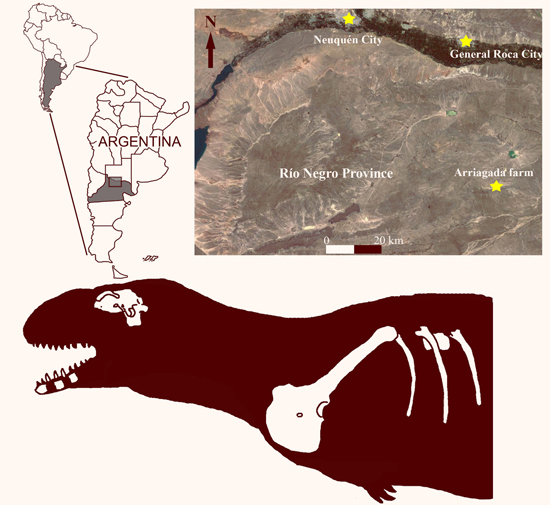
The Location of the Niebla antiqua Fossil Discovery in Río Negro Province (Patagonia) and a Skeletal Drawing
The location of the Niebla antiqua fossils in northern Patagonia and a skeletal drawing showing the known fossil material.
Picture credit: Rolando et al (Journal of South American Earth Sciences)
The fossil material was found during excavation of exposed Allen Formation strata located near Matadero Hill in the province of Río Negro by CONICET researchers. Their study suggests that abelisaurid evolution may be more complex than previously thought.
A Size Comparison Between Niebla antiqua and Carnotaurus sastrei
A size comparison between the newly described abelisaurid Niebla antiqua from the Allen Formation of northern Patagonia and Carnotaurus sastrei. Picture credit: Everything Dinosaur.
Picture credit: Everything Dinosaur
Adding to the Diversity of South American Members of the Abelisauridae
Abelisauridae dinosaurs are very well known from South America. However, the fossil record of the very youngest members of this theropod family (abelisaurids associated with the Maastrichtian faunal stage of the Late Cretaceous), is relatively poor. The researchers describe a new species (Niebla antiqua), although the fossils are highly fragmentary, they conclude that the material represents an adult animal and therefore this dinosaur was a medium-sized abelisaurid, much smaller than other coeval abelisaurids such as Carnotaurus and Abelisaurus.
The genus name is from the Spanish for “mist” a reference to the foggy conditions that the field team encountered when conducting the excavation, whilst the trivial or specific name refers to the great age of the strata.
A Medium-sized Abelisaurid
The braincase shows autapomorphic features (unique characteristics), such as a dorsoventrally tall basal tuber and postemporal foramen enclosed by parietal and exoccipitals. The scapulocoracoid is notably similar to that of Carnotaurus (C. sastrei), the research team note a number of features including having a posterodorsally oriented glenoid, a dorsoventrally expanded and wide coraco-scapular plate and the blade of the scapula is very narrow and straight. These anatomical traits are very different from those of other abelisaurids. This might indicate a unique conformation of the pectoral girdle among these South American members of the Theropoda.
The scientific paper: “A new medium-sized abelisaurid (Theropoda, Dinosauria) from the late cretaceous (Maastrichtian) Allen Formation of Northern Patagonia, Argentina” by Mauro Aranciaga Rolando, Mauricio A. Cerroni, Jordi A. Garcia Marsà, Federico l. Agnolín, Matías J. Motta, Sebastián Rozadilla, Federico Brisson Eglí and Fernando E. Novas published in the Journal of South American Earth Sciences.
Thalassodraco etchesi – A New Species of Ichthyosaur is Described
A new kind of ichthyosaur has been named and described (Thalassodraco etchesi) following the discovery of a partial, articulated skeleton preserved in a limestone concretion on the Dorset coast (southern England). The fossil material consisting of the anterior portion of the marine reptile was discovered by renowned amateur fossil hunter Dr Steve Etches MBE, the founder of the Etches Collection museum, located on Kimmeridge Bay, not too far from where this new species was discovered.
This new species has been named Thalassodraco etchesi, the name translates as “Etches Sea Dragon”.
A Life Reconstruction of Thalassodraco etchesi
A life reconstruction of the newly described Late Jurassic ichthyosaur Thalassodraco etchesi.
Picture credit: Megan Jacobs/University of Portsmouth
Unusual Dentition
Noticing the numerous, small teeth in the jaws, there are more than seventy teeth in the upper jaws alone, Steve passed his find onto researchers at the University of Portsmouth. The scientific paper on the fifth known ichthyosaur from the Late Jurassic has been published in the on-line, open-access journal PLOS One.
Corresponding author of the paper, University of Portsmouth Masters student, Megan Jacobs, comments that at an estimated two metres in length, it is the smallest ichthyosaur from the Late Jurassic to be described to date.
The location of the fossil discovery – Kimmeridge Bay is part of the Jurassic Coast World Heritage Site. The material comes from a limestone layer known as the White Stone Band. When it died, the seafloor would have been a very soft ooze, allowing the front half of the animal to sink into the mud, before scavengers came along and ate the tail end.
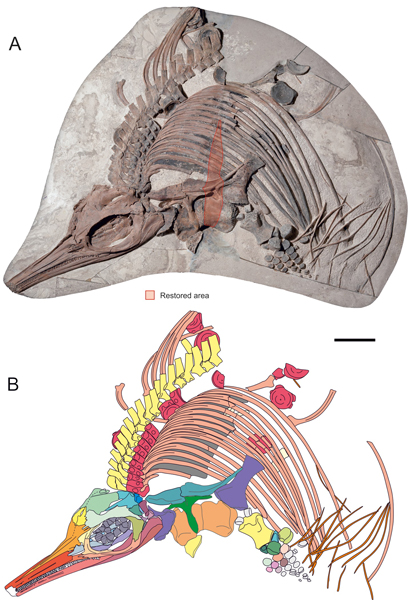
The Beautifully Prepared Fossilised Remains of T. etchesi with an Interpretative Line Drawing
A, photograph showing area restored during preparation. B, interpretative drawing of anterior portion of the skeleton. Scale bar represents 300 mm.
Picture credit: Jacobs and Martill (with permission to use the photograph from the Etches Collection)
As the anterior portion of the carcass was partially buried it was protected from being scavenged and the fine particles of mud which encased it provided conditions for exceptional preservation. Stomach contents along with ligaments and some other soft tissues have been preserved.
Commenting on the specimen, Megan stated:
“Skeletons of Late Jurassic ichthyosaurs in the UK are extremely rare, so, after doing some research, comparing it with those known from other Late Jurassic deposits around the world, and not being able to find a match was very exciting. Thalassodraco etchesi is a beautifully preserved ichthyosaur, with soft tissue preservation making it all the more interesting. Steve’s incredible collection contains many new and exciting animals, and being given the chance to describe this ichthyosaur was a real privilege.”
A Deep Body but Small Forelimbs
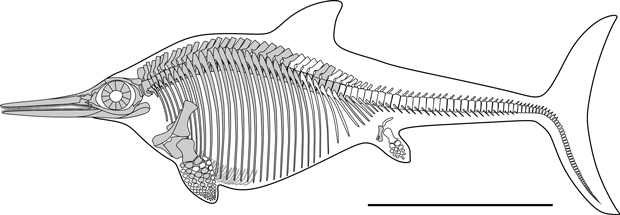
The researchers noted the unusual body shape of the small ichthyosaur, it had a deep ribcage, small forelimbs and jaws lined with dozens of tiny, conical teeth. It may have filled a slightly different niche in the Late Jurassic marine ecosystem compared to other ichthyosaurs.
Co-author of the paper, Professor David Martill, who leads the vertebrate palaeontology research unit at the University of Portsmouth commented:
“Steve is an exceptional fossil collector and although he is sometimes referred to as an amateur collector, he has done so much for palaeontology that he has been awarded an MBE, and is truly a pro. If it were not for collectors like Steve, scientists would have very few specimens to work on.”
A Skeletal Reconstruction of Thalassodraco etchesi
A skeletal drawing of Thalassodraco etchesi (known bones in grey). Scale bar = 1 metre.
Picture credit: Jacobs and Martill (PLOS One)
With the publication of the scientific paper formally naming this new species of marine reptile, the research does not end. The team hope to study the specimen, which is part of the Etches Museum collection, learning more about the reptile’s biology.
Professor Martill explained:
“There are a number of things that make this animal special, not least of which is its unusual rib cage and small flippers. It may have swum with a distinctive style from other ichthyosaurs.”
Our congratulations to Dr Steve Etches and all the team at the amazing Etches Collection museum on the Dorset coast.
The scientific paper: “A new ophthalmosaurid ichthyosaur from the Upper Jurassic (Early Tithonian) Kimmeridge Clay of Dorset, UK, with implications for Late Jurassic ichthyosaur diversity” by Megan L. Jacobs and David M. Martill published in PLOS One.
The last type of sauropod to have lived were the Titanosauria, a clade consisting of a variety of taxa that were geographically widespread. Fossils of titanosaurs have been found on every continent. These long-necked herbivores seem to have been particularly successful in South America, with some of the largest tetrapods of all time – Argentinosaurus, Patagotitan and Dreadnoughtus known from this continent.
A team of scientists based in Argentina recently published a paper describing two new South American titanosaurs from the province of La Rioja located in the north-west of that country. The dinosaurs named Punatitan coughlini and Bravasaurus arrierosorum, help to fill a gap between the types of titanosaurs associated with Patagonia and south-western Brazil, the two main locations associated with Titanosauria fossil discoveries from South America.
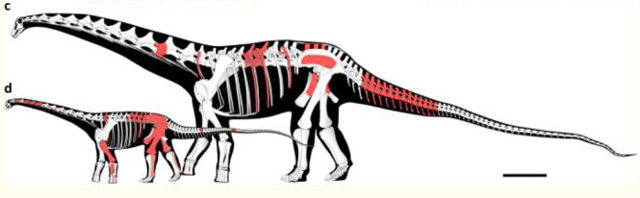
Skeletal Drawings Punatitan coughlini (c) and (d) Bravasaurus arrierosorum
Punatitan coughlini (c) and (d) Bravasaurus arrierosorum. Known fossil material shown in red. Scale bar = 1 metre.
Picture credit: Hechenleitner et al (Communications Biology)
Dinosaurs from the Andes – Titanosaurs Demonstrate Philopatry
The fossil material representing three individuals was found in the Upper Cretaceous red beds of the Quebrada de Santo Domingo locality in the Andes of La Rioja province. In addition, a large number of titanosaurian egg clutches and eggshells were recovered. Such was the abundance of eggshell found that this location is regarded as one the largest dinosaur nesting sites known in the world. These fossils help to support the theory that these types of dinosaurs returned to the same, favoured nesting area year after year, the titanosaurs demonstrated philopatry (the tendency of an organism to habitually return to the same location, usually to breed or to nest).
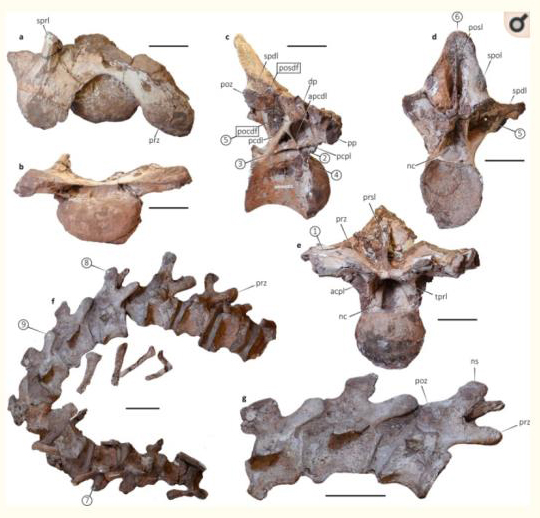
Cervical and dorsal vertebrae of Punatitan coughlini
Cervical and dorsal vertebrae of Punatitan coughlini.
Picture credit: Hechenleitner et al (Communications Biology)
Limb Bones Associated with Bravasaurus arrierosorum
Limb elements of Bravasaurus arrierosorum.
Picture credit: Hechenleitner et al (Communications Biology)
Titanosauria Phylogenetic Analysis
A phylogenetic analysis undertaken by the research team suggests that both Bravasaurus and the much larger Punatitan have affinities with both Patagonian and Brazilian titanosaurs. The discovery of these two genera, both classified within the sub-clade of the Rinconsauria, supports the hypothesis of a close relationship between titanosaurian faunas in South America during the Late Cretaceous.
Titanosaur Palaeogeographical Distribution and Phylogeny
Titanosaur palaeogeographical distribution and phylogeny plotted against temporal distribution. Both Punatitan and Bravasaurus have been assigned to the sub-clade Rinconsauria and they show a link between southern and northern populations of South American titanosaurs.
Picture credit: Hechenleitner et al (Communications Biology)
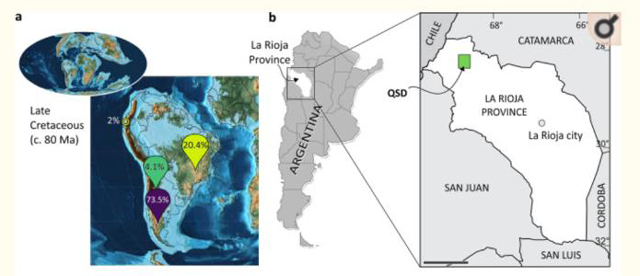
The Site of the Fossil Discoveries and Plotting the Location of Titanosaurs in South America
Percentage diversity of Cretaceous titanosaurian sauropods in three main regions of South America: Patagonia (purple), north-western Argentina (green), and south-west Brazil (yellow). The yellow ring corresponds to the record of the saltasaurid titanosaurian Yamanasaurus in Ecuador. Location of the discoveries in La Rioja Province are shown in (b) and (c).
Picture credit: Hechenleitner et al (Communications Biology)
The scientific paper: “Two Late Cretaceous sauropods reveal titanosaurian dispersal across South America” by E. Martín Hechenleitner, Léa Leuzinger, Agustín G. Martinelli, Sebastián Rocher, Lucas E. Fiorelli, Jeremías R. A. Taborda, and Leonardo Salgado published in Communications Biology.