A New Tyrannosauroid from Northern China – Jinbeisaurus wangi
Over the last two years or so, there have been a number of exciting dinosaur discoveries. Some amazing dinosaur fossils have been found and scientifically described, but sometimes mere scraps of bone, just fragmentary remains can be enough to set the pulses of vertebrate palaeontologists racing. Take for example, the new genus of Late Cretaceous tyrannosaur from northern China that was formally described back in April. At around 5-6 metres in length Jinbeisaurus wangi, may not be the largest carnivorous dinosaur known from Upper Cretaceous deposits from Asia, but it does represent the first theropod to be described from the Chinese province of Shanxi.
Jinbeisaurus wangi
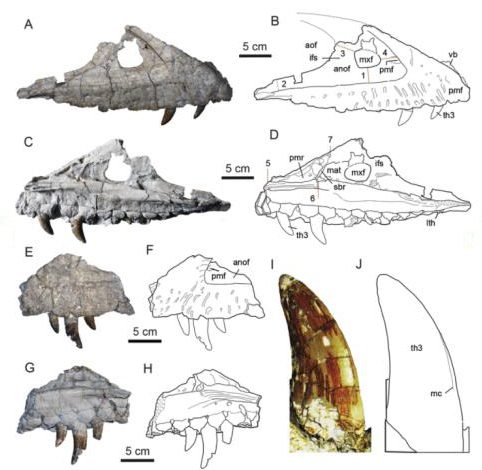
An initial assessment led to the jaw bones, partial pubis (bone from the hip) and incomplete dorsal and cervical vertebrae, being assigned to the Tarbosaurus genus, but unique characteristics associated with the shape and proportion of the maxilla led to erection of a new species.
The Genus Has Been Erected Based on Autapomorphies Identified in the Jaws
Views of J. wangi maxillae and accompanying line drawings. The photograph (above) shows photographs of the upper jaw bones (maxillae), plus a close-up view of a single tooth.
Picture credit: Xiao-Chun Wu et al (Cretaceous Research)
Not a Juvenile Tarbosaurus
The scientific paper describing Jinbeisaurus (pronounced jin-bay-sore-us), was published in late 2019 in the journal “Cretaceous Research”, although it had originally been submitted in the spring, only to be revised before final publication. When the fossil material was found near the city of Yangjiayao, Tianzhen County, Shanxi Province, in northern China, it was suggested that the bones could represent a juvenile Tarbosaurus. This new dinosaur, J. wangi adds to the known diversity of tyrannosauroids in Asia and represents the first theropod to have been discovered in Shanxi Province, although isolated teeth representing carnivorous dinosaurs are known from the area.
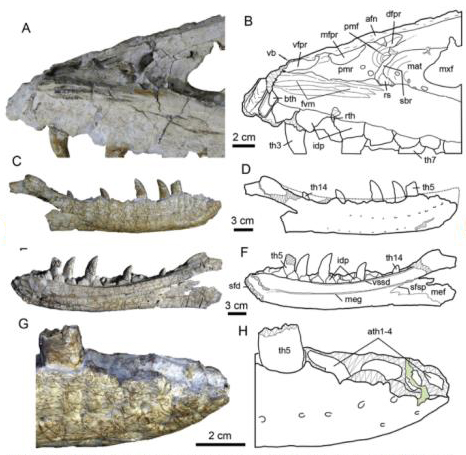
Views of the Upper and Lower Jaw Bones of J. wangi
Views of the upper and lower Jaw of J. wangi with accompanying line drawings.
Picture credit: Xiao-Chun Wu et al (Cretaceous Research)
Estimated to have measured around 5-6 metres long, Jinbeisaurus wangi is regarded as more derived than Suskityrannus (S. hazelae) a tyrannosauroid from New Mexico named earlier in 2019.
The scientific paper: “A new tyrannosauroid from the Upper Cretaceous of Shanxi, China” by Xiao-Chun Wu, Jian-Ru Shi, Li-Yang Dong, Thomas D. Carr, Jian Yi and Shi-Chao Xu published in Cretaceous Research.
A study of the holotype of the iconic duck-billed dinosaur Parasaurolophus (P.walkeri) has revealed that some of these dinosaurs led very tough lives. Tell-tale evidence preserved in the fossilised bones suggest that this particular specimen ROM 768, suffered a major trauma, but survived, at least for a little while after the incident.
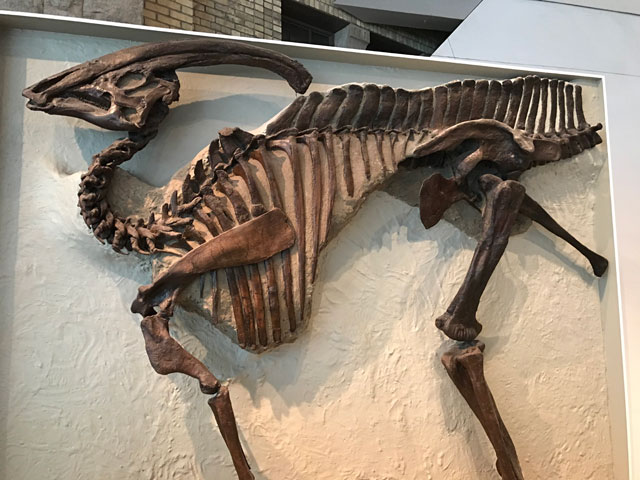
PhD student Filippo Bertozzo from the School of Natural and Built Environment at Queen’s University Belfast, examined the skeleton of the Parasaurolophus which has been on display at the Royal Ontario Museum (Canada). The articulated specimen (ROM 768), represents the almost complete remains of an adult animal, only elements from the lower limbs and the tail are missing.
The fossils were discovered in 1920 in Upper Cretaceous sediments exposed along the Red Deer River of southern Alberta. The material represents the first fossils of the genus Parasaurolophus to be reported and studied.
The Iconic Parasaurolophus Skeleton on Display at the Royal Ontario Museum (ROM 768)
The holotype Parasaurolophus skeleton (ROM 768) on display at the Royal Ontario Museum (Canada).
Picture credit: Queen’s University Belfast
Parasaurolophus – Injured by a Falling Tree
The morphology of the dinosaur’s neck had long intrigued scientists and scientific illustrators. Once thought to have a graceful, swan-like neck most palaeontologists now think that Parasaurolophus had a thick, bulky neck, one capable of supporting that huge, hollow crest for which this dinosaur is famous for.
Student Filippo explained:
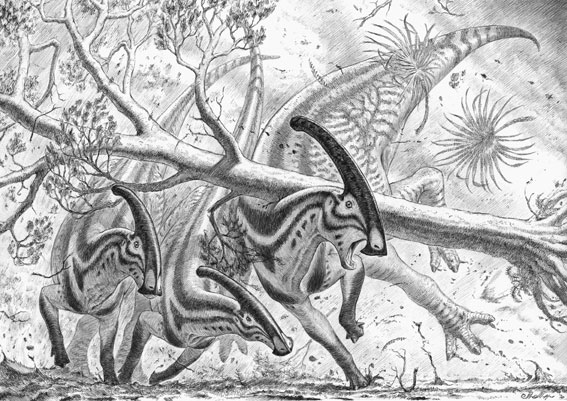
“Our research using paleopathological markers, which help us study the diseases of ancient humans and fossil animals, means we are now fairly certain how this iconic dinosaur would have really looked. The ROM 768 suffered numerous injuries which suggest a major incident of trauma before its death and we think a heavy object such as a tree may have fallen on top of the animal, perhaps during a storm.”
A Dramatic Incident for One Particular Dinosaur
Is this how a Parasaurolophus got an injured neck?
Picture credit: Supplied by Queen’s University Belfast
Reconstructing the Neck of an Ornithischian Dinosaur
The research has shown that members of the Ornithopoda, including duck-billed dinosaurs, iguanodonts and other related genera were prone to a number of injuries and diseases.
Commenting on ROM 768, the PhD student added:
“Damage to the muscles resulted in a disc-shaped overgrowth on the tip on the bony part of one its vertebrae in its neck. We interpreted the disc as a secondary enlargement of the base of the nuchal ligament, a large elastic structure that supports the neck and the head. This enabled us to reconstruct the anatomical structure of the neck, revealing that it was strong and muscular to support its head.”
The study of the iconic Parasaurolophus specimen revealed broken bones in the pelvis, ribs and spine. The scientists also found evidence of a lesion in the mouth that may have been caused as a result of a heavy object falling on the animal.
The injuries show signs of healing, demonstrating how tough and resilient these types of dinosaurs were. The Parasaurolophus (ROM 768), survived for several months or perhaps some years after the traumatic event.
Professor Eileen Murphy, a bioarchaeologist in Queen’s, stated:
Palaeopathology has been a relatively neglected aspect of palaeontology until recent years. The study of ROM 768 clearly demonstrates the value of this approach for reconstructing the quality of life of dinosaurs and the threats from the natural environment they may have faced on a daily basis.”
Everything Dinosaur acknowledges the assistance of a media release from Queen’s University Belfast in the compilation of this article.
Amanzia greppini – The First Sauropod Described From Switzerland
Badly distorted and disarticulated dinosaur bones found in the 1860s in north-western Switzerland have led to the establishment of a new genus of European sauropod. Amanzia greppini, described from an assortment of fragmentary fossil material, representing four individuals is the first sauropod to be described from fossil remains found in Switzerland. The fossils come from Upper Jurassic strata which form part of the Reuchenette Formation, they were discovered in a limestone quarry in the Basse Montagne, near the city of Moutier.
Limb Bones of Amazia greppini from the Late Jurassic of Switzerland
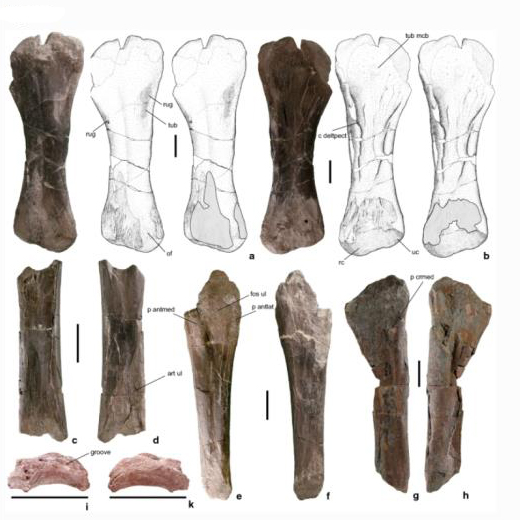
Forelimb bones associated with Amanzia greppini and interpretative drawings. Right humerus in (a) posterior and (b) anterior view with line drawings showing preserved cartilage outlined in grey. Left radius in (c) anterior and (d) posterior view. Left ulna in anterior view (e) and posterior view (f). Right ulna in anterior view (g) and anterior view (h). Views of an ungual phalanx. Note scale bar = 5 cm.
Picture credit: Schwarz et al (Swiss Journal of Geosciences)
The bones had been sold to a private collector, but the Swiss geologist Jean-Baptiste Greppin was notified of the find and identified the assortment of distorted and crushed bones as the remains of dinosaurs. In the early 20th century these remains were associated with the English sauropod Cetiosauriscus stewarti known from fossils found in Cambridgeshire. However, an extensive review of the Swiss fossil material conducted by Daniela Schwarz (Museum für Naturkunde, Berlin) and co-workers resulted in a new genus being erected earlier this year.
Kimmeridgian versus Callovian
The researchers who re-visited the Swiss sauropod remains identified a number of unique autapomorphies (distinctive traits) to distinguish their fossils from those of C. stewarti. In addition, the Swiss dinosaur was much smaller, with an estimated maximum length of around ten metres compared to the proposed fifteen metres for Cetiosauriscus. The scientists, which included Philip Mannion (University College London), Oliver Wings (University Halle-Wittenberg in Germany) and Christian Meyer (University of Basel), found differences in the caudal vertebrae (tail bones) as well as difference in the shape and proportions of the femur, humerus and coracoid.
A discrepancy in the geological age between C. stewarti and the Swiss fossil material was also noted. Fossils of Cetiosauriscus stewarti come from strata associated with the Callovian faunal of the Middle Jurassic, whilst the fossils of Amanzia greppini come from geologically younger deposits laid down during the Kimmeridgian faunal stage (Late Jurassic).
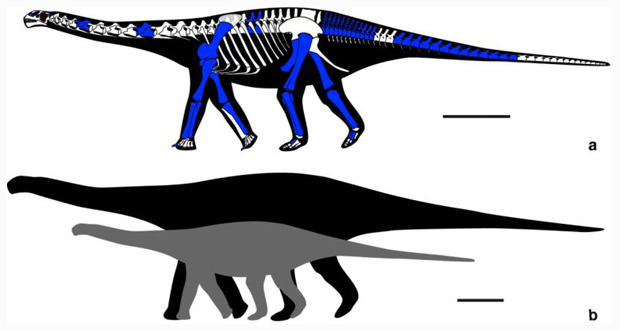
Skeletal Reconstruction of Amanzia greppini and Size Comparison with the Geologically Older Cetiosauriscus stewarti
Skeletal reconstruction of A. greppini. Known fossil elements shown in blue. As much information is missing from the incomplete skeletal material, the dorsal vertebrae, the proportions and morphology of the cervical vertebrae and the skull were modified from Camarasaurus. Scaled silhouette drawings (b) of Cetiosauriscus stewarti (in black) and A. greppini (in grey) demonstrating the significant size difference between the two taxa. Note scale bar = 1 metre.
Picture credit: Schwarz et al (Swiss Journal of Geosciences)
Honouring a Famous Swiss Scientist
The genus is named in honour of the well-known Swiss geologist Amanz Gressly (1814–1865) who introduced the term “facies” to describe rock types with different characteristics and discovered the first dinosaur fossil from Switzerland in 1856. The trivial or specific name pays tribute to Jean-Baptiste Greppin, who was the first person to identify the jumbled remains from the quarry as coming from a member of the Dinosauria.
In addition, to the sauropod bones, a single, worn tooth from a sauropod was discovered. This tooth (specimen number NMB M.H. 451), has been assigned to A. greppini. Bones from an ancient marine crocodylomorph and a broken theropod tooth were also found in association with the sauropod remains. Based on the matrix material and the study of ostracod fossils found at the quarry, the scientists concluded that the carcass of Amanzia, was buried in a shallow, temporary lake close to the sea.
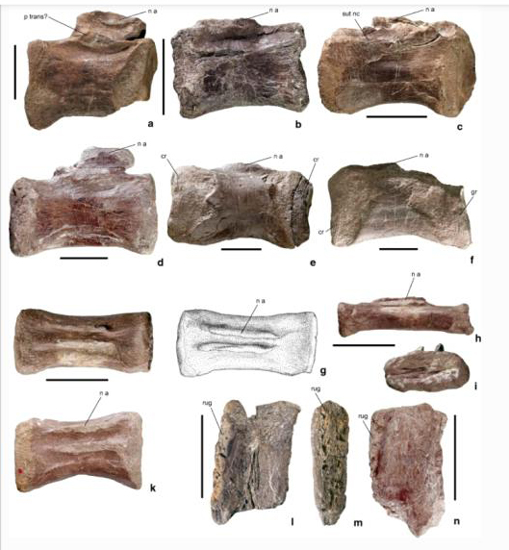
Middle and Posterior Caudal Vertebrae with Accompanying Line Drawing (A. greppini)
Middle and posterior caudal vertebrae of A. greppini with interpretative line drawing. Note scale bar = 5 cm. Differences in the length : height ratios between these bones and those tail bones associated with Cetiosauriscus stewarti helped to identify the Swiss fossil material as that of a new genus.
Picture credit: Schwarz et al (Swiss Journal of Geosciences)
More European Sauropods to Come
When this research was published in the Swiss Journal of Geosciences earlier this year (February 2020), the researchers concluded that the first Swiss sauropod taxon helped to demonstrate the diversity of the sauropods known from the Late Jurassic of Europe. The exact placement of Amanzia greppini within the Sauropoda remains controversial, the authors speculated that it might be a sister taxon to the Neosauropoda or a member of the Turiasauria, a geographically and temporally widespread group of sauropods with a number of European genera such as Cardiodon, Losillasaurus, Zby and Turiasaurus.
They concluded that more fossil discoveries and the reassessment of sauropod fossils held in museum collections would lead to the naming of many more European sauropod genera.
The scientific paper: “Re-description of the sauropod dinosaur Amanzia (“Ornithopsis/Cetiosauriscus”) greppini n. gen. and other vertebrate remains from the Kimmeridgian (Late Jurassic) Reuchenette Formation of Moutier, Switzerland” by Daniela Schwarz, Philip D. Mannion, Oliver Wings and Christian A. Meyer published in the Swiss Journal of Geosciences.
Small Skull of Fossil Bird Has Big Implications (Falcatakely forsterae)
A team of international researchers including scientists from Ohio University, Stony Brook University (New York) and University College London have published a scientific paper describing a new type of enantiornithine bird (Falcatakely forsterae) from the Late Cretaceous of Madagascar.
Named Falcatakely, this crow-sized early avian offers a new perspective on the evolution of face and beak shape in the ancestral group leading to modern-day birds.
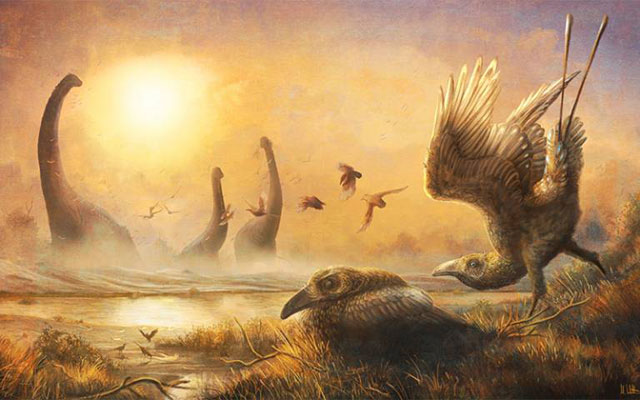
A Life Reconstruction of Falcatakely forsterae in the Late Cretaceous of Madagascar Surrounded by Other Archosaurs
A pair of Falcatakely birds are about to be disturbed an approaching group of titanosaurs.
Picture credit: Mark Witton
A Mesozoic Toucan?
Although palaeontologists are aware of a wide range of Mesozoic birds such as enantiornithines and hesperornithiforms which vary in size, flight adaptations and lifestyles, they all exhibit relatively conservative patterns of beak shape and development. Modern birds (neornithines), such as the finches studied by the famous naturalist Charles Darwin, show a huge range of beak morphologies, all associated with different feeding and behavioural ecologies. Falcatakely forsterae bucks this trend for birds from the Late Cretaceous, it has a beak morphology unlike other Mesozoic birds, one that is superficially similar to that of extant toucans.
Falcatakely forsterae, a combination of Latin and Malagasy words inspired by the small size and the scythe-like shape of the beak, which represents a completely novel face shape in Mesozoic birds.
Co-author of the scientific paper Dr Ryan Felice (University College London), explained how the study of birds have helped many scientists understand the subtleties of convergent evolution:
“Ever since Charles Darwin’s observations of Galapagos finches with differently-shaped beaks, birds have shaped our understanding of evolution through natural selection. This new discovery tells us even more about how the predecessors of modern birds evolved, by showing how different forces in different places can contribute to similar traits in distantly related animals.”
Falcatakely forsterae
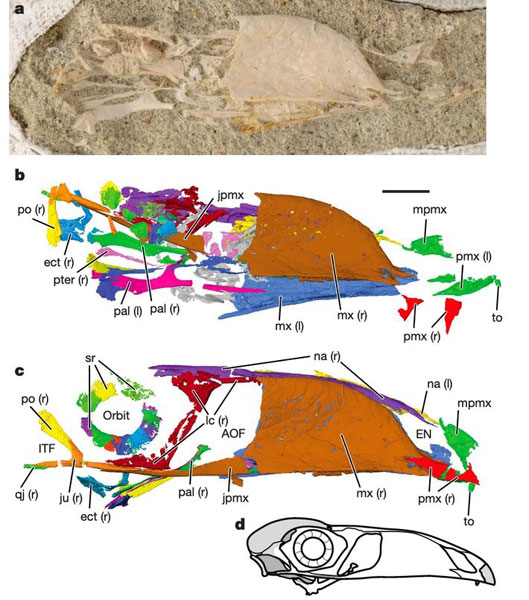
Described from a single skull specimen which had remained uncatalogued for several years since its discovery in 2010, lead author Patrick O’Connor (Ohio University) and his colleagues used high resolution CT scans to build up a picture of the skull and beak.
The Skull of Falcatakely forsterae with CT Scans and Interpretative Line Drawing
The skull of Falcatakely (top) with two diagrams from CT scans and an interpretative line drawing.
Picture credit: O’Connor et al
Bird fossils are rare. Their light fragile bones tend not to fossilise well. Bird skulls are especially rare, but although crushed, the powerful CT scans have been able to reveal many unique features of the bones and the beak. For example, the researchers were able to identify a single preserved tooth in the premaxilla, probably one of several teeth lining the beak of this resident of north-western Madagascar some 68 million years ago.
Everything Dinosaur acknowledges the assistance of a media release from the University of Ohio and University College London in the compilation of this article.
The scientific paper: “Late Cretaceous bird from Madagascar reveals unique development of beaks” by Patrick M. O’Connor, Alan H. Turner, Joseph R. Groenke, Ryan N. Felice, Raymond R. Rogers, David W. Krause and Lydia J. Rahantarisoa published in Nature.
Kholumolumo ellenbergerorum – A Dinosaur from a “Rubbish Dump”
This year (2020), saw the publication of a scientific paper describing a new species of Late Triassic non-sauropodan sauropodomorph from southern Africa. The dinosaur named Kholumolumo ellenbergerorum, at around nine to ten metres in length, was one of the largest animals living in that part of Gondwana during the Norian stage of the Triassic. Surprisingly, for such a big animal, the fossils indicate that this dinosaur was bipedal.
A Life Reconstruction of Kholumolumo ellenbergerorum
Kholumolumo ellenbergerorum life reconstruction. Note scale bar equals 1 metre.Picture credit: Everything Dinosaur.
Picture credit: Everything Dinosaur
Fragmentary Fossils
The fragmentary fossils consisting of post-cranial material, including most notably, a robust lower leg bone (tibia), represent several individuals and these fossils first came to light in 1930, when Samuel Motsoane, a leading member of the Paris Evangelical Mission School located at Bethesda in Lesotho, found several disarticulated dinosaur bones.
It was not until 1955 that a formal survey and excavation of the area was carried out. Brothers Paul and François Ellenberger mapped and excavated a small area uncovering a mono-dominant bonebed representing numerous individuals. The dig took place behind the back of a hut, within a few metres of the village rubbish dump. Undeterred the brothers completed their work, publishing a preliminary description that year with a more detailed paper following in 1956 which was published by the French Geology Society (Societe Geologique de France).
A Rare Archive Made Available
The Maphutseng assemblage has been mentioned in several papers and named on two occasions but never formally published. Back in the spring, this omission was rectified and this dinosaur was finally formally scientifically described (Peyre de Fabrègues & Allain). Two months before the scientific paper came out, the UK Government Foreign and Commonwealth Office via The National Archives made available on-line thousands of rare images of Africa, showing a century of British involvement on the continent.
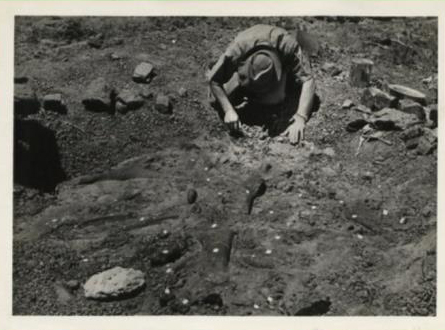
One of those black and white images in the Lesotho section showed a dinosaur fossil excavation. There was a photographic record of the “Maphutseng dinosaur”.
Excavating Dinosaur Fossils in Lesotho
A photograph from The National Archives showing a dinosaur fossil excavation in Lesotho. The photograph is believed to show the excavation of the Late Triassic sauropodomorph Kholumolumo ellenbergerorum.
Picture credit: Alwyn Bisschoff/The National Archives (catalogue reference Part of CO 1069/209)
The photograph (above), might be just one of thousands of rare images of Africa made available on-line by The National Archives in a project entitled “Africa Through a Lens”, but it shows (most likely), one of the Ellenberger brothers carefully exposing the Kholumolumo fossil material.
Everything Dinosaur is not aware of a photographic record of the rubbish dump being preserved for posterity.
Kholumolumo ellenbergerorum
Despite the large size of this taxon (around 9-10 metres in length), with an estimated body mass of approximately 1.7 tonnes, the researchers (Peyre de Fabrègues & Allain), did not think Kholumolumo was linked to the origin of the Sauropoda, an Order of the Dinosauria famous for consisting of the largest terrestrial vertebrates known to science.
Kholumolumo (pronounced Ko-lum-oh-loo-mo) is derived from the local Sotho dialect for a mythical reptilian beast, whilst the specific or trivial name honours the Ellenberger brothers.
Scientists from the University of Portsmouth, National Museums of Ireland and Queen’s University Belfast have confirmed that fossils found by the late Roger Byrne on the east coast of County Antrim (Northern Ireland), are dinosaur bones. These are the only dinosaur bones known from the island of Ireland. Roger Byrne donated a number of specimens to Ulster Museum but they had not been closely studied, a scientific paper published in the Proceedings of the Geologists’ Association remedies that and confirms that two of the pieces are dinosaurian and although they were found at the same location, they represent bones from two different dinosaurs.
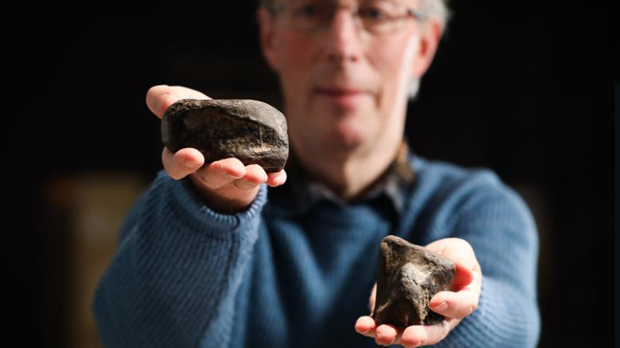
Lead Researcher Dr Mike Simms Holding the Two Dinosaur Fossil Bones
Dr Mike Simms (National Museums Northern Ireland) holds the theropod tibia on the left and the thyreophoran femur on the right.
Picture credit: The University of Portsmouth
Dinosaur Bones
Lead author of the research Dr Mike Simms stated:
“This is a hugely significant discovery. The great rarity of such fossils here is because most of Ireland’s rocks are the wrong age for dinosaurs, either too old or too young, making it nearly impossible to confirm dinosaurs existed on these shores. The two dinosaur fossils that Roger Byrne found were perhaps swept out to sea, alive or dead, sinking to the Jurassic seabed where they were buried and fossilised.”
Lias Group Exposures
The two fossil bones found by the Roger Byrne, a schoolteacher and avid fossil collector, come from Lower Jurassic strata exposed in Islandmagee. They had been suspected of representing dinosaur bones, although they were found in marine deposits. A detailed analysis of their histology and shape indicated that two of the pieces that Roger donated were indeed the bones of dinosaurs. Originally, it had been thought that the bones represented a single type of dinosaur but the research team were surprised to discover that they represent bones from two very different types.
One specimen has been interpreted as the proximal end of the left femur of a basal thyreophoran ornithischian. It has been tentatively assigned to Scelidosaurus, a primitive armoured dinosaur, fossils of which are known from Dorset (southern England) and date from the Sinemurian to the Pliensbachian faunal stages of the Early Jurassic. The strata from which the femur fragment was found dates from slightly earlier, both the fossil bones are around 200 million years old.
A Model of the Early Armoured Dinosaur Scelidosaurus
A model of a Scelidosaurus. The CollectA Deluxe 1:40 scale Scelidosaurus model.
Picture credit: Everything Dinosaur
The picture (above) shows the CollectA Deluxe Scelidosaurus figure.
The second fragment of bone has been identified as the proximal part of the left tibia of an indeterminate neotheropod, perhaps a member of the averostran-line similar to Sarcosaurus, or a megalosauroid. Sarcosaurus fossils are associated with Lower Jurassic strata (Hettangian-Sinemurian faunal stages), of England. Together, the two fossil dinosaur bones represent the first dinosaur remains reported anywhere in Ireland and some of the west westerly in Europe.
An Illustration of Sarcosaurus
Sarcosaurus scale drawing. A speculative drawing of the Early Jurassic theropod Sarcosaurus. It is not known whether this dinosaur had head crests like the distantly related Dilophosaurus.Picture credit: Everything Dinosaur.
Picture credit: Everything Dinosaur
The researchers used high-resolution, three-dimensional replicas to confirm the identity of the items donated by Roger Byrne.
University of Portsmouth researcher Robert Smyth explained:
“Analysing the shape and internal structure of the bones, we realised that they belonged to two very different animals. One is very dense and robust, typical of an armoured plant-eater. The other is slender, with thin bone walls and characteristics found only in fast-moving two-legged predatory dinosaurs called theropods.”
An Illustration of the Fossil Bones from County Antrim
Drawings of the dinosaur fossil bones by the late Roger Byrne and incorporated into the scientific paper. Illustrations e, f, k and l are views of the theropod partial tibia and d, e are illustrations of the partial femur assigned to Scelidosaurus. Note scale bar 5 cm.
Picture credit: Roger Byrne/National Museums of Ireland
Very Important Fossil Discoveries
Despite their fragmentary and weathered nature, these fossils are extremely important as they date from the Hettangian stage of the Early Jurassic, shortly after the End Triassic extinction event when the Dinosauria start to diversify and become more widespread. Very few dinosaur fossils are known from this stage of the Early Jurassic, so Roger’s fossils are globally significant.
One of the other items donated by Roger Byrne probably represents an element from the skull or jawbone from a large marine reptile, perhaps an ichthyosaur or a pliosaur, whilst a polygonal-shaped piece was determined not to be a fossil at all, but a piece of Palaeocene basalt, similar to that found at the famous Giant’s Causeway on the northern coast of County Antrim.
Scelidosaurus a Beachcomber?
Commenting on the number of Scelidosaurus fossils associated with marine deposits, Professor Martill (University of Portsmouth), suggested:
“Scelidosaurus keeps on turning up in marine strata, and I am beginning to think that it may have been a coastal animal, perhaps even eating seaweed like marine iguanas do today.”
The fossils were on display at the Ulster Museum during the “Dippy on Tour” exhibition in 2018, but it is hoped that these important fossil bones will be able to go on permanent display once the COVID-19 restrictions are lifted.
Everything Dinosaur acknowledges the assistance of a media release from the University of Portsmouth in the compilation of this article.
The scientific paper: “First dinosaur remains from Ireland” by Michael J. Simms, Robert S.H. Smyth, David M. Martill, Patrick C. Collins and Roger Byrne published in the Proceedings of the Geologists’ Association.
Dinosaur Diversification Rates not in Decline at the End of the Cretaceous
A team of international researchers including scientists from the London Natural History Museum and the University of Bath have undertaken an extensive and sophisticated statistical analysis to try to establish whether the dinosaurs were in terminal decline prior to the end-Cretaceous mass extinction event that saw the demise of all non-avian forms.
Studying the Dinosaurs at the End of the Cretaceous
The detailed Bayesian analysis suggests had the extra-terrestrial object not hit planet Earth, then the dinosaurs might have continued to dominate terrestrial ecosystems.
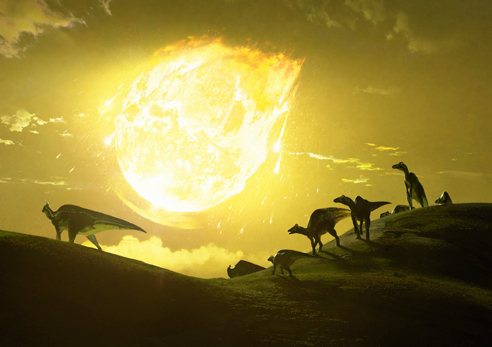
If the Bolide (Extra-terrestrial Object) had not Hit – Would the Non-avian Dinosaurs Still be Around Today?
An artist’s impression of the bolide about to impact with the Gulf of Mexico 66 million years ago. Had this catastrophic event not occurred then the Dinosauria could have continued to dominate terrestrial ecosystems according to a new study.
Picture credit: Chase Stone
How quickly the non-avian dinosaurs died out and what sort of health dinosaur populations were in around 66 million years ago has proved to be one of the most contentious issues in vertebrate palaeontology. Some scientists argue that there were fewer genera of dinosaurs present in the Maastrichtian faunal stage of North America than in the preceding Campanian. They propose that this is evidence to suggest that the non-avian members of the Dinosauria were in decline long before their final extinction. Other scientists present data to support the idea that new species were still evolving and that the “terrible lizards” were showing no signs of being under population stress.
Were the Dinosaurs in Decline Prior to the K-Pg Extinction Event?
Hadrosaurs dominated many dinosaur-based ecosystems and some scientists have postulated that the relative lack of diversity in dinosaur families could represent evidence of populations being under stress.
Picture credit: James Havens
The Extinction of the Dinosaurs
Extensive disagreements remain over whether the extinction of the dinosaurs was a sudden catastrophic event, essentially instantaneous when measured in deep, geological time or whether their ultimate die-off was the culmination of long-term evolutionary trends.
Writing in the open-access, on-line journal “Royal Society Open Science”, the researchers which include Professor Paul Barrett (London Natural History Museum) and PhD student Joe Bonsor (University of Bath), used sophisticated Bayesian statistical analysis to model three competing theories against a variety of taxonomies and phylogenies representing the Dinosauria.
In essence, the study set out to test the match between three competing hypotheses with regards to the dinosaur species-richness during the Late Cretaceous:
1). No evidence of a global downturn in dinosaur speciation rates prior to the end of the Mesozoic.
2). There was a decline in dinosaur species-richness over a timescale of hundreds of thousands or several million years prior to the bolide impact due to the effect of climate change, rising sea levels and the Deccan flood basalt volcanism (plus other factors).
3). That the Dinosauria were in global decline with falling speciation rates from around 100 million years ago.
Twelve Phylogenies Analysed
Bayesian statistical analysis was used to assess the fit of twelve dinosaur phylogenies from various authors. The researchers did not find strong support for the downturn model in their analyses, which suggests that dinosaur speciation rates were not in terminal decline prior to the K-Pg boundary and that the Dinosauria was still capable of generating new taxa and evolving into new species to exploit resources and environmental opportunities.
Dinosaurs Dominated Terrestrial Ecosystems
A dinosaur dominated ecosystem (northern China in the Late Cretaceous). The study found no strong evidence to support the idea that the Dinosaur were in either long-term or short-term decline prior to the K-Pg extinction event.
Picture credit: Zhao Chuang
Urging Caution
The researchers did urge caution when it came to interpreting the results of the models stating that they may be too simplified and therefore not able to reflect the complexities of the underlying data. To help confirm the state of dinosaur populations prior to the K-Pg extinction event the research team concluded that the collection of more dinosaur occurrence data would be needed to test these ideas and to validate any proposed hypothesis.
The scientific paper: “Dinosaur diversification rates were not in decline prior to the K-Pg boundary” by Joseph A. Bonsor, Paul M. Barret, Thomas J. Raven and Natalie Cooper published by Royal Society Open Science.
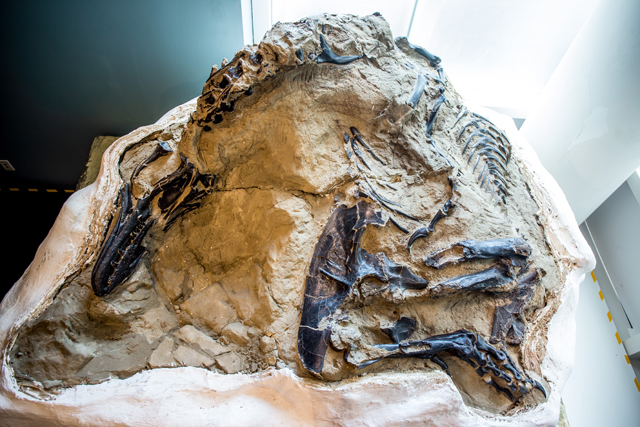
The famous “Duelling Dinosaurs” featuring a tyrannosaurid specimen closely associated with a large ceratopsid have found a permanent home at the North Carolina Museum of Natural Sciences. The fossils, discovered eroding slowly out of a hillside formed from the famous Hell Creek Formation deposits of Montana were once thought to represent a dwarf, lightweight species of Late Cretaceous tyrannosaurid – named Nanotyrannus and a new species of horned dinosaur, these days, most palaeontologists consider the largely articulated and heavily associated pair to represent a sub-adult Tyrannosaurus rex and a Triceratops.
“Duelling Dinosaurs”
Their acquisition on behalf of the Museum, by the not-for-profit Friends of the North Carolina Museum of Natural Sciences will permit palaeontologists access to study these amazing 66-million-year-old dinosaurs as well as allowing the general public to get up close and personal to two dinosaur fossils that could have ended up in the hands of a private collector.
Still Partially Entombed – The Tyrannosaurid Member of the “Duelling Dinosaurs”
A dorsal view of the articulated remains of the sub-adult tyrannosaurid – part of the “duelling dinosaurs”
Picture credit: Matt Zeher
Evidence of Predator/Prey Interaction
The fossils, only partially exposed and still protected by their burlap field jackets may represent the best-preserved skeletons of Triceratops and T. rex known to science. The huge blocks may contain evidence of a predator/prey interaction. The dinosaur carcasses have not been studied and remain entombed within sediment from the Montana hillside where they were discovered. Because of these rare burial conditions, each bone is in its natural position and Museum scientists will have access to biological data that is typically lost in the excavation and preparation processes.
Entombing sediment preserves extraordinary features such as body outlines, skin impressions and other soft tissues, as well as injuries and potential evidence of interaction, such as tyrannosaur teeth embedded in the bones of its ceratopsian companion.
A Life Reconstruction of “Duelling Dinosaurs”
A life reconstruction of the tyrannosaur pack encountering a herd of ceratopsians.
Picture credit: Anthony Hutchings
Welcoming Important Specimens
Commenting on the arrival of these remarkable specimens, Jason Barron, chair of the Friends of the North Carolina Museum of Natural Sciences stated:
“It is an immeasurable honour to welcome these specimens as they take up permanent residence here at the Museum. Duelling Dinosaurs is a singular find; we are incredibly grateful to our supporters for making this a reality and allowing our visitors – in-person and virtual alike – to experience this journey with us.”
In conjunction with the fossil acquisition, design is nearing completion on a globally unique, behind-the-scenes visitor experience at the Museum in downtown Raleigh. The exhibit will be the first physical expansion of the Museum in over ten years and will build on its sustained leadership in public engagement with scientific research.
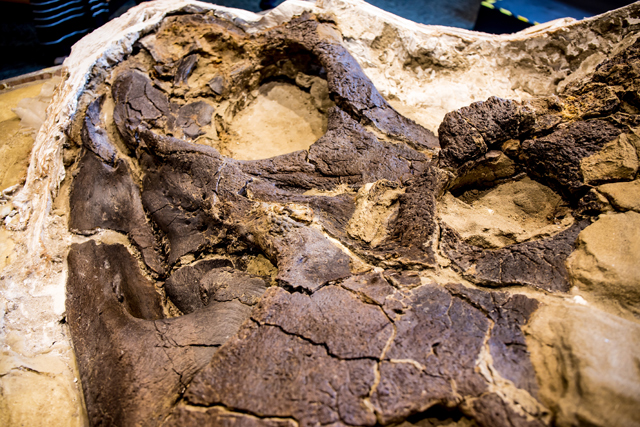
Part of the “Duelling Dinosaurs” Awaiting Further Study and Research
The articulated and near complete specimens may reveal interaction between predator and prey.
Picture credit: Matt Zeher
Providing New Opportunities to Learn About Iconic North American Dinosaurs
The acquisition of the “duelling dinosaurs” and the fact that they have a permanent home, will allow palaeontologists the opportunity to carefully study what has been described as one of the most astonishing vertebrate fossils ever found.
Dr Lindsay Zanno, head of palaeontology at the North Carolina Museum of Natural Sciences, is very excited at the prospect at being able to study these unique, associated fossils and commented:
“We have not yet studied this specimen; it is a scientific frontier. The preservation is phenomenal, and we plan to use every technological innovation available to reveal new information on the biology of T. rex and Triceratops. This fossil will forever change our view of the world’s two favourite dinosaurs. The way we have designed the entire experience — inviting the public to follow the scientific discoveries in real time and participate in the research — will set a new standard for museums.”
Everything Dinosaur acknowledges the assistance of a media release from the North Carolina Museum of Natural Sciences in the compilation of this article.
Ancient Seal from New Zealand Eomonachus belegaerensis
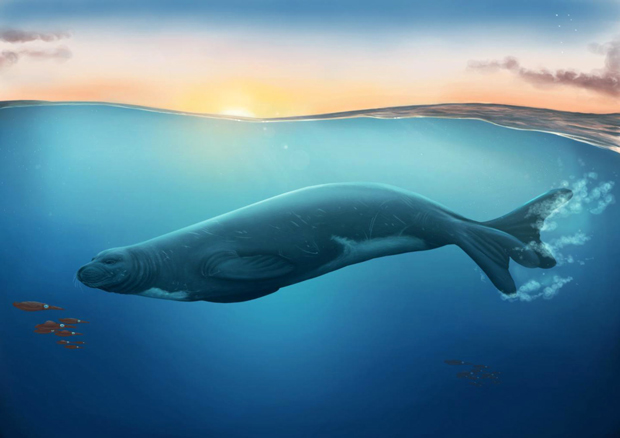
A team of researchers from Monash University (Victoria), the Museum of New Zealand Te Papa Tongarewa (Wellington), Canterbury Museum (Christchurch) and Museums Victoria have identified a new species of prehistoric pinniped, an ancient seal, whose discovery is helping to re-write the evolutionary history of these highly successful and diverse marine mammals.
Writing in the academic journal, the Proceedings of the Royal Society B (Biology), the scientists which include Monash University PhD student James Rule, describe a new species of monk seal that swam in the waters around New Zealand some 3 million years ago (Late Pliocene Epoch). The seal has been named Eomonachus belegaerensis, which means dawn monk seal from Belegaer. The Belegaer reference relates to the sea of Belegaer or the “Great Sea” that lay to the west of Middle Earth in J.R.R. Tolkien’s fantasy epic “Lord of the Rings”.
A Life Reconstruction of the Newly Described E. belegaerensis
Eomonachus belegaerensis an ancient seal from New Zealand.
Picture credit: Jaime Bran (Museum of New Zealand Te Papa Tongarewa)
Changing Views on Seal Evolution
Fossil specimens including a complete skull found by amateur fossil hunters on the Taranaki beaches (western side of North Island, New Zealand), between 2009 and 2016 led to the erection of this new species. The research team estimate that E. belegaerensis measured around 2.5 metres in length and weighed approximately 250 kilograms, about the size of an extant crabeater seal (Lobodon carcinophaga), to which Eomonachus was very distantly related.
It had been previously thought that all true seals (phocids), originated in the North Atlantic. Extant seals are split into two groups, the northern (phocine) and the southern (monachine). Only two types of monachine seal subsequently crossed the equator to inhabit the Southern Hemisphere. Those that made this migration consist of elephant seals and the lobodontins, such as the crabeater seal. The third and most basal monachine, the monk seals, had been regarded as exclusively northern throughout their entire evolutionary history.
Eomonachus belegaerensis
The discovery of the three-million-year-old fossil remains of an ancestral monk seal in New Zealand has led the researchers to conclude that today’s monk, elephant and Antarctic seals, actually evolved in the Southern Hemisphere.
This unexpected discovery reveals that all three monachine tribes once coexisted south of the equator and has led to a profound revision of pinniped evolutionary history. Rather than primarily diversifying in the North Atlantic, monachines largely evolved in the Southern Hemisphere and from this southern cradle later reinvaded the north.
Commenting on the significance of this discovery, James Rule stated:
“This new species of extinct monk seal is the first of its kind from the Southern Hemisphere. Its discovery really turns seal evolution on its head. Until now, we thought that all true seals originated in the Northern Hemisphere, and then crossed the equator just once or twice during their entire evolutionary history. Instead, many of them appear to have evolved in the southern Pacific, and then criss-crossed the equator up to eight times.”
Everything Dinosaur acknowledges the assistance of a media release from Monash University in the compilation of this article.
The scientific paper: “First monk seal from the Southern Hemisphere rewrites the evolutionary history of true seals” by James P. Rule, Justin W. Adams, Felix G. Marx, Alistair R. Evans, Alan J. D. Tennyson, R. Paul Scofield and Erich M. G. Fitzgerald published in the Proceedings of the Royal Society B.
Shark Spines and Fish Jaws Turn Out to be Pterosaur Mandibles
Over the last few months, Everything Dinosaur has reported upon the research into the Pterosauria conducted by scientists from the University of Portsmouth and the University of Leicester in collaboration with academics from several other institutions. We really do seem to be having a “Golden Age” of pterosaur research with lots of exciting discoveries about flying reptile behaviour and lifestyles as well as a number of new species being named and described.
Pterosaur Research Has Not Been Standing Still
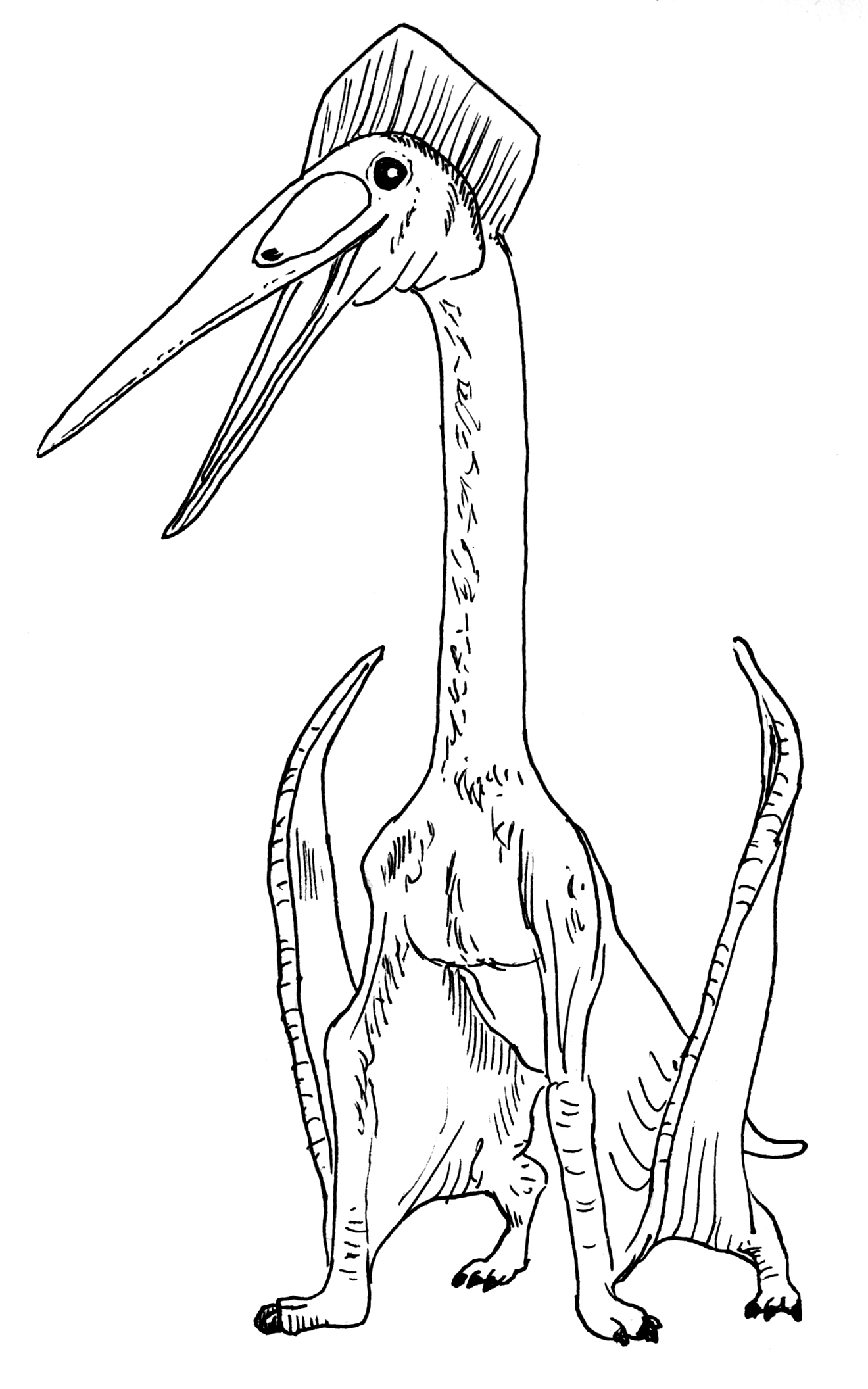
Pterosaur research has not been standing still. There have been lots of new and exciting discoveries made recently.Picture credit: Everything Dinosaur.
Picture credit: Everything Dinosaur
Recently, we have reported upon a suite of new Late Cretaceous flying reptiles from Morocco*, research that re-examined some of the evidence associated with integumentary coverings when it comes to flying reptiles**, a new tapejarid from the Wessex Formation (Wightia declivirostris) and last month, team members looked into the tactile qualities of sensitive pterosaur jaws: The Sensitive Beaks of Pterosaurs.
Researchers from the University of Portsmouth in collaboration with colleagues from the University of Leicester and the London Natural History Museum have published a new paper this week. Writing in the “Proceedings of the Geologists’ Association”, they report upon the discovery of a new species of toothless pterosaur after the re-examination of vertebrate fossil collections at the Sedgwick Museum (Cambridge) and the Booth Museum (Brighton).
It was Portsmouth University PhD student, Roy Smith, already a published author, as the links we have posted above testify, who found evidence for the new species when searching through material in the collections that had been misidentified either as shark spines or the jaws from prehistoric fish.
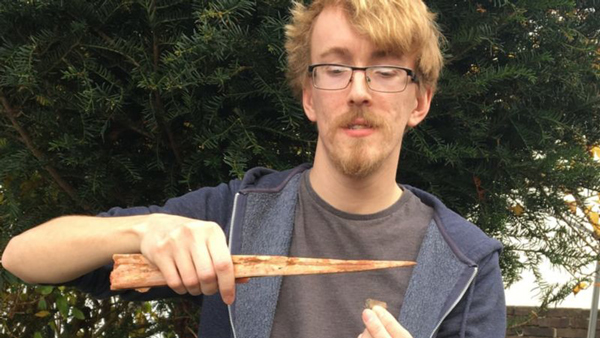
Explaining How to Identify the Edentulous (Toothless) Beak of a Pterosaur
PhD student Roy Smith explaining what the edentulous beaks of pterosaurs look like.
Picture credit: Portsmouth University
Late Cretaceous Pterosaurs
The fossil material studied comes from the Cretaceous Cambridge Greensand Member of the West Melbury Marly Chalk Formation. The fossils had been collected in Cambridgeshire during the latter part of the 19th century, when very little was known about the Pterosauria. As these sediments represent a marine environment, this does explain to some extent how the toothless beaks of flying reptiles could be confused with shark spines and fish jaws.
Thanks to the efforts of the researchers, a number of of new specimens of edentulous pterosaur jaw fragments have been identified. These are now recognised as pterosaurian jaw tips and referred to Ornithostoma sedgwicki, which was first named and described by the British palaeontologist Harry Seeley.
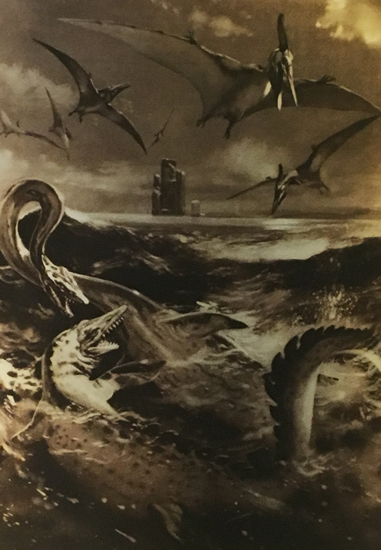
It had been thought that O. sedgwicki was a member of the Pteranodontia, perhaps the most famous of all the types of flying reptile known as the genus Pteranodon is part of this group.
A Prehistoric Scene Featuring Pteranodon
Dramatic scene from the Western Interior Seaway painted by Burian. Images such as this helped to popularise the Pteranodon genus.
Picture credit: Zdeněk Burian
Time to Re-classify Ornithostoma sedgwicki
The research team which includes Professor David Martill (Portsmouth University), Dr David Unwin (University of Leicester), Dr Lorna Steel (London Natural History Museum) as well as PhD student Roy Smith, conclude that as tiny pits along the side of the jaw bone have been identified in these fragmentary fossils, it might be time to revise the taxonomy of O. sedgwicki.
If these pits and minute holes indicate the presence of neural foramina (nerves passing through the jaw to make contact with the beak’s surface to help the animal sense its environment), then as neural foramina are not known in the Pteranodontia, Ornithostoma could have been placed in the wrong part of the flying reptile family tree.
The scientists assign O. sedgwicki to the Azhdarchoidea group instead. Whatever the classification of Ornithostoma, its fossils still probably represent the first evidence of toothless pterosaurs to have ever been discovered.
Student Roy Smith, summarising what the team found as they re-examined the material from the 19th century stated:
“Two of the specimens discovered can be identified as a pterosaur called Ornithostoma, but one additional specimen is clearly distinct and represents a new species – it is a palaeontological mystery.”
Unfortunately, like most of the pterosaur fossils associated with the Cambridge Greensand of England, this fossil is too fragmentary to permit a new genus to be erected.
The scientific paper: “Edentulous pterosaurs from the Cambridge Greensand (Cretaceous) of eastern England with a review of Ornithostoma Seeley, 1871” by Roy E. Smith, David M. Martill, David M. Unwin and Lorna Steel published in the Proceedings of the Geologists’ Association.