All about dinosaurs, fossils and prehistoric animals by Everything Dinosaur team members.

Fossil finds, new dinosaur discoveries, news and views from the world of palaeontology and other Earth sciences.

11 11, 2020

The Earliest Paranthropus robustus Skull

By |2024-03-19T13:44:50+00:00November 11th, 2020|Categories: Dinosaur and Prehistoric Animal News Stories, Main Page, Palaeontological articles, Photos/Pictures of Fossils|0 Comments

The Earliest Paranthropus robustus Skull

The discovery of a near complete skull of the hominin Paranthropus robustus has shed new light on the evolution of this enigmatic species, related to but not likely to be a direct ancestor of the hominin lineage that led to the evolution of our own species.  The fossil was found at the world famous Drimolen Main Quarry (DMQ) site, some twenty-five miles north of Johannesburg, South Africa.  This site consists of in-fill deposits from an ancient cave system and it has produced a number of remarkable fossil specimens of early hominins that co-existed around two million years ago.

Paranthropus robustus

The specimen (DNH 155), is believed to represent the skull of a large, adult male and the fossil has been dated from approximately 2.04–1.95 million years ago (Gelasian age of the early Pleistocene), it is the earliest known Paranthropus skull discovered to date.

Specimen Number DNH 155 The Skull of Paranthropus robustus
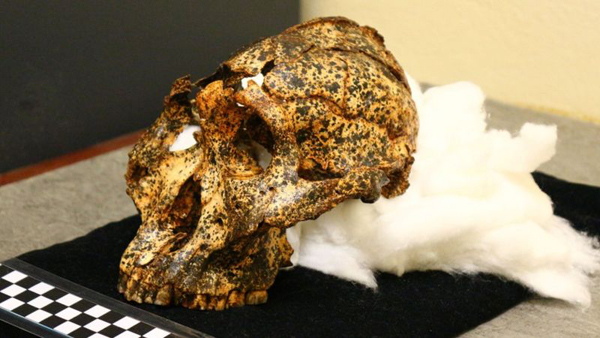
Paranthropus robustus skull fossil from South Africa.
The P. robustus skull has been pieced together from fragments found at the Drimolen Main Quarry (DMQ) archaeological site north of Johannesburg (South Africa).

Picture credit: Andy Herries, La Trobe Archaeology

Discovered on Father’s Day

Field team members from La Trobe University’s Archaeology Department (Melbourne, Australia), led the excavation work.  The rare skull fossil was discovered in 2018, on June 20th, appropriately Father’s Day in South Africa.  During the careful excavation, cleaning and preparation of the fossil, the specimen was nicknamed the “Father’s Day fossil”.

The skull was found close to the location of Homo erectus skull material, that at around two million years of age, provided strong evidence to support the hypothesis that H. erectus evolved in Africa rather than in Asia.  Lead author of the paper outlining the discovery of the partial H. erectus skull was Professor Andy Herries (La Trobe University), the Director of the Australian Research Council-funded Drimolen project, who also co-authored the scientific paper on DNH 155 that was published this week in the journal Nature Ecology & Evolution.

To read more about the Homo erectus discovery at the Drimolen Main Quarry site: Homo erectus Originated in Southern Africa.

The Drimolen Main Quarry – A Hugely Significant Location for Early Hominin Fossil Material
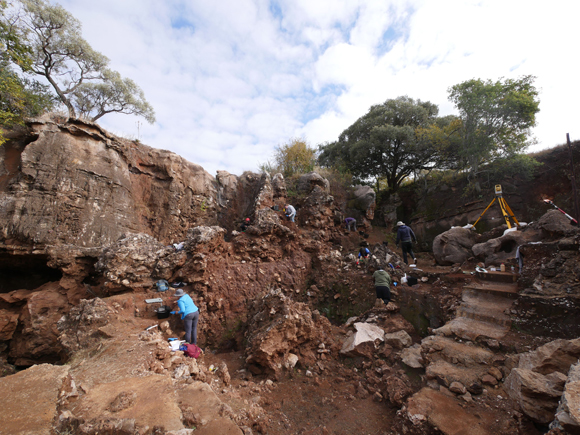
Field team members at the Paranthropus excavation site.
Paranthropus excavation site.  The Drimolen Main Quarry (DMQ) has provided palaeoanthropologists with a treasure trove of early hominin fossils as well as the bones and teeth of a number of contemporaneous early Pleistocene animals.

Picture credit: Andy Herries, La Trobe Archaeology

Describing Paranthropus robustus

Although, small in stature compared to modern humans, these early hominins were strongly built, small-brained and they possessed particularly robust jaws and large teeth.  Adaptations for a mainly vegetarian diet consisting of roots and tubers.  Paranthropus robustus co-existed with other direct human ancestors and is regarded as a “cousin species” to the hominin lineage that led to Homo sapiens.  The researchers postulate that the DNH 155 specimen provides the first high resolution evidence for microevolution within an early hominin species.

The most complete P. robustus skull (DNH 7), which was found at the DMQ site in 1994, differs from other P. robustus skull material found at other chronologically younger locations.  These differences had been put down to sexual dimorphism, with DNH 7 believed to represent the skull of a female.  This led palaeoanthropologists to speculate that if there was sexual dimorphism within the Paranthropus genus then these hominins could have lived in social groups like extant gorillas, with a large dominant male looking after a number of females and their offspring.

Examining the Skulls

However, the newly described DNH 155 skull shares a number of characteristics with the contemporaneous DNH 7 skull.

Co-lead author Jesse Martin (La Trobe University), explained the significance of DNH 155 stating that it could lead to a revised system for classifying and understanding the palaeobiology of human ancestors.

The PhD student commented:

“Demonstrating that Paranthropus robustus is not especially sexually dimorphic removes much of the impetus for supposing that they lived in social structures similar to gorillas, with large dominant males living in a group of smaller females.  The DNH 155 male fossil from Drimolen is most similar to female specimens from the same site, whereas Paranthropus robustus specimens from other sites are appreciably different.”

PhD Student Jesse Martin and Co-author Dr Angeline Leece Examine the Skull
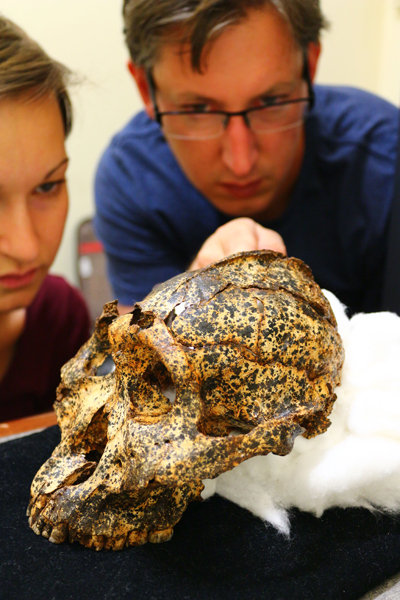
PhD student Jesse Marting and Dr Angeline Leece examine the Paranthropus skull.
Dr Angeline Leece and PhD student Jesse Martin examine the Paranthropus skull specimen.

Picture credit: Andy Herries, La Trobe Archaeology

A Rare Example of Microevolution within Hominins

Mr Martin said the discovery is a rare example of microevolution within a human lineage, showing that Paranthropus robustus evolved their powerful jaws and strong teeth, adaptations that evolved incrementally, possibly over hundreds of thousands of years in response to environmental change.

Mr Martin added:

“The Drimolen fossils represent the earliest known, very first step in the long evolutionary story of Paranthropus robustus.”

Professor Andy Herries elucidated:

“The DNH 155 cranium shows the beginning of a very successful lineage that existed in South Africa for a million years.  Like all other creatures on Earth, to remain successful our ancestors adapted and evolved in accordance with the landscape and environment around them.  For the first time in South Africa, we have the dating resolution and morphological evidence that allows us to see such changes in an ancient hominin lineage through a short window of time.

“We believe these changes took place during a time when South Africa was drying out, leading to the extinction of a number of contemporaneous mammal species.  It is likely that climate change produced environmental stressors that drove evolution within Paranthropus robustus.”

Staring at the Face of DNH 155 (Male P. robustus)
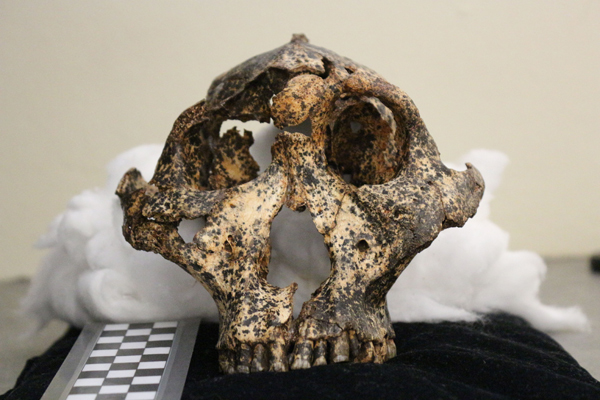
Paranthropus robustus specimen (anterior view).
The face of the Paranthropus specimen (DNH 155).

Picture credit: Andy Herries, La Trobe Archaeology

Paranthropus robustus Co-existed with Homo erectus

Co-lead author, La Trobe’s Dr Angeline Leece, said it was important to know that Paranthropus robustus appeared at roughly the same time as our direct ancestor Homo erectus, as demonstrated by the H. erectus fossil material representing the skull of a child found within a few metres of DNH 155.

Dr Leece commented:

“These two vastly different species, Homo erectus with their relatively large brains and small teeth, and Paranthropus robustus with their relatively large teeth and small brains, represent divergent evolutionary experiments.  Through time, Paranthropus robustus likely evolved to generate and withstand higher forces produced during biting and chewing food that was hard or mechanically challenging to process with their jaws and teeth – such as tubers.  Future research will clarify whether environmental changes placed populations under dietary stress and how that impacted human evolution.”

As Dr Leece pointed out, whilst the lineage made up of our direct ancestors survived this period of environmental change and the Paranthropus genus is extinct having left no direct descendants, the fossil record indicates that two million years ago, Paranthropus robustus was much more common than Homo erectus.  The Drimolen project is likely to continue to play a key role in helping us to understand the evolutionary history of our own species and the fates of those other hominins that ultimately became extinct.

Important Implications for Interpreting the Human Fossil Record

Co-author Professor David Strait (Department of Anthropology, Washington University in St. Louis USA), stated the DNH 155 skull fossil had important implications for interpreting diversity in the fossil record of hominins.

He explained:

“We think that palaeoanthropology needs to be a bit more critical about interpreting variation in anatomy as evidence of the presence of multiple species.  Depending on the ages of fossil samples, differences in bony anatomy might represent changes within lineages rather than evidence of multiple species.”

Everything Dinosaur acknowledges the assistance of a media release from La Trobe University in the compilation of this article.

The scientific paper: “Drimolen cranium DNH 155 documents microevolution in an early hominin species” by Jesse M. Martin, A. B. Leece, Simon Neubauer, Stephanie E. Baker, Carrie S. Mongle, Giovanni Boschian, Gary T. Schwartz, Amanda L. Smith, Justin A. Ledogar, David S. Strait and Andy I. R. Herries published in Nature Ecology & Evolution.

The Everything Dinosaur website: Prehistoric Animal Models and Dinosaur Toys.
7 11, 2020

The First Hadrosaurid Dinosaur From Africa

By |2024-03-19T12:22:58+00:00November 7th, 2020|Categories: Adobe CS5, Dinosaur and Prehistoric Animal News Stories, Dinosaur Fans, Main Page, Palaeontological articles|0 Comments

The First Duckbill from Africa

Fragmentary fossils including parts of a jawbone have led an international team of scientists to announce the discovery of a new species of dinosaur from the Late Cretaceous of Morocco.  A number of dinosaurs have been described from the marine sediments that comprise the economically important phosphate deposits associated with  the Ouled Abdoun Basin of north-central Morocco, but this new discovery is of particular significance.  These are the first fossils of a hadrosaur known from Africa and it suggests that these duck-billed dinosaurs were capable of crossing hundreds of miles of open ocean to reach new habitats.  The lambeosaurine dinosaur has been named Ajnabia odysseus.

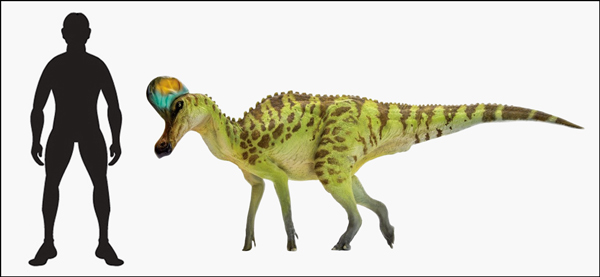
A Life Reconstruction of the Newly Described Lambeosaurine Ajnabia odysseus

Ajnabia odysseus life reconstruction.
A life reconstruction of the dwarf hadrosaurid Ajnabia odysseus.

Picture credit: Raul Martin

Ajnabia odysseus – A Lambeosaurine Hadrosaur

The genus name means stranger or foreigner in Arabic, a reference to the fact that these ornithischian dinosaurs were not known from Africa.  The species name is a reference to Odysseus the sea-faring hero of Homer’s epic poem “Odyssey”.  The researchers which include Dr Nicholas Longrich (University of Bath) and Professor Nour-Eddine Jalil  from the Department of Geology (FSSM), at the University Cadi Ayyad (Morocco), comment that this dinosaur lived about a million years before the end-Cretaceous extinction event (Late Maastrichtian).

A phylogenetic assessment suggests that Ajnabia was closely related to European hadrosaurs (the Arenysaurini, a clade of lambeosaurines previously known only from France and Spain).

The teeth and jawbone permitted the scientists to assign it to the lambeosaurine branch of the Hadrosauridae, a group of duck-billed dinosaurs famed for their elaborate and ornate hollow crests.  It is very likely that the lambeosaurine dinosaurs evolved in North America and then spread into Asia via a northern land bridge before moving into Europe and finally crossing deep and wide seas to reach North Africa.

The specimen suggests that this dinosaur was a dwarf when compared to its more famous and geologically older relatives from North America such as Corythosaurus, Parasaurolophus and Lambeosaurus.  The research team estimate the Ajnabia was around three metres long.

A Scale Drawing of the Newly Described Moroccan Lambeosaurine A. odysseus

Ajnabia odysseus scale drawing.
A scale drawing of the newly described lambeosaurine from Morocco Ajnabia odysseus. Picture credit: Everything Dinosaur.

Picture credit: Everything Dinosaur

Distinct Dinosaur Dominated Terrestrial Faunas

By the Late Cretaceous distinct dinosaur dominated terrestrial faunas had been established in the Northern and Southern Hemispheres.  This had been driven by the continued break-up of the landmass that once was the super-continent Pangaea, the widening of the Atlantic and a rise in global sea levels.

The Northern Hemisphere dinosaur biota was characterised by duck-billed dinosaurs, the Ceratopsia (horned dinosaurs) with tyrannosaurids occupying the niche of apex predators.

The Southern Hemisphere dinosaur biota was characterised by the continuation of the titanosaurian sauropods with members of the Abelisauridae as top predators.

The scientists conclude that hadrosaurs must have crossed hundreds of miles of ocean to rich Africa.  These plant-eating dinosaurs with their powerful, deep tails were very probably capable swimmers so such feats may not have been beyond them.  After all the estuarine crocodile (Crocodylus porosus), has been known to cross wide stretches of open water and has been spotted far out to sea.

Perhaps, dinosaurs were swept out to sea on rafts of vegetation following a storm event, which permitted them to colonise new habitats.

A Modern Analogy – Iguanas on the Island of Anguilla

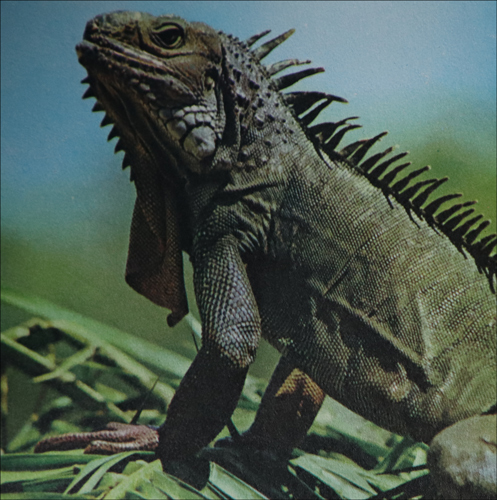
Green iguanas were found to be living on the Caribbean island of Anguilla when they had not been reported from the island before.   Biologists concluded that hurricanes in 1995 had led to trees that originated in Guadaloupe some two hundred miles to the south-east of Anguilla, where the iguanas are indigenous, being washed ashore.  It is thought that a group of these reptiles drifted out to sea and after about three weeks, the trees, with their unintentional lizard cargo made landfall on the island.

An Unlikely Seafarer – An Iguana

An iguana.
Iguanas made the sea crossing from Guadaloupe to Anguilla carried to the island by trees uprooted and washed out to sea during a hurricane. Picture credit: Everything Dinosaur.

Picture credit: Everything Dinosaur

Dr Longrich commented:

“Over millions of years, once-in-a-century events are likely to happen many times.  Ocean crossings are needed to explain how lemurs and hippos got to Madagascar, or how monkeys and rodents crossed from Africa to South America.”

Ajnabia odysseus Colonised New Territories

Writing in the academic journal “Cretaceous Research”, the scientists conclude that as there were extensive and long-lasting seaways separating Africa and Europe from other landmasses and in the absence of any evidence for a two-way faunal interchange characterised by land bridges, it is likely that some animals were able to colonise new territories either by swimming to them or perhaps by being castaways.  Such patterns of dispersal are seen with both extant or ancestral forms of mammals, reptiles and amphibians.  This newly published paper suggests that dinosaurs too, were capable of travelling across oceans.

Dr Longrich added:

“As far as I know, we are the first to suggest ocean crossings for dinosaurs.”

Co-author Professor Nour-Eddine Jalil summarised the importance of this fossil find from a Moroccan phosphate mine by stating:

“The succession of improbable events (crossing an ocean by a dinosaur, fossilisation of a terrestrial animal in a marine environment) highlights the rarity of our find and therefore its importance.  Ajnabia shows us that hadrosaurs have set foot on African land, telling us that ocean barriers are not always an insurmountable obstacle.”

The scientific paper: “The first duckbill dinosaur (Hadrosauridae: Lambeosaurinae) from Africa and the role of oceanic dispersal in dinosaur biogeography” by Nicholas R. Longrich, Xabier Pereda Suberbiola, R. Alexander Pyron and Nour-Eddine Jalil, published in Cretaceous Research.

Visit the Everything Dinosaur website: Everything Dinosaur.

5 11, 2020

Plateosaurus Juveniles Looked a Lot Like Adult Plateosaurus

By |2024-03-19T12:12:35+00:00November 5th, 2020|Categories: Dinosaur and Prehistoric Animal News Stories, Dinosaur Fans, Main Page|0 Comments

Plateosaurus Juveniles Looked a Lot Like Adult Plateosaurus

A team of scientists including researchers from the University of Bonn (Germany), have concluded that baby Plateosaurus were miniature versions of their parents, that is, this Late Triassic member of the Sauropodomorpha had a largely fully developed morphology at an early age.  Unlike most other long-necked dinosaurs, its body proportions did not change dramatically as the creature grew and matured.

This research published this month in the journal Acta Palaeontologica Polonica, focuses on the analysis and study of a juvenile specimen of Plateosaurus discovered in 2015 at the Frick fossil site in Switzerland.  Plateosaurus is one of the best known Late Triassic dinosaurs due to the discovery of extensive bone beds consisting of the fossilised bones of hundreds of individual animals, but to find an almost complete specimen of a juvenile is an exceptionally rare event in vertebrate palaeontology.

Studying Plateosaurus Juveniles

Explaining the lack of juvenile specimens to study, lead author Professor Martin Sander (University of Bonn) stated:

“The smaller individuals probably did not sink into the mud quite as easily and are therefore underrepresented at the bone beds.”

The young Plateosaurus was nicknamed “Fabian” and it looked very similar to its parents even at a young age.  The fact that Plateosaurus showed a largely fully developed morphology at an early age could have important implications for how the young animals lived and moved around.

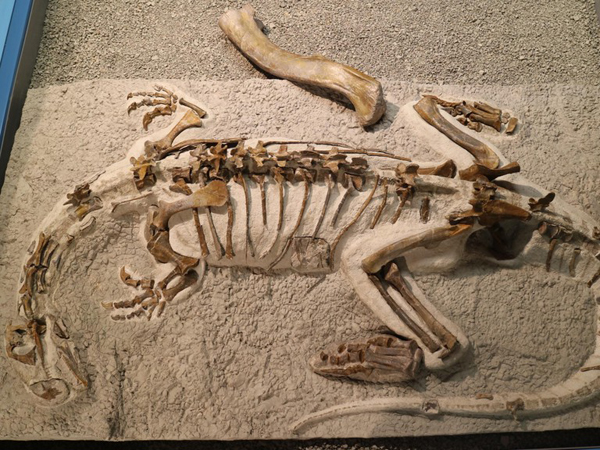
“Fabian” The Juvenile Plateosaurus Specimen

A skeleton of a Plateosaurus juvenile on display.
“Fabian” the Plateosaurus juvenile.  The large bone at the top is an adult Plateosaurus thigh bone (femur) showing a size comparison.

Picture credit: Sauriermuseum Frick, Switzerland

The picture (above), shows the juvenile Plateosaurus specimen that was the focus of the study, (top) an adult Plateosaurus femur (thigh bone) for comparison.

Plateosaurus – An Early European Giant

Known from the Norian faunal stage of the Late Triassic, this herbivorous dinosaur roamed much of what is now North America, Greenland and continental Europe between 222 and 210 million years ago.  Size estimates vary but some palaeontologists have postulated that Plateosaurus reached lengths of around ten metres and weighed up to four tonnes.  It was one of the largest terrestrial animals on the planet during the Late Triassic.

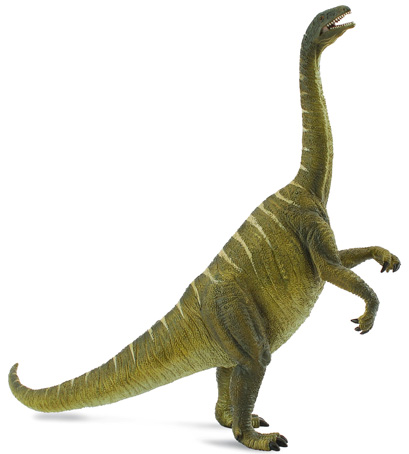
A Model of a Plateosaurus Dinosaur

A Plateosaurus dinosaur model.
A rearing Plateosaurus.  Palaeontologists believe that this dinosaur was a facultative biped.

The picture (above) shows a CollectA Age of Dinosaurs Plateosaurus figure.

To view this model range: CollectA Age of Dinosaurs Figures.

Professor Martin Sander and his team used comparative anatomy to examine “Fabian” and based on the length of the vertebrae they estimate that this dinosaur was about 2.3 metres long when it died with a body weight of around 40-60 kilograms.  The small size of the specimen led the team to propose that the fossils represented a very young animal, this was confirmed when bone sutures in the spinal column were found not to have fully fused.

Young and Old Plateosaurus Resembled Each Other Anatomically

The detailed analysis demonstrated that the young dinosaur resembled its older relatives in anatomical details, such as the pattern of the laminae on the vertebrae (bony struts connecting parts of the vertebrae and helping to protect the spinal cord).

Co-author Darius Nau (University of Bonn), commented:

“The hands and neck of the juveniles may be a little longer, the arm bones a little shorter and slimmer.  But overall, the variations are relatively small compared to the variation within the species overall and also compared to other dinosaur species”.

In contrast, the juveniles of the related Mussasaurus for example, were quadrupedal when young, whilst the adults appear to have been fully bipedal.

Implications for the Plateosaurus Genus

Much lighter than the adults, the body proportions of a young Plateosaurus were very similar to those of a mature animal, although an adult Plateosaurus was perhaps as much as a hundred times heavier than “Fabian”.  However, it is conceivable that the morphological development differed greatly from individual to individual, depending on the climatic conditions or the availability of food and other resources within the environment.  Such differences are still seen in extant reptile populations.

The scientific paper: “Postcranial osteology of the first early-stage juvenile skeleton of Plateosaurus trossingensis from the Norian of Frick, Switzerland” by Darius Nau, Jens N. Lallensack, Ursina Bachmann, and P. Martin Sander published in Acta Palaeontologica Polonica.

Visit the Everything Dinosaur website: Everything Dinosaur.

3 11, 2020

Research Maps the Brain of an Early Dinosaur

By |2024-03-19T11:57:07+00:00November 3rd, 2020|Categories: Adobe CS5, Dinosaur and Prehistoric Animal News Stories, Dinosaur Fans, Main Page, Palaeontological articles|0 Comments

Buriolestes schultzi – A Relatively “Smart” Sauropodomorph

The huge sauropods such as Apatosaurus, Brachiosaurus, Mamenchisaurus and Brontosaurus are not regarded as particularly clever animals.  Their brains were extremely small when compared to their huge body sizes, therefore any consideration of a “smart” sauropod is greatly undermined by their miniscule encephalisation quotient (ratio of brain size to body size).  However, this lineage of lizard-hipped dinosaurs survived for over a 130 million years and they were extremely successful being both speciose and geographically widespread.

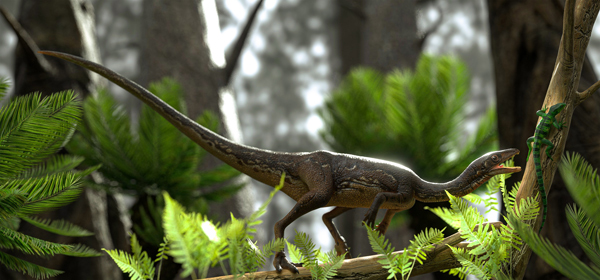
A newly published paper provides an insight into the evolutionary development of the brains of these types of dinosaurs.  Writing in the academic “Journal of Anatomy” scientists report upon the study of the near perfectly preserved neurocranium of Buriolestes schultzi, a member of the Sauropodomorpha known from the Carnian faunal stage of the Late Triassic of Brazil.  The researchers conclude that although the brain of this emu-sized dinosaur was very small, it probably had acute vision and fast reactions – very useful when you are actively pursuing prey.

A Life Reconstruction of the Triassic Sauropodomorph Buriolestes schultzi

A Life Reconstruction of Buriolestes schultzi.
Buriolestes schultzi life reconstruction.  Scientists believe that this Late Triassic sauropodomorph as an agile, predator with a brain adapted to a fast, cursorial, predatory lifestyle.

Picture credit: Márcio L. Castro

A Well-developed Flocculus of the Cerebellum

Buriolestes roamed what is now the Rio Grande do Sul region of southern Brazil around 233 million years ago.  It was a lightweight, bipedal, omnivorous dinosaur part of a group whose descendants would evolve into the giant sauropods of the Jurassic and Cretaceous.  Researchers from the Federal University of Santa Maria in collaboration with colleagues from the Universidade de São Paulo (both institutions in Brazil), used computerised tomography to create a three-dimensional landscape of the inside of the skull of a fossil specimen in order to map the various regions of the brain.

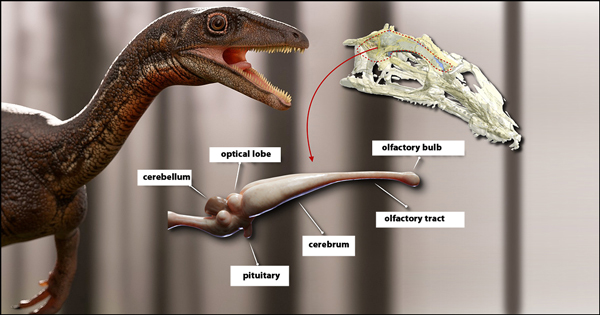
They discovered that Buriolestes had a well-developed flocculus region of its cerebellum, a part of the brain linked to motor skills and co-ordination.  The analysis also revealed an elongated olfactory tract (related to sense of smell), combined to a relatively small pituitary gland, but the area of the brain associated with processing information from the eyes was much more sophisticated.  The researchers inferred that the eyes were essential in the pursuit of prey, that vision was the dominant sense of Buriolestes.

Mapping the Brain of a Late Triassic Sauropodomorph (B. schultzi)

The brain of Buriolestes schultzi.
A diagram showing the skull of Buriolestes schultzi and the skull along with a diagram of the dinosaur’s brain.

Picture credit: Márcio L. Castro

The Senses of Buriolestes

Commenting on the research, one of the co-authors of the paper, palaeontologist Mario Bronzati (Universidade de São Paulo), stated:

“The dinosaur [Buriolestes] had a faunivorous diet.  Unlike a carnivore, which is restricted to eating meat from other animals, the faunivore also includes the ingestion of insects and other small invertebrate animals.  This characteristic, as well as its size, makes the species quite different from the most famous representatives of its lineage, the sauropod giants and herbivores which were the largest animals ever to walk the Earth.”

The team concluded that the characteristics of the brains of these types of dinosaurs changed dramatically as they evolved an entirely herbivorous diet and developed huge body sizes.  Whilst Buriolestes was an agile, swift hunter the later sauropods evolved brains more suited to their particular niche in dinosaur dominated terrestrial communities.

Jurassic sauropods such as Brontosaurus and Diplodocus had higher olfactory capabilities when compared to Buriolestes.   This more developed sense of smell is believed to play a role in foraging, helping plant-eaters to discriminate between digestible and indigestible vegetation.  Having a better sense of smell may also have been important in the later sauropods if they were social animals living in herds.  For example, higher olfactory capabilities are associated with vertebrates with more complex social behaviours, it is important for these herding animals to be able to detect and track chemical secretions.

First Calculations of the Reptile Encephalization Quotient (REQ) for a Triassic Dinosaur

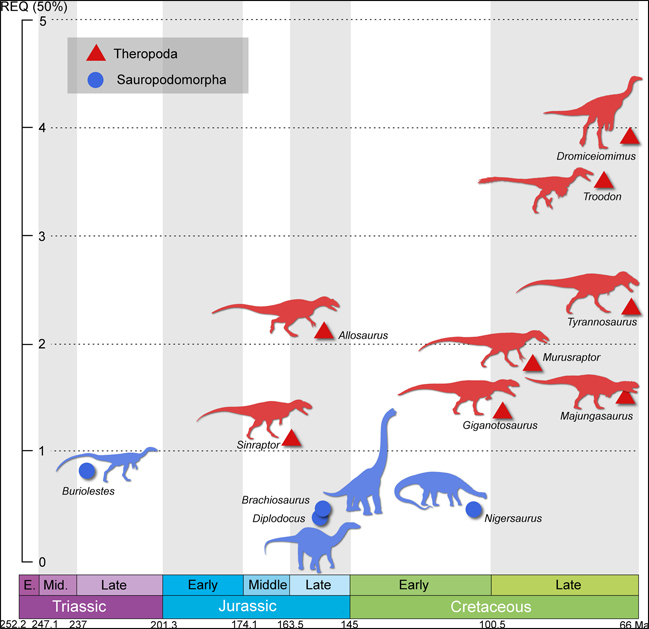
As well as providing information on how the brains sauropodomorphs evolved and changed over time, the researchers were able to plot the Reptile Encephalisation Quotient (REQ) for Buriolestes, the first time this has been calculated for a Triassic dinosaur.  The Reptile Encephalisation Quotient essentially correlates an animal’s physical characteristics with perceived intelligence, it provides an estimate of how “smart” an animal might be.

Time‐calibrated Reptile Encephalisation Quotient (REQ; 50%) of Selected Saurischians

Comparing the Reptile Encephalisation Quotient of selected saurischians.
Measuring the time-calibrated Reptile Encephalisation Quotient (REQ) of selected lizard-hipped dinosaurs.  The sauropodomorph Buriolestes had a higher REQ than later sauropods but its REQ was lower than the theropods included within the study.

Picture credit: Müller et al (Journal of Anatomy)

The scientists found that B. schultzi had a REQ lower than most Jurassic theropod dinosaurs, but much higher than that of later, much larger sauropodomorphs.  Although, the lack of fossils to study prevents the researchers from comparing the REQ of Buriolestes with contemporaneous animals, the team do suggest that when Jurassic sauropods are considered, it could be that encephalisation tended to decline in this dinosaur lineage.

To read an early article (2016) about Buriolestes by Everything Dinosaur: When Did the Dinosaurs Dominate the Land?

The scientific paper: “The endocranial anatomy of Buriolestes schultzi (Dinosauria: Saurischia) and the early evolution of brain tissues in sauropodomorph dinosaurs” by Rodrigo T. Müller, José D. Ferreira, Flávio A. Pretto, Mario Bronzati and Leonardo Kerber published in the Journal of Anatomy.

The Everything Dinosaur website: Everything Dinosaur.

29 10, 2020

New DNA Study Highlights Ancient Relationship Between Us and Dogs

By |2024-03-19T08:43:40+00:00October 29th, 2020|Categories: Dinosaur and Prehistoric Animal News Stories, Main Page, Photos/Pictures of Fossils|0 Comments

Dogs Really are Our Oldest Friends

An international team of scientists including researchers from The Francis Crick Institute (London), University College Dublin, Ludwig Maximillian University (Munich), Stockholm University (Sweden) and Liverpool John Moores University, have collaborated together in order to sequence a total of 27 ancient dog genomes in a bid to unravel the evolution of the domestic dog.  Dogs are widely believed to be the first animal to be domesticated, but very little is known about their population history and to what extent population changes are linked to humans.

Writing in the academic journal “Science”, the researchers present evidence that there were different types of dogs more than 11,000 years ago in the period immediately following the last Ice Age.

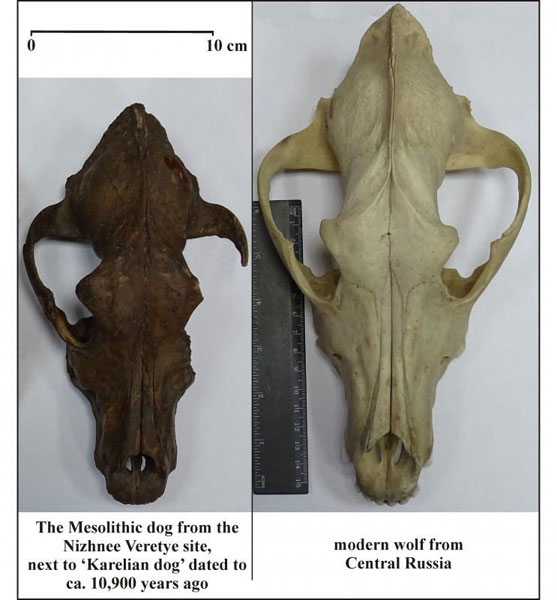
One of the Ancient Dog Skulls Compared to the Skull of a Modern Wolf

Mapping ancient dog DNA.
Mesolithic dog skull (left) compared to wolf skull (right).

Picture credit: E. E. Antipina (Institute of Archaeology of the Russian Academy of Sciences)

By sequencing the ancient DNA from the 27 specimens, some of which lived around 11,000 years ago, the team found that by the end of the last Ice Age before any other animal had been domesticated, there were already at least five different types of dog with distinct genetic ancestries.

This study suggests that the diversity observed between dogs in different parts of the world today originated when all humans were hunters and gatherers.

Commenting on the significance of this research Pontus Skoglund (The Francis Crick Institute) stated:

“Some of the variation you see between dogs walking down the street today originated in the Ice Age.  By the end of this period, dogs were already widespread across the northern hemisphere.”

Extracting Genetic Information from Skeletons

By extracting genetic information from the skeletons of ancient dogs the team were able to analyse the DNA they found providing a window into the past.  They were able to show that over the last ten millennia these early dog lineages mixed and moved giving rise to the dogs we know today.  For example, the researchers calculated that early European dogs were initially diverse, most likely originating from two highly distinct populations, one related to Near Eastern dogs and another cluster related to dogs from Siberia.  However, at some point this diversity was lost, as it is not found in European dogs today.

Lead author Anders Bergström, a post-doctoral researcher at The Francis Crick Institute commented:

“If we look back more than four or five thousand years ago, we can see that Europe was a very diverse place when it came to dogs.  Although the European dogs we see today come in such an extraordinary array of shapes and forms, genetically they derive from only a very narrow subset of the diversity that used to exist.”

DNA Studies Unravels Dog Evolution and the Evolution of Wolves

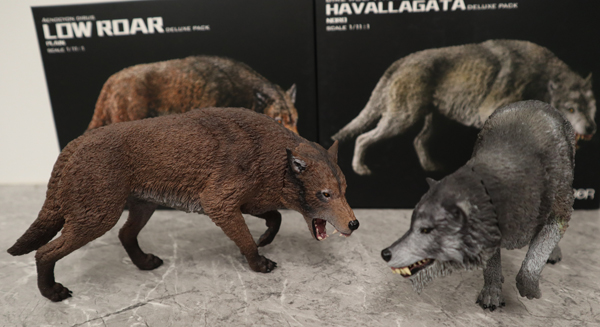
Rebor dire wolf figures.
A pair of prowling dire wolves. Rebor dire wolf (Aenocyon dirus) low roar deluxe pack (left) and the Rebor dire wolf/fantasy figure Havallagata (right). Picture credit: Everything Dinosaur.

Picture credit: Everything Dinosaur

The picture (above) shows two models of dire wolves (Aenocyon dirus). These are Rebor figures. Genetic analysis of dire wolf fossils has revealed that these animals are not closely related to North American wolves.

To view the Rebor range of models and figures: Rebor Figures and Models.

Comparing Human Evolution to Dog Evolution

The researchers also compared the evolution in dog population to changes in human evolution, lifestyles and migrations.  In many cases comparable changes took place, likely reflecting how humans would bring their dogs with them as they migrated across the world.  However, this study also identified that dog evolution and human history do not mirror each other.  The loss of European dog diversity is not reflected in human population studies.

Co-author Ron Pinhasi (University of Vienna), added:

“Just as ancient DNA has revolutionised the study of our own ancestors, it’s now starting to do the same for dogs and other domesticated animals.  Studying our animal companions adds another layer to our understanding of human history.”

This newly published research might provide a fresh perspective on the early history of dog populations and their relationship with our own species, but still, many questions remain.  Dogs may have been the first animal to become domesticated, likely originating from wolves that associated with humans, however, when and how the first wolves became dogs is still not known.

The scientific paper: “Origins and genetic legacy of prehistoric dogs” by Anders Bergström, Laurent Frantz, Ryan Schmidt, Erik Ersmark, Ophelie Lebrasseur, Linus Girdland-Flink et al published in the journal Science.

Visit the Everything Dinosaur website: The Everything Dinosaur Website.

28 10, 2020

Microscopic Analysis of Pterosaur Teeth Provides Guide to Diet

By |2024-03-19T08:31:31+00:00October 28th, 2020|Categories: Adobe CS5, Dinosaur and Prehistoric Animal News Stories, Dinosaur Fans, Main Page, Palaeontological articles, Photos/Pictures of Fossils|0 Comments

Members of the Pterosauria Undergo Dental Examination

Visiting the dentist can be a daunting experience for some, but for seventeen different species of pterosaur, a microscopic analysis of wear on the teeth has provided palaeontologists with a fresh perspective on the diets and lifestyles of these enigmatic flying reptiles.

Scientists from the University of Birmingham and the University of Leicester’s Centre for Palaeobiology Research studied dental wear patterns preserved on the fossilised teeth of the specimens and then compared these wear patterns to those found on the teeth of living reptiles including crocodilians and monitor lizards whose diets are known.

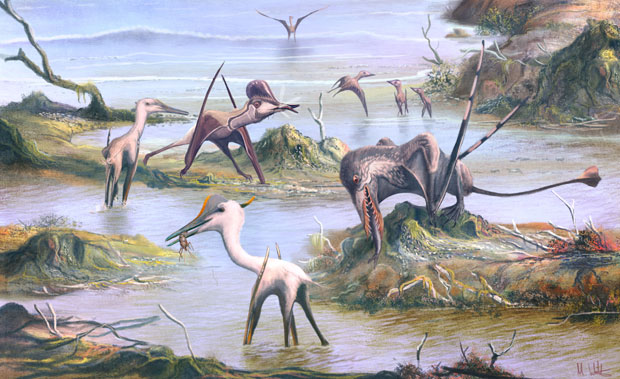
A Newly Published Scientific Paper Reveals New Data on the Diets of Pterosaurs

Pterosaur ecology, a fresh insight into the diets of the Pterosauria.
Pterosaur feeding strategies.  A study of dental microwear provides a new perspective on the diets of flying reptiles.

Picture credit: Mark Witton

Studying Pterosaur Teeth

The researchers were able to demonstrate for the first time how microscopic dental wear analysis can be used to inform palaeontologists about the diet of an extinct animal but to also challenge existing ideas and perceptions about lifestyle and behaviour.

The scientific paper detailing their results are published in the academic journal “Nature Communications”.

Lead author of the study, Dr Jordan Bestwick (University of Birmingham’s School of Geography, Earth and Environmental Sciences), commented:

“Most existing ideas about what pterosaurs ate come from comparisons of the shapes of their teeth with those of living animals.  For example, if the animal had conical teeth like a crocodile, we might assume it ate fish.  But this approach has obvious shortcomings – the teeth of pandas and polar bears, for example, are similar, but comparing them wouldn’t give us an accurate picture of their diets.”

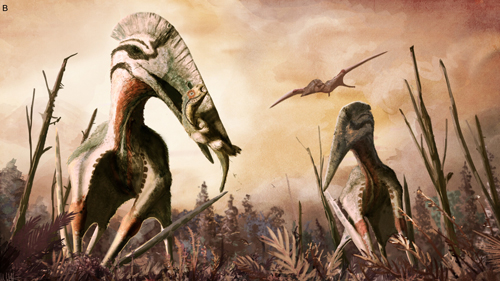
Did Some Super-sized Pterosaurs Eat Dinosaurs?

Powerful necked Hatzegopteryx feeds on a dinosaur.
Transylvanian giant azhdarchid pterosaur Hatzegopteryx sp. preys on the rhabdodontid iguanodontian Zalmoxes.

Picture credit: Mark Witton

Durophagus Diets

The analysis showed that modern reptiles with rougher wear on their tooth surfaces are more likely to have eaten crunchy things, such as shelled invertebrates – beetles or crabs.  Eating hard-shelled animals or creatures with a tough exoskeleton such as some types of insect is referred to as durophagy.  Reptiles which eat mainly soft items, such as fish, have smoother tooth surfaces, which show less wear.  By applying the technique to pterosaurs, the scientists were able to comment on the likely diet of each species.

Dr Bestwick added:

“Our analysis has yielded some fascinating insights into individual species, but also into some of the bigger questions around how these pterosaurs evolved and whether their lifestyles were more similar to those of extant birds or reptiles.  Evidence from dental microwear analysis can shed new light on this debate.”

Professor Mark Purnell, Professor of Palaeobiology at the University of Leicester explained:

“This is the first time this technique has been applied in this way to ancient reptiles, and it’s great to find it works so well.  Often, palaeontologists have very little to go on when trying to understand what extinct animals ate.  This approach gives us a new tool, allowing us to move from what are sometimes little more than educated guesses, into the realms of solid science.”

Examining the Diet of Rhamphorhynchus

In one example, the team examined the teeth of Rhamphorhynchus, a long-tailed pterosaur from the Jurassic period.  Researchers found that juvenile Rhamphorhynchus had insect-based diets, whereas their adult counterparts – about the size of a large seagull – were more likely to have eaten fish.  This suggests a species in which the adults took little care of their young (precocial behaviour) – a behaviour that is common in reptiles and is not exhibited by birds.

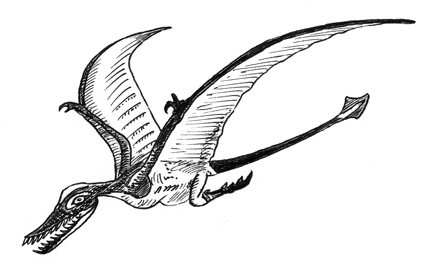
A Rhamphorhynchus Illustration (R. muensteri)

Rhamphorhynchus illustration
Flying low over the water, an adult Rhamphorhynchus is looking for fish to eat. Picture credit: Everything Dinosaur.

Picture credit: Everything Dinosaur

Looking at Pterosaur Evolution

The research team also investigated whether their analysis could shed light on how different species of pterosaurs evolved.  The first pterosaurs evolved during the Triassic and they survived until the very end of the Mesozoic some 66 million years ago, becoming extinct at the same time as their archosaur relatives the dinosaurs.  In that time, according to the dental microwear analysis, there was a general shift in diet from invertebrates such as insects, towards a more meat or fish-based diet.

Commenting on the potential significance of this dietary shift, Dr Bestwick stated:

“We found that the earliest forms of pterosaurs ate mainly crunchy invertebrates.  The shift towards eating fish or meat coincides with the evolution of birds.  We think it’s possible, therefore, that competition with birds could explain the decline of smaller-bodied pterosaurs and a rise in larger, carnivorous species.”

Birds Competing with Pterosaurs

It is an intriguing thought, although the fossil record of the Pterosauria is far from complete and there is a degree of bias towards the most productive pterosaur-fossil bearing strata such as deposits associated with the Crato and Santana Formations of the Early Cretaceous, which prevents a detailed assessment of pterosaur diversity over the duration of the Mesozoic from the Norian onwards.

Natalia Jagielska, a PhD researcher in pterosaur palaeontology based at the University of Edinburgh, (not involved in this study), commented that the research adds much-needed clarity to the behaviour and ecological role of pterosaurs in ancient food webs.

“Pterosaurs are a fascinating group of Mesozoic reptiles with astounding diversity in tooth morphology.  This study is important for contributing to the idea that young Rhamphorhynchus were independent invertebrate hunters before becoming fish consumers, rather than being fed and nurtured by parents, like birds.  Or that in pterosaur-rich environments, like the Late Jurassic Bavarian lagoons, pterosaur species have partitioned to occupy variations of dietary niches.”

The authors of the scientific paper are confident that this new research will provide a benchmark assisting in the interpretation of the diet of long extinct reptiles and in doing so, will lead to an improved understanding of ancient ecosystems.

Everything Dinosaur acknowledges the contribution of a media release from the University of Birmingham in the compilation of this article.

The Everything Dinosaur website: Everything Dinosaur.

20 10, 2020

Mapping the Genome of the Scimitar-Toothed Cat Homotherium latidens

By |2024-03-19T06:47:59+00:00October 20th, 2020|Categories: Dinosaur and Prehistoric Animal News Stories, Dinosaur Fans, Main Page, Photos/Pictures of Fossils|0 Comments

Mapping the Genome of Homotherium latidens

The diverse and geographically widespread machairodonts, a subfamily of the cat family (Felidae), have fascinated palaeontologists for a very long time and there is still a great deal of research directed towards these sabre-toothed predators.  Recently, Everything Dinosaur published an article that looked at how those enlarged canines might have been used by different types of sabre-toothed creature known from the fossil record: Sabre-toothed Predators Evolved Different Hunting Styles.  However, a team of international scientists led by researchers from the University of Copenhagen (Denmark), have taken a more holistic view when it comes to these long-fanged mammals.

Homotherium latidens

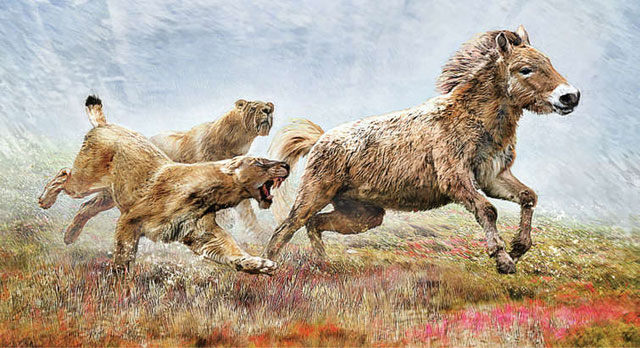
They have mapped the entire nuclear genome of the machairodont Homotherium latidens and their research suggests that this tiger-sized carnivore was a highly social, pursuit predator.

A Pack of Homotherium Pursue a Prehistoric Horse

Homotherium latidens a cursorial pack hunter?

A pack of Homotherium latidens chasing a prehistoric horse.  What an amazing example of paleoart – our congratulations to the artist.

Picture credit: Velizar Simeonovski/University of Copenhagen

Scimitar-toothed Cat

Writing in the academic journal “Current Biology”, the scientists were able to extract DNA from a H. latidens specimen found in thawing Pleistocene permafrost near Dawson City in the Yukon Territory (Canada).  A variety of modern genomic sequencing strategies were applied to reveal a map of the entire genome of the fossil.  The data was then compared to living felids such as the domestic cat as well as lions and tigers.  The DNA study reveals what genes were highly selected upon and important in evolution of the species.

Commenting on the significance of this research, Michael Westbury, a co-author of the paper based at the University of Copenhagen stated:

“Their genetic makeup hints towards scimitar-toothed cats being highly skilled hunters.  They likely had very good daytime vision and displayed complex social behaviours.  They had genetic adaptations for strong bones and cardiovascular and respiratory systems, meaning they were well suited for endurance running.  Based on this, we think they hunted in a pack until their prey reached exhaustion with an endurance-based hunting-style during the day light hours.”

Endurance-based Hunting

This type of hunting behaviour is sometimes seen in lions today, although they are mainly ambush predators and they also hunt at night.  Perhaps the most relevant modern analogue to the hunting behaviour proposed for Homotherium latidens is that of the gray wolf (Canis lupus), which is primarily a diurnal, pursuit predator of large prey.

For replicas of sabre-toothed cats and other prehistoric mammals: CollectA Deluxe Prehistoric Life Scale Figures.

Homotherium latidens was Genetically Diverse

The genome analysis also revealed that this scimitar-toothed cat was genetically very diverse when compared to extant cat species.

Doctor Westbury, a postdoctoral researcher in the GLOBE Institute at the University of Copenhagen also stated:

“We know that genetic diversity correlates to how many of a given species that exists.  Based on this, our best guess is that there were a lot of these big cats around.  This also makes perfect sense given that their fossils have been found on every single continent except Australia and Antarctica.”

To read a related article about the discovery of a treasure trove of prehistoric mammal fossils including machairodonts that have been found in Venezuela: Oil Companies Assist with Huge Fossil Discovery.

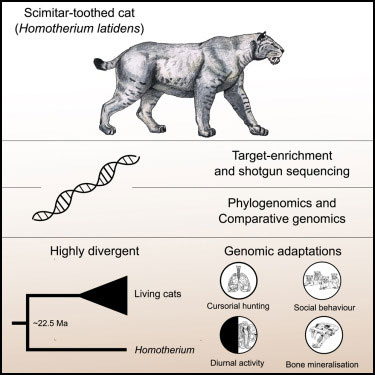
The Genome of the Extinct Machairodont Homotherium latidens has been Mapped

Mapping the genome of Homotherium latidens.

Researchers have mapped the genome of the prehistoric cat Homotherium latidens.  The analysis suggests that these cats were highly social and adapted to a long pursuit, endurance form of hunting.

Picture credit: University of Copenhagen/Current Biology

Homotherium Distantly Related to Extant Felids

The study demonstrated that the Homotherium genus is only very distantly related to all modern cats.  This type of cat diverged from the Felidae lineage around 22.5 million years ago (early Miocene Epoch) and this conclusion supports the hypothesis that the Machairodontinae are a distinct subfamily within the Felidae.

The Demise of Homotherium

The fossil record demonstrates that Homotherium and related genera were extremely successful.  These cats were both geographically and temporally widely dispersed.  It remains a mystery as to why these carnivores were unable to survive to the present day.  The authors of the paper speculate that some of the adaptations/specialisations that led to Homotherium’s success could also have played a pivotal role in its demise and eventual extinction.

An Eventual Extinction

Toward the end of the Late Pleistocene, a decrease in large prey availability may have caused more direct competition with other cat species that were likely more effective at capturing the remaining smaller prey species.  The specific adaptations Homotherium had acquired would have suddenly become less advantageous, leading to an irreversible decline that ultimately resulted in extinction.

Fellow co-author Ross Barnett, (GLOBE Institute at the University of Copenhagen), explained:

“This was an extremely successful family of cats.  They were present on five continents and roamed the earth for millions of years before going extinct.  The current geological period is the first time in 40 million years that earth has lacked sabre-tooth predators.  We just missed them.”

Everything Dinosaur acknowledges the assistance of a media release from the University of Copenhagen in the compilation of this article.

The scientific paper: “Genomic Adaptations and Evolutionary History of the Extinct Scimitar-Toothed Cat, Homotherium latidens” by Ross Barnett, Michael V. Westbury, Marcela Sandoval-Velasco, Filipe Garrett Vieira, Sungwon Jeon, Grant Zazula, Michael D. Martin, Simon Y. W. Ho, Niklas Mather, Shyam Gopalakrishnan, Jazmín Ramos-Madrigal, Marc de Manuel, M. Lisandra Zepeda-Mendoza, Agostinho Antunes, Aldo Carmona Baez, Binia De Cahsan, Greger Larson, Stephen J. O’Brien, Eduardo Eizirik, Warren E. Johnson, Klaus-Peter Koepfli, Andreas Wilting, Jörns Fickel, Love Dalén, Eline D. Lorenzen, Tomas Marques-Bonet, Anders J. Hansen, Guojie Zhang, Jong Bhak, Nobuyuki Yamaguchi and M. Thomas P. Gilbert published in the journal Current Biology.

The Everything Dinosaur website: Everything Dinosaur.

17 10, 2020

A New Species of Mosasaur from Morocco

By |2024-03-18T07:29:55+00:00October 17th, 2020|Categories: Dinosaur and Prehistoric Animal News Stories, Dinosaur Fans, Main Page, Photos/Pictures of Fossils|0 Comments

Gavialimimus almaghribensis – Specialised Piscivore from Morocco

An international team of researchers including scientists from the University of Alberta, the University of Cincinnati (USA) and Flinders University (Adelaide, Australia), have identified a new species of marine reptile from fossil remains found in Upper Cretaceous rocks from Morocco.  The animal, a new species of mosasaur has been named Gavialimimus almaghribensis, its long, narrow snout and interlocking teeth suggest that it specialised in hunting fast-swimming, bony fish.

Gavialimimus almaghribensis

These adaptations suggest that this carnivore, distantly related to modern snakes and lizards, occupied a specific niche in the Moroccan marine ecosystem.  Around a dozen different species of mosasaur are known from the Upper Cretaceous of Morocco, many with different shaped jaws and teeth.  This suggests that these reptiles diversified rapidly during the Late Cretaceous and adapted to differing roles in the ecosystem to avoid direct competition with each other.  The researchers writing in the “Journal of Systematic Palaeontology” suggest that these are examples of niche partitioning in the ancient environment.

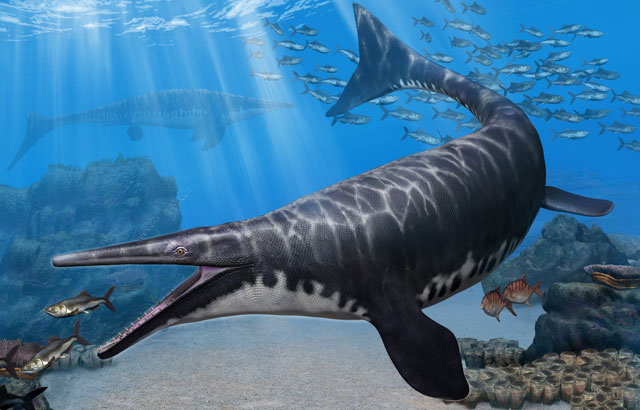
A Life Reconstruction of the Newly Described Gavialimimus almaghribensis

Life reconstruction of Gavialimimus almaghribensis.
A life reconstruction of the newly described Moroccan mosasaur Gavialimimus almaghribensis which is thought to have been a specialised piscivore (fish-eater).

Picture credit: Tatsuya Shinmura

Corresponding author for the scientific paper, Catherine Strong (University of Alberta), stated:

“Its long snout reflects that this mosasaur was likely adapted to a specific form of predation, or niche partitioning, within this larger ecosystem.  For some species, these adaptations can be very prominent, such as the extremely long snout and the interlocking teeth in Gavialimimus, which we hypothesised as helping it to catch rapidly moving prey.”

Resembling a Gavial (Gavial Mimic)

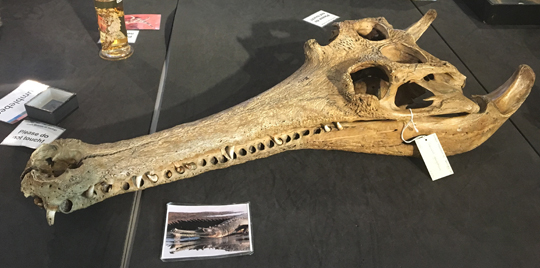
The genus name means “Gavial mimic”, a reference to the similarity between the jaws and dentition of this mosasaur to that of the extant long-snouted gavial (gharial).  Whilst the trivial or species name is derived from the Romanised version of the Arabic term for Morocco (al-Maghrib) paired with the Latin suffix “ensis”, thus denoting the country of origin of the holotype.

The Skull of a Gharial (Gavial)

The skull of a gharial.
The skull of a gharial (gavial) from the Grant Museum of Zoology (London).  The long snout and teeth superficially resemble the jaws and teeth of the newly described mosasaur Gavialimimus almaghribensis. Picture credit: Everything Dinosaur.

Picture credit: Everything Dinosaur

From the Oulad Abdoun Basin

The fossils, including a metre-long skull come from the upper Maastrichtian deposits of the Oulad Abdoun Basin of northern Morocco.  The phosphate mines in this region are a rich source of mosasaur fossils and occasionally a dinosaur or two: The Last Dinosaur from Africa.

These sediments have revealed new species of pterosaur too: Pterosaurs More Diverse at the End of the Cretaceous than Previously Thought.

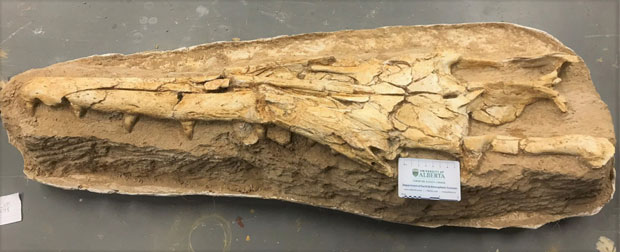
The Fossilised Skull of the Newly Described Gavialimimus almaghribensis

Gavialimimus almaghribensis fossil skull.
The fossilised skull of the newly described mosasaur G. almaghribensis.

Picture credit: Catherine Strong (University of Alberta)

Everything Dinosaur acknowledges the assistance of a media release from the University of Alberta in the compilation of this article.

The scientific paper: “A new species of longirostrine plioplatecarpine mosasaur (Squamata: Mosasauridae) from the Late Cretaceous of Morocco, with a re-evaluation of the problematic taxon ‘Platecarpus’ ptychodon” by Catherine R. C. Strong, Michael W. Caldwell, Takuya Konishi and Alessandro Palci published in the Journal of Systematic Palaeontology.

The Everything Dinosaur website: Everything Dinosaur.

15 10, 2020

Catching Up with Ordosipterus planignathus

By |2024-03-18T07:23:53+00:00October 15th, 2020|Categories: Dinosaur and Prehistoric Animal News Stories, Dinosaur Fans, Main Page, Palaeontological articles, Photos/Pictures of Fossils|0 Comments

Ordosipterus planignathus – The First Pterosaur from the Ordos Region of Inner Mongolia

Time to catch up with developments in the world of the Pterosauria with a brief look at the recently described new dsungaripteroid pterosaur named Ordosipterus planignathus.  Researchers from the Chinese Academy of Geological Sciences have described a new species of flying reptile from a partial lower jawbone found in the Ordos region of Inner Mongolia.

Ordosipterus planignathus

This is the first confirmed pterosaur discovery from the Lower Cretaceous deposits associated with this region.  The Dsungaripteridae are both geographically and temporally widespread, with taxa known from South America, Asia, North America and Europe as well as China and Mongolia.  However, Ordosipterus enlarges the geographical distribution of this kind of pterosaur, from north-western China (with western Mongolia), to central northern China.

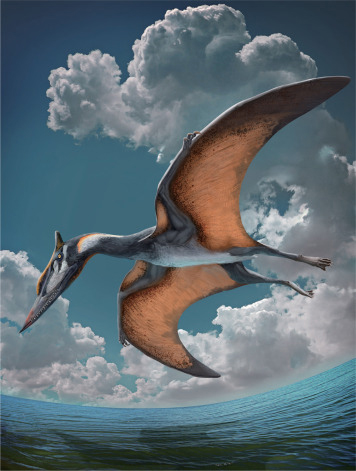
A Life Reconstruction of Ordosipterus planignathus

Life reconstruction - Ordosipterus planignathus.
A life reconstruction of Ordosipterus planignathus.

Picture credit: Ji/China Geology

Probing in the Mud for Crustaceans or an Insect Eater

Palaeontologists are uncertain as the trophic habits of these pterosaurs.  That is, it is hard to say what these animals ate.  Dsungaripteroid skulls are characterised by their stoutness and their study bones.  The skulls seem to be reinforced and strengthened to cope with disproportionately large bite forces.  These reinforced skulls in combination with the robust teeth associated with this family suggest that these types of pterosaurs might have probed in soft-mud to find molluscs such as snails and bivalves.  They may also have fed on hard-shelled insects.  The jaws and teeth of dsungaripteroid pterosaurs seem particularly suited to a durophagus diet.

To read a recent Everything Dinosaur blog post that looked at the evidence for probe feeding amongst flying reptiles: The Sensitive Beaks of Pterosaurs.

Only one tooth crown was found in situ, it appears to be short and blunt, perhaps, further evidence of durophagy in this type of pterosaur.

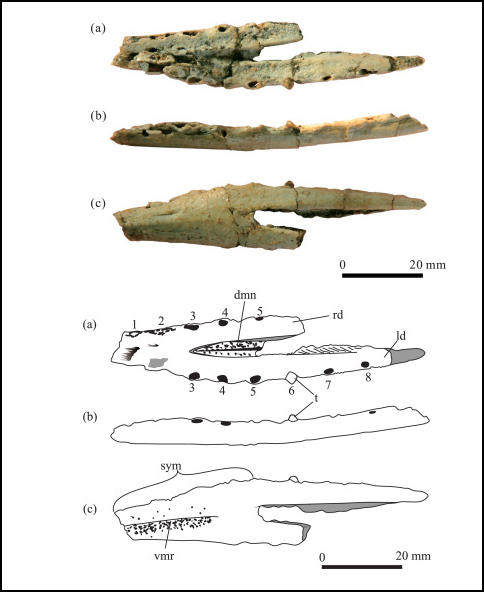
The Holotype Material for O. planignathus with Accompanying Line Drawings

Ordosipterus planignathus (holotype IG V13-011) with line drawings.
The incomplete but articulated lower jaw bones of Ordosipterus planignathus (Holotype IG V13-011) with accompanying line drawings.  Note scale bar equals 2 cm.

Picture credit: Ji/China Geology

The picture (above), shows the anterior portion of the lower jaws of the recently described flying reptile (a) dorsal view, (b) left lateral view and (c) ventral view.  The genus name honours the Ordos region, whilst the species or trivial name translates from the Greek and Latin as “flat-jawed”, in reference to the shape of the lower jaws.

Evidence of a Unique Biota in Northern China/Mongolia during the Early Cretaceous

The finding of a new species of Early Cretaceous (Aptian faunal stage), pterosaur unique to this area of Asia further strengthens the idea that two distinct terrestrial faunas existed.  It has been suggested that during the Early Cretaceous, two separate dinosaur/pterosaur dominated biotas could be identified in China and Mongolia.  The northern fauna was characterised by the presence of Psittacosaurus and a number of pterosaur genera (including Ordosipterus), whilst the southern fauna was distinguished by an absence of psittacosaurs.

The scientific paper: “First record of Early Cretaceous pterosaur from the Ordos Region, Inner Mongolia, China” by Shu-an Ji published in China Geology.

The award-winning Everything Dinosaur website: Everything Dinosaur.

13 10, 2020

A New Basal Abelisaurid is Described “Ghost Hunter”

By |2024-03-18T07:17:46+00:00October 13th, 2020|Categories: Adobe CS5, Dinosaur and Prehistoric Animal News Stories, Dinosaur Fans, Main Page, Palaeontological articles, Photos/Pictures of Fossils|0 Comments

A New Basal Abelisaurid – Spectrovenator ragei

Researchers from the Universidade de São Paulo (Brazil), in collaboration with colleagues from the Museo Paleontológico Egidio Feruglio (Argentina), have described a new species of basal abelisaurid from the Early Cretaceous of Brazil.  The theropod has been named Spectrovenator ragei, the genus name translates from the Latin as “Ghost Hunter” as the fossilised remains were found unexpectedly underneath the holotype of the titanosaur Tapuiasaurus macedoi when the fossils of this dinosaur were being partially prepared by the field team.

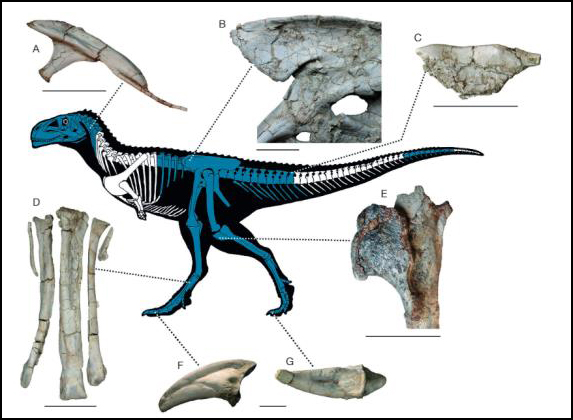
An Illustration of Spectrovenator ragei with Key Fossils Highlighted that Help to Define the Dinosaur’s Taxonomy

Spectrovenator key fossils.
Key fossil bones that helped to define Spectrovenator taxonomically.  Known fossil material shaded blue.

Picture credit: Zaher et al

Spectrovenator ragei

The species or trivial name honours the late Dr Jean-Claude Rage, an eminent French researcher who made a significant contribution to the study of South American Mesozoic vertebrates.

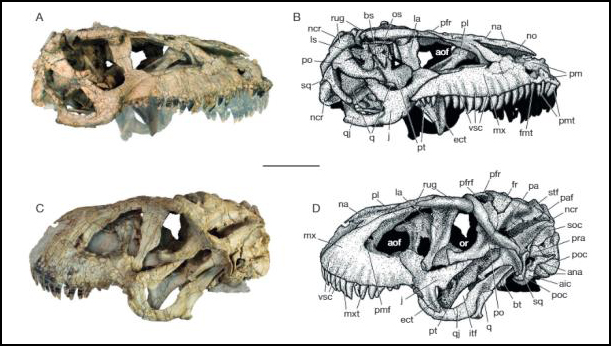
Described from a partially articulated skeleton including a virtually complete skull, the dinosaur is thought to have measured around 2.2 metres in length and it is the first Early Cretaceous abelisaurid known with an almost complete skull.  The cranial material has helped the researchers to demonstrate the evolution of abelisaurid skulls from the earliest, most basal Eoabelisaurus to the abelisaurids that existed in Gondwana during the later stages of the Cretaceous.

Views of the Skull with Accompanying Line Drawings

The Skull of Spectovenator (lateral view with line drawings).
The skull of Spectrovenator ragei (MZSP-PV 833) in (a) right lateral view with (b) line drawing and (c) left lateral view and accompanying line drawing (d).  Scale bar equals 5 cm.

Picture credit: Zaher et al

A Dinosaur Skull to Study

With a beautifully preserved skull to study, the scientists have been able to compare the function of the skull and jaws of Spectrovenator with more derived members of the Abelisauridae.  The Early Cretaceous Spectrovenator (Barremian-Aptian), lacks the specialisations, such as a high occipital region and highly flexible jaw joints linked to a modified feeding strategy suggested for much later abelisaurids.  For example, some scientists, think that large-bodied abelisaurids such as Carnotaurus (C. sastrei) specialised in hunting titanosaurs (large prey).

The lack of these specialisations in the skull of Spectrovenator suggests this modified feeding strategy may be restricted to Late Cretaceous abelisaurids and linked to an increase in body size by this type of predatory dinosaur which occurred during the Cenomanian and through to the Maastrichtian.

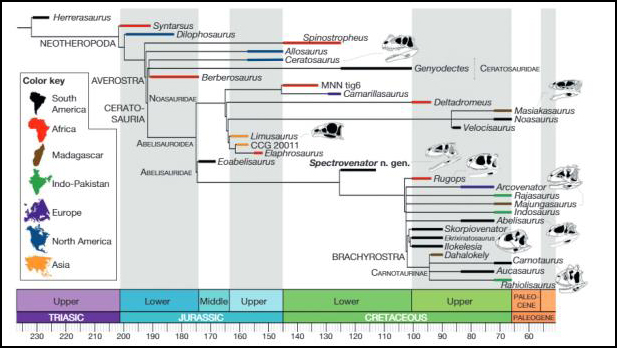
Phylogenetic relationships of Spectrovenator within the Ceratosauria

Phylogenetic relationships of Spectrovenator within the Ceratosauria.
Phylogenetic relationships of Spectrovenator within the Ceratosauria with a geographical and temporal break down of fossil material.  Spectrovenator is regarded as a basal member of the Abelisauridae.

Picture Credit: Zaher et al

Understanding the Abelisauridae

The discovery of Spectrovenator helps to fill a sizeable gap in the evolutionary history of the Abelisauridae.  The earliest member of the Abelisauridae described to date Eoabelisaurus (E. mefi), is known from the Middle Jurassic of Argentina (around 166 million years ago), whilst other abelisaurids such as Rugops and Skorpiovenator are known from Upper Cretaceous sediments (100 million years ago approximately).  Whereas Spectrovenator was found in strata that is approximately 120 million years old.

The scientific paper: “An Early Cretaceous theropod dinosaur from Brazil sheds light on the cranial evolution of the Abelisauridae” by Hussam Zaher, Diego Pol, Bruno Albert Navarro, Rafael Delcourt and Alberto Barbosa Carvalho published in Comptes Rendus Palevol.

The Everything Dinosaur website: Everything Dinosaur.

Go to Top