All about dinosaurs, fossils and prehistoric animals by Everything Dinosaur team members.

Fossil finds, new dinosaur discoveries, news and views from the world of palaeontology and other Earth sciences.

9 10, 2020

The Sensitive Beaks of Pterosaurs

By |2024-03-17T06:55:44+00:00October 9th, 2020|Categories: Adobe CS5, Dinosaur and Prehistoric Animal News Stories, Dinosaur Fans, Main Page, Palaeontological articles, Photos/Pictures of Fossils|0 Comments

Sensitive Probe Feeding Pterosaurs

Whilst it is not always sensible to compare the Pterosauria to birds, they do have a number of things in common.  As vertebrates they may not be very closely related but both birds and pterosaurs share some common anatomical characteristics that have helped them to conquer the sky.  Their skeletons show special adaptations to assist with powered flight and if we focus on modern birds for a moment, we can see that many forms have evolved to occupy different niches in ecosystems.  For example, some birds such as vultures and condors are primarily scavengers, whilst others are active predators (eagles, hawks and falcons).

Yet more are omnivores and some such as flamingos (filter feeders), swifts (aerial insect hunters) and hummingbirds (nectar feeders) occupy very specialist roles within food chains.

Studying the Beaks of the Pterosauria

Although the known fossil record of the Pterosauria probably grossly under-represents these flying reptiles, palaeontologists are becoming increasingly aware of the diversity of this enigmatic clade.  Around 130 genera have been described, probably only a fraction of the total number of genera that evolved during their long history and recently a combination of fossil finds from Morocco in conjunction with a re-examination of fossils from a chalk pit near Maidstone in Kent (England), has led researchers to propose yet another environmental niche for pterosaurs.

Some pterosaurs evolved sensitive beaks that allowed them to probe sediments to help them find food just like many types of modern wading birds and members of the Aves such as the kiwi.

A Life Reconstruction of the Lonchodectid Lonchodraco giganteus Probing in the Mud to Find Food
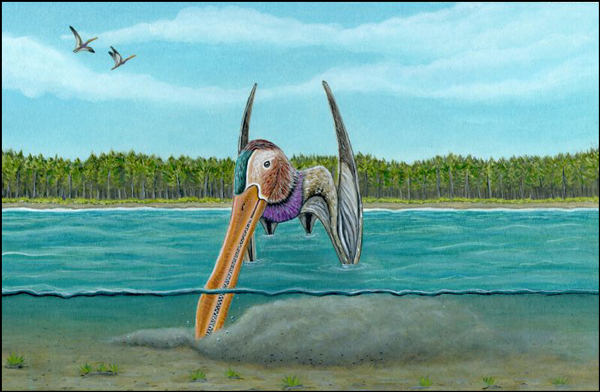
Lonchodraco (pterosaur) probing mud for food.
A life reconstruction of a lonchodectid pterosaur using its sensitive beak to find food.

Picture credit: Megan Jacobs (The University of Portsmouth)

Unusual Foramina in a Fossil Specimen

Researchers from the University of Portsmouth in collaboration with Dr Nicholas Longrich (University of Bath), took a close look at the fragmentary remains of the anterior of the rostrum (front of the jaws), of the pterosaur Lonchodraco giganteus (formerly referred to as Lonchodectes giganteus).  These fossils had been found in a chalk pit, close to the village of Burham, near Maidstone, Kent.  They were originally described as a species of Pterodactylus by the British naturalist James Scott Bowerbank in 1846.

Lonchodraco giganteus Holotype Jaws
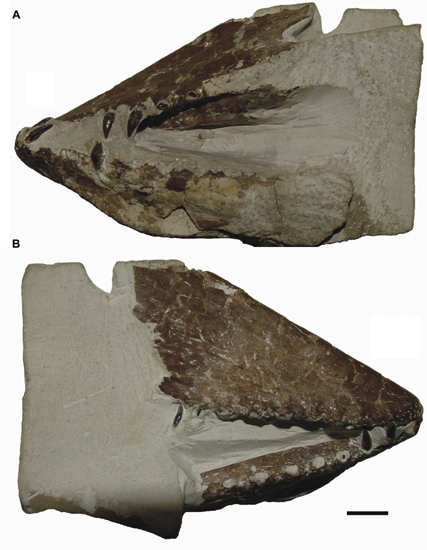
Lonchodraco giganteus holotype rostrum and mandible.
Holotype rostrum and mandible of Lonchodraco giganteus (NHMUK 39412) in (a) left lateral and (b) right lateral views.  Scale bar = 1 cm.

Picture credit: Martill et al (Cretaceous Research)

Extremely Fragmentary Pterosauria Fossil Remains

Like many pterosaur fossils from southern England, the fossilised remains are extremely scrappy, more recent studies have assigned these remains to the little-known lonchodectid pterosaurs (Lonchodectidae family).  These types of pterosaurs are united by having low profile jaws, raised teeth sockets and uniformly small teeth.

In a study of the holotype rostrum and mandible of L. giganteus, dozens of tiny holes (foramina) were discovered in the beak tip.  These are thought to represent sensory areas on the beak, where nerves pass through the bone and make contact with the beak’s surface.  Although foramina have been observed in the Pterosauria before, the pattern identified on the tip of the rostrum of Lonchodraco is unique.

Lonchodraco giganteus Holotype (Anterior View)
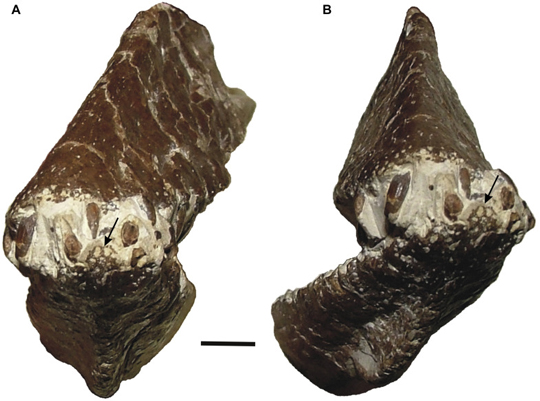
Lonchodraco giganteus holotype (anterior view).
Lonchodraco giganteus (NHMUK 39412).  Two views of anterior rostrum and mandible.  Photograph ( a) showing anterior margin of mandible with small, triangular symphysial process and (b), anterior view of rostrum showing the rounded termination of the beak and the fine perforations of the dental borders.  Black arrows indicate symphysial process/odontoid.  Scale bar = 1 cm.

Picture credit: Martill et al (Cretaceous Research)

Identifying Nerve Clusters

These types of nerve clusters are reminiscent to those found in living birds such as kiwis, sandpapers, spoonbills, geese, ducks and snipes.  These birds rely on their sense of touch when finding and catching food.  Typically, they either probe in water, mud, sand or soil to locate and catch prey.  This research, in combination with a second paper that also postulates on probe-feeding behaviour in the Pterosauria, suggests that just like modern birds, the pterosaurs were capable of evolving into a myriad of forms to exploit different food sources.

Concentration of Foramina at the Jaw Tips (Lonchodraco giganteus)
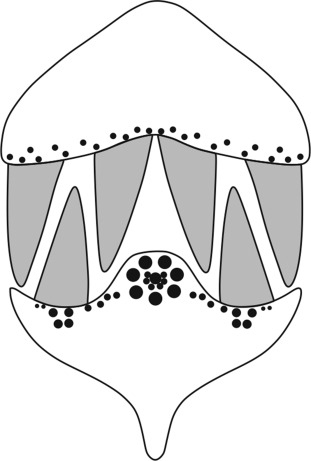
Lonchodraco line drawing showing concentration of foramina at the jaw tips
Hypothetical restoration of the jaw tips of Lonchodraco giganteus.  The black dots represent sensory areas (foramina).

Picture credit: Martill et al (Cretaceous Research)

The scientific paper: “Evidence for tactile foraging in pterosaurs: a sensitive tip to the beak of Lonchodraco giganteus (Pterosauria, Lonchodectidae) from the Upper Cretaceous of southern England” by David M. Martill, Roy E. Smith, Nicholas Longrich and James Brown published in Cretaceous Research.

A Second Example of Probe Feeding

Recently, Professor David Martill, along with colleagues from Portsmouth University, pterosaur expert Samir Zouhri (Université Hassan II, Casablanca, Morocco) and Nicholas Longrich (University of Bath), published a paper in Cretaceous Research describing a new species of long-jawed pterosaur from Morocco that also could have been a probe feeder.

The flying reptile was described as having exceptionally long jaws for its body size, which terminated in a flattened beak with thickened bony walls.  The shape of these jaws superficially resembled the beaks of probing birds such as kiwis, ibises and curlews.  The research team hypothesised that like these living birds, this pterosaur probed in soft sediments in search of invertebrates.  The age of the fossils is not certain, although an Albian to Cenomanian age was postulated.  This pterosaur was tentatively assigned to the azhdarchoids, but if it is a member of the Azhdarchoidea, then it represents an extremely atypical form.

The scientists conclude that this Moroccan pterosaur adds to the remarkable diversity of the Pterosauria known from the Cretaceous.

Everything Dinosaur acknowledges the assistance of media releases from the University of Portsmouth and the University of Bath in compilation of this article.

The scientific paper: “A long-billed, possible probe-feeding pterosaur (Pterodactyloidea: ?Azhdarchoidea) from the mid-Cretaceous of Morocco, North Africa” by Roy E. Smith, David M. Martill, Alexander Kao, Samir Zouhri, and Nicholas Longrich published in Cretaceous Research.

Visit the Everything Dinosaur website: Everything Dinosaur.
8 10, 2020

Two-fingered Oviraptosaur Sheds Light on the Success of the “Egg Thiefs”

By |2024-03-17T05:55:34+00:00October 8th, 2020|Categories: Adobe CS5, Dinosaur and Prehistoric Animal News Stories, Dinosaur Fans, Main Page, Palaeontological articles, Photos/Pictures of Fossils|0 Comments

Oksoko avarsan – New Species of Oviraptorosaur with Two Fingers

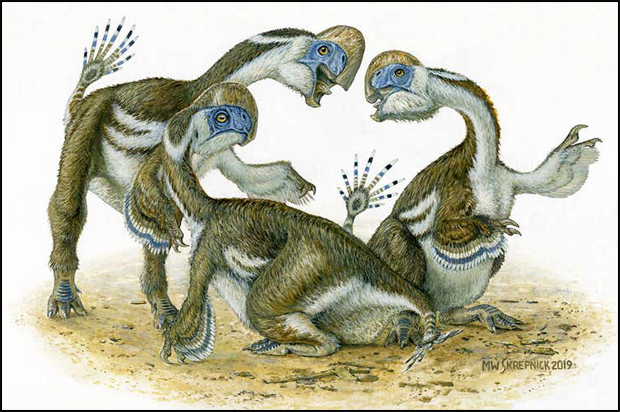
That inappropriately named clade of “Egg Thief Lizards”, the Oviraptorosauria has a new member.  Standing around one metre high at the hips, the newly described Oksoko avarsan (Oak-soak-oh), which had just two digits on each hand, instead of the default Oviraptor setting of three, is helping palaeontologists to understand the radiation and success of these feathered dinosaurs.

A Life Reconstruction of the Newly Described Oksoko avarsan

Oksoko avarsan life reconstruction.
A trio of oviraptors – a life reconstruction of Oksoko avarsan.

Picture credit: Michael Skrepnick

The First Evidence of Digit Loss in the Oviraptorosaurs

Over the last forty years or so, lots of new oviraptorosaur theropods have been named and described, principally from fossil finds made in China and Mongolia.   These feathered dinosaurs were highly successful and although their origins are uncertain, this type of dinosaur probably evolved in the Early Cretaceous of northern China and by the Late Cretaceous they had spread across much of Asia and into North America.

Whilst most palaeontologists confronted with the wealth of fossil material would concede that these theropods were geographically widespread, little research has been undertaken to ascertain the reasons for their evolutionary success.  The discovery of Oksoko with its reduced forelimb with only two functional digits suggests that this group could alter their diets, behaviours and habits which enabled them to diversify and multiply.  In essence, variation in forelimb length and hand morphology provides another example of niche partitioning in oviraptorosaurs, which may have contributed to their incredible diversity in the latest Cretaceous of Asia.

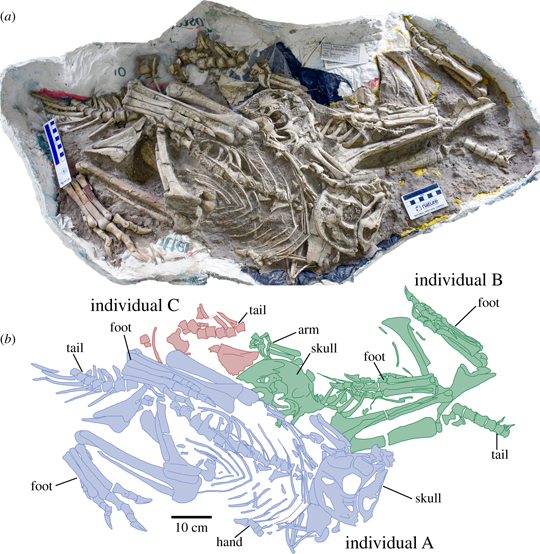
The Holotype Block Containing Three Specimens of O. avarsan

The holotype block consisting of three individuals (Oksoko avarsan).
The holotype block of Oksoko avarsan MPC-D 102/110 with an explanatory line drawing.  The holotype fossil is individual A coloured blue.

Picture credit: Funston et al (Royal Society Open Science)

Gregarious Behaviour in Oviraptorids

Oksoko is known from four specimens, a group of three (see picture above) and a fourth specimen found in the same crouched position that is believed to come from the same location.  All the fossil material was confiscated from poachers so the exact discovery site of these fossils remains unknown.  However, the researchers have confidently assigned them to the Nemegt Formation of the Gobi Desert and the material is estimated to be around 68 million years old.

It had long been suspected that oviraptorosaurs were gregarious social animals.  The finding of three individuals preserved together represents the first, definitive evidence that these animals probably lived in groups and that they were gregarious.  The fossil bones of all four individuals have provided the researchers with an almost complete skeleton of this two-metre-long dinosaur to study.

Key Fossils Representing the Anatomy of Oksoko avarsan

Key fossils associated with Oksoko avarsan.
Skeletal anatomy of Oksoko avarsan with key fossils including skull in lateral view (b) with line drawing (c).

Picture credit: Funston et al (Royal Society Open Science)

Oksoko avarsan – A Three-headed Eagle

The scientists which included Dr Gregory Funston (Edinburgh University) and Phil Currie (University of Alberta), named this dinosaur after the three-headed eagle of Altaic mythology, a reference to the holotype block which contains the skulls of three individuals.  The species or trivial name is from a Mongolian word for “rescued”, it alludes to the fact that these fossils were recovered from poachers.

The remarkably well-preserved fossil material provides the first documented evidence of digit loss in the usually three-fingered Oviraptorosauria.  The holotype block material represents the remains of three dinosaurs that were approximately the same size and bone histology reveals that these animals died when they were around a year old.  The fourth specimen is believed to represent an older animal that died around the age of five.

Commenting on the discovery, Dr Funston remarked:

“Oksoko avarsan is interesting because the skeletons are very complete and the way they were preserved resting together shows that juveniles roamed together in groups.  But more importantly, its two-fingered hand prompted us to look at the way the hand and forelimb changed throughout the evolution of oviraptors — which hadn’t been studied before.  This revealed some unexpected trends that are a key piece in the puzzle of why oviraptors were so diverse before the extinction that killed the dinosaurs.”

Finger Loss in a Dinosaur Family

Oksoko is the sixth genus of the Oviraptoridae family to be named from fossils associated with the Nemegt Formation.  This demonstrates the diversity of these types of dinosaurs in the Late Cretaceous of China.

The other five oviraptorids known from the Nemegt Formation of Mongolia as stated by Everything Dinosaur team members are:

  • Rinchenia mongoliensis
  • Nomingia gobiensis
  • Nemegtomaia barsboldi
  • Gobiraptor minutus
  • Conchoraptor gracilis

In addition, a number of closely related dinosaurs are known from the Nemegt Formation including the caenagnathid Elmisaurus rarus

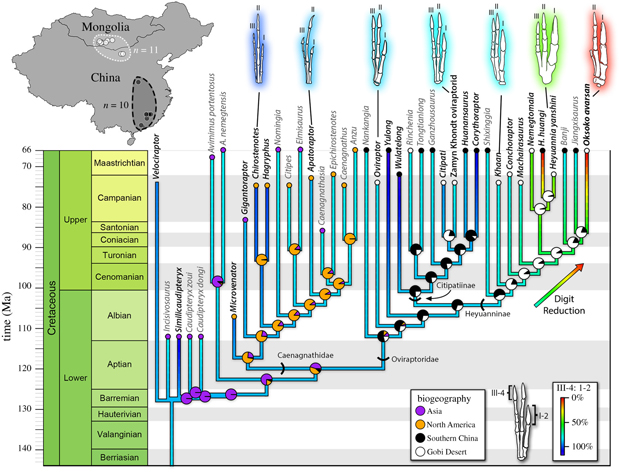
The scientists produced a phylogeny of the Oviraptorosauria based in a reduction in size and eventual loss of digit III as shown in the most derived form described to date (O. avarsan) and a corresponding increase in size and robustness of digit I.  They concluded that the arms and hands of these dinosaurs changed radically in conjunction with migrations into new geographical areas and presumably different habitats – specifically to what is now North America and the Gobi Desert.

Plotting the Change in Hand Morphology and the Radiation of the Oviraptorosauria

Phylogeny, biogeography and digit reduction in Oviraptorosauria.
Phylogeny, biogeography and digit reduction in Oviraptorosauria.  The map (top left) shows the distribution of oviraptorids during the Late Cretaceous of Asia.

Picture credit: Funston et al (Royal Society Open Science)

To read a related article that considered the holotype block as evidence for communal roosting in oviraptorids: Three Theropods Preserved in a Resting Pose.

The scientific paper: “A new two-fingered dinosaur sheds light on the radiation of Oviraptorosauria” by Gregory F. Funston, Tsogtbaatar Chinzorig, Khishigjav Tsogtbaatar, Yoshitsugu Kobayashi, Corwin Sullivan and Philip J. Currie published in Royal Society Open Science.

The award-winning Everything Dinosaur website: Everything Dinosaur.
7 10, 2020

Little Juravenator Had Sensory Scales on its Tail

By |2024-03-17T06:49:03+00:00October 7th, 2020|Categories: Adobe CS5, Dinosaur and Prehistoric Animal News Stories, Dinosaur Fans, Main Page, Palaeontological articles, Photos/Pictures of Fossils|0 Comments

Juravenator and a “Tale” of Sensory Scales

Researchers writing in the academic journal “Current Biology”, have revealed how dinosaurs may have made sense of their surroundings using special sensory nodes embedded in the scales on their skin.  A new paper focusing on the small, theropod Juravenator starki from the Torleite Formation (upper Kimmeridgian), Solnhofen, Bavaria, (Germany), reports on the discovery of dermal structures along the side of the dinosaur’s tail resembling the integumentary sense organs found in extant crocodiles.

Getting a Sense of Dinosaur Senses

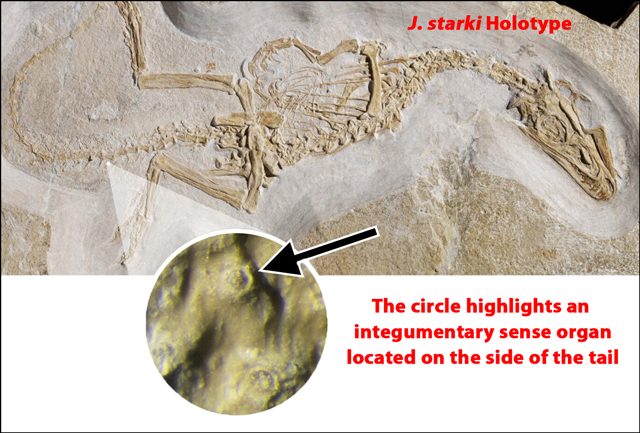
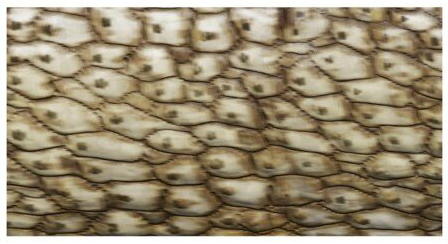
Identifying integumentary sense organs in the Juravenator holotype specimen.
Integumentary sense organs identified in the Juravenator starki holotype.  The black arrow points to the sensory organ, which are found on polygonal scales covering the lower part of the tail

Picture credit: Bell et al Current Biology with additional annotation by Everything Dinosaur

Juravenator starki

Once thought to be a close relative of the contemporary Compsognathus longipes, Juravenator is known from a single, beautifully preserved fossil specimen (JME Sch 200), found in a limestone quarry in 1998.  Although squashed flat, the specimen is mostly articulated and complete with only some caudal vertebrae missing.  It is a juvenile and as such, placing it within the Theropoda has proved problematic.  The taxonomic position is uncertain, but it has been suggested that it could represent a basal member of the Coelurosauria or perhaps a primitive member of the Maniraptora.

The genus name is derived from the Bavarian Jura mountains and “venator” – Latin for “hunter”.  The species (trivial) name honours the Stark family who owned the quarry where the sixty-centimetre-long dinosaur fossil was discovered.

Soft tissue representing body scales have been identified associated with the lower leg bones and between the 8th and 22nd caudal vertebrae.  Other soft tissue structures have been found probably representing preserved tendons and ligaments.  It is these dermal structures that have been the centre of this new study.

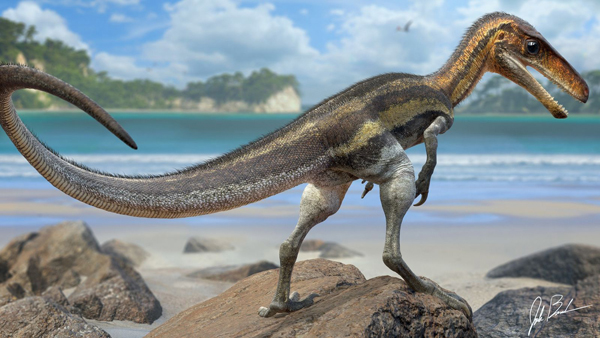
A Life Reconstruction of the Late Jurassic Theropod Juravenator starki

Juravenator starki illustrated.
An illustration of the theropod Juravenator starki.

Picture credit: Jake Baardse

Specialised Scales

Scientists are aware that early in the evolution of the first truly terrestrial tetrapods epidermal scales evolved to provide an effective barrier against ultraviolet radiation and to prevent excessive water loss.  This evolutionary development meant that stem reptiles were no longer constrained by having to stay close to freshwater like their amphibian ancestors.  Epidermal scales in extant reptiles are not simple, inert structures but can perform a suite of functions and assist in how the animal senses its environment.

Researchers Dr Phil Bell (University of New England) in Armidale, Australia along with his colleague Dr Christophe Hendrickx, from the Unidad Ejecutora Lillo in San Miguel de Tucumán, (Argentina), both specialists in dinosaur dermatology, identified a unique scale type with distinctive, prominent circular nodes on the preserved integumentary covering on the tail of Juravenator. They interpret these raised nodes as integumentary sense organs, analogous to those found today in living crocodilians.

Dr Bell commented:

“Few people pay much attention to dinosaur skin, because it is assumed that they are just big, scaly reptiles.  But when I looked closely at the scales on the side of the tail, I kept finding these little ring-like features that didn’t make sense; they were certainly unlike other dinosaur scales.”

Integumentary Sense Organs Identified in a Dinosaur

Crocodilian integumentary sense organs.
Crocodilian integumentary sense organs, circular objects visible on the dermal scales.

Picture credit: Bell et al Current Biology

The First Direct Evidence of Integumentary Sense Organs

The surprising presence of such structures suggests the tail of Juravenator played a role in how this dinosaur sensed the world around it.  This is the first direct evidence of such structures being present on the skin of a dinosaur.

The shape and the orientation of the teeth, especially those in the upper jaw suggest Juravenator ate fish (piscivore).  During the Late Jurassic, this part of Europe was covered by a warm, tropical, shallow sea with numerous small islands.  This archipelago was home to a number of dinosaurs including the famous “urvogel” Archaeopteryx.  As crocodiles are aquatic predators, the research team speculate that Juravenator may have been an aquatic hunter too.

Alligators have integumentary sense organs on their snout, whereas crocodiles have these special scales all over their body including the tail.  These sensory nodes help these reptiles to detect temperature changes, chemical signals in the water as well as having tactile properties.  Although the entire integumentary covering of Juravenator is unknown, this lithe dinosaur could have submerged its tail to help it detect the movement of prey underwater.

To read an article about the sense of smell in the Dinosauria: Don’t Get Sniffy About Dinosaur Sense of Smell.

The scientific paper: “Crocodile-like sensory scales in a Late Jurassic theropod dinosaur” by Phil R. Bell and Christophe Hendrickx published in Current Biology.

The Everything Dinosaur website: Everything Dinosaur.

4 10, 2020

Predatory Tactics of Prehistoric Felids

By |2024-03-17T06:19:23+00:00October 4th, 2020|Categories: Dinosaur and Prehistoric Animal News Stories, Dinosaur Fans, Educational Activities, Everything Dinosaur News and Updates, Everything Dinosaur Products, Main Page, Photos of Everything Dinosaur Products, Press Releases|0 Comments

Predatory Tactics of Prehistoric Felids

In the summer, Everything Dinosaur was contacted by Kate from Nottingham University who was conducting research into the predatory habits of extinct felids.  Our team members are contacted quite frequently by academics, museum staff and students requesting our advice and guidance.  Kate wanted to know whether there were any replicas available that could represent Pseudaelurus, a genus of prehistoric cat that was both geographically and temporally widely distributed.  In addition, our advice was sought over finding suitable models of Smilodon species, specifically S. fatalis, S. gracilis and S. populator.

Models of Prehistoric Felids

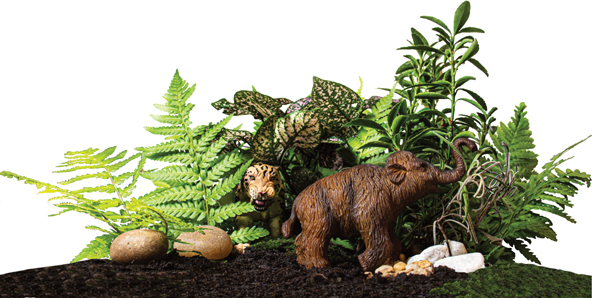
Smilodon Ambush – Creeping Up on a Young Mammoth

Smilodon ambushes a Woolly Mammoth calf.
Everything Dinosaur was asked about potential predator/prey interactions with specific reference to Smilodon.  A beautifully composed diorama depicting a hunting strategy of the sabre-toothed cat Smilodon.

Picture credit: Kate/Nottingham University

Everything Dinosaur has been involved in a number of prehistoric mammal themed projects recently.  Many museums around the world may have been closed due to the current pandemic but this has permitted exhibition organisers and curators the opportunity to review and revamp some of their public displays.  For example, Everything Dinosaur was asked to supply replicas of several prehistoric elephants including Deinotherium and Palaeoloxodon antiquus (Straight-tusked elephant), to a German natural history museum as part of a display featuring the teeth of extinct members of the Proboscidae.

Our work is certainly diverse, no two days are the same.

Identifying Prehistoric Animal Models

Having worked with several academics previously on enigmatic sabre-toothed predators, including gorgonopsids, we were able to advise Kate on which prehistoric animal models could be used to differentiate between the various species and sub-species of Smilodon.

As part of her project work, Kate created some beautiful dioramas using these figures in a bid to replicate hunting behaviours.

For models and replicas of prehistoric felids and other extinct animals: Prehistoric Animal Models and Figures.

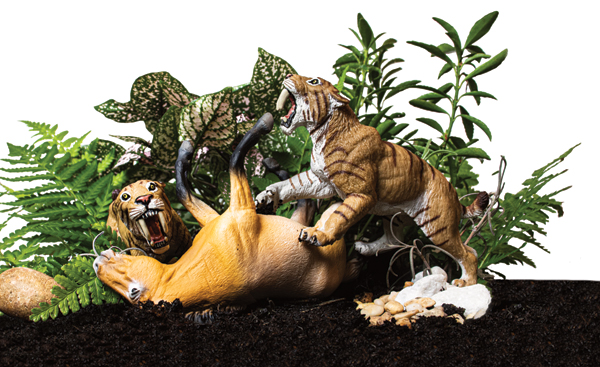
A Pair of Smilodon Tackle a Prehistoric Horse

A Smilodon diorama.
Smilodon hunting.  As apex predators these powerful animals would have preyed on a variety of animals including prehistoric horses, if they could get close enough to ambush them.

Picture credit: Kate Nottingham University

Commenting upon the assistance received from Everything Dinosaur, Kate stated:

“Thank you for your help and advice with the Smilodon models and prey species.  I had a lot of fun using them in my final project.”

A spokesperson from Everything Dinosaur commented:

“We get asked to work on all kinds of prehistoric animal related activities supplying models and figures to museums and other educational bodies all over the world.  The replicas that we supply have proved extremely useful in helping to visualise ancient, prehistoric landscapes and to inform and educate visitors.”

The Everything Dinosaur website: Everything Dinosaur.
3 10, 2020

Naked Pterosaurs – No Protofeathers on Pterosaurs

By |2024-03-17T06:13:31+00:00October 3rd, 2020|Categories: Dinosaur and Prehistoric Animal News Stories, Dinosaur Fans, Main Page, Palaeontological articles, Photos/Pictures of Fossils|0 Comments

New Study Refutes the Idea of Protofeathers in the Pterosauria

A newly published study casts doubt on the idea that members of the Pterosauria had an integumentary covering of insulating protofeathers.  Professor David Martill (University of Portsmouth), in collaboration with fellow flying reptile expert Dr David Unwin (University of Leicester), have reviewed the evidence and they propose that these vertebrates essentially lacked a feathery covering or indeed pycnofibres.

This research contradicts and refutes an earlier study published in the academic journal “Nature Ecology and Evolution” in 2018.

To read our article about the 2018 paper: Are the Feathers About to Fly in the Pterosauria?

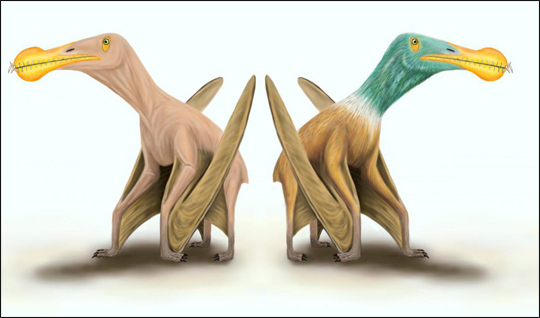
Pterosaurs Uncovered – Lacking an Integumentary Covering

No protofeathers in the Pterosauria.
Naked pterosaurs – British researchers refute the idea of protofeathers in the Pterosauria.

Picture credit: Megan Jacobs (University of Portsmouth)

Feather-like Branching Filaments

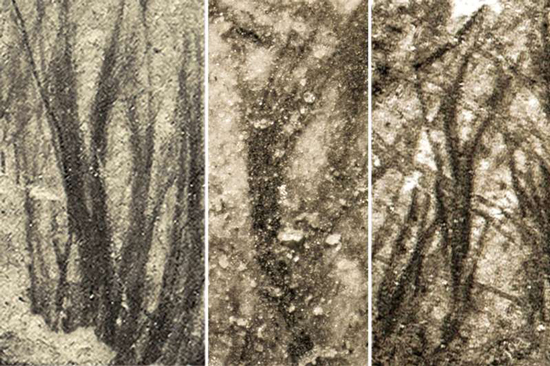
Dr Unwin and Professor Martill have challenged the findings of a research paper that examined the fossilised remains of two anurognathid pterosaurs which concluded that some of the structures preserved in association with the fossil bones were pycnofibres with characteristic features of feathers including non-vaned grouped filaments and bilaterally branched filaments.  The 2018 paper implied that if pterosaurs as well as dinosaurs had feather-like body coverings, then this type of integumentary covering was deeply rooted in the Archosauria.  This would suggest that the common ancestor of both the Pterosauria and the Dinosauria evolved this type of body covering.

If this interpretation of the fossil evidence is correct, then the very first feather-like elements evolved at least eighty million years earlier than currently thought.  It would also suggest that all dinosaurs started out with feathers, or protofeathers but some groups, such as the Sauropoda, subsequently lost them again, the complete opposite of currently accepted theory.

Unwin and Martill challenge the interpretation of the material that featured in the 2018 paper.  The propose that tiny, hair-like filaments reported by Yang et al (2018), are not protofeathers at all but tough fibres which form part of the internal structure of the pterosaur’s wing membrane, and that the “branching” effect may simply be the result of these fibres decaying and unravelling.

Dr Unwin from the University of Leicester’s Centre for Palaeobiology Research commented:

“The idea of feathered pterosaurs goes back to the nineteenth century but the fossil evidence was then and still is, very weak.  Exceptional claims require exceptional evidence – we have the former, not the latter.”

Feather-like Filaments in Pterosaur Fossils

Different types of filaments associated with pterosaur fossils.
Close-up views of different types of feather-like filaments identified in pterosaur fossils.

Picture credit: Yang, Jiang, McNamara et al

Considering Theories Related to the Pterosauria

Highlighting the difficulties of interpretating filament-like structures, Professor Martill commented that either way, palaeontologists have to take care when considering theories related to the Pterosauria, they have no extant equivalents so the reliance of fossil material is perhaps greater when compared to the Dinosauria with their close relatives the birds still very much with us.

Professor Martill observed:

“If they really did have feathers, how did that make them look and did they exhibit the same fantastic variety of colours exhibited by birds.  And if they didn’t have feathers, then how did they keep warm at night, what limits did this have on their geographic range, did they stay away from colder northern climes as most reptiles do today.  And how did they thermoregulate?  The clues are so cryptic, that we are still a long way from working out just how these amazing animals worked”.

The scientific paper: “No protofeathers on pterosaurs” by David M. Unwin and David M. Martill published in Nature Ecology and Evolution.

The Everything Dinosaur website: Visit Everything Dinosaur.

2 10, 2020

That Famous Single Feather Fossil – Probably Archaeopteryx

By |2024-03-17T06:09:31+00:00October 2nd, 2020|Categories: Dinosaur and Prehistoric Animal News Stories, Dinosaur Fans, Main Page, Palaeontological articles, Photos/Pictures of Fossils|0 Comments

Famous Feather Fossil – Probably Represents a Feather from Archaeopteryx

The feathers are flying when it comes to an iconic fossil, arguably one of the most significant in any vertebrate palaeontology collection – a single, carbonised feather from the Solnhofen area of southern Germany.

Described in 1861, this isolated feather specimen is regarded as the first fossil feather known to science.  Having been scientifically studied just two years after the publication of Charles Darwin’s “Origin of Species”, the “Urfeder” – first feather in German, a modern-looking bird feather preserved in lagoonal sediments laid down around 150 million years ago, sent shock waves around the scientific community when it was first described.

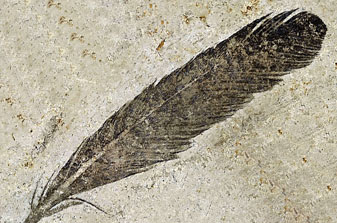
The Iconic Feather Fossil – Is this from the “Urvogel” (Archaeopteryx lithographica)?

The Berlin feather - preserved as a carbonised film.
The slab from the Berlin museum showing the iconic feather, so long associated with Archaeopteryx and recently thought to have come from a dinosaur.  New research suggests this is a feather from Archaeopteryx.

The Application of Laser-Stimulated Fluorescence

Ever since its discovery, scientists have debated what sort of creature this single feather came from.  In February 2019, Everything Dinosaur reported on research conducted by a team of international scientists that applied a sophisticated imaging method called Laser-Stimulated Fluorescence (LSF) to reveal previously unseen details in a forensic examination of both the slab and the counter slab of the fossil feather.  The team, which included Dr Michael Pittman (University of Hong Kong), proposed that the feather did not come from the famous “first bird”, but instead from an unknown species of dinosaur that co-existed with Archaeopteryx.

To read our blog post from February 2019, that disputed the claim that this specimen represented a feather from an Archaeopteryx: Iconic Feather Did Not Belong to Archaeopteryx.

New Study Re-affirms the Archaeopteryx Link

This new research utilised images generated from an electron microscope of the single feather specimen along with detailed examinations of known Archaeopteryx fossils that displayed feather impressions.  The study published in “Scientific Reports” was led by Ryan Carney, an assistant professor of integrative biology at the University of South Florida.  The researchers analysed nine characteristics of the feather, particularly the long quill, which runs up the centre of the specimen (centreline).  This centreline is composed of two parts:

  • Calamus – centreline below the skin (shown in red in the diagram below)
  • Rachis – tubular extension of the calamus above the skin (shown in blue in the diagram below)

The New Study Suggests The Single Feather Fossil is Congruent with Archaeopteryx Feathers

Correcting the centre line from the 2019 scientific paper.
The centre line of the feather has been recalculated to show that the 2019 paper was inaccurate in this regard. The placement of the centreline now falls within the range of selected modern Aves species.

Picture credit: Carney et al (Scientific Reports)

The photograph (above), shows (a) centrelines of the isolated fossil feather modified from Hermann von Meyer’s original 1861 description and (b) Laser-stimulated fluorescence image modified from the 2019 scientific paper.  In (a) and (b), the centerline comprises the calamus (red) and rachis (blue).  An alignment error made in the earlier (2019) research led to the orientation of the centreline of the fossil feather to be out of the expected range found in extant birds (c).  The final figure (d) has been modified from (c) and shows a more representative range of centreline morphologies associated with modern birds (areas shaded yellow in (c) and (d).

A Feather from the Left Wing of Probably Archaeopteryx

Based on this new research, the scientists conclude that the single feather represents a feather from the left wing called a primary covert.  Primary coverts are small contour feathers that overlay the main wing feathers.  As similar feather characteristics were identified in other Archaeopteryx fossil feathers Carney et al conclude that the 1861 specimen probably does represent a feather lost by the famous “Urvogel” (Archaeopteryx lithographica).

Ryan Carney commented:

“There’s been debate for the past 159 years as to whether or not this feather belongs to the same species as the Archaeopteryx skeletons, as well as where on the body it came from and its original colour.  Through scientific detective work that combined new techniques with old fossils and literature, we were able to finally solve these centuries-old mysteries.”

The Location of the Fossil Finds

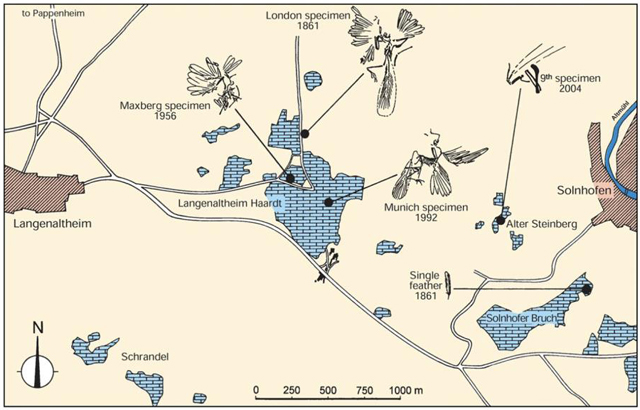
In addition, the research team looked at the provenance of the single feather, where it was found in relation to known discoveries of Archaeopteryx remains.  Four Archaeopteryx specimens, including the London specimen which is now the holotype for A. lithographica were found within 2.2 kilometres of the site where the single feather was discovered.  All of these specimens are coeval (having the same age and origin), from the same horizon in the limestone, all linked by biostratigraphy.  The Archaeopteryx material being associated with the same zonal ammonite fossils (Subplanites rueppellianus).

The Provenance of the Single Feather Fossil in Relation to Other Archaeopteryx Specimens

Supporting evidence for the single feather specimen coming from Archaeopteryx.
Map of the Solnhofen-Langenaltheim quarry district, illustrating locations of the isolated feather and the London (type), Maxberg, Munich, and Ottmann & Steil (9th) specimens of Archaeopteryx.

Picture credit: Carney et al (Scientific Reports)

Detecting and Interpreting Melanosomes on the Feather

The electron microscopy employed permitted the scientists to identify melanosomes (microscopic pigment structures).  They determined that this primary covert feather was coloured matte black.  Other studies have also shown the Archaeopteryx may have been black in colour, with some feathers showing iridescence.

The scientific paper: “Evidence corroborates identity of isolated fossil feather as a wing covert of Archaeopteryx” by Ryan M. Carney, Helmut Tischlinger and Matthew D. Shawkey published in Scientific Reports.

The Everything Dinosaur website: Everything Dinosaur.
30 09, 2020

New Research Suggests Sabre-toothed Predators Evolved Different Hunting Styles

By |2024-03-16T07:37:21+00:00September 30th, 2020|Categories: Adobe CS5, Dinosaur and Prehistoric Animal News Stories, Main Page|0 Comments

Sabre-toothed Predators Evolved Different Hunting Styles Over the Last 250 Million Years

New research suggests that sabre-toothed predators evolved an unknown diversity of hunting and killing methods over the last 250 million years or so.

Sabre-toothed cats are among the most iconic of all the prehistoric animals known to science.  However, not all the tetrapods that evolved long, knife-like canine teeth were members of the cat family (Felidae).  Some animals that evolved sabre-like teeth even predate the Dinosauria.

Sabre-toothed Predators

Enlarged canine teeth, some of which in some species reached sizes in excess of thirty centimetres in length, evolved independently in seven different evolutionary lines of carnivores.  Due to similar skull morphology and tooth shape, it had long been assumed that all these predators occupied very similar niches in ecosystems and hunted and killed prey in the same manner.

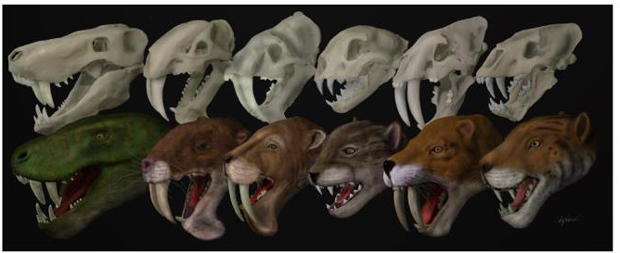
The Six Different Types of Sabre-toothed Tetrapod included in the Study

Skulls and life reconstructions of the 6 different sabre-tooth species used in the study.
Skulls and life reconstructions of the six different sabre-tooth species used in the study.

Picture credit: Stephan Lautenschlager, University of Birmingham

That assertion has been challenged and now refuted in a new study published today in the “Proceedings of the Royal Society B.”

Examining the Functional Capabilities of Teeth and Skulls

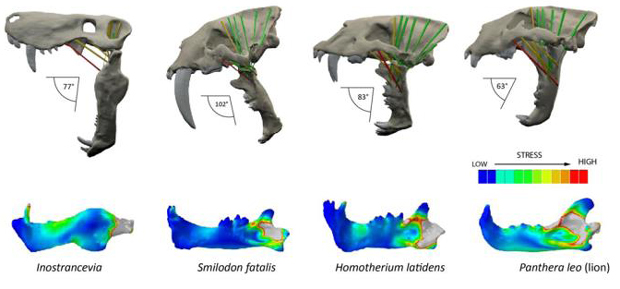
An international team of scientists from Spain, Germany and the UK, analysed over sixty different sabre-tooth species. Using computer models and simulations the researchers investigated the functional capabilities of the teeth and skulls, such as calculating bite forces, the stresses on the skull and bending strength.

Computer Simulations Assessed Bite Forces and Skull Stress in the Sabre-toothed Predators

Computer model and simulation results for three fossil sabretooth species compared to a modern lion showing maximum jaw gape and stress distribution in the lower jaw.
Computer simulation results for three fossil sabretooth species compared to a modern lion showing maximum jaw gape and stress distribution in the lower jaw.

Picture credit: Stephan Lautenschlager, University of Birmingham

Lead author of the scientific paper, Dr Stephan Lautenschlager (Lecturer for Palaeobiology at the University of Birmingham), commented:

“It is fascinating to see that so many different species have evolved elongated canine teeth to subdue prey, but our results show that they used these sabre-like teeth differently to do so.”

Computer Simulations

The analysis of the skull material in combination with the computer simulations revealed that sabre-toothed predators may have looked superficially similar, but they used their canine teeth in different ways.  Some species specialised in hunting small prey using the canine teeth to inflict deep, debilitating wounds, whilst other species were probably pack hunters specialising in tackling larger prey.  Those species that were probably pack hunters specialising in hunting and killing larger prey had reinforced bone structures to help stabilise their jaws.

Dr Lautenschlager added:

“We know that different sabre-tooth species shared the same ecosystem.  Using computational methods, we can show that their specialisation on different prey allowed them co-exist and to avoid competition.”

A Sabre-Toothed Cat – An Iconic Animal from the Cenozoic

Mojo Smilodon prehistoric animal figure
A model of a Sabre-toothed cat. The Mojo Smilodon model is a replica of a sabre-toothed cat. The Smilodon model measures approximately 13 cm long. Picture credit: Everything Dinosaur.

Picture credit: Everything Dinosaur

The picture (above) shows a Mojo Fun Smilodon figure.

To view the range of Mojo Fun prehistoric animal models: Mojo Fun Prehistoric Animal Models.

To read a related article also co-authored by Stephan Lautenschlager (University of Birmingham), which proposed that Thylacosmilus atrox was primarily a scavenger: New Study Suggests Marsupial Sabre-tooth was a Scavenger.

Everything Dinosaur acknowledges the assistance of a media release from the University of Birmingham in the compilation of this article.

Visit the Everything Dinosaur website: Everything Dinosaur.
29 09, 2020

New Species of Trilobite Named After Doctor Who Actor

By |2024-03-16T07:30:54+00:00September 29th, 2020|Categories: Adobe CS5, Dinosaur and Prehistoric Animal News Stories, Dinosaur Fans, Main Page, Photos/Pictures of Fossils|0 Comments

Gravicalymene bakeri – Trilobite Named After Actor Tom Baker

Two Australian scientists have named a new species of trilobite in honour of Tom Baker, the English actor, perhaps most famous for portraying the fourth incarnation of the long-running BBC television series Doctor Who.  The trilobite fossils, preserved in mudstone, come from Ordovician-aged strata in the Gunns Plains area of northern Tasmania.  The new species has been named Gravicalymene bakeri.

Gravicalymene bakeri

This genus had never been found in Australia before, it is known from Europe and North America, so this discovery significantly raises the distribution of this genus.  The discovery reported in the “Alcheringa: An Australasian Journal of Palaeontology”, raises the intriguing possibility that around 450 million years ago, oceanic currents could have somehow linked eastern and western hemispheres.

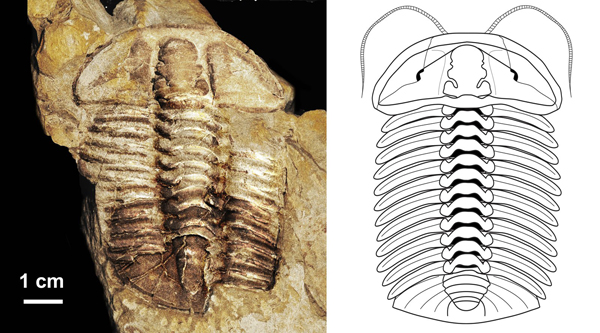
A Photograph of the Newly Described Gravicalymene bakeri with an Explanatory Line Drawing

Gravicalymene bakeri trilobite fossil.
Gravicalymene bakeri trilobite fossil with line drawing.  Note scale bar equals 1 cm.

Picture credit: Australian Museum

A Serendipitous Discovery

Co-author of the scientific paper Dr Malte Ebach of the University of New South Wales, explained that the first evidence of a new species of trilobite was found by chance.  Whilst driving through the Gunns Plains area, a “call of nature” break was required.  It was whilst on this “call of nature”, that a boulder was spotted that was covered in the remains of these ancient, marine invertebrates.

As for the species name, fellow co-author Dr Patrick Smith, (Australian Museum, Sydney, New South Wales), stated that both he and Dr Ebach wanted to honour Tom Baker as his stint as the fourth doctor had inspired them both to pursue a career in the sciences.

Dr Smith commented:

“I’m not old enough to remember Tom Baker’s episodes which were originally aired in 1974-81.  However, growing up as a teenager when the series re-aired in the early 2000’s, I followed the show religiously and became convinced that a career in science was guaranteed to improve the world.”

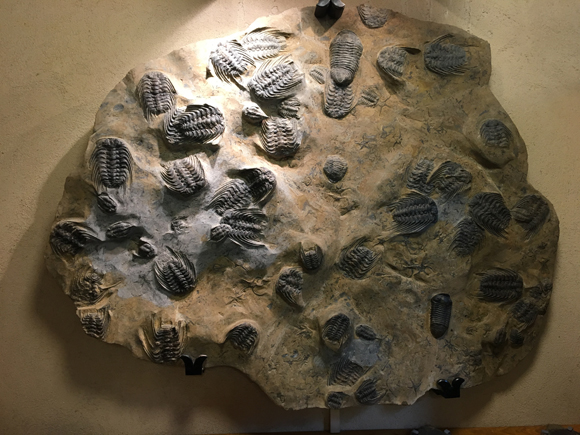
Fossil trilobites.
A collection of fossilised trilobites. Picture credit: Everything Dinosaur.

Picture credit: Everything Dinosaur

For models and replicas of trilobites and other prehistoric creatures: CollectA Prehistoric Life Models.

Actor Tom Baker expressed his delight when he was told the news that he had been honoured by having a Tasmanian trilobite name after him.

The actor who has enjoyed a long career in film, television and radio commented:

“I am delighted to be entitled at last.  I hope the Who World will share my joy.  Will I be allowed to tack “Fossil” on official correspondence?  I hope the Who World will celebrate this fresh honour and will spread the news to those who live in remote places.  Happy days to all the Who fans everywhere.”

The Gravicalymene genus  is known from marine deposits associated with Avalonia, Baltica and Laurentia (Europe and North America) but this is the first time this genus has been reported from eastern Gondwana (Australasia).

The scientific paper: “A new Ordovician (Katian) calymenid, Gravicalymene bakeri sp. nov., from the Gordon Group, Tasmania, Australia” by Patrick M. Smith and Malte C. Ebach published in Alcheringa: An Australasian Journal of Palaeontology.

The Everything Dinosaur website: Everything Dinosaur.
28 09, 2020

Happy 160th Birthday to the Oxford University Museum of Natural History

By |2024-03-16T06:56:47+00:00September 28th, 2020|Categories: Dinosaur and Prehistoric Animal News Stories, Main Page, Photos, Photos/Pictures of Fossils|0 Comments

Happy 160th Birthday to the Oxford University Museum of Natural History

This year, one of our favourite museums is celebrating its 160th birthday.   The Oxford University Museum of Natural History was opened 160 years ago.  There would have been lots of events to commemorate this, but 2020 has proved to be an exceptionally challenging year for museums.

The Oxford University Museum of Natural History

The Museum Collections are Housed in a Stunning Example of Victorian Neo-gothic Architecture

The Oxford Museum of Natural History.
The imposing main entrance of the Oxford University Museum of Natural History.  The grassy area in front of the main entrance is home to a replica of a theropod dinosaur trackway.  Visitors can take the opportunity to “walk with a dinosaur”.

Picture credit: Oxford University Museum of Natural History

This museum was established back in 1860 to house the various scientific collections that had been built up at Oxford University.  Prior to all the collections being installed, it hosted one of the most significant scientific debates ever recorded, a clash of ideologies when Thomas Huxley debated the concept of natural selection as postulated by Charles Darwin, with the Bishop of Oxford Samuel Wilberforce.

Seven Million Items Including Important Dinosaur Fossils

Over 7 million items our housed in the spectacular Victorian neo-Gothic building with its vaulted arches and beautiful ironwork.  The collection continues to play a prominent role in on-going research with more than 6,000 specimen loans made annually.  It attracts around three-quarters of a million visitors each year, but 2020 has seen it suffering, like so many other institutions, from restrictions imposed due to the COVID-19 pandemic.

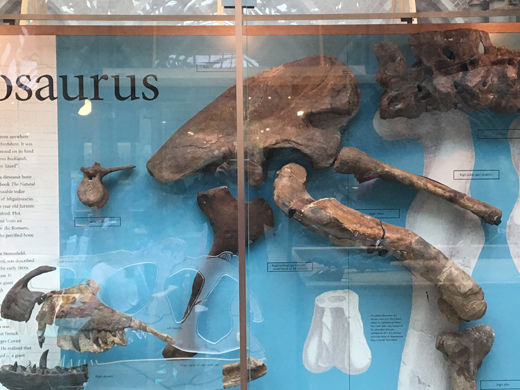
The Megalosaurus bucklandi Display at the Museum

Megalosaurus fossil material on display.
The Megalosaurus display case (Oxford Museum of Natural History).  Picture credit: Everything Dinosaur.

Picture credit: Everything Dinosaur

For models of Megalosaurus and other British dinosaurs: Dinosaurs and Prehistoric Animal Models.

Highlights of the collection include the world-renowned Oxford Dodo specimen, amazingly beautiful trilobite fossils and the remains of the first scientifically described dinosaur Megalosaurus bucklandi.  The Oxford University Museum of Natural History is back open again after the lockdown period.  Admission is free, but visits have to be booked on-line and once in the building social distancing measures have to be followed.

The Spectacular Interior of the Museum

The Oxford University Museum of Natural History (interior).
The spectacular Victorian ironwork of the Oxford University Museum of Natural History.  Picture credit: Everything Dinosaur.

Picture credit: Everything Dinosaur

Happy birthday to the Museum, many happy returns.

The Everything Dinosaur website: Everything Dinosaur.
19 09, 2020

Spinosaurus – Very Much at Home in the River

By |2024-03-15T17:06:40+00:00September 19th, 2020|Categories: Adobe CS5, Dinosaur and Prehistoric Animal News Stories, Dinosaur Fans, Main Page, Photos of Everything Dinosaur Products, Photos/Pictures of Fossils|0 Comments

Spinosaurus A River Monster

An examination of more than a thousand fossil dinosaur teeth collected from an ancient Cretaceous-aged riverbed in Morocco suggests that the giant theropod Spinosaurus was very much at home in an aquatic environment.  This new study, conducted by researchers from the University of Portsmouth, lends further support to the idea that Spinosaurus spent a great deal of time in water, that this enormous theropod, arguably one of the largest of all the carnivorous dinosaurs was a “river monster”.

More Evidence Suggests that Spinosaurus was an Aquatic Animal

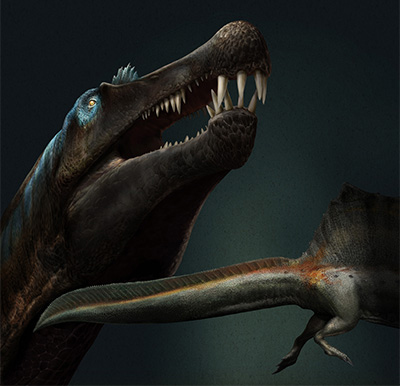
Swimming Spinosaurus (2020)
View of the crocodile-like snout of Spinosaurus and the new interpretation of the tail.  This new paper supports the earlier hypothesis that Spinosaurus aegyptiacus was an aquatic animal.

Picture credit: Davide Bonadonna/National Geographic

This new study builds on a research paper published in the journal “Nature”, earlier this year, which also involved co-author Professor David Martill (University of Portsmouth).  The May (2020) paper focused on the examination of Spinosaurus aegyptiacus caudal vertebrae, it was concluded that Spinosaurus had a wide, flexible, fin-like tail, ideal for helping the dinosaur to propel itself through the water.

To read more about the Spinosaurus tail bones: Spinosaurus – The River Monster.

A Study of Fossil Teeth from the Kem Kem Formation

Writing in the academic journal “Cretaceous Research”, the scientists conclude that Spinosaurus was a water-dwelling dinosaur, a giant “river monster”.

A total of 1,200 broken teeth were collected from the site of an ancient riverbed in the Kem Kem Formation of Morocco.  Each tooth was carefully analysed and documented and it was discovered that Spinosaurus teeth made up the majority of the fossil specimens.

Professor David Martill, Professor of Palaeobiology at the University of Portsmouth explained:

“From this research we are able to confirm this location as the place where this gigantic dinosaur not only lived but also died.  The results are fully consistent with the idea of a truly water-dwelling, “river monster”.”

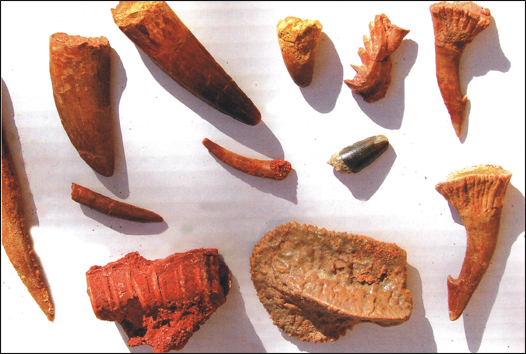
Examples of Typical Fossils from the Kem Kem Formation (Morocco)

Fossil remains (Kem Kem beds).
Assorted vertebrate fossil remains from the Kem Kem beds of Morocco.  The elongated conical tooth (top left) and the large, slender conical tooth which is partially obscured (far left) are likely to be spinosaurid.

Studying Spinosaurus

Around forty-five percent of all the teeth fossils were ascribed to Spinosaurus.

Professor Martill added:

“The huge number of teeth we collected in the prehistoric riverbed reveals that Spinosaurus was there in huge numbers, accounting for 45 per cent of the total dental remains.  We know of no other location where such a mass of dinosaur teeth have been found in bone-bearing rock.  The enhanced abundance of Spinosaurus teeth, relative to other dinosaurs, is a reflection of their aquatic lifestyle.  An animal living much of its life in water is much more likely to contribute teeth to the river deposit than those dinosaurs that perhaps only visited the river for drinking and feeding along its banks.”

Professor Martill worked alongside two students (Aaron Quigley and Thomas Beevor), studying for the Masters Degree in Palaeontology at the university.

Thomas Beevor commented:

“The Kem Kem riverbeds are an amazing source of Spinosaurus remains.  They also preserve the remains of many other Cretaceous creatures including sawfish, coelacanths, crocodiles, flying reptiles and other land-living dinosaurs.  With such an abundance of Spinosaurus teeth, it is highly likely that this animal was living mostly within the river rather than along its banks.”

Identifying Spinosaurus Teeth

Sorting fossil teeth can be quite a challenging process.  However, enough is known about the Kem Kem biota to enable most of the teeth remains to be assigned to a genus or at least at the family level.  Numerous theropod dinosaurs are known from this geological formation, but spinosaurid teeth are distinctive.  They are conical, lack serrations and are not recurved.  Aaron Quigley explained that the teeth of Spinosaurus have a distinct surface.  They have a smooth, round cross-section which glints when held up to the light.

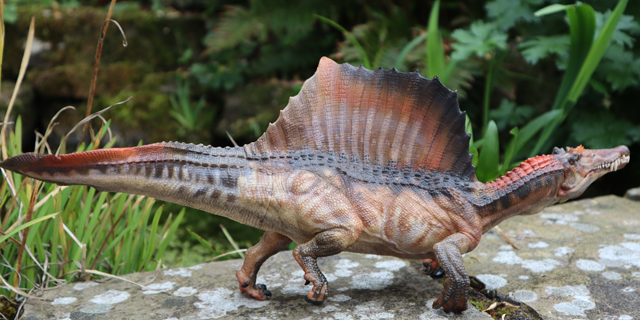
A Model of Spinosaurus Introduced in 2019 (Papo Spinosaurus)

Papo Limited Edition Spinosaurus Model.
The Papo limited-edition Spinosaurus dinosaur model (2019).  Depicting Spinosaurus as an aquatic animal with deep, fin-like tail. Picture credit: Everything Dinosaur.

Picture credit: Everything Dinosaur

The picture (above) shows the Papo limited-edition Spinosaurus figure.

To view the range of Papo dinosaurs and prehistoric animals: Papo Prehistoric Animal Figures.

The Sigilmassasaurus Confusion

Whilst the prevalence of spinosaurid teeth in the sample might indicate that spinosaurids spent more time in close proximity to the ancient river than other dinosaurs, this research does not represent definitive proof that Spinosaurus was aquatic.  It lends weight to the idea.

A large amount of spinosaurid teeth associated with the site, could be a result of some form of depositional bias or general taphonomy.  In addition, the paucity of Spinosaurus remains from the Kem Kem Formation has led to controversy over the classification of fossil bones.  For example, in 1996 a second genus of spinosaurid was named and described from fossilised cervical vertebrae found close to the Tafilalt Oasis in eastern Morocco.

This dinosaur was named Sigilmassasaurus brevicollis (Russell), but its taxonomic validity remains in doubt.  Sigilmassasaurus may be a valid genus, if it is, then it was very closely related to Spinosaurus aegyptiacus.  Other scientists think that S. brevicollis is not a valid genus and a junior synonym of Spinosaurus.  It is possible that the teeth involved in this study could represent another type of spinosaurid, other than S. aegyptiacus.

Everything Dinosaur acknowledges the assistance of a media release from the University of Portsmouth in the compilation of this article.

Visit the Everything Dinosaur website: Everything Dinosaur.
Go to Top