All about dinosaurs, fossils and prehistoric animals by Everything Dinosaur team members.

Fossil finds, new dinosaur discoveries, news and views from the world of palaeontology and other Earth sciences.

29 07, 2013

New Study Shows Dinosaur Brains Pre-programmed for Flight

By |2024-04-29T14:49:24+01:00July 29th, 2013|Categories: Dinosaur and Prehistoric Animal News Stories, Palaeontological articles|0 Comments

Dinosaur “Bird Brains” – Enlarged Brains in the Dinosauria Aided the Evolution of Powered Flight

New research published in the academic journal “Nature” provides evidence that some types of dinosaur developed the brain power required to manage the complex co-ordinated movements that are necessary for powered flight.  It seems that, according to this new study, some dinosaurs were “bird- brained”.

Dinosaur Brains

The term “bird-brained” can be used in a derogatory sense, however, the brains of birds can be quite large in proportion to their body size, previous research has shown that parts of the brains of birds are highly developed, even when compared to mammals.  After all, it takes great skill and co-ordination to achieve the balance and control required for powered flight.  It seems that members of the Dinosauria evolved “bird-brains” long before their descendants actually took to the skies as true birds.

Avian and Non-Avian Dinosaur Brain Study

Research suggests some dinosaurs were "bird brains".

Research suggests some dinosaurs were “bird brains”.

Picture credit: AMNH/M. Ellison

Intelligent Birds

Some extant birds are remarkably intelligent, the humble pigeon can demonstrate amazing feats of memory as they navigate, parrots and members of the starling family (Sturnidae) such as the famous Mynah bird are wonderful mimics. In 2009, Everything Dinosaur team members reported on a study involving members of the crow family (Corvidae) which demonstrated the problem solving abilities of some birds.

To read more about the clever crows: Birds show how clever their “bird-brains” are.

Lead author Amy Balanoff, a research associate at the American Museum of Natural History (New York) and a post-doctoral researcher at Stony Brook University, along with her colleagues has shown that a number of non-avian dinosaurs had brains that were at least as big (in proportion to body size), as that of Archaeopteryx lithographica.  This suggests that at a few of the members of the Dinosauria possessed the neurological hard-wiring essential for flight.

Computer Model Showing the Endocast of Archaeopteryx (A. lithographica)

The brain cast of Archaeopteryx lithographica, one of the earliest known birds, partitioned into neuroanatomical regions: brain stem (yellow), cerebellum (blue), optic lobes (red), cerebrum (green), and olfactory bulbs (orange)

The brain cast of Archaeopteryx lithographica, one of the earliest known birds, partitioned into neuroanatomical regions: brain stem (yellow), cerebellum (blue), optic lobes (red), cerebrum (green), and olfactory bulbs (orange).

Picture credit: AMNH/Dr. Balanoff

Amy commented:

“Archaeopteryx has always been set up as a uniquely transitional species between feathered dinosaurs and modern birds, a half-way point.”

Examining Archaeopteryx

Recent studies, have suggested that the likes of Archaeopteryx may not be the first bird after all, its position as a transitional fossil has also been brought into question.  In the light of this new research, it seems that the brain of the Late Jurassic Archaeopteryx may not have been unique.

Amy went onto add:

“By studying the cranial volume of closely related dinosaurs, we have learned that Archaeopteryx might not have been that special.”

Archaeopteryx must be one of the most intensively studied vertebrates in the whole of the fossil record.  Back in 2009, a team of scientists based at the Natural History Museum (London) analysed Archaeopteryx fossil material in a bid to understand more about the brain function and sensory abilities of this crow-sized, feathered creature.  The research team concluded that Archaeopteryx could hear as well as an extant Emu.

To read an article on this research: Examination of the Senses of Archaeopteryx.

Comparing Birds to Reptiles

When compared to extant reptiles, for their body size, birds generally have larger brains.  This “hyperinflation” is most obvious in the forebrain, an area of the brain dedicated to processing data from the optic nerve (eyesight) and co-ordinating body movement.  These anatomical and neurological features, once thought as exclusive amongst Aves (birds), may also be present in the Dinosauria.

The Model of a Woodpecker’s Brain with Endocast Partitioned to Show Neuroanatomical Positions

A modern woodpecker (Melanerpes aurifrons) with its brain cast rendered opaque and the skull transparent. The endocast is partitioned into the following neuroanatomical regions: brain stem (yellow), cerebellum (blue), optic lobes (red), cerebrum (green), and olfactory bulbs (orange).

A modern woodpecker (Melanerpes aurifrons) with its brain cast rendered opaque and the skull transparent. The endocast is partitioned into the following neuroanatomical regions: brain stem (yellow), cerebellum (blue), optic lobes (red), cerebrum (green), and olfactory bulbs (orange).

Picture credit: AMNH/Dr. Balanoff

Computerised Tomography

The scientists used high-powered computerised tomography scans (CT scans) to piece together the braincases of more than two dozen specimens, modern birds such as woodpeckers, the ancient Archaeopteryx and closely related non-avian dinosaurs such as tyrannosaurs and oviraptorids.  The three-dimensional images that were created allowed the research teams to identify specific portions of the brain such as forebrain as well as permitting a calculation regarding overall cranial capacity.  Major regions of the brain such as the olfactory bulbs, cerebrum, cerebellum, brain stem and optic lobes could be identified.

Reflecting on this study, co-author Gabriel Bever (Assistant Professor of Anatomy at the New York Institute of Technology), said:

“The story of brain size is more than its relationship to body size.  If we also consider how the different regions of the brain changed relative to each other, we can gain an insight into what factors drove brain evolution as well as what developmental mechanisms facilitated those changes.”

Studying Brain Volume

When compared to the members of the tyrannosaur family, or to oviraptorids, the research team discovered that in terms of brain volume, Archaeopteryx is not in a unique, transitional position between what are termed non-avian dinosaurs and extant birds.  Several other non-avian dinosaurs examined, including oviraptorids and troodontids, actually had larger brains relative to body size when compared to A. lithographica.

A spokesperson from Everything Dinosaur, stated:

“Relatively large and well developed brains in certain families within the Dinosauria are not that surprising when you consider some of the niches that these reptiles may have occupied.  The dinosaurs included in this study were probably very active, possibly living in packs or family groups with attendant complex behaviours.  They were active, agile hunters and as many were very probably feathered, it is also likely they performed complicated movements as part of courtship or other types of visual displays.”

The Endocast of the Oviraptorid Citipati (C. osmolskae)

The transparent skull and opaque brain cast of Citipati osmolskae, an oviraptor dinosaur, is shown in this CT scan. The endocast is partitioned into the following neuroanatomical regions: brain stem (yellow), cerebellum (blue), optic lobes (red), cerebrum (green), and olfactory bulbs (orange).

The transparent skull and opaque brain cast of Citipati osmolskae, an oviraptor dinosaur, is shown in this CT scan. The endocast is partitioned into the following neuroanatomical regions: brain stem (yellow), cerebellum (blue), optic lobes (red), cerebrum (green), and olfactory bulbs (orange).

Picture credit: AMNH/Dr. Balanoff

In conclusion, Dr Balanoff stated:

“If  Archaeopteryx had a flight-ready brain, which is almost certainly the case given its morphology, then, so did at least some of the non-avian dinosaurs.”

Oviraptorids Included in the Study

Note the Tail Plume

Note the tail plume.

Picture credit: Everything Dinosaur

The research team also examined another factor which is vital to powered flight in modern birds, a neurological structure referred to as the wulst, which has an important role in data processing and motor control.  In the scans of the Archaeopteryx cranial region, the scientists discovered an indentation that might be homologous to the wulst seen in the brains of extant birds.  No evidence of this indentation could be found in the brains of the dinosaurs that were involved in this study, even though proportionately, these dinosaurs had bigger brains than Archaeopteryx.

The evolution and development of the wulst is an area  of research which the American based team are keen to explore.

Everything Dinosaur is grateful to the American Museum of Natural History for information used in the compiling of this article.
27 07, 2013

Freshwater Pliosaur from Cretaceous Victoria

By |2023-02-21T06:16:11+00:00July 27th, 2013|Categories: Dinosaur and Prehistoric Animal News Stories|0 Comments

Fossil Tooth Provides Evidence of an Australian Freshwater Pliosaur

When amateur palaeontologist Mike Cleeland found a fossilised tooth whilst exploring an area close to San Remo for dinosaur bones, he did not think at the time that his fossil find would lead to new insights into the lifestyles and habits of sea monsters.

Freshwater Pliosaur

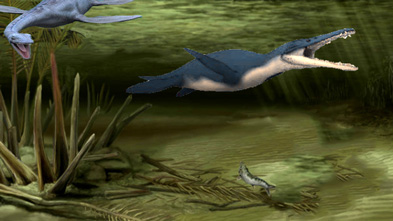
Thanks to a joint investigation by scientists from Museum Victoria, Monash University (Australia) and Oxford University (England), palaeontologists have evidence of a giant, freshwater pliosaur.  The discovery suggests that both short-necked and long-necked plesiosaurs lived in freshwater for at least some parts of their lives.  Perhaps, like some species of extant cetaceans such as the river dolphins of the Amazon Basin and the Ganges in India, these reptiles lived their entire lives in freshwater and they had adapted to a life in rivers and estuaries.

The tooth measures approximately 45 millimetres in length and it was found in 1994, in an area around fifty miles from the centre of Melbourne (Victoria).  The strata in which the fossil was found represents a 100-million-year-old river system. During the Cretaceous, this part of Australia was a low-lying plain which was crossed by many meandering, large rivers.

Not a Crocodile Tooth

At first the tooth was thought to belong to a particularly big crocodile, as fossils of Cretaceous crocodilians had been found in the area in the past, but the tooth was not intensively studied until a couple of years ago when Dr Erich Fitzgerald (Senior Curator of Vertebrate Palaeontology a Museum Victoria), decided to take a closer look at the specimen.

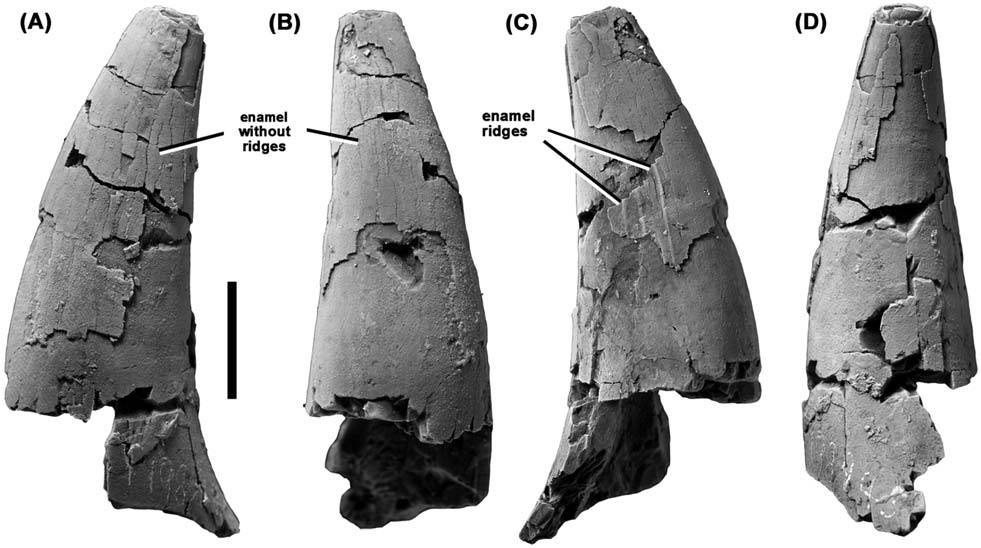
Under the microscope, a series of ridges in the preserved enamel could be seen.   The ridges, essentially a series of fine lines, are spaced apart from each other and stop short of the crown apex (the top of the tooth).  This ridge pattern differs from that seen on smaller teeth found in the same locality.  The smaller teeth measure between 10 and 20 millimetres in size and possess ridges that are closer together and continue closer to the apex of the crown (the tip of the tooth).

Dr Fitzgerald suspected that Mike Cleeland’s fossil tooth could be that of a freshwater pliosaur, but he consulted Dr Roger Benson (Oxford University), who was in Melbourne at the time studying dinosaur fossils that had been discovered in the area. Dr Benson had studied a number of pliosaur fossils that had been found in England and he was able to confirm Dr Fitzgerald’s initial view that this large tooth was indeed that of a pliosaur.

The Thumb-sized Tooth of the Freshwater Pliosaur

Evidence of a freshwater reptile predator

Evidence of a freshwater reptile predator.

Picture credit: Museum Victoria

Establishing the Evidence

Thus began the long, painstaking process to establish a body of evidence to suggest that this was a freshwater pliosaur tooth.  The matrix from which the tooth was extracted was examined, other fossils found in the location were studied and an examination of the palaeo-environment undertaken.  The research team have concluded that the tooth was from a five-metre-long pliosaur, a predator that used to live in the waterways that once criss-crossed this part of Australia.

Scientists had found evidence of a smaller, plesiosaur, a long-necked plesiosaur living in the same ancient river system. This is the first evidence of a large pliosaur sharing rivers with another member of the Plesiosauria.

An Illustration showing Types of Plesiosaur in a Freshwater Environment

Marine reptiles, now a contradiction!

Marine reptiles, now a contradiction!

Picture credit: Everything Dinosaur/M. Witton/Lyme Regis

Marine Reptiles – A Contradiction

The picture above is a composite made by Everything Dinosaur team members based on an image of a Pliosaur produced by renowned artist Mark Witton and the image of a plesiosaur from Lyme Regis museum.  The picture shows a scene in the freshwater environment of Cretaceous Australia where plesiosaurs and pliosaurs shared the same eco-system.

Commenting upon the differences between short-necked plesiosaurs and long-necked plesiosaurs, Dr Fitzgerald stated:

“The Plesiosauria include all those sea-going reptiles from the age of dinosaurs that have these very long snake-like necks and they’ve often been used as a model for the mythological Loch Ness Monster.  The pliosaur is a shorter-necked, much more robust and crocodile-headed relative of those long-necked plesiosaurs.”

The palaeontologist confirmed that the plesiosaur had much smaller teeth which revealed information about the diet of the now extinct species.

“What we can tell from studying the teeth of these river reptiles is that the smaller species was feeding on relatively small prey.  If you have smaller, finer, needle-like teeth, you’re much more likely to be using your teeth as a fishtrap to catch small fish.”

Feeding on Much Larger Animals

However, the much larger teeth of the pliosaur indicate that it was feeding on much larger animals, perhaps bigger types of fish, the plesiosaurs themselves, crocodiles or even small dinosaurs as they came down to the riverbank to get a drink.

A Close up of the Pliosaur Tooth Showing the Fine Ridges

Shown at high magnification and from different angles the fine ridges can be made out.

Shown at high magnification and from different angles the fine ridges can be made out.

Picture credit: Museum Victoria/M. Benson

This is the first evidence to suggest that two Plesiosauria lived inland together at the same time, in the same river system. Recently, a team of scientists studying a Late Cretaceous mosasaur fossil found in Hungary have concluded that mosasaurs too, had members of their group that also lived in freshwater.

To read more about the mosasaur research: Freshwater Mosasaur from a Hungarian Bauxite Mine.

It seems that the term marine reptiles, when applied to the Plesiosauria and even the mosasaurs may not be technically accurate anymore.

24 07, 2013

The Fascinating Tale of a Hadrosaur’s Tail

By |2024-03-17T12:03:25+00:00July 24th, 2013|Categories: Dinosaur and Prehistoric Animal News Stories, Dinosaur Fans|0 Comments

Researchers Uncover the Articulated Caudal Vertebrae of  a Lambeosaurine Hadrosaur

A team of palaeontologists and researchers from the National Autonomous University of Mexico (UNAM) and the National Institute of Anthropology and History (INAH), also of Mexico, have a tale to tell as they have just finished uncovering the tail bones of an enormous, Late Cretaceous duck-billed dinosaur.

Hadrosaur fossils have been found before in Mexico, but what makes this discovery so fascinating is that the fifty or so caudal vertebrae are articulated – positioned in relation to each other as they would have been when the dinosaur roamed.

Hadrosaur Tail

The fossilised tail has been dated to the Maastrichtian faunal stage* of the Late Cretaceous, the strata in the area is approximately 72 million years old and although the genus and species has not yet been determined, the palaeontologists are certain that their dinosaur was a sizeable beast, after all, the tail itself is more than five metres in length.  It is likely that the dinosaur would have measured something in the region of twelve metres in total.  The fossil comes from the Coahuila desert region of Ejido Guadalupe Alamitos municipality of General Cepeda.

* Further analysis led to a revision with the fossil material associated with the upper Campanian.

The duck-billed dinosaur fossil was spotted by José López and Rodolfo Espinoza, in early May 2005.   However, it was only reported to the National Institute of Anthropology and History last month and after a quick, preliminary inspection a field team was despatched to excavate the specimen.  Digging started on July 2nd and the field team thought that they were dealing with just a few vertebrae, but after twenty days, the almost complete tail had been revealed.

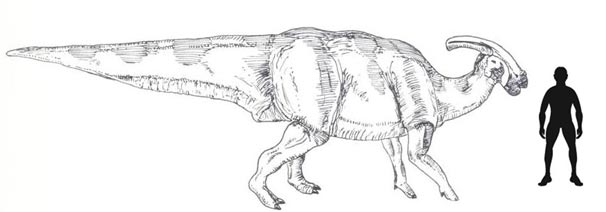
Other elements from the skeleton have also been found including bones from the hip area, these in conjunction with the caudal vertebrae, have led scientists to suggest that this is a fossil of a lambeosaurine hadrosaur.  It is likely that this dinosaur sported a crest on its head, perhaps it was similar to a Parasaurolophus.

An Illustration of the Lambeosaurine Hadrosaur Parasaurolophus walkeri

A crested, duck-billed dinosaur.

Picture credit: Everything Dinosaur

First Fully Articulated Dinosaur Tail Discovered in Mexico

This is the first fully articulated dinosaur tail found in Mexico and is one of the few complete articulated dinosaur tails that have ever been found in the world.  The researchers are optimistic that they will  find the rest of the dinosaur in the rock beneath the site where the tail was found.

Back in 2008, team members at Everything Dinosaur reported on the discovery of Mexico’s first unique dinosaur, another Lambeosaurine Hadrosaur that was named Velafrons coahuilensis.  This specimen was the first example of a significant dinosaur fossil in Mexico that did not reflect other specimens found in the southern United States.

To read about this discovery: Viva Mexico! Lambeosaurine Dinosaur Discovery.

More recently, the discovery of a horned dinosaur was announced.  To read an article about a ceratopsian from Mexico: Giant Horned Dinosaur from Mexico.

A Special Find

A spokesperson from Everything Dinosaur commented:

“This is a really special fossil find.  With the tail bones in such an alignment palaeontologists can understand more about how the tail actually functioned, the specimen is so well-preserved that the space where cartilage was distributed between the actual bones can be identified.  This will help scientists to understand more about the biomechanical properties of the tail.”

Commenting on the field work, palaeontologist Angel Ramirez Velasco, one of the team members on the project stated:

“This finding is important for the biological study of  dinosaurs, we will have a sequence that will reveal the characteristics of the vertebrae.  They will be seen differentiating in size depending on their position in the spine.”

The hefty specimen will be removed from the field location in sections, to avoid as much damage as possible.  The pieces will then be put back together again in a special laboratory.  After further cleaning and study, it is hoped that this amazing fossil will be put on general display so that members of the public can marvel at the tail-end of a Late Cretaceous herbivore, that once roamed Mexico.

For models and replicas of Late Cretaceous lambeosaurines and other dinosaurs: PNSO Age of Dinosaurs Models and Figures.

18 07, 2013

“Large Nose, Horn Face” Nasutoceratops a New Dinosaur is Named

By |2024-04-29T10:54:39+01:00July 18th, 2013|Categories: Dinosaur and Prehistoric Animal News Stories|1 Comment

New Campanian Centrosaurine Dinosaur – Nasutoceratops titusi

A research paper detailing the work on a new type of horned dinosaur discovered in the fossil rich Kaiparowits Formation of the Grand Staircase-Escalante National Monument (southern Utah), has just been published in the academic journal Proceedings of the Royal Society B (Biology).  The fossilised bones of this remarkable looking dinosaur were found back in 2006, the fossils include a nearly complete skull, plus elements from the neck and front limb bones.  Although the scientists cannot be sure that this is a fully mature individual, it is still a sizeable beast, perhaps weighing as much as three tonnes and measuring nearly six metres in length.

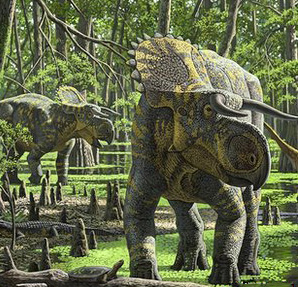
Horned Dinosaur

An Illustration of Nasutoceratops titusi

Nasutoceratops - a Centrosaurine dinosaur from Utah

Nasutoceratops – a Centrosaurine dinosaur from Utah.

Picture credit: Raul Martin 

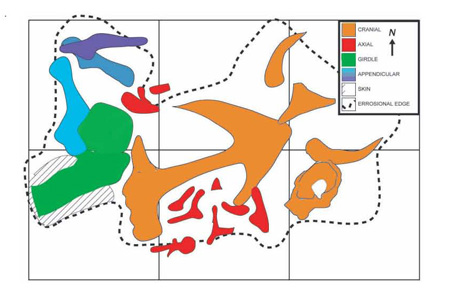
A Grid Diagram Showing the Layout of the Fossil Bones

Nasutoceratops in situ

Nasutoceratops in situ

Picture credit: Eric Lund et al

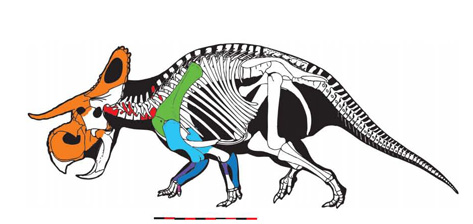
The picture shows the approximate layout of the fossil material in the ground, each square on the diagram represents one square metre.  The skull material including the large brow horns are coloured orange, axial material (related to the neck) is in red, elements from the shoulder girdle are coloured green and front limbs blue/purple.

A Reconstruction of the N. titusi Skeleton

Scale bar = 1 metre

Scale bar = 1 metre

Picture Credit: Eric Lund et al

The diagram above shows how the fossil material found would fit into a reconstruction of the complete skeleton of this plant-eating dinosaur.

Nasutuceratops titusi

The dinosaur’s name means “large nosed horned face” after the Latin nasutus (large nosed) and the Latinised/Greek ceratops (horn face).  The species name “titusi” honours Alan Titus, a palaeontologist who is renowned for his work on fossils from the Grand Staircase-Escalante National Monument.

A phylogenetic analysis of the Centrosaurinae group places Nasutoceratops as the sister taxon to Avaceratops lammersi from the Late Campanian of Montana.  Nasutuceratops titusi has been designated as a basal member of the Centrosaurinae and suggests the existence of a previously unknown clade of short-snouted, long-horned centrosaurines in the southern portion of the North American landmass known as Laramidia.

Dr Mark Loewen (University of Utah and the Natural History Museum of Utah), one of the authors of the new paper published this week commented:

“This dinosaur just completely blew us away.  We would never have predicted it would look like this, it is just so outside of the norm for this group of dinosaurs [centrosaurine].“

A Member of the Centrosaurinae

Centrosaurines tend to have short brow horns with the largest horn being on the snout, but this description is rapidly becoming redundant.  The discovery of N. titusi with its large, curved brow horns and very broad snout challenges a lot of the assumptions palaeontologists had about the appearance of these horned dinosaurs.

When asked to comment about the large number of horned dinosaur discoveries made recently in the western United States a spokesperson from Everything Dinosaur stated:

“There have been a number of new centrosaurine and chasmosaurine dinosaurs named recently, what is perhaps more remarkable is that many of these horned dinosaur remains have been found in close proximity to the fossilised bones of other types of large, herbivorous dinosaur.  For instance, the fossils of N. titusi were found in close association with hadrosaur as well as ankylosaur material.  This suggests that back in the Late Cretaceous Utah was a very fertile and verdant environment capable of supporting a very diverse range of large plant-eating dinosaurs.”

Campanian Faunal Stage

The fossils have been dated as being between 75.9 and 75.2 million years old (Campanian faunal stage).  A number of other types of horned dinosaur have recently been discovered in strata that make up the Grand Staircase-Escalante National Monument, including two bizarre horned dinosaurs that belong to the Chasmosaurinae.  To read about this discovery: Curious Ceratopsians.

The discovery of Nasutoceratops also provides strong support for the hypothesis of regional dinosaurs in this part of the world during the Late Cretaceous.  It seems that dinosaur populations became isolated in what was to become western North America and a number of independent but related populations subsequently evolved.  Palaeontologists have suggested that there was a high degree of  provinciality in Late Campanian mega faunas.

For articulated models of ceratopsians and other dinosaurs: Beasts of the Mesozoic Models and Figures.

16 07, 2013

New Research Reveals T. rex Tooth Crown Found Embedded in an Edmontosaurus Tail – Predatory Behaviour?

By |2024-04-29T14:15:05+01:00July 16th, 2013|Categories: Dinosaur and Prehistoric Animal News Stories, Palaeontological articles|2 Comments

Tyrannosaurus rex – Hunter or Scavenger Debate Reignited after Fossil Find

Almost ever since T. rex was formally named and described back in 1905, debate has raged amongst scientists as to whether this Late Cretaceous dinosaur was an active hunter or primarily a scavenger.  The skull of Tyrannosaurus rex is relatively short when compared to an adult body length somewhere in excess of 13 metres and the teeth in its exceptionally strong jaws are very different in shape when compared to other large meat-eating dinosaurs such as the allosaurids and the abelisaurs.  It is true, the teeth are large, those in the maxilla and dentary (upper and lower jaws), for example, can be in excess of 18 cm long and more than 2.5 cm wide at the point where the crown would emerge above the gum line.

Theropod Teeth

However, the teeth are not necessarily recurved and sabre-like, the sort of teeth one associates with the likes of Mapusaurus, Carcharodontosaurus or even Ceratosaurus.  Having had the opportunity to study tyrannosaurid teeth in detail, it is surprising how blunt they feel at the tips, indeed one of their most remarkable features is their characteristic “D” shape in cross section.  Are these the teeth of an active hunter, or the bone crushing dentition of a scavenger?

A team of American scientists have discovered the tip of a tyrannosaur tooth, embedded in the tail bones of a large, duck-billed dinosaur.  The bone surrounding the tooth shows signs of healing.  Is this physical evidence of a tyrannosaur hunting and attacking another dinosaur?  Could the debate over the hunter versus scavenger issue be finally laid to rest?

Tyrannosaurus rex Feeding Strategies

The feeding strategies of large, theropod dinosaurs such as Tyrannosaurus rex have been debated by palaeontologists for a long time.  Fossil finds have provided some tantalising glimpses into feeding behaviour, however, it is notoriously difficult to distinguish post-mortem pathology with evidence of interspecific hunting behaviour.  There have been several Triceratops fossils found which show tell-tale puncture marks from the teeth of T. rex, but it is impossible to tell whether these wounds were made by a feeding tyrannosaurid on a Triceratops carcase or as a result of a fight between these Late Cretaceous giants.

In a paper published in the academic journal “The Proceedings of the National Academy of Sciences”, the researchers report on the discovery of a tyrannosaur tooth crown stuck fast in the tail bone of a herbivorous Edmontosaurus, the scientists conclude that this is definite evidence of predation by a T. rex, an attack by an immature tyrannosaur on a duck-billed dinosaur.

Hadrosaur with Bite Mark

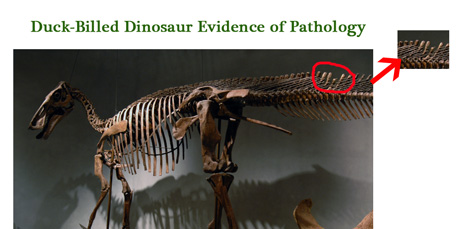
At the Denver Museum of Nature and Science there is a mounted exhibit of a large, hadrosaur (Edmontosaurus annectens), with a strange “U” shaped bite mark out of its tail.  This has been described as the damage caused by an attack from a Tyrannosaurus rex, although, unlike this new study, there was no tell-tale evidence of a tooth being left behind.

Hadrosaur Exhibit Shows Evidence of Tyrannosaur Attack?

Museum exhibit may show evidence of T. rex attack.

Museum exhibit may show evidence of T. rex attack.

 Picture credit: Denver Museum of Nature and Science/Everything Dinosaur

In the picture above, the mounted hadrosaur exhibit is shown with the damage to the neural arches on some of the caudal vertebrae highlighted.

T. rex Tooth

The academic paper was produced by scientists from the Department of Palaeontology (Palm Beach Museum of Natural History, Florida), Pete Larson from the Black Hills Institute of Geological Research (South Dakota) and researchers from the University of Kansas.  One of the paper’s authors, Larry D. Martin of the University of Kansas Biodiversity Institute sadly passed away earlier this year.  This paper was one of the very last that he contributed to.  The hadrosaur fossils, ascribed to Edmontosaurus were found in South Dakota and come from the famous Hell Creek Formation.  The two traumatically fused caudal vertebrae (tail bones), partially enclose the tip (part of the crown), of a tyrannosaurid tooth, one that is believed to represent the dentition from a partial grown, immature Tyrannosaurus rex.

The Researchers Show the Fossilised Tooth Fragment Embedded in the Tail Bones

Evidence of a predatory T.rex?

Evidence of a predatory T. rex?

Picture credit: David A. Burnham/University of Kansas Biodiversity Institute

The healed bone growth indicates that the duck-billed dinosaur survived this encounter.  In February of this year, researchers from the University of Kansas and Florida reported on the discovery of evidence of a scar on fossilised skin tissue from just above the eye of an Edmontosaurus.  In a paper, published in “Cretaceous Research”, the scientists concluded that this too was evidence of an attack of a T. rex on an Edmontosaurus.

Hadrosaur Fossilised Scar – Evidence of an Attack from a T. rex?

A scar above the eye of a Hadrosaur, preserved as an impression in fossilised skin.

A scar above the eye of a hadrosaur, preserved as an impression in fossilised skin.

Picture credit: Robert DePalma/Palm Beach Museum of Natural History

A Hunter or Scavenger?

A number of eminent palaeontologists have commented on the scavenger/hunter debate over the years.  It is likely, that just like most large carnivores today, if a Tyrannosaurus rex found the corpse of another dinosaur it would very probably feed off the kill – a sort of “free lunch” for a tyrannosaur.  However, as an opportunistic feeder, if the same T. rex got the chance to approach undetected a potential meal such as a duck-billed dinosaur, then it would probably have used this chance to launch an attack.

Back in the summer of 2010, as part of Everything Dinosaur’s museum outreach programme, team members devised a presentation on the hunter versus scavenger topic.  Members of the public could examine some of the evidence and decide for themselves as to whether Tyrannosaurus rex was an active hunter or a rather ponderous meat-eater preoccupied with scavenging the kills of other dinosaurs.  To see the results of the survey: Results of the T. rex Hunter or Scavenger Survey.

 CT Scans of the Fused Hadrosaur Tail Bones

CT scans reveal the embedded tooth.

CT scans reveal the embedded tooth.

Picture credit: Robert DePalma et al

The picture above shows computerised tomography (CT) scans of the hadrosaur fossil bones.  1) the two tail bones fused together and 2) showing the cross-section of the Tyrannosaurus rex tooth buried in the bone (the white oval at the bottom of the picture (2)).  The scale bars shown represent 1 cm.

Far from being definitive prove, “smoking gun” evidence that Tyrannosaurus rex was indeed an apex predator, some scientists have challenged the paper’s findings.  Dr Paul Barrett (Natural History Museum, London), rather summed up some of the comments that have been reported by stating:

“This paper shows without question that a T. rex bit a living Hadrosaur, but it can’t show if this was a regular behaviour or not, or even if this was hunting behaviour rather than some other kind of interaction”.

For models and replicas of Tyrannosaurus rex and other prehistoric animals: Rebor Prehistoric Animal Figures and Replicas.

14 07, 2013

Lyme Regis Rare Ammonite Polishing Dates Announced

By |2024-04-29T14:15:37+01:00July 14th, 2013|Categories: Dinosaur and Prehistoric Animal News Stories, Everything Dinosaur News and Updates, Geology|0 Comments

Fossils Fans Get the Chance to Get “Hands On” with Ammonite Activities

Visitors to the picturesque seaside resort of Lyme Regis, on southern England’s famous Jurassic coast, will get the chance to polish their own ammonite fossil, at special events organised by Lyme Regis Museum being held throughout the summer holidays.

Lyme Regis

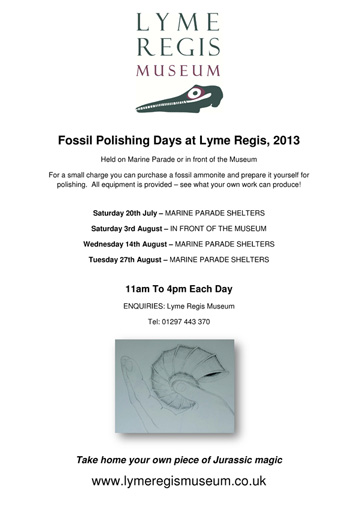
Ammonites are an extinct group of cephalopod molluscs that lived in chambered shells.  Their fossils are associated with much of the strata that can be found along the famous World Heritage Site of the “Jurassic Coast”, for the chance to learn more about these amazing creatures and to polish your own ammonite fossil, see the poster below:

Ammonite Polishing Days Announced

Fancy being a palaeontologist, studying Ammonites?

Fancy being a palaeontologist, studying ammonites?

Picture credit: Lyme Regis Museum/Brandon Lennon/Everything Dinosaur

Ammonite Fossil Polishing

For a small fee, fossil enthusiasts and tourists can purchase their own ammonite fossil and prepare it just like a real palaeontologist.  Polishing the fossil reveals the amazing and very beautiful internal structure of the fossil.  The first fossil polishing event is taking place this weekend (Saturday July 20th).   The event starts at 11am and will run until 4pm that afternoon.

A spokesperson from Everything Dinosaur commented:

“These events give members of the public the opportunity to carry out their own fossil polishing and to learn about these extinct marine creatures that are so important to the science of palaeontology.”

Other dates are:

Saturday 3rd August, Wednesday 14th August and the final ammonite fossil polishing event this summer is scheduled for Tuesday 27th August, the day after the Bank Holiday.

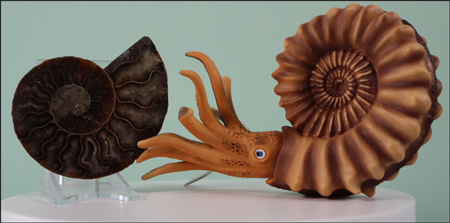
A Replica of an Ammonite and a Polished Ammonite Fossil

The Bullyland ammonite model next to a polished section of an ammonite fossil.
The Bullyland ammonite model is often used in museum displays to depict the living animal next to fossil material. Picture credit: Everything Dinosaur.

Picture credit: Everyting Dinosaur

To view replicas of prehistoric animals including the ammonite figure (whilst stocks last): Bullyland Prehistoric World Models and Figures.

11 07, 2013

Sharks and Ice Age Monsters Invade The Beacon

By |2023-02-19T06:39:46+00:00July 11th, 2013|Categories: Dinosaur and Prehistoric Animal News Stories, Educational Activities, Everything Dinosaur News and Updates, Press Releases|0 Comments

Cumbrian Museum to Play Hosts to Sharks and Woolly Mammoths

Staff at The Beacon, the interactive, family orientated museum at Whitehaven on the Cumbrian coast, are going to have their hands full this summer as not one but two major exhibitions will be taking over their galleries.  Following on from the highly successful “BBC Walking with Dinosaurs Exhibition” in 2011, in which team members at Everything Dinosaur were invited to be the “on the spot dinosaur experts”, the museum will be hosting “Ice Age – Life After Dinosaurs” and “Shark! The Myths and Reality”.

“Ice Age – Life After Dinosaurs” and “Shark! The Myths and Reality”

The Beacon is closed for the next few days as final preparations are made, it is not easy to manipulate life-size replicas of giants such as Woolly Mammoths, Sabre-toothed cats and Great White sharks.  The grand opening is scheduled for this Saturday (13th July), there’s just time for the busy Beacon staff to check all the hands on, educational and fun exhibits before the start of these “monster” exhibitions at 10am Saturday morning.

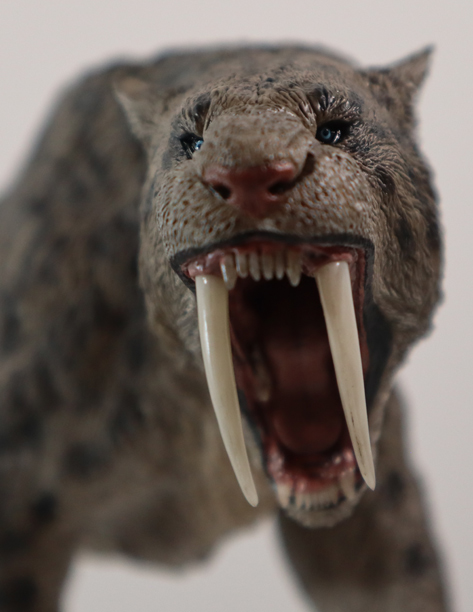
If you’re looking for ways to entertain your little monsters for the summer holidays, then you don’t have to look too far as visitors to Copeland’s museum will be transported back to a time when the Earth was dominated by a diverse range of magnificent mammals, that our ancestors had to contend with.  The “Ice Age – Life After Dinosaurs”  exhibition features full size replicas of giant prehistoric beasts including the wonderful Woolly Rhino and the savage Smilodon as well as real and replica fossils.

Square up to a Sabre-toothed Cat

Rebor Smilodon model in the Ice Age colour scheme.

A close-up of the head of the Rebor Smilodon populator figure (mouth open head attachment). The exquisite detailing or the teeth and the inside of the mouth can be clearly seen.  Picture credit: Everything Dinosaur.

Commenting on the exhibition, Mike Walley from Everything Dinosaur stated:

“This is the best chance people have had to go eyeball to eyeball with Ice Age monsters in the last 20,000 years”.

Everything Dinosaur

Everything Dinosaur team members who will be running two special weekend events at The Beacon in the summer and October school holidays.  The fossil experts are going to be visiting the exhibitions on Saturday 3rd and Sunday 4th of August, with a second, special appearance scheduled to coincide with the autumn half-term, the weekend of 26th and 27th of October.

Everything Dinosaur is keeping what they intend to bring along from their extensive fossil collection under wraps for the moment, however, visitors to The Beacon on these special weekends can expect to get up close to some super-sized marine predators, ferocious hunters that make “Tyrannosaurus rex look like a pussy cat”.  If you have ever wanted to know how to avoid being gored by the two-metre long horn of a giant rhinoceros or to discover how close scientists are to cloning a Woolly Mammoth then don’t forget to book the weekend of August 3rd and 4th and the last weekend of October into your diary.

The Beacon Museum

“Shark! Myths and Reality” will turn everything you thought you knew about sharks upside down, bringing visitors face to face with life size replicas of these ancient hunters, including the Great White.  This exhibition aims to dispel the many myths about sharks as mindless killing machines.  Built in co-operation with The Shark Trust, it tells the real story of these fascinating underwater creatures.

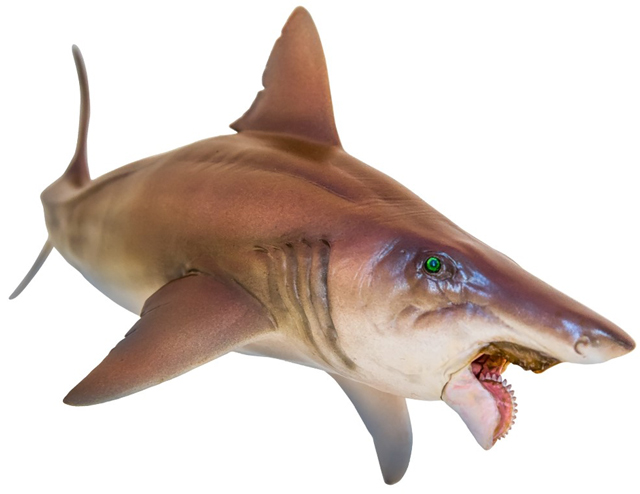
Famous for its Whorl of Teeth – Helicoprion an Extinct Cartilaginous Fish.

PNSO Haylee the Helicoprion anterior view

PNSO Haylee the Helicoprion replica. The stunning emerald eye on the model is reminiscent of the eye of a Chimaera such as the deep water Rabbit Fish (Chimaera monstrosa) to which Helicorprion is distantly related.

For models and replicas of prehistoric animals including Helicoprion (whilst stocks last): PNSO Age of Dinosaurs Models and Figures.

A spokesperson from Everything Dinosaur explained:

“Although sharks have been around for something like 420 million years and there are over 400 species alive today, scientists are still learning  about these incredible creatures.  For example, just this week a new scientific paper has been published that confirms how the Thresher shark uses its amazing tail as a whip to stun its prey.”

Pat Graham, Copeland’s Director of Services added:

“We are proud and delighted that we have managed to again secure a nationally significant exhibition for Whitehaven.  These big events not only attract visitors in the town,  but afford residents  the opportunity to access the best education and fun that museums can offer,  but on our own doorstep.  These are hard times for the Council, and for families, but this is an opportunity for us to celebrate something really great for the town, and we should use this as an opportunity to collectively promote our Borough across the region”.

There will also be weekly drop in family craft days beginning on 31st July.  Be inspired by what you have seen during your visit and create your very own Ice Age creature, shark or other magnificent monster.

But don’t worry if you can’t make it during the summer as both exhibitions will be on display until 5th January.

For more information about the fantastic models in stock at Everything Dinosaur: Dinosaur and Prehistoric Animal Figures.

9 07, 2013

Fragments of Fossilised Teeth Hint at Late Cretaceous Japanese Theropod According to New Research

By |2024-04-29T14:17:17+01:00July 9th, 2013|Categories: Dinosaur and Prehistoric Animal News Stories, Dinosaur Fans|0 Comments

Fossilised Teeth Fragments Go on Display

Fossils of dinosaurs from Japan are extremely rare, those that have been found are in most cases extremely fragmentary.  Japan lacks the extensive bone beds that we have had the chance to visit in places such as in Dinosaur Provincial Park (Alberta, Canada).  However, a dedicated team of researchers are slowly but surely piecing together the ancient flora and fauna of the land we now know as Japan.

Late Cretaceous Theropod Teeth

Some of the very latest fossil discoveries are being put on display for the first time today, including two tooth fragments that most likely come from a carnivorous theropod dinosaur that roamed the Nagasaki Peninsula something like 84 million years ago (Santonian faunal stage).

Dr Kazunori Miyata of the Fukui Prefectural Dinosaur Museum and one of Japan’s leading experts on vertebrate fossils came across the fossils in July 2011 whilst exploring the Mitsuze layer on the western coast of the Nagasaki Peninsula.  It is not possible to ascribe the fossilised teeth to any specific genera of the Theropoda, although the largest fragment (35.4 mm x 26.8 mm x 11.2 mm) probably represents a proportion a six centimetre long tooth (root plus crown).

Unknown Theropod Genus

The other fragment, although smaller measuring 34.2 mm long and 13.6 mm wide probably came from the same species if not the same individual specimen.  Comparisons with other Late Cretaceous theropods suggests a predator in excess of seven metres in length, although whether this animal is a tyrannosaur or possibly a member of some other theropod family remains uncertain.

A Fragment of Fossilised Tooth (Theropoda)

Fossils on display to the public.

Picture credit: KYODO

Serrations (saw-like edges) along one side of a tooth are still visible, this is an indication that these teeth were from a meat-eating dinosaur.  The teeth discovery extends the known range of carnivorous dinosaurs to thirteen prefectures in Japan, from Iwate in the north-east to Kagoshima in the south-west, although these fossil finds do not represent evidence of just a single, carnivorous species.

A Close up of the Fine Serrations (Denticles)

A close up of the serrations on the tooth fragment.

Picture credit: KYODO

The Mitsuze Formation

Fossils from the Mitsuze Formation include pterosaurs, crocodilians, chelonians (turtles) and fragments of herbivorous dinosaur material.  Such is the relative abundance of fossil material associated with this strata that researchers have used this strata to help date other Upper Cretaceous, fossil bearing geological formations in Japan.

The Nagasaki Board of Education in collaboration with staff at the Fukui Prefectural Dinosaur Museum have created a display of this new fossil material in the city of Nagasaki (Sanwa Gyosei Centre).  The exhibit will than be relocated to the Nagasaki Science Museum until the end of this month.  From here the fragile fossils will be taken to Fukui Prefectural Dinosaur Museum so that they can take part in a temporary exhibition showcasing Japan’s dinosaurs which runs from August through to mid October.  After this, the 84 million  year old teeth will be put on permanent display back in the Nagasaki Prefecture (Nagasaki Science Museum).

To read an article about a Japanese school boy who discovered the fossilised remains of a dinosaur toe bone: Schoolboy finds dinosaur toe bone.

8 07, 2013

Miocene Lizard Preserved in Amber

By |2023-02-18T22:08:35+00:00July 8th, 2013|Categories: Dinosaur and Prehistoric Animal News Stories|2 Comments

Scientists Examine New Species of Prehistoric Lizard

Being small has its advantages.  For example, being able to survive a devastating global catastrophe such as an impact by an extraterrestrial object which hastened the demise of the Dinosauria.  As a general rule, if a land-living organism was bigger than a Labrador sixty five million years ago, roughly the time of the disaster, then it would most likely not have survived.  However, small, terrestrial creatures are rarely preserved in the fossil record.

Often their delicate skeletons are lost well before any fossilisation can take place, indeed, the carcase of any small animal is very likely to be scavenged, making a tasty mouthful for any passing predator.  So it is very remarkable to read about the discovery of an entirely new species of lizard dating from the Miocene – a lizard fossil preserved in amber.

Lizard Specimen Preserved in Amber

Lizard specimen preserved in amber.

Lizard specimen preserved in amber.

Miocene Lizard

Researchers studying amber (fossilised tree resin), in the state of Chiapas (Mexico), from a famous location, the Simojovel amber deposits, have uncovered the complete fossilised remains of a small lizard, preserved in an amber nodule.  The little lizard has been assigned to the family Dactyloidae and the genus Anolis, a diverse genera that contains something like 400 extant species.

The lizard specimen measures approximately 4.5 centimetres by 1.3 centimetres and as this little creature was trapped by sticky tree resin the fossilised specimen is virtually complete.  A spokesperson from the National Autonomous University of Mexico’s Physics Institute, Francisco Riquelme stated that the discovery is particularly important as soft tissue and skin has been preserved.  The lizard and a number of other significant amber fossils are on display at the Amber Museum in San Cristobal de las Casas (Chiapas State).

Evolution of Anolis Lizards

Anolis lizards today can be found throughout the south-eastern United States and the Caribbean, most of these lizards are insectivores and the discovery of such a well-preserved specimen will help scientists to understand a little more about the diversity and evolution of this type of lizard.

Director of the nearby Chiapas Palaeontology Museum, Gerardo Carbot commented that the age of the strata from which the amber was excavated dates to around 23 million years ago.  A spokesperson from Everything Dinosaur suggested that the fossil might be from the Aquitanian faunal stage of the Miocene.  Such discoveries are very important as they give palaeontologists an insight into the smaller creatures that inhabited this part of the world millions of years ago.  Other organisms preserved in amber have included frogs, mites, spiders and insects as well as plant remains and pollen.

To read about the discovery of a one-hundred-million-year-old spider fossil preserved in amber: Spider Fossil Preserved in Amber.

Although the discovery of a lizard fossil such as this is extremely rare, the scientists are confident that other fossils in amber are likely to be found, perhaps feathers, lizard scales and other such debris from these Mexican deposits.

For dinosaur themed toys and prehistoric animal themed gifts: Everything Dinosaur.

6 07, 2013

Loch Ness Monster Myth Solved – It was the Faults Fault

By |2023-02-18T21:17:41+00:00July 6th, 2013|Categories: Animal News Stories, Dinosaur and Prehistoric Animal News Stories, Dinosaur Fans, Geology|2 Comments

Sightings of Loch Ness Monster Explained by Geological Fault

Italian geologist Luigi Piccardi claims that activity along a fault line that runs beneath the Scottish Highlands could be responsible for a spate of “Nessie” sightings in the 1930s the reignited the myth of there being a monster in Loch Ness.  Loch Ness itself, was formed around twelve thousand years ago and its dark, cold, peaty waters are more than seven hundred feet deep in places.

Loch Ness Monster

The geologist has postulated that a fault line that runs for 62 miles beneath the Scottish Highlands could be responsible for sightings of “Nessie”.  Loch Ness lies over the Great Glen Fault, a line of weakness in the strata that once marked the boundary between two continents back in the Devonian.  Erosion during the Quaternary led to the formation of many deep basins which after the ice retreated at the end of the last Ice Age, left large bodies of water trapped in these basins, one such body of water became Loch Ness.

Occasional Tremors Mistaken for Monster

As a researcher at the CNR – the Institute of Geosciences and Earth Resources, based in Bologna, ( Italy), Luigi claims that although the fault is now very inactive, occasional tremors would cause surface distortions on the Loch and these could be mistaken for a monster.

The Great Glen Fault was relatively active in the 1920s and 1930s and this led to numerous reports of a strange beast lurking in the Loch’s deep waters.  A number of photographs were taken, apparently showing a large animal with a serpentine head.  The most famous of these, a picture known as the “surgeon’s photograph”, was allegedly taken by a London gynaecologist Dr Robert Kenneth Wilson.  This photograph, showing an image of a head and a long, swan-like neck was taken in 1934.  It caused a sensation when first published but over recent years the photograph has been discredited and many believe that it is a clever fake.

However, the geologist points out that as the Great Glen Fault was particularly active in the 1920s and 1930s the majority of reported sightings could be attributed to disturbances caused by Fault movements.

He stated:

“There are various effects on the surface of the water that can be related to the activity of the Fault.  We know that this was a period [1920-1930] with increased activity of the Fault. In reality, people have seen the effects of the earthquakes on the water.”

“Nessie” as the monster is affectionately known, is thought by some people to be a plesiosaur, a type of marine reptile from the Mesozoic with a small head, long neck, large body and four flippers.  The plesiosaurs are believed to have become extinct at the very end of the Cretaceous geological period around sixty-five million years ago.

A Typical Plesiosaur – Is this Nessie?

Nessie or the consequences of a geological fault?

Nessie or the consequences of a geological fault?

Picture credit: Everything Dinosaur

British Government Believed in Nessie

Recently released records indicate that the British Government believed in the existence of a monster in the Loch.  Intriguingly, there are a number of large lakes in the Northern Hemisphere which are associated with monster legends.  This phenomenon is not just linked to the Scottish Highlands but Ireland, Sweden, Norway, the United States and Canada all over their own “Lake Monsters”.

To view an article on the British Government’s views on “Nessie”: British Officials Believed in the Loch Ness Monster.

Sightings do still occur and this summer visitors to the Loch will be busy scanning the surface of the water to see if Nessie raises its head out of the depths.  The last photograph, showing a brownish hump in the water, perhaps a monster or as many people have suggested an upturned rowing boat, was snapped in 2010.  With the advent of cameras and film recorders in phones, photographs of suspected monsters are likely to increase once again, as tourists visiting various lakes in the northern hemisphere take snap-shots of the so called beasties.

A spokesperson from Everything Dinosaur stated:

“One could imagine a large vertebrate living in the vast, largely unexplored depths of the Pacific or Indian Oceans, but it is difficult to imagine a viable population of air breathing, marine reptiles remaining hidden in a body of water such as Loch Ness.  It [Loch Ness] may hold as much water in it as all the freshwater lakes of England and Wales combined, but I really doubt the existence of any large creatures that could be called monsters lurking in Loch Ness.”

Do you believe in the Loch Ness Monster?

To view the range of plesiosaur models and replicas in stock at Everything Dinosaur: Prehistoric Animal Models including Sea Monsters.

Go to Top