All about dinosaurs, fossils and prehistoric animals by Everything Dinosaur team members.

Fossil finds, new dinosaur discoveries, news and views from the world of palaeontology and other Earth sciences.

30 06, 2013

Psittacosaurus Switched from Four Legs to Two as it Grew According to New Research

By |2024-04-29T14:44:05+01:00June 30th, 2013|Categories: Dinosaur and Prehistoric Animal News Stories|0 Comments

Scientists Explore how Psittacosaurus Changed as it Grew

A new study published in the scientific journal “Nature Communications” has shed light on how the dinosaur known as Psittacosaurus grew.  It seems that when very young these animals adopted a quadrupedal stance and only as they matured did their back legs grow large enough for them to adopt a bipedal way of walking.

Psittacosaurus

The Psittacosaurus genus is perhaps the best represented genus of all the Dinosauria in the fossil record.  Regarded as a transitional form between the ornithopods and the horned dinosaurs, this small type of dinosaur has more species attributed to the genus than any other dinosaur.  Known from Cretaceous aged strata from China, Russia, Mongolia and Thailand  this dinosaur can also lay claim to be the most extensively researched of all the dinosaurs.  The great number of fossils, ranging from tiny, recently hatched individuals to mature adults some two metres long has provided palaeontologists with an extensive fossil resource to study.

An Illustration of a Mature Psittacosaurus (Human Figure for Scale)

New study suggests that as these animals grew they adopted a bipedal stance.Picture credit Everything Dinosaur

For models and replicas of Psittacosaurus (whilst stocks last) and other Early Cretaceous dinosaurs: CollectA Age of Dinosaurs Popular Figures.

The first remains of Psittacosaurus were found in 1922 by the American Museum of Natural History expedition to Outer Mongolia.  This dinosaur was named and described by the famous American palaeontologist Henry Fairfield Osborn, who was also responsible for naming Tyrannosaurus rex.  It was named after its square skull and distinctive large, beak that reminded scientists of a parrots beak.  The name Psittacosaurus means “Parrot lizard”.

The Skull of a Species of Psittacosaurus (P. gobiensis) Compared to the Skull of an Extant Macaw

Psittacosaurus skull compared with a parrot's skull.

Picture credit: Mike Hettwer

Ontogenic studies (studies of how animals grew and changed as they matured), are extremely difficult.  The paucity of the fossil record for each genus makes comparative studies extremely difficult.  However, a team of scientists from the Institute of Vertebrate Palaeontology and Palaeoanthropology (IVPP – Beijing), Bristol University (England) and the University of Bonn (Germany), have used a combination of bio-mechanical studies and analysis of bone growth of Psittacosaurus fossils (histology) to determine that these herbivorous dinosaurs changed their walking postures as they grew and developed.

Dinosaurs Changed as they Grew

In essence, by studying the bones of Psittacosaurs that represented individuals at different ages the scientists were able to determine that these dinosaurs started out on all fours but as they got older they moved to a two-legged stance.

Great care was taken to produce cross-sections of fossilised bones, which when scanned using high power electron microscopes and CT equipment would provide information on how quickly the animals grew.

PhD student Qi Zhao (now on the staff of the IVPP), carried out a detailed and in depth study of how these dinosaurs grew, looking at the fossilised remains of babies, juveniles, immature individuals and fully grown adults.   The student was given access to some extremely rare and delicate fossilised bones, including many that had come from remarkable excavations that indicate that these dinosaurs may have lived in burrows and young Psittacosaurs may have formed creches to protect themselves.

To read more about the discover of a dinosaur creche: Amazing Psittacosaurus fossil unearthed.

Commenting on his painstaking research work, the now qualified Dr Zhao stated:

“Some of the bones from baby Psittacosaurus were only a few millimetres across, so I had to handle them extremely carefully to be able to make useful bone sections.  I also had to be sure to cause as little damage to these valuable specimens as possible.”

Special Permission from the IVPP

With special permission from the IVPP,  the student sectioned two arm and two leg bones from sixteen individual dinosaurs, ranging in age from less than one year to ten years old, a fully grown adult animal.  He did the intricate sectioning work in a special palaeo-histology laboratory in Bonn, Germany, with the assistance and support of Professor Martin Sander of Bonn University.

The youngest specimens, those representing individuals around twelve months in age had long arms and relatively short back legs.  This suggest that these dinosaurs would have walked on all fours.  Analysis of the bone sections indicated that the arm bones were growing at their fastest when these reptiles were between one and three years of age.  From then on, the arm growth slowed and the hind legs showed a massive growth spurt, resulting in the hind limbs growing to nearly twice the length of the fore limbs.  The hind legs took over the role of locomotion, the adults could have ambled about on all fours if they wanted to (facultative quadrupeds).

A Change in Locomotion as these Dinosaurs Matured

As the animals grew and matured they adopted a bipedal stance.

Picture credit: Institute of Vertebrate Palaeontology and Palaeoanthropology

Professor Xing Xu of the Beijing Institute, one of Dr Zhao’s thesis supervisors, stated:

“This is a remarkable study, the first of its kind, it shows how much information is locked in the bones of dinosaurs.  We are delighted the study worked so well, and see many ways to use these new methods to understand even more about the astonishing lives of the dinosaurs.”

Professor Mike Benton of the University of Bristol, whom team members at Everything Dinosaur have met on several occasions, and Dr Zhao’s other PhD supervisor, added:

“These kinds of studies can also throw light on the evolution of a dinosaur like Psittacosaurus.   Having four-legged babies and juveniles suggests that at some time in their ancestry, both juveniles and adults were also four-legged, and Psittacosaurus and dinosaurs in general became secondarily bipedal.”

Asking Intriguing Questions

This study does ask a number of intriguing questions.  Psittacosaurus is regarded as a basal member of the Marginocephalia, a group of ornithischian dinosaurs that would give rise to the pachycephalosaurs and the ceratopsians.  Many of the early horned dinosaurs (dinosaurs that were ancestral to giants such as Styracosaurus and Triceratops), were lithe, agile, bipedal dinosaurs, animals like Archaeoceratops and Liaoceratops.

It was only as larger genera evolved that these animals became quadrupeds.  If Psittacosaurus evolved from a type of ornithopod then it is worth noting that ornithopods such as iguanodonts suggest that these animals as youngsters were bipedal, as they matured, they adopted a four-footed stance, the opposite of what is being seen with the psittacosaur fossil material.

The exact taxonomic relationship between Early Cretaceous ornithischian dinosaurs remains unclear, perhaps fossil material ascribed to the Barremian faunal stage of the Early Cretaceous and believed to represent a new genus of iguanodontid with some advanced skull characteristics could provide further clues.
28 06, 2013

Juvenile Dinosaur Fossil from within the Arctic Circle

By |2023-02-18T12:35:40+00:00June 28th, 2013|Categories: Dinosaur and Prehistoric Animal News Stories|0 Comments

Evidence of Baby Dinosaurs – Pachyrhinosaurus perotorum

Over the last few years a number of dinosaur discoveries from Upper Cretaceous sediments from well inside the Arctic Circle have provided palaeontologists with some remarkable data regarding dinosaurs living at high latitudes.

When asked to conjure up images of dinosaur fossil discoveries, most people might think of the Badlands of the western United States or the dusty, arid, inland areas of Mongolia, the frozen, bitterly cold wastes of Alaska do not readily spring to mind.  However, a team of researchers from the Perot Museum of Nature and Science (Dallas, Texas), have been busy working their way through over ten tonnes of fossil material excavated from a site more than two hundred miles inside the Arctic Circle and they have been rewarded with the discovery of evidence of a juvenile dinosaur.

Juvenile Pachyrhinosaurus

A new species of Pachyrhinosaurus was named and described by Perot Museum scientists back in 2011 from a bone bed consisting of at least eleven individual specimens excavated from a quarry associated with the Prince Creek Formation (Upper Cretaceous).  This new type of horned dinosaur was named Pachyrhinosaurus perotorum, the third species to be assigned to the Pachyrhinosaurus genus.

To read more about this discovery: New Species of Pachyrhinosaurus Announced.

In addition to finding fossils of adults, the scientists have identified portions of the skull from a juvenile.  The presence of such a young dinosaur so far north suggests that far from migrating north each year to take advantage of the long days and good feeding opportunities the extra daylight brought, some dinosaurs may have been permanent residents coping with the harsh, cold winters at high latitudes.

Horned Dinosaur Fossil

Elements from the skull of the juvenile came from the same bone bed where the adult material was found.  The site is known as the Kikak-Tegoseak Quarry and the rocks in this area represent material deposited by rivers, the strata has been dated to approximately 69 million years of age (Early Maastrichtian faunal stage).

North Alaska today is approximately 1,500 miles from the North Pole, however, back in the Late Cretaceous it was much closer, about 350 miles away, although the temperature was much warmer than today.  Snow would have fallen occasionally but the landscape was dominated by extensive conifer forests with an understorey of hardy flowering plants and ferns.  During that part of the year, when the North Pole faces the sun there would have been constant daylight.  However, when the North Pole tilts away from the sun, northern Alaska would have endured the best part of four months in total darkness.

A Museum Quality Reconstruction of a Pachyrhinosaurus Specimen

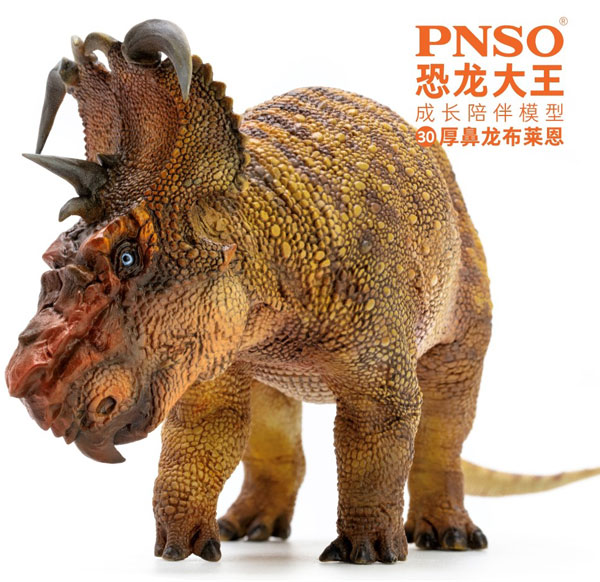
PNSO Pachyrhinosaurus dinosaur model.

PNSO Brian the Pachyrhinosaurus dinosaur model.

To view models and replicas of Pachyrhinosaurus and other ceratopsians: PNSO Age of Dinosaurs Figures.

The field team organised the removal and transport of the large amount of fossil material, transporting it by air and road to the preparation laboratory at the Dallas-based museum.  Dr Tykoski, the member of staff responsible for the fossil preparation work and his colleagues set about removing the fossils from the surrounding rock.  The discovery of the juvenile dinosaur fossil material was made last  year, when Dr Tykoski was working on a block of sediment about the size of a football.

Skull Elements

The fossils represent elements from the skull, an incomplete nasal bone.  Fortunately, one of the key diagnostic features of this species of Pachyrhinosaurus is the area of skull represented by the nasal bone.  The immature, juvenile specimen has a small, narrow, hardened patch on its snout, whilst in mature animals this area of the skull thickens into a large and bumpy boss.  It has been suggested that these hardened and very thick parts of the skull were used in intra-specific head-butting contests between adults.

This newly described specimen, reported in a paper published in the online academic journal “PLoS One”, shows a mix of features in the nasal bone that helps palaeontologists to assess how skull characteristics of Ceratopsian dinosaurs changed as the animal grew.  The specimen consists of an incomplete nasal bone that includes the rearward part of the nasal horn, the dorsal surface between the horn and the left-side contacts for the prefrontal and frontal bones, and some of the left side of the rostrum behind and slightly underneath in relation to the nasal horn.

The combination of morphologies in the new specimen suggests either an additional stage of development should be recognized in the ontogeny (growth and development) of the nasal boss of Pachyrhinosaurus, or that the ontogenetic pathway of nasal boss development in P. perotorum was notably different from that of other species within the Pachyrhinosaurus genus.

How the Skull Features of P. perotorum Grew and Developed

How a baby P. perotorum grew up.

How a baby P. perotorum grew up.

Picture credit: Perot Museum of Nature and Science

Pachyrhinosaurus perotorum

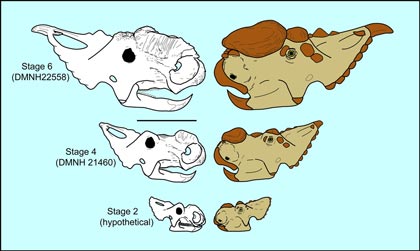
A series of Pachyrhinosaurus perotorum skulls (on the left) and stylized life reconstructions (on the right) at three (of a proposed six) different life stages.  Stage 2 skull is based on juveniles of the closely related species Pachyrhinosaurus lakustai from southern Alberta.  The Stage 4 skull represents a ‘partially grown’ or ‘early adolescent’ individual, based on the new specimen (DMNH 21460) discovered in 2012 by the museum preparation team.  The Stage 6 skull is that of a mature adult, based on DMNH 22558, a nearly complete Pachyrhinosaurus perotorum skull described by Fiorillo and Tykoski in 2012 and currently on public exhibit in the Perot Museum of Nature and Science.

The ‘fleshed-out’ reconstructions are based on previously published ideas of Pachyrhinosaurus skin structures, but modified to reflect new information revealed by the new specimen (DMNH 21460).  Light tan indicates ‘normal’ skin, while dark brown indicates cornified (= thickened, hardened, horn-tissue-covered) scales, horns, sheaths, or other cornified tissue.  Scale bar equals 50 cm.

A Juvenile Specimen

Commenting on the discovery of juvenile Pachyrhinosaurus mateial Dr Tykoski stated:

“After a couple weeks of working on it, our question was ‘what on earth is this?’  It had features on it that looked like the big adult skull of the Pachyrhinosaurus perotorum that we had originally found, yet it was very narrow and skinny and didn’t have the big expanded nose of the adult.  After ruling out all of the possibilities through the process of elimination, we realised this was a juvenile specimen.  This provided us a snapshot in the development of the species – and that’s not common – so this was a very exciting moment for us.”

The finding of this juvenile specimen in and amongst the fossils of several adult animals has important ramifications.  This suggests that either very young animals migrated northwards, or perhaps they may have been born somewhere on route to the feeding grounds.  It also opens up the possibility that at least one species of large, herbivorous dinosaur was so at home in the harsh Alaskan environment that they were able to breed there and that they were perhaps permanent residents.

The Perot Museum of Nature and Science has already organised a number of return expeditions to North Alaska and the team have plans to study other likely fossil-bearing sites in a bid to learn more about these Late Cretaceous dinosaurs.

Three Different Species

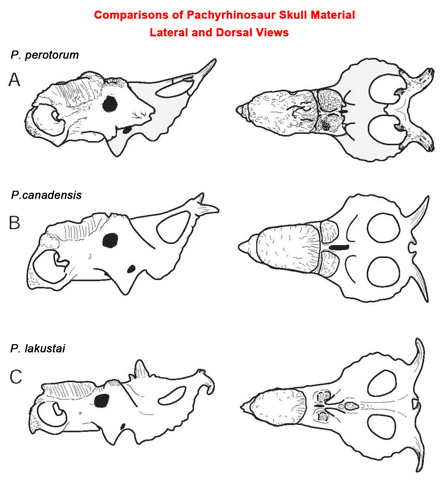
At present, there are three different species of pachyrhinosaurs known, the last to be described was the Perot Museum’s North Alaskan discovery in 2011.  The species are differentiated by different morphologies on the skull.

An Illustration Showing the Differences in Skull Morphology of Pachyrhinosaurus species.

Three species of Pachyrhinosaur have been described to date.

Three species of pachyrhinosaur have been described to date.

Picture credit: Perto Museum of Science and Nature

Everything Dinosaur acknowledges the help of the Perot Museum of Nature and Science in the compilation of this article.

27 06, 2013

The Rocking Horse – Remarkable Ancient Fossil Decodes Horse Evolution

By |2024-04-29T06:49:36+01:00June 27th, 2013|Categories: Dinosaur and Prehistoric Animal News Stories|2 Comments

Ancient Horse Bone Yields Oldest Sequence of DNA Known to Science

A team of international researchers have been able to sequence a substantial portion of the genome of an ancestral horse from a leg bone of a horse that roamed about in Canada some 700,000 years ago.  This research sheds light on the evolution of the Equine family and dramatically extends the known limit of DNA survival.  DNA material has been recovered from other Pleistocene aged fossils, those of Cave Bears (Ursus spelaeus), Mastodons and Mammoths but this DNA recovery is from a sample more than half a million years older than other material successfully studied to date.

Ancient Horse Bone

The study has just been published in the academic journal “Nature” the fossilised leg bone was part of a collection of horse fossils preserved in the Canadian permafrost of the Yukon.  The fossils were found at a location known as Thistle Creek (west-central Yukon Territory)

The fossils are estimated to be around 735,000 years old (Mid Pleistocene), and the fifteen centimetre long leg bone which was used in the DNA study, is part of a collection excavated out of the cold, hard permafrost back in 2003.  Leg bones, being relatively thick and robust have a greater potential for preserving organic material within them than smaller more fragile bone material.

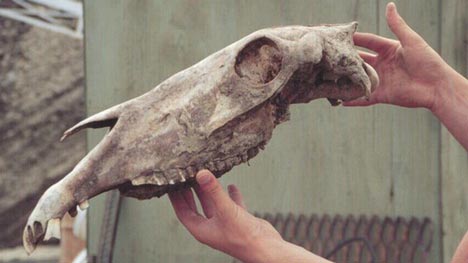
Ancient Genetic Material Recovered from a Horse Fossil

700,000 year old genetic material recovered from a fossil bone.

Picture credit: D.G. Froese/Nature Journal

Extracting DNA

In a recent study, the leg bones of 158 Moas (extinct, giant flightless birds), were used to develop a framework for estimating the half-life of DNA.  This controversial research from New Zealand suggested a half-life of DNA at just 521 years.  The scientists involved with this study programme calculated that fragments of DNA could survive in perfect preservation conditions for perhaps as long as 6.8 million years, but analysis of this highly unstable, ancient material would probably prove impossible.  This new study of DNA related to Equus (horses), may not be 6.8 million years old but the ancient horse leg bone has yielded the most ancient DNA sequence know to science thus far.

To read more about the study of genetic material in Moa bones: Controversial Research Proposes a Half-Life for DNA.

Finding Organic Molecules

Ludovic Orlando, an evolutionary biologist at the University of Copenhagen and one of the co-authors of the scientific paper, explained that the team wanted to determine whether there might be any biological molecules left in this sample.  The first step was to try to identify any evidence of amino acids that would have constituted any collagen (protein found in bone), within the specimens studied.  Once the team had established that there were these proteins present, the researchers moved on in their analysis with the aim of trying to extract DNA from the ancient horse’s leg bone.

Recently, a team of scientists from Manchester University were able to identify an animal from fragments of tibia (leg bone) found in the Yukon.  The fossil bone fragments, much older than the horse fossils (dated to around 3.5 million years ago), were found to belong to a type of ancient camel.

The Manchester-based team were able to make this conclusion by tracing minute amounts of collagen in the fossilised bone and then de-coding it to see how closely it resembled the collagen found in living species.  The technique is referred to as “collagen fingerprinting”.  However, Ludovic Orlando and his colleagues were able to go further and to identify a quantity of genetic material within their sample, allowing them to sequence about seventy percent of this ancient horse’s genome.

Equus Genetic Material

Although for the majority of their 700,000 years of incarceration the horse fossils were protected from liquid water (ground water present in a fossil matrix can speed up the breakdown of organic material) and biological contaminants, the scientists were able to identify from climate change studies that the area in which the fossils had been found had thawed out on several occasions.  However, some of the Equus genetic material had still been preserved.

Of the twelve billion or so DNA molecules identified most were from bacteria that had populated the bone after the horse had died.  However, using DNA from the modern horse species as reference markers, the researchers were able to identify “endogenous DNA”, genetic material from the ancient horse itself.

The CollectA Przewalski's horse model
Stone Age survivor being slowly re-introduced to the wild.

From the detailed analysis of the organic material, the scientists were able to identify about 3% of the total “pool of organic data” as being horse DNA, that’s about 40 million DNA molecules.

Dr Orlando described this finding as:

“A bit of horse DNA in an ocean of microbial DNA.”

Multi-national Team of Researchers

The multi-national team of researchers pulverised a fragment of the bone to recover its DNA, then subjected it to high-throughput, next-generation gene sequencing to unravel the blueprint of this ancient horse, which team members at Everything Dinosaur have nick-named “Old Ned”, a reference to the theme to the television series “Steptoe and Son”, father and son rag and bone men who owned a horse.

A survey of the recovered DNA sequence looking for specific material in the genes known as single nucleotide polymorphisms (SNPs) has enabled the scientists to estimate past population sizes.  It seems that over the last two million years or so, the horse family has experienced a number of significant population declines and then population explosions.  Analysis of climate change data shows that there is a close match between rising horse numbers and improving (warmer) climate.

The location of the genetic differences between the ancient and modern horses also provided tantalising clues into some of the possible consequences of these genetic differences, Dr Orlando went onto explain:

“Once you have the genome, one thing you can do is to actually look at different genes that we know today are important for different traits.  What we’ve learned for example is the alleles that prime to the racing performance in domestics were not present at that time.”

Commenting on the wider implications of the study, co-author Eske Willerslev of the University of Copenhagen stated:

“Pushing back the time barrier is important because it has implications for our evolutionary understanding of anything from Hominins to other animals, because we can look further back in time than people have done previously.”

Everything Dinosaur Comments

A spokesperson from Everything Dinosaur stated:

“Ten years ago, such developments in extracting viable genetic material from such fossil material was simply not possible, next generation sequencing technology has completely revised our expectations.  If DNA can be identified from fossil material more than 700,000 years old, then this widens the net for scientists as they seek to retrieve more genetic data from fossils.”

This branch of genetics is certainly leading to a whole range of new and exciting developments, not least of which is a more complete understanding of the evolution of extant types of horse – all 4 million years of it.  The fossil material from the Yukon is an example of a “rocking horse” that could well have “rocked” our understanding of the ability of organic material to survive fossilisation.

25 06, 2013

The Most “Ugly” Pareiasaur Discovered to Date – Bunostegos

By |2023-02-18T12:20:26+00:00June 25th, 2013|Categories: Dinosaur and Prehistoric Animal News Stories, Palaeontological articles|0 Comments

Pareiasaur from Niger with Bizarre Lumps and Bumps on Its Head

A newly described and “ugly” pareiasaur – Bunostegos akokanensis.

A team of international scientists have discovered that animals living in what was one of the central parts of the super-continent known as Pangea may have become geographically isolated, this led to a number of ancient genera surviving into the Late Permian, whilst these creatures became extinct elsewhere.

Bunostegos akokanensis

One of the more remarkable of these “living Permian fossils” was the cow-sized, herbivorous pareiasaur which has been named Bunostegos akokanensis.  The term pareiasaur refers to a diverse group of reptiles, the “shield lizards”.  These animals were heavily built, robust creatures whose bodies were covered in bony spikes, horns and plate-like projections.  Bunostegos is known from a partial skull and it is distinctive as this specimen has more bumps and lumps on its skull than any other known species of Pareiasaur described to date.

Late Permian Specimen

The skull material has been dated to around 260 million years ago (Late Permian), it was found a few years ago during fieldwork exploring the Moradi Formation of central Niger.  A research paper has just been published in the academic publication “The Journal of Vertebrate Palaeontology”.  The genus name means “knobbly roof” a testament to the strange lumps and bumps on the animal’s skull, which in life may have been covered in skin, rather like the bumps on the top of a giraffe’s head.  The species name honours the town of Akokan in central Niger, which is close to where the fossil material was found.

Scutosaurus and Other Pareiasaurs

Better known pareiasaurs such as the three-metre-long Scutosaurus have provided scientists with evidence that some of these skull and facial features developed with age.  Cheek projections in conjunction with nose and lower jaw spikes seem to have become more prominent as individuals grew larger and matured.  This has led some palaeontologists to speculate that these features were used in mating displays or fights amongst rivals (intra-specific competition).  If this is the case, then the skull material unearthed in Niger might represent a particularly old individual.

A Typical “Shield Lizard” – Scutosaurus

Robust, heavily armoured Pareiasaurs.

Robust, heavily armoured pareiasaurs.

Picture credit: Everything Dinosaur

For models and replicas of Permian prehistoric creatures: Wild Safari Dinos Models and Replicas.

Skull Analysis

Analysis of the skull has led the researchers to conclude that Bunostegos is related to older and more primitive pareiasaurs, but it seems to have persisted in Niger whilst related species died out many millions of years previously.  This would have made Bunostegos a “living fossil”, a survivor from an ancient line of reptiles that had gone extinct elsewhere.  For much of the Permian, the land masses of the Earth were joined together into a huge super-continent (Pangea).

Scientists had thought that much of the fauna and flora was relatively uniform, in theory an animal could have walked from near to the South Pole almost to the North Pole.  The Middle and Late Permian fossil record documents a uniformity in fauna and flora as similar fossil species have been found in what would have been (back in the Permian), geographically dispersed locations.

However, this research work, focusing on the Moradi Formation of Upper Permian strata suggests that there was an isolated habitat in the central part of Pangea that enabled distinctive fauna and flora to evolve and more primitive reptiles to persist.  Bunostegos may have been around during the Late Permian as deserts surrounded its habitat providing a natural barrier preventing animals leaving the area and other creatures coming in.

Commenting on the strange appearance of this reptile, Dr Linda Tsuji from the University of Washington (Seattle) stated:

“We can’t say for sure, but it is most likely that the bony knobs on the skull of pareiasaurs did not serve a protective function.  They vary quite markedly in size and shape between different species, with some species lacking prominent knobs entirely, so I think that they were purely ornamental. The most probable use was for inter-specific [between species] or intra-specific [within species] recognition.”

An Impenetrable Desert

These deserts would have proven to be impenetrable barriers to these creatures, the fauna and flora would have been constrained to a central area, arid but with enough water and food to sustain an ecosystem.

Christian Sidor of the Department of Anatomy, New York College of Osteopathic Medicine, Old Westbury, New York, a co-author of the scientific paper concluded that:

“Our work supports the theory that central Pangea was climatically isolated, allowing a unique relict fauna to persist into the Late Permian.”

Elsewhere on the landmass of Pangea, animals and plants had much more freedom of movement with many fewer natural barriers.  This is reflected in the relatively uniform fossil record as found today in places such as South Africa and South America.

A View of the Bunostegos Skull Material

Two photographs of the skull material are at the top viewed as if looking down onto the fossil material.

Two photographs of the skull material are at the top viewed as if looking down onto the fossil material.

Picture credit: Journal of Vertebrate Palaeontology

The line drawing below is an illustration of the skull, as if viewed from looking down onto the top of the skull (dorsal view).

A spokesperson from Everything Dinosaur stated:

“It is important to explore the geological and fossil record of the super-continent known as Pangaea, especially the Upper Permian deposits.  The end of the Permian is marked by the greatest mass extinction in the history of life on our planet and scientists are still uncertain how this mass extinction event came about”.

24 06, 2013

The Evolution of the Ability to Throw

By |2023-02-18T12:13:35+00:00June 24th, 2013|Categories: Dinosaur and Prehistoric Animal News Stories|3 Comments

Study of Homo erectus Fossils Suggest that Early Hominins Had the Ability to Use Projectile Weapons

Our shoulder joints are effectively a loose fitting “ball and socket” joint.  The shoulder joints in humans have given our arms great manoeuvrability and mobility.  However, as a relatively loose fitting joint with a large degree of motion, injuries can occur.

The Shoulder Joint

The ability to use our arms and shoulders to throw an object, something like a roughly shaped spear, could have enhanced our ancestor’s ability to hunt game.  The addition of more meat into their diet would have enabled them to grow larger bodies, develop bigger brains and to raise more offspring, thanks to better, protein rich nutrition.  Research by a team of scientists from George Washington and Harvard universities (United States), suggests that shoulders capable of hurling an object at speed evolved some two million years ago.

The research paper, published in the academic journal “Nature” proposes that Homo erectus evolved the ability to throw.

Homo erectus

H. erectus was a long-lived species of hominid.  It evolved around two million years ago and survived at least until about 300,000 years ago, this makes it the longest surviving species of hominid known to science.  These ancient hominids evolved in Africa but spread into south-eastern Europe and Asia.  Although very different looking to modern humans with their long, low skulls and distinctive brow ridges they used fire and made sophisticated stone tools.  Intriguingly, they were the first species along the human branch of the hominid family tree to live environments outside their African savannah homelands.  Their brains were also considerably bigger than earlier human ancestors.

Could the ability to hunt using throwing spears have enabled Homo erectus to master new environments?

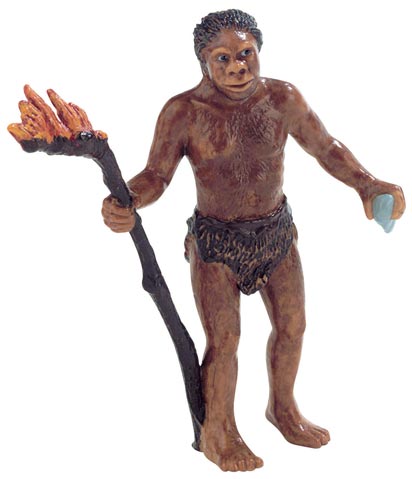
Homo erectus – The First Hominid Species to be Able to Throw a Projectile?

Early hominid with a strong throwing arm?

Early hominid with a strong throwing arm?

Picture credit: Everything Dinosaur

For models and replicas of prehistoric animals and early hominids: Bullyland Prehistoric Life Models.

Use of Stop-motion Photography

The American research team used stop-motion photography to capture the range of movement and muscle action when college athletes were involved in throwing activities.  They then compared their studies with the anatomy of chimpanzees.  The team discovered that humans have the ability to throw at very high speeds, much faster than our closest living relative, the chimpanzee.   Professional athletes can reach speeds in excess of ninety miles per hour, whilst chimps, although with stronger arms and superior grip strength, they can only reach throwing speeds of twenty miles per hour.

The bio-mechanics of the throw action was analysed and it was observed that the shoulder performs like a sling-shot as the arm rotates backwards.

The Evolution of Our Ability to Throw

The shoulder joint, our most mobile joint.

The shoulder joint, our most mobile joint.

Picture credit: Neil Roach

The picture above shows that the maximum shoulder rotation (pictured middle) is when elastic energy is able to power the throw.

Store Elastic Energy

The ligaments and tendons surrounding the shoulder then stretch and store elastic energy, which powers the forward throw.  When this energy is released it generates what scientists found was the fastest motion the human body produces.

Neil Roach, (George Washington University) who led the study, stated that the changes in the anatomy of early humans enabled energy storage in the shoulder that permitted fast throwing.  From this evidence it could be implied that more effective hunting methods could have come about.

He went onto add:

“Success at hunting allowed our ancestors to become part-time carnivores, eating more calorie-rich meat and fat and dramatically improving the quality of their diet.  This dietary change led to seismic shifts in our ancestors’ biology, allowing them to grow larger bodies, larger brains, and to have more children, and it also did interesting things to our social structure.  We start to see the origins of divisions of labour around that time, where some would be hunting, others would be gathering new foods.  It probably also allowed us to move to new environments, such as areas that did not have vegetation to support us before we had the ability to hunt.”

The Throwing Action

Professor Daniel Lieberman, (Harvard University) declared that for him the most fascinating aspect of this research was that half the power the humans generate from the throwing action comes from elastic energy stored in the shoulder muscles.

He commented:

“That’s not a by-product of evolution for something else, it’s clearly an adaptation.  There were shifts in our anatomy that enabled us to throw accurately, so we want to understand better just what those early hunting challenges were.”

With no evidence of spears having been found in the earliest fossils of H. erectus, this interpretation of fossil material by the American team has raised a few eyebrows (or should that be brow ridges).  Other scientists, including those that specialise in studying human and other primate anatomies have suggested that a more holistic approach to comparative anatomy be used.

Comparing Human Anatomy with that of a Chimpanzee

Chimp chest (pictured left) compared with human chest (pictured right)

Chimp chest (pictured left) compared with human chest (pictured right)

Picture credit: Brian Roach/Neil Roach

Professor Susan Larson from Stony Brook University, (United States), a scientist not involved in the study, has queried the conclusions drawn from this research.  Her work also focuses on the shoulder anatomies of primates and humans in order to study their evolution.  She said it could be easy to over interpret what was significant from a fossil.

“We’re looking at the same fossils, it’s a question about how you interpret the anatomy that you see in those fossils.  Homo erectus was not necessarily such a proficient thrower.  I think [Dr Roach and colleagues] are discounting the combination of features of how the shoulder as a whole has to work.”

The few fossils of Homo erectus arms and shoulders suggest that they had an extensive range of movement.  Their hands too, were very capable of manipulating objects and showing great dexterity, however, more work is required before such conclusions can be made.

Professor Larson added:

“You cannot look at just one thing and say how a complicated piece of anatomy works, especially something like the shoulder.  You have to understand how all parts work together to bring about a broad range of motion.”

One interesting point to note, if ancient hominids like H. erectus were throwing spears, chances are they would favour either the left or right hand.  The paper has been regarded as an interesting hypothetical model rather than a definitive explanation of fossil evidence by many scientists working in this field.  For example, the humeral torsion, the angle at which the head of the humerus (funny bone) articulates with the scapula (shoulder bone) in H. erectus specimens does not fall within the range of modern throwing athletes.

There is also no evidence of asymmetry in the humeral torsion angle in H. erectus fossils that one would expect if one limb was preferred over the other for throwing.

Interesting thought, those ball tosses at Wimbledon by today’s tennis players may have a very ancient evolutionary lineage.

19 06, 2013

Rare Dinosaur Bones Aplenty in Queensland

By |2024-04-29T06:50:25+01:00June 19th, 2013|Categories: Dinosaur and Prehistoric Animal News Stories, Dinosaur Fans|0 Comments

Two-Week Museum Dig Provides Stockpile of Dinosaur Bones

The town of Winton in Queensland (Australia), has proved to be something of a “hot bed” for dinosaur discoveries over recent years.  However, palaeontologists and field workers from the Australian Age of Dinosaurs Museum, based at Winton, have had to deal with a problem that is exceptionally rare in palaeontology – having too many fossilised bones to excavate and examine at any one time.  A two-week long excavation at a location near to Winton, has provided the museum with a “treasure trove” of dinosaur fossils.

Dinosaur Bones

The bonebed has revealed limb bones, ribs, vertebrae and other material belonging to a titanosaur, perhaps one already described or perhaps the fossil discovery relates to an entirely new species of long-necked herbivorous dinosaur.

Palaeontologist David Elliott commented that he had never experienced such a hectic fortnight.  He paid tribute to all those volunteers who helped the museum staff to excavate the fossil bones.

He stated:

“Most digs involve a lot of digging in search of the bone deposit but that wasn’t the case with this dig.  As fast as we tried to dig around one bone, we uncovered another – there were bones everywhere – giant limbs, vertebrae and two metre long ribs stacked across each other and joined together by rocky concretions.  It was impossible to remove them safely without taking half a dozen other bones that were joined to them!”

Cretaceous Dinosaur Bones

Although a large number of Cretaceous dinosaur bones have been found in the Winton area in the past decade or so, scientists hope that these newly discovered fossils will help them to shed further light on the megafauna that once roamed this part of what was the super-continent of Gondwana.  It is possible that these fossils represent a specimen of a titanosaur known as Wintonotitan (Wintonotitan wattsi), one of three dinosaurs discovered in this part of Queensland back in 2009.

To read about the discovery of W. wattsi: A Trio of Dinosaur Discoveries from Down Under.

Although the bones have yet to be properly examined and formally identified, it has been speculated that all the material comes from a single, individual animal.  However, since very few bones of W. wattsi are known, the scientists will have to wait until the fossils have been cleaned up and prepared to be more certain about what type of dinosaur the fossils represent.

Large Dinosaur Fossils

It is hoped that these fossils, some of them more than a metre in length, will help palaeontologists to fill in the gaps when it comes to the evolution and diversification of titanosaurs in this part of the world.  A spokesperson for the museum commented that fossils from more than a dozen sauropods (long-necked, lizard-hipped dinosaurs such as the titanosaurs), had been found in the Winton area.  More information about these giant, Australian herbivores had been revealed in the last decade than in the previous one hundred years.

In 2009, fossil bones representing another titanosaur was found, it was nick-named “Zac”.  Although far from complete, the discovery of these fossils helped confirm that there were a number of different types of titanosaur living in what was to become Australia during the Cretaceous.  The habitat must have been particularly lush and verdant to support such large herbivores.

To read about the excavation of “Zac” the titanosaur: Say Hello to a New Aussie Titanosaur, Hi Zac!

Excavating the Fossil Material

The majority of the fossils have been carefully excavated and placed in plaster jackets for their journey to the museum so that they can be stored properly before the lengthy work of preparation begins.  The scientists and field workers hope to be able to return to this site with ground penetrating radar so that they can identify areas where still more bones may be hidden.

An Illustration of a Typical Titanosaur

A typical European Titanosaur from the Late Cretaceous
A typical European titanosaur from the Late Cretaceous.  Picture credit: Everything Dinosaur.

Picture credit: Everything Dinosaur

The latest fossil finds were just eighty metres from an earlier excavation, a dig site explored back in 2011.  The 2011 site provided some backbones and the front limbs of a large titanosaur, it has been speculated that the new bones are from the same animal, both sites may be deposits from the same flood line and the 2011 material represents parts of the skeleton washed downstream and deposited away from the rest of the body.

The fossil material has been dated to around 98 million years ago (Cenomanian faunal stage of the Cretaceous).

Dinosaur Fossils and Exciting Times for Australian Palaeontologists

These are certainly exciting times for Australia’s palaeontologists, glad they have something to occupy their minds what with the Ashes cricket series coming up against England in just a few weeks.  Given the Australians current form, they will need some exciting dinosaur discoveries to take their thoughts away from the cricket!

For models and replicas of Australian prehistoric animals including sauropod figures: CollectA Age of Dinosaurs (Popular).

14 06, 2013

New Giant Species of Ceratopsian Announced

By |2023-02-18T10:53:08+00:00June 14th, 2013|Categories: Dinosaur and Prehistoric Animal News Stories|0 Comments

Bravoceratops polyphemus – New Horned Dinosaur Discovery Announced

A new species of large chasmosaurine dinosaur has been announced, this new member of the horned dinosaurs has been named Bravoceratops polyphemus and it lived in what is now Texas between 72 and 70 million years ago (Maastrichtian faunal stage of the Late Cretaceous).  Chasmosaurines were one of two groups of advanced horned dinosaurs.  In general, they had long neck frills and the brow horns were usually bigger than the nose horn, perhaps the most famous member of the Chasmosaurinae is the Triceratops genus.

New Species of Horned Dinosaur

The fossil material, which includes fragments from the giant skull were found in the lower layers of the Javelina Formation of Texas (United States).  Ceratopsian fossils from this portion of the Javelina Formation are rare, although fossils of Torosaurus, a later chasmosaurine have been found in upper layers of this particular series of strata.  The fossils show extensive weathering, this suggests that much of the material was exposed to weathering before burial and fossilisation, only the most robust elements of the skull and horns have survived as fossils.

The skull may have become disarticulated prior to fossilisation, the research team who discovered this new specimen, back in 2011, found that the pieces of skull were scattered over a ten metre square area.

The holotype material was found at the “Hippiewalk” site, north-east of Paint Gap Hills in the Big Bend National Park.  The fossils were studied by palaeontologists from the United States National Park Service and Texas Tech. University.  This dinosaur was named and described by Steven Wick (Division of Science and Resource Management – Big Bend National Park) and Tom Lehman (Department of Geosciences, Texas Tech).  The genus name – Bravoceratops means “wild horn face”, named after the Rio Bravo del Norte which marks the border between Mexico and the National Park.

Bravoceratops polyphemus

The term “Bravo” comes from the Spanish meaning “wild”.  The species name is derived from the Greek cyclops called Polyphemus, a one-eyed monster.  In the skull material there is a “socket” shape  to be found in part of the bones that form the back of the head, this is believed to have been an attachment area for a protruding bony epoccipital.   A paper on this new dinosaur has been published in the academic journal “Naturwissenschaften”,which incidentally, celebrates its 100th anniversary this year.

An Illustration of the Chasmosaurine B. polyphemus

An artists impression of a typical Chasmosaurine dinosaur.

An artists impression of a typical chasmosaurine dinosaur.

Picture credit: Everything Dinosaur

Fragmentary Material

Although known from only fragmentary and very weathered material, scientists estimate that this was one of the largest of the horned dinosaurs with a skull in excess of 2.2 metres in length, and brow horns nearly one metre long.   It may have been as large as Triceratops horridus, perhaps measuring more than nine metres in length and weighing seven tonnes.  This dinosaur is not to be confused with the much smaller and more primitive ceratopsians from Asia known as Bagaceratops and Breviceratops.

The discovery of B. polyphemus comes at a time when the authorities at the Big Bend National Park are developing a permanent Cretaceous-themed exhibit to showcase some of the prehistoric animal discoveries that have been found within the Park’s borders.  It is hoped that a full-sized cast of the skull of Bravoceratops will form part of the dinosaur display.

B. polyphemus although very similar in appearance to a number of Late Cretaceous chasmosaurines, can be distinguished by its long, narrow snout, the substantial frill with large openings in bone (fenestrae) and several skull bone characteristics including a series of bony projections from the back of the skull (parietal bone).

To view several horned dinosaur models available in the CollectA Prehistoric Life, not-to-scale model range: CollectA Prehistoric Life/Prehistoric World Figures.

12 06, 2013

Family Holiday Turns into a Remarkable Dinosaur Discovery

By |2024-04-29T06:52:57+01:00June 12th, 2013|Categories: Dinosaur and Prehistoric Animal News Stories|0 Comments

Family Holiday Unearths a Partial Sauropod Fossil Skeleton

The San Rafael desert is approximately 2,000 square miles of sandstone, limestone and shale formations in south, central Utah (United States).  It is a popular vacation destination with hikers and family groups.  A family holiday to this historic area, famed for its fossils and evidence of Indian settlements, turned out to be a vacation to remember when part of a huge, long-necked dinosaur skeleton was discovered.

Dinosaur Fossil Discovery

The Watt family have been visiting this part of Utah for many years, Amanda Watt explained that this was an annual trip, part of a long-time family tradition started by her father-in-law.  The discovery was made in Emery County, an area famed for its Upper Jurassic dinosaur fossils, the family and their friends who came with them on their camping trip, enjoy looking for fossils, but they never imagined that one of the young boys would uncover the articulated bones of a giant, herbivorous dinosaur.

Amanda commented that her nephew ran over to the rest of the family with the exciting news that he had found something quite big.

She added:

“It was just like, ‘Oh!’ and everybody was ecstatic  and couldn’t believe what was there.”

Palaeontologists were quickly informed so that the bones could be examined properly with a view to extracting them from the matrix where they have been for about 150 million years or so.

An Articulated Specimen

James Kirkland of the Utah Geological Survey commented:

“It’s also an articulated skeleton.  That means all the bones are joined together.  You can see the backbone just laid out on this animal.”

He praised the family for doing the right thing, alerting the authorities to take care of the excavation rather than trying to remove the fossilised bones themselves.  They may have uncovered the bones but they did not attempt to remove them.

A Possible Camarasaurid

The discovery made on public land but managed by the Bureau of Land Management may turn out to be an important example of a camarasaurid (Macronaria clade).  The family may be rewarded for their dinosaur bone spotting by being given the opportunity to help with the extraction and mapping of this dinosaur discovery.

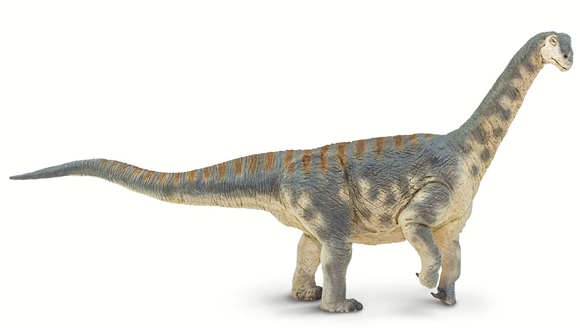
A Model of a Typical Camarasaurid (Camarasaurus)

Wild Safari Prehistoric World Camarasaurus dinosaur model.

The award-winning Wild Safari Prehistoric World Camarasaurus dinosaur model. A replica of a Camarasaurus dinosaur.

The picture above shows a Wild Safari Prehistoric World Camarasaurus model, to view this range of exciting prehistoric animal figures: Wild Safari Prehistoric World Models.

10 06, 2013

Adding to the Triceratops Assemblage

By |2023-02-18T08:27:00+00:00June 10th, 2013|Categories: Dinosaur and Prehistoric Animal News Stories|0 Comments

Potentially Most Complete Fossil of Triceratops Discovered to Date

With all the new horned dinosaur discoveries it can be misleading to think that palaeontologists already have a comprehensive understanding of some of the more famous ceratopsians, giant prehistoric beasts such as Triceratops for example.  However, this is not the case as a number of gifted and talented year six and seven school children will discover when Everything Dinosaur takes part in a special science day at their school this week.

Triceratops

Triceratops may have been described as long ago as 1888, but “three horned face” is still full of mystery for palaeontologists.  The recent discovery of three sets of Triceratops fossils, alongside leg material from a tyrannosaur (probably T. rex) will help researchers to learn more about these giant Late Cretaceous herbivores.  One specimen may prove to be the most complete example of Triceratops (T. horridus) found to date

The discovery was made in May, near to the town of Newcastle, Wyoming.  Up until now, only two relatively complete Triceratops skeletons have been found, this famous dinosaur has been pieced together and become a mainstay of dinosaur galleries in museums from fragmented and disassociated fossils.

Three Triceratops Fossil Specimens

Commenting on the discovery, which includes the lower limb bones and foot of a Tyrannosaur’s left leg, Black Hills Institute President Pete Larson stated:

“We have been given a rare, I would say unprecedented, opportunity.”

The excavation will take the Black Hills Institute working in collaboration with co-workers from the Naturalis Biodiversity Centre from the Netherlands, around a month to complete as at least two of the specimens represent an adult animal.

A Triceratops Exhibit at a Museum

Triceratops Fossil on Display

A cast of a Triceratops skeleton on display at the Naturmuseum Senckenberg (Natural History Museum – Frankfurt). On the left a wall mounted example of a Plateosaurus can be seen.  Picture credit: Everything Dinosaur.

Picture credit: Everything Dinosaur

Dr Larson went onto add:

“If you could imagine a person, 6-foot tall, inside the stomach of one of these adult Triceratops, they couldn’t reach each side of the rib cage.”

Could Yield Important Data

This newly discovered site could yield some important data.  Preliminary work indicates two adults and one potential juvenile, this could be interpreted as a family group indicating parental care, although it is too early to make conclusions.

We, at Everything Dinosaur look forward to hearing about this dig and we are also looking forward to working with the students this week as we explore some of the mysteries of Triceratops with them.

To view articulated models of Triceratops and other horned dinosaurs: Beasts of the Mesozoic Articulated Figures.

7 06, 2013

Neanderthal Rib Bone Shows Signs of Cancer According to New Study

By |2024-04-29T06:54:21+01:00June 7th, 2013|Categories: Dinosaur and Prehistoric Animal News Stories|1 Comment

Earliest Evidence of Cancer Discovered in Hominid Fossil Record

With a report out today from Macmillan Cancer Support stating that by 2020 nearly half the population of the United Kingdom will get cancer during their lifetime, scientists from the University of Kansas have been looking at the oldest incidence of hominid cancer yet found in the fossil record.  Many types of cancers today are associated with a diet which contains too much fat, or exposure to pollution, radiation or other toxins.  However, a fragment of rib bone found in a cave in Krapina, Croatia shows evidence of a fibrous dysplasia (bone cancer) in a Neanderthal.

Neanderthal Rib Bone

Finding evidence of pathology is rare in the human fossil record.  Something such as a fleshy tumour would not be preserved as a fossil, but the evidence of a tumour can be seen as it has affected the internal structure of the rib bone.  The rib specimen is believed to date from around 120,000 years ago, a paper on its discovery and its implications has been published in the on line, peer reviewed journal, PLoS One (public library of science).

A Picture of the Diseased Bone (Top) Compared to Healthy Neanderthal Bone (Bottom)

Abnormal bone (top) compared to healthy fossil bone (bottom).

Abnormal bone (top) compared to healthy fossil bone (bottom).

Picture credit: University of Kansas

Neanderthals Suffered Tumours

Professor of Anthropology at the University of Kansas, David Frayer, one of the co-authors of the scientific paper commented:

“It’s evidence that Neanderthals suffered tumours — that they were susceptible to the same kinds of diseases that we see in modern humans.  Before this, the earliest tumour in bone that we’ve seen goes back to an Egyptian mummy.  So this is 100,000 years older[at least] than the previous tumour that has been found.  There is no evidence of cancer older than this in the human fossil record.”

The bone fragment is one of over 900 different hominid bones which have been found in the cave, along with other items such as stone tools.  The bone is not associated with a complete skeleton so it is impossible to say how severe the cancer was, or indeed whether or not it was the cause of death.  Researcher are not able to identify whether the bone comes from a male or female.  It does suggest that even in a pristine environment cancers were still present.

Our closest Relative

The Neanderthal (H. neanderthalis), is believed to be our closest relative, we share a common ancestor with the Neanderthals and in recent years study of both the Neanderthal and H. sapiens genome show that most people possess about 4 percent of Neanderthal genes in their genetic make up.

Neanderthals were short, stocky and heavily muscled.  Evidence of the heavy musculature appears in the extremely large muscle attachment scars on the fossil bones and the bowing of some of the limb bones.  Neanderthals were tough, used to hard physical work and suffered many injuries, although contrary to popular opinion they were not the brutish apemen often depicted in the early 20th Century.  They had large brains, were very well adapted to life in a cold climate and they made sophisticated stone tools.

Radiographs and CT Scans

According to the researchers, the Neanderthal bone is a 30-millimetre-long fragment of the left rib that shows a fresh break.  The break in the rib exposes a chamber that is 18 millimetres in length and 7.6 millimetres wide.  This cavity in the bone is highly unusual — ordinarily a rib is packed with cancellous bone.  After a detailed analysis with radiographs and CT scans, the investigators came to believe it was the site of a benign tumour associated with a bone cancer.

Fibrous dysplasia (bone cancer), is a developmental disorder of bone in which lesions develop fibrous tissue and spicules of woven bone.   However, it’s difficult to know for certain how severely the tumour affected the Neanderthal involved.

Detailed Analysis of the Bone Fragment Revealed the Pathology

Detailed analysis revealed the tell-tale signs of a bone tumour.

Detailed analysis revealed the tell-tale signs of a bone tumour.

Picture credit: University of Kansas

Professor Frayer added:

“It wasn’t a small tumour.  It was a fairly large one, probably bulging at the base of the rib.  We’re not sure how far along it was, but it was well-expressed in the bone.  It was in the upper third of the back, and muscles attach there that are associated with raising the arm.”

This discovery will help scientists to understand a little more about how cancers could have affected our ancestors.  It also demonstrates that cancer is not a modern phenomenon and that although rare in the fossil record, it provides a clue to the complicated relationship between early humans and forms of cancer.

Go to Top