All about dinosaurs, fossils and prehistoric animals by Everything Dinosaur team members.

Fossil finds, new dinosaur discoveries, news and views from the world of palaeontology and other Earth sciences.

18 08, 2013

Tracing the Origins of the Multituberculates

By |2023-02-21T21:26:17+00:00August 18th, 2013|Categories: Dinosaur and Prehistoric Animal News Stories|0 Comments

Earliest Complete Fossil of a Multituberculate Found

The Mesozoic might be referred to as the “Age of Reptiles” but scurrying around the dinosaurs was a very wide variety of early mammals, descendants of which are familiar to us as placentals, monotremes or marsupials.  The problem with studying primitive mammal fossils from the Mesozoic is that for much of the time when dinosaurs roamed, mammals remained small and their delicate, light bones did not fossilise well.  The study of early mammal specimens is exceptionally difficult due to the paucity of fossil remains.

Multituberculate Mammal

Any small mammal that died, was likely to be scavenged long before fossilisation could possibly take place.  Much of what we know about Jurassic and Cretaceous mammals, for example, comes from the study of faecal remains (coprolites).  Indeed, many mammals lived in environments where fossilisation was very unlikely to occur.

The remains of mammals either hunted and killed or scavenged would sometimes be left in droppings and these could perhaps fossilise  thus preserving the undigested remains of the animal.  The fossil record of small mammals is thus made up mostly of fragments of jawbones, and teeth and it is from these tiny remains that palaeontologists have been able to piece together the story of mammalian evolution.

Chinese Fossil

However, a team of researchers writing in the academic journal “Science” have published a report on a 160-million-year-old fossil multituberculate, found in China.  This is one of the earliest examples of a multituberculate mammal known to science and indicates that these small, chisel-teethed creatures existed for over 125 million years, making them the most successful mammalian group in terms of longevity.

The New Fossil Discovery (Rugosodon eurasiaticus)
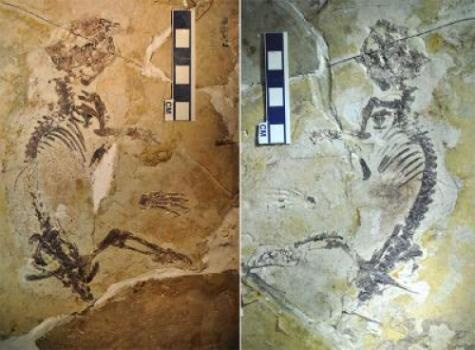
160 million year old multituberculate fossil

160-million-year-old multituberculate fossil.

Picture credit: University of Chicago and Chinese Academy of Sciences

Rugosodon eurasiaticus

The fossil of Rugosodon eurasiaticus is preserved in two shale slabs in part (left) and counterpart (right).  The animal is estimated to have weighed 80 grammes when alive.  The sediments at the site of discovery are lake sediments with embedded volcanic layers.  The fossil assemblage of Rugosodon also includes a number of feathered dinosaur and pterosaur remains.

The distinctive of multituberculate teeth have tiny bumps on the molars, similar in habit and size to today’s rodents, these furry creatures were probably the most abundant mammal around during the time of the dinosaurs.  Although, a very successful group, their fossil remains are extremely fragmented, but now scientists have a beautifully, near complete specimen to study.

Commenting on the discovery, which was made in the finely grained strata of Liaoning Province (China), Professor Zhe-Xi Luo (University of Chicago) stated:

“Now we finally have a compelte skeletal fossil that allows us to paint a coherent picture of the evolutionary origin of these prolific and important ancient mammals.”

Slab and Counter Slab Studied

The animal has been named Rugosodon eurasiaticus, the slab and counter slab of the fossil specimen have allowed palaeontologists to examine some of the anatomical adaptations that may have helped this group become so successful. For instance, scientists were already aware that around sixty-five million years ago, there were a number of multituberculate species that could hyper extend their ankles.  This would have made them very fast and agile.

The remains of R. eurasiaticus reveal mobile and flexible ankle bones too, although the fossil is nearly one hundred million years older.  According to the research team, the flexible ankles and its small size could have helped this group of early mammals adapt to a wide range of environmental niches, including tunnel digging and living in trees.

Scurrying Around a Jurassic Lakeside
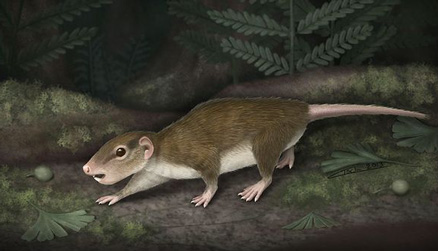
An illustration of an ancient mammal.

An illustration of an ancient mammal. An illustration of R. eurasiaticus.

Picture credit: University of Chicago/April Isch

Examining the Teeth

By the dental features, Rugosodon eurasiaticus closely resembles the teeth of some multituberculate mammals of the Late Jurassic of Western Europe, suggesting that Europe and Asia had extensive mammal faunal inter-changes in the Jurassic.

Examination of the small teeth preserved in the delicate jaws of this seventeen centimetre long specimen indicate that it was an omnivore, probably hunting at night along the large lakes of this part of Jurassic China, catching worms, insects, amphibians as well as eating ferns and mosses.  This specimen is important as it suggests that later herbivorous multituberculates were descended from omnivores.

Professor Luo added:

 “Essentially, multituberculates were the first important mammal group to occupy an herbivorous niche.  They were able to exploit a part of the ecosystem that was not accessible to many other vertebrates, including other Mesozoic mammals.  This superb feeding function, together with versatile locomotor adaptations, explains why multituberculates were so successful and diverse.  Now we have a sense of what they started off with, thanks to the discovery of Rugosodon.”

For models and replicas of Jurassic prehistoric animals and other creatures: CollectA Age of Dinosaurs Models.

15 08, 2013

Remarkable Ostrich Necks Provide Information on Sauropod Neck Flexibility

By |2024-05-01T14:49:58+01:00August 15th, 2013|Categories: Dinosaur and Prehistoric Animal News Stories|0 Comments

Those Not so Flexible Sauropods

The Sauropoda, that group of large, lizard-hipped dinosaurs with their long necks, huge bodies and long tails* have fascinated palaeontologists ever since the first enormous fossil bones of these plant-eaters were discovered.  Most natural history museums, if they are big enough, will feature sauropods amongst their dinosaur exhibits.  Although much has been learned about these Late Triassic to Late Cretaceous creatures since the days of Marsh, Cope and Riggs, palaeontologists still puzzle over many aspects of their anatomy.  For example, just how flexible were those long necks?

Sauropod Dinosaur Neck

New Study into the Long Necks of Sauropoda

Mojo Fun Sauropods for 2020.

A new study has been published that looks at the flexibility of sauropod necks. Picture credit: Everything Dinosaur.

Collaborative Study

In a new, collaborative study between researchers from the University of Utah, the Natural History Museum (London) and Bristol University the neck bones, and soft tissues of the necks of female ostriches have been used to try to model the flexibility of sauropod necks.  Why does this matter?  Well, the flexibility of the neck has all sorts of implications for the Sauropoda.  For example, very flexible sauropod necks would imply that these animals could reach high to feed on the tops of trees, or dip their heads very low to feed at ground level.

This feeding range, often referred to as the “feeding envelope” can be examined and contrasted amongst different sauropod genera permitting scientists to understand more about the feeding habits of certain species that co-existed.

Ostriches Studied

Previous studies had focused on the articulation and degree of movement possible by examining the cervical vertebrae (neck bones) of sauropods.  In this study, the team examined the bones and soft tissue found in ostrich necks (Struthio camelus), ostriches were chosen as they too, have elongated necks and the soft tissue such as muscle groups in the neck region are broadly comparable with that of sauropods.

The researchers measured the flexibility of the flightless birds with all their muscle tissue intact, and then slowly removed the muscles to test how this changed the situation and altered the range of movement possible.  The team’s findings suggest the soft tissues and cartilage associated with the long-necks of sauropods would have restricted their neck movements.  This has implications for the way these dinosaurs are depicted in films, books and displayed in museums.

Matthew Cobley from the University of Utah, one of the authors of the scientific paper that has been published in PLoS One (Public Library of Science) commented:

“Previous studies looked at the skeleton on its own and the assumption was that flexibility is limited by the bones of the skeleton, but our study shows it’s actually the soft tissue around it.”

The Impact on Feeding Strategies

The flexibility of the necks of these herbivores will have an effect on the feeding strategies that these creatures can adopt. There is a wide degree of variation in the shape of the cervical vertebrae, their number and the length of the neck in sauropods.  Each type of sauropod would most likely, have adaptations for exploiting food resources within a given environment.

Dinosaurs with different necks and other adaptations could reach and feed on different types of vegetation. With variation in feeding habits, an ecosystem could support a more diverse range of mega-herbivores.

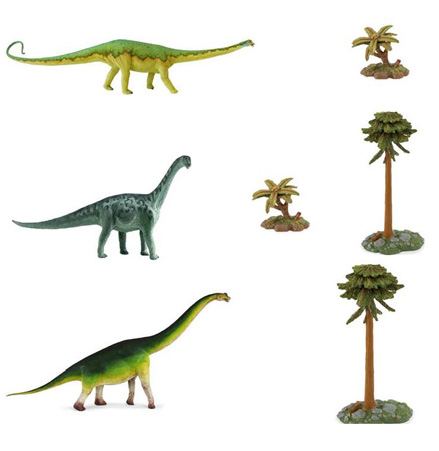
Variation in Sauropod Necks – Adaptations for Different Feeding Strategies Perhaps?

Long necks for different feeding envelopes.

Long necks for different feeding envelopes.

Picture credit: Everything Dinosaur/Safari Ltd

Different Sauropod Feeding Strategies

In the illustration above, examples of different sauropod anatomies can be seen, from diplodocid (top), camarasaurid (middle) and brachiosaurid (bottom).  The necks of these animals are very different, suggesting that each type of long-necked dinosaur was adapted to feeding on certain types of vegetation.  The diplodocids may have been browsers, whilst the brachiosaurs may have been better suited to feeding from the tops of trees.

It has been calculated that some large species would have had to consume as much as 400 kilogrammes of vegetation a day to sustain their immense bodies.  A herd of these herbivores would very quickly strip an area of suitable plant matter.  The competition for food amongst different species would drive the evolution of more specialised feeding and this may help explain why there is a large variation of sauropod species found in places such as the Dashanpu Quarry fossil sites in Sichuan Province, China.

These Jurassic aged sediments have revealed the fossilised bones of at least four different types of long-necked dinosaur.  Each was very probably adapted for feeding in a certain way.  Sauropods such as Mamenchisaurus and Omeisaurus with their extremely long necks would have specialised in one feeding method, whilst their contemporary, Shunosaurus with its much shorter neck would have probably browsed on other types of vegetation.

* Not all members of the Sauropoda were huge.  This is a very diverse group of Dinosauria, some sauropods such as the titanosaur Magyarosaurus  from the Hateg Formation may have reached lengths no longer than four metres and perhaps this dwarf titanosaur might have weighed about the same as a modern dairy cow.

For models and replicas of sauropods and other herbivorous dinosaurs: CollectA Prehistoric Life Models and Figures.

13 08, 2013

Neanderthals Made the First Specialised Bone Tools In Europe

By |2023-02-21T16:58:18+00:00August 13th, 2013|Categories: Dinosaur and Prehistoric Animal News Stories, Geology, Palaeontological articles|0 Comments

Neanderthals Shaped Animal Bones So That They Could Work Leather

For many thousands of years, modern humans (Homo sapiens) and Neanderthals (Homo neanderthalensis) lived in western Europe, it is not known how much interaction there was between these two species of hominids.  Neanderthals, far from being the slow-witted, ape-men of Victorian literature were very well adapted to living in cold climates, skilled tool makers and very capable hunters. In Neanderthal fossil sites dated to near the time when this species became extinct, a few thousand years after the arrival of modern humans in western Europe, tools and other objects have been found that are very similar to those found in contemporaneous fossil sites of modern humans.

Neanderthals

Neanderthals show behaviours similar to those associated with modern humans and have similar fine tools, such as small stone blades and bone implements.

Evidence of Neanderthals Being Skilled Leather Workers

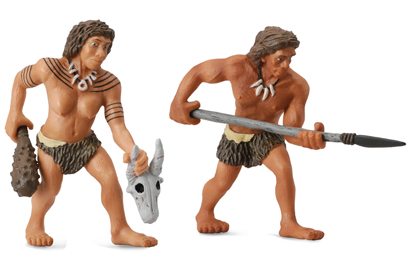
CollectA Neanderthal Models.

Human and Neanderthal genetic research. Evidence suggests that Neanderthals were skilled leather workers and therefore able to make clothes.

The picture (above) shows two CollectA Neanderthal models, to view these replicas (whilst stocks last): CollectA Prehistoric Life Figures.

Sophisticated Behaviours

It had been thought that much of these sophisticated behaviours inferred from artefacts found at Neanderthal fossil sites, had been developed as a result of contact between Neanderthals and our own species.  Modern humans arrived in western Europe around 40,000 years ago and it is after this date that such sophisticated tools turn up in Neanderthal dig sites.

In a new study, published in the academic journal the Proceedings of the National Academy of Sciences (USA), a team of researchers report the discovery of specialised bone tools previously only associated with Homo sapiens that date from a Neanderthal site that is at least 50,000 years old  – before (so it is thought),  the arrival of modern man in western Europe.  This suggests that Neanderthals did not learn sophisticated tool making skills from us, they may have developed such technologies themselves.

Tools Made from Animal Bones

Co-author of the study, Zenobia Jacobs of the University of Wollongong (New South Wales, Australia) stated that the tools were polishing tools made from animal bones.  These “lissoir” tools were used to work the hides of animals and the Neanderthal bone tools predate similar discoveries made in western Europe by about 10,000 years.

The tools were found in south-western France and the University of Wollongong has been engaged in a major project to assess Neanderthal and early human European cultures.  This new study, forms just part of the University’s research.

This discovery implies that the two hominid species either learned how to work animal skins separately, or modern humans may have picked up the skills required from the Neanderthals.  Dr. Jacobs suggests that it may have been the later, with modern humans learning from Neanderthals.

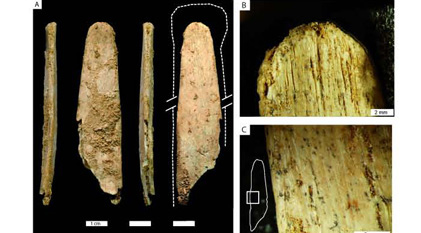
The Bone Tools Discovered at the Site in South-western France

Bone tools shaped by Neanderthals for working animal skins.

Bone tools shaped by Neanderthals for working animal skins.

Picture credit: Proceedings of the National Academy of Sciences

Picture A shows a bone tool, the dotted line shows the original shape of the bone before it was sculpted and shaped into a tool for use in leather work.  The close up images of the bones show evidence of wear as seen in modern lissoir tools used today in the fashion industry.

Used to Prepare Animal Hides

Dr Jacobs said the tools were used to smooth and burnish deer hides and make them water resistant.  They were identically shaped to plastic lissoir tools used today by top fashion houses.  The specialised bone tools  have microscopic wear patterns preserved on them, the wear is consistent with the use of lissoir in modern times to obtain supple, lustrous, and more impermeable hides.

The discovery contradicts theories that Neanderthals were “cognitively challenged dead-ends” who had been supplanted by Homo sapiens because they were stupid, Dr Jacobs said.  Neanderthals have also been found to have had the genetic and anatomical features necessary for speech.

Dr Jacobs added:

“I don’t think they were stupid at all.  They were probably quite capable of inventing all sorts of things that modern humans would like to claim as their own.”

Smart Neanderthals

Dr Jacobs commented that  it had long been believed that humans began behaving in a modern fashion, characterised by the use of symbols, when they reached Europe.

“Now it’s generally accepted that we probably had those abilities over the last 100 to 150 thousand years,” the doctor stated.

While it is not clear why Homo sapiens displaced the Neanderthals, Dr Jacobs said there had been plenty of interbreeding and most people now had between 2.5 per cent and 4 per cent of Neanderthal DNA in their genes.

She quipped:

“Maybe those leather workers are the ones with more Neanderthal genes.”

As these finds clearly predate the oldest known age for the use of similar objects in Europe by anatomically modern humans, they could also be evidence for cultural diffusion from Neanderthals to modern humans.

12 08, 2013

Romantic Megalodon Teeth – Couple Find Matching Halves of Rare Fossil Tooth

By |2024-04-29T14:58:21+01:00August 12th, 2013|Categories: Dinosaur and Prehistoric Animal News Stories|1 Comment

Texan Couple Play “Matching Pairs” with Fossilised Megalodon Tooth 

An American couple on holiday in Florida have an unusual memento of their vacation as each partner discovered part of the fossilised remains of a prehistoric shark tooth.  Last month, Texans Wes and Kerry Kirpach were holidaying at the beach resort of Venice (Florida) and during a dive off the coast to look for fossilised teeth they found the matching halves of a tooth from a Megalodon shark (Carcharodon megalodon).

Megalodon Shark

Venice is on the Gulf of Mexico coast of the Sunshine State, situated around fifty miles south of Tampa, it is regarded by many fossil hunters as the “shark tooth capital of the world” because of the wealth of shark fossil material divers and beachcombers can find.

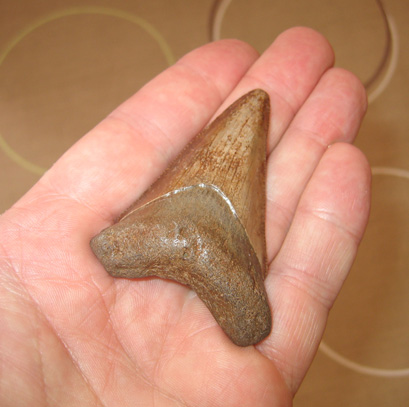
A Carcharodon megalodon Fossil Tooth

A large fossil tooth from a Carcharodon megalodon.

A large fossil tooth from a Carcharodon megalodon.

Picture credit: Everything Dinosaur

Diving for Fossils

The couple have dived looking for shark teeth on many occasions and Wes was delighted to find a 9 centimetre long broken shark’s tooth, a fossil from the ferocious, whale-hunting Megalodon, which some scientists claim may have reached lengths of over fifteen metres.  Kerry found a similar sized tooth just a hour later.  Once the two pieces were examined, the cracks and breaks in the fossils could be seen to match each other, the couple had both found pieces of the same tooth.

Such an occurrence is extremely rare as depositional and tidal action will often disperse fossil fragments over a wide area, however, given the large number of fossils that have aggregated in the sea off Venice, it seems that unlikely events such as this are possible.

A Close-up View of Megalodon Jaws

Papo Megalodon model

The Papo Otodus megalodon model in anterior view.

Picture credit: Everything Dinosaur

Many Teeth in the Jaws

A fully grown Megalodon shark may have had up to 290 triangular teeth in its jaws and it has been claimed that the largest of these predators with its enormous jaws could swallow a Great White shark (Carcharodon carcharias) whole. The teeth of sharks are embedded into their fleshy gums and are not attached directly to the jaws.  These teeth are replaced constantly during the life-time of the animal with some sharks losing more than 20,000 teeth.  Replacement teeth steadily move forward as older teeth at the front are lost.  Shark teeth fossils are relatively common in a number of marine fossil deposits.

The broken tooth found by the Kirpach’s may be as much as four million years old.  Fortunately, for divers and for others who venture into the sea today, the Megalodon shark is believed to have become extinct around 1.6 million years ago.

A spokesperson for Everything Dinosaur commented:

“Giant sharks such as Carcharodon megalodon continue to fascinate, only yesterday one of our team members, whilst helping out a museum exhibition, was asked about their extinction.  Finding a piece of such a large prehistoric shark tooth is  rare and to have your partner come up with the matching half just a few minutes later is truly remarkable.”

Note

Following a taxonomic reassessment most scientists classify this shark species as: Otodus megalodon.

PNSO have produced a range of prehistoric shark figures including a replica of Megalodon. To view the extensive PNSO Age of Dinosaurs range: PNSO Age of Dinosaurs Models and Figures.

10 08, 2013

Psittacosaurus Proves that Three Goes into One

By |2023-02-21T15:36:03+00:00August 10th, 2013|Categories: Dinosaur and Prehistoric Animal News Stories|0 Comments

New Study of Psittacosaur Skulls Shows Three Species are Actually Just One Species

In a new study of Psittacosaurus fossils from China carried out by University of Pennsylvania researchers, the number of known species of this dinosaur has been reduced from fifteen to thirteen.  It seems that what was once thought to be three different types of “parrot lizard” living in China actually may be just one species.  Differences in the morphology of the fossil material had led to the establishment of three separate species but these differences relate to compression and distortion that occurred as the fossil material was buried and preserved, they do not relate to anatomical differences that would be expected if these animals were indeed different species.

Psittacosaurus

Psittacosaurus is one of the most abundant and speciose genera of all the known Dinosauria.  There had been fifteen named species, with fossil finds in Russia, Mongolia and Thailand as well as in China.  The research team, writing in the scientific jounal PLoS One (Public Library of Science), state that what was once thought of being three separate species from the Psittacosauridae family excavated from strata in the Yixian Formation of north-eastern China – P. lujiatunensis, P. major, and Hongshanosaurus houi are actually the same dinosaur.  All the psittacosaur material represents P. lujiatunensis.

Known to science for ninety years or so, psittacosaurs were relatively small, slender, bipedal members of the ornithischian group of dinosaurs.  Fossils date from around 130 million years ago to approximately 100 million years ago.  Most probably herbivorous, these dinosaurs, most of which were less than two metres in length, are distantly related to the giant Late Cretaceous horned dinosaurs such as Triceratops, Styracosaurus and Chasmosaurus.

An Illustration of Psittacosaurus

Psittacosaurus proves that three into one does go.

Psittacosaurus proves that three into one does go.

Picture credit: Everything Dinosaur

Three-dimensional Geometric Morphometrics

Commenting on their findings Peter Dodson, (Professor of Anatomy at the University’s School of Veterinary Medicine) stated:

“Because of the vagaries of fossilisation, no two fossils are the same.   Animals are alive and they die, but what’s crucial in palaeontology is what happens to the animals after they die.”

The research team used a process called three-dimensional geometric morphometrics to compensate for the crushed and distorted fossil material, thus revealing the affinities between different fossil specimens.  This is the first time this laser-based examination technique has been used on dinosaur fossils and this study could have implications for other genera.

New Study Re-assigns Fossil Material

Assessing the shape of dinosaur skulls.

Assessing the shape of dinosaur skulls.

Picture credit: PLoS One

Many New Genera Named

Over the last thirty years or so a large number of horned dinosaur fossils have been found in North America.  As a result, many new genera and species have been erected.  Three-dimensional geometric morphometrics if applied to North American ceratopsian specimens may help to confirm speciation or indeed lead to a re-assignment of some fossil material.

A spokesperson from Everything Dinosaur commented:

“This technique permits scientists to assess the variation in skull morphology.  Given enough specimens to study and this work could have implications for other dinosaur genera, extinct animals which have left us fossils which were thought to represent a new species unknown to science may turn out to be examples of already known and described species.”

The Beasts of the Mesozoic range contains several different, articulated horned dinosaur figures including Psittacosaurus (whilst stocks last).

To view the Beasts of the Mesozoic range: Beasts of the Mesozoic Articulated Dinosaur Figures.

8 08, 2013

The 165-Million-Year-Old “Squirrel” Named in New Research

By |2024-04-29T14:54:53+01:00August 8th, 2013|Categories: Dinosaur and Prehistoric Animal News Stories|0 Comments

165-Million-Year-Old Fossil Provided Evidence of Mammalian Evolution

A newly discovered fossil reveals the evolutionary adaptations of a 165-million-year-old proto-mammal, providing evidence that traits such as hair and fur originated well before the rise of the first true mammals.  University of Chicago scientists described the biological features of this ancient mammalian relative, named Megaconus mammaliaformis, in a paper published in the latest edition of the academic journal “Nature”.

Megaconus mammaliaformis

Professor Zhe-Xi Luo one of the authors of the scientific paper stated:

“We finally have a glimpse of what may be the ancestral condition of all mammals, by looking at what is preserved in Megaconus.  It allows us to piece together poorly understood details of the critical transition of modern mammals from pre-mammalian ancestors.”

An Illustration and Skeletal Reconstruction of M. mammaliaformis

Jurassic squirrel-like primitive mammal.

Jurassic squirrel-like primitive mammal.

Picture credit: April Isch

The specimen, dating from the Bathonian faunal stage of the Middle Jurassic was discovered in Inner Mongolia, China.  Megaconus is one of the best-preserved fossils of the mammaliaform groups, which are long-extinct relatives to modern mammals.

A terrestrial animal about the size of a large ground squirrel, Megaconus was most probably an omnivore, possessing clearly mammalian dental features and jaw hinge.  Its molars had elaborate rows of cusps for chewing on plants, and some of its anterior teeth possessed large cusps that allowed it to eat insects and worms, perhaps even other small vertebrates.  It had teeth with high crowns and fused roots similar to more modern, but unrelated, mammalian species such as rodents.  Its high-crowned teeth also appeared to be slow-growing like modern placental mammals.

The skeleton of Megaconus, especially its hind-leg bones and finger claws, likely gave it a gait similar to modern armadillos, a previously unknown type of locomotion in mammaliaforms.

Preserved in the fossil is a clear halo of guard hairs and underfur residue, making Megaconus only the second known pre-mammalian fossil with fur.  It was found with sparse hairs around its abdomen, leading the scientists to theorise that it had a naked abdomen.  On its heels, Megaconus possessed a long keratinous spur, which was possibly poisonous.  Similar to spurs found on modern egg-laying mammals, such as male platypuses, the spur is evidence that this fossil was most likely a male member of its species.

Mammalian Phylogeny – Our Family Tree

Tracing the mammalian family tree.

Tracing the mammalian family tree.

Picture credit: Luo Laboratory

Professor Luo went on to state:

“Megaconus confirms that many modern mammalian biological functions related to skin and integument had already evolved before the rise of modern mammals.”

However, Luo and his team identified clear non-mammalian characteristics as well.  Its primitive middle ear, still attached to the jaw, was reptile-like.  Its anklebones and vertebral column are also similar to the anatomy of previously known mammal-like reptiles.

When asked to comment on the possible connections between this Mid-Jurassic fur ball and our own ancestry, the professor said:

“We cannot say that Megaconus is our direct ancestor, but it certainly looks like a great-great-grand uncle 165 million years removed.  These features are evidence of what our mammalian ancestor looked like during the Triassic-Jurassic transition.  Megaconus shows that many adaptations found in modern mammals were already tried by our distant, extinct relatives.  In a sense, the three big branches of modern mammals are all accidental survivors among many other mammaliaform lineages that perished in extinction.”

The fossil, now in the collections in Palaeontological Museum of Liaoning in China, was discovered at the famous Daohugou Fossil Site.  It was studied by an international team of palaeontologists from Palaeontological Museum of Liaoning, University of Bonn in Germany and the University of Chicago.

The Slab and Counter Slab of the Fossil

Megaconus mammaliaformis is preserved as a slab (left) and a counter-slab (right) of shale deposited in a shallow lake.

Megaconus mammaliaformis is preserved as a slab (left) and a counter-slab (right) of shale deposited in a shallow lake.

Picture credit: University of Chicago/Professor Zhe-Xi Luo

This specimen, and another fossil mammaliaform found in the same area in 2006 will help scientists to piece together the early evolution and radiation of primitive mammals that scurried around back in a time when the dinosaurs dominated.

Everything Dinosaur is grateful to the University of Chicago in the compilation of this article.

To view models and replicas of prehistoric animals: Dinosaur and Prehistoric Animal Models.

6 08, 2013

Something Fishy from Arizona

By |2023-02-21T08:00:40+00:00August 6th, 2013|Categories: Dinosaur and Prehistoric Animal News Stories|0 Comments

New Species of Prehistoric Shark Described – Meet “Devil Tooth”

Arizona may be one of the very last places you would expect to find a new species of shark, after all, the “Grand Canyon State” does not seem particularly shark friendly when you consider the large amount of desert within the state’s borders. However, during the Middle to Late Permian (Guadalupian/Lopingian Epochs) this part of the United States was covered in a shallow, tropical sea that teemed with life and scientists from the Northern University of Arizona have identified a number of new shark genera from fossilised teeth excavated from the limestone deposits that make up the Kaibab Formation.

Diablodontus michaeledmundi

Their latest discovery is “Devil Tooth” a new type of hybrodont shark Diablodontus michaeledmundi.  Hybrodont sharks evolved during the Late Devonian and persisted as a diverse and geographically dispersed group until their extinction towards the end of the Mesozoic.  D. michaeledmundi seems typical of this group of Elasmobranchs, the teeth, the researchers have found, suggest that this shark was a little over a metre in length and it was probably a diurnal hunter, living in the coastal waters hunting small fish, squid and octopi.

An Illustration of Diablodontus michaeledmundi

Black bar = scale bar (50 cms)

Black bar = scale bar (50 cms).

Picture credit: Northern Arizona University with additional annotation by Everything Dinosaur

Hybrodont Shark

This shark had two spines projecting upwards from the anterior edge of its dorsal fins, such horned sharks exist today, such as the Port Jackson shark, although extant sharks such as the Port Jackson shark are not closely related to these Permian Elasmobranchs.  The name Diablodontus is derived from the Spanish word for devil “diablo” and the Greek word for teeth “dontus”.  The species name honours Michael Edmund Hodnett, for his work in helping to study the shark fossil assemblage of the Kaibab Formation.

The Kaibab Formation has produced a substantial amount of shark teeth fossils.  This strata is particularly important as it dates from around the time of the greatest mass extinction event known in the fossil record – the end Permian extinction when something like 95% of all life on Earth died out.  The holotype material for D. michaeledmundi was collected from limestone sediments near the town of Flagstaff (northern Arizona).

Various Views of the Fossilised Teeth of Diablodontus michaeledmundi

Ancient shark teeth.

Ancient shark teeth.

Picture credit: John-Paul M. Hodnett et al

The image above shows various views of the teeth of this prehistoric shark. The white bar is a scale bar, it is 1 mm in length.

Shallow Sea in North America

Commenting on the discovery, one of the authors of the scientific paper John-Paul Hodnett, an authority on prehistoric sharks stated:

“The shark miraculously survived the extinction event and lived into the Mesozoic Era – the Age of Reptiles.  At this time the ancestors of modern sharks were just starting to diversify but remained small.”

During the Late Palaeozoic, this part of America was covered by a shallow sea, to the east lay extensive deserts crossed by a nascent mountain range, mountains that would one day become part of the Rockies.

Arizona During the Late Permian

Palaeography of the Late Permian (western United States)

Palaeography of the Late Permian (western United States).

Picture credit: John-Paul M. Hodnett et al

The Kaibab Formation

Fossilised sharks teeth from the Kaibab Formation has permitted scientists an insight into the radiation and diversification of a number of different types of shark.  Several different genera have been identified, one of which Kaibabvenator swiftae with its large, serrated teeth was perhaps the apex marine predator in the ancient Kaibab sea. Size estimates vary for K. swiftae, although it has been suggested that this primitive, horned shark may have reached lengths similar to today’s Great White shark (Carcharodon carcharias).

Size Comparisons between Permian Sharks of the Kaibab Formation and a Great White Shark

Size comparisons between extinct and extant sharks.

Size comparisons between extinct and extant sharks.

Picture credit: Northern Arizona University/Everything Dinosaur

One thing that is undeniable, the Kaibab Formation represents one of the most important locations in the world for fossils of ancient sharks.

For models and replicas of prehistoric sharks and other extinct creatures: PNSO Age of Dinosaurs Models and Figures.

5 08, 2013

Theropod Eggshells Discovered in Portugal

By |2023-02-21T07:55:43+00:00August 5th, 2013|Categories: Dinosaur and Prehistoric Animal News Stories|0 Comments

The Nests of Jurassic Hunters

The Lourinhã Formation of western Portugal has provided researchers from the New University of Lisbon (Universidade Nova de Lisboa), with not one but two sets of dinosaur eggs to study.  Palaeontologists from the University state that the fossilised remains of dinosaur eggs from two locations in the Lourinhã Formation come from two different meat-eating dinosaurs.  The crushed and broken nests represent dinosaur remains estimated to be approximately 150 million years old.

Theropod Eggshells

Although no evidence of fossilised embryos could be found, the scientists were able to study the size, morphology and texture of the eggs and from this evidence, candidates as to what dinosaurs might have laid these eggs can be proposed. Much of the preliminary work to identify the fossil material was made by University palaeontologist Vasco Riberio, during the Late Jurassic this part of Portugal was a floodplain inhabited by many different types of dinosaur.

The first set of eggs, spherical in shape and approximately 15 centimetres in diameter were very probably laid by a large theropod. It has been suggested, that based on the size of the eggs, their mother was a Torvosaurus.  Torvosaurus is a little known Late Jurassic carnivorous dinosaur.  It might be a member of the allosaurid family, or perhaps, because of its heavy and robust frame it might be a megalosaur.  Fossils are known from Portugal and the Morrison Formation of the western United States.  At an estimated length of more than ten metres, it is one of the largest carnivorous dinosaurs known from Portugal.

Lourinhanosaurus antunesi

The eggs found at the second location are slightly smaller and more elongated in shape, it has been speculated that this batch of legs was laid by a Lourinhanosaurus (L. antunesi).  Lourinhanosaurus is known from a single partial skeleton and other fragmentary bones including a femur (thigh bone) all found in the Lourinhã Formation on the western coast of Portugal.  Previously, a number of fossilised eggs found in the  Lourinhã Formation have been ascribed to this species, which is estimated to have grown to lengths of five metres.

An Illustration of the Dinosaur Lourinhanosaurus antunesi

Late Jurassic Theropod

Late Jurassic theropod.

Picture credit: Everything Dinosaur

Abandoned Nest Sites

The scientists are not sure why these two nest sites seem to have been abandoned.  It has been suggested that something may have happened to the adults or that the abandonment of eggs once laid was normal behaviour for these types of theropods.  Such behaviour, laying eggs and then leaving them to their fate is referred to as precocial behaviour.  A number of reptiles lay eggs and then abandon them, reptiles such as tortoises and turtles.  Precocial behaviour is also seen in the Aves, with many types of ducks and geese when hatched, are relatively well-developed and can feed themselves.

The dinosaurs that laid these eggs may have simply abandoned the nests, the dinosaurs that hatched would have been mobile almost immediately and would have left the nest shortly after hatching to fend for themselves.

To view the extensive range of prehistoric animal models available from Everything Dinosaur: Dinosaur and Prehistoric Animal Models.

2 08, 2013

Ice Cores Provide Important Clue to American Megafauna Extinction (New Research is Published)

By |2024-04-29T14:54:11+01:00August 2nd, 2013|Categories: Dinosaur and Prehistoric Animal News Stories, Geology|0 Comments

Greenland Ice Cores Indicate Extra-terrestrial Impact in North America

One of the great mysteries surrounding the Ice Age mammalian fauna, the likes of the Mastodons, Mammoths and Sabre-toothed cats is their relatively rapid and sudden extinction in North America.  The demise of these large, prehistoric animals seems to coincide with the demise of the North American “Clovis” people.  A period of dramatic climate change has long been suspected.

Climate Change

Approximately, 12.900 years ago North America experienced a dramatic and rapid cooling.  This climate change probably led to the extinction of the North American megafauna and the collapse of the Clovis culture.  A number of theories have been proposed to explain why this period of sudden cooling took place.  For example, around this time, it is believed that the giant glacial melt water lake known as Lake Agassiz discharged vast amounts of freshwater into the Arctic Ocean.

This lake, which at its greatest extent covered an area of nearly twice the size of the United Kingdom, discharged such a volume of water that ocean currents were disturbed and this contributed to the rapid climate change.

An Extra-terrestrial Impact

It has also been proposed that there was an extra-terrestrial impact, however, this idea has been disputed.  However, new research from Harvard University, a study of ice cores taken from Greenland that date to around 12,900 years ago adds weight to the asteroid/meteorite/comet impact theory.  The American scientists found more than one hundred times the expected level of platinum in the ice cores, apparently deposited around 12,900 years ago.

Did an Extra-terrestrial Impact Event Spell Doom for North American Megafauna?

Will the Woolly Mammoth return?

Will the Woolly Mammoth return?

Picture credit: Everything Dinosaur

The picture (above) shows some Woolly Mammoth models, for models and replicas of Ice Age animals including Woolly Mammoths (whilst stocks last): Papo Prehistoric Animal Models and Figures.

New Data

This new data, published in the academic journal “The Proceedings of the National Academy of Sciences”, seems to support the hypothesis that an impact tipped the climate into a much colder phase.

New platinum measurements were made on ice cores that allow conditions 13,000 years ago to be determined at a time resolution of approximately +/- five years or so.  The hundred times spike in platinum levels coincides with a rapid cooling of the environment as indicated from oxygen isotope measurements, the start of a climatic period known as the “Younger Dryas”.

The “Younger Dryas”

The “Younger Dryas” started and finished abruptly, and is one of a number of shorter periods of climate change that appear to have occurred since the last glacial maximum of around 20,000 years ago.  Each end of the “Younger Dryas” period may have involved very rapid changes in temperature as the climate system reached a tipping point, with suggestions that dramatic changes in temperature occurred over as short as time-scale as a decade or so.  Such dramatic climate changes would have led to the collapse of many ecosystems with much of the mammalian mega-fauna becoming extinct as a result.

This new paper, provides support to the extra-terrestrial impact theory, observations of microscopic grains of diamond and the mineral lonsdaleite found in North American lake sediments also support the hypothesis of a possible meteorite impact.  Similar deposits were found in the area surrounding the Tunguska impact event of 1908.

No Impact Crater Evidence

Although no evidence of an actual impact crater has yet to be found, if a sizeable impact did occur, then debris thrown into the atmosphere could have influenced the climate and helped to cause the rapid global cooling.  Sudden climate change would have put environments and ecosystems under huge stress and ultimately a number of extinctions would have resulted.

30 07, 2013

“Duelling Dinosaurs” Up for Auction – Remarkable Fossils Up for Sale

By |2024-04-29T14:50:01+01:00July 30th, 2013|Categories: Dinosaur and Prehistoric Animal News Stories|0 Comments

Tyrannosaurid and Ceratopsian Fossils Heading for Auction

Two fossils found in association with each other in sediments from the famous Hell Creek Formation of Montana seem destined to go up for auction next November.  The debate has once again sprung up between those who support commercial fossil hunters and those who believe that such discoveries should be made as a gift to science.

Dinosaurs Up For Auction

The fossils consist of a tyrannosaurid, billed in the press releases sent out regarding the proposed auction, as an example of a Nanotyrannus lancensis and a horned dinosaur, a member of the chasmosaurine clade of ceratopsians and possibly a new species.  The two specimens have been referred to as “Montana’s Duelling Dinosaurs”.  It has been suggested that these specimens represent a fight between a meat-eating and a plant-eating dinosaur.  Although, team members at Everything Dinosaur have only a limited knowledge of what material has been excavated so far, it is likely that the “duelling dinosaurs” hypothesis has been put forward as the specimens were found in close proximity and after an examination of some of the pathology identified on the fossil bones.

“Duelling Dinosaurs” Go Up for Sale

Dinosaurs up for auction

Dinosaurs up for auction

Picture credit: Bonhams

Duelling Dinosaurs

Very rarely has the fossil record preserved anything as dramatic as a fight between two vertebrate antagonists, in this case, an example of inter-specific interaction.  It is difficult to comment further as to the validity of these claims as with an auction looming, such statements might be aimed at “whetting the appetites of potential buyers rather than accurately reflecting evidence from a preliminary study” as a spokesperson from Everything Dinosaur commented.

The very fact that a Nanotyrannus specimen might be available for sale is fascinating.  If it ends up in the hands of a private collector and as a result, it remains unavailable for study, this will disappoint a great many palaeontologists as well as their museum directors.  Nanotyrannus might be a dwarf version of Tyrannosaurus rex, however, it could also represent juvenile specimens of T. rex itself.  Skull material discovered in the 1940s and originally described as a Gorgosaurus was re-examined in the 1980s and it was suggested that the specimen represented an adult animal, an example of a new species of pygmy tyrannosaur.  The Nanotyrannus genus was erected, its validity or otherwise has been debated ever since.

Nanotyrannus

A detailed study of the Montana tyrannosaur material may help to resolve this debate.  Many palaeontologists fear that if the specimen is sold at auction to a wealthy individual, then the chance to study the fossils may be lost.  According to other sources tyrannosaurid teeth are embedded in the ceratopsians bones and there may also be skin impressions preserved.  It has also been reported that the tyrannosaurid may be considerably larger than other specimens of the nomen dubium N. lancensis, with well informed American palaeontologists suggesting that the individual tyrannosaur may be about the size of another member of the tyrannosaur family – Albertosaurus.

A Replica of Nanotyrannus

PNSO Nanotyrannus dinosaur model.

The PNSO Nanotyrannus dinosaur model.

The picture (above) shows the PNSO Nanotyrannus figure.

To view the range of PNSO prehistoric animal models and figures in stock at Everything Dinosaur: PNSO Dinosaur Models and Figures.

Duelling Dinosaurs

The two near complete skeletons were found by commercial fossil hunters on private land.  In the United States, fossils found on privately owned land are the property of the land owners, no matter what the significance to science.  In this case, the owners of the fossils in collaboration with the prospectors can put these rare objects up for sale to the highest bidder.  It has been estimated that the two specimens sold together as a single auction lot could fetch as much as £5.8 million (GBP).

The sale is going to managed by Bonhams auction house in New York.  The “city that never sleeps” may turn out to be an ill omen for the sellers, as in May 2012, the sale of another tyrannosaurid, this time a Tarbosaurus was stopped after it was alleged the fossil material had been illegally removed from Mongolia.   The Tarbosaurus fossils were returned to Mongolia and a fossil dealer from Florida will be sentenced next month over his involvement in the importing of the Late Cretaceous fossils into the United States.

To read more about the Tarbosaurus auction: U.S. Officials Seize Tarbosaurus Skeleton.

To read more about the legal action that followed: Tarbosaurus Case – Florida Man Pleads Guilty.

Senior scientific advisor at the Dinosaur Discovery Museum and director of the Carthage Institute of Palaeontology (Wisconsin), Thomas Carr commented:

“This lines their pockets [commercial fossil hunters and the owners of private land] but hurts science.”

Fossils To Be Sold At Auction

Approaches to museums and other educational bodies have already been made, but it seems that none are willing or able to pay the asking price, so the next step is for the fossils to be sold at auction.  Many fossil specimens, even mounted exhibits of dinosaurs are sold each year, but the sale of these two items for what might turn out to be a record amount is likely to attract a lot of media interest.

However, not everything sells at an auction, in 2008 a Triceratops skeleton went under the hammer but it failed to sell on the day of the auction.

To read more about the Triceratops sale: Triceratops Specimen for Auction.

If a wealthy individual purchases the auction lot, then all may not be lost.  Many adopt a philanthropic attitude to their acquisitions and make them available for further study, thus helping palaeontologists to learn more about long extinct prehistoric animals.  Unfortunately, there is no guarantee and many purchasers prefer to remain anonymous.  However, we, at Everything Dinosaur urge those responsible for the sale and indeed any prospective buyers to permit the specimens to be part of a formal study programme.  In this way, these specimens are not lost to science for good.

With the very high prices paid for fossils, especially dinosaur fossils, an entire industry has sprung up catering for the demand.  Whilst many of the organisations involved are highly professional and ethical, there are less honest fossil hunters out there, poaching, thefts and smuggling of fossil material is big business.  How big?  Nobody actually knows.

Let us hope that the sentencing of the Florida fossil dealer convicted of making false statements on customs forms when importing the Tarbosaurus material will help deter unscrupulous commercial fossil hunters.  However, given the huge rewards available and the lack of international efforts to curb the trade we think that these practices will continue.

The Benefits Of Commercial Fossil Collectors

There is another side to consider when examining the role of commercial collectors.  Many excavate their discoveries with the utmost care and are extremely professional.  Such companies and individuals have made significant contributions to the science of palaeontology and without their efforts many important specimens would never have been found and many more would not have been preserved, simply left to erode away as they are exposed to the elements.  With the cutbacks on museum funding, the number of field expeditions that museums can undertake has been reduced and commercial companies have successfully “plugged the gap” helping to preserve a large number of specimens that otherwise would have been lost to science.

Peter Larson, one of the world’s most distinguished commercial fossil hunters and an authority on tyrannosaurs has stated that the bones are well-preserved and articulated, with some fossilised skin impressions present.  He has suggested that teeth from a predatory dinosaur are embedded in the cervical vertebrae (neck bones), whilst the tyrannosaurs chest and skull bones show evidence of being crushed, perhaps from a kick from the massive ceratopsian.

Peter and his company, the Black Hills Institute of Geological Research based in South Dakota, have been involved in the project to excavate and prepare the fossil material since 2011.  Peter went onto add:

“The fossils provide potential evidence for two new kinds of dinosaurs.  They could settle long-running scientific debates over whether the pygmy tyrannosaur existed as a separate genus or was simply a juvenile T. rex, and whether it hunted as well as scavenged.”

We at Everything Dinosaur, hope that if the fossils are put up for sale at auction, then the buyer will be generous and permit the specimens to be studied by the scientific community.   Such a gesture would no doubt provide lots of positive PR and perhaps establish a blueprint for other lots that may go to auction to replicate.

Go to Top