All about dinosaurs, fossils and prehistoric animals by Everything Dinosaur team members.

Fossil finds, new dinosaur discoveries, news and views from the world of palaeontology and other Earth sciences.

11 09, 2013

“Duelling Dinosaurs” Likely to Set World Record at Auction

By |2023-02-23T18:45:31+00:00September 11th, 2013|Categories: Dinosaur and Prehistoric Animal News Stories|0 Comments

 Auction Date Set for “Battling Dinosaurs”

The auction date has been set for the sale of a remarkable fossil, one that shows a tyrannosaur fighting with a horned dinosaur, both specimens could make a significant contribution to the study of vertebrate mega fauna of Late Cretaceous Montana.  The meat-eater, fossils of which are so beautifully preserved, almost the entire skeleton has remained in situ, could resolve the puzzle as to whether a ferocious, “pocket battleship of a tyrannosaur” actually existed.  These specimens will go under the hammer at Bonhams Auction House (New York), on November 19th.  If you are looking for an unusual Christmas present expect to pay somewhere between $7 million and $9 million USD (£4.41 – £5.67 million GBP), experts predict that this auction lot will fetch a world record price for a fossil sale.

“Duelling Dinosaurs”

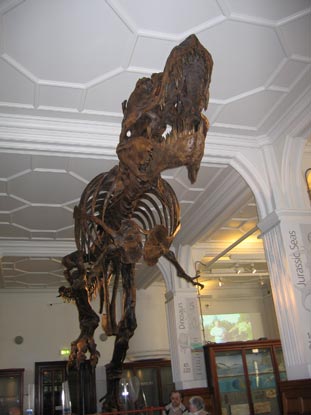
Many palaeontologists and academics are concerned that if these extremely rare specimens end up in private hands then the fossils may not be made available for scientific research.  The “Montana Duelling Dinosaurs”, a record of dinosaur inter-specific combat preserved for 67 million years may be lost to science.  The horned dinosaur is believed to be a type of chasmosaurine ceratopsian, belonging to the same group of horned dinosaurs as the famous Triceratops.  The tyrannosaur, estimated at around seven metres in length could be a specimen of a Nanotyrannus (N. lancensis).  A skull discovered in 1942 and initially ascribed to the Gorgosaurus genus was later discovered to represent an adult animal not a juvenile.  In 1988, in the light of a study suggesting that this relatively diminutive skull did, indeed, represent a fully grown individual, the genus Nanotyrannus was erected.
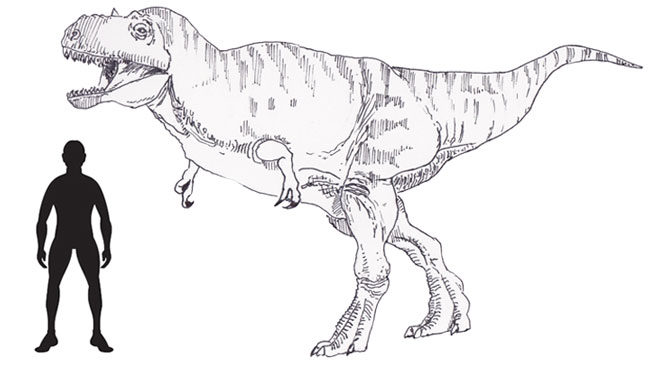
Nanotyrannus lancensis scale drawing.
Nanotyrannus scale drawing. Picture credit: Everything Dinosaur.

Picture credit: Everything Dinosaur

To view models and replicas of tyrannosaurs and other dinosaurs: PNSO Age of Dinosaurs.

“Little Tyrant”

Nanotyrannus means “little tyrant”.  Whether Nanotyrannus is a separate genus, or whether the fossils ascribed to Nanotyrannus actually represent juvenile specimens of already described tyrannosaurs has been hotly debated by palaeontologists.  The discovery of such a complete fossil tyrannosaur could resolve this debate.

To read more about the discovery of these fossils: Duelling Dinosaurs Up For Auction.

Pete Larson of the Black Hills Institute, (South Dakota), himself a highly respected expert on tyrannosaurids, has been involved in the preparation work.  His PhD supervisor Dr Phil Manning (Manchester University) has been granted access to the “duelling dinosaurs” and this week he will present his preliminary findings at a British Science Festival to be held in Newcastle.

The Fossil Specimen – “Duelling Dinosaurs”

Pete Larson can be seen in the background (blue T-shirt).

Dr Manning commented:

“This is possibly the most astoundingly amazing fossil in the world.  Even if it were a T. rex, it would be a big find because the fossil is 99.9 per cent complete. The most valuable T. rex ever found was only eighty-five percent complete.”

Comparing Forearms

Recalling his observations of the fossil material, Dr Manning stated that tyrannosaurs were famous for having small forearms, but the forearm of the Montana specimen was much larger in proportion when compared to an adult tyrannosaurus rex.  Unless the arms did not grow as fast as the rest of the animal as it matured, then the disproportionately large arms could indicate that Nanotyrannus is a real and distinct genus.

Dr Manning was able to identify a number of important anatomical characteristics that could help confirm the existence of a mid-sized, intermediate predator amongst the Late Cretaceous dinosaur mega fauna of Montana.  The tyrannosaur, whose teeth are embedded amongst the cervical vertebrae of the chasmosaur, is described as a graceful looking creature with a flexible but strong neck.   Although, much more time to study the two fossils is required, Dr Manning did suggest that:

“This find indicates that T. rex faced a mid-sized competitor predator or that they preyed on Nanotyrannus.”

Studying the Hell Creek Formation

For many years, scientists have pondered over the structure of the food chain when vertebrate fossils from the Hell Creek Formation are considered.  Whether scavenger or hunter, Tyrannosaurus rex is regarded as the apex predator, but little evidence had been found that suggested mid-sized predators in this ecosystem.  The only other predatory dinosaurs known from the Hell Creek Formation are the very much smaller dromaeosaurids, dinosaurs such as Saurornitholestes and Dromaeosaurus, which measure little more than two metres in length.

Phil Manning concluded:

“It seems logical that this animal filled an intermediate ecological niche between the vast T. rex and contemporary dromaeosaur predators.”

However, the fate of this specimen and whether or not it will be able to studied in greater detail depends on the swing of an auctioneer’s gavel.

We at Everything Dinosaur hope that if a museum or some other academic institution is unable to raise the funds required to purchase the fossil, the buyer will permit full scientific access to this important discovery.

7 09, 2013

Oil Companies Help Uncover “Treasure Trove” of Fossils

By |2023-02-22T13:52:26+00:00September 7th, 2013|Categories: Dinosaur and Prehistoric Animal News Stories|1 Comment

Geologists Help Uncover Large Number of South American Fossils 

As geologists explore rock formations in search of fossil fuels then body and trace fossils are sometimes found as a consequence of their efforts.  With the world’s high demand for hydrocarbons, more and more parts of our planet are having their geology mapped and charted, such work occasionally leads to a major fossil discovery.

The Venezuelan Institute for Scientific Research

Scientists from the Venezuelan Institute for Scientific Research (Venezuela), have been showing off a vast collection of more than 12,000 specimens that have been unearthed as a result of oil exploration.  Recently, the Institute announced that a new palaeontology laboratory was going to be set up to permit the researchers to study the substantial fossil finds, specimens dating from the Late Pleistocene and Pliocene epochs in the main, but amongst the extensive collection there are some much older specimens, examples of early tetrapods from strata that dates back over 360 million years.

Venezuelan Fossils

As the scientists showcased their amazing fossil collection to the media, including cranial material from a car-sized glyptodont, a strong smell of petrol fills the air.  This is a consequence of excavating fossils from tar pits.  An aroma any scientist who has had the opportunity to work at the famous La Brea Tar Pits in Los Angeles (California) would be familiar with.  Other impressive fossils include a 25,000 year old femur (thigh bone) from a Mastodon.  However, despite this wealth of fossil material, the palaeontologists are still looking for undisputed evidence of the presence of one, rather special species in Late Pleistocene aged strata – us.

A Skull of a Glyptodont – Part of an Extensive Fossil Collection

Car-sized relative of modern armadillos.

Picture credit: Venezuelan Institute for Scientific Research

Commenting on the research, palaeontologist Ascania Rincon (Head of the Institute’s Laboratory of Palaeontology), stated that stone tools had been found indicating the presence of humans.

The palaeontologist said:

“We are close.  You have to keep exploring the area.  We have already found spearheads.  What’s lacking is reliable indication that man hunted the megafauna that we are finding.”

Tar-stained Fossil Bones

Although no human fossils have been found to date in the Venezuelan deposits, the tar-stained bones of a woman have been found at La Brea, so why not in the Venezuela tar pits too.  The scientific team are confident that they will find fossilised bones of early human settlers, such fossil evidence would help map the spread of our species through the Americas, from Alaska in the north, through what was to become Canada and the United States down to South America.

Fossil Crocodilians

Most of the fossils on display come from deposits to the north of the Orinoco River.  The crocodiles that can be found in that region, would be dwarfed by the extinct species that have been unearthed by the geologists.  Some of the fossil crocodilian bones hint at creatures more than ten metres in length, far bigger than any extant crocodile today.  Around eight million years ago, the Orinoco was formed, followed a few million years later by the Isthmus of Panama which formed a land bridge between the continents of North and South America.

Some of the specimens that have been recovered hint at a bizarre fauna.  For example, a featherless bird, that superficially resembles an iguana lizard, a three metre tall member of the Pelican family and giant ground sloths.  The pride of the collection is fossil material from a species of sabre-toothed cat known as Homotherium venezuelensis, it took the scientists four years of hard preparation work before they could positively identify the fossils that they had as member of the Machairodontinae group of cats.  This was a significant discovery, as although the Homotherium genus was very widespread, these were the first Homotherium fossils to be positively identified from South America.

A Typical Member of the Machairodontinae Group of Cats

Important South American fossil discovery.

Picture credit: Everything Dinosaur

Homotherium Specimen

The picture below shows the skull of a Homotherium specimen discovered as geologists prospected for oil reserves.

The Skull of an Ancient Sabre-Toothed Predator

Important fossil finds.

Picture credit: Venezuelan Institute for Scientific Research

Commenting on the painstaking work undertaken by the team Ascania Rincon stated:

“Imagine a puzzle of more than five thousand pieces and you have just two hundred pieces that you are trying to interpret and draw a conclusion that might contribute something to science”.

Fossils Unearthed from Potential Venezuelan Oil Fields on Display

An extensive collection of fossil finds.

Picture credit: Venezuelan Institute for Scientific Research

The team have also hinted that fossils of something really unusual have been found, but they were reluctant to reveal more during the interviews with the press.  Although, lacking some of the resources of better funded institutes, the dedication and enthusiasm of the research team has led to some important discoveries regarding the  Miocene, Pliocene and Early Pleistocene fauna of this part of South America.  Surveys to find oil have provided an insight into ancient ecosystems, serving as a reminder to our species how transient these ecosystems can be.

When asked about the value of the team’s work, a spokes person for the Institute replied:

“Palaeontology is fun. It seems that it has no use, but it has economic implications.  With a fossil record, we can determine the age of an oil field.”

For models and replicas of prehistoric mammals and other extinct creatures: Mojo Fun Prehistoric Life Figures.

4 09, 2013

Oldest Known Terrestrial Animal from Gondwanaland – A Sting in the Tail

By |2023-02-22T13:38:14+00:00September 4th, 2013|Categories: Dinosaur and Prehistoric Animal News Stories, Geology, Palaeontological articles|0 Comments

A tourist to the south eastern tip of what was to become the continent of Africa 350 million years ago would have had to watch where they were treading as scorpions were lurking amongst the primitive plants.  We know this because Dr Robert Gess from the Evolutionary Studies Institute at the University of Witswatersrand (Johannesburg), has discovered the fossilised exoskeleton of one such creature.  This unique specimen, a new species named Gondwanascorpio emzantsiensis represents the oldest known terrestrial animal from the super-continent of Gondwana discovered to date.

Gondwanascorpio emzantsiensis

Fossils of terrestrial animals are known from the super-continent of Laurasia, but this is a first for the ancient landmass that dominated the Southern Hemisphere during the Late Devonian and into the Carboniferous.

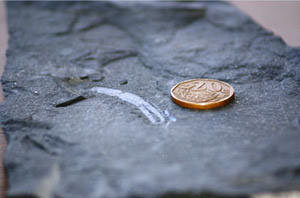
A Photograph showing the Scorpion’s Pincers (Gondwanascorpio emzantsiensis)

Coin provides scale
Coin provides scale.

Picture credit: University of Witwatersrand

Oldest Known Terrestrial Animal

Commenting on his fossil find, Dr Gess stated that early life arose in the sea and that colonisation of the land took place much later on in the history of life on Earth.  This process is believed to have begun back in the Silurian geological period, approximately 420 million years ago, although some palaeobotanists have suggested that microscopic spores preserved in Ordovician strata indicate that plant life was established on land even earlier.

Once plants had become established on land in significant numbers, then detritus and plant eating invertebrates followed, animals such as primitive arthropods.  By the Late Silurian, around 415 million years ago, terrestrial food chains were much more complex with apex predators such as mites, scorpions and early spiders feeding on the herbivorous invertebrates.  By the Late Devonian, some 365 million years ago, the first vertebrates (tetrapods) had ventured out onto land.

The First Tetrapods

Some palaeontologists believe that the first vertebrates were established on land some 390 million years ago, click the link below to read an article published by Everything Dinosaur in 2010, that provides details of a remarkable fossilised trackway studied by Polish scientists: Tetrapods Venture onto Land Thirty-Five Million Years Earlier.

Fossils found in Palaeozoic strata that represent the land mass of Laurasia, a super-continent the straddled much of the northern hemisphere in the Devonian, suggest that this landmass was inhabited by a diverse and abundant group of invertebrates.  Laurasia and Gondwana were separated by an ocean over a thousand miles across at its widest extent.

Evidence of the earliest colonisation of land animals has until now come only from the Northern Hemisphere continent of Laurasia (land that was to form North America, parts of Europe and Asia), and there has been no evidence that Gondwana was inhabited by land living invertebrate animals at that time, however, the discovery of this Southern Hemisphere scorpion suggests that Gondwana too, had its fair share of creepy crawlies.

An Invertebrate Predator on Land

The discovery of an invertebrate predator leads to the assumption that there were other invertebrates present that this creature would have fed upon.  This new species has been named Gondwanascorpio emzantsiensis.

Dr Gess stated:

“For the first time we know for certain that not just scorpions, but whatever they were preying on were already present in the Devonian.  We now know that by the end the Devonian period Gondwana also, like Laurasia, had a complex terrestrial ecosystem, comprising invertebrates and plants which had all the elements to sustain terrestrial vertebrate life that emerged around this time or slightly later.”

The Witpoort Formation

The fossil fragments were found in black carbonaceous shale which represents a marine lagoon and an estuarine environment.  The fossiliferous material is from the Witpoort Formation (Witteberg Group) at a location known as Waterloo Farm, near Grahamstown, South Africa.  Other organic material identified includes traces of algae, terrestrial plants, small fish, a sea scorpion (Eurypterid) and a number of molluscs.  All the fossil material ascribed to G. emzantsiensis consists of two-dimensional compressions in which all the original organic material has been replaced by secondary metamorphic mica.  The mica has largely been altered to chlorite during the uplifting of the strata.  The Witpoort Formation strata at the Waterloo Farm location were laid down towards the end of the Devonian (Famennian faunal stage), approximately 360 million years ago.

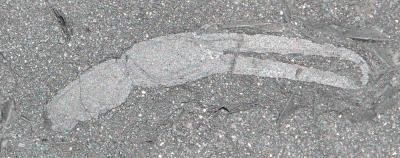
A Close up of the Preserved Pincers

The fossil shows a pincer of the terrestrial scorpion.
The fossil shows a pincer of the terrestrial scorpion. Picture credit: University of Witwatersrand.

Picture credit: University of Witwatersrand

The Discovery of a Palaeozoic Scorpion

The fossil material represents the first discovery of a Palaeozoic scorpion from Gondwana.  In the scientific paper, published in the academic journal “African Invertebrate”, the researchers note that this fossil find is extremely unusual as it comes from rocks deposited at a far higher latitude (much closer to the South Pole), than that at which extant or fossil scorpions are known to have occurred.  The authors suggest that this discovery may suggest that the climate in the southern hemisphere during the Late Devonian was much more uniform than it is today.  Temperatures at high latitudes may have been much higher than they are today.

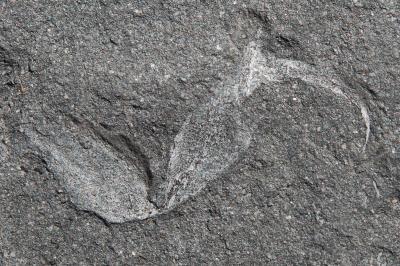
Gondwanascorpio emzantsiensis Possessed a Powerful Sting

Gondwanascorpio sting
Scorpion had a powerful sting. Picture credit: University of Witwatersrand.

Picture credit: University of Witwatersrand

Devonian Ecosystems

The scientists report that the presence of this scorpion from Gondwana, one that is similar to already described Laurasian taxa is consistent with the growing body of evidence that suggests globally comparable terrestrial ecosystems by the end of the Devonian.  Gondwanascorpio, as the oldest terrestrial animal from Gondwana and its fossil material along with progymnosperm plant material (Archaeopteris) that has also been described from fossils found at Waterloo Farm, suggests that marine marginal ecosystems may have been very similar across the world during the Late Devonian.  It has been speculated that this uniformity may have been a consequence of the increasing proximity of Laurasia to Gondwana as the deep ocean that once separated these super-continents began to close up.

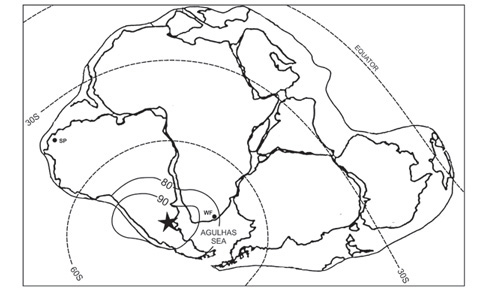
The Location of the Waterloo Farm Site Mapped onto a Late Devonian Map of Gondwana

Waterloo Farm site (South Africa)
Map showing the location of the Waterloo fossil site. Picture credit: University of Witwatersrand.

Picture credit: University of Witwatersrand

The map above shows a reconstruction of the super-continent of Gondwana with the South Pole represented by a large black star.  The Waterloo Farm location is marked by the symbol “WF”.  The map shows the position of landmasses towards the end of the Devonian/early Carboniferous.  The Waterloo Farm deposits are coastal and close to the South Pole.

Everything Dinosaur acknowledges the assistance of a media release from the University of Witwatersrand in the compilation of this article.

For models and replicas of Palaeozoic creatures: CollectA Prehistoric Life Replicas.

2 09, 2013

Isotope Study Suggests “Terror Bird” Gastornis was a Herbivore

By |2023-02-22T12:57:27+00:00September 2nd, 2013|Categories: Dinosaur and Prehistoric Animal News Stories|4 Comments

New Evidence to Support Gastornis was a Herbivore

When the BBC decided to follow up their ground-breaking television series “Walking with Dinosaurs” by exploring the weird and wonderful animals that survived the Cretaceous mass extinction and went onto dominate life in the Cenozoic, they needed a spectacular animal to feature in the first episode of the new series.  Enter Gastornis, a giant, flightless bird that featured in the opening episode of  “Walking with Beasts”.

“Terror Bird”

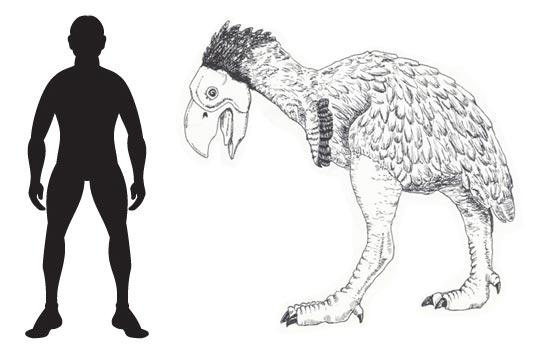
This near six foot tall giant bird was depicted as an apex predator stalking the steamy jungles of what was to become Germany.  In the publicity material to promote the six programmes, Gastornis with its huge, powerful beak featured prominently, here was a “terror bird” from a time when birds ate horses.  An attack by a female Gastornis on a Propalaeotherium (an ancient ancestor of modern horses), was vividly depicted.  However, over recent years a growing body of evidence has been presented which suggests this big bird does not deserve its ferocious reputation.

An Illustration of the Giant Bird Gastornis

Not so terrible after all?

Not so terrible after all?

Picture credit: Everything Dinosaur

Gastornis/Diatryma

Recently, Everything Dinosaur reported on research carried out by scientists at Western Washington University (United States).  The researchers had studied the footprints, believed to have been made by a Gastornis/Diatryma creature.  The absence of talons and the short stride length led them to conclude that this “terror bird” reputation may be undeserved.

To read more about this study: Not so Terrible Terror Bird.

Much of the reputation of these Palaeocene and Eocene giant birds has been  implied after comparative studies with the Phorusrhacidae group of birds.  Scientists in Germany have added weight to the vegetarian Gastornis/Diatryma debate by presenting a new paper that suggests these birds were essentially herbivores.  Dr Thomas Tuetkin from the University of Bonn (Germany) in collaboration with Dr Stephen Galer, Dr Meinoff Hellmund and Petra Held presented an analysis of bone isotopes from a Gastornis skeleton.  The paper was presented during a session of the Goldschmidt Conference held in Florence, Italy.

Dr Tuetkin Pictured Next to a Model of Gastornis

Gastornis a vegetarian?

Gastornis a vegetarian?

Picture credit: Dr Tuetkin (Bonn University)

Gastornis

Commenting on the study, lead researcher Dr Tuetkin stated:

“The terror bird was thought to have used its huge beak to grab and break the neck of its prey, which is supported by biomechanical modelling of its bite force.  It lived after the dinosaurs became extinct and at a time when mammals were at an early stage of evolution and relatively small; thus, the terror bird was thought to have been a top predator at that time on land.”

Isotope Composition

The research team examined the calcium isotope composition contained within the fossilised bones of a Gastornis specimen from a coal mine in the Geisel Valley region of central Germany.  The calcium isotope analysis permitted the team to learn what proportion of the bird’s diet was plant or animal based.  The Gastornis data was then compared to a number of extinct and extant species and the German based team were able to conclude that the calcium isotope composition was similar to that found in herbivorous mammals and dinosaurs.

A Drawing of the Skeleton of Gastornis/Diatryma

Scale bar = 1 metre

Scale bar = 1 metre

Picture credit: Bonn University

Studying Tooth Enamel

Dr Tuetkin added:

“Tooth enamel preserves original geochemical signatures much better than bone, but since Gastornis didn’t have any teeth, we’ve had to work with their bones to do our calcium isotope assay.  Because calcium is a major proportion of bone, around 40% by weight, its composition is unlikely to have been affected much by fossilisation.  However, we want to be absolutely confident in our findings by analysing known herbivores and carnivores using fossilised bone from the same site and the same time period.  This will give us an appropriate reference frame for the terror bird values.”

Team members at Everything Dinosaur have been explaining the latest research regarding the likes of Gastornis to visitors at the Beacon Museum’s exhibition (Whitehaven).  The Beacon Museum is holding  an exhibition into life after the dinosaurs and on certain, special weekends, Everything Dinosaur team members have been invited along to answer questions and help the public to understand more about the amazing birds and mammals that evolved after the dinosaurs died out.  Everything Dinosaur will be making one more appearance at the Beacon Museum, catch up with the team on the weekend of 26th/27th October.

To view models and replicas of Cenozoic animals: Wild Safari Dinos and Prehistoric Animal Models.

31 08, 2013

The Riddle of the Australian Sea Cow

By |2023-02-22T12:15:28+00:00August 31st, 2013|Categories: Dinosaur and Prehistoric Animal News Stories|0 Comments

Ancient Fossils from New Guinea Help Scientists to Understand Distribution of Prehistoric Sea Cows

A gap in Australasia’s marine evolutionary record has been filled by a group of sea cow fossils recently identified by museum scientists as the oldest ever found in the region.  The 12-million-year-old fossils were discovered in a cave under the remote central highlands of New Guinea more than 30 years ago, but remained unstudied.  Last year, they were rediscovered in a museum drawer by scientists from Museum Victoria and the Smithsonian Institution, who immediately found the fossils curious.

Australian Sea Cow

Examples of the Fossil Material Discovered in the Cave (Vertebrae)

Ancient Sea Cow Fossils Discovered
Fossilised bones of an ancient Australian Sea Cow.

Picture credit: Dr Erich Fitzgerald

Dr Erich Fitzgerald, Museum of Victoria’s Senior Curator of Vertebrate Palaeontology stated:

“Until now, Australasia didn’t have a particularly ancient fossil record of sea cows, the group of marine mammals that includes our living dugongs.  The records only went back some five million years.  Elsewhere in Asia, sea cow fossils are found in much older rocks, so it was always a mystery as to why the fossils hadn’t been found in this part of the world.  Now, with this one discovery, we’ve more than doubled the length of their evolutionary history in Australasian seas.”

A Vital Perspective

Dr Fitzgerald says the fossils provide a vital perspective on the relationship modern sea cows have with Australia’s northern marine ecosystems.

He went onto add:

“Modern-day dugongs are major consumers of sea-grass, and, by doing so, have a tremendous impact on the structure of the ecosystem.  They participate in a delicate balancing act: their feeding allows diversity in sea-grass and animal species that would otherwise be lacking.”

Studying the Fossils

Until this drawer of fossils was studied, it had been thought that sea cows were fairly recent arrivals in Australasian waters and that these grazers and their relationship with sea-grass ecosystems around Australian waters was also recent.   This new research suggests that these gentle giants have been an important part of Australasia’s marine ecosystems for at least twelve million years and that their role in the long-term health of these environments may be very significant.

Everything Dinosaur is grateful for the Museum Victoria for their assistance in compiling this news story.

For models and replicas of prehistoric animals from Australia and elsewhere in the world: CollectA Age of Dinosaurs Popular Models.

30 08, 2013

Rare Dinosaur Fossils Unearthed in Eastern China

By |2024-05-01T14:54:42+01:00August 30th, 2013|Categories: Dinosaur and Prehistoric Animal News Stories|0 Comments

Fossilised Eggs and Large Dinosaur Bones Discovered

Sources at the Institute of Vertebrate Palaeontology and Palaeoanthropology (IVPP) in Beijing, China have reported the discovery of a large number of dinosaur fossils at a site in Laiyang City, in Shandong Province (East China). Over 130 fossils including fossilised egg fragments and large dinosaur bones were unearthed at an excavation adjacent to the village of Jingangko.

Dinosaur Fossils

Fossils were first discovered at the site back in 2010 and palaeontologists working for the IVPP have stated that many of the fossils are in an excellent state of preservation.  Field workers have sealed off the fossils and their exposed matrix with gypsum to protect them before the site can be properly mapped and formal excavation work begun.

Wang Xiaolin, a researcher with the Institute and the scientist in charge of this site declared:

“Most of the fossils are relatively intact, and this is favourable for assembly of a complete dinosaur skeleton.”

Fossilised Bones

Amongst the many fossilised bones the researchers have already recovered is a sixty centimetre long humerus (upper arm bone).  The strata is particularly rich in fossil vertebrates and this latest excavation is one of a number going on in the area as palaeontologists have already unearthed many dinosaur fossils from at least twenty different layers of strata.  Two years ago, the Chinese state set up the Laiyang region as a national park for dinosaur fossil remains.

Great Wealth of Dinosaur Fossils in Eastern China

The enormous amount of dinosaur fossils in Eastern China.

The enormous amount of dinosaur fossils in Eastern China.

Picture credit: Institute of Vertebrate Palaeontology and Palaeoanthropology

The picture above shows acclaimed Chinese palaeontologist Xing Xu amongst a bone bed of hadrosaur fossils.

Hadrosaur Fossils

Shandong Province has been regarded as one of the most important dinosaur sites discovered in the last one hundred years or so.  A number of important discoveries have been made, including a new genus of tyrannosaurid and in 2010, Chinese scientists uncovered the fossilised remains of a new genus of large horned dinosaur which was named Sinoceratops zhuchengensis.

To read more about this discovery: New Genus of Chinese Ceratopsid Discovered.

PNSO have created a wondeful Sinoceratops figure. To view the extensive PNSO range: PNSO Age of Dinosaurs – Models and Figures.

28 08, 2013

Updating Leedsichthys – Potentially the Biggest Fish Ever

By |2023-02-22T08:12:37+00:00August 28th, 2013|Categories: Dinosaur and Prehistoric Animal News Stories|0 Comments

Estimating the Size of Leedsichthys

Regarded by many scientists as possibly the largest fish of all time, the filter-feeding teleost Leedsichthys is known from just a few fragmentary remains.  With a skeleton made from cartilage, a material that has a poor preservation potential, scientists have struggled for more than a century to try to piece together data on this immense bony fish.  The specific name for Leedsichthys is L. problematicus, which reflects the problems palaeontologists have had in interpreting the fossil evidence.  After all, it was once suggested that fossils found in eastern England and now ascribed to Leedsichthys belonged to an armoured dinosaur.

Leedsichthys problematicus

A new study carried out by scientists at the University of Bristol in collaboration with the University of Kunming in China have estimated the growth rates of these Jurassic creatures.  The research indicates that these animals ranged in size from 12 metres to 16 metres when fully grown.  At the top end of this range, Leedsichthys is indeed capable of claiming the title of the largest, bony fish of all time.  The animals that occupy a similar niche in today’s marine environment are also of an impressive size, filter feeders such as the Baleen whales, manta rays as well as basking and whale sharks.

There has been a lot of debate about just how big Leedsichthys actually was, to read an earlier article: Leedsichthys Subjected to Fish Shrink Ray.

Professor Jeff Liston a member of the research team that reviewed the known Leedsichthys fossil material stated:

“Leedsichthys skeletons preserve poorly, often only as isolated fragments, so previous size estimates were largely historical arm-waving exercises.  We looked at a wide range of specimens, not just the bones but also their internal growth structures – similar to the growth rings in trees – to get some idea about the ages of these animals as well as their estimated sizes.”

The Giant Filter-Feeder Leedsichthys

Giant filter feeder of the Jurassic.

Giant filter feeder of the Jurassic

Picture credit: Robert Nicholls

Cartilaginous Back Bone Preserved

Occasionally, elements of the cartilaginous back bone are preserved.  These parts of the skeleton can become mineralised and thus have a better chance of surviving the fossilisation process.  Just like in shark species today, the discs that make up the back bone can show preserved internal rings that permit scientists to estimate the age of the animal when it died and how quickly it grew.  Using data from documented Leedsichthys fossil finds, including evidence from a recently discovered specimen found near Peterborough (East Anglia, England), the team estimated that an, adult fish of 8-9 metres would be around twenty years of age.  Lengths in excess of 16 metres would have been reached when the animal was around 38 years of age.

For models and replicas of prehistoric fish and other ancient creatures: PNSO Age of Dinosaurs Replicas and Scale Models.

Scientists are not sure how long these animals lived, but it has been suggested that these leviathans could leave for forty years or more.

Research Project

The project began in Glasgow with a review of the remains of the giant Jurassic fish Leedsichthys, in conjunction with the excavation of a new specimen of this creature (the Peterborough specimen). Professor Liston, who ran the excavation in Peterborough, wanted to explore an anomaly as before Leedsichthys, most vertebrate suspension feeders did not grow much larger than half a metre in length.  It seems sometime around 165 million years ago, the ocean’s ecosystem changed, which permitted these large vertebrates to evolve.

Professor Liston stated:

“The existence of these large suspension-feeding fish at this time is highly significant as it would seem to be clear evidence of a major change in plankton populations in the oceans of Jurassic Earth: a ‘smoking gun’ that something new, widespread and highly edible was around, possibly related to the first appearance of small crustaceans called copepods.  This has implications for our understanding of biological productivity in modern oceans, and how that productivity has changed over time.”

The researchers also looked at specialist structures on the gills as a means of how Leedsichthys grew so large.

Professor Liston added:

“One of the truly fascinating aspects of this fish as a suspension feeder, is that it seems to have developed a unique mesh structure on its gills to help it extract plankton as the seawater passed through its mouth.  Extremely delicate and rarely-preserved, it resembles the honeycomb pattern in a bee-hive.  It functioned like a trawler’s net to trap plankton, and obviously was very effective, given the large sizes this animal achieved.  This mesh structure is very different to what we see in today’s suspension-feeding fish and whales.  It had a unique way of solving a similar problem.”

A Filter Feeding Giant

Filter feeding seems to have enabled Leedsichthys to grow to a very large size.  Its bulk would have made it almost invulnerable to attack, very helpful when you shared the sea with predators such as pliosaurs, plesiosaurs and marine crocodiles.

Leedsichthys

Professor Liston had been involved in a related project reported upon by Everything Dinosaur in 2010.  The fossil record is so poor for cartilaginous fish that there was a huge gap in the fossil record from the likes of the Middle Jurassic Leedsichthys to the filter feeders known from the Cenozoic.  A discovery of a giant, filter-feeding fish of the Late Cretaceous (Bonnerichthys) helped plug what was a 100 million year gap in the fossil evidence.

To read more about Bonnerichthys: Filter-Feeder from the Western Interior Seaway (Cretaceous).

23 08, 2013

Important Dinosaur Fossil Site Threatened by Floods

By |2023-02-22T07:50:10+00:00August 23rd, 2013|Categories: Dinosaur and Prehistoric Animal News Stories, Geology|0 Comments

Dinosaur Fossil Sites in Heilongjiang Province Flooded

The important dinosaur excavation sites located at the foot of mountains in Jiayin County, Heilongjiang Province (north-eastern China), are in danger of being irreparably damaged as flood waters have covered much of the area where palaeontologists and field scientists have been working.  All four dinosaur dig sites have been immersed in flood waters since the Heilong river burst its banks last week.  The water levels, a record high for this part of China, could damage the delicate fossil material, cause exposed fossils to break up and others to be washed away in sediments.

Dinosaur Fossil Site

The strata in this part of China has revealed a number of important Mesozoic vertebrate fossils, some found nowhere else on Earth.  A fossil record of a rich ecosystem could be seriously damaged, with much material lost forever.

Ironically, much of the fossil material was deposited in the region as a result of the action of river water and periodic flooding, now nature seems bent on taken back what it once gave.  A spokes person has stated that the losses caused by the flooding would be “inestimable”.

Investment in Flood Defences

Over the last few years, the state has invested in a number of flood defences and water management systems near the fossil sites, but dikes built to arrest any flood waters have not been able to cope with the volume of water.  Flooding has also inundated the nearby Heilong River Basin Museum.  Water first entered the building on Saturday August 17th and parts of the first floor of the museum are now under over a metre of water.  Staff and volunteers have been working hard to remove artefacts and specimens to the second floor in order to prevent further damage.

The museum was built on an island in the river, but no one envisaged such high water levels.  Some parts of the Heilong River Basin are now covered in several metres of water and the authorities are concerned that water levels could rise further leading to more damage to the Province’s infrastructure and the important fossil rich strata of the area.

Floods and Typhoon Hit China

Chinese state media has reported that at least 105 people have died and a further 115 are missing after floods and a typhoon hit parts of China.  Heavy rain in the north-east of the country has been falling since Wednesday of last week and this has caused substantial flooding and devastation.  Typhoon Utor hit southern China, making landfall in Guangdong Province and this has caused devastation and at least a further 22 people have lost their lives.

Described as some of the worst flooding seen in living memory, volunteers, officials and state workers are working hard to strengthen flood defences in those parts of the country affected.

22 08, 2013

The Search for Dinosaur DNA – New BBC2 Horizon Programme Explores the Seemingly Impossible

By |2024-05-01T14:43:15+01:00August 22nd, 2013|Categories: Dinosaur and Prehistoric Animal News Stories, Dinosaur Fans|12 Comments

Dinosaurs – The Hunt for Life

Horizon, the documentary series regarded by many as the flagship science programme for the BBC is venturing into the world of the dinosaurs once again with a programme dedicated to the remarkable work of Dr Mary Schweitzer and her colleagues.  Scientists have had the fossilised bones of dinosaurs to study and over the last one hundred and eighty years or so much has been learned about these long extinct reptiles, but could there be more than just permineralised, long-dead material present in the fossils of dinosaurs?  Could biological material such as cells, soft tissue, blood and possibly DNA from dinosaurs still exist?

The Hunt for Dinosaur DNA

The hunt for Dinosaurian DNA

The hunt for dinosaurian DNA.

Picture credit: Everything Dinosaur

Dinosaur DNA

On Monday 26th September at 9pm (BST) on BBC2, Horizon will focus on the work of Dr Schweitzer who believes that soft tissues and other organic material has been recovered from deep inside the long, dead bones of iconic animals such as Tyrannosaurus rex.  Perhaps the idea of a Jurassic Park such as the one envisaged by the author Michael Crichton will one day be more than fiction, could the research carried out by scientists such as those at the North Carolina State University lead to the resurrection of some members of the Dinosauria?

DNA Defined

DNA is deoxyribonucleic acid, a molecule of genetic material that determines the inherited characteristics of most living organisms.  The vast majority of examples of the DNA molecule consist of a double helix made up of two long chains which are made up of nucleotides, these in turn are made up from 4 proteins referred to as nucleobases (thymine, guanine, adenine and cytosine) represented by the letters T, G, A, and C.  Almost every cell of every organism from many viruses, amoebas, dinosaurs and humans has its own set of molecular instructions.  The function of each cell is encoded in the chromosomes, these carry the hereditary data in the form of genes.

On this blog, team members at Everything Dinosaur have reported on a number of studies that claim that organic material has been recovered from the fossil record, although many scientists have been sceptical about such research.  Mary made the initial discovery of T. rex soft tissue remains back in 2005, since then she has argued that organic material may actually be relatively common in well-preserved, robust fossils, but since very few people expected to find such material, it has been rather overlooked.  Mary and her team are not alone when it comes to exploring the soft tissues of extinct animals.

Montana State University has pioneered research into ancestral DNA through the study of bird embryos, confirming a now, well established view that Aves (birds) and the Dinosauria, especially Theropoda are very closely related.

One of Dr Schweitzer’s co-authors on a number of soft tissue studies, Assistant Professor of Medicine at Harvard Medical School John Asara agrees with Mary, that there may be more organic material awaiting discovery.  He has been working on a number of projects related to the study of fossilised proteins, which have reaffirmed the dinosaurs close affinity to the birds.

To read a short article on this work: Are You Going to Call T. rex Chicken?

Scientists Challenge the Findings

A number of scientists and other academics have challenged these studies.  It had been thought that DNA could not survive more than 10,000 years.  It, like all other organic material would be rapidly degraded and broken down unless it was subjected to a very unusual manner of preservation, such as being entombed in ice, for example in the case of Woolly Mammoth remains from Siberia.  In 2012, Everything Dinosaur reported on a piece of highly controversial research carried out on the fossilised bones of the Moa (a giant, flightless bird that once inhabited New Zealand).

Analysis of the robust bones of three extinct species of New Zealand Moa by a team of international researchers led to the publication of the estimated half-life of DNA.  Under the very best conditions for preservation, it was calculated that the proteins that make up DNA could persist in the fossil record and permit detectable traces still to be found in fossils as old as 6.8 million years.

Controversial research suggests a half-life for DNA: Calculating the Half-life of DNA using Moa Fossils.

Still to recover DNA from a Tyrannosaurus rex would require DNA to remain preserved, uncontaminated and viable for nearly ten times as long.  After all, the last T. rex went extinct around sixty-five million years ago.

Could what the suggests have found preserved in the fossilised bones of dinosaurs, be organic material from another source?  Tests have shown that some of the material recovered reacts in the same way as organic material from birds.  Is there contamination?  How can the delicate organic material such as blood, collagen and proteins be preserved for so long?  Do the tiny, microscopic fragments recovered really represent organic material from a long dead dinosaur?

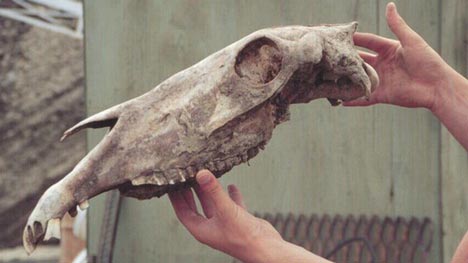
Intriguingly, animals very far removed from Tyrannosaurus rex have lent support to Schweitzer’s and Asara’s claims.   Researchers from the University of Copenhagen (Denmark), co-authored a paper that was published in the journal “Nature” about a study to sequence a portion of the ancestral horse genome from an equine fossil that was more than 700,000 years old.  The research dramatically extended the limit for viable DNA survival in the fossil record.  Recently, a fragment of a tibia (lower leg bone), recovered from 3.5 million year old deposits on Ellesmere Island (Canada) was proved to belong to an ancient camel, thanks to collagen finger printing carried out by University of Manchester scientists.

Recently Published Studies Push Back the Date of Viable Genetic Material from the Fossil Record

700,000 year old genetic material recovered from a fossil bone.

700,000 year old genetic material recovered from a fossil bone.

Picture credit: D.G. Froese/Nature Journal

The horizon programme will focus on the research into dinosaur DNA, however, the implications of this soft tissue recovery will have far reaching consequences and may well lead to a reappraisal of what we do and don’t know about a whole host of extinct fauna.

Watch and enjoy.

To read a related article on the extraction of dinosaur proteins from an ornithischian dinosaur: The Search for Proteins in the Femur of a Duck-Billed Dinosaur.

21 08, 2013

New Study of Neanderthal Hand Axes Suggests Two European Neanderthal Cultures

By |2024-05-01T14:43:42+01:00August 21st, 2013|Categories: Dinosaur and Prehistoric Animal News Stories|0 Comments

Design of Hand Axes Reveals Distinctive Neanderthal Cultures

A study by a postgraduate researcher at the University of Southampton has found that Neanderthals were more culturally complex than previously acknowledged.  Two cultural traditions existed among Neanderthals living in what is now northern Europe between 115,000 to 35,000 years ago.  Dr Karen Ruebens from the Centre for the Archaeology of Human Origins (CAHO) and funded by the Arts and Humanities Research Council examined the design of 1,300 stone tools originating from eighty Neanderthal sites in five European countries; France, Germany, Belgium, Britain and the Netherlands.

Neanderthal Study

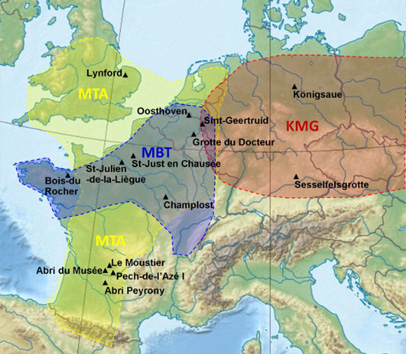
Her investigations uncovered new evidence that two separate hand axe traditions or designs existed – one in a region now spanning south-western France and Britain – the other in Germany and further to the East.  In addition, she found an area covering modern day Belgium and the Netherlands that demonstrates a transition between the two.  Two separate hand axe traditions or designs that have been identified by this analysis are, firstly the Mousterian of Acheulean Tradition (MTA on the map below), in a region now spanning south-western France and Britain and the Keilmessergruppen Tradition (KMG on the map below), in Germany and further to the East.

Evidence for Regionality in Neanderthal Cultures

Distinct cultures identified with a transitional zone.

Distinct cultures identified with a transitional zone.

Picture credit: Dr Karen Ruebens

Different Neanderthal Cultures

The map above marks the approximate boundaries of the different cultures with a transitional zone which features Mousterian with Bifacial tools (marked MBT) between the two distinct tool making cultures.  Please note, the English Channel did not exist during the time of the Neanderthals.  Low sea levels at this time in Earth’s history permitted the United Kingdom to remain part of the European mainland, the UK did not become an island until about 8,000 years ago.

Dr Ruebens commented:

“In Germany and France there appears to be two separate hand axe traditions, with clear boundaries, indicating completely separate, independent developments.  The transition zone in Belgium and Northern France indicates contact between the different groups of Neanderthals, which is generally difficult to identify but has been much talked about, especially in relation to later contacts with groups of modern humans.  This area can be seen as a melting pot of ideas where mobile groups of Neanderthals, both from the eastern and western tradition, would pass by – influencing each other’s designs and leaving behind a more varied record of bifacial tools.”

Neanderthal Hand Axes

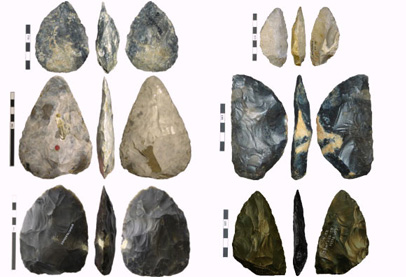
The University of Southampton research has revealed Neanderthals in the western region made symmetrical, triangular and heart-shaped hand axes, while during the same time period, in the eastern region, they produced asymmetrically shaped bifacial knives.

This research has been published shortly after another paper shed further light on the culture of Neanderthals.  A study of Neanderthal bone tools found in France and published in the Proceedings of the National Academy of Sciences (USA) suggested that Neanderthals developed specialised tools for working animal skins many thousands of years before such tools became associated with our own species.

To read more about this research: Neanderthals Made the First Specialised Bone Tools in Europe.

Dr Ruebens went onto add:

“Distinct ways of making a hand axe were passed on from generation to generation and for long enough to become visible in the archaeological record.  This indicates a strong mechanism of social learning within these two groups and says something about the stability and connectivity of the Neanderthal populations.  Making stone tools was not merely an opportunistic task.  A lot of time, effort and tradition were invested and these tools carry a certain amount of socio-cultural information, which does not contribute directly to their function.”

The study’s extensive analysis also shows other factors which could have influenced hand axe design, such as raw material availability to Neanderthals, the function of their sites, or the repeated reuse and sharpening of tools – did not have an impact in this instance.  This research provides a new perspective on the regionality of the Neanderthal population of western Europe.

Examples of the Different Types of Hand Axe

Examples of hand axes used in the study.

Examples of hand axes used in the study.

Picture credit: Dr Karen Ruebens

Key to the hand axes in the picture above:

Left: Mousterian of Acheulean Tradition hand axes, from top to bottom – cordiform hand axe from Le Moustier, France; triangular hand axe from St. Just en Chaussée, France; hand axe from Lynford, UK (Karen Ruebens). Right: Keilmessergruppen Tradition hand axes, from top to bottom – keilmesser from Sesselfesgrotte, Germany; keilmesser from Abri du Musée, France; faustkeilblatt from Königsaue, Germany.

Intriguingly, this study suggests that those Neanderthals that went on to live in Britain, have closer affinities to those Neanderthals from south-western France than they do to Neanderthal populations from Germany, central and western France as well as central Europe.

Everything Dinosaur acknowledges the help of the University of Southampton in the compilation of this article.

Go to Top