All about dinosaurs, fossils and prehistoric animals by Everything Dinosaur team members.

Fossil finds, new dinosaur discoveries, news and views from the world of palaeontology and other Earth sciences.

3 10, 2013

Conditions at Lake Urmia shed Light on Palaeozoic Environments

By |2023-02-24T10:31:14+00:00October 3rd, 2013|Categories: Dinosaur and Prehistoric Animal News Stories, Geology, Palaeontological articles|2 Comments

Salt Lake in northwestern Iran Mirrors Permian Environmental Crisis

Observations made as environments change today can sometimes provide scientists with valuable insights when it comes to studying the fossils of extinct creatures.  Studies into the way climate change affects animals and plants can provide researchers with helpful information when it comes to interpreting fossil evidence.  One such example of this concerns comparisons being made by scientists as Lake Urmia in northwestern Iran dries up to the plight of an ancient ecosystem that was to form part of South America.

Lake Urmia

For Iranian biologist Amin Khaleghparast and Dr Graciela Piñeiro (from Uruguay), breeding stress observed amongst Lake Urmia’s Flamingo population might be mirroring stress amongst a population of ancient Parareptiles as their environment changed.  Lake Urmia was the third largest salt water lake on Earth, and the largest body of salty water in the entire Middle East.  However, over the last fifty years or so the volume of the Lake has been much reduced.  Dams constructed across the rivers that feed Lake Urmia, the increasing demand for water for agriculture and the impact of severe droughts have reduced the Lake to a fraction of its former size.

The Flamingos are filter feeders and rely on brine shrimp (Artemia urmiana) as a food source.  As the water volume of the Lake is reduced, much of what was formerly open water is changing into a salt marsh.  This has led to a reduction in suitable habitat for the Flamingos and a decline in brine shrimp numbers.  With the drying up of Lake Urmia the scientists have witnessed a severe decrease in Artemia populations which has had dire consequences for other animals further up the food chain, including the Lake’s Flamingos.  Many Flamingos have failed to breed, a number of eggs have been aborted and a substantial number of Flamingo hatchlings have died.

Drawing Parallels with the Permian

The scientists have drawn parallels between these observations and a similar situation that may have affected a population of reptiles, (mesosaurs) in South America some 280 million years ago.

To read a short article on the drying up of Lake Urmia: The Ecological Crisis at Lake Urmia.

Dr Piñeiro and her colleagues produced an academic paper, published in 2012 (International Journal of Paleobiology), that highlighted the discovery of a number of Mesosaurus fossils including amniotic embryos, some of the earliest evidence yet of reptile embryos and possible viviparity (live birth) in the Reptilia Class.  Intriguingly, the discovery of an isolated embryo might suggest breeding stress in the population that led to the abandonment of this egg or a possible miscarriage.

Mesosaurs

Mesosaurs such as Mesosaurus were small aquatic reptiles that lived during the Permian.  They had elongated jaws lined with very fine, needle-like teeth that would have helped them to strain arthropods such as brine shrimps out of the water in which they lived.  These reptiles were perhaps the first group of amniotes to adapt to living in marine habitats.  Although mesosaurs are descended from terrestrial reptiles, their long, flexible bodies, paddle-like tails and webbed digits indicate adaptations to a nektonic, marine lifestyle.  These reptiles had thickened ribs which palaeontologists believe was an adaptation to help these small animals counteract their own buoyancy and helped them to remain underwater.

Mesosaurus Specimens
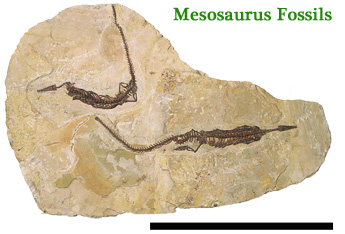
Ancient reptiles adapted to marine environments.

Ancient reptiles adapted to marine environments.

Picture credit: Everything Dinosaur

The scale bar in the picture is approximately seventy-five centimetres long.

Permian Reptilian Fauna

Although, these animals were not the most spectacular looking of the Permian reptilian fauna, their fossils, which have been found in Uruguay, Brazil as well as in western Africa helped to reaffirm the theory of continental drift first proposed by the German meteorologist Alfred Wegener.   Wegener observed that the coastline of west Africa fitted neatly into that of South America’s east coast, even though the Atlantic Ocean separated these two landmasses.  He proposed that some time in the past these two continents had been joined together.  His observations were supported by fossil evidence of creatures such as the mesosaurs which have been found in rocks on now widely separated continents.  Mesosaurs were unlikely to be capable of crossing such vast bodies of water as today’s oceans, so such fossils supported the idea that some time back in ancient history South America and Africa were joined together.  Such evidence helped to establish the theory of plate tectonics (continental drift).

The Fossil Record Provides Supporting Evidence for Plate Tectonics
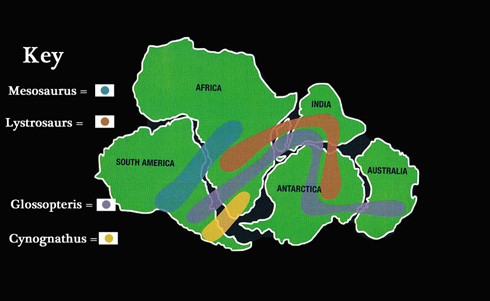
Fossils support evidence of plate movements.

Fossils support evidence of plate movements.

Plate Tectonics

The diagram above shows where fossils of Mesosaurus, lystrosaurs (a terrestrial dicynodont), Cynognathus (a terrestrial cynodont) and Glossopteris (a pteridosperm [seed fern]) have been found.  These discoveries provide supporting evidence for the theory of these disparate land masses once being joined into a super-continent.

In the Carboniferous, a group of terrestrial animals evolved that would eventually dominate vertebrate life on our planet. These were the amniotes a group that includes mammals, birds and reptiles today.  The early amniotes evolved a unique way of protecting embryos inside their eggs.  Amniotic eggs have a semi-permeable shell that protects the egg from drying out.  An internal membrane known as the amnion surrounds the yolk and the embryo, this effectively means that the free-swimming larval stage seen in the Amphibia could be dispensed with.  Later synapsid amniotes evolved the ability to retain embryos internally thus affording the embryo greater protection (as seen in extremis in marsupial and placental mammals today).

Amin Khaleghparast and Dr Graciela Piñeiro postulate a relationship between an ancient salt lake in Pangea and Lake Urmia:

“There is it some similarity between intense evaporation of the ancient Great Salt Lake where Mesosaurus lived and conditions that lead to the drying Lake Urmia, a great salt lake in northwestern Iran, turning large part of it into a salt marsh in last decade. Like Flamingos filter-feed on brine shrimp (Artemia urmiana) in the salt lake, Mesosaurus filter-fed on an extinct group of crustaceans (Pygocephalomorpha) in waters poorly oxygenated and highly saline during the Early Permian. With the drying Lake Urmia,unfortunately, we witnessed severe decrease of Artemia, Flamingos’ abortion, death of many Flamingo young and at last Flamingo migration.”

Mesosaur Fossil Discovery

The discovery of an isolated fossilised embryo could demonstrate that the population of mesosaurs was under environmental pressure as their habitat changes.  According to the scientists this fossil could represent “either a miscarried embryo or an aborted egg”.

The bodies of the animals perished in hypersaline conditions, the degree of preservation is exceptional.  This can be explained by the fact that hypersaline states are associated with very low concentrations of oxygen which in turn creates an environment in which bacteria, responsible for the decomposition of organic matter cannot act.  These amniotic mesosaur embryos provide some of the earliest evidence yet of reproduction biology of vertebrates preserved in the fossil record.  In some specimens, the absence of a recognisable eggshell in association with articulated well-preserved embryos within an adult suggest that mesosaurs may have been viviparous or at least that they laid eggs in an advanced state of development.

Mesosaurus Embryo Fossils – Did they Face the Same Fate as Lake Urmia’s Flamingos?
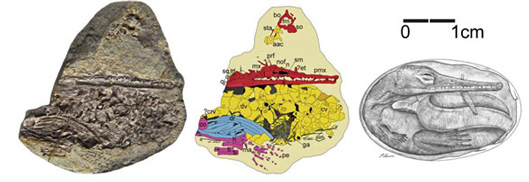
Sharing the same fate as Lake Urmia's Flamingos?

Sharing the same fate as Lake Urmia’s Flamingos?

The picture above shows on the left the fossil of the meosaurus embryo curled up within its amniotic membrane (no egg shell preserved).  The middle component shows a stylised tracing of the fossil, with a life-size drawing of the Mesosaurus embryo on the right.

To read more about the South American fossil discoveries: Early Evidence of Viviparity from South America.

Everything Dinosaur acknowledges the help of Amin Khaleghparast in the compilation of this article and for pointing out the relationship between Lake Urmia and the drying up of shallow seas in the Carboniferous.
1 10, 2013

Saying it with Flowers, 100 Million Years Before Anyone Expected

By |2023-02-24T10:02:45+00:00October 1st, 2013|Categories: Dinosaur and Prehistoric Animal News Stories|0 Comments

New Research Suggests Origins of Flowering Plants as far back as the Middle Triassic

Angiosperms (flowering plants) may have originated more than 100 million years earlier than previously thought according to new research published in the academic journal “Frontiers in Plant Science”.  A team of researchers from the University of Zurich (Switzerland) in collaboration with Geological Consulting & Services of Ober-Ramstadt, (Germany) have discovered microscopic evidence that suggests that flowering plants existed approximately 243 million years ago.  Cores taken from rock strata dating from the Middle Triassic in northern Switzerland have revealed evidence of at least six types of angiosperm pollen, much of which bears a striking resemblance to fossil pollen associated with Lower Cretaceous deposits.

Angiosperms

It had been thought that the angiosperms evolved in the Early Cretaceous, it had even been suggested that the grazing habits of ornithopod and sauropod dinosaurs may have led to pressure on plant populations which resulted in the evolution of the flowering plants – the last of the great plant groups to evolve and one that has grown to encompass over 250,000 species today.  Much of our modern world’s vegetation is characterised by flowering plants and most of our food crops are angiosperms, however, their origins and exactly when angiosperms first appeared has been the subject of a lot of debate.

They probably evolved from derived pteridosperms (seed ferns) but there is a lack of clear, unambiguous fossil evidence to confirm this.  Also, when they first evolved is not clear either, delicate plants do not fossilise well, but the tough pollen grains can be preserved and it is evidence of Triassic pollen grains that has pushed back the potential origins of flowering plants by 100 million years.

New Study Suggests that Scientists May Have to Change their Views on Triassic Flora

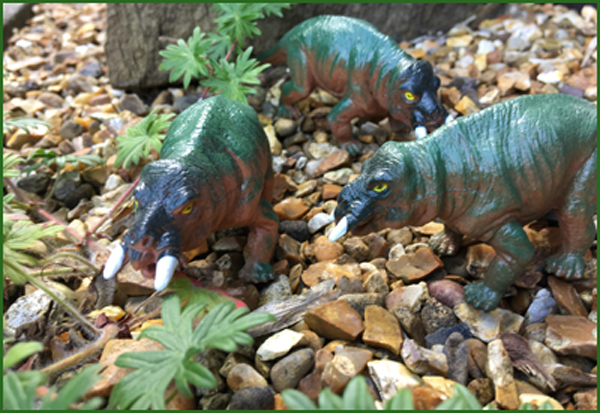
A trio of Placerias models.

A trio of Placerias models. The Placerias replica is great for creating Triassic dioramas.

Picture credit: Everything Dinosaur

The models shown in the image are Placerias figures.  To view the range of Triassic prehistoric animal models in stock at Everything Dinosaur: CollectA Prehistoric Life Figures and Replicas.

Pollen Grain Fossils

Pollen grains are easily dispersed over wide areas due to their relatively small size and the high numbers produced.  They can be found in various depositional environments (marine, coastal, and terrestrial).  For this reason records of fossil pollen are most complete if compared to other plant organs such as seeds or leaves which are considerably more fragile and have a much lower fossilisation potential. Generally accepted first records of angiosperm pollen are mentioned from the early part of the Early Cretaceous (Valanginian—early Hauterivian), corresponding to an age range of approximately 139–133 million years ago (Early Cretaceous).   However, within this interval, pollen fossils are extremely rare and poorly documented.

Most microscopic studies of flora from Lower Cretaceous sediments lack any signs of fossil pollen at all.  However, fossilised grains of pollen become more common in younger Cretaceous rocks and it was because of this data it had been thought that flowering plants evolved in the Early Cretaceous and then rapidly diversified over the next twenty million years or so to establish this group as the dominant terrestrial flora over much of the planet.

A High Resolution, Computer Generated Image of the Triassic Pollen Grains

Evidence of pollen grains from the Middle Triassic.

Evidence of pollen grains from the Middle Triassic.

Picture credit: Peter Hochuli/Susanne Feist-Burkhardt

The scale bar in the picture above measures ten micrometres

A High Fossil Preservation Potential

All angiosperms produce pollen, the male part in reproduction is encased in the tough, protective pollen grain and these tiny grains can be studied using microscopy and other techniques as they do tend to have a high preservation potential.

Professor Peter Hochuli of the University of Zurich and his team used a technique known as confocal laser scanning microscopy to analyse rock samples dating from the Anisian epoch of the Middle Triassic.  The research produced three-dimensional, highly detailed images of the outer, protective elements of fossilised pollen grains.  Six distinct types of fossilised flowering plant-like pollen was identified, potentially changing the impression palaeontologists had of Triassic flora which formerly had been thought to consist of ferns, conifers, cycads, bennettitaleans, caytonialeans and other types of seed-plant. Intriguingly, the microscopic pollen fossils from the Mid Triassic strata looks very similar to the pollen fossils recovered from Lower Cretaceous deposits.

Professor Hochuli stated:

“With a few differences…the pollen from the Middle Triassic look exactly the same as the angiosperm pollen from the Early Cretaceous.”

The research team, which includes Dr Susanne Feist-Burkhardt, suggest that these Triassic samples when compared to the oldest examples of Cretaceous pollen suggest an affinity to a basal group of angiosperms.  Previous studies of Middle Triassic strata from the Barents Sea area, which Professor Hochuli worked on, may also have revealed microscopic pollen-like structures.  This has led to scientists to conclude that flowering plants may have their origins either earlier than the Middle Triassic, perhaps basal forms existed in the Palaeozoic.

What is surprising, is that as far as we at Everything Dinosaur are aware, no evidence of pollen has been found in studies of strata deposited in the Jurassic.  There is now a hefty 100 million year gap between these Triassic aged findings and evidence of pollen being found in Lower Cretaceous aged rocks.  Professor Hochuli has proposed an explanation for this anomaly.  He suggests since scientists such as palaeobotanists did not expect to find pollen in Jurassic samples, they simply did not look for it.

He commented:

“I think part of it [the lack of pollen fossils being found in deposits formed between the Middle Triassic and the Lower Cretaceous] is a gap in the observation, one finds what is already known.  Without my experience from the Barents Sea, I think I would have missed the few tiny grain”

Only a Small Proportion of the Middle Triassic Flora

The pollen grains make up a very small proportion of the overall flora recorded in the Middle Triassic strata, seed ferns, conifers and cycads were very much the dominant terrestrial plant life, but flowering plants had a foot hold which suggests that they may have originated even further back in time.  The research team aim to study other European deposits but those that date from the Early Triassic and the Late Permian in a bid to discover evidence of the first types of flowering plants.

This throws up the interesting possibility that the Permian extinction event may have played a role in altering the mix of flora on our planet.  The Permian period ended with a mass extinction event that wiped out seventy percent of terrestrial species, the void left in ecosystems could have been the spark required to promote the evolution of new types of plant such as the angiosperms.

27 09, 2013

Rare Amphibian Fossil Showing Predation to be Auctioned

By |2023-02-24T09:18:45+00:00September 27th, 2013|Categories: Dinosaur and Prehistoric Animal News Stories|0 Comments

Aspiration Fossil to be Sold in Texas

A rare fossil preserving an ancient amphibian whose eyes were bigger than its stomach is being auctioned by Heritage Auctions in Dallas, Texas next month.  The sale, part of a special science and nature themed auction is to take place on 19th and 20th October.  The reserve on this particular lot, one that shows a seventy centimetre long amphibian apparently having choked as it attempted so swallow a smaller amphibian is set at $75,000 USD, but with the current interest in fossils, the final price to be paid for this exceptionally preserved evidence of feeding behaviour in a Permian amphibian will probably be much higher.

Rare Amphibian Fossil

The fossil originated in Germany, where laws prevent the collection of such specimens, but this particular fossil was excavated and sold prior to the legislation being in place.  The fossil is currently part of a private collection in San Francisco, but when it is auctioned next month, anyone with a spare £200,000 USD or so can purchase it.

Early Permian Fossil

The specimen dates from the Cisuralian epoch of the Permian (Early Permian), it is approximately 300 million years old and it reveals the last moments of a carnivorous, sub-adult Sclerocephalus haeuseri which may have bitten a smaller amphibian in half (presumed to be a specimen of Cherlyderpeton latirostris or possibly a juvenile S. haeuseri).  The exact identity of the victim is not clear, only the rear half is visible, the rest including that diagnostic, all important skull is inside the remains of the larger amphibian.  Apparently, the sub-adult S. haeuseri was asphyxiated as it tried to cope with its large meal, after all its victim was nearly thirty centimetres long.

Aspiration Specimens

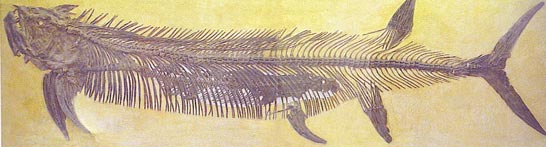
Fossils of a predator choking on its prey are known as aspiration specimens.  They are exceptionally rare in the fossil record, although, Everything Dinosaur is aware of a number of aspiration fossils, most of which feature fish of one sort or another.  A famous example of an aspiration fossil shows a four metre long, Late Cretaceous predatory fish  called Xiphactinus that perished with a two-metre-long, ichthyodectid fish inside its stomach.

The Famous “Greedy Xiphactinus” Fossil Specimen

A fossil fish within a fish

A fossil fish within a fish.

Picture credit: Sternberg Museum of Natural History

The piece also features a fossil fish, possibly Paramblypterus gelberti which can be seen in the bottom right of the slab in the photographs circulated by the auction house.

A spokesperson from Everything Dinosaur commented:

“This is a truly remarkable and very beautiful fossil specimen.  Aspiration fossils, certainly those featuring tetrapods are extremely rare.  If a public body is unable to purchase this fossil, perhaps the private consortium or wealthy individual who secures this lot will allow it to be made available for further study and analysis – let’s hope so.”

Visit Everything Dinosaur’s website: Everything Dinosaur.

26 09, 2013

Dinosaur Soft Toy Made in Space

By |2023-02-24T09:13:14+00:00September 26th, 2013|Categories: Dinosaur and Prehistoric Animal News Stories, Dinosaur Fans|0 Comments

Astronaut Aboard the International Space Station Makes T. rex Soft Toy for her Son

Karen Nyberg, a keen quilter and a dab hand with a needle and thread had a few spare moments in what was her busy daily routine so she decided to make a Tyrannosaurus rex dinosaur soft toy for her little boy from some scraps of material that was lying around.  What’s so remarkable about that  you may ask?

Dinosaur Soft Toy

Karen is a flight engineer currently working on the International Space Station that is orbiting the Earth some 230 miles overhead.  This is the first soft toy made in space (we think), a T. rex created in zero gravity.

Karen has been on the International Space Station since May 29th of this year, missing Jack, her three-year-old son, she decided to make him a toy dinosaur, a special souvenir of his Mum’s time in space.  It seems that the supply boxes that carry the food containers on their space bound journey have a velcro-like packing material inside them.  Karen used this material to make the shape and the soft toy, once stitched, was stuffed with strips from an old T-shirt.

A Space Dinosaur

We at Everything Dinosaur are sure that Jack is going to love his “space dinosaur”, although this is not the first dinosaur in space.  Members of the Dinosauria have ventured into zero gravity before, and we at Everything Dinosaur produced an article on this remarkable feat, especially for an extinct order of reptiles.

To read more about dinosaurs in space: Dinosaurs and Spaceflight.

Working in weightlessness conditions hasn’t stopped Karen from showing off her crafting skills.  Perhaps, Karen could make a second stuffed toy dinosaur in the few spare minutes she gets during her busy work schedule.  This second soft toy could be put on display at the Kennedy Space Centre, to inspire the next generation of astronauts.

Great work Karen, we think Jack is going to love his dinosaur toy.

For more conventionally produced dinosaur soft toys and prehistoric animal plush:  Dinosaur Soft Toys.

25 09, 2013

Thousands of Rare Dinosaur Tracks Discovered in Alaska

By |2024-05-01T15:10:58+01:00September 25th, 2013|Categories: Dinosaur and Prehistoric Animal News Stories|0 Comments

Evidence of an Extinct Ecosystem Revealed

A team of researchers from the University of Alaska Museum of the North have found a number of major new sites which show evidence of Late Cretaceous dinosaur fossils, not too far from the Arctic Circle.  The research team explored the banks and rocky beaches of the Yukon and Tanana rivers and the expedition returned with over 900 kilogrammes of dinosaur trace fossil specimens.  The fossils represent extensive dinosaur tracks and prints.

Dinosaur Tracks

Commentators have stated that the University of Alaska Museum of the North researchers have found major new sites for dinosaur fossils in Alaska.

Earth Sciences Curator Pat Druckenmiller, a member of the expedition team commented:

“There aren’t many places left in the world where palaeontologists can just go out and find thousands of dinosaur footprints”.

In the high summer (July) with the long days of daylight, the research team set off at the start of a 800 kilometre journey, one that would take them down the Tanana and Yukon rivers and also back in time to the Cretaceous a time when, according to the trace fossils, a large number of different dinosaur species roamed these northern latitudes.

Operations Manager at the Museum, Kevin May stated:

“Based on what we know about the geology along the Yukon River, the rocks exposed downriver from Ruby [a small town 400 kilometres west of Fairbanks] suggested they might be a good place to find dinosaurs”.

Ornithopod and Theropod Tracks

Footprints of both plant-eating dinosaurs (ornithopods) and meat-eating dinosaurs (theropods) were discovered indicating that this part of the Late Cretaceous world supported a rich and diverse ecosystem.  Many different types of prehistoric animal footprint have been recovered from the nearby Denali Park (Lower Cantwell Formation), including those of a giant prehistoric bird that may have stood over 1.5 metres tall.

In fact, the nearby Denali Park is famous for its extensive bird fossil trackways, it seems that birds were also abundant and shared this Late Cretaceous habitat with the dinosaurs.  Intriguingly, the newly discovered dinosaur footprints from the Yukon area are probably 25-30 million years older than the Denali fossils, still Late Cretaceous but indicating a rich and diverse ecosystem flourishing in this part of the world for many millions of years.

Preserved Dinosaur Footprints Found Along the Shore

Tracks along the shore.
Large boulders littering the shoreline that have been eroded out of the surrounding strata. The boulder in the foreground shows a positive footprint fossil.

Picture credit: Pat Druckenmiller

The picture above shows the typical shoreline landscape with large boulders littering the shoreline that have been eroded out of the surrounding strata. The boulder in the foreground shows a positive footprint fossil.

Yukon River Dinosaur Footprints

A Positive Dinosaur Footprint – Ceratopsian Hind Foot?

Outlined in red a dinosaur footprint.
Dinosaur footprint outlined in red.

Picture credit: Pat Druckenmiller with highlighting by Everything Dinosaur

The picture above shows a close up of the dinosaur footprint, although team members at Everything Dinosaur have only this photograph to study and there is no defined scale, it has been suggested that this trace fossil may have been made by the foot of a ceratopsian (horned dinosaur).

Natural Casts

Pat Druckenmiller explained that one of the reasons the Yukon River dinosaur tracks may have gone undiscovered for so long is due to their method of preservation, they are “natural casts” formed when sand filled in the actual footprint after the dinosaur stepped in soft mud. The footprints are not “sunken impressions”, as we refer to such tracks at Everything Dinosaur, rather, they are “raised positive impressions”, that actually stick out and stand proud of the surrounding matrix. A spokesperson for the Alaskan based team stated that the prints “stick out from the rock and sometimes look like blobs with toes.”

The fossil finds are significant as they hint at an extensive dinosaur rich ecosystem that predates those fossils found from the Lower Cantwell Formation of Denali. The University of Alaska Museum of the North are keen to work with local native communities to help co-ordinate future expeditions to the area, perhaps looking for body fossils of dinosaurs so that new genera of Dinosauria may be identified. The dedicated dinosaur footprint spotters included, Jørn Hurum, from the University of Oslo Natural History Museum, UAMN Earth Sciences Collection Manager Julie Rousseau, and University of Alaska (Fairbanks) students Meghan Shay, Katherine Anderson, and Meg O’Connor.

Some of the Expedition Members with their Finds

Yukon dinosaur tracks.
Finding dinosaur footprints in Alaska.

Picture credit: Kevin May

A Rich and Diverse Dinosaur Fauna

The Head of Production at the Museum Roger Topp, has produced a film of the team’s exploits and the University of Alaska Museum of the North is planning to exhibit their finds in the summer of 2015.

Commenting on the fossil footprint discoveries, a spokesperson from Everything Dinosaur said:

“From the preliminary studies that have been made, these fossilised footprints indicate a rich Dinosauria fauna, with herbivorous ceratopsians and duck-billed dinosaurs dominating the mega fauna. These animals may have migrated to high latitudes to take advantage of food resources during the long periods of prolonged daylight. Predators such as tyrannosaurs may well have followed these herds north and south, picking off the sick and the old.”

A Close Up of an Ornithopod Footprint

Dinosaur footprint.
An impression made by the hind foot of a plant-eating dinosaur.

Picture credit: Pat Druckenmiller

23 09, 2013

Giant Prehistoric Straight-Tusked Elephant Butchered by H. heidelbergensis in Kent According to New Research

By |2024-05-01T15:07:02+01:00September 23rd, 2013|Categories: Dinosaur and Prehistoric Animal News Stories, Palaeontological articles|0 Comments

University of Southampton Researchers Uncover a Rich Treasure Trove of Palaeolithic Fossils including Many Hand Axes

Research by a University of Southampton archaeologist suggests that early humans, who lived thousands of years before Neanderthals, were able to work together in groups to hunt and slaughter animals as large as a prehistoric elephant.

Straight-tusked Elephant

The fossil evidence of a straight-tusked elephant (Palaeoloxodon antiquus) has provided tantalising evidence that Homo heidelbergenis was very capable of co-ordinating the butchering of a large animal carcase, with the research team proposing that at least four individuals worked on the corpse, extracting the cuts of meat.  It is not known whether, in this instance, H. heidelbergensis actually hunted and killed the elephant but other H. heidelbergensis sites from Germany indicate that they may well have hunted these mega herbivores.

Dr Francis Wenban-Smith discovered a site containing remains of an extinct straight-tusked elephant in 2003, in an area of land at Ebbsfleet in Kent, during the construction of the High Speed 1 rail link from the Channel Tunnel to London.  Investigation of the area was carried out with the independent heritage organisation Oxford Archaeology, with the support of HS1 Ltd.

Extensive Fossil Remains

Excavation revealed a deep sequence of deposits containing the elephant remains, along with numerous flint tools and a range of other species such as; wild aurochs, extinct forms of rhinoceros and lion, Barbary macaque, beaver, rabbit, various forms of vole and shrew, frogs and a diverse assemblage of snails.  These remains confirm that the deposits date to a warm period of climate around 420,000 years ago, the so-called Hoxnian interglacial, when the climate was probably slightly warmer than the present day.

The Tusks of the Prehistoric Elephant Uncovered During the Fossil Excavation

Straight tusks of prehistoric elephant slowly emerge

Straight tusks of prehistoric elephant slowly emerge.

Picture credit: University of Southampton

Evidence for Homo heidelbergensis

Since the excavation, which took place in 2004, Francis has been carrying out a detailed analysis of evidence recovered from the site, including eighty undisturbed flint artefacts found scattered around the elephant carcass and used to butcher it.  The prehistoric elephant was twice the size of today’s African variety and much heavier.

Dr Wenban-Smith commented:

“Although there is no direct evidence of how this particular animal met its end, the discovery of flint tools close to the carcass confirm butchery for its meat, probably by a group of at least four individuals.  Early hominins of this period would have depended on nutrition from large herbivores.  The key evidence for elephant hunting is that, of the few prehistoric butchered elephant carcasses that have been found across Europe, they are almost all large males in their prime, a pattern that does not suggest natural death and scavenging.  Although it seems incredible that they could have killed such an animal, it must have been possible with wooden spears.  We know hominins of this period had these, and an elephant skeleton with a wooden spear through its ribs was found at the site of Lehringen in Germany in 1948.”

Early Humans

These early humans suffered local extinction in northern Europe during the great ice age known as the Anglian glaciation 450,000 years ago, but re-established themselves as the climate grew warmer again in the following Hoxnian interglacial.

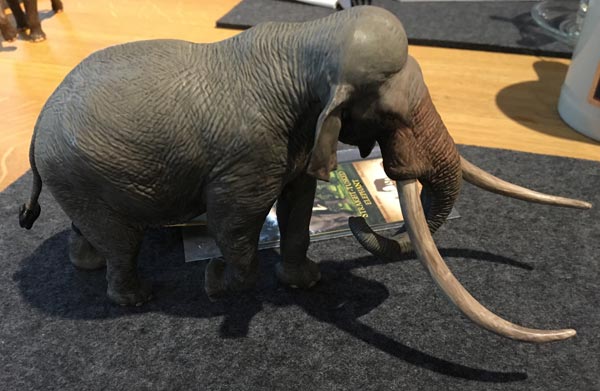
A Model of a Straight-tusked Elephant (Palaeoloxodon antiquus)

Eofauna Scientific Research Straight-tusked elephant.

Straight-tusked elephant (Palaeoloxodon antiquus) model.  Picture credit: Everything Dinosaur.

The picture (above) shows a Straight-tusked elephant from the Eofauna Scientific Research range.

To view this range of scale prehistoric animal figures: Eofauna Scientific Research Models.

An Ability to Hunt Large Mammals

An ability to hunt large mammals, and in particular elephants, as suggested by the Ebbsfleet find, would go some way to explaining how these people then managed to push northwards again into what is now Britain.  The flint artefacts of these pioneer settlers are of a characteristic type known as Clactonian, mostly comprising simple razor-sharp flakes that would have been ideal for cutting meat, sometimes with notches on them that would have helped cut through the tougher animal hide.

The discovery of this previously undisturbed elephant grave site is unique in Britain, where only a handful of other elephant skeletons have been found and none of which have produced similar evidence of human exploitation.  The Ebbsfleet location is just a few miles from the West Sussex gravel beds where further evidence of H. heidelbergensis hunters have been found (Boxgrove).

Ancient Ebbsfleet

Dr Wenban-Smith explains the Ebbsfleet area would have been very different from today:

“Rich fossilised remains surrounding the elephant skeleton, including pollen, snails and a wide variety of vertebrates, provide a remarkable record of the climate and environment the early humans inhabited.  Analysis of these deposits show they lived at a time of peak interglacial warmth, when the Ebbsfleet Valley was a lush, densely wooded tributary of the Thames, containing a quiet, almost stagnant swamp.”

The layer of earth containing the elephant remains and flints is overlain by a higher level of sediment, rich in so-called Acheulian tool types, hand axes of various forms from later in the same interglacial.  Controversy surrounds whether or not these represent a later wave of colonisation of Britain, or whether the Clactonians themselves evolved a more sophisticated tool-kit as they developed a more sustained occupation.

To read an article on the discovery of a baby Woolly Mammoth carcase in Siberia that shows signs of being butchered by humans (H. sapiens): Baby Mammoth Killed by Lions and then Butchered by Humans.

Everything Dinosaur acknowledges the contribution of the University of Southampton in the compilation of this article.

22 09, 2013

Silurian Placoderm from China – a “Jaw-Dropping” Fossil Discovery

By |2023-02-24T07:58:23+00:00September 22nd, 2013|Categories: Dinosaur and Prehistoric Animal News Stories, Palaeontological articles|0 Comments

Say Hello to “Fish Face” Entelognathus primordialis – Crucial New Evidence into the Evolution of Jawed Vertebrates

The evolution of jaws was perhaps one of the most significant events in the history of the vertebrates (and this group includes us by the way).  Jaws permitted vertebrates to eat bigger items, more diverse types of food, develop different feeding styles and in the case of fish, to push more oxygen bearing water through the expanded mouth cavity, a substantial aid to respiration.  It can be argued that the development of a complex jaw gave the gnathostomes (jawed vertebrates) the edge over the invertebrates, perhaps most notably the arthropods and the Mollusca as these groups battled it out for the position of apex predators in the Palaeozoic seas.

The Evolution of Jaws

The discovery of cranial elements from an armoured fish at a quarry near to Xiaoxiang Reservoir, Yunnan Province, China, dated to approximately 419 million years ago is shedding new light on the evolution of jaws.  This fossil shows the earliest evidence discovered to date of jaws and facial bones seen in gnathostomes.  Other bones are more primitive, typical of a placoderm (armoured fish).  This sets up the intriguing hypothesis that the face was the first modern skeletal feature to evolve.

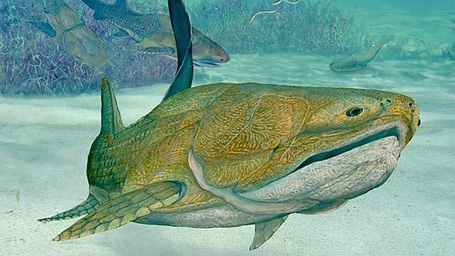
The fish, which swam in shallow seas during the Silurian, has been named Entelognathus primordialis, the name means “primordial complete jaw”.

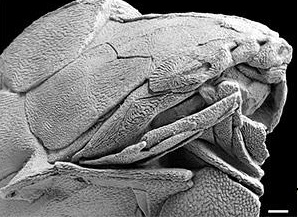
The beautifully preserved fossil skull shows details of the individual bones that make up the skull and jaws, its discovery is extremely significant as the placoderm group is believed to have given rise to the two major classes of extant fish, the cartilaginous fish such as sharks and rays which are known as Chondrichthyes and the bony fish, the Osteichthyes, which encompasses fish with bony skeletons and all other vertebrates that bear limbs with distinct digits, that’s amphibians, reptiles, mammals, birds and of course us.  E. primordialis has dermal marginal jaw bones (premaxilla, maxilla and a dentary) and as such it is the first stem gnathostome to show such anatomical features.

Placoderms (Placodermi)

Placoderms (the name means plated skins) were primitive jawed fish.  They are named after the broad, flat, bony plates that covered their heads and the front parts of their bodies.  Although during the Silurian and up to the Middle Devonian this group was extremely diverse, this type of fish becomes increasingly rare in the fossil record from then onwards and it is believed that placoderms became extinct at the end of the Devonian around 360 million years ago. Features such as the braincase of E. primordialis indicate a strong affinity with the placoderms but, the pattern of the bones in the jaws is almost identical to that seen in fish of the class Osteichthyes and their descendants, terrestrial animals with backbones.

Silurian Placoderm

Member of the research team, Xiaobo Yu (Kean University in Union, New Jersey) commented:

“This is a unique pattern, that is found only in bony fishes.  As such, finding the pattern in what otherwise looks like a placoderm is a real surprise.”

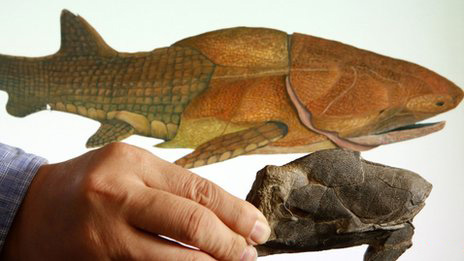
 The Holotype Fossil Material with an Artist’s Impression of E. primordialis in the Background

"Hello Funny Face".

“Hello Funny Face”.

Picture Credit: Reuters

Dermal Armour

The dermal armour at the front of placoderm bodies bears little resemblance to the skeletons of extant vertebrates.  Scientists had thought that the descendants of the placoderms lost their dermal bones entirely with two main classes of fish evolving, the Chondrichthyes such as the sharks and the Osteichthyes.  The sharks and rays continued to evolve without bony skeletons, these fish have skeletons supported by cartilage.  The Osteichthyes class re-evolved the bony skeleton, a successful body plan of all bony fish and their descendants the tetrapods (amphibians, reptiles, birds and mammals).

This new fossil find, is something of a smack in the mouth for the “second evolution” of the bony skeleton theory.  The dermal plates of the placoderm may survive today in the jaws of gnathostomes, and that includes human beings as well.  Placoderms may not have lost their dermal armour, it simply evolved into elements of the modern bony skeleton such as the upper and lower jaws.  The face may have been the fist element of a modern gnathostome skeleton to evolve.

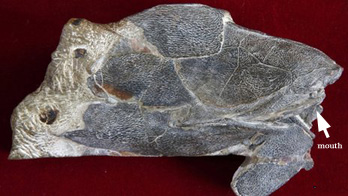
A Close up of the Fossil Material

Something to get your teeth into the evolution of facial features.

Something to get your teeth into the evolution of facial features.

Picture credit: Reuters with the mouth highlighted by Everything Dinosaur

Previously, the common perception had been that the sharks and rays with their skeletons made of cartilage were more primitive than the bony fishes.  Their lack of a bony skeleton rather suggests that the Chondrichthyes arguably, have evolved further from the ancestral form than the bony fishes have.  It may not be a case of having a cartilaginous skeleton being a primitive trait, this new discovery suggests that in terms of a support structure for their bodies, sharks and rays may be more different from basal forms than the bony fishes.  Sharks and rays have evolved further from the ancestral, basal body structure.

A Computer Generated Image of the Fossil Material Revealing Skeletal Features

"Fossilised Face"

“Fossilised Face”

Picture credit: Nature

A spokesperson from Everything Dinosaur stated:

“This intriguing find, one of a number of Silurian fossil fishes that have been discovered in rocks making up the Kuanti Formation (Late Ludlow) Formation, might lead to a revision in the taxonomic relationships between basal members of the modern, vertebrate groups.”

Life in the Silurian Seas – Entelognathus primordialis

The first "Jaws"?

The first “Jaws”?

Picture credit: Brian Choo

E. primordialis

The illustration above shows a life restoration of E. primordialis swimming in a warm, tropical sea that was to form the province of Yunnan (western China).  Scientists believe that this fossil discovery re-writes the history of the evolution of jaw bones, including our own.

The scientific paper: “A Silurian placoderm with osteichthyan-like marginal jaw bones” by Min Zhu, Xiaobo Yu, Per Erik Ahlberg, Brian Choo, Jing Lu, Tuo Qiao, Qingming Qu, Wenjin Zhao, Liantao Jia, Henning Blom and You’an Zhu published in the journal Nature.

19 09, 2013

Beautiful Swaledale Fossil Limestone for King Richard’s Tomb

By |2024-05-01T15:08:16+01:00September 19th, 2013|Categories: Dinosaur and Prehistoric Animal News Stories, Famous Figures|0 Comments

Leicester Cathedral Publishes Plans for the Tomb of King Richard III – Fossils to Play a Role

Church authorities at Leicester Cathedral have announced plans for the burial tomb of King Richard III.  The impressive tomb, is the proposed final resting place of Richard of York who was killed at the Battle of Bosworth Field in in 1485, although there is a strong campaign to have Richard’s remains returned to York for burial.  Leicester Cathedral’s  plans are for a stone tomb, carved with a deep cross and set upon an engraving of a white Yorkshire rose.  The project is likely to cost something like £1.3 million to complete.

King Richard III

The stone that is intended to be used is Swaledale limestone, highly appropriate as this stone is from Swaledale (naturally), part of the magnificent North Yorkshire countryside.  Although this stone comes in various colours, greys, off-white and even with a blueish hue it is highly fossiliferous.  The limestone was formed at the bottom of a shallow sea that covered much of what was to become the United Kingdom back in the early Carboniferous geological period.

Swaledale Fossil Limestone

It is coarse grained and contains a substantial amount of fossil remains of  invertebrate marine creatures, most notably the flexible stems of sea lilies otherwise known as crinoids.  Crinoids belong to the same phylum as starfishes and sea urchins, they look superficially like plants (hence the name sea lily), but they are in fact an animal.  Entirely marine, crinoids have been around since the Cambrian and can still be found today.  Typically, crinoids consisted of a hold fast to anchor them to the sea-bed and a flexible stem made up of calcite plates (called stem ossicles or columnals), which supported umbrella-like branching tubular arms that were able to trap food items in passing currents.  When the creature dies, the minute organic fibres that held the stem ossicles together rot and the stem disintegrates.

In the ancient limestone beds of Swaledale crinoids were so numerous that their fossils form a substantial part of the rocks.

When polished, the fossils show up very clearly and the details of the stem ossicles can be seen very clearly.

Fossil Rich Carboniferous Limestone 

Rock fit for a King!

Rock fit for a King!

Picture credit: Open University

We are not sure whether there is any record of Richard of York being an avid collector of fossils, but if the tomb is built, visitors to the Cathedral will be able to view evidence of  life in a prehistoric sea as well as learning about the last Plantagenet King of England.

The fossilised stems of crinoids are also known as “St Cuthbert’s beads”.  St Cuthbert was a monk at the monastery located at Lindisfarne, otherwise called Holy Island (Northumberland), local legend states the Cuthbert would make rosaries by threading a thin piece of thread through columnals that he had collected on the shore.

For models and replicas of ancient creatures including Palaeozoic and Mesozoic animals: CollectA Prehistoric Life Figures and Models.

18 09, 2013

Dinosaurs in a Wind Tunnel – Giving up the Secret of Microraptor Flight Thanks to New Research

By |2024-05-01T15:11:42+01:00September 18th, 2013|Categories: Dinosaur and Prehistoric Animal News Stories, Dinosaur Fans|0 Comments

Wind Tunnel Tests Provide New Data on the Evolution of Powered Flight in Birds

Thanks to some amazing dinosaur fossil discoveries that have been made in recent years, most notably from the Liaoning Province of northern China, palaeontologists have been able to study a number of feathered theropod dinosaurs and primitive birds.  Such studies have shed light on the evolution of feathers and provided information on the origins of powered flight.  However, little work has been done on testing the flight abilities of these early Cretaceous creatures.  The flight performance, stability and aerodynamics of one theropod dinosaur, a genus called Microraptor, one of the smallest dinosaurs known to science, has been put to the test by a team of researchers at Southampton University (United Kingdom).

Microraptor

About two dozen or so specimens of Microraptor have been excavated from the fine grained sedimentary deposits of Liaoning Province.  Many of these beautifully preserved fossils show that this little dinosaur had asymmetrical flight feathers on both its arms and its legs.  The body was covered in downy feathers and this carnivore, which probably weighed around 1,000 grammes, had a long, rigid tail that sported an array of feathers too.  In essence the feather covered limbs and tail provided Microraptor with five potential lifting surfaces, it essentially had five wings.

The Fossilised Remains of a Microraptor

Insight into the evolution of flight using a wind tunnel.

Insight into the evolution of flight using a wind tunnel.

The scientists from Southampton University built a full scale model of Microraptor in order to test the flight abilities of this “flying dinosaur”.  Tests in a wind tunnel suggest that the fore-limb dominated bird flight passed through an evolutionary stage of four-winged flight (terapteryx).  The research into Microraptor indicates that this dinosaur’s anatomy represents an important stage in the development of gliding leading on to powered flight.

Wind Tunnel Tests

The wind test results show that Microraptor would have been most stable gliding when large amounts of lift was generated from its wings.  Flight simulations demonstrate that this behaviour had advantages since this high lift coefficient allows for slow glides, which can be achieved with less height loss.  For gliding down from low elevations, such as trees, this slow, and aerodynamically less efficient flight was the gliding strategy that results in minimal height loss and longest glide distance, a most efficient form of movement.

For many years, the position and orientation of Microraptor’s legs and wings as it glided had been debated.  However, the leg position and wing shape turns out to be largely irrelevant, the wind tunnel tests indicate that changes in these variables make little difference to the dinosaur’s ability to fly.

The Evolution of Flight

Senior Lecturer in Vertebrate Palaeontology at the University, Dr Gareth Dyke, a co-author of this new study commented:

“Significant to the evolution of flight, we show that Microraptor did not require a sophisticated, ‘modern’ wing morphology to undertake effective glides, as the high-lift coefficient regime is less dependent upon detail of wing morphology.  This is consistent with the fossil record, and also with the hypothesis that symmetric ‘flight’ feathers first evolved in dinosaurs for non-aerodynamic functions, later being adapted to form aerodynamically capable surfaces.”

Model of a Microraptor to Test Aviation Capabilities

The PNSO Gaoyuan the Microraptor model.

PNSO Gaoyuan the Microraptor model.

The black Microraptor model (above) is from the PNSO model series, to view the range of PNSO prehistoric animal models in stock at Everthing Dinosaur: PNSO Age of Dinosaurs Models and Figures.

The research has been written up for inclusion in the next edition of the academic journal  “Nature Communications”.

Dr Roeland de Kat, the study’s co-author and a Research Fellow in the Aerodynamics and Flight Mechanics Research Group (Southampton University), added:

“What interests me is that aerodynamic efficiency is not the dominant factor in determining Microraptor’s glide efficiency.  However, it needs a combination of a high lift coefficient and aerodynamic efficiency to perform at its best.”

New Science on an Early Cretaceous Dinosaur

This is the first time such wind tunnel tests have been carried out on such a sophisticated model representing a Microraptor, the model even has real feathers applied to its limbs, these feathers provide detailed information on the effect of air currents and on drag, helping the researchers to gain a much deeper understanding of the flight capabilities of this Early Cretaceous dinosaur.  Further details of this research will be presented at a conference celebrating the importance of British and Chinese dinosaur fossil discoveries being held later this week at the National Oceanography Centre (Southampton).

 A Scale Drawing of Microraptor

M. gui scale drawing

M. gui scale drawing

Picture credit: Everything Dinosaur

17 09, 2013

Cloning Dinosaurs from DNA Preserved in Amber Entombed Blood-sucking Insects Not Likely According to New Research

By |2024-05-01T14:51:28+01:00September 17th, 2013|Categories: Dinosaur and Prehistoric Animal News Stories|0 Comments

Researchers Conclude that “Jurassic Park Scenario” Not Likely

The title of the next instalment of the “Jurassic Park” movie franchise may have just been announced (Jurassic World), but for one group of Manchester University academics it is finally time to pour cold water on the idea that dinosaurs could be cloned from DNA recovered from blood-sucking insects that had been found in amber.  Research carried in the early 1990s suggested that minute amounts of DNA could be recovered from insects that had been preserved trapped in tree resin (amber).

However, new research published in the online journal “Public Library of Science – Biology”, which used the very latest DNA recovery techniques, casts doubt on the ability to extract DNA from such a source.

The Existence of DNA in Fossils Unlikely

Researchers from the Faculty of Life Sciences at The University of Manchester can now confirm that the existence of DNA in amber fossils is highly unlikely.  The team led by amber expert Dr David Penney and co-ordinated by ancient DNA expert Professor Terry Brown used highly-sensitive “next generation” sequencing techniques, the most advance type of DNA sequencing, on insects in copal, the sub-fossilised resin precursor of amber.

Ancient Insects Preserved in Amber

Scientists explore the "Jurassic Park DNA theory".

Scientists explore the “Jurassic Park DNA theory”.

The research was conducted wearing full forensic suits in the dedicated ancient DNA facility at The University of Manchester, which comprises a suite of independent, physically isolated laboratories, each with an ultra-filtered air supply maintaining positive displacement pressure and a managed access system.

According to Professor Brown:

“In the original 1990s studies DNA amplification was achieved by a process called the polymerase chain reaction (PCR), which will preferentially amplify any modern, undamaged DNA molecules that contaminate an extract of partially degraded ancient ones to give false positive results that might be mistaken for genuine ancient DNA.  Our approach, using “next generation” sequencing methods is ideal for ancient DNA because it provides sequences for all the DNA molecules in an extract, regardless of their length, and is less likely to give preference to contaminating modern molecules.”

Cloning Dinosaurs

The team concluded that their inability to detect ancient DNA in relatively young (60 years to 10,600 years old) sub-fossilised insects in copal, despite using sensitive next generation methods, suggests that the potential for DNA survival in resin inclusions is no better, and perhaps worse, than that in air-dried museum insects (from which DNA has been retrieved using similar techniques).  This raises significant doubts about claims of DNA extraction from fossil insects in amber, many millions of years older than the copal specimens.

Dr Penney added:

“Intuitively, one might imagine that the complete and rapid engulfment in resin, resulting in almost instantaneous demise, might promote the preservation of DNA in a resin entombed insect, but this appears not to be the case.  So, unfortunately, the Jurassic Park scenario must remain in the realms of fiction.”

Everything Dinosaur acknowledges the contribution of Manchester University in compiling this article.

Visit Everything Dinosaurs award-winning website for dinosaur models, toys and games: Everything Dinosaur – Dinosaur Models, Toys and Games.

Go to Top