All about dinosaurs, fossils and prehistoric animals by Everything Dinosaur team members.

Fossil finds, new dinosaur discoveries, news and views from the world of palaeontology and other Earth sciences.

28 10, 2013

Scientists Identify the Oldest Bird Tracks Down Under

By |2023-02-28T14:33:44+00:00October 28th, 2013|Categories: Dinosaur and Prehistoric Animal News Stories|0 Comments

Evidence of Australia’s Oldest Feathered Friend

A team of scientists has identified a pair of 100-million-year-old fossilised bird tracks  – the oldest ever discovered in Australia.  The fossilised tracks,  likely made by two individual birds, each the size of a heron, were found at the famous Dinosaur Cove site, approximately 125 miles south-west of Melbourne (Victoria).  The tracks were discovered as part of a long term project being conducted by a team of scientists including Museum Victoria’s Dr Tom Rich, Dr Patricia Vickers-Rich and Michael Hall from Monash University and Dr Anthony Martin from Emory University in the United States.

Dinosaur Cove

Dr Martin stated:

 “We know the tracks were made by birds because of the rear-pointing toes.  The tracks show a beautiful mark caused by the back toe dragging in the sand, which indicates the bird was flapping its wing and coming in for a soft landing.  Discoveries like these help us better understand avian evolution.”

One of the problems ichnologists have (ichnology is the study of trace fossils, specifically foot prints and tracks), is distinguishing between tri-dactyl dinosaur footprints typically made by members of the Theropoda and those made by birds that lived alongside the Dinosauria.  The back toe (hallux) may not leave an impression so it is very difficult to tell the difference between the two.

The Fossil Dinosaur Cove Site (Victoria, Australia)

Site reveals trace fossils of ancient birds.

Picture Credit: Dr Tom Rich/Museum Victoria

Early Cretaceous Tracks

Dr Rich explained:

“The tracks date back to the Early Cretaceous, a time that spans from 100-million years ago to 140-million years ago when Victoria was still connected to Antarctica.  The tracks were made in what was once the moist sand of a riverbank during a polar spring or summer most likely.”

Dinosaur Cove has produced a remarkable number of fossil finds over the last forty years or so.  This location, in combination with the East Gippsland locations has revealed a diverse assemblage of vertebrate fossils including the dinosaurs Leaellynasaura, Qantassaurus, as well as numerous theropods, pterosaurs, fish, giant labyrinthodont amphibians, turtles and potentially evidence of ornithomimid dinosaurs – a first for Australia.  What is remarkable is that, this part of Australia was at approximately 75 degrees south for much of the Early Cretaceous.

Oldest Bird Tracks

The area was covered by extensive polar forests and for nearly two months of the year, the high southerly latitude meant that there was total darkness, with the sun not appearing above the horizon during the winter.  In the summer, there were periods of 24-hour daylight.  The research team are unsure as to whether these bird tracks were made by residents or migrants that came to the area to exploit the 24-hour feeding opportunity during the summer months.

The bird tracks are estimated to be around 105 million years old, making them the oldest evidence uncovered to date of Aves in Australia.

Ancient Birds Walked this Way

105 million year old bird tracks.

105-million-year-old bird tracks.

Picture credit: Alan Tait

A spokes person from Everything Dinosaur stated:

“Back in 1999 when the ground breaking BBC television series “Walking with Dinosaurs” was being made, an episode was dedicated to the amazing fossil discoveries from Dinosaur Cove and East Gippsland.  The programme was entitled “Spirits of the Silent Forest”, but as no evidence for an Avian presence had been found, no birds were featured.  We suggested at the time that birds were most likely present, perhaps migrating to this area to breed and we imagined vast breeding colonies, it now seems that there is fossil evidence to support the theory that birds inhabited or at least were present in this habitat for some part of each year.”

Everything Dinosaur would like to thank Museum Victoria for their help in putting together this article.

25 10, 2013

Cretaceous Mass Extinction Event – First Evidence of Bee Populations Affected

By |2023-02-28T08:21:51+00:00October 25th, 2013|Categories: Dinosaur and Prehistoric Animal News Stories|0 Comments

Massive Extinction Event – Evidence for Bee Diversity Decline at the End of the Cretaceous

The Cretaceous mass extinction event that saw the demise of the Dinosauria, is perhaps the best known to the general public, of all the great extinctions recorded in the fossil record.  Something like 60% of all, large terrestrial life forms became extinct some sixty-six million  years ago. Although, the causes of the extinction are still debated, we often come across members of the public who can be very knowledgeable about asteroid impacts and such like but seem to have missed some of the important implications of this particular event that occurred back in deep time.

Cretaceous Mass Extinction

It was not just those scary, non-avian dinosaurs  that failed to make it through to what was later termed the Palaeogene.   Whole groups of other organisms died out near to or around the time that the K-T boundary was laid down.

Marine reptiles, ammonites and the pterosaurs become extinct.  Other classes of organism suffered dramatic losses and a rapid reduction in their diversity, groups such as marine plankton, brachiopods, echinoderms and bivalves.  Plants were not immune to effects either.  Although the fossil record for the angiosperms at the end of the Cretaceous is far from complete, scientists have shown that flowering plants, including hardwood trees also suffered, especially those genera associated with the Northern Hemisphere.

Flowering Plants Affected

If flowering plants were affected by the mass extinction event, then it is logical to assume that those organisms that have a close association with these plants would also have declined too.  We are not just talking about the plant-eaters, what about the pollinators?

An international team of researchers have identified a dramatic decline in bee numbers at around the same time the dinosaurs became extinct.  The research team, including Dr Sandra Rehan of the department of Biological Sciences (University of New Hampshire) and her collaborators from the South Australia Museum, the University of Adelaide and Flinders University (South Australia) used a series of molecular phylogenetic analyses to demonstrate that one particular type of bee suffered a significant decline.

Given the implied dramatic changes to ecosystems that occurred at this time, the events recorded in the fossil record at or near the K-T boundary would have significantly disrupted many plant-insect relationships.  Such disruption would have had major consequences for the subsequent evolution of those flowering plants that depend on the likes of bees to pollinate them and vice versa.

Studying Bee Populations

The researchers chose to study bees within the subfamily known as Xylocopinae, the long-tongued bees which included the carpenter bees.  These bees may have evolved more than ninety million years ago, a time when it could be argued that the dinosaurs were in their heyday with the flowering plants also doing extremely well and beginning to dominate the flora in a number of habitats.  It had been assumed by scientists that insect pollinators would have been severely affected by the Cretaceous mass extinction event, but as the paper’s (the paper having just been published in the online journal PLoS One), lead author, Dr Sandra Rehan stated:

“There is a relatively poor fossil record of bees.  This has made the confirmation of such an extinction difficult.”

However, the researchers were able to use an extinct clade from the  Xylocopinae Subfamily as a calibration point for timing the diversification and the radiation of these bees.  The team also studied the fossils of angiosperms that had evolved traits that allowed them to be pollinated by these long-tongued forms.

Dr Rehan commented:

“The data told us something major was happening in four different groups of bees at the same time and it happened to be the same time as the dinosaurs went extinct.”

This research could have important implications for bee conservation today, as environmentalists, governments and scientists express concern over the loss of important bee pollinator species today.

Dr Rehan added:

“Understanding extinctions and the effects of declines in the past can help us understand the pollinator decline and the global crisis in pollinators today.”

Visit Everything Dinosaur’s user-friendly website: Dinosaur Models, Games, Clothing and Toys.

24 10, 2013

Most Complete Fossil of Baby Parasaurolophus Described To Date

By |2023-02-28T08:18:20+00:00October 24th, 2013|Categories: Dinosaur and Prehistoric Animal News Stories|1 Comment

Introducing “Joe” – The Baby Parasaurolophus

Fossils of baby dinosaurs are exceptionally rare, however, when found they can provide palaeontologists with a wealth of information.  Scientists can gain an understanding of how dinosaurs grew, how their bodies changed as the animal got older and in some cases how quickly dinosaurs matured.  The large amount of duck-billed dinosaur fossils found in western North America has enabled researchers to piece together the growth stages of a number of herbivorous dinosaurs and thanks to a sharp-eyed student, scientists at the Raymond M. Alf Museum of Palaeontology in Claremont (California), have a near complete, less than one-year-old baby Parasaurolophus to study.

Baby Parasaurolophus Fossil

High school student Kevin Terris discovered the fossils back in 2009.  It was a chance discovery as palaeontologists had been at the same location just a couple of days earlier but they had failed to spot the articulated specimen eroding out of the rock.  The baby Parasaurolophus, which has not been assigned to a particular species within the Parasaurolophus genus, represents one of the most complete baby hadrosaurs discovered to date.

The fossils have been dated to around 75.5 million years ago (Campanian faunal stage of the Cretaceous) and come from the highly fossiliferous Kaiparowits Formation in the Grand Staircase-Escalante National Monument in southern Utah.

A View of the Right Lateral Side of the Specimen (A = Line Drawing, B = Actual Fossil Material)

Fossil specimen included evidence of preserved skin.

Fossil specimen included evidence of preserved skin.

Picture credit: PeerJ Journal

The interpretive line drawing (A) shows bones bounded by solid lines and coloured orange.  The blue shaded areas show fragmented and highly weathered bone material, whilst the green areas show places where bone impressions can still be seen.  The small, pink area at the bottom of the right hand side of the picture (a foot), indicates the presence of skin impressions.

A Dinosaur Named “Joe”

The baby Parasaurolophus has been named “Joe” in honour of Joe Augustyn, a long-time patron of the museum whose family sponsored the preparation of the fossil material.  It measures approximately 2.5 metres in length, less than one quarter the size of an adult Parasaurolophus.  It did however, have a low bump on the top of its skull, the first signs of that long, tubular, swept-back crest that helps to distinguish this lambeosaurine dinosaur from other duck-bills.

Andrew Farke, a palaeontologist and the lead scientist on the study project that has taken nearly four years to complete commented:

“Our baby Parasaurolophus is barely 25% the size of an adult, but it had already started growing its crest.  This is surprising, because related dinosaurs didn’t sprout their ornamentation until they were at least half-grown.  Parasaurolophus had to get an early start in order to form its unique headgear.”

Crest Development in Lambeosaurine Dinosaurs

Studies of a related lambeosaurine dinosaur, Corythosaurus, suggest that Corythosaurus spp. did not begin to develop crests until their skulls were approximately half the size of an adult’s.  “Joe” may have needed to start sprouting his crest early as in some species of Parasaurolophus, notably P. walkeri the crest in adult males could reach lengths in excess of two metres.

An Illustration of an Adult Parasaurolophus with “Joe” and a Human Figure for Scale

"Joe" the baby Parasaurolophus compared to an adult and a person.

“Joe” the baby Parasaurolophus compared to an adult and a person.

Picture credit: Raymond M. Alf Museum and Everything Dinosaur

The study of growth in organisms is called ontogeny.  The research team analysed cross-sectional areas of the fossilised bones and found that the bone tissue was filled with many large blood vessels, indicative of rapid growth in extant animals.  Furthermore, Sarah Werning (Stony Brook University), a co-author of the scientific paper published in the academic journal “PeerJ” could not detect signs of an annual growth ring in the bone samples studied.  This suggests that this dinosaur was less than twelve months old when it died, yet it had already grown from the size of a small dog to the size of a Guernsey cow.

Post doctoral research fellow Sarah stated:

“We didn’t see even one ring [growth ring].  This means that it grew to a quarter of its adult size in less than a year.”

Dinosaur Ontogeny

This supports previously published research that was reported upon by Everything Dinosaur team members.  The ontogeny of another lambeosaurine dinosaur from North America – Hypacrosaurus had shown that some types of dinosaur must have grown rapidly.  The most likely explanation for this is the need to grow up fast to avoid being eaten.

To read more about the Hypacrosaurus study: Hadrosaurs Grew Up Fast To Avoid Being Eaten by Tyrannosaurs.

The completeness of the specimen in conjunction with the fossils being that of a baby Parasaurolophus enabled the research team to examine other aspects of these dinosaur’s anatomy.

For example, striations found in association with the jaws revealed the location of the keratinous beak.  CAT scans allowed the scientists to study the nasal passages of this young dinosaur.  From this work, the team concluded that baby dinosaurs such as this Parasaurolophus were probably not capable of producing deep, low frequency sounds.  Instead, baby dinosaurs such as “Joe” the Parasaurolophus may have vocalised in a very different way to the adults.  Perhaps it “chirped” and “tweeted” at a higher pitch than older animals in the herd.

Computerised Tomography Reveals Details of the Baby Dinosaur’s Skull Morphology

A computer reconstruction showing the head of the baby Parasaurolophus.

A computer reconstruction showing the head of the baby Parasaurolophus.

Picture credit: Ville Sinkkonen

The picture above shows a computer generated image of the baby dinosaur’s head.  A = lateral view (view of the more complete left side of the skull), note the large eye socket (orbit).  View B is a dorsal view, viewing the skull from the top down.  View C is viewed from the front (rostral).  In the rostral view, the beak (rhamphotheca) can be clearly seen.  The shape and size of the beak has been inferred based on rock striations found in association with the jawbone that indicate the position of the beak and its relationship to the predentary and the premaxilla.

The fossil material is now on display at the Raymond M. Alf Museum of Palaeontology and we are grateful to the museum for their help in the compilation of this article.

For models and replicas of Parasaurolophus and other Late Cretaceous dinosaurs: Wild Safari Prehistoric World Figures and Replicas.

21 10, 2013

Ancient Arthropod Brain and Nervous System Studied

By |2023-02-28T08:07:45+00:00October 21st, 2013|Categories: Dinosaur and Prehistoric Animal News Stories, Palaeontological articles|0 Comments

Cambrian Arthropod – The World’s Oldest “Brain” is Studied

The fossil of an ancient arthropod discovered in southern China is helping scientists to understand the links between different types of animal that make up the largest phylum in the animal kingdom.  The fossil has revealed evidence of a central nervous system and a rudimentary control centre situated at the front of the animal, what could be termed a brain.

Ancient Arthropod Brain

The fossil, a member of a Cambrian arthropod genus known as Alalcomenaeus has a nervous system that is similar to that found in extant spiders and scorpions.  By studying the layout of central nervous systems in the Arthropoda, palaeontologists are able to build up a picture of the phylogenetic relationships between what is a very diverse phylum.  Arthropods include crustaceans, scorpions, spiders, millipedes, centipedes, horseshoe crabs and insects.

Alalcomenaeus is a member of the Megacheiran group of the Arthropoda (big claws).  It lived in a shallow, marine environment approximately 520 million years ago (Middle Cambrian).  The fossil is one of a number of beautifully preserved specimens that have been unearthed in the Chengjiang Formation (the Moatianshan shales of Yunnan Province, south-west China).  The shales have revealed an extensive and diverse marine fauna (something like 16 different phyla have been identified).  The site rivals the great Burgess Shales location in British Columbia (Canada), in terms of its importance to scientists when it comes to understanding the rapid diversification of animal types in what is known as the “Cambrian explosion”.

A Fossil of Alalcomenaeus

Ancient Arthropod from 520 million years ago.Picture credit: University of Arizona/N. Strausfeld

CAT Scans

The research team, which included scientists from the University of Arizona, used CAT scans to make three-dimensional reconstructions of features of the fossilised nervous system.  Laser scanning was also carried out and light microscopy studies to enable the distribution of chemical elements preserved in the fossil to be mapped.  Evidence of metals such as traces of copper and iron helped the team to outline the different neural structures in this ancient animal.

The complex structure in the animal’s head, the brain and the layout of the central nervous system and nerve network reveals similarities between the extinct creature’s nervous system and the nervous systems of several modern arthropods.  This suggests a common ancestry between Alalcomenaeus and many types of extant arthropod.

Shedding Light on Evolutionary Processes

Living arthropods are commonly separated into several major subphyla.  The chelicerates, for example, includes spiders, horseshoe crabs and scorpions.  Then there is a subphylum termed Crustacea (shrimps, crabs, lobsters and such like) and a group the includes the insects (Hexapoda).  This new study sheds light on the evolutionary processes that may have given rise to modern arthropods, and also provides clues about where these extinct mega-clawed creatures fit in with the arthropoda phylum.

Senior author of the research paper, which has recently been published in the journal “Nature”, Professor Nicholas Strausfeld (University of Arizona) stated:

“We now know that the Megacheirans had a central nervous system very similar to today’s horseshoe crabs and scorpions.  This means that the ancestors of spiders and their kin lived side by side with the ancestors of the Crustaceans in the Cambrian.”

Alalcomenaeus is a newly established genus.  It measured around three centimetres in length, had a segmented body with approximately 12 pairs of attached limbs.

Extinct and Extant Arthropod Nervous Systems Compared

Nervous systems of arthropods compared.

Picture credit: University of Arizona/N. Strausfeld

This illustration shows the nervous systems of the Alalcomenaeus fossil (left), a larval horseshoe crab (middle) and a scorpion (right).  Diagnostic features that reveal the evolutionary relationships among these animals include the forward position of the gut opening in the brain and the arrangement of optic centres outside and inside the brain supplied by two pairs of eyes.  The brown coloured objects represent the compound eyes.

Describing this strange creature Professor Strausfeld added:

“Up front, it has a long pair of appendages that have scissor-like components, basically an elbow with scissors on the end.  These are really weird appendages, and there has been a long debate about what they are and what they correspond to in modern animals.”

Studying the Nervous System

Greg Edgecombe (Natural History Museum – London) stated that the nervous system tends to be similar between major groups of related animals.  By studying these structures scientists can work out phylogenetic relationships between different taxa.  He stated that the nervous system and its layout was one of the more reliable tools in the armoury of invertebrate palaeontologists when it comes to trying to investigate the evolutionary tree of the Arthropoda.

Doctor Edgecombe commented:

“They both have an ‘elbow joint’ in the same place, and they both have a similar arrangement of a fixed and movable finger at the tip.  Because of these similarities, one of the main theories for what ‘great appendage arthropods [Megacheirans]’ are is that they were related to chelicerates.  Thus, our findings from the nervous system gave an injection of new data to support an existing theory.”

Recently, Dr Edgecombe and his fellow researchers from the Natural History Museum identified another Cambrian fossil specimen whose nervous system and brain revealed an unexpected similarity to the brains of modern Crustacea.  When these two studies are put together, they reveal important and significant information regarding the evolution and early diversity of the Arthropoda.

A Close up of the Head of Alalcomenaeus

Superimposed colours reveal the presence of elements preserved within the fossil material.

Picture credit: University of Arizona/N. Strausfeld

Alalcomenaeus Fossil Specimen

The picture shows a highly magnified view of the head region of the Alalcomenaeus fossil specimen.  It includes superimposed colours of a microscopy technique that reveal the distribution of chemical elements in the fossil. Copper shows up as blue, iron as magenta and the CT signatures as green. The coincidence of iron and CT denote nervous system components.  The creature boasted two pairs of eyes (ball-shaped structures at the top).

Professor Strausfeld explained:

“Our new find is exciting because it shows that mandibulates (to which Crustaceans belong) and Chelicerates were already present as two distinct evolutionary trajectories 520 million years ago, which means their common ancestor must have existed much deeper in time.  We expect to find fossils of animals that have persisted from more ancient times, and I’m hopeful we will one day find the ancestral type of both the mandibulate and chelicerate nervous system ground patterns.  They had to come from somewhere.  Now the search is on.”

A spokes person from Everything Dinosaur added:

“This new research in conjunction with the earlier published papers, is helping to shed new light on the evolutionary relationships concerning the arthropods.  The Cambrian explosion, a sudden burst of evolution, specifically of those organisms with hard, mineralised parts marks the start of the Phanerozoic Eon – the “time of visible life”, these fossils, many of which are microscopic are playing an important role in helping scientists to unravel the tree of life.”

19 10, 2013

Rare Early Human Fossil May Re-write Early Human Evolutionary History

By |2024-05-01T15:13:56+01:00October 19th, 2013|Categories: Dinosaur and Prehistoric Animal News Stories|1 Comment

New Fossil Study May Lead to the Human Family Tree Being Simplified

A team of international scientists studying a series of hominin remains that date back some 1.8 million years, have concluded that the fossils. although showing a degree of variation, do all represent a single human species.  The team’s findings could have far-reaching implications for the accepted view of the evolutionary human family tree.

Fossils from Georgia

The fossils come from Dmanisi, a site in southern Georgia that has provided an extensive amount of early human fossil material, documenting the earliest migrations of hominins into Eurasia.  The scientists led by David Lordkipanidze, a palaeoanthropologist at the Georgian National Museum (Tbilisi), have spent eight years studying the various fossil bones, many of them fragmentary but their research has amassed enough evidence to suggest a re-writing of the Homo genus.

The paucity of the global fossil record for humans has left scientists with a large number of gaps in the human family tree.  These species currently recognised as distinct members of the Homo genus, the likes of Homo erectus, Homo ergaster and Homo habilis may represent variation amongst members of a single, evolving lineage of humans.

Put into simple terms, people look different from each other today, although they are all members of a single species (H. sapiens), so did early hominins look different from one another?  The wide variation seen in the fossil bones could perhaps have led scientists to establish a number of species, when perhaps, the fossils represent a single human form.

Scientists Attempt to Unravel Human Evolution

Skulls and jaws from the site in Georgia.

Skulls and jaws from the site in Georgia.

Picture credit: Science

The picture above shows some of the distinct differences between hominin fossils excavated from the Dmanisi location.  The skull on the left for example, has a much broader face than the skull on the right, the cheekbones are more pronounced, the brow ridges are more defined and prominent when compared to the specimen on the far right.  One of the jawbones (to the left of the picture), is significantly deeper than the specimen adjacent to it.

Considerable Variation Amongst the Specimens

This is the conclusion drawn by the research team led by David Lordkipanidze and reported in the academic publication, “Science”.  A hominin cranium excavated in 2005, a fossil referred to as “skull 5” or more specifically (D4500) and described as being “the world’s first completely preserved adult hominid skull”, when combined with a fossilised mandible (jawbone) found at the same location (D2600), provided the key evidence that led to the simplified human evolution theory.  This skull was dissimilar to other human remains found at the dig site, it had a number of primitive features such as a long ape-like face, large teeth, a much smaller braincase and a more substantial lower jaw.

Together D4500 and D2600 represent the best example yet found of an adult hominin skull from the early Pleistocene epoch.

The Dmanisi Site

The fossil haul from the Dmanisi site, which now comprises five crania, provides direct evidence of wide morphological variance amongst early Pleistocene hominids.  The Dmanisi fossils have permitted the research team to study the physical traits of Homo genus members that apparently lived at the same location and at approximately the same time.   The small braincase, as indicated by D4500 at approximately 546 cubic centimetres is only about 10% bigger than the average braincase size found in extant Western Lowland Gorillas (Gorilla gorilla).

These primitive characteristics found amongst other hominin remains that show more “human-like” anatomical traits suggests that rather than types of human species, there could have been just a single, evolving lineage of early humans.

The scientists have concluded that the differences between these fossils were no more pronounced than the differences between any given five members of our own species H. sapiens or from five chimpanzees.

The Basis for a new Homo Species?

Such morphological differences had been used as the basis to establish new species in the human evolutionary family tree.  For example, the hominin fossils from Dmanisi, evidence of the earliest Europeans, had been assigned to the new species of H. georgicus.  If this new hypothesis becomes the accepted norm, then fossils assigned to the likes of H. ergaster may have to be re-examined.

Commenting on the results of the study, co-author Christoph Zolikofer (University of Zurich) stated:

“Had the braincase and the face of Skull five been found as separate fossils at different sites in Africa, they might have been attributed to different species.  Since we see a similar pattern and range of variation in the African fossil record, it is sensible to assume that there was a single Homo species at that time in Africa. As the Dmanisi hominids are so similar to the African ones, we further assume that they both represent the same species.”

The very first hominins evolved in Africa, it is only in strata less than two million years old that palaeoanthropologists start to find evidence of a migration of early humans out of Africa into Europe and Asia.  This first phase of human migration out of their ancestral home coincides with a period of dramatic climate change.  There was an extensive period of global cooling.  Many of the apex, mammalian predators that had existed in North Africa became extinct and it has been proposed that the lack of competition for meat that hominids now faced help to drive the migrations into Europe and beyond.

The further north (or south) one travels, the greater the contrast between seasons.  If the world cooled and mankind’s homelands of Africa grew colder, than this in conjunction with the absence of other animal competitors could have helped fuel the movements north.  After all, if Africa was colder than early hominins would have had to adapt to the new climate, predisposing them to being able to cope better with colder climates at more northerly latitudes.

A spokesperson from Everything Dinosaur commented:

“This recently published paper provides a new perspective on the evolution of our own species.  The fossil record of early hominins and evidence for their potential migration out of Africa is very poor and much more research is needed in this area.  Perhaps, in future, scientists will not use species definition to distinguish different forms of ancient human but rely on analysis of stone tool use to establish a range of different progressions in technology to chart the evolution of the human population as we know it today.

Post cranium elements found amongst the medieval ruins of a castle that marks the Dmanisi dig site suggest that the Dmanisi hominins were shorter than modern humans, but they were fully upright bipeds with leg bones capable of efficient locomotion.  These traits help distinguish these fossils from much earlier material still attributed to the Australopithecus genus.  Australopithecines are believed the ancestors of the Homo genus.

16 10, 2013

Diplodocus under the Hammer

By |2023-02-27T13:48:18+00:00October 16th, 2013|Categories: Dinosaur and Prehistoric Animal News Stories|0 Comments

Diplodocus Fossil to be Auctioned in the UK

The fossilised remains of a Diplodocus longus are due to be sold at an auction in the United Kingdom next month.  The specimen, nicknamed “Misty” measures approximately seventeen metres long and dates from the Late Jurassic of Wyoming.  The fossils are estimated to be around 150 million years old and as articulated sauropod skeletons are extremely rare in the fossil record, the lot is likely to sell for around £600,000 GBP ($960,000 USD).

Diplodocus Dinosaur Fossil

The Diplodocus is one of a number of rare fossils and other artefacts being sold by Summers Place Auctions, based in West Sussex (England), on November 27th as part of an auction entitled “Evolution”.  Other lots include Dodo remains, a specimen of the Jurassic marine reptile Ichthyosaurus communis from Dorset, which itself is estimated to fetch up to £80,000 GBP ($128,000 USD) and a rare, stuffed Tarpan.  The Tarpan is an extinct sub-species of the Eurasian Wild Horse.

The fossils, especially the Diplodocus exhibit will attract a great deal of interest no doubt.  However, we at Everything Dinosaur remain concerned when such specimens are offered up for sale in this way.  The specimen was excavated from the privately owned Dana Quarry in Wyoming, whilst there are restrictions placed on the movement and sale of fossils found on Bureau of Land Management land within the United States, as the Diplodocus fossils come from private property, these restrictions do not apply.

Illegal Excavations and Fossil Smuggling Concerns

The concern is that specimens such as this would end up in the hands of a wealthy individual or corporation, who subsequently, may not permit the specimen to be used in further research.  Therefore, a potentially scientifically valuable fossil is lost to the scientific community.  Sales of this kind, may also indirectly encourage illegal excavations and the smuggling of fossils.  High profile sales of dinosaur fossils, ones that fetch hundreds of thousands of pounds, could motivate individuals to break existing laws in a bid to exploit the situation and to profit from the high prices paid for such specimens.

The counter argument to this is that a large number of important specimens would never been found at all, if it were not for the activities of professional fossil dealers.  Many significant fossils could erode away if it were not for the commercial companies and individuals that constantly explore fossil bearing strata in a bid to discover potentially valuable specimens.

A Female Diplodocus?

The Diplodocus, believed to represent a female, was found in 2009 by Benjamin and Jacob, the sons of palaeontologist Raimund Albersdoerfer, who were exploring the Dana Quarry site.  It took the dinosaur hunters a total of nine weeks to excavate all the fossil material representing the Diplodocus from the dig site.  The fossil material was then sent to a specialist laboratory in Holland for further preparation before being offered for sale.

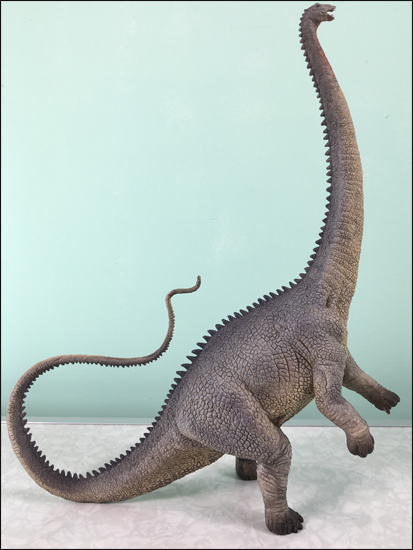
A Model of a Rearing Diplodocus Dinosaur

CollectA rearing Diplodocus (grey). Research into Diplodocus feeding habits.

The CollectA rearing Diplodocus dinosaur model in the elephantine colour scheme. Picture credit: Everything Dinosaur.

Picture credit: Everything Dinosaur

The picture (above) shows a CollectA Age of Dinosaurs Popular Diplodocus figure.

To view this range available at Everything Dinosaur: CollectA Age of Dinosaurs Popular Models and Figures.

Errol Fuller, one of the people responsible for managing the exhibits to go into the auction commented:

“It’s perfectly legal to bring it from America and legal to move it to any country in the world.  Museum workers will sometimes try to stop these things… but almost every great fossil discovery was made by fossil collectors or dealers.”

The Auction of Fossil Specimens

The auction of specimens such as this have proved controversial.  In May of last year, Everything Dinosaur reported on the seizure of a Tarbosaurus fossilised skeleton that had been auctioned in New York.  Allegations that the fossil had been illegally removed from Mongolia were later proven.  The fossil was recently repatriated to its country of origin.

To read more about the Tarbosaurus skeleton being seized: Tarbosaurus Fossil Seized by U.S. Authorities.

Another high profile auction of fossils is due to take place just a few days before the Diplodocus goes under the hammer.  Bonhams (New York), on the 19th November will be overseeing the auction of a chasmosaurine dinosaur and a suspected Nanotyrannus, a lot which has been entitled the “duelling dinosaurs”.  In this case, the fossils originate from Montana.

To read more about the “duelling dinosaurs” auction: “Duelling Dinosaurs” likely to set World Record at Auction.

Let’s hope that whatever, the outcome, the fossils and other artefacts that are part of this auction are made available for further study should the need arise.

13 10, 2013

Ancient Mosquito Fossil with Blood from its Victim Preserved

By |2023-02-27T13:34:55+00:00October 13th, 2013|Categories: Dinosaur and Prehistoric Animal News Stories|0 Comments

A First for Biology – Blood Meal of an Insect Found Intact in a Fossil

In the steamy swamplands of what was to become the north-western part of the United States forty-six million years ago a tiny, insignificant event took place.  An event which had been replicated in that area hundreds, perhaps thousands of times that day.  A tiny mosquito used its needle-like proboscis to penetrate the skin of a vertebrate and took a meal of blood from its victim.  Nothing remarkable about that you might say, but what happened next gave the opportunity for scientists to comment on this incident forty-six million years later.

Ancient Mosquito Fossil

The tiny midge, for some reason stalled in its flight over a body of water.  Perhaps a sudden gust of wind forced the insect to crash land onto the surface of a pond.  The mosquito quickly sank to the bottom, remarkably its body remained intact and it was quickly buried, preserving it and its distended abdomen filled with blood.  The insect was fossilised and researchers exploring these Palaeogene deposits that now make up part of a mountainside in the state of Montana (USA), were able to view the tiny fossilised insect and postulate that the distended body contained the remains of its last meal.

A Window into the Past, The Preserved Mosquito Fossil

Mosquito fossil with potentially preserved blood in its abdomen.

Mosquito fossil with potentially preserved blood in its abdomen.

Picture credit: Smithsonian Institute/Dr Dale Greenwalt

Blood Preserved in Insects Trapped in Amber

It might sound like something that the author Michael Crichton would have written about.  Mr Crichton wrote “Jurassic Park”,  a story of the failed attempt to open a dinosaur theme park with the Dinosauria being resurrected by genetic manipulation of blood preserved in the bodies of insects trapped in amber.  Fanciful stuff perhaps, but a paper in the academic journal “The Proceedings of the National Academy of Science” outlines the study of this beautifully preserved fossilised insect, potentially evidence of the oldest blood yet found in the fossil record.

For models and replicas of prehistoric invertebrates and other extinct creatures including dinosaurs: CollectA Age of Dinosaurs Popular Models.

Retired Dr Dale Greenwalt collects and studies insect fossils from the Montana deposits on behalf of the Smithsonian institute.  The fossils, were discovered in fine grained shales that had been collected many years before and placed in storage.  The female mosquito (only females feed on blood), had been trapped and nearby the remains of a second mosquito, this time most probably a male, was discovered.  Using two different types of light-refracting x-rays that determine what chemicals are present along with advanced, non-destructive mass spectrometry analysis Dr Greenwalt and his colleagues determined that the female mosquito’s abdomen was full of iron, a major feature of blood that gets oxygen to the rest of the body.

Iron levels were higher than elsewhere in her body and no significant levels of iron were identified in the non-biting male mosquito fossil that was used as a control.  The scientists also found evidence of porphyrins, organic compounds that play an important role in blood formation and helping to bind the iron within the blood.  These two substances found together makes a “definitive case for blood” according to the researchers.

A “Definitive Case for Blood”

If this is proven to be true, the tests being verified, then this little mosquito preserves the oldest sample of blood known to science.

But where did the blood come from?  Could it be a dinosaur?  Sadly, most definitely not, the last of the Dinosauria became extinct some twenty million years before the mosquito hatched.  The blood will have come from a vertebrate, most likely a bird according to Dr Greenwalt.

Dr Mary Schweitzer (North Carolina State University), a leader in the research to find microscopic soft tissues preserved in fossils, including the possibility of blood remnants associated with dinosaur fossils from the Hell Creek Formation of Montana, commented that whilst the study was exciting and significant, the research was in its preliminary phase and more work needs to be done to prove the conclusion by ruling out all other possibilities for the unexpected results showing iron concentrations and the possibility of other preserved organic compounds such as the suspected porphyrins.

Dr Greenwalt stated:

“The existence of this rare specimen extends the existence of blood-feeding behaviour in this family of insects 46 million years into the past.”

Blood feeding, otherwise known as haematophagy, occurs in approximately 14,000 living insect species including fleas, ticks and modern mosquitoes.  These fossils are so well preserved that the scientists have been able to name them as two new species of insect.  The female has been named Culiseta lemniscata, the male mosquito has been named as Culiseta kishenehn.  Next time you get bitten by a midge, think on, that incident might, just might, lead to your blood being preserved for forty-six million years or so.

9 10, 2013

Update on “Wade” the Amazing Aussie Dinosaur

By |2024-05-01T15:12:54+01:00October 9th, 2013|Categories: Dinosaur and Prehistoric Animal News Stories|0 Comments

Working on a Titanosaur – It’s a Colossal Job!

The number of huge titanosaurs (long-necked dinosaurs), known from Australia is likely to dramatically increase over the next few years as palaeontologists get to grips with the huge amount of dinosaur fossil material that is currently being studied, most of which originates from Australia’s unofficial dinosaur capital, Winton (Queensland).  Although, only a handful of titanosaurs have been named and described to date, scientists studying fossils excavated over the last ten years or so are confident that many more sauropods will soon be added to the list of dinosaurs known from down-under.

“Wade” the Aussie Dinosaur

Palaeontologist Stephen Poropat, (Uppsala University, Sweden) presented a paper detailing the research work last week in Adelaide, at the fourteenth biennial Conference of Australasian Vertebrate Evolution, Palaeontology and Systematics.  He commented on the discovery of the pelvis and dorsal vertebrae of a new titanosaur, one of the most complete large dinosaur fossil founds ever made in north-eastern Australia.

The palaeontologist stated:

“There have been about seventeen dinosaurs named from Australia, many of them are just represented by single bones.  But with this one, all of the vertebrae are very close, sitting just in front of the pelvis.  It’s definitely one animal.”

From Winton in Queensland

This dinosaur has been given the nickname of “Wade” and so many fossils have been found in the Winton area of Queensland the field workers have a very difficult jog of mapping sites and keeping up with all the developments, as reported by Everything Dinosaur in 2008.

To read the article: Trying to Keep Up with Aussie Dinosaur Excavations.

The titanosaur known as Wade was first excavated back in 2005 by a joint team of scientists from the Australian Age of Dinosaurs Museum (Winton) and the Queensland Museum.  The size and delicate nature of the fossil material has meant that it has taken eight years to get the fossils fully prepared and restored.  Wade has some unique features for a titanosaur.  Titanosaurs generally leave wider tracks than those of equivalent sized diplodocids, but Wade has extremely wide hips, even for a titanosaur so this suggests a big animal with massive proportions, resulting in much wider track ways – were any trace fossils of this nature to be discovered.

The first metacarpal bone (part of the thumb) of this dinosaur is much more robust when compared to other titanosaurs.  This supports the hypothesis that Wade was an enormous dinosaur, the enlarged thumb would have helped to support the animal’s great weight as it slowly crossed its Cretaceous homeland.

With the bones having been prepared, Stephen and his team can begin the job of comparing this specimen with the fossilised bones of already named and described titanosaurs to try to establish anatomical relationships.

Stephen commented:

“What I’m doing is looking at new and old specimens, trying to get a good idea of how the fauna changes over time.”

A spokesperson from Everything Dinosaur stated:

“The substantial amount of fossil material found in this single location may well represent a single individual, this permits scientists the opportunity to learn so much more about this dinosaur, when compared to just having individual bones to study.”

Diamantinasaurus and Wintonotitan

Two already described titanosaurs, Diamantinasaurus (nicknamed Matilda), Wintonotitan (nicknamed Clancy) and “Wade” all existed at around the same time and in the same area indicating a rich and verdant environment. Certainly, the ecosystem would have had to be exceptionally rich to sustain such a range of giant herbivores.

Examining the Vertebrae – Getting to Grips with Titanosaurs

A "Titanic" jigsaw puzzle.

A “Titanic” jigsaw puzzle.

Picture credit: (Credit: Judy Elliott/Australian Age of Dinosaurs Museum)

Postdoctoral Research Fellow, Stephen Poropat examining the titanosaur fossil bones.

The scientists are also hoping to explore the phylogenetic relationships between the Australian titanosaurs and their prehistoric counterparts for South America and Africa.  Phylogeny is the study of evolutionary relationships between organisms.  Wade may well shed new light on the evolutionary relationships of Gondwanaland’s biggest residents.

An Illustration of a Typical Titanosaur

An illustration of a typical Titanosaur.

An illustration of a typical titanosaur.

Picture credit: Everything Dinosaur

For models and replicas of titanosaurs and other prehistoric animals: CollectA Prehistoric Life Models.

7 10, 2013

Royal Mail Issues New Prehistoric Animal Stamps

By |2023-02-27T07:47:49+00:00October 7th, 2013|Categories: Dinosaur and Prehistoric Animal News Stories, Dinosaur Fans|12 Comments

British Prehistoric Animals are First Class – Official

They may have been delayed but in just a few days time Royal Mail will unleash a set of commemorative stamps celebrating two hundred years of prehistoric animal studies in the United Kingdom.  Ten first class stamps are being introduced on Thursday October 10th featuring Mesozoic creatures whose fossilised remains are associated with strata found within the UK.

The stamps which showcase the artwork of that renowned palaeo-artist John Sibbick have been designed to show some of the animals “breaking out” from their self adhesive stamp frames.  The stamps have been produced under the guidance of palaeontologists from the Natural History Museum, including the wonderful Angela Milner, Dr Milner, along with Alan Charig, her colleague at the Natural History Museum (London), named and described Baryonyx, one of the dinosaurs featured in the set.

Prehistoric Animal Stamps

Royal Mail Prehistoric Animal Stamps

A set of first class stamps.

A set of first class stamps.

Picture credit: Royal Mail

When asked about the release of these new first class stamps, Andrew Hammond, Director of Stamps and Collectibles, Royal Mail, stated:

“Britain has played an important role in the discovery of dinosaurs for over 200 years and our Dinosaurs issue is a fitting tribute to these creatures.”

British Prehistoric Animals

The list of extinct animals portrayed is as follows: Baryonyx, Polacanthus, Iguanodon, Cetiosaurus, Megalosaurus and Hypsilophodon.  These six are dinosaurs, the other four remaining stamps feature reptiles but certainly not members of the Dinosauria.  There are two marine reptiles Ichthyosaurus and the long-necked Plesiosaurus. There are also two pterosaurs (flying reptiles) depicted, Dimorphodon and the much later and larger Ornithocheirus.

19th and 20th century academics and scientists based in the United Kingdom have made significant contributions to the nascent branches of the Earth sciences now known as palaeontology and geology.  We at Everything Dinosaur are delighted to see such wonderful extinct animals such as the armoured Polacanthus and the mighty long-necked Cetiosaurus featured on a set of stamps.

 Iguanodon and the “Whale Lizard” Cetiosaurus are Featured

dinosaurs featured in stamp set.

Dinosaurs featured in stamp set.

Picture credit: Royal Mail

“British Dinosaurs”

However, we do take issue with some of the inaccuracies regarding the prehistoric animals featured that have been included in various press releases and web sites from Royal Mail.   We at Everything Dinosaur, have pointed out that it is not appropriate to call this stamp set “British Dinosaurs”.  It could be argued that a number of the animals featured are associated with fossil remains found elsewhere within Europe as well as the United Kingdom, but our main bugbear lies in the fact that 40% of the set are not actually dinosaurs.  Yet these stamps are being constantly referred to as “British Dinosaurs” or “Dinosaur Stamps”, these titles are inaccurate.

The stamp set was originally scheduled for release last year, to mark the centenary of the publication of  “The Lost World”, a novel by Sir Arthur Conan Doyle that tells the story of an exhibition to South America  led by Professor Challenger that discovers a whole host of prehistoric animals surviving on a remote plateau.  Ironically, a number of animals featured on the stamps such as the Iguanodon along with the pterosaur Dimorphodon and the marine reptiles are featured in this book.

Prehistoric Animal Stamps – Baryonyx and a Plesiosaurus

British prehistoric animals beautifully illustrated.

British prehistoric animals beautifully illustrated.

Picture Credit: Royal Mail

The South American spinosaurid Irritator, a dinosaur from the same branch of the Theropoda family tree as Baryonyx has a link to Sir Arthur Conan Doyle’s novel.  The specific name for Irritator (Irritator challengeri) is a reference to Professor Challenger, the central character in the book.

Polacanthus and Dimorphodon

Polacanthus and Dimorphodon

Polacanthus and Dimorphodon.

Picture Credit: Royal Mail

Inaccurate Information

Some of the information that accompanies images of these ten stamps that we have viewed on various websites and other media, including those under the domain of Royal Mail contain other factual errors.  For example, in the information surrounding the Baryonyx stamp it is claimed that this animals was named and scientifically described in 1987,  however, we at Everything Dinosaur have always believed that this dinosaur was named and described a year earlier.

Ichthyosaurs Make a Splash Along with Hypsilophodon

New stamps celebrate prehistoric animals.

New stamps celebrate prehistoric animals.

Picture credit: Royal Mail

The final pair of stamps we are going to illustrate on this blog posting features the fearsome carnivore Megalosaurus and the Early Cretaceous pterosaur called Ornithocheirus.  All these stamps will be available later on this week along with souvenir collectors packs, a wall chart and other items marking our continuing fascination with all things prehistoric.

Ornithocheirus and Megalosaurus

Magnificent British prehistoric animals.

Magnificent British prehistoric animals.

Picture credit: Royal Mail

These stamps are worth collecting not least because of  Mr Sibbick’s beautiful artwork.

A spokes person from Everything Dinosaur stated:

“It is disappointing to note some of the misleading statements that have been made in association with these fine stamps.  Ironically, our experts at Everything Dinosaur have researched and written a fact sheet on all of the prehistoric animals featured in this set.  Perhaps, we can assist philatelists who want to get a little more information on these wonderful Mesozoic creatures.”

For models and replicas of many of the prehistoric animals that are featured in the set: Dinosaur and Prehistoric Animal Models.

4 10, 2013

Articulated Dinosaur Tail Found by Pipeline Construction Team

By |2023-02-24T10:36:44+00:00October 4th, 2013|Categories: Dinosaur and Prehistoric Animal News Stories|0 Comments

Articulated Caudal Vertebrae of a Hadrosaur Uncovered in Alberta

A construction worker excavating using a mechanised digger got a bit of a surprise when his back hoe smashed through a piece of rock revealing a set of dinosaur bones.  The worker, a member of a construction crew digging a pipeline on behalf of Tourmaline Oil Corporation, uncovered what appears to be the articulated tail bones of a hadrosaur (duck-billed dinosaur), a member of the ornithischian group of dinosaurs that roamed north-western Alberta around seventy-five million years ago.

Articulated Dinosaur Tail

Although some news reports have claimed that the fossilised caudal vertebrae indicate a reptile more than one hundred feet long, these claims are erroneous, with most palaeontologists, including those from the Royal Tyrrell Museum at Drumheller (Alberta), that were called in to examine and excavate the fossils, estimating an overall body length of around ten metres or so.  Work on the pipeline has been halted to permit the scientists to map and examine the site to see if they can find further evidence of this herbivorous dinosaur.

Recently, Everything Dinosaur team members reported the discovery of another hadrosaurid dinosaur articulated vertebrae from Mexico.

To read more about this discovery: The Tale of a Hadrosaur’s Tail.

Alberta is Famous for Dinosaur Fossils

Although, the Canadian province of Alberta is famous for its Late Cretaceous dinosaur fossils, the discovery of articulated caudal vertebrae (tail bones) is an exceptionally rare event.  Hopefully other elements of the skeleton will be uncovered, as trying to identify the genus from just the caudal vertebrae may prove to be exceptionally difficult.  Post cranial skeleton material, elements such as the caudal vertebrae are relatively uniform in hadrosaur fossils, however, if parts of the skull can be found then a stab at identifying the genus or even the species can be made.

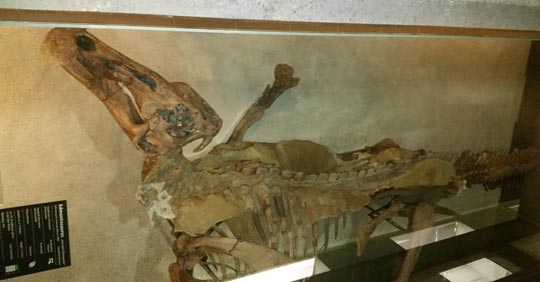
The Fossilised Remains of a Hadrosaur (Edmontosaurus)

Edmontosaurus fossil exhibit.

The Edmontosaurus exhibit at the Frankfurt Natural History Museum. Picture credit: Everything Dinosaur.

Picture credit: Everything Dinosaur

To view models and replicas of hadrosaurs and other dinosaurs: CollectA Deluxe Prehistoric Animal Figures.

A spokesperson from Everything Dinosaur commented that if other parts of the backbone can be found then the presence of tall spines (neural processes) could indicate that the remains are that of a lambeosaurine hadrosaurid known as Hypacrosaurus, which is known from several specimens excavated from Upper Cretaceous strata of Alberta.

Go to Top