All about dinosaurs, fossils and prehistoric animals by Everything Dinosaur team members.

Fossil finds, new dinosaur discoveries, news and views from the world of palaeontology and other Earth sciences.

23 11, 2013

Unravelling the Apex Predators of the Cretaceous – Before Tyrannosaurs

By |2023-03-01T13:47:13+00:00November 23rd, 2013|Categories: Dinosaur and Prehistoric Animal News Stories|2 Comments

Siats meekerorum – The Carcharodontosaurid that Kept the Tyrannosaurs in Check

The trouble with dinosaur fossils is that there is most certainly not anything like a record of dinosaur evolution and development throughout their time dominating terrestrial environments.  True, palaeontologists have been able to build up a remarkable degree of knowledge and some ancient ecosystems are quite well understood.  This said, we really have only the merest glimpse of the Dinosauria, or indeed of other terrestrial vertebrates for much of the Mesozoic.  Take for example, the United States.

Dinosaurs from the USA

A tremendous amount of dinosaur fossil material has been discovered and indeed thanks to the likes of the Morrison Formation, scientists have been able to build up a detailed impression of life in the Late Jurassic.  With the wonderful Dinosaur Park Formation of Alberta, palaeontologists have an insight into an ecosystem from the Campanian faunal stage of the Cretaceous.  The likes of the Badlands and Hell Creek have provided evidence of the dinosaur fauna that roamed at the very end of the Cretaceous period, but what about all the bits in between?

Apex Predators

Take for example, the issue of apex predators.  Allosaurids such as Allosaurus fragilis and Saurophaganex maximus may have been the largest meat-eating dinosaurs in the western United States during the Late Jurassic whilst the tyrannosaurids such as Daspletosaurus (D. torosus) and the recently described Lythronax argestes topped the predator tree towards the end of the Age of Dinosaurs.  Of course, thanks to the Hell Creek Formation, we can be fairly certain that at the very end of Cretaceous the likes of T. rex ruled.

Siats meekerorum

Step forward Siats meekerorum,  a newly described apex predator that roamed Utah approximately 98 million years ago.  Here is evidence of an apex predator, a dinosaur approaching perhaps 3,000 kilogrammes in weight and at least ten metres long, possibly the apex predator in this part of the world during the Cenomanian faunal stage.

Terror of the Tyrannosaurs – Siats meekerorum

Fearsome Cenomanian predator.

Picture credit: Jorge Gonzales

New Dinosaur Discovery

This new dinosaur discovery, (recently new that is, as the fossils were found in 2008), may help explain a mystery surrounding the tyrannosaurs of northern latitudes.  Although, this particular group of meat-eating dinosaurs had their origins back in the Jurassic, they seem not to have grown really big and become apex predators until towards the end of the Cretaceous.  Dinosaurs such as the fearsome Siats meekerorum, pronounced see-atch me-ker-roar-rum, may be the reason why.

Scientists from the Field Museum (Chicago), North Carolina State University and the North Carolina Museum of Natural Sciences, set about exploring the strata in the Cedar Mountain Formation of Utah.  The team’s work, published in the academic journal “Nature Communications” outlines the discovery of a carcharodontid dinosaur, one that was around ten metres in length and a candidate for the top predator position in this part of the western United States around 98 million years ago.

A Partial Specimen

The partial specimen, consisting of elements from the pelvis, a femur, fragmentary lower leg bones, toe bones and some vertebrae including caudal vertebrae represents only about 4% of the entire skeleton but from this largely disarticulated and scattered material, the researchers were able to determine that they had found evidence of a formidable predator.  This dinosaur gets its genus name from Siats, a mythical man-eating monster from local, Native American tribal legend.

The species name honours the Meeker family for their long-term financial support of the palaeontology department of the Field Museum.  It was Lindsay Zanno (Director of Palaeontology at the North Carolina State University/North Carolina Museum of Natural Sciences), who made the discovery.  It took two summer expeditions to carefully remove the fossil material and prepare them in the laboratory.

Carcharodontosauridae Family

Siats meekerorum has been classified as a member of the Carcharodontosauridae family, a group of large to gigantic carnosaurs with strong affinities to the allosaurs which lived in the Western Hemisphere, Europe, Africa and Asia.  Little is known about the majority of the members of the Carcharodontosauridae family, but one thing is for sure, a number of them were massive, bigger than Tyrannosaurus rex and potentially amongst the largest terrestrial predators that have ever lived.

Siats meekerorum is only the second member of this dinosaur family to have been discovered in North America.  The first carcharodontosaur was Acrocanthosaurus atokensis, fossils of which have been found in Maryland, Texas and Oklahoma.  It has been estimated that the fossils of S. meekerorum are ten million years younger than those of the youngest Acrocanthosaurus material, thus the carcharodontosaurids existed in North America later than previously thought.

A Model of Acrocanthosaurus (A. atokensis)

Fierce meat-eater – the dinosaur Acrocanthosaurus.

Picture credit: Everything Dinosaur

Acrocanthosaurus

Remarking on the fact that Acrocanthosaurus was named and described back in 1950 Dr Zanno stated:

“It’s been sixty-three years since a predator of this size has been named from North America.  You can’t imagine how thrilled we were to see the bones of this behemoth poking out of the hillside.”

Dr Peter Makovicky, from the Field Museum of Natural History assisted Dr Zanno in the collection, and study of this fossil material.  The researchers were able to establish that although the fossil bones represented an individual over ten metres in length, and perhaps weighing as much as 3,000 kilogrammes, this dinosaur was not fully grown when it died.  Analysis of the partial femur that was excavated reveals that had the bone been complete, it would have been only about ten centimetres smaller than that of Acrocanthosaurus, so it could be speculated that when fully grown Siats meekerorum may have matched the early carcharodontosaurid Acrocanthosaurus in size.

A spokesperson from Everything Dinosaur commented:

“Size estimates for A. atokensis vary, but most palaeontologists agree that this dinosaur may have reached lengths in excess of twelve metres and perhaps weighed 4 tonnes or more.  Although, slimmer and more lightly built than the very last of the tyrannosaurs these meat-eaters were formidable predators and it is quite likely that a fully grown Siats meekerorum would have been around twelve metres in length too.  This means that S. meekerorum is vying with Acrocanthosaurus for being the second largest Cretaceous theropod dinosaur discovered in North America.”

Representing Different Subfamilies

Although Siats and Acrocanthosaurus are both members of the Carcharodontosauridae family, they represent different sub-families.  There is a lot of debate with regards to the taxonomic affinities of carcharodontosaurs but in this instance, Siats seems to have affinities to the neovenatorids, a sub-family of carcharodontosaurids that are geographically dispersed with fossils found in Europe, South America, China, Japan and Australia.  This is the first neovenatorid known from North America.

For Dr Zanno, who specialises in studying theropod dinosaurs, this discovery helps fill a gap in the apex predators of North America from the allosaurids of the Jurassic, to the earlier carcharodontosaurids such as Acrocanthosaurus, with Siats meekerorum following on before the emergence of the robust, heavy-set tyrannosaurs such as Daspletosaurus, Teratophoneus and Tyrannosaurus rex.

Dr Zanno added:

“This thing is gigantic.  There is nothing even close in this ecosystem to the size of this animal that could have been interpreted as an apex predator.”

Theropod Dinosaurs

There were other theropods in this Cenomanian ecosystem.  Teeth found in the same strata indicate the presence of tyrannosauroids, the distant ancestors of the mighty T. rex.  However, these tyrannosaurs were small-bodied, fast running, cursorial predators and simply no match for Siats meekerorum.  There has been no evidence found in this strata to suggest the presence of an equal sized tyrannosaur challenging the likes of Siats for the apex predator position.

For models and replicas of theropods and other dinosaurs: PNSO Age of Dinosaurs Models and Replicas.

The spokes person from Everything Dinosaur explained:

“Think of Siats meekerorum as the “lion of the Cenomanian” with the much smaller Tyrannosauroids the equivalent of jackals.  Tyrannosaurs may well have fed of the remains of kills but they would have been no match for Siats and probably stayed well clear of such a large carnivore, which was many times their body weight.”

Wary Tyrannosaurs Stay Clear of the Dominant Siats meekerorum
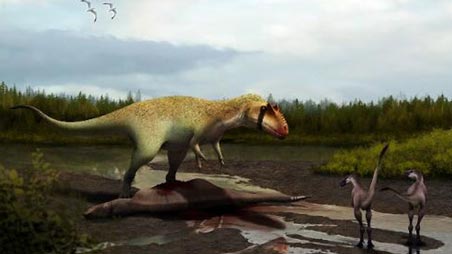
Siats meekerorum has nothing to fear from these two tyrannosaurs.

Picture credit: Julio Lacerdo

The discovery of Siats meekerorum extends the time when allosaurids were present in North America by ten million years.  It also provides evidence of large allosaurs sharing the same environment as small-bodied tyrannosauroids.  This research supports the hypothesis that the extinction of the Allosauridae in terrestrial ecosystems of North America permitted the rise of the tyrannosaurs which went onto become the dominate, apex predators of Late Cretaceous food webs.

It is likely that the presence of such a large carnivorous dinosaur indicates that a very rich faunal ecosystem may have been preserved in the rocks of the Cedar Mountain Formation.  Everything Dinosaur expects announcements of other dinosaur discoveries from excavations carried out, possibly the naming and describing of a number of new herbivorous dinosaur species.
21 11, 2013

Three-Dimensional Printers and Computerised Tomography Reveal Rare Fossils

By |2024-05-02T06:51:38+01:00November 21st, 2013|Categories: Dinosaur and Prehistoric Animal News Stories, Dinosaur Fans|0 Comments

3-D Printing Technology Used to Help Palaeontologists Reveal Fossils Still Inside Protective Plaster Jackets

More and more technology is being employed  by palaeontologists these days and one of the latest tools in the armoury of a palaeontologist is a three-dimensional printer.  In combination with computerised tomography (CT scans), a printer can produce an exact replica of a fossil, even one that is still buried deep inside its protective burlap and plaster jacket.

Computerised Tomography

A team of German scientists have used a 3-D printer to create a copy of a fossil that may have been too delicate to remove from its jacket using conventional methods.  This non-destructive technique opens up a whole new range of possibilities for palaeontology and other branches of the Earth sciences.  The research team used CT scans to create a computerised image of an unidentified fossil bone which is part of the huge natural history collection of the Museum für Naturkunde, based in Berlin (Germany).  The study has been published in the academic journal “Radiology”.

Field teams very often cover fossils that are being excavated in layers of sacking (burlap) and plaster.  This is done to protect the fossil material in the field and in its subsequent transport back to the museum or the preparation lab.  The plaster is carefully applied and then it is smoothed over by hand (surprising how many sharp edges can form on a plaster jacket), these lumps, some of which can weigh hundreds of kilogrammes, are then carefully removed and transported.  Unfortunately, when it comes to removing the fossil from its jacket, this can be very tricky.

3-D Printers

Sometimes the plaster is so strongly bonded to the actual fossil bone that removing the plaster leads to damage of the fossil.  Using the CT scans in combination with 3-D printers enables scientists to find out more information about a specimen without worrying about the removal of the surrounding sediment or plaster.  The fossil is therefore very unlikely to be damaged using such technology.

The “scan and print” method as we call it at Everything Dinosaur is also very time efficient.  It can take weeks, months even years to physically extract a fossil from its surrounding matrix.

The fossil specimen had been housed in a part of the Berlin museum that had been extensively damaged during World War II.  Many of the specimens held by the museum were destroyed in bombing raids, others, like this specimen, ended up as unidentified objects, with researchers not sure as to what material the jackets may contain.  Thanks to the application of this new technology, the research team were able to establish what was inside the plaster block and study the specimen that had been picked out by the powerful X-rays of the CT scan.

CT Scans

CT scans, otherwise known as CAT scans (computerised tomography) were originally conceived in the world of physics, but have applications in all sorts of other branches of science and elsewhere.  This technology is used in medicine, engineering and of course in palaeontology.  The X-rays from the CT scanner can distinguish fossil material from surrounding rock, sediment and plaster jackets as these materials all have different radiation absorption rates (different attenuation).  This permits a computer to plot the data and produce an image in three-dimensions of any object such as a fossil inside a block of burlap wrapped stone.

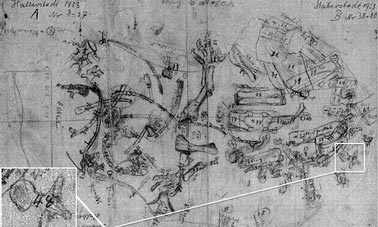
CT scans also provide palaeontologists with information regarding the placement and orientation of a fossil within a block, this can be extremely helpful when it comes to attempting a physical excavation.  Information about the integrity of the fossil can be obtained, even possible fracture lines can be identified.  The object in this study proved to be elements from the backbone, part of the Halberstadt excavations (Germany), a series of digs that took place between 1910 and 1927.

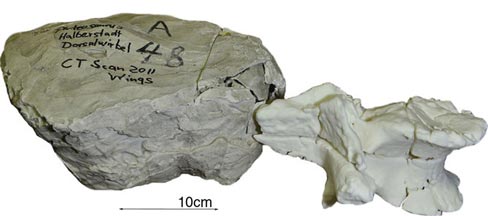
The vertebrae belongs to a Plateosaurus, a lizard-hipped, Late Triassic dinosaur that could have reached lengths in excess of ten metres.  The bones measure approximately 21 centimetres in length and 17 centimetres in diameter at their widest part.

The Original Plaster Jacket and the 3-D Print of the Fossil

Scale bar = 10cm

Picture credit: Radiology and RSNA

The application of this technology is helping the German scientists to sort out which of the unidentified parcels of fossil material belongs to which expedition.  It turns out that this part of the museum that was damaged by bombing, housed fossil specimens collected in Germany and from Tanzania.  The German led expeditions to Tanzania took place between 1909 and 1913, at the time, this was German East Africa.

The fossils collected by these two expeditions were mixed up.  It now seems that 21st Century technology is going to help unravel a mystery surrounding fossilised bones of vertebrates that were collected in some cases more than one hundred years ago.

A Scale Drawing of the Triassic Plateosaurus

Plateosaurus.

Picture credit: Everything Dinosaur

For models and replicas of Triassic dinosaurs and other prehistoric animals: CollectA Age of Dinosaurs Scale Models.

Once the CT images had been produced, the use of a computer allied to a 3-D printer was all that was required to reproduce a model of the object.  Original drawings and diagrams from the expeditions were then used as a source of reference to help confirm the identity of the fossil material.

One of the Original Halberstadt Expedition Illustrations showing the Layout of Fossil Material

A Plateosaurus vertebra is highlighted.

Picture credit: Radiology and RSNA

One of the authors of the research stated that the advances in three-dimensional printing technology means digital models of objects such as fossils can be transferred rapidly among researchers as endless copies can be made.  Reproductions of fossils can be created from digital downloads, this will permit museums to share delicate, fragile fossils very easily.  Very rare and important fossils such as those of early hominids could be made much more accessible, thus facilitating more research and study.

19 11, 2013

D-Day for Remarkable Duelling Dinosaurs

By |2024-05-02T06:50:59+01:00November 19th, 2013|Categories: Dinosaur and Prehistoric Animal News Stories, Dinosaur Fans|0 Comments

Duelling Dinosaurs from Montana – Fossil up for Auction Today

The fossilised remains of two Late Cretaceous dinosaurs that are believed to have died together in mortal combat are due to be auctioned today,  The sale starts at 1pm (Eastern Standard Time), but the duelling dinosaurs, lot number 1032, is just part of an extensive sale of fossil material, everything from crinoids, turtles, fish, marine reptiles and of course dinosaurs.  A number of palaeontologists have attempted to lobby Bonhams of New York,  the auctioneers, in order to delay the sale, but today is the day when science runs the risk of losing a great deal of potentially highly significant fossil material.

Duelling Dinosaurs

The fossils represent a possible specimen of a dwarf tyrannosaur species called Nanotyrannus lancensis, related to Tyrannosaurus rex.  This specimen may represent the best chance scientists are ever going to get to establish whether Nanotyrannus is a separate genus or whether the fossil material represents a juvenile T. rex.  Preliminary investigations suggest that this fossil material is proof that living alongside the larger tyrannosaurs was a lithe and scaled down version of T. rex.  A sort of theropod equivalent of a pocket battleship.

Fossils Up for Auction – Montana’s Duelling Dinosaurs

Going under the hammer.

A Chasmosaurine Horned Dinosaur

The other fossils represent a plant-eating dinosaur, what could be a new to science genus of chasmosaurine horned dinosaur.  The way in which the fossils were found indicate that these animals died together whilst fighting each other, only the second incidence reported in the dinosaur fossil record.  The specimens, discovered in 2006 (Garfield County, Montana), are nearly complete, just about articulated and represent two of the most perfect dinosaur specimens to have been discovered in the famous Hell Creek Formation.  The auctioneers estimate that this lot could fetch in excess of £5.6 million pounds when it goes under the hammer later on today.

A Significant Discovery

The specimens have only been partially prepared, much of the material is still contained in its field jacket of burlap and plaster, but undoubtedly the fossil represent a highly significant find, one that can help scientists to understand more about life in the Late Cretaceous and about predator/prey interactions as the auction lot details goes on to state:

“One of the most valuable features of The Montana Duelling Dinosaurs is the presentation of the dinosaur specimens in preserved taphonomy.  The specimens were removed from the ground in large, plaster-jacketed sections of earth, preserving the spatial relationships in which the bones were found within each block.  This provides, quite literally, fertile ground for scientific study of the individuals, the relationship between the two species, and life during the Cretaceous Age.”

In addition:

“Because the dinosaurs are also articulated, scientists will be able to learn about the anatomy and physiology of both theropods and ceratopsians.  Also of importance is the presence of a leaf horizon directly beneath the two skeletons.”

It is also possible for stomach contents to have been preserved, giving palaeontologists a rare opportunity to examine what ceratopsians and theropods actually ate.  So sad that this auction may result in these specimens being lost to science.

The Duelling Dinosaurs – The Field Jacket can be Clearly Seen in the Photograph

Unique fossils up for auction.

Picture credit: Bonhams (New York)

A Problem with the Auction

The problem is this, if the fossil material ends up in the hands of a private buyer, albeit a very wealthy one, palaeontologists who would want to study the specimens might be denied proper access.  There is also the issue of running into some ethical quandaries, since, if access was restricted then the fossils would not be openly available for others to examine and analyse.

Professor Mike Benton, (Bristol University) explained:

“Nearly all scientific journals require that specimens studied scientifically and published must be freely available for further study by others, and this means an accessible, public collection.  This is a basic tenet of science: the need to make all published work repeatable.”

A spokesperson from Everything Dinosaur added:

“Peer review of published material is not enough in this instance, palaeontologists need to repeat the work, look at the foundation for any conclusions drawn by previous investigations and if necessary, pick apart any arguments made by establishing their own lines of scientific enquiry.

A Close up the Front of the Jaws of the Tyrannosaur

Science goes up for auction.

Picture credit: Bonhams (New York)

High Profile Dinosaur Auctions

This is not the first time dinosaur fossils have been put up for sale at auction, we at Everything Dinosaur have reported on a number of high profile auctions on this blog .  Clayton Phipps, the person responsible for the discovery and for organising the removal of the fossil material did offer this exhibit to a number of museums but none of them could match the sale price and so the fossils have ended up in an auction.  The activities of commercial fossil hunters are important and they can prove to be a very reliable source for new fossil discoveries.  Many of the specimens excavated by private companies and individuals would simply have eroded away to dust without intervention, museums and universities cannot afford to mount expeditions to retrieve all the potential fossil material available.

Let’s hope that this particular auction has a happy ending and that whoever does purchase the fossils, or indeed any of the many hundreds of lots in the sale, they do permit proper scientific access.

News Update:

The duelling dinosaurs lot failed to sell at the auction, this evening (GMT).  It did not reach its reserve price so the future of these fossils remains uncertain.  A spokesperson for Everything Dinosaur who had been monitoring the auction as it progressed in New York, commented that although the fossils attracted a lot of interest, the high reserve price was not exceeded so the lot remains unsold.  It is quite likely that a deal will be done over the next week or so that will see these fossils going to a new home.

13 11, 2013

Scientists Create Detailed Map of the Dinosaur Brain

By |2023-03-01T09:16:07+00:00November 13th, 2013|Categories: Dinosaur and Prehistoric Animal News Stories|1 Comment

Study of the Brains of Alligators and Birds Leads to the Inference that Dinosaurs were Capable of Complex Behaviours

Palaeontologists have got the bones of dinosaurs to study, but it is rare for any soft tissues of dinosaurs to be preserved in the fossil record.  True, scars on bones can provide scientists with information on musculature and ligament placement but it is only through comparative analysis of animals alive today that any understanding of the layout, placement and size of organs of the Dinosauria can be deduced.  For example, much work has been done regarding the study of dinosaur brains, even though no fossilised Dinosauria brain material is known from the fossil record.

Dinosaur Brain

Team members at Everything Dinosaur have been fortunate to work with endocasts of the brains of ancient reptiles.  Endocasts are internal moulds of the brain cavity and other areas of the skull.  By piecing the skull bones carefully together, scientists can work out the size, shape and volume of the spaces left inside.  For example, the shape of some tyrannosaur brains have been calculated using this method.  However, endocasts do not provide much information on the brain’s internal structures or what sort of behaviours dinosaurs were capable of.

Last month, Everything Dinosaur team members reported on the research being undertaken concerning an attempt to map the neural pathways and nerve structure of a Cambrian-aged arthropod fossil that had been discovered in China.

To read more about this research: Ancient Arthropod Brain and Nervous System Revealed.

New Study into the Brains of Dinosaurs

A new study, conducted by a team of international researchers at Duke University in North Carolina (USA), has enabled neuroscientists to create a detailed map of the brain of Theropod dinosaurs.  From this work the team have deduced that these animals were capable of complex behaviours and perhaps even used sounds to communicate with each other just as some birds do today.

Were Dinosaurs Like T. rex Capable of Sophisticated Behaviours?

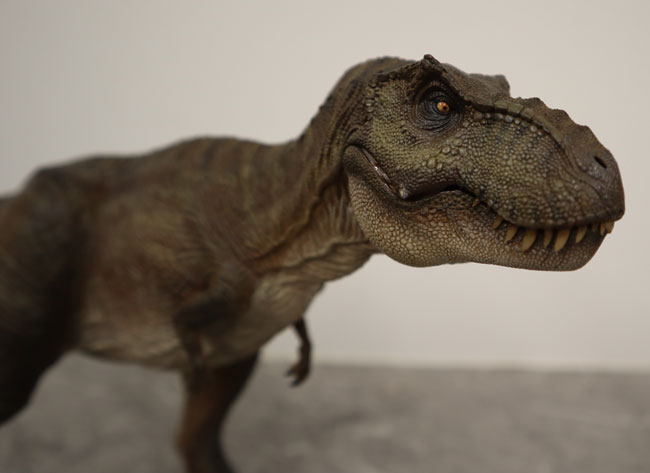
Nanmu Studio T. rex dinosaur model.

A close-up view of the Nanmu Studio Alpha T. rex in the brown colouration.

Picture credit: Everything Dinosaur

To view the Nanmu Studio Jurassic Series range of prehistoric animal models: Nanmu Studio Jurassic Studio Models and Figures.

Dr Erich Jarvis, a neuroscientist and one who specialises in looking at how brain function can help vocalisation and learning commented:

“In the popular mind, dinosaurs may be underrated in the complexity of their behaviour.”

For Dr Jarvis, a lead author of the dinosaur brain study that has just been presented at the Society of Neuroscience meeting in California , added that as soft tissues were rarely preserved in the Dinosauria and that fossilised brain material was unheard of then researchers had to infer dinosaur brain function and morphology by studying extant species that represent close relatives of the dinosaurs.

Capable of Complex Behaviours

Having conducted such a study on alligators and birds it can be inferred that dinosaurs were capable of complex behaviours with parts of the brain specialising in processing visual data, auditory information and assisting with vocalisation.

Asked to comment on the team’s findings, Dr Jarvis said that amongst other skills, dinosaurs had sufficient brain complexity to communicate with sounds but, “did it really happen?  That we do not know.”

To gain an insight into how dinosaurs thought and communicated, the U.S. based research team studied the brains of alligators, as crocodilians are thought to be the most closely related to the dinosaurs of all the types of living reptile today. In addition, the scientists analysed the brains of birds.

Studying the Brains of Crocodilians and Birds

Birds are essentially avian dinosaurs, the Aves being very closely related to parts of the theropod group of the Dinosauria.  From the work on extant creatures the team could piece together an approximation for a typical theropod dinosaur brain and infer its capabilities.

Using a technique that involves mapping gene activity in different parts of the brain as the animal is subjected to certain stimuli, the researchers were able to gain an insight into the function of alligator brains and those of birds.  From this work the map of the dinosaur brain was re-created.  Some genes are permanently on in the brain, whilst others are only switched on in response to certain stimuli, for example, some genes are only activated for a fraction of a second in response to sounds, particularly in that part of the brain associated with the hearing function and interpretation of sounds.

Examining the Auditory Regions of the Brain

To plot  the auditory regions of the brain, Dr Jarvis and his team quietened the animals down in a darkened room and then played bird songs to birds and alligator calls to the alligators.  The team then swiftly removed their brains, froze them, sliced them, and looked at the genes that had switched on in different regions.  Naturally, this was what we palaeontologists term a “destructive” form of research, unfortunately the animals had to be killed before the second phase of the research could be undertaken.

The genetic data that had been retained in the brain slices enabled the research team to make highly detailed maps of the bird and the alligator brains.  They could work out how the brain was organised and which parts had been stimulated by the earlier experiments.  Using the bird and alligator models as templates, the researchers created an amalgam of the two to represent the brain of a typical theropod dinosaur using endocasts from Tyrannosaurus rex and a Late Jurassic theropod called Allosaurus fragilis.  In addition, the bird brain of Archaeopteryx lithographica was re-created.

Six Distinct Regions Identified

The result of this research enabled the scientists to identify six distinct regions within the dinosaur’s brains and a similar structure in that of the early bird Archaeopteryx.  One of these regions, called the mesopallium, would have been involved in processing complex data, given the Dinosauria the capacity for sophisticated behaviour.

An Endocast of the Brain of Archaeopteryx (A. lithographica)

The brain cast of Archaeopteryx lithographica, one of the earliest known birds, partitioned into neuroanatomical regions: brain stem (yellow), cerebellum (blue), optic lobes (red), cerebrum (green), and olfactory bulbs (orange).

Picture credit: AMNH/Dr. Balanoff

Dr Jarvis explained:

“It suggests that the dinosaur brain had the capacity for complex sensory motor processing, just like we see in birds and alligators.”

However, whilst a large number of today’s birds, the passerines (perching birds), have the ability to produce very complicated vocalisations and even learn shared “songs”.  It can only be inferred that members of the Dinosauria were also able to do this as all the brain sub-divisions that support such vocal learning seem to present.

Dr Jarvis, went onto to state:

“We don’t have any evidence that there was a dinosaur out there that did this, that shared vocal learning with songbirds.  But all the brain subdivisions to support vocal learning are there, so I’d argue the capacity to evolve vocal learning did exist in dinosaurs.”

Crocodiles have some of the most sophisticated and complex behaviours of all the reptiles known today.  Certainly, male Alligators (Alligator mississippiensis) are capable of making very loud noises as they ward of rivals and call to attract a mate in the breeding season, perhaps Tyrannosaurus rex did something similar.

11 11, 2013

DNA Study Suggest “Man’s Best Friend” Domesticated in Europe

By |2023-03-01T09:04:35+00:00November 11th, 2013|Categories: Animal News Stories, Dinosaur and Prehistoric Animal News Stories|0 Comments

European Origin of “Domesticated Dogs” At Least 18,000 Years Ago

The results of an extensive study of wolves and domesticated dogs including analysis of fossil material has led a team of scientists to conclude that dogs were first domesticated in Europe.  The likes of Charles Darwin did not know, after all, genetics was a branch of science that was unknown to the co-author of the theory of natural selection (Darwin and Wallace jointly presented their ideas in 1858 to the Linnean Society), but it is now widely accepted that all domesticated dogs are descended from the Grey Wolf (Canis lupus).  Just when dogs became a part of people’s lives and started to work in partnership with humans is a hotly debated subject.

Domesticated Dogs

The emergence of a form of “domesticated” dog has now been mapped and this new study points to an origin from Europe and at least 18,000 years ago.  It all depends on where you are in the world as to whether 18,000 years ago is classed as the Mesolithic “Middle Stone Age” or the Old Stone Age (Palaeolithic), as these time periods are defined by the development and use of tools and other artefacts by indigenous populations, either way, mankind’s relationship with dogs goes back a very long way.

The team of researchers from Turku University (Finland) have somewhat “muddied the waters” when it comes to assessing when and where dogs began to have a much closer relationship with our own species.  Earlier studies had indicated that wolves began to attach themselves with human settlements in the Middle East or perhaps in the near Asia region as recently as 15,000 years ago.

This new data, based on the DNA samples, pushes our relationship with “man’s best friend” further back into prehistory and locates the first domestication as being in Europe.

Scientists Looked at Fossil Evidence from Dogs Buried Close to Human Settlements

Analysis of DNA may hold the key to unravelling the mystery of dog domestication.

Examining Fossil Evidence

However, fossil evidence has challenged this earlier research and indeed, a remarkable excavation site in southern Siberia, dated to around 33,000 years ago (definitely Palaeolithic but who’s counting), puts the date of dog domestication, or at least descendants of wolves having a close relationship with mankind, much further back in time than even this new Finnish study suggests.

To read an article about the discoveries from the southern Siberian dig site: It’s a Dog’s Life!

Studying Mitochondrial Genomes

One of the problems associated with trying to identify exactly where and when dogs began to live alongside humans is that palaeontologists have found some distinctly dog-looking fossil evidence in various sites around both the Old and the New World.  For this research, the scientists looked at the mitochondrial genomes from present-day dogs and wolves, as well as from eighteen fossil Canids, whose remains date from between 1,000 and more than 36,000 years old.

Dr Olaf Thalmann (Turku University) and his colleagues used genetic sequences from a wide range of fossil and extant sources in order to gain an understanding of the great diversity of dog breeds around today and how they relate to the remains of dogs excavated from various fossil sites.  The analysis revealed that modern dogs are most closely related to ancient European wolves or dogs, they are not closely related to any of the wolf groups from outside Europe.  Intriguingly, the research suggests that domesticated dogs have a link with a strain of ancient European wolf, one that is extinct.

When Did Dogs Become Domesticated?

The proposed “start point” for domestication going back beyond 18,000 years is certainly fascinating.  It suggests that dogs began to separate out of wolf populations when our species was nomadic.  Dog domestication may actually have occurred long before we began to settle in farming communities.  It seems that dogs may have come “walkies” with us when we were very much hunters and gatherers.

A spokes person from Everything Dinosaur commented:

“Both wolves and ourselves are diurnal hunters, perhaps the wolves that were the ancestors of the first domesticated dogs followed human hunting trips, to feed off the scraps that we left behind from the hunting of large, herbivorous mammals like Elk, Ox, Mammoth and Woolly Rhino.  Or indeed, it could have been the other way round with human hunting parties scavenging the kills of wolf packs.”

Wolves and Humans

Over time, wolves and humans began to tolerate each other’s presence and the first steps on the long road to mutual co-operation and subsequent domestication were taken.

Explaining some of the reasoning behind the team’s work, Dr Thalmann stated:

“You can see how the wolves benefitted from living near humans because they got to the carcases, but humans too would have benefitted.  You have to remember that 18,800 to 32,000 years ago, Europe had much bigger predators than even the wolves, animals such as bears and hyenas.  You can imagine that having wolves living close to you might prove to be a very useful alarm system.  It is a plausible scenario for the origin of the domestication of dogs.”

The precise details surrounding the origin of today’s domesticated canine remain unclear.  The genetic markers that can be traced are extremely difficult to interpret, not helped that due to mankind’s movements, dog populations have become very mixed over time.  In addition, it seems that some populations of dogs may have back-bred with wild wolves causing further confusion.  This particular study and indeed, the majority of the earlier studies, relied on so-called mitochondrial DNA (mtDNA), a small sub-packet of genetic material in cells that is normally passed down through the generations solely on the maternal line, although incredibly useful,  mtDNA does not represent the fullest information possible.

The much larger DNA retrieved from the cell nucleus (nuclear DNA), could provide a lot more genetic information, but the DNA’s poor preservation ability, the risk of cross-contamination and the difficulty of retrieving substantial amounts from fossils are formidable barriers to progress.

Published in the Journal “Science”

The findings of this research, published in the academic journal “Science”, suggest that an ancient, extinct central European population of wolves gave rise to the domestic dog.  In addition, evidence from the mtDNA indicates that several other types of ancient dog found in the fossil record may represent ultimately doomed previous domestication attempts.   If enough nuclear DNA is recovered from the fossil record, a clearer understanding of our relationship with dogs can probably be obtained, but for the moment it looks like the origins of today’s pets and working dogs are in central Europe and the bond between man and dog goes back into the Palaeolithic.

Visit Everything Dinosaur’s award-winning website: Visit Everything Dinosaur.

10 11, 2013

Alberta – Dinosaur Hotspot and Rare Fossils

By |2024-05-01T15:17:45+01:00November 10th, 2013|Categories: Dinosaur and Prehistoric Animal News Stories|0 Comments

Second Major Dinosaur Fossil from Alberta in a Month

Residents of Leduc, a town approximately eighty miles north of Drumheller (Alberta) and just about ten miles to the south of the Province’s capital Edmonton, have found themselves very much on the palaeontological map of Canada with the discovery of duck-billed dinosaur fossils.  Construction workers from a company called Degner Construction, who were digging a trench as part of the ground works for a new housing development, uncovered the dinosaur remains, believed to be Hypacrosaurus.

Dinosaur Fossil

Experts from Drumheller’s Royal Tyrrell Museum were despatched to confirm the discovery.  This is the second major dinosaur fossil find in about a month from Alberta, as in October, Everything Dinosaur reported the discovery of the tail of another duck-billed dinosaur (hadrosaur), on that occasion by a team of construction workers building a pipeline.

To read more about the October discovery: Pipeline Workers Find Dinosaur Fossils.

Articulated Hadrosaur Fossils

The fossils, some of which are articulated, are lying approximately six metres below the surface, a preliminary examination has revealed the presence of caudal vertebrae (tail bones) and part of the pelvic girdle.

Heather Klimchuk, the Minister of Alberta Culture commented:

“This tremendous find will give us an event greater insight into the dinosaurs that lived in central Alberta.  Alberta’s ability to be successful in preserving and protecting valuable palaeontological resources depends on the co-operation of industry as well as the general public.  Degner Construction is to be commended for recognising and taking the right steps to alert the Royal Tyrrell Museum.”

With the Museum staff supervising, the construction crew were able to use a large excavator to carefully remove topsoil and some of the overlying rock.  Then with great care, the block of sediment containing the fossil remains was removed and transported back to Drumheller for study.

Block Containing Fossils Safely Removed

Leduc’s Deputy Mayor, David Mackenzie stated:

“Leduc will now be acknowledged in the natural history of Alberta in a significant way and we’re pleased future generations of Albertans can benefit from this exciting discovery.”

There is nothing like a major dinosaur fossil discovery to put a place firmly on the map.  Many of the Province’s construction projects will be closed down shortly with the onset of the harsh Canadian winter.

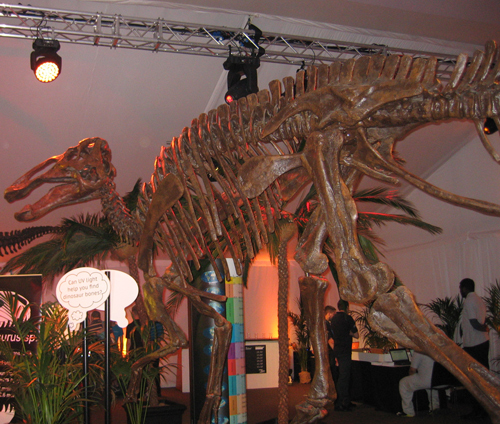
A Hadrosaur Fossil Skeleton on Display (Edmontosaurus)

Edmontosaurus skeleton.

Duck-billed dinosaur on display similar to the fossils found by the construction workers. Picture credit: Everything Dinosaur.

Picture credit: Everything Dinosaur

For models and replicas of Albertan dinosaurs including hadrosaurs: CollectA Deluxe Prehistoric Life Scale Replicas.

However, 2013 has proved to be a great year for the Royal Tyrrell Museum with a number of significant dinosaur fossil finds, perhaps more this year than in other year of the Museum’s twenty-eight years existence.

Once the fossils have been properly cleaned and prepared, it is likely that some elements of the Leduc find will be able to go on show in the Museum’s ornithischian galleries.

6 11, 2013

The “King of Gore” – Newly Discovered Tyrannosaur Described

By |2023-02-28T20:21:41+00:00November 6th, 2013|Categories: Dinosaur and Prehistoric Animal News Stories|0 Comments

Lythronax argestes – New Species of Tyrannosaurid from Southern Utah

An amazing new species of tyrannosaurid has been put on display at the Natural History Museum of Utah (Salt Lake City, Utah).  Fossils of this fearsome predator have been excavated from the Grand Staircase-Escalante National Monument in southern Utah.  Elements of the skull, jaws and part of the hip indicate an animal approximately eight metres in length.  The fossils come from the middle member of the Wahweap Formation and have been dated to approximately 80 million years ago (Middle Campanian faunal stage).

“King of Gore”

This new member of the tyrannosaurid family has been named Lythronax argestes, the creatures’ wide and powerful skull indicate that it was a formidable predator, the genus name means “King of Gore” and the species name is taken from the Greek Homeric wind that blows from the south-west, a reference to the location of the fossil find within North America.  The geographical location of this fossil find, has helped palaeontologists to propose a new theory regarding the evolutionary diversification of the tyrannosaurids of the Late Cretaceous.  It seems the origins of the likes of Tyrannosaurus rex and Tarbosaurus bataar may be somewhat more provincial than previously thought.

Lythronax argestes

An analysis of the skull of L. argestes indicates that this particular tyrannosaur most likely comes from branch of the Tyrannosauridae that includes T. rex.  The snout is short, but stout with the posterior part of the skull quite wide.  The orientation and relative position of the orbits suggest powerful stereoscopic vision.  Until, this dinosaur was described, palaeontologists had thought that this wide-skulled form of tyrannosaurid only evolved during the very last few million years of the Dinosauria (Maastrichtian faunal stage).  Unfortunately, fossilised remains of the forelimbs have not been found to date, so scientists can only speculate on the forelimb proportions and the ratio of upper arm bones to lower arm bones and the digits.  The only limb material excavated from the site so far represent elements from the lower left leg.

CollectA Lythronax dinosaur model.
In 2016, CollectA introduced a model of Lythronax into their Prehistoric Life model collection.

To view the CollectA Prehistoric Life model collection in stock at Everything Dinosaur: CollectA Prehistoric Life Models and Figures.

Collaborative Authors

The study, funded in large part by the Bureau of Land Management and the National Science Foundation, was led by Dr Mark Loewen, research associate at the Natural History Museum of Utah, and adjunct assistant professor in the Department of Geology and Geophysics at the University of Utah.   Additional collaborative authors who worked on this analysis which also covered fossils of another slightly later tyrannosaur called Teratophoneus curriei,  include Dr Randall Irmis (Natural History Museum of Utah and Deparment of Geology and Geophysics, University of Utah), Dr Joseph Sertich (Denver Museum of Nature and Science).  Also involved were Dr Philip Currie (University of Alberta), and Dr Scott Sampson (Denver Museum of Nature & Science).

Reconstructing the Skeletons of Two of Utah’s Tyrannosaurs

Skeletal reconstructions and postcranial elements of Utah tyrannosaurs (L. argestes and T. curriei).

Picture credit: PLoS One/Loewen et al

 Teratophoneus curriei

T. curriei is known from more complete fossil material which includes elements from the skull, upper jaw, vertebrae and the hip girdle.  This dinosaur was officially named and described in 2011.  It was an agile, cursorial predator, perhaps approaching six metres in length.  The genus name translates as “monstrous murderer”, the species name honours Philip Currie.  Teratophoneus curriei is known from Upper Campanian aged strata (Kaiparowits Formation), of southern Utah, it is a later tyrannosaur, having lived approximately 76 million years ago.  Both types of tyrannosaur lived on the huge, isolated landmass that comprises today’s western parts of North America.  This landmass is known as Laramidia.

For much of the Cretaceous, North America was split into several landmasses, by the formation of the Western Interior Seaway.  Recent studies of the Dinosaurian palaeo-communities that made up the fauna of Laramidia suggest that this part of the world was a hot bed for dinosaur evolution, with many regions supporting their own distinct dinosaur genera.  Different parts of Laramidia had similar types of Ornithischian dinosaur but there were differences at the genera level.  A lot of debate has taken place over the last couple of years as to why this arrangement of speciation may have come about.

North America During the Late Cretaceous

North America 75 million years ago and 65 million years ago

Picture Credit: Dr Ron Blakey of Colorado Plateau Geosystems, Inc

To read an article that looks at the distribution of horned dinosaurs on Laramidia: A Surge in Mountain Building May Have Caused Laramidia’s Unique Dinosaur Faunas.

Studying Tyrannosaurids

The work of this research team also indicates that the branch of the tyrannosaurids that led to the evolution of Tyrannosaurus rex most likely evolved in relative isolation on the southern portions of Laramidia.   Just like with the ornithischian dinosaurs, where plant-eating dinosaurs from the southern part of Laramidia differed from those species found in the northernmost areas, the tyrannosaurids show a similar pattern.  Lythronax argestes and its relatives from southern Laramidia are more closely related to each other than the long-snouted tyrannosaurs known from the northern areas of the landmass.

Dr Joseph Sertich, (Denver Museum of Nature and Science), a co-author of the scientific paper that has just been published in the online, academic journal PLoS One, explained:

“Lythronax may demonstrate that tyrannosaurs followed a pattern similar to what we see in other dinosaurs from this age, with different species living in the north and south at the same time.”

In contrast to the research undertaken into the distribution of ornithischian genera, the researchers suggest that mountain building may not have formed the physical barrier that led to the relative isolation of tyrannosaurs that encouraged such speciation and the evolution into a number of different Late Cretaceous forms.  For them, rising sea levels may provide the answer.

Dr Randall Irmis, another co-author of this fascinating study, pointed out that by examining  the evolutionary relationships, geologic age, and geographic distribution of tyrannosaurid dinosaurs on Laramidia a link can be proposed between tyrannosaurid diversification and the incursion of the Western Interior Seaway.  Large parts of Laramidia would have been flooded, leaving isolated islands of dinosaurs, allowing different species of dinosaurs to evolve separated from other groups.  A similar example can be taken from the Galapagos Islands of the Pacific, where different species of animal have evolved from a shared, common ancestor, after many thousands of years of separation.

Sea Level Change and the Timing of the Diversification of the Tyrannosauridae

Rising sea Levels seems to coincide with a burst of Tyrannosaur evolution,

Picture credit: PLoS One/Loewen et al.

As the Seaway retreated, exposing more land, these differences in the local faunas could have been exacerbated by climatic variations, differences in prey components and the flora.  This hypothesis helps to explain why the iconic Late Cretaceous dinosaurs of western North America are so different from those of the same age on other continents.  tyrannosaurs may have originated in Asia, but it seems that the most famous of them all, Tyrannosaurus rex has its roots in the “good ole southern USA”.

The scientific paper: “Tyrant Dinosaur Evolution Tracks the Rise and Fall of Late Cretaceous Oceans” by Mark A. Loewen, Randall B. Irmis, Joseph J. W. Sertich, Philip J. Currie and Scott D. Sampson published in PLoS One.

4 11, 2013

A Helping Hand for the Remarkable Deinocheirus

By |2024-05-01T15:16:45+01:00November 4th, 2013|Categories: Dinosaur and Prehistoric Animal News Stories, Dinosaur Fans|0 Comments

Fifty Year Dinosaur Mystery Finally Solved

As the dust settles after the annual Society of Vertebrate Palaeontology meeting, time to reflect on the huge amount of new information on the Dinosauria that the Los Angeles gathering presented.  Time also to re-write our notes and update the fact sheet on that most enigmatic member of the Dinosauria – Deinocheirus.  Thanks to an international team of scientists, including Professor Phil Currie (University of Alberta), the quarry, where the original fossils of this bizarre dinosaur were found, has been re-explored and we now know a lot more about Deinocheirus mirificus “Peculiar Terrible Hands”.

Deinocheirus

Members of the Korea-Mongolia International Dinosaur Project re-opened the quarry site where the original holotpye material, those huge forelimbs, had been discovered by a joint Polish/Mongolian expedition back in the summer of 1965. In addition, partial skeletons of two other specimens were located close by to where the original fossil material had been found,  The fragments of fossil bone plus remains of gastralia (belly ribs) collected from the first quarry in conjunction with the fossils excavated from the two new sites has enabled scientists to piece together what Deinocheirus actually looked at – fans of bizarre-looking dinosaurs won’t be disappointed.

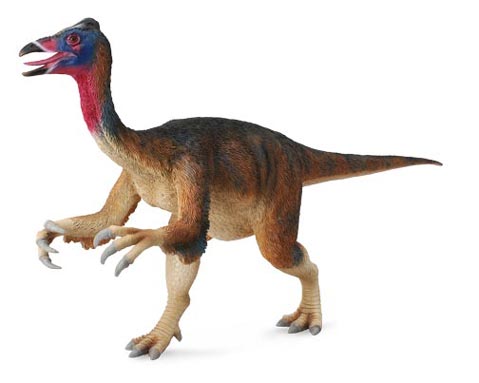
A Model of Deinocheirus based on the Holotype Material

Scientists speculate that Deinocheirus was covered in simple feathers.

Picture credit: Everything Dinosaur

Since the first fossils were discovered and the naming of Deinocheirus back in 1970, there have been numerous theories put forward as to what this dinosaur’s bones actually represented.  This is a great excuse to get out all our old files related to “Terrible Hands”, to thumb through long forgotten text books and various dinosaur encyclopaedia looking back at some of the ideas that have been proposed.  The 1965 expedition recovered both forelimbs with the exception of the claws of the three-fingered right hand, the complete shoulder-girdle plus fragments of ribs, gastralia, and elements from the backbone.

The Nemegt Formation

The Nemegt Formation of Mongolia had never yielded a set of strange fossil bones such as this, although reports of such fossil finds from this area had been circulating for some time.

Over the next few years, the leader of the expedition, the remarkable Professor Zofia Kielan-Jaworowska, the first woman to be appointed to the executive committee of the International Union of Geological Sciences, had her photograph taken on numerous occasions standing next to the Deinocheirus holotype exhibit.  The Professor now in her late eighties, would pose next to forelimbs providing a scale for the colossal arm bones.  We wonder what she makes of the Deinocheirus developments.

A Photograph of Professor Kielan-Jaworowska and the Deinocheirus Forelimbs

Fearsome arms of Deinocheirus

Deinocheirus mirificus

Many of the researchers involved in the initial study of the fossil material thought that Deinocheirus was an enormous predator.  The arms being many times the size of the largest meat-eating dinosaur known from the Nemegt Formation (Tarbosaurus bataar).  This interpretation soon fell out of favour, but Tarbosaurus was destined to play a role later on in the Deinocheirus story.  The idea that these were the arms and claws of a carnivore began to lose support, the claws, although over twenty-five centimetres long were not as curved as seen in large allosaurids, or in the Tyrannosauridae.  Perhaps, these were the claws of an enormous bipedal herbivore.  Other theories put forward over the years included ideas about Deinocheirus being a member of the segnosaurs (therizinosaurs), after all, the fossils of a gigantic therizinosaur (T. cheloniformis) had been found in Mongolia.

Then there was the hypothesis that the limb bones of this dinosaur were roughly equal sized and that these were the forelimbs of an arboreal dinosaur, one that climbed trees, perhaps the Dinosaurian equivalent of a great ape.  More recently, the suggestion that the fossils represented some super-sized member of the ornithomimids began to hold sway.  The holotype fossil material was similar to that seen in the fast-running ornithomimid group, although they would represent an animal at least twice the size of the largest known member of the Ornithomimosauria.

Strange Hands and Claws

At the time, the 1965 expedition team thought that much of the skeleton of the first specimen had been eroded away.  However, an extensive re-examination of the original dig site yielded a lot more fragmentary material, even some skeletal elements were recovered from the spoil heaps of the 1965 excavations.  These fossils provided clues as to what might have happened to the remainder of the carcase.  Tell-tale bite marks on some of the fossil bones indicate that a tyrannosaur, most likely a large Tarbosaurus bataar and dined on this dinosaur, it seems that the Polish/Mongolian scientists had been lucky to find the fossilised bones of the bits the tyrannosaur did not fancy.  Although the researchers cannot be certain, the bite marks indicate that they were made post-mortem.  The grooves and scratches recorded in the fossil bones were most likely made by a Tarbosaurus that scavenged the carcase of an already dead Deinocheirus.

A Drawing of the Likely Deinocheirus Eater – T. bataar

Dining on a Deinocheirus.

Picture credit: Everything Dinosaur

New Fossil Discoveries

The two new specimens of Deinocheirus were discovered in 2006 and 2009 respectively.  One of the specimens represents a sub-adult, (the 2006 discovery), the second specimen are the remains of an individual that was probably bigger than the holotype.  The larger dinosaur’s fossils were found at Bugin Tsav, the upper arm bone is nearly six centimetres longer than the humerus of the original specimen.  Those claims of Deinocheirus being up to twelve metres in length are not too far fetched after all.

This new material when examined alongside the Deinocheirus fossils discovered in the mid 1960s has allowed scientists to piece together a picture of this Late Cretaceous dinosaur.  Over 1100 small stones (gastroliths) were recovered from the body cavity of the Bugin Tsav Deinocheirus.  These stones, some of which are over 8 centimetres long indicate that Deinocheirus was indeed a herbivore.  Lacking teeth like most of the ornithomimids, these stones very probably helped to grind up and digest tough plant fibres.  Deinocheirus was also very tall, it was one of the tallest members of the Theropoda known with the largest specimen, indicating a head height of around sixteen feet, that’s tall enough to look over your average British lamp post!

A Slow Dinosaur

The heavy duty pelvis and the sturdy hind limbs make Deinocheirus the “plodder” when it comes to the Ornithomimosauria, it was not an exceptionally fast runner.  However, with its strong arms and sheer size it would have made a formidable opponent should any predator attempt to tackle it.  When compared to large therizinosaurs, the ribs of Deinocheirus suggest that it was somewhat more narrow bodied.  Perhaps it had less of a pot belly when compared to T. cheloniformis for example.

The most intriguing finding from this new study of the available Deinocheirus material is that this dinosaur had a hump!  Tall neural spines on the vertebrae associated with the hip area very probably supported a fleshy hump or possibly a sail-like structure.  Everything Dinosaur team members are not aware of any such structures being reported when it comes to other ornithomimids.  However, tall neural spines are known from other members of the Dinosauria, most notably Ouranosaurus and the  spinosaurids.  The purpose of this hump or sail in the likes of Deinocheirus remains open to speculation, but team members have raised the possibility that this was a fat reserve store for this herbivore, a similar structure to that found in extant camels today.

Everything Dinosaur’s Amended Drawing of Deinocheirus (D. mirificus)

Adding a hump to a dinosaur.

Picture credit: Everything Dinosaur

With this new evidence in mind, we are going to have to amend the fact sheet that we produce on Deinocheirus.  Palaeontology is a science that is constantly revising and re-visiting known data so our fact sheets are reviewed frequently and updated.

To view models and replicas of Deinocheirus and other dinosaurs: PNSO Age of Dinosaurs Figures and Models.

Humps and bumps on dinosaurs are not new, however, this is an exciting development for a member of the Coelurosauria  of which the Ornithomimosauria form but a small part.  We have had to amend our scale drawing of Deinocheirus giving it a pronounced hump over its pelvic area.  Our interpretation may be a little conservative when compared to others, but for now it is reward enough for us to know that a fifty-year-old puzzle has been solved.

3 11, 2013

Pliosaur Fossil Lurking in Garden Shed

By |2023-02-28T19:09:11+00:00November 3rd, 2013|Categories: Dinosaur and Prehistoric Animal News Stories|0 Comments

Suffolk Man Finds Out About Pliosaur Fossils at the Bottom of His Garden

It pays to keep a sharp look out when working in the garden, as you never know what might turn up when digging.  For example, a strange object discovered in 1997 when builders were digging a trench in the garden of Suffolk resident John Lambert, has turned out to be a fossilised bone from a giant, carnivorous marine reptile.

The village of Tuddenham St Martin, approximately two miles north-east of Ipswich (in the county of Suffolk, East Anglia, UK), may have had very little in common with the Jurassic coast until now and John remained unaware of the significance of his discovery until he took it along to the Colchester and Ipswich Museum to have it examined some sixteen years after the unusually shaped object was found.

Pliosaur Fossil

Mr Lambert, a retired banker, had thought his discovery might have been something very exciting, but he just never got round to getting the specimen checked over by a fossil expert,  that was, until last month.  The fossil is most probably a humerus (upper arm bone) from a large type of marine reptile known as a pliosaur.  It is not possible to identify the genus from a single bone such as this, but one thing is for sure, it was a large animal for the bone measures 42 centimetres in length.

Pliosaurs, otherwise known as short-necked plesiosaurs had large skulls and enormous jaws armed with long, triangular or conical teeth.  They propelled their streamlined bodies through the water using four paddle-like limbs.  Just how big some of these pliosaurs could have been is open to speculation, although recent discoveries such as the Svalbard specimen, or the remains of the jaws and skull of pliosaur found in Dorset indicate that some species could have grown to lengths easily in excess of fifteen metres.

These creatures had their heyday in the Jurassic, survived into the Cretaceous but become increasingly rare in the fossil record towards the end of the Mesozoic.

An Illustration of a Typical Jurassic Pliosaur

Apex Predator of the Jurassic

Apex predator of the Jurassic.

Picture credit: Everything Dinosaur

Liopleurodon

The genus known as Liopleurodon (the name means “smooth-sided tooth”), is illustrated in the picture above.  It has the typically massive jaws and powerful flippers of this family of reptiles.  Some of the teeth in the lower jaw measured nearly twice the size of an adult T. rex tooth.  A number of scientists have estimated that these creatures may have had some of the strongest bites of any known vertebrate.

Ann Ainsworth, assistant curator of natural history at the Colchester and Ipswich Museum, commented that the fossil was in very good condition, however, she stated:

“Marine reptiles are not animals you would expect to find as fossils in Suffolk as the local rocks are not the right age.”

So the question is, how did the fossil end up buried in a Suffolk garden?

Ann has suggested that the fossil “could have been collected by someone else previously and left in the garden.”

This is very plausible, as fossils do turn up in some very strange places.  For instance, last year Everything Dinosaur wrote a short blog article about a Frenchman who discovered a dinosaur’s foot bone in his garden.  Back in 2011, Everything Dinosaur reported on the discovery of an iguanodontid dinosaur bone turning up in Sunderland (north-east England).

To read more about the Sunderland fossil find: Strange Place to Find a Dinosaur Bone.

A Result of Deposition

Another explanation put forward by the researchers at the museum and one that Everything Dinosaur team members happen to agree with, is that this fossil find is as a result of re-deposition.  Re-deposition occurs when strata which contains fossils is disturbed and the fossils end up being moved from the location where they were originally sited.  Much of East Anglia has deposits of glacial clays, the result of movements of ice sheets during the Quaternary.  In 1959, isolated fossils believed to have come from another Pliosaur were discovered in a ploughed field close to the village of Wrentham on the Suffolk coast.  Four years ago, a single dorsal vertebra was found at Theberton Airfield about twenty miles north-east of Tuddenham St Martin.

A spokes person from Everything Dinosaur commented:

“It is quite likely that this particular fossil originates from Lower Jurassic deposits which can be found elsewhere in England.  Lower Jurassic strata forms a narrow belt along the western margins of the Yorkshire Wolds continuing into Lincolnshire and into the Midlands.  One of our team members once spotted a plesiosaur limb bone that had been exposed as a pond dried up.  It is quite likely that this fossil bone originated from this Jurassic aged strata.”

Speaking about his lucky fossil find, Mr Lambert exclaimed:

“It’s rather fun.  I’ve been here 29 years, we’ve got eight acres of ground, we are quite keen on the gardening side and I can honestly say we’ve found nothing whatsoever of any kind of value apart from rubbish, so it’s really fun to have found this.”

It is likely that the fossil will be donated to the Colchester and Ipswich Museum, it may not be part of the geology of Suffolk, but thanks most likely to glaciation and re-deposition, evidence of an apex Jurassic marine predator has been uncovered in a sleepy Suffolk village.

To view the range of prehistoric animal marine reptile models including plesiosaurs and pliosaurs in stock at Everything Dinosaur: Sea Monsters and Models of Marine Reptiles.

30 10, 2013

Argentinosaurus Walks Again After 94 Million Years

By |2023-02-28T14:45:55+00:00October 30th, 2013|Categories: Dinosaur and Prehistoric Animal News Stories, Palaeontological articles|0 Comments

University of Manchester Scientists Digitally Recreate Argentinosaurus Locomotion

It may not have won any awards for its speed, but simply being able to walk when you weigh in excess of eighty metric tonnes and are longer than three double-decker buses is quite an achievement.  One of the debates about the largest land animals that ever lived, those long-necked dinosaurs, was how were they able to move their great bulk around at all.

Thanks to a study undertaken by University of Manchester scientists, in collaboration with researchers from Argentina, some further light has been shed on the locomotion of the super-heavy weights of the Dinosauria.

University of Manchester Research

Under the guidance of Dr Bill Sellers from the University’s Faculty of Life Sciences and an authority on computer modelling to assess vertebrate locomotion, a forty-metre-long reconstruction of the skeleton of Argentinosaurus was scanned by lasers and the data used to model how this huge titanosaur moved.

Argentinosaurus (A. huinculensis) may only be known from fragmentary fossil remains discovered in Patagonia, but it is regarded as one of the largest land-living vertebrates known to science.  It was a titanosaur, a group of huge plant-eating dinosaurs with elongated necks, small heads, wide bodies supported on four pillar-like legs and with long, quite flexible tails.

A life-size reconstruction of the skeleton of this huge herbivore on display at the  Museo Municipal Carmen Funes, Plaza Huincul, Neuquén, (Argentina) was carefully scanned and using Dr Sellers own software and enough computer power to run 30,000 desk top pcs a computer simulation was created that enabled Argentinosaurus to take its first steps for 94 million years.

An Illustration of the Titanosaur Argentinosaurus (A. huinculensis)

Walking with Dinosaurs!

Walking with Dinosaurs!

Picture credit: Everything Dinosaur

New Scientific Study

The study, published in the academic journal Public Library of Science Online (PLoS One) provides the first ever ‘virtual’ footprints of the dinosaur and disproves previous suggestions that the animal was so large that it would have found walking incredibly difficult.  Although able to walk at around 5 mph (8 kmh), about as fast as we can when we undertake a brisk walk, the scientists also noted that under their research criteria, these huge land animals were probably reaching the theoretical limit for a body of that size to achieve efficient locomotion.

Dr Bill Sellers, whose work has led to many insights into Dinosauria locomotion already, including a study of just how fast T. rex could run commented:

“If you want to work out how dinosaurs walked, the best approach is computer simulation.  This is the only way of bringing together all the different strands of information we have on this dinosaur, so we can reconstruct how it once moved.”

To read an earlier article on the work of Dr Sellers on tyrannosaur locomotion: So T.rex could chase down David Beckham.

Dr Lee Margetts, (IT Services for Research at Manchester University), who also worked on the project added:

“We used the equivalent of 30,000 desktop computers to allow Argentinosaurus to take its first steps in over 94 million years.  The new study clearly demonstrates the dinosaur was more than capable of strolling across the Cretaceous plains of what is now Patagonia, South America.”

Argentinosaurus

The team of scientists involved in this study, included Dr Rodolfo Coria from Carmen Funes Museum, Plaza Huincal, (Argentina).  Dr Coria was one of the palaeontologists given the task of formally naming and describing this huge dinosaur twenty years ago.  It was a team led by Dr Coria who were responsible for building the first physical reconstruction of this dinosaur Argentinosaurus.  The dinosaur that was so big it was named after a whole country!

The Reconstruction of the Argentinosaurus Skeleton (Museo Municipal Carmen Funes)

The largest dinosaur yet described.

The largest dinosaur yet described.

Picture credit: Museo Municipal Carmen Funes, Plaza Huincul.

Software to Investigate Locomotion

Using Dr Seller’s own software (Gaitsym) to investigate locomotion of both extant and extinct animals the team were able to create a computer simulation that showed the gait and locomotion of Argentinosaurus.   A spokes person from Everything Dinosaur explained:

“With only a small proportion of the fossil skeleton actually known, the Argentinosaurus skeleton model has been built using better known titanosaurs as bauplans.  The important thing here is the utilisation of new research techniques and methodologies to provide fresh insights into aspects of the Dinosauria whose bones would only tell part of the story.”

Dr Sellers noted:

“The important thing is that these animals are not like any animal alive today and so we can’t just copy a modern animal.  Our machine learning system works purely from the information we have on the dinosaur and predicts the best possible movement patterns.”

Helping to Improve Understanding of Musculoskeletal Systems

Dr Sellers said the research was important for understanding more about musculoskeletal systems and for developing robots.  Knowing how the biggest land vertebrates got around has implications for studies of all vertebrates and applications in robotics and other branches of mechanical engineering.

Plotting Muscle Mass and Joint Loadings for Argentinosaurus

Argentinosaurus locomotion study.

Picture credit: PLoS One

The picture above shows: A, side, and B, front view of the unscaled hull model. C, side, and D, front view of the scaled model with extra mass in the thigh and forearm segments.

He explained:

“All vertebrates from humans to fish share the same basic muscles, bones and joints.  To understand how these function we can compare how they are used in different animals, and the most interesting are often those at extremes.  Argentinosaurus is the biggest animal that ever walked on the surface of the Earth and understanding how it did this will tell us a lot about the maximum performance of the vertebrate musculoskeletal system.”

Dr Sellers added:

“We need to know more about this to help understand how it functions in ourselves.  Similarly if we want to build better legged robots then we need to know more about the mechanics of legs in a whole range of animals and nothing has bigger, more powerful legs than Argentinosaurus.”

Approaching a Functional Limit

The research team have concluded that dinosaurs like Argentinosaurus were approaching  a functional limit and that restricting the joint ranges of motion is necessary for a model without hypothetical passive support structures.  Much larger terrestrial vertebrates may be possible but would probably require significant remodelling of the body shape, or significant behavioural change, to prevent joint collapse due to insufficient muscle mass.

The University of Manchester team how to refine their work and explore the locomotive abilities of other iconic dinosaurs such as the Triceratops and Brachiosaurus.

Go to Top