All about dinosaurs, fossils and prehistoric animals by Everything Dinosaur team members.
29 10, 2011

Everything Dinosaur’s Exclusive Web Log Linked to Main Website

By |2024-04-22T13:22:14+01:00October 29th, 2011|Categories: Everything Dinosaur News and Updates, Press Releases|0 Comments

“B” is for Blog Button or should that be “E”

Our collective photoshop skills are getting better, slowly but surely.  What a powerful tool this CS5 is and we are only just scraping the surface, a feeling that we get when we start the long, arduous and meticulous process of fossil preparation.  The main Everything Dinosaur website: Everything Dinosaur has long been linked to this blog site, but for the first time as part of the company’s on-going development there is a button on the home page.

As part of Everything Dinosaur’s work on the social media sites of YouTube and Facebook we have linked our main website to our other pages on these platforms.  In addition, this blog now has a button too.

The Everything Dinosaur “Blog Button”

Blog button.

Picture credit: Everything Dinosaur

The “E” shape is from our logo, which was originally taken from a modified drawing of a three-toed dinosaur footprint (theropod), it is interesting to note how this logo can be adapted to fit new roles.  The Everything Dinosaur blog has operated since late May 2007 and it now contains over 1,580 published articles and news stories featuring dinosaurs and other prehistoric animals.  Our intention is to put up a post every single day, it is hard work and we do have to divert resources away from our dinosaur toys and games, but we would not want to let down our many thousands of readers.

28 10, 2011

Getting to Grips with Social Media

By |2023-03-08T13:26:20+00:00October 28th, 2011|Categories: Press Releases|0 Comments

Everything Dinosaur Homepage Links to Social Media Sites

Today saw the realisation of a long held ambition of the Everything Dinosaur team members.  The home page of Everything Dinosaur’s website has been linked up to the company’s Youtube and Facebook accounts.  Timing could not be better as there are an additional two video reviews of Safari Ltd products to view on Everything Dinosaur’s Youtube channel – “DinoaurMike1”.  One video is a review of the Prehistoric Sealife Toob made by Safari, the second is a brief review of the new T. rex model, that forms part of the “Wild Safari Dinos” series.

For prehistoric animal themed toys and gifts: Visit Everything Dinosaur’s Website.

Everything Dinosaur

The Facebook pages are regularly updated and contain some of the more quirky things that the company and the staff have been involved with.  We put up fresh material as often as we can and we love looking at the other posts from those “Facebookers” (if that is the right phrase), who we are linked to.  Social media makes a great place for the Everything Dinosaur dinosaur model reviews and videos.

The Everything Dinosaur Corporate Logo

Everything Dinosaur

Everything Dinosaur logo.  Picture credit: Everything Dinosaur.

Picture credit: Everything Dinosaur

This blog remains the main focus for posting up dinosaur and prehistoric animal news stories, after all we have nearly 1,600 articles on in it already – covering virtually every conceivable subject area, or as a colleague put it “from Aardonyx to Zupaysaurus”.  A spokesperson from Everything Dinosaur stated that very shortly:

“There would be further integration between Everything Dinosaur’s web presences including a link to the blog from the website’s home page and some changes in the layout and design of the websites to make them more intuitive and user friendly”.

Visit Everything Dinosaur’s YouTube page: Everything Dinosaur’s YouTube Channel.

We wait to see what the developments will be…

27 10, 2011

Recommended Posting Dates for Christmas Gifts (Helpful Advice)

By |2024-04-22T13:22:48+01:00October 27th, 2011|Categories: Everything Dinosaur News and Updates, Everything Dinosaur Newsletters, Press Releases|0 Comments

Royal Mail Guidelines for Posting Gifts for Christmas

As we approach Halloween, and what with Bonfire Night just around the corner, it seems that a timely reminder might be helpful to all those Everything Dinosaur customers who want to purchase Christmas gifts including dinosaur toys and games.

Last Posting Dates

Our packing teams work seven days a week at the moment, keeping on top of all the orders.  We try our very best to pack and despatch parcels as quickly as we can.  Each autumn/winter we publish tables produced by Royal Mail as to the recommended last safe posting dates for parcels going abroad and within the UK to ensure an arrival before Christmas.

For USA, Canada, Hong Kong, Singapore and South Africa customers, the last recommended safe posting date for international surface mail passed on the 18th October.  Goods purchased after this date and requested to go by international surface mail are unlikely to reach their destinations in time for the big day.

The Royal Mail Table of Christmas Posting Dates 2011

Recommended Posting Dates Christmas 2011.

Source: Royal Mail

We have more details regarding shipping posted up on the Everything Dinosaur website, we urge all customers to be aware of shipping issues when sending packages abroad and we suggest they consider carefully the suitability of any postal option chosen before placing their order.

Everything Dinosaur shipping information: Everything Dinosaur Delivery and Shipping Information.

26 10, 2011

Archaeopteryx Gets Back to Its Perch

By |2023-01-23T07:56:11+00:00October 26th, 2011|Categories: Dinosaur and Prehistoric Animal News Stories, Dinosaur Fans|0 Comments

“Maximum Likelihood” Study Suggests Archaeopteryx is a Bird and Not a Dinosaur

Archaeopteryx (A. lithographica) is perhaps one of the most studied species known.  An amazing amount of research has been carried out on this creature, whose fossils are associated with lithographic limestone deposits in Germany.  A few weeks ago, we reported that a study carried out by a team of Chinese scientists, in the light of a new theropod dinosaur discovery, placed Archaeopteryx in the Dinosauria and not with the Aves (birds).   However, in a new study, this crow-sized, feathered creature has once again been defined as a primitive bird.

Archaeopteryx

The new research appearing this week in the scientific journal ” Biology Letters”  has been carried out  by evolutionary biologist, Dr Michael Lee of the University of Adelaide and the South Australian Museum and Dr Trevor Worthy of the University of New South Wales.  These Australian based scientists contradict the findings of the Chinese team, from the Chinese Academy of Sciences, that only a few weeks ago placed Archaeopteryx in the dinosaur family tree.

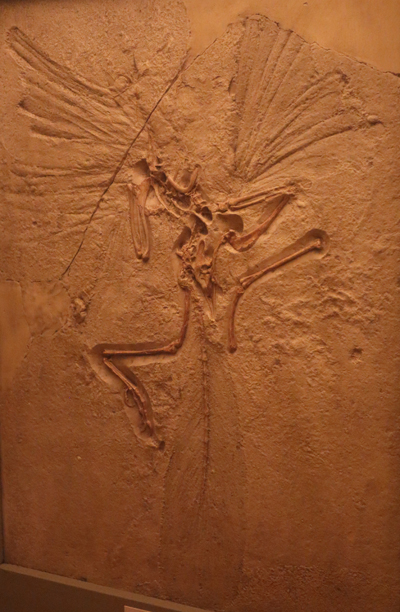
A Fossil Cast of Archaeopteryx on Display at a Museum

Archaeopteryx fossil cast

Archaeopteryx fossil cast. Picture credit: Everything Dinosaur.

Picture credit: Everything Dinosaur

The Chinese researchers compared the fossils of Archaeopteryx with those of a newly discovered non-avian, Chinese theropod dinosaur Xiaotingia zhengi.   This newly discovered, fast-running, meat-eater is believed to be closely related to Archaeopteryx, but it was a non-flying, feathered dinosaur.  This put into doubt the widely accepted scientific view that Archaeopteryx was one of the first birds to evolve.

To read more about this Chinese theropod and the implications for Archaeopteryx: Is Archaeopteryx about to be Knocked Off its Perch?

Commenting on the uproar and excitement caused when the first nearly complete fossil of Archaeopteryx was discovered 150 years ago, Dr Lee stated:

“It was immediately recognised as half bird-half reptile when it was first discovered.”

However, the discovery of X. zhengi led to the proposing of a  new, remodelled evolutionary tree that placed Archaeopteryx in a group with bird-like dinosaurs such as the dromaeosaurs.

Summing up the implications for A. lithographica as a result of the new phylogenetic analysis, Dr Lee stated:

“Archaeopteryx lost its exalted place in bird evolution.”

The problem that concerned the Australian team, was that this new Chinese study placed the flying Archaeopteryx, an animal capable of sustained, powered flight in with a group of dinosaurs that were either ground dwelling, gliders or weak fliers that may not have flown in the same bird-like manner as Archaeopteryx.

Dr Lee commented that, it meant that bird flight most probably evolved more than once and Archaeopteryx possibly evolved flight independently of birds in a case of what’s called “convergent evolution”.  As far as evolutionary theory goes, such scenarios are not particularly elegant.  So Lee and his colleagues carried out a new analysis of the data to see what further analysis could reveal.

Classifying Archaeopteryx

Once the study had been concluded, the team discovered that Archaeopteryx had roughly the same number of traits as birds as it did with dinosaurs.  Archaeopteryx may have been a transitional fossil in every sense of the word –

Dr Lee said:

“If you just count the number of traits it’s basically a 50:50 call.”

The traditional method of building an evolutionary trees, what amounts to a phylogenetic study, weighs each trait equally and tries to find a tree that fits the majority of them – a best fit scenario giving all traits equal weighting.  For the Australian team, they considered this approach to be not the best plan of attack in this case because some traits are more reliable than others, because they evolve slowly and are more likely to be conserved through time.

Dr Lee explained, that for example, a back bone is likely to evolve just once, but a particular fur colour could evolve multiple times, and is thus a less reliable trait for building evolutionary trees.  The Australian team used a statistical analysis  technique called ‘maximum-likelihood’, which is used to build evolutionary trees based on genetic data and applied this methodology to the fossil data.  This technique can determine the rate of evolution of different traits and gives extra weight to more reliable slow-evolving traits, in essence it provides a weighting so that more important, slowly evolving traits have a higher value in the analytical work.

The team found the bird traits in Archaeopteryx were more reliable than the dinosaur traits and when this weighting was taken into consideration.   You get an evolutionary tree that restores Archaeopteryx to its original position as “first bird“.

He went onto state:

“It puts it [Archaeopteryx] back where people have always thought it belonged.”

The researchers comment that despite these findings, the exact position of Archaeopteryx in the evolutionary tree is hard to pin down because there’s a whole swarm of fossils that lie between dinosaurs and birds.  However, the findings do suggest that the “maximum-likelihood” method is a useful tool for analysing the fossil record.  The research team hope to use the same methodology to study in detail the evolutionary relationships between early mammals in a bid to help define more precisely the exact phylogenetic relationships between Mesozoic mammals.

To view models and replicas of Archaeopteryx and other prehistoric animals (whilst stocks last): Papo Prehistoric Animal Models.

25 10, 2011

A Review of the Wild Safari Dinos Tyrannosaurus rex Model

By |2023-01-23T07:51:36+00:00October 25th, 2011|Categories: Everything Dinosaur videos|0 Comments

Updated Tyrannosaurus rex Model Available

It is always a pleasure to see a new model of Tyrannosaurus rex introduced.   It seems no prehistoric animal model series is complete without at least one version of this, most famous of all dinosaurs within its ranks.  We have prepared a short, five minute video review of the new T. rex model made by Safari Ltd.

Tyrannosaurus rex

Safari Ltd have added an updated replica of Tyrannosaurus rex to their Wild Safari Dinos range.  It may be more than 100 years since this particular dinosaur was formally named and described but T. rex’s popularity shows no signs of waning.  Virtually every major Natural History Museum in the world has a Tyrannosaurus rex exhibit as focal point within their collections and for this tyrannosaur we can confidently state that “rex” remains the most popular dinosaur of them all.

Everything Dinosaur’s Video Review of this New T. rex Model

Everything Dinosaur reviews the Wild Safari Dinos Tyrannosaurus rex model.

Video credit: Everything Dinosaur

This video is one of twenty-two videos that we have made.  There are all available on Everything Dinosaur’s YouTube channel (Everything Dinosaur – “DinosaurMike1”), as always we welcome comments.

To view the Wild Safari prehistoric animal model range: Wild Safari Dinos and Prehistoric Animal Models.

Tyrannosaurus rex may be the most iconic of all the dinosaurs, but the tyrannosaur family are a bit of an enigma, how these large, Late Cretaceous predators evolved has remained very much of a mystery to palaeontologists.  However, over the last ten years or so, our understanding of these most famous of all the dinosaurs has grown tremendously as new discoveries have been made and new research techniques to existing fossils applied and this new model brings the latest research into T. rex into dinosaur fan’s model collections.

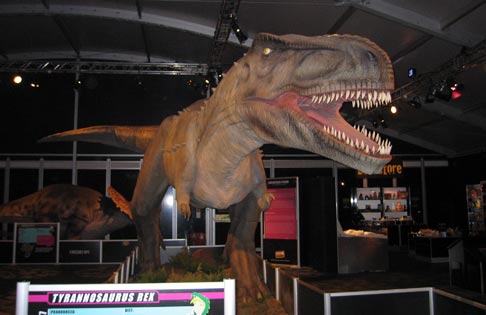
A Tyrannosaurus rex Exhibit on Display

T. rex on display. Dinosaurs Unleashed.
Ferocious T. rex one of the most popular of all animals. Picture credit: Everything Dinosaur.

Picture credit: Everything Dinosaur

To view Everything Dinosaur’s YouTube channel and to subscribe: Everything Dinosaur on YouTube.

24 10, 2011

Bullyland Brachiosaurus Model to be Retired

By |2023-01-23T07:37:14+00:00October 24th, 2011|Categories: Dinosaur and Prehistoric Animal News Stories, Dinosaur Fans, Everything Dinosaur News and Updates, Everything Dinosaur Products|0 Comments

Museum Line Brachiosaurus to be Retired

Bullyland, the German based manufacturer of models and figures is to retire their scale model of the sauropod Brachiosaurus in 2012.  This model, part of the company’s “Museum Line” range of prehistoric animal models is not going to be available once current stocks run out. The Museum Line Brachiosaurus is to be retired.

Brachiosaurus

The  “Museum Line” collection is developed in co-operation with the National Museum for Natural History in Stuttgart, Germany and has earned a deserved reputation for quality and for introducing unusual models such as the recent introduction of the early theropod Liliensternus and the bizarre, carnivorous Arizonasaurus.

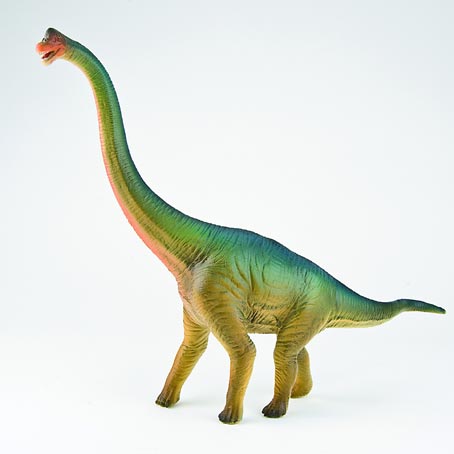
Bullyland Brachiosaurus to be Retired

Due to be retired the Bullyland Brachiosaurus dinosaur model.

Picture credit: Everything Dinosaur

Back in 2010, this model was revised and given a make over with the original brown paint replaced with a dark, metallic green colouring, but after two years this model is being retired.

The Original Museum Line Brachiosaurus Colouration

The brown “Museum Line” Brachiosaurus dinosaur model.

Picture credit: Everything Dinosaur

As yet, we have not been told what new models this German company intend to launch in 2012.  A lot of model manufacturers have been focusing on producing merchandise for the London Olympic games, but we are confident that Bullyland will be working on new prehistoric animals and we look forward to hearing more from them.

Bullyland Prehistoric Life Models and Figures

The Bullyland range of dinosaur and prehistoric animal model figures and replicas has proved to be very popular with dinosaur fans and model collectors.  To view the extensive Bullyland prehistoric animal model series, take a look at the Bullyland section on Everything Dinosaur’s award-winning website: Bullyland Prehistoric Life.

23 10, 2011

Modern Cycads Not as Old as Previously Thought

By |2023-01-23T07:33:45+00:00October 23rd, 2011|Categories: Dinosaur and Prehistoric Animal News Stories, Dinosaur Fans|0 Comments

Extant Cycads may not be “Living Fossils”

Cycads are palm-like seed plants with massive stems which produce a crown of fern-like leaves.  These strange looking plants may be relatively short, but fossil data indicates that some extinct species may have grown to more than fifteen metres tall.   A new study indicates that those species alive today are not closely related to the cycads that were grazed by the dinosaurs and other Mesozoic herbivores.  It seems that extant cycads may have evolved from species that diversified to exploit changing world climates around 5-12 million years ago.

Cycads

That is the conclusion from a study led by Utah State University scientists, the term “living fossil” so often used when referring to organisms that resemble those preserved in the fossil record may not apply to the cycad family.

The evolutionary origins of cycads remains unclear, they are probably descended from pteridosperms (seed ferns) and their are fossils to indicate that these plants were around during the Permian Period, although they may actually have evolved earlier, in the Carboniferous.

A Model of a Cycad

What is a cycad?

A welcome addition to the CollectA model range, a replica of a cycad.

The picture (above) shows a replica of a cycad tree in the CollectA model range, to see this series that is available from Everything Dinosaur: CollectA Prehistoric Plants and Dinosaur Models.

Commenting on his research findings, Hardeep Rai, a post-doctoral research fellow with Utah State University’s department of Wildland Resources stated:

“The current form of cycads looks very much like cycads did when they were at their peak 150 million years ago in terms of the number of species and their coverage of the Earth.”

Modern Species

However, the research team concluded that of the three hundred or so known species alive today, these plants resulted from a fairly recent branching of the cycad family tree.

Discussing the research findings, Nathalie Nagalingum of the Royal Botanic Garden in Sydney, New South Wales said:

“Today’s species did not exist during the reign of the dinosaurs.  They evolved independently of dinosaurs only ten million years ago.  The recent radiation of cycads radically changes our view of these emblematic living fossils.”

It is very likely that the feeding activities of dinosaurs and other herbivores during the Late Palaeozoic and into the Mesozoic affected the evolution of plants, just as the grazing of mammals influences flora today.  However, this study suggests that those cycad species alive today are not directly related to more primitive cycad genera.

Gymnosperm Tree of Life Project

The study arose from the National Science Foundation-funded Gymnosperm Tree of Life project.  Co-authors of the research include Berkeley’s Charles Marshall and Tiago Quental and Damon Little of the New York Botanical Garden.

We at Everything Dinosaur, discussed the cycad family back in July when we produced an article commenting on the presence of cycads today.  We may have to re-write this piece in the light of this research.

To read more about cycads: Yes, we have Cycads Alive Today.

Cycads were most abundant during the Jurassic and Cretaceous, before the evolution of the flowering plants (Angiosperms) led to the decline of this type of flora.  Extant cycads are classed into eleven genera found in three families and certain types of cycad are popular plants with gardeners, although they are high maintenance in a chilly UK climate.

Prior to this new study, the fragmented distribution of modern cycads was thought to indicate that the modern species are the descendants of previously more widespread genera.  The fossil record shows that cycads were particularly widespread during the Mesozoic, even making up a significant proportion of the flora to be found in polar regions.   However, unlike their modern equivalents, these prehistoric polar cycads lost their leaves in winter and they had vine-like stems.

Although, cycads superficially resemble palms and have branching, pinnate, fern-like leaves they are not closely related to palm trees or indeed to ferns.

The research team used a method called molecular dating to analyse the DNA of about two hundred living cycad species.  Scientists calibrated these species’ genetic profiles against the fossil record and found they branched off from a common ancestor between five and twelve million years ago.

The concept of a molecular clock is that evolutionary change occurs at regular time intervals.  If it is assumed that the rate of genetic change (mutation) in the DNA of an organism does not change, i.e. the rate is relatively constant, the molecular genetic difference between two species can be measured and the time when they diversified from a common ancestor calculated.  Using this data, Hardeep Rai and his fellow researchers were able to calculate when these species of cycads in the study diverged from their common ancestor.

Rai said:

“The hypothesis that dinosaurs are responsible for the approximately 300 species of cycads we know today no longer fits.  Some worldwide event caused an explosion of evolutionary change.   The question is: What happened?”

The scientists have postulated that climate change triggered this burst of speciation with the help of specialised insect pollinator, weevils and beetles that underwent evolutionary change at the same time.

Around 12 million years ago, the world’s continents reached their current positions.  Instead of warm climates around the globe, temperate zones emerged at the higher latitudes and climates became seasonal.  Diversification seen in today’s cycads many have occurred in response to these environmental changes.

22 10, 2011

Tyrannosaurus rex – Bigger than Previously Thought According to New Study

By |2024-04-22T13:23:41+01:00October 22nd, 2011|Categories: Dinosaur and Prehistoric Animal News Stories, Dinosaur Fans, Palaeontological articles|2 Comments

Tyrannosaurus rex – All Nine Tons of It

A joint US and UK research team using sophisticated, three-dimensional laser mapping have calculated that tyrannosaurs were heavier than previously thought.  Using tyrannosaur fossil skeletons, including that of “Sue” the most complete Tyrannosaurus rex (and the biggest) found to date the scientists concluded that these Late Cretaceous predators could reach weights of up to 9 tons.

Tyrannosaurus rex

Using three-dimensional laser scans and computer modelling, British and U.S. scientists “weighed” five tyrannosaur specimens, including the Chicago Field Museum’s “Sue.  They concluded that Tyrannosaurus rex grew faster and weighed more than previously thought.  The discovery of sub-adult specimens in recent years has enabled palaeontologists to understand a little more about the ontogeny (growth) of these theropods, for example, it is now widely accepted that just like us humans, Tyrannosaurus rex underwent a growth spurt in its teenage years.

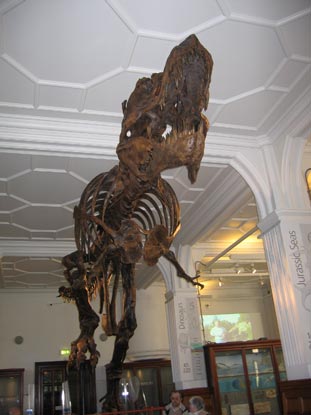
New Body Mass Estimates for Tyrannosaurus rex
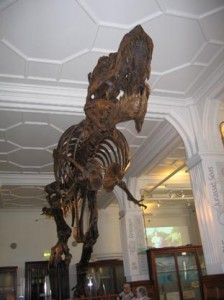
Estimates of up to 9 tons in weight. Picture credit: Everything Dinosaur.

Picture credit: Everything Dinosaur

Remarkable Growth Rates of Dinosaurs

A number of studies have been published in recent years, providing evidence on the remarkable growth rates of different dinosaurs.  One recent study focused on the ontogeny of hadrosaurs (duck-billed dinosaurs), animals that were on the menu for the tyrannosaurs.  This study suggested that the herbivorous hadrosaurs actually grew faster than the predators, a strategy for survival when being small and young meant being a potential dinner for a hungry T. rex.

To read this article: Duck-Billed Dinosaurs Grew Up Fast to Avoid Being Eaten.

In the light of this Anglo/American research which suggests that T. rex may have been up to thirty percent bigger than previously estimated, so of these older papers may have to be revisited.

In an interesting twist to the T. rex growing fast and enormous research, the scientists have estimated that the smallest and youngest specimen of a Tyrannosaurus rex known, actually weighed less than previously thought.  This study indicates that T. rex grew more than twice as fast between 10 and 15 years of age as suggested in a study five years ago.  The University of California (Berkeley) conducted research into the growth of another dinosaur genus, an ornithopod called Tenontosaurus.  This research team concluded that dinosaurs may have reached maturity earlier than previously expected, their work, which involved studying the growth rings preserved in fossilised dinosaur limb bones suggested that dinosaurs did grow up fast, perhaps another survival strategy in the brutal Mesozoic.

University of California research into dinosaur growth: Dinosaurs Grew Fast, Lived Fast and Died Young.

The study, published in the online scientific journal PLoS One, (Public Library of Science) was conducted by a team of scientists led by Professor John R. Hutchinson of The Royal Veterinary College, London, and Peter Makovicky, PhD, curator of dinosaurs at The Field Museum of Natural History in Chicago.  “Sue” the biggest Tyrannosaurus rex is housed at the Chicago Museum.

According to Professor Hutchinson, who commented on the spurt growth of Tyrannosaurus rex during its teens:

“T-rex grew at 3,950lbs per year (1,790 kg) during the teenage period, which is more than twice the previous estimate.”

However, these predators sacrificed speed for power and strength as they got bigger according to this study.  The researchers concluded that heavy, adult Tyrannosaurus slowed down as they grew, but speeds around fifteen miles an hour, about as fast as a footballer can run were still possible.

The velocity that these animals could achieve slowed as they got bigger because the tyrannosaur torso became longer and heavier while its limbs grew relatively shorter and lighter, shifting its centre of balance forward.   This relates to an aspect of ontogeny studies called “distal growth”, it also explains why young animals have proportionately longer limbs than adults, try comparing a foal to its mother and you will see the difference in body proportions.

Professor Hutchinson added:

“The total limb musculature of an adult T. rex probably was relatively larger than that of a living elephant, rhinoceros, or giraffe, partly because of its giant tail and hip muscles.  Yet the muscles of the lower leg were not as proportionately large as those of living birds, and those muscles seem to limit the speed at which living animals can run.”

When commenting on the growth spurts of these apex predators, during their teenage years, Professor Hutchinson stated:

“At their fastest, in their teenage years, they were putting on 11 pounds or 5 kilograms a day.  Just think how much meat that is.  That’s a hell of a lot of cheeseburgers … it’s a whole lot of duck-billed dinosaurs they needed to be chowing down on.”

High Demands for Food

Such high demands for food to fuel their rapid growth may have had an impact on tyrannosaur behaviour.  A huge appetite would suggest that each T. rex or tyrannosaur group would need a massive territory to hunt in.  Each animal would need access to a substantial amount of potential prey – so as one spokesperson for Everything Dinosaur put it:

“Tyrannosaurs may have been few and far between.”

The rapid teenage growth spurt also suggests these reptiles must have had a high metabolic rate, fuelling the idea they were endothermic (warm-blooded).

The researchers, led by Professor Hutchinson and Dr Makovicky used scans of skeletons to build digital models and then added flesh using the structure of soft tissues in birds and crocodiles as a guide.  A number of composite models were then developed, to provide a spread of potential body masses, computer models to assess the body mass of less muscular dinosaurs and models to look at the maximum musculature that these skeletons could theoretically support.

One of the problems the team encountered was that the fossilised bones of many tyrannosaurs, including those of “Sue” from the Field Museum (Chicago) had been compressed during the fossilisation and preservation process, so assessments of the actual “life-size” of bones had to be calculated before an assessment of body mass could be carried out.  The study is further complicated by the fact that scientists believe that male and female tyrannosaurs had very different body forms.   It has been suggested that the more robust, bigger specimens represent females, smaller more gracile forms are males.   Female tyrannosaurs are believed to have been larger as they needed wider hips to allow the storage and passage of eggs.  Such dimorphism is common in Aves – close relatives of theropod dinosaurs.

For models and replicas of tyrannosaurs and other theropod dinosaurs: Tyrannosaur Models and Theropod Figures (Wild Safari).

21 10, 2011

A Review of the Guanlong Dinosaur Model (Wild Safari Dinos)

By |2023-03-08T14:00:37+00:00October 21st, 2011|Categories: Dinosaur Fans, Everything Dinosaur videos|0 Comments

Basal Tyrannosauroid Reviewed – Guanlong

One of the earliest members of that great theropod dynasty – the Tyrannosauroidea, Guanlong (Guanlong wucaii) has been a favourite for many years, well at least since 2006, the year this dinosaur was formally named and described. Team members at Everything Dinosaur have produced a short video review of the Guanlong dinosaur model (Wild Dinos – Safari Ltd).

This particular meat-eater, roamed the woodlands of what was to become north-western China in the Late Jurassic.  Measuring just three metres long and just 1.2 metres high at the hips, this fast running predator is believed to be a distant ancestor of the Late Cretaceous apex tyrannosaur predators of the Northern Hemisphere.  It is hard to believe that this cursorial dinosaur with its long grasping hands and three, clawed fingers was an ancestor of Tyrannosaurus rex, Albertosaurus, Gorgosaurus and Appalachiosaurus.

Guanlong Dinosaur Model

We were delighted when Safari Ltd introduced a colourful model of this dinosaur, an addition to their Wild Safari Dinos model range.  A video review of this replica has been posted up on our Youtube channel and on Everything Dinosaur’s Facebook page.  We hope you like our video review of the Wild Safari Dinos Guanlong dinosaur model.

Everything Dinosaur Reviews the Guanlong Model

Everything Dinosaur reviews the Wild Safari Prehistoric World Guanlong dinosaur model.

 Video credit: Everything Dinosaur

Comments and feedback would be welcome.  One thing worth noting, as fossils of Guanlong’s relative Dilong (Cretaceous dinosaur) have been interpreted as having proto-feathers, the model makers have followed the trend to show Guanlong covered in primitive feathers.  We like the way the coat of navy blue down contrasts with this dinosaur’s distinctive head crest, although are not sure how accurate the tail plume is.

The unusual crest that ran along the top of the snout was very thin and delicate, too delicate to be used in combat.  It was probably used for display either to attract a mate or to show maturity or perhaps to settle intraspecific squabbles.

To view models of theropod dinosaurs in the Wild Dinos range available from Everything Dinosaur: Wild Dinos Prehistoric Animal Figures.

20 10, 2011

New Prehistoric Times (Issue 99)

By |2024-01-01T17:29:10+00:00October 20th, 2011|Categories: Dinosaur and Prehistoric Animal News Stories, Dinosaur Fans, Prehistoric Times|0 Comments

Prehistoric Times Autumn 2011 – Reviewed

And so the penultimate edition of “Prehistoric Times” is here,  the dinosaur fan’s magazine before that all important centenary issue arrives and what a treat it proves to be.

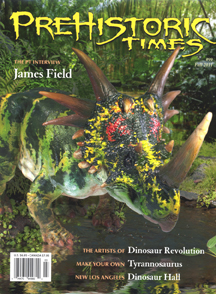
In a novel twist, this issue of “Prehistoric Times” is available with two different front covers.  One copy has the armoured dinosaur Gastonia on the front cover, an illustration done especially for the magazine by William Stout.  The second version has a picture of a Styracosaurus model created by that highly talented sculptor and model maker Steve DeMarco.  We think (well actually we know because the editor told us), that there are plans to do something similar with the 100th edition.  For the record we were sent the Styracosaurus cover version and it was great to read the story of how Steve made this model in a feature entitled “One Horned Army”.

Our Prehistoric Times Featuring Styracosaurus

“One Horned Army”.

Picture credit: Mike Fredericks

Amongst all the dinosaur and prehistoric fossil news, there is a super feature written by Tracy Lee Ford on how to draw Terror Birds, all part of his acclaimed “How to draw Dinosaurs” series, we won’t split hairs between avian and non-avian members of the Dinosauria but this article points out some potentially fundamental differences in bird versus dinosaur locomotion.  This suggests that birds may not be a good study model when considering how dinosaurs moved about.

James Field, that fantastic British prehistoric animal artist is interviewed and this edition features several of his beautiful illustrations.  Keeping up the British theme to this edition of “Prehistoric Times” there is a wonderful article by our dear chum Anthony Beeson on the development of the prehistoric animal model figures produced by the London Natural History Museum in conjunction with Invicta Plastics (Leicester). The black Scelidosaurus (cost me 27 pence) is still amongst my favourite possessions and it was fascinating to read the first part of this article.  Part two will feature in the next edition.

For dinosaur replicas created by the scientists at the London Natural History Museum: Natural History Museum Dinosaur Models.

As if all this and the “Mesozoic Mail” and letters page was not enough, there is even an article celebrating the 150th anniversary of Archaeopteryx and a pictorial tour of the new dinosaur halls at the Natural History Museum of Los Angeles.

With a feature on how to build your own model T. rex, an article on Gastonia, product reviews and the chance to enter the annual “Prehistoric Times” awards there really is so much in this edition, it is going to be hard for the team behind this magazine to top it for that special 100th issue.

To visit the “Prehistoric Times” website: Prehistoric Times.

Go to Top