All about dinosaurs, fossils and prehistoric animals by Everything Dinosaur team members.
4 09, 2011

Planet Dinosaur – A New Cast of Characters

By |2024-04-22T11:45:04+01:00September 4th, 2011|Categories: Dinosaur Fans, Everything Dinosaur News and Updates, Main Page|0 Comments

Prehistoric Animals that Feature in BBC Television’s “Planet Dinosaur”

Not too long to wait until the first episode of this new BBC television series airs (September 14th at 8.30pm BST) on BBC1.  By now many websites and blogs would have reported on the sort of prehistoric animals that are going to be featured.  For example, episode one, entitled “Lost World” will introduce the predators Carcharodontosaurus, Spinosaurus and the crocodile called Sarcosuchus.  We thought it would be helpful at Everything Dinosaur if we discussed some of the less well-known prehistoric animals that will be featured.

Planet Dinosaur

An example might be Kimmerosaurus, a plesiosaur that makes an all too brief appearance in the programme that features “Predator X” – a giant Jurassic pliosaur whose, fossils were discovered in Norway in 2008.  Kimmerosaurus is a victim of this huge marine predator, perhaps the largest known pliosaur in the fossil record (although recent discoveries from Dorset (UK) may challenge this).  Fossils that have been assigned to the Kimmerosaurus genus were found in the same strata as the huge pliosaur fossils.  In the programme, “Predator X” attacks a hapless Kimmerosaurus and tears it apart with its one foot long conical teeth.  This is one of the goriest parts of what is quite a gory series.

To read an article on the power of “Predator X”: The Bite Force of a Pliosaur.

Then there are the bizarre and amazing feathered dinosaurs that feature in episode two.  Take for example Epidexipteryx, a pigeon-sized feathered dinosaur from China.  This predator was most bird-like of any dinosaur and is the first known case of ornamental feathers in the fossil record.  Small feathered dinosaurs such as Microraptor will also feature but look out for “big bird”, the 8-metre long Gigantoraptor.  Feathers may have been used for flight, for insulation or even to intimate and attract.  These dinosaurs not only hint at how animals might have developed flight but also suggest that dinosaurs may still live among us today… as birds or as we say “avian dinosaurs”.

There are certainly a whole host of new prehistoric animals in the television series, whether it is giant pterosaurs such as Hatzegopteryx, horned dinosaurs like Chasmosaurus or fierce carnivores such as Daspletosaurus we are confident that these new programmes will both inform and delight.

To view models of prehistoric animals featured in the BBC television series, visit the prehistoric animal model section of the Everything Dinosaur website: Everything Dinosaur Models and Figures.

3 09, 2011

National Fossil Day – What a Good Idea

By |2023-03-08T09:19:15+00:00September 3rd, 2011|Categories: Dinosaur and Prehistoric Animal News Stories, Geology, Main Page|0 Comments

National Fossil Day – October 12th 2011

The second National Fossil Day, Americas day for promoting public awareness and stewardship of fossils is scheduled to take place on October 12th.  The inaugural National Fossil Day was held last year.  A series of nation-wide events and activities are being held across the United States with many museums, schools, educational institutions and national parks taking part.  This special day dedicated to fossils is a part of Earth Science Week, an event that encourages people everywhere to explore the natural world and learn about the geosciences.  Earth Science Week is celebrated the second full week of October.

With most states having their own “state fossil” symbol and more than 230 national parks having fossil sites within them it seems a very sensible idea.

National Fossil Day

Organised by the National Park Service and the American Geological Institute we at Everything Dinosaur, wish everyone involved with this project the “very best”, just as President Obama stated when he sent a personal message of support to celebrate last years event.  Perhaps the United Kingdom too, should have a national fossil day?

Can you Find Fossils?

Would you go on a fossil hunt on National Fossil Day?

Would you go on a fossil hunt on National Fossil Day? Picture credit: Everything Dinosaur.

Picture credit: Everything Dinosaur

For replicas of famous prehistoric animals found in the fossil record such as belemnites, trilobites and ammonites: Dinosaur Crafts and Replicas of Fossil Animals.

2 09, 2011

A New BBC Planet Dinosaur Trailer

By |2024-04-22T10:29:20+01:00September 2nd, 2011|Categories: Dinosaur and Prehistoric Animal News Stories, Everything Dinosaur News and Updates, Main Page|0 Comments

Planet Dinosaur Starts Wednesday 14th September

Planet Dinosaur – the new six part television series starts on BBC1 at 8.30pm September 14th (2011).  Looks like it is going to be an unmissable event for dinosaur fans.

Planet Dinosaur

We were kindly sent this video trailer for this series by one of the publicists for this particular programme at the BBC television centre – enjoy!

Please note – the trailer for this television series first aired in September 2011 has now been removed from the Everything Dinosaur web log.

The first episode will feature Spinosaurus and Carcharodontosaurus.  In an episode entitled “Lost World” viewers are transported back to Africa in the Early Cretaceous to view an ecosystem dominated by two very different apex predators.  Look out for the fearsome crocs as well. In addition, expect some super-sized sauropods to make an appearance.

A Scale Drawing of the Huge Cretaceous Theropod Carcharodontosaurus

A new Carcharodontosaurus species has been described. This dinosaur appeared in "Planet Dinosaur".

Fearsome “Shark Lizard”. A scale drawing of the huge theropod Carcharodontosaurus.  Picture credit: Everything Dinosaur.

Picture credit: Everything Dinosaur

For figures and replicas of the prehistoric animals that will feature in this new BBC television series: Prehistoric Animal Replicas in the PNSO Range.

2 09, 2011

A Review of the Bullyland Dimetrodon Model

By |2023-03-08T09:20:24+00:00September 2nd, 2011|Categories: Everything Dinosaur News and Updates, Everything Dinosaur videos, Main Page, Product Reviews|0 Comments

Museum Line Dimetrodon Model Reviewed

One of the new additions to the Museum Line scale model range of prehistoric animals has been reviewed by team members at Everything Dinosaur.  It is always a pleasure to see a new model added to the range of prehistoric animals offered by the German manufacturer Bullyland, especially since Dimetrodon (D. grandis) is one of our favourite Permian animals. Here is our video review of the Bullyland Dimetrodon model.

Everything Dinosaur’s Review of Dimetrodon

Video credit: Everything Dinosaur

Dimetrodon was not a dinosaur, but a member of the Pelycosauria and as such it has been classified as a  synapsid reptile.  Why Dimetrodon is often featured in a model range that focused on dinosaurs always puzzles us.  Perhaps manufacturers just like to add a cool sail-backed reptile to their model series.

Bullyland Dimetrodon Model

To view the extensive range of Bullyland prehistoric animal figures stocked by Everything Dinosaur: Bullyland Dinosaurs and Other Prehistoric Animal Figures.

Whatever the reason, team members welcome the addition of a Dimetrodon figure to the Bullyland range of prehistoric animal models.

We did once write an article on this phenomenon – Dimetrodon being added to models of dinosaurs etc.  To read this article: Why Does Dimetrodon Get Added to Dinosaur Model Ranges?

1 09, 2011

Tasmanian Tiger No Sheep Killer

By |2023-01-20T18:21:36+00:00September 1st, 2011|Categories: Animal News Stories, Dinosaur and Prehistoric Animal News Stories, Main Page|0 Comments

Thylacine Not a Sheep Killer – No “Jaws” for Alarm

The Tasmanian Tiger (Thylacinus cynocephalus) became extinct in 1936 when the last known living specimen died at Hobart Zoo.  Scientists believe that the Thylacine had been extinct in mainland Australia for some 2,000 years but populations survived in remote parts of Tasmania up until the early 20th Century.  One of the reasons given for this apex predator’s decline was that it was hunted extensively by farmers and land owners in a bid to reduce attacks on their sheep.

Tasmanian Tiger

However, the Thylacine may have been wrongly accused of killing sheep, a new study published in the Zoological Society of London’s “Journal of Zoology” has found that the “tiger” had such weak jaws that its prey was probably no larger than a possum.

Lead author, Marie Attard of the University of New South Wales (UNSW) Computational Biomechanics Research Group stated:

“Our research has shown that its rather feeble jaw restricted it to catching smaller, more agile prey.  That’s an unusual trait for a large predator like that, considering its substantial 30 kg body mass and carnivorous diet.  As for its supposed ability to take prey as large as sheep, our findings suggest that its reputation was a bit overblown.”

The Thylacine, otherwise known as the “Tasmanian Tiger” was probably a hunter of much smaller prey, other marsupials and flightless birds being cited as typical prey examples, but not the introduced livestock such as sheep, goats and young cattle.  A generous bounty was paid for every dead Thylacine and this hunting and trapping led to the rapid extinction of an animal population that was already under considerable stress due to loss of habitat and indigenous prey.

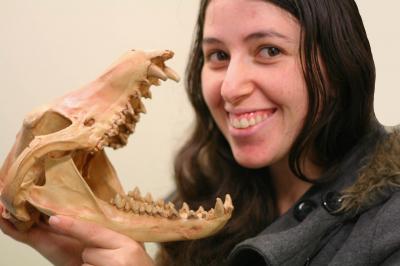
Author Marie Attard with a Thylacine Jaw

Picture credit: Marie Attard

The picture shows Marie holding the skull of a Thylacine, note the wide gape of this predators jaws.

Marie added:

“While there is still much debate about its diet and feeding behaviour, this new insight suggests that its inability to kill large prey may have hastened it on the road to extinction.”

Despite its obvious decline, it did not receive official protection from the Tasmanian Government until two months before the last known individual died (the Hobart Zoo Thylacine).

Advanced Computer Modelling Techniques

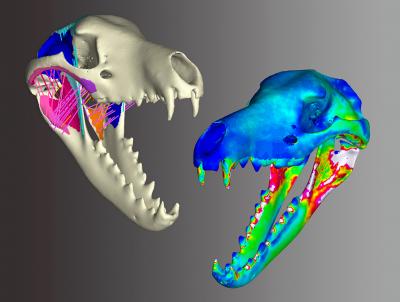
Using advanced computer modelling techniques, the UNSW research team were able to simulate various predatory behaviours, including biting, tearing and pulling, to predict patterns of stress in the skull of a Thylacine and those of Australasia’s two largest remaining marsupial carnivores, the Tasmanian devil and the spotted-tailed quoll.

The Thylacine’s skull was highly stressed compared to those of its close living relatives in response to simulations of struggling prey and bites using their jaw muscles.  This indicates that tackling sheep was not on the Thylacine’s menu – the fear of a “tiger” attacking a flock of sheep would be unfounded.  There would be no “jaws” for alarm.

A Computer Generated Image Showing the Stress Levels on Thylacine Jaws

Could not think of a snappy title.

Picture credit: Marie Attard

The picture shows the digital stress tests revealing weakness (red/white areas in right-hand image) in the Thylacine jaw.

Director of UNSW’s Computational Biomechanics Research Group, Dr Stephen Wroe stated:

“By comparing the skull performance of the extinct Thylacine with those of closely related, living species we can predict the likely body size of its prey.  We can be pretty sure that Thylacines were competing with other marsupial carnivores to prey on smaller mammals, such as bandicoots, wallabies and possums.”

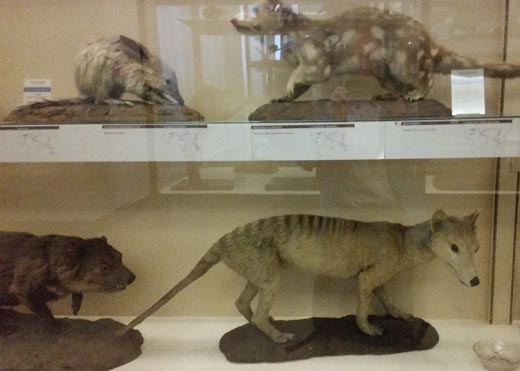
A Stuffed Tasmanian Tiger on Display in a Museum

A Thylacine on display (Tasmanian Tiger).

A Thylacine is included in the Australian mammals part of the gallery (Senckenberg Museum). Picture credit: Everything Dinosaur.

Picture credit: Everything Dinosaur

It seems that the bounty on the Thylacine may have been unjustified, a case of “shoot first and think later” as a member of the Everything Dinosaur team commented.

Dr Wroe added:

“Especially among large predators, the more specialised a species becomes the more vulnerable is it to extinction.  Just a small disturbance to the ecosystem, such as those resulting from the way European settlers altered the land, may have been enough to tip this delicately poised species over the edge.”

The Hobart specimen died on September 7th 1936, this date is commemorated in Australia as the National Threatened Species Day, helping to highlight the plight of other endangered species on the continent.  Ironically, there are from time to time reports of sightings of Thylacine-like animals both on the Australian mainland and in Tasmania.  Many cryptozoologists believe that small populations of this pouched predator may still survive in remote parts of the Australian outback.  A few fuzzy photographs and 8mm film footage exist, taken by people who claim to have seen a strange animal, but as yet there has been no real evidence to suggest that the Thylacine is still with us.

To view models of extinct animals: CollectA Popular Range of Prehistoric Animal Models.

Everything Dinosaur acknowledges the assistance of a University of New South Wales media release in the compilation of this article.

The scientific paper: “Skull mechanics and implications for feeding behaviour in a large marsupial carnivore guild: the thylacine, Tasmanian devil and spotted-tailed quoll” by M.R.G. Attard, U. Chamoli, T.L. Ferrara, T.L. Roger and S. Wroe published in the Journal of Zoology.

31 08, 2011

Cooking – A Great Leap Forward in Human Evolution

By |2023-03-08T09:21:49+00:00August 31st, 2011|Categories: Dinosaur and Prehistoric Animal News Stories, Main Page, Palaeontological articles|0 Comments

Processed Food – Not Too Bad After All if our Ancestors are Anything To Go By

The ability to process food, to make it more edible, easier to digest and to breakdown in the human gut to release nutrients, may have helped hominids to gain the upper hand when it came to competing with other predators back in the Pleistocene and earlier.  Indeed, a paper published in the scientific journal “The Proceedings of the National Academy of Sciences”, postulates that processed food, given such a bad press today may have helped humans gain an evolutionary advantage.

Human Evolution

Compared to other extant primates, our species H. sapiens spends only one tenth the amount of time eating compared to a chimpanzee.  The new research suggests that processing food without the use of fire may date back more than two million years and it could have accelerated human evolution.  Raw food eating primates such as chimpanzees spend nearly fifty percent of their day eating, modern humans devote less than five percent of each day to this vital task – thanks to our diet and the way that we treat foodstuffs.

As well as spending much less time eating than chimpanzees and other apes, humans have also evolved far smaller teeth, jaws and guts.  The physical changes could not have evolved without the introduction of food processing, say the scientists from Harvard University (USA), a university that has produced a number of scientific papers recently on the cooking and eating habits of our ancestors.

According to the new study, there is evidence that this occurred with the emergence of Homo erectus, a direct ancestor of modern humans that evolved around 1.9 million years ago.  The research team carried out a comparative study using non-human primates, modern humans and fourteen extinct hominids.  The team analysed molar sizes, body masses, DNA, and other characteristics to infer when the pattern of reduced eating times began.  They found that H. erectus, its descendants H. neanderthalensis, and H. sapiens evolved smaller molars compared with other primates; a shift not explicable by the amount of overall evolution in the jaws and heads of these species.

Processing Foods with Tools and Fire

Processing foods with tools and fire would have softened edibles and therefore allowed smaller molars and reduced eating time. The authors’ research suggests that food processing originated after the human-chimpanzee split and before H. erectus.  This study therefore suggests that the likes of H.erectus may have been the first to process food, not cooking as we know today but perhaps by using fire and the bashing of meat to make it more easy to digest.

The stateside based authors, led by Dr Chris Organ, from Harvard University, wrote:

“Food processing would have provided higher caloric intake in the ancestors of modern humans, which likely bestowed significant advantages on reproductive success and survival.  Malnutrition resulting from a committed raw food diet strongly suggests that eating cooked and processed food is necessary for long-term survival of wild foods in Homo sapiens.  This hypothesis explains the small teeth, jaws and guts of modern humans and the universal importance that cooking has played in cultures throughout recorded history.”

Richard Wrangham, also of Harvard University produced a book back in 2009, that examined the evolution of cooking and its role in the development of our own species – a sort of scientific reaffirmation of the old saying “you are what you eat”.

Professor Wrangham (Ruth Moore Professor of Anthropology at and Chair of Biological Anthropology at Harvard), argued that the invention of cooking, even more than agriculture, the eating of meat, or the advent of tools is what led to the rise of humanity.

Wrangham’s book entitled, “Catching Fire: How Cooking Made Us Human,”  makes the case that the ability to harness fire and cook food allowed the brain to grow and the digestive tract to shrink, giving rise to our ancestor Homo erectus some 1.8 million years ago.

Professor Wrangham stated at the time his book was published:

“Cooking is the signature feature of the human diet, and indeed, of human life.  It’s the development that underpins many other changes that have made humans so distinct from other species.”

Drawing on a wide body of research, Wrangham made the case that cooking made eating faster and easier, and enabled our ancestors to gain more caloric benefit from food.  Moreover, he theorises that cooking is vitally important to supporting the outsize human brain, which consumes a quarter of the body’s energy.

This new research builds on some of the earlier Harvard University work.  This new study concludes:

“Humans are able to spend less time feeding because they typically consume higher-quality food than chimpanzees, and because they use cooking and non-thermal processing to render more calories available from food. Cooking and non-thermally processing foods also reduces food particle size and increases starch gelatinisation, which results in earlier bolus formation and swallowing.  These facts suggest that a dramatic increase in caloric intake from cooking and non-thermally processing food played an important role in shaping our evolutionary history.”

Perhaps back in the early part of the Pleistocene epoch, our direct ancestor, the hominid known as H. erectus was enjoying his or her very own version of “Master Chef”.

H. erectus has been the focus of a number of scientific papers this month, a team of experts announced the discovery of a portion of a prehistoric hominid skull, believed to be more than 170,000 years old.  This fragment of skull was unearthed near the French town of Nice, the Lazaret Caves – an excavation site that has yielded over 20,000 fossils.

Students Ludovic Dolez and Sebastian Lepvraud were working on the excavation site and discovered the skull fragment on the 13th August, part of a forehead belonging to a Homo erectus.

Palaeontologist Marie-Antoinette de Lumley, in charge of the dig site stated:

“It belonged to a nomad hunter, less than 25 years old.  He may be able to teach us more about the evolution of his successor, the Neanderthal man.”

A Model of a Neanderthal Man
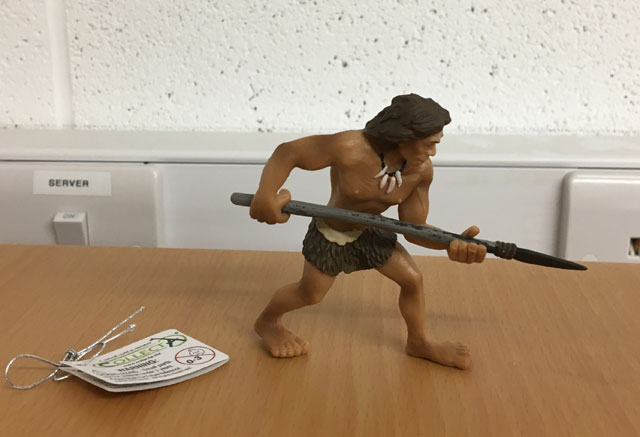
CollectA Neanderthal man model

Selecting a CollectA Neanderthal man figure for an Everything Dinosaur customer. Picture credit: Everything Dinosaur.

Picture credit: Everything Dinosaur

The bone was left to dry for a few days where it was discovered, before being removed for a special public announcement attended by the mayor of Nice and other local officials.

To view models of Neanderthals and other prehistoric figures (whilst stocks last): CollectA Neanderthal Models and Prehistoric Animals.

30 08, 2011

The “Mother” of All Placental Mammal Fossils

By |2023-03-08T09:22:50+00:00August 30th, 2011|Categories: Dinosaur and Prehistoric Animal News Stories, Dinosaur Fans, Main Page|0 Comments

Milestone in Mammalian Evolution

The Liaoning Province in China is famous for its amazing feathered dinosaur and early bird fossils, however, a team of scientists have published a paper on the discovery of a prehistoric mammal.  A tiny creature that scurried through the undergrowth – the fossils suggests that this may be one of the earliest ancestors of the placental mammals.

This well-preserved fossil discovered in north-east China provides new information about the earliest ancestors of most of today’s mammal species, including ourselves as we to are  placental mammals.  According to a paper published today in the journal “Nature”, the fossil represents a new milestone in mammal evolution that was reached 35 million years earlier than previously thought.

Mammalian Evolution

It fills an important gap in the fossil record and helps to calibrate modern, DNA-based methods of dating evolution.

The paper, by a team of scientists led by Carnegie Museum of Natural History palaeontologist Zhe-Xi Luo, describes Juramaia sinensis, a small shrew-like mammal that lived in China 160 million years ago during the Mid Jurassic.

Juramaia is the earliest known fossil of Eutherians, the group that evolved to include all placental mammals, which provide nourishment to unborn young via a placenta.  As the earliest known fossil ancestor to placental mammals, Juramaia provides fossil evidence of the date when Eutherian mammals diverged from other mammals; the Metatherians ( whose descendants include marsupials such as kangaroos ) and monotremes ( such as the duck-billed  platypus ).

As Luo explains,

“Juramaia, from 160 million years ago, is either a great-grand-aunt or a great-grandmother of all placental mammals that are thriving today.”

The fossil of Juramaia sinensis was discovered in the Liaoning Province in northeast China and examined in Beijing by Luo and collaborators: Chong-Xi Yuan and Qiang Ji from the Chinese Academy of Geological Sciences and Qing-Jin Meng from the Beijing Museum of Natural History, where the fossil is stored.

The name Juramaia sinensis means “Jurassic mother from China.”

Juramaia sinensis

The fossil has an incomplete skull, part of the skeleton, and, remarkably, impressions of residual soft tissues such as hair.  The Liaoning Province has a reputation for producing the most exquisitely preserved fossils of animals and plants.

Juramaia’s complete teeth and forepaw bones enable palaeontologists to pinpoint that it is closer to living placentals on the mammalian family tree than to the pouched marsupials, such as kangaroos.

Luo commented:

“Understanding the beginning point of placentals is a crucial issue in the study of all mammalian evolution.”.

Modern molecular studies, such as DNA-based methods, can calculate the timing of evolution by a “molecular clock.”  But the molecular clock needs to be cross-checked and tested by the fossil record.   The idea of a “molecular clock” is that evolutionary changes occur at regular time intervals.  It is assumed that the rate of genetic change (mutation) in an organism’s DNA has not changed over time, or at least can be averaged.  The molecular genetic difference or “distance” between two species can be measured and their rate of genetic change estimated.

Prior to the discovery of Juramaia, the divergence of Eutherians from Metatherians posed a quandary for evolutionary biologists: DNA evidence suggested that Eutherians should have shown up earlier in the fossil record–around 160 million years ago.

The oldest known Eutherian was Eomaia, dated to 125 million years ago (Early Cretaceous).  The primitive mammal Eomaia was originally described in 2002 by a team of scientists led by Luo and Carnegie mammal specialist, John Wible.

Supporting the DNA Evidence

The discovery of Juramaia provides much earlier fossil evidence to corroborate the DNA findings, filling an important gap in the fossil record of early mammal evolution and helping to establish a new milestone of evolutionary history.

Chuck Lydeard, Programme Director in the National Science Foundation’s Division of Environmental Biology, which co-funded the research stated:

“These scientists have used the rich fossil mammal record to test evolutionary hypotheses proposed by their colleagues studying living mammals using genetic data.”

Juramaia also reveals adaptive features that may have helped the Eutherian newcomers survive in a tough Jurassic environment.

Juramaia’s forelimbs are adapted for climbing.  Since the majority of Jurassic mammals lived exclusively on the ground, the ability to escape to the trees and explore the canopy might have allowed Eutherian mammals to exploit an untapped niche and to escape from all those cursorial, feathered dinosaur predators that shared their forest home.

Luo supports this perspective:  He stated:

“The divergence of Eutherian mammals from marsupials eventually led to the placental birth and reproduction that are so crucial for the evolutionary success of placentals.  But it is their early adaptation to exploit niches on trees that paved their way toward this success.”

For models and figures of prehistoric mammals: CollectA Deluxe Scale Models of Prehistoric Mammals.

29 08, 2011

Countdown to Planet Dinosaur – The Excitement Builds

By |2024-04-22T11:51:41+01:00August 29th, 2011|Categories: Dinosaur Fans, Everything Dinosaur News and Updates, Main Page|0 Comments

BBC Television Series to be Shown Next Month

The wait for the new BBC documentary series “Planet Dinosaur” is nearly over with team members at Everything Dinosaur being informed that this six-part television series is scheduled to be shown next month, with a date and time yet to be confirmed.

Countdon to “Planet Dinosaur”

The BBC’s dinosaur portfolio consists of a number of web based activities and complimentary dinosaur themed programmes that will air on the other BBC channels whilst the main series is broadcast on BBC1.  With more dinosaurs having been discovered in the last thirty years or so compared to the preceding one hundred and fifty years, the BBC and their production partners have a lot of new dinosaur material to cover.  Planet dinosaur uses the latest CGI and cutting-edge research to reveal the deadly secrets of these new prehistoric creatures.

For the first time on British television, the very latest dinosaur discoveries have been brought together and brought to life in this ground-breaking series. Featuring a cast of new dinosaurs that will feed the nation’s nightmares, the next generation of children aren’t going to be talking about Tyrannosaurus rex – they are about to meet far bigger, badder, more vicious characters that roamed the Earth 95 million years ago – or so the BBC publicity material goes, although we doubt whether a single television series is going to shake T. rex from the number one dinosaur position.

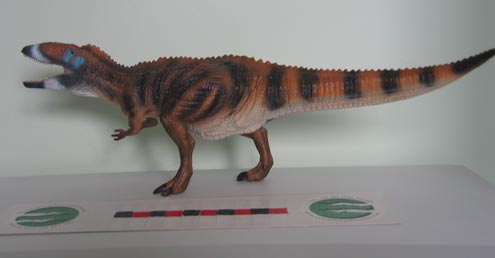
Carcharodontosaurus Features

Collecta Deluxe Carcharodontosaurus dinosaur model

A replica of a Carcharodontosaurus dinosaur model.  Picture credit: Everything Dinosaur.

Picture credit: Everything Dinosaur

The series starts in North Africa, where two of the world’s biggest predators once battled for supremacy.  At 13 metres in length and weighing 7 tonnes, Carcharodontosaurus was a huge beast, a gigantic lizard-like carnivore with shark-like teeth more than 6 inches long.  It was an efficient hunter that would slash at its prey until it bled to death.

But the discovery of an upper jaw in Morocco revealed an even bigger carnivorous killer – Spinosaurus.  Four metres longer than Tyrannosaurus rex, Spinosaurus is thought to have been one of the biggest killers to ever walk the Earth.  But unlike the meat-eating Carcharodontosaurus, Spinosaurus mainly ate fish, living and hunting almost exclusively in the water.  Team members at Everything Dinosaur provided data and advised the CGI team on how to go about bringing Spinosaurus back to life.

For models of prehistoric animals that feature in the television series: Prehistoric Animal Models and Figures (CollectA).

Like all predators that share an environment, the two may once have had to compete for food.  Planet Dinosaur takes a look at what one such deadly battle may have looked like and finds out which giant beast would have been most likely to survive a fight to the death, although no evidence of any conflict between these two apex predators has been preserved in the fossil record.

Looks like the autumn schedule is going to be exciting.

28 08, 2011

Oldest Fossils on Earth 3.4 Billion Years Old

By |2023-01-20T17:58:49+00:00August 28th, 2011|Categories: Dinosaur and Prehistoric Animal News Stories, Educational Activities, Main Page|0 Comments

Scientists Discover Oldest Fossils on Earth

A team of Anglo/Australian scientists have published their findings regarding the discovery of tiny, microbial fossils that could be the oldest fossils ever found on Earth.  The discovery in 3.4-billion-year-old sandstone, some of the oldest sedimentary rock known, suggests that bacteria had evolved early in the Archaen Eon a time when the Earth was virtually devoid of oxygen.  The discovery was made at the remote Strelley Pool location, Pilbara (Western Australia).  Not only does this discovery have significant implications for life on our own planet but such a find could help scientists search for evidence of microbial life on Mars.

Oldest Fossils on Earth

Pictures of the remote fossil location have been distributed, a site synonymous with Archaen microbial fossils.

The new research, published in the scientific journal “Nature Geoscience”, provides solid fossil evidence to date key branching points in the Earth’s evolutionary clock, although as with many microbe fossils, some scientists are challenging whether the tiny tube-like structures that have been discovered are organic remains suggesting that they could have been formed by chemical or other inorganic means.

Scientists based in The University of Western Australia’s Centre for Microscopy, Characterisation and Analysis in collaboration with Oxford University (England) have unearthed arguably the best-preserved pre-three-billion-year-old micro-fossils on Earth.  These consist of remarkably preserved carbonaceous cells along with the protective tubes (sheaths) that housed some of these cells.

Leading author University of Western Australia Postdoctoral Research Fellow Dr David Wacey said direct evidence for early life in the form of micro-fossils was exceedingly rare and evidence for what type of life came first had until now proved elusive.  Certainly, from what is known about the Archaen Eon, any life forms that may have lived during this immensely ancient time were likely to have been extremely tough – extreme extremophiles as it were.

Dr Wacey commented:

“Our research helps to answer the question: How did these microbes survive?  On the early Earth, where free oxygen was rare or absent, evolving life had to employ other means to survive.  Using a combination of electron microscopy and ion probe analysis, we were able to show that these particular microbes had a metabolism that was based on the use of sulphur.  This ability to essentially ‘breathe’ sulphur compounds has long been thought to be one of the earliest stages in the transition from a non-biological to biological world.”

The conditions that early life forms may have evolved in can still be found on our planet today.  Just a few decades ago marine biologists discovered a series of volcanic vents on the bottom of deep oceans.  These “black smokers” as they are called as they belch out columns of dense, black smoke rich in iron sulphides at temperatures of more than 400 degrees Celsius could mirror the conditions where the first life on Earth evolved.   Life may have thrived around such undersea vents, building a sulphur based ecosystem.

Dr Wacey went onto state:

“By showing the intimate association of these 3.4 billion-year-old micro-fossils with the mineral pyrite (FeS2), we have now provided the earliest direct evidence of micro-organisms employing a sulphur-based metabolism.”

The micro-fossils come from Strelley Pool, a remote region of the Pilbara about 60 kilometres west of the small town of Marble Bar (Western Australia).  They are the oldest micro-fossils ever to be found in sandstones, extending the record of life on Earth in such rocks by about 300 million-years.

Pictures show a computer generated 3-D model of a micro-fossil about 10 micrometres in diameter from Western Australia (left).  Cross sections through the reconstruction (right) emphasise the spheroidal nature of this ancient cell.

For models of prehistoric animals and other creatures: Replicas of Extinct Creatures.

Images show a highly magnified collection of tubular micro-fossils (resembling the protective sheaths of modern bacteria) found in between sand grains in a 3.4-billion-year-old sandstone from Western Australia

A team member, Martin Brasier, of Oxford University, made the additional claim that the remains were the Earth’s oldest fossils.

He said:

“At last we have good solid evidence for life over 3.4 billion years ago.”

However, as with a number of such discoveries dating from 3.49 to 3.4 billion years ago this research has attracted controversy.  Although the Strelley Pool area has provided evidence of micro-fossils such as simple bacteria filaments, a number of scientists question the findings.  Professor Brasier has been a leading critic of slightly older fossils, found in the Pilbara in 1993 by a Californian researcher, William Schopf.  He has argued these older fossils are not biological in origin, as Professor Schopf believes.

If the Strelley Pool discoveries are proof of ancient life on Earth then this evidence could assist scientists as they seek to discover if there was life on Mars.  Using this information, they could look for geological features that resemble the Pilbara location on the red planet and then aim to send unmanned probes to sample rock cores to see if the chemical signatures of micro-fossils could be found.

To read an Everything Dinosaur blog post on fossils that indicate the oldest animals known to science: The Oldest Animal Fossils.

27 08, 2011

How Decisions about Prehistoric Animal Models get Made

By |2023-01-20T17:52:49+00:00August 27th, 2011|Categories: Dinosaur Fans, Everything Dinosaur News and Updates, Main Page|1 Comment

Deciding Which Model to Make

Team members at Everything Dinosaur get asked quite frequently about the decision making process that takes place when manufacturers are deciding which new prehistoric animal models to make.  There are many factors to consider and the process of deciding which replicas to make can be long and drawn out.

Prehistoric Animal Models

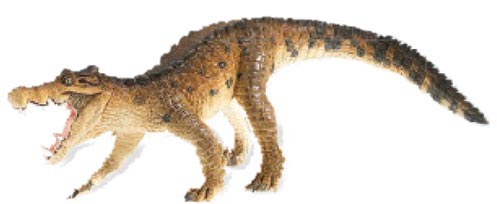
With the Kentrosaurus model from Safari Ltd winning the prestigious “dinosaur model of the year award” from readers of Prehistoric Times magazine and that company’s newly introduced Kaprosuchus prehistoric crocodile model widely tipped to win that accolade for 2011 we decided to ask our good friends at Safari how they go about choosing which models to manufacture.

One of the Favourite Models of 2011 – Safari Wild Dinos Kaprosuchus

Picture credit: Everything Dinosaur

To view Safari’s extensive collection of prehistoric animal models including the Kaprosuchus model (whilst stocks last): Safari Ltd: Dinosaur Models, Prehistoric Crocodile Models, Pterosaurs etc.

It seems that this U.S. based company considers many factors before it goes into full scale model production.  Firstly there is supply and demand, a review of existing model sales and popularity can provide a helpful insight. Then there is the many customer requests received by the company, along with the influence of recent fossil discoveries or new theories about already well-known prehistoric animals.  With our estimate that a new dinosaur species is named and described every twenty to thirty days or so then there is always going to be plenty of new prehistoric animals to choose from.  Prehistoric creatures that appear in television documentaries or in movies can also have an influence.

The input from Everything Dinosaur and those people who contact us about model ideas and suggestions do have an important role to play.  Each enquiry we get is passed on to our contacts at the manufacturer and we know that such suggestions and feedback is greatly appreciated by the design team.

Go to Top