All about dinosaurs, fossils and prehistoric animals by Everything Dinosaur team members.
17 08, 2024

“Snowball Earth” Confirmed by New Study of Scottish and Irish Rocks

By |2024-08-18T13:03:13+01:00August 17th, 2024|Categories: Geology|0 Comments

An ancient rock formation spanning Scotland and Ireland might provide the best evidence of “snowball Earth”.  A study led by University College London (UCL) has identified the Port Askaig Formation, as providing the most complete record of the transition of our planet from a temperate climate to a prolonged period of glaciation.  This was a crucial moment in Earth’s history when the entire planet (probably), became covered in ice.

The paper, published in the “Journal of the Geological Society” of London, postulates that the Port Askaig Formation was likely laid down between 662 to 720 million years ago during the Sturtian glaciation.  The formation is over a thousand metres thick and the Sturtian glaciation was the first of two global freezes thought to have triggered the development of complex, multicellular life.

One exposed outcrop of the formation, found on Scottish islands called the Garvellachs, is unique as it shows the transition into “snowball Earth” from a previously warm, tropical environment.

Arriving on Garbh Eileach, the largest of the Garvellach islands.

Transition into glaciation from right to left. Arriving on Garbh Eileach, the largest of the Garvellach islands. Sedimentary layers above the shoreline here record the transition into glaciation moving through time from right to left. Picture credit: Graham Shields.

Picture credit: Graham Shields

The Port Askaig Formation and “Snowball Earth”

Scientists think that the dramatic freezing of our planet was the catalyst that led to the development of more complex forms of life.  This led to the evolution of the Ediacaran fauna and eventually to the development of more familiar lifeforms as demonstrated by the “Cambrian explosion” as recorded in such famous fossil sites as the Burgess Shale.

Senior author of the scientific paper, Professor Graham Shields (UCL) explained that other rock formations that are approximately the same age as the Port Askaig Formation are missing evidence of the change in climate.

The professor commented:

“These rocks record a time when Earth was covered in ice. All complex, multicellular life, such as animals, arose out of this deep freeze, with the first evidence in the fossil record appearing shortly after the planet thawed.”

PhD candidate Elias Rugen (UCL) and first author of the study stated:

“Our study provides the first conclusive age constraints for these Scottish and Irish rocks, confirming their global significance. The layers of rock exposed on the Garvellachs are globally unique. Underneath the rocks laid down during the unimaginable cold of the Sturtian glaciation are 70 metres of older carbonate rocks formed in tropical waters. These layers record a tropical marine environment with flourishing cyanobacterial life that gradually became cooler, marking the end of a billion years or so of a temperate climate on Earth. Most areas of the world are missing this remarkable transition because the ancient glaciers scraped and eroded away the rocks underneath, but in Scotland by some miracle the transition can be seen.”

A view of Garbh Eileach, the largest island in the Garvellach island chain where the gradational transition into snowball Earth is recorded.

A view of Garbh Eileach, the largest island in the Garvellach island chain where the gradational transition into snowball Earth is recorded. Picture credit: Graham Shields.

Picture credit: Graham Shields

The Sturtian Glaciation

The Cryogenian Period (from 720 to 635 million years ago) immediately preceded the Ediacaran Period, the first time that complex life is unambiguously identified in the fossil record.  The Sturtian glaciation was the first of two global freezing events.  The Sturtian glaciation lasted around sixty to seventy million years, and it was followed shortly afterwards by a second global glaciation event (Marinoan glaciation). During these phases life on Earth transitioned. Cyanobacteria became less prominent and algae began to become more common.

Stromatolites whipped up by tropical storms demonstrate Scotland and Ireland were at low latitudes prior to "Snowball Earth".

Layers of microbially-influenced limestone (stromatolite) that have been whipped up by storms. Such features are typical of tropical climes, in keeping with other evidence that Scotland was at low latitudes prior to the onset of glaciation. Picture credit: Graham Shields.

Picture credit: Graham Shields

The advance and retreat of the ice across the planet was thought to have happened relatively quickly, over thousands of years, because of the albedo effect – that is, the more ice there is, the more sunlight is reflected back into space, and vice versa. After these periods of intense cold, complex life emerged rapidly (in geological terms).  It has been suggested that the extreme conditions on Earth may have prompted the emergence of altruism, with single-celled organisms learning to co-operate with each other, thus forming multicellular life.

Islands provide evidence of "Snowball Earth".

Standing on limestone beds of the pre-glacial Garvellach Formation, looking North from Garbh Eileach over to Dun Chonnuil. Due to tectonic tilting, the sedimentary layers get younger, and closer to the onset of glaciation, as you move to the right. Picture credit: Elias Rugen.

Picture credit: Elias Rugen

The End of “Snowball Earth” was Catastrophic

The dramatic change in climate was catastrophic for life on Earth.

Professor Shields explained:

“The retreat of the ice would have been catastrophic. Life had been used to tens of millions of years of deep freeze. As soon as the world warmed up, all of life would have had to compete in an arms race to adapt. Whatever survived were the ancestors of all animals.”

For this new research, the field team collected samples of sandstone from the 1.1-kilometre-thick Port Askaig Formation and compared them to the older seventy-metre-thick underlying Garbh Eileach Formation.  The team examined tiny, extremely durable minerals in the rock called zircons. These can be precisely dated as they contain the radioactive element uranium, which decays to lead at a steady rate. The zircons together with other geochemical evidence suggest the rocks were deposited between 662 and 720 million years ago.

Anthony (Tony) Spencer standing on the Garbh Eileach Formation.

Anthony (Tony) Spencer standing on the Garbh Eileach Formation. The rocks record a gradual transition from the warm tropical world of the Tonian period into the snowball Earth of the Cryogenian period. Tony first recognised the significance of these rocks over 50 years ago during his PhD. Picture credit: Elias Rugen.

Picture credit: Elias Rugen

Defining the Time Constraints for the Cryogenian Period

The scientists propose that the new age constraints for the rocks may provide the evidence needed for the site to be declared as a marker for the start of the Cryogenian Period.  This marker, known as a Global Boundary Stratotype Section and Point (GSSP), is sometimes referred to as a golden spike, as a gold spike is driven into the rock to mark the boundary.  Scientists from the International Commission on Stratigraphy, a part of the International Union of Geological Sciences, visited the Garvellachs last month for a preliminary assessment to determine the significance of the geological formation.

"Snowball Earth" and Scottish/Irish islands.

An outcrop called “the Bubble” on Eileach an Naoimh (Holy Isle). It shows a huge white rock fragment, tens of metres across, which was originally part of the underlying rock sequence. The layering in the carbonate rock has been squeezed tightly under immense pressure and transported by thick ice sheets to its final resting as one of many different rock fragments within a moraine. Picture credit: Graham Shields.

Picture credit: Graham Shields

Everything Dinosaur acknowledges the assistance of a media release from the University College London in the compilation of this article.

The scientific paper: “Glacially influenced provenance and Sturtian affinity revealed by detrital zircon U–Pb ages from sandstones in the Port Askaig Formation, Dalradian Supergroup” by Elias J. Rugen, Guido Pastore, Pieter Vermeesch, Anthony M. Spencer, David Webster, Adam G. G. Smith, Andrew Carter, and Graham A. Shields published in the Journal of the Geological Society.

Visit the Everything Dinosaur website: Dinosaur Toys.

16 08, 2024

New Rebor Tyrannosaurus rex Models Announced

By |2024-08-17T06:30:08+01:00August 16th, 2024|Categories: Rebor Models and Figures|0 Comments

Rebor have announced that they will be introducing two, new Tyrannosaurus rex figures in the autumn of 2024.  The Rebor Tyrannosaurus rex Cream figures (Mountain and Skull Walker) will be in stock at Everything Dinosaur in a few weeks.

The Rebor Tyrannosaurus rex Cream (Mountain version).

The new for autumn 2024 Rebor Tyrannosaurus rex Cream in the Mountain colouration.

Both figures have been beautifully sculpted. The represent robust variants on a T. rex theme.  Each model measures around forty-two centimetres in length.  The head height is estimated to be around fifteen centimetres.

Rebor Tyrannosaurus rex Cream (Skull Walker) in lateral view.

The new for autumn 2024 Rebor Tyrannosaurus rex Cream (Skull Walker variant).

These new tyrannosaur figures will have articulated lower jaws.  We expect the tails will be flexible and require insertion into the base of the model to complete assembly. The forelimbs will probably be articulated too.

The Rebor Tyrannosaurus rex Cream Pair

The Rebor Tyrannosaurus rex Cream pair, Skull Walker and Mountain will be arriving on the same shipment. Everything Dinosaur customers will be able to select their preferred model, or perhaps pick up both.   A spokesperson from Everything Dinosaur praised these figures and pointed out the innovative “arrow-shaped” end of the tail.  The spokesperson stated that the skin texture on these figures looked fantastic.

Commenting further on their appearance, the spokesperson added:

“Skull Walker and Mountain are excellent figures.  I am most impressed with the amazing texture and fine details of the scales.  For me, these two figures remind me of the Vastatosaurus rex from the 2005 film ‘King Kong’.  Their grey, pebbly appearance, blunt heads and large, irregular teeth remind me of the tyrannosaurine from Skull Island.”

Rebor Tyrannosaurus rex Cream (Skull Walker) in close view.

A close-up view of the anterior portions of the Rebor Tyrannosaurus rex Cream Skull Walker figure.

The image (above) shows the grey and pebbly skin texture of the Rebor Tyrannosaurus rex Cream Skull Walker figure.

Rebor Tyrannosaurus rex Cream (Mountain) a close view.

A closer view of the new for autumn 2024 Rebor Tyrannosaurus rex Cream in the Mountain colour scheme.

To view the range of Rebor models and figures in stock at Everything Dinosaur: Rebor Dinosaurs.

Available in the Autumn of 2024

It was confirmed that these two dinosaur figures would be available from Everything Dinosaur in the autumn (2024).

The Rebor Tyrannosaurus rex Cream (Mountain)

A Rebor Tyrannosaurus rex in the Cream series shown in lateral view. This is the Mountain colour variant.

To request further information about these two new Rebor figures: Email Everything Dinosaur.

Rebor Tyrannosaurus rex Cream in the Skull Walker version.

The Skull Walker variant shown in lateral view.

Visit the award-winning Everything Dinosaur website: Dinosaur Models and Toys.

15 08, 2024

New CollectA Deluxe Diprotodon Model Reviewed

By |2024-08-16T14:33:14+01:00August 15th, 2024|Categories: Everything Dinosaur videos|0 Comments

The new for 2024 CollectA Deluxe Diprotodon figure is featured in a YouTube video.  This video was created by Everything Dinosaur team members.  It highlights some of the details found on this giant marsupial figure.  The narrator comments on the wounds and scars seen on the model.  In addition, the resurrection of the extinct Tasmanian tiger is discussed.

Video credit: Everything Dinosaur

The CollectA Deluxe Diprotodon Model

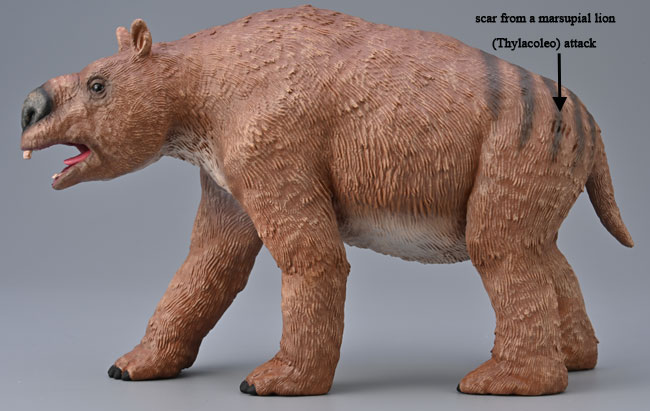
The CollectA Diprotodon figure measures over twenty centimetres in length.  It has a shoulder height of approximately twelve centimetres.  CollectA have declared a scale of 1:20 for this model.  Mike from Everything Dinosaur narrates the video review.  He highlights the skull and discusses the dentition of the model.  The fresh wound on the cheek is contrasted with the old scar located on the rump. One is the result of a recent bout of intraspecific competition, whilst the other is a scar from an attack from a Thylacoleo.

CollectA Deluxe Diprotodon model.

The CollectA Diprotodon model has an old scar from a marsupial lion (Thylacoleo) on its rump.

To view the CollectA Deluxe range of models in stock at Everything Dinosaur: CollectA Deluxe Prehistoric Life Models.

The Video Review Contents

As with many Everything Dinosaur videos, this video has been conveniently divided into helpful chapters.  Viewers can quickly find a section of the video that they want to view.  The entire video is a under eight and a half minutes in length.

The video contents:

0:00 The CollectA Deluxe Diprotodon.
0:36 Subscribe!
0:46 Model Measurements.
1:22 The Head and the Teeth!
2:13 Did Diprotodon have a Trunk?
2:35 Amazing Feet and Accurate Toes.
4:19 Intraspecific Combat!
5:07 Attacked by a Marsupial Lion!
6:15 De-extinction of the Thylacine – A Clue?
7:29 Where to Purchase?

Take a look at Everything Dinosaur’s YouTube channel: Dinosaur Model Video Reviews.

Mike from Everything Dinosaur explained that this video review focused on anatomical details that demonstrate the care and attention taken by CollectA over their prehistoric animal model designs.

He commented:

“We highlight the fused second and third toes on the hind feet.  In addition, we explain why the hind feet are turned inwards and we examine the wrinkled features of this giant marsupial’s snout.  All these little details, perhaps overlooked by other reviewers, highlight the quality of this CollectA figure.”

Visit the award-winning Everything Dinosaur website: Prehistoric Animal Models.

14 08, 2024

A Beautiful Dinosaur Diorama

By |2024-08-16T12:55:40+01:00August 14th, 2024|Categories: Dinosaur and Prehistoric Animal Models|0 Comments

Our thanks to model collector and dinosaur fan Carl, who sent into Everything Dinosaur some pictures of his latest diorama.  Carl was inspired by the 2001 film “Jurassic Park III”.  This was the third film in the award-winning “Jurassic Park” series and the first of the franchise not to be directed by Steven Spielberg. Whilst it reprised many of the characters from the earlier movies, a Spinosaurus replaced Tyrannosaurus rex the apex predator.  Carl’s diorama recreates a famous scene from the film.  The Spinosaurus fights T. rex!  The Nanmu Studio T. rex meets its demise after an assault from a W-Dragon Spinosaurus.

W-Dragon Spinosaurus fights the Nanmu Studio T. rex.

The W-Dragon Spinosaurus fights the Nanmu Studio T. rex. Picture credit: Carl.

Picture credit: Carl

The W-Dragon Spinosaurus Battles the Nanmu Studio T. rex

The picture (above) shows the carefully composed prehistoric animal diorama.  This is Carl’s interpretation of the classic scene from the film Jurassic Park III when a Spinosaurus battles a T. rex. The diorama was created using the W-Dragon Spinosaurus and the Nanmu Studio Once and Future King T. rex.  As dinosaur fans will know, the Tyrannosaurus rex meets its demise.

The Spinosaurus stands over the T. rex corpse.

The W-Dragon Spinosaurus stands over the T. rex corpse (the Rebor “Bites the Dust” T. rex figure). Picture credit: Carl.

Picture credit: Carl

The W-Dragon Spinosaurus stands in triumph over the corpse of the Tyrannosaurus rex.  The Nanmu Studio T. rex figure has been replaced by the Rebor Tyrannosaurus rex carcase in the “jungle” colour scheme.

Mike from Everything Dinosaur commented:

“Jurassic Park has inspired lots of dinosaur dioramas.  The Spinosaurus and T. rex is one of the most iconic scenes from the franchise.  We congratulate Carl for skilfully blending figures from several ranges to recreate this dramatic scene.”

The Nanmu Studio T. rex figure.

The Nanmu Studio Once and Future King T. rex figure features in the diorama. Picture credit: Carl.

Picture credit: Carl

To view the Nanmu Studio Jurassic Series range of figures available from Everything Dinosaur: Nanmu Studio Jurassic Series Models.

CollectA Plants and the Rebor Display Base “Winter Tears”

In addition, to the two protagonists, Carl has used numerous other props in his prehistoric animal diorama.  Some CollectA prehistoric plants have been used.  For example, the large CollectA cycad trees add depth and help to frame the scene. Whilst the smaller Monathesia and cycads model accompanied by the Williamsonia figures in the foreground help to draw the viewer’s attention to the dinosaurs.

The W-Dragon Spinosaurus against a backdrop of cycad trees.

The W-Dragon Spinosaurus is highlighted against a backdrop of CollectA prehistoric cycad models. Picture credit: Carl.

Picture credit: Carl

Recreating some of the incredible scenes from the “Jurassic Park” franchise using detailed prehistoric animal dioramas creates a sense of wonder and excitement. Dioramas such as Carl’s capture some of the thrilling magic that amazed cinema audiences.

Visit the award-winning Everything Dinosaur website: Dinosaur Models.

13 08, 2024

A New Titanosaur from Patagonia

By |2024-08-15T11:26:01+01:00August 13th, 2024|Categories: Palaeontological articles|0 Comments

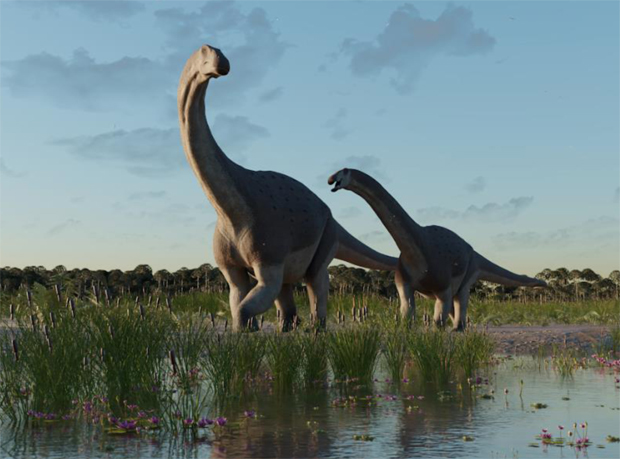
Earlier this year, researchers revealed the discovery of a new titanosaur from Patagonia.  The dinosaur named Titanomachya gimenezi comes from northern Chubut Province in central Patagonia. Several titanosaur taxa have been reported from northern Patagonia, as well as few titanosaurs from southern Patagonia. However, titanosaurs from the end-Cretaceous of central Patagonia are poorly known. The fossil specimen represents an adult animal. It is described as a small-bodied saltasauroid. However, despite being small by titanosaur standards, it has been estimated that Titanomachya weighed around 8 tonnes (weight estimates range from 5.8 to 9.8 tonnes).

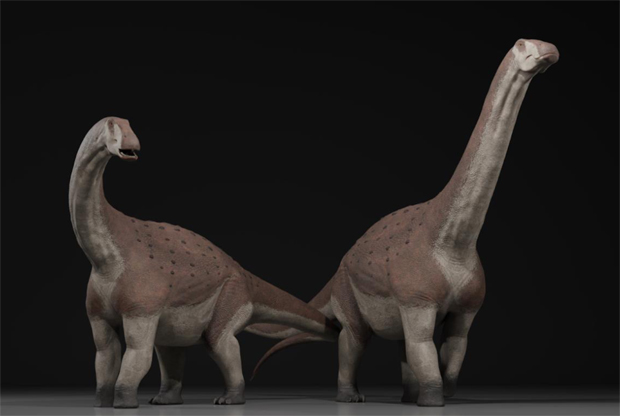
A life reconstruction of Titanomachya gimenezi.

Titanomachya gimenezi life reconstruction. Picture credit: Gabriel Diaz.

Picture credit: Gabriel Diaz

Fossils from the La Colonia Formation

The fossils come from La Colonia Formation and the research team consisted of Agustín Pérez Moreno, Leonardo Salgado, José Luis Carballido, Alejandro Otero, and Diego Pol. These eminent researchers herald from a variety of Argentinian institutions including the Museo de La Plata (MLP), the Museo Paleontológico Egidio Feruglio (MEF) and the Fundación Félix de Azara-Universidad Maimónides.

Titanomachya gimenezi fossil excavation.

Titanomachya gimenezi fossil excavation. Picture credit: Vincent Brusca.

Picture credit: Vincent Brusca

The strata in which the fossils were found date from the Upper Cretaceous (Maastrichtian faunal stage).  This indicates that Titanomachya gimenezi roamed this part of Gondwana around seventy million years ago.  The genus name is derived from the Titanomachy, a mythical battle fought by the Olympian gods against the Titans in Greek mythology.  In this battle, the Titans lost.  The name is appropriate and fitting since Titanomachya comes from the time when the titanosaurs were heading for extinction.  The species name honours the late Dr Olga Giménez.  Dr Giménez played a pivotal role in the study of vertebrate fossils found in central Patagonia.  She was the first palaeontologist to study the dinosaurs of the Chubut province.

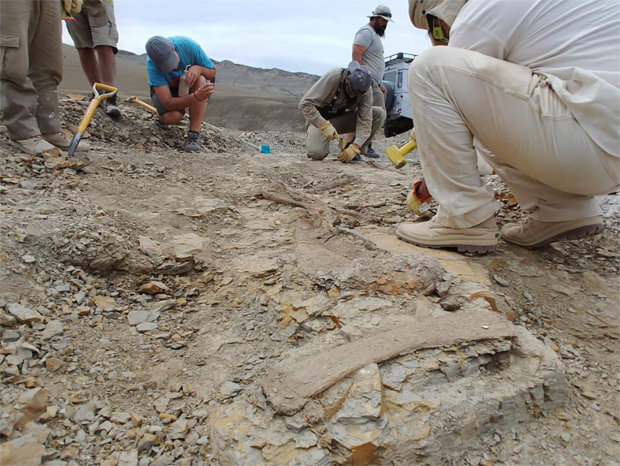
Field team members excavating the fossils.

Field team members excavating the fossils. Picture credit: Vincent Brusca.

Picture credit: Vincent Brusca

Studying the Fossil Material

More than fifteen scientists have been involved in the field work.  The excavation work was carried out over two years and the fossil material found consists of elements from the limbs along with fragments of ribs and a caudal vertebra.  Once exposed, the fossils were jacketed with burlap and plaster and sent to the MEF laboratories for preparation.

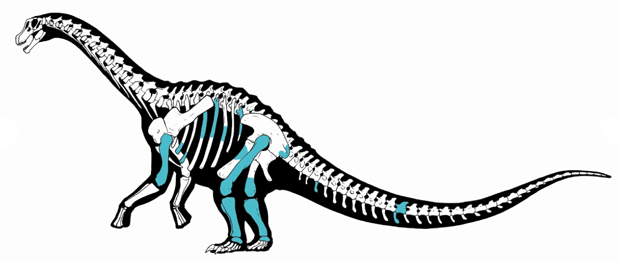
Skeletal reconstruction of Titanomachya gimenezi.

Skeletal reconstruction of Titanomachya gimenezi. The bones coloured blue represent the known fossil material. Picture credit: Gabriel Lio.

Picture credit: Gabriel Lio

This newly described titanosaur is the smallest known from central Patagonia.  Titanomachya (pronounced tie-tan-om-mack-ee-ah), may have measured around ten metres long when fully grown.  It was similar in size to Neuquensaurus australis and Saltasaurus loricatus, to which it was closely related.  The research team identified several unique autapomorphies which allowed them to confidently erect a new taxon.  For example, the astragalus (bone from the ankle), demonstrates unique morphology.  It shows intermediate traits between the Saltasauroidea titanosaurs and the Colossosauria clade of titanosaurs.  These autapomorphies highlight the significance of this discovery as it provides an evolutionary link between different types of sauropod.

Furthermore, phylogenetic studies have demonstrated that Titanomachya is a derived titanosaur. It is a member of the great Saltasauroidea lineage.

Titanomachya gimenezi fossils exposed on the surface.

Titanomachya gimenezi fossils exposed on the surface. Picture credit: Vincent Brusca.

Picture credit: Vincent Brusca

Titanomachya gimenezi and the South America Titanosaur Biota

The La Colonia formation has also yielded the famous theropod Carnotaurus as well as other material.  Fossils representing other carnivorous dinosaurs have been discovered.  For instance, the recently described abelisaurid Koleken (K. inakayali).

To read more about Koleken: A New Abelisaurid from Southern Argentina.

In addition, the remains of ornithischian dinosaurs have been found.  However, Titanomachya gimenezi represents one of only a handful of defined taxa and the first sauropod known from this formation.  This discovery sheds light on the diversity of the region’s ecosystems at the very end of the Age of Dinosaurs.  Moreover, it provides crucial data regarding the composition of sauropod populations in Patagonia during the Maastrichtian.

The researchers postulate that distinct sauropod faunas existed in different parts of Patagonia and also in Brazil over the Campanian and Maastrichtian Epochs. In northern Patagonia, aeolosaurines and saltasaurines dominated, whilst in southern Patagonia, the sauropod biota mostly comprised colossosaurians and other large titanosaurs. In contrast, the less well-known sauropod fauna from central Patagonia seems to have consisted of small-bodied saltasauroids such as Titanomachya along with members of the aeolosaurini and derived eutitanosaurs.

Titanomachya gimenezi life reconstruction.

Titanomachya gimenezi in its low-lying coastal habitat. Picture credit: Gabriel Diaz.

Picture credit: Gabriel Diaz

Further Research Planned

Summarising their research to date, the scientists suggest that Titanomachya provides a new perspective on the rich history of sauropods in Patagonia.  In addition, this unique specimen opens the door to future research that will explore the diversity and evolution of these amazing herbivores.

Everything Dinosaur acknowledges the assistance of corresponding author Dr Pérez Moreno CONICET (Consejo Nacional de Investigaciones Científicas y Técnicas), Buenos Aires, Argentina, in the compilation of this article.

The scientific paper: “A new titanosaur from the La Colonia Formation (Campanian-Maastrichtian), Chubut Province, Argentina” by Agustín Pérez-Moreno, Leonardo Salgado, José L. Carballido, Alejandro Otero and Diego Pol published in Historical Biology.

Visit the Everything Dinosaur website: Dinosaur Models and Toys.

12 08, 2024

CollectA Deluxe Mosasaurus Features in Unique Diorama

By |2024-08-09T13:05:52+01:00August 12th, 2024|Categories: Dinosaur Fans|0 Comments

Our thanks to model collector Caldey who sent into us an image of a prehistoric animal diorama she had created.  A Mosasaurus relaxes in the surf.  The model featured is the CollectA Deluxe Mosasaurus model.  Caldey had photographed her Mosasaurus model whilst on holiday in Wales.  We enjoy receiving pictures of dinosaur and prehistoric animal dioramas.  Our customers are extremely creative, and they create some impressive and unusual dioramas.

Thank you Caldey for taking time away from your holiday to set up this intriguing and carefully conceived photograph.

Mosasaurus is the type genus of the Mosasauridae.  These marine reptiles* were the apex predators in many ocean ecosystems in the Late Cretaceous.

*It is not entirely correct to refer to these animals as marine reptiles.  They were reptiles (Order Squamata), however, some mosasaurs lived in brackish or freshwater.

To read about the unearthing of a freshwater mosasaur (Pannoniasaurus inexpectatus): Freshwater Mosasaur from a Bauxite Mine in Hungary.

CollectA Deluxe Mosasaurus model features in diorama.

Our thanks to Caldey who sent into Everything Dinosaur a picture of her CollectA Deluxe Mosasaurus in the surf. That’s a great prehistoric animal diorama. Thank you for sharing. Picture credit: Caldey.

Picture credit: Caldey

The CollectA Deluxe Mosasaurus

CollectA introduced a not-to-scale Mosasaurus model in 2014.  This figure proved to be extremely popular.  A larger, CollectA Deluxe Mosasaurus figure was added in 2023.  It is the Deluxe Mosasaurus that is featured in Caldey’s diorama. She has chosen to depict this beautiful figure with its articulated jaw closed.

To view the CollectA Deluxe range of scale prehistoric animal models: CollectA Deluxe Prehistoric Life Models.

Mike from Everything Dinosaur praised Caldey’s photograph and stated:

“It is always exciting to see the innovative ways our customers engage with and bring to life the collectibles they are passionate about. We try our best to encourage young people to explore their creativity. Encouraging creativity, especially among young people, is important and we support our customers with their endeavours.” 

11 08, 2024

New Rebor Zombie T. rex Models in Stock

By |2024-08-11T07:42:53+01:00August 11th, 2024|Categories: Rebor Models and Figures|0 Comments

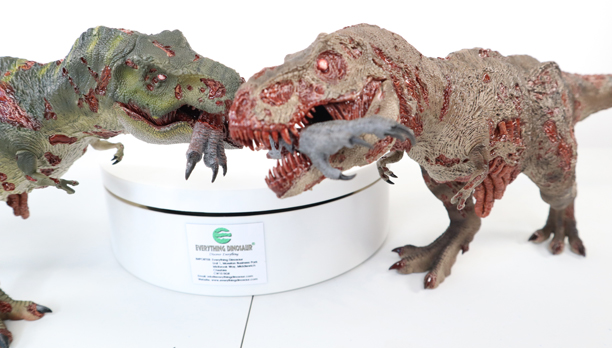
The new Rebor Zombie T. rex models are now in stock at Everything Dinosaur.  Two fantasy dinosaur figures with different colour schemes.  They also have different severed arm accessories.  However, both models share the same Rebor build quality.  Marrying the fascination of prehistoric dinosaurs with the modern horror of zombies is a truly inspired concept.  We congratulate the design team at Rebor for their innovative creations.

Rebor Zombie T. rex in the plain colour scheme.

The Rebor Zombie T. rex in the plain colour scheme. Picture credit: Everything Dinosaur.

Picture credit: Everything Dinosaur

To view the range of Rebor figures available from Everything Dinosaur: Rebor Figures.

The Rebor Zombie T. rex Models (Plain and Jungle)

Two Rebor zombie T. rex colour variants are available.  There is the brown version, known as “Plain” and the green version “Jungle”.  Both models measure around forty-one centimetres in length when assembled.  Collectors have to insert the tail into the rear of the model.  Fortunately, in the figures we looked at, this was easy to accomplish.  The head height is approximately eleven centimetres.  Each figure has a declared scale of 1:35.

Rebor Zombie T. rex figures (Jungle and Plain).

What an amazing pair of zombie dinosaurs! The Rebor Zombie T. rex Cannibal Corpse Jungle (left) and the Plain colour variant (right). Picture credit: Everything Dinosaur.

Picture credit: Everything Dinosaur

The models are supplied with a transparent support stand.  Purchasers will also receive an Everything Dinosaur Tyrannosaurus rex fact sheet.  In addition, each figure has a severed arm accessory.  The arms are different.  We think the “Jungle” version is supplied with a Spinosaurus severed limb.  In contrast, the “Plain” version of Zombie T. rex has the severed arm of an Indominus.  Of course, we could be wrong about the Indominus, but we like to think that Rebor have done this to acknowledge the influence of the “Jurassic Park/Jurassic World” influence on dinosaur designs.

Combining Dinosaurs and Zombies

Mike from Everything Dinosaur praised the team at Rebor for their creativity.

He commented:

“Marrying our fascination with dinosaurs with the horror concept of the living dead is an extremely clever idea.  Rebor has demonstrated that they are an innovative company.  The detail on these figures is most impressive.  If you like gore and fantasy figures, then these models are a must have.”

Rebor Zombie T. rex in the Jungle colour scheme.

The new Rebor Zombie T. rex in the Jungle colour scheme. Picture credit: Everything Dinosaur.

Picture credit: Everything Dinosaur

Both “Jungle” and “Plain” have articulated lower jaws and articulated arms.  The tail is flexible too. Rebor has declared a scale of 1:35 for these two tyrannosaurs.  The idea of these ancient apex predators being reanimated as mindless, ravenous undead creatures is both chilling and captivating.

Mike from Everything Dinosaur added:

“What makes these two T. rex figures compelling is the contrast between the power of these theropods and the otherworldly horror of zombies.  Rebor have once again demonstrated how creative and imaginative they are.”

These are two most impressive dinosaur figures.  Furthermore, these models are a fusion of awe-inspiring natural history and our darkest supernatural nightmares.

The award-winning Everything Dinosaur website: Dinosaur Toys.

10 08, 2024

New CollectA Prehistoric Animal Models in Stock

By |2024-08-10T22:00:17+01:00August 10th, 2024|Categories: CollectA Deluxe Prehistoric Animal Models|0 Comments

Five new for 2024 CollectA prehistoric animal models are now in stock at Everything Dinosaur.  The CollectA Age of Dinosaurs Popular Nanuqsaurus has arrived. In addition, four new CollectA Deluxe figures are now in stock.  These figures are the 1:20 scale Diprotodon, Polacanthus and the Placerias.  Moreover, the 1:6 scale CollectA Deluxe Velociraptor model has arrived too.

New CollectA prehistoric animal models (August 2024).

Five new prehistoric animal models in stock at Everything Dinosaur (August 2024). The new 1:6 scale Deluxe Velociraptor (left), the 1:20 scale Deluxe Diprotodon (back), Placerias 1:20 scale (centre) and the CollectA Age of Dinosaurs Nanuqsaurus is at the front. The new Polacanthus foxii figure in 1:20 scale is on the right. Picture credit: Everything Dinosaur.

Picture credit: Everything Dinosaur

New CollectA Prehistoric Animal Models

Mike from Everything Dinosaur, explained that it had been a busy week for team members.

He stated:

“We have had several deliveries into our warehouse over the last few days.  First, the Haolonggood shipment arrived, then these new CollectA figures were delivered.  We have also had a Rebor shipment as well.”

To view the CollectA Age of Dinosaurs Popular range: CollectA Age of Dinosaurs Popular.

The Deluxe Velociraptor in 1:6 scale, one of the new CollectA prehistoric animal models.

The 1/6th scale CollectA Deluxe Velociraptor dinosaur model. A figure that commemorates the 100th anniversary of the scientific description of this iconic dinosaur. Picture credit: Everything Dinosaur.

Picture credit: Everything Dinosaur

The picture (above) shows the new for 2024 CollectA Deluxe Velociraptor figure.  This figure has been introduced to mark the centenary of the naming of Velociraptor mongoliensis (1924).

The new for 2024 new CollectA Deluxe Diprotodon and the CollectA Deluxe 1:20 scale Placerias.

Mike from Everything Dinosaur with the CollectA Deluxe Diprotodon model (left) and the new CollectA Placerias model (right). Picture credit: Everything Dinosaur.

Picture credit: Everything Dinosaur

To view the CollectA Deluxe range of prehistoric animal models: CollectA Deluxe Prehistoric Life Models.

The Extensive CollectA Range

These five new models join the 1:100 CollectA Deluxe Dreadnoughtus figure and the Dearc sgiathanach pterosaur model as new CollectA prehistoric animal models for 2024.  It is great to see CollectA introducing such a wide variety of prehistoric animal figures.

The CollectA Deluxe 1:20 scale Placerias figure.

The stunning CollectA Deluxe 1:20 scale Placerias figure. Picture credit: Everything Dinosaur.

Picture credit: Everything Dinosaur

Visit the Everything Dinosaur website: Dinosaur Models and Toys.

9 08, 2024

New Haolonggood Dinosaur Models in Stock

By |2024-08-09T13:56:35+01:00August 9th, 2024|Categories: Haolonggood Prehistoric Animal Models|0 Comments

Just arrived at Everything Dinosaur, thirteen new Haolonggood dinosaur models.  Team members have been busy contacting customers who wanted to be notified when these figures arrived.  The models are all part of a shipment of figures that have arrived at Everything Dinosaur’s warehouse.

New Haolonggood dinosaur models in stock (August 2024)

Thirteen new Haolonggood dinosaur models in stock at Everything Dinosaur. The brown boxes at the back of the group are the three new Haolonggood Mamenchisaurus figures. Picture credit: Everything Dinosaur.

Picture credit: Everything Dinosaur

New for 2024 Haolonggood Dinosaur Models

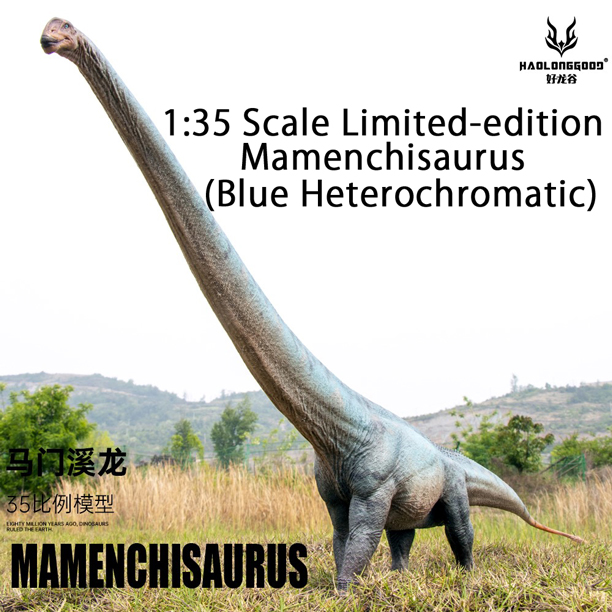
The picture (above) shows the thirteen new Haolonggood figures.  The large boxes at the back of the group are the three Haolonggood Mamenchisaurus figures.  These models are huge, 1:35 scale replicas of the sauropod genus.  Each model measures a whopping sixty-six cm long.  The head height of the Mamenchisaurus figures is twenty-eight cm.

Haolonggood Mamenchisaurus model (blue).

The new for 2024 limited-edition Haolonggood Mamenchisaurus in the blue heterochromatic colour scheme.

Here is a list of the other Haolonggood figures that have arrived:

  • Haolonggood Chasmosaurus Model (Zou Yuan) – a green coloured Chasmosaurus model.
  • The Haolonggood Chasmosaurus Model (Zou Run) – the brown coloured Chasmosaurus.
  • Haolonggood Edmontosaurus Model (Xiao Rang) – a stunning, green Edmontosaurus figure.
  • The Haolonggood Edmontosaurus Model (Pei Xuan) – the brown Edmontosaurus model.
  • Haolonggood Euoplocephalus Model (Xue Yong) – the grey armoured dinosaur model.
  • The Haolonggood Euoplocephalus Model (Shi En) – the brown coloured Euoplocephalus.
  • Haolonggood Maiasaura Mother and Son (Chun Hui) – a pair of Maiasaura models, an adult and juvenile.  The adult is predominantly coloured green.
  • The Haolonggood Maiasaura Mother and Son (Hua Di) – a second pair of Maiasaura models, an adult and juvenile.  The adult Maiasaura is predominantly coloured a reddish brown.
  • Haolonggood Gastonia Model (Tang Long) – the brown coloured Gastonia.
  • Haolonggood Gastonia Model (Du Xin) – the green coloured Gastonia model.

To view the range of Haolonggood prehistoric animal figures in stock: Haolonggood Dinosaur Models.

Mike from Everything Dinosaur welcomed the new Haolonggood prehistoric animal figures and commented:

“The Haolonggood range is extremely popular.  We are busy contacting customers about these new arrivals.  In addition, we have set aside time this weekend to pack orders so that we can quickly despatch parcels to customers.”

The award-winning Everything Dinosaur website: Prehistoric Animal Models and Toys.

8 08, 2024

The Remarkable Wollemi Pine

By |2024-08-25T08:11:57+01:00August 8th, 2024|Categories: Palaeontological articles|0 Comments

During a short visit to Cambridge, Everything Dinosaur team members were able to examine a specimen of the remarkable Wollemi pine (Wollemia nobilis). This tree is regarded as a “living fossil”.  However, its fossil record is extremely poor and scientists are uncertain of its phylogeny.  What is certain, is that this gymnosperm is exceptionally rare.

In 1994, a small grove of fewer than a hundred Wollemi pines were found in a deep gorge in the Blue Mountains (New South Wales). The location remains a secret as this sheltered area is the only known habitat for these remarkable trees. This amazing discovery sparked a global effort to study and conserve the Wollemi pine, which is now considered one of the rarest trees on the planet. Two Wollemi pines have been potted into large planters flanking the glasshouses at the Cambridge University Botanic Gardens. In addition, a third specimen is located close to another ancient type of tree, a Dawn Redwood.

Wollemia nobilis (Wollemi pine).

A young Wollemi pine (Wollemia nobilis) at the Cambridge University Botanic Garden. Picture credit: Everything Dinosaur.

Picture credit: Everything Dinosaur

The Extremely Rare Wollemi Pine

Ironically, the Wollemi pine (Wollemia nobilis) is not a pine.  It is thought to be a member of the Araucariaceae, a family of coniferous trees with three living genera, Agathis, the Wollemi pine and the Araucaria (monkey puzzle tree).   These trees flourished during the Mesozoic. They had a global distribution, although these days they are mostly confined to the Southern Hemisphere.  Wollemia nobilis shares several characteristics with both Araucaria and Agathis. Genetic studies have proved controversial, as they lacked consistency of method. However, many palaeobotanists consider Wollemia nobilis as a sister taxon to Agathis within the Araucariaceae and therefore more closely related to Agathis than it is to Araucaria.

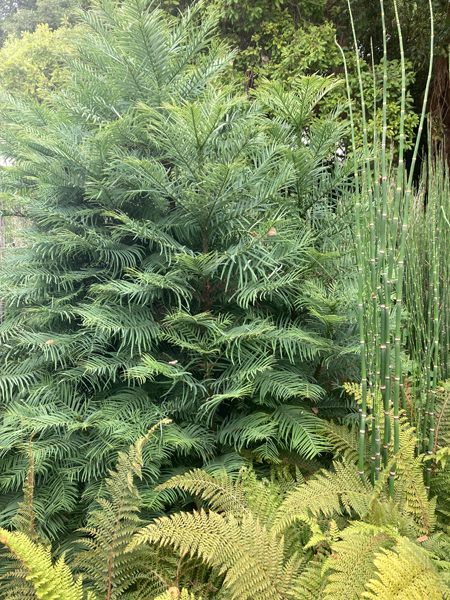
A collection of prehistoric plants including ferns, horsetails and a Wollemi pine.

A piece of plant prehistoric history. A small Wollemi pine surrounded by ferns and horsetails. These are ancient plants representing taxa that evolved before flowering plants. Picture credit: Everything Dinosaur.

Picture credit: Everything Dinosaur

Models of Prehistoric Plants

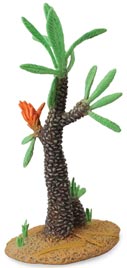
For dinosaur model fans and collectors keen to build dioramas, there are not that many prehistoric plant models.  Safari Ltd used to include three prehistoric plant models within their range (Tree fern, Agathis and a Cycad). Sadly, all three of these figures have been retired.  Thankfully, diorama builders can rely on CollectA to provide models of prehistoric plants.  The company has introduced replicas of many prehistoric trees and plants.  For instance, CollectA have made a replica of Williamsonia, an example of a member of the Bennettitales Order of seed plants.

The CollectA Williamsonia plant.

The CollectA Williamsonia prehistoric plant, a great addition to dinosaur dioramas.

To view the CollectA not-to-scale model range: CollectA Prehistoric Life Models.

Mike from Everything Dinosaur commented:

“It was fascinating to learn more about the remarkable Wollemi pine.  The Cambridge University Botanic Gardens are amazing.  We are so pleased that model makers and diorama builders still have the CollectA prehistoric plants to help them with their prehistoric landscapes.”

The award-winning Everything Dinosaur website: Prehistoric Animal and Plants Models.

Go to Top