All about dinosaurs, fossils and prehistoric animals by Everything Dinosaur team members.
7 02, 2025

Soft Tissue from a Remarkable Jurassic Plesiosaur is Analysed

By |2025-08-11T09:46:39+01:00February 7th, 2025|Categories: Palaeontological articles|0 Comments

Scientists have analysed the soft tissue preserved in a nearly complete Jurassic plesiosaur fossil. This is the first in-depth study of plesiosaur soft tissues to be published.  The study has been published in the journal “Current Biology”.  The research was led by scientists from Lund University (Sweden).  The results show that some plesiosaurs had smooth skin on the body and small scales on the flippers.  This integumentary covering permitted maximum swimming efficiency by reducing drag.  The scales on the flippers are reminiscent of modern reptile scales.  They may have played a role in flipper hydrodynamics and/or provided protection and traction as these marine reptiles moved across rough seabeds in search of food (benthic feeding).
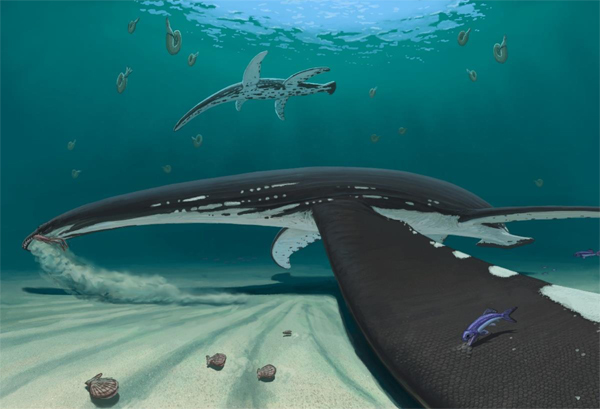
Plesiosaur reconstruction.

Reconstruction of the new plesiosaur with scales on the flipper and smooth scale-less skin along the body as informed by this new plesiosaur fossil. This is a significant update to how we reconstruct plesiosaurs which has otherwise not changed substantially since their initial discovery more than 200 years ago. Picture credit: Joschua Knüppe.

Picture credit: Joschua Knüppe

Studying a Remarkable Jurassic Plesiosaur

Plesiosaurs are an iconic group of Mesozoic marine reptiles with an evolutionary history spanning over 140 million years Their skeletal remains have been discovered worldwide. However, accompanying fossilised soft tissues are exceptionally rare. Only eight instances of plesiosaur soft tissue preservation have been reported to date. The research team examined a beautifully preserved fossil specimen from the Lower Jurassic Posidonia Shale (Posidonienschiefer Formation) of southern Germany.  The fossil is estimated to be around 183 million years old.  It dates from the Toarcian faunal stage of the Early Jurassic.
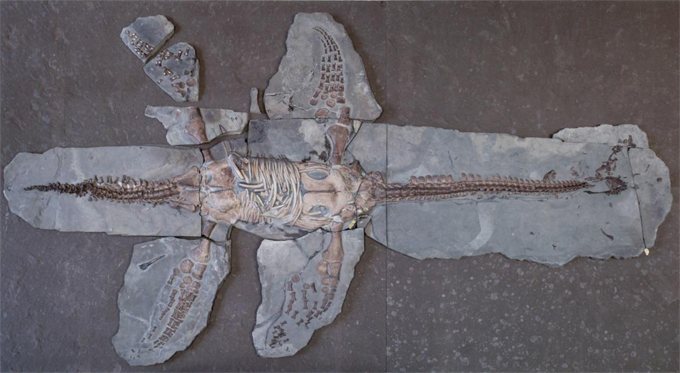
The Jurassic plesiosaur specimen (MH 7).

Skeleton of the new plesiosaur at the Urwelt-Museum Hauff in Holzmaden, Germany. Picture credit: Klaus Nilkens/Urwelt-Museum Hauff.

Picture credit: Klaus Nilkens/Urwelt-Museum Hauff

Until now, little was known about the external anatomy of plesiosaurs.  For example, considerable debate has occurred in regards to whether plesiosaurs had tail flukes, and if they did, what shape they were.  In 2021, CollectA introduced a replica of the Late Cretaceous derived plesiosaur Elasmosaurus.  This model had a diamond-shaped tail fluke.  In Everything Dinosaur’s video review of this figure, the controversy over the tail fluke was highlighted.

To read more about this and to view Everything Dinosaur’s video review: New for 2021 CollectA Figures Including a New Interpretation of Elasmosaurus.

The specimen (MH 7) was excavated from a quarry near the town of Holzmaden in 1940. More complete preparation undertaken in 2020 revealed traces of soft tissue preservation. The soft tissue was associated with the tail and the trailing edge of the right forelimb.
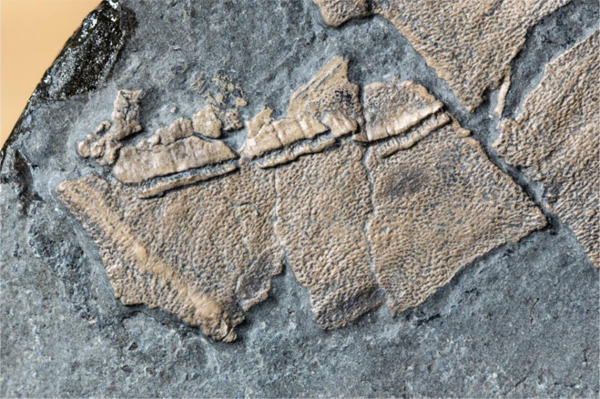
Jurassic plesiosaur skin from the underside of the tail.

Skin from the bottom half of the tail in the new plesiosaur. The skin as preserved is beige in colour with some parts showing a pitted surface. This pitted surface represents the underside of the skin, with the outer surface facing into the rock matrix. Picture credit: Klaus Nilkens/Urwelt-Museum Hauff.

Picture credit: Klaus Nilkens/Urwelt-Museum Hauff

What Does Specimen MH 7 Reveal?

The scientists utilised a variety of techniques, including transmitted light microscopy (TLM), scanning electron microscopy (SEM) and energy-dispersive X-ray spectroscopy (EDX), examining specimen MH 7 in unprecedented detail. In addition, the researchers used electron backscatter diffraction (EBSD), infrared (IR) microspectroscopy, and time-of-flight secondary ion mass spectrometry (ToF-SIMS) to reveal details of the integumentary covering including the identification of potential melanosomes.

Their research indicates that plesiosaurs had both smooth and scaly skin.
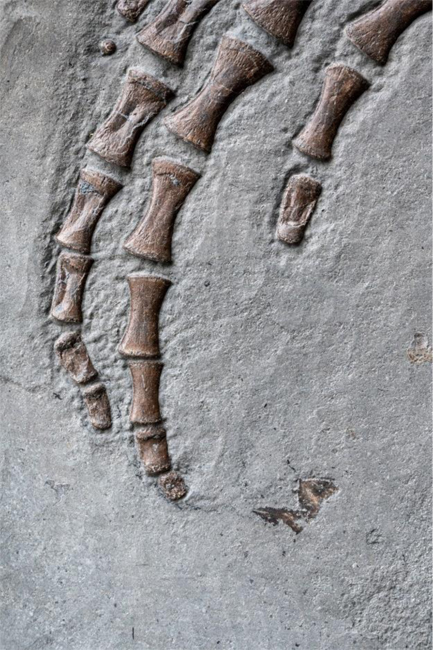
Jurassic plesiosaur fossil with integumentary covering.

The tip of the right flipper with two scales along the trailing edge. Picture credit: Klaus Nilkens/Urwelt-Museum Hauff.

Picture credit: Klaus Nilkens/Urwelt-Museum Hauff

Lead author of the study into this remarkable Jurassic plesiosaur fossil, Miguel Marx, a PhD student in geology at Lund University commented:

“Fossilised soft tissue, such as skin and internal organs, is exceptionally rare. We used a broad range of techniques to identify smooth skin in the tail region as well as scales along the rear edge of the flippers. This provided us with unparalleled insights into the appearance and biology of these long-extinct reptiles.”

Smooth and Scaly Skin

An unusual combination of smooth and scaly skin on different parts of the body was revealed.  The scientists conclude that this variation related to different functions.  For example, the plesiosaur needed to be streamlined so that it could swim efficiently.  Moreover, the smooth and hydrodynamic skin would have reduced drag and helped the animal to use less energy as it swam after prey.  However, it also needed to move across rough seafloors, the scaly flippers would have likely allowed it to do so with maximum efficiency and without damaging its skin.

Miguel Marx added:

“Our findings help us create more accurate life reconstructions of plesiosaurs, something that has been extremely difficult since they were first studied over 200 years ago. Also, the well-preserved German fossil really highlights the potential for soft tissue in providing valuable insights into the biology of these long-extinct animals.”
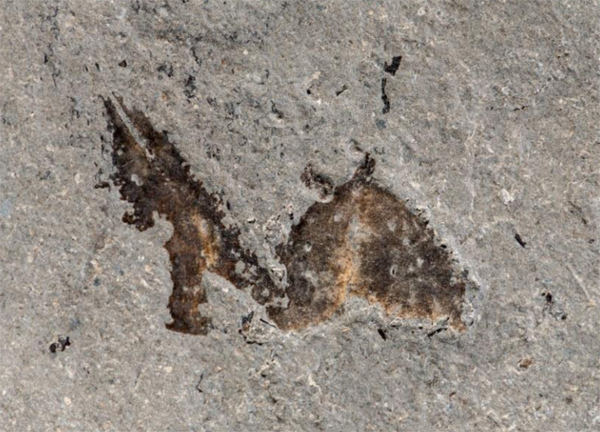
Two scales from the right flipper from the Jurassic plesiosaur.

A close-up image of the two scales from the right flipper. Note the triangular shape of the scale remnants that are distinct from the skin found on the tail of this plesiosaur.
Picture credit: Klaus Nilkens/Urwelt-Museum Hauff.

Picture credit: Klaus Nilkens/Urwelt-Museum Hauff

Reconstructing the Appearance of an Ancient Marine Reptile

With a better understanding of the anatomy and adaptations of extinct creatures palaeontologists can develop an improved understanding of macroevolution.  Furthermore, in recreating the past, scientists can make better predictions about future events.

Summarising the importance of this study, Miguel Marx stated:

“Apart from the mosaic of smooth skin and scales, it was an incredible moment to visualize the cells in thin sections of the fossilized plesiosaur’s skin. I was shocked when I saw skin cells that had been preserved for 183 million years. It was almost like looking at modern skin.”

In addition to Lund University, collaborators from Uppsala University, RISE (Research Institutes of Sweden), Naturkunde-Museum Bielefeld, and Urwelt-Museum Hauff took part in this research.

Everything Dinosaur acknowledges the assistance of a media release from Lund University in the compilation of this article.

The scientific paper: “Skin, scales, and cells in a Jurassic plesiosaur” by Miguel Marx, Peter Sjövall, Benjamin P. Kear, Martin Jarenmark, Mats E. Eriksson, Sven Sachs, Klaus Nilkens, Michiel Op De Beeck and Johan Lindgren published in Current Biology.

The award-winning Everything Dinosaur website: Models of Prehistoric Animals.

6 02, 2025

New Haolonggood Concavenator Figures Coming into Stock Soon

By |2025-02-20T12:21:36+00:00February 6th, 2025|Categories: Haolonggood Prehistoric Animal Models|0 Comments

The two, new for 2025 Haolonggood Concavenator figures are due to be in stock at Everything Dinosaur shortly. These models are in 1:35 scale.  These stunning figures are part of a shipment of Haolonggood models due to arrive at the Everything Dinosaur warehouse next month (March 2025).  A spokesperson from the UK-based mail order company confirmed that both colour variants would be available.

Haolonggood Concavenator figures.

Two new for 2025 theropod figures from Haolonggood. A pair of Concavenator models in 1:35 scale. The lighter coloured Li Li is on the left, whilst (right) is the darker coloured figure with the orange flashes Li Yun.

The New for 2025 Haolonggood Concavenator Figures

These two, new theropods are the same sculpt.  However, two colour variants are offered.  The green and yellow variant is named Li Li.  It has bright red humps. In contrast, the darker coloured figure (Li Yun) has orange flashes on its humps.  This feature is in keeping with the orange colouration of the model’s tail.

Each figure measures sixteen and half centimetres long.  The head height of each model is a little over seven centimetres.

To view the range of Haolonggood figures in stock: Haolonggood Prehistoric Animal Models.

The two new Concavenator figures:

  • Li Li – the lighter coloured, mainly green figure.
  • Li Yun – the darker coloured, mainly blue/grey figure.
Li Li the Haolonggood Concavenator dinosaur model.

On the hunt – Li Li the Haolonggood Concavenator dinosaur model. Note the bright red humps on this figure. The forelimbs indicate the presence of simple feathers.

Concavenator corcovatus

Concavenator corcovatus is known from the Early Cretaceous of Spain. It was scientifically described in 2010 (Ortega et al). This theropod has been assigned to the Carcharodontosauria clade and is estimated to have been about six metres in length. It was described from a single, partially complete and articulated fossil specimen (MCCM-LH 6666).

The elongated neural spines indicated the presence of a sail-like structure over the hips. It is not known what function this feature played. However, it is thought to have been primarily used for visual display. This idea is reinforced by the two Haolonggood Concavenator figures. Both models have brightly coloured humps.

To read Everything Dinosaur’s article from 2010 on the discovery of Concavenator: New European Meat-eater Discovered – One Lump or Two?

Mike from Everything Dinosaur commented that these new theropod figures were on the same shipment as some other new Haolonggood figures.  The Styracosaurus, Utahceratops and Majungasaurus models were all due to arrive in the same container as the Concavenators.

Haolonggood Concavenator model (Li Yun)

The darker of the two Haolonggood Concavenator figures (Li Yun).

Visit the award-winning Everything Dinosaur website: Dinosaur and Prehistoric Animal Models.

5 02, 2025

Unique Ichthyosaur Illustration Sent to Everything Dinosaur

By |2025-02-05T09:22:19+00:00February 5th, 2025|Categories: Dinosaur and Prehistoric Animal Drawings|0 Comments

Our thanks to James, a young artist who sent into Everything Dinosaur an ichthyosaur illustration. It is a fabulous painting of a marine reptile.  James had a little trouble emailing the illustration to us, a special thank you to his sister for helping out.  The beautiful and evocative image reveals plenty of detail.  For example, the huge eye of the ichthyosaur.  The artwork gives the impression that the viewer is observing the marine reptile underwater.

A beautiful, blurry ichthyosaur illustration from James.

A beautiful, blurry ichthyosaur illustration from James. The illustration gives the impression that we are viewing the marine reptile underwater. Picture credit: James.

Picture credit: James

A Clever Ichthyosaur Illustration

The marine reptile’s anatomy has been carefully observed by the artist.  It seems to be hanging motionless in the water column.  The blurring of the image provides a unique perspective.  It is as if we are viewing the animal from under the water.  It is a clever ichthyosaur illustration.

James has sent several illustrations to Everything Dinosaur.  For instance, last year he dispatched an illustration of a Columbian mammoth.

To view the Columbian mammoth illustration: Excellent Columbian Mammoth Artwork.

Mike from Everything Dinosaur thanked James and his sister Lorraine and stated:

“What an intriguing ichthyosaur illustration.  We are always amazed at how talented some of our customers are.  It is always a pleasure to receive pictures from our customers.  My thanks once again to James and Lorraine.”

The award-winning Everything Dinosaur website: Dinosaur and Prehistoric Animal Models.

4 02, 2025

New Study Reveals Preserved Collagen Remnants in Edmontosaurus Fossil

By |2025-02-06T12:20:45+00:00February 4th, 2025|Categories: Palaeontological articles|0 Comments

A newly published scientific paper demonstrates that an Edmontosaurus fossil contains collagen. The study confirms fossils can retain original organic materials.  The discovery of hydroxyproline, a unique collagen-indicator amino acid, in acid-digested samples resolves a long-standing debate amongst palaeontologists.  Identifying organic materials in dinosaur bones could provide a new perspective on the Dinosauria.

Reports of proteins in fossilised bones have been a subject of controversy in the scientific literature.  It is assumed that fossilisation results in the destruction of all organic components.  However, this new research adds weight to the theory that in exceptional circumstances traces of organic materials can persist for tens of millions of years.  Research led by scientists from the University of Liverpool suggests that Mesozoic fossils could still preserve remnants of original organic materials.

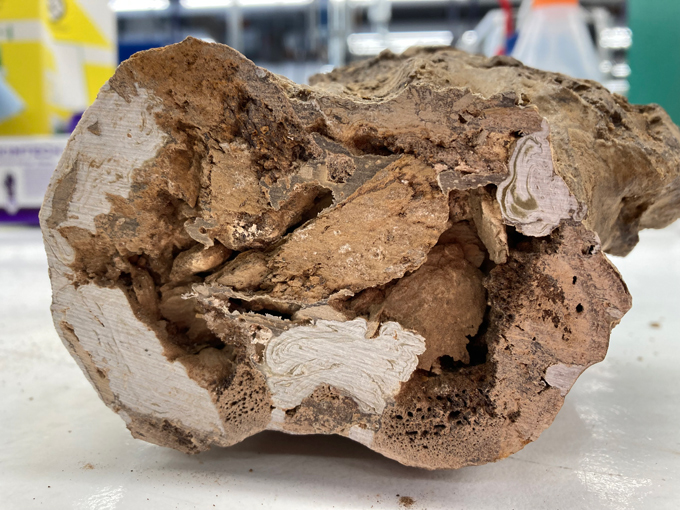
Edmontosaurus fossil contains collagen.

A view of the inside of the Edmontosaurus fossil bone. An exceptionally well-preserved Edmontosaurus sacrum excavated from the Upper Cretaceous strata of the South Dakota Hell Creek Formation is demonstrated to preserve evidence of hydroxyproline. Hydroxyproline is a unique collagen-indicator amino acid. Picture credit: University of Liverpool.

Picture credit: University of Liverpool

Edmontosaurus Fossil Contains Collagen

The research team used mass spectrometry and other advanced techniques to tease out traces of preserved collagen within the sacrum of an Edmontosaurus.  Edmontosaurus is a duck-billed dinosaur (family Hadrosauridae).  Fossils of these taxon come from Upper Cretaceous deposits of North America. It was a large, herbivorous dinosaur. Some specimens indicate a body length in excess of thirteen metres.

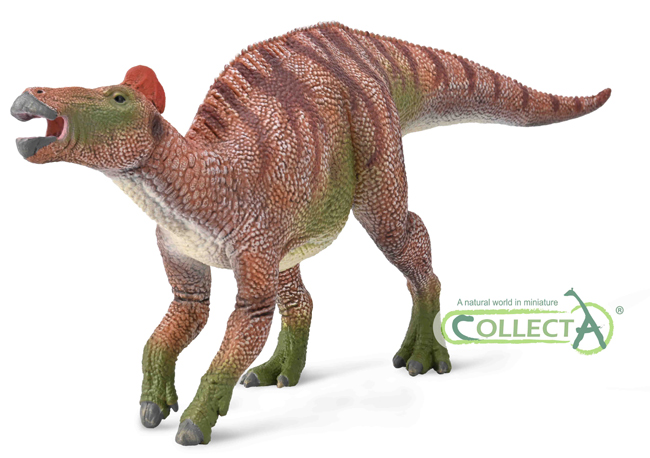
CollectA Deluxe 1:40 scale Edmontosaurus dinosaur model

The CollectA Deluxe 1:40 scale Edmontosaurus dinosaur model. A detailed analysis of Edmontosaurus hip bone fossils (sacrum) reveals evidence of collagen.

The picture (above) shows a model of Edmontosaurus.  This figure is from the CollectA Deluxe series.

To view the range of CollectA Deluxe prehistoric animal models: CollectA Deluxe Prehistoric Animal Figures.

Writing in the journal “Analytical Chemistry” the researchers outline several techniques, including protein sequencing that led to the detection of collagen in the fossilised bone. The specimen (a sacrum), was excavated from Hell Creek Formation deposits located in South Dakota. It is part of the University of Liverpool’s collections and offered a unique opportunity for cutting-edge analyses.

The Implications of this Research

Commenting on the significance of this study, co-author Professor Steve Taylor (chair of the Mass Spectrometry Research Group at the University of Liverpool), stated:

“This research shows beyond doubt that organic biomolecules, such as proteins like collagen, appear to be present in some fossils. Our results have far-reaching implications. Firstly, it refutes the hypothesis that any organics found in fossils must result from contamination. Secondly, it suggests that cross-polarised light microscopy images of fossil bones, collected for a century, should be revisited. These images may reveal intact patches of bone collagen, potentially offering a ready-made trove of fossil candidates for further protein analysis. This could unlock new insights into dinosaurs. For example, revealing connections between dinosaur species that remain unknown. Lastly, the findings inform the intriguing mystery of how these proteins have managed to persist in fossils for so long.”

Researchers from the University of California were also involved in this study.  Mass spectrometry was used to detect and quantify, for the first time, the amino acid hydroxyproline, which is specific to collagen when found in bone, thus confirming the presence of decayed collagen.

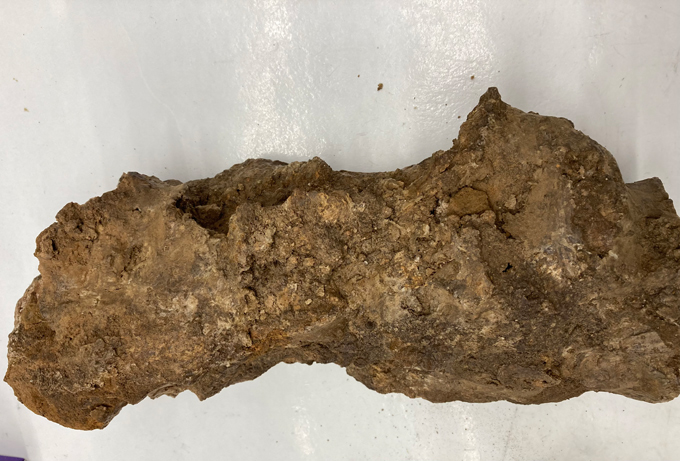
Edmontosaurus fossil specimen used in collagen study.

Edmontosaurus fossil specimen used in collagen study. Picture credit: University of Liverpool.

Picture credit: University of Liverpool

The researchers conclude that their study demonstrated the presence of identical collagen peptide sequences previously discovered in another hadrosaur and a T. rex sample.

Links to Other Blog Posts

To read an article from 2017 about a study that identified fragments of collagen in the femur of a hadrosaur (Brachylophosaurus):Researchers Confirm the Presence of Dinosaur Collagen.

Traces of organic material discovered in a juvenile hadrosaur fossil: Has Dinosaur DNA Been Found?

Research from 2008 outlining the search for organic materials in a femur of Tyrannosaurus rex: Are You Going to Call the “Tyrant Lizard King” Chicken?

This newly published research opens further avenues for studying ancient life, offering a glimpse into the biochemical preservation of fossils of extinct creatures.

Everything Dinosaur acknowledges the assistance of a media release from the University of Liverpool in the compilation of this article.

The scientific paper: “Evidence for Endogenous Collagen in Edmontosaurus Fossil Bone” by Lucien Tuinstra, Brian Thomas, Steven Robinson, Krzysztof Pawlak, Gazmend Elezi, Kym Francis Faull, and Stephen Taylor published in Analytical Chemistry.

The award-winning Everything Dinosaur website: Dinosaur Toys and Models.

3 02, 2025

A Unique Lokiceratops Scale Drawing

By |2025-02-19T07:24:49+00:00February 3rd, 2025|Categories: Dinosaur and Prehistoric Animal Drawings|0 Comments

Team members at Everything Dinosaur have commissioned a Lokiceratops scale drawing for use in the company’s free Lokiceratops fact sheet.  The fact sheet on this horned dinosaur will be sent out free with sales of Lokiceratops figures.  The new PNSO Lokiceratops model is due in stock soon. The fact sheet is being prepared as team members await the arrival of the shipment.  It will feature the scale drawing.  Readers of the fact sheet will be able to see just how big Lokiceratops rangiformis was.

Lokiceratops scale drawing.

Lokiceratops rangiformis scale drawing. Picture credit: Everything Dinosaur.

Picture credit: Everything Dinosaur

To view the extensive range of PNSO prehistoric animal models in stock: PNSO Prehistoric Animal Figures.

The Lokiceratops Scale Drawing

Lokiceratops is one of the largest centrosaurines described to date. Palaeontologists have estimated that this horned dinosaur grew to more than six and a half metres in length, and it may have weighed around five tonnes.  Its fossils were collected from the lower portion of the McClelland Ferry Member of the Judith River Formation in northern Montana.  Lokiceratops was formally named and described last year (2024).

Most of the skull is known, although the lower jaw was absent. Postcranial material includes vertebrae, hip bones and the right scapula and coracoid. Lokiceratops possessed two, enormous blade-like horns on the back of its frill (epiparietal two). The super-sized epiparietal two horns are relatively larger than any other parietal epiossification within the Centrosaurinae.

PNSO Lokiceratops model.

The new for 2025 PNSO Frederik the Lokiceratops dinosaur model.

Mike from Everything Dinosaur explained that he researched and then wrote each Everything Dinosaur fact sheet.

He added:

“The Lokiceratops scale drawing is one of about a dozen prehistoric animal drawings that we have commissioned over the last few months.  With all these new prehistoric animal models coming into stock, we have a lot of fact sheets to prepare.”

Visit the award-winning and customer friendly Everything Dinosaur website: Dinosaur and Prehistoric Animal Models.

2 02, 2025

Let’s Challenge Ourselves to Learn Something New Every Day

By |2025-02-03T08:28:41+00:00February 2nd, 2025|Categories: Everything Dinosaur News and Updates|1 Comment

Mike and Sue from Everything Dinosaur visited the Spring Fair in Birmingham.  It is an enormous trade show, the UK’s biggest home, gift and fashion retail event.  The pair had several meetings to attend.  However, they did have the opportunity to wander the halls and visit some of the trade stands.  After all, they were on the hunt for dinosaur related merchandise.

They found a children’s game entitled “So, you think you’re an expert – dinosaurs”.  We might know a little about the Dinosauria, but we are always amazed by the incredible knowledge that many children have about prehistoric animals.

As Mike happily confesses:

“I spend my life being corrected by budding young palaeontologists.”

Mike from Everything Dinosaur holding a dinosaur-themed game.

Mike from Everything Dinosaur holding a children’s game “So, you think you’re an expert – Dinosaurs”. Picture credit: Everything Dinosaur.

Picture credit: Everything Dinosaur

Everything Dinosaur – Always More to Learn and Discover

Examining the children’s quiz game made Mike and Sue think.  It is important to recognise your limits, even in areas that you may feel confident in.  Just like the incredible Dinosauria, we can be powerful in our areas of expertise, but there is always more to learn and discover.  Every day is a school day!

Embracing the idea that we don’t know everything opens the door to growth and collaboration.  It can be helpful to challenge yourself.  Try to learn something new every day and acknowledge that expertise is a journey, not a destination.

The Everything Dinosaur website: Dinosaur Toys and Gifts.

1 02, 2025

Photographing the New CollectA Deluxe Arctodus simus Figure

By |2025-02-16T12:28:24+00:00February 1st, 2025|Categories: CollectA Deluxe Prehistoric Animal Models|0 Comments

Mike and Sue from Everything Dinosaur have been taking a close look at the new for 2025 CollectA Deluxe Arctodus simus model. They thank CollectA for sending a sample of the figure.  These models will be in stock at the company’s warehouse in a few weeks.  The CollectA Deluxe Giant short-faced bear is one of seven new prehistoric animal figures to be introduced by CollectA this year.

A CollectA Deluxe Arctodus simus model photographed by Everything Dinosaur.

A CollectA Deluxe Arctodus simus model photographed next to some boxes containing CollectA tree models. Picture credit: Everything Dinosaur.

Picture credit: Everything Dinosaur

The picture shows the new Arctodus simus model photographed against the backdrop of some boxes containing CollectA tree models.  The superb texture of the fur and the details of the inside of the mouth can clearly be seen.  The subtle staining of the white flash on the chest can be made out too.

It is a wonderful model a huge and formidable prehistoric bear.

To view the range of CollectA Deluxe models in stock at Everything Dinosaur: CollectA Deluxe Prehistoric Animal Figures.

The CollectA Deluxe Arctodus simus Figure

The model stands around seventeen centimetres tall and it has a declared scale of 1:20. Our photograph shows the torn right ear of the figure.  This injury could have resulted from intraspecific combat or perhaps in a fight over a carcase with an American lion (Panthera atrox) or some other apex predator.  Meat is not thought to have made up a large part of this bear’s diet.  Especially those animals that roamed the southern parts of North America.  However, like modern bears this huge mammal would have happily fed on a carcase that it found.  It’s huge size and immense strength would have probably intimidated most other predators that encountered it.

To view Everything Dinosaur’s blog post that contained a video review of the figure: An Exclusive, Giant Short-faced Bear Video.

Mike from Everything Dinosaur confirmed that this beautiful prehistoric bear figure would be in stock soon.

Visit the award-winning Everything Dinosaur website: Prehistoric Animal Models and Figures.

31 01, 2025

News of Papo Dinosaur Model Retirements for 2025

By |2025-01-31T09:37:27+00:00January 31st, 2025|Categories: Papo Prehistoric Animal Models|0 Comments

Everything Dinosaur can confirm the Papo dinosaur model retirements for 2025.  In total, four dinosaur figures are being retired from the famous “Les Dinosaures” model range.  The figures are three theropods and one horned dinosaur model.

We have listed the four Papo figures below, along with their year of introduction.

  • Cryolophosaurus (2017).
  • Dilophosaurus (2014).
  • Concavenator (2023).
  • Pentaceratops (2019).

New Papo models are due into stock at Everything Dinosaur shortly.  For example, the Corythosaurus and the eagerly awaited Suchomimus models should be in stock in a few weeks.

Papo dinosaur model retirements in 2025

Four Papo dinosaur models are being retired in 2025. Top left Cryolophosaurus, top right Dilophosaurus, bottom left Concavenator and bottom right Pentaceratops. Picture credit: Everything Dinosaur.

Picture credit: Everything Dinosaur

To view the range of Papo models stocked by Everything Dinosaur: Papo Prehistoric Animal Models.

Papo Dinosaur Model Retirements

Everything Dinosaur team members do their best to update dinosaur model collectors.  It can be helpful to be alerted about model retirements.  In doing so, collectors can make sure they pick up any figures they want before they become unobtainable.  New Papo figures, the Suchomimus and Corythosaurus figures will be in stock soon.  Models due to come out in 2025 such as the new feathered T. rex figure will be available later in the year.

Mike from Everything Dinosaur commented:

“It is always a little bit sad to announce model retirements.  However, by retiring models, manufacturers make room for new additions to their range.  Personally, I will be saddened to see the Papo Pentaceratops go.  It is a beautiful figure of a rearing horned dinosaur.”

Papo Pentaceratops dinosaur model.

The Papo Pentaceratops dinosaur model. This horned dinosaur model has been retired (2025). Picture credit: Everything Dinosaur.

Picture credit: Everything Dinosaur

Papo Dilophosaurus

The Papo Dilophosaurus figure is being retired after more than ten years. In contrast the controversial Concavenator figure is being withdrawn only two years since it was introduced.  Mike explained that a turnover of figures was natural for a manufacturer.  Given the production pressures companies could not continue to grow their ranges indefinitely.

He added:

“Even with these Papo dinosaur model retirements, the Papo range will still consist of over forty figures by the end of the year.”

Visit the award-winning Everything Dinosaur website: Prehistoric Animal Models and Toys.

30 01, 2025

Two New Mojo Fun Prehistoric Animal Models for 2025

By |2025-02-15T21:46:48+00:00January 30th, 2025|Categories: Mojo Fun and Prehistoric and Extinct Animals|0 Comments

Mojo Fun will introduce two new prehistoric animal models this year (2025).  The company will introduce a model of the Late Cretaceous theropod from South America called Carnotaurus.  In addition, they will add a model of a plesiosaur (Cryptoclidus) to the range.  It seems that blue is the colour for 2025 according to Mojo Fun!  In 2024, no new Mojo Fun models were introduced.  It is wonderful to see a pair of new models for 2025.

New Mojo Fun Models 2025.

New Mojo Fun models for 2025. The Carnotaurus model (left) and the Cryptoclidus figure (right). Blue is the colour for 2025 according to Mojo Fun. Picture credit: Everything Dinosaur.

Picture credit: Everything Dinosaur

New Mojo Fun Models

The Mojo Fun Carnotaurus has a remarkable pair of horns.  They are extremely prominent and give the model quite a formidable look.  The figure has been painted in a matt blue finish with a lighter underside.  The plesiosaur is also painted blue, but a much deeper hue.  The needle-like teeth at the front of the mouth are present as well as the large eyes. However, in our examination of Cryptoclidus skull material we thought the orbits were positioned more to towards the top of the head.  This notwithstanding it is a fine figure with great colouration and fantastic counter shading.  The diamond-shaped tail is a welcome addition.

To view the range of Mojo Fun models available from Everything Dinosaur: Mojo Fun Prehistoric Animal Models.

It is pleasing to see Mojo Fun adding a Carnotaurus to their dinosaur collection. Furthermore, the Cryptoclidus model represents a plesiosaur that lived in the Middle Jurassic.  Most of the assigned fossil material comes from Oxford Clay deposits from Cambridgeshire.  The Cryptoclidus genus was erected in 1892 (Seeley). It is one of our favourite plesiosaurs.

Mike from Everything Dinosaur praised Mojo Fun for introducing new sculpts for 2025.

Visit the Everything Dinosaur website: Dinosaur Toys.

29 01, 2025

New Rebor Tyrannosaurus rex Cream Models Reviewed

By |2025-01-29T19:14:59+00:00January 29th, 2025|Categories: Rebor Models and Figures|0 Comments

Our thanks to dinosaur model collector Carl, who sent into Everything Dinosaur his review of the new Rebor Tyrannosaurus rex Cream figures.  Carl is a big fan of the King Kong movie franchise.

Here is his review:

Rebor Tyrannosaurus rex Cream Figures

In August 2024, a team member from the fantastic Everything Dinosaur posted up a blog with an announcement to say that Rebor Studio are starting production on a brand-new dinosaur figure. It was to be another Tyrannosaurus rex. This new sculpture comes in two different colour variants, the first one is called “Skull Walker”.  The second is known as the “Mountain” colour variant. These two simply incredible dinosaur figures are a must have if you love the 2005 version of the cinematic epic movie “King Kong” – a fantastic fantasy film which was directed by Mr Peter Jackson.

A film that Mr Jackson said he always wanted to do. Furthermore, for a remake to be filmed as close as possible to the original 1933 version, well I think he pulled it off superbly.

Unfortunately, the giant theropod Vastatosaurus rex has had only one showing in the movies. It would be fantastic to see this awesome carnivorous giant show its dominance in another Kong film, or in any future releases from the Monsterverse movie franchise, doubtful but always hoping.

Rebor Tyrannosaurus rex Cream view of the mouth.

The amazing detail in the mouth of the model. Picture credit: Carl.

Picture credit: Carl

Vastatosaurus rex

Rebor Studio has no official licence to name these as the antagonist from the movie which is the awesome Vastatosaurus rex – (Ravager Lizard King) so, for all intense purposes it is labelled as a Tyrannosaurus rex.

However, these two recent additions are truly fantastic, both models are the same sculpt, once the flexible tail is assembled you can see you have a decent sized figure to display.

To view the range of Rebor models and figures available from Everything Dinosaur: Rebor Figures.

Rebor T. rex Cream models on display.

The Rebor Tyrannosaurus rex (Cream) figures on display. The “Mountain” colour scheme is in the foreground with the “Skull Walker” variant behind. Picture credit: Carl.

Picture credit: Carl

For help with the assembly of this dinosaur I would definitely recommend you check out all the hints and tips posted by one of the team members at Everything Dinosaur. It is a big help – thank you.

Impressive Models

Once you have hold of this impressive model you can see the amount of detail that has gone into its production.  It is a carefully researched model which has a good screen likeness to the Vastatosaurus rex in the 2005 King Kong movie. Both dinosaurs have incredible skin and scale detail. Looking at the figures from a bird’s eye view gives the appearance of a crocodile (Crocodilia – order of the crocodilians), again relatives of the Dinosauria.

The pose on both models is dynamic, the Mountain colour is more like the Vastatosaurus rex in the movie.  The end battle shows a very similar stance if you look closely at it, it is a fantastic figure. However, for me personally, it is the look of the animal itself, if you stared straight at this animal, I believe it would most certainly stare right back with such a vicious and menacing appearance.  It is a dinosaur no one would want to mess with.

A close-up view of the beautiful and detailed head of the Rebor T. rex Cream (Mountain colour variant).

The stunning textures on the head of the T. rex figure. This is the Rebor T. rex Cream (Mountain). Picture credit: Carl.

Picture credit: Carl

None of this movie nonsense “don’t move – it won’t see you if you don’t move” – a line from Jurassic Park. Tyrannosaurus rex, fictional or not would probably have been a very active hunter, scavenging at times yes, no different to any other predators past or present.

Anyway…….

Anyway, to behold, this impressive model is now in stock at the fantastic award-winning Everything Dinosaur. A company that is dedicated to everything dinosaur related and palaeontology news and information from around the world.

A close-up view of the Rebor Tyrannosaurus rex Cream in the Mountain colour scheme.

A close-up view of the Rebor Tyrannosaurus rex Cream in the Mountain colour scheme. Note the deep scar associated with the eye socket. Picture credit: Carl.

Picture credit: Carl

Thank You Everything Dinosaur

Finally, a huge thank you to the team members at Everything Dinosaur for supplying these beautiful Rebor Tyrannosaurus rex Cream figures – thank you!

Visit the award-winning Everything Dinosaur website: Everything Dinosaur.

To Rebor Studio – from a collector’s point of view, I hope the continuation in producing some fantastic dinosaur collectables continues in the future and beyond. Thank you for producing two more stunning Tyrannosaurus rex figures to add to your catalogue and to my collection also.

One final thing to add is that the new Rebor Tyrannosaurus rex Cream figures stand perfectly well on a stable flat surface, preferably away from any heat source, indoor heating or in direct sunlight.

Our thanks to Carl for sending in his dinosaur model review.

Go to Top