All about dinosaurs, fossils and prehistoric animals by Everything Dinosaur team members.
2 04, 2025

New Nanmu Studio Articulated Dinosaur Models in Stock

By |2025-04-02T13:34:56+01:00April 2nd, 2025|Categories: Everything Dinosaur videos|0 Comments

The six, new Nanmu Studio articulated dinosaurs are now in stock at Everything Dinosaur. There are two “raptors” as well as Carnotaurus Ranger and V-rex.  The V-rex figure is the Studio’s version of the Hollywood creation Vastatosaurus.  This is a tyrannosaur that featured in the 2005 film remake of “King Kong”.  Vastatosaurus is thought to be a descendant of the Late Cretaceous tyrannosaurs like T. rex.  Thanks to these articulated figures, model collectors can make their own stop-motion Vastatosaurus movies!

Nanmu Studio Articulated Dinosaurs

On the subject of movies, Everything Dinosaur has made a YouTube short to celebrate the arrival of these figures.  Our sixty second video highlights the product packaging and shows the two Velociraptors and the two V-rex figures.  In addition, the Carnotaurus pair (Broken Horn Demon and Red Two Horns) are featured.  Sixty seconds to highlight six new, articulated dinosaur figures.  Between these models there are one hundred and fifty-four points of articulation!

Video credit: Everything Dinosaur

To view the range of Nanmu Studio figures in stock: Nanmu Studio Dinosaur Models.

Mike from Everything Dinosaur commented:

“These are fantastic, articulated dinosaur models.  We have been busy sorting out orders for customers.  However, we wanted to produce a short video highlighting these figures and the colourful artwork on the packaging.”

Ranger Carnotaurus, “Raptors” and a Pair of V-rex

Nanmu Studio have chosen to produce articulated theropod figures.  Each model has multiple articulation points.  For example, the “raptors” Tiger Blade and Shadow Blade have twenty-three points of articulation each.  In contrast, the Vastatosaurus figures have a whopping twenty-eight points of articulation.

Nanmu Studio articulated dinosaurs.

The pair of articulated Vastatosaurus figures from Nanmu Studio. Dark Moon Queen (reddish colour) is in the foreground. The model entitled Scarface Black is in the background. Two beautiful, articulated Nanmu Studio figures.

The two Carnotaurus Ranger figures have twenty-one points of articulation.  One model is entitled “Red Two Horns”, the second darker figure is named “Broken Horn Demon”.  This figure has a battle-damaged horn on its head.
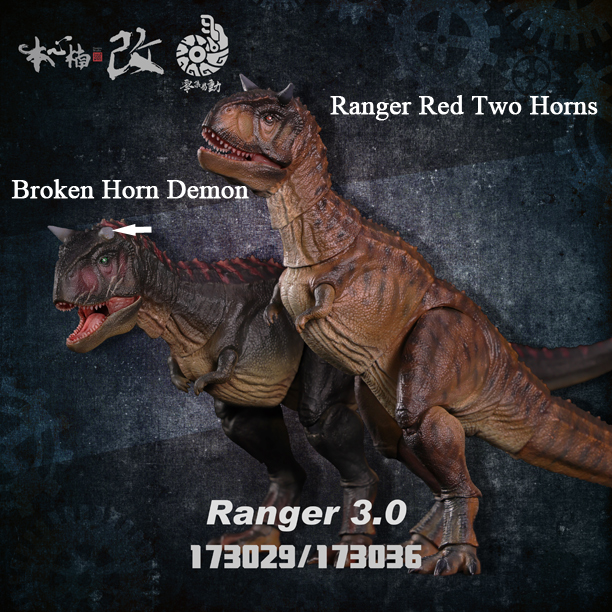
The two Nanmu Studio Carnotaurus Ranger models (Broken Horn Demon and Red Two Horns).

The two articulated Nanmu Studio Carnotaurus Ranger models (Broken Horn Demon and Red Two Horns).

Mike added:

“The Carnotaurus Ranger Broken Horn Demon has a broken left horn.  In contrast, the other figure has both horns intact.  These models are the same sculpt.  However, they have different paint schemes.  For example, the darker Carnotaurus has amazing green eyes.”

Visit the award-winning Everything Dinosaur website: Dinosaur Models and Toys.
1 04, 2025

New Research Challenges the Story of Humanity’s Shift from Hunter-Gatherers to Farming

By |2025-03-31T11:47:04+01:00April 1st, 2025|Categories: Teaching|0 Comments

New research published this week highlights the role of human interactions during the transition from hunter gathering to farming.  The study, published in the Proceedings of the National Academy of Sciences (PNAS) challenges consensus.  It has turned previous ideas on prehistoric societies on their head as it highlights the role of human interactions during the shift from hunting and gathering to farming – one of the biggest changes in human history – rather than earlier ideas that focused on environmental factors.

For the vast majority of our existence, Homo sapiens has adopted a hunter-gatherer foraging lifestyle.  However, from about 12,000 years ago our species began to adopt a different lifestyle.  Communities formed, settling in one location as farming began to take over.  Scientists sometimes refer to this change as the “Agricultural Revolution”.

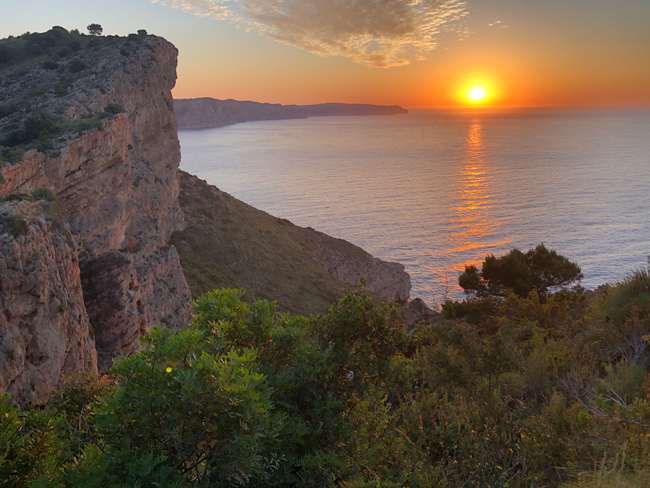
Views from Cova de les Cendres (Alacant, Spain). Early farmers settled in this area.

Views from Cova de les Cendres (Alacant, Spain). Early farmers arrived at this area through navigation. Picture credit: Oreto García-Puchol.

Picture credit: Oreto García-Puchol

The Palaeolithic and the Neolithic Transition

The “Stone Age”, the time when the most advanced tools used by humans were mainly made of stone, is divided into stages.  For example, the earliest stage of this time in human history is referred to as the Palaeolithic.  This denotes a period of time from the earliest known use of stone tools by hominins around 3.3 million years ago, down to roughly around 11,650 years ago. Palaeolithic means “Old Stone Age”.

The “Middle Stone Age” or Mesolithic followed, and this time period is associated with a decline in group hunting of megafauna in favour of a broader hunter-gatherer lifestyle. The Neolithic or “New Stone Age” marks the transition from a hunter-gatherer way of life to that of living in permanent settlements with a focus on farming.

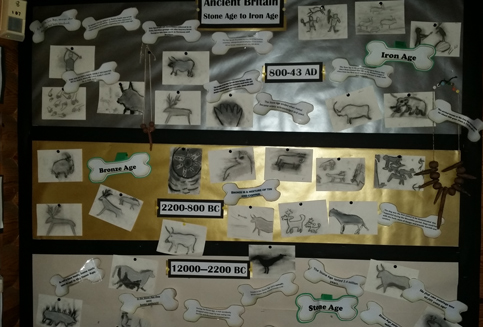
Stone Age study in a school.

Children learning about prehistoric societies. Schools in the UK have learning about the Stone Age and the transition to settled agriculture as part of their history curriculum.  Picture credit: Everything Dinosaur.

Picture credit: Everything Dinosaur

Using a Mathematical Model to Plot Changes in Human Behaviour

The study involved a collaboration between researchers from the University of Bath, the Max Planck Institute for Evolutionary Anthropology in Germany, University College London and the University of Cambridge.  The team developed a new mathematical model and framework that challenges the traditional view that this major transition was driven by external factors, such as climate warming, increased rainfall, or the development of fertile river valleys.

The research team conclude that modern humans were not just passive participants in this process. They played an active and vital role in the transition. Factors such as varying population growth rates and mortality rates driven by competition between hunter-gatherers and farmers, influenced the development of farming in these regions.

The mathematical model had originally been used to study predator-prey interactions.  However, the researchers modified the framework permitting them to examine how early adopting farming communities and hunter-gatherers may have influenced each other. This study suggests that early farming societies spread through migration, competition, and cultural exchange, reshaping how hunter-gatherers lived and interacted with their environment.

A New Perspective on Prehistoric Societies

Commenting on the results, Dr Javier Rivas (Department of Economics at the University of Bath), stated

“Our study provides a new perspective on prehistoric societies. By statistically fitting our theoretical predator-prey model to observed population dynamics inferred from radiocarbon dates, we explored how population growth shaped history and uncovered interesting patterns, such as how the spread of farming, whether by land or sea, influenced interactions between different groups. More importantly, our model also highlights the role of migration and cultural mixing in the rise of farming.”

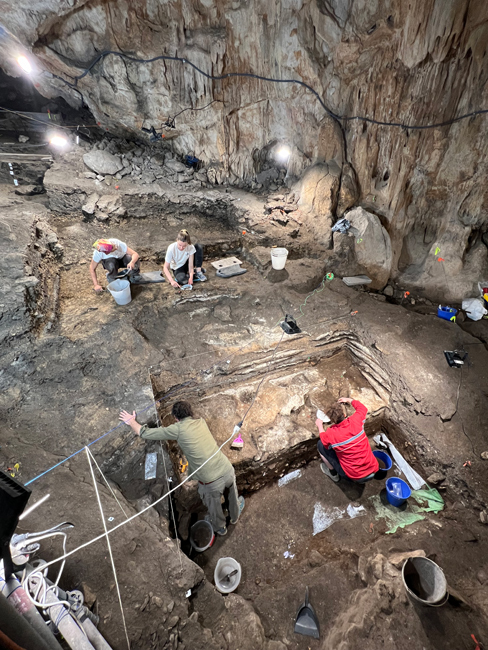
Excavating a cave floor in Spain to develop a better understanding in the transition of prehistoric societies from hunter-gathering to settled farming.

A field team excavating the floor of the Cova de les Cendres (Alacant, Spain), one of the sites included in the study. Picture credit: Oreto García-Puchol.

Picture credit: Oreto García-Puchol

The research team hope to develop this research by adding more factors into their model and evaluating it over larger regions and bigger datasets.

Dr Javier Rivas explained:

“We hope the methods we’ve developed will eventually become a standard tool for understanding how populations interacted in the past, offering fresh insight into other key moments in history, not just the shift to farming.”

The European Research Council funded this research.

Everything Dinosaur acknowledges the assistance of the University of Bath in the compilation of this article.

The award-winning Everything Dinosaur website: Prehistoric Animal Figures and Models.

31 03, 2025

The Exclusive Lyme Regis Fossil Festival Poster for the 2025 Festival

By |2025-04-05T08:58:47+01:00March 31st, 2025|Categories: Everything Dinosaur News and Updates|0 Comments

The Lyme Regis Fossil Festival poster has been published.  This is the first poster for the 2025 event.  Everything Dinosaur is one of the main sponsors. The Fossil Festival is one of the most anticipated palaeontological events of the year. It takes place over the weekend of the 14th and 15th of June (2025).  Come along and meet Mike and Sue from Everything Dinosaur.

The Lyme Regis Fossil Festival poster (2025).

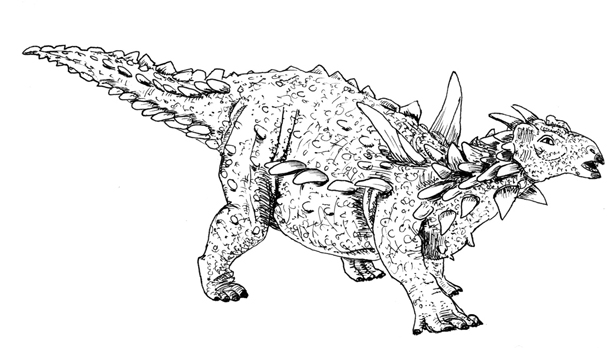
The Lyme Regis Fossil Festival poster features a wonderful drawing of the ornithischian dinosaur Scelidosaurus.

Our congratulations to dailydinosketch for the wonderful drawing of a Scelidosaurus on the poster.

There will be lots of engaging activities, expert talks, and hands-on exhibits. Scelidosaurus (S. harrisonii) is the only dinosaur synonymous with Lyme Regis. Its fossils were found in the Charmouth Mudstone Formation (Charmouth, Dorset) and this small, armoured dinosaur is thought to be a basal member of the thyreophorans. Its exact taxonomic status remains unresolved.

Scelidosaurus

An illustration of the Early Jurassic armoured dinosaur Scelidosaurus. Picture credit: Everything Dinosaur.

Picture credit: Everything Dinosaur

The picture (above) is an illustration of the CollectA Deluxe Scelidosaurus model.  This reconstruction is now a little outdated, the figure was first introduced approximately fifteen years ago.

To view the range of CollectA Deluxe figures: CollectA Deluxe Scale Dinosaur Models.

The Lyme Regis Fossil Festival Poster

The Festival has been run annually for the last twenty years.  Everything Dinosaur team members helped establish the Festival.  Now on the twentieth anniversary of this event, the company is returning as one of the main sponsors.  It promises an unforgettable experience for fossil fans, scientists, families and devotees of dinosaurs. Visiting the UNESCO “Jurassic Coast” is always a pleasure.  In addition, to all the other events and activities, we will be giving a talk in the Driftwood Cafe at the Baptist Church. The talk (with some very special guests), will take place on Sunday morning (June 15th).

The Lyme Regis Fossil Festival website: Lyme Regis Fossil Festival.

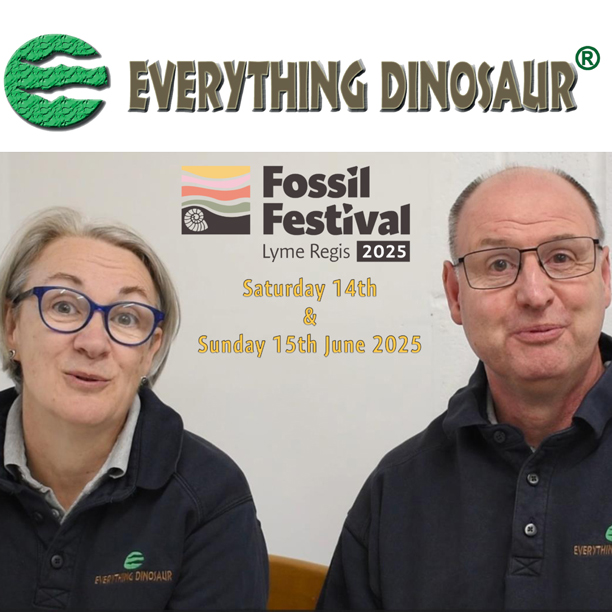
Everything Dinosaur is a main sponsor of the Lyme Regis Fossil Festival 2025.

Everything Dinosaur is a main sponsor of the Lyme Regis Fossil Festival 2025. Picture credit: Everything Dinosaur.

Picture credit: Everything Dinosaur

Visit the award-winning Everything Dinosaur website: Dinosaur Toys and Models.

30 03, 2025

Celebrating Mother’s Day “Good Mother Lizard”

By |2025-03-30T14:16:55+01:00March 30th, 2025|Categories: Haolonggood Prehistoric Animal Models|0 Comments

Today is “Mother’s Day” a day to celebrate and honour mums around the world.  This day is also known as “Mothering Sunday” not every country recognises this day as a special occasion for mothers. For example, in Germany, “Mother’s Day” is celebrated in the second week of May. However, today we have an excuse to write about the remarkable member of the Hadrosauridae – Maiasaura.  Indeed, we can highlight the Haolonggood Maiasaura models that were introduced last year (2024).

Haolonggood in recognition of “Good Mother Lizard” supplied each adult Maiasaura with an accompanying juvenile figure.

Haolonggood Maiasaura models.

Celebrating Mother’s Day with Haolonggood Maiasaura models. Each adult figure is supplied with a juvenile. The green coloured adult Maiasaura (left) is called Chun Hui. Whereas the model with the tail tinged purple is known as Hua Di.

Haolonggood Maiasaura Models

Haolonggood introduced two colour variants of Maiasaura (M. peeblesorum).  Both adult models are supplied with a juvenile Maiasaura figure.

In the image (above) the green coloured adult is Chun Hui. In contrast, there is also a Haolonggood Maiasaura model with a purple coloured tail.  This figure is referred to as Hua Di.

To view the range of Haolonggood figures in stock at Everything Dinosaur: Haolonggood Prehistoric Animal Models.

Maiasaura is a member of the Hadrosauridae subfamily Saurolophinae. The first fossil evidence of this dinosaur was uncovered in the Badlands of Montana (USA) in 1978. The fossil material is associated with the Two Medicine Formation (Upper Cretaceous). The location consisted of numerous dinosaur nests, eggs, baby Maiasaura, adults and juveniles. The location was renamed “Egg Mountain” and represents the fossilised remains of a Maiasaura peeblesorum nesting site.

Maiasaura was formally named and described by Jack Horner and Robert Makela (1979). The name means “Good Mother Lizard” and in contrast with the majority of the Dinosauria, it takes the female form of the Latin term for lizard – saura.  This location provided the first documented evidence that dinosaurs raised and fed their young.  Maiasaura babies were altricial.  This means that they required significant parental care.  These ornithopods were dedicated and devoted parents.

Mike from Everything Dinosaur commented:

“The altricial behaviour of Maiasaura peeblesorum, characterised by the care and nurturing of their young, suggests a level of dedication and commitment to their offspring that is reminiscent of most mammalian parenting, including our own species.”

Happy Mother’s Day.

The award-winning Everything Dinosaur website: Dinosaur Toys and Models.

29 03, 2025

A Helpful Definition of the Cerapoda

By |2025-04-04T18:03:44+01:00March 29th, 2025|Categories: Dinosaur Fans|0 Comments

Recently, Everything Dinosaur produced a blog article about the discovery of a fragmentary fossil dinosaur limb bone in Morocco.  The fossil (specimen number USMBA 001), is the head of a left femur (thigh bone). The fossil measures approximately five centimetres in length. It might not be very big, but its discovery has big implications for those palaeontologists studying the Ornithischia (bird-hipped dinosaurs).  Researchers have posited that this fossil represents the world’s oldest described remains of a cerapodan dinosaur.  Following our blog post about this discovery, we received an enquiry asking what is a cerapodan dinosaur?  The Cerapoda defined by Everything Dinosaur team members in response to a customer query.

To read our earlier blog post about USMBA 001: World’s Oldest Cerapodan Fossil Described.

The Cerapoda Defined

Whilst the taxonomy of many bird-hipped dinosaurs remains unresolved, most palaeontologists agree that within the huge and diverse Ornithischia, there are a number of groups (clades) that can be defined. Within the Ornithischia, there are two major sub-divisions, the armoured dinosaurs (Thyreophora) and the Neornithischia.

If we focus on the Neornithischia we can further divided these dinosaurs into sub-groups. One sub-group, more accurately termed a clade, consists of highly derived bird-hipped dinosaurs. This is the Cerapoda.

This clade comprises two branches:

  • Ornithopoda – iguanodontians and their relatives along with the hadrosaurs (Ankylopollexia).
CollectA Deluxe Iguanodon.

CollectA 1:40 scale Iguanodon model. An illustration of a member of the clade Cerapoda as we explore this clade and provide a definition – the Cerapoda defined.

The picture (above) shows a model of an Iguanodon (Iguanodon bernissartensis). It is an iconic member of the Ornithopoda.  The model comes from the CollectA Deluxe range of scale prehistoric animal models.

To view this range: CollectA Deluxe Prehistoric Animal Figures.

  • Marginocephalia – the horned dinosaurs and their relatives (ceratopsids) and the bone-headed dinosaurs (pachycephalosaurs).
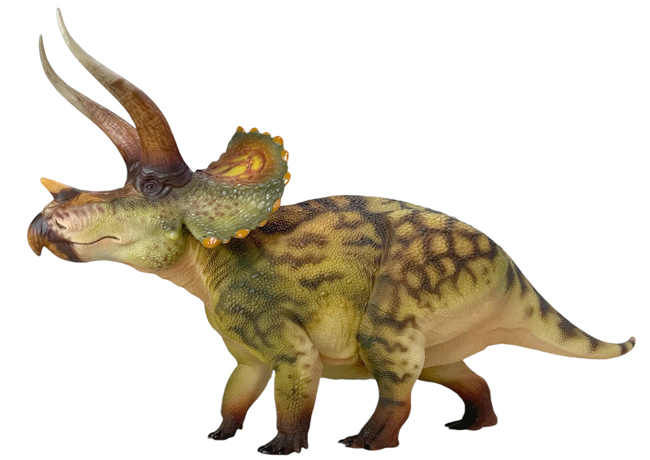
The Haolonggood Triceratops dinosaur model (Qin Ming).

An iconic member of the Marginocephalia.  A replica of Triceratops (T. horridus).  This is the Haolonggood Triceratops model.

The picture (above) shows a replica of perhaps one of the most famous dinosaurs of all.  This is Triceratops, a ceratopsian dinosaur and a member of the Marginocephalia.

This is the Haolonggood Qin Ming Triceratops figure. To view the range of Haolonggood models: Haolonggood Prehistoric Animal Figures.

Our Definition

The Cerapoda is a clade within the ornithischian (bird-hipped dinosaurs). It consists of two distinct two subgroups the Ornithopoda and the Marginocephalia. It is an extremely diverse clade with the ornithopods including iconic dinosaurs such as Hypsilophodon, Iguanodon and the duck-billed dinosaurs along with their close relatives. In turn, the Marginocephalia comprises the horned dinosaurs (Ceratopsia) and the pachycephalosaurs.

We hope this answers our customer’s enquiry. At Everything Dinosaur, we try our best to respond to every question that we receive.

The Everything Dinosaur website: Dinosaur Figures and Models.

28 03, 2025

Unique, New Therizinosaur is Named

By |2025-03-31T15:34:20+01:00March 28th, 2025|Categories: Palaeontological articles|1 Comment

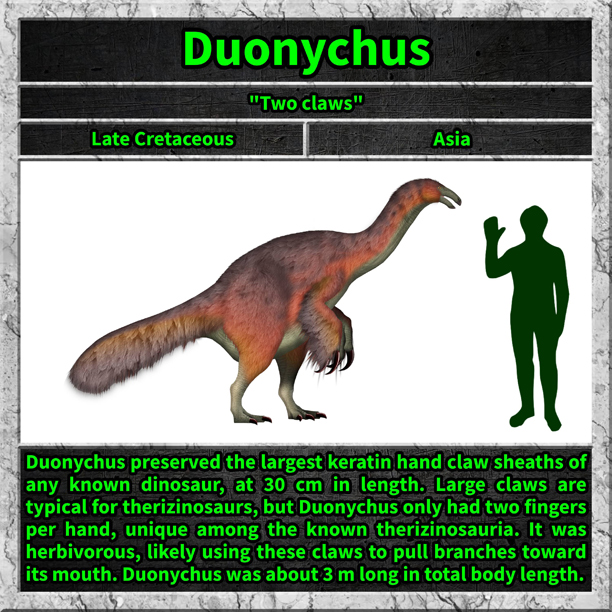
Scientists have named a unique, two-fingered therizinosaur species.  The fossils of Duonychus tsogtbaatari come from the Upper Cretaceous Bayanshiree Formation of the Gobi Desert (Mongolia).  This is the first time that a reduction of the digits on the manus has been recorded within the Therizinosauridae family.  All other therizinosaurs possessed three fingers on each hand.  Moreover, each finger ended in a curved claw.  Some of the claws of therizinosaurs were huge.  For example, one of the largest, Therizinosaurus cheloniformis had finger claws over a metre in length.

A life reconstruction of Duonychus tsogtbaatari.

A life reconstruction of Duonychus tsogtbaatari. This dinosaur had two fingers on each hand. Although the fossils from which this new species has been described represent a subadult. Scientists have calculated that It weighed approximately 260 kilograms and was around three metres in length. Picture credit: Tim Bollinger.

Picture credit: Tim Bollinger

Duonychus tsogtbaatari

Duonychus (pronounced due-oh-ny-kus) translates from the Greek as “two claws”.  The species name honours the Mongolian palaeontologist Khishigjav Tsogtbaatar.  The discovery of this therizinosaur is doubly unique.  One of the sheaths on a fossil claw (digit I) has been preserved.  The sheath made from the protein keratin (same as our hair and fingernails), reveals that the claw was much longer than the underlying bone.  It was forty percent longer than the claw’s bony core.  It is the largest claw of its kind found fully preserved in this way.  The total claw length has been estimated at around thirty centimetres.

Duonychus tsogtbaatari was not carnivorous.  These long claws were probably not used to attack other dinosaurs.  Although, they could have had a defensive function or have been used in intraspecific combat.  The researchers studying the fossil material believe the long, curved claws and the ability of Duonychus to flex them would have helped this animal to grasp vegetation.

Duonychus tsogtbaatari data card.

Duonychus tsogtbaatari data card. Picture credit: Tim Bollinger.

Picture credit: Tim Bollinger

Digit Reduction in Theropod Dinosaurs

The most famous two-fingered theropod dinosaur is Tyrannosaurus rex.  Duonychus is not closely related to T. rex.  However, both these dinosaurs evolved from ancestors that had three digits on each hand.  So, why did some theropod dinosaurs lose digits?  It is likely that the outer fingers of the hand became less useful and so they were gradually reduced over the time.  An evolutionary pathway led to the outer fingers becoming redundant, then vestigial, before finally disappearing altogether. Alternatively, digits I and II became increasingly dominant and thus enlarged.  This led to the eventual reduction and elimination of digit III.

Intriguingly, the hand claws of Duonychus were highly curved.  The researchers conclude that the extremely curved claws were adaptations to help this animal to “hook” branches and pull them within easy reach.  In essence, the reduction of digits was an evolutionary adaptation towards more efficient feeding.

Potential Niche Partitioning?

The sediments of the Bayanshiree Formation preserve a diverse dinosaur biota.  For example, there were at least three other therizinosaurs that were likely coeval with Duonychus.  All the other Bayanshiree Formation therizinosaurs described to date had three fingers on each hand.  With so many therizinosaurs in the same environment, it is possible that Duonychus evolved reduced digits to permit it to feed on different types of vegetation.  The reduced fingers could represent evidence of niche partitioning within the Therizinosauridae associated with these strata.

The four therizinosaurs described from the Bayanshiree Formation to date:

  • Segnosaurus (S. galbinensis) named in 1979. One of the largest therizinosaurs known with a length of around seven metres.
  • Erlikosaurus (E. andrewsi) named in 1980.  Measuring around three and half metres in length it had a robust beak suggesting a diet of mainly vegetation.
  • Enigmosaurus (E. mongoliensis) named in 1983.  Some scientists consider Enigmosaurus a junior synonym of Erlikosaurus.  Although, the discovery of Duonychus lends support to the idea that several different types of therizinosaur were present.
  • Duonychus (D. tsogtbaatari) named in 2025.  The first didactyl therizinosaur, possessing only two manual digits. In addition, the keratinous sheath on digit I provides a rare insight into theropod claw structure.

It is also worth noting that several other potential therizinosaur fossil specimens have been excavated from the Bayanshiree Formation.  These have yet to be formally named and described.

Our thanks to Tim Bollinger for permission to use his Duonychus illustrations in the compilation of this article.

Take a look at Tim Bollinger’s work under the moniker UnexpectedDinoLesson:

Instagram – @unexpecteddinolesson
Facebook – @UnexpectedDinoLesson
X (Twitter) – @Dino_Lesson

The scientific paper: “Didactyl therizinosaur with a preserved keratinous claw from the Late Cretaceous of Mongolia” by Yoshitsugu Kobayashi, Darla K. Zelenitsky, Anthony R. Fiorillo and Tsogtbaatar Chinzorig published in the journey iScience.

27 03, 2025

New Front Cover of “Prehistoric Times” Magazine

By |2025-04-19T16:24:16+01:00March 27th, 2025|Categories: Magazine Reviews|2 Comments

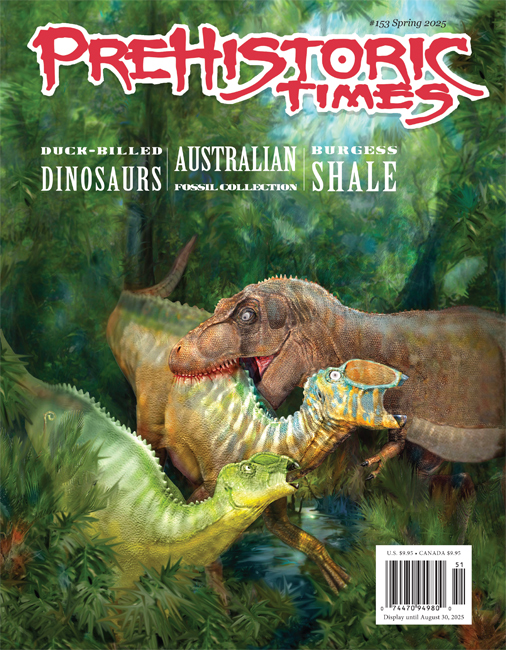
The next issue of the quarterly magazine “Prehistoric Times” will be out shortly. Our thanks to the editor for sending us an image of the front cover of the next issue (issue 153).  Hadrosaurs feature prominently in this spring edition.  Pete VonSholly and Mark Hallett have written about duck-billed dinosaurs.  Gryposaurus features and is highlighted by Phil Hore.  A member of the Hadrosauridae subfamily Saurolophinae, Gryposaurus is known from the Late Cretaceous of North America.  The dramatic front cover art is by the regular contributor Chuck Egnaczak, a highly respected palaeoartist.

Readers may recognise Chuck’s artistic style.  He has supplied many illustrations for the magazine and if I recall correctly, his spectacular close view of the head of a Suchomimus was the front cover illustration for issue 139.

Issue 153 of "Prehistoric Times" magazine.

The front cover of “Prehistoric Times” magazine issue 153. The artwork for the spring edition was created by Chuck Egnaczak. Picture credit: Mike Fredericks.

Picture credit: Mike Fredericks

The front cover of the spring edition features a pair of hadrosaurs being ambushed by a tyrannosaur.  In addition, we can expect articles from Randy Knol, Tracy Lee Ford and the continuation of the long-running series on the influential Czech artist Zdeněk Burian.

Issue 153 of “Prehistoric Times” Magazine

Inside the spring issue, subscribers will find an article by Andreas Forrer about the Burgess Shale.  The Chicago Field Museum’s extensive collection of Cambrian fossils is highlighted. Furthermore, a collector from Florida shows us some of his vast collection of fossils from Australia.  There will be lots of reader’s art on display too.

Mike from Everything Dinosaur commented:

“I believe one of the creatures to be featured in this issue is Steller’s sea cow.  This huge marine mammal is believed to be extinct. It was thought to have died out in the late 1700s.  However, I am interested in finding out how the article treats supposed sightings from as recently as the 1960s.”

To learn more about the magazine and to subscribe: “Prehistoric Times” Magazine.

26 03, 2025

An Amazing Jurassic Journey Holiday Experience

By |2025-03-26T15:38:56+00:00March 26th, 2025|Categories: Educational Activities|2 Comments

Fancy a personalised tour of some of the most significant Jurassic fossil sites in England?  Thanks to Ancient Odysseys, a company that specialises in amazing palaeontology themed experiences you can get privileged access to some remarkable fossil locations.  As well as an incredible experience you will be helping to fund paleontological research!  Multi-award-winning palaeontologist, author and presenter Dr Dean Lomax will take a lucky few on a fantastic Jurassic journey.   A week-long exploration of England’s major Jurassic hotspots.  An opportunity to explore iconic fossil locations with experts and to get behind the scenes access to amazing fossil discoveries and world-renowned museum collections.

Award-winning palaeontologist Dr Dean Lomax.

Ancient Odysseys and Dr Dean Lomax have teamed up to offer an incredible and exclusive travel experience. A Jurassic journey!

A Jurassic Journey with Dr Dean Lomax

Ancient Odysseys have teamed up with Dr Dean Lomax to create a week-long Jurassic adventure.  Running from July 6th to the 12th (2025), participants will be able to explore Yorkshire’s breath-taking Whitby Coast.  Hunting for ammonites, marine reptiles and the famous, rare, semi-precious organic gemstone Whitby Jet.  From the beautiful North Yorkshire coast, the tour party will encounter the enormous “Rutland Sea Dragon” the largest most complete ichthyosaur ever found in the UK.  Dr Lomax will be your guide providing exclusive access to this astonishing fossil discovery.

To read more about the amazing “Rutland Sea Dragon”: The Incredible Rutland Ichthyosaur Discovery.

The Jurassic Journey itinerary.

Visit some of the most important Jurassic fossil locations in England. Your very own personalised tour.

The following day, the VIP tour party have the opportunity to visit the dreaming spires of Oxford and receive a personal tour of the stunning Oxford University Museum of Natural History.  A chance to view the iconic Megalosaurus jaw.  This type specimen could be considered one of the fossils that kick-started the dinosaur global phenomenon.  In addition, the newly discovered “Dinosaur Highway” trackway site is on the itinerary.  Your opportunity to go “Walking with Dinosaurs” accompanied by Dr Emma Nicholls, (Collections Manager, Vertebrate Palaeontology at the Oxford Museum).

To read Everything Dinosaur’s blog post about this amazing trackway site: Remarkable Dinosaur Trackways Unearthed in Oxfordshire.

The tour concludes with a visit to picturesque Lyme Regis to explore the UNESCO World Heritage site the “Jurassic Coast” and to walk in the footsteps of Mary Anning.  A personal guided tour of the Lyme Regis Museum is included as is a special screening of the amazing “Why Dinosaurs?” documentary.

The Jurassic Journey Itinerary

  • Sunday July 6, 2025 | Arrival in Whitby.
  • Monday, July 7, 2025 | Fossil Hunting with Dr Lomax and Yorkshire Fossils on the Whitby Coast.
  • Tuesday, July 8, 2025 | Whitby Museum | Rutland Sea Dragon.
  • Wednesday, July 9, 2025 | Oxford Natural History Museum | Britain’s Dinosaur Highway.
  • Thursday, July 10, 2025 | Lyme Regis Museum | Mary Anning’s Home | WHY DINOSAURS? Screening.
  • Friday, July 11, 2025 | Full-Day Jurassic Coast Fossil Hunt | Farewell Dinner.
  • Saturday, July 12, 2025 | Departure.

Dean Lomax will personally accompany you on your very own Jurassic adventure.  What an incredible, once-in-a-lifetime opportunity.

​For further details and to make an enquiry about booking: Jurassic Journey (Dr Dean Lomax).

Helping to Fund Real Research

A portion of the revenue from this fantastic tour will go to support Dr Lomax’s research. Funding for fieldwork and paleontological research is highly competitive.  Funding from this special holiday tour will help to contribute to scientific studies and will be acknowledged directly in upcoming papers.

Mike from Everything Dinosaur commented:

“What an incredible opportunity!  Fourteen people have the chance to visit and explore some of the most remarkable fossil locations in the world.  To go behind the scenes at prestigious museums and to pick the brains of leading academics and professional fossil hunters.  Ancient Odysseys, a company that specialises in palaeontology themed tours has teamed up with the multi-award-winning Dr Dean Lomax to offer an amazing vacation experience. Don’t miss your chance to take part in this extraordinary Jurassic journey.”

The website of Dr Dean Lomax: British Palaeontologist Dr Dean Lomax.

25 03, 2025

New Stock of Beasts of the Mesozoic Models has Arrived!

By |2025-03-25T22:52:08+00:00March 25th, 2025|Categories: Beasts of the Mesozoic Models|0 Comments

More stock of Beasts of the Mesozoic figures has arrived at the Everything Dinosaur warehouse. Sue has been busy unpacking and sorting the models.  This large shipment contains dromaeosaurs, tyrannosaurs and ceratopsian figures.  In addition, the black Smilodon populator model is back in stock.  Once the delivery has been unpacked and checked customers on reservation lists will be emailed.  It’s going to be a long day, there are hundreds of models to check over.

Sue from Everything Dinosaur with some unpacked Beasts of the Mesozoic models.

Sue with some of the Beasts of the Mesozoic stock that has been unpacked ready to add on-line. Picture credit: Everything Dinosaur.

Picture credit: Everything Dinosaur

To view the range of Beasts of the Mesozoic figures in stock at Everything Dinosaur: Beasts of the Mesozoic/Cyberzoic Figures.

Beasts of the Mesozoic Models

These colourful, articulated figures are popular with dinosaur fans and model collectors.  We have a long list of customers to contact.  Rest assured, we will reach out to everyone and let them know about these new arrivals.

Mike from Everything Dinosaur commented:

“There must be something like fifty different prehistoric animal figures in the shipment.  It is going to be a challenge sorting them all out and checking them off against the shipping manifest. Once this job is done, we will get in touch with customers who had reserved figures.”

The award-winning Everything Dinosaur website: Dinosaur Models.

24 03, 2025

A New Tyrannosaurus Book by Dr Mark Witton

By |2025-03-24T21:04:19+00:00March 24th, 2025|Categories: Book Reviews|0 Comments

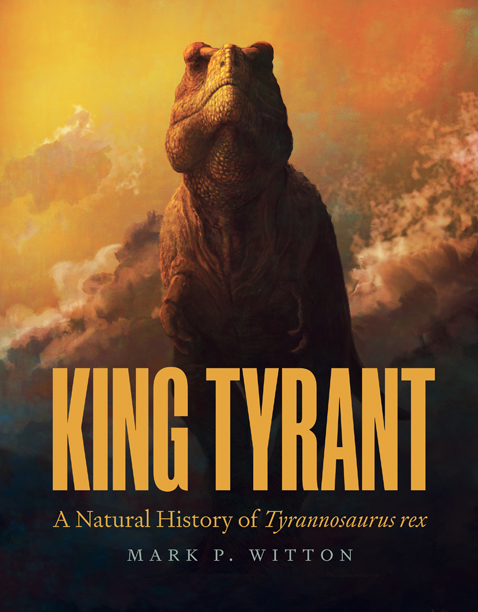
We have some exciting news!  A new dinosaur book by the extremely talented British palaeontologist and palaeoartist Dr Mark Witton is due to be published in May (2025).  Entitled “Tyrant King A Natural History of Tyrannosaurus rex“, this beautifully illustrated Tyrannosaurus rex book is available to pre-order from Princeton University Press.  Mark skilfully translates complex scientific concepts into an engaging narrative, helping to bridge the gap between academia and the general reader.

Mark is a highly respected palaeoartist. He has an extensive portfolio of prehistoric animal themed artwork. He created the striking front cover illustration.

The front cover of the new dinosaur book by Dr Mark Witton.

The fabulous front cover of the new book “King Tyrant A Natural History of Tyrannosaurus rex” by Dr Mark P. Witton. Dr Witton is an accomplished author and palaeoartist as well as a highly respected palaeontologist. Naturally, this stunning T. rex artwork on the front cover was created by the author. Picture credit: Princeton University Press.

Picture credit: Princeton University Press

A New Tyrannosaurus rex Book – “King Tyrant”

T. rex is arguably the world’s favourite dinosaur.  At Everything Dinosaur, Tyrannosaurus rex models outsell all the other figures that we stock.  Virtually, every range we supply has at least one figure of this iconic Late Cretaceous theropod within it.  However, it is one of those dinosaurs so often depicted in the media, that sometimes the actual science gets overlooked.  Dr Witton sets out to distinguish the hyperbole surrounding this dinosaur from the actual fossil evidence.  The book presents these predators as palaeontologists consider them from the perspective of having interpreted the tyrannosaur fossil record.

With numerous original paintings, illustrations and diagrams by the author, this book focuses on the latest discoveries and provides a modern understanding of the Tyrannosaurus taxon.

Titus the T. rex Skull and Jaws. Dinosaur extinction.

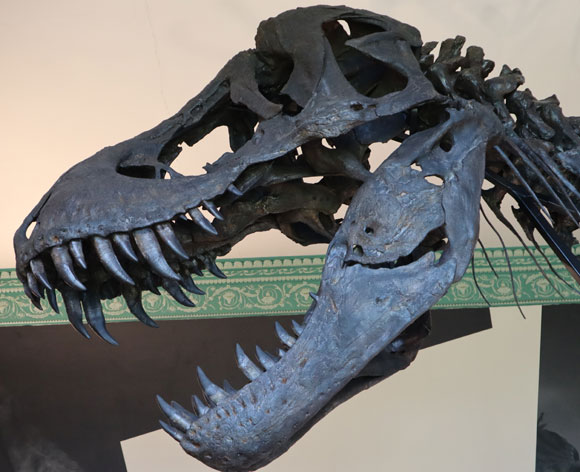
The skull of a T. rex on display at Wollaton Hall (Nottinghamshire). This new dinosaur book discloses details about T. rex behaviour such as intraspecific combat and hunting strategies. Picture credit: Everything Dinosaur.

Picture credit: Everything Dinosaur

Dr Mark Witton has written several other books.  For example, in 2013 he wrote the highly acclaimed “Pterosaurs” which coincidently is also published by Princeton University Press.

To read Everything Dinosaur’s review of “Pterosaurs” by Dr Mark Witton: A Book Review “Pterosaurs” by Dr Mark Witton.

With over one hundred and fifty superb, photographs, illustrations and diagrams, this new Tyrannosaurus rex book is going to delight dinosaur fans.

Book Details

The book reviews the evidence for there being more than one species of Tyrannosaurus.  It examines whether they were solitary hunters or social animals.  How fast could T. rex run?  Was its bite as powerful as depicted in popular culture?   These are just some of the questions examined in the book’s seven chapters.  Some of the chapters have intriguing titles.  For example, chapter six entitled “Life, Food, Love, Death”.

“King Tyrant A Natural History of Tyrannosaurus rex

Publisher: Princeton University Press

Publish Date: May 13th, 2025 | Price: £35.00/$39.95 | Pages: 320

Illustrations: 150+ colour illustrations

ISBN: 9780691245584

Size: 20 x 25 cm (8 x 10 inches)

Visit the Princeton University Press website: Princeton University Press. To find the book search for “King Tyrant” or the author.

Mike from Everything Dinosaur commented:

“I am so excited about this.  I can’t wait to read this new book all about this most iconic of all the non-avian dinosaurs.  After all, who doesn’t love a T. rex!”

The Everything Dinosaur website: Dinosaur Models and Prehistoric Animal Figures.

Go to Top