All about dinosaurs, fossils and prehistoric animals by Everything Dinosaur team members.
17 07, 2025

New Haolonggood Euhelopus Dinosaur Models Coming into Stock

By |2025-07-26T05:59:38+01:00July 17th, 2025|Categories: Haolonggood Prehistoric Animal Models|0 Comments

The two, new for 2025 Haolonggood Euhelopus figures will be in stock at Everything Dinosaur soon.  Both the brown and grey coloured versions will be arriving at the company’s warehouse shortly.  These replicas of an Early Cretaceous sauropod are in 1:35 scale.

Haolonggood Euhelopus figures.

The new for 2025 Haolonggood Euhelopus dinosaur models.

Haolonggood Euhelopus Figures

These models measure twenty-six and a half centimetres in length.  Those majestic heads are approximately eighteen and a half centimetres off the ground.  Everything Dinosaur supplies a free fact sheet on Euhelopus.

Haolonggood Euhelopus figure (Yang Chun)

A majestic, grey-coloured Haolonggood Euhelopus dinosaur model (Yang Chun).

To view the extensive range of Haolonggood models in stock at Everything Dinosaur: Haolonggood Prehistoric Animal Models.

Euhelopus fossils are known from Lower Cretaceous deposits from the Chinese coastal province of Shandong. It had a disproportionately long neck, and its forelimbs were longer than its hindlimbs, giving this sauropod a sloping back.  Size estimates vary.  For example, the Everything Dinosaur Euhelopus fact sheet cites a body weight range from 3, 500 kilograms to 15,000 kilograms.

The Term “Comb. nov.“

In 1929, Swedish palaeontologist Carl Wiman originally described and named the dinosaur Helopus, meaning “Marsh Foot.” He derived the name from the Greek words helos (meaning swamp), and pous (meaning foot). Therefore, the dinosaur’s name references both the marshy site where the fossils were discovered and Swedish swamp shoes that, according to Wiman, resembled the animal’s wide feet. However, the name Helopus was already in use for a bird species, as the Caspian tern had been named Helopus caspius.  The Latin term “comb. nov.” is associated with the Euhelopus taxon.  This stands for “Combinatio nova“, reflecting the fact that the formal, binomial name for this dinosaur was a new scientific name created from a pre-existing name for this animal.

Haolonggood Euhelopus models.

Two colour variants of the Euhelopus will be available. The figure (left) is the brown-coloured Euhelopus Jiang Jing. Yang Chun the grey-coloured Euhelopus is on the right.

Mike from Everything Dinosaur commented:

“It is wonderful to have a Chinese company making models of Chinese dinosaurs.  We are looking forward to getting these two fabulous sauropod figures into stock.”

Visit the Everything Dinosaur website: Dinosaur Models and Toys.

16 07, 2025

Remarkable Research Reveals Giant Temnodontosaurus Relied on Stealth

By |2025-07-16T21:58:56+01:00July 16th, 2025|Categories: Palaeontological articles|0 Comments

A remarkable fossilised ichthyosaur flipper has provided new insights into the hunting behaviour of ancient marine reptiles.  The study, published in the journal “Nature” reveals that the giant ichthyosaur Temnodontosaurus trigonodon relied on stealth whilst hunting in the darkness. The metre-long front flipper was equipped with flow control structures that probably served to suppress self-generated noise as this megapredator hunted in dimly lit pelagic environments.
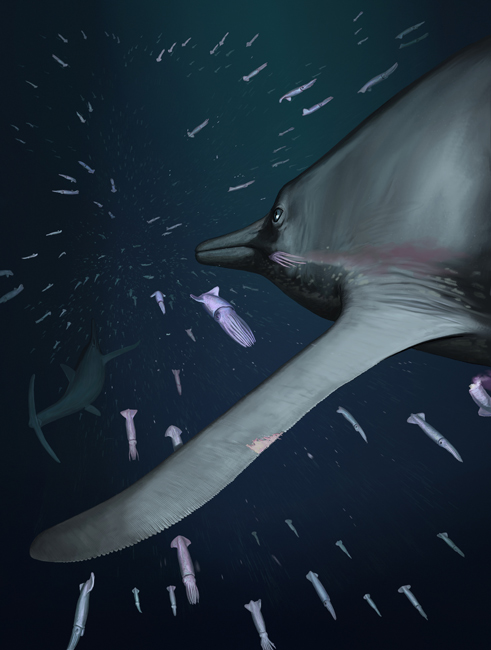
Temnodontosaurus trigonodon hunting squid.

Life reconstruction of the giant Jurassic ichthyosaur Temnodontosaurus trigonodon hunting in the depths. The artwork highlights the winglike flipper, and the unusual structures observed in the fin. Picture credit: Joschua Knüppe.

Picture credit: Joschua Knüppe

Temnodontosaurus trigonodon Flipper Study

Temnodontosaurus was a large ichthyosaur. Size estimates vary, however, some individuals may have exceeded ten metres in length. Researchers have named several species within the genus. While fragmentary remains of unusual “fish lizards” had previously been excavated along the Dorset coast, it was the discovery of a metre-long skull by Joseph Anning at Lyme Regis in the autumn of 1811—followed by vertebrae and ribs found by 13-year-old Mary Anning in 1812 that prompted the first formal scientific study and description of an ichthyosaur. More than two centuries later, these enigmatic marine reptiles continue to yield unexpected insights and discoveries.

The fossilised flipper (specimen number SSN8DOR11) was collected from a temporary exposure of dark, laminated limestone (Lower Toarcian Posidonia Shale) of southwestern Germany. The partial front flipper preserves soft tissue structures and has been studied by an international team of researchers led by Dr Johan Lindgren from Lund University in Sweden.  The research was undertaken in collaboration with Dr Dean Lomax, an 1851 Research Fellow at the University of Bristol, who has been working on the fossil for about six years. Dr Lomax is one of the world’s leading ichthyosaur experts.
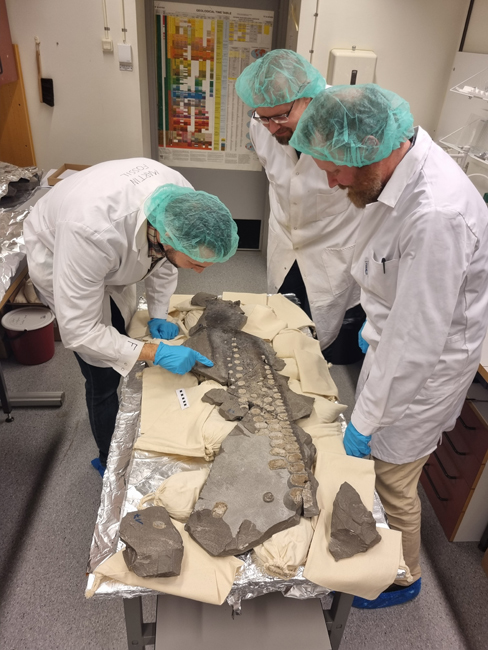
Examining the fossil flipper.

Dr Dean Lomax and Dr Johan Lindgren, together with fellow researcher Sven Sachs, examining one part of the Temnodontosaurus trigonodon flipper at Lund University, Sweden. Picture credit: Katrin Sachs.

Picture credit: Katrin Sachs

Dr Lindgren, who has pioneered research into marine reptile soft tissues commented:

“The wing-like shape of the flipper, together with the lack of bones in the distal end and distinctly serrated trailing edge collectively indicate that this massive animal had evolved means to minimise sound production during swimming. Accordingly, this ichthyosaur must have moved almost silently through the water, in a manner similar to how living owls—whose wing feathers also form a zigzag pattern—fly quietly when hunting at night. We have never seen such elaborate evolutionary adaptations in a marine animal before.”
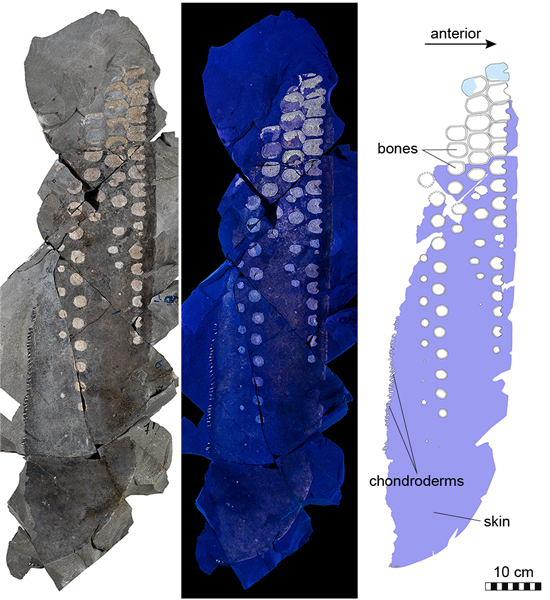
Images of the fossil flipper.

The remarkable fossil flipper specimen (SSN8DOR11) shown left, under UV light (centre) and in a line drawing (right). Picture credit: Randolph G. De La Garza, Martin Jarenmark and Johan Lindgren.

Picture credit: Randolph G. De La Garza, Martin Jarenmark and Johan Lindgren

“Silent Swimming”

Although there are many exceptional ichthyosaur specimens with soft-tissue preservation, most soft tissues are associated with the fossilised remains of much smaller dolphin-sized species.  This is a remarkable discovery, it represents the first-ever soft tissues associated with a large-bodied ichthyosaur. In addition, the research team have identified unique structures never observed before in an aquatic animal.  The crenulated trailing edge of the wing-shaped flipper being reinforced by novel, mineralised, rod-like structures.  The researchers have named these structures “chondroderms”.

Dr Dean Lomax, who is also a palaeontologist at the University of Manchester, said:

“The first time I saw the specimen, I knew it was unique. Having examined thousands of ichthyosaurs, I had never seen anything quite like it. This discovery will revolutionise the way we look at and reconstruct ichthyosaurs (and possibly also other ancient marine reptiles) but specifically soft-tissue structures in prehistoric animals.”
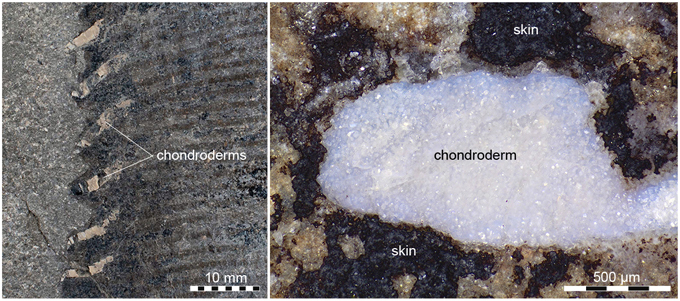
Novel cartilaginous integumentary structures identified on a Temnodontosaurus trigonodon flipper.

Novel cartilaginous integumentary structures. To the left, light micrograph of the crenulated trailing edge in SSN8DOR11. Note that each serration is supported by a centrally located chondroderm. To the right, magnified image of a distal chondroderm. Picture credit: Randolph G. De La Garza, Martin Jarenmark and Johan Lindgren.

Picture credit: Randolph G. De La Garza, Martin Jarenmark and Johan Lindgren

The team postulate that this huge predator relied on underwater stealth, or “silent swimming” while hunting in the depths, in much the same way that owls as nocturnal predators have almost silent flight.

Eyes as Big as Footballs

Temnodontosaurus had the largest eyes of any vertebrate known.  The eye sockets of some specimens are more than twenty-five centimetres in diameter.  These huge eyes lend further support to the theory that Temnodontosaurus hunted under low-light conditions, either at night or in deep waters.
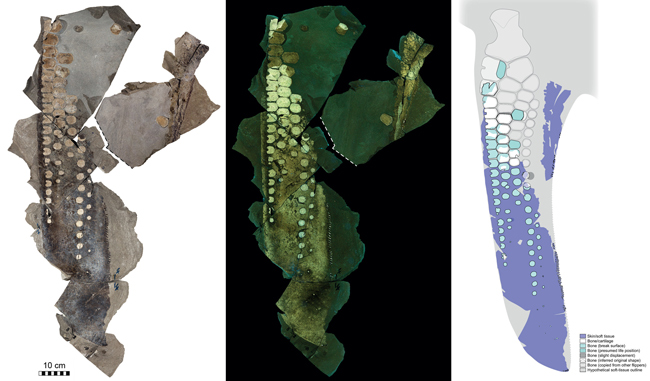
SSN8DOR11 images.

Spectacular, 183-million-year-old soft-tissue fossil (SSN8DOR11; Paläontologisches Museum Nierstein, Nierstein, Germany): an isolated wing-like front flipper of the giant predatory ichthyosaur Temnodontosaurus (T. trigonodon). Photograph (left) and shown under UV light (centre). Line drawing (right) providing a representation of the metre-long flipper. Picture credit: Randolph G. De La Garza, Martin Jarenmark and Johan Lindgren.

Picture credit: Randolph G. De La Garza, Martin Jarenmark and Johan Lindgren

The remarkable fossilised flipper was discovered by fossil collector Georg Göltz, a co-author on the new study. Amazingly, Georg made the find entirely by chance whilst looking for fossils at a temporary exposure at a road cutting in the municipality of Dotternhausen, Germany. The fossil consists of both the part and counterpart (opposing sides) of almost an entire front flipper.  Georg continued to look for more remains, but no other fossil material was found.

As the proximal part of the fin is absent, it has been speculated that the flipper could have been ripped off by an even larger ichthyosaur.  The specimen was shown to palaeontologist and study co-author Sven Sachs (Natural History Museum, Bielefeld).  Dr Sachs immediately recognised the rarity of the find.

A multidisciplinary research team employed a variety of sensitive imaging, elemental and molecular analyses to examine the unique preserved structures. This involved high-end techniques such as synchrotron radiation-based X-ray microtomography at the Swiss Light Source SLS at PSI and Diamond Light Source, time-of-flight secondary ion mass spectrometry and infrared microspectroscopy, along with the reconstruction of a virtual model using computational fluid dynamics.

To recreate the stealth hunting behaviours of a marine reptile that lived more than 180 million years ago is remarkable. Furthermore, by studying the fin morphology, scientists could find ways of reducing our impact on modern marine soundscapes.

Going Back to Mary Anning

For Dr Dean Lomax, this astonishing study harks all the way to back to the days of pioneering palaeontologist Mary Anning and her older brother Joseph.

He stated:

“In a weird way, I feel that there is a wonderful full-circle moment that goes back to Mary Anning showcasing that even after two hundred years, we are still uncovering exciting and surprising finds that link back to her initial discoveries.”

Dr Lomax added:

“The fossil provides new information on the flipper soft tissues of this enormous leviathan. It has structures never seen in any animal, and reveals a unique hunting strategy thus providing evidence of its behaviour, all combined with the fact that its noise-reducing features may even help us to reduce human-made noise pollution. Although I might be a little bias, in my opinion, this represents one of the greatest fossil discoveries ever made.”

Everything Dinosaur acknowledges the assistance of a media release from the University of Bristol in the compilation of this article.

The scientific paper: “Adaptations for stealth in the wing-like flippers of a large ichthyosaur” by Johan Lindgren, Dean R. Lomax, Robert-Zoltán Szász, Miguel Marx, Johan Revstedt, Georg Göltz, Sven Sachs, Randolph G. De La Garza, Miriam Heingård, Martin Jarenmark, Kristina Ydström, Peter Sjövall, Frank Osbæck, Stephen A. Hall, Michiel Op de Beeck, Mats E. Eriksson, Carl Alwmark, Federica Marone, Alexander Liptak, Robert Atwood, Genoveva Burca, Per Uvdal, Per Persson and Dan-Eric Nilsson published in the journal Nature.

Visit the website of the award-winning palaeontologist and author Dr Dean Lomax: Palaeontologist Dr Dean Lomax.

15 07, 2025

The Return of a Favourite Rebor Komodo Dragon Back in Stock

By |2025-07-21T10:01:31+01:00July 15th, 2025|Categories: Rebor Models and Figures|0 Comments

The Rebor Komodo dragon model is back in stock at Everything Dinosaur.  This popular replica of the largest living lizard has returned.  The model measures nearly fifty centimetres in length and it is an accurate representation of Varanus komodoensis.

The Rebor Komodo dragon model image credit: Everything Dinosaur.

The Rebor Komodo dragon model measures around fifty centimetres in length. Picture credit: Everything Dinosaur.

Picture credit: Everything Dinosaur

To view the range of Rebor models and figures in stock: Rebor Models and Figures.

Mike from Everything Dinosaur commented:

“The 1/6th scale Komodo dragon figure was introduced in the autumn of 2019.  It quickly proved popular amongst model collectors and herpetologists.  The model appeals as it looks so realistic.  We took some photographs of the figure outside.  These photos highlight the quality of the figure. Sadly, the images have been stolen by a number of unscrupulous individuals and have been used to sell their own figures and models.”

The Rebor Komodo Dragon Model

The Rebor GrabNGo Komodo dragon also makes a wonderful replica of Megalania. Megalania (Varanus priscus) roamed Australia during the Pleistocene Epoch. It is thought to be closely related to the Komodo dragon. Size estimates vary but it is widely reported as being the largest terrestrial lizard known to science. The fragmentary nature of the fossil remains make it difficult to provide a definitive size. Most individuals were probably comparable in size to the extant Komodo dragon. However, some animals may have been much larger with body lengths of seven metres proposed. If the Rebor GrabNGo figure is used to represent Varanus priscus, then the model is in approximately 1/12th scale.

The Rebor Komodo dragon model.

The Rebor GrabNGo Komodo dragon model can also represent the giant monitor lizard Megalania. Picture credit: Everything Dinosaur.

Picture credit: Everything Dinosaur

It is great to see this popular and highly detailed figure back in stock.

Visit the award-winning Everything Dinosaur website: Prehistoric Animal Models and Figures.

14 07, 2025

The Search for the Great Auk and the Discovery of Extinction – Book Review

By |2025-07-20T16:30:32+01:00July 14th, 2025|Categories: Book Reviews|0 Comments

The last days on Earth of an iconic bird species is re-told in remarkable detail by Gísli Pálsson in his book documenting the decline of the Great Auk (Pinguinus impennis). Entitled “The Last of Its Kind” anthropologist Gísli Pálsson tells the haunting story of the Great Auk’s extinction.  The Great Auk extinction provides a powerful reminder of our culpability and the impact Homo sapiens is having on the planet.

Once abundant in the North Atlantic, this flightless bird was extinct by the middle of the 19th century. Through meticulous research and vivid storytelling, Pálsson reconstructs not just the bird’s fate, but the birth of a modern awareness of the natural world and our role in extinctions.

The Great Auk extinction explored in "The Last of Its Kind" by Gísli Pálsson.

The front cover of the Princeton University Press release “The Last of its Kind” by Great Auk extinction explored in “The Last of Its Kind” by Gísli Pálsson. Picture credit: Everything Dinosaur.

Picture credit: Everything Dinosaur

The Great Auk Extinction

The Great Auk extinction was perhaps the first extinction event to attract widespread public awareness of our impact on the natural world.  It remains one of the most tragic and well-documented examples of extinction.  A large, flightless bird that mainly bred on remote, inaccessible islands in the North Atlantic was wiped out by hunting and egg collecting.  The last remaining Great Auks were killed on the Icelandic island of Eldey on the 3rd of June 1844.

The book mixes science, history and cultural analysis. It vividly recounts how British ornithologists Alfred Newton and John Wolley set out for Iceland to collect specimens, only for them to discover that these magnificent birds were gone forever. Pálsson explores museum archives, personal journals, and ecological data to build a compelling narrative. A species lost that helped to awaken our sense of environmental responsibility.

This book is both timely and thought-provoking. It invites readers to reflect on today’s biodiversity crisis through the lens of a single vanished bird. Bird lovers and conservationists alike will find it essential reading.  It has been shortlisted for the prestigious Royal Society Trivedi Science Book Prize.

Book Details

Title: “The Last of its Kind – The Search for the Great Auk and the Discovery of Extinction”
Author: Gísli Pálsson
Publisher: Princeton University Press
Publication Date: April 2024
Format: Hardcover
Pages: 291
ISBN: 9780691230986

List Price: £22.00 GBP/$27.95 USD

This remarkable book can be ordered at this website: Princeton University Press.

Mike Walley from Everything Dinosaur observed:

“The extinction of the Great Auk offers a stark reminder of humanity’s lasting impact on nature. Furthermore, Pálsson’s work challenges us to reflect, take responsibility, and act—before more species are lost forever.”

The award-winning Everything Dinosaur website: Models of Prehistoric and Extinct Animals.

13 07, 2025

North America’s Oldest Pterosaur Known to Date is Described

By |2025-07-20T09:27:15+01:00July 13th, 2025|Categories: Palaeontological articles|0 Comments

Researchers have described a new species of Late Triassic pterosaur.  It has been named Eotephradactylus mcintireae and it represents North America’s oldest known flying reptile. A field team led by the Smithsonian National Museum of Natural History and Columbia College Chicago discovered the fossil remains. They were exploring outcrops of the Owl Rock Member of the Chinle Formation in north-eastern Arizona. They come from an unusual bonebed that preserves the remains of a variety of Late Triassic vertebrates. The assemblage provides evidence of animals that persisted into the Jurassic co-existing with archaic lineages such as phytosaurs, armoured aetosauriforms and ancient temnospondyls.

The bonebed provides a snapshot of an ecosystem prior to the End Triassic Mass Extinction event.

Eotephradactylus mcintireae life reconstruction.

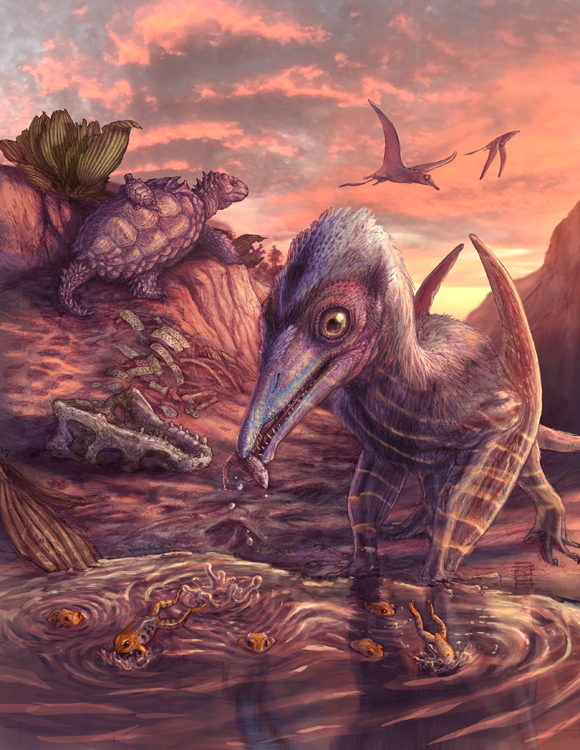
North America’s oldest pterosaur described to date Eotephradactylus mcintireae disturbs some frogs whilst catching a ray-finned fish. An early tortoise is seen in the background and the bones of an armoured crocodilian are visible. Picture credit: Brian Engh.

Picture credit: Brian Engh

Eotephradactylus mcintireae – North America’s Oldest Pterosaur

The study has been published in the “Proceedings of the National Academy of Sciences.”  The pterosaur fossils identified from the bonebed include a partial left mandible (lower jaw), isolated teeth and a phalanx (digit bone).  The fossils are approximately 209 million years old (Norian faunal stage of the Late Triassic).

Corresponding author Ben Kligman (Peter Buck Postdoctoral Fellow at the Smithsonian’s National Museum of Natural History), stated:

“The site captures the transition to more modern terrestrial vertebrate communities where we start seeing groups that thrive later in the Mesozoic living alongside these older animals that don’t make it past the Triassic. Fossil beds like these enable us to establish that all of these animals actually lived together.”

Field team members working at a site in the Petrified Forest National Park.

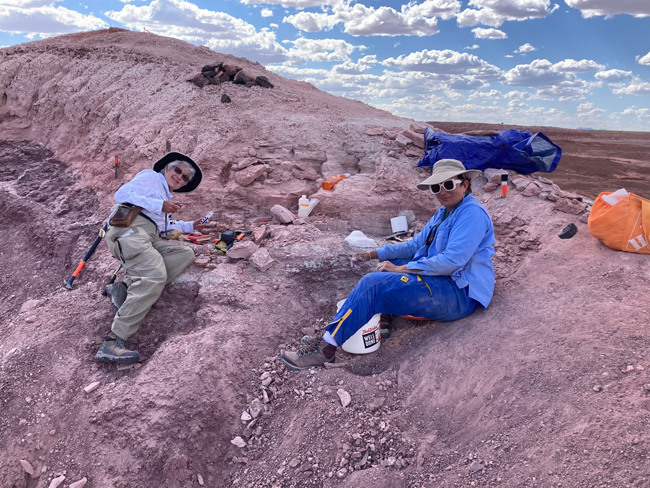
Kay Behrensmeyer (left), the curator of vertebrate palaeontology at the Smithsonian’s National Museum of Natural History. Robin Whatley (right), professor and associate dean at Columbia College Chicago in the Petrified Forest National Park digging for fossils in a quarry in 2023. Picture credit: Ben Kligman, (Smithsonian).

Picture credit: Ben Kligman (Smithsonian)

“Ash-winged Dawn Goddess”

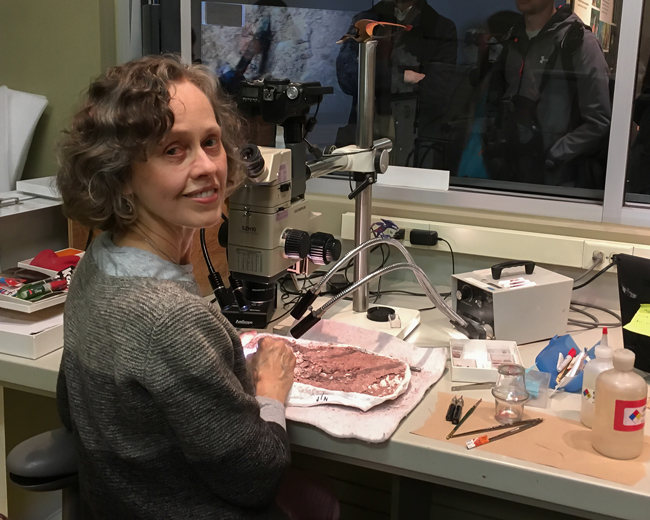
The genus name translates as “ash-winged dawn goddess”, it references the location’s volcanic ash layers and the pterosaur’s position as a basal member of the Pterosauria family tree. The species name honours preparator Suzanne McIntire, who discovered the fossil material in 2013 when preparing a block from the site.

Suzanne McIntire at the FossiLab working on the Eotephradactylus mcintireae.

The pterosaur fossil was unearthed by preparator Suzanne McIntire, a volunteer at the museum’s FossiLab for eighteen years. Picture credit: Bill King.

Picture credit: Bill King

The Owl Rock Member

The Owl Rock Member strata are some of the least explored parts of the Petrified Forest National Park.  The extensive volcanic ash layers in the quarry, permitted the scientists to calculate the age of the bonebed.  It represents the remains of an ecosystem that existed around 209 million years ago (Norian faunal stage of the Late Triassic).  These are some of the geologically youngest sediments in the Petrified Forest National Park.

In the Late Triassic, Arizona was positioned in the central part of the supercontinent Pangaea. The area was just north of the equator. It was a low-lying, semi-arid environment criss-crossed with small river channels and prone to seasonal floods. The bonebed likely preserves the remains of a community of animals that were caught up in a flash flood.

The bonebed is rich vertebrate fossils. So many fossils were found that excavating them in the field was impossible. Field team members took large chunks of rock, entombed in plaster jackets back to the preparation laboratory at the Smithsonian National Museum of Natural History. Volunteers spent thousands of hours carefully excavating the fossil material.

Fossil preparators who have worked on the Eotephradactylus mcintireae fossil material.

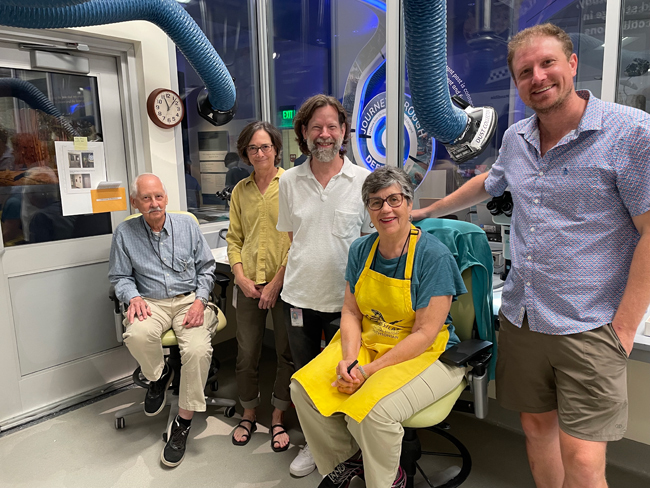
Ben Kligman (right), a Peter Buck Postdoctoral Fellow at the Smithsonian’s National Museum of Natural History with several of the museum’s FossiLab volunteers who contributed to the study of the fossils from the bonebed. Richard Cline (far left), Hillary Cochard, James Morrison and far right Lynn Sharp. Picture credit: Abby Telfer, (Smithsonian).

Picture credit: Abby Telfer (Smithsonian)

A Diverse Community of the Familiar and Not So Familiar

The gull-sized pterosaur Eotephradactylus mcintireae shared its home with a huge variety of other vertebrates. Some of these animals would be familiar to us, others represent taxa that did not survive into the Jurassic. For example, coelacanths swam in the rivers along with freshwater sharks.  In addition, frogs were present and an ancient tortoise.

The tortoise fossils are of particular interest. They are some of the world’s oldest tortoise remains. The tortoise had a robust shell, with protruding spikes for additional protection. Stem members of the Testudinata clade (reptiles with a true carapace and plastron shell) are known from the Late Triassic. For instance, the genus Proterochersis was present in Germany and Poland and is roughly contemporaneous with the Owl Rock Member biota.

Ben Kligman commented:

“This suggests that turtles rapidly dispersed across Pangaea, which is surprising for an animal that is not very large and is likely walking at a slow pace.”

Animals that are familiar to us today coexisted with animals that were very different to modern faunas.  For example, whilst relatives of New Zealand’s tuatara were present (rhynchocephalians), there were also giant, ancient amphibians, aetosaurs and phytosaurs.

Over 1,200 Fossils Including the Pterosaur Eotephradactylus mcintireae

The team has uncovered more than 1,200 individual fossils. They include bones, teeth, fish scales and coprolites. Sixteen different types of vertebrate were identified from this single bonebed indicating a diverse ecosystem.  Amongst these fossils were the remains of North America’s oldest known pterosaur Eotephradactylus mcintireae.  Its discovery motivates research teams to continue to explore the remote and difficult to access Owl Rock Member exposures.

Suzanne McIntire reflecting on the significance of her discovery said:

“What was exciting about uncovering this specimen was that the teeth were still in the bone, so I knew the animal would be much easier to identify.”

The teeth provide important clues to the pterosaur’s diet; the worn-down crowns suggest it was durophagous, adapted for consuming hard-shelled prey.  The researchers conclude that this flying reptile fed on the site’s fish. Ray-finned fish are known from this locality (actinopterygians).  Many had armour-like scales, and a diet of these types of fish would have resulted in extensive tooth wear.

Everything Dinosaur acknowledges the assistance of a media release by the Smithsonian National Museum of Natural History in the compilation of this article.

The scientific paper: “Unusual bone bed reveals a vertebrate community with pterosaurs and turtles in equatorial Pangaea before the end-Triassic extinction” by Ben T. Kligman, Robin L. Whatley, Jahandar Ramezani, Adam D. Marsh, Tyler R. Lyson, Adam J. Fitch, William G. Parker and Anna K. Behrensmeyer published in the Proceedings of the National Academy of Sciences.

The award-winning Everything Dinosaur website: Pterosaur and Prehistoric Animal Models.

12 07, 2025

A New Outlook Signature for Everything Dinosaur

By |2025-07-13T15:48:39+01:00July 12th, 2025|Categories: Everything Dinosaur News and Updates|0 Comments

Everything Dinosaur has unveiled an eye-catching new email signature.  It celebrates the launch of the company’s own model range. The model range is entitled Everything Dinosaur Evolution.  Leading the way is the beautiful Evolution Tyrannosaurus rex model.  This exciting new tyrannosaur figure proudly features in the company’s digital correspondence.

Everything Dinosaur Evolution T. rex model on an email footer signature.

The latest email signature footer from Everything Dinosaur features the soon to be available Everything Dinosaur Evolution T. rex model.

Picture credit: Everything Dinosaur

The Evolution Tyrannosaurus rex Model Incorporated into an Email Signature

This new email signature shows the Everything Dinosaur Evolution logo.  In addition, the figure is shown in lateral view. Only the front half of the dinosaur model is visible.  To see the entire figure, recipients of emails have to click on the link embedded in the image.

The T. rex is the first model in this exciting new series of museum-quality prehistoric animal figures.  This powerful symbol highlights the start of a new chapter for Everything Dinosaur.  The image implores recipients to “Join the Evolution”.  No other range of dinosaur models has been designed with this much attention to detail.

For further information on the Everything Dinosaur Evolution range of models: Everything Dinosaur Evolution Models.

By clicking the embedded link in the signature, email recipients can go directly to the Everything Dinosaur Evolution section of the website. Site visitors can explore the range, sign up for updates, and stay informed about the release of future figures.  They will be amongst the first to be informed about more Hell Creek Formation models.

Mike from Everything Dinosaur explained the strategy behind this digital update:

“We want to inform as many dinosaur model fans as possible about our new product range. This new outlook signature on our emails helps us to do just that.”

Setting the Tone

The Everything Dinosaur Evolution Tyrannosaurus rex figure is a 1:33 scale model.  It sets a strong tone for this brand-new line of prehistoric animal replicas.  The updated email signature promotes this range.  In addition, it reflects the company’s commitment to scientific accuracy and customer communication.

The evolution of Everything Dinosaur has begun!

Visit the company’s award-winning website: Museum Quality Prehistoric Animal Models.

11 07, 2025

The Palaeo Minute a New Newsletter for Dinosaur Fans

By |2025-07-12T09:58:51+01:00July 11th, 2025|Categories: Dinosaur Fans|0 Comments

Palaeontologist and University of Bristol graduate James Ronan has launched a new monthly newsletter for fans of palaeontology.  Entitled “The Palaeo Minute” it is packed with insights into palaeontological research, information about fossil discoveries and research.  Published in the middle of each month, James intends to explore a wide range of topics.  For example, his first newsletter available for free explores how the tyrannosaurs became the apex predators over much of the Northern Hemisphere during the Late Cretaceous.

This free edition of “The Palaeo Minute” is entitled: “The Secrets of Tyrannosaurs: Growth, Dominance, and Evolution”.

"The Palaeo Minute" a new newsletter about dinosaurs.

Palaeontologist James Ronan a graduate of Bristol University has devised “The Palaeo Minute”, a new palaeontology-based newsletter highlighting research and providing expert insight. Picture credit: James Ronan.

Picture credit: James Ronan (artwork by Aram Papazyan)

“The Palaeo Minute”

James is UK-based and keen to connect with others with a passion for vertebrate palaeontology.  With an MSc in palaeobiology, he is well qualified to bring the fascinating world of the Dinosauria to life.  His new, monthly newsletter is a personal passion project for this young scientist.  He aims to make deep time more accessible.

Who is “The Palaeo Minute” for?

  • Teens (16+) with a passion for dinosaurs or natural history.
  • Undergraduate or Master’s students pursuing palaeontology.
  • Adults curious about the science behind prehistoric life.
  • Families eager to explore natural history together.
  • Readers with little or no scientific background seeking to learn more about Earth’s geological past.

When asked about this new mid-monthly newsletter James commented:

“The concept had been on my mind for quite some time. I envisioned a dynamic way to share my expertise in palaeontology, something engaging, accessible and informative.”

We wish James every success with his exciting new venture.

Visit the website of the palaeontologist and consultant James Ronan: James Ronan MSc – Vertebrate Palaeontologist.

Here is the subscription link for the new mid-monthly newsletter: James Ronan – “The Palaeo Minute”.

What a great way to explore the Dinosauria, fossils, and scientific research.  A newsletter crafted by a vertebrate palaeontologist.

10 07, 2025

A Unique Scale Drawing of Austroraptor

By |2025-07-13T12:07:46+01:00July 10th, 2025|Categories: Dinosaur and Prehistoric Animal Drawings|0 Comments

The new for 2025 Wild Safari Prehistoric World Austroraptor model is heading our way.  We expect this figure of Austroraptor cabazai to be in stock at Everything Dinosaur in a few days. It is the largest dromaeosaurid known to date from the Southern Hemisphere. Size estimates vary, partly because the holotype specimen is fragmentary and also because a second referred specimen is around two thirds the size of the holotype.

Austroraptor may have reached a length of six metres, and it is estimated to have weighed around three hundred kilograms. Although heavier weight estimates have been proposed. For example, Benson et al proposed a much heavier body mass in a paper published in PLOS Biology (2014)*.

This paper looked at the remarkable morphological and ecological diversity of animals. Moreover, particular emphasis was placed on the Dinosauria. The researchers examined the theory that evolutionary rates are highest early in the evolution of a group, as lineages diversify to fill disparate ecological niches.

The team found rapid evolutionary rates in early dinosaur evolution, beginning in the Late Triassic. They postulated that this occurred as dinosaur body sizes diversified rapidly to fill new ecological niches, including herbivory. High rates were maintained only on the evolutionary line leading to birds. As part of their research, they estimated body size of animals based on the robustness or otherwise of their limbs. Austroraptor fossils were part of this study. A body mass estimate in excess of five hundred kilograms was reported.

Wild Safari Prehistoric World Austroraptor figure.

The new for 2025 Wild Safari Prehistoric World Austroraptor figure shown in lateral view.

The Wild Safari Prehistoric World Austroraptor Model

Fortunately, this new dromaeosaurid figure is considerably lighter.  This attractive model of a feathered dinosaur measures a fraction over twenty-two and a half centimetres in length.  Those carefully painted black quills on the head are nearly eight centimetres off the ground.  This replica of Austroraptor cabazai will be in stock at Everything Dinosaur shortly.

To view the range of Wild Safari Prehistoric World figures: Safari Ltd. Wild Safari Prehistoric World Figures.

As part of preparations for the arrival of this theropod figure, Mike from Everything Dinosaur has been writing a fact sheet.  The fact sheet will include a scale drawing of Austroraptor cabazai.

Austroraptor cabazai scale drawing.

The Austroraptor cabazai scale drawing prepared by Everything Dinosaur in anticipation of the arrival of the Wild Safari Prehistoric World Austroraptor figure. Picture credit: Everything Dinosaur.

Picture credit: Everything Dinosaur

Mike explained:

“We commission a drawing of most of the prehistoric animal models that we sell.  This drawing is then used to create a scale drawing, and this is added to our free fact sheet.  These scale drawings help our customers to appreciate the estimated size of the actual prehistoric animal.”

To read Everything Dinosaur’s blog post from December 2008 about the discovery of Austroraptor: Introducing Austroraptor – A Fearsome Predator of the Late Cretaceous.

The scientific paper*: “Rates of Dinosaur Body Mass Evolution Indicate 170 Million Years of Sustained Ecological Innovation on the Avian Stem Lineage” by Roger B. J. Benson, Nicolás E. Campione, Matthew T. Carrano, Philip D. Mannion, Corwin Sullivan, Paul Upchurch and David C. Evans published in PLOS Biology.

Visit the award-winning Everything Dinosaur website: The Everything Dinosaur Website.

9 07, 2025

The Remarkable Rebor Tyrannosaurus rex “Kiss” Island

By |2025-07-09T15:47:09+01:00July 9th, 2025|Categories: Rebor Models and Figures|0 Comments

Our thanks to model collector Carl who sent into Everything Dinosaur some photographs of his recent acquisition.  The images show the Rebor Tyrannosaurus rex “Kiss” island version on display.  Carl has placed his figure on a display base and added some foliage.  Moreover, he has added a CollectA Deluxe cycad model in the foreground to add depth to his composition.  The viewer’s eye is drawn to the tyrannosaur figure whilst the cycad fronds and trunk help to frame the shot.  It is a cleverly crafted composition.

The Rebor Tyrannosaurus rex "Kiss" Island version.

The Rebor Tyrannosaurus rex “Kiss” Island version on display. Picture credit: Carl.

Picture credit: Carl

The Rebor Tyrannosaurus rex “Kiss” Island Figure

This latest release from Rebor measures over forty centimetres in length.  It has a declared scale of 1:35. In addition, the model has an articulated lower jaw, poseable arms and a flexible tail.  The model stands around fourteen centimetres high.  It would be slightly taller for Carl with the addition of his display base.  This new Rebor “Kiss” version replaces the original “Kiss” mountain model.  The photographs help to highlight the striking paint scheme and the model’s colouration.

Mike from Everything Dinosaur commented:

“I congratulate Carl.  Firstly, for the addition of the vegetation and the display base and secondly for the careful way in which he has composed his photographs.”

The remarkable Rebor Tyrannosaurus rex "Kiss" Island dinosaur model on display.

The amazing Rebor Tyrannosaurus rex “Kiss” Island dinosaur model on display. Carl has added a base to this figure. The base includes the CollectA Deluxe cycad tree model. Picture credit: Carl.

Picture credit: Carl

Carl impressed us by sending in fantastic photos of his recent T. rex model purchase. Thank you for sharing your prehistoric passion with Everything Dinosaur!

To view the range of Rebor models and figures: Rebor Models.

8 07, 2025

Rigourous Palaeontology and Amazing Palaeoart Connected

By |2025-07-09T21:08:11+01:00July 8th, 2025|Categories: Dinosaur Fans|0 Comments

Palaeontology and palaeoart connected in the new for 2025 Everything Dinosaur Evolution Tyrannosaurus rex dinosaur figure. The latest post about Everything Dinosaur Evolution highlights how the science of palaeontology and palaeoart are connected.  Palaeontologist Dr Dean Lomax is responsible for the scientific accuracy of the figures.  Acclaimed palaeo-reconstruction artist Bob Nicholls provides the illustrations and brings the models to life.  In addition, award-winning digital sculptor Glen Southern brings his expertise to the model development process.

Palaeontology and palaeoart connected with Everything Dinosaur Evolution.

The Everything Dinosaur Evolution range of scientifically accurate prehistoric animal models unites palaeontology and palaeoart. Acclaimed palaeontologist Dr Dean Lomax and renowned palaeo-reconstruction artist Bob Nicholls are involved in this exciting project. In addition, the design team includes award-winning digital sculptor Glen Southern. Picture credit: Everything Dinosaur.

Picture credit: Everything Dinosaur

To learn more about the Everything Dinosaur Evolution range: Everything Dinosaur Evolution.

From the toes to the tip of the tail everything about the Everything Dinosaur Evolution T. rex model has to look right and feel right. We have put together the best team to make perhaps, the most scientifically accurate scale model of Tyrannosaurus rex. Join the Evolution!

Palaeontology and Palaeoart Connected

The Everything Dinosaur Evolution T. rex figure is a scientifically accurate model. It links palaeontology and palaeoart.  Team members include Dr Dean Lomax, Glen Southern and Bob Nicholls.  All three experts are working in collaboration with Mike and Sue from Everything Dinosaur.  The team aims to examine the fossil record and to produce figures by following the fossil evidence.

Mike from Everything Dinosaur commented:

“Palaeontology and palaeoart connected.  That is one of our ambitions.  If we are going to try to recreate prehistoric animals and depict them as real animals not movie monsters, we need to follow the fossil evidence. Furthermore, we must utilise the skills of a top designer and renowned palaeoartist to realise our dream.”

The award-winning Everything Dinosaur website: Dinosaur Models and Prehistoric Animal Figures.


Go to Top