All about dinosaurs, fossils and prehistoric animals by Everything Dinosaur team members.

Everything Dinosaur team members working in schools, helping museums and other educational bodies. Our work with and in schools.

18 12, 2020

Unique Interactive “I-Book” Provides Readers with Unprecedented Access to Archaeological Sites

By |2024-02-29T07:44:42+00:00December 18th, 2020|Categories: Book Reviews, Educational Activities, Main Page, Photos, Teaching|0 Comments

Interactive “I-Book” Provides Readers with Unprecedented Access to Archaeological Sites

An interactive ‘”I-Book” which allows users to virtually walk around otherwise inaccessible historical sites has been shortlisted as a finalist in a major award.  Entitled “The Shetland in the Iron Age”, this  Interactive “I-Book” gives anyone a VIP pass to three distant archaeological sites and has been highly commended in an industry awards ceremony.

Interactive “I-Book”

The concept of providing virtual access to sites of great historical significance was developed by Archaeological and Forensic Sciences PhD student Li Sou from the University of Bradford.  The “I-Book” offers a no-holds barred tour of three “broch”, Iron Age drystone hollow-walled structures found in the Shetland Islands, Scotland.  The technology is so simple to use, that anyone aged nine or over can use the “I-Book” and visit relatively remote and inaccessible sites.

University of Bradford Student Li Sou Demonstrates the “I-Book”

Archaeological and Forensic Sciences PhD student Li Sou from the University of Bradford.
Archaeological and Forensic Sciences PhD student Li Sou from the University of Bradford demonstrates the new “I-Book”.

Picture credit: University of Bradford

The “I-Book” provides 360° virtual maps of the interiors that users can explore.  Virtual visitors can wander around their inner workings, exploring different buildings, accessing staircases and corridors, as though they were there in the Shetlands themselves.

Providing Lots of Associated Information and Data

The cleverly designed “I-Book” includes clickable information hotspots that link to a wealth of associated data, including historic photographs and videos from experts in the field.  The concept was shortlisted in the Association for Learning Technologists Awards and the “I-Book” was highly commended.  The judges describing it as an “incredibly varied, engaging and accessible digital educational resource.”

Historic Environment Scotland have been developing this technology for use at other historic properties in their care and these will launch in 2021, both on site and freely downloadable online.

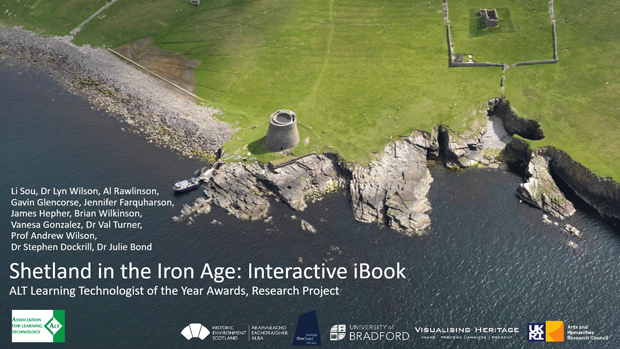
An Overhead Photograph of a Broch

An overhead photograph of a broch on the Isle of Shetland.
An aerial shot of a broch.

Picture credit: University of Bradford

The judging panel stated that the project:

“Has excelled in developing a range of versatile digital assets to aid in learning about complicated archaeological and academic themes.”

Commenting after the prestigious award ceremony, student Li Sou exclaimed:

“This is the culmination of a six-month project and brochs are complicated archaeological sites to understand and are not physically accessible to everyone.  The I-Book format is not very well known in the heritage sector, so the project was an excellent opportunity to design a resource that gives readers a chance to explore the sites as if they were there in real life, with integrated accessibility features to make them accessible to all.”

A Useful Resource in the Midst of a Global Pandemic

The use of technology such as this has significant implications for the support of archaeology and general education in the midst of a global pandemic.  The emergence and spread of COVID-19 has curtailed travel and restricted the opening times for heritage monuments.  “I-Books” such as this permit sites that might be closed to the public and otherwise difficult to reach due to the need to restrict travel or to self-isolate, to still be accessible to students, archaeologists and the general public.

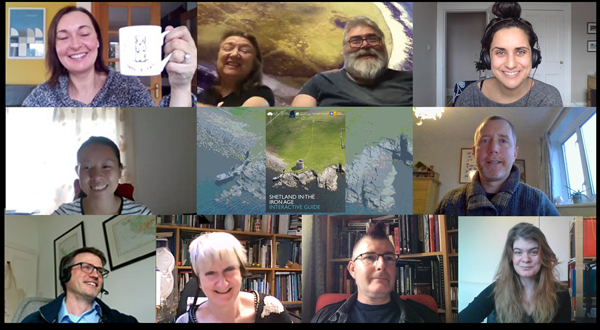
“I-Book” Development Team Photo (in an Age of Social Distancing)

Team photo of all those involved in the project
Team photo of all those involved in the “I-Book” project.

Picture dredit: University of Bradford

The interactive “I-Book”  entitled “The Shetland in the Iron Age” was developed in collaboration with the Shetland Amenity Trust with a working group from Historic Environment Scotland, along with the co-operation and assistance of the Visualising Heritage group within the School of Archaeological and Forensic Sciences, University of Bradford.

Implicatioms for Palaeontology Departments

A spokesperson from Everything Dinosaur commented that this type of technology has applications within the Earth sciences.  For example, interactive “I-Books” could be provided to help students and researchers virtually visit remote dig sites and fossil quarries.  It could also be used in other research areas such as allowing observations of fossil collections and other material that would otherwise be very difficult to access.

Everything Dinosaur acknowledges the assistance of a media release from the University of Bradford in the compilation of this article.

Visit the Everything Dinosaur website: Everything Dinosaur.
27 09, 2020

Monsters of the Deep: Science Fact and Fiction

By |2024-03-16T06:40:45+00:00September 27th, 2020|Categories: Animal News Stories, Educational Activities, Main Page, Photos, Press Releases, Teaching|0 Comments

Monsters of the Deep: Science Fact and Fiction at the National Maritime Museum Cornwall (July to 3rd January 2022)

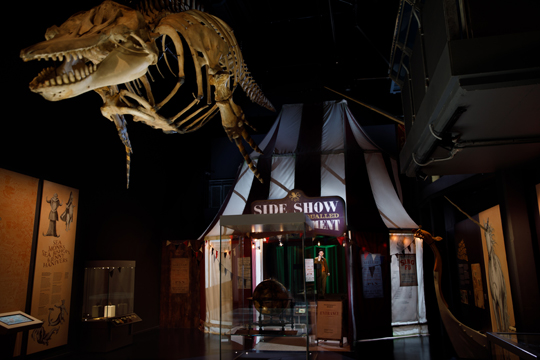
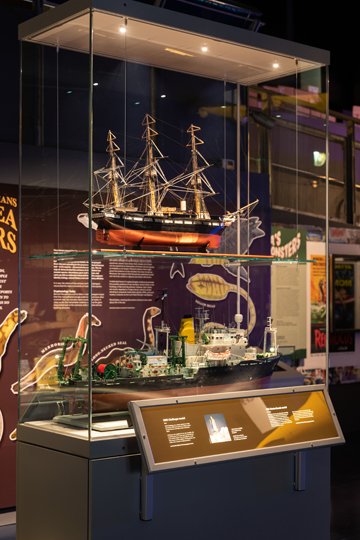
We might be living in a world of track and trace, where everywhere we go and who we meet can be uploaded into a gargantuan database, but there is a part of our planet that remains relatively unknown even in today’s digitally dominated environment.  The deep, dark depths of our oceans harbour some of the most bizarre and amazing creatures to have ever evolved and a recently re-opened exhibition at the National Maritime Museum (Falmouth, Cornwall), permits visitors to meet up with some of nature’s most curious creatures as well as plunging into the depths of our own imagination to explore legendary sea monsters – all without getting our feet wet.

Monsters of the Deep: Science Fact and Fiction

Monsters of the Deep exhibition.
Monsters of the Deep: Science Fact and Fiction at the National Maritime Museum (Cornwall).  Take the plunge!  Encounter myths, legends and real sea monsters. 

Picture credit: Courtesy of the National Maritime Museum Cornwall 

Monsters of the Deep Real and Imagined

Running until January 2022, this carefully crafted exhibition takes visitors on a voyage of discovery from Medieval folklore through cryptozoology and the modern-day monster hunters employing the very latest maritime technology used to explore those parts of planet Earth furthest from our sun.

A Collection of Ocean-dwelling Curiosities

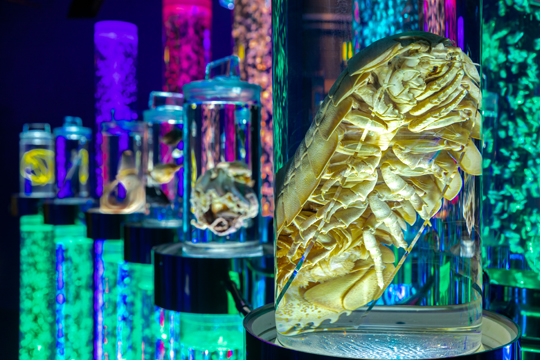
Giant Isopods on display.
Curious crustaceans such as giant isopods with their huge compound eyes stare back at you.  The exhibition permits visitors to closely examine some of the most amazing ocean-dwelling creatures known to science.

Picture credit: Courtesy of the National Maritime Museum Cornwall 

A Collaboration Between Leading Institutions

World class scientific collections from such august bodies as the British Museum, the National Oceanography Centre, the Science Museum, Royal Museums Greenwich and Cambridge University Library have been plundered by modern day buccaneers on a mission to inform, educate and entertain.  Rarely seen specimens, artwork and artefacts all housed under one roof including a large scale reproduction of the Carta Marina, the world’s most famous medieval map of the sea, complete with fanciful monsters and mermaids.

The exhibition highlights the myths associated with early exploration and showcases exquisite illustrations of sea monsters including the strange “mirror creatures”, denizens of the deep that haunted the nightmares of many a seafarer in the age of sail.

In the meantime, visit the Everything Dinosaur website: Everything Dinosaur.
Early Explorers Brought Home Tales of Encounters with Fantastic Sea Creatures

Explorers and sea monsters.
Early explorers brought back fanciful tales of sea serpents, mermaids and monsters.

Picture credit: Courtesy of the National Maritime Museum Cornwall

As Real as Elephants and Giraffes

Prior to the Age of Enlightenment which hastened a revolution in scientific thinking in the 17th century, little was known about the exotic fauna that inhabited our world.  On display at this exhibition is the Hortus sanitatis, the first ever natural history encyclopaedia.  Originally printed in 1491, the year before Christopher Columbus set out on his voyage that led to the discovery of the New World, it represents a significant landmark in our attempts to document and understand the natural world with unicorns and mermaids considered just as real as elephants and giraffes.

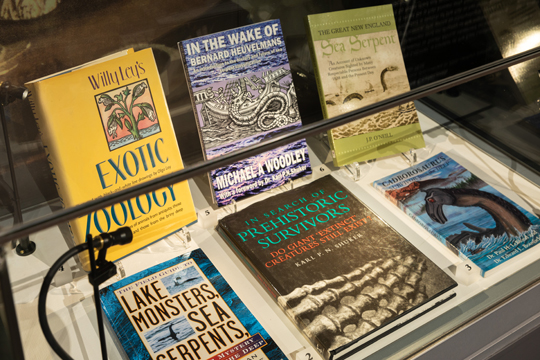
A Collection of Books on Cryptozoology on Display

Books about Sea Monsters on Display
A large number of books documenting our fascination with monsters of the deep are on display.

Picture credit: Courtesy of the National Maritime Museum Cornwall

Guest Curators and Leading Specialists

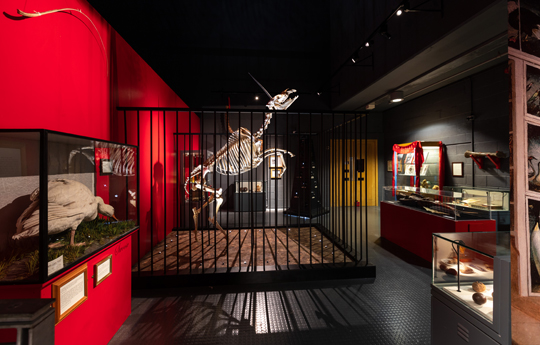
Monsters of the Deep: Science Fact and Fiction has been developed in co-operation with leading specialists and guest curators, including Viktor Wynd, the custodian of the “UnNatural History Museum”, bringing together a collection of curiosities including a mummified feegee mermaid and a skeleton of a unicorn!  This section of the exhibition is dedicated to exploring ideas about what is real and what can be falsified or faked.

A Rearing “Unicorn” on Display at the National Maritime Museum

A rearing unicorn skeleton.
An exhibit from the “UnNatural History Museum” – a rearing unicorn skeleton.

Picture credit: Courtesy of the National Maritime Museum Cornwall 

As well as exploring the theme of sea monsters in popular culture, the exhibition provides an insight into some of the very latest cutting-edge technical developments that have allowed marine biologists rare glimpses of the natural wonders that still exist in the largely unexplored regions of our planet such as the vast abyssal plain.

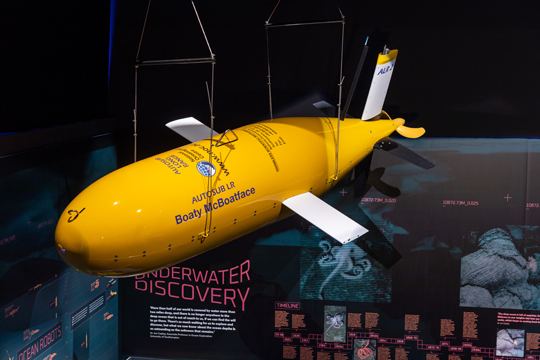
Combining Myth and Fantasy with Scientific Endeavour and Research

Meet Boaty McBoatface.
The exhibition highlights state-of-the-art technology such as the latest mini submersibles that are transforming our understanding of the world’s oceans.

Picture credit: Courtesy of the National Maritime Museum Cornwall 

To ensure the safety and wellbeing of all visitors and staff, the Museum has implemented a number of new health and safety measures, in line with the latest government advice including timed arrival slots, social distancing measures and on-line only booking.

As half-term approaches, escape your bubble and take the plunge!  Immerse yourself in a world of folklore, fun, facts and fantasy.

Monsters of the Deep: Science Fact and Fiction at the National Maritime Museum Cornwall (July to 3rd January 2022).  For further details: The National Maritime Museum.

23 05, 2020

Explaining the Principle of Superposition

By |2024-02-20T21:00:41+00:00May 23rd, 2020|Categories: Educational Activities, Geology, Main Page, Teaching|0 Comments

Explaining The Principle of Superposition

Everything Dinosaur received an enquiry earlier this week from a young student studying rocks and fossils at their school as part of a geology project.  The student asked, “what is the law of superposition?” Our team members were happy to provide a short explanation.

The principle of superposition, often referred to as the law of superposition is an observation that sedimentary layers of rock at the bottom of a sequence if they undeformed, then they must be older than those at the top.  The bottom layers must have been in existence in order to permit the upper layers to have been deposited on top of them.

Layers of Sedimentary Rock Demonstrating the Principle of Superposition

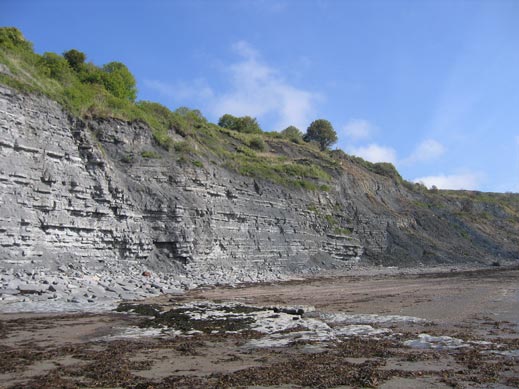
The Church cliffs at Lyme Regis.
Fossil hunting can be fun but beware of the cliffs.  The Church cliffs at Lyme Regis are notoriously unstable and dangerous but they do help to demonstrate the law of superposition. Picture credit: Everything Dinosaur.

Picture credit: Everything Dinosaur

A Fundamental Principle of Geology

The law of superposition is regarded as one of the fundamental principles that underpins modern geology, although this principle is very much applicable in other research fields such as archaeology.  It helps to provide a basis for the relative dating of strata.  As the oldest strata will always be found at the bottom of an undeformed, observable sequence of sedimentary rocks.  It is extremely helpful when considering stratigraphical dating, which is governed by the proposition that a layer cannot be older than its constituents.

The introduction of this principle is accredited to the Danish polymath Nicolas Stenos (1638-1686), often referred to as the “father of modern geology”.  In 2012, Nicolas Stenos was honoured with the creation of a Google doodle demonstrating his principle complete with illustrations of fossils.

The 2012 Google Doodle Honouring Nicolas Stenos

Remembering the Contribution of Nicolas Stenos.  Danish scientist honoured with a Google doodle.

Picture credit: Google

This geological principle was popularised by the famous English geologist William Smith (1769-1839), who used this law to create the first ever map showing the geology of a landscape.  In 1815, the year of the battle of Waterloo, William Smith published a map outlining the geology of England, Wales and parts of Scotland.

The “Ground-breaking” First Geological Map to be Published

The William Smith Geological Map (1815).
Can you see the geology in your part of the world?

Picture credit: The Geological Society of London

Visit the Everything Dinosaur website: Everything Dinosaur.
21 05, 2020

Happy Birthday to the Famous Mary Anning

By |2024-02-20T20:50:35+00:00May 21st, 2020|Categories: General Teaching, Key Stage 1/2|Comments Off on Happy Birthday to the Famous Mary Anning

Happy Birthday Mary Anning

On this day in 1799, Mary Anning the famous fossil hunter from Lyme Regis was born.  Mary along with her brother Joseph was responsible for the discovery of some highly significant fossils from an area of Dorset which forms part of the UNESCO World Heritage site known as the “Jurassic Coast”.

Mary Anning 1799-1847 (Famous Fossil Collector from Dorset)

Mary Anning Statue Unveiled
A close-view of the statue of Mary Anning which was created by leading artist and sculptress Denise Dutton. Mary is holding an ammonite fossil in her left hand. Picture credit: Mary Anning Rocks.

Picture credit: Mary Anning Rocks

Mary Anning

Like many children growing up in Georgian England, Mary had very little formal education, but she was able to read and in her later life she taught herself, geology and anatomy as well as becoming quite adept at scientific illustration.

She became well known for her fossil discoveries and she supplemented the family’s meagre income by selling some of her fossil finds to wealthy members of society who were encouraged to holiday in England whilst the Napoleonic Wars raged in Europe.

During her lifetime, she did not receive full credit for her discoveries including the first pterosaur (flying reptile), to be found outside Germany.  For example, as a woman, she was not permitted to join the Geological Society of London, an institute that was to remain closed to women members until 1919.

In 2010, the Royal Society named Mary Anning as one of the ten British women who have most influenced the history of science.  Learning the story of Mary Anning and her fossil discoveries is often integrated into the “Rocks and Fossils” scheme of work which forms part of the Year 3 science curriculum in England.

The Everything Dinosaur website: Everything Dinosaur.
30 04, 2020

“Crazy Beast” Lived Amongst the Last of the Dinosaurs

By |2024-02-18T13:33:24+00:00April 30th, 2020|Categories: General Teaching, Key Stage 1/2, Key Stage 3/4|Comments Off on “Crazy Beast” Lived Amongst the Last of the Dinosaurs

Adalatherium hui – “Crazy Beast” from Madagascar

Scientists have published a scientific paper in the academic journal “Nature” that describes a cat-sized mammal that lived alongside the dinosaurs at the very end of the Cretaceous.  The furry little creature has been named Adalatherium hui and its fossils have been found on the island of Madagascar.

Madagascar started to  break away from the super-continent of Gondwana around 88 million years ago and so animals such as Adalatherium evolved in relative isolation, separated from other populations of mammals on larger landmasses.  At around three kilograms in weight and not being fully grown when it died, it challenges the perception that all mammals were very small during the time of the dinosaurs.

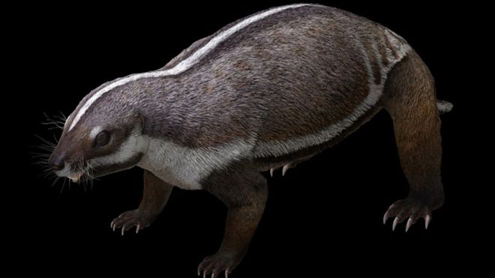
A Life Reconstruction of the Late Cretaceous Mammaliaform Adalatherium hui

Adalatherium life reconstruction.
A life reconstruction of Adalatherium hui.

Picture credit: Reuters

“Crazy Beast”

Adalatherium lived around 72 million to 66 million years ago (Late Cretaceous).  The genus name translated from the Greek and native Malagasy means “crazy beast”, as the discovery of skull and postcranial fossil material of this badger-like creature challenges a lot of scientific assumptions about the evolution of mammals during the latter stages of the Mesozoic.

The snout had a large congregation of nerves within it, making the nose of this animal extremely sensitive.  This suggests that sense of smell was very important and therefore, it has been proposed that Adalatherium lived underground, that it was a burrowing animal (fossorial – an animal adapted to digging and living in burrows).

Adalatherium shared its island home with a number of predatory dinosaurs, including abelisaurids, dromaeosaurs and noasaurids as well as at least three species of crocodilians, both ancient forms and distant relatives of today’s living crocodiles (Neosuchian crocodilians).

Perhaps living underground was a very sensible strategy when surrounded by large predators.

Teaching Extensions Associated with Adalatherium

  • Make a list of animals alive today that live in burrows
  • What similarities do they have?  What differences can you spot?
  • Can you design a dinosaur that could live underground?  What sort of adaptations would this animal have?

For further information about educational resources: Email Everything Dinosaur.

24 04, 2020

Encouraging Children’s Learning and Development with a Triceratops

By |2024-02-18T08:22:37+00:00April 24th, 2020|Categories: General Teaching|Comments Off on Encouraging Children’s Learning and Development with a Triceratops

Triceratops Encourages Learning

The extensive range of dinosaur and fossil themed teaching resources available free of charge from Everything Dinosaur are not just for teaching professionals, mums and dads can use them too!  The dedicated and enthusiastic teaching team at Everything Dinosaur have prepared a large range of teaching resources to help support and assist all those having to home school at the moment.  It can be quite hard to motivate young learners at this challenging time (coronavirus outbreak), but we have prepared lesson plan suggestions, experiments, fact sheets, schemes of work, all with a prehistoric theme to provide inspiration for the next generation of young scientists currently confined to their homes.

Triceratops Encourages Learning

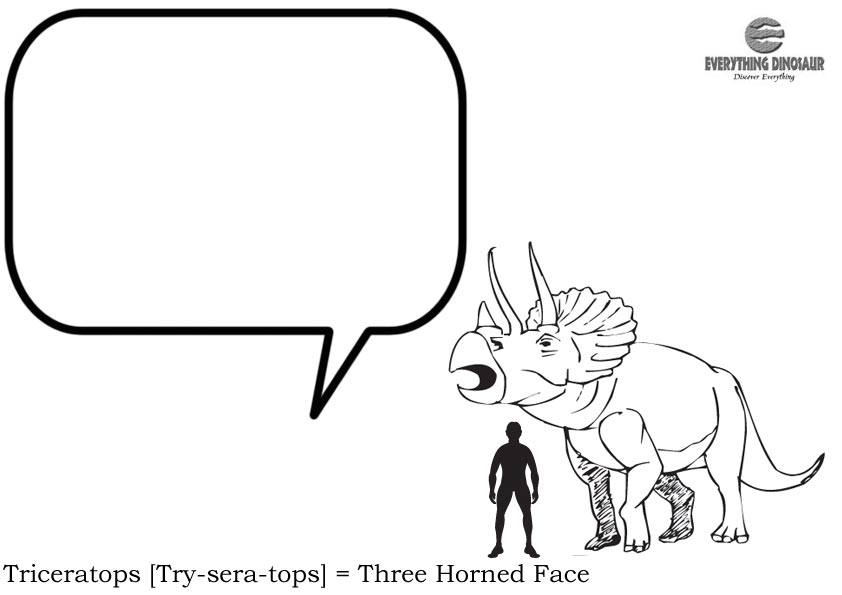
Don’t take our word for it, a Triceratops tells you how it is…

Triceratops Says Feel Free to use Everything Dinosaur’s Free Downloads

Triceratops helps with speech development.
Exploring emotions and helping to construct sentences. Picture credit: Everything Dinosaur.

Picture credit: Everything Dinosaur

Visit the award-winning Everything Dinosaur website: The Everything Dinosaur Website.

Exploring the Downloads Section of the Everything Dinosaur Site

To aid navigation around the downloads section of the Everything Dinosaur school website, this area has been divided into three subcategories based upon the standard teaching definitions found in most UK schools.

The subcategories are:

  • EYFS/Reception (resources suitable for children in nursery or reception classes)
  • KS1/KS2 (resources aimed at primary schools)
  • KS3/KS4 (resources aimed at those children in secondary education)

The downloads are not just for teachers, as our Triceratops states, they are available to everybody so those parents, grandparents, uncles, aunts and guardians supporting home schooling can use them as well.

Feel free to contact Everything Dinosaur. These resources have been downloaded hundreds and hundreds of times.  Just one of the ways in which Everything Dinosaur team members are helping out in these difficult times.

Contact Everything Dinosaur: Email Everything Dinosaur.

20 04, 2020

Thousands of Helpful and Informative Blog Posts

By |2024-02-17T20:38:49+00:00April 20th, 2020|Categories: General Teaching|Comments Off on Thousands of Helpful and Informative Blog Posts

4,750 Blog Posts to Help Teachers and those Home Schooling

Today, (April 20th, 2020), for many schools would have been the first day of the summer term.  However, in these extraordinary times (COVID-19), most of the schools in the UK and elsewhere in the world remain closed.  Teachers and teaching assistants and doing all they can to help with home schooling.  Parents and guardians too are in the unusual position of having to organise and manage the home schooling of children.  Team members at Everything Dinosaur have already supplied hundreds of helpful resources with a dinosaur or fossil theme to support science teaching.

The Everything Dinosaur blog has just passed the landmark of 4,750 articles.  These are on-line and free to access providing helpful information about fossil discoveries, research and prehistoric animals.

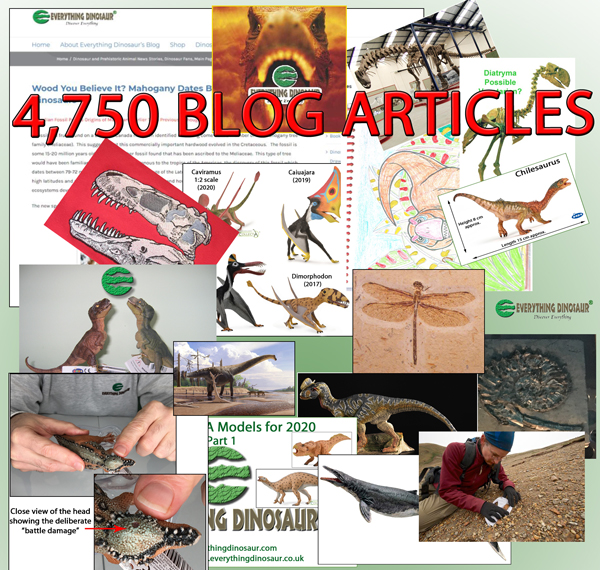
Celebrating 4,750 Articles on the Everything Dinosaur Weblog

Everything Dinosaur celebrating 4,750 blog posts.
Celebrating 4,750 blog posts. Picture credit: Everything Dinosaur.

Picture credit: Everything Dinosaur

Everything Dinosaur Publishes Blog Post Number 4,750

The Everything Dinosaur main blog site is crammed full with helpful information and of the 4,750 articles that have been posted up to date, there are 548 in the education category and a further 287 articles within the teaching category, providing yet more assistance and support as well as a wealth of information to permit the development of lesson plans.

The main blog site of Everything Dinosaur can be found here: Everything Dinosaur’s Main Blog Site.

There is no paywall, there are no fees to pay, each and every day a team member from Everything Dinosaur ensures that there is an article or feature posted up onto the site.  These are all free and available to be used to help support teaching work, lesson plans, subjects and topics.  Readers can use as many of these articles and features as they like.

Easy to Read, Informative and Helpful Articles

The blog certainly covers a wide range of dinosaur and fossil themed subjects.  For example, in the last week team members have produced posts explaining how aeronautical engineers are looking at the fossilised remains of flying reptiles to provide inspirational ideas on drone designs, a study of insect wing cases found in Switzerland has helped answer the question why are some insects iridescent?  Furthermore, the site has looked at Woolly Mammoths, Caribbean frogs, the origins and evolution of hominins and even provided a free crossword to download.

A spokesperson from Everything Dinosaur commented:

“As well as covering information about our business, the blog has been designed to provide a resource for teachers and the general public to help them learn more about the Earth sciences.  In these challenging times, this is a free-to-use resource that can help support teachers, academics and those people responsible for home schooling.”

With 4,750 articles it certainly is a large site providing support and assistance in these difficult times. We promise to keep posting up more articles.

Visit the Everything Dinosaur website: The Everything Dinosaur Website.

12 04, 2020

The Origins of the Easter Bunny

By |2024-02-17T15:45:33+00:00April 12th, 2020|Categories: General Teaching|Comments Off on The Origins of the Easter Bunny

Remarkable Rabbits

The rabbit, an animal often associated with this time of year (Easter), is not a rodent, although many members of the public think this chisel-toothed animal is.  After all, rodents have chisel-teeth too.  However, whilst both rodents and rabbits tend to be small, often burrow dwellers and herbivorous with ever-growing front incisors, there are notable differences.  For example, rabbits, hares and pikas (referred to as lagomorphs), have two pairs of upper chisel-like incisors whilst rodents only have one pair.

The Evolutionary History of Lagomorphs

Rabbits also differ from rodents in that they have short tails, long ears that also help them to radiate excess heat as well as listen out for predators and long hind legs adapted to a jumping gait.

Although, they are related to rodents, where rabbits and their kin fit into the history of mammal evolution remains hotly debated.  The earliest fossils associated with these types of creatures date back to just a few million years after the extinction of the dinosaurs.  Whilst only two families of rabbits survive today – the Leporidae (hares and rabbits) and the Ochotonidae (pikas), in the past they were much more diverse and these animals have an extensive fossil record.

Nuralagus rex

Some prehistoric rabbits were giants such as Nuralagus rex which inhabited the Spanish island of Menorca until about 3 million years ago.  This giant bunny is estimated to have weighed more than twenty kilograms and it was so large and heavy it probably lost the ability to hop.

A Comparison of the Giant Pliocene Rabbit Nuralagus rex with a Pet Rabbit

Nuralagus rex.
The prehistoric rabbit Nuralagus rex compared in size to a domestic rabbit.

Picture credit: Mary Persis Williams

Rabbits might be associated with this time of year (Easter), but to a vertebrate palaeontologist, these lagomorphs have a long and diverse fossil record and some ancient rabbits were giants.

The Everything Dinosaur website: Everything Dinosaur.

6 04, 2020

New Research Suggests Not All Dinosaurs were Feathered

By |2024-02-16T16:57:14+00:00April 6th, 2020|Categories: General Teaching, Key Stage 3/4|Comments Off on New Research Suggests Not All Dinosaurs were Feathered

There were Feathered Dinosaurs but not all Dinosaurs were Feathered

Research conducted by palaeontologists at the London Natural History Museum suggests that whilst dinosaurs that were closely related to modern birds (Aves), were probably feathered, other types of dinosaurs such as the Late Cretaceous horned dinosaurs and the duck-billed dinosaurs probably were not covered in feathers.

A book tracing the evolution of feathers is being written and as part of the background to this forthcoming publication, Professor Paul Barrett of the Museum conducted an evolutionary analysis looking at the preserved skin fossils of the 77 dinosaur species where evidence of skin has been preserved.

A Preserved Skin Impression from a Tyrannosaurus rex

Tyrannosaurus rex skin impression.
Preserved integument from the neck (b) of T. rex specimen HMNS 2006.1743.01

Picture credit: Biology Letters

Evidence of Reptilian Scaly Skins

The study suggests that the first types of dinosaurs were probably covered in scaly skin and not feathered.  Professor Barrett and his colleagues found no evidence of the earliest members of the Dinosauria being feathered.  Most of the fossil evidence supports the view that a specific proportion of the Theropoda (mostly meat-eating dinosaurs), the Coelurosauria – were feathered.  No evidence for a feathery covering in long-necked, plant-eaters (Sauropodomorpha) has been identified to date.

Sinosauropteryx – The First Dinosaur with Feathers to be Described

Sinosauropteryx fossil material.
Sinosauropteryx on display – the first feathered dinosaur described. Picture credit: Everything Dinosaur.

Picture credit: Everything Dinosaur

The First Feathered Dinosaur Fossils were Found in China

PNSO Sinosauropteryx dinosaur model.
PNSO Yuyan the Sinosauropteryx dinosaur model.

The picture (above) shows a life reconstruction of Sinosauropteryx. It is a model from the PNSO range of prehistoric animals.

To view this range: PNSO Age of Dinosaurs.

The book is due to be published later on this year, a spokesperson from Everything Dinosaur commented that it would add to the growing list of books aimed at the general reader that helped to explain some of the areas of research currently being conducted on the Dinosauria.

For further articles about feathered dinosaurs and research:

Tyrannosaurus rex loses its feathers: T. rex Sheds its Feathers.

The origins of feathers: Feathers came first, then Birds Evolved.

Did all Dinosaurs have feathers? Did all Dinosaurs have Feathers?

Extension Ideas

  • What evidence can you find for dinosaurs having feathers?  Can you draw up a simplified family tree of the Dinosauria identifying which types of dinosaurs were feathered?
  • What are the reasons for large animals such as the sauropods probably not having a feathery covering?  A hint, think surface to volume ratios and how large animals need to prevent overheating.
  • Create a poster/chart comparing a bird to a meat-eating dinosaur.  What are the similarities, what are the differences?
  • Why do you think some dinosaurs were feathered?  Can you come up with a theory?

Visit the Everything Dinosaur website: Everything Dinosaur.
3 04, 2020

Supporting Teachers and Home Educators with Learning Resources

By |2024-02-16T13:50:58+00:00April 3rd, 2020|Categories: General Teaching, Key Stage 1/2|Comments Off on Supporting Teachers and Home Educators with Learning Resources

Everything Dinosaur Supporting Teachers and Home Educators

For the staff at Everything Dinosaur, the interests of our customers, our team members and our communities are at the very heart of all that we do.  At this particularly challenging time with the continuing Coronavirus (COVID-19) outbreak, we want to do our best to help all those people having to teach children either at home or in school.

We want to let you know that you remain our top priority and we are doing all we can to assist schools, parents, guardians, nurseries and home educators.

To date, Everything Dinosaur has provided hundreds of free downloads of teaching materials and other resources.

Take for example, this free junior word search and crossword that we have been sending out.  Aimed at young children with a fascination for dinosaurs, our word search contains seven words associated with dinosaurs and prehistoric animals, can you find them all?

Everything Dinosaur Providing a Free Dinosaur Themed Crosswords

Rebor inspired crossword designed by Everything Dinosaur.
The Rebor inspired crossword designed by Everything Dinosaur. Picture credit: Everything Dinosaur.

Picture credit: Everything Dinosaur

The Benefits of Word Games

Word games such as word search puzzles and crosswords have many benefits.  Firstly, they assist with the development of pattern recognition, a key cognitive function in humans.  For young dinosaur fans, our word search also improves spelling, assists in vocabulary development and above all, it is fun.

The word search puzzles (and the answers), can be requested by simply emailing Everything Dinosaur: Email Everything Dinosaur.

A spokesperson for the UK-based company commented:

“Over the last few weeks, we have all been working very hard to support teachers and home educators.  With many children now at home and unable to go to school, we have been providing lots of helpful teaching resources and other learning materials to help assist with home schooling.”

An Extension Idea

How about creating your own wordsearch?  It could be about dinosaurs or any other subject that you wish.  If you are learning about the Romans, why not try creating a Roman-themed word search that you can try out on a family member.  Perhaps, you could record the time it takes for each person to complete the challenge and create a chart to display the results.

The Everything Dinosaur website: Everything Dinosaur.
Go to Top