All about dinosaurs, fossils and prehistoric animals by Everything Dinosaur team members.

Pictures of fossils, fossil hunting trips, fossil sites and photographs relating to fossil hunting and fossil finds.

12 12, 2021

New Dinosaur Species Described – Arrudatitan

By |2024-09-16T20:22:26+01:00December 12th, 2021|Categories: Adobe CS5, Dinosaur and Prehistoric Animal News Stories, Dinosaur Fans, Main Page, Palaeontological articles, Photos/Pictures of Fossils|0 Comments

This year (2021), has been another bumper year for dinosaur discoveries with over forty new species of dinosaur described, including several from the British Isles such as Pendraig (P. milnerae) from Wales and four new dinosaurs described from fossil finds on the Isle of Wight (Brighstoneus, Ceratosuchops, Riparovenator and Vectiraptor).

New genera are erected based on new fossil discoveries. In addition, a new dinosaur genus or species can be established based on a revision of existing and previously studied fossil material. A new genus of Late Cretaceous, Brazilian titanosaur was announced this year, based on fragmentary remains that had previously been assigned to a titanosaur that roamed Argentina. Time for Arrudatitan maximus to step out of the shadows.

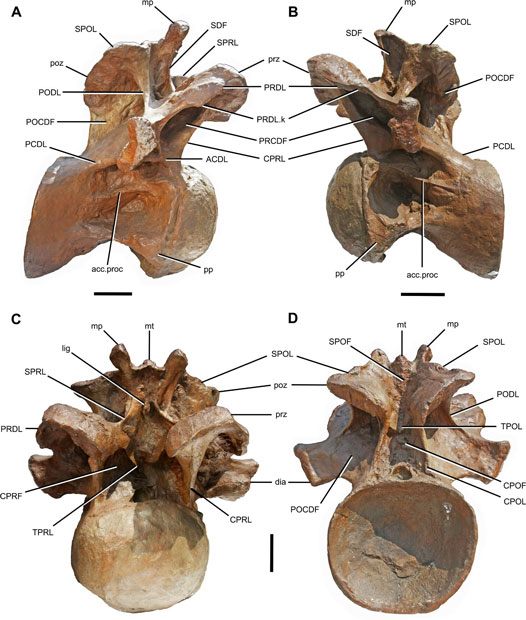
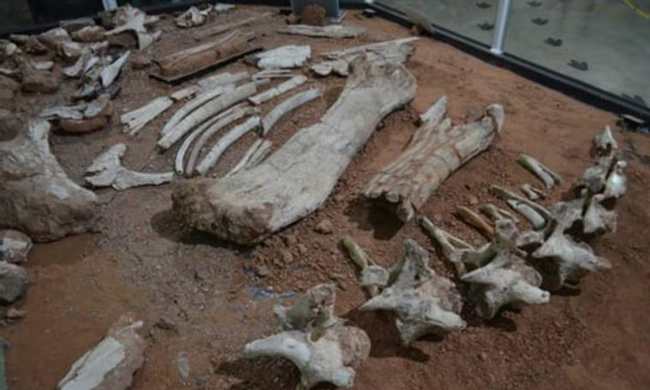
Arrudatitan maximus fossils

The fragmentary fossil bones previously assigned to the Argentinian titanosaur Aeolosaurus maximus and now defined as new Brazilian titanosaur taxon Arrudatitan maximus. Picture credit: Silva Junior et al.

Picture credit: Silva Junior et al

Aeolosaurus maximus

The Aeolosaurus genus was erected by the Argentinian palaeontologist Jaime Powell in 1987 when the first species was named (A. rionegrinus). It was a widespread genus known from numerous individuals collected from Upper Cretaceous deposits, most notably the Angostura Colorada Formation in Río Negro Province, but dinosaur fossils collected from the Bajo Barreal, Los Alamitos and Allen Formations of Argentina have also been assigned to this genus.

The Brazilian fossil remains that led to the erection of the species Aeolosaurus maximus in 2011, have always been regarded as somewhat of an outlier when compared to Aeolosaurus fossil remains discovered in Argentina. A. maximus was described based on vertebrae, ribs, a left ischium, a fragmentary scapula and elements from the limbs including a left femur discovered in 1997 eroding out of an outcrop of the Adamantina Formation in the state of São Paulo state south-eastern Brazil.

Researchers who included Julian Silva Junior (Universidade de São Paulo), reassessed the fossil material following a cladistic analysis in 2019 that challenged the taxonomic placement. Writing in “Historical Biology”, the scientists have confirmed the assertion expressed previously that the Brazilian fossil material represents a distinct genus and the fossils ascribed to Aeolosaurus maximus have been reassigned to the new dinosaur species Arrudatitan maximus.

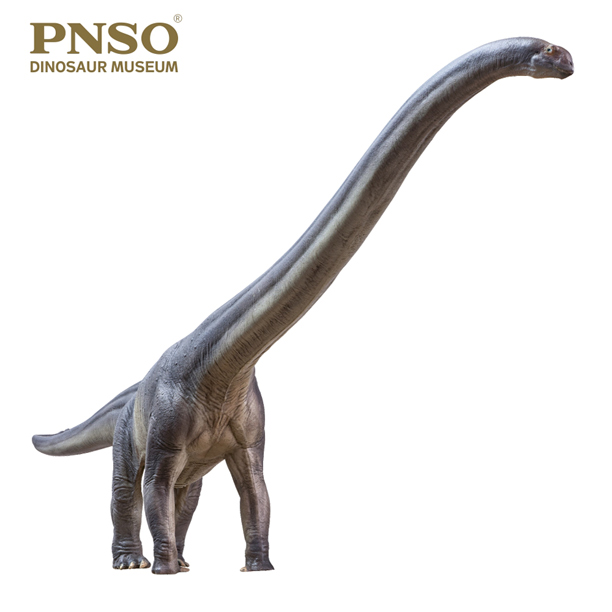
Arrudatitan maximus scale drawing.

Although the size of A. maximus remains uncertain, based on the femur length of 1.55 metres, palaeontologists estimate that this titanosaur may have reached a length of around 15 metres.

Commenting on the revision, lead author of the scientific paper, doctoral student Julian Silva Junior stated:

“When analysing the caudal vertebrae, we found that they were different to those assigned to Aeolosaurus and these characteristics served to establish a diagnosis to propose a new genus.”

2021 – A Good Year for Titanosaur Discoveries

Several new titanosaur genera have been erected this year including Menucocelsior (M. arriagadai) and Ninjatitan (N. zapatai), which is the oldest titanosaur known to science.

Everything Dinosaur’s list of new titanosaurs named in 2021

  • Arackar licanantay a titanosaur from the Upper Cretaceous Hornitos Formation of Chile.
  • Arrudatitan maximus from the Upper Cretaceous Adamantina Formation of south-eastern Brazil.
  • Australotitan cooperensis a titanosaur from the Winton Formation of Queensland, Australia.
  • Garrigatitan meridionalis from the Upper Cretaceous Argiles Rutilantes Formation of south-eastern France.
  • Hamititan xinjiangensis from the Lower Cretaceous Shengjinkou Formation of north-western China which was coeval with the euhelopodid sauropod Silutitan (S. sinensis) which was also scientifically described in 2021.
  • Menucocelsior arriagadai from the Upper Cretaceous Allen Formation of Argentina.
  • Ninjatitan zapatai the earliest titanosaur known to date described from fossils found in the Lower Cretaceous Bajada Colorada Formation of Argentina.

To read blog posts about some of these newly described titanosaurs:

A new species of titanosaur from the Atacama Desert of northern Chile (Arackar licanantay): A New Titanosaur from Chile – Arackar licanantay.

Australian dinosaur “Cooper” named: “Cooper” – Australotitan cooperensis.

Our article on Hamititan xinjiangensis and Silutitan sinensis: Two New Sauropods from North-western China.

To read the Everything Dinosaur blog post about the earliest titanosaur known to science: Ninjatitan zapatai the Earliest Titanosaur.

The scientific paper: “Reassessment of Aeolosaurus maximus, a titanosaur dinosaur from the Late Cretaceous of Southeastern Brazil” by Julian C. G. Silva Junior, Agustín G. Martinelli, Fabiano V. Iori, Thiago S. Marinho, E. Martín Hechenleitner and Max C. Langer published in Historical Biology.

Visit the Everything Dinosaur website: Dinosaur Toys.

10 12, 2021

Tarchia tumanovae – New Ankylosaur Species

By |2024-09-15T20:38:09+01:00December 10th, 2021|Categories: Adobe CS5, Dinosaur and Prehistoric Animal News Stories, Dinosaur Fans, Main Page, Palaeontological articles, Photos/Pictures of Fossils|0 Comments

Scientists have named a new species of armoured dinosaur based on cranial and postcranial fossils collected in 2008 from the famous Nemegt Formation of the Gobi Desert, Mongolia. A detailed analysis of the fossil material consisting of a well-preserved skull, vertebrae, ribs, part of the hip and a tail club has been published in the journal “Scientific Reports”. The new ankylosaur has been named Tarchia tumanovae and it is the third species to be assigned to the Tarchia genus.

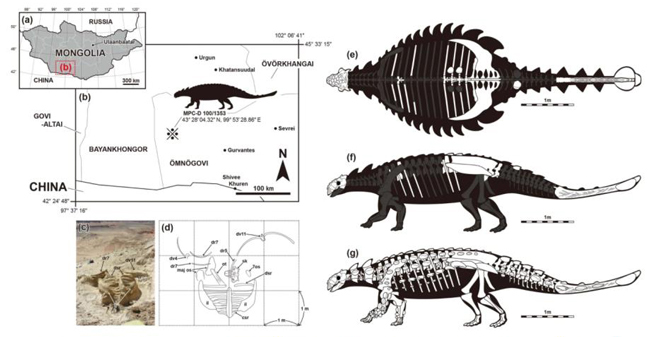
Tarchia tumanovae fossils and line drawings.

Location map (a) of the fossil discovery in Mongolia with (b) a larger scale map showing the fossil quarry. Photograph (c) shows the specimen (MPC-D 100/1353) partially excavated with (d) a line drawing of the fossils in situ. T. tumanovae illustrations show known fossil bones in white (e) dorsal view, (f) left lateral view and (g) shows a skeletal reconstruction with dermal armour. Picture credit: Park et al.

Picture credit: Park et al

Evidence of Injury and a Damaged Tail Club

A joint Korean/Mongolian expedition discovered the fossil material at Hermiin Tsav in the southern Gobi Desert. The ribs show signs of fracture healing and there are localised injuries on the pelvic bones. The researchers speculate that these injuries were probably caused by intraspecific combat. The pathology is consistent with tail club strikes. Intriguingly, the tail club of the skeleton also shows signs of injury. The tail club is asymmetrical when viewed from above (dorsal view). A badly healed ossified tendon on the tail knob handle is present, a possible injury caused as the tail was used during combat. Whether this injury occurred as a result of intraspecific combat or when deterring an attack from a theropod is unknown.

Noting a Change in the Diet of Late Cretaceous Ankylosaurids

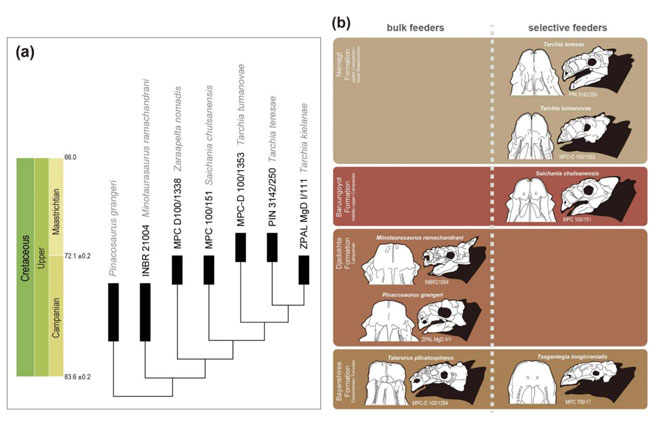
The scientists noted wide muzzles are a character of low-level, bulk feeders, whereas those ankylosaurines with narrower muzzles such as T. tumanovae and the coeval, closely related Tarchia teresae were probably selective feeders. The researchers demonstrate that ankylosaurid diets shifted from one of low-level, relatively unfussy bulk feeders during the early Campanian to more selective diets as characterised by a narrower muzzle by the late Campanian/early Maastrichtian.

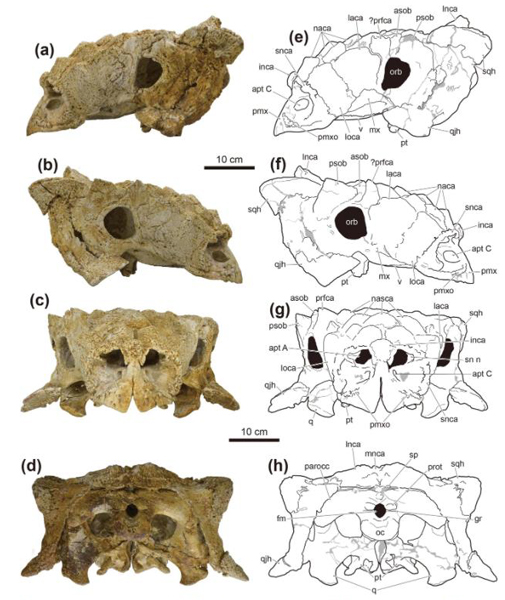
Views of the skull of Tarchia tumanovae with accompanying line drawings.

Photographs (a–d) and line drawings (e–h) of the skull of Tarchia tumanovae sp. nov. (MPC-D 100/1353). Photographs of the skull in (a) left lateral, (b) right lateral, (c) anterior, and (d) occipital views. Line drawings in (e) left lateral, (f) right lateral, (g) anterior, and (h) occipital views.

Picture credit: Park et al

It is not known why ankylosaurids show this trend towards selective feeding, although the researchers speculate that this change could have been a consequence of habitat change as the region gradually became less arid towards the very end of the Cretaceous. The research team also postulate that ankylosaurids evolved more selective browsing habits in response to the presence of bulk-feeding saurolophine hadrosaurids such as Saurolophus angustirostris and Barsboldia sicinskii.

Tarchia was a selective feeder

A diagram showing (a) a phylogenetic analysis of Tarchia tumanovae, placed in the context of geological time. Ankylosaurids from this region seem to have changed feeding strategies, (b), evolving narrower muzzles that indicate a switch from low-level bulk feeding to more selective browsing. Ankylosaurid fossils from the geologically older Bayanshiree and Djadokhta Formations which represent arid habitats had broad muzzles, whilst ankylosaurids from the younger and more humid Nemegt Formation have narrower muzzles. Picture credit: Park et al.

Picture credit: Park et al

Honouring a Famous Researcher

The species name honours Tat’yana A. Tumanova of the Russian Academy of Sciences, in recognition of her contribution to the study of Mongolian armoured dinosaurs.

The scientific paper: “A new ankylosaurid from the Upper Cretaceous Nemegt Formation of Mongolia and implications for paleoecology of armoured dinosaurs” by Jin-Young Park, Yuong-Nam Lee, Yoshitsugu Kobayashi, Louis L. Jacobs, Rinchen Barsbold, Hang-Jae Lee, Namsoo Kim, Kyo-Young Song and Michael J. Polcyn published in “Scientific Reports”.

The Everything Dinosaur website: Dinosaur Models: Dinosaur Models.

2 12, 2021

Sizing Up Tethyshadros Thanks to New Research

By |2024-03-10T12:00:03+00:00December 2nd, 2021|Categories: Adobe CS5, Dinosaur and Prehistoric Animal News Stories, Dinosaur Fans, Main Page, Photos/Pictures of Fossils|0 Comments

Tethyshadros (T. insularis), which was formally named and described in 2009 from a superbly preserved fossil specimen discovered in a limestone quarry near to the village of Villaggio del Pescatore (Italy), had been thought to represent a dwarf hadrosaur. However, newly published research suggests that this Late Cretaceous dinosaur was not diminutive. Its body-size fits with the range in body sizes seen in other non-hadrosaurid Eurasian hadrosauroids.

The holotype specimen SC 57021 nicknamed “Antonio” represents a sub-adult. Writing in the academic journal “Scientific Reports”, researchers describe a second, much larger specimen SC 57247, which was discovered when “Antonio” was been excavated. The larger specimen given the moniker “Bruno” is much bigger and the original hypothesis that this taxon was a dwarf form is refuted in this new study.

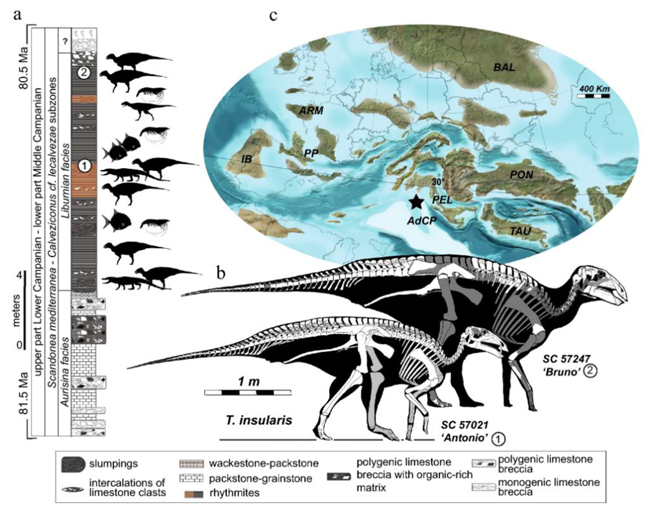
Tethyshadros study.
Diagram showing the stratigraphy of the site and the approximate placement of dinosaur and other fossil finds at the quarry (a) with a comparison of the holotype “Antonio” now regarded as sub-adult and the larger, much more mature specimen “Bruno” (b). Map of Europe in the Campanian showing the location of the island where Tethyshadros lived, the black star indicates the position (c). Picture credit: Chiarenza et al

Insular Dwarfism

During the Late Cretaceous much of Europe was covered by sea. There were numerous islands and these fragmented landmasses were populated by dinosaurs, many of which were dwarf forms when compared with closely related genera known from other continents. This was accepted as fossil evidence for the “island rule”, a theory, famously postulated by the 20th Century polymath Baron Franz Nopcsa von Felső-Szilvás. He proposed that the limited resources such as food, water and space on islands would result in a reduction of the size of animals that lived there. These island dwelling populations would become smaller over many generations when compared to their continental counterparts. Nopcsa referred to this idea as “insular dwarfism”.

The palaeo-Mediterranean region is best represented by the Villaggio del Pescatore quarry as it preserves a record of the fauna to be found on one of these islands. In this new research, this location is critically re-evaluated as early Campanian in age. This is significant, as it means that Tethyshadros lived prior to the final fragmentation stages of the European Archipelago. Tethyshadros lived prior to the emergence of the dwarf European taxa such as those animals associated with Hațeg Island which is geologically younger (Maastrichtian faunal stage of the Late Cretaceous).

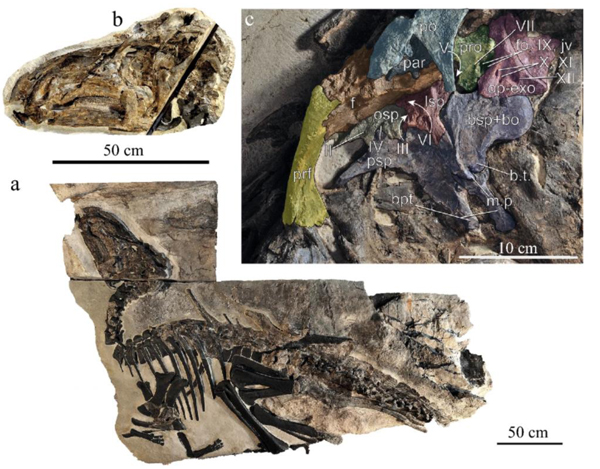
Tethyshadros Fossils
The new skeleton of Tethyshadros insularis “Bruno” (a) preserving details of its cranial anatomy such as the nearly complete skull (b) exposing its braincase (c) adding important information for the anatomy and systematic of this taxon. Elements in black are reconstructed. Picture credit: Chiarenza et al.

Examination of the bones of “Bruno” (histological study), confirms that these dinosaurs were bigger than previously thought. The research team, which included Alfio Alessandro Chiarenza (Universidade de Vigo, Spain) and Matteo Fabbri (Field Museum of Natural History, Chicago, USA), conducted a phylogenetic analysis examining the body size of Tethyshadros compared to related species. They discovered that the body size of T. insularis is within the range of the body sizes of other non-hadrosaurid Eurasian hadrosauroids

Tethyshadros was not a diminutive form, it was not a “pygmy” dinosaur. Team members at Everything Dinosaur have updated their Tethyshadros fact sheet which is supplied with sales of Tethyshadros figures.

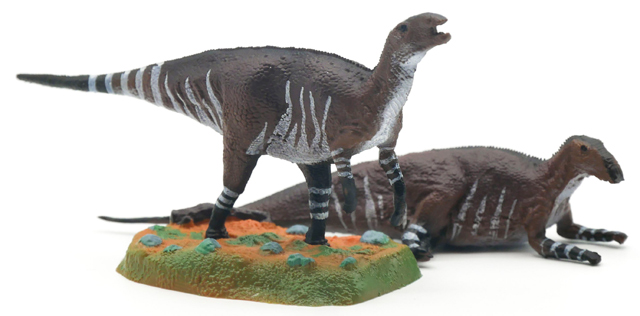
Although “Antonio” and “Bruno” perhaps represent the most complete and best preserved of all the European dinosaur fossils discovered to date, Tethyshadros does not feature in many model ranges. However, a pair of Tethyshadros figures was added to the Wild Past series last year (2021).

To view the Wild Past model range: Wild Past Prehistoric Animal Models.

Wild Past Tethyshadros dinosaur models
The Wild Past Tethyshadros dinosaur models. Everything Dinosaur’s free fact sheet that is sent out with these models has been updated after the publication of the new T. insularis research.

The scientific paper: “An Italian dinosaur Lagerstätte reveals the tempo and mode of hadrosauriform body size evolution” by Alfio Alessandro Chiarenza, Matteo Fabbri, Lorenzo Consorti, Marco Muscioni, David C. Evans, Juan L. Cantalapiedra and Federico Fanti published in Scientific Reports.

1 12, 2021

New Armoured Dinosaur from Chile

By |2024-08-27T07:34:50+01:00December 1st, 2021|Categories: Adobe CS5, Dinosaur and Prehistoric Animal News Stories, Dinosaur Fans, Main Page, Palaeontological articles, Photos/Pictures of Fossils|0 Comments

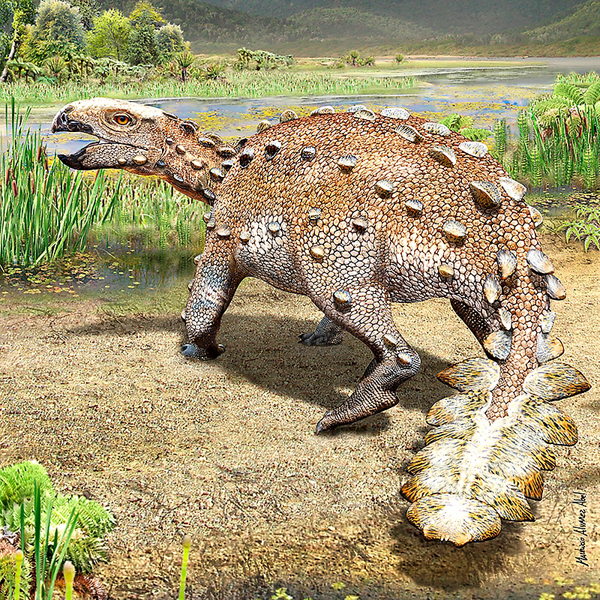
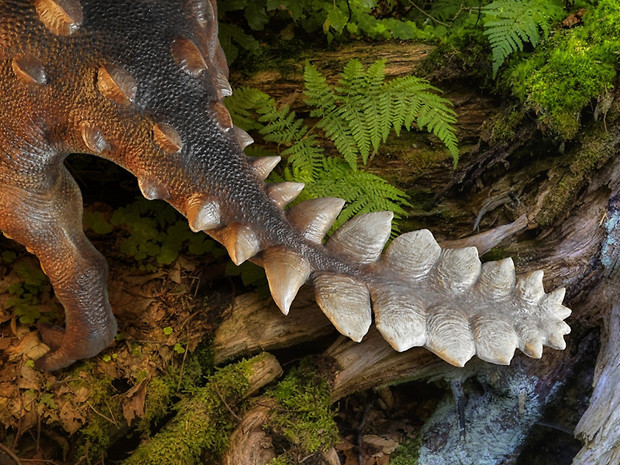
Scientists writing in the journal “Nature” have announced the discovery of a new species of Late Cretaceous ankylosaur from southernmost Chile. The dinosaur named Stegouros elengassen evolved a large tail weapon, unlike any other tail weapon known in the Dinosauria. Stegouros had a flat, frond-like structure formed by seven pairs of laterally projecting osteoderms. This formidable tail weapon superficially resembles a macuahuitl, a frightening war club used by Aztec warriors.

Stegouros life reconstruction

A life reconstruction of the newly described Gondwana ankylosaur Stegouros elengassen. Picture credit: Mauricio Álvarez.

Picture credit: Mauricio Álvarez

A Combination of Stegosaur and Ankylosaur Anatomical Characteristics

The researchers from the University of Chile (Universidad de Chile) in Santiago report on an articulated, nearly complete fossil specimen representing a single animal that was excavated by a field team in February 2018 from sediments relating to the Dorotea Formation in the province of Ultima Esperanza in southern Chile. Stegouros was very small for an ankylosaur, measuring around two metres in length and weighing approximately 100 kilograms.

It shows ankylosaurian cranial characters, but a largely ancestral postcranial skeleton, with some stegosaur-like characters.

A phylogenetic analysis places Stegouros in the Ankylosauria and the research team postulate that it is closely related to other ankylosaurs known from southern Gondwana such as Kunbarrasaurus from Australia and Antarctopelta, fossils of which were found on James Ross Island off the Antarctic Peninsula.

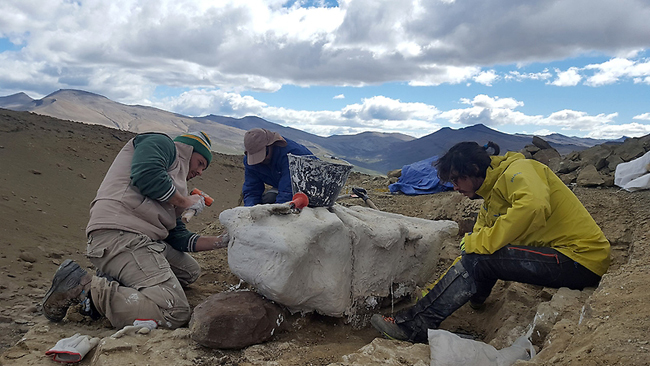
Stegouros fossil excavation.

Field team members jacket the fossilised remains of Stegouros. Picture credit: Universidad de Chile.

Picture credit: Universidad de Chile

The Parankylosauria Clade

The researchers propose the establishment of a new clade of ankylosaurs – the Parankylosauria which consists of basal ankylosaurs that split from the main ankylosaurian lineage during the Middle Jurassic, although the fossil evidence for this is currently lacking with Stegouros, Antarctopelta and Kunbarrasaurus forming part of a ghost lineage of basal ankylosaurs with origins back in the mid-Jurassic.

Stegouros fossil remains.

The posterior of the Stegouros specimen with the armoured tail clearly shown. Picture credit: Universidad de Chile.

A Transitional Ankylosaur

Commenting on the significance of this fossil discovery, lead author of the scientific paper, Sergio Soto, a researcher at the University of Chile stated that the fossilised remains of S. elengassen represent a “Rosetta Stone” for deciphering the fragmentary fossils of other ankylosaurs from southern Gondwana.

He added:

“Stegouros is an evolutionary link between ankylosaurs and other older lineages of armoured dinosaurs. Stegouros has only some of the features normally found in ankylosaurs, particularly the skull, but many others are absent. It also has some traits similar to stegosaurs, inherited from a common ancestor with them, but that other ankylosaurs lost in evolution.”

A close-up view of the armoured tail of Stegouros elengassen.

A close-up view of the armoured tail of Stegouros elengassen. The tail club served as a defensive structure perhaps used in intraspecific combat or to deter attacks from predators. Picture credit: Universidad de Chile.

Picture credit: Universidad de Chile

Stegouros roamed the Chilean Patagonia around 74 million years ago. The genus name translates as “roofed tail”, whilst the species name comes from a mythical armoured monster from the folklore of the indigenous Tehuelche people.

Note

CollectA introduced a 1:6 scale figure of this remarkable dinosaur in 2023.  Safari Ltd also added a Stegouros model to their range in 2024.

CollectA Deluxe 1:6 scale Stegouros elengassen dinosaur model

The CollectA Deluxe 1:6 scale Stegouros elengassen dinosaur model – due to be available mid 2023.

To view the range of CollectA Deluxe prehistoric animal figures available from Everything Dinosaur: CollectA Deluxe Prehistoric Life Models.

The scientific paper: “Bizarre tail weaponry in a transitional ankylosaur from subantarctic Chile” by Sergio Soto-Acuña, Alexander O. Vargas, Jonatan Kaluza, Marcelo A. Leppe, Joao F. Botelho, José Palma-Liberona, Carolina Simon-Gutstein, Roy A. Fernández, Héctor Ortiz, Verónica Milla, Bárbara Aravena, Leslie M. E. Manríquez, Jhonatan Alarcón-Muñoz, Juan Pablo Pino, Cristine Trevisan, Héctor Mansilla, Luis Felipe Hinojosa, Vicente Muñoz-Walther and David Rubilar-Rogers published in the journal Nature.

The Everything Dinosaur website: Dinosaur Toys and Models,

24 11, 2021

Pelecanimimus Under the Spotlight

By |2024-08-26T17:48:20+01:00November 24th, 2021|Categories: Adobe CS5, Dinosaur and Prehistoric Animal News Stories, Dinosaur Fans, Main Page, Palaeontological articles, Photos/Pictures of Fossils|0 Comments

Known from a single specimen discovered in Spain back in 1993 Pelecanimimus (P. polyodon) from the Las Hoyas lagerstätte was the first unambiguous ornithomimosaur described from Europe. Although the scientific paper erecting the genus was published in 1994, no detailed examination of the holotype fossil material (LH 7777) had been undertaken.

A re-examination of the holotype fossil has been carried out by a team of international scientists, which included Francisco Ortega, one of the authors of the original scientific paper describing this 2-metre-long theropod. They conclude that Pelecanimimus was remarkably bird-like although as a member of the Ornithomimosauria it was not that closely related to the dinosaur lineage that led to the evolution of the birds.

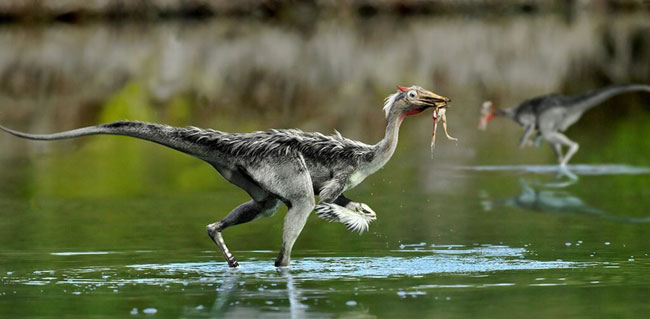
A life reconstruction of Pelecanimimus.
Pelecanimimus had more than 200 small teeth it its long narrow jaws. Palaeontologists believe that this small theropod filled an ecological niche similar to modern herons. It waded in the shallows catching fish and small amphibians. Picture credit: José Antonio Peñas Artero.

An Ossified Sternum

Pelecanimimus when it was named, was the only ornithomimosaur that had a preserved ossified sternum. The sternum is not usually preserved in theropods, it has been suggested that this part of the skeleton was not ossified and therefore it did not fossilise well, or perhaps the absence of this structure was due to preservational bias. The distance observed between the coracoids in articulated theropod specimens led to many palaeontologists inferring its presence. In this new paper, the researchers examined the shape of the sternum and concluded that its morphology was similar to the sternums of dinosaurs more closely related to birds such as Velociraptor and Oviraptor (the Maniraptora clade).

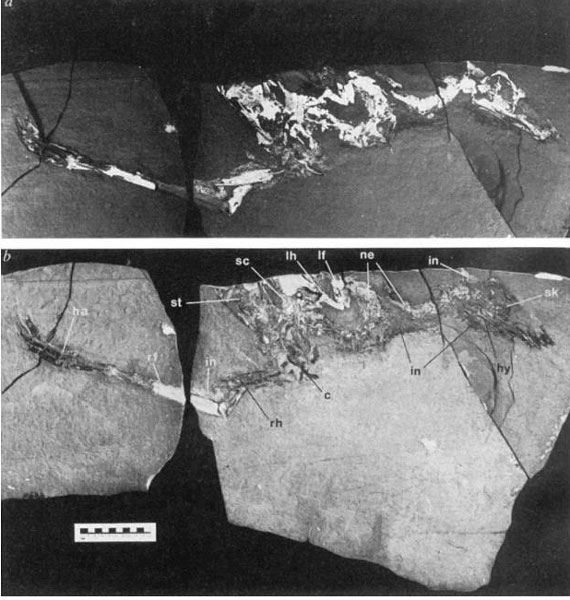
Pelecanimimus holotype fossil material
Pelecanimimus polyodon holotype (LH 7777) viewed under (a) ultraviolet light and (b) normal light. The slabs containing the skull and the manus (hand) have been prepared whilst the central slab with the body had yet to be fully cleaned and prepared for study when this dinosaur was named. Scale bar in cm. Picture credit: Pérez-Moreno et al.

Pelecanimimus Breathed Like a Bird

Furthermore, the research team found evidence of the presence of uncinate processes. These small, hook-shaped bones are linked to the ribs and are also present in extant and extinct birds. Pelecanimimus is the only known representative of the Ornithomimosauria with these structures and this is the first time that uncinate processes have been found in a non-maniraptoran theropod. If maniraptorans evolved these structures, along with the distantly related Pelecanimimus, this suggests convergent evolution.

In birds, uncinate processes function to increase the mechanical advantage for movements of the ribs and sternum during respiration. They make breathing more efficient. In summary, the research team suggest Pelecanimimus, breathed like a modern bird.

Elena Cuesta, the lead author of the study from the Fukui Prefectural University, Japan explained:

“The fact that Pelecanimimus preserved these processes suggests that it also had a bird-like breathing mechanism. Apparently, the origin of such avian-like features is older and more widespread than thought. However, the evolutionary history of both the ossified sternum and uncinate processes is still unclear. Nevertheless, their detection in Pelecanimimus confirms that these elements were present in Ornithomimosauria as well as in other dinosaurs.”

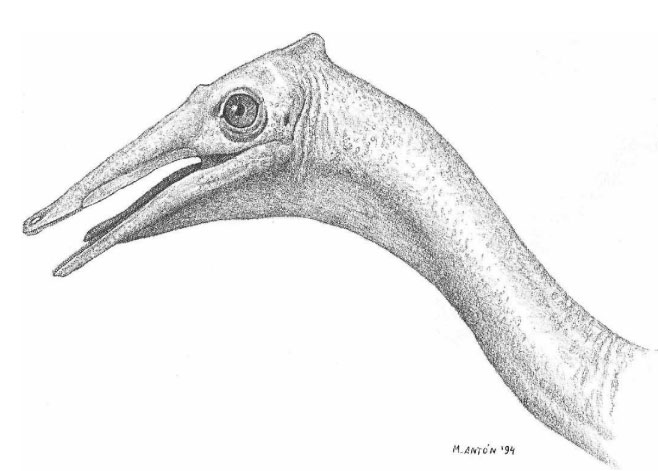
Pelecanimimus illustration.
Pelecanimimus drawing of the head, showing the small head crest and the throat pouch. Integumentary impressions resembled the gular pouch of a pelican. It was this feature that inspired this dinosaur’s name. Picture credit: M. Antón.

Distinctive Features on the Hands

The joint Japanese/Spanish research team also discovered distinctive features on the hands. The manus of Pelecanimimus has conspicuously elongated metacarpals, particularly metacarpal I and lengthened distal phalanges, a feature also found in some later, more derived ornithomimosaur species. The authors of the study conclude that these anatomical features require the erection of a new clade, the Macrocheiriformes. This clade is defined as including Pelecanimimus and more derived ornithomimosaurs. The term Macrocheiriformes, means “forms with large hands.”

The scientific paper: “Pelecanimimus (Theropoda: Ornithomimosauria) postcranial anatomy and the evolution of the specialized manus in Ornithomimosaurs and sternum in maniraptoriforms” by Elena Cuesta, Daniel Vidal, Francisco Ortega, Masateru Shibata and José L Sanz published in the Zoological Journal of the Linnean Society.

23 11, 2021

Appalachia Gets a New Dinosaur

By |2023-07-15T11:41:30+01:00November 23rd, 2021|Categories: Adobe CS5, Dinosaur and Prehistoric Animal News Stories, Dinosaur Fans, Main Page, Palaeontological articles, Photos/Pictures of Fossils|0 Comments

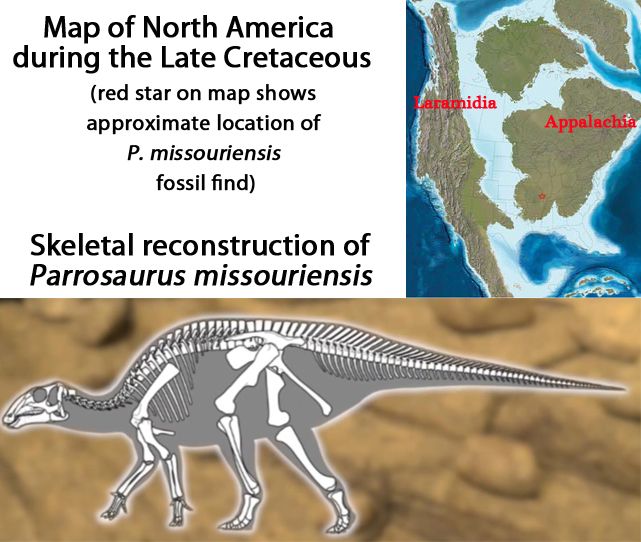
A new dinosaur from Appalachia – Parrosaurus missouriensis.

For much of the Cretaceous the North American landmass was effectively divided into two, by a shallow sea (Western Interior Seaway). At its greatest extent it was around 1,000 kilometres (600 miles) wide, the long, narrow landmass that represented the western part of North America is known as Laramidia and palaeontologists have amassed a huge amount of data about the abundant dinosaurs that roamed these ancient shores. The eastern landmass, Appalachia, stretched from Newfoundland in the north, to the mid-west American states, but in comparison little is known about the Appalachian dinosaur fauna.

A new species of duck-billed dinosaur has been added to the Appalachian biota, named Parrosaurus missouriensis and as the species epithet suggests, this Late Cretaceous herbivore was found in Missouri.

Parrosaurus map and skeletal reconstruction
A skeletal reconstruction of Parrosaurus and a map showing North America in the Late Cretaceous. The red star shows the approximate location of the Missouri fossil find. Picture credit: Fox2 and Everything Dinosaur.

Very Rare Dinosaur Discovery

In contrast to the extensive, rapidly eroding “Badlands” of Montana, Wyoming and North/South Dakota, rocks of Cretaceous age from the ancient landmass of Appalachia are not exposed to any great extent in eastern North America. Dinosaur fossil bearing units are not being eroded, they remain buried under other strata and to add to this dilemma, much of the eastern part of the USA is conurbation. However, there are bright spots for palaeontologists looking for dinosaur bones.

Mines, eroding rivers and construction sites can all provide opportunities for fossil discoveries. Indeed, it was the digging of a well near to the village of Glen Allen in Bollinger County, south-eastern Missouri back in 1942 that led to the finding of several dinosaur bones, the first time such fossils had been reported from the “Show Me State”.

The caudal vertebrae that were excavated from the site were thought to represent a sauropod and it was scientifically described and named Neosaurus missouriensis in 1945 (Gilmore and Stewart). It was noted that the genus name was already occupied, Neosaurus having been erected in 1869 for a Palaeozoic synapsid from France, so the scientific name was changed to Parrosaurus missouriensis.

Duck-billed Dinosaur Fossils

Ironically, duck-billed dinosaur fossils had been found in North Carolina and the species Hypsibema crassicauda was erected in 1869, a review of the Glen Allen material (Baird and Horner), led to the erection of the species Hypsibema missouriensis as the Missouri fossils were confirmed to be hadrosaurid and showed similarities with the fossils that had been found in North Carolina.

More recent excavations carried out at the Glen Allen site, led by fossil expert Guy Darrough and with the support of the Field Museum of Chicago has led to the discovery of at least four individual hadrosaur specimens. The fossils found in close association in black clay represent three adults and juvenile.

The site has yielded other fascinating fossils, providing a glimpse into the fauna of Appalachia. For example, a scute (dermal armour) from a giant crocodilian has been found, fossils of turtles discovered and even the tooth of a tyrannosaur has been uncovered.

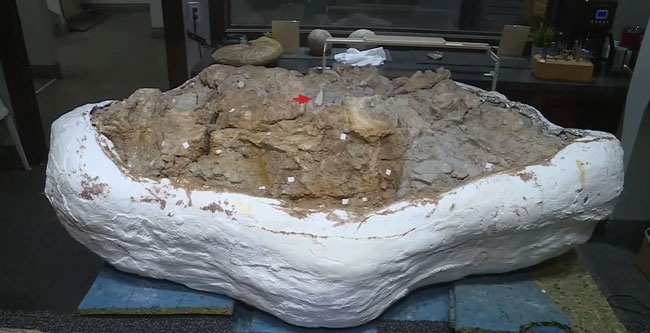
Parrosaurus missouriensis fossil material.
A Parrosaurus specimen in its protective burlap jacket. The broken tyrannosaur tooth found in close association with the hadrosaur bones is shown by the red arrow. Picture credit: Fox2.

Parrosaurus missouriensis

The extensive fossil material found as led to the establishment of a new species Parrosaurus missouriensis. This very notable fossil location might just prove to be a headache for the State administration, as in 2004 these fossils had been declared Missouri’s official State dinosaur when they were assigned to Hypsibema missouriensis.

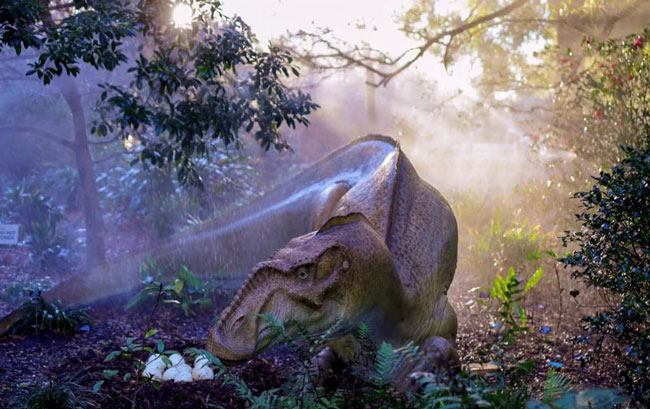
Parrosaurus missouriensis life reconstruction
Parrosaurus missouriensis life reconstruction. Picture credit: Danny Morrison for the Saint Genevieve Museum Learning Centre.

The story has been widely reported and team members at Everything Dinosaur are optimistic that once the fossil material has been studied in detail and more of the specimens cleaned and prepared, then new discoveries will be made.

20 11, 2021

Toothless Theropod Dinosaur from Brazil

By |2024-08-26T17:32:06+01:00November 20th, 2021|Categories: Adobe CS5, Dinosaur and Prehistoric Animal News Stories, Main Page, Palaeontological articles, Photos/Pictures of Fossils|0 Comments

Scientists writing in the academic journal “Nature” have described a new species of dinosaur. It has been classified as a theropod and a member of the Ceratosauria, however, unlike the vast majority of the Theropoda it had no teeth. The dinosaur has been named Berthasaura leopoldinae and it roamed southern Brazil during the Cretaceous.

This little dinosaur lived in the same oasis environment as the recently described pterosaurs Keresdrakon vilsoni *and Caiuajara dobruskii ** measuring around a metre in length Berthasaura was no giant, but its fossilised remains, which were excavated from an outcrop overlooking a country road (Cruzeiro do Oeste Municipality, Paraná State), represent the most complete non-avian theropod known from the Cretaceous of Brazil.

The discovery of this little theropod dinosaur expands our knowledge of the palaeofauna associated with the Goio Êre Formation. It demonstrates that members of the Ceratosauria were capable of evolving different feeding strategies away from meat-eating. Although the research team cannot confirm the diet of Berthasaura they postulate that it could have been herbivorous or perhaps an omnivore.

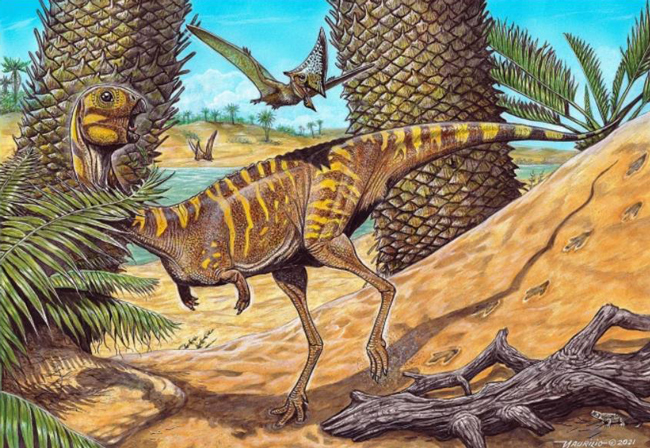
Berthasaura life reconstruction
A life reconstruction of the newly described toothless theropod Berthasaura leopoldinae with a pair of Caiuajara pterosaurs flying nearby. The strata in which the fossils were found represent an oasis environment surrounded by a desert. Picture credit: Maurílio Oliveira.

A Member of the Ceratosauria

The first ceratosaurs (members of the Ceratosauria clade), probably evolved in the Late Triassic. This diverse theropod clade consists of three families. The Ceratosauridae and the Abelisauridae are mostly made up of mid-sized to large carnivores and they contain well-known dinosaurs such as Ceratosaurus (Ceratosauridae) and Carnotaurus, Rugops and Ekrixinatosaurus (abelisaurids). The third dinosaur family within the Ceratosauria are the poorly known Noasauridae. Noasaurids are generally much smaller and lighter

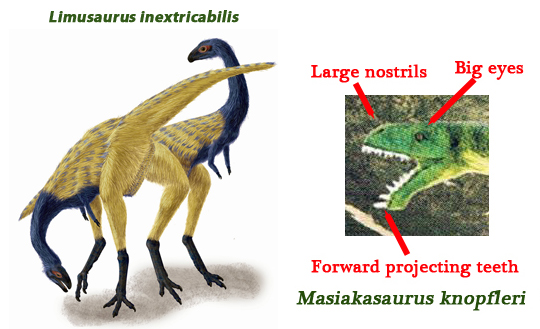
The largest known noasaurid taxon is Elaphrosaurus bambergi from the Late Jurassic of Tanzania, which may have been around six metres long. These theropods seemed to have occupied a variety of specialist niches in dinosaur-dominated ecosystems. For example, Masiakasaurus (M. knopfleri) from the Late Cretaceous of Madagascar had forward projecting teeth in its lower jaw, a possible adaptation to catching fish. In contrast, fossils of Limusaurus (L. inextricabilis) found in Upper Jurassic strata of north-eastern China, show that whilst juveniles had teeth, by the time these gracile theropods reached about three years of age they had lost all their teeth ***. Palaeontologists have postulated that adult Limusaurus were probably herbivorous whilst juveniles were most likely omnivores.

Examples of noasaurids.
Two noasaurids – Limusaurus (left) that lost all its teeth as it matured and Masiakasaurus which had forward projecting teeth in its lower jaw and is regarded as a piscivore. Picture credit: Portia Sloan and Everything Dinosaur.

Taking the Feminine Form for Saurus

The genus name honours Bertha Maria Júlia Lutz, who was a leading activist for women’s rights in Brazil, combined with saura, the feminine form of saurus from the Greek for lizard. The species epithet “leopoldinae” honours the first Brazilian empress, Maria Leopoldina who was instrumental in helping Brazil to become independent.

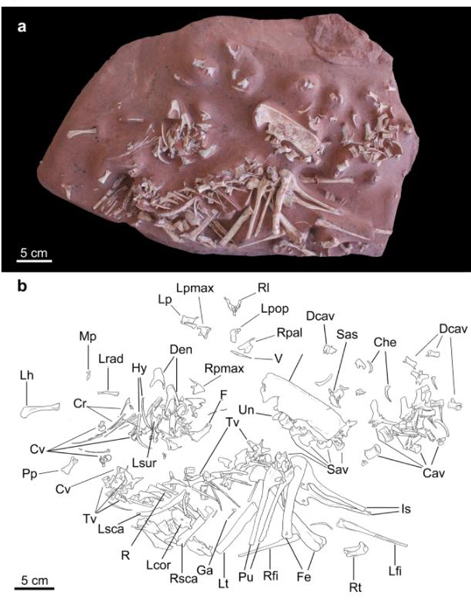
Berthasaura fossil and line drawing
The holotype fossil of Berthasaura leopoldinae (MN 7821-V) which represents a disarticulated but nearly complete skeleton (A) and an interpretative line drawing (B). Picture credit: de Souza et al.

A Juvenile Theropod Dinosaur

Careful analysis of the fossilised bones indicated that the skeleton represents a juvenile. Skull bones and parts of the spine showed signs of not being fused and therefore, the research team, who were led by Geovane Alves de Souza (Universidade Federal do Rio de Janeiro), concluded that Berthasaura, in contrast to Limusaurus, probably did not have any teeth, even as a young animal.

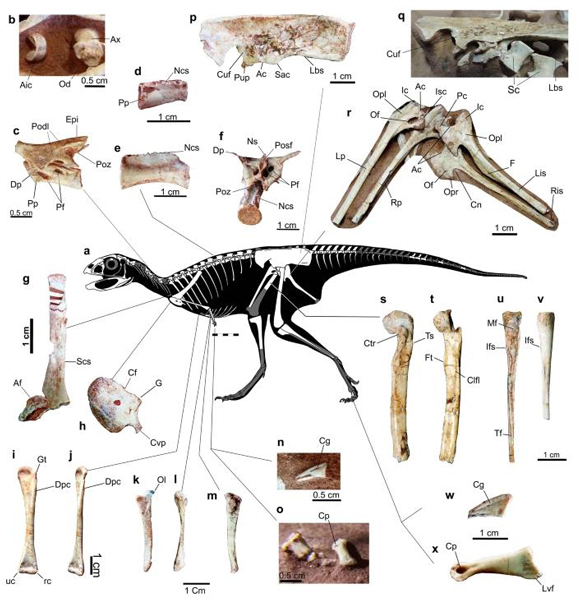
Examining the skeleton of Berthasaura.
Analysis of the fossil bones of Berthasaura. The fossil material represents a juvenile and is one of the most complete noasaurid skeletons described to date. Picture credit: de Souza et al.
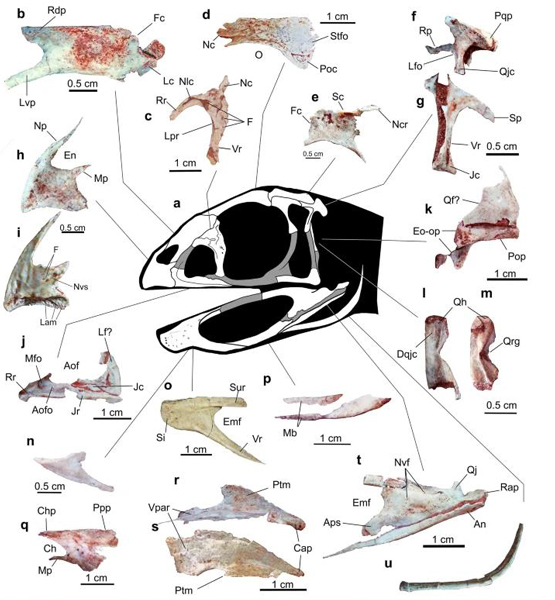
Berthasaura skull fossils and interpretative line drawing.
An interpretative drawing of the skull of Berthasaura showing the placement of individual bones. Picture credit: de Souza et al.

A Basal Member of the Noasauridae

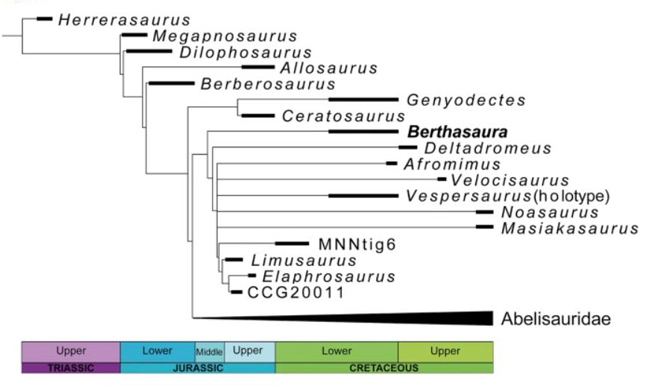
Taxonomic assessment of Berthasaura amongst the Noasauridae and within the wider Ceratosauria proved challenging for the research team. The lack of comparable noasaurid fossils limited the assessment that could be undertaken and it was difficult to conduct a phylogenetic assessment encompassing the Abelisauridae due to difficulties resolving taxonomic relationships between some poorly known abelisaurids. However, the scientists concluded that Berthasaura most likely represents a late, basal member of the Noasauridae and one that was not closely related to Limusaurus.

Phylogenetic relationship of Berthasaura leopoldinae.
Phylogenetic relationship of Berthasaura leopoldinae. Picture credit: de Souza et al.

To read Everything Dinosaur’s blog post about the discovery of Keresdrakon vilsoni * from 2019: New Brazilian Pterosaur Announced.

To read Everything Dinosaur’s blog post about Caiuajara dobruskii ** from 2014: New Species of Flying Reptile Identified from Pterosaur Graveyard.

Research that suggests Limusaurus lost its teeth as it grew up *** from 2016: Limusaurus – Dinosaur Species Lost its Teeth.

The scientific paper: “The first edentulous ceratosaur from South America” by Geovane Alves de Souza, Marina Bento Soares, Luiz Carlos Weinschütz, Everton Wilner, Ricardo Tadeu Lopes, Olga Maria Oliveira de Araújo and Alexander Wilhelm Armin Kellner published in Nature.

16 11, 2021

Defining Foliodont Teeth Some Helpful Information

By |2024-05-12T07:01:11+01:00November 16th, 2021|Categories: Adobe CS5, Dinosaur Fans, Main Page, Palaeontological articles, Photos/Pictures of Fossils|0 Comments

One of the terms that you might come across when reading about different types of dinosaur dentition (their teeth) is the term foliodont. Foliodont is from the Latin and it translates as “leaf tooth”, the term is used to describe teeth that have a leaf-shaped crown. For example, armoured dinosaurs (Thyreophora), have leaf-shaped teeth.

The diagram below, shows typical stegosaur teeth (A and B) and typical ankylosaur teeth (C, D) from Maidment et al (2008).

Examples of Thyreophoran teeth (stegosaur and ankylosaur)
Examples of thyreophoran teeth. Teeth of stegosaurs (A, B) and ankylosaurs (C, D) showing typical foliodont characteristics. The leaf-shaped teeth come from (A) Paranthodon, an Early Cretaceous stegosaur from South Africa, whilst B is from Stegosaurus armatus from the Morrison Formation of the western USA. The ankylosaur tooth (C) is from Sauropelta edwardsorum from the Cloverly Formation of the USA and (D) is from Edmontonia rugosidens from the Upper Cretaceous deposits of the Horseshoe Canyon Formation (Canada). Scale bar for (A, B) equals 0.5 cm, whilst scale bar for (C, D) equal 1 cm. Picture credit: Maidment et al.
Small stegosaur tooth from the dentary.
Small, relatively unworn tooth of an indeterminate stegosaur from the Teete locality in (A) occlusal, (B) labial and (C) lingual views. These teeth in labial and lingual view can be described as foliodont. Picture credit: Skutschas et al

Beware of Wear

Unfortunately, perfectly preserved and entire teeth are exceptionally rare. Worn, broken teeth are much more common, either as a result of the shedding of teeth when the thyreophoran was alive or as a result of distortion during the fossilisation process (taphonomy). This can lead to difficulties when trying to assign isolated teeth fossils to a particular family or genus.

Whilst general characteristics of tooth morphology can be discerned from a fragmentary, partial specimen and some idea of diet can be surmised, identifying the taxon represented is extremely difficult.

For example, worn teeth discovered in the Arctic circle indicate that stegosaurs were present in Siberia during the Early Cretaceous, at what was a high palaeolatitude, but in the absence of more substantial fossil material little more about the dinosaurs present can be discerned.

To read our blog post about Arctic stegosaurs: Studying Stegosaurs that Lived in the Arctic Circle.

15 11, 2021

A New Species of Sauropodomorph Called Issi saaneq – “Cold Bone” from Greenland

By |2024-05-12T07:01:47+01:00November 15th, 2021|Categories: Adobe CS5, Dinosaur and Prehistoric Animal News Stories, Dinosaur Fans, Main Page, Palaeontological articles, Photos/Pictures of Fossils|0 Comments

This month has seen another new species of sauropodomorph named and described. Issi saaneq (pronounced is-y sa-ah-neq), roamed what is now eastern Greenland around 214 million years ago (Late Triassic), this new dinosaur has been named based on two fossil skulls believed to represent one juvenile and one older animal possibly a sub-adult. Ascribed to the Plateosauridae family and showing affinities to South American sauropodomorphs I. saaneq helps to extend our understanding of the evolution and development of these important early dinosaurs.

Computer generated models of skulls and a life reconstruction of Issi saaneq.
A image showing digital interpretative reconstruction of the skulls NHMD 164741 and NHMD 164758 and living representation of Issi saaneq. A digital interpretative reconstruction of the skull NHMD 164741 in left lateral view (A). Digital interpretative reconstruction of the smaller skull NHMD 164758 in left lateral view (B). Digital interpretative reconstruction of skull NHMD 164741 in dorsal view (C). Living representation of Issi saaneq (D). Scale bar = 50 mm.

Originally Assigned to Plateosaurus

The skull fossils were found in the early 1990s, during excavations of sediments representing lake shore deposits that make up part of the of the Malmros Klint Formation in Jameson Land, Greenland. The larger skull was found in 1991, the smaller skull, now believed to represent the same species was found subsequently along with numerous other fossils including skull material that has yet to be catalogued and described.

The two skulls (specimen numbers NHMD 164741 and NHMD 164758), are now part of the vertebrate fossil collection of the Natural History Museum of Denmark. Postcranial material was also found in association with the smaller skull (NHMD 164758) and this could have come from the same animal, but these bones have also not yet been examined in detail.

When first found, it was thought that these fossils were examples of Plateosaurus (P. engelhardt which is now regarded as nomen dubium with fossil material assigned to P. trossingensis). As several new sauropodomorphs had been described in recent years, the researchers were able to tap into the wealth of new fossil data and confidently assign the skulls to a new genus.

Commenting on the significance of the find, lead author of the scientific paper, published in the journal “Diversity”, Doctor Victor Beccari (Universidade Nova de Lisboa), stated:

“The anatomy of the two skulls is unique in many respects, for example in the shape and proportions of the bones. These specimens certainly belong to a new species.”

Photograph of the skulls NHMD 164741 and NHMD 164758
Photograph of the skulls NHMD 164741 and NHMD 164758 (A) NHMD 164741 in left lateral view and (B) NHMD 164758 in left lateral view. The smaller skull (NHMD 164758) represents a juvenile, whilst the larger skull (NHMD 164741) represents an older juvenile or a young adult. Picture credit: Beccari et al.

“Cold Bone” – Issi saaneq

Issi saaneq is the first non-avian dinosaur to be named from fossils found in Greenland. The name comes from the local Inuit language, with “issi” meaning cold and “saaneq” meaning bone. This is a reference to the harsh and very unpleasant weather conditions associated with the fossil site. The bones of this dinosaur were cold to the touch and the field team were often “frozen to the bone” as they worked in the extremely chilly conditions.

Jameson Land and the Issi saaneq fossil site
Location map of Jameson Land, central east Greenland (A), the Issi saaneq quarry is circled in red and indicated by the number 2. Photograph of the outcrop from which the fossil material was excavated (B). The conditions endured by the various field teams were extremely challenging and harsh.

Affinities with South American Sauropodomorphs as well as Plateosaurus

Phylogenetic assessment indicates that Issi saaneq has affinities to Brazilian plateosaurids such as Macrocollum (M. itaquii) and the European Plateosaurus, being recovered as the sister clade of Plateosaurus in this study. It is the northernmost record of a Late Triassic sauropodomorph.

To read Everything Dinosaur’s blog post about the naming and scientific description of Macrocollum itaquii: How Did Some Dinosaurs Get Long Necks?

The discovery of Issi saaneq expands the known geographical range of these dinosaurs and broadens our knowledge about the evolution of the Sauropodomorpha.

The scientific paper: “A New Sauropodomorph Dinosaur from the Late Triassic (Norian) of Jameson Land, Central East Greenland” by Victor Beccari, Octávio Mateus, Oliver Wings, Jesper Milàn and Lars B. Clemmensen published in Diversity.

11 11, 2021

New Iguanodontid from the Isle of Wight

By |2024-08-26T16:05:43+01:00November 11th, 2021|Categories: Adobe CS5, Dinosaur Fans, Main Page, Palaeontological articles, Photos/Pictures of Fossils|0 Comments

Hot on the heels of the announcement of two new spinosaurids* from the Isle of Wight, a scientific paper has been published today (11th November 2021), that announces the discovery of a new genus of iguanodontid from the same stretch of coastline on the island.

The dinosaur has been named Brighstoneus simmondsi and it suggests that there are probably several different iguanodontids still awaiting discovery in the Wealden Group strata. The genus Iguanodon had been regarded as a taxonomic waste basket, extensive revision has taken place and several new genera have been erected, but in general terms, Wealden Group iguanodontian fossil material was classed into the gracile, lightly built Mantellisaurus (M. atherfieldensis) and more robust fossil bones usually classified as Iguanodon (I. bernissartensis), although other genera such as Barilium dawsoni and Hypselospinus fittoni are also known from southern England.

Analysis of fossils originally found near the village of Brighstone on the Isle of Wight in 1978 have proved sufficiently different from other iguanodontid fossil material to warrant the establishment of a new genus.

Brighstoneus (top) compared to Mantellisaurus (bottom).
Brighstoneus (top) with its more bulbous snout compared to Mantellisaurus (below). Picture credit: John Sibbick.

A Collaboration between the London Natural History Museum and the University of Portsmouth

Writing in the academic publication the Journal of Systematic Palaeontology, researchers from the London Natural History Museum in collaboration with the University of Portsmouth describe this new species of ornithopod and highlight the unique anatomical traits that merited the erection of a new dinosaur genus. An assessment of the dentition, including a count of the teeth present in the jaws indicated that these fossils represented something new. Careful analysis of the nasal bone by Dr Jeremy Lockwood (University of Portsmouth) and one of the authors of the scientific paper, revealed that Brighstoneus probably had a prominent, bulbous snout.

Brighstoneus simmondsi nasal and maxilla with skull drawing
The nasal and maxilla bones of Brighstoneus simmondsi with accompanying line drawings. The shape of the nasal bone suggests that this iguanodontid had a bulbous snout. Picture credit: Dr Jeremy Lockwood.

Explaining why the fossils represent a new dinosaur species, Dr Jeremy Lockwood stated:

“For me, the number of teeth was a sign. Mantellisaurus [M. atherfieldensis] has 23 or 24, but this has 28. It also had a bulbous nose, whereas the other species have very straight noses. Altogether, these and other small differences made it very obviously a new species.”

Honouring Brighstone Village and the Finder of the Fossils

Estimated to have measured around 8 metres in length and weighing around 900 kilograms, Brighstoneus simmondsi can be regarded as a mid-sized iguanodontid. The genus name honours the village of Brighstone, close to where the fossils were found and the species name is in tribute to Mr Keith Simmonds who found the fossils back in 1978.

Brighstoneus model
The CollectA drinking Mantellisaurus modified to resemble Brighstoneus simmondsi with its more bulbous snout.

The discovery of this new species following a reassessment of previously described fossil material suggests that there were far more iguanodontian dinosaurs in the Early Cretaceous of the UK than previously thought, and that simply assigning specimens from this period to either Iguanodon or Mantellisaurus is over simplified.

Dr Lockwood added:

“We’re looking at six, maybe seven million years of deposits, and I think the genus lengths have been overestimated in the past. If that’s the case on the island, we could be seeing many more new species. It seems so unlikely to just have two animals being exactly the same for millions of years without change.”

Co-author of the paper, Dr Susannah Maidment (London Natural History Museum), stated:

“The describing of this new species shows that there is clearly a greater diversity of iguanodontian dinosaurs in the Early Cretaceous of the UK than previously realised. It’s also showing that the century-old paradigm that gracile iguanodontian bones found on the island belong to Mantellisaurus and large elements belong to Iguanodon can no longer be substantiated.”

Fossil Bones Showing Unusual Pathology

A dorsal bone, which Everything Dinosaur team members believe was previously ascribed to Mantellisaurus but now assigned to this new genus shows some unusual pathology. The top of the neural spine is deformed and twisted over. It is not known how this trauma occurred but analysis of the bone surrounding the injury suggests that this dinosaur lived for some time after this injury took place.

B. simmondsi dorsal vertebra showing pathology.
Brighstoneus simmondsi dorsal vertebra showing pathology on the neural spine. Picture credit: Dr Jeremy Lockwood.

Highlighting the significance of the Isle of Wight in terms of vertebrate palaeontology, Dr Lockwood commented that there were probably many more dinosaur discoveries going to be made in southern England.

To read Everything Dinosaur’s recent blog post about the naming of two new Isle of Wight spinosaurids*: Two New Spinosaurids from the Isle of Wight.

Compton Bay (Isle of Wight)
Dr Jeremy Lockwood walking along the beach at Compton Bay. Picture credit: Dr Jeremy Lockwood.

The scientific paper: “A new hadrosauriform dinosaur from the Wessex Formation, Wealden Group (Early Cretaceous), of the Isle of Wight, Southern England” is published in the Journal of Systematic Palaeontology.

Go to Top