All about dinosaurs, fossils and prehistoric animals by Everything Dinosaur team members.

Fossil finds, new dinosaur discoveries, news and views from the world of palaeontology and other Earth sciences.

1 02, 2017

More Amazing Dinosaur Proteins Found

By |2024-05-07T13:38:33+01:00February 1st, 2017|Categories: Dinosaur and Prehistoric Animal News Stories, Dinosaur Fans, Main Page|0 Comments

Evidence of Preserved Collagen in the Early Jurassic Dinosaur Lufengosaurus

Just days after writing about a scientific paper published in the academic publication “The Journal of Proteome Research”, which confirmed the presence of collagen in the fossilised bones of an 80-million-year-old duck-billed dinosaur, then a second paper comes along reporting evidence of preserved collagen in a much older dinosaur, a Lufengosaurus, a herbivore that roamed Asia back in the Early Jurassic.

Studying the Rib Bone of a Lufengosaurus

Lufengosaurus – a Sauropodomorph from the Early Jurassic

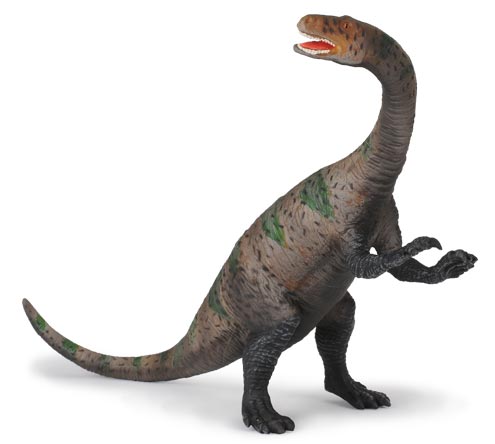
The CollectA Lufengosaurus dinosaur model.

The CollectA Lufengosaurus model.

Picture credit: Everything Dinosaur

The picture (above) shows a replica of Lufengosaurus from the CollectA Prehistoric Life range.

To view this range: CollectA Age of Dinosaurs Popular Prehistoric Life Models.

Preserved Proteins

Writing in the journal “Nature Communications”, researchers from the National Central University of Taiwan, the National Synchrotron Radiation Research Centre (Taiwan) and in collaboration with palaeontologist Robert Reisz (Dept. of Biology, University of Toronto Mississauga, Ontario, Canada) report on the discovery of protein preservation in a terrestrial vertebrate found inside the vascular canals of a rib of a 195-million-year-old sauropodomorph dinosaur, where blood vessels and nerves would normally have been present in the living reptile.

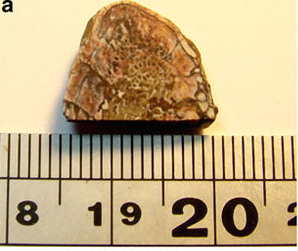
The Lufengosaurus Rib Bone that was Used in the Research

Lufengosaurus rib fragment.

A fragment of Lufengosaurus rib bone prior to collagen study.

Picture credit: Nature Communications

Evidence of Organic Traces

Evidence of peptides and amino acids have been found before in dinosaur bones, even evidence of dinosaur blood and red blood cells, although a lot of this research remains controversial.  What is significant about this study, is that the vast majority of the organic traces found within the Dinosauria fossil record relate to bones of animals that lived during the Late Cretaceous.   In this new paper, the scientists report evidence of proteins that make up collagen in a fossil rib bone from a dinosaur that lived some 195 million years ago.

Palaeontologist Dr Robert Reisz, heralded the significance of this research, which used a synchrotron to analyse the mineral content of a cross-section of rib bone, he stated:

“We hope to be able to learn more about the biology of these animals and the more we know about their soft tissues the more we will know about them overall.  We are actually looking at the preservation of the original materials that were in the living organism rather than an impression of the soft tissues that were there.”

Blood from a Lufengosaurus?

The synchrotron permitted the team to examine the infrared spectroscopy of tiny fragments of the rib bone.  Signatures of proteins typical of collagen were picked up along with iron-rich proteins found within the walls of microscopic blood vessels located deep with the rib (specimen number CXPM Z4644).

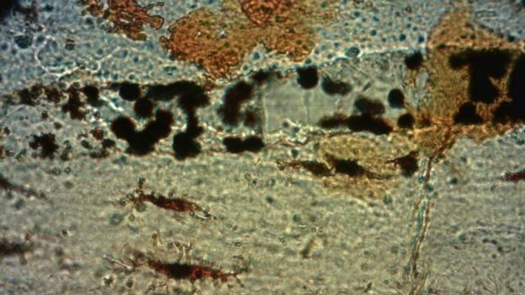
A Highly-magnified Section of the Rib Showing a Vascular Canal with Potential Dinosaur Blood Remnants

Evidence of dinosaur blood?

Rib section with vascular canal associated with dark iron rich particles that probably constitute preserved elements of dinosaur blood.

Picture credit: Dr Reisz (University of Toronto Mississauga)

The image above shows a rib section with vascular canal associated with dark iron rich particles (haematite) that probably constitute preserved elements of dinosaur blood.

To read Everything Dinosaur’s recently published article about duck-billed dinosaur collagen: Researchers Confirm Duck-billed Dinosaur Collagen.

This new study may not represent the oldest traces of reptile proteins found in the fossilised remains of Mesozoic creatures.  In 2016, Everything Dinosaur reported on evidence of blood vessels and proteins having been identified within the fossilised bones of some Triassic marine reptiles, to read about this: Spectroscopic Studies on Organic Matter from Triassic Reptiles.

The scientific paper detailing the Lufengosaurus research: “Evidence of preserved collagen in an Early Jurassic sauropodomorph dinosaur revealed by synchrotron FTIR microspectroscopy”, published in the journal “Nature Communications”.

Visit the website of Everything Dinosaur: Everything Dinosaur.

31 01, 2017

New South African Permian Dicynodont Described

By |2023-05-15T07:35:40+01:00January 31st, 2017|Categories: Dinosaur and Prehistoric Animal News Stories, Dinosaur Fans, Main Page|0 Comments

Dicynodont with a Big, Bulbous Nose – Bulbasaurus phylloxyron

The Karoo Basin of South Africa is famous for its Permian fossils.  The rocks exposed in this part of the world, trace the geology of what was to become known as the super-continent of Gondwana, from the Late Carboniferous through into the Early Jurassic.  It is the abundance of Permian-aged tetrapod fossils from the Beaufort Group of strata and its rock formations that have provided palaeontologists with a great deal of information about terrestrial life before the rise of the dinosaurs.

Researchers from the Museum für Naturkunde Berlin and the University of Witwatersrand have announced the discovery of a bizarre-looking new type of dicynodont, this critter may have been quite small, but it did have large tusks and strange, rough boss on its nose.

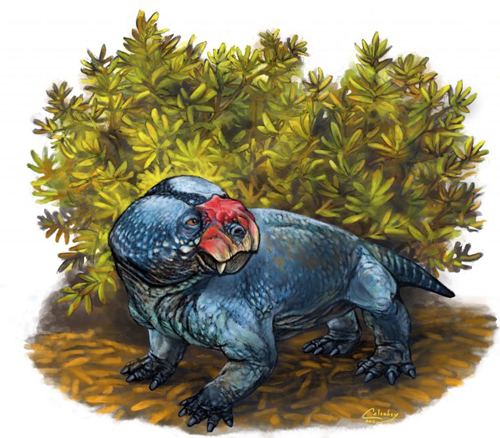
An Illustration of the Newly Described Late Permian Dicynodont Bulbasaurus phylloxyron

Bulbasaurus illustrated.

A drawing of the new Late Permian Dicynodont Bulbasaurus.

Picture credit: Matt Celeskey

Bulbasaurus phylloxyron

Described from skull material that was discovered preserved in 1.5 metre-deep mudstone, it is thought the head of this reptile was transported by a flood event before coming to rest in the mud.  Over millions of years the mud became rock, preserving the skull and some of the teeth, including evidence of an impressive pair of tusks (located in the upper jaw).

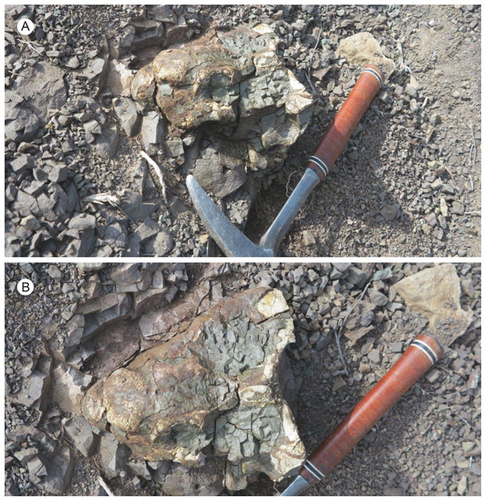
Photographs of the Holotype Skull Material in Situ (SAM-PK-K11235)

Bulbasaurus skull fossil.

The skull of Bulbasaurus photographed by a member of the field team.

Picture credit: Peer J

The photograph above shows two views of the holotype material (SAM-PK-K11235) taken from the excavation site.  Picture (A) shows the skull in left lateral view, whilst (B) shows the dorsal view.  The geological hammer provides scale.

A Bizarre Permian Dicynodont

The fossil material was discovered at Driekoppe, Vredelus, Fraserburg, Western Cape Province, by Dr Roger Smith (University of Witwatersrand), it was during a visit to view the collection of Permian fossils that dicynodont specialist Dr Christian Kammerer (Museum für Naturkunde Berlin), noted the skull showed a number of unusual features, most of which are associated with much younger types of Dicynodontians.  Further study led to the establishment of a new species (B. phylloxyron).  The genus name means “bulbous nose”, a reference to the large and roughened boss located on the naris bone.

c

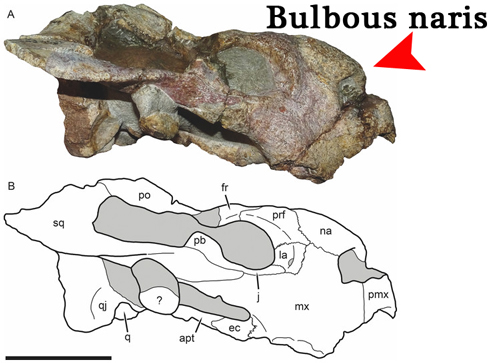
A view of the skull and line drawing of the Late Permian Dicynodont Bulbasaurus.

Left lateral view and line drawing of the skull of Bulbasaurus.

Picture credit: PeerJ with annotation by Everything Dinosaur

The picture above shows a photograph of the sixteen-centimetre-long skull and an accompanying line drawing.  The large, bulbous area of the naris (from which this animal has been named), is highlighted.

Key

sq = squamosal, qj =quadratojugal, apt = anterior pterygoid ramus, ec = ectopterygoid, fr = frontal, la = lacrimal, mx = maxilla, na = nasal, pmx = premaxilla, pb = base of postorbital bar, po = postorbital, prf= prefrontal and ? indicates an unidentified bone.  The area shaded grey in the line drawing represents matrix.

For models and replicas of prehistoric animals including Permian creatures: CollectA Deluxe Scale Prehistoric Animal Models.

A Significant Permian Fossil Discovery

Bulbasaurus was found in rocks that have been dated to the early Lopingian Epoch of the Late Permian.  It lived around 259 million years ago.  The fossils are significant as Bulbasaurus is the oldest known member of a family of dicynodonts known as the Geikiidae.  Its discovery helps to fill in a gap in the early fossil record of this important group.

The scientific paper: “An early geikiid dicynodont from the Tropidostoma Assemblage Zone (late Permian) of South Africa”, published in the journal PeerJ.

Visit the award-winning, user-friendly Everything Dinosaur website: Everything Dinosaur.

30 01, 2017

Unravelling the Origin of the Deuterostomes

By |2023-05-15T06:15:55+01:00January 30th, 2017|Categories: Dinosaur and Prehistoric Animal News Stories, Dinosaur Fans, Main Page|0 Comments

Saccorhytus coronarious – Our Earliest Ancestor?

It might resemble that green, slimy ghost/monster out of the movie Ghostbusters, but this tiny sack-like creature with a huge mouth (and no obvious signs of an anus), might just be our earliest ancestor.  Scientists writing in the journal “Nature” report on the discovery of Saccorhytus coronarious a tiny organism less than one millimetre in diameter that could represent the oldest “deuterostome” yet discovered.  Deuterostomes are divided into three major clades, one of which is the Chordata, that’s the vertebrates which includes us!  This animal could represent your earliest known ancestor!

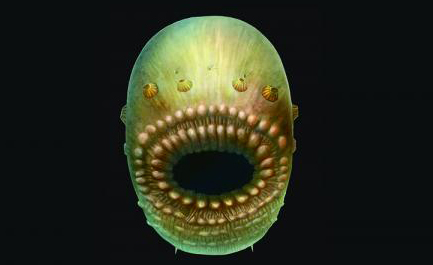
An Illustration of the Minute Saccorhytus coronarious – Our Earliest Ancestor?

Saccorhytus Illustration

An illustration of the earliest known deuterostome – Saccorhytus.

Picture credit: Cambridge University

Deuterostomes

Within the Animal Kingdom (Animalia), the complex organisms, (more complex than jellyfish with their radial symmetry), are split into two main groups namely:

  1. Deuterostomia – bilateral symmetry mainly, with only the echinoderms showing radial symmetry, this group includes all the Chordata, plus the Hemichordata – acorn worms and the extinct graptolites and the Echinodermata star fish, sea urchins etc.
  2. Protostomia – bilateral symmetry including the molluscs, arthropods, nematodes and worms.

These lineages are believed to share a common ancestor that lived during the Ediacaran geological period.  The hunt has been on to find this common ancestor, and Saccorhytus is the best candidate discovered to date.  Firstly, it is the most primitive example of a deuterostome yet discovered and it is the oldest, having been discovered in rocks laid down some 540 million-years-ago (Fortunian Stage of the Lower Cambrian).

Saccorhytus coronarious

The micro-fossils were discovered in rocks in Shaanxi Province, (central China) and when it comes to identifying vertebrate features, that is a bit tricky, despite the remarkable degree of preservation.

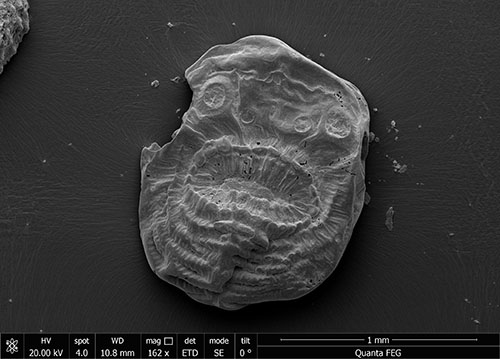
A Highly-Magnified Image Showing the Micro-fossil (S. coronarious)

Saccorhytus image.

A highly-magnified image of Saccorhytus.

Picture credit: Jian Han

The body is bag-like and has a huge, mouth located in the centre (the oval shaped object in the central part of the organism).  It has four conical openings on either side of the body, that may well have served as outlets to allow sea water that had passed into the body to be ejected.  It has been suggested that these simple openings could provide an insight into the origin and development of gills.

The Mouth of Saccorhytus coronarious Probably Served Two Functions

The mouth probably served two functions, as the researchers have not been able to detect the presence of an anus.  What entered into the mouth, once nutrients had been extracted, was ejected out of the mouth.  The organism does show bilateral symmetry, however, a trait that was passed onto all the vertebrates.

Living in the Sand

Saccorhytus could have easily sat on the head of a pin.  It probably lived between grains of sand on the seabed, wriggling its way through them, perhaps it was an active predator, perhaps it fed on waste or other detritus.  The study was carried out by an international team of academics, including researchers from the University of Cambridge in the UK and North-west University in Xian China, with support from other colleagues at institutions in China and Germany.

Simon Conway Morris, Professor of Evolutionary Palaeobiology and a Fellow of St John’s College, University of Cambridge, one of the co-authors of the study, commented:

“We think that as an early deuterostome this may represent the primitive beginnings of a very diverse range of species, including ourselves.  To the naked eye, the fossils we studied look like tiny black grains, but under the microscope the level of detail is jaw-dropping.  All deuterostomes had a common ancestor, and we think that is what we are looking at here.”

Fossils Show a Wide Degree of Diversity and Variety

Most of the very early deuterostome groups are known from fossils that date from between 510-520 million years ago, but these fossils already show a wide degree of diversity and variety so, if they did share a common ancestor, it probably lived much earlier. What the common ancestor might have looked like has also been extremely difficult to work out, given the level of diversity and variety already found in the fossil record from 510-520 million years ago.

The scientific paper: “Meiofaunal deuterostomes from the basal Cambrian of Shaanxi (China)”, published in the journal “Nature”.

Visit the Everything Dinosaur website: Everything Dinosaur.

29 01, 2017

Researchers in New Study Confirm Dinosaur Collagen

By |2024-05-07T13:02:22+01:00January 29th, 2017|Categories: Dinosaur and Prehistoric Animal News Stories, Dinosaur Fans, Main Page, Palaeontological articles|0 Comments

2009 Brachylophosaurus Study Replicated

One of the most controversial areas of palaeontology is the extraction and assessment of traces of organic remains preserved in the fossil record.  Indeed, the study of preserved proteins and other organic remains such as potential red blood cells from within fossils tens of millions of years old, is perhaps, one of the most controversial subjects in the whole of science.

Researchers from North Carolina State University, eminent figures such as Professor Mary Schweitzer have been at the very forefront of this relatively new area of study, essentially long extinct animal molecular biology.  Organic material from fossils of dinosaurs is being reported more frequently, however, being able to repeat analyses and confirm previous results remains fundamental to the results of such studies gaining acceptance in the wider scientific community.

Studying Dinosaur Fossil Bone

A new paper has been published in the “Journal of Proteome Research” by scientists from North Carolina State University who, in collaboration with colleagues from North-western University and the University of Texas – Austin, have applied the most rigorous testing methods used to date to isolate additional collagen peptides from an 80-million-year-old dinosaur thigh bone.  This study helps strengthen the idea that organic molecules can persist within the fossil record for many millions of years.

Repeating an experiment and replicating previous results has implications for our ability to study the fossils of long extinct creatures at the molecular level.  The job of “dinosaur biologist” may have come one step closer.

The Brachylophosaurus (B. canadensis) Femur
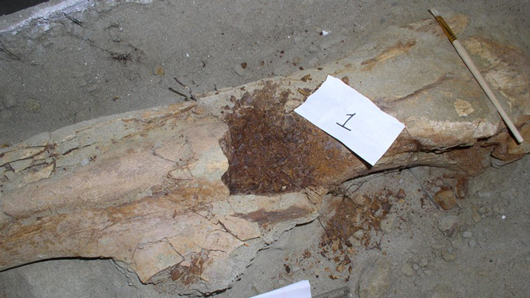
Brachylophosaurus femur.

MOR 2598 the Brachylophosaurus femur in its field jacket prior to the peptide study.

Picture credit: North Carolina State University

Dinosaur Femur Used in the Study

The picture above shows the dinosaur thigh bone used in the study.  The area for sampling has been marked on the bone, demonstrating that not everything within this cutting-edge form of palaeontology is that sophisticated.

North Carolina State postdoctoral researcher Elena Schroeter, along with Professor Mary Schweitzer and co-worker Wenxia Zheng wanted to confirm the results of an earlier (2009) assessment of organic material retrieved from the femur of a duck-billed dinosaur (Brachylophosaurus canadensis).  Advances in mass spectrometry and clean room technology since the first experiments, would permit the team to produce a more robust set of results, with less risk of contamination or false “positive” results.

Explaining the team’s reasoning for repeating the 2009 study, Elena Schroeter stated:

“Mass spectrometry technology and protein databases have improved since the first findings were published, and we wanted to not only address questions concerning the original findings, but also demonstrate that it is possible to repeatedly obtain informative peptide sequences from ancient fossils.”

The Hunt for Collagen

Collagen is a protein, it forms fibrous strands and, ironically it happens to be the most abundant protein found in our own bodies.  The proteins that make up collagen are themselves composed of peptides, which are chains made up of amino acids.  If peptides can be identified within a dinosaur bone (or any fossil bone for that matter), palaeontologists will be able to determine the evolutionary relationships between members of the Dinosauria and their relationship with extant animals.

This would help solve such puzzles as whether or not the dinosaurs were warm-blooded and provide much more information about the lives of these long extinct animals, far more information than could be derived from an anatomical analysis of preserved bones and teeth.  In addition, this type of study would help to answer other intriguing questions. related to the fossilisation process itself.  For example, which characteristics of collagen proteins permit preservation over deep geological time?

Brachylophosaurus canadensis

Brachylophosaurus was a member of the Hadrosauridae family of bird-hipped dinosaurs (ornithischians) and it is known from relatively abundant (bonebed) fossil material excavated from Upper Cretaceous deposits of North America (Judith River Formation of Montana, USA and the contemporaneous Oldman Formation of Alberta, Canada).  This herbivorous dinosaur lived some 80-78 million years ago, (Campanian faunal stage of the Late Cretaceous).  It was formally named and scientifically described in 1953.

The Late Cretaceous Duck-billed Dinosaur Brachylophosaurus canadensis
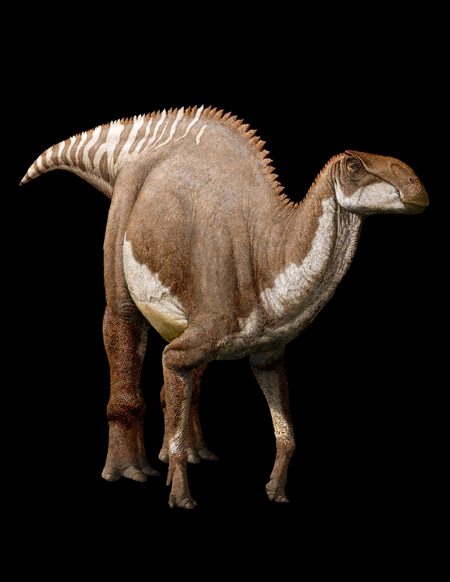
The Late Cretaceous Brachylophosaurus.

Brachylophosaurus illustrated.

Picture credit: Houston Museum of Natural Science

For models and replicas of hadrosaurs and other ornithischian dinosaurs: CollectA Prehistoric Life Figures.

Professor Schweitzer commented:

“We collected B. canadensis with molecular investigation in mind.  We left a full metre of sediment around the fossil, used no glues or preservatives and only exposed the bone in a clean, or aseptic environment. The mass spectrometer that we used was cleared of contaminants prior to running the sample as well.”

Specimen Number MOR 2598

The sample of bone that was analysed was from the specimen’s femur (thigh bone).  The bone used was specimen number MOR 2598.  Using mass spectrometry, the team recovered a total of eight peptide sequences that form collagen (collagen I).  Two peptide sequences were identical to those recovered in the 2009 research, six are new, not having been found in previous studies.  The peptide sequences show that the collagen in a dinosaur (B. canadensis) has affinities with extant Aves (birds) and crocodylians, a result expected given the close phylogeny between the Dinosauria and these two groups.

Elena Schroeter added:

“We are confident that the results we obtained are not contamination and that this collagen is original to the specimen.  Not only did we replicate part of the 2009 results, thanks to improved methods and technology, we did it with a smaller sample and over a shorter period of time.”

Phylogenetic Affinity

Phylogenetic analyses place the recovered sequences within basal Archosauria and when only the six new sequences are considered, B. canadensis is grouped more closely to crocodylians.  However, when all sequences (current and those reported in 2009), are analysed, B. canadensis is placed more closely to stem Aves.  The researchers conclude that their data robustly supports the hypothesis of an endogenous origin for these peptides, (they originated from within the organism’s bone), confirming the idea that peptides can survive in specimens tens of millions of years old, and being able to repeat the experiment and obtain the same results bolsters the validity of the earlier (2009) study.

Professor Schweitzer, a stalwart for organic molecular research in the fossil record explained:

“Our purpose here is to build a solid scientific foundation for other scientists to use to ask larger questions of the fossil record.  We’ve shown that it is possible for these molecules to preserve.  Now, we can ask questions that go beyond dinosaur characteristics.  For example, other researchers in other disciplines may find that asking why they preserve is important.”

Testing a Hypothesis

Although this research remains controversial, there is a growing body of evidence that suggests the minute traces of organic matter can be preserved within the fossil record.  In order for this research to gain wider acceptance it must be shown that peptide sequences can be reliably obtained from fossil material and that these experiments can be repeated with the same outcomes.  Intriguingly, as our ability to identify organic molecules improves, so these highly fragmentary sequences for ancient proteins can be increasingly expanded.

To test the hypothesis that peptides can be repeatedly detected and validated from fossil tissues many millions of years old, the research team applied updated and more sophisticated extraction methodology, in conjunction with improved sterile, clean-room conditions.

Eight Peptide Sequences Identified

High resolution mass spectrometry and bioinformatics analyses on a Brachylophosaurus canadensis specimen (MOR 2598), from which collagen I peptides were recovered in 2009, led to the identification of eight peptide sequences in the repeated experiment.  This new study further augments the idea that within fossilised elements, which, perhaps have been preserved under exceptional conditions, do indeed, contain minute organic remnants of long dead organisms.

To read a related article about the potential for finding blood remnants with dinosaur fossils: The Blood of a Brachylophosaurus.

The scientific paper: “Expansion of the Brachylophosaurus canadensis collagen I sequence and additional evidence for the preservation of Cretaceous protein”.

Authors: Elena Schroeter, Mary Schweitzer and Wenxia Zheng, NC State University; Caroline DeHart, Paul Thomas, Neil Kelleher, North-western University; Timothy Cleland, University of Texas-Austin; Marshall Bern, Protein Metrics.  Published: Journal of Proteome Research.

Visit Everything Dinosaur’s award-winning website: Everything Dinosaur.

28 01, 2017

Terrifying Pterosaurs Just Got More Terrible

By |2023-05-15T05:53:40+01:00January 28th, 2017|Categories: Dinosaur and Prehistoric Animal News Stories, Dinosaur Fans, Main Page|0 Comments

Robust Necks Indicate Apex Predator Niche

Amongst all the amazing genera that are now grouped into the Order Pterosauria, it is perhaps, the azhdarchids that are the most spectacular of all the pterosaurs.  When other types of flying reptile were in decline and heading towards extinction in the Late Cretaceous, the Azhdarchidae were still going strong.  Some of these Late Cretaceous azhdarchids, animals such as Quetzalcoatlus, Arambourgiania and Hatzegopteryx stood as tall as a giraffe and had wingspans the size of small aircraft.  These large wings, combined with their light bodies (even the very largest are estimated to have weighed no more than 225 kilogrammes), permitted these creatures to fly extremely long distances.

Studies of wing function and biomechanics indicate that some of the largest forms could have traversed continents and crossed the recently formed Atlantic Ocean with ease.

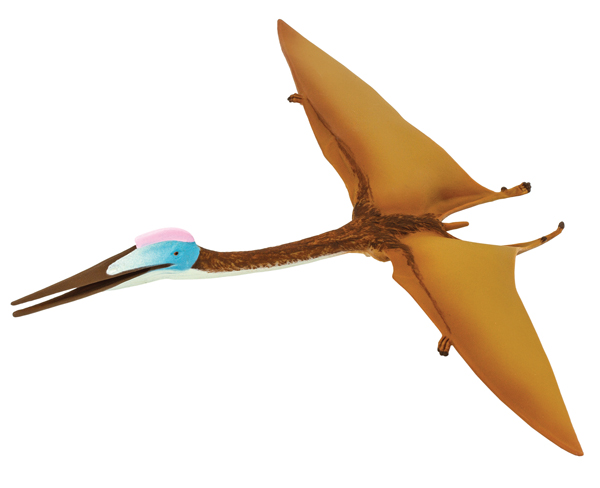
A Model of the Giant Late Cretaceous Azhdarchid Pterosaur Quetzalcoatlus (Q. northropi)

Quetzalcoatlus model.

A model of the giant Pterosaur Quetzalcoatlus.

Picture credit: Safari Ltd

The picture (above) shows a Quetzalcoatlus model from the range produced by Safari Ltd.

To view this range: Wild Safari Pterosaur and Dinosaur Models.

To read an article about the flight dynamics of giant Cretaceous pterosaurs: Cretaceous Runways – Flight Dynamics of Pterosaurs.

Which Niches within Ecosystems?

Our understanding of the Pterosauria has been much revised over the last three decades or so.  Recent fossil finds and new research on previously collected and catalogued material has provided a wealth of scientific information and a new paper written by the eminent British pterosaurologists Darren Naish (University of Southampton) and Mark Witton (University of Portsmouth), further supports the hypothesis that some super-sized pterosaurs occupied apex predator niches within Late Cretaceous ecosystems.

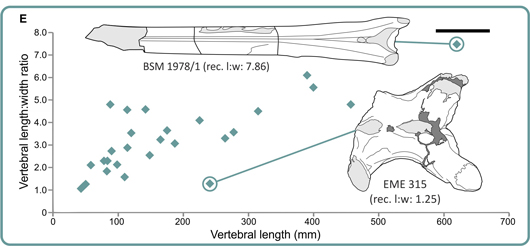
A study of two pterosaur neck bones (cervicals), including one giant, twenty-four-centimetre-long cervical suggests that the body proportions of azhdarchids may not have been as uniform as previously thought.

The researchers postulate that the enormous Hatzegopteryx had a proportionately shorter, more stocky neck that was very strong.

Pterosaurs with Strong Necks

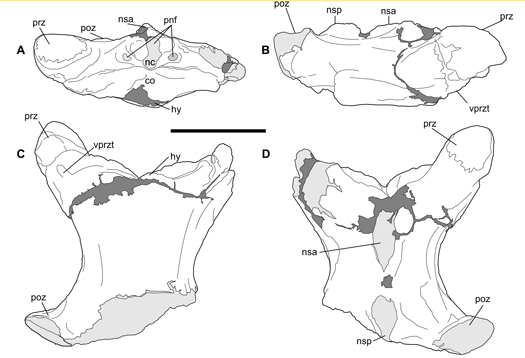
Line Drawings Showing Various Views of the Giant Azhdarchid Pterosaur Fossil (EME 315)

Giant Neck Bone of a Pterosaur (Hatzegopteryx).

Giant azhdarchid cervical vertebra referred to Hatzegopteryx sp. (A–D) line drawings of EME 315 in anterior (A) right lateral (B) ventral (C) and dorsal (D) views.

Picture credit: PeerJ

In the picture above, four views of the pterosaur neck bone are shown (A) viewed from the front, (B) viewed from the right, (C) viewed from underneath and (D) viewed from the top.  The lighter areas in the drawings indicate where damage to the bone has occurred, the darker shading indicates the presence of filler.  Scale bar equals ten centimetres.

A strong, powerful neck would have been resistant to the forces and stresses imposed upon it by a prey struggling in the pterosaur’s large beak.  The specimen (EME 315) is almost as wide as it is long and as it was excavated from the Maastrichtian Sebeş Formation of the Transylvanian Basin, (Romania), it has been assigned to the Hatzegopteryx genus, as Hatzegopteryx thambema fossil material is known from the adjacent and contemporaneous Densuş-Ciula Formation, of the northern Haţeg basin.

Thick, Robust Neck Bones Support the Idea of Pterosaurs Feeding on Dinosaurs

The scientists compared the dimensions of EME 315 (believed to be cervical VII, which is from the base of the neck, articulating with the first of the thoracic or dorsal vertebrae), to the neck bones from other azhdarchids and they argue that in the absence of large, terrestrial predators on the ancient island, known as Hateg, azhdarchids such as Hatzegopteryx occupied the role of top predators in the ecosystem.

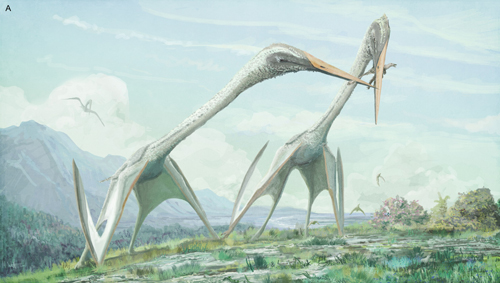
The Robust and Relatively Short Neck of Hatzegopteryx Helps this Pterosaur Overcome a Struggling Dinosaur

Powerful necked Hatzegopteryx feeds on a dinosaur.

Transylvanian giant azhdarchid pterosaur Hatzegopteryx sp. preys on the rhabdodontid iguanodontian Zalmoxes.

Picture credit: Mark Witton

Azhdarchid Pterosaurs Had Huge Skulls

Azhdarchids had proportionately bigger skulls than any other known terrestrial vertebrate.  Their size and these huge skulls, if related to a relatively, short but powerful neck would lend support to the idea that these creatures stalked smaller animals in the same way that extant Marabou storks (Leptoptilos crumenifer) do in Africa.  However, unlike the modern Marabou, which catches frogs, lizards, small mammals and fish, Hatzegopteryx would have been capable of swallowing whole a dinosaur the size of a Cocker Spaniel!

Hatchling dinosaurs would have been especially vulnerable to attack and with a number of dwarf dinosaur forms known from the Hateg Formation (Magyarosaurus), juveniles could have been predated upon also.

Giant Azhdarchid Neck Bone (EME 315) Compared to Arambourgiania Giant Cervical

Pterosaur cervical bone comparison.

The giant neck bone compared to the only other giant pterosaur cervical Arambourgiania.

Picture Credit: PeerJ

Cervicals Compared

Writing in the journal “PeerJ” the researchers compare the Hatzegopteryx cervical (cervical VII), with the only other giant azhdarchid neck bone known, a single cervical representing Arambourgiania philadelphia, from the Late Cretaceous of Jordan (see picture above).  The paucity of the fossil record restricts accurate size estimates for entire animals, but the cervical assigned to A. philadelphia, believed to represent cervical V is approximately seventy centimetres long.  Its morphology and proportions are very different from the Hatzegopteryx material (EME 315).  This suggests that there may be greater variation in the body proportions of the Azhdarchidae then previously thought.

Some members of the Azhdarchidae may have had shorter and stronger necks than other genera.  This leads to the tantalising idea that, giant pterosaurs did indeed occupy apex predatory roles in isolated island ecosystems such as Hateg, which was largely devoid of large, carnivorous theropods and that proportional differences between super-sized taxa may even hint at distinct feeding specialisms.

Late Cretaceous Jordan Two Arambourgiania Fight Over a Luckless Dinosaur

Azhdarchid pterosaurs feeding on dinosaurs.

Arambourgiania philadelphia (giant pterosaurs) squabble over a small Theropod dinosaur.

Picture credit: Mark Witton

Giant Pterosaur Scavengers?

If we reflect on the feeding habits of the Marabou stork, it is known to feast on carrion.  Few carnivores will turn up the offer of a free meal if they find a corpse to feed on.  It could be speculated that some of the more robust-necked azhdarchids may have specialised in scavenging the carcases of dinosaurs.

The absence of teeth in the jaws, may have inhibited these reptiles from being able to eviscerate a dead dinosaur, but this could have been compensated to some degree by having a strong, pointed beak and a powerful neck.  As well as being apex predators, some Late Cretaceous pterosaurs may have occupied an ecological role similar to today’s vultures.  Ironically, when Quetzalcoatlus northropi was first named and described back in 1975, several palaeontologists argued that this giant flying reptile filled a scavenger niche.

For an article which examines the role of Azhdarchid pterosaurs in ecosystems (based on research published in 2015): Understanding Azhdarchid Pterosaurs.

The article: “Naish D, Witton MP. (2017) Neck biomechanics indicate that giant Transylvanian azhdarchid pterosaurs were short-necked arch predators”.  PeerJ 5:e2908, (published in the online journal PeerJ).

To read the PeerJ article: Peer J Article.

Visit the Everything Dinosaur website: Everything Dinosaur.
27 01, 2017

The Oldest, Most Complete Iguanian of the Americas

By |2023-05-14T21:11:49+01:00January 27th, 2017|Categories: Dinosaur and Prehistoric Animal News Stories, Dinosaur Fans, Main Page, Photos/Pictures of Fossils|0 Comments

Magnuviator ovimonsensis from Egg Mountain

Palaeontologists picking through a bounty of fossils from Montana have discovered something very unexpected, a new species of lizard from that lived near to the end of the Age of Dinosaurs, whose closest relatives roamed in faraway Asia.

Magnuviator ovimonsensis

This ancient lizard, which lived 75 million years ago in a dinosaur nesting ground, is described in a paper published this week in the academic journal “The Proceedings of the Royal Society B”.  Named Magnuviator ovimonsensis, the new species fills in significant gaps in our understanding of how lizards evolved and spread during the Mesozoic, according to palaeontologists at the University of Washington and the Burke Museum of Natural History and Culture who led the research.

Postdoctoral research associate, David DeMar, lead author of the paper stated:

“It is incredibly rare to find one complete fossil skeleton from a relatively small creature like this lizard.  But, in fact, we had two specimens, both from the same site at Egg Mountain in Montana.”

Magnuviator is reshaping how scientists view lizards, their biodiversity and their role in complex ecosystems during the Cretaceous some seventy-five million-years-ago.

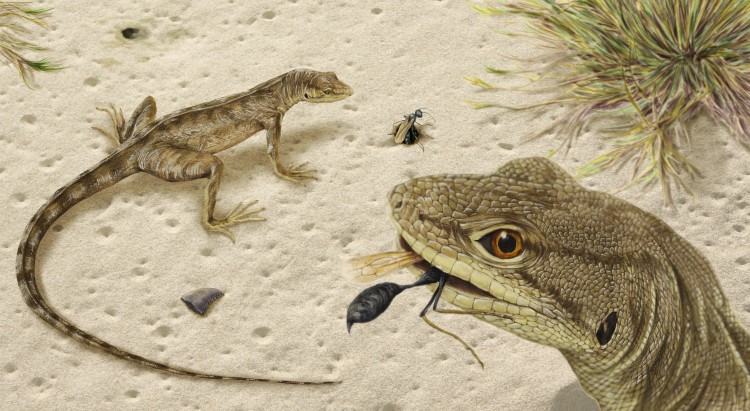
An Illustration of Magnuviator ovimonsensis

Magnuviator ovimonsensis illustrated.

An illustrated life reconstruction of Magnuviator ovimonsensis at the Egg Mountain site.

Picture credit: Misaki Ouchida

The picture above shows a pair of Magnuviator lizards at the Egg Mountain fossil site.   One Magnuviator eats a wasp, on the ground is a tooth from the bird-like, theropod dinosaur Troodon.  The arid-adapted plant is based on fossil pollen found near Egg Mountain.

An Ancient Lineage of Iguanian Lizards

Based on analyses of the nearly complete fossil skeletons, Magnuviator was an ancient offshoot of iguanian lizards.  The fossils are the oldest, most complete iguanian fossils from the Americas.  Today, iguanians include chameleons of the Old World, iguanas and anoles in the American tropics.  Based on its anatomy, Magnuviator was at best a distant relative of these modern lizard families, most of which did not arise until after the non-avian dinosaurs and quite a few lizards and other creatures became extinct some sixty-six million years ago.

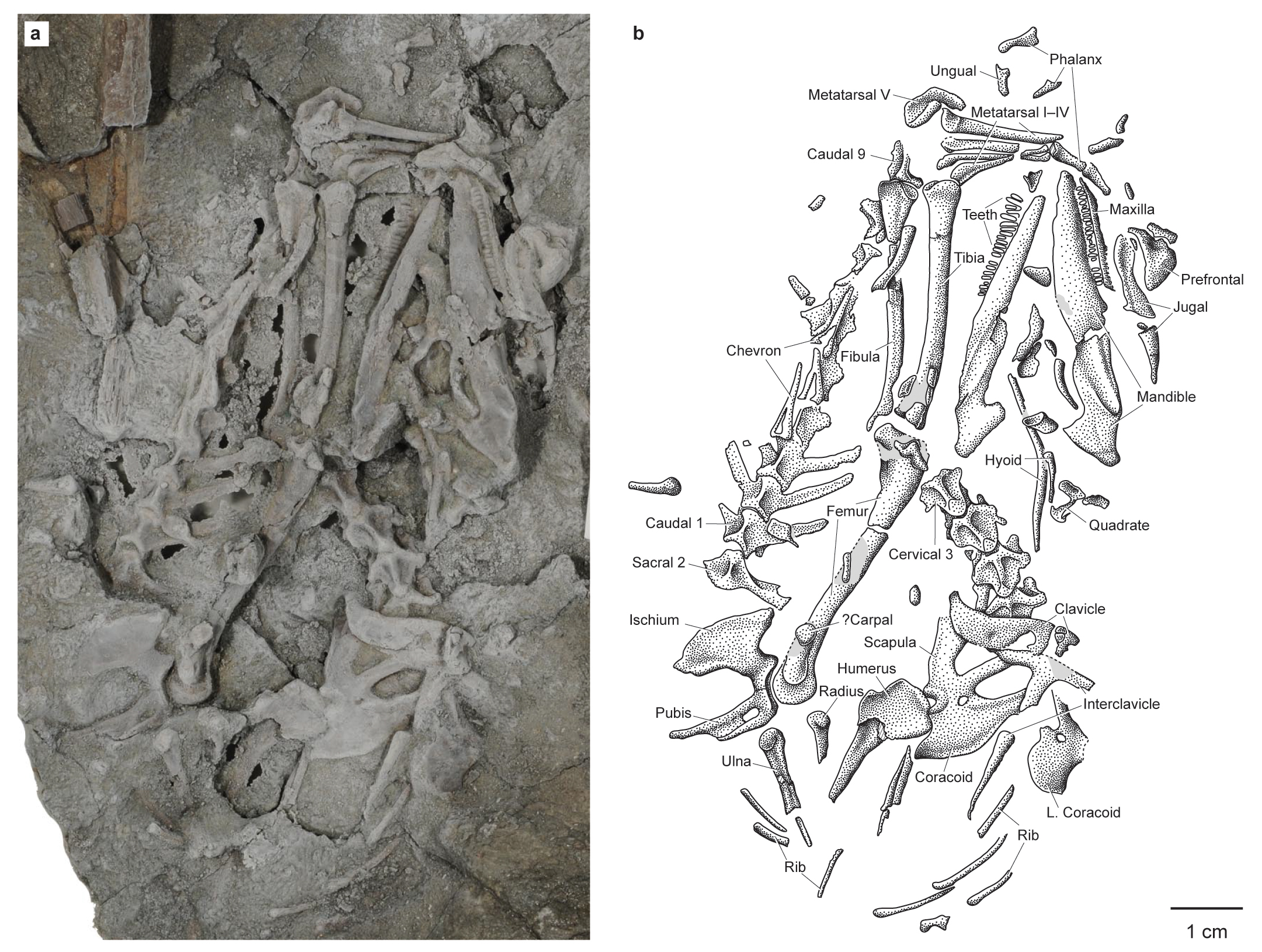
The Holotype Fossil Material (M. ovimonsensis)

Magnuviator holotype fossil and line drawing.

Holotype fossil (A) with interpretative line drawing (B).

Picture credit: David DeMar and Morgan Turner

A Meticulous Study

The researchers came to these conclusions after a meticulous study of both Egg Mountain specimens over a period of four years.  This included a round of CT scans at Seattle Children’s Hospital to narrow down the fossil’s location within a larger section of rock and a second round at the American Museum of Natural History to digitally reconstruct the skull anatomy.

The fact that both skeletons were nearly complete allowed the team to determine not only that Magnuviator represented an entirely new species, but also that its closest kin weren’t other fossil lizards from the Americas.  Instead, it showed striking similarities to other Cretaceous iguanians from Mongolia.

The Second Magnuviator Fossil Specimen

Second Magnuviator ovimonsensis specimen.

The second Magnuviator ovimonsensis fossil specimen.

Picture credit: Burke Museum of Natural History and Culture

DeMar commented:

“These ancient lineages are not the iguanian lizards which dominate parts of the Americas today, such as anoles and horned lizards.  So, discoveries like Magnuviator give us a rare glimpse into the types of ‘stem’ lizards that were present before the extinction of the dinosaurs.”

A Resident of Egg Mountain

But Magnuviator’s surprises don’t end with the Mongolian connection.  The site of its discovery is also astonishing.  Egg Mountain is already famous among fossil hunters.  Over thirty years ago, palaeontologists discovered the first fossil remains of dinosaur babies there, and it is also one of the first sites in North America where dinosaur eggs were discovered.

Senior author Greg Wilson (University of Washington, associate professor of biology), stated:

“We now recognise Egg Mountain as a unique site for understanding Cretaceous Period ecosystems in North America.  We believe both carnivorous and herbivorous dinosaurs came to this site repeatedly to nest, and in the process of excavating this site we are learning more and more about other creatures who lived and died there.”

The team even named their new find as homage to its famous home and its close lizard relatives in Asia.  Magnuviator ovimonsensis means “mighty traveller from Egg Mountain.”

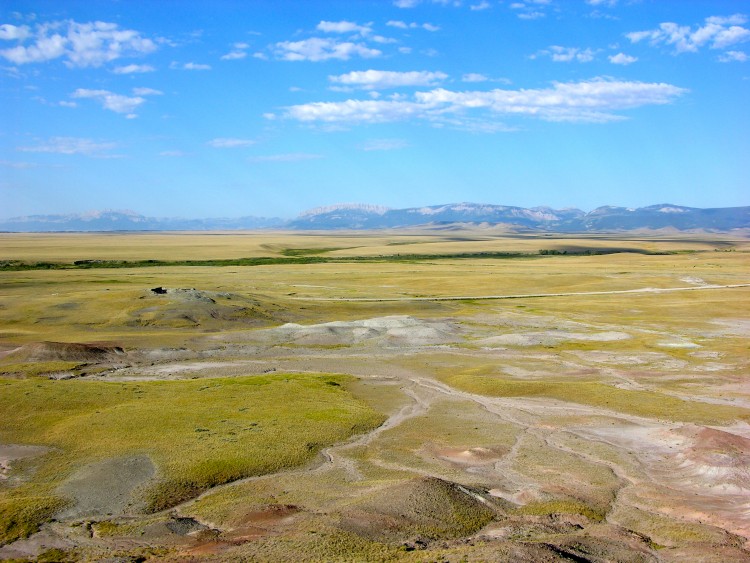
A View of the Famous Fossil Location in Montana – Egg Mountain

The famous Egg Mountain fossil site.

A distant view of Egg Mountain and the basin in which it lies.

Picture credit: David Varricchio

A distant view of Egg Mountain and the basin in which it lies.  Egg Mountain is in the centre-left of this image, within the basin.  Clearly visible at its top are black rectangular shapes, which are tarps erected near the excavation site

The Spectacular Egg Mountain Fossil Site

Through excavations at Egg Mountain led by co-author David Varricchio at Montana State University and meticulous analysis of fossils at partner institutions like the University Washington and the Burke Museum, scientists are piecing together the Egg Mountain ecosystem of around seventy-five million years ago.   In those days, Egg Mountain was a semi-arid environment, with little or no water at the surface. Dinosaurs like the duck-billed hadrosaurs such as Maiasaura and the bird-like, carnivorous Troodon nested there.

To read about a study mapping the lives of a population of Maiasaura: Mapping the Lives of a Population of Plant-eating Dinosaurs.

The Egg Mountain Ecosystem

Researchers have also unearthed fossilised mammals at Egg Mountain, which are being studied by Wilson’s group, as well as wasp pupae cases and pollen grains from plants adapted for dry environments.  Based on the structure of Magnuviator’s teeth, as well as the eating habits of some lizards today, the researchers believe that it could have feasted on wasps at the Egg Mountain site.  Though based on its relatively large size for a lizard, in excess of thirty centimetres long, Magnuviator could have also eaten something entirely different.  It might have been a herbivore.

Whatever its diet, Magnuviator and its relatives in Mongolia did not make it into the modern era.  DeMar and co-authors hypothesise that these stem lineages of lizards may have gone extinct along with the non-avian dinosaurs.  But given the spotty record for lizards in the fossil record, it will take more Magnuviator-level discoveries to resolve this debate, and, unfortunately, part of the excitement surrounding Magnuviator is that it is a very rare find.

Everything Dinosaur acknowledges the assistance of the University of Washington in the compilation of this article.

Visit the Everything Dinosaur website: Everything Dinosaur.
24 01, 2017

Super-sized Otter as Big as a Wolf

By |2023-05-14T18:45:20+01:00January 24th, 2017|Categories: Dinosaur and Prehistoric Animal News Stories, Dinosaur Fans, Main Page, Photos/Pictures of Fossils|0 Comments

Ancient Otter Species Amongst Largest Known to Science

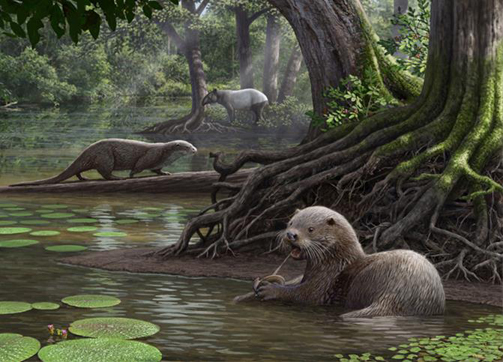
South-western China some 6.25 million years ago (Late Miocene Epoch), was home to a giant river otter that grew to the size of a Grey Wolf.

That is the conclusion of a team of researchers which includes Dr Denise Su (curator and head of palaeobotany and palaeoecology at the Cleveland Museum of Natural History).  The new species, named Siamogale melilutra would have weighed around fifty kilogrammes, making it one of the largest otter species known to science.  The largest extant otter species is the South American Giant Otter (Pteronura brasiliensis), it can reach a similar size, but it is much more lightly built, weighing around two-thirds as much as the Late Miocene species.

An Illustration of the Giant River Otter Siamogale melilutra

Siamogale illustration.

Yunnan Province (south-western China), in the Late Miocene was home to a giant otter (S. melilutra).

Picture credit: Mauricio Antón

Mustelidae Fossil Record

Otters are members of the Mustelidae family (weasels and their kin).  These agile, aquatic predators are grouped into a sub-family, the Lutrinae.  There are around a dozen or so species alive today.  The fossil record for the Mustelidae (weasels, ferrets, stoats, polecats, minks, martens, badgers, honey-badgers, wolverines and otters), is relatively poor.  Siamogale melilutra belongs to an ancient lineage of extinct otters that was previously known only from isolated teeth from a different, much older species that was recovered in Thailand (Siamogale thailandica from the middle Miocene basin of Mae Moh in northern Thailand).

What’s so special about this new discovery is that researchers were able to recover a complete cranium, mandible, teeth and various post-cranial skeletal elements, providing a wealth of insight into the taxonomy, evolutionary history and functional morphology of this new species.

Dr Su, co-author of the paper published in “The Journal of Systematic Palaeontology”, explained:

“While the cranium is incredibly complete, it was flattened during the fossilisation process.  The bones were so delicate that we could not physically restore the cranium.  Instead, we CT-scanned the specimen and virtually reconstructed it in a computer.”

The Holotype Fossil Material of S. melilutra Cranium in Right Lateral and Dorsal Views with the Digital Reconstruction

Fossil reconstruction and digital images (Siamogale).

Siamogale fossil reconstruction (digital images).

Picture credit: The Journal of Systematic Palaeontology

The scale bar in the above image is 30 millimetres.  The fossil skull is shown on the left (right lateral view top and dorsal view bottom), with the digital reconstruction of the fossil generated from the CT-scans.

The Phylogeny of the Mustelidae

Where the otters sit on the Mustelidae family tree has long been debated.  Since most of the Mustelidae fossil record is very poor, palaeontologists have struggled to assess taxonomic relationships.  The digital reconstruction of the crushed and flattened skull revealed that Siamogale melilutra had a combination of otter-like and badger-like characteristics, hence the species name “melilutra” which is derived from the Latin for otters (lutra) and the Latin for badgers (meles).

Siamogale melilutra had a large, powerful jaw with the enlarged, bunodont (rounded-cusped) teeth typical of many otter lineages.   It has been suggested that this giant otter specialised in eating freshwater mussels and clams, using its strong jaws to crack open the shells.

The discovery of this fossil material raises the question of whether these bunodont teeth were inherited by all otters from a common ancestor, or evolved independently in different otter lineages over time because of the evolution of similar adaptations to thrive in similar environments, an example of convergent evolution.

Dr Su and her co-workers which included Dr Xiaoming Wang (Dept. of Palaeontology at the Natural History Museum of Los Angeles County), through their analysis, found that bunodont teeth independently appeared at least three times over the evolutionary history of otters, suggesting convergent evolution to be the cause.

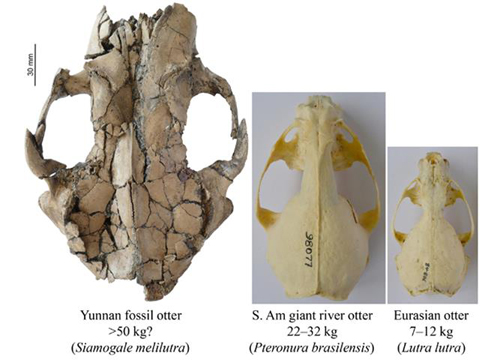
A Skull Size Comparison Between S. melilutra and P. brasiliensis and Lutra lutra

Otter skull comparisons.

Siamogale skull size comparison with South American giant river otter (middle) and European otter (right).

Picture credit: The Journal of Systematic Palaeontology

Siamogale melilutra Raises Further Questions

The completeness of Yunnan province specimen allows researchers to better understand the evolutionary history of otters, however, lots of questions about this super-sized river otter remain.

Dr Su summed up the questions that the researchers would like to answer:

“Why did this species grow so large?  How did its size affect its movement on land and in water? And most importantly, what types of advantages did its size give?”

The “Bear Otter” Enhydriodon dikikae

Although, much larger than modern-day otters, Siamogale melilutra is not the largest otter known from the fossil record.  Fossils of a much bigger “bear-otter” have been recovered from the Hadar Formation of Ethiopia.  The enormous Enhydriodon dikikae, would have been familiar to our hominin ancestors and it is estimated to have reached a total length in excess of two metres and weighed perhaps as much as 180 kilogrammes.

Otter Size Comparisons (Extinct versus Extant)

Otter Size Comparisons

Otter size comparisons (extinct species compared to living species).

Picture credit: Everything Dinosaur

The grey silhouettes represent living species, whilst the black silhouettes represent extinct species, two of the largest species of otter known from the fossil record.

Everything Dinosaur acknowledges the help of the Cleveland Museum of Natural History in the compilation of this article.

The scientific paper: “A New Otter of Giant Size Siamogale melilutra sp. nov. (Lutrinae: Mustelidae: Carnivora), from the latest Miocene Shiutangba site in north-eastern Yunnan, south-western China, and a total-evidence of phylogeny of Lutrines.” published in “The Journal of Systematic Palaeontology”.

Visit the Everything Dinosaur website: Everything Dinosaur.
19 01, 2017

New “Chilling” Theory Explains Dinosaur Extinction

By |2023-05-14T17:20:26+01:00January 19th, 2017|Categories: Dinosaur and Prehistoric Animal News Stories, Dinosaur Fans, Main Page|0 Comments

Freezing Cold Killed the Dinosaurs

A prolonged “nuclear winter” caused by an extra-terrestrial impact event some sixty-six million years ago, resulted in the extinction of most of the large terrestrial animals on Earth including the Dinosauria.  So say a team of scientists from the Potsdam Institute for Climate Impact Research (PIK).  In essence, a period of sustained global cooling “froze out” the dinosaurs.  The dinosaur extinction was caused by global climate change.

A Very “Chilly-saurus” Dramatic Global Cooling Led to Dinosaur Demise

Dinosaur extinction caused by global cooling.

Dramatic global cooling may have led to the dinosaur extinction event.

Dinosaur Extinction

Climate scientists have reconstructed how tiny droplets of sulphuric acid formed high up in the air after the well-known impact of a large body from space (Chicxulub crater event).  These particles blocked sunlight for several years and had a profound influence on life on Earth.  Plants died, and death spread through food chains.

Previous theories focused on the shorter-lived dust ejected by the impact (the ejector).  The new computer simulations show that the droplets resulted in long-lasting cooling, a likely contributor to the death of the terrestrial dinosaurs.  An additional kill mechanism might have been a vigorous mixing of the oceans, caused by the surface cooling, severely disturbing marine ecosystems.

Julia Brugger (Potsdam Institute for Climate Impact Research) and lead author of this new study, published this week in the Geophysical Research Letters stated:

“The big chill following the impact of the asteroid that formed the Chicxulub crater in Mexico is a turning point in Earth history.  We can now contribute new insights for understanding the much debated ultimate cause for the demise of the dinosaurs at the end of the Cretaceous.”

Computer Simulations

To investigate the phenomenon, the scientists for the first time used a specific kind of computer simulation normally applied in different contexts, a climate model coupling atmosphere, ocean and sea ice.  They built on research showing that sulphur-bearing gases that evaporated from the violent impact event on our planet’s surface were the main factor for blocking the sunlight and cooling down the planet.

Global Temperatures Plunged

The scientists calculate that in the tropics, annual mean temperature fell from a balmy twenty-seven to just five degrees Celsius.  To put this in a modern context, the average annual temperature at the heart of the Amazon rainforest is around twenty-seven degrees Celsius.  Imagine the impact on the flora and fauna if this tropical part of the world suddenly had to endure a prolonged period of cold with an average annual temperature of just five degrees, that’s colder than the average annual temperatures experienced by the inhabitants of Oslo in Norway.

A Computer Model Showing Global Temperatures Prior to the Extra-terrestrial Impact Event

Global temperatures at the end of the Cretaceous.

Global temperatures prior to the extra-terrestrial impact event that contributed to the extinction of the dinosaurs.

Picture credit: Potsdam Institute for Climate Impact Research

Julia Brugger added:

“It became cold, I mean, really cold.”

Dinosaur Extinction Caused by Prolonged Cold

Global annual mean surface air temperature dropped by at least twenty-six degrees Celsius.  The dinosaurs were used to living in a lush climate.  After the impact event, the annual average temperature was below freezing point for about three years.  Evidently, the ice caps expanded.  Even in the tropics, annual mean temperatures went from twenty-seven degrees to a mere five degrees.

Co-author and leader of the climate research team at the Potsdam Institute for Climate Impact Research, Georg Feulner commented:

“The long-term cooling caused by the sulphate aerosols was much more important for the mass extinction than the dust that stays in the atmosphere for only a relatively short time.  It was also more important than local events like the extreme heat close to the impact, wildfires or tsunamis.”

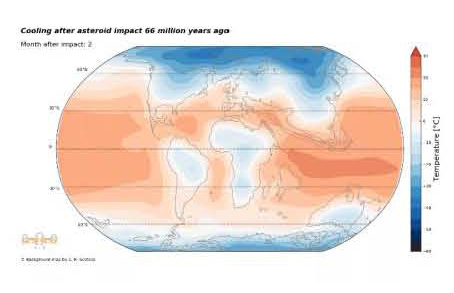
A Computer Simulation Showing Global Temperatures After the Impact Event

Extraterrestrial impact event causes global cooling.

Dramatic global cooling after impact event.

Picture credit: Potsdam Institute for Climate Impact Research

The image above shows the effect on our planet’s temperature just two months after the impact event.

The researchers calculate that it took the climate about thirty years to recover, more than enough time to see the demise of seventy percent of all terrestrial animals as well as many different kinds of plants and a number of different families of marine organisms.

Disruption of Ocean Circulation

As well as climate chaos, ocean circulation became disturbed.  Surface waters cooled down, thereby becoming denser and hence heavier.  While these cooler water masses sank into the depths, warmer water from deeper ocean layers rose to the surface, carrying nutrients that likely led to massive blooms of algae, the scientists postulate.  It is conceivable that these algal blooms produced toxic substances, further affecting life at the coasts.  Yet in any case, marine ecosystems were severely shaken up, and this likely contributed to the extinction of species in the oceans, like the ammonites and several types of marine reptile.

The dinosaurs, until then the masters of the Earth, made space for the rise of the mammals, and eventually humankind.  The study of Earth’s past also shows that efforts to study future threats by objects from outer space have more than just academic interest.

Twenty-six Months After the Impact Event – A Sustained Global Cooling

The demise of the dinosaurs due to global cooling.

26 months after the impact, the world has rapidly cooled.

Picture credit: Potsdam Institute for Climate Impact Research

Georg Feulner concluded by saying:

“It is fascinating to see how evolution is partly driven by an accident like an asteroid’s impact, mass extinctions show that life on Earth is vulnerable.  It also illustrates how important the climate is for all lifeforms on our planet.  Ironically today, the most immediate threat is not from natural cooling but from human-made global warming.”

Everything Dinosaur recognises the help of the Potsdam Institute for Climate Impact Research in the compilation of this article.

The scientific paper: Brugger, J., Feulner, G., Petri, S. (2017): “Baby, it’s cold outside: Climate model simulations of the effects of the asteroid impact at the end of the Cretaceous.”  This paper is published in Geophysical Research Letters.

Visit the Everything Dinosaur website: Everything Dinosaur.
14 01, 2017

Trilobite Reproduction Puzzle Solved by New Research

By |2024-05-07T12:55:50+01:00January 14th, 2017|Categories: Dinosaur and Prehistoric Animal News Stories, Main Page|0 Comments

Trilobite Eggs Found in Ordovican Fossil

Trilobites are some of the most recognisable fossils to be found in Palaeozoic strata.  However, despite there being tens of thousands of exceptionally preserved specimens, little is known about how trilobites bred.  Trilobite reproduction has remained a bit of a mystery.  A team of scientists from Western Illinois University in collaboration with colleagues from Vanderbilt University (Nashville, Tennessee), writing in the academic journal “Geology” have published a paper on a remarkable fossil find.  They report finding the first evidence of trilobite eggs preserved within a fossil specimen.

A Trilobite Fossil

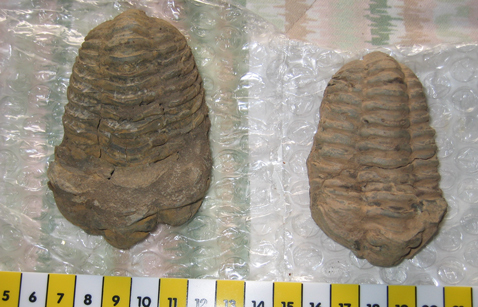
The definition of benthic. A pair of trilobite fossils. Trilobites feature in the televison programme "First Life".

“Mike and Sue” – the trilobites.  A pair of trilobite fossils.  Picture credit: Everything Dinosaur.

The Trilobita

Trilobites are an extinct, geographically widespread and abundant group of Palaeozoic arthropods that evolved in the Cambrian and survived until the Permian mass extinction event some 252 million years ago.  Trilobites have a distinctive threefold longitudinal division of the body and a tough exoskeleton.  At least ten Orders of Trilobita have been assigned and although most trilobites were small, the largest specimens grew to up to a metre in length.

All trilobites lived in marine environments and they evolved to occupy a number of ecological niches from active, predatory nektonic animals to epifaunal forms.  In order to grow, these animals had to moult and shed their exoskeleton.  The cast exoskeleton readily fossilised and as a result, huge numbers of trilobite fossil material is present.

Triarthrus eatoni

An analysis of an exceptionally well-preserved specimen of the Late Ordovican trilobite (Triarthrus eatoni) from the Lorraine Group found in the United States has revealed the presence of nine tiny eggs, clustered together in an area located underneath the head shield (the genal area of the cephalon).  Other specimens also show evidence of eggs within the fossilised form.

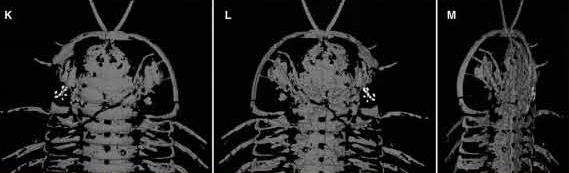
Digital Images from the Computerised Tomography Showing the Tiny Eggs

Trilobite eggs.

A digital reconstruction of T. eatoni shows evidence of Trilobite egg formation.

Picture credit: Geological Society of America

The image above shows close up views of the cephalon and the upper portion of the trunk.  Picture K represents a dorsal view (view from the top), picture L (ventral view), viewed from underneath and picture M is a left ventral view.  The egg cluster, represented by the tiny white dots can be clearly seen.

Spherical and Elliptical Eggs

Like many fossil trilobite specimens from the Lorraine Group, the complete exoskeleton has been replaced with pyrite.  The eggs are described as being spherical to elliptical in shape, although the fossilisation process could have distorted the material.  Each egg is approximately 200 μm in size, that’s around half the width of a human hair.  The eggs are only visible ventrally with no dorsal brood pouch or recognised sexual dimorphism.

Triathrus eatoni (Ordovician Whetstone Gulf Formation) Reveals Eggs

Fossil eggs in Trilobite fossil discovered.

Pyritised specimens of Triarthrus eatoni showing evidence of fossil eggs.

Picture credit: Geological Society of America

The picture above show a pyritised specimen of T. eatoni, part of the collection of the Yale Peabody Museum showing nine eggs (picture A is ventral view).  Picture B shows a second specimen with four eggs preserved in the right genal area.  The image (picture C) is a close up of the eggs in specimen B, whilst D is a closer view of the eggs preserved in specimen A.

Highly magnified (scanning electron microscopy), views of an egg cluster (E) with a closer view of a single egg (F).  Picture G shows the egg surface under high magnification.

A close up of a single limb from specimen A is shown in picture H, whilst images I and J show pyritised elements of the body fossil.

Trilobtie Reproduction Strategy Similar to Modern Horseshoe Crabs

The location of the eggs is consistent with where extant female horseshoe crabs release their unfertilised eggs from the ovarian network within their head.  Trilobites probably released their gametes (eggs and sperm) through a genital pore of as-yet unknown location (likely near the posterior boundary of the head).  If the T. eatoni reproductive biology is representative of other trilobites, they spawned with external fertilisation, possibly the ancestral mode of reproduction for early members of the Arthropoda.

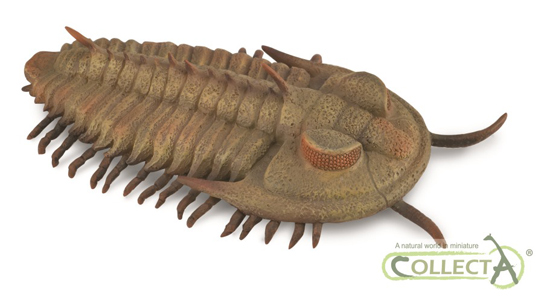
An Trilobite Model

CollectA Redlichia rex trilobite. "First Life"

CollectA Redlichia rex trilobite model.

To view the CollectA model range: CollectA Age of Dinosaurs Popular Models and Figures.

As pyritisation preferentially preserves the external rather than internal features of fossils, it is suggested that there is likely a bias in the fossil record toward the preservation of arthropods that brood eggs externally, animals with an exoskeleton that brood their eggs internally are unlikely to preserve any evidence of their mode of reproduction.

The scientific paper: “Pyritised in situ Trilobite Eggs from the Ordovician of New York (Lorraine Group): Implications for Trilobite Reproductive Biology” published in Geology.

Visit the Everything Dinosaur website: Everything Dinosaur.
11 01, 2017

Hyoliths Find a New Home

By |2024-05-07T12:57:21+01:00January 11th, 2017|Categories: Dinosaur and Prehistoric Animal News Stories, Main Page, Photos/Pictures of Fossils|0 Comments

Ancient, Long Extinct Animal Finds Place on Tree of Life

A bizarre shelled marine creature’s place in the Animal Kingdom has finally been resolved thanks to the efforts of a remarkable student at the University of Toronto.  Undergraduate student Joseph Moysiuk has identified Hyoliths, not as members of the Mollusca, which many palaeontologists had previously believed, but as lophophores and as such, they are closely related to brachiopods.

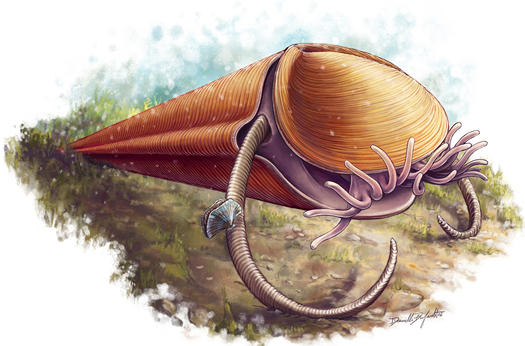
An Illustration of the Hyolith Haplophrentis

The Hyolith Haplophrentis.

An illustration of the Hyolith Haplophrentis.

Picture credit: Royal Ontario Museum/Danielle Dufault

In the Hyolith illustration above, a tiny brachiopod can be seen attached to the nearest appendage of Haplophrentis.

Studying Hyoliths

The distinctive appearance and structure of the Hyolith skeleton has obstructed previous attempts to classify these animals.  All Hyoliths had an elongated, bilaterally symmetrical cone-shaped shell and a smaller cap-like shell that covered the opening of the conical shell (known as an operculum).  Some species also bore a pair of rigid, curved spines (helens) that protruded from between the conical shell and operculum (the shell cap), structures with no equivalents in any other group of animals.

An Extensive Fossil Record

The mineralised external skeletons (argonite) and their sessile/semi-sessile habit (living on the seabed), gives these animals, which range in size from 1 cm to around 5 cm in length, a good fossil preservation potential.

The earliest fossil evidence for this type of creature occurs in rocks dating from around 540 million years ago (Cambrian).  These filter feeders seem to have persisted throughout the Palaeozoic and the Hyolith fossil record is relatively abundant and geographically widespread.

The Hyolitha were very diverse during the Cambrian and the subsequent Ordovician geological period, before their fossil record and their presence as an important member of marine benthos communities (animals and plants living on the sea floor) declines.  Hyoliths are one of many types of marine invertebrate that failed to survive into the Mesozoic.

The Cambrian Hyolith Haplophrentis

Burgess Shale Hyolith fossil.

Soft tissue of a Cambrian Hyolith (Haplophrentis) has been preserved.

Picture credit:  Royal Ontario Museum

Diverse in the Palaeozoic

In the picture of a Hyolith fossil above, (genus Haplophrentis – H. carinatus), the conical shape of the shell can be clearly made out and the partially extended lophophore (feeding organ) can be seen.  The lophophore consisting of numerous, blackened, thin, finger-like extensions is highlighted against the operculum.  The curved spines are the helens.

Writing in the academic journal “Nature”, student Joseph Moysiuk and his fellow authors, Durham University’s Martin Smith and Burgess Shale fossil expert Jean-Bernard Caron, studied over 1,500 fossil specimens from the mid-Cambrian strata that represent elements of the Burgess Shale (British Columbia) and the Spence Shale Formations (Idaho and Utah).  The Hyolith material (Haplophrentis) and its exceptional state of preservation permitted the team to assess the soft tissue structures and from this information the team were able to deduce their taxonomic affinities.

Dr Caron explained:

“Burgess Shale fossils are exceptional because they show preservation of soft tissues which are not usually preserved in normal conditions.”

Not Closely Related to Snails, Cephalopods and Other Molluscs

The analysis showed that Hyoliths are not closely related to snails, squid or other members of the Mollusca.  They are instead, more closely related to the Brachiopoda, a group of animals with a rich fossil record but with few extant representatives.  Brachiopods have a soft body enclosed between upper and lower shells (valves), unlike the left and right arrangement of valves in bivalve molluscs.  Brachiopods open their valves at the front when feeding but otherwise keep them closed to protect their feeding apparatus and other body parts.

Student Moysiuk commented:

“Our most important and surprising discovery is the Hyolith feeding structure, which is a row of flexible tentacles extending away from the mouth, contained within the cavity between the lower conical shell and upper cap-like shell.  Only one group of living animals – the brachiopods, has a comparable feeding structure enclosed by a pair of valves.  This finding demonstrates that brachiopods, and not molluscs, are the closest surviving relatives of Hyoliths.”

The undergraduate added:

“It suggests that these Hyoliths fed on organic material suspended in water as living brachiopods do today, sweeping food into their mouths with their tentacles,”

A Diagram Showing the Proposed Anatomy of a Hyolith

Haplophrentis anatomy.

Diagrams showing the anatomy of the Cambrian Hyolith Haplophrentis.

Picture credit: Royal Ontario Museum/Danielle Dufault

The Function of the Helens

Examination of the orientation of the helens in multiple Hyolith specimens from the Burgess Shale suggests that these spines may have been used like stilts to lift the body of the animal above the sediment, elevating the feeding apparatus to enhance feeding.

Dr Caron led recent field exhibitions to the Burgess Shale.  This resulted in the discovery of many specimens that form the basis of this research.  The key specimens came from recently discovered deposits near Stanley Glacier and Marble Canyon in Kootenay National Park, about twenty miles south-east of the original Burgess Shale site in Yoho National Park.

Exploring the Burgess Shale

Exploring the Burgess Shales.

Student Joseph Moysiuk (left) in the field with Dr Jean-Bernard Caron.

Picture credit: Joseph Moysiuk

Solving a Puzzle

Palaeontology lecturer Martin Smith expressed his delight at being able to help solve a 175-year-old palaeontological puzzle.  Hyolith fossils have been included in a number of fossil studies previously, but until now, where these creatures featured in the tree of life remained open to speculation.

Dr Smith stated:

“Resolving the debate over the Hyoliths adds to our understanding of the Cambrian Explosion, the period of rapid evolutionary development when most major animal groups emerge in the fossil record.  Our study reiterates the importance of soft tissue preservation from Burgess Shale-type deposits in illuminating the evolutionary history of creatures about which we still know very little.”

Everything Dinosaur acknowledges the assistance of the University of Toronto in the compilation of this article.

Visit the Everything Dinosaur website: Everything Dinosaur.
Go to Top