All about dinosaurs, fossils and prehistoric animals by Everything Dinosaur team members.

Fossil finds, new dinosaur discoveries, news and views from the world of palaeontology and other Earth sciences.

8 07, 2017

A Time for Digging Up Dinosaurs

By |2023-08-07T07:36:31+01:00July 8th, 2017|Categories: Dinosaur and Prehistoric Animal News Stories, Dinosaur Fans, Geology, Main Page, Palaeontological articles|0 Comments

Field Teams Prepare to Explore Northern Latitudes

High summer in the Northern Hemisphere, most teaching programmes may have come to an end but for many palaeontologists, this is their busiest time of year.  The months of July and August represent the best times to explore some of the more remote and difficult to access vertebrate fossil sites.  Take for example, Dr Anthony Fiorillo from the Perot Museum of Nature and Science (Dallas, Texas).  He and his colleagues are busy organising field work in the Aniakchak National Monument (Alaska), area in a bid to learn more about polar dinosaurs.

The summer months represent the only time that scientists have to work at such remote and inaccessible sites, as the weather for once, is on their side.  Palaeontologists will be taking advantage of the near 24-hours of daylight in northern latitudes to further explore the unique prehistoric environments that for most of the year are simply inaccessible.

Dinosaurs of Northern Latitudes

The Late Cretaceous exposures in Alaska provide a record of life at very high latitudes as the age of dinosaurs was drawing to a close.  Just like the herds of migratory herbivorous dinosaurs, which would have fed around the clock, the scientists will be taking advantage of the very long days to get as much work done as possible.  The field team hope to revisit a number of locations in the Aniakchak National Monument in a bid to collect more data on the hundreds of dinosaur tracksites that have been discovered.

These tracks and individual dinosaur footprints provide a unique insight into the ancient palaeofauna, an opportunity to further explore the lives of polar dinosaurs.  In 2014, Everything Dinosaur wrote an article summarising some of the work undertaken by Dr Fiorillo and his colleagues as they interpreted a substantial number of duck-billed dinosaur tracks.  These trace fossils helped the researchers to better understand how these giant, herbivorous dinosaurs moved around in herds: Duck-Billed Dinosaurs Moved Around in Herds just like Elephants. Over the years, researchers from the Perot Museum of Nature and Science have made a very important contribution to research into dinosaur populations that lived (and seemed to thrive) at high northern latitudes.

Commenting on the significance of their work, Dr Fiorillo stated:

“At the start of every one of these expeditions, the adrenaline is pumping.  We are so excited to get back out there.  I fully expect that we will find dozens of footprints and we will learn a little bit more about the environment in which these dinosaurs lived.”

Nanuqsaurus hoglundi and Pachyrhinosaurus perotorum

Staff at the Perot Museum of Nature and Science, along with their collaborators from other institutions have been instrumental in helping to improve our understanding of the polar dinosaurs and the palaeoenvironment.  For example, a third species of Pachyrhinosaurus (P. perotorum) has been erected thanks to Alaskan fossil discoveries.

A Model of the Horned Dinosaur Pachyrhinosaurus
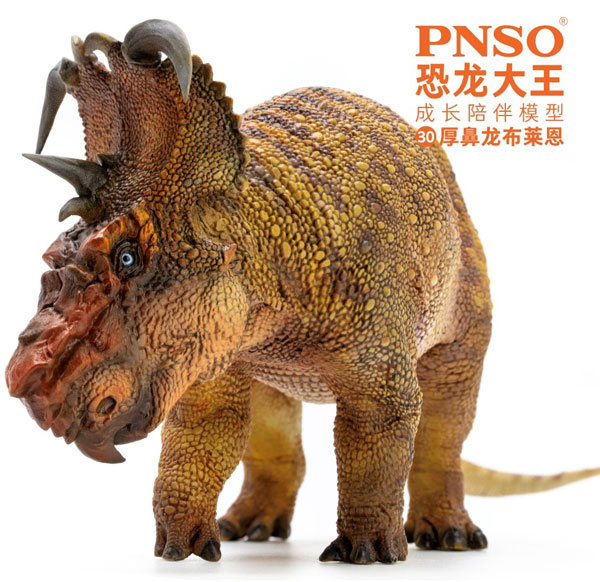
PNSO Pachyrhinosaurus dinosaur model.

PNSO Brian the Pachyrhinosaurus dinosaur model.

The picture (above) shows a Pachyrhinosaurus dinosaur model from the PNSO range.

To view this range of prehistoric animal figures: PNSO Age of Dinosaurs.

Alaskan Dinosaurs

With all that plant food and the long summer days, Alaska might have been a paradise, albeit a chilly one for plant-eating dinosaurs.  However, they did have to contend with some particularly nasty predators, over-sized dromaeosaurids for example and perhaps, even more surprisingly a “polar” tyrannosaur.  In 2006, a research team led by Dr Anthony Fiorillo and his colleague Dr Ronald Tykoski, also from the Perot Museum of Nature and Science discovered the fossils of a carnivorous dinosaur that was later named Nanuqsaurus hoglundi.

To read more about this fossil discovery: An Update on “Polar Bear Lizard”.

We wish all field teams every success and we hope that they have a safe, rewarding and very satisfactory field season.

To read more about the discovery of Pachyrhinosaurus perotorum an article first published in 2011: A New Species of Pachyrhinosaurus is Announced.
6 07, 2017

Tyrannosaurs Roamed Late Cretaceous Japan According to New Study

By |2024-04-01T14:07:34+01:00July 6th, 2017|Categories: Dinosaur and Prehistoric Animal News Stories, Dinosaur Fans, Main Page|0 Comments

Large Theropod Tooth Indicates Tyrannosaurs Roamed Japan

Researchers have identified a single, shed theropod tooth that indicates that large tyrannosaurs roamed the land that we now know as Japan some 80 million years ago.  The single tooth is very characteristic of a member of the Tyrannosauridae family, however, it is not possible to identify a specific genus based on such fragmentary evidence.

This has not stopped the speculation, with some sources suggesting that the tooth might have come from a dinosaur which was very similar to Gorgosaurus, which is one of the better known Late Cretaceous tyrannosaurs, although, as far as we at Everything Dinosaur think, Gorgosaurus lived several million years later and is only known from North America.

The Single Broken Theropod Tooth – Potential Japanese Tyrannosaur

Lateral view of the Japanese tyrannosaur tooth.

The tyrannosaur tooth (Japan).

Picture credit: Goshoura Cretaceous Museum

A Fossil Find on Amakusa Island

In October 2014, a research team from the Fukui Prefectural Dinosaur Museum in collaboration with colleagues from the Goshoura Cretaceous Museum was exploring a series of Upper Cretaceous exposures in the Amakusa archipelago (Kumamoto Prefecture), a tooth from a theropod was found.  In a press release, a spokesperson from the Goshoura Cretaceous Museum, which is run by the Amakusa city government, explained that the single tooth is believed to have come from either the upper left jaw or the lower right jaw of a carnivorous dinosaur.

The tooth morphology is typical of a tyrannosaur, it has serrations running down the sides of the tooth, very similar to those of dinosaurs in the Tyrannosauridae family.  It is slightly recurved and has a characteristic robust appearance and a classic oval or “D” shape when seen in cross-section.

A View of the Underside of the Tooth – A Typical Tyrannosaur Tooth Shape

The Japanese tyrannosaurid tooth (ventral vew)

Ventral view of the tyrannosaurid tooth (view from underneath).

Picture credit: Goshoura Cretaceous Museum

A Shed Tyrannosaur Tooth from Japan

Only the crown has been found.  No roots have been found in association with the tooth, so it is very likely a shed tooth.  Dinosaurs replaced teeth throughout their lives.  Palaeontologists have calculated that a tooth in the jaws of Tyrannosaurus rex probably lasted less than two years.  The dental enamel on the tooth is quite well preserved and the fossil measures 4.2 cm long, 2.5 cm wide (at the bottom) and it is 1.6 cm thick.  Based on the size of the tooth, scientists have estimated that the tyrannosaur that lost this tooth could have measured over seven metres in length.  The original length of the tooth (crown plus root) is estimated at around 5.6 cm long.

The tooth would have been quite sizeable, but this is not the largest theropod tooth ever found in Japan.  In 2008, Everything Dinosaur reported the discovery of a much older dinosaur tooth that measured more than eight centimetres in length.

To read about this fossil discovery: Largest Meat-Eating Dinosaur Tooth Found in Japan.

The serrations (denticles) are quite prominent and measure about 0.3 mm in size.  In the press statement, it was stated that the tooth was found in exposures related to the Ikusagaura stratum of the Himenoura Group (Upper Cretaceous – Campanian faunal stage).

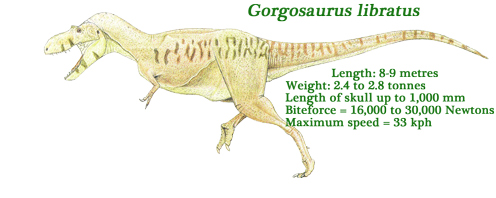
An Illustration of a Typical Gorgosaurus (G. libratus Member of the Tyrannosauridae)

Gorgosaurus libratus illustrated.

Faster and slightly more nimble when compared to the biggest Albertosaurus dinosaurs.

Picture credit: Everything Dinosaur

A Tyrannosaur Tooth from Japan

Commenting on the fossil find, a team member from Everything Dinosaur stated:

“Dinosaur fossils from Japan are exceptionally rare and most material is extremely fragmentary.  The finding of this single tooth does indicate that during the latter stages of the Late Cretaceous, this part of the world was home to large tyrannosaurs similar to those found in similar aged rocks in North America and elsewhere in Asia.”

Earlier this year, (April 2017), Everything Dinosaur reported on the discovery of the most complete dinosaur skeleton ever found in Japan.  The fossilised remains of a hadrosaur were discovered on the Japanese island of Hokkaido.  The fossils were found in marine strata, it is likely that the corpse of this herbivorous dinosaur was washed out to sea – an example of a “bloat and float” form of taphonomy.

To read an article about this discovery: Japan’s Most Complete Dinosaur Discovery.

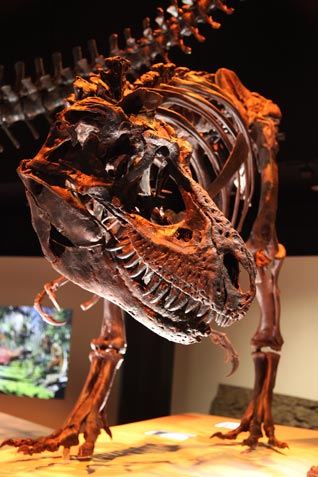
A Mounted Skeleton of a Gorgosaurus (Late Cretaceous Tyrannosaur)

A Gorgosaurus on display.

Gorgosaurus fossil display.

Picture credit: Manchester University

Visit the Everything Dinosaur website: Everything Dinosaur.

5 07, 2017

Madagascar’s Mighty-mouthed Croc Described in New Paper

By |2024-05-08T20:37:57+01:00July 5th, 2017|Categories: Dinosaur and Prehistoric Animal News Stories, Dinosaur Fans, Main Page|0 Comments

Razanandrongobe sakalavae – Terror of the Middle Jurassic

A team of French and Italian palaeontologists have pieced together a more than decade-long puzzle and as a result, have come face to face with one of the most nightmarish prehistoric animals imaginable.  New research on fossils found in north-western Madagascar has led scientists to describe a giant, terrestrial crocodile with immensely strong teeth and bone-crushing jaws.  The new species, the largest and oldest Notosuchian described to date, may well have filled the apex predatory niche in this part of the southern, super-continent Gondwana.  The super-sized croc, named Razanandrongobe sakalavae (pronounced Ray-zan-an-dro-go-bay sack-ah-lar-vey), had teeth reminiscent of the robust teeth of a Late Cretaceous tyrannosaur.

Indeed, an examination of the denticles (serrations) on the teeth preserved in the left dentary fragment and partial right premaxilla are strikingly similar to the serrations on a T. rex tooth.

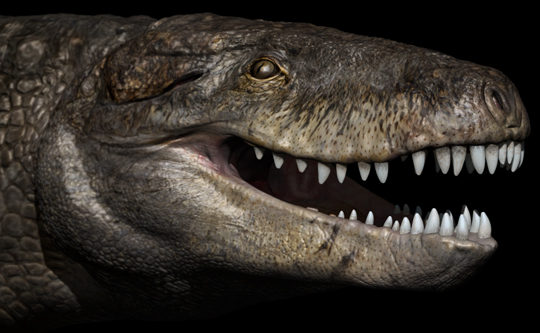
A Reconstruction of the Deep Skull of Razanandrongobe sakalavae

The fearsom Razanandrongobe.

Razanandrongobe skull.

Picture credit: Fabio Manucci

Archosauria incertae sedis

In 2006, three palaeontologists (Simone Maganuco, Cristiano Dal Sasso and Giovanni Pasini), published a scientific paper that described a large predatory archosaur from the Mahajanga Basin of Madagascar.  The animal was named based on a fragmentary right maxilla and seven isolated teeth.  It is not unusual to have a new genus established based on such incomplete remains, however, what kind of reptile these fossils represented was very much open to debate.  Could it have been a crocodylomorph or perhaps a carnivorous dinosaur?  A new taxon was erected Razanandrongobe sakalavae, in the 2006 paper.

It was suggested that the fossils might represent the largest predatory animal known from the Bathonian faunal stage of Jurassic Madagascar and that it could have been durophagous – feeding on hard materials like the bones of other vertebrates.  Such was the paucity of the fossil material, that although the species name entered scientific literature, it was referred to as “Archosauria incertae sedis”, which means it was a member of the Archosauria, but where it belonged in this large and extremely diverse clade was anyone’s guess.

More Fossils – More Skull Material

Writing in the academic journal “PeerJ” the same researchers, in collaboration with Guillaume Fleury (Muséum d’Histoire Naturelle de Toulouse, France), have described more cranial material including an almost complete right premaxilla, a portion of left lower jaw bone (dentary), plus a partial maxilla complete with unerupted teeth and a single, very large broken tooth.  In addition, a further five skull bones, that were, most likely collected from the same location are also assigned to R. sakalavae.  These fossils have ruled out Theropoda, Razanandrongobe was definitely from the Crurotarsi archosauriforms and as such, it has affinities with today’s crocodilians.

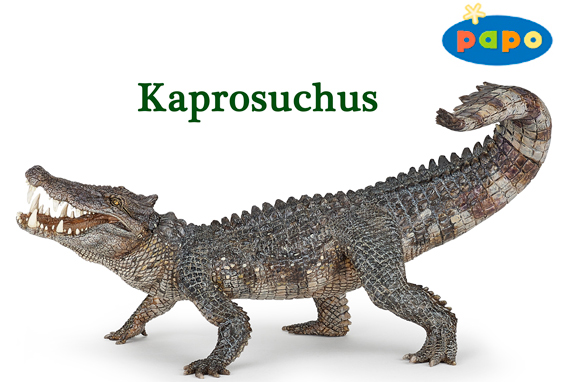
However, phylogenetic analysis assigns Razanandrongobe to the Notosuchia and as such, it was very distantly related to Kaprosuchus from the Late Cretaceous of Niger, a terrestrial predator that readers of this blog and collectors of Papo and Safari Ltd prehistoric animal models might be familiar with.  As several sauropods are known from the same stratigraphy, this “super-croc” has been depicted scavenging on the carcass of long-necked dinosaur.

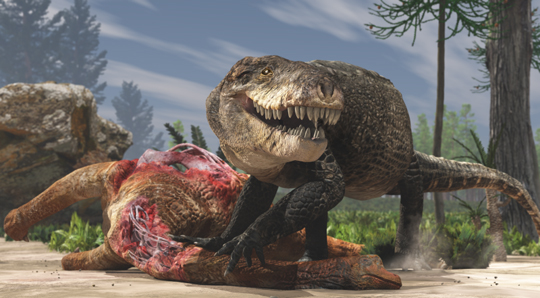
Razanandrongobe sakalavae Feeding on a Sauropod Carcass (Archaeodontosaurus)

Razanandrongobe feeding on a dinosaur (Razanandrongobe sakalavae).

Razanandrongobe feeding on a sauropod carcass.

Picture credit: Fabio Manucci

The illustration above depicts the deep-snouted terrestrial Razanandrongobe scavenging on the carcass of a sauropod.  We speculate that the artist has depicted an Archaeodontosaurus as the victim.  Archaeodontosaurus is known from fossils that came from the same region of Madagascar.  Ironically, we think at Everything Dinosaur, this Middle Jurassic sauropod was named on the basis of isolated teeth and a fragment of jawbone, just like R. sakalavae.

Razanandrongobe sakalavae

Although distantly related to living crocodiles, Razanandrongobe moved very differently.  Its legs were longer and it walked with a much more erect stance.  It may even have been capable of bipedalism, although analysis of the postcranial skeleton would be the only way to confirm this.

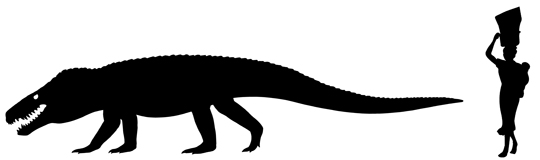
As to the size of this 165 million-year-old crocodile, that is very difficult to say.   However, this animal nick-named “Razana”, has been estimated at around seven metres in length.  This measurement has been calculated by comparing the Razanandrongobe fossil material with better-known and more complete baurusuchids, another type of Notosuchian from South America.

Estimating the Size of Razanandrongobe sakalavae

Estimating the size of Razanandrongobe sakalavae scale drawing.

Estimating the size of Razanandrongobe sakalavae.

Picture credit: Natural History Museum (Milan)

Razanandrongobe may have been about as big as a modern Saltwater crocodile (Crocodylus porosus), but on those powerful erect limbs it would have stood much higher, perhaps around 1.6 metres high at the hips.  Its weight has been estimated at 800 to 1,000 kilogrammes.

Visit the award-winning Everything Dinosaur website: Everything Dinosaur.

“Giant Lizard Ancestor from the Sakalava Region”

Razanandrongobe sakalavae translates from the local dialect and Latin and means “giant lizard ancestor from the Sakalava region”, Sakalava relating to the ethnic group that inhabits the Mahajanga region, where the fossil material was found.

It is thanks to the additional fossil fragments, the majority of which indicating that they represent the same individual whose fossils were described back in 2006, that the research team have been able to “flesh out the bones” and provide a more detailed picture of this monster.  In essence, the paper clarifies features on the holotype material that confirms that the fossils do not represent any type of dinosaur, it establishes Razanandrongobe as a member of the Notosuchia and as such it is by far the oldest Notosuchian so far described.  It is the first Jurassic Notosuchian and its fossils are some 42 million years older than other members of this crocodilian Suborder.

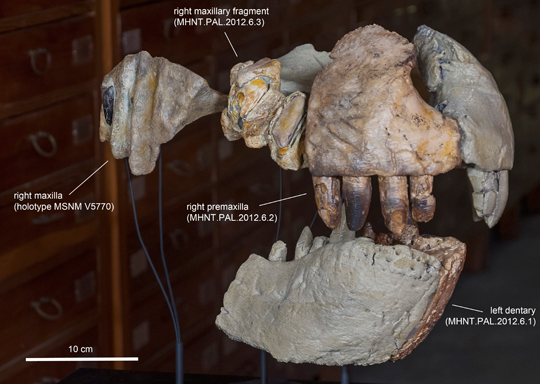
The Mounted Fossils (with some casts) Reconstructing the Front of the Jaws of R. sakalavae 

R. sakalavae  skull reconstruction.

Razanandrongobe sakalavae  skull reconstruction.

Picture credit: Natural History Museum (Milan)

The picture above shows the reconstructed anterior portion of the skull and jaws of Razanandrongobe with the fossil material and casts shown in life position.

Cristiano Dal Sasso (Natural History Museum of Milan) commented:

“Like these and other gigantic crocs from the Cretaceous “Razana” could outcompete even theropod dinosaurs, at the top of the food chain.”

Very little is known about the origins and the early evolution of the Notosuchia, this Madagascan fossil material represents the first Jurassic fossils related to this Sub-order.  Razanandrongobe has extended the evolutionary history of the Notosuchia by more than forty million years and as such, it has established a ghost lineage that, hopefully further fossil finds will help to fill in.

Speaking about the implications for the evolution of these types of terrestrial crocodiles, co-author of the PeerJ paper, Simone Maganuco (Natural History Museum of Milan), stated:

“These fossils represent a further signal that the Notosuchia originated in southern Gondwana.”

Predator or Scavenger?

Although nothing can be discounted, it is likely that, just like the majority of scavengers today, Razanandrongobe was an active hunter.  It probably hunted dinosaurs and other large vertebrates.  However, it was also very probably an opportunist, if it found a carcass it would have fed upon it.  After all, dead animals don’t fight back and a corpse represents a free lunch, so long as you can defend it from other hungry carnivores.

The powerful jaws and strong teeth lead to the idea that this crocodile was durophagous.  It was able to consume parts of the carcass that other predators including most theropod dinosaurs, could not.  This ability to exploit such a food source could have been key to this type of predator’s evolutionary success.

The Papo Kaprosuchus Model – A Distant Relative of Razanandrongobe

Papo Kaprosuchus model.

A spectacular Papo Kaprosuchus.

Picture credit: Everything Dinosaur

The picture (above) shows the Papo Kaprosuchus model.

To view the range of Papo prehistoric animal figures: Papo Prehistoric Animal Models.

3 07, 2017

New Titanosaur “Judy” from the Outback!

By |2024-04-01T10:27:34+01:00July 3rd, 2017|Categories: Dinosaur and Prehistoric Animal News Stories, Dinosaur Fans|0 Comments

Research Team Excavate Aussie Titanosaur

The fossilised remains of what might turn out to be one of the most complete dinosaur specimens ever found in Australia are currently being excavated near the town of Winton (Queensland, Australia).  Although much of the field work has yet to be completed, palaeontologists are confident that around twenty-five percent of the animal’s entire skeleton may be present.  If this is the case, then these fossils, representing a single, individual titanosaur, may help scientists to better understand the megafauna of Gondwana during the early Late Cretaceous.

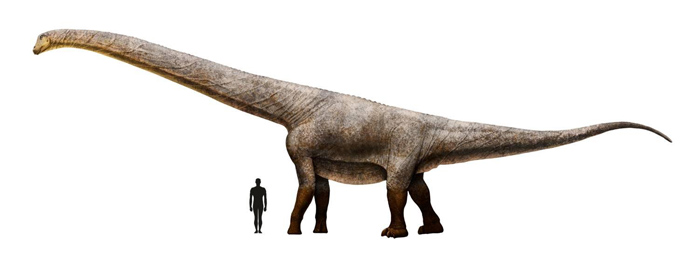
A Scale Drawing Showing “Cooper” Australia’s Largest Titanosaur Fossil Discovery to Date

A scale drawing of an Australian Titanosaur.

Scale drawing of “Cooper”.

Picture credit: Dr Scott Hocknell

Winton – The Unofficial Dinosaur Capital of Australia

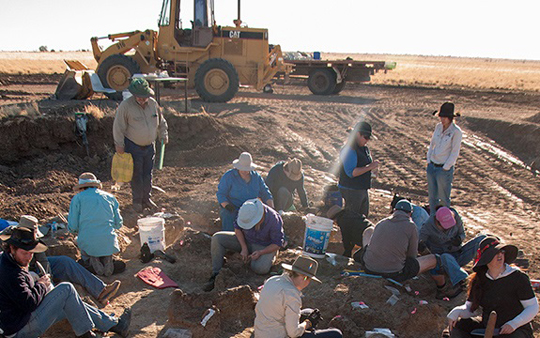
The discovery was made back in 2015, when a local rancher, Bob Elliott noticed fragments of dinosaur bone on the surface of one of his livestock paddocks.  Over the last few field seasons, volunteers, guided by the dig team’s leader Dr Stephen Poropat of Swinburne University (Melbourne), have slowly and steadily been uncovering the treasure trove of dinosaur fossil material.  Winton, named after, Winton, a suburb of Bournemouth (Dorset, southern England), is regarded as the unofficial dinosaur capital of Australia as numerous dinosaur fossils have been found.

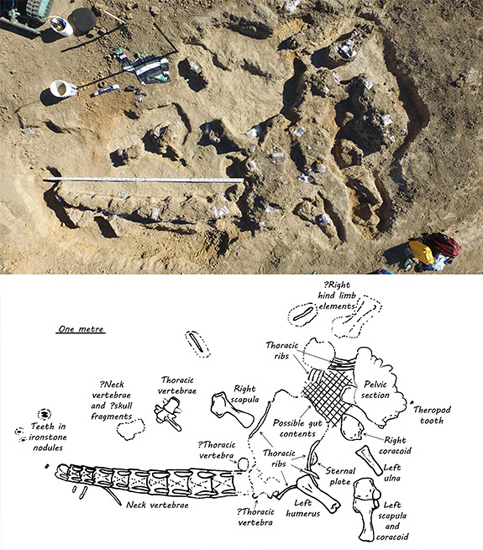
To date, the team has found four peg-like teeth, at least ten cervical vertebrae, dorsal vertebrae, pelvic material and elements from the shoulder and limbs.

Commenting upon the importance of this dig site in the context of Australian dinosaurs, Dr Poropat stated:

“This just might be the most complete sauropod ever found in Australia.  We have probably more than twenty-five percent of the skeleton, which is phenomenal.”

Palaeontologists and Volunteers Working at the Dig Site

Excavating an Australian titanosaur.

A group of field workers at the “Judy” dig site.

Picture credit: Swinburne University of Technology

An Australian Titanosaur Nicknamed “Judy”

The fossil material has been nick-named “Judy”, in honour of Judy Elliott, one of the co-founders of the Australian Age of Dinosaurs Museum in Winton.  Although a number of titanosaurs (a type of sauropod), have already been described from fossils found in this region, Dr Poropat believes that this particular specimen will give scientists a better understanding of Australia’s Late Cretaceous long-necked dinosaurs.

The postdoctoral fellow added:

“We will be able to understand many aspects of this sauropod’s anatomy, simply because we have so much of its skeleton.  By studying its teeth and neck in particular, we might be able to shed light on how it fed.”

Potential Cololites

The area where the chest and hips are located at the quarry has yet to be fully excavated.  The remains of this dinosaur’s last meal might be preserved inside the body cavity (cololites).  This would provide direct evidence as to the types of plant material this giant herbivore consumed.  If the researchers are able to locate cololites, this would be the first time gut contents in an Australian titanosaur would have been discovered.

An Aerial View of the Dinosaur Dig Site with Accompanying Schematic Drawing

The dig site with a schematic drawing showing the layout of the fossil bones.

Photograph of the dig site with schematic drawing.

Picture credit: Swinburne University of Technology

Studying an Australian Titanosaur

Dr Poropat explained that these fossils may lead to more questions:

“We still have a lot to learn about many aspects of sauropod behaviour, physiology and in the case of Australia’s sauropods in particular their skeletal anatomy.”

This herbivorous dinosaur was not fully grown when it perished (as indicated by the unfused shoulder girdles), but at around twelve metres in length it was a sizeable animal none-the-less.  The team hope to return to the dig site next month to continue the excavation.  As for when “Judy” roamed, the rocks in this arid part of Australia are estimated to be around ninety-five million years old (Cenomanian faunal stage of the early Late Cretaceous).

To read an article on the naming of an Australian titanosaur: The Naming of a Titanosaur.

For an article discussing more dinosaur finds from Queensland: Time for Some More Aussie Dinosaurs.

More Australian dinosaurs discovered (2009 article): A Trio of Australian Dinosaurs.

Visit the award-winning Everything Dinosaur website: Everything Dinosaur.

1 07, 2017

Amazing Dinosaurs of China Exhibition Starts Today

By |2024-04-01T10:26:39+01:00July 1st, 2017|Categories: Dinosaur and Prehistoric Animal News Stories, Dinosaur Fans, Main Page, Press Releases|0 Comments

Dinosaurs of China Exhibition Opens

Six years in the planning, but finally the great day has arrived!  “Dinosaurs of China – Ground Shakers to Feathered Flyers” opens today, a once in a lifetime opportunity to get up close to some of the most remarkable, amazing and significant dinosaur fossils ever found.  Based in the beautiful Wollaton Hall, (Nottingham), with a complementary exhibit located at the nearby Lakeside Arts Centre, this not-to-be-missed exhibition runs from today until October 29th.

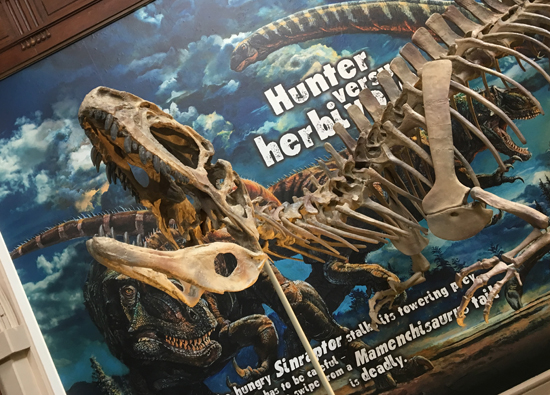
Ground Shakers like Sinraptor Welcome Visitors to the Exhibition

Sinraptor mounted skeleton.

Sinraptor dongi – fearsome Chinese theropod.  Picture credit: Everything Dinosaur.

Picture credit: Everything Dinosaur

For models and replicas of Chinese dinosaurs and other prehistoric animals: Dinosaur and Prehistoric Animal Models.

Evolution – Challenging Perceptions

This cleverly constructed exhibition features a total of twenty-six prehistoric species, plus a wealth of other exhibits and artefacts that tells the story of how one group of dinosaurs – the Maniraptora, evolved into the birds that live alongside us today.  There are lots of helpful information panels to help guide visitors and look out for the astonishing artwork that accompanies the fossils created by the famous Chinese palaeoartist Zhao Chuang.

Dr Adam Smith (Nottingham Natural History Museum and Exhibition Curator) and his team have skilfully contributed to the informative story-telling aspect of the exhibition by including a selection of fossils and other objects from the Nottingham Natural History Museum’s own collection – no mean feat in itself, as the museum is one of the largest dedicated natural history museums in the UK with over 750,000 items, including some 40,000 fossils.

Broadcaster and Naturalist Chris Packham with Dr Adam Smith Welcoming Visitors at the Press Day

The opening of the Dinosaurs of China exhibition.

Chris Packham and Dr Adam Smith speaking welcoming visitors at the press day. Picture credit: Everything Dinosaur.

Picture credit: Everything Dinosaur

With a lifelong passion for palaeontology, television presenter Chris Packham commented that he felt like “a kid in a sweet shop”.  For Chris, ground shakers such as the huge Mamenchisaurus skeleton, the tallest dinosaur exhibit ever seen in the UK, are simply awesome, but the real jaw-dropping moments are when you can get to see some of the exquisitely preserved fossils of feathered dinosaurs.  These remarkable fossils, most of which are more than 100 million-years-old, provide the “smoking gun”, as Chris so elegantly phrased it, linking the birds to the Dinosauria.

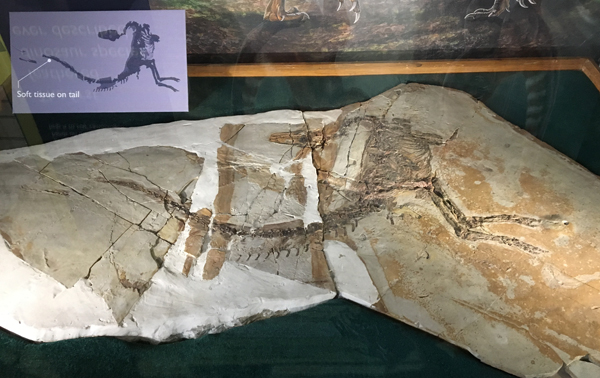
Sinosauropteryx – The First Feathered Dinosaur Ever Described

Sinosauropteryx fossil material.

Sinosauropteryx on display – the first feathered dinosaur described.  Picture credit: Everything Dinosaur.

Picture credit: Everything Dinosaur

To view the PNSO Dinosaur model range: PNSO (China) Age of Dinosaurs Models.

Discovery – A History of Chinese Palaeontology

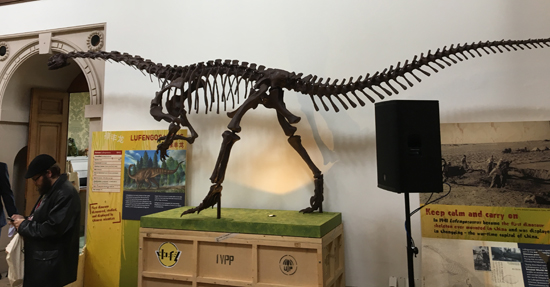
It is a case of “East meets West” with the Dinosaurs of China exhibition.  Some 250 different types of dinosaur have been named from Chinese fossils and several important specimens are on display, such as Lufengosaurus, the first dinosaur from China to be scientifically described.

One of the key themes of the Dinosaurs of China exhibition is to tell the story of Chinese palaeontology.  Thanks to the dedicated efforts of institutions such as the Beijing-based, Institute of Vertebrate Palaeontology and Palaeoanthropology (IVPP), a partner in this Anglo-Chinese joint-venture, visitors will be able to learn how our knowledge of prehistoric animals has been enriched thanks to amazing Chinese fossil discoveries.

Lufengosaurus – Early Jurassic Herbivore

Lufengosaurus huenei exhibit.

Lufengosaurus – the first Chinese dinosaur to be scientifically described.  Picture credit: Everything Dinosaur.

Picture credit: Everything Dinosaur

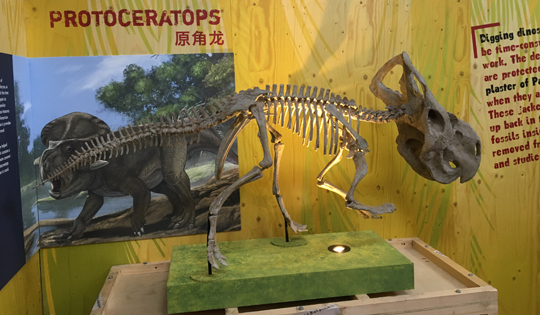
Several of the specimens featured are relatives of much better-known dinosaurs from North America.  American dinosaurs such as Triceratops may have a bigger profile with the general public  than their Asian ancestor Protoceratops, but to a palaeontologist, it is “first horned face” from Mongolia, that is the by far the most significant in terms of the amount of fossil material to study.  Protoceratops is the favourite dinosaur amongst Everything Dinosaur team members and it’s great to see it included as part of this most enjoyable exhibition.

Protoceratops – “The Sheep of the Cretaceous”

Protoceratops specimen.

Protoceratops – the favourite dinosaur amongst Everything Dinosaur team members.  Picture credit: Everything Dinosaur.

Picture credit: Everything Dinosaur

Dinosaurs of China – A Journey Through Time

Parents of young dinosaur fans will, no doubt, be informed that the majority of dinosaurs found on the ground floor date from the Jurassic.  In contrast, the exhibits found on the first floor feature Cretaceous prehistoric animals.  The displays have been carefully laid out so that the visitor is taken on a journey through geological time.  There is a transition from the Jurassic through to the Cretaceous, this helps to reinforce the idea that dinosaurs evolved into a myriad of different forms.

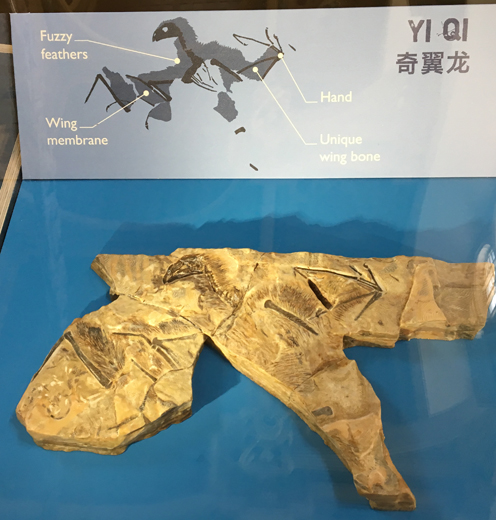
Check out the amazing Microraptor specimen and visitors will learn that this four-winged reptile was not the only flying dinosaur.  Take for example, the most recently described animal in the exhibition, the bizarre Yi qi (pronounced ee-chee), which was named just two years ago.  The three-dimensional replica on display preserves astonishing detail about this little Theropod.  The pigeon-sized Yi qi had downy feathers like a young bird, but wings that resembled those of a bat.  It probably was an accomplished glider.

The Three-dimensional Printed Replica of Yi qi

Yi qi Chinese dinosaur.

The bat-like theropod Yi qi. Picture credit: Everything Dinosaur.

Picture credit: Everything Dinosaur

To read more about Yi qi a dinosaur with webbed wings like a bat: Yi qi the Dinosaur that thought it was a Bat!

A spokesperson from Everything Dinosaur stated:

“This is a once in a lifetime opportunity to see fossils that have never been outside of Asia before.  “Ground Shakers to Feathered Flyers”, simply cannot be missed and it’s a real feather in Nottingham’s cap to be able to host such a prestigious exhibition.”

Visit the Everything Dinosaur website: Everything Dinosaur.

30 06, 2017

New Research Outlines the Origin of Filter Feeding in Whales

By |2024-04-01T10:25:37+01:00June 30th, 2017|Categories: Dinosaur and Prehistoric Animal News Stories, Dinosaur Fans, Main Page|0 Comments

Coronodon havensteini – An Important Transitional Fossil

The classification and evolutionary history of whales has been a source of fascination for many scientists.  It was the famous Swedish biologist, Carl Linnaeus, who in 1758, defined whales as mammals and not fish.

Charles Darwin speculated on the origins of whales (Cetacea), if we at Everything Dinosaur recall correctly, Darwin proposed that whales and their smaller cousins, the dolphins and porpoises had a terrestrial ancestor, but the exact evolutionary history of this diverse group of vertebrates has yet to be fully unravelled.  Step forward, the newly described Coronodon havensteini, the premolars and molars of this Oligocene-aged toothed whale have provided tantalising evidence suggesting how filter feeding in whales evolved.

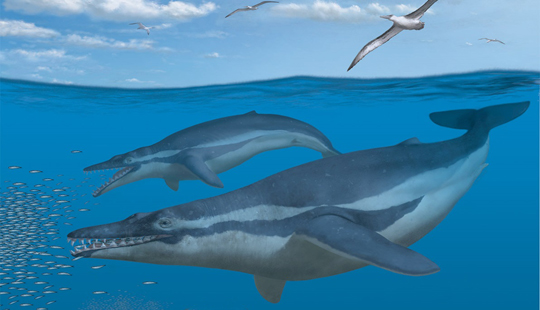
Coronodon havensteini Hunting Fish

C. havensteini feeding.

An illustration showing two Coronodon havensteini specimens chasing a school of small fish.

Picture credit: Alberto Gennari

The picture above depicts a scene off the south-eastern United States some thirty million years ago (Oligocene).  A pair of Coronodon pursue a shoal of fish, whilst above, some toothed birds (Pelagornis sandersi), circle in the hope of picking off any injured fish that come to the surface.

Different Types of Whale – Different Types of Feeding

Although, all whales share a common ancestor, a terrestrial ancestor with teeth that hunted prey (raptorial behaviour), over the fifty million years or so, since the first ancestral whales, three main feeding strategies have evolved.

  1. Odontoceti – the toothed whales the most specious component of the Cetacea consisting of Sperm whales, the Beluga, dolphins, Orcas and porpoises.
  2. Suction feeders – within the Odontocetes, a number of genera have utilised their large, broad jaws and big skulls to help them suck prey into their mouths.  Examples include many of the beaked whales and the bizarre Narwhal.
  3. Mysticeti – the baleen whales, much less diverse and specious when compared to the Odontoceti, these are the filter feeders and as such, they include the largest vertebrates to have ever existed, leviathans like the Blue whale (Balaenoptera musculus) and the Humpback (Megaptera novaeangliae).

Whilst scuba diving in South Carolina’s Wando River on the hunt for sharks’ teeth, geologist Mark Havenstein came across the well-preserved skull of an ancient toothed whale, one that seems to be a transitional fossil between raptorial toothed whales and the evolution of filter feeding cetaceans.

The Evolution of Baleen – Keratinous Sieves

Scientists from the Mace Brown Museum of Natural History, Charleston, South Carolina (where the holotype material currently resides), along with colleagues from the New York Institute of Technology College of Osteopathic Medicine (New York), prepared and restored the fossil, a subsequent study of the teeth indicates that this prehistoric whale, named Coronodon havensteini was starting out on an evolutionary path that would eventually lead to functional filter feeding.

The Restored Skull of the Oligocene Whale Coronodon havensteini

The restored skull of Coronodon.

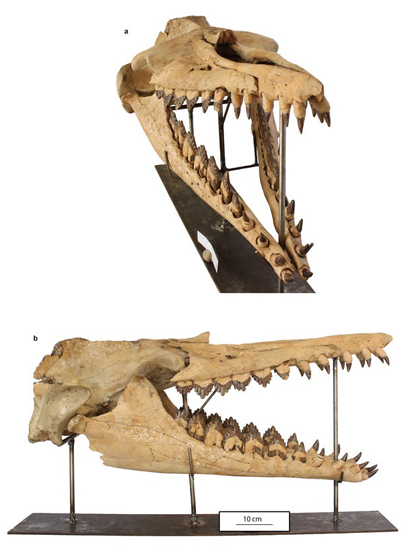
Two views of the restored Coronodon skull (a) oblique anterior view and (b) right lateral view.

Picture credit: Geisler et al (Current Biology)

Coronodon havensteini

Writing in the academic journal “Current Biology”, the researchers propose that Coronodon represents the most basal member of the baleen whales (Mysticeti) found to date.  The teeth at the front of the jaws are conical, pointed and demonstrate procumbent dentition (the teeth in the front of the jaw point forward, ideal for spearing slippery fish).  These teeth indicate a piscivorous diet, that Coronodon actively hunted its prey (raptorial behaviour).  However, a detailed analysis of the huge molars at the back of the jaws revealed something remarkable.

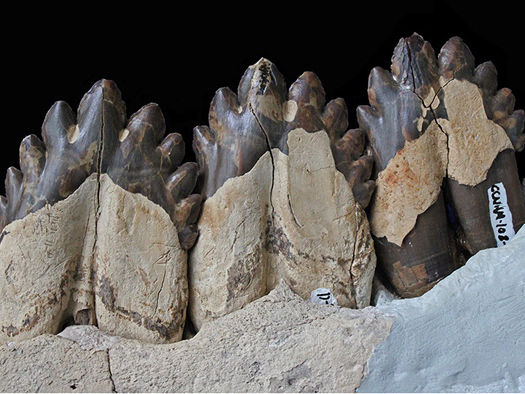
The molars show very little signs of wear from shearing or cutting up food, instead these teeth may have served as simple sieves to sift out smaller prey items from seawater.  The broad, multi-cusped molars frame narrow slits and wear patterns on the cusps indicate a role in filter feeding.

This suggests that the Mysticeti evolved their baleen plates whilst they retained their teeth and that baleen did not evolve in the mouths of Odontocetes that specialised in suction feeding and as a result, lost their teeth.

The Specialised “Filtering Teeth” of Coronodon havensteini

Coronodon havensteini molars.

The molars of C. havensteini acted as simple filters.

Picture credit: Geisler et al (Current Biology)

Commenting on the implications for their discovery, lead author of the research paper, Associate Professor Dr Jonathan Geisler (College of Osteopathic Medicine, New York Institute of Technology), stated:

“The transition from teeth to baleen is widely contested, but our research indicates that ancient toothed whales relied on the spaces between their complex and enormous teeth for filtering.  It appears that over millions of years, the teeth were retained until baleen became sufficiently large and complex to take over the role of filter feeding.”

Giant Filter Feeders

The newly erected genus name Coronodon comes from the Greek for “crown tooth”, a reference to the multi-cusped molars that indicate filter feeding.  The species name honours Mark Havenstein who found the holotype.  The researchers suggest that later lineages of ancestral Mysticetes relied on specialised molars to act as functional sieves with baleen evolving in the mouth too.  At some point in the evolution of these whales a “tipping point” was reached with a shift from mostly teeth to mostly baleen in the jaw.

The bristle-like baleen of extant filter feeding whales is made from keratin, it hangs from the upper jaw and acts like a giant sieve, straining out tiny food particles such as krill.

The researchers conclude that Coronodon havensteini lends weight to the idea that filter feeding was preceded by raptorial, predatory behaviour and that suction feeding evolved separately.

The scientific paper: “The Origin of Filter Feeding in Whales” by Jonathan H. Geisler, Robert W. Boessenecker, Mace Brown, Brian L. Beatty published in the journal “Current Biology”

Visit the Everything Dinosaur website: Everything Dinosaur.

25 06, 2017

The Sensitive Face of Neovenator

By |2023-07-27T21:56:01+01:00June 25th, 2017|Categories: Dinosaur and Prehistoric Animal News Stories, Dinosaur Fans, Main Page|0 Comments

The Neurovascular System of Neovenator – A “Touchy” Subject

When it comes to European theropods, most are only known from a handful of fragmentary bones.  An exception to this is the allosauroid Neovenator (N. salerii) from the Barremian faunal stage of the Early Cretaceous.  Some seventy percent of the skeleton of an individual animal has been excavated from the Wessex Formation exposures on the Isle of Wight and crucially, this fossil material, the holotype, includes portions from the front of the skull.

Neovenator salerii

Although it has been some twenty years, since this dinosaur was formally named and described, the fossils, especially the cranial material, can still yield intriguing information about the capabilities and potential behaviour of carnivorous dinosaurs.

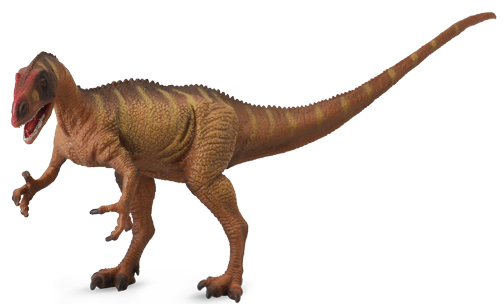
A Model of Neovenator (N. salerii)

A model of Neovenator.

“New Hunter” from the Isle of Wight.

Picture credit: Everything Dinosaur

The picture (above) shows a Neovenator from the CollectA Deluxe range.

To view this range: CollectA Prehistoric Animal Models – Deluxe.

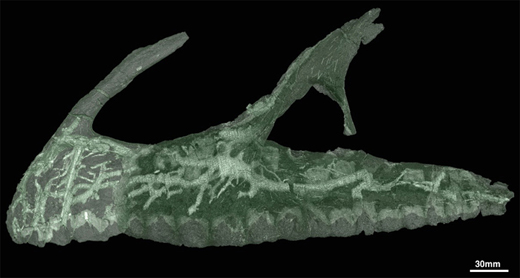
Writing in the journal Scientific Reports, a team of researchers from Southampton University in collaboration with European colleagues, provide a detailed study using computed tomography of two bones from the front part of the skull that make up the upper jaw (premaxilla and maxilla).

The research reveals the presence of a substantial network of neurovascular canals which are linked to the external surfaces of the jaw bones.  This suggests that Neovenator had a “sensitive face”, it might have been able to sense its environment, or perhaps the anterior portion of some theropod skulls played a tactile role in behaviour, dinosaurs rubbing noses for example, perhaps as a way of reinforcing bonds in a pack.    The snouts of meat-eating dinosaurs could have had a functional role, similar to the same role that our fingertips perform for us primates.  It is an intriguing thought.

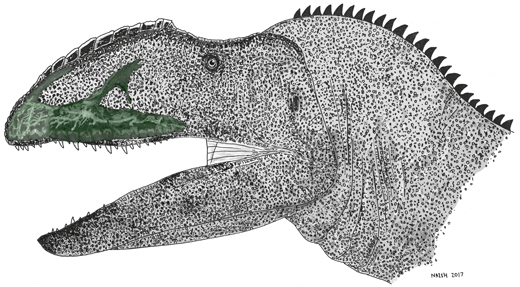
The Skull of Neovenator Showing the Location of the Premaxilla and Maxilla Fossil Bones

The skull of Neovenator showing the upper jaw bones.

The head of Neovenator reconstructed showing the holotype premaxilla and the maxilla.

Picture credit: Darren Naish

The Trigeminal Nerve

The research team took care to rule out the idea that these observed internal structures may have resulted from imaging errors arising from the scanning process.  In addition, theropod skulls like many extant tetrapods, have lots of air spaces in the bones (skeletal pneumaticity), the researchers interpreted these canals and channels as being independent and separate from the pneumatic system.  The branching structures that the team identified were concluded to be part of the neurovascular system, components the team identified were interpreted as constituents of the trigeminal nerve, sometimes referred to as the fifth cranial nerve.

This multi-branching nerve is responsible for tactile information, external temperature assessment, it has a role in motor control such as our chewing motion and provides pain receptors within the face.  It seems that Neovenator had a sensitive snout.

The Articulated Premaxilla and Maxilla of Neovenator – Scan Reveals a Network of Neurovascular Structures

Neovenator skull scan reveals neurovascular structures.

Articulated premaxilla and maxilla of Neovenator holotype MIWG 6348 in left lateral view showing neurovascular structures.

Picture credit: Barker et al University of Southampton

A Specialised Tactile Organ of Neovenator

When the size of these canals and structures were assessed they were calculated to occupy 7.3% of the volume of the premaxilla and 6.7% of the total volume of the maxilla.  If this large theropod had a very sensitive face, then this leads onto the question regarding the role or function of such a sensitive area of skin.  Some research has already been undertaken when it comes to the sensory abilities of large theropods.  For example, the cranial morphology of Spinosaurus (S. aegyptiacus) has been studied, in particular the enlarged foramina (openings) associated with the surface of the premaxilla.

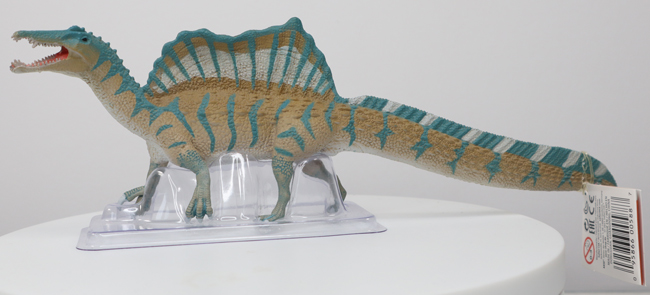
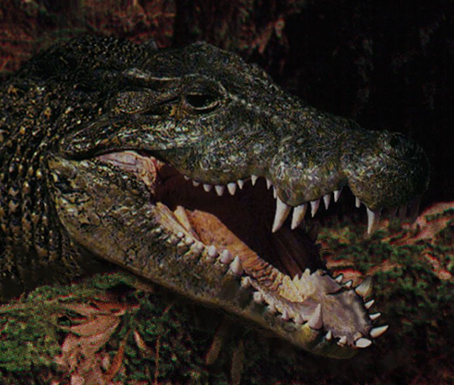
Spinosaurus is believed to have been an aquatic dinosaur, these enlarged and numerous foramina may have played a role in helping this dinosaur make sense of its aquatic environment.  Crocodylians for instance, have very sensitive jaws, lined with tiny foramina that provide sensory information (integumentary sense organs), their exact role is uncertain but they probably play a role in prey detection and orientation.

The Long Jaws of Spinosaurus Could Have Provided Sensory Information

Wild Safari Dinos Spinosaurus figure (2021).

The award-winning Wild Safari Dinos Spinosaurus figure. Picture credit: Everything Dinosaur.

Picture credit: Everything Dinosaur

The picture (above) shows a Spinosaurus figure from the Safari Ltd range.

To view this range: Wild Safari Prehistoric World Models.

In addition, earlier this year, Everything Dinosaur published a short article summarising research undertaken on a newly described species of Tyrannosaur (Daspletosaurus), which may have had a sensitive snout: New Species of Daspletosaurus Announced – The Sensitive Side of Theropods.

Exploring the Sensory Capabilities of the Dinosauria

Commenting upon the significance of this new study, one of the co-authors of the scientific paper, Dr Darren Naish, (National Oceanography Centre, University of Southampton) stated:

“This is a pretty exciting study; the results were unexpectedly good and reveal a level of anatomical detail we hoped for but didn’t realise we’d actually get.  Quite what this facial sensitivity means for the behaviour and biology of these animals is the big question – roles in feeding, foraging, nesting and social behaviour are all possible.”

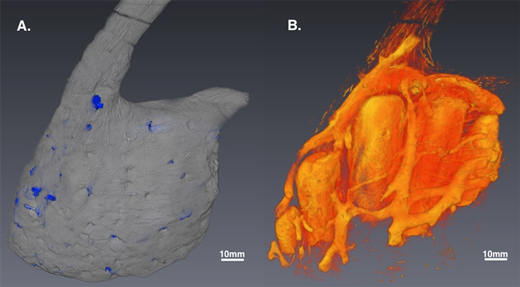
Scan of the Anterior Portion of the Skull of Neovenator

Neovantor face scan.

The complex neurovascular system observed in the premaxilla including the nervous system associated with tooth sockets.

Picture credit: Barker et al University of Southampton

Large, Complicated Facial Canals

The discovery of large, complicated internal canals within the bones of the anterior portion of theropod dinosaur skulls suggests that these were sensory organs providing an enhanced tactile function in conjunction with information about the dinosaur’s immediate environment.

This well-written paper poses a number of intriguing questions as to the function(s) of these structures.  One of the ideas suggested is that a sensitive snout helped with the mechanical process of stripping flesh from a carcass, perhaps guiding the feeding to ensure that teeth did not impact with bone.  Or maybe these structures played a role in thermoregulation, helping to keep the animal cool.

It also shows that a surprising amount of new data can be obtained by revisiting very well documented fossil material.  The researchers conclude that extensive neurovascular facial structures may not have been limited to the spinosaurids and as such regarded as an adaptation to aquatic foraging.  What roles they did play is open to speculation, enhanced facial sensitivity could be linked to a very wide range of behaviours such as precise feeding, social bonding, identifying individuals, nest selection, intraspecific combat and social interaction.

More Work is Needed

More work is required in this fascinating area of Dinosauria anatomy and our understanding of the facial neurovascular systems of extinct archosaurs would be aided with a better understanding of the facial neurovascular structures of living archosaurs such as the crocodylians and birds.

The scientific paper: “Complex neuroanatomy in the rostrum of the Isle of Wight theropod Neovenator salerii” by Chris Tijani Barker, Darren Naish, Elis Newham, Orestis L. Katsamenis & Gareth Dyke published as an open access paper in the journal Scientific Reports.

Paper is available here: Open Access Paper is here.

Visit the Everything Dinosaur website: Everything Dinosaur.

22 06, 2017

Baru – New Information on Australia’s Ancient “Super Croc”

By |2023-07-27T16:51:25+01:00June 22nd, 2017|Categories: Dinosaur and Prehistoric Animal News Stories, Dinosaur Fans, Main Page, Palaeontological articles|0 Comments

New Specimens of Extinct Crocodylian Baru Described

Australia might be home to some very unusual flora and fauna, but ever since the break-up of the ancient super-continent of Gondwana and the resulting separation of Australia from Antarctica during the Late Cretaceous, this substantial landmass has been isolated.  This isolation has enabled the development of unique ecosystems, many of which included super-sized animals much larger than those found in Australia today.

A paper published in the on-line open access journal PeerJ provides new information on one such ancient Australian resident, a genus of broad-snouted crocodile that probably specialised in ambushing large vertebrates, a formidable predator of prehistoric Australia.  The scientific paper describes new specimens of an extinct crocodylian genus Baru.  One species, Baru wickeni was previously only known from fossil material collected from the famous Riversleigh World Heritage area in Queensland.  However, the paper describes new B. wickeni fossil discoveries from a site approximately twenty-five miles south of Alice Springs in the Northern Territory.  Thus, the known range for Baru wickeni has been extended.

A Reconstruction of the Large Prehistoric Crocodile Baru wickeni

The ancient Australian crocodile Baru wickeni

A life reconstruction of the broad-snouted ancient crocodilian Baru wickeni.

Picture credit: Paul Willis

In addition, the paper documents the species of another member of the Baru genus – Baru darrowi.  B. darrowi was previously only known from the Bullock Creek site in the Northern Territory, but fossils of this reptile have also been found in the Riversleigh World Heritage area.  Thus, the range of this species has been extended too.

Baru – A Formidable Ancient Aussie Crocodile

Crocodiles assigned to the Baru genus were formidable, large predators equivalent in length to a fully-grown, extant Saltwater crocodile (Crocodylus porosus).  The skull was much more robust, the snout was broader and the head was deeper.  Furthermore, the teeth were proportionately bigger and the jaws were powered by particularly massive muscles.  Today’s “Salties” are extremely dangerous and they do attack large vertebrates including people when the opportunity arises, but mostly these crocodiles, the largest living reptiles, subsist on prey much smaller than themselves such as fish and turtles.

The skull and jaw adaptations of Baru indicate that this crocodylian was specialised towards subsisting on large vertebrate prey (animals of similar size to itself), ambushing its victims close to water sources.  In outward appearance Baru would have resembled a modern crocodile, but the deeper head and alligator-like overbite would have been more pronounced.
The Significance of the Scientific Paper

Author, Adam Yates, (Senior Curator of Earth Sciences at the Museum of Central Australia, part of the Museum and Art Gallery of the Northern Territory), has established that these two species (B. wickeni and B. darrowi) had much wider geographic ranges that in all likelihood encompassed the northern third to half of the continent.  These two species, however, did not compete with each other, as they were separated in geological time.  Baru wickeni lived earlier, its fossils date from the Late Oligocene Epoch (about 25 million years ago).  In contrast, Baru darrowi lived more recently, its remains are associated with Middle Miocene Epoch deposits (approximately 13 million years old).

A Skull of Baru wickeni from the Riversleigh World Heritage Site (Queensland)

B. wickeni skull.

A skull of the prehistoric crocodile Baru wickeni.

Picture credit: Adam Yates

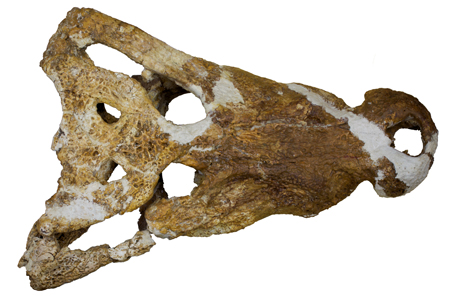
The picture (above) shows a new skull (dorsal view) of B. wickeni excavated from Riversleigh World Heritage area deposits.  This skull represents the most complete skull of any Baru species described to date, full details can be found in the scientific paper: PeerJ Paper.

Helping to Map the Timespan of Australia’s Cenozoic Terrestrial Vertebrate Fossil Sites

The Cenozoic vertebrate fossil assemblages of Australia have proved troublesome to date accurately due to the vast distances evolved between sites and their temporal isolation.  As these species of crocodiles have broad geographical ranges but relatively constrained chronological timespans, these fossils may be helpful when it comes to determining the age of some vertebrate fossil sites in Australia where there is no radiometrically dateable material and no associated mammal fossils that would normally assist with relative dating.

Another interesting implication from this paper is the presence of Baru wickeni from south of Alice Springs in what was then (and still is now) part of the Lake Eyre drainage system.  Previously Baru was known only from coastally draining marginal areas of northern Australia, while rocks of the same age in the Lake Eyre Basin of South Australia produced a distinctly different type of extinct crocodile called Australosuchus.  It was therefore suggested that Australosuchus was a denizen of the internally draining rivers of central Australia while Baru lurked in the northern fringes in rivers that drained to the north coast.

The presence of Baru wickeni south of Alice Springs, in what is part of the Lake Eyre Basin, disproves this hypothesis.  Instead the pattern may be the result of palaeolatitude, and consequently climate, with Australosuchus potentially being more tolerant of cooler conditions and subsequently occupying the cool south and Baru in the warmer northern part of the continent.

The scientific paper: “The biochronology and palaeobiogeography of Baru (Crocodylia: Mekosuchinae) based on new specimens from the Northern Territory and Queensland, Australia” by Adam Yates, published in PeerJ.

Our thanks to Adam Yates and the Museum and Art Gallery Northern Territory for the compilation of this article.

Visit the award-winning Everything Dinosaur website: Everything Dinosaur.

21 06, 2017

Tyrannosaur Skull from British Columbia

By |2023-07-27T09:41:57+01:00June 21st, 2017|Categories: Dinosaur and Prehistoric Animal News Stories, Dinosaur Fans, Main Page, Photos/Pictures of Fossils|0 Comments

Hiker Finds Part of a Tyrannosaur Skull Near Tumbler Ridge

Fossil hunter Rick Lambert was hiking in the Tumbler Ridge area of British Columbia when he spotted an unusual object partially exposed in a large rock.  It turns out the eagle-eyed chiropractor from Vancouver Island had found the maxilla bone from a tyrannosaur skull.    The maxilla is part of the upper jaw, this fossil and the teeth/teeth sockets that it contains, can help palaeontologists to identify the type of dinosaur down to genus level.

Tyrannosaur Skull Bone

This is the first dinosaur skull fossil material to have been found in this area and although the one-hundred-kilogram rock containing the fossil is not part of the local strata, it was probably moved to the site as part of a landscaping project, it’s discovery could help scientists to better understand the geographic distribution of a genus of tyrannosaur from the Late Cretaceous.

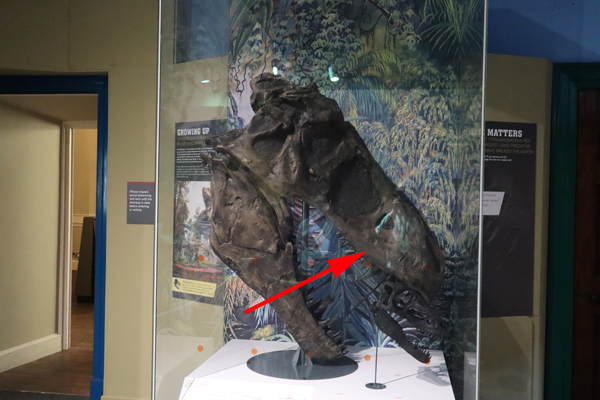
The Tumbler Ridge Tyrannosaur Skull Fossil (Maxilla)

Adult and juvenile T. rex fossil casts.

An adult T. rex and a juvenile T. rex skull cast on display. The maxilla bone has been highlighted in the adult skull fossil cast. Picture credit: Everything Dinosaur.

Picture credit: Everything Dinosaur

A Significant Tyrannosaur Fossil Find

Large theropod footprints have been found in the Tumbler Ridge area in the past, indeed, this location has provided the palaeontologists based at the Peace Region Palaeontology Research Centre, which was established back in 2003 to study the fossils, with hundreds of dinosaur teeth, fragmentary bones as well as the remarkable trace fossils, but this upper jaw bone could be a real game changer for the region.

The director of the Peace Region Palaeontology Research Centre, Richard McCrea commented:

“We are in a frontier in British Columbia because there’s been no research in this area.  This is quite a jump for us.”

Having studied and worked in geology, Rick Lambert knew he had found something significant, but he had no idea how important his fossil find could prove to be.  Rick was used to finding fossils in the area, but he wasn’t expecting to find a bone from the skull of a theropod dinosaur, a skull that would have measured more than a metre in length.

Rick explained:

“I never expected to find something like that.  It’s not anything I actually kept my eye out for.  I thought at least they would have four or five of those in a drawer somewhere.”

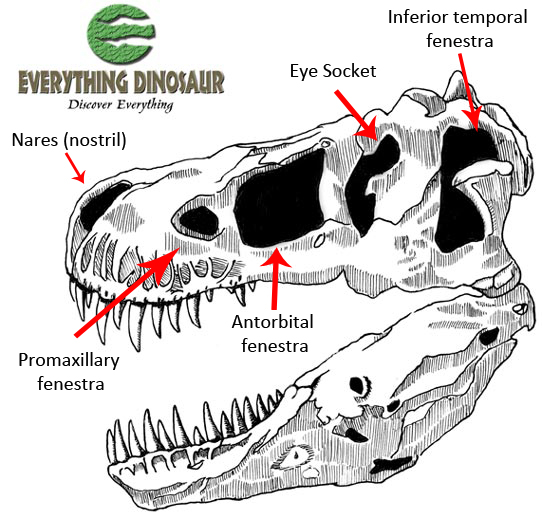
An Illustration of a Typical Tyrannosaur Skull

T. rex skull labelled.

A diagram of a T. rex skull with the fenestrae in the top half of the skull labelled. Picture credit: Everything Dinosaur.

Picture credit: Everything Dinosaur

For models and replicas of tyrannosaurs and other theropod dinosaurs: Theropod and Other Prehistoric Animal Models.

Identifying the Genus and Possibly the Species

McCrea said finding this specific piece of bone is significant because it can be used to determine the type of tyrannosaur it originated from.  Elements from the skull can be very helpful when it comes to identifying dinosaurs, however, the sandstone rock in which the fossil was found rules out a Tyrannosaurus rex.

A spokesperson from Everything Dinosaur explained:

“The Cretaceous-aged exposures in this area, mostly date from the Upper Cretaceous but they are nowhere near young enough to permit the preservation of a T. rex or any close relative of that iconic dinosaur.  The sandstone block containing the fossil material is very similar in composition to nearby deposits that are around 74-75 million years old, many millions of  years younger than the Cenomanian/Turonian strata from this locality.  The sandstone dates from the Campanian, so the maxilla very probably comes from a member of the Tyrannosauridae family that lived during that time – something like an Albertosaurus or perhaps a large Gorgosaurus.”

From a Large Tyrannosaur

Roughly shaped like a reversed capital “C”, the fossil measures between 30 to 40 centimetres in length and is around 25 centimetres wide.  It is a sizeable bone, indicating that this belonged to a very large tyrannosaur, something in excess of eight metres in length.  Local palaeontologists calculate that the entire skull of this theropod, if it could be found, would measure over a metre.

The curator and collections manager at the Peace Region Palaeontology Research Centre, Dr Lisa Buckley commented:

“The exposed maxilla and teeth are eroded, but their shape is perfectly preserved, including fine details of the delicate serrations that form the cutting edge of the teeth. The specimen has twelve teeth evident, with the potential to expose more.  The tooth count and tooth shape make it likely that this is part of the skull of a tyrannosaurid like Albertosaurus, and is probably around 75 million years old.  We aim to establish the point of origin of this rock.”

The forested terrain, steep gullies and lack of roads in this part of British Columbia makes prospecting for fossils quite challenging, however, field team members and volunteers can study the sandstone formation from which the block came from in the hope of finding more elements from the skull.

An Illustration of a Typical Tyrannosaurid (Albertosaurus)

Albertosaurus illustrated.

May have been bigger, slightly heavier, with a stronger bite.  Picture credit: Everything Dinosaur.

Picture credit: Everything Dinosaur

To read an article about theropod dinosaur prints found in the Tumbler Ridge area: Dinosaur Footprint Discovered in British Columbia.

Visit the award-winning Everything Dinosaur website: Everything Dinosaur.

19 06, 2017

Volcanic Eruptions Heralded Dawn of the Dinosaurs

By |2023-07-27T07:10:48+01:00June 19th, 2017|Categories: Dinosaur and Prehistoric Animal News Stories, Dinosaur Fans, Geology, Main Page|0 Comments

End-Triassic Mass Extinction Triggered by Volcanic Activity

The demise of the dinosaurs some sixty-six million years ago has been well documented.  This mass extinction event and its impact on the Dinosauria has been seared into the public’s consciousness with all the intensity of an asteroid impact, however, the domination of terrestrial ecosystems by dinosaurs may have been assisted by a period of intense, global volcanic activity some two hundred million years ago, an episode in deep geological time referred to as the end-Triassic mass extinction event.

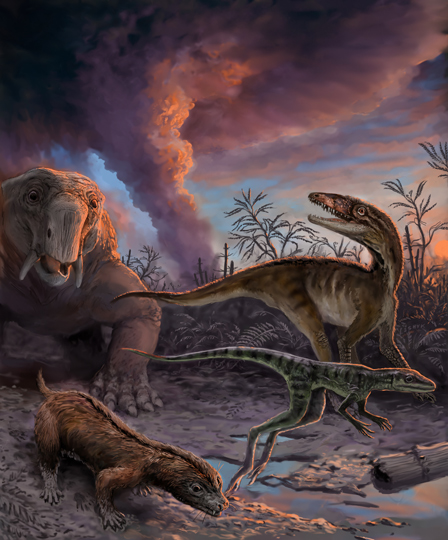
Much of the Diverse Terrestrial Fauna of the Late Triassic Died Out

The diverse fauna of Triassic Argentina.

Diverse fauna of north-western Argentina in the Triassic.

Picture credit: Victor Leshyk

End-Triassic Mass Extinction

A team of researchers based at British universities have found that huge pulses of volcanic activity are likely to have played a major role in triggering the end-Triassic mass extinction event.  The early dinosaurs survived and with a lot of the competition removed, the scene was set for the domination of life on land by this Order of reptiles.

Scientists from the University of Exeter in collaboration with colleagues from Southampton University and the Department of Earth Science at the University of Oxford have published a paper that looks at the world-wide impact of immense gas emissions as a result of volcanism and their link to the end-Triassic extinction event.

Life on Earth at the End of the Triassic

Some fifty million years or so, after the “Great Dying” – the end-Permian extinction event that saw the demise of some 95% of all life on our planet, the end-Triassic extinction event led to wholesale changes in global ecosystems.  Numerous food webs on land and in the sea collapsed and many different types of animals and plants were affected.

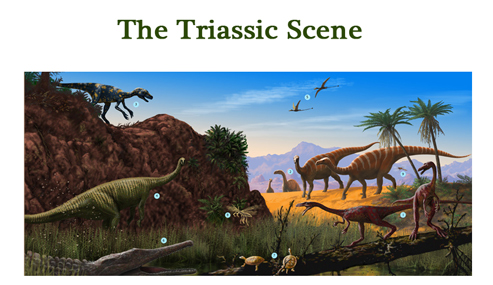
The Landscape of the Triassic

A Triassic scene from the dinosaur timeline poster.

Triassic scene from the dinosaur timeline poster.

Major Casualties of the end-Triassic Extinction Event

  • Marine molluscs (especially gastropods and cephalopods)
  • Brachiopods
  • Bivalves
  • Marine sponges
  • Conodonts
  • Marine vertebrates – fish and many types of marine reptiles (a number of ichthyosaur genera along with the extinction of the placodonts and the Nothosauroidea)
  • Several families of archosaurs along with mammal-like reptiles and numerous types of amphibians
  • Large numbers of plants especially within the Lycopodiopsida (club mosses) and the Sphenopsida (horse tails)

Everything Dinosaur stocks a wide range of prehistoric animal replicas of animals that lived during the Triassic, including marine reptiles and replicas of terrestrial animals including dicynodonts and early archosaurs.

To view the range of scale models in stock: CollectA Deluxe Prehistoric Life/World Figures.

Writing in the academic journal “The Proceedings of the National Academy of Sciences of the United States of America”, the researchers conclude that huge volumes of volcanic gas had a dramatic effect on life on Earth and slowed the recovery of ecosystems afterwards.

A Large and Abrupt Release of Carbon Dioxide

Following the discovery of volcanic rocks of approximately the same age as the extinction event, huge amounts of volcanic carbon dioxide (CO2) emitted into the atmosphere had previously been suggested as an important contributor to this mass extinction event.  Previous studies had also shown that this intense volcanism might have occurred in phases, over tens of thousands of years, but the global extent and potential impact of these volcanic episodes had remained unknown.  Extensive areas of flood basalt, a consequence of the volcanic activity, built up across much of the super-continent of Pangaea, these basalts are now found on four continents, a consequence of plate tectonics and the break-up of Pangaea.  These deposits are known as the Central Atlantic Magmatic Province (CAMP).

By studying the level of mercury found within sedimentary rocks formed during the extinction phase, the scientists were able to reveal clear links in the timing of the CAMP formation and the end-Triassic extinction.  The intense volcanic activity released mercury into the environment, which spread across the planet, before being locked away in sediments.  Any rocks formed during extensive volcanism would therefore have a higher than normal mercury content.

Studying Sedimentary Deposits

The research team studied sedimentary deposits from six locations (Austria, Argentina, Canada, Greenland, Morocco and the UK).  The levels of mercury were analysed and five of the six records showed a sizeable increase in the mercury content at the beginning of the end-Triassic extinction horizon.  Other peaks were observed between the start of the extinction event and the Triassic-Jurassic boundary, which occurred around 200,000 years later.

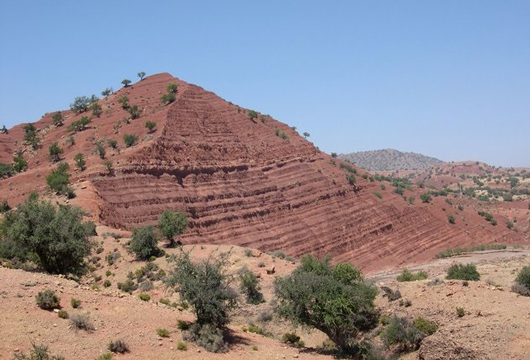
The Researchers Studied Sedimentary Deposits from Morocco

Late Triassic sediments (Morocco).

Late Triassic sediments (Morocco) were part of the mercury study.

Picture credit: Jessica Whiteside

End-Triassic Mass Extinction Study

The higher levels of mercury coincided with previously established increases in atmospheric CO2 levels.  The volcanism would have produced vast amounts of carbon dioxide that would have affected the gaseous content of the atmosphere and led to periods of global warming.

One of the authors of the scientific paper, geologist Professor Stephen Hesselbo (Camborne School of Mines at Exeter University) commented:

“This volcanic activity is strongly believed to have led to one of the largest extinction events in the Earth’s history which, in turn, paved the way for the era of the dinosaurs.  By studying the sediment deposits in Europe, South America, North America and Africa, we have been able to show a large increase in levels of mercury, which shows a clear link between this volcanic activity – specifically from very large lava flows – and the mass extinction in the era.  It’s a fascinating discovery that paves the way to enhance our understanding of this and other significant climate change events.”

In a press release, lead author Lawrence Percival, a geochemistry graduate student at Oxford University stated:

“These results strongly support repeated episodes of volcanic activity at the end of the Triassic, with the onset of volcanism during the end-Triassic extinction.  This research greatly strengthens the link between the Triassic mass extinction and volcanic emissions of CO2.  This, further evidence of episodic emissions of volcanic CO2 as the likely driver of the extinction, enhances our understanding of this event, and potentially of other climate change episodes in Earth’s history.”

To read a related article on the rise of the Dinosauria: Extreme Equatorial Climates Slowed the Rise of the Dinosaurs.

Go to Top