All about dinosaurs, fossils and prehistoric animals by Everything Dinosaur team members.

Fossil finds, new dinosaur discoveries, news and views from the world of palaeontology and other Earth sciences.

9 08, 2014

“Mega-Trove” of Dinosaur Footprints from Burgos Province (Spain)

By |2023-03-16T07:35:10+00:00August 9th, 2014|Categories: Dinosaur and Prehistoric Animal News Stories, Dinosaur Fans, Main Page|0 Comments

Spanish Site – Provides Palaeontologists with the Opportunity to Follow in the Footsteps of Dinosaurs

A site some twenty kilometres south-east of the town of Burgos in northern Spain has provided a team of palaeontologists with an opportunity to study an exceptionally well-preserved collection of fossilised dinosaur footprints.  The site, known as Las Sereas part of the Quitanilla de las Viñas trace fossil beds is believed to date from the Early Cretaceous and the location, which covers some five kilometres, preserves the trace fossils from a number of different types of dinosaur – stegosaurs, sauropods and a variety of theropods.

Dinosaur Footprints

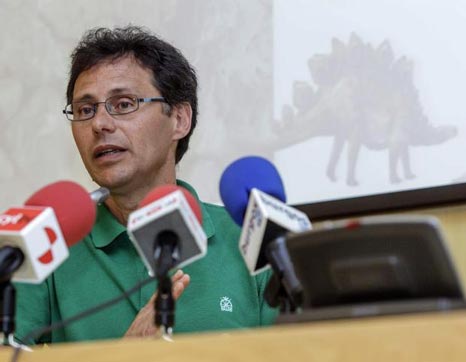
In a media briefing, the scientific director of the Las Sereas site, Fidel Torcida, heralded the huge number of footprints and regarded it as a “mega-trove” of ichnites (the term used to describe a fossil footprint).

Research Director Dr Torcida Discusses the Fossilised Footprints

Important trace fossil site from northern Spain.

Important trace fossil site from northern Spain.

Dr Torcida, who is also the research director at the nearby Dinosaur Museum (Salas de los Infantes), commented that some of the fossilised prints show sauropod prints with four toes on the front feet and not five.  He stated that the four toes are not curved, unlike all the others that have been documented around the world.

In 2011, Dr Torcida was a member of a team of researchers who described a new species of long-necked dinosaur Demandasaurus darwini.  Demandasaurus (named from the Sierra de la Demanda mountains).  It was classified as a diplodocoid and as such it was the first to be formally described from the Iberian peninsula of Spain.

Demandasaurus darwini

D. darwini is known from a fragmentary skeleton, including elements of the skull, jaws and vertebrae.  It has been placed in the Rebbachisauridae family of sauropods, a bizarre family, only established in 1997 but the family now contains more than a dozen genera including species from Africa and South America.  Demandasaurus is believed to have measured around ten metres in length and perhaps weighed more than five tonnes.

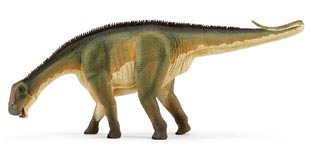
An Illustration of a Rebbachisaurid (Nigersaurus taqueti)

The "Lawn Mower" Sauropod

The “Lawn Mower” sauropod.

Picture credit: Everything Dinosaur

For replicas of sauropods and other Early Cretaceous dinosaurs: Wild Safari Prehistoric World Figures.

The site has been studied for several years, but the full extent of the trace fossil material is only beginning to be realised.  Last year, a large footprint from a sauropod was discovered, but recent excavations revealed a trail some seventeen metres long , consisting of forty-five sauropod prints.  Many of the individual prints are over fifty-five centimetres long and record a time some 144 million years ago when a large sauropod made its may across a mud flat.

In total, something like eight hundred individual footprints had been identified so far, but it was reported that there was probably more than a thousand or so trace fossils in total.  The tracks of at least three different sized theropod (meat-eating) dinosaurs had also been identified.

Over the last decade, there have been some remarkable dinosaur discoveries made in Spain.  Back in 2007, Everything Dinosaur reported on the discovery of an extensive bone bed containing the preserved remains of several Late Cretaceous dinosaurs from a site near to the city of Cuenca in western Spain.

To read more about this discovery: Dinosaur Bone bed from Spain.

7 08, 2014

Laquintasaura – What Does it all Mean? That’s a Great Question!

By |2024-05-02T12:09:00+01:00August 7th, 2014|Categories: Dinosaur and Prehistoric Animal News Stories, Dinosaur Fans, Main Page, Palaeontological articles|0 Comments

Notes on the Newly Described Dinosaur – Laquintasaura

Over the last day or so, the popular science media has carried a vast array of articles detailing the discovery of a new type of dinosaur from the continent of South America.  There have been radio interviews with some of the scientists behind the academic paper, news reports and of course, a number of video news stories too.   The great majority of the press outpourings have been excellent.  The naming of a new dinosaur is a big story, the general public seems to have an ever-lasting fascination with these ancient animals.

Palaeontologists and science editors far cleverer than ourselves have provided a comprehensive overview of Laquintasaura venezuelae, so rather than dwell on describing this animal, we at Everything Dinosaur will try to place this dinosaur discovery in context and cover some of the issues raised in the scientific paper that were not necessarily picked up by the general media.

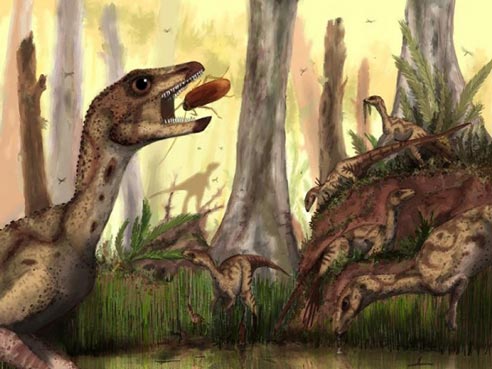
The Illustration of the Newly Named Dinosaur L. venezuelae

Small, Early Jurassic, bird-hipped dinosaur

Small, Early Jurassic, bird-hipped dinosaur.

Picture credit: Mark Witton/Natural History Museum

Why Saura and Not Saurus?

First of all, let’s deal with the name Laquintasaura venezuelae.  The fossil material (and there is lots of it), comes from a single bone bed located at a dig site which is effectively a road cutting between the two small towns of Seboruco and La Grita in  Táchira State, western Venezuela, just a few miles from the border with Columbia.

The horizon from which the fossils were excavated form part of the La Quinta Formation, which outcrops in western Venezuela and eastern Columbia.  So the  name is pronounced La-quin-tah-sore-rah  ven-ee-zway-lay and it translates as “Venezuela’s lizard from the La Quinta”, but note the ending of the genus, it is “saura” and not the much more common “saurus”, what’s going on here?

Saura is the female form of the Greek word saurus, it still means lizard and a number of dinosaurs have been given genus names which take the female form of saurus, examples are the likes of Maiasaura (means “good mother lizard”), or the small Cretaceous ornithopod Leallynasaura which was named after the daughter of the discoverer.  There is nothing particularly feminine about Laquintasaura, it is very likely that the bone bed represents the remains of both males and females, in this case, we think the name has come about as the rock formation “La Quinta” has a female root.

Early Jurassic – So What?

The majority of the rocks that make up the La Quinta Formation are sandstones, accurately dating these rocks is made all the more difficult due to the lack of marine deposits and the more abundant zonal fossils that help to date them.  However, the scientists involved in this study have been able to date the age of the fossils with a very high degree of confidence.  Zircon crystals found very close to the fossilised bones permitted highly accurate radiometric dating techniques to be applied.  Essentially, these crystals are abraded by acids, cooked at very high temperatures and then the proportion of uranium isotopes is measured.

Radioactive elements such as uranium begin to decay from the moment they are formed.  They decay and form “daughter” isotopes by shedding electrons at a consistent, regular rate.  By measuring the proportion of isotopes in these minute zircon crystals the rock formation can be accurately dated.  The fossils of Laquintasaura are 200.91 million years old, plus or minus half a million years or so.

Very few dinosaur fossils have been found that can be dated so accurately to this period in Earth’s history.  The vast majority of the dinosaur fossils that have been dated to around 200 million years or so, are lizard-hipped dinosaurs (saurischians), Laquintasaura is a member of that other group of dinosaurs, the bird-hipped dinosaurs (Ornithischia).

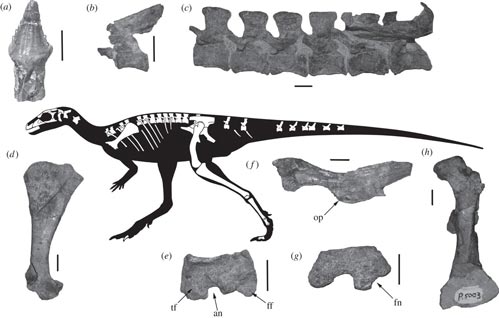
Photographs of Some of the Fossil Material and Outline Body Shape

Abundant fossil finds.

Abundant fossil finds.

Picture credit: Proceedings of the Royal Society B.

What’s so Special about Laquintasaura?

The picture above shows an outline of the body shape of Laquintasaura.  It was estimated to be about a metre long, but half of its body length was made up of the tail.  It was lightly built and probably a fast runner, roughly the size of a common Red Fox (Vulpes vulpes).  The drawing also indicates the sort of fossil material that has been found.  Most of the fossils are isolated teeth, or represent bones from the hip area or fragments of rib.  However, other fossils representing parts of the skull, the limb bones and vertebrae have also been found but these elements are much rarer.  The fossils represent the remains of at least four individuals, but probably many more.

Key to the Picture

  • (a) Triangular cheek tooth
  • (b) Neck bones
  • (c) Dorsal vertebrae
  • (d) Left shoulder blade
  • (e) Part of the ankle bone
  • (f) Left ischium (bone from the hip)
  • (g and h) Views of the femur

This is the first early ornithischian bone bed containing the bones of a number of individual dinosaurs found anywhere in the world.  Studies of the bones suggest that the fossils represent a group of animals that ranged from about three years to twelve years of age.

Although the bones are jumbled up, they do not show any obvious signs of having been transported a long distance perhaps by a river in spate.  Palaeontologists interpreting this fossil deposit have suggested that this bone bed was not formed over a long period, where single dinosaur carcases were deposited in the same location as a result of seasonal, violent floods.

The fossils seem to have been transported and deposited in a low-energy water environment, perhaps a slow moving river and it has been suggested that this group of dinosaurs died in a single catastrophe.  It is unclear whether they all died as a result of becoming stuck in the water, or whether the water transport occurred after death.   This suggests that this was a social group, a small herd or a flock if you prefer.

Most palaeontologists are confident that later ornithischians, the likes of the iguanodonts, duck-billed dinosaurs and the horned dinosaurs lived in herds.  If Laquintasaura is a social, bird-hipped dinosaur, then these fossils have provided the earliest known evidence for the evolution of complex social groups in the Ornithischia.  This social behaviour in ornithischian dinosaurs is being seen around fifty million years earlier than previously thought.

Weird Teeth

The teeth are unlike any other teeth associated with ornithischian dinosaurs.  They are quite prominent, and although triangular in shape, the edges are curved and slightly concave in appearance.  The edges of the crown (the tooth that sticks out of the gum) are coarsely serrated.  This suggests that this little dinosaur was most probably a herbivore eating tough ferns and horsetails.  It probably also grabbed at passing insects or small reptiles from time to time, hence the bug eating Laquintasaura depicted in Mark Witton’s excellent illustration (see above).

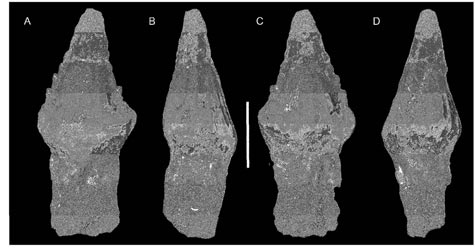
A Close up of One of the Teeth of Laquintasaura (various views)

Strange teeth indicate herbivorous habit.

Strange teeth indicate herbivorous habit.

Picture credit: Barrett et al, Proceedings of the Royal Society B.

Venezuela’s First Dinosaur – Dinosaurs Thrived Around the Equator

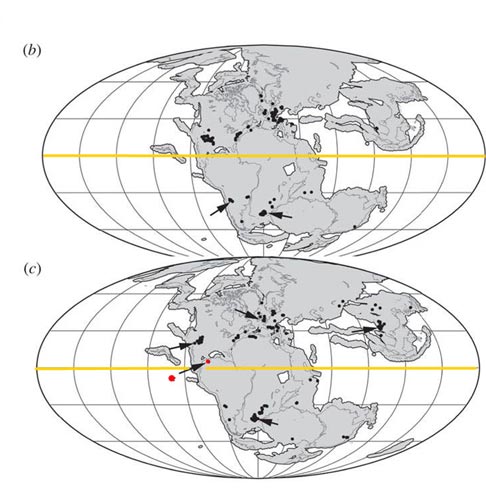
Much has been made of the fact that this is the first dinosaur ever to be discovered in Venezuela.  Indeed, this is the first dinosaur to be named and described from the northern portion of South America.  Two hundred million years ago, Venezuela formed part of the central portion of the giant super-continent Pangaea.  Laquintasaura seems to have thrived in a habitat close to the equator in the centre of this huge land mass.  Very few dinosaur fossils have been found in what is termed the palaeoequatorial region.

It had been thought that much of this part of the world in the Late Triassic/Early Jurassic was too hot and dry to support extensive, complex ecosystems.  Much of this area was thought to have been covered by vast, inhospitable deserts.  However, the finding of the fossils of Laquintasaura suggests that dinosaurs and most likely other types of vertebrate did live in these regions.

The Location of the Laquintasaura Fossils (Palaeoequatorial Environment)

Spatial distribution of early bird-hipped dinosaurs.

Spatial distribution of early bird-hipped dinosaurs.

Picture credit: Proceedings of the Royal Society B.

The diagram (b) shows the location of dinosaur fossil finds mapped onto a picture of the world from the Late Triassic.  The yellow line indicates the position of the equator.  Diagram (c) shows the position of dinosaur fossil finds known from the very Early Jurassic.  Arrows indicate ornithischian dinosaur finds.  Note the scarcity of palaeoequatorial dinosaur finds and the very limited palaeobiogeographical distribution of ornithischians in the Late Triassic and their subsequent spread in the Early Jurassic.  The red dot in diagram (c) indicates the site of the Laquintasaura fossils.  As these dinosaurs were small, around one metre in length, it is highly unlikely that these dinosaurs could have migrated long distances, this and the fact that the fossil bones show little sign of long distance transport indicates that Laquintasaura lived close to the equator.

The discovery of Laquintasaura suggests that there were ornithischian dinosaurs living close to the equator around 200 million years ago.  Their presence (and the discovery of two theropod teeth at the same site), indicates that western Venezuela supported a diverse and flourishing ecosystem.

What Does it Mean for Dinosaur Evolution?

The fossils of Laquintasaura come from just a few hundred thousand years after the end Triassic extinction event.  The period of deep time marked by the end of the Triassic experienced a mass extinction event.  The type and diversity of terrestrial vertebrates altered dramatically with many kinds of reptile and amphibian becoming extinct.

Palaeontologist Dr Paul Barrett of the Natural History Museum (London) and one of the lead authors of the scientific paper commented:

“Laquintasaura lived very soon after the major extinction at the end of the Triassic Period, 201 million years ago, showing dinosaurs bounced back quickly after this event.  It is fascinating and unexpected to see they lived in herds, something we have little evidence of so far in dinosaurs from this time.”

Either the dinosaurs did recover quickly after this extinction event or they were not too badly affected when compared to other vertebrates.

Laquintasaura

In addition, scientists are aware that by the Middle Jurassic, the bird-hipped dinosaurs had begun to diversify into a range of body types.  There were the likes of the ancestors of the camptosaurs, heterodontids and the first of the armoured dinosaurs.

This research carried out by the University of Zurich and the Natural History Museum is helping to piece together the origins and the subsequent diversification of this group of the Dinosauria that led them to become the dominant terrestrial herbivores of the Mesozoic.

5 08, 2014

Duck-Billed Dinosaurs Lived in Herds like Elephants

By |2023-03-15T08:07:52+00:00August 5th, 2014|Categories: Dinosaur and Prehistoric Animal News Stories, Dinosaur Fans, Main Page|0 Comments

Dinosaur Tracks from Alaska Reveals Herd Structure of Edmontosaurs

Thousands of dinosaur footprints discovered in Alaska have provided palaeontologists with the first definitive guide to the herd structure of Late Cretaceous duck-billed dinosaurs.  The fossil site location is within the boundaries of Denali National Park and it represents one of the greatest concentrations of dinosaur tracks ever discovered.  The site provides evidence that at least four different sizes of the same species lived together in a herd and it supports the theory that dinosaurs lived at high latitudes all year round.

Dinosaurs at High Latitudes

The tracksite was discovered back in the summer of 2007 by a field team led by a trio of palaeontologists, Dr Anthony Fiorillo (Perot Museum of Nature and Science, Dallas), Dr Yoshitsugu Kobayashi (Hokkaido University Museum, Japan) and Dr Stephen Hasiotis (University of Kansas), an academic paper detailing the discovery has just been published in the journal “Geology”.  The actual fossil site is being kept a closely guarded secret but the strata is part of the Upper Cretaceous Cantwell Formation.

Commenting on the discovery, lead author of the scientific paper, Dr Fiorillo stated:

“Without question, Denali is one of the best dinosaur footprint localities in the world, but what we found was incredible, so many tracks, so big and so well preserved.  Many had skin impression so we could even see what the bottom of their feet looked like.  And there were lots of invertebrate traces, the tracks of bugs, worms, larvae and more, which were important to us because they showed an ecosystem existed during the warm parts of the year.”

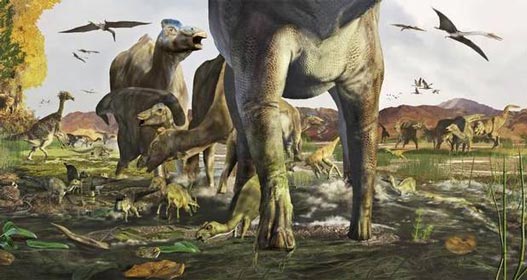
An Illustration Depicting the Late Cretaceous of Alaska

Different sized prints indicate herd members of different sizes.

Different sized prints indicate herd members of different sizes.

Picture credit: Karen Carr

Edmontosaurus

The picture above depicts an imagined summer scene in the Late Cretaceous of Alaska.  A herd of Edmontosaurus (duck-billed dinosaurs) wade across a body of water, whilst a tyrannosaur ambushes a group of these herbivores, on the left of the scene, a giant therizinosaur looks on.  A flock of azhdarchid pterosaurs soars overhead.

Dr Fiorillo and his colleagues from the Perot Museum of Nature and Science have been at the fore front of studies into Alaskan dinosaurs.  As well as exploring the fossilised trackways, the Dallas based scientists have helped with the documentation of a new species of Alaskan pachyrhinosaur and provided footprint evidence to suggest that therizinosaurs roamed this far north.

To read an article about the discovery of a fossilised footprint from a potential therizinosaur: Is this Evidence for an Alaskan Therizinosaur?

Five Exposed Bedding Planes

The fossil site, was believed to represent as many as five exposed bedding planes when it was initially examined but a number of summer expeditions were able to map the area and identify this location as a single bedding plane preserving the footprints made by several types of dinosaur as they wandered close to a large body of water, either a slow moving river or possibly a large lake.  The vast majority of the footprints are those made by duck-billed dinosaurs, as fossilised remains of Edmontosaurus have been found in this part of the world, it has been assumed that the tracks were made by a herd of Edmontosaurus dinosaurs.

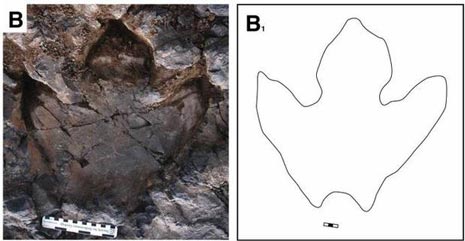
 A Close Up of One of the Fossilised Plant-Eating Dinosaur Footprints

Large, tridactyl prints from an Hadrosaur.

Large, tridactyl prints from an hadrosaur.

Picture credit: Perot Museum of Nature and Science

The picture shows B an in situ photograph of a single footprint with its associated line drawing (B1).

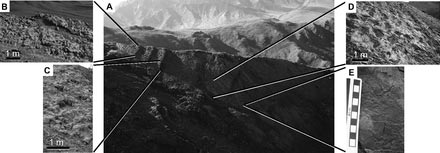
Aerial Photographs and Pictures that Provide an Overview of the Fossil Site

Various views of the location.

Various views of the location.

Picture credit: Perot Museum of Nature and Science

The picture above shows various black and white views of the location.  The large photograph in the centre is a view of the Denali National Park tracksite from the air.  Picture B shows the left side of the trackway with each dimple in the shot representing a single footprint.  Picture C shows a typical hadrosaur track at the site, whilst D shows hadrosaur footprints from the right side of the fossil site.

Different Dinosaurs Including Theropods

Other types of dinosaur also walked over the muddy surface, preserving their footprint impressions as trace fossils, picture E records the tracks of two, small theropod dinosaurs.

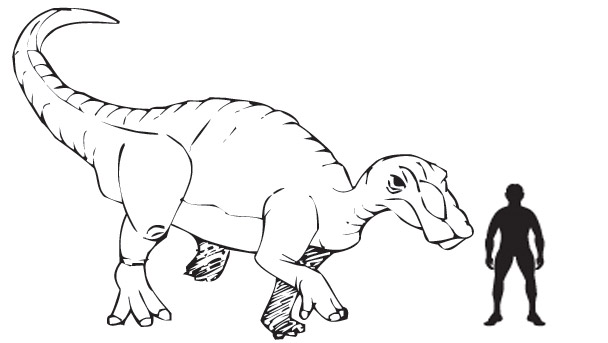
An Illustration of an Edmontosaurus (Hadrosaur)

Edmontosaurus Dinosaur

Edmontosaurus dinosaur.

Picture credit: Everything Dinosaur

As this part of Alaska is subject to occasional Earthquakes, steps have been taken to preserve as much data about the site as possible.  Over the last few years, the tracks have been carefully measured, photographed and recorded.  In addition, many casts of individual prints have been made and these are now safely in storage at the Dallas museum.  Some of these casts are on display, permitting members of the public to gain in insight into the ongoing research on polar dinosaurs.

Trace fossils such as surface trails and shallow burrows from insects and other invertebrates found amongst the dinosaur footprints led the scientists to conclude that this site represents a single event, one that was produced in the warmer months of the year – the polar summer.

Seasonal Distribution

Seasonal distribution of modern, extant, equivalent invertebrates suggest that the tracksite was formed in the warmest months of the year during the Late Cretaceous.  How warm was it?  Palaeoenvironmental studies indicate that this part of the world had a much milder climate than it does today.  Summer temperatures could have averaged 12-14 degrees Celsius, whilst the darkest winter months would have led to freezing temperatures with perhaps occasional highs of 4 -5 degrees Celsius.

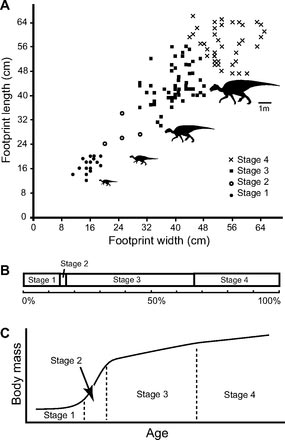
Duck-billed dinosaur footprints (the ichnogenus Hadrosauropodus, but believed to represent Edmontosaurus), in the 180 metre by 60 metre site were then measured (length v width measurements) and a scatter-plot graph generated.  The scientists discovered that four different sized prints of duck-bills were present at the site.  This suggests that adult animals roamed in herds that also contained sub-adults, juveniles and very young animals.

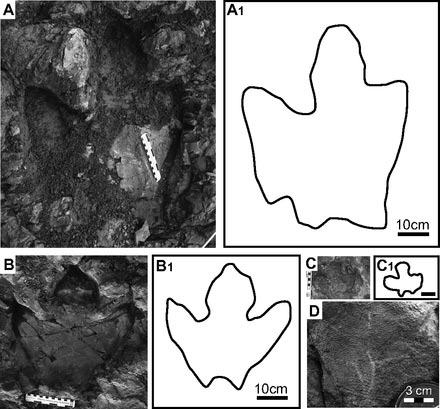
Scientists Identified Different Sized Duck-billed Dinosaur Prints

Large prints, medium sized prints and tracks made by very young animals were identified.

Large prints, medium sized prints and tracks made by very young animals were identified.

Picture credit: Perot Museum of Nature and Science

The picture shows photographs and corresponding scale drawings of three differently sized dinosaur prints found at the site.  So well preserved were the prints from these hadrosaurs that something like fifty percent of the tracks preserved traces of the skin impressions from the underside of the dinosaur’s foot (D).  These tracks suggest that this group of dinosaurs formed a herd structure similar to extant elephants. Elephants live in extended families with many different age groups represented in the herd.

Maastrichtian Faunal Stage

The fossilised footprints, estimated to be around 70 million years old, indicate that at least some types of plant-eating dinosaur may have lived in similar social groups.

In addition, the scientists looked at the frequency of the different sized prints across the site.  The two largest classes of print made up 84% of all the footprints found.  The smallest prints made up 13% but the second smallest footprints only represented 3% of all the tracks.  The researchers have suggested that this frequency pattern reinforces the histological studies of dinosaur bones carried out by other palaeontologists that indicate duck-billed dinosaurs experienced a rapid growth spurt.

Scatter Graph of the Footprint Data Linked to Projected Hadrosaur Growth Chart

Four sizes of Hadrosaur print identified.

Four sizes of hadrosaur print identified.

Picture credit: Perot Museum for Nature and Science

Different size classes are consistent with extant populations that breed seasonally (A), the bar graph (B) shows the relative frequencies of each growth stage with figure C plotting frequency against proposed hadrosaur growth stages.  The tracks support earlier studies of duck-billed dinosaur bones that showed that these reptiles underwent a rapid growth spurt as relatively young animals.  Presumably, this strategy had evolved as an adaptation against predation.

To read an article about hadrosaur growth rates: Duck-billed Dinosaurs Grew Fast to Avoid Tyrannosaurs.

The research team also suggest that since small hadrosaurs were members of the herd, then it was unlikely that these dinosaurs migrated northwards to take advantage of the long daylight hours before returning to the south to avoid the worst of the polar winter.  The young hadrosaurs were probably not capable of making long migrations and this implies that these dinosaurs were year-round residents of the polar regions.

For models and figures of duck-billed dinosaurs and other Late Cretaceous prehistoric animals: CollectA Deluxe Prehistoric Life Figures.

4 08, 2014

Unravelling a Remarkable Ammonite Mystery

By |2024-05-02T12:11:17+01:00August 4th, 2014|Categories: Dinosaur and Prehistoric Animal News Stories, Main Page, Palaeontological articles|3 Comments

Why did the Ammonites go Extinct but the Nautilus Survive?

A team of international researchers led by scientists from the American Museum of Natural History (New York), have been trying to unravel one of the great mysteries of invertebrate palaeontology.  Why did the ammonites go extinct but their relative the Nautilus survive the Cretaceous extinction event?  Building on previous research, lead author of the scientific paper, published this week in the journal “Geology”, Dr Neil Landman believes that over specialisation and limited geographic distribution led to the downfall of this particular group of chambered shelled molluscs.

 A Nautilus Compared to an Extinct Ammonite

Similar creatures but only the Nautilus is around today.

Similar creatures but only the Nautilus is around today.

Picture credit: Everything Dinosaur/Safari Ltd

Ammonites

Ammonites belong to the Class Cephalopoda and they seem to have been entirely marine, pelagic animals (living above the sea floor).  Although more closely related to today’s cuttlefish, ammonites and their living relative the Nautilus both had coiled, chambered shells.  The first nautiloids can be traced back to the Late Cambrian, whilst the ammonites are believed to have originated in the Devonian geological period.

There are two extant genera of Nautilus alive today.  These animals tend to be found in deep water (up to seven hundred metres, although more usually around three to four hundred metres) and they inhabit the deeper slopes of coral reefs in the Indo-Pacific.  They are believed to be scavengers feeding on a variety of dead animal matter.

In this new study, the researchers including scientists from the Royal Belgian Institute of Natural Sciences, Saint Petersburg State University, Polska Akademia Nauk (Warsaw), Bowling Green State University (Ohio) and the Natural History Museum of Maastricht (Holland) as well as Dr Landman, mapped all the locations of ammonite fossil finds in the last half a million years or so of the Cretaceous (Maastrichtian faunal stage).  They then compared this data with the occurrences of the nautiloid genus Eutrephoceras over the same period.

Surviving into the Palaeogene

The scientists also included information from a recently published study that looked at ammonite genera that appear to have briefly survived beyond the Cretaceous into the Palaeogene.

What? Evidence of ammonites surviving beyond the Cretaceous extinction event we hear you ask!  There is some evidence to suggest that a few types of ammonite did indeed survive into the Age of Mammals.  Perhaps the very last of this great group of marine invertebrates lived for a hundred thousand years or so before they too finally became extinct.

In a few, very special locations the sequence of strata that was led down at the end of the Cretaceous (Maastrichtian faunal stage) and the first deposits of the Palaeogene (Palaeocene epoch, Danian faunal stage) can be identified.  One such location is the cliffs at Stevns Klint on the Danish island of Sjaelland.  Fragmentary fossils representing two different genera of ammonite have been identified from the strata immediately above the thin, dark line that marks the end of the Cretaceous.

Dr Landman has been at the forefront of these studies and he believes as many as six species may have lingered, sort of “dead clades swimming”.

Fragmentary Fossils of Ammonites from Stevns Klint

Fragmentary fossils indicate survival of some species into the Palaeocene Epoch.

Fragmentary fossils indicate survival of some species into the Palaeocene Epoch.

Picture credit: PLOS One

 The picture above shows ammonite fossilised remains found in the Palaeocene aged strata at Stevns Klint and surrounding area.  Pictures A, B and D-H are fossils of the ammonite Baculites vertebralis whereas picture C represents the species Hoploscaphites constrictus.  The white arrows in pictures A and C indicate voids left after the dissolution of the original aragonite shell.

To read more about Stevns Klint being granted UNESCO World Heritage status: Famous KT Boundary Gets UNESCO World Heritage Status.

Studying Geographical Distribution

The research team plotted the fossil data against two criteria, firstly they looked at all the occurrences of each genus and secondly they looked at the maximum distance between occurrences for each genus, an examination of geographical distribution based on an assessment of world geography at the end of the Mesozoic.  The scientists discovered that most of the ammonite genera at the very end of the Maastrichtian were restricted in their geographic distribution.  This may have made the ammonites more susceptible to an extinction event.  This idea is reinforced when the geographical spread of those genera that may have briefly survived into the Palaeocene is examined.

These genera have a significantly greater geographical spread when compared to non-surviving ammonite genera.  The research team suggest that those types of ammonite that were more broadly distributed had a greater chance of survival, at least for a little while longer.  This pattern is further emphasised when the distribution of the nautiloid  Eutrephoceras is considered.  The scientists found that the distribution of Eutrephoceras was as broad as that of the most widely distributed ammonites at the end of the Cretaceous.

However, even the most geographically dispersed ammonites became extinct in the Palaeocene, whereas Eutrephoceras survived.  This new paper proposes that a broad geographical distribution may have initially protected some ammonites against dying out, but it was no guarantee of their ultimate survival.

Ammonite Fossils are Popular with Fossil Collectors

Examples of fossil Ammonites.

Examples of fossil ammonites.

Picture credit: Everything Dinosaur

Restricted Distribution

The restricted distribution of ammonites may have contributed to their extinction.  Other studies have also helped shed light on the reasons for the demise of the Ammonoidea, Dr Landman and his colleagues at the American Museum of Natural History have been at the forefront of many of these research projects.  Many scientists now agree that ammonite numbers and the range of species was in decline before the end of the Cretaceous and this Subclass of cephalopods would have been devastated by the aftermath of the extraterrestrial impact event.  Large amounts of acid rain falling into the sea would have significantly altered the pH balance of marine environments, this would have had a major impact on ammonite numbers.

Dr Landman stated:

“The ammonites petered out due to more than one disastrous change caused by the impact.  Ocean acidification likely dissolved the shells of their microscopic young, which floated on the ocean’s surface early in their life-cycle.  Fossil records also show the impact event devastated plankton species, the primary food source for adult ammonites.  These effects may have only lasted a hundred years or so, but that would have effectively starved some of the ammonites.”

To read a related report by Everything Dinosaur into studies of the prey of Ammonites: The Last Supper of an Ammonite.

In contrast, the deeper living nautiloids may have been less affected by changes at the ocean’s surface and as they are less reliant on plankton as a staple source of food they could have ridden out the cataclysmic events.  This may explain why there are two genera of nautiloids around today but as far as anyone knows, not one species of ammonite remains.

Everything Dinosaur’s Review of the Recently Introduced Wild Safari Ammonite Model

Video credit: Everything Dinosaur

To view Everything Dinosaur’s range of Safari Ltd prehistoric animal models including ammonite models: Safari Ltd. Wild Safari Prehistoric World.

CollectA have also introduced ammonite and nautiloid replicas: CollectA Prehistoric Life Replicas.

2 08, 2014

Stunning Miocene Baleen Whale Fossil Rescued from Hillside

By |2024-05-02T12:11:50+01:00August 2nd, 2014|Categories: Dinosaur and Prehistoric Animal News Stories, Main Page|0 Comments

Californian Search and Rescue Team have a “Whale” of a Time

A search and rescue team at Los Angeles Sheriffs department are reflecting on a job well done as yesterday (Friday), they were called in to conduct a very unusual rescue.  Normally, the volunteers are involved in helping the authorities to save lives, but on this occasion the subject of the rescue had passed on sometime before the crew arrived – around sixteen million years earlier or thereabouts.  The volunteers had been called in to help extract a huge boulder that contains part of the fossilised jaw of a long extinct Baleen whale.

Miocene Baleen Whale Fossil

The fossil was located in a ravine close to Chadwick School in the Rancho Palos Verdes area of Los Angeles.  Although this suburb overlooks Long Beach to the east and is somewhere around three miles from the Pacific Ocean, back in the Miocene, the area was covered by a shallow sea.  This area teemed with life and several different types of whale fossil have been found, including the fossilised skull of a toothed whale that was removed from Chadwick School in January.  This new fossil discovery, just a hefty stones throw from the school, represents the partial jaw of a filter feeding Baleen whale (Order Mysticeti).  It might represent a new species.

Researchers at the Natural History Museum of Los Angeles County heard about the whale fossil earlier this year when, in all the surrounding publicity of the Chadwick School discovery, local resident Gary Johnson informed the museum about the fossil he had found when as a teenager he explored a ravine behind the family home.

Fossils Have Helped Palaeontologists Learn More about Prehistoric Whales

PNSO Requena the Livyatan model

PNSO Requena the Livyatan prehistoric whale model anterior view.

The picture (above) shows the PNSO Requena the Livyatan prehistoric whale model, to view the range of prehistoric whale replicas and other monsters of the sea in stock at Everything Dinosaur: Sea Monster Models and Figures.

Howell Thomas, from the palaeontology department at the Museum explained that the boulder was a shale deposit and that had been laid down at the bottom of the shallow Miocene sea.  Over millions of years, the land had been uplifted to form the hillside and a number of large fossils of ancient cetaceans had been discovered in this part of southern California.  Howell, was keen to point out how rare Baleen whale fossils are, according to the Museum, this new discovery represents one of only twenty known Miocene Baleen specimens in the world.

Back in March, Everything Dinosaur reported on the excavation of a large number of Miocene whale fossils but this time from the Atacama desert of Chile.  It seems that these fossils represented a form of mass stranding of cetaceans and scientists were interested in trying to understand the cause of the stranding as well as in the extraction and preservation of the fossil material.

To read this article: Algal Bloom the Probable Cause of Miocene Mass Strandings.

The rock containing the fossil, a partial jawbone, a section of the baleen plate and elements of the skull weighed an estimated five hundred kilogrammes and the rescue team used a special three-legged frame and lifting winch called an Arizona Vortex Multipod to lift the specimen so that it could be lowered onto a special crate in readiness for hauling over an improvised track way.  The tracks led to a waiting truck that could then take the fossil to the Museum, where the specimen will hopefully be put on display.

Commenting on the significance of the discovery, Thomas stated:

“It is a very rare fossil and something that we actually go out looking for.  We find lots of whale fossils in Palos Verdes, so any backyard could house a fossil.   However, the fossil in this particular case is very, very rare.  It is very significant.”

The search and rescue team chief, Mike Leum, commented that his volunteers were more used to rescuing hikers stuck on the hillside, although the techniques the team employed to remove the specimen were typical of what they do, this mission was a little out of the ordinary.

Mike explained:

“For us, we are usually moving people, so this is our oldest victim in history.  The good news is, she is not complaining at all and we don’t have to get her to the emergency room.”

Mr Leum, then stated that the exercise had been useful training for the team and officials from the Natural History Museum of Los Angeles County outlined the plans that they had for the specimen.  Once the fossil had been catalogued and placed in the Museum’s research collection, researchers will set about the painstaking process of cleaning and preparing the fossil.  Vertebrate palaeontologists will then be able to compare this material with other Miocene whalebone specimens to see if these fossils do indeed represent a new species of Baleen whale.

30 07, 2014

Astonishing Giant Sauropod Claw Discovered in France

By |2024-05-02T12:17:54+01:00July 30th, 2014|Categories: Dinosaur and Prehistoric Animal News Stories, Main Page|2 Comments

On the Pedals of a Sauropod

An enormous fossilised claw of a giant sauropod has been uncovered by field workers excavating material from a dig site about forty-five miles east of Limoges in the picturesque Poitou-Charente region of France.  The site located at Angeac-Charente, has yielded a number of Early Cretaceous dinosaur fossils including vertebrae from a stegosaur and sauropod teeth.  The claw which may have been located on the first digit of the front foot, measures an astonishing thirty-four centimetres in length.  Heavy rain in this part of France had severely hampered this summer’s field work, but ironically the rainfall had help expose this enormous fossil.

Giant Sauropod Claw

A Photograph of a Sauropod Hind Foot

Sauropod claw fossil (the hind foot of a diplodocid.

A sauropod hind foot. Picture credit: Everything Dinosaur.

Picture credit: Everything Dinosaur

The bone is referred to as an ungual phalanx, it is the very last bone found at the end of the toe/finger (usually) and this is the bone that would have supported the claw.  The dig site has over the last six years or so, yielded in the region of 4,000 fossilised bones.  Despite the wealth of fossil material it is not possible to determine the species or indeed the genus to which this sauropod belonged.  However, based on comparisons with other sauropod claws, palaeontologists estimate that the individual dinosaur whose bone this is, might have reached a length in excess of forty metres.

Huge Sauropod Femur Found

The site has attracted the attention of a number of France’s leading vertebrate palaeontologists including Ronan Allain, (Museum of Natural History in Paris) and Jean-François Tournepiche, curator at the Museum of Angoulême.  One of the biggest sauropod femurs ever found in the Northern Hemisphere was discovered at the same site four years ago.  It is not known whether this thigh bone and the new claw fossil discovery come from the same dinosaur.  At least seven different types of dinosaur roamed this part of France around 130 million years ago (Barremian faunal stage of the Early Cretaceous).

Sue of Everything Dinosaur and a Sauropod Limb

A cast of a sauropod dinosaur foot.

Sauropod limb on display. Picture credit: Everything Dinosaur.

Picture credit: Everything Dinosaur

To read about the discovery of giant sauropod tracks not far from the Swiss border: Giant Sauropod Fossilised Footprints Found in France.

Sediment analysis in conjunction with fossilised plant remains suggest that this region was a large, low-lying swamp.  Sauropod dinosaurs had three prominent claws on their hind feet and a bigger single claw on the first digit of their front feet.  Scientists have speculated that this claw might have been used for defence or in combat between rivals.

We at Everything Dinosaur, don’t favour this hypothesis, preferring instead to consider this huge front digit claw as like a sort of “crampon”.  The claw would have helped these enormous dinosaurs to keep their balance and to stop them sliding in soft mud.  Bones in the feet are referred to as “pedals”, hence our caption “on the pedals of a sauropod”.

To view models and replicas of sauropods: Mojo Fun Prehistoric and Extinct Models and Figures.

28 07, 2014

Dinosaur Extinction – A Perfect Storm

By |2023-03-14T11:07:49+00:00July 28th, 2014|Categories: Dinosaur and Prehistoric Animal News Stories, Dinosaur Fans, Educational Activities, Teaching|2 Comments

Bad Luck and Bad Timing for the Dinosaurs

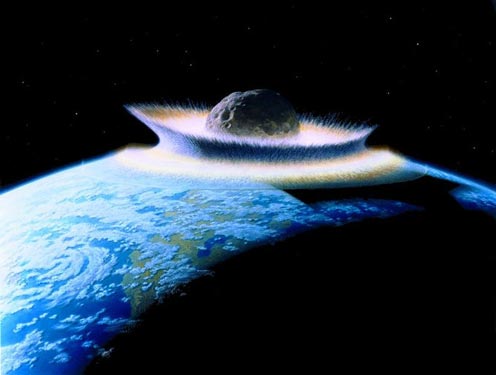
A new collaborative study looking at the dinosaur fossil record from the Upper Cretaceous of North America suggests that if the extraterrestrial impact event had occurred a few million years before or after it actually hit, life on Earth could be very different today.  Dinosaurs could well be still roaming around.  If the Dinosauria (with the exception of the birds), had not gone extinct, then it could be argued that many of the families of mammals so familiar to us today may not have evolved.  The evolution of the primates, and indeed, our own species, might not ever have happened.

Unlucky Dinosaurs Sixty-six Million Years Ago?

Cataclysmic impact event.

Cataclysmic impact event.

Picture credit: Don Davis (commissioned by NASA)

Dinosaur Extinction

Similar studies into the extinction event that took place approximately 66 million years ago have been carried out before, however, this new research, published in the latest edition of the academic journal “Biological Reviews” and led by the University of Edinburgh, focused on examining an updated catalogue of North American dinosaur fossils, in a bid to understand how well the Order Dinosauria was doing in terms of species diversity at around the time of the impact event.

Previous studies, examining the number of different dinosaur species and genera preserved in Upper Cretaceous strata such as the Hell Creek Formation of the western United States, have showed that the number of different types of dinosaur fossils found declines in rocks that mark the time period towards the end of the Cretaceous.  A lack of diversity in an ecosystem, or the dominance of one particular type of creature, can make such ecosystems vulnerable to sudden and dramatic changes that ultimately lead to an extinction.

An International Research Team

The research team, drawn from a number of universities and museums, conclude that prior to the impact event, our planet was experiencing dramatic environmental upheaval.  Changing sea levels, fluctuating global temperatures and enormous amounts of volcanic activity were all happening.  Many groups of animals and plants were under stress and the devastating impact from a six-mile-wide space rock provided the final “coup de grâce” that finished off the dinosaurs.

Soon to Become Extinct

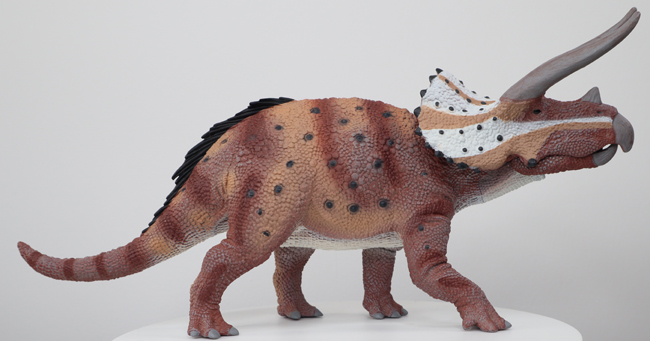
CollectA Triceratops horridus 1:40 scale dinosaur model.

The CollectA Triceratops in right lateral view. Picture credit: Everything Dinosaur.

Picture credit: Everything Dinosaur

The picture (above) shows a CollectA Deluxe Triceratops.  To view the CollectA scale model series: CollectA Deluxe Prehistoric Life Scale Models.

The research team which includes scientists from Edinburgh University, Birmingham University, Imperial College (London), Oxford University, University College (London) and Baylor University (Waco, Texas) suggest that the dinosaurs’ food chain was threatened by a lack of diversity amongst large herbivorous dinosaurs.  The lack of diversity, much of North America was dominated by a handful of plant-eating types of ornithischian dinosaur, created a “perfect storm” and the vulnerable Dinosauria was unable to recover from the extraterrestrial strike and its aftermath.

Everything Dinosaur team members have provided a number of teaching resources to schools that help to explain extinction events.  To read an article specially prepared for use in schools at Key Stage 2 and 3 about the Cretaceous mass extinction event: Dinosaur Extinction Event – Providing Teaching Resources for Schools.

A Stimulus to Evolution

Environmental change, even dramatic global events such as an asteroid impact can in fact provide a stimulus to evolution.  Earlier extra-terrestrial impacts which at first caused devastation may actually have acted as catalysts helping certain types of life to flourish.

It can be argued that once the dinosaurs became extinct, the Mammalia were able to rapidly diversify and exploit the niches left vacant by the demise of the Dinosauria, back in 2010, Everything Dinosaur reported on a scientific paper that suggested that earlier cataclysmic events and significantly benefited life on Earth.

To read this article: Extra-terrestrial Impact Led to Palaeozoic Explosion of Life.

Dr Steve Brusatte (School of GeoSciences at Edinburgh University) commented:

“Five million years earlier dinosaur ecosystems were much stronger, they were more diverse, the base of the food chain was more robust and it was harder to knock out a lot of species.  If they had a few million years more to recover their diversity they would have had a better chance of surviving the asteroid impact.  Dinosaurs had been around for 160 million years, they had plenty of dips and troughs in their diversity but they always recovered.”

A number of mass extinction events have been identified in the fossil record.  Such mass extinctions ultimately led to a change in direction for life on Earth, permitting new types of organism to evolve.

A Table Showing the Major Extinction Events of the Phanerozoic Eon

Mass Extinction in Summary

Table credit: Everything Dinosaur

The research team hope to extend their study by taking into account vertebrate fossil data from Upper Cretaceous sediments that have been examined in China and Spain.  This will help the scientists to formulate a global picture.  Naturally, with such academic papers, there is always speculation as to whether or not the dinosaurs would have survived until the present day.  Some speculators go further and ask the question would the dinosaurs have evolved greater intelligence, perhaps evolving into the reptilian equivalents of primates and eventually into a form of humanoid dinosaur – a dinosauroid?

Could the Earth Have Been Dominated by “Intelligent Dinosaurs”?

What intelligent life on Earth might have looked like if the dinosaurs had not become extinct.

What intelligent life on Earth might have looked like if the dinosaurs had not become extinct.

Picture credit: Boxtree

Dr Brusatte speculates that the Dinosauria could well have survived and that non-avian dinosaurs could make up a significant proportion of the fauna today, whilst other scientists, including a number who worked on this study remain less sure.

For example, Dr Richard Butler (Birmingham University) stated:

“We can’t re-run the tape of life and see whether an impact at a different time would have led to total extinction.  But it [extra-terrestrial impact event] did come at a particularly bad time.”
25 07, 2014

Did All Dinosaurs Have Feathers? That is an Excellent Question!

By |2024-05-02T12:19:05+01:00July 25th, 2014|Categories: Dinosaur and Prehistoric Animal News Stories, Dinosaur Fans, Educational Activities, Palaeontological articles|0 Comments

Kulindadromeus Discovery Gets Palaeontologists into a Flap

The embargo has been lifted and we can now talk about the amazing new fossil discovery from Siberia, details of which has just been published in the academic journal “Science”.  News of the discovery of the first ever plant-eating dinosaur with feathers as well as scales has been announced.  So what does this mean?  Feathered dinosaurs have been discovered before right?  True, but and it is a big “but“, feathers have only been associated with one group of dinosaurs up until now, the theropods, the group of dinosaurs most closely related to birds.

Kulindadromeus

The dinosaur has been named Kulindadromeus zabaikalicus and at just over a metre in length, it is not going to be breaking any size records when it comes to extinct prehistoric animals.  Indeed, if we had the technology to travel back 175 million years or so, to the area surrounding what was to become the Siberian city of Chita, this little dinosaur would have probably gone almost unnoticed.  However, the publication of this long-awaited scientific paper is very important and over the next few paragraphs we will try to put this fossil discovery into perspective.

The Order Dinosauria (the dinosaurs) can be split into two distinct groups based on the structure and position of their hip bones.  These two sub-divisions are the Ornithischia (bird-hipped dinosaurs) and the Saurischia (lizard-hipped dinosaurs).  Those theropods many of whom were feathered, belong to the saurischians.   The Siberian fossils show that a member of the ornithischian group also had feathers.

Feathers Amongst the Dinosauria

Ornithischians had feathers too.

Ornithischians had feathers too.

Picture credit: Everything Dinosaur

The Dinosaur Family Tree

The picture above shows the dinosaurs split into two groups, on one side of the dinosaur family tree are the lizard-hipped dinosaurs, the long-necked sauropods and the theropods, those mainly meat-eating dinosaurs who are the closest related to birds (Aves).  The other part of the Dinosauria consists of the bird-hipped ornithischians, an almost entirely vegetarian group consisting of the horned dinosaurs, duck-bills, armoured dinosaurs and such like.  Kulindadromeus, described as a neoornithischian dinosaur and definitely amongst the bird-hipped dinosaurs, shows that other types of dinosaurs, not just the theropods had feathers too.

Kulindadromeus zabaikalicus

The terms “bird-hipped” and “lizard-hipped” can be a little confusing, especially when we are trying to identify the ancestors of birds.  These terms were first coined by Henry Govier Seeley in 1887.  He divided the dinosaurs into two groups, based on the fact that all the dinosaurs known at the time (and the majority of dinosaurs discovered to date for that matter), had a pelvis that followed one of two distinctive shapes.

There was a bird-like pelvis, where the pubis bone points backwards and the lizard-hipped configuration where the pubis bone points forward.  It is the lizard-hipped dinosaurs,the theropoda, that are most closely related to the Aves and indeed one group of theropods, the maniraptorans that are the direct ancestors of today’s birds.

Classifying the Dinosauria
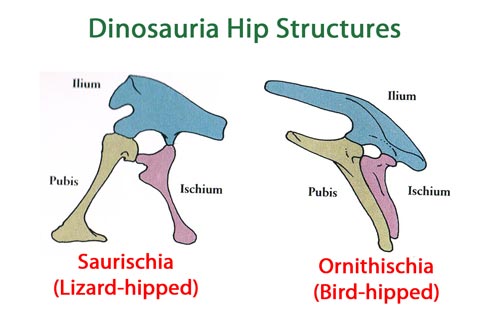
Classifying dinosaurs by the shape of their hip bones.

Classifying dinosaurs by the shape of their hip bones.

Picture credit: Everything Dinosaur

Back in 2010, a scientific team led by Sofia Sinitsa, a geologist at the Institute of Natural Resources, Ecology and Cryology from the Siberian city of Chita, explored some highly fossiliferous strata located in the nearby Kulinda valley.  The site represented a low energy depositional environment with freshwater crustaceans, insect larvae and plant fossils.  The strata was laid down by the edge of a large lake, evidence of ash in the layers of rock indicated that there were volcanoes in the neighbourhood too.

Fragmentary fossils indicating the presence of small dinosaurs were also discovered but their poor state of preservation led the scientists to focus on other fossil material.  Expeditions to the same locality found more fossils of dinosaurs over the next two summers and as a result, Pascal Godefroit, a palaeontologist at the Royal Belgian Institute of Natural Sciences (Brussels) was contacted along with other scientists as the implications of the discovery began to dawn on the Russian team.

Dr Godefroit commented:

“We were completely shocked by the discoveries.”

Pictures from the Dig Site and Some of the Fossil Material Collected

A vast amount of fossil material was collected.

A vast amount of fossil material was collected.

Picture credit: Royal Belgian Institute of Natural Sciences

Bristle-like and brush-like structures had been identified in a number of Cretaceous species of ornithischian dinosaur, most notably in dinosaurs such as Psittacosaurus and Tianyulong, but these quills, brushes and bristles have been described by researchers as representing the very earliest development stage of feathers, what scientists call proto-feathers.

To read an article by Everything Dinosaur on the evidence of quills and bristles in later ornithischian dinosaurs:

Evidence of feathers in psittacosaurids: Upsetting the Apple Cart.

The scientists claim that these new fossils differ from the the bristle-like structures found in much later ornithischian dinosaurs as they have complex, multi-filamented structures typical of the feathers associated with the Theropoda.

Kulindadromeus zabaikalicus (pronounced Cul-lin-dah-dro-me-us zah-bay-cal-lik-us) had been named after the Kulinda valley locality and from the Greek “dromeus”, which means runner.  The trivial name honours the Zabaikal krai region of Siberia in which the Kulinda valley can be found.

An Illustration of Kulindadromeus zabaikalicus

Feathered dinosaur down amongst the horsetails.

Feathered dinosaur down amongst the horsetails.

Picture credit: Andrey Atuchin

Dated to around 175 to 160 million years ago (Aalenian to Early Callovian of the Mid Jurassic), this one- metre-long plant-eater had filamentous structures covering most of its body, including its head, neck and chest.  The more complex feather-like structures are confined to the upper arms and upper legs, an arrangement found in a number of fossils of small theropod dinosaurs excavated from Cretaceous strata in the famous Lioaning Province of north-eastern China.

Explaining the significance of this discovery, Dr Godefroit stated:

“For the first time we found more complex, compound structures together with simpler hair-like structures in a plant-eating dinosaur that really resemble the proto-feathers in advanced meat-eaters”.

Multiple Filamentous Structures Associated with the Femur (Thigh Bone)

Complex feather-like structures on the thigh

Complex feather-like structures on the thigh.

Picture credit: Royal Belgian Institute of Natural Sciences/ Dr. Pascal Godefroit

Fossil Feathers

The scientists are confident that these little, fast-running creatures could not fly, so why evolve feathers then?  The answer is quite simple, feathers first evolved for other purposes and they only became adapted for flight much later.  These feathers probably helped to keep these small animals insulated and warm.  This suggests that contrary to popular opinion, most dinosaurs were endothermic (warm-blooded  like mammals and birds) and not cold-blooded like today’s reptiles.

The longer, more complex feather structures may have had some role in display and visual communication.  In total, at least six fossil skulls have been found along with a large number of fossilised bones from many individuals and lots of different growth stages have been recognised.  The abundance of fossil material will give the palaeontologists the chance to study how feathers changed as animals grew and matured.

If this neoornithischian had complex feathers then this also throws up an intriguing set of possibilities.  The common ancestor of both the ornithischian and saurischian dinosaurs could have been feathered, or perhaps, feathers evolved in different types of dinosaur, an example of convergent evolution.

Chinese palaeontologist Xing Xu of the Institute of Vertebrate Palaeontology and Palaeoanthropology (Beijing), someone who has intensively studied the Lioaning feathered dinosaurs commented:

“The finds are a fantastic discovery”.

However, he warns against getting too carried away, stating that the fossils are too fragmentary to be certain that the more complex feathery structures actually correspond to those found later in birds.  We suspect that further research is going to be carried out into the nature of these branched integumentary structures, before palaeontologists will agree that feather-like structures were widespread amongst the Dinosauria.

One of the co-authors of the scientific paper, Professor Danielle Dhouailly from the Université Joseph Fourier in La Tronche (France ), has been examining these ancient structures and comparing them to the down and feathers found in modern birds.  The lake sediments also preserved scales, so scientists now have evidence that both scales and feathers could be found on individual dinosaurs.  In addition, scientists now know that the leg scales found in modern birds are essentially aborted feathers.

The Ancient Lake Sediments Preserved Evidence of Scales

Fossilised bone (sandy colour) surrounded by evidence of small scales on the foot.

Fossilised bone (sandy colour) surrounded by evidence of small scales on the foot.

Picture credit: Royal Belgian Institute of Natural Sciences/ Dr. Pascal Godefroit

Professor Dhouailly added:

“Developmental experiments in modern chickens suggest that  avian  scales are aborted feathers, an idea that explains why birds have scaly legs.  The astonishing discovery is that the molecular mechanisms needed for this switch might have been so clearly related to the appearance of the first feathers in the earliest dinosaurs”.

There is more research to be done, but this discovery has potentially huge implications for our view of the Dinosauria.  Ironically, back in the beginning of 2014, Everything Dinosaur team members were asked to predict what news stories might occur over the year and they did predict that a discovery regarding feathered ornithischian dinosaurs would be announced.

To read Everything Dinosaur’s full list of 2014 predictions: 2014 Palaeontology Predictions.

Team members congratulate all those involved in this exciting fossil discovery and the subsequent research.

To view models and replicas of feathered dinosaurs and other prehistoric creatures: Safari Ltd Prehistoric World Figures.

21 07, 2014

Brain of World’s First Super Predator Studied

By |2023-03-14T10:02:23+00:00July 21st, 2014|Categories: Dinosaur and Prehistoric Animal News Stories, Main Page, Palaeontological articles|0 Comments

Brain Provides Clue to the Descendants of the Cambrian Anomalocaridid Lyrarapax unguispinus

An international team of scientists, including researchers from the University of Arizona have identified and mapped the brain in an anomalocaridid that swam in the ancient seas that existed in the Cambrian geological period.  Their study of the brain of this twelve centimetre long predator provides clues as to the taxonomic relationship that this extinct group has to extant members of the Animalia Kingdom.

The Brain of an Anomalocaridid

In addition, the remarkably well preserved fossil that is around 520 million years old, suggests that the brains of the anomalocaridids were relatively simple, the brains of their prey were, in many cases more complex.  This leads to the intriguing thought that the evolution of apex predators could have given a boost to the evolution of better senses and ultimately bigger and more sophisticated brains.

The scientific paper, published in the journal “Nature” describes for the first time, the brain of an anomalocaridid, a group of extinct, early members of the Arthropoda that evolved into the first group of animal super-predators known in the fossil record.  The largest specimens of Anomalocaris measure around a metre in length and it is now known that this group of nektonic predators survived into the Ordovician.

Anomalocaris

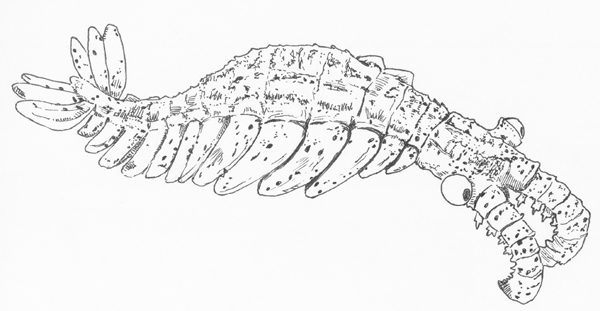
An Illustration of a Typical Anomalocaridid

Anomalocaris

Anomalocaris drawing. Picture credit: Everything Dinosaur.

Picture credit:  Everything Dinosaur

To view models and replicas of prehistoric invertebrates including Anomalocaris (whilst stocks last): CollectA Prehistoric Life Models.

Super Predator

An extensive analysis of the beautifully preserved fossils of a new to science, species of anomalocaridid predator discovered in Yunnan Province (China), suggests that these creatures have an affinity with the bizarre velvet worms (Onychophorans).  These strange little creatures are found in the southern hemisphere and they are classed in the taxon Panarthropoda.  Unlike true arthropods these creatures do not have an exoskeleton and they live in the undergrowth and leaf litter feeding on smaller animals such as insects and mites.

An Illustration of a Velvet Worm (Peripatus)

Peripatus - creatures like this may have been the first to walk on land.

Peripatus – creatures like this may have been the first to walk on land.

Picture credit: BBC

The fossil material comes from the famous Chengjiang Formation (Yunnan Province), which rivals the Burgess Shale of British Columbia in terms of the variety of Cambrian fauna that is preserved.  First explored by Chinese palaeontologists in 1984, the members that make up this part of the Chengjiang Formation have preserved in exquisite detail ancient marine creatures.  The degree of fossil preservation is so good that even internal structures such as nervous systems can be studied.

One of the Fossils of the Newly Described L. unguispinus Showing Brain Morphology

This photograph and corresponding drawing show the flattened, fossilized trace of the brain of the world's earliest known predator; the X-like structure in the head denotes the fossilised brain.

This photograph and corresponding drawing show the flattened, fossilised trace of the brain of the world’s earliest known predator; the X-like structure in the head denotes the fossilised brain.

Picture credit: University of Arizona

The Fossilised Brain

The “X-shaped” structure seen clearly in the line drawing interpretation of the fossil denotes the fossilised brain.  Two dark round spots represent the optic ganglia with nerves that lead from the eye-stalks into the head.  The smaller, almond-shaped areas just in front would have supported the creature’s grasping appendage.  The main brain region is in front of the mouth, giving rise to two nerve cords leading down along the animal.

Commenting on the research, lead author of the scientific paper, Professor Nicholas Strausfeld (Director of Arizona University’s Centre for Insect Research) stated:

“It turns out the top predator of the Cambrian had a brain that was much less complex than that of some of its possible prey and that it looked surprisingly similar to a modern group of rather modest worm-like animals.”

Lyrarapax unguispinus

The new species has been named Lyrarapax unguispinus, this translates from the Latin to mean “spiny clawed lyre shaped predator”.  It is likely that this creature was an active predator hunting other invertebrates and perhaps preying on the recently evolved primitive, jawless vertebrates, the fore-runners of the first fish.

Lyrarapax Attacks a Shoal of Primitive Fish

Artist's impression of Lyararapax, one of the species of the world's first predators, the anomalocaridids, chasing its possible prey, primitive fishes that also existed in the Lower Cambrian

Artist’s impression of Lyrarapax, one of the species of the world’s first predators, the anomalocaridids, chasing its possible prey, primitive fishes that also existed in the Cambrian.

Picture credit: Professor Nicholas Strausfeld/University of Arizona

Professor Strausfeld and his colleagues have made some remarkable discoveries amongst the Chengjiang biota, back in the autumn of 2013, Everything Dinosaur reported on the mapping of the brain and nervous system of a Cambrian arthropod, fossils of which had been recovered from the same location as the Lyrarapax fossil material.

To read more about this remarkable discovery: Mapping the Ancient Brains and Nervous Systems of Cambrian Arthropods.

By examining in minute detail the brain morphology of this long extinct species, the scientists were able to compare the neuroanatomy with extant velvet worms (Onychophorans).  The terrestrial velvet worm, such as Peripatus, has a simple brain located at the front of the mouth and a pair of ganglia, a group of nerve cells, located in the front part of the optic nerve and at the base of long, sensory feelers.

Similar Neuroanatomy to Extant Velvet Worms

The anomalocaridid fossil resembles the neuroanatomy of today’s Onychophorans (velvet worms) in several ways, according to Strausfeld and his collaborators. Onychophorans have a simple brain located in front of the mouth and a pair of ganglia – a collection of nerve cells – located in the front of the optic nerve and at the base of their long feelers.  Anomalocaridids do not have these feelers, but they do have a pair of grasping claws extending out from the front of their heads.

Professor Strausfeld explained:

“Surprise, surprise, that is what we also found in our fossil.  These top predators in the Cambrian are defined by just their single pair of appendages, these wicked-looking graspers, extending out from the front of their head.  These are totally different from the antennae of insects and crustaceans.  Such frontally disposed appendages are not found in any other living animals with the exception of the velvet worms.”

Study Suggests Velvet Worms are Descended from Anomalocaridids

A side-by-side comparison reveals the similarity between the brain of a living Onychophoran (green) and that of the anomalocaridid fossil Lyrarapax unguispinus (grey)

A side-by-side comparison reveals the similarity between the brain of a living Onychophoran (green) and that of the anomalocaridid fossil Lyrarapax unguispinus (grey).

Picture credit: Professor Nicholas Strausfeld

The relatively simple brain structure of these large, apex predators may have driven the evolution of more sophisticated senses and brains in their intended prey.

Professor Strausfeld concluded:

“With the evolution of dedicated and highly efficient predators, the pressure was on other animals to be able to detect and recognize potential danger and rapidly coordinate escape movements.  These requirements may have driven the evolution of more complex brain circuitry.”

A Close up of the Head of Lyrarapax Showing a Powerful Grasping Claw

The grasping claw on this specimen can clearly be seen.

The grasping claw on this specimen can clearly be seen.

Picture credit: Peiyun Cong

Everything Dinosaur acknowledges the help of a University of Arizona press release in the compilation of this article.

19 07, 2014

Biggest Ever Apatosaurus Thigh Bone Discovered in Colorado

By |2024-05-02T11:43:35+01:00July 19th, 2014|Categories: Dinosaur and Prehistoric Animal News Stories, Main Page|0 Comments

Apatosaurus Femur Fossil – Biggest Apatosaurus Fossil Femur Found to Date

Reports received from Colorado state that a six foot seven inch long sauropod femur has been safely removed from the Mygatt-Moore Quarry, a famous, highly fossiliferous site which has provided museums in the western United States with hundreds of Upper Jurassic dinosaur fossils.  The quarry has been excavated for many years but this new fossil extraction is something special.  The femur, believed to come from a species of Apatosaurus represents the largest thigh bone associated with the long-necked, plant-eating dinosaur to have been found to date.

An Illustration of Apatosaurus

Apatosaurus dinosaur model.

Apatosaurus dinosaur model.

Apatosaurus

A number of Apatosaurus species have been described.  It was a member of the diplodocid clade of sauropods and up until now the largest individuals of this species were around twenty-five metres in length.  However, this enormous femur (it measures 200.66 cm approximately), indicates that this genus could have reached lengths in excess of twenty-five metres.  Apatosaurus is one of the most popular of all the dinosaurs and it is often, still, referred to as Brontosaurus (Thunder Lizard).

For an explanation as to why the term Brontosaurus is no longer used to describe this dinosaur: Why Brontosaurus is no more.

Apatosaurus Thigh Bone

The excavation and extraction work was supervised by palaeontologists from the Museum of Western Colorado’s Dinosaur Journey Museum.   The fossil had been spotted back in 2010, but it has taken a number of summer expeditions to prepare the fossil for its removal.  Museum volunteers Kay Fredette and Dorothy Stewart originally spotted the fossilised thigh bone, slowly eroding out of the surrounding rock, at first, all that was exposed was a “pancake-sized” chunk of rock.

After the burlap and plaster fossil was lifted by crane onto awaiting transport, Kay Fredette commented:

“We’ve got to clean the bottom side of it and there’s so much other bone around it.  It is going to take a couple of years to finish this.”

Immensely Heavy Specimen

In total, the fossil including the remaining matrix and its cradle weighed more than 1,270 kilogrammes, a spokes person from Everything Dinosaur explained that the plaster and burlap protected fossil would be transported to a laboratory and once installed inside, a team of preparators would begin the long process of cleaning the fossilised bone and extracting it from the surrounding rock.

The Everything Dinosaur spokes person stated:

“To give readers an idea of the weight of the object, the fossil bones, its matrix and surrounding cradle that had to be lifted weighed about as much as a Ford Focus motor car”.

The Mygatt-Moore Quarry is located in the Bureau of Land Management’s (BLM) McInnis Canyons National Conservation Area and the scientists at the Museum of Western Colorado hope to learn more about the potential maximum size of this iconic dinosaur.

Dr Julia McHugh, who helped supervise the fossil extraction stated:

“So after the remaining matrix is removed and the bone is repaired it is going to be used to verify its taxonomic identity.  That means what animal it belongs to as well as whether it was a fully grown, mature adult.”

To view models and replicas of sauropod dinosaurs including diplodocids like Apatosaurus: Mojo Fun Prehistoric and Extinct Models.

Go to Top