All about dinosaurs, fossils and prehistoric animals by Everything Dinosaur team members.

Fossil finds, new dinosaur discoveries, news and views from the world of palaeontology and other Earth sciences.

9 11, 2014

Researchers Report on Cretaceous Trace Fossils From Angola

By |2023-03-17T17:30:59+00:00November 9th, 2014|Categories: Dinosaur and Prehistoric Animal News Stories, Dinosaur Fans, Main Page|0 Comments

Important Prehistoric Animal Tracks Discovered in Angola

Amongst the many exciting news stories that have come out of the annual Society of Vertebrate Palaeontology meeting held this week in Berlin, is the report from the Paleo Angola Project about the discovery of extensive vertebrate tracks preserved in sediment that now makes up part of a diamond mine in north-eastern Angola.

A New Frontier for Palaeontology

Angola is one of the new frontiers for palaeontology.  This vast, yet underdeveloped country in southern Africa is believed to contain a number of Mesozoic aged, highly fossiliferous deposits and it is likely that any dinosaur fossils excavated from this country are likely to be species new to science.

Researchers Map the Trace Fossil Locations
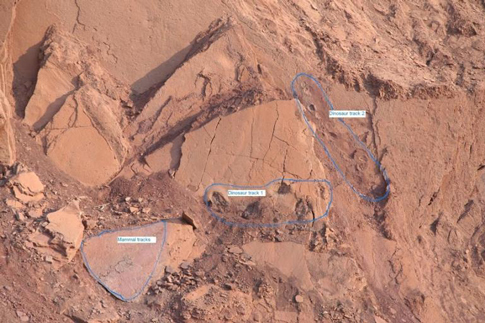
Mapping the fossil locations.

Mapping the fossil locations.

Picture credit: Paleo Angola Project

The picture above shows an aerial view of some of the trace fossils with their locations highlighted by the research team.  Dinosaur tracks are highlighted in the centre and on the right of the photograph, whilst the mammalian tracks can be seen highlighted towards the bottom left portion of the picture.

Angolan Fossil Exploration

To read an article from Everything Dinosaur about Angolan fossil exploration: Angola Starts to Share its Fossil Secrets.

In a report to the Society of Vertebrate Palaeontology, researchers from the Paleo Angola Project described a location in the silt and sand deposits that represents a lacustrine (lake) environment dating from approximately 118 million years ago (Aptian faunal stage).  Approximately, seventy distinct footprints have been identifed so far.  These trace fossils represent footprints made by sauropod dinosaurs, crocodiles and a relatively large prehistoric mammal.  The mammal print is particularly intriguing.

Most mammals during this part of the Cretaceous were very small, no bigger than rats, but the five-toed print measuring more than three centimetres across indicates that a mammal the size of a Bedlington Terrior dog or a North American Raccoon.  The scientists stated that the tracks were probably made over a substantial period of time, as the lake dried out over several seasons.

A Close Up and Line Drawing of a Single Mammalian Print

Five digits can be clearly seen.

Five digits can be clearly seen.

Picture credit: Paleo Angola Project

Studying the Mammalian Track

The mammalian track suggests that in at least this part of Africa, mammals were much larger than previously thought.  The mammal track has been described as “a very rare find.”

Working out what kind of mammal left the rare footprints may not be possible, after all, no body fossils have been found.

Commenting on the discovery, Marco Marzola, one of the palaeontologists with the Paleo Angola Project explained:

“We cannot narrow down to a species but we can say what they [the footprints] do belong to.  They were made by an exceptionally large mammal, that we can say for sure.”

Cretaceous Trace Fossils

In the same location, eighteen sauropod tracks have been discovered, the Paleo Angola Project team have already named and described one giant, long-necked dinosaur that once roamed Angola.  The fossils of this dinosaur were found in marine sediments.  It is likely that the corpse floated out to sea and there is evidence preserved on the fossilised bones of feeding from sharks, that were scavenging the carcase.

To read about the discovery of Angola’s first dinosaur: Angolatitan – Dinosaur that Ended Up as Fish Food.

Praising the action of the consortium which owns the diamond mine (Catoca mine, the fourth largest diamond mine in the world), the scientists said that the mine owners stopped all activity at the mine to allow the researchers to map and plot the trace fossils.  The mine owners put the promotion of vertebrate palaeontology in Angola ahead of their own desire to make money.
8 11, 2014

Ankylosaurs with Air Conditioning as New Research is Published

By |2024-05-04T18:33:45+01:00November 8th, 2014|Categories: Dinosaur and Prehistoric Animal News Stories, Dinosaur Fans, Main Page|0 Comments

Complicated Nasal Passages Helped Keep Ankylosaurs Cool

Animals have a number of ways of controlling their body temperatures and cooling down.  Some warm-blooded animals like kangaroos and antelopes seek shade during the heat of the day.  Elephants cover themselves with mud or take a cooling dip.  Dogs pant and humans sweat, but how did the heavily armoured dinosaurs keep cool?  These “living tanks” with their huge, armoured bodies could have been in danger of overheating as they wandered around in the Mesozoic.

Ankylosaurs with Air Conditioning

A new paper suggests that their complicated nasal passages not only would have helped these animals with their sense of smell, but they would have acted as very efficient heat transfers.

Ankylosaurids with Built in Air Conditioning

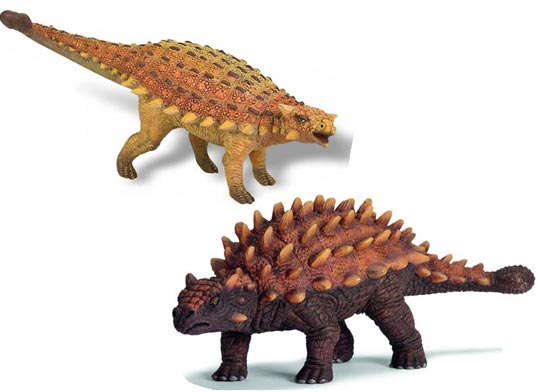
Armoured dinosaur models.

Armoured dinosaur models.

Picture credit: Everything Dinosaur

A team of scientists based at Ohio University used CAT scans of ankylosaurid cranial material to map the anatomy of the complex nasal passages in two different North American ankylosaur species.  The team then modelled the air flow in three dimensions using a computer programme that interpreted the CAT scan data.  Palaeontologist Jason Bourke, one of the authors of the scientific paper stated that the complex nasal passages would have given the inhaled air more time to warm up to body temperature by drawing heat way from blood vessels in the nasal cavity.  This would have helped cool the blood and in turn this would have cooled vital organs such as the brain.

Brain Size in Ankylosaurids

The brain of even the largest ankylosaurids was extremely small when compared to their body size.  The dinosaur experts at Everything Dinosaur regularly compare the brain of a large ankylosaur such as Euoplocephalus tutus to the size of a child’s fist.  The nasal passages would have helped to keep the brain in its heavily armoured skull cool and stable.

Mammals and birds use scroll-shaped bones called conchae, otherwise known as turbinates to warm air that is breathed in, but the armoured dinosaurs seem to have achieved the same result with a completely different anatomical configuration.

Transferring Heat Whilst Breathing

Commenting on the study, Jason Bourke stated:

“There are two ways that animal noses transfer heat while breathing.  One is to pack a bunch of conchae into the air field, like most mammals and birds do, it is spatially efficient.  The other option is to what lizards and crocodiles do and simply make the nasal airway much longer.  Ankylosaurs seem to have taken this second approach to the extreme.”

Doctor Lawrence Witmer (Ohio University), who was also involved in this research explained:

“Our team discovered these “crazy-straw” airways several years ago, but only recently have we been able to scientifically test hypotheses on how they functioned.  By simulating airflow through these noses, we found that these stretched airways were effective heat exchangers.  They would have allowed these multi-tonne beasts to keep their multi-ounce brains from overheating.”

Complext Nasal Passages

Ohio University researchers had previously studied the complex nasal passages of another group of ornithischian dinosaurs – the pachycephalosaurs.

To read this earlier article: Nosing Around Pachycephalosaurs.

Just like noses in humans, (Homo sapiens) ankylosaurid noses are likely to have served more than one function.  As the complex nasal passages helped condition the air that was breathed in and out, water may have been removed from exhaled breath helping these dinosaurs to retain water, important when you live in arid environments.  In addition, the convoluted passageways may have added resonance to the low-pitched sounds this dinosaur made.  The nose could have amplified these sounds acting as a resonator, making the noises made by ankylosaurs  heard over greater distances.

A Model of an Ankylosaurus

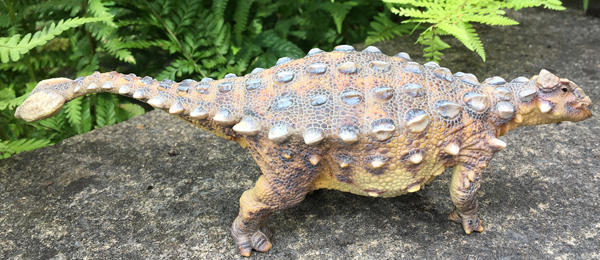
PNSO Ankylosaurus "Sede".

“Sede” the Ankylosaurus dinosaur model.  A PNSO “Age of Dinosaurs” replica.

Picture credit: Everything Dinosaur

The model (above) is “Sede” the Ankylosaurus from PNSO. To view the range of PNSO prehistoric animal models and figures in stock: PNSO Age of Dinosaurs.

5 11, 2014

Egg Shape Could Explain Survival of Birds into the Cenozoic

By |2023-03-17T17:07:07+00:00November 5th, 2014|Categories: Dinosaur and Prehistoric Animal News Stories, Dinosaur Fans, Main Page|0 Comments

New Study Suggests Egg Shape Might Hint at Clues to Survival

Eggs come in many different shapes and sizes.  There are large ones, small ones, those that are more rounded, others that can be more ovoid in shape and so on.  However, a new study, conducted by evolutionary biologists at Lincoln University (UK), suggests that egg shape could have been a factor in why some birds survived the Cretaceous extinction event, whilst other types of bird and the Dinosauria did not.

New Research

The research published in the on line journal of the Royal Society, looks at the geometry of eggshells and highlights morphological differences between the eggs of birds and those of their extinct, but very close relatives, the theropod dinosaurs.

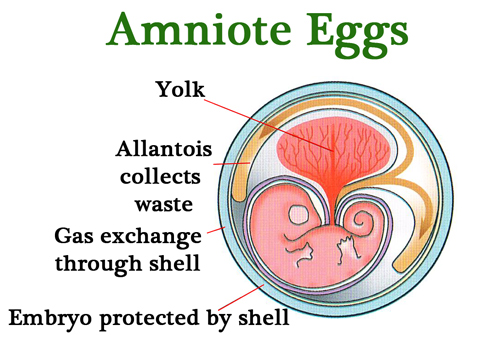
Birds, Reptiles and Mammals are linked as all these types of creature are descended from Carboniferous tetrapods that evolved an ability to reproduce from an egg that was contained within a semi-permeable eggshell.  These early terrestrial animals were no longer dependent on the presence of water in order to breed and reproduce successfully.  These types of eggs are called amniotic eggs.

A Diagram Showing the Structure of an Amniotic Egg

The growing embryo is protected by a semi-permeable egg shell.

The growing embryo is protected by a semi-permeable egg shell.

Picture credit: Everything Dinosaur

Amniote Eggs

Safe from drying out, the embryo inside the egg is further protected by a robust, internal membrane called the amnion.  It is the evolution of the amniote egg that permitted tetrapods to conquer all terrestrial environments.

In this new study, the research team noted that there were notable differences between the eggs of birds that survived the Cretaceous mass extinction event that took place around sixty-five million years ago, and the shape of the eggs of those creatures that become extinct.  Although, the fossil record is far from complete when it comes to preserving evidence of eggs and reproductive strategies, the results suggest that early birds from the Mesozoic laid eggs that had different shapes to those of modern birds.

It is possible that egg morphology indicates different physiologies or different rates of embryonic development and this may have implications when it comes to surviving a mass extinction event, such as that which led to demise of around 70% of all terrestrial life, including all the non-avian dinosaurs.

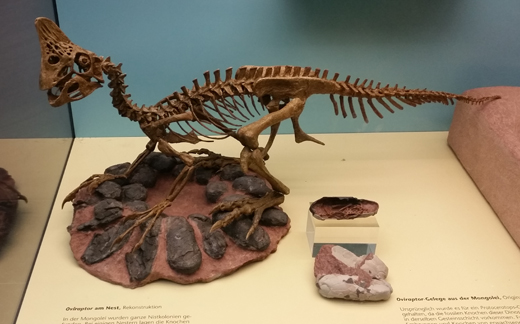
Could Theropod Egg Shape Have Doomed the Dinosauria?

An Oivraptor fossil with nest.

An Oviraptor (theropod) dinosaur sitting on her nest.

Picture credit: Everything Dinosaur

Egg Shape

One of the authors of this new paper, Dr Charles Deeming (School of Life Sciences, Lincoln University) explained:

“These results indicate that egg shape can be used to distinguish between different types of egg-laying vertebrates.  More importantly they suggest Mesozoic bird eggs differ significantly from modern day bird eggs, but more recently extinct Cenozoic birds do not.  This suggests that the range of egg shapes in modern birds had already been attained in the Cenozoic.”

Comparing Extinct and Extant Egg Shapes

As extant amniotic eggs vary considerably in size and shape and this variety reflects different patterns of egg formation and development, then the variation seen in the fossil record of eggs may also reflect different patterns of egg formation, egg development and even nesting behaviour.

Dr Deeming commented:

“From a biological perspective, it is self-evident that different egg shapes by birds, both past and present, might be associated with different nesting behaviours or incubation methods.  However, hardly any research has been carried out on this topic and fossil data are insufficient to draw firm conclusions.  We hope that future discoveries of associated fossil eggs and skeletons will help refine the general conclusions of this work.”

Other Factors to Consider

Although there might be a link between eggshell shape and the ability to survive the Cretaceous mass extinction, it is likely that a lot of other factors contributed to the survival of one group of vertebrates whilst others died out.  The eggshell shape itself may be a part of the story, but palaeontologists are confident that dinosaurs, including many theropod dinosaurs engaged in complex nesting behaviours, brooded eggs on nests and invested a great deal of time and effort in raising the next generation.

A spokesperson from Everything Dinosaur stated:

“Although the fossil record for eggs and nesting sites is extremely fragmentary, there is evidence to suggest that members of the Dinosauria exhibited altricial and precocial behaviours.  How one group of birds, the Neornithines were able to dominate the Aves remains uncertain, more research in this area is needed.  However, this data adds a fresh perspective and it is certainly intriguing.” 

Dr Deeming advised that this new paper does not provide all the answers, but it hints at the tantalising possibility that eggshell morphology could have been an contributory factor in the extinction of the dinosaurs.  Dr Deeming and this paper’s co-author Dr Marcello Ruta (Lincoln University), are continuing their investigations.  The scientists intend to explore how highly variable amounts of yolk (food for the embryo) and albumen (egg white) could possibly effect egg shape.

For models and replicas of prehistoric animals including dinosaurs: Dinosaur Models and Prehistoric Animal Figures.

4 11, 2014

Mary Anning at the Natural History Museum

By |2023-03-17T16:46:47+00:00November 4th, 2014|Categories: Dinosaur and Prehistoric Animal News Stories, Photos, Photos/Pictures of Fossils|0 Comments

Being Associated with the Wrong Marine Reptile

As team members from Everything Dinosaur travel around they sometimes get the chance to visit a natural history museum whilst out on their adventures.  There are many splendid museums in this country and elsewhere in the world and it is great fun looking at the various fossils held within the collections.  Occasionally, we come across an exhibit that has inaccurate or out of date information, mistakes do occur and we are always appreciative of the time and trouble curators take over their particular charges.

The Natural History Museum

One such anomaly can be seen in the fossil marine reptiles gallery in the Natural History Museum London.  There are some spectacular marine reptile fossils on display, ichthyosaurs, pliosaurs and their close cousins the plesiosaurs.  The fossil specimens (most of them are casts), are truly astonishing and this museum (quite rightly in our opinion), does much to acknowledge the contribution of Mary Anning to the nascent science of palaeontology and her work excavating and describing fossils of ancient Jurassic marine vertebrates preserved in the cliffs on the Dorset coast around Lyme Regis.

Mary Anning

Information about Mary Anning and her work can be found on various information boards on display.  However, one thing that has always puzzled us is that there is a prominent information board about Mary located on the Rhomaleosaurus cramptoni cast, Mary Anning had nothing to do with this specimen, its discovery or research into it.  In fact, she died about a year before this specimen was found.

Wonderful Marine Reptile Exhibits – but Nothing to Do with Mary Anning

Mary Anning died before this fossil was discovered.

Mary Anning died before this fossil was discovered.

Picture credit: Everything Dinosaur/Rebor

The specimen in the photograph is not a fossil but a cast, a copy of the fossil which was made very probably in the late 19th century by the American Henry Augustus Ward, who set up one of the world’s first fossil dealers and provider of museum replicas and casts.

Rhomaleosaurus cramptoni

The animal that the cast represents is called Rhomaleosaurus cramptoni.  It is pronounced Row-ma-lee-oh-sore-us.  It is mounted on the wall of the fossil marine reptiles gallery in the Natural History Museum, but we are aware of similar casts of the same fossil specimen in Monash University (Victoria, Australia), Cornell University, (New York USA), University of Illinois,  and the Bath Royal Literary and Scientific Institution (Bath, Somerset).

The actual fossil is part of the National Museum of Ireland (Natural History), Dublin, Ireland, we don’t think it is on current display.  The code for the specimen is NMING F8785 (all significant fossils are given a unique identifier, this helps when searching for information on a particular specimen).

A Model of the Fearsome Rhomaleosaurus cramptoni

A super model of a marine reptile.

A super model of a marine reptile. The CollectA Deluxe Rhomaleosaurus model.

Picture credit: Everything Dinosaur

Rhomaleosaurus means “strong lizard” an appropriate name for this fearsome predator that grew to more than six metres in length and might have weighed as much as 1,000 kilogrammes.

To view the range of CollectA Deluxe prehistoric animal figures in stock at Everything Dinosaur: CollectA Deluxe Prehistoric Life.

3 11, 2014

Tracing the Origins of the Ichthyosaurs

By |2023-03-17T16:43:51+00:00November 3rd, 2014|Categories: Dinosaur and Prehistoric Animal News Stories, Dinosaur Fans, Main Page|0 Comments

Short Snouted Basal Ichthyosauriform from the Lower Triassic of China

It had long been predicted, but until now one of the enduring mysteries of the marine reptiles had remained unsolved.  One of the most successful clades of marine vertebrates ever to have existed were the ichthyosaurs , reptiles that form the Order Ichthyosauria (fish lizards), also known as the Ichthyopterygia (fish flippers).  These animals thrived in the seas and oceans for much of the Mesozoic but unlike other types of back-boned animals that had adapted to a life in water, no fossils of transitional forms showing a link with terrestrial ancestors had been found.

Ichthyosaur Origins

However, this week a team of researchers led by scientists from the University of California have published a paper detailing the discovery of an amphibious ichthyosaur, an animal that, although adapted to a life in the sea was still capable of clambering about on land.  This specimen is believed to represent a transitional form, between the Ichthyosauria and their terrestrial ancestors.

Writing in the science Journal “Nature”, the researchers document a nearly complete specimen (just the end of the tail is missing), of a forty-centimetre-long, amphibious reptile that is probably part of a group of animals that were the ancestors of the nektonic ichthyosaurs, widely regarded by many palaeontologists as the most well-adapted to a marine existence of all the reptiles.

The Fossil Specimen that Indicates a Transitional Form

Cartorhynchus

Picture credit: University of California – Davis/Professor Motani

Commenting on the research, lead author Professor Ryosuke Motani (University of California, Department of Earth and Planetary Sciences) stated:

 “But now we have this fossil showing transition.  There’s nothing that prevents it from coming onto land.”

From Anhui Province

Professor Motani and his colleagues uncovered the fossil specimen in eastern China (Anhui Province) from Lower Triassic strata believed to date from around 248 million years ago (Olenikian faunal stage).  Unlike the long-snouted fully marine ichthyosaurs this animal, which has been named Cartorhynchus lenticarpus, had a short snout, its bones were also heavier, traits associated with fully terrestrial ancestors.

Cartorhynchus lenticarpus

Unlike later ichthyosaurs, the flippers were large in proportion to the body size and the wrists flexible.  These features helped this creature crawl around on land, in a similar way to extant seals.  C. lenticarpus means “truncated snout with flexible wrists”, an apt name for this little reptile that spent part of its life on land.  During the early part of the Triassic, eastern China was covered by a shallow tropical sea, there were numerous small islands, the whole area resembled the Caribbean today.  The isolated islands with their limited resources probably acted as a spur for vertebrate evolution.  There was plenty of food in the sea but it was a question of being able to reach it, this probably led to the evolution of reptiles that were more at home in water than their ancient ancestors.

The researchers also had to consider the implications of the Permian mass extinction event on the evolutionary pressures that these animals were under.  Just four million years earlier, planet Earth had undergone the most devastating extinction event known in the history of our planet.  More than 95% of all life on Earth died out.

A spokesperson from Everything Dinosaur explained:

“Extinction events mean the inevitable demise of many genera and families.  However, for those organisms able to survive, such events open up a whole range of new opportunities and often there is a “burst” of evolution as animals and plants adapt to take advantage of vacated niches and new resources.”

Scientific Collaboration

Collaborating with the University of California were scientists from the Chinese Academy of Sciences, Peking University, Anhui Geological Museum, the University of Milan, and the Field Museum (Chicago).  As a basal Ichthyosauriform has been discovered in China, and the most primitive true ichthyosaurs are also known from Triassic rocks from this region, then it is likely that the Ichthyosauria evolved in this part of the world.  This clade then radiated out and occupied a number of ecological niches including apex predatory positions before dying out in the Late Cretaceous.

Later ichthyosaurs were agile, swimmers, although the end of the tail is missing, scientists speculate that Cartorhynchus lenticarpus was probably a relatively poor swimmer.  It probably hunted soft bodied animals and arthropods in coastal waters.

For replicas and figures of ichthyosaurs and other marine reptiles: CollectA Age of Dinosaurs Popular Figures.

29 10, 2014

Determining the Extinction Date of Megalodon

By |2023-03-17T15:04:40+00:00October 29th, 2014|Categories: Dinosaur and Prehistoric Animal News Stories, Main Page|0 Comments

C. megalodon Extinct by 2.6 million Years Ago

The giant prehistoric shark known as Megalodon (C. megalodon) has certainly attracted a lot of scientific attention in recent years.  This predatory shark, believed to be the largest, carnivorous shark to have ever existed, might have reached lengths in excess of sixteen metres.  Bodyweight estimates vary, but a number of scientists have calculated weights around the twenty tonnes mark.  With a mouth that could gape nearly 3 metres wide, this fish would have been capable of swallowing an extant Great White shark (C. carcharias) whole!

Megalodon Still Exists?

Some fishermen, such as those who fish the waters off South Africa have claimed that Megalodon still exists, but a team of researchers from the University of Zurich and Florida University have used a statistical technique to provide the best estimate yet of the extinction of this apex marine predator.

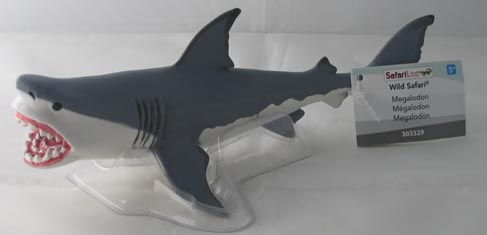
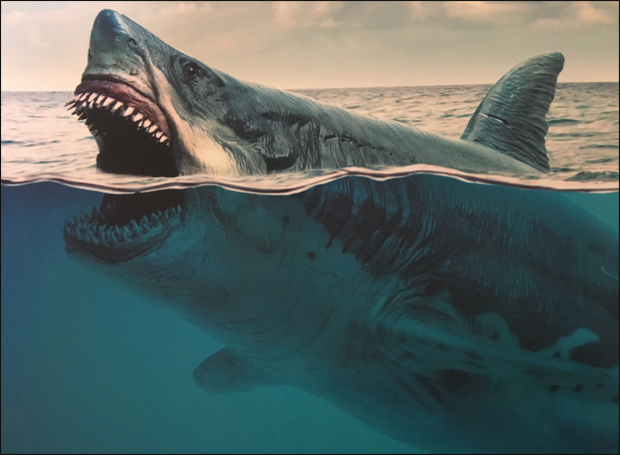
Safari Ltd Introduced a Model of the Giant Shark Known as Megalodon this Year

Fearsome marine predator.

Fearsome marine predator.

Picture credit: Everything Dinosaur

To view the range of Safari Ltd prehistoric animal models: Safari Ltd. Prehistoric World Figures.

Megalodon Extinction

Writing in the on line journal PLOS One (Public Library of Science), the researchers Catalina Pimiento (Department of Biology, University of Florida) and Christopher Clements, (Institute of Evolutionary Biology and Environmental Studies, Zurich University), used a statistical analysis to calculate the approximate time of the extinction of these predators.

By developing a better understanding of the time of the extinction, the research team are able to map the consequences of the extinction of an apex predator on the marine ecosystem.  Using a mathematical technique called Optimal Linear Estimation (OLE) the scientists have calculated that around 2.6 million years ago C. megalodon became extinct.  This is the first time the extinction of C. megalodon has been quantitatively assessed.

A total of fifty-three fossils of this ancient shark were used in this study, but this number was reduced to forty-two for the statistical assessment, as eleven of the fossil specimens gave the researchers less confidence over their actual age.

Optimal Linear Estimation

Optimal Linear Estimation is used for mapping the extinction of modern species, but with the abundant and widespread fossil record of Megalodon, mainly the large number of fossilised teeth associated with this species, the team were able to apply this mathematical method to calculate the time when the very last of these magnificent creatures lived.

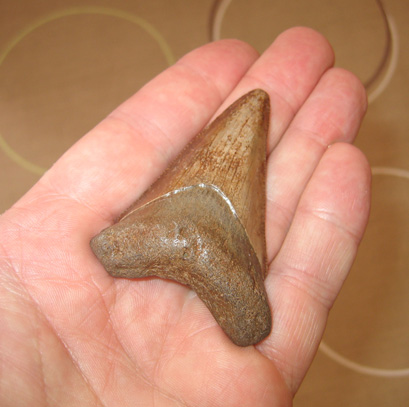
Fossilised Tooth from C. megalodon

A large fossil tooth from a Carcharodon megalodon.

A large fossil tooth from a Carcharodon megalodon. Picture credit: Everything Dinosaur.

 Picture credit: Everything Dinosaur

Although the team admit that their calculations are subject to margins of error, this work represents a refinement on previous estimates of the extinction of this shark species.  Why this apex predator became extinct remains a mystery

Megalodon Fossil Material from the Miocene

Most Megalodon fossil material dates from around 16 to 11.6 million years ago (Miocene Epoch) with some further fossils known from the Pleistocene Epoch, although a lot of the fossil material associated with Pleistocene deposits were not included in this particular study.  With a more accurate extinction date established, the researchers can then assess the impact of the removal of a large predator from the marine environment on other genera including cetaceans.

The date of 2.6 million years ago marks the border between the Pliocene and Pleistocene Epochs, it was after this point that the baleen whales began to increase in size and to evolve into the many giant forms alive today.

Did Whales Flourish When Megalodon Became Extinct?

As marine mammals are thought to have made up a substantial part of the bus-sized shark’s diet, although there is no conclusive evidence to suggest Megalodon fed on large whales, if Megalodon died out, did this trigger the flourishing of the baleen whales?

Commenting on the research, Catalina Pimiento stated:

“When we calculated the time of Megalodon’s extinction, we noticed that the modern function and gigantic sizes of filter feeder whales became established around that time.  Future research will investigate if Megalodon’s extinction played a part in the evolution of these new classes of whales.”

Megalodon is a prime candidate for this sort of statistical analysis, due to the relative abundance and widespread distribution of its fossilised teeth.  It is hoped that this technique can be applied to other extinct species to plot more accurately the impact of a single species extinction on the wider ecosystem.

The PNSO Megalodon Model

Brilliant artwork on the PNSO Megalodon model cover sleeve.

The amazing, colourful sleeve artwork on the PNSO Megalodon figure.

Note

Following a taxonomic revision this prehistoric shark is now known as Otodus megalodon.

28 10, 2014

Zaraapelta nomadis In Praise of Victoria Arbour

By |2023-03-17T14:57:31+00:00October 28th, 2014|Categories: Dinosaur and Prehistoric Animal News Stories, Dinosaur Fans, Main Page|0 Comments

 New Species of Ankylosaurid Named – Zaraapelta nomadis

There are lots of female scientists all helping to make a significant contribution within their chosen specialist fields.  In palaeontology, many of the world’s top researchers are female, the gender imbalance in the sciences is slowly being altered as more and more women take up the opportunities offered by a career in academia.  When it comes to the Dinosauria, we at Everything Dinosaur, have remarked on numerous occasions how the ankylosaurids and research into these heavily armoured ornithischians seems to be overshadowed by studies focused on the ceratopsian and the hadrosaurs.  So it is doubly pleasing to write about the naming of a new species of ankylosaur, one that has been named by Victoria Arbour (University of Alberta).

Victoria Arbour and Ankylosaurids

Victoria’s research into Late Cretaceous ankylosaurids has been featured in a number of our blog articles over the years, she has established herself as the “go to person”, when it comes to studies into this particular branch of the armoured dinosaur family tree.

The new species has been named Zaraapelta nomadis.  It is known from a nearly complete skull (missing the snout), from the Baruungoyot Formation of Mongolia.  The fossil specimen was discovered in 2000 A.D. during an expedition to the Gobi Desert which was led by Professor Phil Currie (University of Alberta).  The genus name is a combination of the Mongolian and the Greek for “hedgehog shield”, whilst the species name honours, the Mongolian company Nomadic Expeditions which has played a pivotal role in helping scientists to explore the Gobi Desert for dinosaur fossils.

Zaraapelta nomadis

Thanks to the work of post-doctoral researchers like Victoria, scientists are beginning to work out that there were a number of different types of ankylosaurid present in the region that was to form the Nemegt and Baruungoyot rock formations.  Similar research has revealed a number of different ankylosaur genera present in North America (Dinosaur Park Formation).  It seems likely that there was almost as much diversity in the ankylosaurids as there was in the ceratopsians and hadrosaurs.

Zaraapelta was certainly a very prickly customer, the new species has been erected as the skull shows some unique morphology.  For example,  behind the eye sockets and over the rear of the skull there is extensive ornamentation, lots of bumps and lumps of bone, to us, this dinosaur reminds us of a giant thorny devil lizard (Moloch horridus).  At the back of its skull there were distinctive horns with a prominent ridge along the top, the holotype specimen is being kept at the Mongolian Palaeontological Centre, located at Ulaanbaatar.

A Spectacular Skull

The skull of Zaraapelta is even more spectacular than the other Mongolian armoured dinosaurs, the likes of Saichania (S. chulsanensis) and Tarchia (T. kielanae).  In a paper published in the “Zoological Journal of the Linnean Society”, the research team, that included Professor Phil Currie and Demchig Badamgarav (Mongolian Academy of Sciences), provide a phylogenetic analysis of ankylosaurids from the Gobi desert.  The scientists concluded that Z. nomadis was probably most closely related to Tarchia kielanae.

An Illustration of Zaarapelta nomadis

Dinosaur with a very spiky head.

Dinosaur with a very spiky head.

Picture credit: University of Alberta/Danielle Dufault

Elaborate and Distinctive Ornamentation

Doctor Arbour explained that the elaborate and distinctive ornamentation on the skulls of these ankylosaurs may have evolved as a way to show off in order to attract a mate.  Head crests and extensive skull ornamentation in the ceratopsian and hadrosaurs are associated with display as well as for defence (in the case of the horned dinosaurs), but this idea is not generally applied to ankylosaurids.

Victoria stated:

“You can think of bone being an expensive item for your body to maintain.  Bone requires lots of nutrients and metabolic energy to create and so that investment needs to pay off in some way.  Maybe ankylosaurs had this bumpy ornamentation for protection, but another good explanation is that the horns and bumps on their skulls showed that they were a good mate to choose, in the same way that Peacocks use their tail feathers.”

The Holotype Fossil Material of Zaraapelta nomadis

Left lateral view (top) and dorsal view (bottom).  Scale bars = 10cm

Left lateral view (top) and dorsal view (bottom). Scale bars = 10cm.

Picture credit: University of Alberta

Examining Previously Named Mongolian Ankylosaurs

In addition to naming the new ankylosaur Zaraapelta, this study also re-examined previously named ankylosaurs from Mongolia and found support for “resurrecting” a species that had been discarded by earlier workers.  The science of naming organisms, called taxonomy, is more fluid than many people might realise, Arbour notes.  Sometimes, researchers might determine that two species names represent only one actual species, in which case the name that was created first has priority (senior synonym).

This was the case for an ankylosaur called Tarchia kielanae, which was eventually thought to be the same kind of ankylosaur as Tarchia gigantea.  But new information from recent dinosaur discoveries, including this study, suggests that Tarchia kielanae might be a separate species after all, so the name has been brought back into scientific literature.

Just as the phylogenetic analysis of ankylosaurids has changed, so it is all change for Dr Arbour, next month she is taking up a new position as a post-doctoral researcher at the North Carolina Museum of Natural Sciences.

We wish her well in her new role and we look forward to writing about her future research.

For models and replicas of ankylosaurids and other dinosaurs, visit Everything Dinosaur’s award-winning website: Everything Dinosaur.

27 10, 2014

Rare Plesiosaur Vertebrae from Lyme Regis

By |2024-05-04T18:05:32+01:00October 27th, 2014|Categories: Dinosaur and Prehistoric Animal News Stories, Dinosaur Fans, Main Page|0 Comments

Plesiosaur Vertebrae United!

Having been on the Cumbrian coast last week as the last vestiges of hurricane Gonzalo battered the UK, our thoughts turned to elsewhere in the UK where strong winds and high tides might also be damaging the coastline.  One area we considered to be under particular threat was the Jurassic coast of Dorset.  The cliffs around Lyme Regis are very unstable and adverse weather conditions could lead to further rock falls and mud slides.

Plesiosaur Vertebrae

Ironically, our chum Brandon Lennon sent us some amazing pictures over the weekend of plesiosaur dorsal vertebrae that had been found in the Lyme Regis area.  Not only is this fossil specimen very beautiful, but it seems behind every string of articulated vertebrae there is an interesting story…

Whilst visiting Lyme Regis for the Fossil Festival (May 2014), enthusiastic fossil hunter Chris East decided to try his luck and explore the beach west of Lyme Regis (Monmouth).  He found a Birchi nodule with signs of a fossilised bone encased within it.  Birchi nodules are rounded, calcareous concretions that can be found deposited in a thin layer above the shales with beef strata.  They are often associated with fossils, particularly ammonites such as Microderoceras birchi.  Finding evidence of a bone, he thought it best if this specimen was professionally prepared and cleaned.  A very sensible idea, as once the rock had been cleaned and carefully prepared the nodule was seen to contain a row of beautifully preserved and articulated plesiosaur vertebrae.

Plesiosaurs

Plesiosaurs were a diverse group of marine reptiles that thrived during the Jurassic and Cretaceous.  There were two main types, the long-necked forms (plesiosaurs) and the closely related, short-necked forms commonly referred to as pliosaurs.

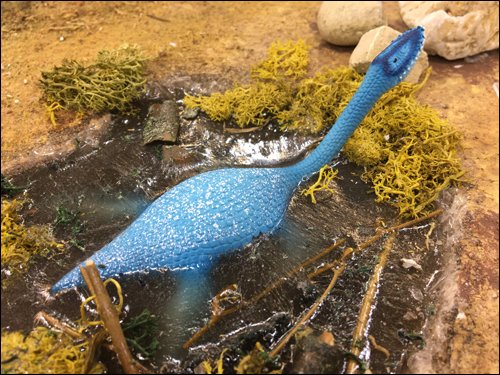
An Illustration of a Typical Jurassic Plesiosaur (Schleich Plesiosaurus Model)

Schleich Plesiosaurus model.

The Schleich Plesiosaurus model on display. Picture credit: Everything Dinosaur.

The picture (above) shows a plesiosaur replica.  To view models and replicas of plesiosaurs and other prehistoric animal figures: Schleich Dinosaurs and Other Prehistoric Animals.

Fossils of plesiosaurs from Lyme Regis are much rarer than ichthyosaurs, discovering this set of articulated vertebrae is an exceptionally rare find indeed.  Whilst in Lyme Regis earlier this month, Chris took the opportunity to show the vertebrae fossils to local fossil expert Brandon Lennon.  To Chris’s great surprise Brandon, on hearing where the Birchi nodule had been found, was able to add to his specimen.

From the Same Specimen

Fossil expert Brandon, who regularly takes guided fossil walks onto Monmouth beach, had identified some plesiosaur bones whilst exploring a recent mudslip on Monmouth beach.  Brandon was able to confirm that the isolated bones did come from the same individual plesiosaur as the bones found by Chris East some months before.

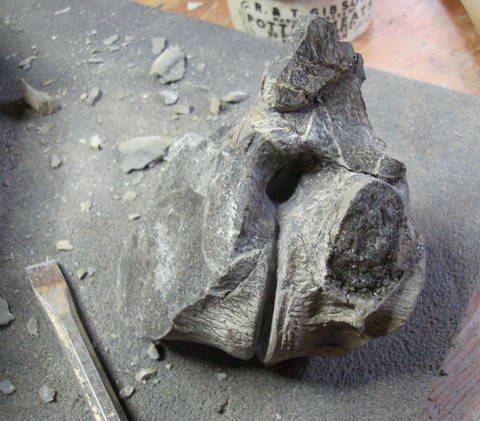
The Plesiosaur Vertebrae Found by Brandon Lennon

Fossil specimen found by Brandon Lennon.

Fossil specimen found by Brandon Lennon.

Picture Credit: Brandon Lennon

Thanks to one local man’s expertise, the plesiosaur fossil material was re-united.

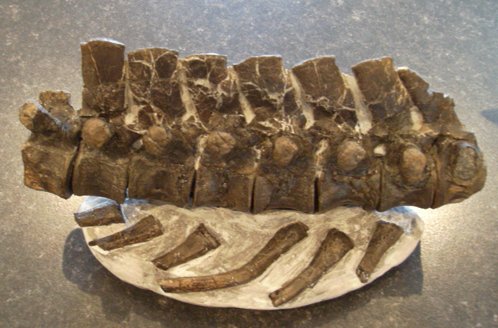
The row of Articulated Plesiosaur Vertebrae

A row of 8 Plesiosaur vertebrae with associated ribs fragments.

A row of 8 Plesiosaur vertebrae with associated ribs fragments.

Picture credit: Brandon Lennon

Finding Treasures

The beaches around the Dorset town of Lyme Regis can still yield such treasures. Storms over the winter months are likely to expose yet more fossil finds, however, we would urge caution as the frequent rock falls and mudslips from the unstable cliffs coupled with dangerous tides make this part of the coast no place for the inexperienced fossil hunter.  Our best advice is to go on a guided fossil walk with a local expert.  A fossil expert, such as Brandon Lennon, can show visitors the best (and safest) places to find fossils, you never know, you might just find a vertebra or two from a marine reptile.

For information on guided fossil walks: Lyme Regis Fossil Walks.

23 10, 2014

Deinocheirus – Done and Dusted (For Now At Least)

By |2023-03-17T11:51:26+00:00October 23rd, 2014|Categories: Dinosaur and Prehistoric Animal News Stories, Dinosaur Fans, Main Page|2 Comments

Solving the Mystery of “Peculiar Terrible Hand”

Back in November 2013, team members at Everything Dinosaur wrote about of the most intriguing reports to come out of the annual Society of Vertebrate Palaeontology meeting that had just come to an end in Los Angeles.  As the dust settled and the researchers made their way home, here was a chance to reflect on the remarkable work done to help finally resolve a fifty year mystery.  What type of dinosaur was Deinocheirus?

Huge fossilised forelimbs and shoulder bones, discovered by a joint Polish/Mongolian expedition to the Gobi desert in 1965 had fascinated scientists for nearly half a century.  The arms were massive, measuring some 2.6 metres in length (including shoulder blades) and each hand ended in three-fingers, each finger tipped with an enormous, curved claw which in one case was over twenty centimetres long.

Deinocheirus Dinosaur

Based on these huge arms and a few other scraps of fossil bone, most palaeontologists agreed that the fossils represented a giant form of ornithomimid, a member of the “Bird  Mimic” group of theropod dinosaurs.  Although the arms were much bigger, they did resemble the arms and hands of agile, fast running ornithomimids such as Struthiomimus and Dromiceiomimus.  A formal announcement was made about the discovery in 1966, and Deinocheirus “Terrible Hand” was described based on this holotype material in 1970.

This was the cue for every dinosaur book publisher to include a picture of the fossil material in virtually every dinosaur book produced in the seventies and eighties, although very few attempts to illustrate the dinosaur were actually made if we recall correctly.

The Holotype Fossils of Deinocheirus (Deinocheirus mirificus)

Fearsome arms of Deinocheirus

Fearsome arms of Deinocheirus.

Professor Zofia Kielan-Jaworowska

The woman in the photograph is Professor Zofia Kielan-Jaworowska, the scientist who led the 1965 expedition.  Although the limbs have been repositioned and remounted since this picture was taken, it does provide a very good impression of the scale of those fossilised limbs.

Writing in the journal “Nature” the scientists behind the paper presented at the conference last year have revealed more about the “enigma” that is the ornithomimosaur Deinocheirus mirificus.  Turns out that this bizarre theropod is even more amazing than previously imagined.  In the journal, the scientists describe two new specimens of Deinocheirus that were discovered in the same formation (Nemegt Formation) as the original holotype material.

More Complete Fossil Remains

These much more complete fossil remains have enabled the researchers which include Phil Currie (University of Alberta), Yuong-Nam Lee and Hang-Jae Lee (Geological Museum, Korea Institute of Geoscience and Mineral Resources) as well as Pascal Godefroit (Royal Belgian Institute of Natural Sciences), to build up a comprehensive picture of what this dinosaur looked like, where it lived and what it ate.

A New Interpretation of Deinocheirus (D. mirificus)

A bizarre looking Theropod after all.

A bizarre looking theropod after all.

Picture credit: Yuong-Nam Lee/Korea Institute of Geoscience and Mineral Resources

It is certainly the largest member of the Ornithomimosauria known to science, with an estimated length of around 11 metres, several tonnes in weight and standing about as tall as a modern-day Giraffe, but it was no vicious super predator.  Studies of the feet and hind legs indicate that this animal was probably a slow walker, one with a huge pot belly to boot.  A pot belly?  This dinosaur had an expanded pelvis with strong muscle attachments.  It probably had a large gut to help it digest the tough plant material that it ate.

Edentulous Jaws

The skull measures over a metre in length, but there were no teeth in the deep jaws.  Indeed, over a 1,000 gastroliths have been found in association with the fossils, along with fish remains in the body cavity indicating that this animal was probably a mega-omnivore, eating plants, but also insects, small animals and fish.

Deinocheirus lived next to a large river.  Seventy million years ago, this part of Mongolia resembled the Upper Nile.  The broad, wide toes with their blunt claws were ideally suited to assist this animal when walking over soft mud. It probably wandered into the river to feed on soft water plants, to catch the occasional fish and to avoid the attentions of the tyrannosaur Tarbosaurus.  However, evidence that Tarbosaurus fed on Deinocheirus has been preserved on some of the bones.

Scavenged by Tarbosaurus?

Whether or not the bite marks and feeding gouges that have been identified indicate that Tarbosaurus predated on these large bipeds, or whether these marks were made as a result of scavenging a carcase remains unclear.  However, the deep, “U-shaped” wishbone of this dinosaur and those big shoulder bones suggest that this ponderous giant could inflict some serious damage should any unwary tyrannosaurid venture too close to those huge arms.

This dinosaur had a number of unique skeletal features, it had a pygostyle (fused vertebrae on the end of the tail), like a bird and a much thicker tail than its smaller ornithomimid relatives.  Perhaps one of the most intriguing features are the large number of tall neural spines.  The dorsal and sacral vertebrae have flat, blade-like extensions (neural spines).  To us, these spatulate spines resemble the bones seen in the humps of Bison.

A Sail-like Structure or Perhaps a Large Hump

Deinocheirus could have had a sail-like structure on its back, or maybe even a large hump.  It has been suggested that the hump, originally reported upon in 2013, could have been exaggerated. These neural spines could have supported a network of ossified tendons to help support this dinosaur’s huge gut and heavy tail.

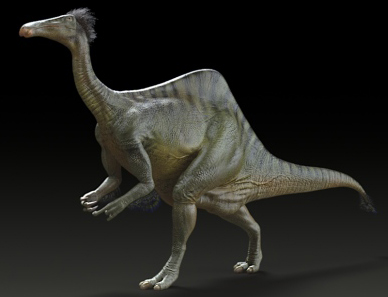
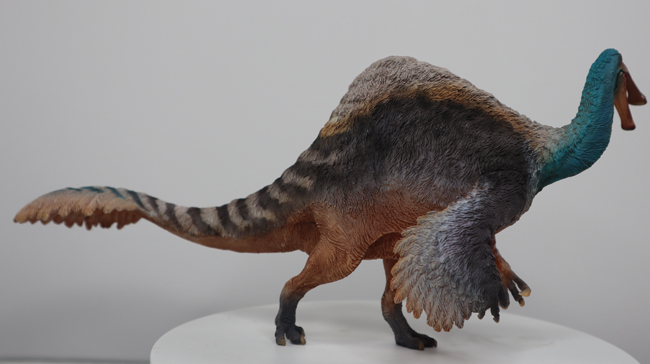
An Illustration of Deinocheirus (D. mirificus)

PNSO Deinocheirus model.

The PNSO Jacques the Deinocheirus dinosaur model has an articulated jaw. Picture credit: Everything Dinosaur.

Picture credit: Everything Dinosaur

To view the PNSO range of dinosaur models: PNSO Dinosaur Models.

Deinocheirus Models

The model making company CollectA introduced a 1:40 scale replica of the mysterious Deinocheirus back in 2012.  At the time, we commended them for bringing out a model of this dinosaur when so very little of the total skeleton had been studied and described.  With the information regarding the hump, we at Everything Dinosaur amended our scale drawing to give an impression of a small hump over the pelvis, but the latest illustrations really emphasis the hump or sail on this animal’s back.

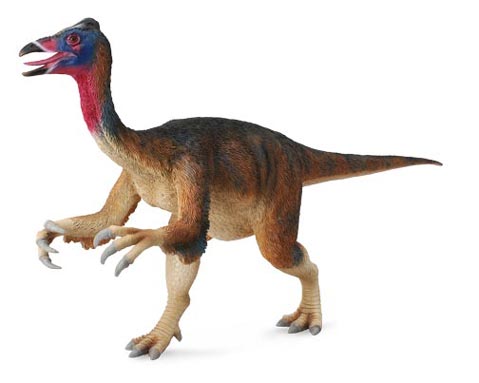
Ironically, CollectA gave their Deinocheirus model feathers, no evidence of feathers on the original holotype material or indeed on the more recently discovered fossils have been found, but it is thought that a number of ornithomimids were indeed, feathered.

An Illustration of the CollectA Deinocheirus Model (2012)

Scientists speculate that Deinocheirus was covered in simple feathers.

Scientists speculate that Deinocheirus was covered in simple feathers.

As lead author of the scientific paper, Yuong-Nam Lee states the researchers were just as surprised as anyone when they put the complete dinosaur together based on the three main specimens that had been found to date.

Yuong-Nam Lee went on to add:

“The discovery of the original specimen almost half a century ago suggested that this was an unusual dinosaur, but did not prepare us for how distinctive Deinocheirus is.  A true cautionary tale in predicting forms from partial skeletons.”

To view Everything Dinosaur’s origin article on this research, published in November 2013: A Helping Hand for Deinocheirus.

To view the range of CollectA scale models available including the 1:40 replica of Deinocheirus: CollectA Deluxe Prehistoric Life Replicas.

20 10, 2014

Those Plucky and Remarkable Placoderms

By |2024-05-04T18:30:07+01:00October 20th, 2014|Categories: Dinosaur and Prehistoric Animal News Stories, Main Page, Palaeontological articles|0 Comments

Armoured Fish Made a Significant Contribution to Vertebrate Evolution

The placoderms were a hugely diverse and very successful group of fishes, whilst they lasted. For in terms of this groups’ persistence, in geological terms they make a relative short appearance in the history of life on Earth.  As a group the placoderms were around for approximately sixty-five million years, not a bad innings but nothing like the longevity of other types of fish such as the sharks, rays and certain actinistians, the Coelacanth for example.  The placoderms, or to be more correct, the Class Placodermi first evolved in the Late Silurian and they disappear from the fossil record at the end of the Devonian Period.

Placoderms

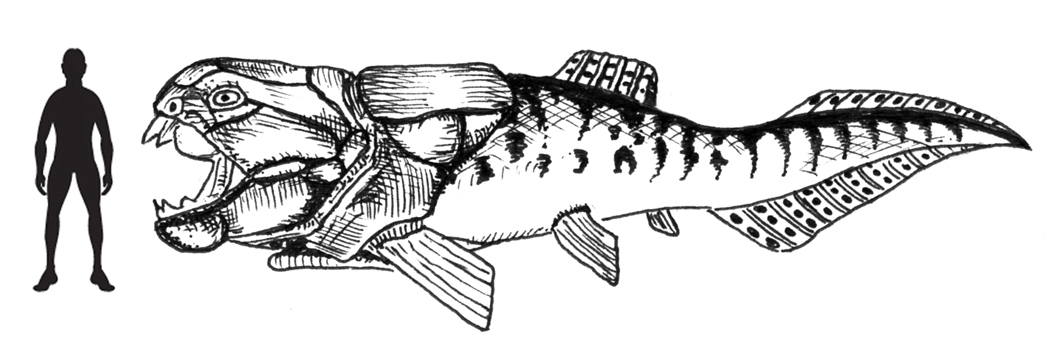
Perhaps the most famous placoderm is the giant predator Dunkleosteus.  Several species are known and with some specimens estimated to have reached lengths of around ten metres or more, at the time, (Dunkleosteus lived towards the end of the Devonian something like 370 – 360 million years ago), this fish would have been one of the largest vertebrates ever to have evolved.

Dunkleosteus – An Illustration

Fearsome marine predator of the Late Devonian.

Fearsome marine predator of the Late Devonian.

Picture credit: Everything Dinosaur

Dunkleosteus

Dunkleosteus may have looked like a typical placoderm with its head and thorax covered in articulated armour plate, but the Placodermi, it turns out are being seen as one of the most important group of vertebrates to have existed  It is not just because they evolved into the likes of Dunkleosteus, regarded by many as the world’s first, vertebrate, super-predator, but this group of armoured fishes seems to have achieved a number of “firsts” in terms of the Chordata (animals with a spine or spine-like structure in their bodies).

PNSO have added a replica of a Dunkleosteus to the mid-size model series. To view this range: PNSO Prehistoric Animal Figures.

Firstly, palaeontologists have found a number of fossils that suggest that early members of the Placodermi were amongst the first types of vertebrate to evolve a jaw.  Recently, Everything Dinosaur wrote a short article about a remarkable fossil discovery form China which reveals some remarkable features: A Jaw Dropping Discovery.

In addition, although the majority of placoderms seemed to have been poor swimmers, with most of them living close to the bottom, a number of families were active and nektonic, indeed these types of fish were the first to evolve paired pelvic fins, a fishy equivalent of legs, although not connected with the spine.  Paired pelvic fins are an anatomical feature found in most types of extant fish today.

Plucky Placoderms

Those plucky placoderms may have been amongst the first types of animal to develop teeth.  Recently a team of scientists from Australia and Bristol University studying fossilised remains of placoderms from Western Australia found evidence of the first types of teeth, teeth with a structure very similar to our own.  To read more about this: The Origins of a Toothy Grin.

Fossils from the same rocks (Go Go Formation) western Australia gave palaeontologists a remarkable insight into the reproductive strategies of many types of ancient fish.  One species of placoderm, known from just a single fossil specimen represents the oldest example of a vertebrate capable of giving birth to live young (viviparity). Materpiscis attenboroughi was a small, bottom of the reef dwelling fish whose fossilised remains preserved in a limestone nodule showed evidence of an embryo and an umbilical cord.  This was evidence of internal fertilisation within the fossil record and the oldest known case of viviparity.

Materpiscis attenboroughi – A Remarkable Placoderm

Materpiscus means "Mother Fish".

Materpiscus means “Mother Fish”.

Picture credit: Museum Victoria

The remarkable Placodermi may have just added another evolutionary “first” to their string of impressive attributes.   A scientific paper published in the journal “Nature” provides details on a fossil discovery that hints at the very first example of copulation amongst vertebrates.  The international team of researchers that led the study into the antiarch (an-tee-arc) placoderm called Microbrachius dicki state that this was the earliest animal known from the fossil record to stop reproducing by spawning (external fertilisation).

Materpiscus attenboroughi

Professor John Long (Flinders University, South Australia), was the lead author of the academic paper.  The Professor, a renowned expert on Devonian fishes had earlier worked on Materpiscus attenboroughi.  The fossils of M. dicki are relatively common.  This small freshwater placoderm grew to about ten centimetres in length and lived around 385 million years ago.

Professor Long Explains the Key Points of the Research

Studying Placoderms and other Devonian fish.

Studying placoderms and other Devonian fish.

Picture credit: Flinders University

Commenting on the research, Professor Long stated:

“We have defined the very point in evolution where the origin of internal fertilisation in all animals began.  That is a really big step.”

A Peculiar “L-shaped” Appendage

A close inspection of a fossil revealed that one of the Microbrachius specimens had a peculiar “L-shaped” appendage.  Further study revealed that this was the male fish’s genitalia.

The Professor pointed out:

“The male had large bony claspers, These are the grooves that they used to transfer sperm into the female”.

On the other hand, the females had a small bony structure at the rear that helped to lock the male organ in place during mating.  Constrained by the anatomy, the fish probably had to mate side by side, a sort of “square dance position” as described by the researchers.

An Illustration Showing the Proposed Mating Position of M. dicki

Mating "square dance" style.

Mating “square dance” style.

Picture credit: Flinders University/Nature

However, copulation using this method does not seem to have stayed around for very long in these Devonian fish.  As fish evolved, they reverted back to external fertilisation (spawning), whereby male and females release sperm and eggs respectively into the water and fertilisation relies more on chance.  It took several more millions of years before the ancestors of today’s sharks and rays evolved copulation.

The Placodermi may be most famous for the likes of Dunkleosteus, but scientists are beginning to realise that these strange, armoured fish may have contributed much more to the evolution of the vertebrates than just the first, back-boned  super-predator!

Go to Top